US5070733A - Photoacoustic imaging method - Google Patents
Photoacoustic imaging methodDownload PDFInfo
- Publication number
- US5070733A US5070733AUS07/409,313US40931389AUS5070733AUS 5070733 AUS5070733 AUS 5070733AUS 40931389 AUS40931389 AUS 40931389AUS 5070733 AUS5070733 AUS 5070733A
- Authority
- US
- United States
- Prior art keywords
- photoacoustic
- frequency
- light
- signal
- thermal diffusion
- Prior art date
- Legal status (The legal status is an assumption and is not a legal conclusion. Google has not performed a legal analysis and makes no representation as to the accuracy of the status listed.)
- Expired - Fee Related
Links
- 238000003384imaging methodMethods0.000titleclaimsabstractdescription14
- 238000009792diffusion processMethods0.000claimsdescription24
- 238000000034methodMethods0.000claimsdescription7
- 238000005286illuminationMethods0.000claimsdescription5
- 230000007547defectEffects0.000description26
- 238000010895photoacoustic effectMethods0.000description6
- RYGMFSIKBFXOCR-UHFFFAOYSA-NCopperChemical compound[Cu]RYGMFSIKBFXOCR-UHFFFAOYSA-N0.000description5
- 229910052802copperInorganic materials0.000description5
- 239000010949copperSubstances0.000description5
- 238000010586diagramMethods0.000description5
- 230000001419dependent effectEffects0.000description2
- 238000002474experimental methodMethods0.000description2
- 230000003287optical effectEffects0.000description2
- 230000000704physical effectEffects0.000description2
- 235000010724Wisteria floribundaNutrition0.000description1
- 239000000919ceramicSubstances0.000description1
- 238000006243chemical reactionMethods0.000description1
- 238000010276constructionMethods0.000description1
- 238000007796conventional methodMethods0.000description1
- 230000007423decreaseEffects0.000description1
- 230000003247decreasing effectEffects0.000description1
- 230000000694effectsEffects0.000description1
- 238000007689inspectionMethods0.000description1
- 230000035945sensitivityEffects0.000description1
- 230000001360synchronised effectEffects0.000description1
Images


Classifications
- G—PHYSICS
- G01—MEASURING; TESTING
- G01N—INVESTIGATING OR ANALYSING MATERIALS BY DETERMINING THEIR CHEMICAL OR PHYSICAL PROPERTIES
- G01N29/00—Investigating or analysing materials by the use of ultrasonic, sonic or infrasonic waves; Visualisation of the interior of objects by transmitting ultrasonic or sonic waves through the object
- G01N29/34—Generating the ultrasonic, sonic or infrasonic waves, e.g. electronic circuits specially adapted therefor
- G01N29/346—Generating the ultrasonic, sonic or infrasonic waves, e.g. electronic circuits specially adapted therefor with amplitude characteristics, e.g. modulated signal
- G—PHYSICS
- G01—MEASURING; TESTING
- G01N—INVESTIGATING OR ANALYSING MATERIALS BY DETERMINING THEIR CHEMICAL OR PHYSICAL PROPERTIES
- G01N29/00—Investigating or analysing materials by the use of ultrasonic, sonic or infrasonic waves; Visualisation of the interior of objects by transmitting ultrasonic or sonic waves through the object
- G01N29/04—Analysing solids
- G01N29/06—Visualisation of the interior, e.g. acoustic microscopy
- G01N29/0609—Display arrangements, e.g. colour displays
- G—PHYSICS
- G01—MEASURING; TESTING
- G01N—INVESTIGATING OR ANALYSING MATERIALS BY DETERMINING THEIR CHEMICAL OR PHYSICAL PROPERTIES
- G01N29/00—Investigating or analysing materials by the use of ultrasonic, sonic or infrasonic waves; Visualisation of the interior of objects by transmitting ultrasonic or sonic waves through the object
- G01N29/22—Details, e.g. general constructional or apparatus details
- G01N29/221—Arrangements for directing or focusing the acoustical waves
- G—PHYSICS
- G01—MEASURING; TESTING
- G01N—INVESTIGATING OR ANALYSING MATERIALS BY DETERMINING THEIR CHEMICAL OR PHYSICAL PROPERTIES
- G01N29/00—Investigating or analysing materials by the use of ultrasonic, sonic or infrasonic waves; Visualisation of the interior of objects by transmitting ultrasonic or sonic waves through the object
- G01N29/22—Details, e.g. general constructional or apparatus details
- G01N29/24—Probes
- G01N29/2418—Probes using optoacoustic interaction with the material, e.g. laser radiation, photoacoustics
- G—PHYSICS
- G01—MEASURING; TESTING
- G01N—INVESTIGATING OR ANALYSING MATERIALS BY DETERMINING THEIR CHEMICAL OR PHYSICAL PROPERTIES
- G01N29/00—Investigating or analysing materials by the use of ultrasonic, sonic or infrasonic waves; Visualisation of the interior of objects by transmitting ultrasonic or sonic waves through the object
- G01N29/44—Processing the detected response signal, e.g. electronic circuits specially adapted therefor
- G01N29/46—Processing the detected response signal, e.g. electronic circuits specially adapted therefor by spectral analysis, e.g. Fourier analysis or wavelet analysis
- G—PHYSICS
- G01—MEASURING; TESTING
- G01N—INVESTIGATING OR ANALYSING MATERIALS BY DETERMINING THEIR CHEMICAL OR PHYSICAL PROPERTIES
- G01N2291/00—Indexing codes associated with group G01N29/00
- G01N2291/01—Indexing codes associated with the measuring variable
- G01N2291/012—Phase angle
- G—PHYSICS
- G01—MEASURING; TESTING
- G01N—INVESTIGATING OR ANALYSING MATERIALS BY DETERMINING THEIR CHEMICAL OR PHYSICAL PROPERTIES
- G01N2291/00—Indexing codes associated with group G01N29/00
- G01N2291/01—Indexing codes associated with the measuring variable
- G01N2291/015—Attenuation, scattering
- G—PHYSICS
- G01—MEASURING; TESTING
- G01N—INVESTIGATING OR ANALYSING MATERIALS BY DETERMINING THEIR CHEMICAL OR PHYSICAL PROPERTIES
- G01N2291/00—Indexing codes associated with group G01N29/00
- G01N2291/02—Indexing codes associated with the analysed material
- G01N2291/028—Material parameters
- G01N2291/02854—Length, thickness
- G—PHYSICS
- G01—MEASURING; TESTING
- G01N—INVESTIGATING OR ANALYSING MATERIALS BY DETERMINING THEIR CHEMICAL OR PHYSICAL PROPERTIES
- G01N2291/00—Indexing codes associated with group G01N29/00
- G01N2291/10—Number of transducers
- G01N2291/104—Number of transducers two or more emitters, one receiver
Definitions
- This inventionrelates to a photoacoustic imaging method for nondestructively obtaining planar images of an object cut at any desired depth beneath its surface.
- a photoacoustic signal obtained by extracting this sound as a signalvaries with respect to physical properties of the object including its absorptance of light, the speed of conduction of heat through the object and various other properties, so by using this photoacoustic effect, the interior of the object can be observed in a nondestructive manner.
- a photoacoustic signalis generated from a wide region 3b which includes areas located both near the surface and deep under the surface, so the defect area 4 can be observed even if it is present deep within the object.
- photoacoustic signals from areas which need not be observedbecome noise which is incorporated into the detected photoacoustic signal, greatly affecting it so that a clear image of the defect area 4 only cannot be obtained.
- an appropriate modulation frequencymust be selected depending on the type of object to be observed.
- the object of this inventionis to supply a photoacoustic imaging method through which one is able to nondestructively obtain clear planar images at any desired depth from the surface of an object.
- the photoacoustic imaging method of the present inventioncomprises the steps of using modulated light of two different modulation frequencies to illuminate said object to be observed and obtaining an image based on any ratio of intensities or phase differences between two photoacoustic signals detected by said acoustic sensor.
- FIGS. 1(a) and 1(b)are diagrams used to explain the photoacoustic effect.
- FIG. 2is a block diagram illustrating a photoacoustic imaging device as a preferred embodiment of the method of this invention.
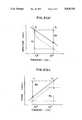
- FIG. 3(a)is a graph of the intensity (amplitude) signal as a function of frequency.
- FIG. 3(b)is a graph of the phase signal as a function of frequency.
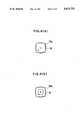
- FIGS. 4(a) and 4(b)are diagrams used to explain samples used in experiments on this invention.
- FIG. 5(a)is a graph of the intensity (amplitude) signal as a function of frequency when the samples of FIGS. 4(a) and 4(b) are illuminated with modulated light.
- FIG. 5(b)is a graph of the phase signal as a function of frequency when the samples of FIGS. 4(a) and 4(b) are illuminated with modulated light.
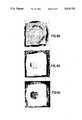
- FIG. 6(a)is a photograph of an image based on a phase signal obtained when the sample of FIG. 4(b) is illuminated with modulated light of a frequency of 109 Hz.
- FIG. 6(b)is a photograph of an image based on a phase signal obtained when the same sample is illuminated with modulated light of a frequency of 2 KHz.
- FIG. 6(c)is a photograph of an image obtained when the method of this invention is applied to the same sample.
- FIG. 2is a block diagram illustrating a photoacoustic imaging device as a preferred embodiment of the method of this invention.
- Number 11 in the diagramis a He-Ne laser used as the light source.
- Arranged in line with the forward axis of the laser 11are a modulator 12, optical system 13, and a two-axis beam scanner 14 in this order.
- the modulator 12is provided with a facility allowing it to be set to any desired modulation frequency and the modulation frequency can be changed as needed.
- An object to be observed 15is arranged facing the two-axis beam scanner 14, and an acoustic sensor 16 is arranged on the rear surface of the object 15.
- an acoustic sensor 16is arranged on the rear surface of the object 15.
- the weak photoacoustic signal detected by this acoustic sensor 16is amplified by a preamplifier 17.
- a lock-in amplifier 18synchronizes the amplified signal with a signal sent from the modulator 12 and the synchronized signal is processed by a data processing unit 19 and converted to an image on a screen 20.
- the He-Ne laser 11emits a laser beam l 1 toward modulator 12.
- the light sourceis not limited to being a laser; rather a light source which generates white light, for example, can also be used.
- the laser beam l 1 entering modulator 12is modulated and exits as modulated light l 2 of a specified frequency depending on the depth of the region of the object to be observed.
- the thermal diffusion length ⁇ (m) and the light frequency fare related as follows, ##EQU1## so if certain physical properties of the sample object are known, the frequency which generates the desired thermal diffusion length can be calculated from the above equation, where ⁇ is the thermal conductivity of the object, ⁇ is the density of the object and c is the specific heat of the object. For example, if an image of a plane approximately 500 ⁇ m beneath the surface of a sample is to be obtained, the laser beam l 1 entering modulator 12 is first modulated so that it exits as modulated light l 2 of a frequency such that the thermal diffusion length becomes 600 ⁇ m.
- This modulated light l 2is focused by an optical system 13 of lenses or the like into a beam of parallel light of a desired diameter and sent to a beam scanner 14. Reducing the diameter of the beam of modulated light gives a higher resolution but also increases the amount of time required for scanning which is the next step, so the diameter should be appropriately selected by taking resolution and scanning time into consideration.
- the beam scanner 14illuminates the specified region on the object to be observed 15 with a series of consecutive scans of the beam of modulated light focused to the specified diameter l 3 .
- sound obtained by means of the photoacoustic effect, or more specifically, sound generated by thermal strain which accompanies the conversion to heat of light intermittently absorbed by the objectis sequentially detected by an acoustic sensor 16 arranged behind the object to be observed 15.
- the frequency of the modulatoris set so that the thermal diffusion length becomes 600 ⁇ m, so the photoacoustic signal thus detected contains information for the region from the surface down to 600 ⁇ m below the surface.
- the photoacoustic signal detected by the acoustic sensor 16is amplified by the preamplifier 17 and sent to the lock-in amplifier 18.
- the lock-in amplifier 18uses a frequency-modulated signal sent from the modulator 12 as a reference signal to remove the frequency-modulated component of the input photoacoustic signal and analyzes the remaining signal into its amplitude and phase components, which are sent to the data processing unit 19 as intensity (amplitude) and phase signals, and stored sequentially.
- the modulator 12is then manipulated to change the frequency of the modulated light to a frequency which will give a thermal diffusion length of, for example, 400 ⁇ m, and then this light is used to illuminate the specified region on the object to be observed 15 by scanning with the two-axis beam scanner 14 as described above.
- the photoacoustic signal generated in the object from a region which depends on the thermal diffusion length and detected by this acoustic sensor 16is amplified by a preamplifier 17.
- a lock-in amplifier 18synchronizes the amplified signal with a modulated signal sent from the modulator 12 and sends an intensity signal and a phase signal to the data processing unit 19.
- These intensity and phase signalscontain information for the region from the surface of the object down to 400 ⁇ m below the surface.
- the data processing unit 19calculates the difference between the previously stored intensity or phase signal containing information for the region from the object surface down to 600 ⁇ m with the newly obtained intensity or phase signal containing information for the region from the surface down to 400 ⁇ m.
- An imageis created by finding the ratio of intensities when intensity signals are used, or by finding phase differences when phase signals are used. This results in an image of a region containing the desired depth of 500 ⁇ m between 400 ⁇ m and 600 ⁇ m below the surface of the object being displayed on the screen 20.
- the solid line in FIG. 3(a)represents amplitude as a function of frequency at a defect-free location within the object.
- the dotted line in the figurerepresents amplitude as a function of frequency at a location which contains a defect. (The scale of the graph is logarithmic.) If the ratio of intensity of two intensity (amplitude) signals of frequencies f 1 and f 2 is always A 6 , this means that no defects are present in the region between the thermal diffusion lengths of the two signals.
- the data processing unit 19will sequentially find the ratio of intensity between two intensity signals of different frequencies at the same point in the region to be observed; if no defects are present this value will be A B , and if defects are present this value will be a value other than A B , namely A D , so if a defect is present in the plane of a desired depth, it will be clearly displayed in the image.
- the solid line in FIG. 3(b)represents phase as a function of frequency at a location within the object which is free from defects.
- the dotted line in the figurerepresents phase as a function of frequency at a location which contains a defect.
- the difference between two phase signals of frequencies f 1 and f 2is ⁇ B if there are no defects present at the desired depth in the location being observed, but if a defect is present this difference will become ⁇ D .
- information from a plane at a desired depthmay be obtained from either a ratio of intensities or phase difference between two signals of different frequencies, so the decision of which to use when carrying out imaging should be made when needed by taking the imaging conditions into consideration.
- the present inventioncame about from the observation, as in the above, that changing the frequency of modulated light with which an object is illuminated will change the region (depth from the surface) from which a photoacoustic signal is generated, so by appropriately selecting two frequencies of modulated light with which the object is illuminated, photoacoustic signals from unwanted regions can be removed to nondestructively display an image of a region at any desired depth from the surface of the object.
- sample 15a shown in FIG. 4(a)which is a copper plate measuring 15 mm on one side and 1 mm thick
- sample 15bmade by using a press to imbed a copper plate of dimensions 8 ⁇ 7 ⁇ 0.5 mm into the center of a copper plate of the same dimensions as sample 15a.
- a piezoelectric AE sensor(Fuji Ceramic, Japan, AE705S) was arranged as an acoustic sensor 16 behind each of the two samples 15a and 15b.
- a 0.1 mm diameter beam from a 30 mW laserwas used to illuminate sample 15a at its center (the ⁇ symbol) and an area on its edge (the ⁇ symbol) and sample 15b at its center (the ⁇ symbol).
- the intensity signal and phase signal as a function of frequencywere observed by measuring the photoacoustic signal at these locations with the acoustic sensor 16 while the frequency of the beam was varied between 10 and 10 4 Hz.
- the thermal diffusivity of the sample copper plate at 20° C.is 117 mm 2 /sec.
- FIGS. 5(a) and 5(b)illustrate the intensity signal as a function of frequency obtained in the experiment, and the phase signal as a function of frequency, respectively.
- the amplitudevaried almost linearly with frequency in the range from 100 Hz to 3 KHz, and it was found that selecting any two frequencies and finding their ratio of intensities gives a constant value over this frequency range. Furthermore, upon calculating the phase difference, this difference was found to be constant.
- FIG. 6(a)is a photograph of an image obtained by processing the phase signal of a photoacoustic signal obtained by using modulated light of a frequency of 2 kHz (arrow F 1 on FIG. 5(b) to illuminate and scan the sample of FIG. 4(b). Since the frequency is high, the thermal diffusion length does not reach the defect so the defect section does not appear in the image.
- FIG. 6(b)is a photograph of an image obtained by processing the phase signal of a photoacoustic signal obtained by using modulated light of a frequency of 109 Hz (arrow F 2 on FIG. 5(b) to illuminate and scan the same sample. Since the frequency is low, the thermal diffusion length does reach the defect so the defect section is barely visible in the image.
- FIG. 6(c)is a photograph of an image based on the phase difference obtained by processing the above two phase signals.
- the defect section of the small imbedded copper plateis distinctly visible.
- the thermal diffusion length of the modulated light of 2 kHz frequency through the sampleis approximately 200 ⁇ m, while the thermal diffusion length of the 109 Hz light is approximately 600 ⁇ m.
- the photoacoustic effectwhen used to image the interior of an object, in contrast to the conventional method of obtaining an image from only modulated light of a single modulation frequency, in this invention, by using modulated light which is modulated to have two different frequencies, the effect of noise on the images obtained can be reduced and the plane to be observed can be moved from the object surface in the depth direction so that images can be obtained at any desired depth.
Landscapes
- Physics & Mathematics (AREA)
- General Physics & Mathematics (AREA)
- Immunology (AREA)
- Life Sciences & Earth Sciences (AREA)
- Chemical & Material Sciences (AREA)
- Analytical Chemistry (AREA)
- Biochemistry (AREA)
- General Health & Medical Sciences (AREA)
- Pathology (AREA)
- Health & Medical Sciences (AREA)
- Engineering & Computer Science (AREA)
- Signal Processing (AREA)
- Acoustics & Sound (AREA)
- Optics & Photonics (AREA)
- Mathematical Physics (AREA)
- Spectroscopy & Molecular Physics (AREA)
- Investigating Or Analyzing Materials By The Use Of Ultrasonic Waves (AREA)
- Investigating Or Analysing Materials By Optical Means (AREA)
- Measurement Of Velocity Or Position Using Acoustic Or Ultrasonic Waves (AREA)
Abstract
Description
1. Field of the Invention
This invention relates to a photoacoustic imaging method for nondestructively obtaining planar images of an object cut at any desired depth beneath its surface.
2. Prior Art Statement
When an object is illuminated with modulated light, the light absorbed by the object is intermittently converted to heat, thus generating sound caused by the accompanying thermal strain.
A photoacoustic signal obtained by extracting this sound as a signal varies with respect to physical properties of the object including its absorptance of light, the speed of conduction of heat through the object and various other properties, so by using this photoacoustic effect, the interior of the object can be observed in a nondestructive manner.
Microscopes which exploit the photoacoustic effect in this manner, e.g. U.S. Pat. No. 4,255,971, have been disclosed, and are being employed in the nondestructive inspection of the interior of products which cannot be seen with visible light.
The resolution of these photoacoustic microscopes in the direction of the two-dimensional surface illuminated by modulated light is dependent on the spot diameter of the incident light. Resolution in the depth direction of the illuminated surface is dependent on the thermal diffusion length, or the distance over which heat travels through the object during one cycle of the modulated light. Therefore, increasing the modulation frequency decreases the thermal diffusion length, so as shown in FIG. 1(a), a photoacoustic signal is generated from aregion 3a near the surface of anobject 2 illuminated by modulated light 1, and thus this region can be observed, but adefect area 4 located deeper within the object and outside of the signal-generating region cannot be observed. On the other hand, if the modulation frequency is decreased, the thermal diffusion length increases so as shown in FIG. 1(b), a photoacoustic signal is generated from awide region 3b which includes areas located both near the surface and deep under the surface, so thedefect area 4 can be observed even if it is present deep within the object. However in this case, photoacoustic signals from areas which need not be observed (shallow areas near the surface of the object) become noise which is incorporated into the detected photoacoustic signal, greatly affecting it so that a clear image of thedefect area 4 only cannot be obtained.
Therefore, in the present situation, an appropriate modulation frequency must be selected depending on the type of object to be observed.
The object of this invention is to supply a photoacoustic imaging method through which one is able to nondestructively obtain clear planar images at any desired depth from the surface of an object.
In order to solve the above problem, when an object to be observed is illuminated with modulated light and a photoacoustic signal generated by thermal strain of said object is sensed by an acoustic sensor, amplified and converted to an image, the photoacoustic imaging method of the present invention comprises the steps of using modulated light of two different modulation frequencies to illuminate said object to be observed and obtaining an image based on any ratio of intensities or phase differences between two photoacoustic signals detected by said acoustic sensor.
As described above, different frequencies of modulated light with which the object is illuminated will give different thermal diffusion lengths within the object, so by finding the ratio of intensities or phase differences between the photoacoustic- signals from the two types of modulated light of different frequencies, an image of regions of differences between the two thermal diffusion lengths can be obtained. Thus by selecting two frequencies for the modulated light as needed, an image of a plane at the desired depth can be obtained without information from unwanted regions.
Other objects and other characteristics of the present invention will be made clear through the following detailed explanation with reference to the attached figures.
FIGS. 1(a) and 1(b) are diagrams used to explain the photoacoustic effect.
FIG. 2 is a block diagram illustrating a photoacoustic imaging device as a preferred embodiment of the method of this invention.
FIG. 3(a) is a graph of the intensity (amplitude) signal as a function of frequency.
FIG. 3(b) is a graph of the phase signal as a function of frequency.
FIGS. 4(a) and 4(b) are diagrams used to explain samples used in experiments on this invention.
FIG. 5(a) is a graph of the intensity (amplitude) signal as a function of frequency when the samples of FIGS. 4(a) and 4(b) are illuminated with modulated light.
FIG. 5(b) is a graph of the phase signal as a function of frequency when the samples of FIGS. 4(a) and 4(b) are illuminated with modulated light.
FIG. 6(a) is a photograph of an image based on a phase signal obtained when the sample of FIG. 4(b) is illuminated with modulated light of a frequency of 109 Hz.
FIG. 6(b) is a photograph of an image based on a phase signal obtained when the same sample is illuminated with modulated light of a frequency of 2 KHz.
FIG. 6(c) is a photograph of an image obtained when the method of this invention is applied to the same sample.
FIG. 2 is a block diagram illustrating a photoacoustic imaging device as a preferred embodiment of the method of this invention.Number 11 in the diagram is a He-Ne laser used as the light source. Arranged in line with the forward axis of thelaser 11 are amodulator 12,optical system 13, and a two-axis beam scanner 14 in this order. Themodulator 12 is provided with a facility allowing it to be set to any desired modulation frequency and the modulation frequency can be changed as needed.
An object to be observed 15 is arranged facing the two-axis beam scanner 14, and anacoustic sensor 16 is arranged on the rear surface of theobject 15. By illuminating the object to be observed 15 with modulated light, a photoacoustic signal generated by the photoacoustic effect can be detected.
The weak photoacoustic signal detected by thisacoustic sensor 16 is amplified by apreamplifier 17. A lock-inamplifier 18 synchronizes the amplified signal with a signal sent from themodulator 12 and the synchronized signal is processed by adata processing unit 19 and converted to an image on ascreen 20.
In a photoacoustic imaging device of the above construction, the He-Nelaser 11 emits a laser beam l1 towardmodulator 12. The light source is not limited to being a laser; rather a light source which generates white light, for example, can also be used. The laser beam l1 entering modulator 12 is modulated and exits as modulated light l2 of a specified frequency depending on the depth of the region of the object to be observed. In other words, the thermal diffusion length μ(m) and the light frequency f are related as follows, ##EQU1## so if certain physical properties of the sample object are known, the frequency which generates the desired thermal diffusion length can be calculated from the above equation, where κ is the thermal conductivity of the object, ρ is the density of the object and c is the specific heat of the object. For example, if an image of a plane approximately 500 μm beneath the surface of a sample is to be obtained, the laser beam l1 entering modulator 12 is first modulated so that it exits as modulated light l2 of a frequency such that the thermal diffusion length becomes 600 μm.
This modulated light l2 is focused by anoptical system 13 of lenses or the like into a beam of parallel light of a desired diameter and sent to abeam scanner 14. Reducing the diameter of the beam of modulated light gives a higher resolution but also increases the amount of time required for scanning which is the next step, so the diameter should be appropriately selected by taking resolution and scanning time into consideration.
Thebeam scanner 14 illuminates the specified region on the object to be observed 15 with a series of consecutive scans of the beam of modulated light focused to the specified diameter l3. When the object to be observed 15 is illuminated by scanning in this manner, sound obtained by means of the photoacoustic effect, or more specifically, sound generated by thermal strain which accompanies the conversion to heat of light intermittently absorbed by the object, is sequentially detected by anacoustic sensor 16 arranged behind the object to be observed 15.
The frequency of the modulator is set so that the thermal diffusion length becomes 600 μm, so the photoacoustic signal thus detected contains information for the region from the surface down to 600 μm below the surface.
The photoacoustic signal detected by theacoustic sensor 16 is amplified by thepreamplifier 17 and sent to the lock-inamplifier 18. The lock-inamplifier 18 uses a frequency-modulated signal sent from themodulator 12 as a reference signal to remove the frequency-modulated component of the input photoacoustic signal and analyzes the remaining signal into its amplitude and phase components, which are sent to thedata processing unit 19 as intensity (amplitude) and phase signals, and stored sequentially.
Once the scanning of the specified region of theobject 15 is complete and the intensity signal and phase signal are stored, themodulator 12 is then manipulated to change the frequency of the modulated light to a frequency which will give a thermal diffusion length of, for example, 400 μm, and then this light is used to illuminate the specified region on the object to be observed 15 by scanning with the two-axis beam scanner 14 as described above.
The photoacoustic signal generated in the object from a region which depends on the thermal diffusion length and detected by thisacoustic sensor 16 is amplified by apreamplifier 17. A lock-inamplifier 18 synchronizes the amplified signal with a modulated signal sent from themodulator 12 and sends an intensity signal and a phase signal to thedata processing unit 19. These intensity and phase signals contain information for the region from the surface of the object down to 400 μm below the surface.
Thedata processing unit 19 calculates the difference between the previously stored intensity or phase signal containing information for the region from the object surface down to 600 μm with the newly obtained intensity or phase signal containing information for the region from the surface down to 400 μm. An image is created by finding the ratio of intensities when intensity signals are used, or by finding phase differences when phase signals are used. This results in an image of a region containing the desired depth of 500 μm between 400 μm and 600 μm below the surface of the object being displayed on thescreen 20.
Here follows an explanation of the method of using thedata processing unit 19 to obtain an image based on the ratio of intensities between two signals of different frequencies. The solid line in FIG. 3(a) represents amplitude as a function of frequency at a defect-free location within the object. The dotted line in the figure represents amplitude as a function of frequency at a location which contains a defect. (The scale of the graph is logarithmic.) If the ratio of intensity of two intensity (amplitude) signals of frequencies f1 and f2 is always A6, this means that no defects are present in the region between the thermal diffusion lengths of the two signals. If however the intensity signal of frequency f2 is a low value which crosses the dotted line and the ratio of intensity becomes AD, this means that there is a defect present in the region between the thermal diffusion lengths of the two signals. Therefore, thedata processing unit 19 will sequentially find the ratio of intensity between two intensity signals of different frequencies at the same point in the region to be observed; if no defects are present this value will be AB, and if defects are present this value will be a value other than AB, namely AD, so if a defect is present in the plane of a desired depth, it will be clearly displayed in the image.
Here follows an explanation of the method of obtaining an image from phase differences between two signals of different frequencies. The solid line in FIG. 3(b) represents phase as a function of frequency at a location within the object which is free from defects. The dotted line in the figure represents phase as a function of frequency at a location which contains a defect. The difference between two phase signals of frequencies f1 and f2 is φB if there are no defects present at the desired depth in the location being observed, but if a defect is present this difference will become φD. Thus as described above, by finding the difference between two intensity signals of different frequencies at the same point in the region to be observed and converting it to an image, any defects which may be present in the plane of a desired depth will be clearly displayed in the image.
As described above, by this invention, information from a plane at a desired depth may be obtained from either a ratio of intensities or phase difference between two signals of different frequencies, so the decision of which to use when carrying out imaging should be made when needed by taking the imaging conditions into consideration.
The present invention came about from the observation, as in the above, that changing the frequency of modulated light with which an object is illuminated will change the region (depth from the surface) from which a photoacoustic signal is generated, so by appropriately selecting two frequencies of modulated light with which the object is illuminated, photoacoustic signals from unwanted regions can be removed to nondestructively display an image of a region at any desired depth from the surface of the object.
Two samples were prepared: sample 15a shown in FIG. 4(a), which is a copper plate measuring 15 mm on one side and 1 mm thick, andsample 15b made by using a press to imbed a copper plate of dimensions 8×7×0.5 mm into the center of a copper plate of the same dimensions assample 15a. A piezoelectric AE sensor (Fuji Ceramic, Japan, AE705S) was arranged as anacoustic sensor 16 behind each of the twosamples sample 15a at its center (the ∘ symbol) and an area on its edge (the □ symbol) andsample 15b at its center (the ○ symbol). The intensity signal and phase signal as a function of frequency were observed by measuring the photoacoustic signal at these locations with theacoustic sensor 16 while the frequency of the beam was varied between 10 and 104 Hz. The thermal diffusivity of the sample copper plate at 20° C. is 117 mm2 /sec.
FIGS. 5(a) and 5(b) illustrate the intensity signal as a function of frequency obtained in the experiment, and the phase signal as a function of frequency, respectively. In both cases of thesample 15a being illuminated in its center (the ∘ symbol) and at an area on its edge (the □ symbol), the amplitude varied almost linearly with frequency in the range from 100 Hz to 3 KHz, and it was found that selecting any two frequencies and finding their ratio of intensities gives a constant value over this frequency range. Furthermore, upon calculating the phase difference, this difference was found to be constant. Thus in the sample with no defect, when the frequency of the modulated light is changed, while the intensity and phase obtained in the center and in the periphery of the sample are slightly different due to differences in the sensitivity of the sensor in its center and periphery, they vary almost linearly with frequency, indicating that the data is independent of whether the position of illumination is in the center or the periphery.
When illuminating the center of defect-containingsample 15b of FIG. 4(b), the values represented by the ○ symbols in both FIGS. 5(a) and 5(b) do not parallel the values of the sample with no defect. This is particularly apparent in the phase graph in which the phase essentially ceases to change once the frequency becomes lower than 1 kHz. This is because the signal obtained by the sensor was found to be affected by the defect. Note that at high frequencies, the thermal diffusion length is so short as to be unaffected by the defect, so the values should be coincident with the ∘ symbols, but the generated photoacoustic signal travels through the defect section before it is received by thesensor 16 so the defect section becomes noise which prevents the values from coinciding with the o symbols.
FIG. 6(a) is a photograph of an image obtained by processing the phase signal of a photoacoustic signal obtained by using modulated light of a frequency of 2 kHz (arrow F1 on FIG. 5(b) to illuminate and scan the sample of FIG. 4(b). Since the frequency is high, the thermal diffusion length does not reach the defect so the defect section does not appear in the image. FIG. 6(b) is a photograph of an image obtained by processing the phase signal of a photoacoustic signal obtained by using modulated light of a frequency of 109 Hz (arrow F2 on FIG. 5(b) to illuminate and scan the same sample. Since the frequency is low, the thermal diffusion length does reach the defect so the defect section is barely visible in the image.
FIG. 6(c) is a photograph of an image based on the phase difference obtained by processing the above two phase signals. The defect section of the small imbedded copper plate is distinctly visible. The thermal diffusion length of the modulated light of 2 kHz frequency through the sample is approximately 200 μm, while the thermal diffusion length of the 109 Hz light is approximately 600 μm.
As is clear from the above description, according to this invention, when the photoacoustic effect is used to image the interior of an object, in contrast to the conventional method of obtaining an image from only modulated light of a single modulation frequency, in this invention, by using modulated light which is modulated to have two different frequencies, the effect of noise on the images obtained can be reduced and the plane to be observed can be moved from the object surface in the depth direction so that images can be obtained at any desired depth.
Claims (2)
1. A photoacoustic imaging method in which an object to be observed is illuminated with modulated light and then any sound generated by thermal strain of said object is detected by an acoustic sensor, amplified and converted to an image, said method comprising the steps of:
illuminating said object with first light modulated to a frequency which generates a first thermal diffusion length of said object;
detecting a sound generated by the illumination with said first light as a first photoacoustic signal by the use of a photoacoustic sensor;
illuminating said object with second light modulated to a frequency which generates a second thermal diffusion length of said object;
detecting a sound generated by the illumination with said second light as a second photoacoustic signal by the use of said photoacoustic sensor;
determining intensities of said first and second photoacoustic signals thus detected;
calculating a ratio between said intensities; and imaging a region at a specific depth between said first and second thermal diffusion lengths of said object on the basis of said ratio thus obtained.
2. A photoacoustic imaging method in which an object to be observed is illuminated with modulated light and then any sound generated by thermal strain of said object is detected by an acoustic sensor, amplified and converted to an image, said method comprising the steps of:
illuminating said object with first light modulated to a frequency which generates a first thermal diffusion length of said object;
detecting a sound generated by the illumination with said first light as a first photoacoustic signal by the use of a photoacoustic sensor;
illuminating said object with second light modulated to a frequency which generates a second thermal diffusion length of said object;
detecting a sound generated by the illumination with said second light as a second photoacoustic signal by the use of said photoacoustic sensor;
determining phases of said first and second photoacoustic signals thus detected;
calculating a phase difference between said phases; and imaging a region at a specific depth between said first and second thermal diffusion lengths of said object on the basis of said phase difference obtained.
Applications Claiming Priority (2)
| Application Number | Priority Date | Filing Date | Title |
|---|---|---|---|
| JP63236899AJPH0827264B2 (en) | 1988-09-21 | 1988-09-21 | Photoacoustic imaging method with multiple modulation frequencies |
| JP63-236899 | 1988-09-21 |
Publications (1)
| Publication Number | Publication Date |
|---|---|
| US5070733Atrue US5070733A (en) | 1991-12-10 |
Family
ID=17007409
Family Applications (1)
| Application Number | Title | Priority Date | Filing Date |
|---|---|---|---|
| US07/409,313Expired - Fee RelatedUS5070733A (en) | 1988-09-21 | 1989-09-19 | Photoacoustic imaging method |
Country Status (2)
| Country | Link |
|---|---|
| US (1) | US5070733A (en) |
| JP (1) | JPH0827264B2 (en) |
Cited By (42)
| Publication number | Priority date | Publication date | Assignee | Title |
|---|---|---|---|---|
| US5698787A (en)* | 1995-04-12 | 1997-12-16 | Mcdonnell Douglas Corporation | Portable laser/ultrasonic method for nondestructive inspection of complex structures |
| US5713356A (en)* | 1996-10-04 | 1998-02-03 | Optosonics, Inc. | Photoacoustic breast scanner |
| DE19755866C1 (en)* | 1997-12-16 | 1999-05-12 | Christian Dipl Phys Kopp | Photoacoustic sensor for depth-resolved analysis of e.g. biological and laminated plastic layers |
| US5924986A (en)* | 1997-09-10 | 1999-07-20 | Acuson Corporation | Method and system for coherent ultrasound imaging of induced, distributed source, bulk acoustic emissions |
| WO1999058957A1 (en)* | 1998-05-12 | 1999-11-18 | Optosonics, Inc. | Thermoacoustic tissue scanner |
| RU2141676C1 (en)* | 1997-12-02 | 1999-11-20 | Государственное предприятие "Всероссийский научно-исследовательский институт физико-технических и радиотехнических измерений" | Sonar system for optico-acoustic examination of underwater object |
| US6216025B1 (en) | 1999-02-02 | 2001-04-10 | Optosonics, Inc. | Thermoacoustic computed tomography scanner |
| US6490470B1 (en) | 2001-06-19 | 2002-12-03 | Optosonics, Inc. | Thermoacoustic tissue scanner |
| US6684701B2 (en) | 2000-07-14 | 2004-02-03 | Lockheed Martin Corporation | System and method of determining porosity in composite materials using ultrasound |
| RU2230436C2 (en)* | 2001-10-15 | 2004-06-10 | Оленев Евгений Александрович | Method for data transfer in liquid phase |
| RU2236691C1 (en)* | 2003-04-01 | 2004-09-20 | Федеральное государственное унитарное предприятие "Всероссийский научно-исследовательский институт физико-технических и радиотехнических измерений" | Holographic acoustic system for visualization of underwater objects in natural water basin |
| US20080123083A1 (en)* | 2006-11-29 | 2008-05-29 | The Regents Of The University Of Michigan | System and Method for Photoacoustic Guided Diffuse Optical Imaging |
| US20080173093A1 (en)* | 2007-01-18 | 2008-07-24 | The Regents Of The University Of Michigan | System and method for photoacoustic tomography of joints |
| US20080221647A1 (en)* | 2007-02-23 | 2008-09-11 | The Regents Of The University Of Michigan | System and method for monitoring photodynamic therapy |
| US20090054763A1 (en)* | 2006-01-19 | 2009-02-26 | The Regents Of The University Of Michigan | System and method for spectroscopic photoacoustic tomography |
| WO2009050632A1 (en) | 2007-10-16 | 2009-04-23 | Koninklijke Philips Electronics N.V. | Apparatus, systems and methods for production and integration of compact illumination schemes |
| US20090227997A1 (en)* | 2006-01-19 | 2009-09-10 | The Regents Of The University Of Michigan | System and method for photoacoustic imaging and monitoring of laser therapy |
| DE102008030691A1 (en)* | 2008-07-01 | 2010-01-14 | Edevis Gmbh | Material testing method for to-be-examined test object, involves performing heat measurement processes of object at different frequencies, and subjecting phase images of one image element to another image element of differential processing |
| US20100049049A1 (en)* | 2008-08-20 | 2010-02-25 | Canon Kabushiki Kaisha | Biological information imaging apparatus and biological information imaging method |
| US20100249570A1 (en)* | 2007-12-12 | 2010-09-30 | Carson Jeffrey J L | Three-dimensional photoacoustic imager and methods for calibrating an imager |
| US20110239766A1 (en)* | 2008-12-11 | 2011-10-06 | Canon Kabushiki Kaisha | Photoacoustic imaging apparatus and photoacoustic imaging method |
| US20140307259A1 (en)* | 2013-04-15 | 2014-10-16 | Advantest Corporation | Photoacoustic wave measurement instrument, photoacoustic wave measurement device, method, and recording medium |
| US9541537B1 (en)* | 2015-09-24 | 2017-01-10 | Frito-Lay North America, Inc. | Quantitative texture measurement apparatus and method |
| US9678015B2 (en) | 2014-09-26 | 2017-06-13 | Frito-Lay North America, Inc. | Method for elemental analysis of a snack food product in a dynamic production line |
| CN107132187A (en)* | 2017-04-05 | 2017-09-05 | 清华大学 | Photoacoustic imaging system and imaging method with high speed and high signal-to-noise ratio |
| US10070661B2 (en) | 2015-09-24 | 2018-09-11 | Frito-Lay North America, Inc. | Feedback control of food texture system and method |
| US10107785B2 (en) | 2015-09-24 | 2018-10-23 | Frito-Lay North America, Inc. | Quantitative liquid texture measurement apparatus and method |
| US10117583B2 (en) | 2014-10-22 | 2018-11-06 | illumiSonics, Inc. | Photoacoustic remote sensing (PARS) |
| US10265047B2 (en) | 2014-03-12 | 2019-04-23 | Fujifilm Sonosite, Inc. | High frequency ultrasound transducer having an ultrasonic lens with integral central matching layer |
| US10327646B2 (en) | 2016-02-02 | 2019-06-25 | Illumisonics Inc. | Non-interferometric photoacoustic remote sensing (NI-PARS) |
| US10478859B2 (en) | 2006-03-02 | 2019-11-19 | Fujifilm Sonosite, Inc. | High frequency ultrasonic transducer and matching layer comprising cyanoacrylate |
| US10598648B2 (en) | 2015-09-24 | 2020-03-24 | Frito-Lay North America, Inc. | Quantitative texture measurement apparatus and method |
| US10969316B2 (en) | 2015-09-24 | 2021-04-06 | Frito-Lay North America, Inc. | Quantitative in-situ texture measurement apparatus and method |
| US11022540B2 (en) | 2017-03-23 | 2021-06-01 | Illumisonics Inc. | Camera-based photoacoustic remote sensing (C-PARS) |
| US11122978B1 (en) | 2020-06-18 | 2021-09-21 | Illumisonics Inc. | PARS imaging methods |
| DE102019124344B4 (en) | 2019-09-11 | 2021-11-11 | Edevis Gmbh | Method and device for checking the internal condition of a test object by means of an impressed heat flow |
| US11243190B2 (en) | 2015-09-24 | 2022-02-08 | Frito-Lay North America, Inc. | Quantitative liquid texture measurement method |
| US11304607B2 (en)* | 2014-06-30 | 2022-04-19 | Fujifilm Corporation | Photoacoustic image generation apparatus, signal processing device, and photoacoustic image generation method |
| US11564578B2 (en) | 2019-03-15 | 2023-01-31 | Illumisonics Inc. | Single source photoacoustic remote sensing (SS-PARS) |
| US11786128B2 (en) | 2020-06-18 | 2023-10-17 | Illumisonics Inc. | PARS imaging methods |
| US11841315B2 (en) | 2019-12-19 | 2023-12-12 | Illumisonics Inc. | Photoacoustic remote sensing (PARS), and related methods of use |
| US12100153B2 (en) | 2023-02-08 | 2024-09-24 | illumiSonics, Inc. | Photon absorption remote sensing system for histological assessment of tissues |
Citations (4)
| Publication number | Priority date | Publication date | Assignee | Title |
|---|---|---|---|---|
| US4255971A (en)* | 1978-11-01 | 1981-03-17 | Allan Rosencwaig | Thermoacoustic microscopy |
| US4484820A (en)* | 1982-05-25 | 1984-11-27 | Therma-Wave, Inc. | Method for evaluating the quality of the bond between two members utilizing thermoacoustic microscopy |
| US4513384A (en)* | 1982-06-18 | 1985-04-23 | Therma-Wave, Inc. | Thin film thickness measurements and depth profiling utilizing a thermal wave detection system |
| US4518992A (en)* | 1982-11-17 | 1985-05-21 | Sonoscan, Inc. | Acoustic imaging system and method |
Family Cites Families (1)
| Publication number | Priority date | Publication date | Assignee | Title |
|---|---|---|---|---|
| JPS58169056A (en)* | 1982-03-31 | 1983-10-05 | Rikagaku Kenkyusho | Detection of internal information of solid sample by photo-acoustic method |
- 1988
- 1988-09-21JPJP63236899Apatent/JPH0827264B2/ennot_activeExpired - Lifetime
- 1989
- 1989-09-19USUS07/409,313patent/US5070733A/ennot_activeExpired - Fee Related
Patent Citations (4)
| Publication number | Priority date | Publication date | Assignee | Title |
|---|---|---|---|---|
| US4255971A (en)* | 1978-11-01 | 1981-03-17 | Allan Rosencwaig | Thermoacoustic microscopy |
| US4484820A (en)* | 1982-05-25 | 1984-11-27 | Therma-Wave, Inc. | Method for evaluating the quality of the bond between two members utilizing thermoacoustic microscopy |
| US4513384A (en)* | 1982-06-18 | 1985-04-23 | Therma-Wave, Inc. | Thin film thickness measurements and depth profiling utilizing a thermal wave detection system |
| US4518992A (en)* | 1982-11-17 | 1985-05-21 | Sonoscan, Inc. | Acoustic imaging system and method |
Cited By (62)
| Publication number | Priority date | Publication date | Assignee | Title |
|---|---|---|---|---|
| US5698787A (en)* | 1995-04-12 | 1997-12-16 | Mcdonnell Douglas Corporation | Portable laser/ultrasonic method for nondestructive inspection of complex structures |
| US6292682B1 (en) | 1996-10-04 | 2001-09-18 | Optosonics, Inc. | Photoacoustic breast scanner |
| US6102857A (en)* | 1996-10-04 | 2000-08-15 | Optosonics, Inc. | Photoacoustic breast scanner |
| US5713356A (en)* | 1996-10-04 | 1998-02-03 | Optosonics, Inc. | Photoacoustic breast scanner |
| US5924986A (en)* | 1997-09-10 | 1999-07-20 | Acuson Corporation | Method and system for coherent ultrasound imaging of induced, distributed source, bulk acoustic emissions |
| RU2141676C1 (en)* | 1997-12-02 | 1999-11-20 | Государственное предприятие "Всероссийский научно-исследовательский институт физико-технических и радиотехнических измерений" | Sonar system for optico-acoustic examination of underwater object |
| DE19755866C1 (en)* | 1997-12-16 | 1999-05-12 | Christian Dipl Phys Kopp | Photoacoustic sensor for depth-resolved analysis of e.g. biological and laminated plastic layers |
| WO1999058957A1 (en)* | 1998-05-12 | 1999-11-18 | Optosonics, Inc. | Thermoacoustic tissue scanner |
| US6104942A (en)* | 1998-05-12 | 2000-08-15 | Optosonics, Inc. | Thermoacoustic tissue scanner |
| US6216025B1 (en) | 1999-02-02 | 2001-04-10 | Optosonics, Inc. | Thermoacoustic computed tomography scanner |
| US6684701B2 (en) | 2000-07-14 | 2004-02-03 | Lockheed Martin Corporation | System and method of determining porosity in composite materials using ultrasound |
| US6490470B1 (en) | 2001-06-19 | 2002-12-03 | Optosonics, Inc. | Thermoacoustic tissue scanner |
| US6633774B2 (en)* | 2001-06-19 | 2003-10-14 | Optosonics, Inc. | Thermoacoustic tissue scanner |
| RU2230436C2 (en)* | 2001-10-15 | 2004-06-10 | Оленев Евгений Александрович | Method for data transfer in liquid phase |
| RU2236691C1 (en)* | 2003-04-01 | 2004-09-20 | Федеральное государственное унитарное предприятие "Всероссийский научно-исследовательский институт физико-технических и радиотехнических измерений" | Holographic acoustic system for visualization of underwater objects in natural water basin |
| US20090054763A1 (en)* | 2006-01-19 | 2009-02-26 | The Regents Of The University Of Michigan | System and method for spectroscopic photoacoustic tomography |
| US20090227997A1 (en)* | 2006-01-19 | 2009-09-10 | The Regents Of The University Of Michigan | System and method for photoacoustic imaging and monitoring of laser therapy |
| US10478859B2 (en) | 2006-03-02 | 2019-11-19 | Fujifilm Sonosite, Inc. | High frequency ultrasonic transducer and matching layer comprising cyanoacrylate |
| US20080123083A1 (en)* | 2006-11-29 | 2008-05-29 | The Regents Of The University Of Michigan | System and Method for Photoacoustic Guided Diffuse Optical Imaging |
| US20080173093A1 (en)* | 2007-01-18 | 2008-07-24 | The Regents Of The University Of Michigan | System and method for photoacoustic tomography of joints |
| US20080221647A1 (en)* | 2007-02-23 | 2008-09-11 | The Regents Of The University Of Michigan | System and method for monitoring photodynamic therapy |
| WO2009050632A1 (en) | 2007-10-16 | 2009-04-23 | Koninklijke Philips Electronics N.V. | Apparatus, systems and methods for production and integration of compact illumination schemes |
| US8677829B2 (en) | 2007-10-16 | 2014-03-25 | Koninklijke Philips N.V. | Apparatus, systems and methods for production and integration of compact illumination schemes |
| US20100229650A1 (en)* | 2007-10-16 | 2010-09-16 | Koninklijke Philips Electronics N.V. | Apparatus, systems and methods for production and integration of compact illumination schemes |
| US20100249570A1 (en)* | 2007-12-12 | 2010-09-30 | Carson Jeffrey J L | Three-dimensional photoacoustic imager and methods for calibrating an imager |
| US9128032B2 (en) | 2007-12-12 | 2015-09-08 | Multi-Magnetics Incorporated | Three-dimensional staring spare array photoacoustic imager and methods for calibrating an imager |
| DE102008030691B4 (en)* | 2008-07-01 | 2011-07-21 | edevis GmbH, 70569 | Method and device for material testing by means of periodic thermal radiation |
| DE102008030691A1 (en)* | 2008-07-01 | 2010-01-14 | Edevis Gmbh | Material testing method for to-be-examined test object, involves performing heat measurement processes of object at different frequencies, and subjecting phase images of one image element to another image element of differential processing |
| US20100049049A1 (en)* | 2008-08-20 | 2010-02-25 | Canon Kabushiki Kaisha | Biological information imaging apparatus and biological information imaging method |
| US8864667B2 (en)* | 2008-08-20 | 2014-10-21 | Canon Kabushiki Kaisha | Biological information imaging apparatus and biological information imaging method |
| US9032800B2 (en)* | 2008-12-11 | 2015-05-19 | Canon Kabushiki Kaisha | Photoacoustic imaging apparatus and photoacoustic imaging method |
| US20140128718A1 (en)* | 2008-12-11 | 2014-05-08 | Canon Kabushiki Kaisha | Photoacoustic imaging apparatus and photoacoustic imaging method |
| US20110239766A1 (en)* | 2008-12-11 | 2011-10-06 | Canon Kabushiki Kaisha | Photoacoustic imaging apparatus and photoacoustic imaging method |
| US9442062B2 (en)* | 2013-04-15 | 2016-09-13 | Advantest Corporation | Photoacoustic wave measurement instrument, photoacoustic wave measurement device, method, and recording medium |
| US20140307259A1 (en)* | 2013-04-15 | 2014-10-16 | Advantest Corporation | Photoacoustic wave measurement instrument, photoacoustic wave measurement device, method, and recording medium |
| US10265047B2 (en) | 2014-03-12 | 2019-04-23 | Fujifilm Sonosite, Inc. | High frequency ultrasound transducer having an ultrasonic lens with integral central matching layer |
| US11931203B2 (en) | 2014-03-12 | 2024-03-19 | Fujifilm Sonosite, Inc. | Manufacturing method of a high frequency ultrasound transducer having an ultrasonic lens with integral central matching layer |
| US11083433B2 (en) | 2014-03-12 | 2021-08-10 | Fujifilm Sonosite, Inc. | Method of manufacturing high frequency ultrasound transducer having an ultrasonic lens with integral central matching layer |
| US11304607B2 (en)* | 2014-06-30 | 2022-04-19 | Fujifilm Corporation | Photoacoustic image generation apparatus, signal processing device, and photoacoustic image generation method |
| US9678015B2 (en) | 2014-09-26 | 2017-06-13 | Frito-Lay North America, Inc. | Method for elemental analysis of a snack food product in a dynamic production line |
| US11298027B2 (en) | 2014-10-22 | 2022-04-12 | Illumisonics Inc. | Photoacoustic remote sensing (PARS) |
| US10682061B2 (en) | 2014-10-22 | 2020-06-16 | Illumisonics Inc. | Photoacoustic remote sensing (PARS) |
| US12207902B2 (en) | 2014-10-22 | 2025-01-28 | Illumisonics Inc. | Photoacoustic remote sensing (PARS) |
| US10117583B2 (en) | 2014-10-22 | 2018-11-06 | illumiSonics, Inc. | Photoacoustic remote sensing (PARS) |
| US11243190B2 (en) | 2015-09-24 | 2022-02-08 | Frito-Lay North America, Inc. | Quantitative liquid texture measurement method |
| US10107785B2 (en) | 2015-09-24 | 2018-10-23 | Frito-Lay North America, Inc. | Quantitative liquid texture measurement apparatus and method |
| US10969316B2 (en) | 2015-09-24 | 2021-04-06 | Frito-Lay North America, Inc. | Quantitative in-situ texture measurement apparatus and method |
| US10598648B2 (en) | 2015-09-24 | 2020-03-24 | Frito-Lay North America, Inc. | Quantitative texture measurement apparatus and method |
| US10070661B2 (en) | 2015-09-24 | 2018-09-11 | Frito-Lay North America, Inc. | Feedback control of food texture system and method |
| WO2017053844A1 (en)* | 2015-09-24 | 2017-03-30 | Frito-Lay North America, Inc. | Quantitative texture measurement apparatus and method |
| US9541537B1 (en)* | 2015-09-24 | 2017-01-10 | Frito-Lay North America, Inc. | Quantitative texture measurement apparatus and method |
| US10327646B2 (en) | 2016-02-02 | 2019-06-25 | Illumisonics Inc. | Non-interferometric photoacoustic remote sensing (NI-PARS) |
| US11517202B2 (en) | 2016-02-02 | 2022-12-06 | Illumisonics Inc. | Non-interferometric photoacoustic remote sensing (NI-PARS) |
| US11022540B2 (en) | 2017-03-23 | 2021-06-01 | Illumisonics Inc. | Camera-based photoacoustic remote sensing (C-PARS) |
| CN107132187A (en)* | 2017-04-05 | 2017-09-05 | 清华大学 | Photoacoustic imaging system and imaging method with high speed and high signal-to-noise ratio |
| US11564578B2 (en) | 2019-03-15 | 2023-01-31 | Illumisonics Inc. | Single source photoacoustic remote sensing (SS-PARS) |
| US11950882B2 (en) | 2019-03-15 | 2024-04-09 | Illumisonics Inc. | Single source photoacoustic remote sensing (SS-PARS) |
| DE102019124344B4 (en) | 2019-09-11 | 2021-11-11 | Edevis Gmbh | Method and device for checking the internal condition of a test object by means of an impressed heat flow |
| US11841315B2 (en) | 2019-12-19 | 2023-12-12 | Illumisonics Inc. | Photoacoustic remote sensing (PARS), and related methods of use |
| US11786128B2 (en) | 2020-06-18 | 2023-10-17 | Illumisonics Inc. | PARS imaging methods |
| US11122978B1 (en) | 2020-06-18 | 2021-09-21 | Illumisonics Inc. | PARS imaging methods |
| US12100153B2 (en) | 2023-02-08 | 2024-09-24 | illumiSonics, Inc. | Photon absorption remote sensing system for histological assessment of tissues |
Also Published As
| Publication number | Publication date |
|---|---|
| JPH0283481A (en) | 1990-03-23 |
| JPH0827264B2 (en) | 1996-03-21 |
Similar Documents
| Publication | Publication Date | Title |
|---|---|---|
| US5070733A (en) | Photoacoustic imaging method | |
| US4557607A (en) | Method and device for structural, superficial and deep analysis of a body | |
| US3790287A (en) | Surface inspection with scanned focused light beams | |
| US4518992A (en) | Acoustic imaging system and method | |
| EP0012262B1 (en) | Apparatus and method for acoustically examining a microscopic portion of an object | |
| US4411525A (en) | Method of analyzing an object by use of scattering light | |
| US4824250A (en) | Non-destructive testing by laser scanning | |
| US20020005951A1 (en) | Semiconductor impurity concentration testing apparatus and semiconductor impurity concentration testing method | |
| WO1997035162A1 (en) | Method and device for measuring defect of crystal on crystal surface | |
| JP2846079B2 (en) | Photoacoustic signal detection method and apparatus | |
| US4881818A (en) | Differential imaging device | |
| JPS6319822B2 (en) | ||
| JPH11153549A (en) | Surface inspection method and surface inspection apparatus using the method | |
| JPH01158578A (en) | Object point successive scanner | |
| JP2847289B2 (en) | Distance shape measuring device | |
| JPH07128032A (en) | Method and apparatus for inspecting surface waviness of plate-shaped material | |
| JPH07167793A (en) | Phase difference semiconductor inspection device and method of manufacturing semiconductor device | |
| JPS6280507A (en) | Measuring method for cracking on road surface | |
| JP3271994B2 (en) | Dimension measurement method | |
| JPH04213053A (en) | photoacoustic microscope | |
| JPH08248043A (en) | Scanning near-field optical microscope | |
| JPS61254834A (en) | Scanning photoacoustic microscope device | |
| JPH01221657A (en) | Optical scanning type dual mode optoacoustic video device | |
| Holt et al. | Acoustical holography and its applications | |
| JPH06317535A (en) | Semiconductor inspection device and manufacture of semiconductor using same |
Legal Events
| Date | Code | Title | Description |
|---|---|---|---|
| AS | Assignment | Owner name:AGENCY OF INDUSTRIAL SCIENCE & TECHNOLOGY, MINISTR Free format text:ASSIGNMENT OF ASSIGNORS INTEREST.;ASSIGNORS:NAGATA, YOSHIHIKO;KODA, TOSHIO;REEL/FRAME:005814/0366 Effective date:19890912 | |
| FEPP | Fee payment procedure | Free format text:PAYOR NUMBER ASSIGNED (ORIGINAL EVENT CODE: ASPN); ENTITY STATUS OF PATENT OWNER: LARGE ENTITY | |
| FPAY | Fee payment | Year of fee payment:4 | |
| REMI | Maintenance fee reminder mailed | ||
| LAPS | Lapse for failure to pay maintenance fees | ||
| FP | Lapsed due to failure to pay maintenance fee | Effective date:19991210 | |
| STCH | Information on status: patent discontinuation | Free format text:PATENT EXPIRED DUE TO NONPAYMENT OF MAINTENANCE FEES UNDER 37 CFR 1.362 |