US5070730A - Device for level gauging with microwaves - Google Patents
Device for level gauging with microwavesDownload PDFInfo
- Publication number
- US5070730A US5070730AUS07/613,574US61357490AUS5070730AUS 5070730 AUS5070730 AUS 5070730AUS 61357490 AUS61357490 AUS 61357490AUS 5070730 AUS5070730 AUS 5070730A
- Authority
- US
- United States
- Prior art keywords
- fluid
- gas
- sound
- microwave
- container
- Prior art date
- Legal status (The legal status is an assumption and is not a legal conclusion. Google has not performed a legal analysis and makes no representation as to the accuracy of the status listed.)
- Expired - Lifetime
Links
Images

Classifications
- G—PHYSICS
- G01—MEASURING; TESTING
- G01F—MEASURING VOLUME, VOLUME FLOW, MASS FLOW OR LIQUID LEVEL; METERING BY VOLUME
- G01F23/00—Indicating or measuring liquid level or level of fluent solid material, e.g. indicating in terms of volume or indicating by means of an alarm
- G01F23/22—Indicating or measuring liquid level or level of fluent solid material, e.g. indicating in terms of volume or indicating by means of an alarm by measuring physical variables, other than linear dimensions, pressure or weight, dependent on the level to be measured, e.g. by difference of heat transfer of steam or water
- G01F23/28—Indicating or measuring liquid level or level of fluent solid material, e.g. indicating in terms of volume or indicating by means of an alarm by measuring physical variables, other than linear dimensions, pressure or weight, dependent on the level to be measured, e.g. by difference of heat transfer of steam or water by measuring the variations of parameters of electromagnetic or acoustic waves applied directly to the liquid or fluent solid material
- G—PHYSICS
- G01—MEASURING; TESTING
- G01S—RADIO DIRECTION-FINDING; RADIO NAVIGATION; DETERMINING DISTANCE OR VELOCITY BY USE OF RADIO WAVES; LOCATING OR PRESENCE-DETECTING BY USE OF THE REFLECTION OR RERADIATION OF RADIO WAVES; ANALOGOUS ARRANGEMENTS USING OTHER WAVES
- G01S7/00—Details of systems according to groups G01S13/00, G01S15/00, G01S17/00
- G01S7/02—Details of systems according to groups G01S13/00, G01S15/00, G01S17/00 of systems according to group G01S13/00
- G01S7/40—Means for monitoring or calibrating
- G01S7/4004—Means for monitoring or calibrating of parts of a radar system
- G—PHYSICS
- G01—MEASURING; TESTING
- G01F—MEASURING VOLUME, VOLUME FLOW, MASS FLOW OR LIQUID LEVEL; METERING BY VOLUME
- G01F23/00—Indicating or measuring liquid level or level of fluent solid material, e.g. indicating in terms of volume or indicating by means of an alarm
- G01F23/22—Indicating or measuring liquid level or level of fluent solid material, e.g. indicating in terms of volume or indicating by means of an alarm by measuring physical variables, other than linear dimensions, pressure or weight, dependent on the level to be measured, e.g. by difference of heat transfer of steam or water
- G01F23/28—Indicating or measuring liquid level or level of fluent solid material, e.g. indicating in terms of volume or indicating by means of an alarm by measuring physical variables, other than linear dimensions, pressure or weight, dependent on the level to be measured, e.g. by difference of heat transfer of steam or water by measuring the variations of parameters of electromagnetic or acoustic waves applied directly to the liquid or fluent solid material
- G01F23/284—Electromagnetic waves
- G—PHYSICS
- G01—MEASURING; TESTING
- G01F—MEASURING VOLUME, VOLUME FLOW, MASS FLOW OR LIQUID LEVEL; METERING BY VOLUME
- G01F23/00—Indicating or measuring liquid level or level of fluent solid material, e.g. indicating in terms of volume or indicating by means of an alarm
- G01F23/22—Indicating or measuring liquid level or level of fluent solid material, e.g. indicating in terms of volume or indicating by means of an alarm by measuring physical variables, other than linear dimensions, pressure or weight, dependent on the level to be measured, e.g. by difference of heat transfer of steam or water
- G01F23/28—Indicating or measuring liquid level or level of fluent solid material, e.g. indicating in terms of volume or indicating by means of an alarm by measuring physical variables, other than linear dimensions, pressure or weight, dependent on the level to be measured, e.g. by difference of heat transfer of steam or water by measuring the variations of parameters of electromagnetic or acoustic waves applied directly to the liquid or fluent solid material
- G01F23/296—Acoustic waves
- G01F23/2962—Measuring transit time of reflected waves
- G—PHYSICS
- G01—MEASURING; TESTING
- G01S—RADIO DIRECTION-FINDING; RADIO NAVIGATION; DETERMINING DISTANCE OR VELOCITY BY USE OF RADIO WAVES; LOCATING OR PRESENCE-DETECTING BY USE OF THE REFLECTION OR RERADIATION OF RADIO WAVES; ANALOGOUS ARRANGEMENTS USING OTHER WAVES
- G01S13/00—Systems using the reflection or reradiation of radio waves, e.g. radar systems; Analogous systems using reflection or reradiation of waves whose nature or wavelength is irrelevant or unspecified
- G01S13/86—Combinations of radar systems with non-radar systems, e.g. sonar, direction finder
- G—PHYSICS
- G01—MEASURING; TESTING
- G01S—RADIO DIRECTION-FINDING; RADIO NAVIGATION; DETERMINING DISTANCE OR VELOCITY BY USE OF RADIO WAVES; LOCATING OR PRESENCE-DETECTING BY USE OF THE REFLECTION OR RERADIATION OF RADIO WAVES; ANALOGOUS ARRANGEMENTS USING OTHER WAVES
- G01S13/00—Systems using the reflection or reradiation of radio waves, e.g. radar systems; Analogous systems using reflection or reradiation of waves whose nature or wavelength is irrelevant or unspecified
- G01S13/86—Combinations of radar systems with non-radar systems, e.g. sonar, direction finder
- G01S13/862—Combination of radar systems with sonar systems
- G—PHYSICS
- G01—MEASURING; TESTING
- G01S—RADIO DIRECTION-FINDING; RADIO NAVIGATION; DETERMINING DISTANCE OR VELOCITY BY USE OF RADIO WAVES; LOCATING OR PRESENCE-DETECTING BY USE OF THE REFLECTION OR RERADIATION OF RADIO WAVES; ANALOGOUS ARRANGEMENTS USING OTHER WAVES
- G01S13/00—Systems using the reflection or reradiation of radio waves, e.g. radar systems; Analogous systems using reflection or reradiation of waves whose nature or wavelength is irrelevant or unspecified
- G01S13/88—Radar or analogous systems specially adapted for specific applications
- Y—GENERAL TAGGING OF NEW TECHNOLOGICAL DEVELOPMENTS; GENERAL TAGGING OF CROSS-SECTIONAL TECHNOLOGIES SPANNING OVER SEVERAL SECTIONS OF THE IPC; TECHNICAL SUBJECTS COVERED BY FORMER USPC CROSS-REFERENCE ART COLLECTIONS [XRACs] AND DIGESTS
- Y10—TECHNICAL SUBJECTS COVERED BY FORMER USPC
- Y10S—TECHNICAL SUBJECTS COVERED BY FORMER USPC CROSS-REFERENCE ART COLLECTIONS [XRACs] AND DIGESTS
- Y10S367/00—Communications, electrical: acoustic wave systems and devices
- Y10S367/908—Material level detection, e.g. liquid level
Definitions
- the present inventionrelates to a device for gauging the level of a fluid in a container, above the surface of the fluid there being a gas, the device comprising a first transmitter for transmitting a microwave signal through said gas towards the surface of the fluid, a first receiver for receiving the microwave signal reflected against said surface, an electronic unit arranged to calculate from the propagation time of the emitted and reflected microwave signal a first distance from the first transmitter to the surface of the fluid and thereby its level in the container.
- Such deviceshave increasingly come in use, particularly for petroleum products such as crude oil and products made thereof.
- containerit is meant in this context very large ones constituting parts of the total loading volume of a tanker as well as even larger, usually circular-cylindrical landbased tanks, with volumes of tens of thousands of cubic meters.
- Demands for accuracy of measurementhave become increasingly greater. In some cases accuracy of measurement of 1 to 2 mm at a 20-meter distance from the transmitter to the surface of the fluid may be required. In order to achieve so high an accuracy of measurement special measures must be taken to eliminate disturbances.
- One problem frequently occurring in connection with level gauging of the kind mentioned in the introduction, particularly in what regards the container containing the petroleum products or other chemical products,is the condition that the gas above the surface of the fluid, i.e.
- the "tank atmosphere”shows a partial pressure of vaporized fluid and also usually a partial pressure of air and possibly water vapour.
- a vaporized petroleum producti.e. a gaseous hydrocarbon
- the steam pressurevaries substantially for different fluids such as hydrocarbon products, from practically zero to atmospherical pressure and thereabove. If, on the other hand, the container is emptied, air flows in from the atmosphere and mixes with the gaseous hydrocarbon so that a mixture of gaseous hydrocarbon and air takes place. In connection with the emptying, the partial pressure of the air will be relatively high, but if the container is left unmoved, more hydrocarbon will evaporate from the surface and the partial pressure of the hydrocarbon will increase. It is evident that the microwave velocity will vary depending on the partial pressure of the hydrocarbon, which in turn means that the gauging result will show corresponding deviations from the correct values of level gauging.
- the object of the present inventionis to provide a simple and reliable device of the kind mentioned in the introduction that admits correction of the level gauging result achieved therewith.
- the inventionalso admits that the correction becomes relatively independent of horizontal density gradient.
- such a deviceis characterized by a first means for gauging the sound velocity in said gas and a second means for correcting said first distance to a second distance with consideration to the microwave velocity in the gas through a known relation between the sound velocity and the microwave velocity.
- the relation between the sound velocity and the microwave velocityis known for a large number of gases and gas mixtures.
- the sound velocity in a mixture of gaseous hydrocarbon and airis affected about 500 times more by the partial pressure of the hydrocarbon, i.e. proportion of the gas mixture, than the microwave velocity.
- a level gauging effected above a fluid where there is a gas with a certain partial pressure of a gas corresponding to the fluidcan be corrected with very great accuracy by gauging the sound velocity in the gas in question. If the same path is used for sound and microwaves the correction will be independent of the inhomogeneity.
- the sound velocity and the microwave velocity, respectively, in gases and gas mixturescan be described with more or less complex formulas, according to the need for accuracy. What regards the aforementioned relationship between the sound velocity and the microwave velocity the demands for accuracy should be relatively moderate, which means that approximate formulas can be used.
- ⁇ rrelative permeability constant for the transmission medium
- ⁇ rcan be assigned the value 1 for the gases here in question, and therefore only the variation of the relative dielectricity constant with the gas composition must be considered.
- Rcan be calculated by adding certain data for atoms and bonds in a molecule. For a gas mixture the corresponding calculations can be effected. R can be approximated to being proportional to the molecular weight if there is a restriction to hydrocarbons. Some gases are polar which makes R seem bigger, and in that case R may have to be chosen according to the gas. For hydrocarbons it is not required to have detailed knowledge of the composition of the gas. ⁇ r -1 can be considered proportional to the density of the gas as long as ⁇ r is close to 1, which always is the case for gases close to atmospherical pressure (max. 1.01). For hydrocarbons an average of 0.0011 per 1 kg/m 3 can be given.
- the microwave velocitydecreases by 400 ppm (millionth parts) per kg hydrocarbon per m 3 , almost irrespective of what particular gaseous hydrocarbon.
- the given numberis independent of the temperature within an interval of about 20° (i.e. usual storage temperature), but the increasing temperature will of course bring about an increased partial pressure of gaseous hydrocarbon above the surface of the fluid.
- gasessuch as water, ammonia etc., show a permanent moment of dipole which affects R in the relationship above.
- the density of air at 20°is about 1.2 kg/m 3 while it is 3-3.5 kg/m 3 for gaseous hydrocarbon of the kind in question.
- C P /C v for airis 1.40 and for gaseous hydrocarbon about 1.15.
- the inverted sound velocityi.e. the propagation time
- the partial pressure of the gaseous hydrocarbonincreases essentially linearly with the density of the hydrocarbon.
- the partial pressure of a hydrocarbon corresponding to the density 1 kg/m 3 of the hydrocarbongives a propagation time increase of 20% compared with the propagation time in air, while the corresponding figure for the propagation time of the microwave is a 0.04% increase.
- the increase in the propagation time of the sound wavewill not be linearly depending on the density but still a function of it.
- the density of the gasvaries along the gauge length for the sound signal and the microwave signal.
- the sound signalit can be calculated approximately that the propagation time of sound is proportional to the average of the square root of the density, while regarding the microwave signal the propagation time is proportional to the density on the condition that the relative dielectricity constant is close to 1, which is true for the cases in question.
- said first meansis arranged to emit a sound signal parallelly to said microwave signal towards the surface of the fluid, and is arranged to receive the sound signal reflected against said surface.
- both the sound signal and the microwave signalwill pass through the same gas, i.e. the transmission medium, with the same composition, possibly showing a density gradient.
- the first means and the transmitter of a microwave signalto a unit, preferably arranged to transmit the sound signal and the microwave signal essentially the same way.
- this principlecan be realized by letting said unit comprise a horn arranged to give directivity to both the sound signal and the microwave signal.
- the first means for gauging the sound velocityis formed with a second transmitter and a second receiver, both preferably located in the upper portion of the container.
- the deviceis suitably equipped with a third means, constituting a computer that comprises a memory unit for storing a first gauge value of the sound velocity for a relatively high level of the fluid in the container, further comprising a calculating unit for calculating the sound velocity in a gas showing a density gradient, starting out from the first stored gauge value and a recently gauged second gauge value for the sound velocity corresponding to a relatively lower level of the fluid in the container, and from an algorithm stored in the computer describing a probable density gradient in the gas.
- a third meansconstituting a computer that comprises a memory unit for storing a first gauge value of the sound velocity for a relatively high level of the fluid in the container, further comprising a calculating unit for calculating the sound velocity in a gas showing a density gradient, starting out from the first stored gauge value and a recently gauged second gauge value for the sound velocity corresponding to a relatively lower level of the fluid in the container, and from an algorithm stored in the computer describing a probable density gradient in the gas.
- the device according to the inventioncan be formed in a number of ways, in addition to those mentioned above.
- the devicecan for instance comprise a vertical tube through which the microwave signal and possibly also the sound signal is led towards the reflecting surface of the fluid.
- the tubemust naturally be provided with a number of openings along its longitudinal extension in order that the surface of the fluid will take the same level inside and outside the tube.
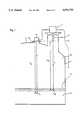
- FIG. 1shows schematically a vertical cross section through a device according to the invention in a first embodiment
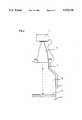
- FIG. 2shows in the same manner a second embodiment of the device
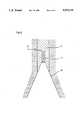
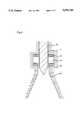
- FIG. 3-5a,bshow different detail embodiments of the device according to FIG. 2;
- FIG. 6shows schematically a vertical cross section through an alternative embodiment of the device according to the invention.
- FIG. 7shows a diagram of the gas density as a function of the distance, from a means for gauging the sound velocity according to FIG. 6 to the surface of the fluid.
- FIG. 1designates a container containing a fluid such as a petroleum product 2, with the surface 3.
- An electronic unit 7comprises among other things equipment for calculating from the propagation time of a microwave signal transmitted and reflected against the surface 3 a first distance to the surface of the fluid.
- a first means 9for transmitting and receiving a sound signal transmitted and reflected against the surface 3 of the fluid.
- This correctionis effected by a not shown second means included in the electronic unit 7.
- k 1is independent of what hydrocarbon is in the container. This is important since the mixture is often unknown; e.g. petrol can contain about a thousand components. For other liquids, for instance polar liquid, k 1 can be chosen according to the content.
- the transmitter for the microwave signal 6 and the means for transmitting a sound signalare in this case placed at the same height above the level of the fluid, which of course is not necessary as the required conversions considering different heights above the level of the fluid can easily be effected by said second means. It should be noted however, that it is an advantage if the sound waves and the microwaves go essentially equal distances through the gas in question.
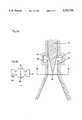
- FIG. 2an embodiment of the device according to the invention is shown schematically, comprising a horn 11, which leads both the microwaves and the sound waves to being transmitted and reflected essentially coincidingly.
- FIGS. 3 to 5Some variants of embodiments according to FIG. 2 are shown in FIGS. 3 to 5.
- the transmitter for the microwave signalsshows a waveguide filled with a dielectric 12, a sound source and a receiver for reflected sound 13, with a lead-in 14 for sound signals and a horn with a wall 15.
- the variant in FIG. 4comprises a waveguide for microwaves 16 with dielectric filling.
- the waveguideis surrounded by a metal tube 17.
- a sound element 18 coaxial with the waveguide of piezo-electric or magnetostriction typesurrounds the waveguide.
- a quarter-wave transformer 20in the form of a ring slot which prevents the microwaves from extending that way but limits them from leaving the waveguide.
- the wall in a hornis designated by 21.
- FIGS. 5a and bA variant with non-circular-symmetrical feeding of the sound waves is shown in FIGS. 5a and b.
- a waveguide 22 for microwavesis filled with dielectric and ends downwards with an edge 23 which is evident from the cross section according to the markings I--I, shown in FIG. 5b.
- a sound source 24is arranged at the side of one wall 25 of the waveguide, which limits the wedge-shaped lower portion of the waveguide on one side. The sound signal is reflected by the wall 25 downwards, and returns after the reflection against the surface of the fluid to be reflected by the opposite wall 26 of the waveguide to a receiver or microphone 27.
- the waveguidehas one-mode propagation for both microwaves and sound waves there is relatively great freedom to form the transition unsymmetrically maintaining the propagation of the mode.
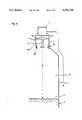
- FIG. 6An alternative embodiment of the device according to the invention is shown in FIG. 6.
- the designations in FIG. 1are repeated for the corresponding parts of the device, but the sound gauging is effected via a sound source 29 arranged in a bracket 28, the sound source being directed towards a receiver or microphone 30, also mounted on the bracket 28.
- the distance between the sound source and the microphonecan be about 0.5 m.
- the drawback with this embodimentis that the sound signal does not go the same way as the microwave signal. This gives a satisfactory correction of the level gauging only if the gas 10 above the surface 3 of the fluid is homogeneous, i.e. does not show any density gradient. This is the case when the container has been filled with for instance a petroleum product, in which case the air has been displaced out of the container.
- the devicecan be supplemented with a third means constituting a computer comprising a memory for storing a first gauge value achieved when the container is more or less filled with fluid such as a petroleum product.
- This gauge valuethen constitutes a maximum density value for the gas in question, as it can be calculated that the space above the fluid is completely filled with homogeneous gas corresponding to the fluid.
- the third meansalso comprises a calculating unit which, starting out partly from the first stored gauge value and partly from a second gauge value corresponding to the recent level of the fluid, corresponding to a substantially lower density in the gas due to the mixture of air during the emptying of the container, and partly with the aid of an algorithm stored in the computer, which describes a probable density gradient in the gas, calculates the probable sound velocity in the gas, whereby an approximately satisfactory correction of the level gauged with the microwave signal can be effected.
- a calculating unitwhich, starting out partly from the first stored gauge value and partly from a second gauge value corresponding to the recent level of the fluid, corresponding to a substantially lower density in the gas due to the mixture of air during the emptying of the container, and partly with the aid of an algorithm stored in the computer, which describes a probable density gradient in the gas, calculates the probable sound velocity in the gas, whereby an approximately satisfactory correction of the level gauged with the microwave signal can be effected.
- FIG. 7the gauging method is described with a device according to FIG. 6 in case the gas in the container shows a gradient.
- the shown diagramshows schematically the density of the gas as a function of the distance between the sound gauging means and the surface of the fluid.
- the density valuei.e. corresponding to the sound velocity
- Ais gauged.
- this density valueis maintained at the beginning until a point B, when air which is flowing in begins to decrease the density to a lowest value, at the point C. If then the container is left without any measure the fluid will evaporate gradually and the density gauged at this relatively large distance to the surface reaches a value D.
- the maximum density value Ewhich can possibly occur in the container. It is now assumed the density gradient D-E, e.g. through gauging with extra equipment or with the aid of theoretical calculations of the dependency of the density on the height in the container, the density gradient D-E being stored in the computer in the form of an algorithm that is used for correction in the aforementioned manner.
Landscapes
- Physics & Mathematics (AREA)
- Engineering & Computer Science (AREA)
- Radar, Positioning & Navigation (AREA)
- Remote Sensing (AREA)
- General Physics & Mathematics (AREA)
- Electromagnetism (AREA)
- Computer Networks & Wireless Communication (AREA)
- Fluid Mechanics (AREA)
- Thermal Sciences (AREA)
- Acoustics & Sound (AREA)
- Measurement Of Levels Of Liquids Or Fluent Solid Materials (AREA)
- Radar Systems Or Details Thereof (AREA)
- Length-Measuring Devices Using Wave Or Particle Radiation (AREA)
- Control Of Motors That Do Not Use Commutators (AREA)
- Investigating Or Analyzing Materials By The Use Of Ultrasonic Waves (AREA)
- Measurement Of Velocity Or Position Using Acoustic Or Ultrasonic Waves (AREA)
Abstract
Description
The present invention relates to a device for gauging the level of a fluid in a container, above the surface of the fluid there being a gas, the device comprising a first transmitter for transmitting a microwave signal through said gas towards the surface of the fluid, a first receiver for receiving the microwave signal reflected against said surface, an electronic unit arranged to calculate from the propagation time of the emitted and reflected microwave signal a first distance from the first transmitter to the surface of the fluid and thereby its level in the container.
Such devices have increasingly come in use, particularly for petroleum products such as crude oil and products made thereof. By container it is meant in this context very large ones constituting parts of the total loading volume of a tanker as well as even larger, usually circular-cylindrical landbased tanks, with volumes of tens of thousands of cubic meters. Demands for accuracy of measurement have become increasingly greater. In some cases accuracy of measurement of 1 to 2 mm at a 20-meter distance from the transmitter to the surface of the fluid may be required. In order to achieve so high an accuracy of measurement special measures must be taken to eliminate disturbances. One problem frequently occurring in connection with level gauging of the kind mentioned in the introduction, particularly in what regards the container containing the petroleum products or other chemical products, is the condition that the gas above the surface of the fluid, i.e. the "tank atmosphere", shows a partial pressure of vaporized fluid and also usually a partial pressure of air and possibly water vapour. A vaporized petroleum product, i.e. a gaseous hydrocarbon, shows a somewhat lower velocity of translation for microwaves compared with air. This velocity of translation stands in a certain relation to the density of the gas. This means that the velocity of translation of the microwave, or the microwave velocity, depends on the condition in the gas above the fluid in the container. If the container is essentially filled with a petroleum product, the corresponding partial pressure of the hydrocarbons will be essentially equal to the steam pressure when a steady condition has been obtained, i.e. the gas is saturated with gaseous hydrocarbon. The steam pressure varies substantially for different fluids such as hydrocarbon products, from practically zero to atmospherical pressure and thereabove. If, on the other hand, the container is emptied, air flows in from the atmosphere and mixes with the gaseous hydrocarbon so that a mixture of gaseous hydrocarbon and air takes place. In connection with the emptying, the partial pressure of the air will be relatively high, but if the container is left unmoved, more hydrocarbon will evaporate from the surface and the partial pressure of the hydrocarbon will increase. It is evident that the microwave velocity will vary depending on the partial pressure of the hydrocarbon, which in turn means that the gauging result will show corresponding deviations from the correct values of level gauging.
There has long been a need for a simple possibility to correct the gauge values achieved with a device of the kind mentioned in the introduction taking into account the prevailing condition in said gas, but no such device has been provided.
The object of the present invention is to provide a simple and reliable device of the kind mentioned in the introduction that admits correction of the level gauging result achieved therewith. In its preferred embodiment the invention also admits that the correction becomes relatively independent of horizontal density gradient.
According to the invention such a device is characterized by a first means for gauging the sound velocity in said gas and a second means for correcting said first distance to a second distance with consideration to the microwave velocity in the gas through a known relation between the sound velocity and the microwave velocity.
The relation between the sound velocity and the microwave velocity is known for a large number of gases and gas mixtures. As to size it can be said that the sound velocity in a mixture of gaseous hydrocarbon and air is affected about 500 times more by the partial pressure of the hydrocarbon, i.e. proportion of the gas mixture, than the microwave velocity. This means that a level gauging effected above a fluid where there is a gas with a certain partial pressure of a gas corresponding to the fluid can be corrected with very great accuracy by gauging the sound velocity in the gas in question. If the same path is used for sound and microwaves the correction will be independent of the inhomogeneity.
The sound velocity and the microwave velocity, respectively, in gases and gas mixtures can be described with more or less complex formulas, according to the need for accuracy. What regards the aforementioned relationship between the sound velocity and the microwave velocity the demands for accuracy should be relatively moderate, which means that approximate formulas can be used.
The microwave velocity vm can be expressed as: ##EQU1## where c=microwave velocity in vacuum
μr =relative permeability constant for the transmission medium
εr =relative dielectricity constant for the transmission medium
μr can be assigned thevalue 1 for the gases here in question, and therefore only the variation of the relative dielectricity constant with the gas composition must be considered.
For a gas εr can be calculated from the relationship:
(ε.sub.r -1/ε.sub.r +2)=ρ·R/M
where
ρ=gas density
R=molar refraction
M=molecular weight
R can be calculated by adding certain data for atoms and bonds in a molecule. For a gas mixture the corresponding calculations can be effected. R can be approximated to being proportional to the molecular weight if there is a restriction to hydrocarbons. Some gases are polar which makes R seem bigger, and in that case R may have to be chosen according to the gas. For hydrocarbons it is not required to have detailed knowledge of the composition of the gas. εr -1 can be considered proportional to the density of the gas as long as εr is close to 1, which always is the case for gases close to atmospherical pressure (max. 1.01). For hydrocarbons an average of 0.0011 per 1 kg/m3 can be given. If the displaced air is taken into account it can be calculated that the microwave velocity decreases by 400 ppm (millionth parts) per kg hydrocarbon per m3, almost irrespective of what particular gaseous hydrocarbon. The given number is independent of the temperature within an interval of about 20° (i.e. usual storage temperature), but the increasing temperature will of course bring about an increased partial pressure of gaseous hydrocarbon above the surface of the fluid. Certain gases, such as water, ammonia etc., show a permanent moment of dipole which affects R in the relationship above.
For the sound velocity in a gas v1 the following is true: ##EQU2## where CP =specific heat at constant pressure
Cv =specific heat at constant volume
P=pressure
o=density
The density of air at 20° is about 1.2 kg/m3 while it is 3-3.5 kg/m3 for gaseous hydrocarbon of the kind in question. CP /Cv for air is 1.40 and for gaseous hydrocarbon about 1.15.
For gas mixtures there is a relationship for v1 which is a modification of the above formula. The velocity v1 will then be ##EQU3## where T=absolute temperature
M=average molecular weight
R=gas constant
CP =specific heat per mole (average)
Particularly if the partial pressure of the gaseous hydrocarbon is low the inverted sound velocity, i.e. the propagation time, increases essentially linearly with the density of the hydrocarbon. As an example it can be mentioned that the partial pressure of a hydrocarbon corresponding to thedensity 1 kg/m3 of the hydrocarbon gives a propagation time increase of 20% compared with the propagation time in air, while the corresponding figure for the propagation time of the microwave is a 0.04% increase. For high partial pressures of hydrocarbon the increase in the propagation time of the sound wave will not be linearly depending on the density but still a function of it.
In practice it often occurs during level gauging e.g. in tanks with petroleum products, that the density of the gas varies along the gauge length for the sound signal and the microwave signal. Regarding the sound signal it can be calculated approximately that the propagation time of sound is proportional to the average of the square root of the density, while regarding the microwave signal the propagation time is proportional to the density on the condition that the relative dielectricity constant is close to 1, which is true for the cases in question.
An analysis of some practical cases with some twenty-percent increase of the propagation time for the sound wave shows that the error regarding the propagation time increase of the microwave is limited to a few percent of the increase, which amounts totally to about 0.01-0.1% in the cases in question, which is well acceptable considering the intended correction at level gauging.
In a suitable embodiment of the device according to the invention said first means is arranged to emit a sound signal parallelly to said microwave signal towards the surface of the fluid, and is arranged to receive the sound signal reflected against said surface. In this way both the sound signal and the microwave signal will pass through the same gas, i.e. the transmission medium, with the same composition, possibly showing a density gradient.
It is advantageous to combine the first means and the transmitter of a microwave signal to a unit, preferably arranged to transmit the sound signal and the microwave signal essentially the same way. Constructively, this principle can be realized by letting said unit comprise a horn arranged to give directivity to both the sound signal and the microwave signal.
In an alternative embodiment of the device according to the invention the first means for gauging the sound velocity is formed with a second transmitter and a second receiver, both preferably located in the upper portion of the container. The advantage with this embodiment is a simple construction, but the drawback is that the sound signal and the microwave signal go different ways. Only provided that the gas above the fluid can be considered homogeneous and without density gradient can the gauging of the sound velocity be used directly for correcting the propagation time of the microwave signal.
To make possible the use of the above-described alternative embodiment of the device according to the invention also in those cases when the gas shows a gradient, the device is suitably equipped with a third means, constituting a computer that comprises a memory unit for storing a first gauge value of the sound velocity for a relatively high level of the fluid in the container, further comprising a calculating unit for calculating the sound velocity in a gas showing a density gradient, starting out from the first stored gauge value and a recently gauged second gauge value for the sound velocity corresponding to a relatively lower level of the fluid in the container, and from an algorithm stored in the computer describing a probable density gradient in the gas.
The device according to the invention can be formed in a number of ways, in addition to those mentioned above. The device can for instance comprise a vertical tube through which the microwave signal and possibly also the sound signal is led towards the reflecting surface of the fluid. The tube must naturally be provided with a number of openings along its longitudinal extension in order that the surface of the fluid will take the same level inside and outside the tube.
The device will now be described in more detail with reference to the accompanying drawings, in which
FIG. 1 shows schematically a vertical cross section through a device according to the invention in a first embodiment;
FIG. 2 shows in the same manner a second embodiment of the device;
FIG. 3-5a,b show different detail embodiments of the device according to FIG. 2;
FIG. 6 shows schematically a vertical cross section through an alternative embodiment of the device according to the invention; and
FIG. 7 shows a diagram of the gas density as a function of the distance, from a means for gauging the sound velocity according to FIG. 6 to the surface of the fluid.
In FIG. 1, 1 designates a container containing a fluid such as apetroleum product 2, with thesurface 3. In the roof 4 of the container there are placed in a connection piece 5 a transmitter and areceiver 6 for transmitting and receiving a microwave signal, e.g. with λ=3.0 cm corresponding to the X band within the radar frequency range. Anelectronic unit 7 comprises among other things equipment for calculating from the propagation time of a microwave signal transmitted and reflected against the surface 3 a first distance to the surface of the fluid. In anotherconnection piece 8 in the roof of the container there is located a first means 9 for transmitting and receiving a sound signal transmitted and reflected against thesurface 3 of the fluid. If the space in the container between thesurface 3 and the transmitter/receiver 6 and the means 9, respectively, is filled with a gaseous hydrocarbon with a certain partial pressure, i.e. density, the microwave velocity through the transmission medium, i.e. the gas, will be somewhat lower than if the transmission medium had been air. In FIG. 1 the correct distance is designated by L and the distance calculated by theelectronic unit 7 is designated by LM =L+dM where dM is a measure of the error measurement. The distance to thesurface 3 measured by the means 9 with the aid of a sound signal is LL =L+dL where dL is a measure of the increase of the distance from the correct distance L which is due to the sound velocity in the gaseous hydrocarbon being lower than in the air. With the knowledge of the relationship dL =k1 ·dM the following is obtained:
L=L.sub.M -(L.sub.L -L.sub.M)/(k.sub.1 -1)
or when k1 >>1
L=L.sub.M -(L.sub.L -L.sub.M)/k.sub.1
This correction is effected by a not shown second means included in theelectronic unit 7.
For hydrocarbons it is true that in practice k1 is independent of what hydrocarbon is in the container. This is important since the mixture is often unknown; e.g. petrol can contain about a thousand components. For other liquids, for instance polar liquid, k1 can be chosen according to the content.
The transmitter for themicrowave signal 6 and the means for transmitting a sound signal are in this case placed at the same height above the level of the fluid, which of course is not necessary as the required conversions considering different heights above the level of the fluid can easily be effected by said second means. It should be noted however, that it is an advantage if the sound waves and the microwaves go essentially equal distances through the gas in question.
In FIG. 2 an embodiment of the device according to the invention is shown schematically, comprising ahorn 11, which leads both the microwaves and the sound waves to being transmitted and reflected essentially coincidingly.
Some variants of embodiments according to FIG. 2 are shown in FIGS. 3 to 5. Of these the transmitter for the microwave signals shows a waveguide filled with a dielectric 12, a sound source and a receiver for reflectedsound 13, with a lead-in 14 for sound signals and a horn with awall 15.
The variant in FIG. 4 comprises a waveguide formicrowaves 16 with dielectric filling. The waveguide is surrounded by ametal tube 17. Asound element 18 coaxial with the waveguide of piezo-electric or magnetostriction type surrounds the waveguide. Below thesound element 18 there is anacoustic resonator 19 arranged. In its lower portion there is a quarter-wave transformer 20 in the form of a ring slot which prevents the microwaves from extending that way but limits them from leaving the waveguide. The wall in a horn is designated by 21.
A variant with non-circular-symmetrical feeding of the sound waves is shown in FIGS. 5a and b. Awaveguide 22 for microwaves is filled with dielectric and ends downwards with anedge 23 which is evident from the cross section according to the markings I--I, shown in FIG. 5b. Asound source 24 is arranged at the side of onewall 25 of the waveguide, which limits the wedge-shaped lower portion of the waveguide on one side. The sound signal is reflected by thewall 25 downwards, and returns after the reflection against the surface of the fluid to be reflected by theopposite wall 26 of the waveguide to a receiver ormicrophone 27.
If the waveguide has one-mode propagation for both microwaves and sound waves there is relatively great freedom to form the transition unsymmetrically maintaining the propagation of the mode.
An alternative embodiment of the device according to the invention is shown in FIG. 6. The designations in FIG. 1 are repeated for the corresponding parts of the device, but the sound gauging is effected via asound source 29 arranged in abracket 28, the sound source being directed towards a receiver ormicrophone 30, also mounted on thebracket 28. The distance between the sound source and the microphone can be about 0.5 m. As has been mentioned the drawback with this embodiment is that the sound signal does not go the same way as the microwave signal. This gives a satisfactory correction of the level gauging only if thegas 10 above thesurface 3 of the fluid is homogeneous, i.e. does not show any density gradient. This is the case when the container has been filled with for instance a petroleum product, in which case the air has been displaced out of the container.
In order to make it possible to effect satisfactory corrections with the device according to FIG. 6 also in such cases when the gas is heterogeneous and shows a gradient the device can be supplemented with a third means constituting a computer comprising a memory for storing a first gauge value achieved when the container is more or less filled with fluid such as a petroleum product. This gauge value then constitutes a maximum density value for the gas in question, as it can be calculated that the space above the fluid is completely filled with homogeneous gas corresponding to the fluid. The third means also comprises a calculating unit which, starting out partly from the first stored gauge value and partly from a second gauge value corresponding to the recent level of the fluid, corresponding to a substantially lower density in the gas due to the mixture of air during the emptying of the container, and partly with the aid of an algorithm stored in the computer, which describes a probable density gradient in the gas, calculates the probable sound velocity in the gas, whereby an approximately satisfactory correction of the level gauged with the microwave signal can be effected.
In FIG. 7 the gauging method is described with a device according to FIG. 6 in case the gas in the container shows a gradient.
The shown diagram shows schematically the density of the gas as a function of the distance between the sound gauging means and the surface of the fluid. At an essentially filled container with homogeneous gas in the container the density value (i.e. corresponding to the sound velocity) A is gauged. When the container is emptied this density value is maintained at the beginning until a point B, when air which is flowing in begins to decrease the density to a lowest value, at the point C. If then the container is left without any measure the fluid will evaporate gradually and the density gauged at this relatively large distance to the surface reaches a value D. From earlier gauging, knowledge has been gained of the maximum density value E which can possibly occur in the container. It is now assumed the density gradient D-E, e.g. through gauging with extra equipment or with the aid of theoretical calculations of the dependency of the density on the height in the container, the density gradient D-E being stored in the computer in the form of an algorithm that is used for correction in the aforementioned manner.
The assumption that the density of the gas varies exponentially with the height above the surface of the fluid gives a simple algorithm, which usually is adaptable as an acceptable approximation.
Claims (6)
1. A device for gauging the level of a fluid in a container, above the surface of the fluid there being a gas, the device comprising a first transmitter for transmitting a microwave signal through said gas towards the surface of the fluid, a first receiver for receiving the microwave signal reflected against said surface, an electronic unit arranged to calculate from the propagation time of the emitted and reflected microwave signal a first distance from the first transmitter to the surface of the fluid and thereby its level in the container, characterized by a first means for gauging the sound velocity in said gas and a second means for correcting said first distance to a second distance as a function of the microwave velocity and a known relation between the sound velocity and the microwave velocity.
2. A device according to claim 1, characterized in that said first means is arranged to emit a sound signal parallel to said microwave signal towards the surface of the fluid, and is arranged to receive the sound signal reflected against said surface.
3. A device according to claim 1, characterized in that the first means and the transmitter of a microwave signal are combined to a unit, preferably arranged to transmit the sound signal and the microwave signal essentially the same way.
4. A device according to claim 3, characterized in that said unit comprises a horn arranged to give directivity to both the sound signal and the microwave signal.
5. A device according to claim 1, characterized in that the first means for gauging the sound velocity comprises a second transmitter and a second receiver, both preferably located in the upper portion of the container.
6. A device according to claim 5, characterized in that a third means, constituting a computer that comprises a memory unit for storing a first gauge value of the sound velocity for a relatively high level of the fluid in the container, further comprising a calculating unit for calculating the sound velocity in a gas showing a density gradient, starting out from the first stored gauge value and a recently gauged second gauge value for the sound velocity corresponding to a relatively lower level of the fluid in the container, and from an algorithm stored in the computer describing a probable density gradient in the gas.
Applications Claiming Priority (2)
| Application Number | Priority Date | Filing Date | Title |
|---|---|---|---|
| SE8901260 | 1989-04-10 | ||
| SE8901260ASE466519B (en) | 1989-04-10 | 1989-04-10 | DEVICE FOR Saturation of the level of a fluid present in a container |
Publications (1)
| Publication Number | Publication Date |
|---|---|
| US5070730Atrue US5070730A (en) | 1991-12-10 |
Family
ID=20375610
Family Applications (1)
| Application Number | Title | Priority Date | Filing Date |
|---|---|---|---|
| US07/613,574Expired - LifetimeUS5070730A (en) | 1989-04-10 | 1990-03-27 | Device for level gauging with microwaves |
Country Status (15)
| Country | Link |
|---|---|
| US (1) | US5070730A (en) |
| EP (1) | EP0419636B1 (en) |
| JP (1) | JPH068741B2 (en) |
| KR (1) | KR940000144B1 (en) |
| AU (1) | AU616357B2 (en) |
| BR (1) | BR9006408A (en) |
| CA (1) | CA2031453C (en) |
| DE (1) | DE69005245T2 (en) |
| DK (1) | DK0419636T3 (en) |
| ES (1) | ES2048487T3 (en) |
| FI (1) | FI97999C (en) |
| NO (1) | NO179385C (en) |
| SA (1) | SA90110002B1 (en) |
| SE (1) | SE466519B (en) |
| WO (1) | WO1990012292A1 (en) |
Cited By (26)
| Publication number | Priority date | Publication date | Assignee | Title |
|---|---|---|---|---|
| US5136299A (en)* | 1989-02-08 | 1992-08-04 | Saab Marine Electronics Aktiebolag | Device at a radar level gauge |
| US5233352A (en)* | 1992-05-08 | 1993-08-03 | Cournane Thomas C | Level measurement using autocorrelation |
| US5305237A (en)* | 1991-07-12 | 1994-04-19 | Union Tank Car Company | Method and apparatus for monitoring a flowable material in a transportable vessel |
| US5406842A (en)* | 1993-10-07 | 1995-04-18 | Motorola, Inc. | Method and apparatus for material level measurement using stepped frequency microwave signals |
| US5438867A (en)* | 1992-10-05 | 1995-08-08 | Krohne Messtechnik Gmbh & Co. Kg. | Process for measuring the level of fluid in a tank according to the radar principle |
| US5440310A (en)* | 1994-02-14 | 1995-08-08 | Motorola, Inc. | Bandwidth synthesized radar level measurement method and apparatus |
| WO1996025647A1 (en)* | 1995-02-13 | 1996-08-22 | Saab Marine Electronics Aktiebolag | A method and apparatus for level gauging using radar in floating roof tanks |
| US5872494A (en)* | 1997-06-27 | 1999-02-16 | Rosemount Inc. | Level gage waveguide process seal having wavelength-based dimensions |
| US5926080A (en)* | 1996-10-04 | 1999-07-20 | Rosemount, Inc. | Level gage waveguide transitions and tuning method and apparatus |
| US6107957A (en)* | 1997-06-27 | 2000-08-22 | Rosemount Inc. | Radar level gauge |
| US6155112A (en)* | 1996-10-04 | 2000-12-05 | Endress + Hauser Gmbh + Co. | Filling level measuring device operating with microwaves |
| WO2001042746A1 (en)* | 1999-12-10 | 2001-06-14 | Saab Marine Electronics Ab | Method and device for level measurement in tanks |
| US6318524B1 (en)* | 1998-01-14 | 2001-11-20 | Mannesmann Sachs Ag | Piston cylinder unit with a movement determination device |
| US6353407B1 (en)* | 2001-03-22 | 2002-03-05 | The United States Of America As Represented By The Secretary Of The Navy | Radar tank level indicating system for measurement of water content in shipboard tank involving identification of fuel-water interface |
| US6640628B2 (en)* | 2001-01-19 | 2003-11-04 | Endress + Hauser Gmbh + Co. Kg | Level-measuring device |
| US6677891B2 (en)* | 2001-01-19 | 2004-01-13 | Vega Grieshaber Kg | Method and device for transmitting and receiving electromagnetic waves |
| US20040099058A1 (en)* | 2002-11-21 | 2004-05-27 | Edvardsson Kurt O. | Apparatus and method for radar-based level gauging |
| WO2004083791A1 (en)* | 2003-03-21 | 2004-09-30 | Saab Rosemount Tank Radar Ab | System and method in a radar level gauging system |
| US20050127924A1 (en)* | 2003-12-11 | 2005-06-16 | Ohmart/Vega Corporation | Apparatus for use in measuring fluid levels |
| CN100356145C (en)* | 2003-03-21 | 2007-12-19 | 罗斯蒙特雷达液位股份公司 | System and method in a radar level gauging system |
| US20080105048A1 (en)* | 2006-11-06 | 2008-05-08 | Valter Nilsson | Pulsed radar level gauging with relative phase detection |
| US20090066966A1 (en)* | 2005-03-31 | 2009-03-12 | Lars Baath | Method and device for contactless level and interface detection |
| US20090128395A1 (en)* | 2005-03-31 | 2009-05-21 | Lars Baath | Method for analysing a substance in a container |
| US20120206290A1 (en)* | 2011-02-09 | 2012-08-16 | Krohne Messtechnik Gmbh | Microwave emitter and level measuring device |
| US20140126097A1 (en)* | 2012-11-08 | 2014-05-08 | Krohne Messtechnik Gmbh | Measuring arrangement for determining a measured quantity |
| US11407628B2 (en)* | 2018-10-23 | 2022-08-09 | Khs Gmbh | Filling system for filling containers with a fluid filling material and filling machine |
Families Citing this family (6)
| Publication number | Priority date | Publication date | Assignee | Title |
|---|---|---|---|---|
| DE4100922A1 (en)* | 1991-01-15 | 1992-07-16 | Krohne Messtechnik Kg | DISTANCE MEASURING DEVICE, IN PARTICULAR FOR LEVEL MEASUREMENT OF INDUSTRIAL TANKS |
| WO1997012211A1 (en)* | 1995-09-29 | 1997-04-03 | Rosemount Inc. | Microwave waveguide for tank level sensors |
| DE19722180C2 (en)* | 1997-05-27 | 1999-07-01 | Siemens Ag | Arrangement and method for measuring distance or speed |
| DE10060068C1 (en)* | 2000-12-01 | 2002-06-27 | Krohne Messtechnik Kg | level meter |
| DE102007042043A1 (en)* | 2007-09-05 | 2009-03-12 | Endress + Hauser Gmbh + Co. Kg | Level measuring instrument for determining and monitoring level of filling material provided in container with run time measuring method of sent signals, has transducer unit and sensor unit having ultrasonic sensor |
| US9325077B2 (en)* | 2013-11-12 | 2016-04-26 | Rosemount Tank Radar Ab | Radar level gauge system and reflector arrangement |
Citations (16)
| Publication number | Priority date | Publication date | Assignee | Title |
|---|---|---|---|---|
| US2960078A (en)* | 1955-10-17 | 1960-11-15 | Reining Helmut Paul Ott Gustav | Door framework for open hearth furnaces or other industrial furnaces |
| US3184969A (en)* | 1963-06-10 | 1965-05-25 | Gen Signal Corp | Liquid level indication system |
| US3286098A (en)* | 1963-02-28 | 1966-11-15 | Mobil Oil Corp | Methods and apparatus for determining factors related to sonic velocity in a gas |
| US4101865A (en)* | 1975-10-24 | 1978-07-18 | Endress & Hauser Gmbh & Co. | Sonic echo-sounder for the measurement of levels of substances |
| SU631786A1 (en)* | 1977-01-26 | 1978-11-05 | Государственный Ордена Трудового Красного Знамени Всесоюзный Проектный Научно-Исследовательский Институт Цементной Промышленности | Building material level determining method |
| US4221004A (en)* | 1978-08-03 | 1980-09-02 | Robertshaw Controls Company | Adjustable ultrasonic level measurement device |
| US4566321A (en)* | 1985-01-18 | 1986-01-28 | Transamerica Delaval Inc. | Microwave tank-contents level measuring assembly with lens-obturated wall-opening |
| US4578997A (en)* | 1982-01-04 | 1986-04-01 | Fischer & Porter | Time-shaped AGC for ultrasonic liquid level meter of the echo-ranging type |
| US4641139A (en)* | 1984-04-25 | 1987-02-03 | Saab Marine Electronics Aktiebolag | Method and apparatus for measuring the level of a fluent material in a container |
| US4661817A (en)* | 1983-04-05 | 1987-04-28 | 501 Autronica A/S | Method and apparatus for measuring the distance to an object |
| US4670754A (en)* | 1985-12-30 | 1987-06-02 | Transamerica Delaval, Inc. | Microwave tank-contents level measuring assembly with a phase controlled lens |
| US4675854A (en)* | 1983-11-04 | 1987-06-23 | Endress U. Hauser Gmbh U. Co. | Sonic or ultrasonic distance measuring device |
| US4700567A (en)* | 1985-11-21 | 1987-10-20 | Halliburton Company | Rheology test system |
| US4785664A (en)* | 1986-04-28 | 1988-11-22 | Kay-Ray, Inc. | Ultrasonic sensor |
| JPS6465420A (en)* | 1987-09-05 | 1989-03-10 | Kobe Steel Ltd | Level measuring instrument |
| US4821569A (en)* | 1987-10-30 | 1989-04-18 | Fischer & Porter Co. | Parasitic echo pulse rejector for ultrasonic liquid level meter |
Family Cites Families (5)
| Publication number | Priority date | Publication date | Assignee | Title |
|---|---|---|---|---|
| GB829741A (en)* | 1955-12-23 | 1960-03-09 | Heem V D Nv | A method and device for measuring small distances, especially the liquid level in liquid tanks |
| US3707717A (en)* | 1971-06-25 | 1972-12-26 | Gen Signal Corp | Boat berthing monitor incorporating sonar and doppler radar techniques |
| SE456538B (en)* | 1984-06-01 | 1988-10-10 | Saab Marine Electronics | SET AND DEVICE FOR NIVAMATING WITH MICROVAGOR |
| GB8607111D0 (en)* | 1986-03-21 | 1986-04-30 | Procontech Ltd | Liquid level sensing |
| DE3618021A1 (en)* | 1986-05-28 | 1987-12-03 | Krupp Gmbh | METHOD FOR LOCATING A UNDERWATER DESTINATION |
- 1989
- 1989-04-10SESE8901260Apatent/SE466519B/ennot_activeIP Right Cessation
- 1990
- 1990-03-27ESES90906420Tpatent/ES2048487T3/ennot_activeExpired - Lifetime
- 1990-03-27CACA002031453Apatent/CA2031453C/ennot_activeExpired - Fee Related
- 1990-03-27DEDE90906420Tpatent/DE69005245T2/ennot_activeExpired - Fee Related
- 1990-03-27AUAU55288/90Apatent/AU616357B2/ennot_activeCeased
- 1990-03-27USUS07/613,574patent/US5070730A/ennot_activeExpired - Lifetime
- 1990-03-27EPEP90906420Apatent/EP0419636B1/ennot_activeExpired - Lifetime
- 1990-03-27DKDK90906420.6Tpatent/DK0419636T3/enactive
- 1990-03-27WOPCT/SE1990/000194patent/WO1990012292A1/enactiveIP Right Grant
- 1990-03-27BRBR909006408Apatent/BR9006408A/ennot_activeIP Right Cessation
- 1990-03-27JPJP2506375Apatent/JPH068741B2/ennot_activeExpired - Fee Related
- 1990-03-27KRKR1019900702561Apatent/KR940000144B1/ennot_activeExpired - Fee Related
- 1990-07-23SASA90110002Apatent/SA90110002B1/enunknown
- 1990-12-05FIFI906016Apatent/FI97999C/ennot_activeIP Right Cessation
- 1990-12-07NONO905314Apatent/NO179385C/enunknown
Patent Citations (17)
| Publication number | Priority date | Publication date | Assignee | Title |
|---|---|---|---|---|
| US2960078A (en)* | 1955-10-17 | 1960-11-15 | Reining Helmut Paul Ott Gustav | Door framework for open hearth furnaces or other industrial furnaces |
| US3286098A (en)* | 1963-02-28 | 1966-11-15 | Mobil Oil Corp | Methods and apparatus for determining factors related to sonic velocity in a gas |
| US3184969A (en)* | 1963-06-10 | 1965-05-25 | Gen Signal Corp | Liquid level indication system |
| US4101865A (en)* | 1975-10-24 | 1978-07-18 | Endress & Hauser Gmbh & Co. | Sonic echo-sounder for the measurement of levels of substances |
| SU631786A1 (en)* | 1977-01-26 | 1978-11-05 | Государственный Ордена Трудового Красного Знамени Всесоюзный Проектный Научно-Исследовательский Институт Цементной Промышленности | Building material level determining method |
| US4221004A (en)* | 1978-08-03 | 1980-09-02 | Robertshaw Controls Company | Adjustable ultrasonic level measurement device |
| US4578997A (en)* | 1982-01-04 | 1986-04-01 | Fischer & Porter | Time-shaped AGC for ultrasonic liquid level meter of the echo-ranging type |
| US4661817A (en)* | 1983-04-05 | 1987-04-28 | 501 Autronica A/S | Method and apparatus for measuring the distance to an object |
| US4675854A (en)* | 1983-11-04 | 1987-06-23 | Endress U. Hauser Gmbh U. Co. | Sonic or ultrasonic distance measuring device |
| US4641139A (en)* | 1984-04-25 | 1987-02-03 | Saab Marine Electronics Aktiebolag | Method and apparatus for measuring the level of a fluent material in a container |
| US4641139B1 (en)* | 1984-04-25 | 1998-04-14 | Saab Marine Electronics | Method and apparatus for measuring the level of a fluent material in a container |
| US4566321A (en)* | 1985-01-18 | 1986-01-28 | Transamerica Delaval Inc. | Microwave tank-contents level measuring assembly with lens-obturated wall-opening |
| US4700567A (en)* | 1985-11-21 | 1987-10-20 | Halliburton Company | Rheology test system |
| US4670754A (en)* | 1985-12-30 | 1987-06-02 | Transamerica Delaval, Inc. | Microwave tank-contents level measuring assembly with a phase controlled lens |
| US4785664A (en)* | 1986-04-28 | 1988-11-22 | Kay-Ray, Inc. | Ultrasonic sensor |
| JPS6465420A (en)* | 1987-09-05 | 1989-03-10 | Kobe Steel Ltd | Level measuring instrument |
| US4821569A (en)* | 1987-10-30 | 1989-04-18 | Fischer & Porter Co. | Parasitic echo pulse rejector for ultrasonic liquid level meter |
Cited By (38)
| Publication number | Priority date | Publication date | Assignee | Title |
|---|---|---|---|---|
| US5136299A (en)* | 1989-02-08 | 1992-08-04 | Saab Marine Electronics Aktiebolag | Device at a radar level gauge |
| US5305237A (en)* | 1991-07-12 | 1994-04-19 | Union Tank Car Company | Method and apparatus for monitoring a flowable material in a transportable vessel |
| US5233352A (en)* | 1992-05-08 | 1993-08-03 | Cournane Thomas C | Level measurement using autocorrelation |
| US5438867A (en)* | 1992-10-05 | 1995-08-08 | Krohne Messtechnik Gmbh & Co. Kg. | Process for measuring the level of fluid in a tank according to the radar principle |
| US5406842A (en)* | 1993-10-07 | 1995-04-18 | Motorola, Inc. | Method and apparatus for material level measurement using stepped frequency microwave signals |
| US5440310A (en)* | 1994-02-14 | 1995-08-08 | Motorola, Inc. | Bandwidth synthesized radar level measurement method and apparatus |
| WO1996025647A1 (en)* | 1995-02-13 | 1996-08-22 | Saab Marine Electronics Aktiebolag | A method and apparatus for level gauging using radar in floating roof tanks |
| US5614831A (en)* | 1995-02-13 | 1997-03-25 | Saab Marine Electronics Ab | Method and apparatus for level gauging using radar in floating roof tanks |
| US6155112A (en)* | 1996-10-04 | 2000-12-05 | Endress + Hauser Gmbh + Co. | Filling level measuring device operating with microwaves |
| US5926080A (en)* | 1996-10-04 | 1999-07-20 | Rosemount, Inc. | Level gage waveguide transitions and tuning method and apparatus |
| US6276199B1 (en) | 1996-10-04 | 2001-08-21 | Endress + Hauser Gmbh + Co. | Method for producing filling level measuring device operating with microwaves |
| US5872494A (en)* | 1997-06-27 | 1999-02-16 | Rosemount Inc. | Level gage waveguide process seal having wavelength-based dimensions |
| US6107957A (en)* | 1997-06-27 | 2000-08-22 | Rosemount Inc. | Radar level gauge |
| US6318524B1 (en)* | 1998-01-14 | 2001-11-20 | Mannesmann Sachs Ag | Piston cylinder unit with a movement determination device |
| WO2001042746A1 (en)* | 1999-12-10 | 2001-06-14 | Saab Marine Electronics Ab | Method and device for level measurement in tanks |
| US6640628B2 (en)* | 2001-01-19 | 2003-11-04 | Endress + Hauser Gmbh + Co. Kg | Level-measuring device |
| US6677891B2 (en)* | 2001-01-19 | 2004-01-13 | Vega Grieshaber Kg | Method and device for transmitting and receiving electromagnetic waves |
| US6353407B1 (en)* | 2001-03-22 | 2002-03-05 | The United States Of America As Represented By The Secretary Of The Navy | Radar tank level indicating system for measurement of water content in shipboard tank involving identification of fuel-water interface |
| US20040099058A1 (en)* | 2002-11-21 | 2004-05-27 | Edvardsson Kurt O. | Apparatus and method for radar-based level gauging |
| US6915689B2 (en)* | 2002-11-21 | 2005-07-12 | Saab Rosemount Tank Radar Ab | Apparatus and method for radar-based level gauging |
| CN100356145C (en)* | 2003-03-21 | 2007-12-19 | 罗斯蒙特雷达液位股份公司 | System and method in a radar level gauging system |
| WO2004083791A1 (en)* | 2003-03-21 | 2004-09-30 | Saab Rosemount Tank Radar Ab | System and method in a radar level gauging system |
| US7392699B2 (en) | 2003-12-11 | 2008-07-01 | Ohmart/Vega Corporation | Apparatus for use in measuring fluid levels |
| US20050127924A1 (en)* | 2003-12-11 | 2005-06-16 | Ohmart/Vega Corporation | Apparatus for use in measuring fluid levels |
| US6988404B2 (en) | 2003-12-11 | 2006-01-24 | Ohmart/Vega Corporation | Apparatus for use in measuring fluid levels |
| US7237435B2 (en) | 2003-12-11 | 2007-07-03 | Ohmart/Vega Corporation | Apparatus for use in measuring fluid levels |
| US20090066966A1 (en)* | 2005-03-31 | 2009-03-12 | Lars Baath | Method and device for contactless level and interface detection |
| US20090128395A1 (en)* | 2005-03-31 | 2009-05-21 | Lars Baath | Method for analysing a substance in a container |
| US7733267B2 (en)* | 2005-03-31 | 2010-06-08 | Agellis Group Ab | Method for analysing a substance in a container |
| US8044843B2 (en)* | 2005-03-31 | 2011-10-25 | Agellis Group Ab | Method and device for contactless level and interface detection |
| US20080105048A1 (en)* | 2006-11-06 | 2008-05-08 | Valter Nilsson | Pulsed radar level gauging with relative phase detection |
| US7823446B2 (en)* | 2006-11-06 | 2010-11-02 | Rosemount Tank Radar Ab | Pulsed radar level gauging with relative phase detection |
| US20120206290A1 (en)* | 2011-02-09 | 2012-08-16 | Krohne Messtechnik Gmbh | Microwave emitter and level measuring device |
| CN102706407A (en)* | 2011-02-09 | 2012-10-03 | 克洛纳测量技术有限公司 | Microwave transmission device and fill level measuring device |
| US9109941B2 (en)* | 2011-02-09 | 2015-08-18 | Krohne Messtechnik Gmbh | Microwave emitter and level measuring device |
| US20140126097A1 (en)* | 2012-11-08 | 2014-05-08 | Krohne Messtechnik Gmbh | Measuring arrangement for determining a measured quantity |
| US8902553B2 (en)* | 2012-11-08 | 2014-12-02 | Krohne Messtechnik Gmbh | Measuring arrangement for determining a measured quantity |
| US11407628B2 (en)* | 2018-10-23 | 2022-08-09 | Khs Gmbh | Filling system for filling containers with a fluid filling material and filling machine |
Also Published As
| Publication number | Publication date |
|---|---|
| ES2048487T3 (en) | 1994-03-16 |
| CA2031453A1 (en) | 1990-10-11 |
| SE8901260D0 (en) | 1989-04-10 |
| SE8901260L (en) | 1990-10-11 |
| EP0419636B1 (en) | 1993-12-15 |
| NO179385C (en) | 1996-09-25 |
| DK0419636T3 (en) | 1994-04-11 |
| FI97999B (en) | 1996-12-13 |
| DE69005245T2 (en) | 1994-03-31 |
| NO905314D0 (en) | 1990-12-07 |
| DE69005245D1 (en) | 1994-01-27 |
| CA2031453C (en) | 1995-05-16 |
| JPH068741B2 (en) | 1994-02-02 |
| NO179385B (en) | 1996-06-17 |
| EP0419636A1 (en) | 1991-04-03 |
| JPH03502493A (en) | 1991-06-06 |
| FI97999C (en) | 1997-03-25 |
| BR9006408A (en) | 1991-08-06 |
| SE466519B (en) | 1992-02-24 |
| AU616357B2 (en) | 1991-10-24 |
| AU5528890A (en) | 1990-11-05 |
| KR940000144B1 (en) | 1994-01-07 |
| SA90110002B1 (en) | 2004-01-26 |
| WO1990012292A1 (en) | 1990-10-18 |
| NO905314L (en) | 1990-12-13 |
| FI906016A0 (en) | 1990-12-05 |
| KR920700396A (en) | 1992-02-19 |
Similar Documents
| Publication | Publication Date | Title |
|---|---|---|
| US5070730A (en) | Device for level gauging with microwaves | |
| US7345622B2 (en) | Two-mode radar level gauge system | |
| US9410904B2 (en) | System and method for determining density of a medium in a tank | |
| US6915689B2 (en) | Apparatus and method for radar-based level gauging | |
| US7532155B2 (en) | Radar level gauging system | |
| AU623980B2 (en) | Device at a radar level gauge | |
| US10801873B2 (en) | System and method for determining level and density distribution | |
| JP4695394B2 (en) | Liquid level measurement apparatus and measurement method using radar | |
| CN103364051A (en) | Material level measuring device and adapter with reflector | |
| EP1422503A1 (en) | Apparatus and method for radar-based level gauging | |
| US12104943B2 (en) | Guided wave radar level gauge and method for controlling the guided wave radar level gauge | |
| CN113108866B (en) | Guided wave radar level gauge and method for controlling a guided wave radar level gauge | |
| US20250189360A1 (en) | Container for pressurized liquid gas and liquid level measuring system | |
| EP3959490B1 (en) | Pulsed rlg with improved resistance to signal disturbance |
Legal Events
| Date | Code | Title | Description |
|---|---|---|---|
| AS | Assignment | Owner name:SAAB MARINE ELECTRONICS AKTIEBOLAG,, SWEDEN Free format text:ASSIGNMENT OF ASSIGNORS INTEREST.;ASSIGNOR:EDVARDSSON, KURT O.;REEL/FRAME:005594/0975 Effective date:19910205 | |
| STCF | Information on status: patent grant | Free format text:PATENTED CASE | |
| FPAY | Fee payment | Year of fee payment:4 | |
| FEPP | Fee payment procedure | Free format text:PAYOR NUMBER ASSIGNED (ORIGINAL EVENT CODE: ASPN); ENTITY STATUS OF PATENT OWNER: LARGE ENTITY | |
| FPAY | Fee payment | Year of fee payment:8 | |
| FPAY | Fee payment | Year of fee payment:12 |