US506348A - tainter - Google Patents
tainterDownload PDFInfo
- Publication number
- US506348A US506348AUS506348DAUS506348AUS 506348 AUS506348 AUS 506348AUS 506348D AUS506348D AUS 506348DAUS 506348 AUS506348 AUS 506348A
- Authority
- US
- United States
- Prior art keywords
- carriage
- screw
- coin
- lever
- return
- Prior art date
- Legal status (The legal status is an assumption and is not a legal conclusion. Google has not performed a legal analysis and makes no representation as to the accuracy of the status listed.)
- Expired - Lifetime
Links
- 239000004020conductorSubstances0.000description1
- 238000010276constructionMethods0.000description1
- 230000000994depressogenic effectEffects0.000description1
- 230000000694effectsEffects0.000description1
- 239000003643water by typeSubstances0.000description1
Images
Classifications
- G—PHYSICS
- G07—CHECKING-DEVICES
- G07F—COIN-FREED OR LIKE APPARATUS
- G07F5/00—Coin-actuated mechanisms; Interlocks
- G07F5/10—Coin-actuated mechanisms; Interlocks actuated electrically by the coin, e.g. by a single coin
Definitions
- the present inventionhas reference to the construction of actuating mechanism, controlled by the deposit of a coin, for instruments whereby sounds are recorded and reproduced, such instruments being known generally as phonographs or graphophones.
- An automatic actuating mechanism in common useemploys a feed screw of slow pitch for feeding the reproducer carriage in one direction, a return feed screw of rapid pitch, a tilting stirrup which is shifted bystops at each end of the path of the carriage, and a springactuated pin carried by said stirrup and adapted in one position to engage the carriage with the direct feed screw andin the other with the return feed-screw.
- the principal object of the present inventionis to insure precision of action on the part of the reversing and stopping mechanism, so that the shift will be. made with certainty, the coin latch be reset for the operation of a coin, and the motor c1rcu1t broken.
- the inventionconsists in certain improvements and arrangements of mechanism whereby these and other advantageous results are secured.
- the automatic feed mechanismis, or may be, the same in principle as that heretofore used, though this has been somewhat modified and improved.
- the starting and stopping of the apparatusis effected by a lever which is moved in one direction (to start the apparatus) by a spring, and in the other direction by contact of the reproducer carriage at the end of its return movement.
- Meansare provided to insure the restoration of this lever to its normal position before the carriage is disengaged from the return screw and engaged with the direct feed-screw.
- the starting and stopping leverwhen pressed back against its spring is caught and held by the coin-latch, so that the deposit of a suitable coin acts to start the apparatus by releasing the lever.
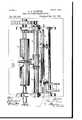
- FIG. Iis a plan view of mechanism constructed in accordance with the invention and applied to a graphophoue.
- Fig. IIis an elevation thereof.
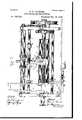
- Fig. IIIis an elevation and
- Fig. IVa plan view in detail of another form of mechanism.
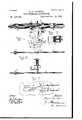
- Fig. Vis a bottom'plan view'of the-circuit making and breaking devices, and
- Fig. VIis a detail of the shifting stirrup and accessories.
- the tablet A and its actuating mechanism, the reproducer B, its carriage O, the hollow guide-rod D inclosing the .direct feed screw ,E, as well as other parts which need not be specified,are such as commonly used in the commercial graphophone and require no description.
- Rod fis capable of sliding vertically. In its highest position the carriage is engaged by nut ewith the direct feed screw. In its lowest position it is engaged by nut 6' with the return feedscrew.
- the tilting stirrup Fwhich is pivoted at G controls the connections of the feednuts and screws.
- a rod Iis extended from end to end of the machine, being supported in brackets i, and upon this rod are sliding collars H H provided with set screws.
- Set screw h of collar IIhas a milled head for turning by hand, and this collar can be set at any point lengthwise of the machine according to the length of the record to be reproduced. Stop I-I after its initial adjustment will not ordinarily be disturbed.
- the starting or stopping of the motoris efiected by means of a lever K, pivoted at k in the side of the coin chute L, and whose lower end It acts as a circuit-closer for the motor circuit.
- the conductors 9 and 10represent this circuit, they being attached respectively to the terminal springs 11 and 12, which are mounted upon opposite edges of an insulating block 13 (Fig. V). These springs approach each other closely at their free ends, but are not electrically connected.
- a fiat spring-latch 15whose free end projects slightly under the mouth of the coin-chute L, so that the action ofa coin falling through the latter will depress the spring momentarily.
- the spring or latch 15has a slot 16, and as shown in Fig.
- the breaking of the circuit, and consequent arrest of the slide or carriage,is effected by the action of the carriage through'a rod 1, supported loosely in bearings in the frame, so as to be capable of suflicient longitudinal motion to restore lever K to its normal position.
- Connect-ion between the actuating rod and the levermay be made in any convenient way.
- the rod Pis provided with a grooved collar 19, and a pin p on lever K enters this groove.
- Collar 19is in the path of a pin n on arm N. When this pin encounters collar 19, the rodP and the lever K move with the carriage until the end is restored to its normal position, and caught by latch 15.
- arm Nis, by further motion of the carriage, pushed back by contact of its pin n with collar 9; and thus after the breaking of the circuit is offected, the coin latch reset, and the stirrup F shifted, the nut e is released from the return feed-screw E and rodf resumes its normal position engaging the carriage with the direct feed-screw.
- Figs. III and IVa somewhat different arrangement of the parts is shown, the operation, however, being similar in that the action of the rod P upon the circuit-breaker is insured, before the carriage disengages itself from the return feed-screw.
- the stirrup'framehas at its under side a curved plate I which acts as a cam upon the arm Q (which corresponds in somerespects with arm N of the other figures) keeping it (against the pressure of a coiled spring at on its axis q) in the position shown in Fig/III.
- the axis or spindle qis perforated at its outer end and rod P passes through this perforation, which makes a loose fit so that, under normal conditions there is no connection between the rod and spindle.
- Cam plate Fhas at one side a notch r, so that when in the shifting of the stirrup-frame, this notch comes opposite pin 8 of the arm Q the latter is no longer held extended by cam plate F
- the spindle qis turned slightly, and by its twist takes a bite or grip upon the actuating rod P of the circuit-breaker or stoplever.
- this connectionshould occur just as the carriage C is reaching the end of its return movement. It is also necessary to prevent its occurrence when notch 7' passes pin 8 at the end of the forward movement of the carriage. As shown, in Fig.
- nut ecarries an arm t, which, when the nut is raised (that is during the forward movement of the carriage) is in the path of pin 3, and prevents motion of arm Q when the stirrup shifts at the end of the forward movement.
- stop t'is beneath pin 3 and opposes no obstacle to its movement. Consequently, when the stirrup is tilted by stop'H', pin 8 drops into notch 0" above stop t, and in consequence, spindle q. grips and carries with it the actuating rod P of the circuit-breaker.
- coin-latch projecting slightly into the path of a coin descending through said chuteare producer-carriage, feed-mechanism therefor set into operation by the depression of said latch, and a light spring in said coin-chute above the end of said latch, adapted to defiect a coin of less width than the coin chute away from said latch substantially as and for.
Landscapes
- Physics & Mathematics (AREA)
- General Physics & Mathematics (AREA)
- Pinball Game Machines (AREA)
Description
3 SheetsSheet 1.
(-No Model.)
O. S. TAINTER. COIN GONTROLLED GRAPHOPHONE;
Patented Oct. 10 1893.
(No Model.) 3 Sheets-Sheet 2.
c. s. TAINTER. GOIN CONTROLLED GRAPHOPHONE- Patented Oct. 10, 1893.
'EHEH. '1 f (No Model.) 0 s TAINTER 3 Sheets-Sheet 3. OOIN CONTROLLED GRAPHOPHONE.
No. 506,348. Patented Oct. 10, 1893.
llllllll NITED STATES PATENT OFFICE.
CHARLES S. TAINTER, OF WASHINGTON, DISTRICT OF COLUMBIA.'
com-contractual: GRAPHOPHONE.
SPECIFICATION forming part of Letters Patent No. 506,348, dated October 10, 1893.
Application filed April 27, 1893- Serial No. 472,110. No model.)
.To all whom it may concern.-
Be it known that I, CHARLES SUMNER' TAINTER, of Washington, in the District of. Columbia, have invented a new and useful Improvement in Coin Controlled Graphophones, which improvement is fully set forth in the following specification.
The present invention has reference to the construction of actuating mechanism, controlled by the deposit of a coin, for instruments whereby sounds are recorded and reproduced, such instruments being known generally as phonographs or graphophones. An automatic actuating mechanism in common use employs a feed screw of slow pitch for feeding the reproducer carriage in one direction, a return feed screw of rapid pitch, a tilting stirrup which is shifted bystops at each end of the path of the carriage, and a springactuated pin carried by said stirrup and adapted in one position to engage the carriage with the direct feed screw andin the other with the return feed-screw. By the operation of this mechanism the carriage when started travels upon the direct feed screw until the stirrup is shifted by the stop at the last end of the direct screw, wherebyit is disengaged from that screw and engaged with the return screw, and thereupon the reproducer carriage is returned to the starting point, upon reaching which the reverse shift occurs engaging it with the direct feed screw. At this precise moment it is necessary to arrest the machine, so that all the parts will be in readiness for a new feed when another coin is deposited in the coin chute. The arrest of the machine is effected by breaking the circuit of the electric-motor by which the machine is driven. rienced in securing the requisite precision in the operation of the reversing mechanism. Sometimes the shift would occur too soon and the motor circuit not being broken, the carriage would start off again, and perhaps continue in motion back and forth until the battery became exhausted. The principal object of the present invention is to insure precision of action on the part of the reversing and stopping mechanism, so that the shift will be. made with certainty, the coin latch be reset for the operation of a coin, and the motor c1rcu1t broken.
Difficulty has been 6Xp6-- The invention consists in certain improvements and arrangements of mechanism whereby these and other advantageous results are secured. The automatic feed mechanism is, or may be, the same in principle as that heretofore used, though this has been somewhat modified and improved. The starting and stopping of the apparatus is effected by a lever which is moved in one direction (to start the apparatus) by a spring, and in the other direction by contact of the reproducer carriage at the end of its return movement.
Means are provided to insure the restoration of this lever to its normal position before the carriage is disengaged from the return screw and engaged with the direct feed-screw. The starting and stopping lever, when pressed back against its spring is caught and held by the coin-latch, so that the deposit of a suitable coin acts to start the apparatus by releasing the lever.
-Apparatus of this character are most conveniently driven by electric-motors, but, of course the disconnecting mechanism could readily be applied to disengage a clutch or to effect analogous operations whereby the motion of machines is arrested.
The invention will be explained in connection with the accompanying drawings, in which- Figure I is a plan view of mechanism constructed in accordance with the invention and applied to a graphophoue. Fig. II is an elevation thereof. Fig. III is an elevation and Fig. IV a plan view in detail of another form of mechanism. Fig. V is a bottom'plan view'of the-circuit making and breaking devices, and Fig. VI is a detail of the shifting stirrup and accessories.
The tablet A and its actuating mechanism, the reproducer B, its carriage O, the hollow guide-rod D inclosing the .direct feed screw ,E, as well as other parts which need not be specified, are such as commonly used in the commercial graphophone and require no description.
The mechanism for reversing the movement of the reproducer-carriage or slide, except as hereinafter pointed out and claimed,
too
is not of myinvention. Its principal parts are the slow, or direct feed screw E, the rapid pitch return screw E, the nuts 66' carried on opposite ends of the vertical rod f, the shifting pin g, whose point engages in a hole in rod fand is pressed toward the latter by aspring 9, and the tilting stirrup F in which the shifter-pin is carried. Rod f is capable of sliding vertically. In its highest position the carriage is engaged by nut ewith the direct feed screw. In its lowest position it is engaged by nut 6' with the return feedscrew. The tilting stirrup F which is pivoted at G controls the connections of the feednuts and screws. When in the position shown in Fig. I the shifter-pin g is pressing the rodfupward, and the carriage is moving to the right. W'hen arm F of the stirrup encounters stop H it gradually tilts, raising pin g until the latter has passed the horizontal position, when its spring 9' acts, completing the movement of the stirrup, and snapping rod f downward, thus disengaging the carriage from the direct feed-screw and engagin g it with the return screw.
Instead of making the stops in the form of adjustable arms as heretofore, a rod I is extended from end to end of the machine, being supported in brackets i, and upon this rod are sliding collars H H provided with set screws. Set screw h of collar II has a milled head for turning by hand, and this collar can be set at any point lengthwise of the machine according to the length of the record to be reproduced. Stop I-I after its initial adjustment will not ordinarily be disturbed.
The starting or stopping of the motor is efiected by means of a lever K, pivoted at k in the side of the coin chute L, and whose lower end It acts as a circuit-closer for the motor circuit. Theconductors block 13 is attached a fiat spring-latch 15, whose free end projects slightly under the mouth of the coin-chute L, so that the action ofa coin falling through the latter will depress the spring momentarily. Near its free end, the spring orlatch 15 has aslot 16, and as shown in Fig. V the end k of the circuit closing lever K is normally held by this slot out of contact withterminal springs 11, 12. As soon, however, asspring 15 is depressed, lever K is released, and its spring m (Figs. I and II) swings it to the right, forcing circuit-closer it between thesprings 11 and 12 and bridging the space between them. This is the position of the parts as shown in Fig. II, the circuit being closed, and the reproducer carriage being in its forward motion. As soon as the rod f is snapped down by the reversal of the stirrup F and shifter-pin g, and nute engages the return feed screw E, a pin 6 carried by said nut is caught and held by the notched arm N, which is pivoted in the lower part of the movable frame and actuated by a coiled spring at (Fig. IV) so that during the return movement of the carriage the latter is held positively to its feed screw, and even after the stirrup F is reversed, the carriage will continue to be moved by the return screw until the locking arm N is withdrawn. The breaking of the circuit, and consequent arrest of the slide or carriage, is effected by the action of the carriage through'a rod 1, supported loosely in bearings in the frame, so as to be capable of suflicient longitudinal motion to restore lever K to its normal position. Connect-ion between the actuating rod and the lever may be made in any convenient way. As shown the rod P is provided with a grooved collar 19, and a pin p on lever K enters this groove. Collar 19 is in the path of a pin n on arm N. When this pin encounters collar 19, the rodP and the lever K move with the carriage until the end is restored to its normal position, and caught bylatch 15. The coiled springn which holds arm N in place is sufficiently strong to overcome the force of spring m, and prevent the unlocking of arm N until the circuit is broken and latch 15 reset for another operation. The stop H is so placed that it will tilt the stirrup F and its shifter-pin g before the breaking of the circuit occurs, so thatpin 9 is in position to throw rodfupward the moment arm N releases the latter. This release is effected, after lever K is reset. When this lever becomes rigid, arm N is, by further motion of the carriage, pushed back by contact of its pin n withcollar 9; and thus after the breaking of the circuit is offected, the coin latch reset, and the stirrup F shifted, the nut e is released from the return feed-screw E and rodf resumes its normal position engaging the carriage with the direct feed-screw.
It will be observed that the moment lever K is pushed back, the current tothe motor is cut 0d. The machine, however, does not at once come to rest, as the momentum is more than sufficient to move the carriage the distance required to release arm N.
In Figs. III and IV a somewhat different arrangement of the parts is shown, the operation, however, being similar in that the action of the rod P upon the circuit-breaker is insured, before the carriage disengages itself from the return feed-screw. In this case the stirrup'frame has at its under side a curved plate I which acts as a cam upon the arm Q (which corresponds in somerespects with arm N of the other figures) keeping it (against the pressure of a coiled spring at on its axis q) in the position shown in Fig/III. The axis or spindle q is perforated at its outer end and rod P passes through this perforation, which makes a loose fit so that, under normal conditions there is no connection between the rod and spindle. Cam plate F has at one side a notch r, so that when in the shifting of the stirrup-frame, this notch comes opposite pin 8 of the arm Q the latter is no longer held extended by cam plate F The consequence is that the spindle q is turned slightly, and by its twist takes a bite or grip upon the actuating rod P of the circuit-breaker or stoplever. For the purpose in view it is necessary that this connection should occur just as the carriage C is reaching the end of its return movement. It is also necessary to prevent its occurrence when notch 7' passes pin 8 at the end of the forward movement of the carriage. As shown, in Fig. III nut e carries an arm t, which, when the nut is raised (that is during the forward movement of the carriage) is in the path of pin 3, and prevents motion of arm Q when the stirrup shifts at the end of the forward movement. When, however, nut e is lowered into engagement with the return feed screw, stop t'is beneath pin 3 and opposes no obstacle to its movement. Consequently, when the stirrup is tilted by stop'H', pin 8 drops into notch 0" above stop t, and in consequence, spindle q. grips and carries with it the actuating rod P of the circuit-breaker. This is timed to occur when the shifter-pin g has assumed a position nearly horizontal, nut a being still in engagement with the return screw. Further movement of the stirrup, while actuating the circuit-breaker, brings pin g into a downwardly inclined position when it completes the shift by a quickaction. By this complete -movement of the stirrup-frame arm Q is lever K (which forms one side of the coinchute) a delicate spring 1; (Fig.1). If a coin under the size by which the machine is designed to be operated, falls throughthe chute, this spring will keep it against the opposite side, and it will fail to strike thecoin latch 15.
Having thus described my invention, what Iclaim as new, and desire to secure by Letters Patent, is
1. The combination with a reproducer slide or carriage, the direct and return feed screws, and means for shifting said carriage from one screw to the other at the respective ends of its travel, of starting and stopping mechanism comprising a spring-actuated lever, a coincontrolled latch or spring normally holding said lever retracted, and an actuating rod for resetting said lever, operated by the move-- ing witnesses.
ment of said carriage before itsdisengagement from the return feed-screw, substantially as described.
2. The combination with the reproducercarriage, and the direct and return feedscrews, of an electric-circuit for the motor driving said screws, said circuit having normally open contact-springs or terminals, a circuit-closing lever, means for actuating said lever to close said circuit upon the deposit of a suitable coin, means for shifting the carriage from the return to the direct feed-screw, and connections between the carriage and 1ever, whereby the circuit is broken and the end of its return movement, and means for holding the nut in engagement with thereturn feed-screw until said step mechanism .has been actuated, and then'releasing saidnut, substantially as described.
4. The combination of the direct and return feed screws, the reproducer carriage, shifting mechanism carriedtherebyforconnectingsaid carriage alternately to the direct and return feed screws, a lockin g arm holding the carriage positively in engagement with the return screw, a stop-lever actuated by the carriage when traveling on the return screw, and
means for releasing said locking arm after] the stop-lever has been actuated, substan tially as described.
5. The combination of the coin-chute, the.
coin-latch projecting slightly into the path of a coin descending through said chute, are producer-carriage, feed-mechanism therefor set into operation by the depression of said latch, and a light spring in said coin-chute above the end of said latch, adapted to defiect a coin of less width than the coin chute away from said latch substantially as and for.
the purpose set forth. In testimony whereof I have signed thi specification in the presence of two subscrib CHARLES s. TAINTER.
Witnesses:
PEROIVAL L. WATERS, PHILIP MAURO.
Publications (1)
| Publication Number | Publication Date |
|---|---|
| US506348Atrue US506348A (en) | 1893-10-10 |
Family
ID=2575183
Family Applications (1)
| Application Number | Title | Priority Date | Filing Date |
|---|---|---|---|
| US506348DExpired - LifetimeUS506348A (en) | tainter |
Country Status (1)
| Country | Link |
|---|---|
| US (1) | US506348A (en) |
- 0
- USUS506348Dpatent/US506348A/ennot_activeExpired - Lifetime
Similar Documents
| Publication | Publication Date | Title |
|---|---|---|
| US506348A (en) | tainter | |
| GB764490A (en) | Improvements in automatic or magazine gramophone apparatus | |
| US518190A (en) | Attachment for operating phonographs | |
| US2565881A (en) | Juke box and television receiver control device | |
| US921763A (en) | Coin-controlled vending-machine. | |
| US2850135A (en) | Plural-selection wall box for automatic phonograph | |
| US771851A (en) | Repeating attachment for phonographs. | |
| US773405A (en) | Coin-controlled mechanism. | |
| US609791A (en) | cheney | |
| US2719720A (en) | Phonographs | |
| US1346823A (en) | Rotatable wicket | |
| US621834A (en) | Coin-controlled graphophone | |
| US1694726A (en) | Coin control for automatic sound reproducers | |
| US1014107A (en) | Magazine-slot for coin-operated musical instruments. | |
| US523748A (en) | Coin-controlled phonograph | |
| US900876A (en) | Automatic phonograph apparatus. | |
| US478709A (en) | Coin-controlled device for phonographs | |
| US1216357A (en) | Telephone pay-station. | |
| US2850134A (en) | Multi-selector wall box for automatic phonograph | |
| US883190A (en) | Phonograph-stop. | |
| US1273572A (en) | Automatic phonograph. | |
| US977130A (en) | Time-controlling mechanism for type-writing machines, &c. | |
| US1837608A (en) | Combined talking machine and advertising device | |
| US631911A (en) | Coin-operated mechanism. | |
| US1134603A (en) | Automatic talking-machine. |