US5043792A - Integrated circuit having wiring strips for propagating in-phase signals - Google Patents
Integrated circuit having wiring strips for propagating in-phase signalsDownload PDFInfo
- Publication number
- US5043792A US5043792AUS07/508,853US50885390AUS5043792AUS 5043792 AUS5043792 AUS 5043792AUS 50885390 AUS50885390 AUS 50885390AUS 5043792 AUS5043792 AUS 5043792A
- Authority
- US
- United States
- Prior art keywords
- wiring
- signal
- circuit
- insulating film
- integrated circuit
- Prior art date
- Legal status (The legal status is an assumption and is not a legal conclusion. Google has not performed a legal analysis and makes no representation as to the accuracy of the status listed.)
- Expired - Lifetime
Links
Images



Classifications
- H—ELECTRICITY
- H01—ELECTRIC ELEMENTS
- H01L—SEMICONDUCTOR DEVICES NOT COVERED BY CLASS H10
- H01L23/00—Details of semiconductor or other solid state devices
- H01L23/52—Arrangements for conducting electric current within the device in operation from one component to another, i.e. interconnections, e.g. wires, lead frames
- H01L23/522—Arrangements for conducting electric current within the device in operation from one component to another, i.e. interconnections, e.g. wires, lead frames including external interconnections consisting of a multilayer structure of conductive and insulating layers inseparably formed on the semiconductor body
- H01L23/5222—Capacitive arrangements or effects of, or between wiring layers
- H—ELECTRICITY
- H01—ELECTRIC ELEMENTS
- H01L—SEMICONDUCTOR DEVICES NOT COVERED BY CLASS H10
- H01L2924/00—Indexing scheme for arrangements or methods for connecting or disconnecting semiconductor or solid-state bodies as covered by H01L24/00
- H01L2924/0001—Technical content checked by a classifier
- H01L2924/0002—Not covered by any one of groups H01L24/00, H01L24/00 and H01L2224/00
- Y—GENERAL TAGGING OF NEW TECHNOLOGICAL DEVELOPMENTS; GENERAL TAGGING OF CROSS-SECTIONAL TECHNOLOGIES SPANNING OVER SEVERAL SECTIONS OF THE IPC; TECHNICAL SUBJECTS COVERED BY FORMER USPC CROSS-REFERENCE ART COLLECTIONS [XRACs] AND DIGESTS
- Y10—TECHNICAL SUBJECTS COVERED BY FORMER USPC
- Y10S—TECHNICAL SUBJECTS COVERED BY FORMER USPC CROSS-REFERENCE ART COLLECTIONS [XRACs] AND DIGESTS
- Y10S257/00—Active solid-state devices, e.g. transistors, solid-state diodes
- Y10S257/915—Active solid-state devices, e.g. transistors, solid-state diodes with titanium nitride portion or region
Definitions
- This inventionrelates to an integrated circuit fabricated on a semiconductor substrate and, more particularly, to an arrangement of wiring strips incorporated in the integrated circuit for propagating signals in phase or in-phase signals.
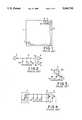
- FIG. 1shows an example of the integrated circuit fabricated on a semiconductor substrate 1, and the integrated circuit has a component circuit 2 serving as a signal source and component circuits 3 and 4 serving as destinations. Although other signal sources and destinations are provided on the semiconductor substrate and other wiring strips interconnect the signal sources and associated destinations, respectively, those are not shown in FIG. 1.
- the signal source 2is coupled to the destinations 3 and 4 through a wiring strip 5, and the wiring strip 5 is bifurcated into two branches 5a and 5b so that a signal produced by the signal source 2 is propagated through the wiring strip 5 to both of the destinations 3 and 4.
- FIG. 2is a circuit diagram equivalent to the circuit arrangement shown in FIG.
- parasitic capacitances C1 and C2are coupled to the wiring strip 5 as shown in FIG. 3, because an insulating film (not shown) is provided between the wiring strip 5 and the substrate 1.
- the wiring strip 5has side surfaces 5c and 5d and a bottom surface 5e, and the parasitic capacitance C1 is produced between the bottom surface 5e and the substrate 1, but the parasitic capacitance C2 is coupled to the side surfaces 5c and 5d of the wiring strip 5.
- R and Cdare indicative of an internal resistance of the signal source 2 and a parasitic capacitance coupled to the output node of the signal source 2, respectively, and Cg stands for a parasitic capacitance coupled to the input node of each destination 3 or 4.
- Equation 2teaches us that the time constant is increased with length of the wiring strip 5, and, accordingly, a substantial amount of time delay tends to be introduced in the signal propagation along the wiring strip 5.
- the internal resistance Ris dependent on channel resistances of MOS field effect transistors of an output buffer circuit, and the MOS field effect transistor with a wide channel decreases the internal resistance R but increases the parasitic capacitance Cd due to a large amount of the gate area.
- it is necessary to enlarge the output transistors of the previous stagebecause a small current driving capability of the previous stage is causative of undesirable current passing through a series combination of output transistors or the output buffer circuit.
- the enlarged output transistors of the previous stagefurther request an output buffer circuit with a large current driving capability provided upstream thereof, and a sequence of such enlarged output transistors consume a large amount of real estate on the semiconductor substrate 1.
- the approach to decreasing the internal resistance Ris not effective against prolonged signal propagation, and, therefore, another approach is requested.
- the present inventionproposes to accompany a signal line with another signal line propagating an in-phase signal.
- an integrated circuit fabricated on a semiconductor substratecomprising: a) a plurality of component circuits having first and second circuits respectively serving as signal sources and a third circuit serving as a signal destination; b) an insulating film covering a major surface of the semiconductor substrate; and c) a plurality of wiring strips formed in the insulating film and having a first wiring strip interconnecting the first circuit and at least the third circuit and a second wiring strip coupled to the second circuit, in which the first and second wiring strips are arranged to be opposed to one another through the insulating film and in which the first and second wiring strips respectively propagate signals substantially in phase with one another.
- FIG. 1is a plan view showing a part of the layout of a prior art integrated circuit fabricated on a semiconductor substrate;
- FIG. 2is a circuit diagram equivalent to the integrated circuit shown in FIG. 1;
- FIG. 3is a cross sectional view showing, a modeled form, parasitic capacitances coupled to a wiring strip incorporated in the integrated circuit shown in FIG. 1;
- FIG. 4is a circuit diagram showing the integrated circuit shown in FIG. 1 together with the parasitic capacitances coupled to the wiring strip;
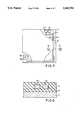
- FIG. 5is a plan view showing a part of the layout of an integrated circuit according to the present invention.
- FIG. 6is a cross sectional view taken along line VI--VI of FIG. 5 and showing wiring strips incorporated in the integrated circuit;
- FIG. 7is a cross sectional view showing the wiring strips incorporated in the integrated circuit shown in FIG. 5;
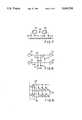
- FIG. 8is a circuit diagram equivalent to the integrated circuit shown in FIG. 5;
- FIG. 9is a circuit diagram showing the integrated circuit shown in FIG. 5 together with parasitic capacitances
- FIG. 10is a plan view showing a part of the layout of another integrated circuit according to the present invention.
- FIG. 11is a circuit diagram equivalent to the integrated circuit shown in FIG. 10;
- FIG. 12is a circuit diagram showing the integrated circuit shown in FIG. 10 together with parasitic capacitances
- FIG. 13is a cross sectional view showing wiring strips incorporated in still an integrated circuit according to the present invention.
- FIG. 14is a cross sectional view showing parasitic capacitances coupled to the wiring strips shown in FIG. 13;
- FIG. 15is a circuit diagram showing the integrated circuit equipped with the wiring strips shown in FIG. 13 together with the parasitic capacitances;
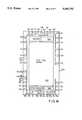
- FIG. 16is a plan view showing the layout of a read only memory device as an example of actual integrated circuit having the wiring strips according to the present invention.
- FIG. 17is a circuit diagram showing a chip enable buffer circuit incorporated in the read only memory device shown in FIG. 16;
- FIG. 18is a circuit diagram showing an output enable buffer circuit incorporated in the read only memory device shown in FIG. 16.
- an integrated circuit embodying the present inventionis fabricated on a semiconductor substrate 11 covered with a lower insulating film 12.
- a large number of component circuitsare incorporated in the integrated circuit, and first, second, third and fourth circuits 13a, 13b, 13c and 13d are included in the component circuits.
- the first and second circuits 13a and 13bproduces respective signals substantially in phase with one another (which are hereinbelow referred to as "in-phase signals"), so that the first and second circuits 13a and 13b serve as signal sources, respectively.
- the first and second circuits 13a and 13bare coupled through first and second wiring strips 14a and 14b to the third and fourth circuits 13c and 13d, respectively, and the first and second wiring strips 14a and 14b respectively propagate the in-phase signals to the third and fourth circuits 13c and 13d. Then, the third and fourth circuits 13c and 13d serve as signal destinations, respectively.
- the first and second wiring strips 14a and 14bare covered with an upper insulating film 15, and, therefore, the first and second wiring strips 14a and 14b are opposed through the insulating film 12 to the semiconductor substrate 11 and further through the insulating film 15 to one another as will be better seen from FIG. 6.
- the first and second wiring strips 14a and 14b thus arrangedare causative of parasitic capacitances C11, C12 and C13, and the parasitic capacitances C11 and C12 are coupled between the bottom surfaces of the wiring strips 14a and 14b and the semiconductor substrate 11 and between the side surfaces thereof and the semiconductor substrate 11, respectively, but the parasitic capacitance C13 takes place between the side surface of the first wiring strip 14a and the side surface of the second wiring strip 14b as illustrated in FIG. 7.
- the first and second wiring strips 14a and 14bare equivalent to a circuit diagram shown in FIG. 8. Since each of the first and second circuits 13a and 13b has an internal resistance R and a parasitic capacitance coupled to the output node thereof and each of the third and fourth circuits 13c and 13d has a parasitic capacitance Cg coupled to an input node thereof, an equivalent circuit shown in FIG. 9 stands for the first to fourth circuits 13a to 13d associated with the first and second wiring strips 14a and 14b.
- the parasitic capacitance C13accounts for a substantial part of the parasitic capacitance coupled to the right side surface of the wiring strip 14a; however, the parasitic capacitance C13 is eliminated from the parasitic capacitance coupled to the right side surface of the wiring strip 14A according to the present invention, and, for this reason, the total amount of the parasitic capacitances and, accordingly, the time constant ⁇ is drastically decreased due to the in-phase signals on the first and second wiring strips 14a and 14b.
- the prior art wiring strip 5is bifurcated into two parts for the two signal destinations, and, therefore, the parasitic capacitances 2Cg is coupled to the wiring strip 5.
- each wiring stripis decreased in width with minimum device dimensions but is hardly decreased in thickness, and the parasitic capacitance coupled to the side surfaces accounts for a large percentage of the total parasitic capacitance coupled to the wiring strip.
- Applicant's approachaims at reduction in parasitic capacitance coupled to the side surfaces of the wiring strip, and is, therefore, effective against the signal delay.
- FIGS. 10 to 12 of the drawingsanother integrated circuit embodying the present invention is illustrated.
- the integrated circuit shown in FIGS. 10 to 12is similar to that shown in FIG. 5 with the exception of a bifurcated first wiring strip 21 and of elimination of the fourth circuit 13d, and, for this reason, the other circuit components are designated by the same reference numerals used in the first embodiment without any detailed description.
- the component circuitsfurther includes a fifth circuit 13e serving as a signal destination, and the bifurcated first wiring strip 21 is coupled to not only the third circuit 13c but also the fifth circuit 13e.
- Parasitic capacitances C11, C12 and C13are coupled to the integrated circuit as shown in FIG. 11, and the integrated circuit thus arranged is equivalent to a diagram shown in FIG. 12.
- the bifurcated second wiring strip 21is effective against the parasitic capacitance rather than wiring strips vertically spaced from each other.
- FIGS. 13 to 15still another integrated circuit embodying the present invention has first and second wiring strips 31a and 31b vertically spaced apart from each other and formed in an insulating film 32 on the major surface of a semiconductor substrate 33.
- the first and second wiring strips 31a and 32bare respectively coupled to first and second circuits 34a and 34b, and the first wiring strip 31a is further coupled at the other end thereof to third and fifth circuits represented by respective parasitic capacitances Cg coupled to the input nodes thereof.
- the second wiring strip 31bis accompanied with three parasitic capacitances namely C21 between the bottom surface and the semiconductor substrate 33, C22 between the side surfaces and the semiconductor substrate 33 and C23 between the upper surface and the first wiring strip 31a.
- a parasitic capacitance C24is produced between the side surfaces of the first wiring strip 31a and the semiconductor substrate 33.
- the parasitic capacitance C24is much smaller than the parasitic capacitance C22, and, for this reason, is ignored in FIG. 15.
- the time constant ⁇is calculated as
- Cais the total capacitance of Cs and 2Cg
- Cbis the total capacitance of C21 and 2C22
- Ccis equal to C23
- the time constantis also decreased because of the in-phase signals, and the wiring arrangement shown in FIG. 13 occupies a relatively small amount of real estate rather than the first and second embodiments.
- the wiring arrangement according to the present inventionis applicable to various integrated circuits.
- a read only memory device shown in FIGS. 16 to 18is, by way of example, provided with the wiring arrangement according to the present invention.
- the read only memory deviceis designated in its entirety by reference numeral 500, A 17-bit address signal is supplied to address input buffers A0 to A16, and the address input buffers A0 to A16 produce the complementary signal thereof and supply the address signal and the complementary signal to a decoder 502.
- the decoder 502is responsive to the address signal and the complementary signal thereof, and selects ROM cells from a ROM cell array 501. In this instance, sixteen ROM cells are simultaneously accessed with a single address signal representative of address information. Data bits thus read out from the ROM cells are transferred to a sense amplifier unit 503, and the sense amplifier unit 503 increases differences in the voltage level through difference amplification so that a logic level of each data bit is rapidly determined by the sense amplifier unit 503.
- the data bits thus decidedare supplied from output buffers O0 to O15 to an external device.
- Signal lines interconnecting the address input buffers A0 to A16, the decoder 502, the ROM cell array 501, the sense amplifier unit 503 and the output buffers O0 to O15are eliminated from FIG. 13 for the sake of simplicity.
- the read only memory device 500further has a chip enable buffer 550 (CE) and an output enable buffer 560 (OE), and a chip enable signal and an output enable signal are fed to these buffers 550 and 560, respectively.
- the chip enable signalallows the read only memory device 500 to enter an enable state, so that the read only memory device 500 fetches the address signal and sequentially activates the internal component circuits.
- the chip enable buffer 550is coupled through a signal line 510 to the address input buffers A0 to A16. Since the address input buffers are provided along the periphery of the semiconductor chip, the signal line 510 is extremely long.
- FIG. 17shows the circuit arrangement of the chip enable buffer 550, and the chip enable signal is supplied from the outside thereof to a node 551.
- the chip enable signalis transferred through four inverter circuits 552 to 555 to the signal line 510, and an intermediate node between the inverter circuits 553 and 554 transfers the chip enable signal through the inverter circuits 556 and 557 to the signal line 511. Since the chip enable signal is thus branched from the intermediate node but is transferred to the signal lines 510 and 511 via inverter circuits equal in number to each other, the signals on the signal lines 510 and 511 are in phase with each other.
- the chip enable buffer 550includes first and second circuits (each implemented by a series combination of the inverter circuits 552 to 555 or 552, 553, 556 and 557) for producing the in-phase signals, and the signal lines 510 and 511 serve as first and second wiring strips.
- the present inventionfurther appertains to another component circuit of the read only memory device 500.
- the output buffer 560is supplied with the output enable signal, and the output enable signal controls the read-out timing for the data bits read out from the ROM ce11s under the enable state of the read only memory device 500.
- the chip enable signal on the signal line 510is fed to the output enable buffer 560, and the output enable buffer 560 relays the output enable signal to the output buffers O0 to O15 in the presence of the chip enable signal.
- the output buffers O0 to O15are also provided along the periphery of the semiconductor chip, and, for this reason, a signal line for the output enable signal is extremely long.
- the signal line 520is associated with another signal line 521, and in-phase signals are supplied to the signal lines 520 and 521, respectively.
- the output enable signalis fed to a node 561, and the output enable signal and the chip enable signal are supplied in parallel to a NOR gate 562. Since the NOR gate 562 is activated in the presence of the chip enable signal on the signal line 510, the output enable signal is transferred from the node 561 to an inverter circuit 563 in the presence of the chip enable signal on the signal line 510. The output enable signal is further transferred through inverter circuits 564 and 565 to the signal line 521 and through inverter circuits 566 and 567 to the signal line 520.
- the output signals on the signal lines 520 and 521are in phase with each other.
- the inverter circuits 563, 566 and 567form in combination a first circuit coupled to a first wiring strip, and the inverter circuits 563 to 565 as a whole constitute a second circuit coupled to a second wiring strip.
- the signal line 510 for the chip enable signal and the signal line 520 for the output enable signalare extremely long, however, the signal lines 511 and 521 are provided in association with the signal lines 510 and 520, respectively, and the in-phase signals are respectively supplied to the associated signal lines 511 and 521 according to the present invention, so that the parasitic capacitances respectively coupled to the signal lines 510 and 520 are drastically decreased and, accordingly, high-speed signal propagations are achieved in the read only memory device 500.
Landscapes
- Physics & Mathematics (AREA)
- Condensed Matter Physics & Semiconductors (AREA)
- General Physics & Mathematics (AREA)
- Engineering & Computer Science (AREA)
- Computer Hardware Design (AREA)
- Microelectronics & Electronic Packaging (AREA)
- Power Engineering (AREA)
- Design And Manufacture Of Integrated Circuits (AREA)
- Semiconductor Integrated Circuits (AREA)
- Internal Circuitry In Semiconductor Integrated Circuit Devices (AREA)
Abstract
Description
τ=R(Cd+C1+2C2+2Cg) (Equation 1)
τ=R×Cd+R(C1+2C2)+2RCg (Equation 2)
τ=R(Cd+C11+C12+Cg) (Equation 3)
τ=R[Cs+2Cg(1+(C13/Cs))/(1+2(C13/Cs)) (Equation 4)
τ=R(CaCb+CbCc+CcCa)/(Cb+2Cc) (Equation 5)
Claims (8)
Applications Claiming Priority (2)
| Application Number | Priority Date | Filing Date | Title |
|---|---|---|---|
| JP1-97946 | 1989-04-17 | ||
| JP9794689 | 1989-04-17 |
Publications (1)
| Publication Number | Publication Date |
|---|---|
| US5043792Atrue US5043792A (en) | 1991-08-27 |
Family
ID=14205839
Family Applications (1)
| Application Number | Title | Priority Date | Filing Date |
|---|---|---|---|
| US07/508,853Expired - LifetimeUS5043792A (en) | 1989-04-17 | 1990-04-12 | Integrated circuit having wiring strips for propagating in-phase signals |
Country Status (1)
| Country | Link |
|---|---|
| US (1) | US5043792A (en) |
Cited By (10)
| Publication number | Priority date | Publication date | Assignee | Title |
|---|---|---|---|---|
| EP0536972A3 (en)* | 1991-10-07 | 1993-06-16 | Tektronix, Inc. | An integrated circuit device having improved substrate capacitance isolation |
| US5448208A (en)* | 1993-07-15 | 1995-09-05 | Nec Corporation | Semiconductor integrated circuit having an equal propagation delay |
| US5691566A (en)* | 1996-03-25 | 1997-11-25 | Hughes Electronics | Tapered three-wire line vertical connections |
| US5973951A (en)* | 1992-05-19 | 1999-10-26 | Sun Microsystems, Inc. | Single in-line memory module |
| US6128347A (en)* | 1996-09-10 | 2000-10-03 | Nec Corporation | Signal transmission circuit with protection line driven with signal having same phase as transmission signal |
| US6246277B1 (en)* | 1997-12-26 | 2001-06-12 | Hitachi, Ltd. | Semiconductor integrated circuit device |
| EP0977263A3 (en)* | 1998-07-31 | 2002-07-10 | STMicroelectronics, Inc. | Apparatus and method for reducing propagation delay in a conductor |
| US20030158714A1 (en)* | 2001-02-12 | 2003-08-21 | Cohn John M. | Wiring optimizations for power |
| US20050190587A1 (en)* | 2004-02-27 | 2005-09-01 | Roy Greeff | Microstrip line dielectric overlay |
| US20080297217A1 (en)* | 2000-10-11 | 2008-12-04 | Welland David R | Method and apparatus for reducing interference |
Citations (2)
| Publication number | Priority date | Publication date | Assignee | Title |
|---|---|---|---|---|
| US4626889A (en)* | 1983-12-23 | 1986-12-02 | Hitachi, Ltd. | Stacked differentially driven transmission line on integrated circuit |
| US4924293A (en)* | 1985-05-24 | 1990-05-08 | Hitachi, Ltd. | Semiconductor integrated circuit device |
- 1990
- 1990-04-12USUS07/508,853patent/US5043792A/ennot_activeExpired - Lifetime
Patent Citations (2)
| Publication number | Priority date | Publication date | Assignee | Title |
|---|---|---|---|---|
| US4626889A (en)* | 1983-12-23 | 1986-12-02 | Hitachi, Ltd. | Stacked differentially driven transmission line on integrated circuit |
| US4924293A (en)* | 1985-05-24 | 1990-05-08 | Hitachi, Ltd. | Semiconductor integrated circuit device |
Cited By (28)
| Publication number | Priority date | Publication date | Assignee | Title |
|---|---|---|---|---|
| EP0536972A3 (en)* | 1991-10-07 | 1993-06-16 | Tektronix, Inc. | An integrated circuit device having improved substrate capacitance isolation |
| US5973951A (en)* | 1992-05-19 | 1999-10-26 | Sun Microsystems, Inc. | Single in-line memory module |
| US5448208A (en)* | 1993-07-15 | 1995-09-05 | Nec Corporation | Semiconductor integrated circuit having an equal propagation delay |
| US5691566A (en)* | 1996-03-25 | 1997-11-25 | Hughes Electronics | Tapered three-wire line vertical connections |
| US6128347A (en)* | 1996-09-10 | 2000-10-03 | Nec Corporation | Signal transmission circuit with protection line driven with signal having same phase as transmission signal |
| US6636095B2 (en) | 1997-12-16 | 2003-10-21 | Hitachi, Ltd. | Semiconductor integrated circuit device |
| US20040036518A1 (en)* | 1997-12-16 | 2004-02-26 | Yusuke Nitta | Semiconductor integrated circuit device |
| US6462599B2 (en) | 1997-12-26 | 2002-10-08 | Hitachi, Ltd. | Semiconductor integrated circuit device |
| US6246277B1 (en)* | 1997-12-26 | 2001-06-12 | Hitachi, Ltd. | Semiconductor integrated circuit device |
| US6867632B2 (en) | 1997-12-26 | 2005-03-15 | Renesas Technology Corp. | Semiconductor integrated circuit device |
| EP0977263A3 (en)* | 1998-07-31 | 2002-07-10 | STMicroelectronics, Inc. | Apparatus and method for reducing propagation delay in a conductor |
| US20090206946A1 (en)* | 1998-07-31 | 2009-08-20 | James Brady | Apparatus and method for reducing propagation delay in a conductor |
| US6842092B2 (en)* | 1998-07-31 | 2005-01-11 | Stmicroelectronics, Inc. | Apparatus and method for reducing propagation delay in a conductor |
| US20050093640A1 (en)* | 1998-07-31 | 2005-05-05 | James Brady | Apparatus and method for reducing propagation delay in a conductor |
| US7495526B2 (en) | 1998-07-31 | 2009-02-24 | Stmicroelectronics, Inc. | Apparatus and method for reducing propagation delay in a conductor system selectable to carry a single signal or independent signals |
| US20080297217A1 (en)* | 2000-10-11 | 2008-12-04 | Welland David R | Method and apparatus for reducing interference |
| US8154336B2 (en)* | 2000-10-11 | 2012-04-10 | Silicon Laboratories Inc. | Method and apparatus for reducing interference |
| US6985004B2 (en)* | 2001-02-12 | 2006-01-10 | International Business Machines Corporation | Wiring optimizations for power |
| US7346875B2 (en) | 2001-02-12 | 2008-03-18 | International Business Machines Corporation | Wiring optimizations for power |
| US20050262463A1 (en)* | 2001-02-12 | 2005-11-24 | Cohn John M | Wiring optimizations for power |
| US7469395B2 (en) | 2001-02-12 | 2008-12-23 | International Business Machines Corporation | Wiring optimizations for power |
| US20030158714A1 (en)* | 2001-02-12 | 2003-08-21 | Cohn John M. | Wiring optimizations for power |
| US20060290438A1 (en)* | 2004-02-27 | 2006-12-28 | Micron Technology, Inc. | Microstrip line dielectric overlay |
| US7432774B2 (en)* | 2004-02-27 | 2008-10-07 | Micron Technology, Inc. | Microstrip line dielectric overlay |
| US7436267B2 (en) | 2004-02-27 | 2008-10-14 | Micron Technology, Inc. | Microstrip line dielectric overlay |
| US20090025204A1 (en)* | 2004-02-27 | 2009-01-29 | Micron Technology, Inc. | Microstrip line dielectric overlay |
| US20050190587A1 (en)* | 2004-02-27 | 2005-09-01 | Roy Greeff | Microstrip line dielectric overlay |
| US9214713B2 (en) | 2004-02-27 | 2015-12-15 | Micron Technology, Inc. | Method of fabricating a microstrip line dielectric overlay |
Similar Documents
| Publication | Publication Date | Title |
|---|---|---|
| US6522565B2 (en) | Semiconductor storage device | |
| US5815428A (en) | Semiconductor memory device having hierarchical bit line structure | |
| US5886943A (en) | Semiconductor memory having a hierarchical data line structure | |
| US5043792A (en) | Integrated circuit having wiring strips for propagating in-phase signals | |
| JP2001156185A (en) | Integrated circuit having balanced cross part in differential signal line | |
| US5973554A (en) | Semiconductor device structured to be less susceptible to power supply noise | |
| US5828622A (en) | Clocked sense amplifier with wordline tracking | |
| JPH0146954B2 (en) | ||
| KR970060221A (en) | A semiconductor memory having a main word line and a sub word line provided corresponding to the main word line | |
| US5473195A (en) | Semiconductor integrated circuit device having parallel signal wirings variable in either width or interval | |
| KR960016426B1 (en) | Semiconductor integrated circuit device | |
| JPH05101674A (en) | Semiconductor memory | |
| KR950010620B1 (en) | Semiconductor memory device | |
| US5132930A (en) | CMOS dynamic memory device having multiple flip-flop circuits selectively coupled to form sense amplifiers specific to neighboring data bit lines | |
| KR100282385B1 (en) | Folded dummy word line | |
| KR910000877B1 (en) | Semiconductor memory device having common driver circuits for plural memory cell arrays | |
| US20100284228A1 (en) | Semiconductor device having data input/output unit connected to bus line | |
| US4924440A (en) | MOS gate array devices | |
| US6477074B2 (en) | Semiconductor memory integrated circuit having high-speed data read and write operations | |
| JPH0786425A (en) | Dynamic RAM | |
| JPH0245273B2 (en) | ||
| US5822238A (en) | Semiconductor memory | |
| US6081005A (en) | Semiconductor integrated circuit | |
| JP4246454B2 (en) | Integrated circuit device and local read / write circuit | |
| EP0169460A2 (en) | Dynamic memory array with segmented and quasi-folded bit lines |
Legal Events
| Date | Code | Title | Description |
|---|---|---|---|
| AS | Assignment | Owner name:NEC CORPORATION, JAPAN Free format text:ASSIGNMENT OF ASSIGNORS INTEREST.;ASSIGNOR:ADACHI, TAKAO;REEL/FRAME:005279/0727 Effective date:19900406 | |
| STCF | Information on status: patent grant | Free format text:PATENTED CASE | |
| FEPP | Fee payment procedure | Free format text:PAYOR NUMBER ASSIGNED (ORIGINAL EVENT CODE: ASPN); ENTITY STATUS OF PATENT OWNER: LARGE ENTITY | |
| FPAY | Fee payment | Year of fee payment:4 | |
| FEPP | Fee payment procedure | Free format text:PAYER NUMBER DE-ASSIGNED (ORIGINAL EVENT CODE: RMPN); ENTITY STATUS OF PATENT OWNER: LARGE ENTITY Free format text:PAYOR NUMBER ASSIGNED (ORIGINAL EVENT CODE: ASPN); ENTITY STATUS OF PATENT OWNER: LARGE ENTITY | |
| FPAY | Fee payment | Year of fee payment:8 | |
| FPAY | Fee payment | Year of fee payment:12 | |
| AS | Assignment | Owner name:NEC ELECTRONICS CORPORATION, JAPAN Free format text:ASSIGNMENT OF ASSIGNORS INTEREST;ASSIGNOR:NEC CORPORATION;REEL/FRAME:013758/0595 Effective date:20030110 | |
| AS | Assignment | Owner name:ELPIDA MEMORY, INC., JAPAN Free format text:ASSIGNMENT OF ASSIGNORS INTEREST;ASSIGNORS:NEC CORPORATION;NEC ELECTRONICS CORPORATION;REEL/FRAME:018545/0737 Effective date:20060531 |