US5022426A - Pressure operated sequencing valve - Google Patents
Pressure operated sequencing valveDownload PDFInfo
- Publication number
- US5022426A US5022426AUS07/548,570US54857090AUS5022426AUS 5022426 AUS5022426 AUS 5022426AUS 54857090 AUS54857090 AUS 54857090AUS 5022426 AUS5022426 AUS 5022426A
- Authority
- US
- United States
- Prior art keywords
- piston
- housing
- camming
- sequencing valve
- opening
- Prior art date
- Legal status (The legal status is an assumption and is not a legal conclusion. Google has not performed a legal analysis and makes no representation as to the accuracy of the status listed.)
- Expired - Fee Related
Links
- 238000012163sequencing techniqueMethods0.000titleclaimsabstractdescription33
- 239000012530fluidSubstances0.000claimsabstractdescription15
- 238000007789sealingMethods0.000claims2
- XLYOFNOQVPJJNP-UHFFFAOYSA-NwaterSubstancesOXLYOFNOQVPJJNP-UHFFFAOYSA-N0.000description6
- 238000012423maintenanceMethods0.000description4
- 230000002262irrigationEffects0.000description3
- 238000003973irrigationMethods0.000description3
- 230000013011matingEffects0.000description2
- 238000009429electrical wiringMethods0.000description1
- 238000012986modificationMethods0.000description1
- 230000004048modificationEffects0.000description1
- 230000001429stepping effectEffects0.000description1
Images
Classifications
- F—MECHANICAL ENGINEERING; LIGHTING; HEATING; WEAPONS; BLASTING
- F16—ENGINEERING ELEMENTS AND UNITS; GENERAL MEASURES FOR PRODUCING AND MAINTAINING EFFECTIVE FUNCTIONING OF MACHINES OR INSTALLATIONS; THERMAL INSULATION IN GENERAL
- F16K—VALVES; TAPS; COCKS; ACTUATING-FLOATS; DEVICES FOR VENTING OR AERATING
- F16K31/00—Actuating devices; Operating means; Releasing devices
- F16K31/44—Mechanical actuating means
- F16K31/52—Mechanical actuating means with crank, eccentric, or cam
- F16K31/524—Mechanical actuating means with crank, eccentric, or cam with a cam
- F16K31/52475—Mechanical actuating means with crank, eccentric, or cam with a cam comprising a sliding valve
- F16K31/52483—Mechanical actuating means with crank, eccentric, or cam with a cam comprising a sliding valve comprising a multiple-way sliding valve
- F—MECHANICAL ENGINEERING; LIGHTING; HEATING; WEAPONS; BLASTING
- F16—ENGINEERING ELEMENTS AND UNITS; GENERAL MEASURES FOR PRODUCING AND MAINTAINING EFFECTIVE FUNCTIONING OF MACHINES OR INSTALLATIONS; THERMAL INSULATION IN GENERAL
- F16K—VALVES; TAPS; COCKS; ACTUATING-FLOATS; DEVICES FOR VENTING OR AERATING
- F16K31/00—Actuating devices; Operating means; Releasing devices
- F16K31/12—Actuating devices; Operating means; Releasing devices actuated by fluid
- F16K31/36—Actuating devices; Operating means; Releasing devices actuated by fluid in which fluid from the circuit is constantly supplied to the fluid motor
- Y—GENERAL TAGGING OF NEW TECHNOLOGICAL DEVELOPMENTS; GENERAL TAGGING OF CROSS-SECTIONAL TECHNOLOGIES SPANNING OVER SEVERAL SECTIONS OF THE IPC; TECHNICAL SUBJECTS COVERED BY FORMER USPC CROSS-REFERENCE ART COLLECTIONS [XRACs] AND DIGESTS
- Y10—TECHNICAL SUBJECTS COVERED BY FORMER USPC
- Y10T—TECHNICAL SUBJECTS COVERED BY FORMER US CLASSIFICATION
- Y10T137/00—Fluid handling
- Y10T137/2496—Self-proportioning or correlating systems
- Y10T137/2559—Self-controlled branched flow systems
- Y10T137/265—Plural outflows
- Y10T137/2668—Alternately or successively substituted outflow
- Y10T137/268—Responsive to pressure or flow interruption
- Y—GENERAL TAGGING OF NEW TECHNOLOGICAL DEVELOPMENTS; GENERAL TAGGING OF CROSS-SECTIONAL TECHNOLOGIES SPANNING OVER SEVERAL SECTIONS OF THE IPC; TECHNICAL SUBJECTS COVERED BY FORMER USPC CROSS-REFERENCE ART COLLECTIONS [XRACs] AND DIGESTS
- Y10—TECHNICAL SUBJECTS COVERED BY FORMER USPC
- Y10T—TECHNICAL SUBJECTS COVERED BY FORMER US CLASSIFICATION
- Y10T137/00—Fluid handling
- Y10T137/8593—Systems
- Y10T137/86389—Programmer or timer
- Y10T137/86445—Plural, sequential, valve actuations
Definitions
- This inventionrelates to sequencing valves and is particularly directed to sequencing valves which are operated by pressure of fluid supplied to the inlet thereof.
- Sequencing valvesare frequently used in irrigation systems and the like to distribute fluid, such as water, from a single supply source to one or another of a plurality of irrigations points, such as sprinklers.
- a golf coursemay have a single water supply pipe supplying a sequencing valve which passes the water, in turn, to sprinklers serving a respective one of the fairways of the golf course.
- the sequencing valveis stepped to its next position to pass the water to the sprinklers serving the new fairway.
- the stepping action of the sequencing valveis conventionally accomplished by turning the water supply "OFF" and "ON" to provide a pressure pulse to which the sequencing valve responds by advancing one step.
- an improved sequencing valvecomprising a housing having a desired number of inlet and outlet ports, a piston normally urged to an inoperative position and responsive to inlet pressure to pass fluid to an appropriate one of said outlet ports, together with camming means responsive to movement of said piston to rotate said piston in a positive step-wise fashion.
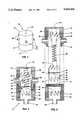
- FIG. 1is an isometric view of a sequencing valve embodying the present invention
- FIG. 2is an exploded view of the sequencing valve of FIG. 1;
- FIG. 3is a vertical section through the sequencing valve of FIG. 1;
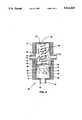
- FIG. 4is a view, similar to that of FIG. 3, showing inserts for the camming surfaces.
- FIGS. 1, 2 and 3show a sequencing valve, indicated generally at 10, having a hollow, cylindrical housing 12.
- the housing 12comprises an upper half 14 and a lower half 16 which are joined together by suitable means, such as threads 18.
- the upper half 14 of the housing 12is formed with a plurality of outlet ports 20 disposed about the periphery thereof, while the lower half 16 of the housing 12 has an inlet port entering the bottom of the housing 12, as seen at 22.
- six outlet ports 20 and one inlet port 22are provided.
- an air vent 24may be provided in the top of the upper half 14 of housing 12.
- the piston 30comprises a cylindrical member 32 having upper and lower camming surfaces 34 and 36 which cooperate with camming surfaces 26 and 28, respectively, to cause step-wise rotation of the piston 30, as described more fully below.
- the piston 30has a wall 38 located generally centrally of the cylindrical member 32 and has an opening 40 extending through the cylindrical member 32 below the wall 38.
- the exterior of the cylindrical member 32is provided with a groove 42 which serves to seat a suitable O-ring 44.
- the groove 42is curved so as to cause the O-ring 44 to be located above the opening 40 and curves downwardly on either side of the opening 40.
- the opening 40will be aligned with an appropriate one of the outlet ports 20 of the housing 12 and O-ring 44 will serve to allow fluid from opening 40 to flow through the aligned outlet port 20, but will prevent fluid from flowing laterally about the piston 30 to the other outlet ports 20.
- a spring 46is located between the wall 40 of the piston 30 and the upper half 14 of the housing 12 to normally urge the piston 30 to its downward position, as seen in FIG. 3.
- the piston 30In use, the piston 30 is normally urged, by spring 46, into the downward position, as seen in FIG. 3. However, when fluid is delivered through the inlet port 22 of housing 12, the fluid serves to push the piston 30 upward, against the action of spring 46, until opening 40 of the piston 30 becomes aligned with one of the outlet ports 20 of the housing 12. When this occurs, the fluid can pass through opening 40 and the aligned one of the outlet ports 20 to supply the fluid to a desired location.
- O-ring 44sealingly engages the interior of the housing 12 to prevent fluid from passing laterally about the piston 30 to pass out of any of the ports 20 which is not aligned with the opening 40.
- camming surface 34 of the piston 30engages camming surface 26 in the upper half 14 of the housing 12, causing the piston to rotate until the camming surfaces 34 and 26 are fully engaged.
- spring 46will urge the piston 30 downward, whereupon camming surface 36 of piston 30 will engage camming surface 28 on the lower half 16 of housing 12 and this again will serve to rotate the piston 30 until the camming surfaces 36 and 28 are fully engaged.
- mating camming surfaces 34 and 26serve to rotate piston 30 through an arc of 30° or one twelfth of a circle.
- mating camming surfaces 36 and 28also serve to rotate piston 30 through an arc of 30° or one twelfth of a circle.
- one complete upward and downward cycle of the piston 30serves to rotate the piston through an arc of 60° or one sixth of a circle.
- the housing 12is provided with six outlet ports 20, it will be seen that one upward and downward cycle of the piston 30 serves to rotate the opening 40 of piston 30 from alignment with one of the outlet ports 20 into alignment with the next adjacent outlet port 20.
- consecutive pressure pulses by the fluid flowing through inlet port 22will serve to advance the piston 30 in a step-wise fashion into alignment with successive ones of the outlet ports 20 of the housing 12 to provide the desired sequencing of the valve 10.
- the camming surfaces 26 and 28are integral with the upper half 14 and lower half 16 of the housing 12 and camming surfaces 34 and 36 are integral with the piston 30.
- the camming surfaces 26 and 28could be provided as inserts as seen at 27 and 29 in FIG. 4, which could be removably secured within the housing 12, while camming surfaces 34 and 36 could be supplied as separate units as seen at 35 and 37 in FIG. 4, which could be removably attached to the appropriate ends of the piston 30.
- the sequencing valve 10comprises only three parts; i.e., the housing 12, the piston 30 and the spring 46, and the only moving part is the piston 30. Obviously, these components are quite simple and can be manufactured with minimum expense. This would still be true, even if the camming surfaces 26, 28, 34 and 36 were provided separately, as suggested above as an alternative. Furthermore, since the sequencing valve 10 has only one moving part, the piston 30, the valve 10 will require little, if any maintenance. Obviously, numerous other variations and modifications can be made without departing from the spirit of the present invention. Therefore, it should be clearly understood that the forms of the present invention described above and shown in the figures of the accompanying drawing are illustrative only and are not intended to limit the scope of the present invention.
Landscapes
- Engineering & Computer Science (AREA)
- General Engineering & Computer Science (AREA)
- Mechanical Engineering (AREA)
- Fluid-Driven Valves (AREA)
Abstract
Description
1. Field of Invention
This invention relates to sequencing valves and is particularly directed to sequencing valves which are operated by pressure of fluid supplied to the inlet thereof.
2. Prior Art
Sequencing valves are frequently used in irrigation systems and the like to distribute fluid, such as water, from a single supply source to one or another of a plurality of irrigations points, such as sprinklers. Thus, for example, a golf course may have a single water supply pipe supplying a sequencing valve which passes the water, in turn, to sprinklers serving a respective one of the fairways of the golf course. When it is desired to switch the system to irrigate a different fairway, the sequencing valve is stepped to its next position to pass the water to the sprinklers serving the new fairway. The stepping action of the sequencing valve is conventionally accomplished by turning the water supply "OFF" and "ON" to provide a pressure pulse to which the sequencing valve responds by advancing one step. Unfortunately, many of the prior art sequencing valves are highly complex devices which are expensive to produce and require considerable maintenance. Still other prior art sequencing valves have been unreliable in operation and have failed to properly regulate the flow of water in a desired manner. Also, some prior art sequencing valves have been electrically actuated. However, for large irrigation systems, such as farms, golf courses and the like, this requires running extensive lengths of electrical wiring, which is expensive and is subject to breakage or weathering, thereby adding an additional maintenance factor. A search in the U.S. Patent Office has revealed the following:
______________________________________ U.S. Pat. No. INVENTOR ISSUED ______________________________________ 3,730,208 D. E. Lewis May 1, 1973 3,759,283 T. Maeda Sep. 18, 1973 4,305,417 W. W. Bell, Jr. Dec. 15, 1981 4,492,247 G. H. Lockwood Jan. 8, 1985 ______________________________________
Each of these reference is subject to the limitations set forth above. Thus, none of the prior art sequencing valves have been entirely satisfactory.
These disadvantages of prior art sequencing valves are overcome with the present invention and an improved sequencing valve is provide which is simple and inexpensive to construct, accurate and reliable in operation and requires little, if any, maintenance.
The advantages of the present invention are preferably attained by providing an improved sequencing valve comprising a housing having a desired number of inlet and outlet ports, a piston normally urged to an inoperative position and responsive to inlet pressure to pass fluid to an appropriate one of said outlet ports, together with camming means responsive to movement of said piston to rotate said piston in a positive step-wise fashion.
These and other objects and features of the present invention will be apparent from the following detailed description, taken with reference to the figures of the accompanying drawing.
FIG. 1 is an isometric view of a sequencing valve embodying the present invention;
FIG. 2 is an exploded view of the sequencing valve of FIG. 1;
FIG. 3 is a vertical section through the sequencing valve of FIG. 1; and
FIG. 4 is a view, similar to that of FIG. 3, showing inserts for the camming surfaces.
In that form of the present invention chosen for purposes of illustration in the drawing, FIGS. 1, 2 and 3 show a sequencing valve, indicated generally at 10, having a hollow,cylindrical housing 12. As shown, thehousing 12 comprises anupper half 14 and alower half 16 which are joined together by suitable means, such asthreads 18. Theupper half 14 of thehousing 12 is formed with a plurality ofoutlet ports 20 disposed about the periphery thereof, while thelower half 16 of thehousing 12 has an inlet port entering the bottom of thehousing 12, as seen at 22. As seen in FIG. 1, sixoutlet ports 20 and oneinlet port 22 are provided. However, it will be understood, by those skilled in the art, that these numbers could be varied substantially as desired. If desired, anair vent 24 may be provided in the top of theupper half 14 ofhousing 12. Within theupper half 14 andlower half 16 of thehousing 12 arecamming surfaces piston 30 is slidably mounted within thehousing 12. As best seen in FIG. 2, thepiston 30 comprises acylindrical member 32 having upper andlower camming surfaces camming surfaces piston 30, as described more fully below. Thepiston 30 has awall 38 located generally centrally of thecylindrical member 32 and has an opening 40 extending through thecylindrical member 32 below thewall 38. The exterior of thecylindrical member 32 is provided with agroove 42 which serves to seat a suitable O-ring 44. Thegroove 42 is curved so as to cause the O-ring 44 to be located above the opening 40 and curves downwardly on either side of the opening 40. Thus, when thepiston 30 is in its raised position, the opening 40 will be aligned with an appropriate one of theoutlet ports 20 of thehousing 12 and O-ring 44 will serve to allow fluid from opening 40 to flow through the alignedoutlet port 20, but will prevent fluid from flowing laterally about thepiston 30 to theother outlet ports 20. Finally, aspring 46 is located between thewall 40 of thepiston 30 and theupper half 14 of thehousing 12 to normally urge thepiston 30 to its downward position, as seen in FIG. 3.
In use, thepiston 30 is normally urged, byspring 46, into the downward position, as seen in FIG. 3. However, when fluid is delivered through theinlet port 22 ofhousing 12, the fluid serves to push thepiston 30 upward, against the action ofspring 46, until opening 40 of thepiston 30 becomes aligned with one of theoutlet ports 20 of thehousing 12. When this occurs, the fluid can pass throughopening 40 and the aligned one of theoutlet ports 20 to supply the fluid to a desired location. At the same time, however, O-ring 44 sealingly engages the interior of thehousing 12 to prevent fluid from passing laterally about thepiston 30 to pass out of any of theports 20 which is not aligned with the opening 40. As thepiston 30 continues upward, due to the pressure of the fluid flowing throughinlet port 22,camming surface 34 of thepiston 30 engagescamming surface 26 in theupper half 14 of thehousing 12, causing the piston to rotate until thecamming surfaces inlet port 22 is reduced or halted,spring 46 will urge thepiston 30 downward, whereuponcamming surface 36 ofpiston 30 will engagecamming surface 28 on thelower half 16 ofhousing 12 and this again will serve to rotate thepiston 30 until thecamming surfaces camming surfaces piston 30 through an arc of 30° or one twelfth of a circle. Similarly, matingcamming surfaces piston 30 through an arc of 30° or one twelfth of a circle. Thus, one complete upward and downward cycle of thepiston 30 serves to rotate the piston through an arc of 60° or one sixth of a circle. Since, as seen in FIG. 1, thehousing 12 is provided with sixoutlet ports 20, it will be seen that one upward and downward cycle of thepiston 30 serves to rotate the opening 40 ofpiston 30 from alignment with one of theoutlet ports 20 into alignment with the nextadjacent outlet port 20. Thus, consecutive pressure pulses by the fluid flowing throughinlet port 22 will serve to advance thepiston 30 in a step-wise fashion into alignment with successive ones of theoutlet ports 20 of thehousing 12 to provide the desired sequencing of thevalve 10. Obviously, ifhousing 12 were provided with a different number ofoutlet ports 20, the slopes of thecamming surfaces camming surfaces upper half 14 andlower half 16 of thehousing 12 andcamming surfaces piston 30. However, it will be apparent that, if desired, thecamming surfaces housing 12, whilecamming surfaces piston 30.
As shown, thesequencing valve 10 comprises only three parts; i.e., thehousing 12, thepiston 30 and thespring 46, and the only moving part is thepiston 30. Obviously, these components are quite simple and can be manufactured with minimum expense. This would still be true, even if thecamming surfaces sequencing valve 10 has only one moving part, thepiston 30, thevalve 10 will require little, if any maintenance. Obviously, numerous other variations and modifications can be made without departing from the spirit of the present invention. Therefore, it should be clearly understood that the forms of the present invention described above and shown in the figures of the accompanying drawing are illustrative only and are not intended to limit the scope of the present invention.
Claims (10)
1. A sequencing valve comprising:
a generally cylindrical housing having at least one inlet port entering adjacent one end of said housing and having a plurality of outlet ports spaced evenly about the periphery of said housing adjacent the opposite end from said inlet port,
a generally cylindrical piston located within said housing and slideable between a raised position and a lower position, said piston having an opening formed in the side wall thereof positioned to communicate with said outlet ports when said piston is in its raised position and having a wall closing said piston above said opening,
sealing means carried by said piston to permit fluid from said opening to flow only to one adjacent outlet port,
resilient means normally urging said piston to its lower position, and
stepping means responsive to movement of said piston to its raised and lower positions to rotate said opening to advance to the next adjacent outlet port.
2. The sequencing valve of claim 1 wherein said stepping means comprises:
first camming surfaces carried by said piston, and
second camming surfaces located within said housing.
3. The sequencing valve of claim 2 wherein:
said first camming surfaces are provided on the upper and lower edges of said piston, and
said second camming surfaces are located adjacent the top and bottom of said housing.
4. The sequencing valve of claim 1 wherein:
said sealing means is an O-ring positioned to lie above said opening and to extend downward about the sides of said opening and about said piston.
5. The sequencing valve of claim 1 wherein said stepping means comprises:
first camming means carried by the upper edge of said piston,
second camming means located within the upper end of said housing and cooperating with said first camming means upon movement of said piston to its raised position to rotate said opening one-half the distance to the next outlet port,
third camming means carried by the lower edge of said piston, and
fourth camming means located within the bottom of said housing and cooperating with said third camming means upon movement of said piston to its lower position to again rotate said opening one-half the distance to the next outlet.
6. The sequencing valve of claim 5 wherein:
said first and third camming means are formed integral with said piston.
7. The sequencing valve of claim 5 wherein:
said first and third camming means are releasably attached to said piston.
8. The sequencing valve of claim 5 wherein:
said second and fourth camming means are integral with said housing.
9. The sequencing valve of claim 5 wherein:
said second and fourth camming means are releasably secured within said housing.
10. The sequencing means of claim 1 wherein:
said resilient means is a spring.
Priority Applications (1)
| Application Number | Priority Date | Filing Date | Title |
|---|---|---|---|
| US07/548,570US5022426A (en) | 1990-07-05 | 1990-07-05 | Pressure operated sequencing valve |
Applications Claiming Priority (1)
| Application Number | Priority Date | Filing Date | Title |
|---|---|---|---|
| US07/548,570US5022426A (en) | 1990-07-05 | 1990-07-05 | Pressure operated sequencing valve |
Publications (1)
| Publication Number | Publication Date |
|---|---|
| US5022426Atrue US5022426A (en) | 1991-06-11 |
Family
ID=24189441
Family Applications (1)
| Application Number | Title | Priority Date | Filing Date |
|---|---|---|---|
| US07/548,570Expired - Fee RelatedUS5022426A (en) | 1990-07-05 | 1990-07-05 | Pressure operated sequencing valve |
Country Status (1)
| Country | Link |
|---|---|
| US (1) | US5022426A (en) |
Cited By (32)
| Publication number | Priority date | Publication date | Assignee | Title |
|---|---|---|---|---|
| US5755250A (en)* | 1992-05-11 | 1998-05-26 | I.E.I. Pty. Ltd. | Manifold and valve assembly for a smoke/pollution detection system |
| WO2004055388A1 (en)* | 2002-12-13 | 2004-07-01 | Actuant Corporation | Hydraulic tilting device for tilting the cab of a vehicle |
| US20050180819A1 (en)* | 2004-11-15 | 2005-08-18 | Neal Zook | Sewage effluent distribution means |
| US20100000917A1 (en)* | 2008-07-01 | 2010-01-07 | Neal Zook | Sewage effluent distribution means |
| US20100186838A1 (en)* | 2009-01-28 | 2010-07-29 | Aeromaster Innovations Inc. | Alternating State Flow Valve |
| US20100193721A1 (en)* | 2009-02-02 | 2010-08-05 | Fabian Melle | Plumbing shutoff or switching valve |
| US20100276011A1 (en)* | 2009-01-28 | 2010-11-04 | Spitzer Jeffrey J | Alternating state flow valve |
| US20120312403A1 (en)* | 2010-02-25 | 2012-12-13 | Xiamen Solex High-Tech Industries Co., Ltd. | Outlet switch device and an outlet switch method |
| US8397745B2 (en) | 2007-02-12 | 2013-03-19 | Colt Irrigation, LLC | Fluid activated flow control apparatus |
| US8413673B2 (en) | 2010-12-06 | 2013-04-09 | Alcor Scientific, Inc. | Flow actuated valve |
| US20140191147A1 (en)* | 2012-03-02 | 2014-07-10 | David E. Sisk | Aeration butterfly valve |
| US20140345705A1 (en)* | 2011-09-05 | 2014-11-27 | Interwell As | Flow Activated Circulating Valve |
| US9341281B2 (en) | 2007-02-12 | 2016-05-17 | Colt Irrigation Llc | Fluid activated flow control apparatus |
| US9599286B2 (en) | 2014-01-23 | 2017-03-21 | Colt Irrigation, LLC | Fluid activated flow control apparatus |
| WO2017218113A1 (en)* | 2016-06-17 | 2017-12-21 | Illinois Tool Works Inc. | System for selectively feeding liquid to various nozzle arrangements, and dishwasher comprising a system of this kind |
| US9907734B2 (en) | 2014-06-13 | 2018-03-06 | The Procter & Gamble Company | Cartridges for the deposition of treatment compositions on keratinous surfaces |
| US9924875B2 (en) | 2014-06-13 | 2018-03-27 | The Procter & Gamble Company | Apparatus and methods for modifying keratinous surfaces |
| US9928591B2 (en) | 2014-06-13 | 2018-03-27 | The Procter & Gamble Company | Apparatus and methods for modifying keratinous surfaces |
| US9925362B2 (en) | 2014-06-13 | 2018-03-27 | The Procter & Gamble Company | Apparatus and methods for modifying keratinous surfaces |
| US9949552B2 (en) | 2014-07-25 | 2018-04-24 | The Procter & Gamble Company | Handheld treatment apparatus for modifying keratinous surfaces |
| US9955769B2 (en) | 2014-07-25 | 2018-05-01 | The Procter & Gamble Company | Applicator heads for handheld treatment apparatus for modifying keratinous surfaces |
| US9993392B2 (en) | 2008-06-19 | 2018-06-12 | Alcor Scientific Inc. | Enteral feeding pump system |
| US10036484B2 (en)* | 2015-09-08 | 2018-07-31 | Fujian Xihe Sanitary Ware Technology Co., Ltd. | Pushbutton valve assembly |
| US10088849B2 (en) | 2014-01-23 | 2018-10-02 | Colt Irrigation, LLC | Fluid activated flow control apparatus |
| US20180283122A1 (en)* | 2017-04-03 | 2018-10-04 | Charles Abernethy Anderson | Differential pressure actuation tool and method of use |
| US10406076B2 (en) | 2008-06-19 | 2019-09-10 | Alcor Scientific, Inc. | Enteral feeding pump system |
| US10571937B1 (en) | 2014-01-23 | 2020-02-25 | Colt Irrigation, LLC | Valve control apparatus |
| US10920681B2 (en)* | 2016-12-13 | 2021-02-16 | Carrier Corporation | Pressure control valve system |
| FR3107329A1 (en)* | 2020-02-17 | 2021-08-20 | Akwel | Multiport valve with rotary plug and hydraulic pressure control |
| US11116302B2 (en) | 2015-06-11 | 2021-09-14 | The Procter & Gamble Company | Apparatus and methods for modifying keratinous surfaces |
| DE102020110836A1 (en) | 2020-04-21 | 2021-10-21 | Bayerische Motoren Werke Aktiengesellschaft | Valve device for a fluid guidance system of a vehicle |
| FR3156875A1 (en)* | 2023-12-19 | 2025-06-20 | Valeo Systèmes D’Essuyage | Multi-directional sequential valve and cleaning fluid projection system |
Citations (3)
| Publication number | Priority date | Publication date | Assignee | Title |
|---|---|---|---|---|
| US3018788A (en)* | 1959-09-29 | 1962-01-30 | David B Perlis | Fluid branch switching system |
| US3459208A (en)* | 1967-02-06 | 1969-08-05 | Claude R Clyde | Cycling valve |
| US4877047A (en)* | 1987-10-16 | 1989-10-31 | Guido Isidoro | Control mechanism for controlling the water supply in an irrigation system and similar, operating by means of pressure pulses |
- 1990
- 1990-07-05USUS07/548,570patent/US5022426A/ennot_activeExpired - Fee Related
Patent Citations (3)
| Publication number | Priority date | Publication date | Assignee | Title |
|---|---|---|---|---|
| US3018788A (en)* | 1959-09-29 | 1962-01-30 | David B Perlis | Fluid branch switching system |
| US3459208A (en)* | 1967-02-06 | 1969-08-05 | Claude R Clyde | Cycling valve |
| US4877047A (en)* | 1987-10-16 | 1989-10-31 | Guido Isidoro | Control mechanism for controlling the water supply in an irrigation system and similar, operating by means of pressure pulses |
Cited By (46)
| Publication number | Priority date | Publication date | Assignee | Title |
|---|---|---|---|---|
| US5755250A (en)* | 1992-05-11 | 1998-05-26 | I.E.I. Pty. Ltd. | Manifold and valve assembly for a smoke/pollution detection system |
| WO2004055388A1 (en)* | 2002-12-13 | 2004-07-01 | Actuant Corporation | Hydraulic tilting device for tilting the cab of a vehicle |
| NL1022163C2 (en)* | 2002-12-13 | 2004-07-09 | Actuant Corp | Hydraulic valve. |
| CN1308598C (en)* | 2002-12-13 | 2007-04-04 | 埃克徒安特公司 | Hydraulic tilting device for tilting the cab of a vehicle |
| US7252029B2 (en) | 2002-12-13 | 2007-08-07 | Actuant Corporation | Hydraulic tilting device for tilting the cab of a vehicle |
| US20050180819A1 (en)* | 2004-11-15 | 2005-08-18 | Neal Zook | Sewage effluent distribution means |
| US7040840B2 (en) | 2004-11-15 | 2006-05-09 | Neal Zook | Sewage effluent distribution means |
| US8397745B2 (en) | 2007-02-12 | 2013-03-19 | Colt Irrigation, LLC | Fluid activated flow control apparatus |
| US9841769B2 (en) | 2007-02-12 | 2017-12-12 | Colt Irrigation Llc | Fluid activated flow control apparatus |
| US9341281B2 (en) | 2007-02-12 | 2016-05-17 | Colt Irrigation Llc | Fluid activated flow control apparatus |
| US10406076B2 (en) | 2008-06-19 | 2019-09-10 | Alcor Scientific, Inc. | Enteral feeding pump system |
| US9993392B2 (en) | 2008-06-19 | 2018-06-12 | Alcor Scientific Inc. | Enteral feeding pump system |
| US8137541B2 (en) | 2008-07-01 | 2012-03-20 | Neal Zook | Sewage effluent distribution means |
| US20100000917A1 (en)* | 2008-07-01 | 2010-01-07 | Neal Zook | Sewage effluent distribution means |
| US9116522B2 (en) | 2009-01-28 | 2015-08-25 | Aeromaster Innovations, Inc. | Alternating state flow valve |
| US8752582B2 (en) | 2009-01-28 | 2014-06-17 | Aeromaster Innovations, Inc. | Alternative state flow valve |
| US20100186838A1 (en)* | 2009-01-28 | 2010-07-29 | Aeromaster Innovations Inc. | Alternating State Flow Valve |
| US20100276011A1 (en)* | 2009-01-28 | 2010-11-04 | Spitzer Jeffrey J | Alternating state flow valve |
| US20100193721A1 (en)* | 2009-02-02 | 2010-08-05 | Fabian Melle | Plumbing shutoff or switching valve |
| US8474482B2 (en)* | 2009-02-02 | 2013-07-02 | Hansgrohe Se | Plumbing shutoff or switching valve |
| US8973614B2 (en)* | 2010-02-25 | 2015-03-10 | Xiamen Solex High-Tech Industries Co., Ltd. | Outlet switch device and an outlet switch method |
| US20120312403A1 (en)* | 2010-02-25 | 2012-12-13 | Xiamen Solex High-Tech Industries Co., Ltd. | Outlet switch device and an outlet switch method |
| USD687930S1 (en) | 2010-12-06 | 2013-08-13 | Alcor Scientific, Inc. | Flow actuated valve |
| US8413673B2 (en) | 2010-12-06 | 2013-04-09 | Alcor Scientific, Inc. | Flow actuated valve |
| US20140345705A1 (en)* | 2011-09-05 | 2014-11-27 | Interwell As | Flow Activated Circulating Valve |
| US9267345B2 (en)* | 2011-09-05 | 2016-02-23 | Interwell As | Flow activated circulating valve |
| US20140191147A1 (en)* | 2012-03-02 | 2014-07-10 | David E. Sisk | Aeration butterfly valve |
| US9599286B2 (en) | 2014-01-23 | 2017-03-21 | Colt Irrigation, LLC | Fluid activated flow control apparatus |
| US10571937B1 (en) | 2014-01-23 | 2020-02-25 | Colt Irrigation, LLC | Valve control apparatus |
| US10088849B2 (en) | 2014-01-23 | 2018-10-02 | Colt Irrigation, LLC | Fluid activated flow control apparatus |
| US9907734B2 (en) | 2014-06-13 | 2018-03-06 | The Procter & Gamble Company | Cartridges for the deposition of treatment compositions on keratinous surfaces |
| US9925362B2 (en) | 2014-06-13 | 2018-03-27 | The Procter & Gamble Company | Apparatus and methods for modifying keratinous surfaces |
| US9924875B2 (en) | 2014-06-13 | 2018-03-27 | The Procter & Gamble Company | Apparatus and methods for modifying keratinous surfaces |
| US9928591B2 (en) | 2014-06-13 | 2018-03-27 | The Procter & Gamble Company | Apparatus and methods for modifying keratinous surfaces |
| US9949552B2 (en) | 2014-07-25 | 2018-04-24 | The Procter & Gamble Company | Handheld treatment apparatus for modifying keratinous surfaces |
| US9955769B2 (en) | 2014-07-25 | 2018-05-01 | The Procter & Gamble Company | Applicator heads for handheld treatment apparatus for modifying keratinous surfaces |
| US11116302B2 (en) | 2015-06-11 | 2021-09-14 | The Procter & Gamble Company | Apparatus and methods for modifying keratinous surfaces |
| US10036484B2 (en)* | 2015-09-08 | 2018-07-31 | Fujian Xihe Sanitary Ware Technology Co., Ltd. | Pushbutton valve assembly |
| WO2017218113A1 (en)* | 2016-06-17 | 2017-12-21 | Illinois Tool Works Inc. | System for selectively feeding liquid to various nozzle arrangements, and dishwasher comprising a system of this kind |
| US10920681B2 (en)* | 2016-12-13 | 2021-02-16 | Carrier Corporation | Pressure control valve system |
| US20180283122A1 (en)* | 2017-04-03 | 2018-10-04 | Charles Abernethy Anderson | Differential pressure actuation tool and method of use |
| US10794135B2 (en)* | 2017-04-03 | 2020-10-06 | Charles Abernethy Anderson | Differential pressure actuation tool and method of use |
| FR3107329A1 (en)* | 2020-02-17 | 2021-08-20 | Akwel | Multiport valve with rotary plug and hydraulic pressure control |
| DE102020110836A1 (en) | 2020-04-21 | 2021-10-21 | Bayerische Motoren Werke Aktiengesellschaft | Valve device for a fluid guidance system of a vehicle |
| FR3156875A1 (en)* | 2023-12-19 | 2025-06-20 | Valeo Systèmes D’Essuyage | Multi-directional sequential valve and cleaning fluid projection system |
| WO2025132665A1 (en)* | 2023-12-19 | 2025-06-26 | Valeo Systèmes d'Essuyage | Multidirectional sequence valve and cleaning fluid spraying system |
Similar Documents
| Publication | Publication Date | Title |
|---|---|---|
| US5022426A (en) | Pressure operated sequencing valve | |
| US5299743A (en) | Body spray nozzle | |
| US5143300A (en) | Showerhead | |
| US4613080A (en) | Multiple outlet trickle irrigation unit | |
| US4635673A (en) | Accessory faucet | |
| US4629121A (en) | Flow control nozzle and shutoff valve having screen-carrying passage in rotatable stem | |
| AU651514B2 (en) | Regulated drip irrigation emitter | |
| US2665171A (en) | Spray forming shower tube | |
| US5178191A (en) | Modular pneumatic control systems | |
| US5499767A (en) | Shower head having elongated arm, plural nozzles, and plural inlet lines | |
| US6311728B1 (en) | Fluid distribution valve | |
| US20190388914A1 (en) | Shower head flow control structure | |
| ATE172282T1 (en) | CHICK COCK | |
| US3459208A (en) | Cycling valve | |
| US6360767B1 (en) | Fluid distribution valve | |
| US6047949A (en) | Programmable fluid flow control valve | |
| US4590628A (en) | Fountain device | |
| US6170765B1 (en) | Pressure actuated shower head mechanism | |
| US4193545A (en) | Pressure compensating emitter | |
| US4462545A (en) | Sprinkler device | |
| US6354518B1 (en) | Pressure actuated shower head mechanism | |
| US20050205697A1 (en) | Combination showerhead with waterfall nozzle | |
| US3224458A (en) | Sequencing valve | |
| US4678004A (en) | Quick-action on/off valve | |
| US3767119A (en) | Fluidic cycled sprinkler head |
Legal Events
| Date | Code | Title | Description |
|---|---|---|---|
| REMI | Maintenance fee reminder mailed | ||
| LAPS | Lapse for failure to pay maintenance fees | ||
| FP | Lapsed due to failure to pay maintenance fee | Effective date:19950614 | |
| STCH | Information on status: patent discontinuation | Free format text:PATENT EXPIRED DUE TO NONPAYMENT OF MAINTENANCE FEES UNDER 37 CFR 1.362 |