US4939575A - Fault-tolerant serial video processor device - Google Patents
Fault-tolerant serial video processor deviceDownload PDFInfo
- Publication number
- US4939575A US4939575AUS07/402,975US40297589AUS4939575AUS 4939575 AUS4939575 AUS 4939575AUS 40297589 AUS40297589 AUS 40297589AUS 4939575 AUS4939575 AUS 4939575A
- Authority
- US
- United States
- Prior art keywords
- serial
- input
- processors
- video
- bit
- Prior art date
- Legal status (The legal status is an assumption and is not a legal conclusion. Google has not performed a legal analysis and makes no representation as to the accuracy of the status listed.)
- Expired - Lifetime
Links
Images


Classifications
- G—PHYSICS
- G06—COMPUTING OR CALCULATING; COUNTING
- G06F—ELECTRIC DIGITAL DATA PROCESSING
- G06F11/00—Error detection; Error correction; Monitoring
- G06F11/07—Responding to the occurrence of a fault, e.g. fault tolerance
- G06F11/16—Error detection or correction of the data by redundancy in hardware
- G06F11/1666—Error detection or correction of the data by redundancy in hardware where the redundant component is memory or memory area
- G—PHYSICS
- G06—COMPUTING OR CALCULATING; COUNTING
- G06F—ELECTRIC DIGITAL DATA PROCESSING
- G06F15/00—Digital computers in general; Data processing equipment in general
- G06F15/76—Architectures of general purpose stored program computers
- G06F15/78—Architectures of general purpose stored program computers comprising a single central processing unit
- G06F15/7839—Architectures of general purpose stored program computers comprising a single central processing unit with memory
- G06F15/7842—Architectures of general purpose stored program computers comprising a single central processing unit with memory on one IC chip (single chip microcontrollers)
- G—PHYSICS
- G06—COMPUTING OR CALCULATING; COUNTING
- G06F—ELECTRIC DIGITAL DATA PROCESSING
- G06F15/00—Digital computers in general; Data processing equipment in general
- G06F15/76—Architectures of general purpose stored program computers
- G06F15/80—Architectures of general purpose stored program computers comprising an array of processing units with common control, e.g. single instruction multiple data processors
- G06F15/8007—Architectures of general purpose stored program computers comprising an array of processing units with common control, e.g. single instruction multiple data processors single instruction multiple data [SIMD] multiprocessors
- G—PHYSICS
- G06—COMPUTING OR CALCULATING; COUNTING
- G06T—IMAGE DATA PROCESSING OR GENERATION, IN GENERAL
- G06T1/00—General purpose image data processing
- G06T1/20—Processor architectures; Processor configuration, e.g. pipelining
Definitions
- This inventionrelates to digital signal processor systems, and more particularly to a serial processor especially useful for video signal processing or the like.
- a system for real-time digital processing of a video signalusing a linear array of a large number of one-bit serial processor elements, each operating on one pixel of a horizontal scan.
- the video signalis converted to digital by an A-to-D converter, and one full scan line is stored in a set of input registers, one register for each processor element. All of these input registers are loaded during a horizontal scan, as the input registers are addressed in sequence by a commutator.
- Each processor elementincludes a one-bit binary adder, a set of one-bit registers, and two one-bit wide data memories of a size to store data from several scans.
- the processor elementsare all controlled in common by stored microcode, or by a sequencer, a state machine or a processor.
- the processed video datais transferred to an output register for each processor element, from which it is off-loaded in sequence defined by a commutator, then converted to a video signal by a D-to-A converter.
- a frame memorymay be used to save a processed frame for use in convolving the next frame; the input of the frame memory is taken at the output registers, and the frame memory output is applied to the input registers.
- serial processor elementsare configured as a linear array, and laid out in a semiconductor integrated circuit in a regular pattern, similar to a dynamic RAM, with one column for each element.
- the columncontains the two data memories, the input and output registers, the commutator, and the adder and its register set.
- the processoris illustrated as being used for video signal enhancement, but it is also useful for image processing in general, character recognition, signal processing, filtering, and applications of this type.
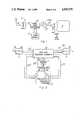
- FIG. 1is an electrical diagram in block form of one example of a video system which uses the serial video processor according to the invention
- FIG. 2is an electrical diagram in block form of the serial video processor on the system in FIG. 1;
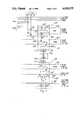
- FIG. 3is an electrical diagram in block form in more detail of the serial video processor of FIGS. 1 or 2;
- FIG. 4is an electrical diagram in schematic form of the registers, multiplexers, circuits, and ALU of the processor of FIG. 3;
- FIG. 5is an electrical diagram in schematic form of the input and output registers of the processor element of FIG. 3;
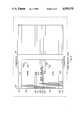
- FIG. 6is greatly-enlarged diagram of the layout of a semiconductor chip containing the processor of FIG. 3 or 4.
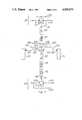
- FIG. 7is an electrical diagram in block form of connections for using redundant processor elements.
- a TV or video system 8which may use a serial video processor 10 according to the invention, in this example, consists of a CRT 11 of the raster-scanned type receiving an analog video signal at input 12 from standard video circuits 13 as used in a conventional TV set.
- a video signal from an antenna 14, or from a VCR or the likeis treated in the usual manner through RF and IF stages of a tuner, producing an analog composite video signal at a line 15.
- This analog input 15is the same as would be the input 16 to the video circuitry 13, if the serial video processor 10 were not used, so it is seen that in this example the processor 10 is merely interposed in the signal stream at the output of the IF strip.
- the processor 10functions to perform various signal enhancement operations on the video signal, and to this end would usually save one (or more) frames in a frame memory 17.
- the horizontal synch, vertical synch, and color burstwould be recovered separately; i.e., would by-pass the signal processor illustrated herein, which deals only with the video signal, for illustrative purposes.
- FIG. 2a block diagram of the serial video processor 10 and frame memory 17 is shown in more detail.
- the video signal input on line 15is converted to 8-bit digitized video data in an A-to-D converter 18 which operates at a sampling rate of, for example, 14.32 MHz (a multiple ⁇ 4 of the color subcarrier 3.58 MHz), producing an 8-bit parallel output on lines 19 as one input to the video processor 10.
- the other 8-bit data input 20 to the processor 10is the output of the frame buffer memory 17, which stores the processed video data for the previous frame.
- the frame memory 17may consist of a bank of video DRAMs as commercially available, or, since the random access function is not needed, frame memory devices with only serial I/O may be used.
- the processed video datais output from the video processor on eight lines 21 to an 8-bit digital-to-analog converter 22 which produces the input 16 to the video circuitry.
- the system illustrated as an examplemay be black and white or color, since the real-time image enhancement processing is done on the composite video signal.
- the processorcan also perform the color separation, which will not be treated in this application.
- the processed video datais also applied by eight lines 23 to the input of the frame memory 17.
- the frame memory 17also receives controls and clocking on lines 24 from the video processor 10 or from a controller 25.
- controller 25may be a standard microprocessor or microcontroller device such as a commercially-available TMS 7000, for example, as described in detail in U.S. Pat. No. 4,432,052.
- the codecan be stored in RAM or ROM, or a state machine or sequencer of conventional form may be employed.
- the controller 25functions to apply twenty-one microcode control bits and sixteen address bits on lines 26 to the video processor.
- the program store or controller 25may be on the same semiconductor chip as the video processor 10, especially if it merely consists of stored code in a ROM with associated address counter.
- the video processor 10may contain, for example, 1024 identical processor elements 28 as shown in FIG. 3, in a linear array.
- Each processor element 28includes a 16-bit data input register 30 receiving the two 8-bit parallel inputs 19 and 20 from the A-to-D converter and from the frame memory 17; the input register 30, also referred to as the DIR register, loads the data on lines 19 and 20, only when an enable signal is applied at an input 31, this enable signal being received from a 1-of-1024 commutator or ring counter 32 triggered to begin at the end of a horizontal blanking period and continue for 1024 cycles synchronized with the sampling frequency of the A-to-D converter 18.
- the sixteen bits of the register 30are also addressed one at a time by an address input from the controller 25 as will be described, for selection to write into a data memory 33; this data memory 33 is referred to as RAM0 and consists of a 128-bit dynamic random-access memory configured 1 ⁇ 128.
- the RAM0 data memory 33 and the DIR input register 30are parts of the same 1 ⁇ 144 DRAM column, but the register 30 differs from the RAM0 part in that the DIR part is dual ported so it can be written into from the inputs 19 and 20, all sixteen bits in parallel.
- the 1-bit data input/output line 35 for RAM0is coupled to the column or bit-line I/O for a sense amplifier 34 of a DRAM column.
- the particular bit being addressed in the 1 ⁇ 128 memory RAM0 part of the columnis selected by 128 word lines shared by all 1024 processor elements; a shared 1-of-144 decode 36 receives an 8-bit address 37 (actually seven address bits and one of the twenty-one control bits) from the controller 25 and applies the same word line selection to RAM0 or DIR of all 1024 processor elements. Likewise, a second one-bit wide dynamic memory 38, referred to as RAM1, is used on the output side of the processor, again having a shared decoder 39 producing a 1-of-144 word line selection from an 8-bit address on lines 41 from controller 25. The RAM1 memory is associated with a 16-bit data output register 42 also called DOR, also addressed by a 1-of-16 selection from the shared decoder 39.
- the addresses 37 and 41 for the input and output registers 30 and 42 and data memories 33 and 38are each 8-bit inputs 37 and 41 to decoders 36 and 39, shared by all 1024 processor elements, these inputs 37 and 41 being generated by the controller 25.
- the output register 42is selected for 16-bit parallel data output on lines 21 and 23 by an input 48 from a 1-of-1024 commutator or ring counter 49.
- the input commutator 32is clocked at above 1024 times the horizontal scan rate, so all 1024 of the input registers 30 can be loaded during a horizontal scan period.
- the output commutator 49maybe clocked at the same rate as the input.
- the processor element of FIG. 3includes an ALU and register set 50 which functions to perform one-bit arithmetic/logic functions on one-bit inputs from RAM0 and RAM1, and to write the one-bit result to RAM0 or RAM1, or alternatively, the one-bit 10 of the ALU 50 may be the adjacent "East and West" processor elements on either side via left or right data inputs 52 or 53, or left/right data output line 54.
- the one-bit arithmetic/logic functionis defined by a 22-bit microcode control input 55 from the controller 25. In one clock cycle defined by a clock input CLK to the sense amplifiers 34 and 40 of the data memories 33 and 38 and to the ALU 50, the processor element of FIG.
- This CLK inputis at about 50 nS repetition rate, or 20 MHz; it need not be correlated with the clocking of the commutators 32 and 49.
- the ALU and register set 50 of the processor element of FIG. 3is shown in more detail.
- the selected conditional one-bit input from RAM0 or RAM1is referred to as R0 or R1
- the twenty-one microcode control bitsare referred to as C0 to C20
- the carry bitis CY
- the borrow bitis BW
- the sum bitis SM.
- Four one-bit clocked registers 56, 57, 58, and 59are included, referred to as Register A, Register B, Register C and Register M; these are standard D flip-flop circuits having D and Q input/output terminals and a clock input CLK.
- Each of the registers 56-59has a multiplexer 61, 62, 63 or 64 which is a 1-of-8 selector controlled by three respective bits of the microcode control bits 55 as indicated.
- the register 56 or Reg Areceives a one-bit input on line 65 from its own output 66, or it receives R0 or R1, or the right or left lines 52 or 53, or the B or C registers, or a hard-wired zero, as selected by three bits C14-C16 from the controller 25 on lines 67, depending upon the binary value 000 thru 111 of this control input.
- Registers B, C and Mare likewise controlled.
- the Register Chas an additional multiplexer 68 referred to as the divide multiplexer, as one of the inputs of its multiplexer 63, receiving the control bits C20 and the Reg M output M as its selector bits.
- Input for the RAM0 data memory 33, and for the RAM1 data memory 38,is controlled by the RAM0 and RAM1 write control multiplexers 70 and 71.
- Conditional multiplexers 72 and 73 responsive to the C20 control bit and the Reg M outputprovide a data-dependent write input for RAM0 and RAM1.
- the R0 and R1 bits used as the inputs of multiplexers 61, 62, 63 and 64are the "read" outputs for RAM0 and RAM1.
- Each of the multiplexers 70, 71, 72 and 73is a 1-of-4 selector receiving two control bits C0, C1, C3, C4, C20 or M as indicated.
- Control bits C2 and C5are the same as address bits A7 for RAM0 and RAM1, and are used to select the DIR or DOR registers instead of RAM0 and RAM1 for data transfer.
- the ALUitself consists of a binary full adder/subtractor 75, and two-input OR and AND gates 76 and 77, all receiving inputs A, B, C, M and C20 (or D) as indicated and producing outputs Sum SM, Carry Cy and Borrow BW as shown.
- a left/right control L/Ris produced by a one-of-4 multiplexer 78 based upon the inputs R0, R1, B and logical zero, as selected by control bits C6 and C7.
- the dual-port input registers 30are illustrated in FIG. 5, wherein the pointer input 31 from the commutator 32 is seen to drive a set of sixteen input transistors 81 which connect sixteen data lines 19a and 20a (from the parallel inputs 19 and 20) to dynamic memory cells 82. These cells are dual-port, and are also written to or read from through access transistors 83 and folded bit lines 84 and 85 connected to sense amplifier 34, when addressed by word lines 186. There are sixteen of the word lines 186, and 128 of the word lines 187 for the RAM0 part of this 144-bit dynamic RAM column.
- the dual-port output registers 42are also illustrated in FIG. 5, and these are the same as the input registers except static cells 87 are used, since the cells have to drive long data and data-bar pairs of lines 88. Again, conflicts between reading out to lines 21, 23, and writing to the cells 87 from sense amplifier 40 may be resolved by the stored program; only the thirty-two cycles just after a horizontal scan are used to load DOR from RAM1.
- the processor element 50 of FIGS. 3 and 4provides an instruction set as set forth below as Table A.
- Table AIn forming the instructions of the instruction set, it is understood that each of the registers A, B, C, M and the ALU 75 can perform simultaneous operations. For example, an operation expressed as:
- the right arrow ⁇ > ⁇indicates direction of data flow, and the colon ⁇ : ⁇ separates statements to be performed simultaneously (same clock cycle). A new line indicates a new clock cycle.
- xblank Immediate cell (i.e., processor element) is source/destination
- a sourcemay be specified more than once in a command line: that is, "A>B:A>C” is legal.
- a destinationmay be specified only once in a command line: that is, "A>B:B>C” is legal; but "A>C:B>C” is not legal.
- Each memory bankmay be specified more than once as a source: "R0(13)>A"R0(13)>B" is legal (same address); but “R0(13)>A:R0(100)>B” is not legal (same bank, different adder); while “R0(13)>A:R1(100)>B” is legal (different bank).
- Each of the banks RAM0 or RAM1may be specified as a destination only once: that is, “A>R0(13):B>R0(13)" is not legal; but “A>R0(13):B>R1(13)” is legal.
- ALL references to the characters R0may be replaced with INP and the characters R1 may be replaced with OUT. That is, if “R0(10)>B:SM>R0(10)" is legal, then: “INP(10)>B:SM>INP(10)” is also legal. Or, “R0(10)>B:SM>INP(10)” is not legal, but “R1(25)>B:SM>INP(10)” is legal (different bank).
- the serial video processor of FIGS. 3 and 4is constructed in a single integrated circuit for which the bar layout is shown in FIG. 6.
- Each of the 1024 processor elements 28is a vertical strip 90 of the array, and each strip 90 is made up of the RAM0 memory 33, the RAM1 memory 38, the 16-bit data input register 30, the 16-bit data output register 42, the multiplexers 61, 62, 63, 64, 70, 71, 72, 73 and 78 in the area 91, the registers 56, 57, 58 and 59 in area 92, the adder/subtractor 75 and gates 76, 77 in area 93, along with sense amplifiers 86 and 89 in areas 94 and 95.
- CMOS sense amplifiers and the folded-bit line DRAM cellsare of the type shown in U.S. Pat. No. 4,630,240, issued to Poteet, et al, assigned to Texas Instruments, for example.
- the word lines 186 and 187run horizontally across the bar from row decoders and word-line drivers located in area 97.
- the operation of the RAM0/DIR combination with the 1024 sense amplifiers 86is like that of a standard dynamic RAM, but no column decode or column addressing is needed of course since all 1024 processor elements operate at one time, every clock cycle.
- the operation of the RAM1/DOR combinationis the same, except the output registers 42 may use static cells.
- the shift pointers 32 and 49are standard shift register bits connected as ring counters.
- this video processoras a linear array provides several advantages.
- linear arrayis meant that the 1024 (or whatever number) processor elements operate simultaneously on a whole horizontal line at a time in parallel, each in a one-bit serial processor element. This allows the interconnections to the memory, processor elements, and nearest neighbors to be quite regular, allowing the device to be laid out like a memory chip.
- the linear array processing a line at a timedoes not require physical connections to data for pixels above and below since the necessary interim data from previous lines is maintained in the local processor memory RAM0 and RAM1, thus eliminating the excessive pin out or interconnect problem.
- the processor of the inventiondoes not require any massive shifting of data along the processor elements or memories for a given line; the data inputted via input register DIR for a given element stays in the memories RAM0 and RAM1 for this element until it has been processed via the ALU in the same processor element, and outputted via DOR.
- This techniqueallows the processor elements to spend virtually all of their time processing while the independently-clocked data-in and data-out registers DIR and DOR handle the I/O function.
- the processor elementhas only to transfer its own data to and from the output and input registers prior to shifting.
- This linear architecture of the serial video processorallows the length of the array (number of processor elements) to be arbitrarily lengthened during the design phase by stepping more elements and adjusting signal driver size for the larger load.
- the pin-out(number of pins for the semiconductor package) is not affected by the array length so that versions of the processor with more elements can be pin-compatible with smaller versions.
- a very important featureis that the linear layout allows for implementation of redundancy of the memories, processor element and input/output registers. This is important due to the large amount of dynamic memory on the chip.
- each cell or stage 101 of the commutator 32has a normally-open by-pass switch 102, and a normally-closed series switch 103. These switches include conductors on the chip which may be shorted or blown by a laser, using methods of blowing laser fuses as commonly employed for memory devices having redundant rows and columns.
- each processor element 50contains normally-open switches 104 and 105 for the connection from L/R line 54 to the L input 52 of the next cell, and normally-closed switches 106 and 107 in series with the L/R output 54 that goes from this cell to the R input 53 of the left-hand element 50 and to the L input 52 of the right-hand element 50.
- the connections for the output register 42include a normally-open bypass switch 108 for the stage 109 of the commutator 49, and normally-closed switches 110 and 111 in series with the line 40 and the connection from this stage 109 to the next one in the commutator. All of those switches are laser-blown fuses or the like.
- the chipis designed with a number of extra columns 90 or processor elements 28 (of FIG.
Landscapes
- Engineering & Computer Science (AREA)
- Theoretical Computer Science (AREA)
- Computer Hardware Design (AREA)
- Physics & Mathematics (AREA)
- General Physics & Mathematics (AREA)
- General Engineering & Computer Science (AREA)
- Computing Systems (AREA)
- Quality & Reliability (AREA)
- Image Processing (AREA)
Abstract
Description
This application is a continuation of application Ser. No. 323,045, filed Mar. 10, 1989.
This application is a continuation of application Ser. No. 256,150, filed Oct. 6, 1988, now abandoned.
This application is a continuation of application Ser. No. 119,889, filed Nov. 13, 1987, now abandoned.
This invention relates to digital signal processor systems, and more particularly to a serial processor especially useful for video signal processing or the like.
Real-time processing of video signals such as standard TV, for image enhancement or the like, requires a massive amount of data handling and processing in a short time interval. One method heretofore proposed for image processing uses an array of single-bit microprocessors as set forth by Paris et al in Electronic Design, Oct. 31, 1984, pp. 207-218, and a series of articles following this publication, particularly Electronic Design, Nov. 15, 1984, pp. 289-300, Nov. 29, 1984, pp. 257-266, Dec. 13, 1984, pp. 217-226, and Jan. 10, 1985, pp. 349-356. In order to process video in real time, this system used an array of 48×48 processor elements, actually formed by 32 chips with 6×12 processor elements per chip. Each processor element was connected for data transfer to its four adjacent elements, North, South, East and West. Such a structure required a very large number of interconnections between processors and between chips, resulting in expensive equipment of limited capability and questionable reliability.
It is the primary object of this invention to provide an improved video signal processor or the like, in particular a processor capable of real-time processing of video signals. Another object is to provide an image processor capable of performing convolutions or similar algorithms on large amounts of data in real time. A further object is to provide a linear array of serial processors configured to do convolutions or the like on all pixels of a scan line at the same time. An additional object is to provide a lower-cost and more reliable processor of the type useful for video signal processing or image enhancement. additional object is to provide a lower-cost and more reliable processor of the type useful for video signal processing or image enhancement.
In accordance with one embodiment of the invention, a system for real-time digital processing of a video signal is disclosed, using a linear array of a large number of one-bit serial processor elements, each operating on one pixel of a horizontal scan. The video signal is converted to digital by an A-to-D converter, and one full scan line is stored in a set of input registers, one register for each processor element. All of these input registers are loaded during a horizontal scan, as the input registers are addressed in sequence by a commutator. Each processor element includes a one-bit binary adder, a set of one-bit registers, and two one-bit wide data memories of a size to store data from several scans. There is no physical connection to the "North and South" processor elements, but instead the data memories provide this function. The processor elements are all controlled in common by stored microcode, or by a sequencer, a state machine or a processor. The processed video data is transferred to an output register for each processor element, from which it is off-loaded in sequence defined by a commutator, then converted to a video signal by a D-to-A converter. A frame memory may be used to save a processed frame for use in convolving the next frame; the input of the frame memory is taken at the output registers, and the frame memory output is applied to the input registers.
The serial processor elements are configured as a linear array, and laid out in a semiconductor integrated circuit in a regular pattern, similar to a dynamic RAM, with one column for each element. The column contains the two data memories, the input and output registers, the commutator, and the adder and its register set.
The processor is illustrated as being used for video signal enhancement, but it is also useful for image processing in general, character recognition, signal processing, filtering, and applications of this type.
The novel features believed characteristic of the invention are set forth in the appended claims. The invention itself, however, as well as other features and advantages thereof, will be best understood by reference to the detailed description which follows, read in conjunction with the accompanying drawings, wherein:
FIG. 1 is an electrical diagram in block form of one example of a video system which uses the serial video processor according to the invention;
FIG. 2 is an electrical diagram in block form of the serial video processor on the system in FIG. 1;
FIG. 3 is an electrical diagram in block form in more detail of the serial video processor of FIGS. 1 or 2;
FIG. 4 is an electrical diagram in schematic form of the registers, multiplexers, circuits, and ALU of the processor of FIG. 3;
FIG. 5 is an electrical diagram in schematic form of the input and output registers of the processor element of FIG. 3;
FIG. 6 is greatly-enlarged diagram of the layout of a semiconductor chip containing the processor of FIG. 3 or 4.
FIG. 7 is an electrical diagram in block form of connections for using redundant processor elements.
Referring to FIG. 1, a TV orvideo system 8 which may use aserial video processor 10 according to the invention, in this example, consists of a CRT 11 of the raster-scanned type receiving an analog video signal at input 12 from standard video circuits 13 as used in a conventional TV set. A video signal from anantenna 14, or from a VCR or the like, is treated in the usual manner through RF and IF stages of a tuner, producing an analog composite video signal at aline 15. Thisanalog input 15 is the same as would be theinput 16 to the video circuitry 13, if theserial video processor 10 were not used, so it is seen that in this example theprocessor 10 is merely interposed in the signal stream at the output of the IF strip. Theprocessor 10 functions to perform various signal enhancement operations on the video signal, and to this end would usually save one (or more) frames in aframe memory 17. The horizontal synch, vertical synch, and color burst would be recovered separately; i.e., would by-pass the signal processor illustrated herein, which deals only with the video signal, for illustrative purposes.
In FIG. 2, a block diagram of theserial video processor 10 andframe memory 17 is shown in more detail. The video signal input online 15 is converted to 8-bit digitized video data in an A-to-D converter 18 which operates at a sampling rate of, for example, 14.32 MHz (a multiple×4 of the color subcarrier 3.58 MHz), producing an 8-bit parallel output on lines 19 as one input to thevideo processor 10. The other 8-bit data input 20 to theprocessor 10 is the output of theframe buffer memory 17, which stores the processed video data for the previous frame. Theframe memory 17 may consist of a bank of video DRAMs as commercially available, or, since the random access function is not needed, frame memory devices with only serial I/O may be used. The processed video data is output from the video processor on eightlines 21 to an 8-bit digital-to-analog converter 22 which produces theinput 16 to the video circuitry. The system illustrated as an example may be black and white or color, since the real-time image enhancement processing is done on the composite video signal. The processor can also perform the color separation, which will not be treated in this application. The processed video data is also applied by eightlines 23 to the input of theframe memory 17. Theframe memory 17 also receives controls and clocking onlines 24 from thevideo processor 10 or from acontroller 25. For relatively low speeds,controller 25 may be a standard microprocessor or microcontroller device such as a commercially-available TMS 7000, for example, as described in detail in U.S. Pat. No. 4,432,052. Or, for faster speeds, a higher speed controller may be needed; the code can be stored in RAM or ROM, or a state machine or sequencer of conventional form may be employed. Thecontroller 25 functions to apply twenty-one microcode control bits and sixteen address bits onlines 26 to the video processor. Indeed, the program store orcontroller 25 may be on the same semiconductor chip as thevideo processor 10, especially if it merely consists of stored code in a ROM with associated address counter.
Referring to FIG. 3, an example of one of theserial processor elements 28 contained in theserial video processor 10 is illustrated. Thevideo processor 10 may contain, for example, 1024identical processor elements 28 as shown in FIG. 3, in a linear array. Eachprocessor element 28 includes a 16-bitdata input register 30 receiving the two 8-bitparallel inputs 19 and 20 from the A-to-D converter and from theframe memory 17; theinput register 30, also referred to as the DIR register, loads the data onlines 19 and 20, only when an enable signal is applied at aninput 31, this enable signal being received from a 1-of-1024 commutator orring counter 32 triggered to begin at the end of a horizontal blanking period and continue for 1024 cycles synchronized with the sampling frequency of the A-to-D converter 18. The sixteen bits of theregister 30 are also addressed one at a time by an address input from thecontroller 25 as will be described, for selection to write into adata memory 33; thisdata memory 33 is referred to as RAM0 and consists of a 128-bit dynamic random-access memory configured 1×128. Actually, theRAM0 data memory 33 and the DIR input register 30 are parts of the same 1×144 DRAM column, but theregister 30 differs from the RAM0 part in that the DIR part is dual ported so it can be written into from theinputs 19 and 20, all sixteen bits in parallel. The 1-bit data input/output line 35 for RAM0 is coupled to the column or bit-line I/O for asense amplifier 34 of a DRAM column. The particular bit being addressed in the 1×128 memory RAM0 part of the column is selected by 128 word lines shared by all 1024 processor elements; a shared 1-of-144decode 36 receives an 8-bit address 37 (actually seven address bits and one of the twenty-one control bits) from thecontroller 25 and applies the same word line selection to RAM0 or DIR of all 1024 processor elements. Likewise, a second one-bit widedynamic memory 38, referred to as RAM1, is used on the output side of the processor, again having a shareddecoder 39 producing a 1-of-144 word line selection from an 8-bit address on lines 41 fromcontroller 25. The RAM1 memory is associated with a 16-bit data output register 42 also called DOR, also addressed by a 1-of-16 selection from the shareddecoder 39. Theaddresses 37 and 41 for the input andoutput registers data memories bit inputs 37 and 41 todecoders inputs 37 and 41 being generated by thecontroller 25. Theoutput register 42 is selected for 16-bit parallel data output onlines input 48 from a 1-of-1024 commutator orring counter 49. Theinput commutator 32 is clocked at above 1024 times the horizontal scan rate, so all 1024 of the input registers 30 can be loaded during a horizontal scan period. Theoutput commutator 49 maybe clocked at the same rate as the input.
The processor element of FIG. 3 includes an ALU and register set 50 which functions to perform one-bit arithmetic/logic functions on one-bit inputs from RAM0 and RAM1, and to write the one-bit result to RAM0 or RAM1, or alternatively, the one-bit 10 of theALU 50 may be the adjacent "East and West" processor elements on either side via left orright data inputs data output line 54. The one-bit arithmetic/logic function is defined by a 22-bitmicrocode control input 55 from thecontroller 25. In one clock cycle defined by a clock input CLK to thesense amplifiers data memories ALU 50, the processor element of FIG. 3 performs one of the operations of the instruction set described below on inputs from RAM0, RAM1, L or R, and applies the result to RAM0, RAM1, input only or output only, as selected by themicrocode input 55 and addresses 37 and 41. This CLK input is at about 50 nS repetition rate, or 20 MHz; it need not be correlated with the clocking of thecommutators
Referring to FIG. 4, the ALU and register set 50 of the processor element of FIG. 3 is shown in more detail. In this block diagram, the selected conditional one-bit input from RAM0 or RAM1 is referred to as R0 or R1, the twenty-one microcode control bits are referred to as C0 to C20, the carry bit is CY, the borrow bit is BW, and the sum bit is SM. Four one-bit clockedregisters multiplexer microcode control bits 55 as indicated. Thus, the register 56 or Reg A, for example, receives a one-bit input online 65 from itsown output 66, or it receives R0 or R1, or the right or leftlines controller 25 on lines 67, depending upon the binary value 000 thru 111 of this control input. Registers B, C and M are likewise controlled. The Register C has anadditional multiplexer 68 referred to as the divide multiplexer, as one of the inputs of itsmultiplexer 63, receiving the control bits C20 and the Reg M output M as its selector bits. Input for theRAM0 data memory 33, and for theRAM1 data memory 38, is controlled by the RAM0 and RAM1write control multiplexers Conditional multiplexers multiplexers multiplexers subtractor 75, and two-input OR and ANDgates
The dual-port input registers 30 are illustrated in FIG. 5, wherein thepointer input 31 from thecommutator 32 is seen to drive a set of sixteeninput transistors 81 which connect sixteendata lines dynamic memory cells 82. These cells are dual-port, and are also written to or read from throughaccess transistors 83 and foldedbit lines amplifier 34, when addressed byword lines 186. There are sixteen of the word lines 186, and 128 of the word lines 187 for the RAM0 part of this 144-bit dynamic RAM column. There should be no conflict in the processor trying to write to thecells 82 while they are being read from, because the DIR is loaded to the RAM0 part (and simultaneously the RAM1 part is transferred to the DOR part) only in the thirty-two processor cycles immediately following completion of a horizontal scan; the program stored incontroller 25 is written to avoid the conflict, but in any event in video processing there would be no noticeable effect even if a random bit of indeterminate data was introduced, especially after the convolution algorithm.
The dual-port output registers 42 are also illustrated in FIG. 5, and these are the same as the input registers exceptstatic cells 87 are used, since the cells have to drive long data and data-bar pairs of lines 88. Again, conflicts between reading out tolines cells 87 fromsense amplifier 40 may be resolved by the stored program; only the thirty-two cycles just after a horizontal scan are used to load DOR from RAM1.
Theprocessor element 50 of FIGS. 3 and 4 provides an instruction set as set forth below as Table A. In forming the instructions of the instruction set, it is understood that each of the registers A, B, C, M and theALU 75 can perform simultaneous operations. For example, an operation expressed as:
0>A:A>B:R0(123)>C:M>M:SM>R1(27):B>GO
implies the following simultaneous events:
______________________________________ 0 > A load register A with 0 (zero) A > B load register B with the contents previously in A R0(123) > C move data from RAM0 address 123 to register C M > M this is a NO-OP (do nothing) instruction for register M SM > R1(27) write result of the addition into RAM1 address 27 B > GO output register B onto GLOBAL OUTPUT line ______________________________________
The basic format of an instruction is:
Source>Destination:Source>Destination: . . .
The right arrow `>` indicates direction of data flow, and the colon `:` separates statements to be performed simultaneously (same clock cycle). A new line indicates a new clock cycle.
__________________________________________________________________________A, xB, C, M Are registers SM, Cy, BW Are ALU outputs xR0(n) RAM0, address n, 0 <= n <= 127 xINP(m) Data Input Register DIR, bits 0-15 0 <= m <= 15 xR1(n) RAM1, address n, 0 <= n <= 127 xOUT(m) Data Output Register DOR,bits 0-15, 0 <= m <= 15 GO Global output line __________________________________________________________________________
where:
x=blank Immediate cell (i.e., processor element) is source/destination
x=L Cell to left of immediate cell is source/destination
x=R Cell to right of immediate cell is source/destination
A source may be specified more than once in a command line: that is, "A>B:A>C" is legal. However, a destination may be specified only once in a command line: that is, "A>B:B>C" is legal; but "A>C:B>C" is not legal.
Each memory bank may be specified more than once as a source: "R0(13)>A"R0(13)>B" is legal (same address); but "R0(13)>A:R0(100)>B" is not legal (same bank, different adder); while "R0(13)>A:R1(100)>B" is legal (different bank). Each of the banks RAM0 or RAM1 may be specified as a destination only once: that is, "A>R0(13):B>R0(13)" is not legal; but "A>R0(13):B>R1(13)" is legal.
If a bank RAM0 or RAM1 is specified as a source and a destination, the source and destination address must be the same: that is, "R0(22)>C:C>R0(123)" is not legal (same bank, different address); but: R0(22)>B:SM>R0(22)" is legal (read/modify/write); and "R0(22)>C:C>R1(123)" is legal. Any of these rules set forth above for xR0(n) and Xr1(n) applies to the xINP(m) and xOUT(m) instructions as well, with the exception that the address range of `n` is 0 to 127 while `m` is 0 to 15. In each case, ALL references to the characters R0 may be replaced with INP and the characters R1 may be replaced with OUT. That is, if "R0(10)>B:SM>R0(10)" is legal, then: "INP(10)>B:SM>INP(10)" is also legal. Or, "R0(10)>B:SM>INP(10)" is not legal, but "R1(25)>B:SM>INP(10)" is legal (different bank).
Using the instruction set as explained above and in Table A, examples of software algorithms for fixed point arithmetic are set forth in Table B. These examples arbitrarily use eight bits as the source number size; however, the numbers may be any length from one bit to whatever can be accumulated in two banks of 128 bits. This varies according to the operation but is at least 63 bits. Note that in the instruction examples of Table B, C20 is referred to as `D`; "0>D" is equivalent to "C20=0".
The table below shows the processing speed and required clock cycles of some of these fixed point operations; while eight bit examples are given, there is nothing significant about the word length in principle.
______________________________________ Speed Clock at 70 nS 8-bit Operation Cycles Cycle Time ______________________________________ two'scomplement 8 .56 uS absolute value 9 .63 fixed point addition RAM0 → RAM1 9 .63 fixed point additionRAM0 → RAM0 17 1.19 fixed point subtraction RAM0 → RAM1 9 .63 fixed point subtractionRAM0 → RAM0 17 1.19 fixed point multiply 73 5.11 fixed point divide 131 9.17 ______________________________________
Even though 0.63 microseconds are needed for a fixed-point addition of two 8-bit numbers (nine 70 nS cycles), it should be recognized that 1024 of these are done simultaneously, so the effective rate is 0.6 nS. Similarly, the effective rate for an 8×8 multiply is 5 nS.
The serial video processor of FIGS. 3 and 4 is constructed in a single integrated circuit for which the bar layout is shown in FIG. 6. Each of the 1024processor elements 28 is avertical strip 90 of the array, and eachstrip 90 is made up of theRAM0 memory 33, theRAM1 memory 38, the 16-bitdata input register 30, the 16-bitdata output register 42, themultiplexers area 91, theregisters area 92, the adder/subtractor 75 andgates area 93, along withsense amplifiers 86 and 89 inareas area 97. The operation of the RAM0/DIR combination with the 1024sense amplifiers 86 is like that of a standard dynamic RAM, but no column decode or column addressing is needed of course since all 1024 processor elements operate at one time, every clock cycle. The operation of the RAM1/DOR combination is the same, except the output registers 42 may use static cells. Theshift pointers
The configuration of this video processor as a linear array provides several advantages. By "linear array" is meant that the 1024 (or whatever number) processor elements operate simultaneously on a whole horizontal line at a time in parallel, each in a one-bit serial processor element. This allows the interconnections to the memory, processor elements, and nearest neighbors to be quite regular, allowing the device to be laid out like a memory chip. The linear array processing a line at a time does not require physical connections to data for pixels above and below since the necessary interim data from previous lines is maintained in the local processor memory RAM0 and RAM1, thus eliminating the excessive pin out or interconnect problem.
It is important that the processor of the invention does not require any massive shifting of data along the processor elements or memories for a given line; the data inputted via input register DIR for a given element stays in the memories RAM0 and RAM1 for this element until it has been processed via the ALU in the same processor element, and outputted via DOR. This technique allows the processor elements to spend virtually all of their time processing while the independently-clocked data-in and data-out registers DIR and DOR handle the I/O function. The processor element has only to transfer its own data to and from the output and input registers prior to shifting.
The regularity in the linear layout reduces line lengths and parasitics to help minimize processor cycle time. This linear architecture of the serial video processor allows the length of the array (number of processor elements) to be arbitrarily lengthened during the design phase by stepping more elements and adjusting signal driver size for the larger load. The pin-out (number of pins for the semiconductor package) is not affected by the array length so that versions of the processor with more elements can be pin-compatible with smaller versions.
The feature of including two separate banks of independently-addressable RAM, that is RAM0 and RAM1, allows a complete addition or subtraction to be performed in a single clock cycle. Thus, it is not necessary to first load a register with the addend in one cycle and then perform the addition in a second cycle. In real-time TV enhancement, this is quite important in being able to achieve the throughput needed.
A very important feature is that the linear layout allows for implementation of redundancy of the memories, processor element and input/output registers. This is important due to the large amount of dynamic memory on the chip.
Referring to FIG. 7, redundancy is implemented by providing by-pass connections in thecommutators processor elements 50, so that these parts may be omitted from operation of the unit. The DIR, RAM0, RAM1 and DOR need not have by-pass connections, because these parts are of no consequence when thepointers stage 101 of thecommutator 32 has a normally-open by-pass switch 102, and a normally-closedseries switch 103. These switches include conductors on the chip which may be shorted or blown by a laser, using methods of blowing laser fuses as commonly employed for memory devices having redundant rows and columns. Similarly, eachprocessor element 50 contains normally-open switches 104 and 105 for the connection from L/R line 54 to theL input 52 of the next cell, and normally-closedswitches 106 and 107 in series with the L/R output 54 that goes from this cell to theR input 53 of the left-hand element 50 and to theL input 52 of the right-hand element 50. The connections for theoutput register 42 include a normally-open bypass switch 108 for the stage 109 of thecommutator 49, and normally-closedswitches 110 and 111 in series with theline 40 and the connection from this stage 109 to the next one in the commutator. All of those switches are laser-blown fuses or the like. Thus, the chip is designed with a number ofextra columns 90 or processor elements 28 (of FIG. 3), all having the by-pass laser fuses of FIG. 7. For example, there may be eight extra so there would be 1032 when only 1024 are needed. The chip is tested, and faulty columns are by-passed by the laser fuse blowing operation while the slice containing the chips is still at the test station.
While this invention has been described with reference to an illustrative embodiment, this description is not intended to be construed in a limiting sense. Various modifications to the illustrative embodiment, as well as other embodiments of the invention, will be apparent to persons skilled in the art upon reference to this description. It is therefore contemplated that the appended claims will cover any such modifications or embodiments as fall within the true scope of the invention.
TABLE A __________________________________________________________________________MNEMONIC OP-CODE COMMENTS __________________________________________________________________________REGISTER A The following are legal instructions for register A: register instructions 0 > A 1C000 Logical 0 into A A > A 00000 NO-OP B > A 14000 Register B into register A C > A 18000 Register C into register A read instructions R0(n) > A 04000 RAM0 address n into A, 0 < n < 127 INP(m) > A 04004 DIR address m into A, 0 < m < 15 R1(n) > A 08000 RAM1 address n into A OUT(m) > A 08020 DOR address m into A read from left cell into A/out to right cell's register A LR0(n) > A 10040 Cell-Left RAM0 address n into A LINP(m) > A 10044 Cell-Left DIR address m into A LR1(n) > A 10080 Cell-Left RAM1 address n into A LOUT(m) > A 100A0 Cell-Left DOR address m into A LB > A 100C0 Cell-Left register B into A read from right cell into A/out to left cell's register A RR0(n) > A 0C040 Cell-Right RAM0 address n into A RINP(m) > A 0C044 Cell-Right DIR address m into A RR1(n) > A 0C080 Cell-Right RAM1 address n into A ROUT(m) > A 0C0A0 Cell-Right DOR address m into A RB > A 0C0C0 Cell-Right register B into A REGISTER B The following are legal instructions for register B: internal to cell 0 > B 03800 Logical 0 into B B > B 00000 NO-OP A > B 02800 Register A into register B C > B 03000 Register C into register B R0(n) > B 00800 RAM0 address n into B, 0 <= n <= 127 INP(m) > B 00804 DIR address m into B, 0 <= m <= 15 R1(n) > B 01000 RAM1 address n into B OUT(m) > B 01020 DOR address m into B from left cell into B/out to right cell's register B LR0(n) > B 02040 Cell-Left RAM0 address n into B LINP(m) > B 02044 Cell-Left DIR address m into B LR1(n) > B 02080 Cell-Left RAM1 address n into B LOUT(m) > B 020A0 Cell-Left DOR address m into B LB > B 020C0 Cell-Left register B into B from right cell into B/out to left cell's register B RR0(n) > B 01840 Cell-Right RAM0 address n into B RINP(m) > B 01844 Cell-Right DIR address m into B RR1(n) > B 01880 Cell-Right RAM1 address n into B ROUT(m) > B 018A0 Cell-Right DOR address m into B RB > B 018C0 Cell-Right register B into B REGISTER C The following are legal instructions for register C: register instructions 0 > C 00600 Logical 0 into C 1 > C 00700 Logical 1 into C C > C 00000 NO-OP A > C 00200 Register A into register C B > C 00300 Register B into register C CY > C 00400 ALU Carry into register C BW > C 00500 ALU Borrow into register C read instructions R1(n) > C 00100 RAM1 address n into C OUT(m) > C 00120 DOR address m into C write instructions C > R0(n) 00001 (1) Register C into RAM0 address n C > INP(m) 00005 Register C into DIR address m C > R1(n) 00080 Register C into RAM1 address n C > OUT(m) 00280 Register C into DOR address m REGISTER M The following are legal instructions for register M: internal to cell 0 > M C0000 Logical 0 into M 1 > M E0000 Logical 1 into M C > M A0000 Register C into register M M > M 00000 NO-OP R0(n) > M 20000 RAM0 address n into M, 0 <= n <= 127 INP(m) > M 20004 DIR address m into M, 0 <= m <= 15 R1(n) > M 40000 RAM1 address n into M OUT(m) > M 40020 DOR address m into M from left cell into M/out to right cell's register M LR0(n) > M 80040 Cell-Left RAM0 address n into M LINP(m) > M 80044 Cell-Left DIR address m into M LR1(n) > M 80080 Cell-Left RAM1 address n into M LOUT(m) > M 800A0 Cell-Left DOR address m into M LB > M 800C0 Cell-Left register B into M from right cell into M/out to left cell's register M RR0(n) > M 60040 Cell-Right RAM0 address n into M RINP(m) > M 60044 Cell-Right DIR address m into M RR1(n) > M 60080 Cell-Right RAM1 address n into M ROUT(m) > M 600A0 Cell-Right DOR address m into M RB > M 600C0 Cell-Right register B into M __________________________________________________________________________
TABLE B __________________________________________________________________________clock cycle mnemonics __________________________________________________________________________A. two's complement (change sign): Two's complement of an 8 bit number in RAM0 addresses 7-0 with the result in the same locations. ;SUBTRACT NUMBER FROM ZERO (1) 0 >D 1 >M 0 > A R0(0) >B 0 > C SM > R0(0) (2) 0 > D M > M A > A R0(1) > B BW > C SM > R0(1) (3) 0 > D M > M A > A R0(2) > B BW > C SM > R0(2) (4) 0 > D M > M A > A R0(3) > B BW > C SM > R0(3) (5) 0 > D M > M A > A R0(4) > B BW > C SM > R0(4) (6) 0 > D M > M A > A R0(5) > B BW > C SM > R0(5) (7) 0 > D M > M A > A R0(6) > B BW > C SM > R0(6) (8) 0 > D M > M A > A R0(7) > B BW > C SM > R0(7) B. absolute value: Absolute value of an 8 bit two's complement number in RAM0 addresses 7-0 with the magnitude in RAM1 addresses 6-0 and the sign in R0(7). ;COMPLEMENT SIGN (RESULT IN C) (1) 0 > D 1 > M R0(7) > A 0 > B 1 > C (2) 0 > D BW > C ;FIND MAGNITUDE; USE DIVIDE MODE'S CY/BW CONTROL, I.E., IF # < 0 THEN ;SUBTRACT IT FROM 0; IF # > 0 THEN ADD IT TO 0 (3) 1 > D C > M 0 > A R0(0) > B 0 > C SM > R1(0) (4) 1 > D M > M A > A R0(1) > B CY > C SM > R1(1) (5) 1 > D M > M A > A R0(2) > B CY > C SM > R1(2) (6) 1 > D M > M A > A R0(3) > B CY > C SM > R1(3) (7) 1 > D M > M A > A R0(4) > B CY > C SM > R1(4) (8) 1 > D M > M A > A R0(5) > B CY > C SM > R1(5) (9) 1 > D M > M A > A R0(6) > B CY > C SM > R1(6) C. fixed point addition: Integer or signed two's complement addition of two 8 bit numbers located in RAM0 addresses 7-0 and RAM1 addresses 17-10; the sum is accumulated back into RAM0 addresses 8-0.Bit 8 is the Carry flag. ;ADD NUMBERS BITWISE (1) 0 > D 1 > M R0(0) > A R1(10) > B 0 > C SM > R0(0) (2) 0 > D M > M R0(1) > A R1(11) > B CY > C SM > R0(1) (3) 0 > D M > M R0(2) > A R1(12) > B CY > C SM > R0(2) (4) 0 > D M > M R0(3) > A R1(13) > B CY > C SM > R0(3) (5) 0 > D M > M R0(4) > A R1(14) > B CY > C SM > R0(4) (6) 0 > D M > M R0(5) > A R1(15) > B CY > C SM > R0(5) (7) 0 > D M > M R0(6) > A R1(16) > B CY > C SM > R0(6) (8) 0 > D M > M R0(7) > A R1(17) > B CY > C SM > R0(7) (9) CY > R1(8) Integer or signed two's complement addition of two 8 bit numbers located in RAM0 at address 7-0 and 15-8; the sum is accumulated back into addresses 16-8. Both source addresses in the same RAM bank is worst case for addition. ;FETCH ADDEND `A` (1) R0(0) > A ;FETCH ADDEND `B`, ADD, AND WRITE RESULT BACK (2) 0 > D 1 > M A > A R0(8) > B 0 > C SM > R0(8) ;MAINTAIN PREVIOUS CARRY BIT (3) 0 > D M > M R0(1) > A CY > C (4) 0 > D M > M A > A R0(9) > B C > C SM > R0(9) (5) 0 > D M > M R0(2) > A CY > C (6) 0 > D M > M A > A R0(10) > B C > C SM > R0(10) (7) 0 > D M > M R0(3) > A CY > C (8) 0 > D M > M A > A R0(11) > B C > C SM > R0(11) (9) 0 > D M > M R0(4) > A CY > C (10) 0 > D M > M A > A R0(12) > B C > C SM > R0(12) (11) 0 > D M > M R0(5) > A CY > C (12) 0 > D M > M A > A R0(13) > B C > C SM > R0(13) (13) 0 > D M > M R0(6) > A CY > C (14) 0 > D M > M A > A R0(14) > B C > C SM > R0(14) (15) 0 > D M > M R0(7) > A CY > C (16) 0 > D M > M A > A R0(15) > B C > C SM > R0(15) (17) CY > R0(16) D. fixed point subtraction: Integer or signed two's complement subtraction of two 8 bit numbers located in RAM0 addresses 7-0 and RAM1 addresses 17-10; the difference is accumulated back into RAM0 addresses 8-0.Bit 8 is the Borrow flag. ;SAME AS ADDITION EXCEPT USES BORROW EACH TIME (1) 0 > D 1 > M R0(0) > A R1(10) > B 0 > C SM > R0(0) (2) 0 > D M > M R0(1) > A R1(11) > B BW > C SM > R0(1) (3) 0 > D M > M R0(2) > A R1(12) > B BW > C SM > R0(2) (4) 0 > D M > M R0(3) > A R1(13) > B BW > C SM > R0(3) (5) 0 > M > M R0(4) > A R1(14) > B BW > C SM > R0(4) (6) 0 > D M > M R0(5) > A R1(15) > B BW > C SM > R0(5) (7) 0 > D M > M R0(6) > A R1(16) > B BW > C SM > R0(6) (8) 0 > D M > M R0(7) > A R1(17) > B BW > C SM > R0(7) (9) BW > R1(8) Signed two's complement subtraction of two 8 bit numbers located in RAM0 at address 7-0 and 15-8; the difference is accumulated back into addresses 16-8. Both source addresses in the same RAM bank is worst case for subtraction. (15-8) minus (7-0) = (16-8) ;SAME AS ADDITION EXCEPT USE BORROW (1) R0(8) > A (2) 0 >D 1 > M A > A R0(0) >B 0 > C SM > R0(8) (3) 0 > D M > M R0(9) > A BW > C (4) 0 > D M > M A > A R0(1) > B C > C SM > R0(9) (5-14) (cycles 3 & 4 repeated 5 times for bits 2-6) (15) 0 > D M > M R0(15) > A BW > C (16) 0 > D M > M A > A R0(7) > B C > C SM > R0(15) (17) BW > R0(16) E. fixed point multiply: Multiplication of two 8 bit positive integers located in RAM0, 7-0 and RAM0, 15-8; the 16 bit product is accumulated into RAM1, 15-0. ;`AND` FIRST BIT OF MULTIPLIER WITH MULTIPLICAND, STORE SUM (1) 0 > D R0(0) > M (2) 0 > D M > M R0(8) > A 0 > B 0 > C SM > R1(0) (3) 0 > D M > M R0(9) > A 0 > B 0 > C SM > R1(1) (4) 0 > D M > M R0(10) > A 0 > B 0 > C SM > R1(2) (5) 0 > D M > M R0(11) > A 0 > B 0 > C SM > R1(3) (6) 0 > D M > M R0(12) > A 0 > B 0 > C SM > R1(4) (7) 0 > D M > M R0(13) > A 0 > B 0 > C SM > R1(5) (8) 0 > D M > M R0(14) > A 0 > B 0 > C SM > R1(6) (9) 0 > D M > M R0(15) > A 0 > B 0 > C SM > R1(7) ;`AND` MULTIPLIER BIT 2 WITH MULTIPLICAND, SHIFT AND ADD TO PREVIOUS SUM (10) 0 > D R0(1) > M (11) 0 > D M > M R0(8) > A R1(1) > B 0 > C SM > R1(1) (12) 0 > D M > M R0(9) > A R1(2) > B CY > C SM > R1(2) (13) 0 > D M > M R0(10) > A R1(3) > B CY > C SM > R1(3) (14) 0 > D M > M R0(11) > A R1(4) > B CY > C SM > R1(4) (15) 0 > D M > M R0(12) > A R1(5) > B CY > C SM > R1(5) (16) 0 > D M > M R0(13) > A R1(6) > B CY > C SM > R1(6) (17) 0 > D M > M R0(14) > A R1(7) > B CY > C SM > R1(7) (18) 0 > D M > M R0(15) > A 0 > B CY > C SM > R1(8) (19) 0 > D R0(2) > M CY > R1(9) ;ETC. FOR EACH MULTIPLIER BIT (20) 0 > D M > M R0(8) > A R1(2) > B 0 > C SM > R1(2) (21) 0 > D M > M R0(9) > A R1(3) > B CY > C SM > R1(3) (22) 0 > D M > M R0(10) > A R1(4) > B CY > C SM > R1(4) (23) 0 > D M > M R0(11) > A R1(5) > B CY > C SM > R1(5) (24) 0 > D M > M R0(12) > A R1(6) > B CY > C SM > R1(6) (25) 0 > D M > M R0(13) > A R1(7) > B CY > C SM > R1(7) (26) 0 > D M > M R0(14) > A R1(8) > B CY > C SM > R1(8) (27) 0 > D M > M R0(15) > A R1(9) > B CY > C SM > R1(9) (28) 0 > D R0(3) > M CY > R1(10) (29-36) (similar to 20-27 except using R1(3) through R1(10)) (37) 0 > D R0(4) > M CY > R1(11) (38-45) (similar to 20-27 except using R1(4) through R1(12)) (46) 0 > D R0(5) > M CY > R1(12) (47-54) (similar to 20-27 except using R1(5) through R1(13)) (55) 0 > D R0(6) > M CY > R1(13) (56-63) (similar to 20-27 except using R1(6) through R1(13)) (64) 0 > D R0(7) > M CY > R1(14) (65) 0 > M > M R0(8) > A R1(7) > B 0 > C SM > R1(7) (66) 0 > D M > M R0(9) > A R1(8) > B CY > C SM > R1(8) (67) 0 > D M > M R0(10) > A R1(9) > B CY > C SM > R1(9) (68) 0 > D M > M R0(11) > A R1(10) > B CY > C SM > R1(10) (69) 0 > D M > M R0(12) > A R1(11) > B CY > C SM > R1(11) (70) 0 > D M > M R0(13) > A R1(12) > B CY > C SM > R1(12) (71) 0 > D M > M R0(14) > A R1(13) > B CY > C SM > R1(13) (72) 0 > D M > M R0(15) > A R1(14) > B CY > C SM > R1(14) (73) CY > R1(15) F. fixed point divide: Division of two 8 bit positive integers; the dividend in RAM1, 7-0, and the divisor in RAM0, 7-0; the integer portion of the quotient is accumulated into RAM0, 15-8. In this example the remainder is discarded. Division by zero is flagged by RAM0, bit 16 = 0. RAM1, 15-8 are scratch areas. ;SEE IF DIVISOR IS ZERO, R0(16) = 0 IF `Division by Zero`. (1) 0 > D 1 > M 0 > A R0(0) > B 0 > C SM > R1(8) (2) 0 > D M > M A > A R0(1) > B BW > C SM > R1(9) (3) 0 > D M > M A > A R0(2) > B BW > C SM > R1(10) (4) 0 > D M > M A > A R0(3) > B BW > C SM > R1(11) (5) 0 > D M > M A > A R0(4) > B BW > C SM > R1(12) (6) 0 > D M > M A > A R0(5) > B BW > C SM > R1(13) (7) 0 > D M > M A > A R0(6) > B BW > C SM > R1(14) (8) 0 > D M > M A > A R0(7) > B BW > C SM > R1(15) (9) C > R0(16) ;ENABLE DIVIDE MODE (D = 1), SUBTRACT DIVISOR/2 FROM DIVIDEND (10) 1 > D 0 > M R1(7) > A R0(0) > B 0 > C SM > R1(7) (11) 1 > D M > M R1(8) > A R0(1) > B CY > C SM > R1(8) (12) 1 > D M > M R1(9) > A R0(2) > B CY > C SM > R1(9) (13) 1 > D M > M R1(10) > A R0(3) > B CY > C SM > R1(10) (14) 1 > D M > M R1(11) > A R0(4) > B CY > C SM > R1(11) (15) 1 > D M > M R1(12) > A R0(5) > B CY > C SM > R1(12) (16) 1 > D M > M R1(13) > A R0(6) > B CY > C SM > R1(13) (17) 1 > D M > M R1(14) > A R0(7) > B CY > C SM > R1(14) ;PRETEND THAT R0(8) IS A ZERO (B = 0) (18) 1 > D M > M R1(15) > A 0 > B CY > C SM > R1(15) ;CARRY BIT IS COMPLEMENT OF QUOTIENT (COMPLEMENTED LATER) (19) CY > R0(15) ;THIS BIT CONTROLS WHETHER CY OR BW IS FED BACK (ADD OR SUBTRACT) (20) 1 > D R0(15) > M ;ONE MORE BIT IS PICKED UP EACH ADD/SUBTRACT PASS (21) 1 > D M > M R1(6) > A R0(0) > B 0 > C SM > R1(6) (22) 1 > D M > M R1(7) > A R0(1) > B CY > C SM > R1(7) (23) 1 > D M > M R1(8) > A R0(2) > B CY > C SM > R1(8) (24) 1 > D M > M R1(9) > A R0(3) > B CY > C SM > R1(9) (25) 1 > D M > M R1(10) > A R0(4) > B CY > C SM > R1(10) (26) 1 > D M > M R1(11) > A R0(5) > B CY > C SM > R1(11) (27) 1 > D M > M R1(12) > A R0(6) > B CY > C SM > R1(12) (28) 1 > D M > M R1(13) > A R0(7) > B CY > C SM > R1(13) (29) 1 > D M > M R1(14) > A 0 > B CY > C SM > R1(14) (30) 1 > D M > M R1(15) > A B > B CY > C SM > R1(15) (31) CY > R0(14) (32) 1 > D R0(14) > M (33) 1 > D M > M R1(5) > A R0(0) > B 0 > C SM > R1(5) (34) 1 > D M > M R1(6) > A R0(1) > B CY > C SM > R1(6) (35) 1 > D M > M R1(7) > A R0(2) > B CY > C SM > R1(7) (36) 1 > D M > M R1(8) > A R0(3) > B CY > C SM > R1(8) (37) 1 > D M > M R1(9) > A R0(4) > B CY > C SM > R1(9) (38) 1 > D M > M R1(10) > A R0(5) > B CY > C SM > R1(10) (39) 1 > D M > M R1(11) > A R0(6) > B CY > C SM > R1(11) (40) 1 > D M > M R1(12) > A R0(7) > B CY > C SM > R1(12) (41) 1 > D M > M R1(13) > A 0 > B CY > C SM > R1(13) (42) 1 > D M > M R1(14) > A B > B CY > C SM > R1(14) (43) 1 > D M > M R1(15) > A B > B CY > C SM > R1(15) (44) CY > R0(13) (45) 1 > D R0(13) > M (46) 1 > D M > M R1(4) > A R0(0) > B 0 > C SM > R1(4) (47) 1 > D M > M R1(5) > A R0(1) > B CY > C SM > R1(5) (48) 1 > D M > M R1(6) > A R0(2) > B CY > C SM > R1(6) (49) 1 > D M > M R1(7) > A R0(3) > B CY > C SM > R1(7) (50) 1 > D M > M R1(8) > A R0(4) > B CY > C SM > R1(8) (51) 1 > D M > M R1(9) > A R0(5) > B CY > C SM > R1(9) (52) 1 > D M > M R1(10) > A R0(6) > B CY > C SM > R1(10) (53) 1 > D M > M R1(11) > A R0(7) > B CY > C SM > R1(11) (54) 1 > D M > M R1(12) > A 0 > B CY > C SM > R1(12) (55) 1 > D M > M R1(13) > A B > B CY > C SM > R1(13) (56) 1 > D M > M R1(14) > A B > B CY > C SM > R1(14) (57) 1 > D M > M R1(15) > A B > B CY > C SM > R1(15) (58) CY > R0(12) (59) 1 > D R0(12) > M (60) 1 > D M > M R1(3) > A R0(0) > B 0 > C SM > R1(3) (61) 1 > D M > M R1(4) > A R0(1) > B CY > C SM > R1(4) (62) 1 > D M > M R1(5) > A R0(2) > B CY > C SM > R1(5) (63) 1 > D M > M R1(6) > A R0(3) > B CY > C SM > R1(6) (64) 1 > D M > M R1(7) > A R0(4) > B CY > C SM > R1(7) (65) 1 > D M > M R1(8) > A R0(5) > B CY > C SM > R1(8) (66) 1 > D M > M R1(9) > A R0(6) > B CY > C SM > R1(9) (67) 1 > D M > M R1(10) > A R0(7) > B CY > C SM > R1(10) (68) 1 > D M > M R1(11) > A 0 > B CY > C SM > R1(11) (69) 1 > D M > M R1(12) > A B > B CY > C SM > R1(12) (70) 1 > D M > M R1(13) > A B > B CY > C SM > R1(13) (71) 1 > D M > M R1(14) > A B > B CY > C SM > R1(14) (72) 1 > D M > M R1(15) > A B > B CY > C SM > R1(15) (73) CY > R0(11) (74) 1 > D R0(11) >M (75) 1 > D M > M R1(2) > A R0(0) > B 0 > C SM > R1(2) (76) 1 > D M > M R1(3) > A R0(1) > B CY > C SM > R1(3) (77) 1 > D M > M R1(4) > A R0(2) > B CY > C SM > R1(4) (78) 1 > D M > M R1(5) > A R0(3) > B CY > C SM > R1(5) (79) 1 > D M > M R1(6) > A R0(4) > B CY > C SM > R1(6) (80) 1 > D M > M R1(7) > A R0(5) > B CY > C SM > R1(7) (81) 1 > M > M R1(8) > A R0(6) > B CY > C SM > R1(8) (82) 1 > D M > M R1(9) > A R0(7) > B CY > C SM > R1(9) (83) 1 > D M > M R1(10) > A 0 > B CY > C SM > R1(10) (84) 1 > D M > M R1(11) > A B > B CY > C SM > R1(11) (85) 1 > D M > M R1(12) > A B > B CY > C SM > R1(12) (86) 1 > D M > M R1(13) > A B > B CY > C SM > R1(13) (87) 1 > D M > M R1(14) > A B > B CY > C SM > R1(14) (88) 1 > D M > M R1(15) > A B > B CY > C SM > R1(15) (89) CY > R0(10) (90) 1 > D R0(10) > M (91) 1 > D M > M R1(1) > A R0(0) > B 0 > C SM > R1(1) (92) 1 > D M > M R1(2) > A R0(1) > B CY > C SM > R1(2) (93) 1 > D M > M R1(3) > A R0(2) > B CY > C SM > R1(3) (93) 1 > D M > M R1(4) > A R0(3) > B CY > C SM > R1(4) (94) 1 > D M > M R1(5) > A R0(4) > B CY > C SM > R1(5) (95) 1 > D M > M R1(6) > A R0(5) > B CY > C SM > R1(6) (96) 1 > D M > M R1(7) > A R0(6) > B CY > C SM > R1(7) (97) 1 > D M > M R1(8) > A R0(7) > B CY > C SM > R1(8) (98) 1 > D M > M R1(9) > A 0 > B CY > C SM > R1(9) (99) 1 > D M > M R1(10) > A B > B CY > C SM > R1(10) (100) 1 > D M > M R1(11) > A B > B CY > C SM > R1(11) (101) 1 > D M > M R1(12) > A B > B CY > C SM > R1(12) (102) 1 > D M > M R1(13) > A B > B CY > C SM > R1(13) (103) 1 > D M > M R1(14) > A B > B CY > C SM > R1(14) (104) 1 > D M > M R1(15) > A B > B CY > C SM > R1(15) (105) CY > R0(9) (106) 1 > D R0(9) > M (107) 1 > D M > M R1(0) > A R0(0) > B 0 > C SM > R1(0) (108) 1 > D M > M R1(1) > A R0(1) > B CY > C SM > R1(1) (109) 1 > D M > M R1(2) > A R0(2) > B CY > C SM > R1(2) (110) 1 > D M > M R1(3) > A R0(3) > B CY > C SM > R1(3) (111) 1 > D M > M R1(4) > A R0(4) > B CY > C SM > R1(4) (112) 1 > D M > M R1(5) > A R0(5) > B CY > C SM > R1(5) (113) 1 > D M > M R1(6) > A R0(6) > B CY > C SM > R1(6) (114) 1 > D M > M R1(7) > A R0(7) > B CY > C SM > R1(7) (115) 1 > D M > M R1(8) > A 0 > B CY > C SM > R1(8) (116) 1 > D M > M R1(9) > A B > B CY > C SM > R1(9) (117) 1 > D M > M R1(10) > A B > B CY > C SM > R1(10) (118) 1 > D M > M R1(11) > A B > B CY > C SM > R1(11) (119) 1 > D M > M R1(12) > A B > B CY > C SM > R1(12) (120) 1 > D M > M R1(13) > A B > B CY > C SM > R1(13) (121) 1 > D M > M R1(14) > A B > B CY > C SM > R1(14) (122) 1 > D M > M R1(15) > A B > B CY > C SM > R1(15) (123) CY > C ;COMPLEMENT R0(8-15) TO GET TRUE QUOTIENT (124) 0 > D 1 > M C > A 0 > B 1 > C SM > R0(8) (125) 0 > D M > M R0(9) > A B > B C > C SM > R0(9) (126) 0 > D M > M R0(10) > A B > B C > C SM > R0(10) (127) 0 > D M > M R0(11) > A B > B C > C SM > R0(11) (128) 0 > D M > M R0(12) > A B > B C > C SM > R0(12) (129) 0 > D M > M R0(13) > A B > B C > C SM > R0(13) (120) 0 > D M > M R0(14) > A B > B C > C SM > R0(14) (131) 0 > D M > M R0(15) > A B > B C > C SM > R0(15) __________________________________________________________________________
Claims (34)
1. A fault-tolerant, serial video device system for real-time processing of raster-scanned video, comprising:
an input for receiving digitized, multi-bit video data;
a set of N serial video processors, each one of said set of N video processors having: an input register connected to receive said multi-bit video data from said input; an output register connected to transfer multi-bit processed data from the video processor; first and second random-access memories each having data inputs and outputs connected to said input and output registers and each having an address input; a serial ALU having a plurality of one-bit registers and means to connect inputs and outputs of each said registers to data input and outputs of said first and second random-access memories, cross-connect means connecting inputs and outputs of the serial ALU to the serial ALU of adjacent video processors on the left and right; control inputs in common with all of said video processors receiving control and address sets of bits to select operation of the sense ALU and addressing of said first and second random-access memories to thereby perform one-bit serial arithmetic/logic operations in each of the set of N video processors for each set of control and address bits;
commutator means having N stages addressing the input registers of said set of N serial video processors in a repeating sequence correlated with a raster scan to load said multi-bit video data from said input into said input registers; and commutator means having N stages also addressing the output registers of said set of N serial video processors in a repeating sequence correlated with a raster scan to transfer processed multi-bit video data to an output;
control means having a multi-bit parallel output connected in common to said control inputs of all of said serial video processors to apply sequences of sets of control and address bits to said control inputs to result in real-time processing of said multi-bit video data,
wherein each of said set of N serial video processors and said commutator means include by-pass means whereby selected ones of said serial video processors are omitted from operation of the device, the number N exceeding the number of processors needed for one line of said scan.
2. A device according to claim 1 wherein an analog system input is connected to said input through an analog-to-digital converter, and said output is connected to an analog system output through a digital-to-analog converter.
3. A device according to claim 2 wherein said analog system input is sampled at a rate which is related to a multiple of the horizontal scan rate of said raster scan, said multiple being at least equal to the number of serial video processors.
4. A device according to claim 3 wherein said number N of said set of N serial video processors exceeds the number of pixels in a horizontal scan of said raster scan.
5. A system according to claim 1 wherein each of said first and second memories comprise a dynamic random access memory having a differential sense amplifier.
6. A system according to claim 1 wherein said input register of each video processor includes a first set of bits connected to receive said multi-bit video data in parallel from said input and a second set of bits connected in parallel to outputs of a frame memory.
7. A system according to claim 6 wherein said output register of each video processor includes a first set of bits connected to transfer in parallel said multi-bit processed data from said video processor to said output and a second set of bits connected to transfer processed data in parallel to inputs of said frame memory.
8. A system according to claim 7 wherein the number N of said set of N serial video processors is greater than the number of pixels in a horizontal scan of said raster scan, and there is a delay of at least one of said horizontal scans between input of video data to said input and the output of processed data at said output.
9. A system according to claim 8 wherein said frame memory stores processed video data for one frame of said raster scan.
10. A system according to claim 1 wherein each of said first and second random-access memories has a number of bits many times the number of bits in said input and output registers.
11. A serial processor system for high-speed processing, containing fault-tolerant processor elements, comprising;
an input for receiving digitized, multi-bit signal data;
a set of N serial processors in a linear array, each one of said set of N serial processors having: an input register connected to receive said multi-bit signal data from said input; an output register connected to transfer multi-bit processed data from the serial processor; random-access memory means having data inputs and outputs connected to said input and output registers and having at least one address input; a serial ALU element having a plurality of one-bit registers and connector means to connect inputs and outputs of each said registers to data inputs and outputs of said random-access memory means, cross connect means for connecting inputs and outputs of the ALU element to the serial ALU element of adjacent serial processors on the left and right; control inputs in common with all of said set of N serial processors receiving sets of control and address bits to select operation of the multiplexer means and addressing of said random-access memory means to thereby perform one-bit serial arithmetic/logic operations simultaneously in all of said sets of N serial processors for each separate set of control and address bits;
first commutator means addressing the input registers of said set of N serial processors in a repeating sequence correlated with said signal data to load said multi-bit signal data from said input into said input registers; and second commutator means addressing the output registers of said set of N serial processors in a repeating sequence to transfer processed multi-bit data to an output;
control means having a multi-bit parallel output connected in common to said control inputs and address inputs for all of said serial processors to apply sequences of sets of control and address bits to said control inputs to result in high-speed processing of said multi-bit signal data,
wherein each one of said set of N serial processors and each one of said first and second commutor means has by-pass means whereby selected ones of said serial video processors are omitted from operation of the device.
12. A system according to claim 11 wherein said random-access memory means includes first and second memories comprising dynamic random-access memory having one differential sense amplifier for each one of the first and second memories for each of the serial processors.
13. A system according to claim 11 wherein said input register of each serial processor includes a first set of bits connected to receive said multi-bit signal data from said input and a second set of bits connected to outputs of an auxiliary memory.
14. A system according to claim 11 wherein said random-access memory means has a number of bits many times the number of bits in said input and output registers.
15. A fault-tolerant, serial video device system for real-time processing of raster-scanned video, comprising:
an input receiving a serial video signal:
a set of N processors, each one of said set of N processors having: an input register connected to receive parts of said video signal from said input; an output register connected to transfer processed parts of said video signal from the processor; a serial ALU having a plurality of registers and multiplex leads to operate on said parts of said video signal in said input registers and place the same in said output registers; cross-connect means connecting inputs and outputs of the serial ALU to the serial ALU of adjacent processors on the left and right; and control inputs in common with all of said processors receiving control and address sets of bits to select operation of the serial ALU and addressing to thereby perform serial arithmetic/logic operations in each of the set of N processors for each set of control and address bits;
a commutator circuit having N stages addressing the input registers of said set of N serial processors in a repeating sequence correlated with a raster scan to load said parts of said serial video signal circuit from said input into said input registers; and a commutator circuit having N stages also addressing the output registers of said set of N serial processors in a repeating sequence correlated with a raster scan to transfer said processed parts of said serial video signal to an output and
a control circuit having a multi-bit parallel output connected in common to said control inputs of all of said processors to apply sequences of sets of control and address bits to said control inputs to result in real-time processing of said parts of said serial video signal,
each of said set of N processors and said commutator circuits including by-pass circuits that omit selected ones of said processors from operation of the system, the number N exceeding the number of processors needed for one line of said scan.
16. A system according to claim 15 wherein an analog system input connects to said input through an analog-to-digital converter, and said output connects to an analog system output through a digital-to-analog converter.
17. A system according to claim 16 wherein said analog system input is sampled at a rate which is related to a multiple of the horizontal scan rate of said raster scan, said multiple being at least equal to the number of processors.
18. A system according to claim 17 wherein said number N of said set of N processors exceeds the number of pixels in a horizontal scan of said raster scan.
19. A system according to claim 15 wherein said input register of each processor includes a first set of bits connected to receive said parts of said serial video signal in parallel from said input and a second set of bits connected in parallel to outputs of a frame memory.
20. A system according to claim 19 wherein said output register of each processor includes a first set of bits connected to transfer in parallel said parts of said serial video signal from said processor to said output and a second set of bits connected to transfer processed parts of said serial video signal in parallel to inputs of said frame memory.
21. A system according to claim 20 wherein the nubmer N of said set of N processors is greater than the number of pixels in a horizontal scan of said raster scan, and there is a delay of at least one of said horizontal scans between input of said parts of said serial video signal to said input and the output of said processed parts of said serial video signal at said output.
22. A system according to claim 21 wherein said frame memory stores processed parts of said video signal for one frame of said raster scan.
23. A serial processor system for high-speed processing, containing fault-tolerant processor elements, comprising:
an input for receiveing serial signal data:
a set of N processors in a linear array, each one of said set of N processors having: an input register connected to receive a part of said serial signal data from said input; an output register connected to transfer processed data from the processor; a serial ALU element having a plurality of registers and connector means to connect inputs and outputs of each said registers to data inputs and outputs of said input and output registers; cross connect means for connecting inputs and outputs of the ALU element to the serial ALU element of adjacent processors on the left and right; control inputs in common with all of said set of N processors receiving sets of control and address bits to select operation of the connector means and addressing of said input and output registers to thereby perform arithmetic/logic operations simultaneously in all of said sets of N processors for each separate set of control and address bits;
a first commutator circuit addressing the input registers of said set of N processors in a repeating sequence correlated with said signal data to load said serial signal data from said input into said input registers; and a second cummutator circuit addressing the output registers of said set of N processors in a repeating sequence to transfer processed signal data to an output; and
a control circuit having a multi-bit parallel output connected in common to said control inputs and address inputs for all of said processors to apply sequences of sets of control and address bits to said control inputs to result in high-speed processing of said serial signal data,
each one of said set of N processors and each one of said first and second commutator circuits has a by-pass circuit that omit selected ones of said processors from operation of the system.
24. A system according to claim 23 wherein said input register of each processor includes a first set of bits connected to receive said signal data from said input and a second set of bits connected to outputs of an auxiliary memory.
25. A serial video device for real-time processing of raster-scanned video, comprising:
an input for receiving digitized, multi-bit video data;
a set of N serial video processors, each one of said set of N video processors having: an input register connected to receive said multi-bit video data from said input; an output register connected to transfer multi-bit processed data from the video processor; first and second random-access memories each having data inputs and outputs connected to said input and output registers and each having an address input; a serial arithmetic logic unit having a plurality of one-bit registers and means to connect inputs and outputs of each said registers to data inputs and outputs of said first and second random-access memories; control inputs in common with all of said video processors receiving control and address sets of bits to select operation of the serial arithmetic logic unit and addressing of said first and second random-access memories to thereby perform one-bit serial arithmetic/logic operations in each of the set of N video processors for each set of control and address bits; and
an output connected to receive said multi-bit processed data.
26. The serial video device of claim 25, wherein each one of said set of N video processors further having:
cross-connect means connecting inputs and outputs of the serial arithmetic logic unit to the serial arithmetic logic unit of adjacent video processors on the left and right.
27. The serial video device of claim 25, further comprising:
first commutator means having N stages addressing the input registers of said set of N serial video processors in a repeating sequence correlated with a raster scan to load said multi-bit video data from said input into said input registers; and second commutator means having N stages also addressing the output registers of said set of N serial video processors in a repeating sequence correlated with a raster scan to transfer processed multi-bit video data to said output.
28. The serial video device of claim 25, further comprising:
control means having a multi-bit parallel output connected to common to said control inputs of all of said serial video processors to apply sequences of sets of control and address bits to said control inputs to result in real-time processing of said multi-bit video data.
29. The serial video device of claim 27, wherein each of said set of N serial video processors, and said first and second commutator means further comprise:
means by-pass means whereby selected ones of said serial video processors are omitted from operation of the device, the number N exceeding the number of processors needed for one line of said scan.
30. A serial processor for high-speed processing, containing fault-toleran processor elements, comprising:
an input for receiving digitized, multi-bit signal data;
a set of N serial processors in a linear array, each one of said set of N serial processors having: an input register connected to receive said multi-bit signal data from said input; an output register connected to transfer multi-bit processed data from the serial processor; random-access memory means having data inputs and outputs connected to said input and output registers and having at least one address input; a serial arithmetic logic unit element having a plurality of one-bit registers and connector means to connect inputs and outputs of each said registers to data inputs and outputs of said random-access memory means; control inputs in common with all of said set of N serial processors receiving sets of control and address bits to select operation of the multiplexer means and addressing of said random-access memory means to thereby perform one-bit serial arithmetic/logic operations simultaneously in all of said sets of N serial processors for each separate set of control and address bits; and
an output connected to receive said multi-bit processed data.
31. The serial processor of claim 30, further comprising:
first commutator means addressing the input registers of said set of N serial processors in a repeating sequence correlated with said signal data to load said multi-bit signal data from said input into said input registers; and second commutator means addressing the output registers of said set of N serial processors in a repeating sequence to transfer processed multi-bit data to said output.
32. The serial processor or claim 30, further comprising:
control means having a multi-bit parallel output connected in common to said control inputs and address inputs for all of said serial processor to apply sequences of sets of control and address bits to said control inputs to result in high-speed processing of said multi-bit signal data.
33. The serial processor of claim 30, wherein each of said set of N processors further comprise:
cross-connect means for connecting inputs and outputs of the arithmetic logic unit element to the serial arithmetic logic unit element of adjacent serial processors on the left and right.
34. The serial processor of claim 31, further comprising:
wherein each one of said set of N serial processors and each one of said first and second commutator means has by-pass means whereby selected ones of said serial video processors re omitted from operation of the device.
Priority Applications (1)
| Application Number | Priority Date | Filing Date | Title |
|---|---|---|---|
| US07/402,975US4939575A (en) | 1987-11-13 | 1989-09-05 | Fault-tolerant serial video processor device |
Applications Claiming Priority (2)
| Application Number | Priority Date | Filing Date | Title |
|---|---|---|---|
| US11988987A | 1987-11-13 | 1987-11-13 | |
| US07/402,975US4939575A (en) | 1987-11-13 | 1989-09-05 | Fault-tolerant serial video processor device |
Related Parent Applications (1)
| Application Number | Title | Priority Date | Filing Date |
|---|---|---|---|
| US07323045Continuation | 1989-03-10 |
Publications (1)
| Publication Number | Publication Date |
|---|---|
| US4939575Atrue US4939575A (en) | 1990-07-03 |
Family
ID=26817828
Family Applications (1)
| Application Number | Title | Priority Date | Filing Date |
|---|---|---|---|
| US07/402,975Expired - LifetimeUS4939575A (en) | 1987-11-13 | 1989-09-05 | Fault-tolerant serial video processor device |
Country Status (1)
| Country | Link |
|---|---|
| US (1) | US4939575A (en) |
Cited By (18)
| Publication number | Priority date | Publication date | Assignee | Title |
|---|---|---|---|---|
| US5091786A (en)* | 1990-03-01 | 1992-02-25 | Texas Instruments Incorporated | Multi-screen feature for improved definition television digital processing units, systems, and methods |
| US5091783A (en)* | 1990-03-01 | 1992-02-25 | Texas Instruments Incorporated | Still more feature for improved definition television digital processing units, systems, and methods |
| US5093722A (en)* | 1990-03-01 | 1992-03-03 | Texas Instruments Incorporated | Definition television digital processing units, systems and methods |
| US5128760A (en)* | 1990-02-28 | 1992-07-07 | Texas Instruments Incorporated | Television scan rate converter |
| US5163100A (en)* | 1988-07-08 | 1992-11-10 | U.S. Philips Corporation | Image processing circuit with reduced number of contact pads |
| US5189712A (en)* | 1990-07-17 | 1993-02-23 | Mitsubishi Denki K.K. | Correlation detector for images |
| US5210836A (en)* | 1989-10-13 | 1993-05-11 | Texas Instruments Incorporated | Instruction generator architecture for a video signal processor controller |
| US5293637A (en)* | 1989-10-13 | 1994-03-08 | Texas Instruments | Distribution of global variables in synchronous vector processor |
| US5408673A (en)* | 1989-10-13 | 1995-04-18 | Texas Instruments Incorporated | Circuit for continuous processing of video signals in a synchronous vector processor and method of operating same |
| US5526051A (en)* | 1993-10-27 | 1996-06-11 | Texas Instruments Incorporated | Digital television system |
| US5579273A (en)* | 1990-03-01 | 1996-11-26 | Texas Instruments Incorporated | Storage circuitry using sense amplifier shared between memories of differing number of rows |
| US5586309A (en)* | 1992-06-11 | 1996-12-17 | Sierra Semiconductor Corporation | Universal programming interface for clock generators operable in a parallel programming mode and a serial programming mode |
| US5732164A (en)* | 1991-05-23 | 1998-03-24 | Fujitsu Limited | Parallel video processor apparatus |
| US5761466A (en)* | 1994-05-09 | 1998-06-02 | Lsi Logic Corporation | Soft programmable single-cycle/pipelined micro-programmed control system |
| US5986913A (en)* | 1990-03-01 | 1999-11-16 | Texas Instruments Incorporated | Storage circuitry using sense amplifier shared between memories of differing number of rows |
| US6052705A (en)* | 1995-08-30 | 2000-04-18 | Sony Corporation | Video signal processor with triple port memory |
| FR2868565A1 (en)* | 2004-03-18 | 2005-10-07 | Infineon Technologies Ag | CALCULATION UNIT |
| US20060208963A1 (en)* | 2003-05-20 | 2006-09-21 | Kagutech, Ltd. | Instructions Controlling Light Modulating Elements |
Citations (8)
| Publication number | Priority date | Publication date | Assignee | Title |
|---|---|---|---|---|
| US4346405A (en)* | 1979-10-12 | 1982-08-24 | Hitachi, Ltd. | Visual information processing apparatus |
| US4550437A (en)* | 1981-06-19 | 1985-10-29 | Hitachi, Ltd. | Apparatus for parallel processing of local image data |
| US4684823A (en)* | 1984-01-16 | 1987-08-04 | The Grass Valley Group, Inc. | Monolithic switch with selective latch control |
| US4776025A (en)* | 1985-08-27 | 1988-10-04 | Hamamatsu Photonics Kabushiki Kaisha | Neighbor image processing exclusive memory |
| US4790026A (en)* | 1985-12-31 | 1988-12-06 | The United States Of America As Represented By The Administrator Of The National Aeronautics And Space Administration | Programmable pipelined image processor |
| US4791677A (en)* | 1985-12-16 | 1988-12-13 | Matsushita Electric Industrial Co., Ltd. | Image signal processor |
| US4805227A (en)* | 1987-08-13 | 1989-02-14 | Honeywell Inc. | Parallel pipeline image processor with 2×2 window architecture |
| US4817175A (en)* | 1986-08-26 | 1989-03-28 | Schlumberger Systems And Services, Inc. | Video stream processing system |
- 1989
- 1989-09-05USUS07/402,975patent/US4939575A/ennot_activeExpired - Lifetime
Patent Citations (8)
| Publication number | Priority date | Publication date | Assignee | Title |
|---|---|---|---|---|
| US4346405A (en)* | 1979-10-12 | 1982-08-24 | Hitachi, Ltd. | Visual information processing apparatus |
| US4550437A (en)* | 1981-06-19 | 1985-10-29 | Hitachi, Ltd. | Apparatus for parallel processing of local image data |
| US4684823A (en)* | 1984-01-16 | 1987-08-04 | The Grass Valley Group, Inc. | Monolithic switch with selective latch control |
| US4776025A (en)* | 1985-08-27 | 1988-10-04 | Hamamatsu Photonics Kabushiki Kaisha | Neighbor image processing exclusive memory |
| US4791677A (en)* | 1985-12-16 | 1988-12-13 | Matsushita Electric Industrial Co., Ltd. | Image signal processor |
| US4790026A (en)* | 1985-12-31 | 1988-12-06 | The United States Of America As Represented By The Administrator Of The National Aeronautics And Space Administration | Programmable pipelined image processor |
| US4817175A (en)* | 1986-08-26 | 1989-03-28 | Schlumberger Systems And Services, Inc. | Video stream processing system |
| US4805227A (en)* | 1987-08-13 | 1989-02-14 | Honeywell Inc. | Parallel pipeline image processor with 2×2 window architecture |
Cited By (30)
| Publication number | Priority date | Publication date | Assignee | Title |
|---|---|---|---|---|
| US5163100A (en)* | 1988-07-08 | 1992-11-10 | U.S. Philips Corporation | Image processing circuit with reduced number of contact pads |
| US5210836A (en)* | 1989-10-13 | 1993-05-11 | Texas Instruments Incorporated | Instruction generator architecture for a video signal processor controller |
| US5408673A (en)* | 1989-10-13 | 1995-04-18 | Texas Instruments Incorporated | Circuit for continuous processing of video signals in a synchronous vector processor and method of operating same |
| US5293637A (en)* | 1989-10-13 | 1994-03-08 | Texas Instruments | Distribution of global variables in synchronous vector processor |
| US5128760A (en)* | 1990-02-28 | 1992-07-07 | Texas Instruments Incorporated | Television scan rate converter |
| US5986913A (en)* | 1990-03-01 | 1999-11-16 | Texas Instruments Incorporated | Storage circuitry using sense amplifier shared between memories of differing number of rows |
| US5093722A (en)* | 1990-03-01 | 1992-03-03 | Texas Instruments Incorporated | Definition television digital processing units, systems and methods |
| US5091783A (en)* | 1990-03-01 | 1992-02-25 | Texas Instruments Incorporated | Still more feature for improved definition television digital processing units, systems, and methods |
| US5579273A (en)* | 1990-03-01 | 1996-11-26 | Texas Instruments Incorporated | Storage circuitry using sense amplifier shared between memories of differing number of rows |
| US5091786A (en)* | 1990-03-01 | 1992-02-25 | Texas Instruments Incorporated | Multi-screen feature for improved definition television digital processing units, systems, and methods |
| US5189712A (en)* | 1990-07-17 | 1993-02-23 | Mitsubishi Denki K.K. | Correlation detector for images |
| US5732164A (en)* | 1991-05-23 | 1998-03-24 | Fujitsu Limited | Parallel video processor apparatus |
| US5586309A (en)* | 1992-06-11 | 1996-12-17 | Sierra Semiconductor Corporation | Universal programming interface for clock generators operable in a parallel programming mode and a serial programming mode |
| US5526051A (en)* | 1993-10-27 | 1996-06-11 | Texas Instruments Incorporated | Digital television system |
| US5761466A (en)* | 1994-05-09 | 1998-06-02 | Lsi Logic Corporation | Soft programmable single-cycle/pipelined micro-programmed control system |
| US6052705A (en)* | 1995-08-30 | 2000-04-18 | Sony Corporation | Video signal processor with triple port memory |
| US20060268022A1 (en)* | 2003-05-20 | 2006-11-30 | Kagutech, Ltd. | Allocating Memory on a Spatial Light Modulator |
| US8004505B2 (en) | 2003-05-20 | 2011-08-23 | Syndiant Inc. | Variable storage of bits on a backplane |
| US8766887B2 (en) | 2003-05-20 | 2014-07-01 | Syndiant, Inc. | Allocating registers on a spatial light modulator |
| US20060274002A1 (en)* | 2003-05-20 | 2006-12-07 | Kagutech, Ltd. | Masked Write On An Array of Drive Bits |
| US20060274001A1 (en)* | 2003-05-20 | 2006-12-07 | Kagutech, Ltd. | Bit Serial Control of Light Modulating Elements |
| US20070120787A1 (en)* | 2003-05-20 | 2007-05-31 | Kagutech, Ltd. | Mapping Pixel Values |
| US7924274B2 (en) | 2003-05-20 | 2011-04-12 | Syndiant, Inc. | Masked write on an array of drive bits |
| US20060208963A1 (en)* | 2003-05-20 | 2006-09-21 | Kagutech, Ltd. | Instructions Controlling Light Modulating Elements |
| US8035627B2 (en)* | 2003-05-20 | 2011-10-11 | Syndiant Inc. | Bit serial control of light modulating elements |
| US8089431B2 (en) | 2003-05-20 | 2012-01-03 | Syndiant, Inc. | Instructions controlling light modulating elements |
| US8120597B2 (en) | 2003-05-20 | 2012-02-21 | Syndiant Inc. | Mapping pixel values |
| US8189015B2 (en) | 2003-05-20 | 2012-05-29 | Syndiant, Inc. | Allocating memory on a spatial light modulator |
| US8558856B2 (en) | 2003-05-20 | 2013-10-15 | Syndiant, Inc. | Allocation registers on a spatial light modulator |
| FR2868565A1 (en)* | 2004-03-18 | 2005-10-07 | Infineon Technologies Ag | CALCULATION UNIT |
Similar Documents
| Publication | Publication Date | Title |
|---|---|---|
| US5321510A (en) | Serial video processor | |
| US4939575A (en) | Fault-tolerant serial video processor device | |
| US4739474A (en) | Geometric-arithmetic parallel processor | |
| US4561072A (en) | Memory system handling a plurality of bits as a unit to be processed | |
| US4622632A (en) | Data processing system having a pyramidal array of processors | |
| US4215401A (en) | Cellular digital array processor | |
| US6073185A (en) | Parallel data processor | |
| US6195738B1 (en) | Combined associative processor and random access memory architecture | |
| US4434502A (en) | Memory system handling a plurality of bits as a unit to be processed | |
| EP0317218B1 (en) | Serial video processor and method | |
| US4606066A (en) | Programmable image processor | |
| US5212780A (en) | System for single cycle transfer of unmodified data to a next sequentially higher address in a semiconductor memory | |
| US4907284A (en) | Image processing apparatus having function of enlargement and/or shrinkage of image | |
| US4570222A (en) | Information processor having information correcting function | |
| US3787817A (en) | Memory and logic module | |
| EP0728337A1 (en) | Parallel data processor | |
| US4621324A (en) | Processor for carrying out vector operation wherein the same vector element is used repeatedly in succession | |
| CA1249376A (en) | Parallel image processor | |
| EP0130340B1 (en) | Memory mapping and readout system | |
| JPH06167958A (en) | Memory device | |
| JPH07152730A (en) | Discrete cosine transform device | |
| US4805228A (en) | Cellular logic processor | |
| EP0409008B1 (en) | Video memory with write mask from vector or direct input | |
| JP2855899B2 (en) | Function memory | |
| US5887137A (en) | Data processing apparatus having a sorting unit to provide sorted data to a processor |
Legal Events
| Date | Code | Title | Description |
|---|---|---|---|
| STCF | Information on status: patent grant | Free format text:PATENTED CASE | |
| FEPP | Fee payment procedure | Free format text:PAYOR NUMBER ASSIGNED (ORIGINAL EVENT CODE: ASPN); ENTITY STATUS OF PATENT OWNER: LARGE ENTITY | |
| FPAY | Fee payment | Year of fee payment:4 | |
| FPAY | Fee payment | Year of fee payment:8 | |
| FPAY | Fee payment | Year of fee payment:12 |