US4929832A - Methods and apparatus for determining distributions of radioactive materials - Google Patents
Methods and apparatus for determining distributions of radioactive materialsDownload PDFInfo
- Publication number
- US4929832A US4929832AUS07/291,393US29139388AUS4929832AUS 4929832 AUS4929832 AUS 4929832AUS 29139388 AUS29139388 AUS 29139388AUS 4929832 AUS4929832 AUS 4929832A
- Authority
- US
- United States
- Prior art keywords
- detectors
- radiation
- track
- medium
- radioactive material
- Prior art date
- Legal status (The legal status is an assumption and is not a legal conclusion. Google has not performed a legal analysis and makes no representation as to the accuracy of the status listed.)
- Expired - Fee Related
Links
- 238000000034methodMethods0.000titleclaimsabstractdescription43
- 239000012857radioactive materialSubstances0.000titleclaimsabstractdescription30
- 238000009826distributionMethods0.000titleclaimsabstractdescription14
- 230000005855radiationEffects0.000claimsabstractdescription36
- 230000002285radioactive effectEffects0.000claimsdescription22
- 238000005259measurementMethods0.000claimsdescription5
- 239000000499gelSubstances0.000description51
- 239000000872bufferSubstances0.000description15
- 238000001962electrophoresisMethods0.000description15
- 108091033319polynucleotideProteins0.000description15
- 239000002157polynucleotideSubstances0.000description15
- 102000040430polynucleotideHuman genes0.000description15
- 239000000523sampleSubstances0.000description12
- 235000021251pulsesNutrition0.000description11
- 108020004414DNAProteins0.000description10
- 238000001514detection methodMethods0.000description10
- 239000000203mixtureSubstances0.000description7
- 239000000126substanceSubstances0.000description7
- 238000004458analytical methodMethods0.000description6
- 238000000211autoradiogramMethods0.000description6
- 108090000623proteins and genesProteins0.000description6
- 238000010586diagramMethods0.000description5
- 239000000463materialSubstances0.000description5
- 239000012528membraneSubstances0.000description5
- 238000012546transferMethods0.000description5
- 238000000376autoradiographyMethods0.000description4
- 150000001875compoundsChemical class0.000description4
- 238000002474experimental methodMethods0.000description4
- FAPWRFPIFSIZLT-UHFFFAOYSA-MSodium chlorideChemical compound[Na+].[Cl-]FAPWRFPIFSIZLT-UHFFFAOYSA-M0.000description3
- HEMHJVSKTPXQMS-UHFFFAOYSA-MSodium hydroxideChemical compound[OH-].[Na+]HEMHJVSKTPXQMS-UHFFFAOYSA-M0.000description3
- 238000004587chromatography analysisMethods0.000description3
- 238000009396hybridizationMethods0.000description3
- 238000012545processingMethods0.000description3
- 238000011160researchMethods0.000description3
- 238000000926separation methodMethods0.000description3
- 239000011780sodium chlorideSubstances0.000description3
- KRKNYBCHXYNGOX-UHFFFAOYSA-KCitrateChemical compound[O-]C(=O)CC(O)(CC([O-])=O)C([O-])=OKRKNYBCHXYNGOX-UHFFFAOYSA-K0.000description2
- ZHNUHDYFZUAESO-UHFFFAOYSA-NFormamideChemical compoundNC=OZHNUHDYFZUAESO-UHFFFAOYSA-N0.000description2
- DBMJMQXJHONAFJ-UHFFFAOYSA-MSodium laurylsulphateChemical compound[Na+].CCCCCCCCCCCCOS([O-])(=O)=ODBMJMQXJHONAFJ-UHFFFAOYSA-M0.000description2
- 239000011543agarose gelSubstances0.000description2
- 238000004925denaturationMethods0.000description2
- 230000036425denaturationEffects0.000description2
- 238000011209electrochromatographyMethods0.000description2
- 239000000839emulsionSubstances0.000description2
- 239000007789gasSubstances0.000description2
- 238000001502gel electrophoresisMethods0.000description2
- 238000012986modificationMethods0.000description2
- 230000004048modificationEffects0.000description2
- 238000003345scintillation countingMethods0.000description2
- -1such asProteins0.000description2
- PNDPGZBMCMUPRI-HVTJNCQCSA-N10043-66-0Chemical compound[131I][131I]PNDPGZBMCMUPRI-HVTJNCQCSA-N0.000description1
- 229920000936AgarosePolymers0.000description1
- 241000972773AulopiformesSpecies0.000description1
- 108020000946Bacterial DNAProteins0.000description1
- 229920002799BoPETPolymers0.000description1
- 229910001369BrassInorganic materials0.000description1
- 108020003215DNA ProbesProteins0.000description1
- 239000003298DNA probeSubstances0.000description1
- ZGTMUACCHSMWAC-UHFFFAOYSA-LEDTA disodium salt (anhydrous)Chemical compound[Na+].[Na+].OC(=O)CN(CC([O-])=O)CCN(CC(O)=O)CC([O-])=OZGTMUACCHSMWAC-UHFFFAOYSA-L0.000description1
- 108010042407EndonucleasesProteins0.000description1
- 102000004533EndonucleasesHuman genes0.000description1
- 102000004190EnzymesHuman genes0.000description1
- 108090000790EnzymesProteins0.000description1
- 241000701959Escherichia virus LambdaSpecies0.000description1
- UFHFLCQGNIYNRP-UHFFFAOYSA-NHydrogenChemical compound[H][H]UFHFLCQGNIYNRP-UHFFFAOYSA-N0.000description1
- 108010086093Mung Bean NucleaseProteins0.000description1
- 239000005041Mylar™Substances0.000description1
- 229910021204NaH2 PO4Inorganic materials0.000description1
- 239000000020NitrocelluloseSubstances0.000description1
- 101710163270NucleaseProteins0.000description1
- OAICVXFJPJFONN-UHFFFAOYSA-NPhosphorusChemical compound[P]OAICVXFJPJFONN-UHFFFAOYSA-N0.000description1
- 238000002105Southern blottingMethods0.000description1
- 208000037065Subacute sclerosing leukoencephalitisDiseases0.000description1
- 206010042297Subacute sclerosing panencephalitisDiseases0.000description1
- NINIDFKCEFEMDL-UHFFFAOYSA-NSulfurChemical compound[S]NINIDFKCEFEMDL-UHFFFAOYSA-N0.000description1
- 239000005864SulphurSubstances0.000description1
- YZCKVEUIGOORGS-NJFSPNSNSA-NTritiumChemical compound[3H]YZCKVEUIGOORGS-NJFSPNSNSA-N0.000description1
- FJWGYAHXMCUOOM-QHOUIDNNSA-N[(2s,3r,4s,5r,6r)-2-[(2r,3r,4s,5r,6s)-4,5-dinitrooxy-2-(nitrooxymethyl)-6-[(2r,3r,4s,5r,6s)-4,5,6-trinitrooxy-2-(nitrooxymethyl)oxan-3-yl]oxyoxan-3-yl]oxy-3,5-dinitrooxy-6-(nitrooxymethyl)oxan-4-yl] nitrateChemical compoundO([C@@H]1O[C@@H]([C@H]([C@H](O[N+]([O-])=O)[C@H]1O[N+]([O-])=O)O[C@H]1[C@@H]([C@@H](O[N+]([O-])=O)[C@H](O[N+]([O-])=O)[C@@H](CO[N+]([O-])=O)O1)O[N+]([O-])=O)CO[N+](=O)[O-])[C@@H]1[C@@H](CO[N+]([O-])=O)O[C@@H](O[N+]([O-])=O)[C@H](O[N+]([O-])=O)[C@H]1O[N+]([O-])=OFJWGYAHXMCUOOM-QHOUIDNNSA-N0.000description1
- 230000001580bacterial effectEffects0.000description1
- 239000008280bloodSubstances0.000description1
- 210000004369bloodAnatomy0.000description1
- 239000010951brassSubstances0.000description1
- 230000000295complement effectEffects0.000description1
- 238000007796conventional methodMethods0.000description1
- 230000009977dual effectEffects0.000description1
- 230000000694effectsEffects0.000description1
- 230000005684electric fieldEffects0.000description1
- 238000011156evaluationMethods0.000description1
- 239000012467final productSubstances0.000description1
- 239000012634fragmentSubstances0.000description1
- 229910052739hydrogenInorganic materials0.000description1
- 239000001257hydrogenSubstances0.000description1
- 239000002184metalSubstances0.000description1
- 229910052751metalInorganic materials0.000description1
- 238000010369molecular cloningMethods0.000description1
- 229920001220nitrocellulosPolymers0.000description1
- 239000002773nucleotideSubstances0.000description1
- 125000003729nucleotide groupChemical group0.000description1
- 238000004816paper chromatographyMethods0.000description1
- 239000002245particleSubstances0.000description1
- 229910052698phosphorusInorganic materials0.000description1
- 239000011574phosphorusSubstances0.000description1
- 229920003023plasticPolymers0.000description1
- 239000004033plasticSubstances0.000description1
- 229920002401polyacrylamidePolymers0.000description1
- 239000004417polycarbonateSubstances0.000description1
- 229920000515polycarbonatePolymers0.000description1
- 102000004169proteins and genesHuman genes0.000description1
- 239000000941radioactive substanceSubstances0.000description1
- 235000019515salmonNutrition0.000description1
- 230000035945sensitivityEffects0.000description1
- 239000011734sodiumSubstances0.000description1
- 230000006641stabilisationEffects0.000description1
- 238000011105stabilizationMethods0.000description1
- 229910001220stainless steelInorganic materials0.000description1
- 239000010935stainless steelSubstances0.000description1
- 238000010561standard procedureMethods0.000description1
- 238000004809thin layer chromatographyMethods0.000description1
- 229910052722tritiumInorganic materials0.000description1
- 125000000391vinyl groupChemical group[H]C([*])=C([H])[H]0.000description1
- 229920002554vinyl polymerPolymers0.000description1
- XLYOFNOQVPJJNP-UHFFFAOYSA-NwaterSubstancesOXLYOFNOQVPJJNP-UHFFFAOYSA-N0.000description1
Images



Classifications
- G—PHYSICS
- G01—MEASURING; TESTING
- G01T—MEASUREMENT OF NUCLEAR OR X-RADIATION
- G01T1/00—Measuring X-radiation, gamma radiation, corpuscular radiation, or cosmic radiation
- G01T1/29—Measurement performed on radiation beams, e.g. position or section of the beam; Measurement of spatial distribution of radiation
- G01T1/2914—Measurement of spatial distribution of radiation
- G01T1/2921—Static instruments for imaging the distribution of radioactivity in one or two dimensions; Radio-isotope cameras
- G01T1/2942—Static instruments for imaging the distribution of radioactivity in one or two dimensions; Radio-isotope cameras using autoradiographic methods
- G—PHYSICS
- G01—MEASURING; TESTING
- G01N—INVESTIGATING OR ANALYSING MATERIALS BY DETERMINING THEIR CHEMICAL OR PHYSICAL PROPERTIES
- G01N27/00—Investigating or analysing materials by the use of electric, electrochemical, or magnetic means
- G01N27/26—Investigating or analysing materials by the use of electric, electrochemical, or magnetic means by investigating electrochemical variables; by using electrolysis or electrophoresis
- G01N27/416—Systems
- G01N27/447—Systems using electrophoresis
- G01N27/44704—Details; Accessories
- G01N27/44717—Arrangements for investigating the separated zones, e.g. localising zones
- G—PHYSICS
- G01—MEASURING; TESTING
- G01T—MEASUREMENT OF NUCLEAR OR X-RADIATION
- G01T1/00—Measuring X-radiation, gamma radiation, corpuscular radiation, or cosmic radiation
- G01T1/29—Measurement performed on radiation beams, e.g. position or section of the beam; Measurement of spatial distribution of radiation
- G01T1/2914—Measurement of spatial distribution of radiation
Definitions
- This inventionrelates to methods and apparatus for determining distributions of radioactive materials. More particularly, it relates to methods and apparatus for determining distributions of radioactive materials wherein the distribution has been produced by a chromatography process, such as, an electrochromatography (electrophoresis) process.
- a chromatography processsuch as, an electrochromatography (electrophoresis) process.
- radioisotopesare currently used in chemical and medical research. Chromatographic procedures are routinely applied to separate isolate, and identify radioactively-labelled organic substances. The ability to effect such separation and identification of such radioactively-labelled materials has helped to increase their applications, especially in biochemical research. Thin-layer chromatography, column chromatographic techniques, electrophoresis, and paper chromatography can be used in suitable situations and have various sensitivities. Long-lived radioisotopes, which are generally weak beta emitters, are preferentially used for chemical and biological studies.
- RadiocarbonC 14
- radioactive hydrogenTritium
- H 3Radioactive phosphorus, P 32 , radioactive sulphur, S 35 , and radioactive iodine, I 131 .
- Autoradiogramsare limited in that no direct quantitative measurement of the relative strength of different bands is provided and that the procedures are often difficult to perform and require extended periods of time.
- Autoradiogramsare produced as a result of the ability of alpha, beta, and gamma rays to darken photographic emulsions.
- the dry chromatogramis pressed against an X-ray film, wrapped, and kept in the dark for a period of time depending upon the nature of the radio isotopes involved. For example, C 14 labelled compounds are usually left in contact with X-ray film for 1-8 days; tritiated substances have to be exposed for more than a week; and P 32 or I 131 compounds can produce good autoradiograms in some cases in less than six hours.
- Double emulsion radioautography, or mixed radioautography radiofluographycan be used to detect dual labelled substances.
- Paper chromatograms of radioactive substancescan be quantitatively evaluated by a Geiger-Mueller counting tube, by use of a proportional counter, or by scintillation counting.
- Commercial devices for the detection and recording of material on an automatically transported paper strip or on a two-dimensional chromatogramare commercially available. Similar instruments for use with plates or gels are known.
- the mixture of polynucleotides to be analyzedis applied to a suitable electrophoresis gel, such as, an agarose or polyacrylamide gel, and an electric field is applied across the gel to separate the mixture into discrete bands.
- a suitable electrophoresis gelsuch as, an agarose or polyacrylamide gel
- an electric fieldis applied across the gel to separate the mixture into discrete bands.
- the polynucleotides in any particular bandwill in general have the same molecular weight and electrical charge.
- Radioactive bandscan be obtained in other ways.
- the mixture of polynucleotides to be analyzedcan be radiolabeled, separated using electrophoresis, and then hybridized with cold probe.
- Non-hybridized sequencescan then be removed using an enzyme, such as, mung bean nuclease or nuclease S 1 , which preferentially breaks down single stranded polynucleotides.
- an enzymesuch as, mung bean nuclease or nuclease S 1 , which preferentially breaks down single stranded polynucleotides.
- the final productis a gel having discrete bands of radioactivity.
- the gelsmust be analyzed to determine where the radioactive bands are located. It is to this aspect of the overall process that the present invention is directed.
- the location of the radioactive bandshas in most cases been determined through the use of X-ray films (autoradiography).
- X-ray filmsautoradiography
- the radioactive bands in the gelhave been transferred to a second medium, such as a sheet of cellulose nitrate paper, and a sheet of photographic film has been placed next to the second medium so that the radiation emitted by the radioactive bands ban locally expose the film.
- the filmhas then been developed using conventional techniques, and the bands analyzed visually to determine the presence or absence of specific polynucleotide sequences in the mixture of polynucleotides.
- This photographic procedurehas numerous disadvantages which are well known in the art. For example, it can often take exceedingly long periods of time to expose the film, e.g., periods of time on the order of week or more. Moreover, the process involves numerous manipulative steps both in terms of exposing the film and in terms of developing it. Overriding these physical problems is the fact that the ultimate output of the photographic process is simply a piece of film having a series of exposed bands therein. Output of this type has in general only been interpretable by skilled personnel.
- electrophorsis gels having radioactive bandshave also been analyzed by scintillation counting.
- the gel containing radioactive bands sliced or cut, dissolved in a certain scintillant, and subsequent light emissionsare then measured.
- This procedurecan produce quantitative results, but resolution is limited by the size of the slices of gel (typically 1 mm or greater).
- radioactive materialsbecome distributed in a supporting medium and there is a need to determine the distribution of those materials within the medium. Accordingly, the present invention is applicable to these fields also.
- the inventionin accordance with certain of its aspects provides a method for determining the distribution of a radioactive material in a medium comprising the steps of:
- the inventionprovides an apparatus for determining the distribution of a radioactive material in a medium comprising:
- the plurality of radiation detectorsare arranged in a straight line and the medium and the detectors are moved relative to one another along a path parallel to that line.
- the predetermined locations of the detectorsit is further preferred for the predetermined locations of the detectors to be equally spaced from one another, for the predetermined relative positions of the medium and the detectors to be also equally spaced, and for the spacing between the predetermined positions to be smaller than the spacing between the predetermined locations.
- Geiger-Mueller radiation detector tubesare used as the radiation detectors and the radiation emitted by the radioactive material in the medium is collimated before it reaches the Geiger-Mueller tubes.
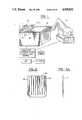
- FIG. 1shows an overall arrangement of apparatus suitable for practicing the present invention.
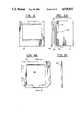
- FIG. 2shows an electrophoresis gel containing radioactive bands, the locations of which can be determined using the apparatus of FIG. 1.
- FIG. 2Ashows a side view of the electrophoresis gel of FIG. 2.
- FIG. 3shows a frame for receiving the electrophoresis gel of FIG. 2.
- FIG. 3Ais a side view of frame 14.
- FIG. 3Bis a top view of frame portion 32.
- FIG. 3Cis a side view of frame portion 32.
- FIG. 3Dis a lower view of frame portion 34.
- FIG. 3Eis a side view of frame portion 34.
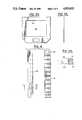
- FIG. 4shows a mounting block for locating a plurality of Geiger-Mueller tubes at predetermined locations.
- FIG. 4Ais a cross-sectional view along lines 4A-4A in FIG. 4.
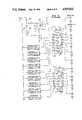
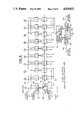
- FIG. 5is a circuit diagram showing suitable circuitry for powering the Geiger-Mueller tubes of FIG. 4, as well as for converting the output of those tubes into digital pulses.
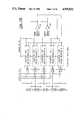
- FIG. 6is a block diagram of circuitry suitable for recording the digital pulses generated by the circuit of FIG. 5 and for transferring the recorded values to a digital computer for further processing.
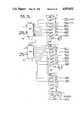
- FIGS. 7A, 7B and 7Care more detailed diagram of the circuitry shown in block form in FIG. 6.
- FIG. 8is a diagram of an interface circuit for use with the circuit of FIG. 7 for transferring data into a digital computer.
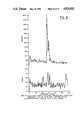
- FIG. 9is a graph comparison and autoradiogram showing comparison of the detection of bacterial DNA (pBR322 DNA) in the presence of human DNA.
- FIG. 10is a graph and autoradiogram showing comparison of the detection of radio-labelled lambda DNA.
- the present inventionrelates to methods and apparatus for determining the distribution of radioactive materials in a medium.
- the inventionis discussed and illustrated with regard to its use in the field of gene analysis, and, in particular, with regard to its use in determining the distribution of a radioactive probe in an electrophoresis gel. It is to be understood that this description of the invention in this particular context is for purposes of illustration only and is not to be interpreted as limiting the applicability of the invention to other fields in which distributions of radioactive materials are to be determined.
- the present inventionhas particularly advantageous applications in the context of an automated gene analysis system of the type described in copending U.S. patent application Ser. No. 497,997, filed May 25, 1985, and entitled "Apparatus and Method for Separating Polynucleotides and Detecting Specific Polynucleotide Sequences," the pertinent portions of which are incorporated herein by reference. See also European Patent Publication No. 134,622, published Mar. 20, 1985, which corresponds to the above U.S. patent application.
- FIG. 1an overall schematic view and block diagram of apparatus suitable for practicing the present invention.
- frame 10for receiving electrophoresis gel 12
- frame 14to which are attached electronic module 16 (printed circuit board; 1 board/lane servicing 10 Geiger-Mueller tubes) and radiation detector mounting blocks 18, which carry Geiger-Mueller radiation counter tubes 20
- robot 22[e.g., a modified Armdroid 1 (Colne Robotics Co., Ltd., Twickenham, England], for moving frame 10 and thus electrophoresis gel 12 past counter tubes 20
- computer 24e.g., a general purpose microcomputer, such as Radio Shack TRS 80 Model 4, or equivalent can be used], for controlling the operation of robot 22 and electronic module 16 and for receiving and processing electrical output from module 16.
- computer 24e.g., a general purpose microcomputer, such as Radio Shack TRS 80 Model 4, or equivalent can be used
- tray 200can optionally be attached to the detector and can be used for storage of weight 201.
- the weight 201can be placed on top of the gel frame of the invention for stabilization purposes during the detection process.
- Electrophoresis gel 12 and frame 10are shown in more detail in FIGS. 2 and 3, respectively.
- gel 12is supported on backing 26 and includes nine individual tracks 28 separated from one another by open spaces 30.
- the inventionwill be illustrated with regard to the multi-track gel shown in FIG. 2, it is to be understood that the invention is equally applicable to a single track gel.
- Each of tracks 28includes radioactive bands created by a hybridization process of the type described above. For typical radiolabeled nucleotides, the bands will emit beta particles, it being understood, of course, that the present invention is equally applicable to other types of emitted radiation, e.g., gamma rays.
- Gel 12is preferably an agarose gel having a thickness of less than about 1.5 mm. See U.S. patent application Ser. No. 497,997, referred to above.
- Backing 26can be made of a polycarbonate plastic and can have a thickness of about 0.062 inches. Support membrane 36 attenuates the radiation emitted.
- frame 10is composed of three parts: upper portion 32, lower portion 34, and support membrane 36.
- the upper and lower portions of the frameare attached to each other by, for example, screws, and together form opening 38 for receiving gel 12.
- Support membrane 36forms the bottom of opening 38 and is attached to lower portion 34 by, for example, being glued thereto.
- Support membrane 36can be composed of mylar or vinyl and can have a thickness of about 0.003 inches, for the purpose of minimizing radiation attenuation.
- Upper portion 32includes chamber 40 which aids robot 22 in placing gel 12 in opening 38.
- FIG. 3shows a top view of frame 14;
- FIG. 3Ashows a side view of frame 14; electronic circuit board 16; Geiger-Mueller tube 20; mounting block 18; membrane 36; lower portion of frame 10, (34); gel 12; and upper portion of frame 10 (32).
- FIG. 3Bshows a top view of upper portion 32; opening 38.
- FIG. 3Cis a side view of 32 showing chamber 40.
- FIG. 3Dis a top view of lower portion 34; opening 38.
- FIG. 3Eis a side view of 34.
- FIG. 4shows in greater detail one of the radiation detector mounting blocks 18 carried by frame 14. In total, nine detector blocks are attached to frame 14, one for each of electrophoresis gel tracks 28.
- Block 18which can be made of a metal, such as, brass, includes a plurality of bores 42 for receiving Geiger-Mueller tubes 20. Although shown offset from the center line of block 18, when assembled onto frame 14, tubes 20 lie along the center lines of gel tracks 28. Conventional Geiger-Mueller tubes, including an anode and cathode sealed within a stainless steel housing filled with a counting gas mixture are used. A suitable Geiger-Mueller tube for use with the present invention is LND Co. Model 715.
- a total of ten Geiger-Mueller tubesare carried by block 18, the tubes being equally spaced from one another.
- a spacing between tubes on the order of approximately 12 mm (center-to-center)has been found suitable, although larger and smaller spacings can also used.
- Geiger-Mueller tubes 20are held in bores 42 by means of set screws 44 which pass through threaded bores 46 and engage the outer housing of tubes 20.
- Block 18also includes bores 48 for attaching block 18 to frame 14, as well as bores 50 for attaching portions of electronics module 16 to block 18.
- block 18includes throughs 52 which extend across the top surface of the block.
- throughs 52which extend across the top surface of the block.
- the throughsintersect bores 42 to produce a rectangular window having a width of approximately 1 mm and a length of approximately 0.180 inches through which radiation can reach detector tubes 20.
- the circuitryalso converts the output of the Geiger-Mueller tubes into digital pulses which can be recorded by the circuit of FIG. 6 and 7, and subsequently processed in computer 24.
- the circuitry of FIG. 5can conveniently be mounted on a single circuit board which can be attached directly to block 18 by means of bores 50. As will be evident, the circuitry of FIGS. 5, 6, and 7 is repeated for each of blocks 18.
- each Geiger-Mueller tube 20is provided with a high voltage, e.g., +500 volts, through resistors 54 and 56.
- a high voltagee.g., +500 volts
- the gasbreaks down producing a spike at the negative input of LM311N comparator 58. If the magnitude of the spike exceeds the threshold value set at the comparator's positive input, e.g., 1.7 volts, the comparator outputs a pulse having a nominal value of +3 volts. This pulse is fed into SN74367 buffer 60 and then to the recording circuitry of FIGS. 6 and 7.
- the recording circuitry of FIGS. 6 and 7receives the output of the circuitry of FIG. 5 at the terminals identified by the numbers 1 through 20 and produces output suitable for subsequent inputting to a microcomputer at the terminals identified by the designations CE1, CE2, CF1, CF2, CH1, CH2, CJ1, CJ2, CK1, CK2, CL1, CL2, CM1, and CM2 (D0T00 through D0T13).
- the circuitryis also designed to receive inputs originating from the microcomputer at terminals DD2, DE1, DE2, DF1, DF2, and DU2. As explained below, these inputs control the flow of data from the detectors to the recording circuitry and from the recording circuitry to the computer.
- the overall operation of the recording circuitrycan best be seen by reference to FIG. 6.
- the output from buffers 60is recorded by 14-bit counters 62.
- Connected to the countersare counter reset line 64 and counter enable line 66.
- computer 24causes a reset signal to be sent along line 64 which resets the total of each of counters 62 to zero.
- the computercauses an enable signal to be sent along line 64 which turns on the counters for a predetermined amount of time, e.g., 30 seconds, during which time the counters record the number of electrical pulses generated by the Geiger-Mueller tubes.
- shift registers 68Connected to counters 62 are shift registers 68. These registers are of the parallel in/serial out type. Connected to the registers are load line 70 and shift line 72. At the end of each counting period, computer 24 causes a load signal to be sent along line 70 which causes the number of counts recorded by the counters to be loaded into the shift registers. Thereafter, the computer causes 16 shift signals to be sent to the shift registers along shift line 72. 16 shifts are necessary because two 8-bit shift registers (SR) are used. These shift signals cause the contents of the tenth shift register to be loaded into serial in/parallel out shift register 74, and the contents of all the remaining shift registers to be loaded into the next downstream register by means of lines 76.
- SR8-bit shift registers
- the information in shift register 74is sent to computer 24 by means of data bus 82 and tri-state buffers 78 and 80.
- computer 24causes a strobe signal to be inputted into buffer 78 along line 84, allowing that buffer to transfer its contents to bus 82 and thus to the computer.
- a strobe signalis inputted into buffer 80 along line 86, allowing that buffer to transfer its contents to the computer.
- fourteen bit counters 62can be composed of a SN74LS93 counter 84 connected to a MC14040BAL counter 86.
- Parallel in/serial out shift registers 68can be composed of two MC14021BAL shift registers 88 and 90.
- Serial in/parallel out shift register 74can be composed of two SN74LS164 shift registers 92 and 94.
- Tri-state buffers 78 and 80can be composed of three SN74LS365 buffers 96, 98 and 100 (only part of buffer 100 is used) in combination with the interface circuit of FIG. 8 which employs three LS367 buffers 101.
- Resetting of the countersoccurs through terminal DE1 and SN7404 inverter 102.
- Countingis enabled through terminal DF2 and SN7404 inverter 104.
- Pulses from buffers 60enter the counters through 314E221331 terminators 106 and SN74LS510 NAND gates 108.
- NAND gates 108also receive a high input along line 110 from SN7404 inverter 112.
- Loading of the counter totals into the parallel in/serial out shift registersoccurs through terminal DE2 and SN7404 inverter 114.
- Downstream shifting from shift register to shift registeroccurs through terminal DD2 and SN7404 inverter 116.
- Strobing of the tri-state buffersoccurs through terminal DU2, which selects the set of Geiger-Mueller tubes from which data is to be transferred to the computer, terminal DF1 which enables buffers 96, 98, and 100, and the NOT LOW STB and NOT HIGH STB inputs of FIG. 8 which determine whether the most or least significant bits at terminals CE1, CE2, CF1, CF2, CH1, CH2, CJ1, CJ2, CK1, CK2, CL1, CL2, CM1, and CM2 (D0T00 through D0Tl3) are transferred to terminals DB0IN through DB7IN.
- Robot 22which is under the control of computer 24, places electrophoresis gel 12 into frame 10 and positions that frame with respect to stationary frame 14 at a first predetermined position wherein gel tracks 28, which include the radioactive bands whose positions are to be determined, lie over Geiger-Mueller tubes 20, with the left hand edge of the tracks (as seen in FIG. 1) being positioned over the tenth detector tube for each track.
- the computerresets and then enables 16-bit counters 62 for a predetermined period of time, e.g., 30 seconds, during which time the counters record the number of pulses generated by the detector tubes. Thereafter, the computer causes the contents of counters 62 to be loaded into 16-bit shift registers 68.
- robot 22moves frame 10 and gel 12 to the left (as seen in FIG. 1) so as to place the gel and the detectors at a second predetermined position with respect to one another.
- the datacan be displayed, processed and analyzed using standard data manipulation techniques. For example, the data can be smoothed by using a hanning window-type software filter.
- the weight 201 stored in tray 200 as shown in FIG. 1may optionally be placed on top of gel 12 in order to maintain contact with the detector during the measurement of radioactivity.
- Example 1A similar experiment to Example 1 above was performed using a sample of lambda phage DNA digested with HindIII and the methods of Example 1. A P 32 probe of lambda DNA digest was used. The resultant gel was radiofluorographed 33 hours and evaluated by the detector of the invention at the rate of 10 minutes/mm for a total time of 2 hours. Results of this experiment are presented in FIG. 10. The detector of the invention rapidly produces a graphic quantitative measurement of the radiolabelled bands of the gel.
Landscapes
- Health & Medical Sciences (AREA)
- Life Sciences & Earth Sciences (AREA)
- Molecular Biology (AREA)
- Physics & Mathematics (AREA)
- General Physics & Mathematics (AREA)
- Chemical & Material Sciences (AREA)
- Spectroscopy & Molecular Physics (AREA)
- High Energy & Nuclear Physics (AREA)
- Biochemistry (AREA)
- General Health & Medical Sciences (AREA)
- Analytical Chemistry (AREA)
- Immunology (AREA)
- Pathology (AREA)
- Electrochemistry (AREA)
- Chemical Kinetics & Catalysis (AREA)
- Measurement Of Radiation (AREA)
Abstract
Description
This is a continuation of co-pending of application Ser. No. 170,042, filed on 3/11/88, now abandoned, which is a continuation of application Ser. No. 797,725, filed 13 Nov. 1985.
1. Field of the Invention
This invention relates to methods and apparatus for determining distributions of radioactive materials. More particularly, it relates to methods and apparatus for determining distributions of radioactive materials wherein the distribution has been produced by a chromatography process, such as, an electrochromatography (electrophoresis) process.
2. Description of the Prior Art
By way of background, a variety of radioisotopes are currently used in chemical and medical research. Chromatographic procedures are routinely applied to separate isolate, and identify radioactively-labelled organic substances. The ability to effect such separation and identification of such radioactively-labelled materials has helped to increase their applications, especially in biochemical research. Thin-layer chromatography, column chromatographic techniques, electrophoresis, and paper chromatography can be used in suitable situations and have various sensitivities. Long-lived radioisotopes, which are generally weak beta emitters, are preferentially used for chemical and biological studies. Of particular importance are radiocarbon, C14, and radioactive hydrogen (Tritium), H3 Radioactive phosphorus, P32, radioactive sulphur, S35, and radioactive iodine, I131, are also frequently used. Autoradiograms are limited in that no direct quantitative measurement of the relative strength of different bands is provided and that the procedures are often difficult to perform and require extended periods of time.
There are two major methods of detecting radiation in electro or other chromatograms: (i) autoradiography; and (ii) counting tubes and scintillation counters. Autoradiograms are produced as a result of the ability of alpha, beta, and gamma rays to darken photographic emulsions. The dry chromatogram is pressed against an X-ray film, wrapped, and kept in the dark for a period of time depending upon the nature of the radio isotopes involved. For example, C14 labelled compounds are usually left in contact with X-ray film for 1-8 days; tritiated substances have to be exposed for more than a week; and P32 or I131 compounds can produce good autoradiograms in some cases in less than six hours. In the case of the detection of compounds containing different radioisotopes and double labelled substances on the same chromatogram, it is necessary to produce several autoradiograms over several months (i.e., the earlier autoradiographs would show spots caused by both isotopes, whereas the later autoradiographs would only show the isotope with the longer half life). Double emulsion radioautography, or mixed radioautography radiofluography can be used to detect dual labelled substances.
Paper chromatograms of radioactive substances can be quantitatively evaluated by a Geiger-Mueller counting tube, by use of a proportional counter, or by scintillation counting. Commercial devices for the detection and recording of material on an automatically transported paper strip or on a two-dimensional chromatogram are commercially available. Similar instruments for use with plates or gels are known.
Various patents have issued concerned with methods and devices for the detection of radioactively-labelled materials which have been chromatographically separated. Examples of such patents are: U.S. Pat. Nos. 3,027,453; 3,033,986; 4,019,057; 4,110,615; 4,311,908; 4,431,921; 4,028,549; 4,298,796; 3,814,939; 4,214,161; 4,267,451; 4,275,300; and 4,469,601. These publications are incorporated herein by way of reference.
In the field of biochemistry with particular reference to gene analysis, the standard technique for analyzing mixtures of polynucleotides involves the use of electrochromatography in combination with radioactive polynucleotide probes having known sequences. See E. Southern, "Gel Electrophoresis of Restriction Fragments," Methods in Enzymology, Vol. 68, 1979, pages 152-176.
In accordance with this technique, the mixture of polynucleotides to be analyzed is applied to a suitable electrophoresis gel, such as, an agarose or polyacrylamide gel, and an electric field is applied across the gel to separate the mixture into discrete bands. As a result of the separation, the polynucleotides in any particular band will in general have the same molecular weight and electrical charge.
Once the separation has been completed, denaturation is generally effected and a radioactive probe is applied to the gel and allowed to hybridize with the bands. The gel is then washed to remove unhybridized probe. As a result of this procedure, those bands, and presumably only those bands, which include polynucleotide sequences complementary to the probe sequence end up being radioactive. Radioactive bands can be obtained in other ways. For example, the mixture of polynucleotides to be analyzed can be radiolabeled, separated using electrophoresis, and then hybridized with cold probe. Non-hybridized sequences can then be removed using an enzyme, such as, mung bean nuclease or nuclease S1, which preferentially breaks down single stranded polynucleotides. Again, the final product is a gel having discrete bands of radioactivity.)
Once the hybridization has been completed, the gels must be analyzed to determine where the radioactive bands are located. It is to this aspect of the overall process that the present invention is directed.
Prior to the present invention, the location of the radioactive bands has in most cases been determined through the use of X-ray films (autoradiography). Specifically, in the standard "Southern Blot" procedure, see E. Southern, Methods in Enzymology, supra, the radioactive bands in the gel have been transferred to a second medium, such as a sheet of cellulose nitrate paper, and a sheet of photographic film has been placed next to the second medium so that the radiation emitted by the radioactive bands ban locally expose the film. The film has then been developed using conventional techniques, and the bands analyzed visually to determine the presence or absence of specific polynucleotide sequences in the mixture of polynucleotides.
This photographic procedure has numerous disadvantages which are well known in the art. For example, it can often take exceedingly long periods of time to expose the film, e.g., periods of time on the order of week or more. Moreover, the process involves numerous manipulative steps both in terms of exposing the film and in terms of developing it. Overriding these physical problems is the fact that the ultimate output of the photographic process is simply a piece of film having a series of exposed bands therein. Output of this type has in general only been interpretable by skilled personnel.
In addition to the use of autoradiography, electrophorsis gels having radioactive bands have also been analyzed by scintillation counting. In this procedure the gel containing radioactive bands sliced or cut, dissolved in a certain scintillant, and subsequent light emissions are then measured. This procedure can produce quantitative results, but resolution is limited by the size of the slices of gel (typically 1 mm or greater).
Although one of the major applications of the invention herein described involves the analysis of genetic material, chromatography employing radioactive materials is also widely used in diverse chemical, and particularly biochemical, disciplines. As with gene analysis, in these fields radioactive materials become distributed in a supporting medium and there is a need to determine the distribution of those materials within the medium. Accordingly, the present invention is applicable to these fields also.
In view of the foregoing state of the art, it is an object of this invention to provide improved methods and apparatus for determining the distribution of a radioactive material in a medium. In particular, it is an object of the invention to provide automated methods and apparatus for making such determinations. In addition, it is an object of the invention to provide such methods and apparatus wherein the output produced is in an electrical form, suitable for computer processing.
To achieve the foregoing and other objects, the invention in accordance with certain of its aspects provides a method for determining the distribution of a radioactive material in a medium comprising the steps of:
(a) providing a plurality of radiation detectors at a set of predetermined locations, each of said detectors producing an electrical output indicative of the amount of radioactive material in the vicinity of the detector;
(b) moving the medium containing the radioactive material and the plurality of radiation detectors relative to one another so as to position the medium relative to the detectors at each of a set of predetermined positions; and
(c) recording the electrical output of each of the detectors at each of the predetermined positions.
In accordance with others of its aspects, the invention provides an apparatus for determining the distribution of a radioactive material in a medium comprising:
(a) first means for locating a plurality of radiation detectors at a set of predetermined locations, each of said detectors producing an electrical output indicative of the amount of radioactive material in the vicinity of the detector;
(b) second means for receiving the medium containing the radioactive material;
(c) third means for moving the first and second means relative to one another so as to position the medium relative to the detectors at each of a set of predetermined positions and said movement means is amenable to computer control; and
(d) fourth means for recording the electrical output of each of the detectors at each of the predetermined positions.
In accordance with certain preferred embodiments of the invention, the plurality of radiation detectors are arranged in a straight line and the medium and the detectors are moved relative to one another along a path parallel to that line. In accordance with these embodiments, it is further preferred for the predetermined locations of the detectors to be equally spaced from one another, for the predetermined relative positions of the medium and the detectors to be also equally spaced, and for the spacing between the predetermined positions to be smaller than the spacing between the predetermined locations.
In accordance with other preferred embodiments, Geiger-Mueller radiation detector tubes are used as the radiation detectors and the radiation emitted by the radioactive material in the medium is collimated before it reaches the Geiger-Mueller tubes.
The accompanying drawings, which are incorporated in and constitute part of the specification, illustrate the preferred embodiments of the invention, and together with the description, serve to explain the principles of the invention.
FIG. 1 shows an overall arrangement of apparatus suitable for practicing the present invention.
FIG. 2 shows an electrophoresis gel containing radioactive bands, the locations of which can be determined using the apparatus of FIG. 1.
FIG. 2A shows a side view of the electrophoresis gel of FIG. 2.
FIG. 3 shows a frame for receiving the electrophoresis gel of FIG. 2.
FIG. 3A is a side view offrame 14.
FIG. 3B is a top view offrame portion 32.
FIG. 3C is a side view offrame portion 32.
FIG. 3D is a lower view offrame portion 34.
FIG. 3E is a side view offrame portion 34.
FIG. 4 shows a mounting block for locating a plurality of Geiger-Mueller tubes at predetermined locations.
FIG. 4A is a cross-sectional view alonglines 4A-4A in FIG. 4.
FIG. 5 is a circuit diagram showing suitable circuitry for powering the Geiger-Mueller tubes of FIG. 4, as well as for converting the output of those tubes into digital pulses.
FIG. 6 is a block diagram of circuitry suitable for recording the digital pulses generated by the circuit of FIG. 5 and for transferring the recorded values to a digital computer for further processing.
FIGS. 7A, 7B and 7C are more detailed diagram of the circuitry shown in block form in FIG. 6. FIG. 8 is a diagram of an interface circuit for use with the circuit of FIG. 7 for transferring data into a digital computer.
FIG. 9 is a graph comparison and autoradiogram showing comparison of the detection of bacterial DNA (pBR322 DNA) in the presence of human DNA.
FIG. 10 is a graph and autoradiogram showing comparison of the detection of radio-labelled lambda DNA.
As described above, the present invention relates to methods and apparatus for determining the distribution of radioactive materials in a medium. In the description which follows, the invention is discussed and illustrated with regard to its use in the field of gene analysis, and, in particular, with regard to its use in determining the distribution of a radioactive probe in an electrophoresis gel. It is to be understood that this description of the invention in this particular context is for purposes of illustration only and is not to be interpreted as limiting the applicability of the invention to other fields in which distributions of radioactive materials are to be determined.
With regard to the field of gene analysis, the present invention has particularly advantageous applications in the context of an automated gene analysis system of the type described in copending U.S. patent application Ser. No. 497,997, filed May 25, 1985, and entitled "Apparatus and Method for Separating Polynucleotides and Detecting Specific Polynucleotide Sequences," the pertinent portions of which are incorporated herein by reference. See also European Patent Publication No. 134,622, published Mar. 20, 1985, which corresponds to the above U.S. patent application.
Referring now to the figures, there is shown in FIG. 1 an overall schematic view and block diagram of apparatus suitable for practicing the present invention. Four main components are shown: (1)frame 10 for receivingelectrophoresis gel 12; (2)frame 14 to which are attached electronic module 16 (printed circuit board; 1 board/lane servicing 10 Geiger-Mueller tubes) and radiationdetector mounting blocks 18, which carry Geiger-Muellerradiation counter tubes 20; (3)robot 22, [e.g., a modified Armdroid 1 (Colne Robotics Co., Ltd., Twickenham, England], for movingframe 10 and thus electrophoresisgel 12past counter tubes 20; and (4)computer 24, [e.g., a general purpose microcomputer, such asRadio Shack TRS 80Model 4, or equivalent can be used], for controlling the operation ofrobot 22 andelectronic module 16 and for receiving and processing electrical output frommodule 16.
The modifications of theArmdroid 1 robot specified above are described in copending patent application Ser. No. 797, 729 (this application is a continuation-in-part of Ser. No. 497,997, filed May 25, 1983 and entitled "Apparatus and Method for Separating Polynucleotides and Detecting Specific Polynucleotide Sequences").
Referring to FIG. 1,tray 200 can optionally be attached to the detector and can be used for storage ofweight 201. Theweight 201 can be placed on top of the gel frame of the invention for stabilization purposes during the detection process.
As shown in FIGS. 3-3E,frame 10 is composed of three parts:upper portion 32,lower portion 34, andsupport membrane 36. The upper and lower portions of the frame are attached to each other by, for example, screws, and together form opening 38 for receivinggel 12.Support membrane 36 forms the bottom of opening 38 and is attached tolower portion 34 by, for example, being glued thereto.Support membrane 36 can be composed of mylar or vinyl and can have a thickness of about 0.003 inches, for the purpose of minimizing radiation attenuation.Upper portion 32 includeschamber 40 which aidsrobot 22 in placinggel 12 inopening 38.
FIG. 3 shows a top view offrame 14; FIG. 3A shows a side view offrame 14;electronic circuit board 16; Geiger-Mueller tube 20; mountingblock 18;membrane 36; lower portion offrame 10, (34);gel 12; and upper portion of frame 10 (32). FIG. 3B shows a top view ofupper portion 32;opening 38. FIG. 3C is a side view of 32 showingchamber 40. FIG. 3D is a top view oflower portion 34;opening 38. FIG. 3E is a side view of 34.
Turning now to FIG. 4, this figure shows in greater detail one of the radiationdetector mounting blocks 18 carried byframe 14. In total, nine detector blocks are attached to frame 14, one for each of electrophoresis gel tracks 28.
As shown in FIG. 4, a total of ten Geiger-Mueller tubes are carried byblock 18, the tubes being equally spaced from one another. For analyzing electrophoresis gels, a spacing between tubes on the order of approximately 12 mm (center-to-center) has been found suitable, although larger and smaller spacings can also used.
Geiger-Mueller tubes 20 are held inbores 42 by means ofset screws 44 which pass through threadedbores 46 and engage the outer housing oftubes 20.Block 18 also includesbores 48 for attachingblock 18 to frame 14, as well asbores 50 for attaching portions ofelectronics module 16 to block 18.
To collimate the radiation being emitted fromgel 12 before the radiation reachestubes 20, block 18 includesthroughs 52 which extend across the top surface of the block. For the Geiger-Mueller tubes described above, it has been found suitable to use throughs having a width of approximately 1 mm and a depth of approximately 0.015 inches. The throughs intersect bores 42 to produce a rectangular window having a width of approximately 1 mm and a length of approximately 0.180 inches through which radiation can reachdetector tubes 20. By collimating the radiation in this way, it has been found that each Geiger-Mueller tube is primarily responsive to the transverse portion of the gel nearest the tube and not particularly responsive to transverse portions ahead or behind the nearest portion.
Referring now to FIG. 5, there is shown in this figure circuitry suitable for powering the ten Geiger-Mueller tubes carried by one of blocks 18. The circuitry also converts the output of the Geiger-Mueller tubes into digital pulses which can be recorded by the circuit of FIG. 6 and 7, and subsequently processed incomputer 24. The circuitry of FIG. 5 can conveniently be mounted on a single circuit board which can be attached directly to block 18 by means ofbores 50. As will be evident, the circuitry of FIGS. 5, 6, and 7 is repeated for each of blocks 18.
As shown in FIG. 5, each Geiger-Mueller tube 20 is provided with a high voltage, e.g., +500 volts, throughresistors LM311N comparator 58. If the magnitude of the spike exceeds the threshold value set at the comparator's positive input, e.g., 1.7 volts, the comparator outputs a pulse having a nominal value of +3 volts. This pulse is fed intoSN74367 buffer 60 and then to the recording circuitry of FIGS. 6 and 7.
It has been found that the presence of sharp edges at the connection ofresistor 56 todetector tube 20 can result in false pulses being produced by the circuitry of adjacent detectors when one detector fires. To avoid this problem, it has been found advantageous to use Geiger-Mueller tubes of the type described above and to directly connectresistor 56 to those tubes using the screw-on cap which forms the top part of the tubes.
The recording circuitry of FIGS. 6 and 7 receives the output of the circuitry of FIG. 5 at the terminals identified by thenumbers 1 through 20 and produces output suitable for subsequent inputting to a microcomputer at the terminals identified by the designations CE1, CE2, CF1, CF2, CH1, CH2, CJ1, CJ2, CK1, CK2, CL1, CL2, CM1, and CM2 (D0T00 through D0T13). The circuitry is also designed to receive inputs originating from the microcomputer at terminals DD2, DE1, DE2, DF1, DF2, and DU2. As explained below, these inputs control the flow of data from the detectors to the recording circuitry and from the recording circuitry to the computer. Depending upon the microcomputer used, its programming, and the physical layout of the components, it may be convenient to use interface/buffer circuits of the type illustrated in FIG. 8 between the microcomputer and the circuitry of FIGS. 6 and 7.
The overall operation of the recording circuitry can best be seen by reference to FIG. 6. The output frombuffers 60 is recorded by 14-bit counters 62. Connected to the counters are counter resetline 64 and counter enableline 66. At the beginning of each counting period,computer 24 causes a reset signal to be sent alongline 64 which resets the total of each ofcounters 62 to zero. Thereafter, the computer causes an enable signal to be sent alongline 64 which turns on the counters for a predetermined amount of time, e.g., 30 seconds, during which time the counters record the number of electrical pulses generated by the Geiger-Mueller tubes.
Connected tocounters 62 areshift registers 68. These registers are of the parallel in/serial out type. Connected to the registers areload line 70 andshift line 72. At the end of each counting period,computer 24 causes a load signal to be sent alongline 70 which causes the number of counts recorded by the counters to be loaded into the shift registers. Thereafter, the computer causes 16 shift signals to be sent to the shift registers alongshift line 72. 16 shifts are necessary because two 8-bit shift registers (SR) are used. These shift signals cause the contents of the tenth shift register to be loaded into serial in/parallelout shift register 74, and the contents of all the remaining shift registers to be loaded into the next downstream register by means oflines 76.
The information inshift register 74 is sent tocomputer 24 by means ofdata bus 82 andtri-state buffers computer 24 causes a strobe signal to be inputted intobuffer 78 alongline 84, allowing that buffer to transfer its contents tobus 82 and thus to the computer. Thereafter, a strobe signal is inputted intobuffer 80 alongline 86, allowing that buffer to transfer its contents to the computer.
Once the contents of the tenth shift register have been transferred tocomputer 24, sixteen additional shift signals are sent to the shift registers alongshift line 72, causing the contents of the ninth shift register to move into serial in/parallelout shift register 74, and the contents of all the other shift registers to move one shift register downstream. The new contents ofshift register 74 is then transferred to the computer following the same procedure as described above, and the process is repeated eight more times until the contents of all the shift registers have been loaded into the computer. It is important to note that while this loading of data into the computer is taking place, counters 62 can be enabled so that counting of pulses can take place simultaneously with data transfer to the computer.
Specific apparatus for implementing the circuit of FIG. 6 is shown in FIGS. 7 and 8. As shown therein, fourteen bit counters 62 can be composed of aSN74LS93 counter 84 connected to aMC14040BAL counter 86. Parallel in/serial out shift registers 68 can be composed of two MC14021BAL shift registers 88 and 90. Serial in/parallelout shift register 74 can be composed of two SN74LS164 shift registers 92 and 94.Tri-state buffers buffer 100 is used) in combination with the interface circuit of FIG. 8 which employs three LS367 buffers 101.
Resetting of the counters occurs through terminal DE1 andSN7404 inverter 102. Counting is enabled through terminal DF2 andSN7404 inverter 104. Pulses frombuffers 60 enter the counters through314E221331 terminators 106 andSN74LS510 NAND gates 108. In addition to the pulse signal and the enable signal,NAND gates 108 also receive a high input alongline 110 from SN7404 inverter 112. Loading of the counter totals into the parallel in/serial out shift registers occurs through terminal DE2 andSN7404 inverter 114. Downstream shifting from shift register to shift register occurs through terminal DD2 andSN7404 inverter 116. Strobing of the tri-state buffers occurs through terminal DU2, which selects the set of Geiger-Mueller tubes from which data is to be transferred to the computer, terminal DF1 which enablesbuffers
With reference to FIG. 1, the operation of the apparatus is as follows.Robot 22, which is under the control ofcomputer 24, places electrophoresisgel 12 intoframe 10 and positions that frame with respect tostationary frame 14 at a first predetermined position wherein gel tracks 28, which include the radioactive bands whose positions are to be determined, lie over Geiger-Mueller tubes 20, with the left hand edge of the tracks (as seen in FIG. 1) being positioned over the tenth detector tube for each track.
Next, the computer resets and then enables 16-bit counters 62 for a predetermined period of time, e.g., 30 seconds, during which time the counters record the number of pulses generated by the detector tubes. Thereafter, the computer causes the contents ofcounters 62 to be loaded into 16-bit shift registers 68.
Upon the completion of loading,robot 22moves frame 10 andgel 12 to the left (as seen in FIG. 1) so as to place the gel and the detectors at a second predetermined position with respect to one another. For Geiger-Mueller tubes of the type described above and for a 12 mm spacing between tubes, it has been found convenient to move the gel with respect to the tubes in increments of either 1 mm, for higher speed scans, or 1/2 or 1/4 mm, for higher resolution scans. In this way, a complete gel can be scanned in 12, 24, or 48 steps for the 1, 1/2, and 1/4 mm increments, respectively. In terms of time, for a recording period of 30 seconds at each position, this corresponds to scan times of from 6 to 24 minutes for a complete gel. Other convenient recording periods may be conveniently employed.
Once the gel has been located at its new position, data recording is again commenced by resetting and then enabling counters 62. During both moving of the gel and, if need be, during the initial recording of data at the new location, data is transferred tocomputer 24 from shift registers 68. In this way, no time is lost waiting for data transfer to be completed from the 90 detectors (10 detectors per gel track ×9 gel tracks). The record-move-record process with simultaneous data transfer is repeated until the entire gel has been scanned.
Once all of the data has been transferred tocomputer 24, it can be displayed, processed and analyzed using standard data manipulation techniques. For example, the data can be smoothed by using a hanning window-type software filter.
Although specific embodiments of the invention have been described and illustrated, it is to be understood that modifications can be made without departing from the invention's spirit and scope. For example, rather than using a robot to move the gel past the detectors, a separate motor (stepper motor) can be employed for this purpose. Similarly, a variety of circuits and circuit components other than those shown can be used to practice the present invention.
During the operation of the detector of the invention, theweight 201 stored intray 200 as shown in FIG. 1 may optionally be placed on top ofgel 12 in order to maintain contact with the detector during the measurement of radioactivity.
The following non-limiting Examples further serve to illustrate the invention.
An experiment was designed to compare detection of radioactively-labelled compounds on the electrophoresis gel using the apparatus previously described (continuation-in-part application Ser. No. 797,729, filed Nov. 13, 1985 and entitled "Apparatus and Method for Separating Polynucleotides and Detecting Specific Polynucleotide Sequences") and including detector of the invention with autoradiography detection of the same sample. A sample of human DNA from blood was extracted and purified using the technique described in Maniatis et al., Molecular Cloning, Cold Springs Harbor Laboratory, pp. 104-106 (1982), and digested 11/2 hours with Bg1I endonuclease. pBR322 DNA was purchased from Bethesda Research Labs. and similarly cut with Bg1I. These bacterial and human samples of DNA were then separated by gel electrophoresis using a thin agarose gel. The gel was dried for 10 minutes in a microwave-vacuum dryer. The microwave dryer is described in copending U.S. patent application Ser. No. 343,256, filed Jan. 27, 1982. Denaturation of the separated material was effected using NaOH. The sample was then prehybridized to block all extraneous sites by circulation in a prehybridization mixture containing: 50% formamide (v/v); 5×Denhardt's Soln; 5×SSPE (per/1 43.5 g NaCl; 6.9 g NaH2 PO4. H2 O; 1.85 Na2.EDTA; pH 7.4); 400 mg/ml Salmon Sperm DNA; and 0.19 (v/v) SDS (Sodium Dodecyl Sulfate), and hybridized with a single-stranded P32 pBR322 DNA probe. Following hybridization, the sample was washed twice with SSC (standard saline citrate per/1: 8.76 g NaCl2 : 4.41 g Na.Citrate, pH 7.0), then 0.1×SSC, then water, dried again using a microwave dryer, and evaluated. An autoradiograph of 36 hours duration was obtained, and the detector of the invention was used to obtain a graphic evaluation in 2 hours, 18 minutes (at a rate of 11.5 minutes of counting/mm traversed). Results of this experiment are presented in FIG. 9. It can be seen that the detector of the invention rapidly produces a graphic quantitative measurement of the different bands of the gel.
A similar experiment to Example 1 above was performed using a sample of lambda phage DNA digested with HindIII and the methods of Example 1. A P32 probe of lambda DNA digest was used. The resultant gel was radiofluorographed 33 hours and evaluated by the detector of the invention at the rate of 10 minutes/mm for a total time of 2 hours. Results of this experiment are presented in FIG. 10. The detector of the invention rapidly produces a graphic quantitative measurement of the radiolabelled bands of the gel.
Claims (9)
1. A method for determining the quantitative distribution of bands of a radioactive material spaced lengthwise along a medium which is in the form of a narrow elongated track, said radioactive material comprising a radioactive isotope which emits radiation, said method comprising the steps of:
(a) providing a plurality of identical radiation detectors at a set of predetermined locations spaced along the length of the track, said radiation detectors being arranged in a straight line, said predetermined locations being equally spaced from one another, center-to-center, by a distance D, and each of said detectors producing an electrical output indicative of the amount of radioactive material in each said band in the vicinity of the detector;
(b) moving the medium containing the radioactive material and the plurality of radiation detectors relative to one another in a step-like manner only along a path parallel to the straight line and parallel to the long axis of the track so as to position the medium and radioactive bands relative to the detectors at each of a plurality of predetermined positions which are equally spaced from one another by a distance d, the spacing D between the predetermined locations being several times greater than the spacing d between the predetermined positions, the total relative movement of the medium and the plurality of radiation detectors being equal to the spacing D between the predetermined locations;
(c) simultaneously measuring the amount of radioactive material in each of the bands in the vicinity of each of the detectors after each step at each of the predetermined positions by means of the electrical output produced by the individual detectors; and
(d) recording the electrical output of each of the detectors at each of the predetermined positions to produce simultaneous measurements of the amount of radioactive material in each of the spaced bands along the elongated track.
2. The method of claim 1 wherein the spacing between the predetermined locations is greater than the spacing between the predetermined positions by a factor of 10 or more.
3. The method of claim 1 wherein the relative motion between the plurality of radiation detectors and the medium is achieved by holding the detectors stationary and moving the medium past the detectors.
4. The method of claim 1 including the additional step of providing identical collimating means between the medium and each of the detectors for collimating the radiation emitted by the radioactive material in the medium before said radiation reaches the detectors, each said collimating means forming a rectangular through in front of each of the detectors, the long axis of the rectangle extending across the width of the track so that each detector is primarily responsive to the transverse portion of the track nearest the detector rather than transverse portions of the track ahead or behind the nearest portion.
5. Apparatus for determining the distribution of a radioactive material in a medium which is in the form of a narrow elongated track, said radioactive material comprising a radioactive isotope which emits radiation, said apparatus comprising:
(a) first means for supporting a plurality of identical radiation detectors at a set of predetermined locations spaced along the length of the track, said radiation detectors being arranged in a straight line, said predetermined locations being equally spaced from one another, center to center, by a distance D, and each of said detectors producing an electrical output indicative of the amount of radioactive material in each said band in the vicinity of the detector;
(b) second means for receiving the medium containing the radioactive material;
(c) third means for moving the first and second means relative to one another in a step-like manner only along a path parallel to the straight line and parallel to the long axis of the track so as to position the medium and radioactive bands relative to the detectors at a plurality of predetermined positions which are equally spaced from one another by a distance d, the spacing D between the predetermined locations being several times greater than the spacing d between the predetermined positions, the total relative movement of the first and second means being equal to the spacing D between the predetermined locations; and
(d) fourth means for simultaneously recording the electrical output of each of the detectors after each step at each of the predetermined positions.
6. The apparatus of claim 5 wherein the spacing between the predetermined location is greater than the spacing between the predetermined positions by a factor of 10 or more.
7. The apparatus of claim 5 wherein the first means is stationary and the second means is moved past the first means by the third means.
8. The apparatus of claim 5 wherein the radiation detectors are Geiger-Mueller detector tubes.
9. The apparatus of claim 8 wherein the first means includes identical collimating means for collimating the radiation emitted by the radioactive material in the medium before said radiation reaches the detectors each said collimating means forming a rectangular through in front of each of the detectors, the long axis of the rectangle extending across the width of the track so that each detector is primarily responsive to the transverse portion of the track nearest the detector rather than transverse portions of the track ahead or behind the nearest portion.
Priority Applications (1)
| Application Number | Priority Date | Filing Date | Title |
|---|---|---|---|
| US07/291,393US4929832A (en) | 1988-03-11 | 1988-12-27 | Methods and apparatus for determining distributions of radioactive materials |
Applications Claiming Priority (2)
| Application Number | Priority Date | Filing Date | Title |
|---|---|---|---|
| US17004288A | 1988-03-11 | 1988-03-11 | |
| US07/291,393US4929832A (en) | 1988-03-11 | 1988-12-27 | Methods and apparatus for determining distributions of radioactive materials |
Related Parent Applications (1)
| Application Number | Title | Priority Date | Filing Date |
|---|---|---|---|
| US17004288AContinuation | 1988-03-11 | 1988-03-11 |
Publications (1)
| Publication Number | Publication Date |
|---|---|
| US4929832Atrue US4929832A (en) | 1990-05-29 |
Family
ID=26865634
Family Applications (1)
| Application Number | Title | Priority Date | Filing Date |
|---|---|---|---|
| US07/291,393Expired - Fee RelatedUS4929832A (en) | 1988-03-11 | 1988-12-27 | Methods and apparatus for determining distributions of radioactive materials |
Country Status (1)
| Country | Link |
|---|---|
| US (1) | US4929832A (en) |
Cited By (39)
| Publication number | Priority date | Publication date | Assignee | Title |
|---|---|---|---|---|
| US20030139661A1 (en)* | 2001-01-22 | 2003-07-24 | Yoav Kimchy | Ingestible device |
| US20040054278A1 (en)* | 2001-01-22 | 2004-03-18 | Yoav Kimchy | Ingestible pill |
| US20040116807A1 (en)* | 2002-10-17 | 2004-06-17 | Roni Amrami | Blood vessels wall imaging catheter |
| US20040204646A1 (en)* | 2002-11-04 | 2004-10-14 | V-Target Technologies Ltd. | Intracorporeal-imaging head |
| US20050055174A1 (en)* | 2000-08-21 | 2005-03-10 | V Target Ltd. | Radioactive emission detector equipped with a position tracking system and utilization thereof with medical systems and in medical procedures |
| US20050205792A1 (en)* | 2004-01-13 | 2005-09-22 | Benny Rousso | Multi-dimensional image reconstruction |
| US20050266074A1 (en)* | 2004-05-20 | 2005-12-01 | Yoel Zilberstein | Ingestible device platform for the colon |
| US20060220919A1 (en)* | 2005-04-01 | 2006-10-05 | Pitts Robert W Jr | System for Monitoring and Tracking One or More Radioactive Sources |
| US20070128591A1 (en)* | 2001-07-17 | 2007-06-07 | Fishman Mark C | Methods for diagnosing and treating diseases and conditions of the digestive system and cancer |
| US20070156047A1 (en)* | 2000-08-21 | 2007-07-05 | Michael Nagler | Radioactive-emission-measurement optimization to specific body structures |
| US20090078875A1 (en)* | 2004-11-09 | 2009-03-26 | Spectrum Dynamics Llc | Radioimaging |
| US20090152471A1 (en)* | 2005-11-09 | 2009-06-18 | Spectrum Dynamics Llc | Dynamic Spect Camera |
| US20090190807A1 (en)* | 2005-07-19 | 2009-07-30 | Spectrum Dynamics Llc | Reconstruction Stabilizer and Active Vision |
| US7601966B2 (en) | 2006-06-28 | 2009-10-13 | Spectrum Dynamics Llc | Imaging techniques for reducing blind spots |
| US20090282004A1 (en)* | 2008-05-06 | 2009-11-12 | Radiocarb Genetics, Inc. | Method for analyzing, labeling and certifying low radiocarbon food products |
| US7652259B2 (en) | 2000-08-21 | 2010-01-26 | Spectrum Dynamics Llc | Apparatus and methods for imaging and attenuation correction |
| US20100245354A1 (en)* | 2004-01-13 | 2010-09-30 | Spectrum Dynamics Llc | Dynamic spect camera |
| US7872235B2 (en) | 2005-01-13 | 2011-01-18 | Spectrum Dynamics Llc | Multi-dimensional image reconstruction and analysis for expert-system diagnosis |
| US8204500B2 (en) | 2005-12-28 | 2012-06-19 | Starhome Gmbh | Optimal voicemail deposit for roaming cellular telephony |
| US8280124B2 (en) | 2004-06-01 | 2012-10-02 | Spectrum Dynamics Llc | Methods of view selection for radioactive emission measurements |
| US8338788B2 (en) | 2009-07-29 | 2012-12-25 | Spectrum Dynamics Llc | Method and system of optimized volumetric imaging |
| US8445851B2 (en) | 2004-11-09 | 2013-05-21 | Spectrum Dynamics Llc | Radioimaging |
| US8489176B1 (en) | 2000-08-21 | 2013-07-16 | Spectrum Dynamics Llc | Radioactive emission detector equipped with a position tracking system and utilization thereof with medical systems and in medical procedures |
| US8521253B2 (en) | 2007-10-29 | 2013-08-27 | Spectrum Dynamics Llc | Prostate imaging |
| US8565860B2 (en) | 2000-08-21 | 2013-10-22 | Biosensors International Group, Ltd. | Radioactive emission detector equipped with a position tracking system |
| US8571881B2 (en) | 2004-11-09 | 2013-10-29 | Spectrum Dynamics, Llc | Radiopharmaceutical dispensing, administration, and imaging |
| US8606349B2 (en) | 2004-11-09 | 2013-12-10 | Biosensors International Group, Ltd. | Radioimaging using low dose isotope |
| US8610075B2 (en) | 2006-11-13 | 2013-12-17 | Biosensors International Group Ltd. | Radioimaging applications of and novel formulations of teboroxime |
| US8615405B2 (en) | 2004-11-09 | 2013-12-24 | Biosensors International Group, Ltd. | Imaging system customization using data from radiopharmaceutical-associated data carrier |
| US8644910B2 (en) | 2005-07-19 | 2014-02-04 | Biosensors International Group, Ltd. | Imaging protocols |
| US8837793B2 (en) | 2005-07-19 | 2014-09-16 | Biosensors International Group, Ltd. | Reconstruction stabilizer and active vision |
| US8894974B2 (en) | 2006-05-11 | 2014-11-25 | Spectrum Dynamics Llc | Radiopharmaceuticals for diagnosis and therapy |
| US8909325B2 (en) | 2000-08-21 | 2014-12-09 | Biosensors International Group, Ltd. | Radioactive emission detector equipped with a position tracking system and utilization thereof with medical systems and in medical procedures |
| US9040016B2 (en) | 2004-01-13 | 2015-05-26 | Biosensors International Group, Ltd. | Diagnostic kit and methods for radioimaging myocardial perfusion |
| US9275451B2 (en) | 2006-12-20 | 2016-03-01 | Biosensors International Group, Ltd. | Method, a system, and an apparatus for using and processing multidimensional data |
| US9316743B2 (en) | 2004-11-09 | 2016-04-19 | Biosensors International Group, Ltd. | System and method for radioactive emission measurement |
| US9470801B2 (en) | 2004-01-13 | 2016-10-18 | Spectrum Dynamics Llc | Gating with anatomically varying durations |
| US10136865B2 (en) | 2004-11-09 | 2018-11-27 | Spectrum Dynamics Medical Limited | Radioimaging using low dose isotope |
| WO2022231545A1 (en)* | 2021-04-30 | 2022-11-03 | Eczacibasi Monrol Nukleer Urunler Sanayi Ve Ticaret Anonim Sirketi | System and method enabling the behavior of radioactive substance within a structure to be determined |
Citations (22)
| Publication number | Priority date | Publication date | Assignee | Title |
|---|---|---|---|---|
| US3027453A (en)* | 1960-12-06 | 1962-03-27 | John L Carter | Electrical duplexer employing a traveling wave tube as a directional coupler |
| US3033986A (en)* | 1958-05-23 | 1962-05-08 | Iowa State College Res Found | Chromatographic method and apparatus |
| US3308438A (en)* | 1963-11-01 | 1967-03-07 | Baird Atomic Inc | Autofluoroscope |
| DE1939464A1 (en)* | 1968-08-16 | 1970-02-19 | Sen Electronique | Process for the simultaneous determination of the emitted radiation or particles from several different radioactive samples as well as a device for carrying out the process |
| DE1616007A1 (en)* | 1968-02-28 | 1971-03-11 | Prof Dr Dr Graul Emil Heinz | Method and device for nuclear medical localization diagnosis |
| US3793520A (en)* | 1972-01-27 | 1974-02-19 | Baird Atomic Inc | Collimator particularly for high resolution radioactivity distribution detection systems |
| US3814939A (en)* | 1973-04-25 | 1974-06-04 | Nasa | Chromato-fluorographic drug detector |
| US4001591A (en)* | 1975-07-11 | 1977-01-04 | Elscint Ltd. | Scintillation camera and head therefor having means for improving resolution over a limited field of view |
| US4019057A (en)* | 1974-04-25 | 1977-04-19 | Institut Pasteur | Device for determining the spatial distribution of radioactivity within an object |
| US4028549A (en)* | 1974-12-06 | 1977-06-07 | Shigeo Baba | Synchronized accumulating radiodetector |
| US4110615A (en)* | 1977-11-16 | 1978-08-29 | Mccann Robert L | Automatic radiochromatagram strip scanner |
| US4118632A (en)* | 1975-10-27 | 1978-10-03 | Heribert Luig | Nuclear medicine diagnostic instrument for the determination of the distribution pattern of a radioactive radiation source |
| US4214161A (en)* | 1977-01-24 | 1980-07-22 | Institut Khimicheskoi Fiziki Akademii Nauk Ussr | Apparatus for radiochromatographic analysis of mixture of substances containing components tagged by radioactive isotopes |
| US4267451A (en)* | 1978-12-04 | 1981-05-12 | Varian Associates, Inc. | Radioactivity detection in high-pressure liquid chromatography |
| US4275300A (en)* | 1978-10-23 | 1981-06-23 | Varian Associates, Inc. | Fluorescent composition, a process for synthesizing the fluorescent composition, and methods of use of the fluorescent composition |
| US4298796A (en)* | 1976-09-24 | 1981-11-03 | Warner Gerald T | Method of, and apparatus for, monitoring radioactivity |
| US4311908A (en)* | 1980-03-04 | 1982-01-19 | The Rockefeller University | Simple electronic apparatus for the analysis of radioactively labeled gel electrophoretograms |
| US4431921A (en)* | 1980-01-29 | 1984-02-14 | Filthuth Heinz A A W | Position sensitive proportional counter of high resolution with delay line read out to measure the surface distribution of ionizing radiation |
| US4469601A (en)* | 1981-03-17 | 1984-09-04 | Varex Corporation | System and apparatus for multi-dimensional real-time chromatography |
| US4582993A (en)* | 1983-06-20 | 1986-04-15 | Prescot Rod Rollers Limited of C.C.R. Plant | Void detection in cast metal |
| US4598202A (en)* | 1984-05-30 | 1986-07-01 | Walter Koechner | Nuclear and pressure sensitive line/perimeter detection system |
| US4626684A (en)* | 1983-07-13 | 1986-12-02 | Landa Isaac J | Rapid and automatic fluorescence immunoassay analyzer for multiple micro-samples |
- 1988
- 1988-12-27USUS07/291,393patent/US4929832A/ennot_activeExpired - Fee Related
Patent Citations (23)
| Publication number | Priority date | Publication date | Assignee | Title |
|---|---|---|---|---|
| US3033986A (en)* | 1958-05-23 | 1962-05-08 | Iowa State College Res Found | Chromatographic method and apparatus |
| US3027453A (en)* | 1960-12-06 | 1962-03-27 | John L Carter | Electrical duplexer employing a traveling wave tube as a directional coupler |
| US3308438A (en)* | 1963-11-01 | 1967-03-07 | Baird Atomic Inc | Autofluoroscope |
| DE1616007A1 (en)* | 1968-02-28 | 1971-03-11 | Prof Dr Dr Graul Emil Heinz | Method and device for nuclear medical localization diagnosis |
| DE1939464A1 (en)* | 1968-08-16 | 1970-02-19 | Sen Electronique | Process for the simultaneous determination of the emitted radiation or particles from several different radioactive samples as well as a device for carrying out the process |
| US3793520A (en)* | 1972-01-27 | 1974-02-19 | Baird Atomic Inc | Collimator particularly for high resolution radioactivity distribution detection systems |
| US3814939A (en)* | 1973-04-25 | 1974-06-04 | Nasa | Chromato-fluorographic drug detector |
| US4019057A (en)* | 1974-04-25 | 1977-04-19 | Institut Pasteur | Device for determining the spatial distribution of radioactivity within an object |
| US4019057B1 (en)* | 1974-04-25 | 1984-11-20 | ||
| US4028549A (en)* | 1974-12-06 | 1977-06-07 | Shigeo Baba | Synchronized accumulating radiodetector |
| US4001591A (en)* | 1975-07-11 | 1977-01-04 | Elscint Ltd. | Scintillation camera and head therefor having means for improving resolution over a limited field of view |
| US4118632A (en)* | 1975-10-27 | 1978-10-03 | Heribert Luig | Nuclear medicine diagnostic instrument for the determination of the distribution pattern of a radioactive radiation source |
| US4298796A (en)* | 1976-09-24 | 1981-11-03 | Warner Gerald T | Method of, and apparatus for, monitoring radioactivity |
| US4214161A (en)* | 1977-01-24 | 1980-07-22 | Institut Khimicheskoi Fiziki Akademii Nauk Ussr | Apparatus for radiochromatographic analysis of mixture of substances containing components tagged by radioactive isotopes |
| US4110615A (en)* | 1977-11-16 | 1978-08-29 | Mccann Robert L | Automatic radiochromatagram strip scanner |
| US4275300A (en)* | 1978-10-23 | 1981-06-23 | Varian Associates, Inc. | Fluorescent composition, a process for synthesizing the fluorescent composition, and methods of use of the fluorescent composition |
| US4267451A (en)* | 1978-12-04 | 1981-05-12 | Varian Associates, Inc. | Radioactivity detection in high-pressure liquid chromatography |
| US4431921A (en)* | 1980-01-29 | 1984-02-14 | Filthuth Heinz A A W | Position sensitive proportional counter of high resolution with delay line read out to measure the surface distribution of ionizing radiation |
| US4311908A (en)* | 1980-03-04 | 1982-01-19 | The Rockefeller University | Simple electronic apparatus for the analysis of radioactively labeled gel electrophoretograms |
| US4469601A (en)* | 1981-03-17 | 1984-09-04 | Varex Corporation | System and apparatus for multi-dimensional real-time chromatography |
| US4582993A (en)* | 1983-06-20 | 1986-04-15 | Prescot Rod Rollers Limited of C.C.R. Plant | Void detection in cast metal |
| US4626684A (en)* | 1983-07-13 | 1986-12-02 | Landa Isaac J | Rapid and automatic fluorescence immunoassay analyzer for multiple micro-samples |
| US4598202A (en)* | 1984-05-30 | 1986-07-01 | Walter Koechner | Nuclear and pressure sensitive line/perimeter detection system |
Cited By (63)
| Publication number | Priority date | Publication date | Assignee | Title |
|---|---|---|---|---|
| US8620046B2 (en) | 2000-08-21 | 2013-12-31 | Biosensors International Group, Ltd. | Radioactive-emission-measurement optimization to specific body structures |
| US7826889B2 (en) | 2000-08-21 | 2010-11-02 | Spectrum Dynamics Llc | Radioactive emission detector equipped with a position tracking system and utilization thereof with medical systems and in medical procedures |
| US7652259B2 (en) | 2000-08-21 | 2010-01-26 | Spectrum Dynamics Llc | Apparatus and methods for imaging and attenuation correction |
| US8565860B2 (en) | 2000-08-21 | 2013-10-22 | Biosensors International Group, Ltd. | Radioactive emission detector equipped with a position tracking system |
| US20050055174A1 (en)* | 2000-08-21 | 2005-03-10 | V Target Ltd. | Radioactive emission detector equipped with a position tracking system and utilization thereof with medical systems and in medical procedures |
| US8094894B2 (en) | 2000-08-21 | 2012-01-10 | Spectrum Dynamics Llc | Radioactive-emission-measurement optimization to specific body structures |
| US20070156047A1 (en)* | 2000-08-21 | 2007-07-05 | Michael Nagler | Radioactive-emission-measurement optimization to specific body structures |
| US8909325B2 (en) | 2000-08-21 | 2014-12-09 | Biosensors International Group, Ltd. | Radioactive emission detector equipped with a position tracking system and utilization thereof with medical systems and in medical procedures |
| US9370333B2 (en) | 2000-08-21 | 2016-06-21 | Biosensors International Group, Ltd. | Radioactive-emission-measurement optimization to specific body structures |
| US8489176B1 (en) | 2000-08-21 | 2013-07-16 | Spectrum Dynamics Llc | Radioactive emission detector equipped with a position tracking system and utilization thereof with medical systems and in medical procedures |
| US8036731B2 (en) | 2001-01-22 | 2011-10-11 | Spectrum Dynamics Llc | Ingestible pill for diagnosing a gastrointestinal tract |
| US20040054278A1 (en)* | 2001-01-22 | 2004-03-18 | Yoav Kimchy | Ingestible pill |
| US8055329B2 (en) | 2001-01-22 | 2011-11-08 | Spectrum Dynamics Llc | Ingestible device for radioimaging of the gastrointestinal tract |
| US20030139661A1 (en)* | 2001-01-22 | 2003-07-24 | Yoav Kimchy | Ingestible device |
| US20070128591A1 (en)* | 2001-07-17 | 2007-06-07 | Fishman Mark C | Methods for diagnosing and treating diseases and conditions of the digestive system and cancer |
| US20040116807A1 (en)* | 2002-10-17 | 2004-06-17 | Roni Amrami | Blood vessels wall imaging catheter |
| US20040204646A1 (en)* | 2002-11-04 | 2004-10-14 | V-Target Technologies Ltd. | Intracorporeal-imaging head |
| US10964075B2 (en) | 2004-01-13 | 2021-03-30 | Spectrum Dynamics Llc | Gating with anatomically varying durations |
| US20100245354A1 (en)* | 2004-01-13 | 2010-09-30 | Spectrum Dynamics Llc | Dynamic spect camera |
| US9040016B2 (en) | 2004-01-13 | 2015-05-26 | Biosensors International Group, Ltd. | Diagnostic kit and methods for radioimaging myocardial perfusion |
| US8676292B2 (en) | 2004-01-13 | 2014-03-18 | Biosensors International Group, Ltd. | Multi-dimensional image reconstruction |
| US7968851B2 (en) | 2004-01-13 | 2011-06-28 | Spectrum Dynamics Llc | Dynamic spect camera |
| US9470801B2 (en) | 2004-01-13 | 2016-10-18 | Spectrum Dynamics Llc | Gating with anatomically varying durations |
| US7176466B2 (en) | 2004-01-13 | 2007-02-13 | Spectrum Dynamics Llc | Multi-dimensional image reconstruction |
| US20050205792A1 (en)* | 2004-01-13 | 2005-09-22 | Benny Rousso | Multi-dimensional image reconstruction |
| US7970455B2 (en) | 2004-05-20 | 2011-06-28 | Spectrum Dynamics Llc | Ingestible device platform for the colon |
| US20050266074A1 (en)* | 2004-05-20 | 2005-12-01 | Yoel Zilberstein | Ingestible device platform for the colon |
| US8280124B2 (en) | 2004-06-01 | 2012-10-02 | Spectrum Dynamics Llc | Methods of view selection for radioactive emission measurements |
| US9943278B2 (en) | 2004-06-01 | 2018-04-17 | Spectrum Dynamics Medical Limited | Radioactive-emission-measurement optimization to specific body structures |
| US9316743B2 (en) | 2004-11-09 | 2016-04-19 | Biosensors International Group, Ltd. | System and method for radioactive emission measurement |
| US8615405B2 (en) | 2004-11-09 | 2013-12-24 | Biosensors International Group, Ltd. | Imaging system customization using data from radiopharmaceutical-associated data carrier |
| US8000773B2 (en) | 2004-11-09 | 2011-08-16 | Spectrum Dynamics Llc | Radioimaging |
| US8423125B2 (en) | 2004-11-09 | 2013-04-16 | Spectrum Dynamics Llc | Radioimaging |
| US8445851B2 (en) | 2004-11-09 | 2013-05-21 | Spectrum Dynamics Llc | Radioimaging |
| US20090078875A1 (en)* | 2004-11-09 | 2009-03-26 | Spectrum Dynamics Llc | Radioimaging |
| US8620679B2 (en) | 2004-11-09 | 2013-12-31 | Biosensors International Group, Ltd. | Radiopharmaceutical dispensing, administration, and imaging |
| US8606349B2 (en) | 2004-11-09 | 2013-12-10 | Biosensors International Group, Ltd. | Radioimaging using low dose isotope |
| US10136865B2 (en) | 2004-11-09 | 2018-11-27 | Spectrum Dynamics Medical Limited | Radioimaging using low dose isotope |
| US8571881B2 (en) | 2004-11-09 | 2013-10-29 | Spectrum Dynamics, Llc | Radiopharmaceutical dispensing, administration, and imaging |
| US8586932B2 (en) | 2004-11-09 | 2013-11-19 | Spectrum Dynamics Llc | System and method for radioactive emission measurement |
| US8748826B2 (en) | 2004-11-17 | 2014-06-10 | Biosensor International Group, Ltd. | Radioimaging methods using teboroxime and thallium |
| US7872235B2 (en) | 2005-01-13 | 2011-01-18 | Spectrum Dynamics Llc | Multi-dimensional image reconstruction and analysis for expert-system diagnosis |
| US20060220919A1 (en)* | 2005-04-01 | 2006-10-05 | Pitts Robert W Jr | System for Monitoring and Tracking One or More Radioactive Sources |
| US8837793B2 (en) | 2005-07-19 | 2014-09-16 | Biosensors International Group, Ltd. | Reconstruction stabilizer and active vision |
| US20090190807A1 (en)* | 2005-07-19 | 2009-07-30 | Spectrum Dynamics Llc | Reconstruction Stabilizer and Active Vision |
| US8111886B2 (en) | 2005-07-19 | 2012-02-07 | Spectrum Dynamics Llc | Reconstruction stabilizer and active vision |
| US8644910B2 (en) | 2005-07-19 | 2014-02-04 | Biosensors International Group, Ltd. | Imaging protocols |
| US20090152471A1 (en)* | 2005-11-09 | 2009-06-18 | Spectrum Dynamics Llc | Dynamic Spect Camera |
| US7705316B2 (en) | 2005-11-09 | 2010-04-27 | Spectrum Dynamics Llc | Dynamic SPECT camera |
| US8204500B2 (en) | 2005-12-28 | 2012-06-19 | Starhome Gmbh | Optimal voicemail deposit for roaming cellular telephony |
| US8894974B2 (en) | 2006-05-11 | 2014-11-25 | Spectrum Dynamics Llc | Radiopharmaceuticals for diagnosis and therapy |
| US7601966B2 (en) | 2006-06-28 | 2009-10-13 | Spectrum Dynamics Llc | Imaging techniques for reducing blind spots |
| US8610075B2 (en) | 2006-11-13 | 2013-12-17 | Biosensors International Group Ltd. | Radioimaging applications of and novel formulations of teboroxime |
| US9275451B2 (en) | 2006-12-20 | 2016-03-01 | Biosensors International Group, Ltd. | Method, a system, and an apparatus for using and processing multidimensional data |
| US8521253B2 (en) | 2007-10-29 | 2013-08-27 | Spectrum Dynamics Llc | Prostate imaging |
| US8153973B2 (en)* | 2008-05-06 | 2012-04-10 | Radiocarb Genetics, Inc. | Method for analyzing, labeling and certifying low radiocarbon food products |
| US20090282004A1 (en)* | 2008-05-06 | 2009-11-12 | Radiocarb Genetics, Inc. | Method for analyzing, labeling and certifying low radiocarbon food products |
| US8492725B2 (en) | 2009-07-29 | 2013-07-23 | Biosensors International Group Ltd. | Method and system of optimized volumetric imaging |
| US8338788B2 (en) | 2009-07-29 | 2012-12-25 | Spectrum Dynamics Llc | Method and system of optimized volumetric imaging |
| US8748827B2 (en) | 2009-07-29 | 2014-06-10 | Biosensors International Group, Ltd. | Method and system of optimized volumetric imaging |
| WO2022231545A1 (en)* | 2021-04-30 | 2022-11-03 | Eczacibasi Monrol Nukleer Urunler Sanayi Ve Ticaret Anonim Sirketi | System and method enabling the behavior of radioactive substance within a structure to be determined |
| EP4330728A4 (en)* | 2021-04-30 | 2025-04-23 | Eczacibasi Monrol Nukleer Urunler Sanayi Ve Ticaret Anonim Sirketi | SYSTEM AND METHOD FOR DETERMINING THE BEHAVIOUR OF A RADIOACTIVE SUBSTANCE WITHIN A STRUCTURE |
| US12429611B2 (en) | 2021-04-30 | 2025-09-30 | Eczacibasi Monrol Nukleer Urunler Sanayi Ve Ticaret Anonim Sirketi | System and method enabling the behavior of radioactive substance within a structure to be determined |
Similar Documents
| Publication | Publication Date | Title |
|---|---|---|
| US4929832A (en) | Methods and apparatus for determining distributions of radioactive materials | |
| US4707235A (en) | Electrophoresis method and apparatus having continuous detection means | |
| US6613210B1 (en) | Molecular imaging | |
| EP0199327B1 (en) | Signal processing method for determining base sequence of nucleic acids | |
| US4005292A (en) | Mass counting of radioactivity samples | |
| US4941092A (en) | Signal processing method for determining base sequence of nucleic acid | |
| US4894786A (en) | Signal processing method for analyzing autoradiograph | |
| US4939667A (en) | Signal processing method for analyzing autoradiograph | |
| GB2180941A (en) | System for determining sizes of biological macromolecules | |
| US6268605B1 (en) | Autoradiography imaging | |
| US4862360A (en) | Signal processing method in autoradiography | |
| US4682035A (en) | Solid state counting system for high energy beta and gamma decay isotopes | |
| US4868749A (en) | Signal processing method in autoradiography | |
| US4048501A (en) | Method and apparatus for determining the condition of a biological specimen | |
| Abdushukurov et al. | Automatic coordinate detectors based on MWPC for applied studies | |
| US4203035A (en) | Method and apparatus for determining the condition of a biological specimen | |
| JPS61294363A (en) | Method and instrument for radiochromatographic analysis | |
| JP3186269B2 (en) | DNA separation detector | |
| EP0330897A2 (en) | Apparatus for determining base sequence of nucleic acid | |
| JPH0614040B2 (en) | Nucleic acid base sequencer | |
| Filthuth | A Note on—Digital Autoradiograph: A New Detector for Radiochromatography and Electrophoresis | |
| Pande | Electrophoresis Techniques | |
| SE8200121L (en) | RONTGENFLUORESCENSANALYSATOR | |
| JPS63282658A (en) | Method and device for sequentially analyzing high composite molecule such as nucleic acid molecule | |
| Oesterlin et al. | Mass counting of radioactivity samples |
Legal Events
| Date | Code | Title | Description |
|---|---|---|---|
| FEPP | Fee payment procedure | Free format text:PAYOR NUMBER ASSIGNED (ORIGINAL EVENT CODE: ASPN); ENTITY STATUS OF PATENT OWNER: SMALL ENTITY | |
| FPAY | Fee payment | Year of fee payment:4 | |
| REMI | Maintenance fee reminder mailed | ||
| LAPS | Lapse for failure to pay maintenance fees | ||
| FP | Lapsed due to failure to pay maintenance fee | Effective date:19980603 | |
| STCH | Information on status: patent discontinuation | Free format text:PATENT EXPIRED DUE TO NONPAYMENT OF MAINTENANCE FEES UNDER 37 CFR 1.362 |