US4920480A - Digital signal processor - Google Patents
Digital signal processorDownload PDFInfo
- Publication number
- US4920480A US4920480AUS07/164,257US16425788AUS4920480AUS 4920480 AUS4920480 AUS 4920480AUS 16425788 AUS16425788 AUS 16425788AUS 4920480 AUS4920480 AUS 4920480A
- Authority
- US
- United States
- Prior art keywords
- data
- bus
- memory
- program
- address
- Prior art date
- Legal status (The legal status is an assumption and is not a legal conclusion. Google has not performed a legal analysis and makes no representation as to the accuracy of the status listed.)
- Ceased
Links
Images


Classifications
- G—PHYSICS
- G06—COMPUTING OR CALCULATING; COUNTING
- G06F—ELECTRIC DIGITAL DATA PROCESSING
- G06F13/00—Interconnection of, or transfer of information or other signals between, memories, input/output devices or central processing units
- G06F13/14—Handling requests for interconnection or transfer
- G06F13/20—Handling requests for interconnection or transfer for access to input/output bus
- G06F13/28—Handling requests for interconnection or transfer for access to input/output bus using burst mode transfer, e.g. direct memory access DMA, cycle steal
- G—PHYSICS
- G06—COMPUTING OR CALCULATING; COUNTING
- G06F—ELECTRIC DIGITAL DATA PROCESSING
- G06F15/00—Digital computers in general; Data processing equipment in general
- G06F15/76—Architectures of general purpose stored program computers
- G06F15/78—Architectures of general purpose stored program computers comprising a single central processing unit
- G06F15/7839—Architectures of general purpose stored program computers comprising a single central processing unit with memory
- G06F15/7842—Architectures of general purpose stored program computers comprising a single central processing unit with memory on one IC chip (single chip microcontrollers)
- G06F15/7857—Architectures of general purpose stored program computers comprising a single central processing unit with memory on one IC chip (single chip microcontrollers) using interleaved memory
Definitions
- the present inventionrelates to a digital signal processor for implementing computation which is mainly intended for systems of signals.
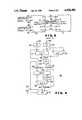
- FIG. 1shows in block diagram a conventional digital signal processor intended mainly for audio signal processing, i.e., Digital Speech Signal Processor 1 (DSSP1) in this example described in the proceeding of symposium of the annual convention of The Institute of Electronics and Communication Engineers of Japan, Communication Section, held in 1986.
- DSSP1Digital Speech Signal Processor 1
- a program counterwhich incorporates a stack pointer for controlling the program address
- 2is a program ROM in the DSSP1
- 3is an instruction register 0 (IRO) for latching an instruction retrieved from the program ROM
- 4is an instruction register 1 (IR1) for latching the instruction released from the IRO 3 onto a program bus P-Bus
- 5is an instruction decoder for decoding the instruction held in the IR1 4
- 6is a bus interface register (BIR) for relaying immediate data placed on the P-Bus onto a data bus (D-Bus)
- 7is an address arithmetic unit (AAU) which incorporates three address registers for generating addresses
- 8is a page register (PR) which adds high-order 3 bits to a 9-bit address output from the AAU 7 to produce a 12-bit external RAM address
- 9is the program bus (P-Bus) for transferring instructions
- 10is the data bus (D-Bus) for transferring data separately from the P-Bus
- 25is a selector for selecting the outputs of the AAU 7 and DMA controller
- 26is the direct memory access (DMA) controller for implementing DMA transfer between serial I/O 33, 35, 37, 39 and an external RAM 32
- 45is a R/W controller for controlling data reading and writing for the external RAM
- 27 and 28are read RD and write WR signals provided by the R/W controller 45
- 29is an address register for latching the address 30 of the external RAM
- 31is a data register DR for latching data on the data bus 32 which is connected to the external RAM
- 33is SO0 for outputting serial output data 0 (34)
- 35is SI0 for inputting serial input data 0 (36)
- 37is SO1 for outputting serial output data 1 (38)
- 39is SI1 for inputting serial input data 1 (40)
- 41is an interrupt controller for analyzing the interrupt signal 42 to determine the interrupt
- 43is a bus controller for controlling the data bus 32 connected to the external data RAM using the bus signal 44
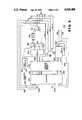
- FIG. 2shows an example of arrangement using two sets of DSSP1 shown in FIG. 1 for implementing a sample-by-sample process through the serial data ports.
- a master processorwhich is the entire DSSP1 shown in FIG. 1
- 52is a request signal issued by the master processor 50 to a slave processor 51
- 53is an acknowledge signal issued by the slave processor 51 to the master processor 50.
- This system arrangementhas the separate P-Bus 9 and D-Bus 10, allowing the instruction decoder 5 to perform instruction fetching and the FMPY 16 and FALU 20 to execute internal operations concurrently.
- address generation by the AAU 7takes place in parallel to these operations, thereby preventing instruction overhead from the address generation.
- the systemhas a DMA transfer function by the DMA controller between the external data bus 32 and the two serial I/O systems 33, 35 and 37, 39. Since the DMA transfer uses the D-Bus 10, the internal operation halts for a 6 machine cycle time for each word transfer during the DMA transfer cycle.
- the parallel processing ability of this systemis summarized as follows.
- the systemallots one system of serial I/O 33, 35, 37, 39 to the A/D converter and another system to the transmission path, making itself suitable for arranging on a single chip a full-duplex audio codec which implements DMA transfer in units of transmission frame and buffering using an external RAM, rather than for fast processing mass data using an external memory.
- the arithmetic operator constituted by the FMPY 16 and FALU 20is capable of executing a product-sum operation, which is performed often in FIR filters and FFT (fast Fourier transformation), in one machine cycle, as in the case of a multiplier-accumulator pair described in article "Packing a single processor onto a single digital board", by Louis Schirm, Electronics, Dec. 20, 1979. Namely, this system achieves the maximum throughput when the multiply-accumulation operation is carried out continuously, and it reaches 40 MIPS (mega instructions per second) when the machine cycle is 50 ns.
- general signal processingsinclude other types of operations such as absolute value accumulation and differential absolute value evaluation besides the multiply-accumulation operation, in which case the FMPY 16 cannot be used, resulting in a halved throughput of 20 MIPS achieved by the FALU 20 alone.
- Serial input data of system 0 (36) and system 1 (40) entered to the master processor 50are rendered a certain computation by the processor 50, which yields an intermediate result.
- the master processor 50issues a data transfer request 52 to the slave processor 51 and, after confirming a data transfer ready 53 from the slave processor 51, transfers the intermediate result held in the DR 31 to the slave processor 51 through the data bus 30.
- the DR 31is timed for latching on the basis of the RD 27 and WR 28.
- the intermediate result processed by the slave processor 51is transferred back to the master processor 50 using a reverse procedure and, after being rendered a final computation by the processor 50, sent to the serial data output ports 34 and 38 of system 0 and system 1.
- This system arrangementis based on the anticipation of the intricate signal processing algorism which is infeasible to carry out by a single DSSP1 and the requirement of throughput which is beyond the ability of a single DSSP 1.
- the systeminvolves the following problems.
- the master and slave processors 50 and 51must be in complete synchronism in running their programs, and if the load is concentrated to one of processors the system throughout is determined by its maximum load.
- data transfer through the data bus 30creates a bus contention with a process using the external RAM which is connected through the data bus 30, resulting in a possible significant fall in throughput.
- the conventional digital signal processoris not always suitable for signal processings such as image signal processing, and an intentional application of this will incur an increased number of processors needed for compensating the lowered throughput and an increased hardware of external circuitry due to the increased load. As a result, it has been difficult to introduce a processor-based system to this technical field.
- the present inventionis intended to solve the foregoing prior art deficiencies, and its prime object is to provide a digital signal processor as an image signal processing system which enables the introduction of a processor-based system to signal processing mainly intended for image signal processing and is applicable to various applications by utilization of compact and flexible features that are the advantages of the processor-based system.
- the inventive digital signal processorcomprises a bus structure including a program bus, data bus and data input/output bus, an internal data memory consisting of a plurality of 2-port memories for storing block data, a DMA controller for implementing block data transfer between the external data memory and the internal data memory in parallel fashion with an internal computation, an address generator which implements 22 dimensional address generation for at least five separate systems concurrently, an arithmetic operator having multiply-accumulation oriented and general operation oriented pipeline cycles, an asynchronous PIO incorporating FIFO, and a program controller which implements the multiple branching program control in accordance with a preset jump table when a conditional branching with multiple conditions is encountered.
- the inventive bus structureallows the DMA transfer between the internal and external memories to take place in parallel to internal computation, the arithmetic operator having the multiply-accumulation oriented and general operation oriented pipeline cycles deals with an image processing algorism at a high throughput, the asynchronous PIO including FIFO improves the throughput in the case of multiprocessor configuration, and the multiple branching program controller carries out an intricate adaptive processing algorism at a high speed.
- FIG. 1is a block diagram showing the arrangement of the conventional digital signal processor (DSSP1);
- FIG. 2is a block diagram of a multiprocessor system based on the conventional digital signal processor shown in FIG. 1;
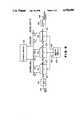
- FIG. 3is a block diagram showing the arrangement of the digital signal processor embodying the present invention.
- FIG. 4is a block diagram showing the arrangement of the arithmetic operator 123 shown in FIG. 3;
- FIG. 5is a block diagram showing the arrangement of the address generator 103 shown in FIG. 3;
- FIG. 6is a block diagram showing an embodiment of the serial multiprocessor system using the digital signal processor shown in FIG. 3.
- FIG. 3showing the inventive digital signal processor, indicated by 100 is a program memory for storing a program
- 101is a program controller
- 102is a program bus (P-Bus), which is one of the bus structures, for transferring an instruction provided by the program controller 101
- 103is an address generator which generates six addresses concurrently
- 104is a direct memory access (DMA) controller
- 105is a bidirectional selector
- 106is an internal data memory consisting of two 2-port (2P) RAMs
- 107is an address to the internal data memory 106
- 108is an external data memory address
- 109is an address register (AR) which holds the external memory address for DMA and external memory address for internal operation to output an external data memory address 112 by way of an external memory interface (I/F) 111
- 110is the DMA control signal
- 113is external data memory data
- 114is a data register (DR) having a 2-word capacity for T-Bus 115 and D-Bus 120 in the bus structure
- FIG. 4shows the arrangement of the arithmetic operator 123 shown in FIG. 3.
- Dx, Dydata input registers
- MPYmultiplier
- ALU1first arithmetic/logic unit
- 153is a first selector
- 154is a pipeline register (PR)
- 155is a second selector
- 156is a third selector
- 157is a data exchanger (EXCH)
- 158is a barrel shifter (BSHIFT)
- 159is a second arithmetic/logic unit (ALU2)
- 160is a fourth selector
- 161is a working register (WR) having a capacity of at least one word.
- FIG. 5shows the arrangement of the address generator 103 shown in FIG. 3.
- 200are address data given to an address register group 202
- 201is a selector which selects the address data 200 from among feedback data 209 from the address generator (AGU) 212
- 203are address data sets produced by selecting arbitrarily a plurality of data in the address register group 202
- 204is a multiplexer (MUX) for separating the address data sets 203
- 205is an arithmetic unit (AU) for addition and subtraction
- 206is a barrel shifter (BSHIFT)
- 207is an arithmetic/logic unit (ALU) implementing at least addition and subtraction
- 208is an arithmetic unit (AU) for addition and subtraction
- 209is feedback data from the AGU
- 210is displacement data on the P-Bus 102 or D-Bus 120
- 211is
- FIG. 6shows a multiprocessor system configured by connecting three digital signal processors of FIG. 3 in series through the parallel data port (PIO) interface 126.
- 300is a data input terminal
- 301is an input interface
- 302is a memory bus arbiter
- 303is a common memory
- 304is an output interface
- 305is an address of the common memory 303
- 306is data of the common memory 303
- 307is a parallel data path used for data communication between the processors 310
- 308is a resulting output
- 309are bus signals for performing the control between the processors 310 and memory bus arbiter 302
- 310are the processors each shown in FIG. 3
- 311is a memory bus.
- instructions stored in the program memory 100are read out sequentially by being addressed by the program controller 101, and entered to the program controller 101.
- the instructionis decoded by the program controller 101 and then placed on the P-Bus 102.
- the D-Bus 120executes an internal operation for the instruction which has been outputted on the P-Bus 102 one machine cycle ago.
- the address generator 103generates the addresses 107 and 108 of the 2P-RAM 106 and external data memory associated with the internal operation for three units concurrently and in parallel to the internal operation.
- the DMA controller 104implements data transfer between the 2P-RAM 106 and external data memory by way of the T-Bus 115.
- the DMA controller 104fetches block data from the external data memory into the internal data memory 106 and stores the operational result again in the internal data memory 106, and thereafter the DMA controller 104 transfers it to the external data memory.
- the systemimplements asynchronous communication with the external device by way of the PIO interface 126 efficiently with little overhead and connection loss.
- the program controller 101stores in advance the program branch destination address or the differential address between the current address and branch destination address in a memory having 2m (m is an integer larger than or equal to one) addresses, obtains the program branch destination address or differential address by addressing the memory using a bit pattern of arbitrary k bits in a l-bit flag register for storing test flag bits of l in number (where l is an integer larger than one; k is smaller than or equal to l and m), and causes the program to branch to the indicated branch destination address.
- the PIO interface 126implements parallel data communication with the external device using the PIO control signal 133 for the parallel input/output data from the POR 124 and FIFO 125 connected separately to the D-Bus 120.
- the reason for the provision of the FIFO 125 only on the input sideis that the data communication direction is confined to one direction on the basis of the fact that data to be processed are time-series data in most signal processing algorism. Unless the FIFO 125 overflows, it is possible to receive data from the external device independently of the internal operation, whereby the reduction of throughput in multiprocessor configuration can be minimized.
- Parallel data outputis timed by the PIO interface 126 and input is timed by the external device.
- the data transmitting partytakes the part of master for carrying out the communication.
- the FIFO 125has a finite capacity and the amount of input data is limited. Therefore, the PIO interface 126 inhibits data input when the FIFO 125 is full. The output of the POR 124 is released only when data input from the external device is not inhibited. In this way, loss of data due to the overflow of FIFO 125 is prevented.
- the internal data memory 106has one port of 2P-RAM connected to the T-Bus 115 or D-Bus 120 by means of the bidirectional selector 105, and it is capable of concurrently reading and writing two input block data 129 to the arithmetic operator and block data on the D-Bus 120 to the internal data memory 106 by means of the bidirectional 4-3selector and, in parallel to this operation, transferring block data from the external data memory interface 111 over the T-Bus 115 under control of the DMA controller 104.
- Two input data entered to the data input registers 150are delivered simultaneously to the MPY 151 and ALU1 152, and rendered multiplication and other arithmetic operation in one machine cycle.
- Either output of the MPY 151 or ALU1 152is selected by the first selector 153, and the selected output is latched by the PR 154 at the end of the machine cycle to terminate the initial stage of pipeline.
- the second selector 155 and third selector 156select certain data, which are entered to the ALU2 159 through the EXCH 157 and BSHIFT 158, and rendered an arithmetic operation in one machine cycle.
- the outputs of the ALU2 159 and PR 154are selected by the selector 160 under a certain instruction and latched in the working register 161. Finally, one of the contents of WR 161 is selected, and the data is placed on the output line 128 so that it is outputted on the D-Bus 120.
- the arithmetic operator 123carries out the following processings in parallel in one machine cycle.
- the inventive arrangementdeals with arithmetic operations such as absolute value summation and differential absolute value evaluation in the same efficiency as for product-sum, in addition to the product-sum operation.
- the inventive arrangementcan double the throughput in dealing with operations which do not need a high accuracy by processing data with n-bit width dividedly and concurrently with the MPY 151, ALU1 152 and ALU2 159 which are each divided into a upper n/2 bits and lower n/2 bits.
- This operationis readily performed by suspending the partial multiplication in the MPY 151 (at n/2 bit) and cutting the carried of ALU1 152 and ALU2 159 on the way (at n/2 bit).
- the AGU 212includes four systems for the internal data memory 106 and two units for the external memory interface 111, a total of six units, and they operates in parallel.
- the memoryusually has the 1-dimensional address (linear address), but for much signal processing, particularly image signal processing, the 2-dimensional address is useful for processing. Accordingly, the AGU 212 generates the regular 2-dimensional address with the MUX 204, AU 205 and AU 208 separately for horizontal and vertical directions of the picture by implementing the arithmetic operation and modulo operation, and produces the 1-dimensional address for memory by processing the regular 2-dimensional address for the weighting addition of two addresses in the horizontal and vertical directions with the BSHIFT 206 and ALU 207.
- the MUX 204produces each component of the 2-dimensional address through bit discomposition and recomposition for the feedback data 209 and address register data 203. This eliminates the need of calculation of the 2-dimensional address by the arithmetic operator 123, and 2-dimensional data can be processed without a decay of throughput.
- the processors 310have their input and output ports of PIO interface 126 chained, and implement pipeline processings in which data is processed while being fed from processor 1 to processor 2 and to processor 3.
- the common memory 303is used for the video frame memory, for example, and it can be accessed equally from all processors 310.
- the memory bus control signal 309is exchanged among the processors 310 and memory bus arbiter 302 for the access request arbitration.
- control of FIFO 125is performed based on the test as to whether the FIFO 125 is full, and the parallel data communication has been done, the control may be based on the test as to whether a space is available for entering one block of data for block data transfer.
- serial-type multiprocessor systemit may be a parallel-type or hierarchy-type multiprocessor system, and the same effectiveness as the above embodiment is attained.
- the digital signal processoris configured to be suitable for many signal processing fields such as image signal processing in which fast processing of mass data while accessing memory is required, whereby a compact, flexible and inexpensive signal processing system can be constructed.
Landscapes
- Engineering & Computer Science (AREA)
- Theoretical Computer Science (AREA)
- Physics & Mathematics (AREA)
- General Engineering & Computer Science (AREA)
- General Physics & Mathematics (AREA)
- Computer Hardware Design (AREA)
- Complex Calculations (AREA)
- Executing Machine-Instructions (AREA)
- Multi Processors (AREA)
- Processing Or Creating Images (AREA)
Abstract
Description
1. Field of the Invention
The present invention relates to a digital signal processor for implementing computation which is mainly intended for systems of signals.
2. Description of the Prior Art
FIG. 1 shows in block diagram a conventional digital signal processor intended mainly for audio signal processing, i.e., Digital Speech Signal Processor 1 (DSSP1) in this example described in the proceeding of symposium of the annual convention of The Institute of Electronics and Communication Engineers of Japan, Communication Section, held in 1986. In the figure, indicated by 1 is a program counter (PC) which incorporates a stack pointer for controlling the program address, 2 is a program ROM in the DSSP1, 3 is an instruction register 0 (IRO) for latching an instruction retrieved from theprogram ROM IRO 3 onto a program bus P-Bus IR1 order 3 bits to a 9-bit address output from the AAU 7 to produce a 12-bit external RAM address, 9 is the program bus (P-Bus) for transferring instructions, 10 is the data bus (D-Bus) for transferring data separately from the P-Bus O external RAM 32, 45 is a R/W controller for controlling data reading and writing for the external RAM, 27 and 28 are read RD and write WR signals provided by the R/W controller 45, 29 is an address register for latching the address 30 of the external RAM, 31 is a data register DR for latching data on thedata bus 32 which is connected to the external RAM, 33 is SO0 for outputting serial output data 0 (34), 35 is SI0 for inputting serial input data 0 (36), 37 is SO1 for outputting serial output data 1 (38), 39 is SI1 for inputting serial input data 1 (40), 41 is an interrupt controller for analyzing theinterrupt signal 42 to determine the interrupt, and 43 is a bus controller for controlling thedata bus 32 connected to the external data RAM using thebus signal 44.
FIG. 2 shows an example of arrangement using two sets of DSSP1 shown in FIG. 1 for implementing a sample-by-sample process through the serial data ports. In the figure, indicated by 50 is a master processor which is the entire DSSP1 shown in FIG. 1, 52 is a request signal issued by themaster processor 50 to aslave processor 51, and 53 is an acknowledge signal issued by theslave processor 51 to themaster processor 50.
Next, the operation of the above conventional digital signal processor will be explained in brief. This system arrangement has the separate P-Bus 9 and D-Bus 10, allowing theinstruction decoder 5 to perform instruction fetching and the FMPY 16 and FALU 20 to execute internal operations concurrently. In addition, address generation by the AAU 7 takes place in parallel to these operations, thereby preventing instruction overhead from the address generation. The system has a DMA transfer function by the DMA controller between theexternal data bus 32 and the two serial I/O systems
(1) Address generation (primary address) by AAU 7.
(2) Floating point multiplication by FMPY 16.
(3) Floating point arithmetic/logic operation by FALU 20.
(4) Data transfer between 2P-RAM 15 and external RAM.
(5) Data transfer between two serial I/O systems
The system allots one system of serial I/O
The arithmetic operator constituted by the FMPY 16 and FALU 20 is capable of executing a product-sum operation, which is performed often in FIR filters and FFT (fast Fourier transformation), in one machine cycle, as in the case of a multiplier-accumulator pair described in article "Packing a single processor onto a single digital board", by Louis Schirm, Electronics, Dec. 20, 1979. Namely, this system achieves the maximum throughput when the multiply-accumulation operation is carried out continuously, and it reaches 40 MIPS (mega instructions per second) when the machine cycle is 50 ns.
However, general signal processings include other types of operations such as absolute value accumulation and differential absolute value evaluation besides the multiply-accumulation operation, in which case theFMPY 16 cannot be used, resulting in a halved throughput of 20 MIPS achieved by theFALU 20 alone.
Next, the operation of the DSSP1 multiprocessor configuration will be described in connection with FIG. 2. Serial input data of system 0 (36) and system 1 (40) entered to themaster processor 50 are rendered a certain computation by theprocessor 50, which yields an intermediate result. Themaster processor 50 issues adata transfer request 52 to theslave processor 51 and, after confirming a data transfer ready 53 from theslave processor 51, transfers the intermediate result held in the DR 31 to theslave processor 51 through the data bus 30. TheDR 31 is timed for latching on the basis of theRD 27 andWR 28.
Subsequently, the intermediate result processed by theslave processor 51 is transferred back to themaster processor 50 using a reverse procedure and, after being rendered a final computation by theprocessor 50, sent to the serialdata output ports system 0 andsystem 1.
This system arrangement is based on the anticipation of the intricate signal processing algorism which is infeasible to carry out by a single DSSP1 and the requirement of throughput which is beyond the ability of asingle DSSP 1. However, the system involves the following problems. First, in case of mass data transfer by way of the data bus 30, the throughput is not improved as expected due to the overhead of data transfer control. The master andslave processors
Although these problems may easily be overcome by addition of an external control circuit, this will result in an increased hardware and lowered flexibility and the abandonment of the superiority of the signal processor in a processor-based system. Especially, image signal processing is mostly required to perform a very fast processing for mass data in a multiprocessor configuration using a video frame memory, and the above-mentioned scheme imposes a most significant problem in introducing processors in image signal processing.
As described above, the conventional digital signal processor is not always suitable for signal processings such as image signal processing, and an intentional application of this will incur an increased number of processors needed for compensating the lowered throughput and an increased hardware of external circuitry due to the increased load. As a result, it has been difficult to introduce a processor-based system to this technical field.
The present invention is intended to solve the foregoing prior art deficiencies, and its prime object is to provide a digital signal processor as an image signal processing system which enables the introduction of a processor-based system to signal processing mainly intended for image signal processing and is applicable to various applications by utilization of compact and flexible features that are the advantages of the processor-based system.
In order to achieve the above objective, the inventive digital signal processor comprises a bus structure including a program bus, data bus and data input/output bus, an internal data memory consisting of a plurality of 2-port memories for storing block data, a DMA controller for implementing block data transfer between the external data memory and the internal data memory in parallel fashion with an internal computation, an address generator which implements 22 dimensional address generation for at least five separate systems concurrently, an arithmetic operator having multiply-accumulation oriented and general operation oriented pipeline cycles, an asynchronous PIO incorporating FIFO, and a program controller which implements the multiple branching program control in accordance with a preset jump table when a conditional branching with multiple conditions is encountered.
The inventive bus structure allows the DMA transfer between the internal and external memories to take place in parallel to internal computation, the arithmetic operator having the multiply-accumulation oriented and general operation oriented pipeline cycles deals with an image processing algorism at a high throughput, the asynchronous PIO including FIFO improves the throughput in the case of multiprocessor configuration, and the multiple branching program controller carries out an intricate adaptive processing algorism at a high speed.
Those and other objects and advantages of the present invention will become more apparent from the following detailed description taken in conjunction with the accompanying drawings.
FIG. 1 is a block diagram showing the arrangement of the conventional digital signal processor (DSSP1);
FIG. 2 is a block diagram of a multiprocessor system based on the conventional digital signal processor shown in FIG. 1;
FIG. 3 is a block diagram showing the arrangement of the digital signal processor embodying the present invention;
FIG. 4 is a block diagram showing the arrangement of thearithmetic operator 123 shown in FIG. 3;
FIG. 5 is a block diagram showing the arrangement of theaddress generator 103 shown in FIG. 3; and
FIG. 6 is a block diagram showing an embodiment of the serial multiprocessor system using the digital signal processor shown in FIG. 3.
An embodiment of this invention will now be described with reference to the drawings.
In FIG. 3 showing the inventive digital signal processor, indicated by 100 is a program memory for storing a program, 101 is a program controller, 102 is a program bus (P-Bus), which is one of the bus structures, for transferring an instruction provided by theprogram controller internal data memory data memory address 112 by way of an external memory interface (I/F) 111, 110 is the DMA control signal, 113 is external data memory data, 114 is a data register (DR) having a 2-word capacity for T-Bus 115 and D-Bus 120 in the bus structure for holding the externaldata memory data 113 transacted through theexternal memory interface internal data memory address generator Bus 120, 119 is a flag register (FR), 120 is the data bus (D-Bus) for transferring internal operation data, 121 and 122 are selectors, 123 is an arithmetic operator for implementing internal operations, 124 is a parallel output register (POR) for outputting parallel data to the external device, 125 is a first-in-first-out (FIFO) memory for receiving parallel data from the external device, 126 is a PIO interface for relaying the parallel data communication with the external device, 127 is a data path from the D-Bus 120 for initializing the working register in thearithmetic operator arithmetic operator 123 to the D-Bus 120, 129 is parallel output data, 130 is parallel input data, 131 is a bus request signal, 132 is a bus acknowledge signal, and 133 is a PIO control signal.
FIG. 4 shows the arrangement of thearithmetic operator 123 shown in FIG. 3. In the figure, indicated by 150 are data input registers (Dx, Dy), 151 is a multiplier (MPY), 152 is a first arithmetic/logic unit (ALU1), 153 is a first selector, 154 is a pipeline register (PR), 155 is a second selector, 156 is a third selector, 157 is a data exchanger (EXCH), 158 is a barrel shifter (BSHIFT), 159 is a second arithmetic/logic unit (ALU2), 160 is a fourth selector, and 161 is a working register (WR) having a capacity of at least one word.
FIG. 5 shows the arrangement of theaddress generator 103 shown in FIG. 3. In the figure, indicated by 200 are address data given to anaddress register group address data 200 from amongfeedback data 209 from the address generator (AGU) 212,data 130 on the P-Bus 102 anddata 117 on the D-Bus 120, 203 are address data sets produced by selecting arbitrarily a plurality of data in theaddress register group address data sets internal memories 106 and two units for the externaldata memory address 112.
FIG. 6 shows a multiprocessor system configured by connecting three digital signal processors of FIG. 3 in series through the parallel data port (PIO)interface 126. In the figure, indicated by 300 is a data input terminal, 301 is an input interface, 302 is a memory bus arbiter, 303 is a common memory, 304 is an output interface, 305 is an address of thecommon memory common memory processors processors 310 andmemory bus arbiter
Next, the operation will be explained.
In FIG. 3, instructions stored in theprogram memory 100 are read out sequentially by being addressed by theprogram controller 101, and entered to theprogram controller 101. The instruction is decoded by theprogram controller 101 and then placed on the P-Bus 102. In parallel to this operation, the D-Bus 120 executes an internal operation for the instruction which has been outputted on the P-Bus 102 one machine cycle ago. Theaddress generator 103 generates theaddresses RAM 106 and external data memory associated with the internal operation for three units concurrently and in parallel to the internal operation. At the same time, in parallel to the internal operation, theDMA controller 104 implements data transfer between the 2P-RAM 106 and external data memory by way of the T-Bus 115. Through the above operations, the processor system carries out the following processings in parallel.
(1) Instruction fetching and transfer.
(2) Six address generation by dedicated address generator.
(3) Direct data transfer between external data memory andinternal data memory 106.
(4) Data transfer with external data memory through D-Bus 120 or data transfer withPIO 126.
(5) Internal operation byexecution unit 123.
Accordingly, in this processor system, theDMA controller 104 fetches block data from the external data memory into theinternal data memory 106 and stores the operational result again in theinternal data memory 106, and thereafter theDMA controller 104 transfers it to the external data memory. At the same time, the system implements asynchronous communication with the external device by way of thePIO interface 126 efficiently with little overhead and connection loss.
Theprogram controller 101 stores in advance the program branch destination address or the differential address between the current address and branch destination address in a memory having 2m (m is an integer larger than or equal to one) addresses, obtains the program branch destination address or differential address by addressing the memory using a bit pattern of arbitrary k bits in a l-bit flag register for storing test flag bits of l in number (where l is an integer larger than one; k is smaller than or equal to l and m), and causes the program to branch to the indicated branch destination address.
ThePIO interface 126 implements parallel data communication with the external device using thePIO control signal 133 for the parallel input/output data from thePOR 124 andFIFO 125 connected separately to the D-Bus 120. The reason for the provision of theFIFO 125 only on the input side is that the data communication direction is confined to one direction on the basis of the fact that data to be processed are time-series data in most signal processing algorism. Unless theFIFO 125 overflows, it is possible to receive data from the external device independently of the internal operation, whereby the reduction of throughput in multiprocessor configuration can be minimized. Parallel data output is timed by thePIO interface 126 and input is timed by the external device. Namely, the data transmitting party takes the part of master for carrying out the communication. Naturally, theFIFO 125 has a finite capacity and the amount of input data is limited. Therefore, thePIO interface 126 inhibits data input when theFIFO 125 is full. The output of thePOR 124 is released only when data input from the external device is not inhibited. In this way, loss of data due to the overflow ofFIFO 125 is prevented.
Theinternal data memory 106 has one port of 2P-RAM connected to the T-Bus 115 or D-Bus 120 by means of thebidirectional selector 105, and it is capable of concurrently reading and writing twoinput block data 129 to the arithmetic operator and block data on the D-Bus 120 to theinternal data memory 106 by means of the bidirectional 4-3selector and, in parallel to this operation, transferring block data from the externaldata memory interface 111 over the T-Bus 115 under control of theDMA controller 104.
Next, the operation of thearithmetic operator 123 will be explained with reference to FIG. 4. Two input data entered to the data input registers 150 are delivered simultaneously to theMPY 151 andALU1 152, and rendered multiplication and other arithmetic operation in one machine cycle. Either output of theMPY 151 orALU1 152 is selected by thefirst selector 153, and the selected output is latched by thePR 154 at the end of the machine cycle to terminate the initial stage of pipeline. In the next stage, thesecond selector 155 andthird selector 156 select certain data, which are entered to theALU2 159 through theEXCH 157 andBSHIFT 158, and rendered an arithmetic operation in one machine cycle. At the end of the machine cycle, the outputs of theALU2 159 andPR 154 are selected by theselector 160 under a certain instruction and latched in the working register 161. Finally, one of the contents of WR 161 is selected, and the data is placed on theoutput line 128 so that it is outputted on the D-Bus 120.
For the above operations, thearithmetic operator 123 carries out the following processings in parallel in one machine cycle.
(1) Input of two data.
(2) Multiplication ofarithmetic operation 1.
(3) Data exchange and barrel shift.
(4)Arithmetic operation 2.
(5) Latching in working register.
(6) Output to D-Bus 120.
Accordingly, in contrast to the conventional system arrangement which is oriented to the multiply-accumulation operation, the inventive arrangement deals with arithmetic operations such as absolute value summation and differential absolute value evaluation in the same efficiency as for product-sum, in addition to the product-sum operation.
The inventive arrangement can double the throughput in dealing with operations which do not need a high accuracy by processing data with n-bit width dividedly and concurrently with theMPY 151,ALU1 152 andALU2 159 which are each divided into a upper n/2 bits and lower n/2 bits. This operation is readily performed by suspending the partial multiplication in the MPY 151 (at n/2 bit) and cutting the carried ofALU1 152 andALU2 159 on the way (at n/2 bit).
Next, the operation of theaddress generator 103 will be explained with reference to FIG. 5. Feedback data from the P-Bus 130, D-Bus 117 andAGU 212 are selected by theselector 201 using a certain instruction, thereby providing latcheddata 200 to theaddress register group 202. After that, a complex operation fordata 203 formed through arbitrary selection (more than one) of arbitrary contents of theaddress register group 202 and the contents of thedisplacement register 211 is processed with theAGU 212 to produce theaddresses feedback data 209. TheAGU 212 includes four systems for theinternal data memory 106 and two units for theexternal memory interface 111, a total of six units, and they operates in parallel.
The memory usually has the 1-dimensional address (linear address), but for much signal processing, particularly image signal processing, the 2-dimensional address is useful for processing. Accordingly, theAGU 212 generates the regular 2-dimensional address with theMUX 204,AU 205 andAU 208 separately for horizontal and vertical directions of the picture by implementing the arithmetic operation and modulo operation, and produces the 1-dimensional address for memory by processing the regular 2-dimensional address for the weighting addition of two addresses in the horizontal and vertical directions with theBSHIFT 206 andALU 207. TheMUX 204 produces each component of the 2-dimensional address through bit discomposition and recomposition for thefeedback data 209 and addressregister data 203. This eliminates the need of calculation of the 2-dimensional address by thearithmetic operator 123, and 2-dimensional data can be processed without a decay of throughput.
Finally, the operation of the serial-type microprocessor system will be explained with reference to FIG. 6. Theprocessors 310 have their input and output ports ofPIO interface 126 chained, and implement pipeline processings in which data is processed while being fed fromprocessor 1 toprocessor 2 and toprocessor 3. Thecommon memory 303 is used for the video frame memory, for example, and it can be accessed equally from allprocessors 310. In order to prevent the access contention to the memory bus 311, the memorybus control signal 309 is exchanged among theprocessors 310 andmemory bus arbiter 302 for the access request arbitration.
Since FIFO is provided at the input of thePIO interface 126, it is not necessary to have a complete synchronism for the program operation among theprocessors 310. This minimizes the overhead of data communication by the PIO, and the throughput of this multiprocessor system becomes virtually equal to the maximum value of the average processing time for the process allotted to eachprocessor 310. Generally, there is a great difference between the average value and maximum value of processing time, and the improvement in process efficiency by this difference can be expected.
Although in the foregoing embodiment, the control ofFIFO 125 is performed based on the test as to whether theFIFO 125 is full, and the parallel data communication has been done, the control may be based on the test as to whether a space is available for entering one block of data for block data transfer.
Although the foregoing embodiment has been described mainly for digital signal processing, the system may be applied to other field for fast processing mass data (e.g., numerical analysis), and the same effectiveness as the above embodiment is attained.
Although the above embodiment has been described for the serial-type multiprocessor system, it may be a parallel-type or hierarchy-type multiprocessor system, and the same effectiveness as the above embodiment is attained.
According to this invention, as described above, the digital signal processor is configured to be suitable for many signal processing fields such as image signal processing in which fast processing of mass data while accessing memory is required, whereby a compact, flexible and inexpensive signal processing system can be constructed.
Claims (5)
1. A digital signal processor comprising:
a bus structure including a program bus for instruction transfer, a data bus only for internal data transfer and a data input/output bus only for data input and output;
a program memory which is separated from data memories for storing a certain program;
a program controller connected to said program memory and to said program bus for reading out said program from said program memory and for executing instruction transfer, internal operation and data input/output in parallel fashion;
an internal data memory comprising a plurality of 2-port memories, connected selectively to said data bus and said data input/output bus, and adapted to store data in block units;
an arithmetic operator connected selectively to said data bus and said internal memory for executing internal operations including binomial operations;
a direct memory access (DMA) controller connected to said program controller and to said program bus and connecting said internal data memory with an external data memory through said data input/output bus to implement DMA transfer for block data in parallel to said internal operation;
an address generator which generates an address of said internal data memory for internal operation by said arithmetic operator and an address of said external data memory for DMA transfer by said DMA controller concurrently and in parallel to said internal operation, said address generator being connected to said program bus, said data bus and said internal data memory; and
parallel data input/output interface means which include a first-in first-out (FIFO) memory and which connect an external device to said data bus and said FIFO memory to implement parallel data communication with said external device independently of input/output operations and in asynchronous fashion.
2. A digital signal processor according to claim 1, wherein said arithmetic operator comprises a first arithmetic/logic unit which receives two input data and performs at least addition or subtraction in a single instruction cycle; a multiplier which receives said two input data simultaneously with said arithmetic/logic unit and performs multiplication in one instruction cycle; a pipeline register which selectively stores one of outputs from said multiplier and said first arithmetic/logic unit; a data exchanger which selectively exchanges said two input data with an output of said pipeline register at first and second outputs thereof; a barrel shifter which shifts one of the outputs of said data exchanger for an arbitrary number of bits right or left; a second arithmetic/logic unit which receives the output of said barrel shifter and another output of said data exchanger to perform at least addition or subtraction; and a working register which stores the output of said second arithmetic/logic unit.
3. A digital signal processor according to claim, wherein said arithmetic operator comprises a circuit which splits data to said first and second arithmetic/logic units and multiplier by dividing said data into high-order n/2 bits and low-order n/2 bits, and performs arithmetic operations on the split sections independently.
4. A digital signal processor according to claim 1, wherein said program controller comprises a controller which stores in a memory having addresses of 2m (where m is an integer larger than or equal to one) a program branch destination address or a differential address between a current address and a branch destination address, obtains the program branch destination address, or differential address by addressing said memory using a bit pattern of arbitrary k bits in a l-bit flag register in which test flag bits of l in number are stored (where l is an integer larger than or equal to one, and k is an integer smaller than or equal to l and m), and causes said program to branch to the indicated branch destination address.
5. A digital signal processor according to claim 1, wherein said address generator comprises an address generator including at least five systems of address generating units which generate a regular 2-dimensional address in logical sense by implementing modulo addition-subtraction or accumulation separately for addresses in the horizontal and vertical directions of a picture, and subsequently generate a 1-dimensional address of said internal data memory or external data memory through weighting addition for two addresses in the horizontal and vertical directions.
Priority Applications (1)
| Application Number | Priority Date | Filing Date | Title |
|---|---|---|---|
| US07/803,457USRE34850E (en) | 1987-03-05 | 1991-12-06 | Digital signal processor |
Applications Claiming Priority (2)
| Application Number | Priority Date | Filing Date | Title |
|---|---|---|---|
| JP62050755AJPS63216170A (en) | 1987-03-05 | 1987-03-05 | digital signal processing processor |
| JP62-50755 | 1987-03-05 |
Related Child Applications (1)
| Application Number | Title | Priority Date | Filing Date |
|---|---|---|---|
| US07/803,457ReissueUSRE34850E (en) | 1987-03-05 | 1991-12-06 | Digital signal processor |
Publications (1)
| Publication Number | Publication Date |
|---|---|
| US4920480Atrue US4920480A (en) | 1990-04-24 |
Family
ID=12867657
Family Applications (2)
| Application Number | Title | Priority Date | Filing Date |
|---|---|---|---|
| US07/164,257CeasedUS4920480A (en) | 1987-03-05 | 1988-03-04 | Digital signal processor |
| US07/803,457Expired - LifetimeUSRE34850E (en) | 1987-03-05 | 1991-12-06 | Digital signal processor |
Family Applications After (1)
| Application Number | Title | Priority Date | Filing Date |
|---|---|---|---|
| US07/803,457Expired - LifetimeUSRE34850E (en) | 1987-03-05 | 1991-12-06 | Digital signal processor |
Country Status (5)
| Country | Link |
|---|---|
| US (2) | US4920480A (en) |
| EP (1) | EP0282825B1 (en) |
| JP (1) | JPS63216170A (en) |
| CA (1) | CA1297195C (en) |
| DE (1) | DE3885775T2 (en) |
Cited By (40)
| Publication number | Priority date | Publication date | Assignee | Title |
|---|---|---|---|---|
| US5136701A (en)* | 1990-07-04 | 1992-08-04 | Mitsubishi Denki Kabushiki Kaisha | Processing unit containing DMA controller having concurrent operation with processor wherein addresses and data are divided into two parts |
| US5175863A (en)* | 1989-10-23 | 1992-12-29 | International Business Machines Corporation | Signal data processing system having independently, simultaneously operable alu and macu |
| US5179668A (en)* | 1990-06-11 | 1993-01-12 | Omron Corporation | Signal processor |
| US5251312A (en)* | 1991-12-30 | 1993-10-05 | Sun Microsystems, Inc. | Method and apparatus for the prevention of race conditions during dynamic chaining operations |
| US5265225A (en)* | 1990-02-21 | 1993-11-23 | Harris Corporation | Digital signal processing address sequencer |
| US5295246A (en)* | 1990-11-30 | 1994-03-15 | International Business Machines Corporation | Bidirectional FIFO buffer for interfacing between two buses of a multitasking system |
| DE4333649A1 (en)* | 1992-10-08 | 1994-04-14 | Mitel Corp | Interface of a digital signal processor |
| US5311878A (en)* | 1990-06-13 | 1994-05-17 | British Technology Group Limited | Real-time electrical impedance tomography system |
| US5504916A (en)* | 1988-12-16 | 1996-04-02 | Mitsubishi Denki Kabushiki Kaisha | Digital signal processor with direct data transfer from external memory |
| US5513374A (en)* | 1993-09-27 | 1996-04-30 | Hitachi America, Inc. | On-chip interface and DMA controller with interrupt functions for digital signal processor |
| US5535417A (en)* | 1993-09-27 | 1996-07-09 | Hitachi America, Inc. | On-chip DMA controller with host computer interface employing boot sequencing and address generation schemes |
| US5548735A (en)* | 1993-09-15 | 1996-08-20 | International Business Machines Corporation | System and method for asynchronously processing store instructions to I/O space |
| US5584010A (en)* | 1988-11-25 | 1996-12-10 | Mitsubishi Denki Kabushiki Kaisha | Direct memory access control device and method in a multiprocessor system accessing local and shared memory |
| US5778416A (en)* | 1993-12-20 | 1998-07-07 | Motorola, Inc. | Parallel process address generator and method |
| US5826101A (en)* | 1990-09-28 | 1998-10-20 | Texas Instruments Incorporated | Data processing device having split-mode DMA channel |
| US5829054A (en)* | 1989-05-04 | 1998-10-27 | Texas Instruments Incorporated | Devices and systems with parallel logic unit operable on data memory locations |
| US5835787A (en)* | 1994-07-07 | 1998-11-10 | Lucent Technologies, Inc. | System for bi-directionally transferring a digital signal sample from a CODEC to a particular memory location and a second sample from memory to CODEC |
| US5951659A (en)* | 1997-04-07 | 1999-09-14 | Ncr Corporation | Communications-oriented computer system backplane including a PCI input/output bus for transmission of address, data, and control information, and a time-domain multiplexed signal bus (TDMSB) for transmission of high-speed digitized signal information |
| US5964858A (en)* | 1993-07-30 | 1999-10-12 | Motorola, Inc. | Digital communication unit monitoring |
| US6061749A (en)* | 1997-04-30 | 2000-05-09 | Canon Kabushiki Kaisha | Transformation of a first dataword received from a FIFO into an input register and subsequent dataword from the FIFO into a normalized output dataword |
| US6118724A (en)* | 1997-04-30 | 2000-09-12 | Canon Kabushiki Kaisha | Memory controller architecture |
| US6195674B1 (en) | 1997-04-30 | 2001-02-27 | Canon Kabushiki Kaisha | Fast DCT apparatus |
| US6237079B1 (en) | 1997-03-30 | 2001-05-22 | Canon Kabushiki Kaisha | Coprocessor interface having pending instructions queue and clean-up queue and dynamically allocating memory |
| US6289138B1 (en) | 1997-04-30 | 2001-09-11 | Canon Kabushiki Kaisha | General image processor |
| US6298162B1 (en) | 1992-12-23 | 2001-10-02 | Lockheed Martin Corporation | Image compression/expansion using parallel decomposition/recomposition |
| US6311258B1 (en) | 1997-04-03 | 2001-10-30 | Canon Kabushiki Kaisha | Data buffer apparatus and method for storing graphical data using data encoders and decoders |
| US6336180B1 (en) | 1997-04-30 | 2002-01-01 | Canon Kabushiki Kaisha | Method, apparatus and system for managing virtual memory with virtual-physical mapping |
| US6628289B1 (en)* | 1999-06-29 | 2003-09-30 | Canon Kabushiki Kaisha | Rendering apparatus and method, and storage medium |
| US6707463B1 (en) | 1997-04-30 | 2004-03-16 | Canon Kabushiki Kaisha | Data normalization technique |
| US20040064197A1 (en)* | 2002-09-30 | 2004-04-01 | Shinichi Nakaishi | Digital signal processor system |
| US20040225767A1 (en)* | 2003-05-09 | 2004-11-11 | Chih-Ming Tsai | System bus controller and the method thereof |
| US20060018562A1 (en)* | 2004-01-16 | 2006-01-26 | Ruggiero Carl J | Video image processing with parallel processing |
| US20070300041A1 (en)* | 2006-06-23 | 2007-12-27 | Wieland Eckert | Method for processing streaming data in a multiprocessor system |
| US20080086617A1 (en)* | 2006-10-06 | 2008-04-10 | Hitachi , Ltd., | Processor and data transfer unit |
| US20100199070A1 (en)* | 2007-08-16 | 2010-08-05 | Stephen Schmitt | Programmable filter processor |
| CN101303599B (en)* | 2007-05-09 | 2010-12-15 | 株式会社东芝 | industrial controller |
| US7895412B1 (en)* | 1998-06-29 | 2011-02-22 | Cisco Tehnology, Inc. | Programmable arrayed processing engine architecture for a network switch |
| US9357162B2 (en) | 2005-01-13 | 2016-05-31 | Nvidia Corporation | Video processing system and method with dynamic tag architecture |
| US11314674B2 (en)* | 2020-02-14 | 2022-04-26 | Google Llc | Direct memory access architecture with multi-level multi-striding |
| US20230333747A1 (en)* | 2022-04-13 | 2023-10-19 | Korea University Research And Business Foundation | Processing-in-memory device based on spin orbit torque device |
Families Citing this family (25)
| Publication number | Priority date | Publication date | Assignee | Title |
|---|---|---|---|---|
| EP0373393A1 (en)* | 1988-11-22 | 1990-06-20 | Nec Corporation | Information processing system |
| US5109497A (en)* | 1989-01-27 | 1992-04-28 | Hughes Aircraft Company | Arithmetic element controller for controlling data, control and micro store memories |
| JP2569210B2 (en)* | 1989-09-04 | 1997-01-08 | 株式会社日立製作所 | Propagation signal processing device and processor system |
| JP2581234B2 (en)* | 1989-11-06 | 1997-02-12 | 日本電気株式会社 | Arithmetic unit |
| CA2038822A1 (en)* | 1990-04-26 | 1991-10-27 | Jordon W. Woods | High speed processor for digital signal processing |
| JPH0683578A (en)* | 1992-03-13 | 1994-03-25 | Internatl Business Mach Corp <Ibm> | Method for controlling processing system and data throughput |
| US5325401A (en)* | 1992-03-13 | 1994-06-28 | Comstream Corporation | L-band tuner with quadrature downconverter for PSK data applications |
| EP0640909B1 (en)* | 1993-07-30 | 2001-05-16 | Texas Instruments Incorporated | Modular audio data processing architecture |
| US6016538A (en)* | 1993-11-30 | 2000-01-18 | Texas Instruments Incorporated | Method, apparatus and system forming the sum of data in plural equal sections of a single data word |
| TW266275B (en)* | 1994-10-13 | 1995-12-21 | Yamaha Corp | Digital signal processing device and its direct memory access control process |
| US5867726A (en)* | 1995-05-02 | 1999-02-02 | Hitachi, Ltd. | Microcomputer |
| US5898877A (en)* | 1996-02-29 | 1999-04-27 | Sanyo Electric Co., Ltd. | Processor using special instruction set to enhance exception handling |
| JP3934710B2 (en)* | 1996-09-13 | 2007-06-20 | 株式会社ルネサステクノロジ | Microprocessor |
| JP3318499B2 (en)* | 1997-01-07 | 2002-08-26 | 株式会社日立製作所 | Programmable controller |
| US6055619A (en)* | 1997-02-07 | 2000-04-25 | Cirrus Logic, Inc. | Circuits, system, and methods for processing multiple data streams |
| US6189090B1 (en)* | 1997-09-17 | 2001-02-13 | Sony Corporation | Digital signal processor with variable width instructions |
| US6920543B1 (en) | 1999-12-14 | 2005-07-19 | Genesis Microchip, Inc. | Method and apparatus for performing distributed processing of program code |
| US6775757B1 (en) | 1999-12-14 | 2004-08-10 | Genesis Microchip Inc. | Multi-component processor |
| US6738884B1 (en) | 1999-12-14 | 2004-05-18 | Genesis Microchip Inc. | Method and apparatus for processing data with semaphores |
| US6742083B1 (en) | 1999-12-14 | 2004-05-25 | Genesis Microchip Inc. | Method and apparatus for multi-part processing of program code by a single processor |
| US6728853B1 (en)* | 1999-12-14 | 2004-04-27 | Genesis Microchip Inc. | Method of processing data utilizing queue entry |
| US6614438B1 (en)* | 2000-05-30 | 2003-09-02 | Koninlijke Philips Electronics N.V. | Data-processing arrangement for processing different types of data |
| JP2002175266A (en)* | 2000-09-27 | 2002-06-21 | Texas Instruments Inc | Device and method for sorting mode in direct memory access controller of digital signal processor |
| GB2372115A (en)* | 2001-02-08 | 2002-08-14 | Mitel Semiconductor Ltd | Direct memory access controller |
| US6898695B2 (en)* | 2001-03-28 | 2005-05-24 | Intel Corporation | Use of a future file for data address calculations in a pipelined processor |
Citations (11)
| Publication number | Priority date | Publication date | Assignee | Title |
|---|---|---|---|---|
| US4400772A (en)* | 1980-12-30 | 1983-08-23 | International Memories, Inc. | Method and apparatus for direct memory access in a data processing system |
| US4433378A (en)* | 1981-09-28 | 1984-02-21 | Western Digital | Chip topography for MOS packet network interface circuit |
| US4439839A (en)* | 1981-08-24 | 1984-03-27 | International Telephone And Telegraph Corporation | Dynamically programmable processing element |
| US4471427A (en)* | 1981-12-01 | 1984-09-11 | Burroughs Corporation | Direct memory access logic system for a data transfer network |
| US4494187A (en)* | 1982-02-22 | 1985-01-15 | Texas Instruments Incorporated | Microcomputer with high speed program memory |
| US4507727A (en)* | 1982-02-11 | 1985-03-26 | Texas Instruments Incorporated | Microcomputer with ROM test mode of operation |
| US4574348A (en)* | 1983-06-01 | 1986-03-04 | The Boeing Company | High speed digital signal processor architecture |
| US4577282A (en)* | 1982-02-22 | 1986-03-18 | Texas Instruments Incorporated | Microcomputer system for digital signal processing |
| US4586131A (en)* | 1982-02-22 | 1986-04-29 | Texas Instruments Incorporated | Microcomputer having data move circuits for within-memory shift of data words |
| US4713748A (en)* | 1985-02-12 | 1987-12-15 | Texas Instruments Incorporated | Microprocessor with block move instruction |
| US4713749A (en)* | 1985-02-12 | 1987-12-15 | Texas Instruments Incorporated | Microprocessor with repeat instruction |
Family Cites Families (4)
| Publication number | Priority date | Publication date | Assignee | Title |
|---|---|---|---|---|
| JPS5390838A (en)* | 1977-01-21 | 1978-08-10 | Hitachi Ltd | Microprogram memory unit |
| JPS5471533A (en)* | 1977-11-18 | 1979-06-08 | Toshiba Corp | Arithmetic logic operation circuit |
| JPS59146380A (en)* | 1983-02-10 | 1984-08-22 | Matsushita Electric Ind Co Ltd | digital signal processing device |
| JPS6158042A (en)* | 1984-08-29 | 1986-03-25 | Toshiba Corp | Microprogram control method |
- 1987
- 1987-03-05JPJP62050755Apatent/JPS63216170A/enactivePending
- 1988
- 1988-03-03DEDE3885775Tpatent/DE3885775T2/ennot_activeExpired - Fee Related
- 1988-03-03EPEP88103230Apatent/EP0282825B1/ennot_activeExpired - Lifetime
- 1988-03-04CACA000560636Apatent/CA1297195C/ennot_activeExpired - Lifetime
- 1988-03-04USUS07/164,257patent/US4920480A/ennot_activeCeased
- 1991
- 1991-12-06USUS07/803,457patent/USRE34850E/ennot_activeExpired - Lifetime
Patent Citations (11)
| Publication number | Priority date | Publication date | Assignee | Title |
|---|---|---|---|---|
| US4400772A (en)* | 1980-12-30 | 1983-08-23 | International Memories, Inc. | Method and apparatus for direct memory access in a data processing system |
| US4439839A (en)* | 1981-08-24 | 1984-03-27 | International Telephone And Telegraph Corporation | Dynamically programmable processing element |
| US4433378A (en)* | 1981-09-28 | 1984-02-21 | Western Digital | Chip topography for MOS packet network interface circuit |
| US4471427A (en)* | 1981-12-01 | 1984-09-11 | Burroughs Corporation | Direct memory access logic system for a data transfer network |
| US4507727A (en)* | 1982-02-11 | 1985-03-26 | Texas Instruments Incorporated | Microcomputer with ROM test mode of operation |
| US4494187A (en)* | 1982-02-22 | 1985-01-15 | Texas Instruments Incorporated | Microcomputer with high speed program memory |
| US4577282A (en)* | 1982-02-22 | 1986-03-18 | Texas Instruments Incorporated | Microcomputer system for digital signal processing |
| US4586131A (en)* | 1982-02-22 | 1986-04-29 | Texas Instruments Incorporated | Microcomputer having data move circuits for within-memory shift of data words |
| US4574348A (en)* | 1983-06-01 | 1986-03-04 | The Boeing Company | High speed digital signal processor architecture |
| US4713748A (en)* | 1985-02-12 | 1987-12-15 | Texas Instruments Incorporated | Microprocessor with block move instruction |
| US4713749A (en)* | 1985-02-12 | 1987-12-15 | Texas Instruments Incorporated | Microprocessor with repeat instruction |
Non-Patent Citations (6)
| Title |
|---|
| Jonathan Allen, "Computer Architecture for Signal Processing", Proceedings of the IEEE, vol. 63, No. 4, Apr. 4, 1975, pp. 624-633. |
| Jonathan Allen, Computer Architecture for Signal Processing , Proceedings of the IEEE, vol. 63, No. 4, Apr. 4, 1975, pp. 624 633.* |
| Louis Schirm IV, "Packing a Signal Processor Onto a Single Digital Board, Electronics", Dec. 20, 1979, pp. 109-115. |
| Louis Schirm IV, Packing a Signal Processor Onto a Single Digital Board, Electronics , Dec. 20, 1979, pp. 109 115.* |
| Takao Kaneko et al., "A 50ns Floating-Point Signal Processor VLSI", IEEE, 1986, pp. 401-404. |
| Takao Kaneko et al., A 50ns Floating Point Signal Processor VLSI , IEEE, 1986, pp. 401 404.* |
Cited By (56)
| Publication number | Priority date | Publication date | Assignee | Title |
|---|---|---|---|---|
| US6393545B1 (en) | 1919-04-30 | 2002-05-21 | Canon Kabushiki Kaisha | Method apparatus and system for managing virtual memory with virtual-physical mapping |
| US5584010A (en)* | 1988-11-25 | 1996-12-10 | Mitsubishi Denki Kabushiki Kaisha | Direct memory access control device and method in a multiprocessor system accessing local and shared memory |
| US5504916A (en)* | 1988-12-16 | 1996-04-02 | Mitsubishi Denki Kabushiki Kaisha | Digital signal processor with direct data transfer from external memory |
| US5829054A (en)* | 1989-05-04 | 1998-10-27 | Texas Instruments Incorporated | Devices and systems with parallel logic unit operable on data memory locations |
| US5175863A (en)* | 1989-10-23 | 1992-12-29 | International Business Machines Corporation | Signal data processing system having independently, simultaneously operable alu and macu |
| US5265225A (en)* | 1990-02-21 | 1993-11-23 | Harris Corporation | Digital signal processing address sequencer |
| US5179668A (en)* | 1990-06-11 | 1993-01-12 | Omron Corporation | Signal processor |
| US5311878A (en)* | 1990-06-13 | 1994-05-17 | British Technology Group Limited | Real-time electrical impedance tomography system |
| US5136701A (en)* | 1990-07-04 | 1992-08-04 | Mitsubishi Denki Kabushiki Kaisha | Processing unit containing DMA controller having concurrent operation with processor wherein addresses and data are divided into two parts |
| US5826101A (en)* | 1990-09-28 | 1998-10-20 | Texas Instruments Incorporated | Data processing device having split-mode DMA channel |
| US5295246A (en)* | 1990-11-30 | 1994-03-15 | International Business Machines Corporation | Bidirectional FIFO buffer for interfacing between two buses of a multitasking system |
| US5251312A (en)* | 1991-12-30 | 1993-10-05 | Sun Microsystems, Inc. | Method and apparatus for the prevention of race conditions during dynamic chaining operations |
| DE4333649A1 (en)* | 1992-10-08 | 1994-04-14 | Mitel Corp | Interface of a digital signal processor |
| US6298162B1 (en) | 1992-12-23 | 2001-10-02 | Lockheed Martin Corporation | Image compression/expansion using parallel decomposition/recomposition |
| US5964858A (en)* | 1993-07-30 | 1999-10-12 | Motorola, Inc. | Digital communication unit monitoring |
| US5548735A (en)* | 1993-09-15 | 1996-08-20 | International Business Machines Corporation | System and method for asynchronously processing store instructions to I/O space |
| US5535417A (en)* | 1993-09-27 | 1996-07-09 | Hitachi America, Inc. | On-chip DMA controller with host computer interface employing boot sequencing and address generation schemes |
| US5513374A (en)* | 1993-09-27 | 1996-04-30 | Hitachi America, Inc. | On-chip interface and DMA controller with interrupt functions for digital signal processor |
| US5778416A (en)* | 1993-12-20 | 1998-07-07 | Motorola, Inc. | Parallel process address generator and method |
| US5835787A (en)* | 1994-07-07 | 1998-11-10 | Lucent Technologies, Inc. | System for bi-directionally transferring a digital signal sample from a CODEC to a particular memory location and a second sample from memory to CODEC |
| US6237079B1 (en) | 1997-03-30 | 2001-05-22 | Canon Kabushiki Kaisha | Coprocessor interface having pending instructions queue and clean-up queue and dynamically allocating memory |
| US6311258B1 (en) | 1997-04-03 | 2001-10-30 | Canon Kabushiki Kaisha | Data buffer apparatus and method for storing graphical data using data encoders and decoders |
| US5951659A (en)* | 1997-04-07 | 1999-09-14 | Ncr Corporation | Communications-oriented computer system backplane including a PCI input/output bus for transmission of address, data, and control information, and a time-domain multiplexed signal bus (TDMSB) for transmission of high-speed digitized signal information |
| US6349379B2 (en) | 1997-04-30 | 2002-02-19 | Canon Kabushiki Kaisha | System for executing instructions having flag for indicating direct or indirect specification of a length of operand data |
| US6414687B1 (en) | 1997-04-30 | 2002-07-02 | Canon Kabushiki Kaisha | Register setting-micro programming system |
| US6272257B1 (en) | 1997-04-30 | 2001-08-07 | Canon Kabushiki Kaisha | Decoder of variable length codes |
| US6289138B1 (en) | 1997-04-30 | 2001-09-11 | Canon Kabushiki Kaisha | General image processor |
| US6118724A (en)* | 1997-04-30 | 2000-09-12 | Canon Kabushiki Kaisha | Memory controller architecture |
| US6061749A (en)* | 1997-04-30 | 2000-05-09 | Canon Kabushiki Kaisha | Transformation of a first dataword received from a FIFO into an input register and subsequent dataword from the FIFO into a normalized output dataword |
| US6259456B1 (en) | 1997-04-30 | 2001-07-10 | Canon Kabushiki Kaisha | Data normalization techniques |
| US6336180B1 (en) | 1997-04-30 | 2002-01-01 | Canon Kabushiki Kaisha | Method, apparatus and system for managing virtual memory with virtual-physical mapping |
| US6246396B1 (en) | 1997-04-30 | 2001-06-12 | Canon Kabushiki Kaisha | Cached color conversion method and apparatus |
| US6195674B1 (en) | 1997-04-30 | 2001-02-27 | Canon Kabushiki Kaisha | Fast DCT apparatus |
| US6507898B1 (en) | 1997-04-30 | 2003-01-14 | Canon Kabushiki Kaisha | Reconfigurable data cache controller |
| US6707463B1 (en) | 1997-04-30 | 2004-03-16 | Canon Kabushiki Kaisha | Data normalization technique |
| US6674536B2 (en) | 1997-04-30 | 2004-01-06 | Canon Kabushiki Kaisha | Multi-instruction stream processor |
| US7895412B1 (en)* | 1998-06-29 | 2011-02-22 | Cisco Tehnology, Inc. | Programmable arrayed processing engine architecture for a network switch |
| US6628289B1 (en)* | 1999-06-29 | 2003-09-30 | Canon Kabushiki Kaisha | Rendering apparatus and method, and storage medium |
| US20040064197A1 (en)* | 2002-09-30 | 2004-04-01 | Shinichi Nakaishi | Digital signal processor system |
| US20040225767A1 (en)* | 2003-05-09 | 2004-11-11 | Chih-Ming Tsai | System bus controller and the method thereof |
| US7076585B2 (en)* | 2003-05-09 | 2006-07-11 | Icp Electronics Inc. | System bus controller and the method thereof |
| US9292904B2 (en)* | 2004-01-16 | 2016-03-22 | Nvidia Corporation | Video image processing with parallel processing |
| US20060018562A1 (en)* | 2004-01-16 | 2006-01-26 | Ruggiero Carl J | Video image processing with parallel processing |
| US9357162B2 (en) | 2005-01-13 | 2016-05-31 | Nvidia Corporation | Video processing system and method with dynamic tag architecture |
| US20070300041A1 (en)* | 2006-06-23 | 2007-12-27 | Wieland Eckert | Method for processing streaming data in a multiprocessor system |
| US20080086617A1 (en)* | 2006-10-06 | 2008-04-10 | Hitachi , Ltd., | Processor and data transfer unit |
| US8200934B2 (en) | 2006-10-06 | 2012-06-12 | Hitachi, Ltd. | Data transfer unit in multi-core processor |
| CN101303599B (en)* | 2007-05-09 | 2010-12-15 | 株式会社东芝 | industrial controller |
| US8464027B2 (en)* | 2007-08-16 | 2013-06-11 | Robert Bosch Gmbh | Programmable filter processor select algorithm and parameters and pass time/angle stamp in parallel with A/D data in pipelined logic |
| US20100199070A1 (en)* | 2007-08-16 | 2010-08-05 | Stephen Schmitt | Programmable filter processor |
| US11314674B2 (en)* | 2020-02-14 | 2022-04-26 | Google Llc | Direct memory access architecture with multi-level multi-striding |
| US20220327075A1 (en)* | 2020-02-14 | 2022-10-13 | Google Llc | Direct memory access architecture with multi-level multi-striding |
| US11762793B2 (en)* | 2020-02-14 | 2023-09-19 | Google Llc | Direct memory access architecture with multi-level multi-striding |
| US12287745B2 (en) | 2020-02-14 | 2025-04-29 | Google Llc | Direct memory access architecture with multi-level multi-striding |
| US20230333747A1 (en)* | 2022-04-13 | 2023-10-19 | Korea University Research And Business Foundation | Processing-in-memory device based on spin orbit torque device |
| US12260089B2 (en)* | 2022-04-13 | 2025-03-25 | Korea University Research And Business Foundation | Processing-in-memory device based on spin orbit torque device |
Also Published As
| Publication number | Publication date |
|---|---|
| EP0282825A2 (en) | 1988-09-21 |
| CA1297195C (en) | 1992-03-10 |
| DE3885775D1 (en) | 1994-01-05 |
| JPS63216170A (en) | 1988-09-08 |
| DE3885775T2 (en) | 1994-06-16 |
| EP0282825B1 (en) | 1993-11-24 |
| USRE34850E (en) | 1995-02-07 |
| EP0282825A3 (en) | 1990-03-28 |
Similar Documents
| Publication | Publication Date | Title |
|---|---|---|
| US4920480A (en) | Digital signal processor | |
| US7818539B2 (en) | System and method for performing efficient conditional vector operations for data parallel architectures involving both input and conditional vector values | |
| US5099417A (en) | Data processing device with improved direct memory access | |
| US4574345A (en) | Multiprocessor computer system utilizing a tapped delay line instruction bus | |
| US5247627A (en) | Digital signal processor with conditional branch decision unit and storage of conditional branch decision results | |
| JPH02210538A (en) | Integrated circuit and processing system | |
| EP0154051A1 (en) | Integrated and programmable processor for word-wise digital signal processing | |
| CN111353126A (en) | Block matrix multiplication system | |
| JPH0562387B2 (en) | ||
| JPH056906B2 (en) | ||
| KR880011681A (en) | Memory-Connected Wavefront Array Processors | |
| KR20010031884A (en) | METHODS AND APPARATUS FOR EFFICIENT SYNCHRONOUS MIMD OPERATIONS WITH iVLIW PE-to-PE COMMUNICATION | |
| JPS58101345A (en) | Computer controller | |
| US6269435B1 (en) | System and method for implementing conditional vector operations in which an input vector containing multiple operands to be used in conditional operations is divided into two or more output vectors based on a condition vector | |
| US4853890A (en) | Vector processor | |
| US5983328A (en) | Data processing device with time-multiplexed memory bus | |
| US5907864A (en) | Data processing device with time-multiplexed memory bus | |
| EP1035479A2 (en) | System for processing vector data | |
| KR100472706B1 (en) | Digital signal processor having a plurality of independent dedicated processors | |
| Barazesh et al. | A VLSI signal processor with complex arithmetic capability | |
| JPH0378083A (en) | Double-precision arithmetic system and product-sum arithmetic device | |
| EP0314342B1 (en) | Parallel pipelined computer processor | |
| Srini et al. | Parallel DSP with memory and I/O processors | |
| US4805133A (en) | Processor memory element and a new computer architecture | |
| JP2577452B2 (en) | Digital signal processor |
Legal Events
| Date | Code | Title | Description |
|---|---|---|---|
| AS | Assignment | Owner name:MITSUBISHI DENKI KABUSHIKI KAISHA Free format text:ASSIGNMENT OF ASSIGNORS INTEREST.;ASSIGNORS:MURAKAMI, TOKUMICHI;KAMIZAWA, KOH;KAMEYAMA, MASATOSHI;REEL/FRAME:004904/0746 Effective date:19880413 | |
| STCF | Information on status: patent grant | Free format text:PATENTED CASE | |
| RF | Reissue application filed | Effective date:19911206 | |
| FPAY | Fee payment | Year of fee payment:4 | |
| FEPP | Fee payment procedure | Free format text:PAYOR NUMBER ASSIGNED (ORIGINAL EVENT CODE: ASPN); ENTITY STATUS OF PATENT OWNER: LARGE ENTITY |