US4862159A - Centralized system for selecting and reproducing perceptible programs - Google Patents
Centralized system for selecting and reproducing perceptible programsDownload PDFInfo
- Publication number
- US4862159A US4862159AUS07/182,388US18238888AUS4862159AUS 4862159 AUS4862159 AUS 4862159AUS 18238888 AUS18238888 AUS 18238888AUS 4862159 AUS4862159 AUS 4862159A
- Authority
- US
- United States
- Prior art keywords
- program
- user
- signal
- call signal
- control
- Prior art date
- Legal status (The legal status is an assumption and is not a legal conclusion. Google has not performed a legal analysis and makes no representation as to the accuracy of the status listed.)
- Expired - Fee Related
Links
- 230000002463transducing effectEffects0.000claimsdescription25
- 230000005055memory storageEffects0.000claimsdescription14
- 230000004044responseEffects0.000claimsdescription8
- 230000000737periodic effectEffects0.000claimsdescription5
- 238000010586diagramMethods0.000description9
- 238000010276constructionMethods0.000description6
- 230000003252repetitive effectEffects0.000description4
- 230000005540biological transmissionEffects0.000description3
- 238000012986modificationMethods0.000description3
- 230000004048modificationEffects0.000description3
- 230000000694effectsEffects0.000description2
- 238000007689inspectionMethods0.000description2
- 239000012528membraneSubstances0.000description2
- 230000003247decreasing effectEffects0.000description1
- 238000000034methodMethods0.000description1
- 238000012163sequencing techniqueMethods0.000description1
Images

Classifications
- H—ELECTRICITY
- H04—ELECTRIC COMMUNICATION TECHNIQUE
- H04H—BROADCAST COMMUNICATION
- H04H20/00—Arrangements for broadcast or for distribution combined with broadcast
- H04H20/53—Arrangements specially adapted for specific applications, e.g. for traffic information or for mobile receivers
- H04H20/61—Arrangements specially adapted for specific applications, e.g. for traffic information or for mobile receivers for local area broadcast, e.g. instore broadcast
- H04H20/63—Arrangements specially adapted for specific applications, e.g. for traffic information or for mobile receivers for local area broadcast, e.g. instore broadcast to plural spots in a confined site, e.g. MATV [Master Antenna Television]
- H—ELECTRICITY
- H03—ELECTRONIC CIRCUITRY
- H03G—CONTROL OF AMPLIFICATION
- H03G3/00—Gain control in amplifiers or frequency changers
- H—ELECTRICITY
- H04—ELECTRIC COMMUNICATION TECHNIQUE
- H04H—BROADCAST COMMUNICATION
- H04H20/00—Arrangements for broadcast or for distribution combined with broadcast
- H04H20/65—Arrangements characterised by transmission systems for broadcast
- H04H20/76—Wired systems
- H04H20/82—Wired systems using signals not modulated onto a carrier
Definitions
- This inventionrelates in general to a system for providing persons located at a plurality of individual stations with perceptible programs, the persons at each station being capable of selecting, from a plurality of programs and types of program devices available at a remote source, programs to be received and reproduced at the stations by manipulating a control pad or similar mechanism, and, deals more particularly, with a centralized entertainment system for the economical distribution of entertainment programs throughout several rooms in a dwelling, hotel, school, or other building, in which a station control pad is located in each room for controlling a desired entertainment program in the room by a user entering commands through the station control pads to the system.
- a system embodying this inventionhas use in many situations, ranging from a dwelling to a school language laboratory where a number of users from a plurality of different stations may selectively access different programs from a number of pre-set or randomly accessible user selected program sources or channels.
- An object of the present inventionis to provide a system for supplying persons located at a plurality of stations with perceptible programs, the persons being capable of selecting, from a plurality of programs and types of program devices available at a remote source, programs to be received and reproduced at such station, by manipulating a control pad or similar mechanism.
- Another object of the present inventionis to provide a centralized entertainment system for the economical distribution of entertainment programs throughout one or several rooms in a dwelling, hotel, school, or other building, where a selected entertainment program may be received and caused to operate a loudspeaker located in the room by a user entering commands through the station control pads to the system.
- Yet another object of the present inventionis to provide a system for supplying a plurality of users located at a plurality of individual stations with perceptible programs which includes a programmable microprocessor controller device for multiple devices having a specific application in the system as a centralized controller for managing a number of audio devices, such as tape decks, tuners, compact disc players, etc., from any of a plurality of individual rooms or stations, each room or station having a controller entry pad that allows an individual to choose which of the device types that will have its program signal directed into that particular room or to that particular station.
- a programmable microprocessor controller devicefor multiple devices having a specific application in the system as a centralized controller for managing a number of audio devices, such as tape decks, tuners, compact disc players, etc., from any of a plurality of individual rooms or stations, each room or station having a controller entry pad that allows an individual to choose which of the device types that will have its program signal directed into that particular room or to that particular station.
- Still another object of the present inventionis to provide a commercial system for providing entertainment services for homes and the like facilities where each occupant can control the entertainment program that is being presented in their own particular area surrounding their station, or, with some restrictions, throughout selected areas being served by the system.
- the inventionis embodied in a system for providing selected programs to specified areas serviced by the system.
- the systemcontains a plurality of program sources, each providing a user selectible program signal located at a single, remote location.
- a power supply unitis adapted to be connected to both a source of power and to each of the program sources.
- the power supply unitis further adapted to respond to a power control signal to either enable or disable a selected program source.
- a control padis located at each of the uniquely identified stations. Each pad includes a plurality of switch means and means for generating a program call signal in response to the actuation of each switch means by a user.
- Each padalso includes means for producing a program call signal having a first portion for uniquely identifying the station for which the program call signal is being generated, a second portion identifying the type of program source being selected by the user, and a third portion identifying a volume level or line level out.
- a microprocessor control unitis coupled to both the power supply unit and to the plurality of control pads.
- a plurality of transducing meansare coupled to the microprocessor control unit, and are each located at the stations for converting a received program signal to a sensibly perceptible program for the user.
- Each of the transducing unitsare adapted to respond to the volume level control (or line level out) signal for controlling the volume level of the sensibly perceptible program at the station.
- a switching deviceis coupled to the microprocessor control unit, to the plurality of program sources and to the plurality of transducing units. The switching device is adapted to respond to the routing signal for connecting the selected program source to at least one selected transducing unit.
- the inventionmay be embodied in a system wherein the microprocessor control unit is operatively connected through a common wideband bus to a plurality of devices, such as tuners having manually pre-set or randomly accessible user selected channels, tape players, compact disc players, etc., and to a plurality of amplifiers feeding the chosen program signal output chosen into a selected area.
- a plurality of devicessuch as tuners having manually pre-set or randomly accessible user selected channels, tape players, compact disc players, etc.
- Each individual room or areamay have an entry pad that permits a user to choose the device type or program they wish directed into the specified room or area.
- an individualenters a room and selects, by entering the appropriate commands into the keypad of the entry pad, that he wishes to have a certain specified type of device, such as an FM tuner, for example, direct a musical program into the room.
- the user entered commandis interpretered by the microprocessor control unit in accordance with a pre-programmed set of instructions, to then select the first available, that is, non-used FM tuner, and issues a turn-on or enable command to the microprocessor control unit's selected device.
- This enable or turn-on commandis preferably a request to a common power supply that in turn energizes the selected unit.
- the desired FM program signalis then directed to a dedicated amplifier that serves the subject room or area making the request.
- the usermay choose from among different channels that are either manually pre-selected, pre-set, or randomly accessible by issuing another command to the microprocessor control unit which will in turn issue another command to the chosen device to move to the desired channel available.
- Another station, or room,may concurrently request that either another device of the same or different type, such as a tape or compact disc player, be directed to the second station.
- the microprocessor control unitwill poll the existing program source units available to the system to determine if there are any "free" FM tuners available for dedication to the second requesting station. Failing to find any such "free” FM tuners, the microprocessor control unit will direct the switching unit of the system to direct to the requesting station the last of the "in use" FM tuners.
- the usercan select a desired device by identifying the desired device by keyboard entry of instructions to the microprocessor control unit.
- the usercan also either permit multiple access and control of the system device by other system users, or select a privacy option that would permit other system users to access the selected device's program, but not permit any control over the system device by another user.
- a microprocessor control unitthat includes an alarm system that will respond only to a particular room or area on a one-time or daily basis controlled by entry of data from the selected area's station.
- datacan be stored in either the microprocessor control unit of the system or in a satellite memory in the station's control pad.
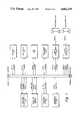
- FIG. 1constitutes a block diagram showing the general arrangement and construction of a system embodying this invention
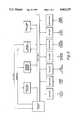
- FIG. 2constitutes a block diagram showing in greater detail than FIG. 1 the general arrangement and construction of the microprocessor control unit of a system embodying this invention
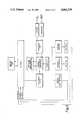
- FIG. 3constitutes a block diagram showing in greater detail than FIG. 1 the general arrangement and construction of the control pad member of a system embodying this invention
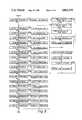
- FIG. 4constitutes a block diagram showing in greater detail than FIG. 1 the general arrangement and construction of the amplifier means portion of a system embodying this invention
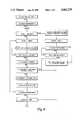
- FIG. 5constitutes a flow chart diagram showing the main logic flow of the microprocessor control unit of a system embodying this invention.
- FIG. 6constitutes a flow chart diagram showing the logic flow of the microprocessor control unit of a system embodying this invention in responding to a request to lessen the volume level at a particular requesting station.
- FIG. 1, and in greater detail in FIGS. 2, 3, and 4show the general arrangement and construction of a system embodying the present invention.
- the system illustratedis one that is preferable for use as a system for providing user selected audio programs to a plurality of uniquely identified stations in the system.
- the systemcomprises a plurality of program sources 12.
- each of these program sources 12can be either pre-set manually or randomly accessed by a user to a selected program signal or channel representing a desired audio channel, such as a local radio station.
- Program sources 12may be radio tuners, tape players, compact disc players, or even television sets. Therefore, while the preferred embodiment of the invention being described herein is an audio system, it is also contemplated that a system embodying the present invention can also include video program sources as well as merely audio program sources.
- a primary power supply unit 14is adapted to be connected to a source of power (not illustrated, but, for example, an electrical wall outlet) and to each of the program sources 12. Power supply unit 14 is also adapted to respond to a power control signal to either enable or disable a selected program source 12 as is better described below.
- a plurality of control pads 16are each located at a respective one of uniquely identified stations throughout the area to be serviced by system 10.
- Each control pad 16includes a plurality of switch means 15 and means 19 for generating a program call signal in response to the actuation of each switch means by a user.
- control pads 16shown in block diagrammatic form in FIG. 3, would employ a keypad such as a membrane touch, or pressure sensitive keypad that provides the user with individual keys that produce a tone or other binary data, suitable for encoding and decoding into binary coded signals for use by a microprocessor or central processing unit as is better described below for the transmission of data between control pads 16 and such central processing unit.
- a keypadsuch as a membrane touch, or pressure sensitive keypad that provides the user with individual keys that produce a tone or other binary data, suitable for encoding and decoding into binary coded signals for use by a microprocessor or central processing unit as is better described below for the transmission of data between control pads 16 and such central processing unit.
- Other non-membrane keypad devicessuch as toggle switches may also be used.
- Control pads 16also include means 19 for producing a program call signal having a first portion for uniquely identifying the station issuing the particular program call signal, a second portion identifying the type of program source being selected by the user at the particular station, and a third portion, that can identify a desired volume level or line level out for the program reproducing means, such as an audio speaker, associated with that particular station.
- Each of the control pads 16further includes timer means 17 and can further include local memory storage means.
- the timer meanscan be a continuous clock/timer that both visually displays the time and provides a timing or strobe signal for us by the associated control pad for sequencing the execution of its data operations.
- the local memory storage means that can be associated with each control pad 16is preferably a Random Access Memory device with a battery backup, adapted to retain a set of user-stored instructions entered by using the individual keys found on the keyboard of each control pad 16.
- each control pad 16The set of instructions contained in the memory portion of each control pad 16 is adapted to selectively control the program call signal generating means associated with each control pad 16 with reference to a timing standard provided by the clock/timer associated with the control pad.
- the local memory storage meansis preferably adapted to retain the set of user stored instructions for controlling the program call signal generating means for its associated control pad on a recurring periodic basis unless a second set of instructions is stored therein by the user.
- the set of user stored instructions at each control padis also be capable of a single, non-repetitive execution as well as a daily, periodic execution.
- the user-stored instructions entered at each stationmay be centrally stored in a memory storage portion or unit of the microprocessor control unit described below. With a centrally stored memory, there need only be a single battery backup for data protection.
- a microprocessor control unit 18is preferably coupled to power supply unit 14 and to control pads 16 by means of a wideband bus 20.
- Microprocessor control unit 18is shown in relation to the system 10 in FIG. 1, and in greater detail in the block diagram illustrated in FIG. 2.
- Wideband bus 20is generally connected to most individual element members of system 10 as shown in the FIGS. for transmitting and passing both data and power, as well as program signals throughout the system from program sources 12 to each station of the system 10, and between and among the individual system elements as better indicated herein.
- Microprocessor control unit 18is operable upon the receipt of a program call signal from each of the control pads 16, in accordance with a set of pre-set instructions for:
- This routing signalis preferably generated by polling through the type of program sources identified by the first portion of said program call signal, and generating the routing signal to connect the first non-connected program source of the identified type to the selected transducing means. If all of the particular type of individual program sources identified by the program call signal are connected, then the routing signal should connect the selected transducing means and station to the last of the identified type of program sources polled by the microprocessor control unit; and,
- volume level controlor line level out
- a volume level control signalfor use in driving associated equipment such as an additional amplifier device or a transducing unit, such as a speaker associated with the particular station making the program call, based upon the third portion of the program call signal.
- One preferable transducing unitshown in the FIGS., is a pair of audio speakers 22 located at or near each station of the system.
- Each of these transducing units or audio speakers 22is coupled to microprocessor control unit 18 and is located at the system stations for converting a received program signal to a sensibly perceptible program for the requesting user.
- Each of the audio speakers 22is adapted to respond to the volume level control (or line level out) signal for controlling the volume level of the sensibly perceptible program at the station.
- each of the audio speakers 22includes amplifier means 24 for amplifying the volume level of the selected program signal.
- Audio speaker units 22are adapted for providing the sensibly perceptible program for the enjoyment of the requesting user at that station.
- Switching unit 26is coupled to microprocessor control unit 18, to program sources 12, and audio speaker units 22, by means of wideband bus 20 for the transmission and reception of data and control signals throughout system 10.
- Switching unit 26responds to received routing signals to connect a selected one of the program sources 12 to at least one of the audio speaker units 22 located at a selected station of the system.
- FIGS. 5 and 6provide examples of a user supplied instruction set for use by the microprocessor control unit 18 for overall control of a system embodying the invention, such as that system 10 described here, and for controlling the volume or line level out of a program signal.
- the instructionsfirst require that the microprocessor control unit reference the timing standard for the system to determine whether the time has changed. If so, the microprocessor control unit is branched to a procedure that performs certain house-keeping chores such as changing the time display, checking to see if a repetitive task is required and performing that repetitive task if so required.
- the microprocessor control unitis directed to commence a series of checks to determine the nature of the commands being presented it.
- the microprocessor control unitbegins its checks by determining whether the program signal should be terminated from transmission to that particular station.
- microprocessor control unitis directed to determine if the user is attempting to store instructions for either one time or repetitive daily execution by the system.
- the microprocessor control unitis directed to loop back to the beginning of the instruction set and continue processing the instructions set so that it can respond to any additional or continuing instructions it may receive.
- FIG. 6provides an example of one of the subsets of instructions that would be processed by the microprocessor control unit.
- FIG. 6shows the logic flow diagram for the instruction set forming the volume down subroutine.
- the microprocessor control unithas branched to the start point from its activities better described above and shown in FIG. 5.
- the microprocessor control unitcommences its activity by first checking whether the user desires to change the existing minimum volume parameters already stored in its memory, and so visually displays these parameters at the station's control pad for the user's inspection.
- the microprocessor control unitthen receives the user's instructions to modify the existing stored minimum volume parameters, it proceeds to issue various control signals (such as line level out signals) to the appropriate amplifier devices to vary the volume of the program signal. After an appropriate reference to the timing standard to insure a known volume level, it displays the new volume level for the user's inspection.
- various control signalssuch as line level out signals
- the microprocessor control unitdisplays the timing reference for the user and returns to the main program logic flow as shown in FIG. 5.
- a subroutine instruction set for increasing the volume level of the program signalwould be similar to the above described subroutine instruction set for decreasing the volume set with only the change in volume level signal being opposite in direction, i.e, in one instance the control signal to the amplifying unit would increase the signal strength while in the other instance to decrease the signal strength.
Landscapes
- Engineering & Computer Science (AREA)
- Signal Processing (AREA)
- Circuits Of Receivers In General (AREA)
Abstract
Description
Claims (12)
Priority Applications (1)
| Application Number | Priority Date | Filing Date | Title |
|---|---|---|---|
| US07/182,388US4862159A (en) | 1988-04-18 | 1988-04-18 | Centralized system for selecting and reproducing perceptible programs |
Applications Claiming Priority (1)
| Application Number | Priority Date | Filing Date | Title |
|---|---|---|---|
| US07/182,388US4862159A (en) | 1988-04-18 | 1988-04-18 | Centralized system for selecting and reproducing perceptible programs |
Publications (1)
| Publication Number | Publication Date |
|---|---|
| US4862159Atrue US4862159A (en) | 1989-08-29 |
Family
ID=22668251
Family Applications (1)
| Application Number | Title | Priority Date | Filing Date |
|---|---|---|---|
| US07/182,388Expired - Fee RelatedUS4862159A (en) | 1988-04-18 | 1988-04-18 | Centralized system for selecting and reproducing perceptible programs |
Country Status (1)
| Country | Link |
|---|---|
| US (1) | US4862159A (en) |
Cited By (17)
| Publication number | Priority date | Publication date | Assignee | Title |
|---|---|---|---|---|
| EP0479456A3 (en)* | 1990-10-01 | 1992-05-06 | Ford Motor Company Limited | Automatically configured audio system |
| US5131048A (en)* | 1991-01-09 | 1992-07-14 | Square D Company | Audio distribution system |
| US5182552A (en)* | 1989-08-24 | 1993-01-26 | Bose Corporation | Multiple zone audio system |
| US5223825A (en)* | 1989-09-19 | 1993-06-29 | Matsushita Electric Industrial Co., Ltd. | Communication control system and communication control apparatus |
| USD339806S (en) | 1990-04-23 | 1993-09-28 | Bose Corporation | Music source central controller |
| US5287547A (en)* | 1989-05-11 | 1994-02-15 | Pioneer Electronic Corporation | Transmission and reception system |
| US5296848A (en)* | 1990-10-23 | 1994-03-22 | Sony (Australia) Pty Limited | Method and apparatus for triggering an automatic transmission |
| US5313524A (en)* | 1991-11-12 | 1994-05-17 | U.S. Philips Corporation | Self-contained active sound reproducer with switchable control unit master/slave |
| US5327114A (en)* | 1990-01-17 | 1994-07-05 | Square D Company | Service entrance distribution and management system for communication systems |
| US5406634A (en)* | 1993-03-16 | 1995-04-11 | Peak Audio, Inc. | Intelligent speaker unit for speaker system network |
| US5495301A (en)* | 1994-12-27 | 1996-02-27 | Zenith Electronics Corporation | Three wire pillow speaker with full television remote control functions |
| GB2306869A (en)* | 1995-11-03 | 1997-05-07 | Patrik Garten | Software for customised radio program |
| US6329908B1 (en)* | 2000-06-23 | 2001-12-11 | Armstrong World Industries, Inc. | Addressable speaker system |
| US7197148B2 (en) | 2001-09-28 | 2007-03-27 | Hubbell Incorporated | System for controlling remote speakers using centralized amplifiers, centralized monitoring and master/slave communication protocol |
| US8189753B1 (en) | 2007-04-12 | 2012-05-29 | Russound/Fmp Incorporated | Distributed intercom system with audio bus |
| US20170164111A1 (en)* | 2009-10-22 | 2017-06-08 | Dolby Laboratories Licensing Corporation | Digital Communication System for Loudspeakers |
| US11048398B2 (en)* | 2016-11-01 | 2021-06-29 | Yamaha Corporation | Information display apparatus and information display method |
Citations (5)
| Publication number | Priority date | Publication date | Assignee | Title |
|---|---|---|---|---|
| US3156770A (en)* | 1960-10-31 | 1964-11-10 | Hershman Musical Instr Company | Method and apparatus for selectively controlling sound emission |
| US4228402A (en)* | 1978-09-22 | 1980-10-14 | Sound-Mate Inc. | Device for remote control of stereo hi-fi amplifier parameters |
| US4371750A (en)* | 1980-07-24 | 1983-02-01 | Markley John B | Microphone and remote control system |
| US4504933A (en)* | 1979-06-18 | 1985-03-12 | Christopher Janney | Apparatus and method for producing sound images derived from the movement of people along a walkway |
| US4621374A (en)* | 1981-12-24 | 1986-11-04 | Itt Industries, Inc. | Circuit arrangement for processing, transmitting, and acoustically reproducing digitized audio-frequency signals |
- 1988
- 1988-04-18USUS07/182,388patent/US4862159A/ennot_activeExpired - Fee Related
Patent Citations (5)
| Publication number | Priority date | Publication date | Assignee | Title |
|---|---|---|---|---|
| US3156770A (en)* | 1960-10-31 | 1964-11-10 | Hershman Musical Instr Company | Method and apparatus for selectively controlling sound emission |
| US4228402A (en)* | 1978-09-22 | 1980-10-14 | Sound-Mate Inc. | Device for remote control of stereo hi-fi amplifier parameters |
| US4504933A (en)* | 1979-06-18 | 1985-03-12 | Christopher Janney | Apparatus and method for producing sound images derived from the movement of people along a walkway |
| US4371750A (en)* | 1980-07-24 | 1983-02-01 | Markley John B | Microphone and remote control system |
| US4621374A (en)* | 1981-12-24 | 1986-11-04 | Itt Industries, Inc. | Circuit arrangement for processing, transmitting, and acoustically reproducing digitized audio-frequency signals |
Cited By (20)
| Publication number | Priority date | Publication date | Assignee | Title |
|---|---|---|---|---|
| US5287547A (en)* | 1989-05-11 | 1994-02-15 | Pioneer Electronic Corporation | Transmission and reception system |
| US5182552A (en)* | 1989-08-24 | 1993-01-26 | Bose Corporation | Multiple zone audio system |
| US5223825A (en)* | 1989-09-19 | 1993-06-29 | Matsushita Electric Industrial Co., Ltd. | Communication control system and communication control apparatus |
| US5327114A (en)* | 1990-01-17 | 1994-07-05 | Square D Company | Service entrance distribution and management system for communication systems |
| USD339806S (en) | 1990-04-23 | 1993-09-28 | Bose Corporation | Music source central controller |
| EP0479456A3 (en)* | 1990-10-01 | 1992-05-06 | Ford Motor Company Limited | Automatically configured audio system |
| US5296848A (en)* | 1990-10-23 | 1994-03-22 | Sony (Australia) Pty Limited | Method and apparatus for triggering an automatic transmission |
| US5131048A (en)* | 1991-01-09 | 1992-07-14 | Square D Company | Audio distribution system |
| JP3311795B2 (en) | 1991-11-12 | 2002-08-05 | コーニンクレッカ フィリップス エレクトロニクス エヌ ヴィ | Active sound reproduction device and control device thereof |
| US5313524A (en)* | 1991-11-12 | 1994-05-17 | U.S. Philips Corporation | Self-contained active sound reproducer with switchable control unit master/slave |
| US5406634A (en)* | 1993-03-16 | 1995-04-11 | Peak Audio, Inc. | Intelligent speaker unit for speaker system network |
| US5495301A (en)* | 1994-12-27 | 1996-02-27 | Zenith Electronics Corporation | Three wire pillow speaker with full television remote control functions |
| GB2306869B (en)* | 1995-11-03 | 2000-09-20 | Patrik Garten | Listener operated radio programme selection and entertainment system |
| GB2306869A (en)* | 1995-11-03 | 1997-05-07 | Patrik Garten | Software for customised radio program |
| US6329908B1 (en)* | 2000-06-23 | 2001-12-11 | Armstrong World Industries, Inc. | Addressable speaker system |
| US7197148B2 (en) | 2001-09-28 | 2007-03-27 | Hubbell Incorporated | System for controlling remote speakers using centralized amplifiers, centralized monitoring and master/slave communication protocol |
| US8189753B1 (en) | 2007-04-12 | 2012-05-29 | Russound/Fmp Incorporated | Distributed intercom system with audio bus |
| US20170164111A1 (en)* | 2009-10-22 | 2017-06-08 | Dolby Laboratories Licensing Corporation | Digital Communication System for Loudspeakers |
| US10009688B2 (en)* | 2009-10-22 | 2018-06-26 | Dolby Laboratories Licensing Corporation | Digital communication system for loudspeakers |
| US11048398B2 (en)* | 2016-11-01 | 2021-06-29 | Yamaha Corporation | Information display apparatus and information display method |
Similar Documents
| Publication | Publication Date | Title |
|---|---|---|
| US4862159A (en) | Centralized system for selecting and reproducing perceptible programs | |
| US5182552A (en) | Multiple zone audio system | |
| CA1286025C (en) | Component audio/video system with automatic turn-off of peripheral device | |
| US5797125A (en) | Voice guide system including portable terminal units and control center having write processor | |
| US20010036809A1 (en) | Electronic apparatus | |
| EP0812492A1 (en) | Dual audio program system | |
| JPS63300464A (en) | Component voice/video system equipment | |
| KR950014338B1 (en) | Memo management apparatus method | |
| US5734964A (en) | Mass programmable FM stereo sound equalized assistive listening apparatus | |
| EP1423929A1 (en) | Intelligent broadcasting control system | |
| EP0414524B1 (en) | Multiple zone audio system | |
| EP0485416B1 (en) | Stored voice receiver having user controllable message retrieval | |
| CN100455143C (en) | Realplayer | |
| JP2898006B2 (en) | Multi-sourcing system | |
| KR100466304B1 (en) | A control system for plural audio signal and speaker group | |
| KR200302580Y1 (en) | A control system for plural audio signal and speaker group | |
| KR20000038176A (en) | Automatic Radio Frequency Selection Method Using Satellite Position Measurement System | |
| JP2756786B2 (en) | Timer device | |
| KR970002772Y1 (en) | Signal source automatic selection circuit | |
| KR960019278A (en) | Compact disc player integrated television receiver with wake-up call and wake-up function of the receiver | |
| KR20060135276A (en) | Pet control device and method using image display device | |
| JP3476106B2 (en) | Recording equipment | |
| KR0133948B1 (en) | Laser Disc Player Automatic Control System | |
| KR20010083810A (en) | Multi-room sound system | |
| JP2510057Y2 (en) | Controller of audio system |
Legal Events
| Date | Code | Title | Description |
|---|---|---|---|
| AS | Assignment | Owner name:AUDIOEASE, INC., COLORADO Free format text:ASSIGNMENT OF ASSIGNORS INTEREST.;ASSIGNOR:AUDIO TECHNOLOGY, INC. A CORPORATION OF CA;REEL/FRAME:006008/0881 Effective date:19911223 | |
| REMI | Maintenance fee reminder mailed | ||
| FPAY | Fee payment | Year of fee payment:4 | |
| SULP | Surcharge for late payment | ||
| AS | Assignment | Owner name:EASY ACRES, INC., COLORADO Free format text:CHANGE OF NAME;ASSIGNOR:AUDIO EASE, INC.;REEL/FRAME:007936/0844 Effective date:19921030 Owner name:AUDIO TECHNOLOGY, INC., CALIFORNIA Free format text:ASSIGNMENT OF ASSIGNORS INTEREST;ASSIGNORS:MUNROE, BRUCE R.;MARUSA, DAVID;REEL/FRAME:007936/0838 Effective date:19890626 Owner name:ULTRA AUDIO, INC., COLORADO Free format text:CHANGE OF NAME;ASSIGNOR:EASY ACRES, INC.;REEL/FRAME:007936/0842 Effective date:19930223 Owner name:SPS INTERNATIONAL, INC., COLORADO Free format text:ASSIGNMENT OF ASSIGNORS INTEREST;ASSIGNOR:ULTRA AUDIO, INC.;REEL/FRAME:007936/0836 Effective date:19960513 | |
| REMI | Maintenance fee reminder mailed | ||
| LAPS | Lapse for failure to pay maintenance fees | ||
| FP | Lapsed due to failure to pay maintenance fee | Effective date:19970903 | |
| STCH | Information on status: patent discontinuation | Free format text:PATENT EXPIRED DUE TO NONPAYMENT OF MAINTENANCE FEES UNDER 37 CFR 1.362 |