US4839014A - Cleaner assembly, humidifier, gas alarm and detoxification system - Google Patents
Cleaner assembly, humidifier, gas alarm and detoxification systemDownload PDFInfo
- Publication number
- US4839014A US4839014AUS07/133,924US13392487AUS4839014AUS 4839014 AUS4839014 AUS 4839014AUS 13392487 AUS13392487 AUS 13392487AUS 4839014 AUS4839014 AUS 4839014A
- Authority
- US
- United States
- Prior art keywords
- filter
- oxygen
- air
- assembly
- disposed
- Prior art date
- Legal status (The legal status is an assumption and is not a legal conclusion. Google has not performed a legal analysis and makes no representation as to the accuracy of the status listed.)
- Expired - Lifetime
Links
Images

Classifications
- F—MECHANICAL ENGINEERING; LIGHTING; HEATING; WEAPONS; BLASTING
- F24—HEATING; RANGES; VENTILATING
- F24F—AIR-CONDITIONING; AIR-HUMIDIFICATION; VENTILATION; USE OF AIR CURRENTS FOR SCREENING
- F24F5/00—Air-conditioning systems or apparatus not covered by F24F1/00 or F24F3/00, e.g. using solar heat or combined with household units such as an oven or water heater
- B—PERFORMING OPERATIONS; TRANSPORTING
- B01—PHYSICAL OR CHEMICAL PROCESSES OR APPARATUS IN GENERAL
- B01D—SEPARATION
- B01D46/00—Filters or filtering processes specially modified for separating dispersed particles from gases or vapours
- B01D46/10—Particle separators, e.g. dust precipitators, using filter plates, sheets or pads having plane surfaces
- B01D46/12—Particle separators, e.g. dust precipitators, using filter plates, sheets or pads having plane surfaces in multiple arrangements
- B—PERFORMING OPERATIONS; TRANSPORTING
- B01—PHYSICAL OR CHEMICAL PROCESSES OR APPARATUS IN GENERAL
- B01D—SEPARATION
- B01D46/00—Filters or filtering processes specially modified for separating dispersed particles from gases or vapours
- B—PERFORMING OPERATIONS; TRANSPORTING
- B01—PHYSICAL OR CHEMICAL PROCESSES OR APPARATUS IN GENERAL
- B01D—SEPARATION
- B01D47/00—Separating dispersed particles from gases, air or vapours by liquid as separating agent
- G—PHYSICS
- G01—MEASURING; TESTING
- G01N—INVESTIGATING OR ANALYSING MATERIALS BY DETERMINING THEIR CHEMICAL OR PHYSICAL PROPERTIES
- G01N33/00—Investigating or analysing materials by specific methods not covered by groups G01N1/00 - G01N31/00
- G01N33/0004—Gaseous mixtures, e.g. polluted air
- G01N33/0009—General constructional details of gas analysers, e.g. portable test equipment
- G01N33/0062—General constructional details of gas analysers, e.g. portable test equipment concerning the measuring method or the display, e.g. intermittent measurement or digital display
- G01N33/0063—General constructional details of gas analysers, e.g. portable test equipment concerning the measuring method or the display, e.g. intermittent measurement or digital display using a threshold to release an alarm or displaying means
Definitions
- the present inventionrelates to a multi-functional home appliance air cleaner, humidifier, gas alarm and gas detoxification system. More particularly, the present invention relates to an assembly which includes an air processing structure for air cleaning and humidifying, and an electrochemical reactor which activates a gas alarm for human safety upon detection of a predetermined dosage of gas, such as for example a fatal dose of a gas such as carbon monoxide, and which detoxifies the gas.
- a predetermined dosage of gassuch as for example a fatal dose of a gas such as carbon monoxide
- Another object of the present inventionis to provide a multi-functional appliance which comprises an air processing structure for air cleaning and humidifying, and a electrochemical reactor for activating a gas alarm and gas-detoxifying.
- a further object of the present inventionis to provide an apparatus which includes in its structure a device for producing and supplying oxygen by the electrolysis of water disposed therein.
- the present inventionrelates to an assembly of an air processing structure for air cleaning and humidifying, and an electrochemical reactor which activates a gas alarm for human safety upon detection of a predetermined gas dosage, such as for example a fatal dose of a gas such as carbon monoxide, and detoxifies the gas.
- a gas dosagesuch as for example a fatal dose of a gas such as carbon monoxide
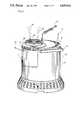
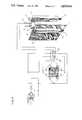
- FIG. 1is a perspective view of a multi-functional home appliance assembly of the present invention
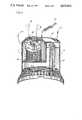
- FIG. 2is a sectional view of FIG. 1;
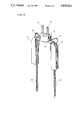
- FIG. 3is an exploded perspective view of a water containing member of the multi-functional home appliance assembly according to the present invention.
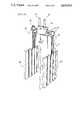
- FIG. 4is a perspective view of a pair of electrodes of a electrochemical reactor of the multi-functional home appliance assembly according to the present invention.
- FIG. 4Ais a perspective view illustrating another embodiment of the pair of electrodes of the electrochemical reactor of the multi-functional home appliance assembly according to the present invention.
- FIG. 5is a diagrammic view showing a oxygen indicator associated with electrolysis components of the assembly according to the present invention.
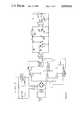
- FIG. 6is a diagrammic view showing an electrical system of an alarm device of the assembly according to the present invention.
- the assembly apparatus 10 as shown in FIGS. 1 and 2comprises an air processing structure 11 for air-cleaning and humidifying, an electrochemical reactor member 12 for activating a gas alarm and for detoxifying gas and a handle 13.
- the air processing structure 11comprises a water tank 11' containing a water soaked filter chamber 18, an electrical turbo fan 19 disposed within the filter chamber 18, a motor mount housing 20 including a motor rotor 22, a cover 26 containing a plurality of filtering stages 27, and a cover grille 28 for communicating with the atmosphere.
- the motor mount housing 20is provided with a motor field winding 21 and an on/off switch 25.
- the motor rotor 22is associated with a bearing 23 and screws 24.
- the plurality of filtering stages 27 for filtering the dirty air such as smoke, dust, pollen, odors etc.includes a first stage containing an impingement fiber for filtering large size airborne particles, a second stage containing a coated fiber for absorbing particles, a third stage containing an activated charcoal filter for absorbing odors, a fourth stage of a woven fabric filter for filtering contaminants, a fifth stage of a coated filter for electrostatically absorbing particles, and a sixth stage of a filter for eliminating submicron airborne pollutants. Therefore, the dirty air 15 in the room is delivered to the bundle of filters 27 for filtering and cleaning the air therethrough. The cleaned air is delivered into the filter chamber 18 by the electrical turbo fan 19 disposed in the filter chamber 18.
- the cleaned and humidified air 16'is exhausted into the room through a plurality of air outlets 16 disposed at the upper front side portion of the air processing member 11.
- the air processing structure 11is detachable from the electrochemical reactor 12. Also, in summer, the air cleaner can be operated individually without water in the water tank 11'.
- the electrochemical reactor 12may be used as a gas alarm, for oxygen-manufacturing, with AC as well as DC current, and with a battery or back up battery pack, and comprises a electrolysis system 29 which includes a cathode 39, an anode 40, an oxygen indicator 46 (FIG. 5), and an electronic circuit (FIG. 6).
- the cathode 39 and anode 40are disposed in ceramic conductive path members 34 and 35, respectively.
- a frame 38 attached to the ceramic conductive path members 34 and 35contains a ceramic leading edge 33 disposed thereon.
- the ceramic leading edge 33includes a cathode lead 31 connected to a cathode leader cable 36 which is connected to the cathode 39 disposed in the ceramic conductive path member 34, and an anode lead 32 connected to an anode leader cable 37 which is connected to the anode 40 disposed in the ceramic conductive path member 35 (FIG. 4).
- the electrodesinclude a large cathode 39' and a large anode 40' for use in a large space area such as an office room, conference room or the like.
- a diaphragm. 41is disposed between the ceramic conductive path member 34 including the cathode 39 and the ceramic conductive path member 35 including anode 40.
- the electrolysis system 29serves to control the supply of oxygen therethrough. That is, a on/off switch 47 is set at a predetermined oxygen percentage for the room and the electrolysis system 29 operates to supply the oxygen. The operation of the electrolysis system 29 is automatically stopped at the predetermined oxygen percentage.
- the oxygen indicator systemcomprises a sample measuring cell 42, a sample referencing cell 43, and pressure compensating cells 44 and 45 for measuring oxygen in the room.
- the reaction scheme of the electrolysis to produce oxygenis as follows:
- the oxygen 17' from the electrolysis system 29is exhausted through a plurality of apertures 17 into the room (FIG. 1).
- the electronic circuitprovides for a is provided to transfer from AC to DC by means of a transformer T 1 .
- the transformerhas 1.2A and 110V/12V.
- the electronic circuitincludes a back up battery pack and a stand-by rechargeable batter.
- R 1represents a 100 OHM and 1/2W resistor
- R 2represents a 15 OHM and 1W resistor
- R 3represents a 270 OHM and 1/2W resistor
- R 4represents a 50K OHM and linear potentiometer.
- B 1represents Ni-Cd cells
- C 1is a 220 UF/16V capacitor
- D 1 and D 2are 1A/200V silicon diodes
- Siis a SPST miniature switch.
- RECPrepresents a 50v/1A full wave rectifier
- LEDrepresents a red light emitting diode
- 1Clis a 5 volt regulator.
- Buzzrepresents a is piezo electric buzzer
- SCRIa 200V/0.8A or 200V/6A silicon-controlled rectifier
- TGSIis gas sensor.
Landscapes
- Chemical & Material Sciences (AREA)
- Engineering & Computer Science (AREA)
- Chemical Kinetics & Catalysis (AREA)
- Life Sciences & Earth Sciences (AREA)
- Health & Medical Sciences (AREA)
- Combustion & Propulsion (AREA)
- Biochemistry (AREA)
- Immunology (AREA)
- Physics & Mathematics (AREA)
- Analytical Chemistry (AREA)
- Food Science & Technology (AREA)
- General Health & Medical Sciences (AREA)
- General Physics & Mathematics (AREA)
- Medicinal Chemistry (AREA)
- Pathology (AREA)
- Sustainable Development (AREA)
- Mechanical Engineering (AREA)
- General Engineering & Computer Science (AREA)
- Electrolytic Production Of Non-Metals, Compounds, Apparatuses Therefor (AREA)
- Air Humidification (AREA)
Abstract
Description
The present invention relates to a multi-functional home appliance air cleaner, humidifier, gas alarm and gas detoxification system. More particularly, the present invention relates to an assembly which includes an air processing structure for air cleaning and humidifying, and an electrochemical reactor which activates a gas alarm for human safety upon detection of a predetermined dosage of gas, such as for example a fatal dose of a gas such as carbon monoxide, and which detoxifies the gas.
Previously, many types of air cleaners, humidifiers, gas alarms and gas detoxification apparatuses have been separately developed. However, these home appliances suffer from a number of difficulties since a separate air cleaner, humidifier, gas-alarm device, and gas detoxification apparatus require separate purchases which are expensive and these devices occupy a large amount of space in a given room.
Accordingly, it is an object of the present invention to provide a compact home appliance having multiple functions, that is, air cleaning, humidifying, use as a gas alarm, and gas detoxifying for improving human environmental conditions.
Another object of the present invention is to provide a multi-functional appliance which comprises an air processing structure for air cleaning and humidifying, and a electrochemical reactor for activating a gas alarm and gas-detoxifying.
A further object of the present invention is to provide an apparatus which includes in its structure a device for producing and supplying oxygen by the electrolysis of water disposed therein.
Other objects and further scope of applicability of the present invention will become apparent from the detailed description given hereinafter. It should be understood, however, that the detailed description and specific examples, while indicating preferred embodiments of the invention, are given by way of illustration only, since various changes and modifications within the spirit and scope of the invention will become apparent to those skilled in the art from this detailed description.
Briefly described, the present invention relates to an assembly of an air processing structure for air cleaning and humidifying, and an electrochemical reactor which activates a gas alarm for human safety upon detection of a predetermined gas dosage, such as for example a fatal dose of a gas such as carbon monoxide, and detoxifies the gas.
The present invention will become more fully understood from the detailed description given hereinbelow and the accompanying drawings which are given by way of illustration only, and thus are not limitative of the present invention, and wherein:
FIG. 1 is a perspective view of a multi-functional home appliance assembly of the present invention;
FIG. 2 is a sectional view of FIG. 1;
FIG. 3 is an exploded perspective view of a water containing member of the multi-functional home appliance assembly according to the present invention;
FIG. 4 is a perspective view of a pair of electrodes of a electrochemical reactor of the multi-functional home appliance assembly according to the present invention;
FIG. 4A is a perspective view illustrating another embodiment of the pair of electrodes of the electrochemical reactor of the multi-functional home appliance assembly according to the present invention;
FIG. 5 is a diagrammic view showing a oxygen indicator associated with electrolysis components of the assembly according to the present invention; and
FIG. 6 is a diagrammic view showing an electrical system of an alarm device of the assembly according to the present invention.
Referring now in detail to the drawings for the purpose of illustrating preferred embodiments of the present invention, theassembly apparatus 10 as shown in FIGS. 1 and 2 comprises an air processing structure 11 for air-cleaning and humidifying, anelectrochemical reactor member 12 for activating a gas alarm and for detoxifying gas and ahandle 13.
As shown in FIG. 3, the air processing structure 11 comprises a water tank 11' containing a water soakedfilter chamber 18, an electrical turbo fan 19 disposed within thefilter chamber 18, amotor mount housing 20 including amotor rotor 22, acover 26 containing a plurality offiltering stages 27, and acover grille 28 for communicating with the atmosphere. Themotor mount housing 20 is provided with a motor field winding 21 and an on/offswitch 25. Also, themotor rotor 22 is associated with abearing 23 andscrews 24. The plurality offiltering stages 27 for filtering the dirty air such as smoke, dust, pollen, odors etc., includes a first stage containing an impingement fiber for filtering large size airborne particles, a second stage containing a coated fiber for absorbing particles, a third stage containing an activated charcoal filter for absorbing odors, a fourth stage of a woven fabric filter for filtering contaminants, a fifth stage of a coated filter for electrostatically absorbing particles, and a sixth stage of a filter for eliminating submicron airborne pollutants. Therefore, thedirty air 15 in the room is delivered to the bundle offilters 27 for filtering and cleaning the air therethrough. The cleaned air is delivered into thefilter chamber 18 by the electrical turbo fan 19 disposed in thefilter chamber 18. The cleaned and humidified air 16' is exhausted into the room through a plurality ofair outlets 16 disposed at the upper front side portion of the air processing member 11. The air processing structure 11 is detachable from theelectrochemical reactor 12. Also, in summer, the air cleaner can be operated individually without water in the water tank 11'. As shown in FIGS. 4, 5 and 6, theelectrochemical reactor 12 may be used as a gas alarm, for oxygen-manufacturing, with AC as well as DC current, and with a battery or back up battery pack, and comprises aelectrolysis system 29 which includes acathode 39, ananode 40, an oxygen indicator 46 (FIG. 5), and an electronic circuit (FIG. 6).
Thecathode 39 andanode 40 are disposed in ceramicconductive path members frame 38 attached to the ceramicconductive path members edge 33 disposed thereon. The ceramic leadingedge 33 includes acathode lead 31 connected to acathode leader cable 36 which is connected to thecathode 39 disposed in the ceramicconductive path member 34, and ananode lead 32 connected to ananode leader cable 37 which is connected to theanode 40 disposed in the ceramic conductive path member 35 (FIG. 4).
Referring in detail to FIG. 4A, there is illustrated an additional embodiment of electrodes of the electrochemical reactor in accordance with the present invention. The electrodes include a large cathode 39' and a large anode 40' for use in a large space area such as an office room, conference room or the like. A diaphragm. 41 is disposed between the ceramicconductive path member 34 including thecathode 39 and the ceramicconductive path member 35 includinganode 40. Theelectrolysis system 29 serves to control the supply of oxygen therethrough. That is, a on/offswitch 47 is set at a predetermined oxygen percentage for the room and theelectrolysis system 29 operates to supply the oxygen. The operation of theelectrolysis system 29 is automatically stopped at the predetermined oxygen percentage. As shown in FIG. 5, the oxygen indicator system comprises asample measuring cell 42, asample referencing cell 43, and pressure compensating cells 44 and 45 for measuring oxygen in the room. The reaction scheme of the electrolysis to produce oxygen is as follows:
2H.sub.2 O→2H.sub.2 +O.sub.2
2H.sub.2 O+2e.sup.- →2H+2OH.sup.-
2H→H.sub.2 (Cathode)
2OH.sup.- →2OH+2e.sup.-
2OH→H.sub.2 O+1/2O.sub.2 (Anode)
The oxygen 17' from theelectrolysis system 29 is exhausted through a plurality ofapertures 17 into the room (FIG. 1).
As shown in FIG. 6, the electronic circuit provides for a is provided to transfer from AC to DC by means of a transformer T1. The transformer has 1.2A and 110V/12V. Also, the electronic circuit includes a back up battery pack and a stand-by rechargeable batter. In FIG. 6, R1 represents a 100 OHM and 1/2W resistor, R2 represents a 15 OHM and 1W resistor, R3 represents a 270 OHM and 1/2W resistor and R4 represents a 50K OHM and linear potentiometer. B1 represents Ni-Cd cells, C1 is a 220 UF/16V capacitor, D1 and D2 are 1A/200V silicon diodes, and Si is a SPST miniature switch. RECP represents a 50v/1A full wave rectifier, LED represents a red light emitting diode, and 1Cl is a 5 volt regulator. Buzz represents a is piezo electric buzzer, SCRI a 200V/0.8A or 200V/6A silicon-controlled rectifier, and TGSI is gas sensor.
The invention being thus described, it will be obvious that the same may be varied in many ways. Such variations are not to be regarded as a departure from the spirit and scope of the invention, and all such modifications as would be obvious to one skilled in the art are intended to be included in the scope of the following claims.
Claims (6)
1. An appliance assembly for use in a room which comprises:
an air processing structure for air cleaning and humidifying the room, said air processing structure including a water tank, a filter chamber disposed in said water tank, an electrical turbo fan disposed within said filter chamber, a motor mount housing disposed within said water containing member, a motor rotor supported by said housing operatively associated with said turbo fan, a filter cover containing six filter stages, a cover grille as an air intake disposed on said filter cover for receiving unfiltered air, and a plurality of apertures for exhausting cleaned and humidified air to the atmosphere, wherein said six filter stages include a first stage containing impingement fiber for filtering large size airborne particles, a second stage containing a coated filter for absorbing the particles, a third stage containing an activated charcoal filter for absorbing odors, a fourth stage containing a woven fabric filter for filtering contaminants, a fifth stage containing a coated filter for electrostatically absorbing the particles, and a sixth stage containing a filter for eliminating submicron airborne pollutants; and
an electrochemical reactor operatively connected to said air processing structure for activating a gas alarm and supplying oxygen to the room, said electrochemical reactor being detachable from said air processing structure, and said electrochemical reactor including an electrolysis system for supplying oxygen, an oxygen controlling system for controlling the supply of oxygen at a predetermined percentage in the room and a gas alarm system for monitoring carbon monoxide,
wherein the assembly is constructed so as to be used as an air cleaner, humidifier, gas alarm, and oxygen-supplier.
2. The assembly of claim 1, wherein the gas alarm system includes an on/off switch operatively associated therewith, a buzzer operatively connected to said switch, cells, plurality of resisters, and diodes operatively associated with said buzzer for activating said buzzer upon detecting the presence of said carbon monoxide.
3. The assembly of claim 1, wherein the electrolysis system contains a first ceramic conductive path member which includes a cathode, a second ceramic conductive path member which includes an anode, and a diaphragm operatively disposed between said first and second ceramic conductive path members.
4. The assembly of claim 3, wherein the oxygen controlling system includes an on/off switch operatively associated therewith, and an oxygen percentage meter operatively connected to a sample measuring cell, a sample referencing cell, and a pressure compensating cells for measuring oxygen in the room.
5. The assembly of claim 3, wherein the cathode disposed in the ceramic conductive path member is operatively connected to a cathode lead through a cathode leader cable.
6. The assembly of claim 5, wherein the anode disposed in the ceramic conductive path member is operatively connected to an anode lead through an anode leader cable.
Priority Applications (2)
| Application Number | Priority Date | Filing Date | Title |
|---|---|---|---|
| US07/133,924US4839014A (en) | 1987-12-16 | 1987-12-16 | Cleaner assembly, humidifier, gas alarm and detoxification system |
| KR1019880001111AKR900006079B1 (en) | 1987-11-16 | 1988-02-06 | Cleaner assembly, humidifier, gas alarm and detoxification system |
Applications Claiming Priority (1)
| Application Number | Priority Date | Filing Date | Title |
|---|---|---|---|
| US07/133,924US4839014A (en) | 1987-12-16 | 1987-12-16 | Cleaner assembly, humidifier, gas alarm and detoxification system |
Publications (1)
| Publication Number | Publication Date |
|---|---|
| US4839014Atrue US4839014A (en) | 1989-06-13 |
Family
ID=22460935
Family Applications (1)
| Application Number | Title | Priority Date | Filing Date |
|---|---|---|---|
| US07/133,924Expired - LifetimeUS4839014A (en) | 1987-11-16 | 1987-12-16 | Cleaner assembly, humidifier, gas alarm and detoxification system |
Country Status (2)
| Country | Link |
|---|---|
| US (1) | US4839014A (en) |
| KR (1) | KR900006079B1 (en) |
Cited By (32)
| Publication number | Priority date | Publication date | Assignee | Title |
|---|---|---|---|---|
| US5018395A (en)* | 1990-02-08 | 1991-05-28 | Bacharach, Inc. | Gas sampling device with improved mixed flow fan |
| USD337634S (en) | 1992-04-29 | 1993-07-20 | Bemis Manufacturing Company | Humidifier |
| US5529726A (en)* | 1994-04-04 | 1996-06-25 | Holmes Products Corp. | Evaporative humidifier |
| USD374480S (en) | 1995-10-13 | 1996-10-08 | Bemis Manufacturing Company | Humidifier |
| USD376001S (en) | 1994-09-01 | 1996-11-26 | Kaz, Incorporated | Humidifier |
| US5593482A (en)* | 1990-03-20 | 1997-01-14 | W. L. Gore & Associates, Inc. | Adsorbent assembly for removing gaseous contaminants |
| US5596314A (en)* | 1994-08-01 | 1997-01-21 | Quantum Group, Inc. | Enclosure for a gas detector system |
| US5694118A (en)* | 1994-12-28 | 1997-12-02 | Park; Sea C. | Gas detection and alarm system for monitoring gas such as carbon monoxide |
| US5797358A (en)* | 1996-07-08 | 1998-08-25 | Aos Holding Company | Control system for a water heater |
| US5800741A (en)* | 1994-04-04 | 1998-09-01 | Holmes Products Corp. | Evaporative humidifier having wick filter with color change indicator |
| US6053482A (en)* | 1997-01-31 | 2000-04-25 | Holmes Products Corp. | Humidifier including a water filtration device |
| US6214095B1 (en) | 1999-07-06 | 2001-04-10 | Donaldson Company, Inc. | Adsorbent pouch for removal of gaseous contaminants |
| USD449097S1 (en) | 2000-05-01 | 2001-10-09 | Hamilton Beach/Proctor-Silex, Inc. | Air cleaner |
| USD449679S1 (en) | 2000-05-01 | 2001-10-23 | Hamilton Beach/Proctor-Silex, Inc. | Air cleaner filter |
| USD449676S1 (en) | 2000-08-11 | 2001-10-23 | Hamilton Beach/Proctor-Silex, Inc. | Humidifier |
| US6315821B1 (en) | 2000-05-03 | 2001-11-13 | Hamilton Beach/Proctor-Silex, Inc. | Air filtration device including filter change indicator |
| US6328791B1 (en) | 2000-05-03 | 2001-12-11 | Hamilton Beach/Proctor-Silex, Inc. | Air filtration device |
| USRE37745E1 (en)* | 1996-07-08 | 2002-06-18 | Aos Holding Company | Control system for a water heater |
| USD459457S1 (en) | 2000-05-01 | 2002-06-25 | Hamilton Beach/Proctor-Silex, Inc. | Air cleaner |
| US6427984B1 (en) | 2000-08-11 | 2002-08-06 | Hamilton Beach/Proctor-Silex, Inc. | Evaporative humidifier |
| US6494940B1 (en) | 2000-09-29 | 2002-12-17 | Hamilton Beach/Proctor-Silex, Inc. | Air purifier |
| USD468820S1 (en) | 2000-09-29 | 2003-01-14 | Hamilton Beach/Proctor-Silex, Inc. | Air purifier |
| US20050151280A1 (en)* | 2004-01-09 | 2005-07-14 | Jon French | Humidifier |
| US20060283877A1 (en)* | 2005-06-20 | 2006-12-21 | South-Tek Systems | Beverage dispensing gas consumption detection with alarm and backup operation |
| US7368003B2 (en) | 2005-06-24 | 2008-05-06 | S.C. Johnson & Son, Inc. | Systems for and methods of providing air purification in combination with odor elimination |
| US7537647B2 (en) | 2005-08-10 | 2009-05-26 | S.C. Johnson & Son, Inc. | Air purifier |
| US7754157B2 (en)* | 2002-07-08 | 2010-07-13 | Panasonic Corporation | Humidifier |
| US20110318817A1 (en)* | 2010-06-25 | 2011-12-29 | Sgblue, Inc. | Compact air purifier |
| US20180214811A1 (en)* | 2017-01-18 | 2018-08-02 | Bluesea Co., Ltd. | Air cleaning machine |
| US11446584B2 (en) | 2020-02-20 | 2022-09-20 | Honor Metro Limited | Apparatus and method for generating bubbles |
| USD975190S1 (en)* | 2020-02-20 | 2023-01-10 | Honor Metro Limited | Bubble machine |
| US12172098B2 (en) | 2013-11-08 | 2024-12-24 | Honor Metro Limited | Apparatus for generating bubbles |
Families Citing this family (1)
| Publication number | Priority date | Publication date | Assignee | Title |
|---|---|---|---|---|
| CN112316580B (en)* | 2020-11-06 | 2023-05-05 | 李金慧 | Atmospheric pollution treatment equipment |
Citations (7)
| Publication number | Priority date | Publication date | Assignee | Title |
|---|---|---|---|---|
| US558176A (en)* | 1896-04-14 | Process of electrizing water for heating purposes | ||
| US1581944A (en)* | 1923-11-17 | 1926-04-20 | Hausmeister Paul | Production of compressed gases by electrolysis |
| US2771283A (en)* | 1955-05-05 | 1956-11-20 | Eranosian John | Air conditioning unit |
| US3045665A (en)* | 1956-09-22 | 1962-07-24 | Hartmann & Braun Ag | Instrument for maintaining constant oxygen partial pressure and measuring oxygen consumption |
| US4141703A (en)* | 1976-01-30 | 1979-02-27 | Stanley I. Wolf | Air-pollution filter and face mask |
| US4462246A (en)* | 1982-06-04 | 1984-07-31 | Sierra Monitor Corporation | Percent oxygen gauge |
| US4726888A (en)* | 1986-12-04 | 1988-02-23 | Mccambridge Michael | Electrolysis of water |
- 1987
- 1987-12-16USUS07/133,924patent/US4839014A/ennot_activeExpired - Lifetime
- 1988
- 1988-02-06KRKR1019880001111Apatent/KR900006079B1/ennot_activeExpired
Patent Citations (7)
| Publication number | Priority date | Publication date | Assignee | Title |
|---|---|---|---|---|
| US558176A (en)* | 1896-04-14 | Process of electrizing water for heating purposes | ||
| US1581944A (en)* | 1923-11-17 | 1926-04-20 | Hausmeister Paul | Production of compressed gases by electrolysis |
| US2771283A (en)* | 1955-05-05 | 1956-11-20 | Eranosian John | Air conditioning unit |
| US3045665A (en)* | 1956-09-22 | 1962-07-24 | Hartmann & Braun Ag | Instrument for maintaining constant oxygen partial pressure and measuring oxygen consumption |
| US4141703A (en)* | 1976-01-30 | 1979-02-27 | Stanley I. Wolf | Air-pollution filter and face mask |
| US4462246A (en)* | 1982-06-04 | 1984-07-31 | Sierra Monitor Corporation | Percent oxygen gauge |
| US4726888A (en)* | 1986-12-04 | 1988-02-23 | Mccambridge Michael | Electrolysis of water |
Cited By (53)
| Publication number | Priority date | Publication date | Assignee | Title |
|---|---|---|---|---|
| WO1991012512A1 (en)* | 1990-02-08 | 1991-08-22 | Bacharach, Inc. | Gas sampling device with improved mixed flow fan |
| AU632668B2 (en)* | 1990-02-08 | 1993-01-07 | Bacharach, Inc. | Gas sampling device with improved mixed flow fan |
| US5018395A (en)* | 1990-02-08 | 1991-05-28 | Bacharach, Inc. | Gas sampling device with improved mixed flow fan |
| US5593482A (en)* | 1990-03-20 | 1997-01-14 | W. L. Gore & Associates, Inc. | Adsorbent assembly for removing gaseous contaminants |
| USD337634S (en) | 1992-04-29 | 1993-07-20 | Bemis Manufacturing Company | Humidifier |
| US5688446A (en)* | 1994-04-04 | 1997-11-18 | Holmes Products Corp. | Evaporative humidifier |
| US5529726A (en)* | 1994-04-04 | 1996-06-25 | Holmes Products Corp. | Evaporative humidifier |
| US5800741A (en)* | 1994-04-04 | 1998-09-01 | Holmes Products Corp. | Evaporative humidifier having wick filter with color change indicator |
| US5596314A (en)* | 1994-08-01 | 1997-01-21 | Quantum Group, Inc. | Enclosure for a gas detector system |
| US5793295A (en)* | 1994-08-01 | 1998-08-11 | Quantum Group, Inc | Detection apparatus and method |
| USD376001S (en) | 1994-09-01 | 1996-11-26 | Kaz, Incorporated | Humidifier |
| US5694118A (en)* | 1994-12-28 | 1997-12-02 | Park; Sea C. | Gas detection and alarm system for monitoring gas such as carbon monoxide |
| USD374480S (en) | 1995-10-13 | 1996-10-08 | Bemis Manufacturing Company | Humidifier |
| USRE37745E1 (en)* | 1996-07-08 | 2002-06-18 | Aos Holding Company | Control system for a water heater |
| US5797358A (en)* | 1996-07-08 | 1998-08-25 | Aos Holding Company | Control system for a water heater |
| US6053482A (en)* | 1997-01-31 | 2000-04-25 | Holmes Products Corp. | Humidifier including a water filtration device |
| US6214095B1 (en) | 1999-07-06 | 2001-04-10 | Donaldson Company, Inc. | Adsorbent pouch for removal of gaseous contaminants |
| USD449097S1 (en) | 2000-05-01 | 2001-10-09 | Hamilton Beach/Proctor-Silex, Inc. | Air cleaner |
| USD449679S1 (en) | 2000-05-01 | 2001-10-23 | Hamilton Beach/Proctor-Silex, Inc. | Air cleaner filter |
| USD459457S1 (en) | 2000-05-01 | 2002-06-25 | Hamilton Beach/Proctor-Silex, Inc. | Air cleaner |
| US6447587B1 (en) | 2000-05-03 | 2002-09-10 | Hamilton Beach/Proctor-Silex, Inc. | Air filtration device |
| US6328791B1 (en) | 2000-05-03 | 2001-12-11 | Hamilton Beach/Proctor-Silex, Inc. | Air filtration device |
| US6315821B1 (en) | 2000-05-03 | 2001-11-13 | Hamilton Beach/Proctor-Silex, Inc. | Air filtration device including filter change indicator |
| US20040079059A1 (en)* | 2000-05-03 | 2004-04-29 | Hamilton Beach/Proctor-Silex, Inc. | Air filtration device |
| US6863704B2 (en) | 2000-05-03 | 2005-03-08 | Hamilton Beach/Proctor-Silex, Inc. | Air filtration device |
| US6508868B2 (en) | 2000-05-03 | 2003-01-21 | Hamilton Beach/Proctor-Silex, Inc. | Air filtration device including filter change indicator |
| US20030056478A1 (en)* | 2000-05-03 | 2003-03-27 | Hamilton Beach/Proctor-Silex, Inc. | Air filtration device |
| US6712889B2 (en) | 2000-05-03 | 2004-03-30 | Hamilton Beach/Proctor-Silex, Inc. | Air filtration device |
| US6427984B1 (en) | 2000-08-11 | 2002-08-06 | Hamilton Beach/Proctor-Silex, Inc. | Evaporative humidifier |
| USD449676S1 (en) | 2000-08-11 | 2001-10-23 | Hamilton Beach/Proctor-Silex, Inc. | Humidifier |
| US6604733B2 (en) | 2000-08-11 | 2003-08-12 | Hamilton Beach/Proctor-Silex, Inc. | Evaporative humidifier |
| US20040012103A1 (en)* | 2000-08-11 | 2004-01-22 | Hamilton Beach/Proctor-Silex, Inc. | Evaporative humidifier |
| US6715739B2 (en) | 2000-08-11 | 2004-04-06 | Hamilton Beach/Proctor-Silex, Inc. | Evaporative humidifier |
| US6494940B1 (en) | 2000-09-29 | 2002-12-17 | Hamilton Beach/Proctor-Silex, Inc. | Air purifier |
| USD468820S1 (en) | 2000-09-29 | 2003-01-14 | Hamilton Beach/Proctor-Silex, Inc. | Air purifier |
| US7754157B2 (en)* | 2002-07-08 | 2010-07-13 | Panasonic Corporation | Humidifier |
| US20050151280A1 (en)* | 2004-01-09 | 2005-07-14 | Jon French | Humidifier |
| US7073782B2 (en) | 2004-01-09 | 2006-07-11 | Jcs/Thg, Llc | Humidifier |
| US20060170121A1 (en)* | 2004-01-09 | 2006-08-03 | Jcs/Thg, Llc. | Humidifier |
| US7377494B2 (en) | 2004-01-09 | 2008-05-27 | Sunbeam Products, Inc. | Humidifier |
| US7832592B2 (en) | 2005-06-20 | 2010-11-16 | South-Tek Systems | Beverage dispensing gas consumption detection with alarm and backup operation |
| US20060283877A1 (en)* | 2005-06-20 | 2006-12-21 | South-Tek Systems | Beverage dispensing gas consumption detection with alarm and backup operation |
| US20060289559A1 (en)* | 2005-06-20 | 2006-12-28 | South-Tek Systems | Beverage dispensing gas consumption detection with alarm and backup operation |
| US7717294B2 (en) | 2005-06-20 | 2010-05-18 | South-Tek Systems | Beverage dispensing gas consumption detection with alarm and backup operation |
| US7368003B2 (en) | 2005-06-24 | 2008-05-06 | S.C. Johnson & Son, Inc. | Systems for and methods of providing air purification in combination with odor elimination |
| US7537647B2 (en) | 2005-08-10 | 2009-05-26 | S.C. Johnson & Son, Inc. | Air purifier |
| US20110318817A1 (en)* | 2010-06-25 | 2011-12-29 | Sgblue, Inc. | Compact air purifier |
| US8748167B2 (en)* | 2010-06-25 | 2014-06-10 | Sgblue, Inc. | Compact air purifier |
| US12172098B2 (en) | 2013-11-08 | 2024-12-24 | Honor Metro Limited | Apparatus for generating bubbles |
| US20180214811A1 (en)* | 2017-01-18 | 2018-08-02 | Bluesea Co., Ltd. | Air cleaning machine |
| US10668423B2 (en)* | 2017-01-18 | 2020-06-02 | Bluesea Co., Ltd. | Air cleaning machine |
| US11446584B2 (en) | 2020-02-20 | 2022-09-20 | Honor Metro Limited | Apparatus and method for generating bubbles |
| USD975190S1 (en)* | 2020-02-20 | 2023-01-10 | Honor Metro Limited | Bubble machine |
Also Published As
| Publication number | Publication date |
|---|---|
| KR900006079B1 (en) | 1990-08-22 |
| KR890010510A (en) | 1989-08-09 |
Similar Documents
| Publication | Publication Date | Title |
|---|---|---|
| US4839014A (en) | Cleaner assembly, humidifier, gas alarm and detoxification system | |
| US7120006B2 (en) | Ion generator and air conditioning apparatus | |
| US7679879B2 (en) | Air conditioning apparatus | |
| EP1382096B1 (en) | Ion generator and air conditioning apparatus | |
| US5893944A (en) | Portable PSA oxygen generator | |
| US7419533B2 (en) | Separable air purifying apparatus | |
| US5601636A (en) | Wall mounted air cleaner assembly | |
| US5010777A (en) | Apparatus and method for establishing selected environmental characteristics | |
| US20040072046A1 (en) | Method and apparatus for maintenance of fuel cell cathode air quality with breathable hydrophobic membrane air filter | |
| WO2010023979A1 (en) | Ion detection device and ion generation device | |
| US6092387A (en) | Air conditioner with electric dust collector | |
| US4627862A (en) | Air cleaning apparatus | |
| US5185903A (en) | Electric vacuum cleaner with an ozonizer | |
| CN214841216U (en) | Fresh air assembly for air conditioner and air conditioner | |
| EP0271457A2 (en) | An electrostatic air cleaner particularly for kitchen forced suction hoods | |
| CN109028511A (en) | A kind of air-conditioning system with Detection of Air Quality sensor | |
| JP2002216933A (en) | Ion generator and air conditioner using the same | |
| JP3608661B2 (en) | Ion generator and air conditioner using the same | |
| KR920004206B1 (en) | Briquette gas poisoning prevention system with air purification, humidification, briquette gas alarm, blackout detection and hydrolysis function | |
| Charry et al. | Ion exposure chambers for small animals | |
| CN211659711U (en) | Electrified dust collector | |
| TWI765722B (en) | Simple replacement air conversion device | |
| JPH01123648A (en) | Air cleaner device | |
| CN2559814Y (en) | Fan | |
| CN116867731A (en) | Ozone generator |
Legal Events
| Date | Code | Title | Description |
|---|---|---|---|
| STCF | Information on status: patent grant | Free format text:PATENTED CASE | |
| FEPP | Fee payment procedure | Free format text:PAYOR NUMBER ASSIGNED (ORIGINAL EVENT CODE: ASPN); ENTITY STATUS OF PATENT OWNER: SMALL ENTITY | |
| FPAY | Fee payment | Year of fee payment:4 | |
| SULP | Surcharge for late payment | ||
| REMI | Maintenance fee reminder mailed | ||
| FPAY | Fee payment | Year of fee payment:8 | |
| SULP | Surcharge for late payment | ||
| FPAY | Fee payment | Year of fee payment:12 |