US4809429A - Apparatus for manufacturing laminated assemblies having ridges formed on projections which interlock with recesses of adjacent laminations - Google Patents
Apparatus for manufacturing laminated assemblies having ridges formed on projections which interlock with recesses of adjacent laminationsDownload PDFInfo
- Publication number
- US4809429A US4809429AUS07/109,598US10959887AUS4809429AUS 4809429 AUS4809429 AUS 4809429AUS 10959887 AUS10959887 AUS 10959887AUS 4809429 AUS4809429 AUS 4809429A
- Authority
- US
- United States
- Prior art keywords
- projection
- recess
- die
- ridges
- lamina
- Prior art date
- Legal status (The legal status is an assumption and is not a legal conclusion. Google has not performed a legal analysis and makes no representation as to the accuracy of the status listed.)
- Expired - Fee Related
Links
- 238000003475laminationMethods0.000titleclaimsabstractdescription11
- 238000004519manufacturing processMethods0.000titleclaimsabstractdescription10
- 230000000712assemblyEffects0.000titleabstractdescription7
- 238000000429assemblyMethods0.000titleabstractdescription7
- 230000000750progressive effectEffects0.000claimsabstractdescription8
- 230000002093peripheral effectEffects0.000claims6
- 238000004080punchingMethods0.000abstractdescription9
- 238000000034methodMethods0.000abstractdescription5
- 239000000463materialSubstances0.000abstractdescription2
- 239000002184metalSubstances0.000abstract1
- 238000005520cutting processMethods0.000description1
- 238000003860storageMethods0.000description1
- 238000009966trimmingMethods0.000description1
Images

Classifications
- B—PERFORMING OPERATIONS; TRANSPORTING
- B21—MECHANICAL METAL-WORKING WITHOUT ESSENTIALLY REMOVING MATERIAL; PUNCHING METAL
- B21D—WORKING OR PROCESSING OF SHEET METAL OR METAL TUBES, RODS OR PROFILES WITHOUT ESSENTIALLY REMOVING MATERIAL; PUNCHING METAL
- B21D39/00—Application of procedures in order to connect objects or parts, e.g. coating with sheet metal otherwise than by plating; Tube expanders
- B21D39/03—Application of procedures in order to connect objects or parts, e.g. coating with sheet metal otherwise than by plating; Tube expanders of sheet metal otherwise than by folding
- B21D39/031—Joining superposed plates by locally deforming without slitting or piercing
- B21D39/032—Joining superposed plates by locally deforming without slitting or piercing by fitting a projecting part integral with one plate in a hole of the other plate
- B—PERFORMING OPERATIONS; TRANSPORTING
- B21—MECHANICAL METAL-WORKING WITHOUT ESSENTIALLY REMOVING MATERIAL; PUNCHING METAL
- B21K—MAKING FORGED OR PRESSED METAL PRODUCTS, e.g. HORSE-SHOES, RIVETS, BOLTS OR WHEELS
- B21K23/00—Making other articles
- H—ELECTRICITY
- H02—GENERATION; CONVERSION OR DISTRIBUTION OF ELECTRIC POWER
- H02K—DYNAMO-ELECTRIC MACHINES
- H02K1/00—Details of the magnetic circuit
- H02K1/06—Details of the magnetic circuit characterised by the shape, form or construction
- H—ELECTRICITY
- H02—GENERATION; CONVERSION OR DISTRIBUTION OF ELECTRIC POWER
- H02K—DYNAMO-ELECTRIC MACHINES
- H02K15/00—Processes or apparatus specially adapted for manufacturing, assembling, maintaining or repairing of dynamo-electric machines
- H02K15/02—Processes or apparatus specially adapted for manufacturing, assembling, maintaining or repairing of dynamo-electric machines of stator or rotor bodies
- H—ELECTRICITY
- H02—GENERATION; CONVERSION OR DISTRIBUTION OF ELECTRIC POWER
- H02K—DYNAMO-ELECTRIC MACHINES
- H02K2201/00—Specific aspects not provided for in the other groups of this subclass relating to the magnetic circuits
- H02K2201/09—Magnetic cores comprising laminations characterised by being fastened by caulking
- Y—GENERAL TAGGING OF NEW TECHNOLOGICAL DEVELOPMENTS; GENERAL TAGGING OF CROSS-SECTIONAL TECHNOLOGIES SPANNING OVER SEVERAL SECTIONS OF THE IPC; TECHNICAL SUBJECTS COVERED BY FORMER USPC CROSS-REFERENCE ART COLLECTIONS [XRACs] AND DIGESTS
- Y10—TECHNICAL SUBJECTS COVERED BY FORMER USPC
- Y10T—TECHNICAL SUBJECTS COVERED BY FORMER US CLASSIFICATION
- Y10T29/00—Metal working
- Y10T29/49—Method of mechanical manufacture
- Y10T29/49002—Electrical device making
- Y10T29/49009—Dynamoelectric machine
- Y—GENERAL TAGGING OF NEW TECHNOLOGICAL DEVELOPMENTS; GENERAL TAGGING OF CROSS-SECTIONAL TECHNOLOGIES SPANNING OVER SEVERAL SECTIONS OF THE IPC; TECHNICAL SUBJECTS COVERED BY FORMER USPC CROSS-REFERENCE ART COLLECTIONS [XRACs] AND DIGESTS
- Y10—TECHNICAL SUBJECTS COVERED BY FORMER USPC
- Y10T—TECHNICAL SUBJECTS COVERED BY FORMER US CLASSIFICATION
- Y10T29/00—Metal working
- Y10T29/49—Method of mechanical manufacture
- Y10T29/49002—Electrical device making
- Y10T29/49009—Dynamoelectric machine
- Y10T29/49012—Rotor
- Y—GENERAL TAGGING OF NEW TECHNOLOGICAL DEVELOPMENTS; GENERAL TAGGING OF CROSS-SECTIONAL TECHNOLOGIES SPANNING OVER SEVERAL SECTIONS OF THE IPC; TECHNICAL SUBJECTS COVERED BY FORMER USPC CROSS-REFERENCE ART COLLECTIONS [XRACs] AND DIGESTS
- Y10—TECHNICAL SUBJECTS COVERED BY FORMER USPC
- Y10T—TECHNICAL SUBJECTS COVERED BY FORMER US CLASSIFICATION
- Y10T29/00—Metal working
- Y10T29/49—Method of mechanical manufacture
- Y10T29/49002—Electrical device making
- Y10T29/4902—Electromagnet, transformer or inductor
- Y10T29/49075—Electromagnet, transformer or inductor including permanent magnet or core
- Y10T29/49078—Laminated
- Y—GENERAL TAGGING OF NEW TECHNOLOGICAL DEVELOPMENTS; GENERAL TAGGING OF CROSS-SECTIONAL TECHNOLOGIES SPANNING OVER SEVERAL SECTIONS OF THE IPC; TECHNICAL SUBJECTS COVERED BY FORMER USPC CROSS-REFERENCE ART COLLECTIONS [XRACs] AND DIGESTS
- Y10—TECHNICAL SUBJECTS COVERED BY FORMER USPC
- Y10T—TECHNICAL SUBJECTS COVERED BY FORMER US CLASSIFICATION
- Y10T29/00—Metal working
- Y10T29/51—Plural diverse manufacturing apparatus including means for metal shaping or assembling
- Y10T29/5136—Separate tool stations for selective or successive operation on work
- Y10T29/5137—Separate tool stations for selective or successive operation on work including assembling or disassembling station
- Y10T29/5138—Separate tool stations for selective or successive operation on work including assembling or disassembling station and means to machine work part to fit cooperating work part
- Y—GENERAL TAGGING OF NEW TECHNOLOGICAL DEVELOPMENTS; GENERAL TAGGING OF CROSS-SECTIONAL TECHNOLOGIES SPANNING OVER SEVERAL SECTIONS OF THE IPC; TECHNICAL SUBJECTS COVERED BY FORMER USPC CROSS-REFERENCE ART COLLECTIONS [XRACs] AND DIGESTS
- Y10—TECHNICAL SUBJECTS COVERED BY FORMER USPC
- Y10T—TECHNICAL SUBJECTS COVERED BY FORMER US CLASSIFICATION
- Y10T29/00—Metal working
- Y10T29/53—Means to assemble or disassemble
- Y10T29/5313—Means to assemble electrical device
- Y10T29/53143—Motor or generator
- Y10T29/53161—Motor or generator including deforming means
- Y—GENERAL TAGGING OF NEW TECHNOLOGICAL DEVELOPMENTS; GENERAL TAGGING OF CROSS-SECTIONAL TECHNOLOGIES SPANNING OVER SEVERAL SECTIONS OF THE IPC; TECHNICAL SUBJECTS COVERED BY FORMER USPC CROSS-REFERENCE ART COLLECTIONS [XRACs] AND DIGESTS
- Y10—TECHNICAL SUBJECTS COVERED BY FORMER USPC
- Y10T—TECHNICAL SUBJECTS COVERED BY FORMER US CLASSIFICATION
- Y10T29/00—Metal working
- Y10T29/53—Means to assemble or disassemble
- Y10T29/5313—Means to assemble electrical device
- Y10T29/5317—Laminated device
Definitions
- the present inventionrelates to methods and apparatuses for manufacturing laminated assemblies for electrical machinery and appliances, such as rotors and stators, having interlocking projections and recesses for securing adjacent laminations together by compressive interference fit throughout the entire length of the laminated assembly.
- the present inventionrelates to an improvement in the method and apparatus for manufacturing laminated assemblies having interlocking projections and recesses.
- the improvementreduces the cross-sectional area of the projection, making it smaller than the cross-sectional area of the recess, while forming a plurality of exterior, longitudinal ridges protruding from the projection surface.
- the projectionis secured into the recess of an adjacent lamination by compressive interference fit between the ridges on the projection and the recess.
- the improved projectionhas ridges formed in a multistation progressive die manufacturing and assembling apparatus for laminated electrical machinery and appliances, such as rotors and stators, of the type including a punch and a lower die for forming interlocking projections and recesses.
- the lower diehas a plurality of longitudinal grooves on the interior surface of a bore in the lower die.
- the grooves in the lower dieproduce the ridges protruding from the circumferential surface of the projection during the punching operation, while the punch forms the recess in the laminated plate.
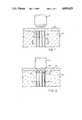
- FIG. 1is a partial cross-sectional view of a punching station for forming an interlocking projection and recess prior to operation of the punch;
- FIG. 2shows the same punching station as depicted in FIG. 1 with the punch in its lowermost position
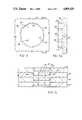
- FIG. 3is a view of the plate showing the projection after it is formed
- FIG. 3Ais a side view of the plate shown in FIG. 3;
- FIG. 4is a cross-sectional view of a compressed stack of laminated plates
- FIG. 5is a cross-sectional view of the lower die associated with the punching station.
- FIG. 6is a detailed view of one of the grooves in the lower die.
- the present inventionis incorporated into a multistation progressive die apparatus for manufacturing and assembling laminated electrical machinery and appliances, such as rotors and stators.
- a progressive die operationis performed by the multistation progressive die apparatus on a strip of material and typically includes the steps of forming pilot holes, forming stator slots and relief holes, forming rotor slots and shaft holes, punching interlock projections and recesses, punching out the rotor, shaving the inner diameter of the stators, trimming outer diameters of stators, forming shading coil slots, cutting stators apart, stacking stators or rotors, and compressing stacked stators or rotors.
- the step of punching interlock projections and recessesis typically performed at a station having one or more punches and corresponding lower dies, wherein the punch forms a recess in one side of a plate while a projection is formed by the lower die on the opposite side of the plate.
- a punch 10 and a lower die 20are shown, representing the one or more corresponding pairs of punches and lower dies present in a station for punching interlocking projections and recesses.
- the lower die 20has an aperture 22 with a plurality of longitudinal grooves 24 on the interior surface of the lower die 20.
- a plate 30is positioned on the upper surface of the lower die 20 between the lower die 20 and the punch 10.
- the punch 10is shown in its lowermost position having formed a recess 40 in the upper surface of the plate 30, and a projection 50 having been formed in the lower die 20.
- the longitudinal grooves 24 in the lower die 20produce ridges 52 protruding from the circumferential surface of the projection 50 as the punch 10 forms the recess 40 in the upper part of the plate 30.
- the projection 50 formed in accordance with the present inventionhas a smaller cross section than the recess 40.
- the outermost edge 54 of the ridges 52 on the circumferential surface of the projection 50project beyond the outer dimension of the recess 40 formed in the opposite side of the plate 30.
- a preferred embodimenthas the outmost edge 54 of the ridge 52 extending approximately 0.0005 inch beyond the outer dimension of the recess 40, the diameter from one outermost edge 54 to an opposing outermost edge 54 being approximately 0.001 inch greater than the diameter of the recess 40.
- FIG. 4shows a plurality of plates 30 having interlocking projections 50 and recesses 40 in which the projection 50 of a first plate 30 is compressed into a recess 40' of a second plate 30' (and third plate 30"), resulting in an interference fit between the ridges 52 on the projection 50 and the wall of the recess 40' of an adjacent plate 30'.
- the lowermost plate 30"' in a laminated assembly, as shown in FIG. 4,has the projections removed to separate the laminated plates into stacks, thereby facilitating storage and handling of the assemblies.
- a preferred embodiment of the projection 50has at least six ridges 52.
- Another preferred embodiment of the projection 50has ridges 52 formed with a partial circular cross section.
- the outer periphery of the ridge 52can be defined by an arc having at least a 0.01 inch diameter D.
- another preferred embodimentdefines the distance X that the ridge protrudes from the projection to be at least 0.0005 inch.
- the improvement of the present inventioncan also be defined in the embodiment comprising a projection 50 with a smaller cross-sectional area than the recess 40, the projection having a diameter of approximately 0.1493 inch and at least six exterior longitudinal ridges 52 with partial circular cross sections whose outer periphery is defined by an arc having at least a 0.01 inch diameter D and which protrudes from the surface of the projection by a distance X of at least 0.0005 inch, while the recess 40 has a diameter of approximately 0.1500 inch.
- FIG. 5shows a cross-sectional view of the lower die 20 used to form the projection 50.
- the lower die 20has a plurality of grooves 24 evenly spaced about the periphery of the aperture 22.
- the grooves 24extend longitudinally along the axis of the aperture 22, as shown in FIG. 1. It is preferable that there be at least six grooves 24 formed in the wall of the lower die 20. In a preferred embodiment, each groove 24 is formed and shaped as shown in FIG. 6.
- a 0.01 inch diameter D wire 60(shown in phantom) is used to burn a groove 24 in the surface of the aperture 22 of the lower die 20 to a depth X of 0.0005 inch.
- the diameter of the aperture 22preferably is approximately 0.1493 inch, while the punch 10 (shown in FIG. 1 and FIG. 2) has a diameter of approximately 0.1500 inch for forming the recess 40.
Landscapes
- Engineering & Computer Science (AREA)
- Mechanical Engineering (AREA)
- Power Engineering (AREA)
- Manufacturing & Machinery (AREA)
- Manufacture Of Motors, Generators (AREA)
Abstract
Description
This application is a division of application Ser. No. 912,840, filed Sept. 29, 1986, now U.S. Pat. No. 4,728,842.
1. Field of the Invention
The present invention relates to methods and apparatuses for manufacturing laminated assemblies for electrical machinery and appliances, such as rotors and stators, having interlocking projections and recesses for securing adjacent laminations together by compressive interference fit throughout the entire length of the laminated assembly.
2. Description of the Prior Art
Laminated assemblies having interlocking projections and recesses are known in the art. For instance, U.S. Pat. No. 2,975,312 discloses the use of interlocking projections and recesses having the same identical outlines and dimensions. Various other uses for the projections and recesses are disclosed in U.S. Pat. Nos. 4,538,345; 4,364,169; 3,203,077 and 3,202,851. However, the known methods and apparatuses for manufacturing laminated assemblies using projections and recesses for securing adjacent laminations together tend to cause deformation of the laminated plates during and after compressive fit of the projection into the recess.
It is a desirable characteristic of the present invention to reduce the amount of distortion inherent in the compressive fit of interlocking projections and recesses of adjacent laminated plate packs.
It is also a desirable characteristic to reduce the amount of compressive force required to achieve the compressive fit interlock of a laminated plate pack.
Furthermore, it is a desirable characteristic to increase the holding pressure of the interlocked laminated plate pack.
The present invention relates to an improvement in the method and apparatus for manufacturing laminated assemblies having interlocking projections and recesses. The improvement reduces the cross-sectional area of the projection, making it smaller than the cross-sectional area of the recess, while forming a plurality of exterior, longitudinal ridges protruding from the projection surface. The projection is secured into the recess of an adjacent lamination by compressive interference fit between the ridges on the projection and the recess. The improved projection has ridges formed in a multistation progressive die manufacturing and assembling apparatus for laminated electrical machinery and appliances, such as rotors and stators, of the type including a punch and a lower die for forming interlocking projections and recesses. The lower die has a plurality of longitudinal grooves on the interior surface of a bore in the lower die. The grooves in the lower die produce the ridges protruding from the circumferential surface of the projection during the punching operation, while the punch forms the recess in the laminated plate.
Further advantages and uses of the present invention will be apparent to those skilled in the art upon examination of the following drawings and description of the preferred embodiments.
FIG. 1 is a partial cross-sectional view of a punching station for forming an interlocking projection and recess prior to operation of the punch;
FIG. 2 shows the same punching station as depicted in FIG. 1 with the punch in its lowermost position;
FIG. 3 is a view of the plate showing the projection after it is formed;
FIG. 3A is a side view of the plate shown in FIG. 3;
FIG. 4 is a cross-sectional view of a compressed stack of laminated plates;
FIG. 5 is a cross-sectional view of the lower die associated with the punching station; and
FIG. 6 is a detailed view of one of the grooves in the lower die.
The present invention is incorporated into a multistation progressive die apparatus for manufacturing and assembling laminated electrical machinery and appliances, such as rotors and stators. A progressive die operation is performed by the multistation progressive die apparatus on a strip of material and typically includes the steps of forming pilot holes, forming stator slots and relief holes, forming rotor slots and shaft holes, punching interlock projections and recesses, punching out the rotor, shaving the inner diameter of the stators, trimming outer diameters of stators, forming shading coil slots, cutting stators apart, stacking stators or rotors, and compressing stacked stators or rotors. The step of punching interlock projections and recesses is typically performed at a station having one or more punches and corresponding lower dies, wherein the punch forms a recess in one side of a plate while a projection is formed by the lower die on the opposite side of the plate.
Referring now to FIG. 1, apunch 10 and alower die 20 are shown, representing the one or more corresponding pairs of punches and lower dies present in a station for punching interlocking projections and recesses. Thelower die 20 has anaperture 22 with a plurality oflongitudinal grooves 24 on the interior surface of thelower die 20. Aplate 30 is positioned on the upper surface of thelower die 20 between thelower die 20 and thepunch 10.
Referring now to FIG. 2, thepunch 10 is shown in its lowermost position having formed arecess 40 in the upper surface of theplate 30, and aprojection 50 having been formed in thelower die 20. Thelongitudinal grooves 24 in thelower die 20produce ridges 52 protruding from the circumferential surface of theprojection 50 as thepunch 10 forms therecess 40 in the upper part of theplate 30. theprojection 50 formed in accordance with the present invention has a smaller cross section than therecess 40. As can best be seen in FIG. 3 and FIG. 3A, theoutermost edge 54 of theridges 52 on the circumferential surface of theprojection 50 project beyond the outer dimension of therecess 40 formed in the opposite side of theplate 30. A preferred embodiment has theoutmost edge 54 of theridge 52 extending approximately 0.0005 inch beyond the outer dimension of therecess 40, the diameter from oneoutermost edge 54 to an opposingoutermost edge 54 being approximately 0.001 inch greater than the diameter of therecess 40.
After the plates are stacked and compressed, the laminated assembly is in an interlocking relationship progressively throughout the length of the assembly as depicted in FIG. 4. FIG. 4 shows a plurality ofplates 30 having interlockingprojections 50 andrecesses 40 in which theprojection 50 of afirst plate 30 is compressed into a recess 40' of a second plate 30' (andthird plate 30"), resulting in an interference fit between theridges 52 on theprojection 50 and the wall of the recess 40' of an adjacent plate 30'. Thelowermost plate 30"' in a laminated assembly, as shown in FIG. 4, has the projections removed to separate the laminated plates into stacks, thereby facilitating storage and handling of the assemblies.
Referring again to FIGS. 3 and 3A, a preferred embodiment of theprojection 50 has at least sixridges 52. Another preferred embodiment of theprojection 50 hasridges 52 formed with a partial circular cross section. The outer periphery of theridge 52 can be defined by an arc having at least a 0.01 inch diameter D. Yet, another preferred embodiment defines the distance X that the ridge protrudes from the projection to be at least 0.0005 inch. The improvement of the present invention can also be defined in the embodiment comprising aprojection 50 with a smaller cross-sectional area than therecess 40, the projection having a diameter of approximately 0.1493 inch and at least six exteriorlongitudinal ridges 52 with partial circular cross sections whose outer periphery is defined by an arc having at least a 0.01 inch diameter D and which protrudes from the surface of the projection by a distance X of at least 0.0005 inch, while therecess 40 has a diameter of approximately 0.1500 inch.
FIG. 5 shows a cross-sectional view of thelower die 20 used to form theprojection 50. Thelower die 20 has a plurality ofgrooves 24 evenly spaced about the periphery of theaperture 22. Thegrooves 24 extend longitudinally along the axis of theaperture 22, as shown in FIG. 1. It is preferable that there be at least sixgrooves 24 formed in the wall of thelower die 20. In a preferred embodiment, eachgroove 24 is formed and shaped as shown in FIG. 6. A 0.01 inch diameter D wire 60 (shown in phantom) is used to burn agroove 24 in the surface of theaperture 22 of thelower die 20 to a depth X of 0.0005 inch. The diameter of theaperture 22 preferably is approximately 0.1493 inch, while the punch 10 (shown in FIG. 1 and FIG. 2) has a diameter of approximately 0.1500 inch for forming therecess 40.
Claims (6)
1. In a multistation progressive tool for manufacturing and assembling laminated electrical parts, said tool including a die and a punch for respectively forming a projection on a first surface of a lamina and a recess on a second surface of said lamina for securing adjacent laminations together in interlocking relationship; the improvement comprising:
a die having an aperture adapted to form a projection with a smaller cross-sectional area than the recess formed by the punch and the die having a plurality of longitudinal grooves on an interior surface of the die for producing ridges protruding from a peripheral surface of the projection beyond a peripheral surface of the recess formed by the punch for securing adjacent laminations together in interlocking relationship by compressive interference fit between the ridges of the projection on a first lamina and the peripheral surface of the recess in an adjacent second lamina.
2. The improvement according to claim 1, wherein the die has at least six grooves.
3. The improvement according to claim 1, wherein each groove has a partial circular cross section.
4. The improvement according to claim 3, wherein the partial circular cross section has an outer periphery defined by an arc having at least a 0.01 inch diameter.
5. The improvement according to claim 1 wherein each of the plurality of grooves extends into the interior surface of the die by at least 0.0005 inch.
6. In a multistation progressive tool for manufacturing and assembling laminated electrical parts, said tool including a die and a punch for respectively forming a projection on a first surface of a lamina and a recess on a second surface of said lamina for securing adjacent laminations together in interlocking relationship; the improvement comprising:
a die having an aperture adapted to form a projection with a smaller cross-sectional area than the recess formed by the punch, the die having at least six longitudinal grooves on an interior surface of the die, the grooves having partial circular cross sections with a concave cylindrical surface of at least a 0.01 inch diameter and extending into the interior surface of the die by at least 0.0005 inch for producing ridges protruding from the peripheral surface of the projection beyond the peripheral surface of the recess formed by the punch for securing adjacent laminations together in interlocking relationship by compressive interference fit between the ridges of the projection on a first lamina and the peripheral surface of the recess of an adjacent second lamina.
Priority Applications (1)
| Application Number | Priority Date | Filing Date | Title |
|---|---|---|---|
| US07/109,598US4809429A (en) | 1986-09-29 | 1987-10-19 | Apparatus for manufacturing laminated assemblies having ridges formed on projections which interlock with recesses of adjacent laminations |
Applications Claiming Priority (2)
| Application Number | Priority Date | Filing Date | Title |
|---|---|---|---|
| US06/912,840US4728842A (en) | 1986-09-29 | 1986-09-29 | Laminated assembly for a dynamoelectric machine and method for manufacturing laminated assemblies having ridges formed on projections which interlock with recesses of adjacent laminations |
| US07/109,598US4809429A (en) | 1986-09-29 | 1987-10-19 | Apparatus for manufacturing laminated assemblies having ridges formed on projections which interlock with recesses of adjacent laminations |
Related Parent Applications (1)
| Application Number | Title | Priority Date | Filing Date |
|---|---|---|---|
| US06/912,840DivisionUS4728842A (en) | 1986-09-29 | 1986-09-29 | Laminated assembly for a dynamoelectric machine and method for manufacturing laminated assemblies having ridges formed on projections which interlock with recesses of adjacent laminations |
Publications (1)
| Publication Number | Publication Date |
|---|---|
| US4809429Atrue US4809429A (en) | 1989-03-07 |
Family
ID=26807140
Family Applications (1)
| Application Number | Title | Priority Date | Filing Date |
|---|---|---|---|
| US07/109,598Expired - Fee RelatedUS4809429A (en) | 1986-09-29 | 1987-10-19 | Apparatus for manufacturing laminated assemblies having ridges formed on projections which interlock with recesses of adjacent laminations |
Country Status (1)
| Country | Link |
|---|---|
| US (1) | US4809429A (en) |
Cited By (9)
| Publication number | Priority date | Publication date | Assignee | Title |
|---|---|---|---|---|
| US5044237A (en)* | 1990-02-05 | 1991-09-03 | Magnetic Metals Corporation | Method for stamping stepper motor laminations |
| US5299350A (en)* | 1992-06-11 | 1994-04-05 | Magnetek Century Electric, Inc. | Method for joining a motor shell and base |
| US6163949A (en)* | 1996-06-05 | 2000-12-26 | L.H. Carbide Corporation | Method for manufacturing long, slender lamina stack from nonuniform laminae |
| US6195875B1 (en) | 1996-06-05 | 2001-03-06 | L.H. Carbide Corporation | Apparatus for manufacturing long, slender lamina stacks from nonuniform laminae |
| US6265802B1 (en) | 1996-04-15 | 2001-07-24 | Warner Electric Technology, Inc. | Laminated rotor assembly and method for a dynamoelectric machine |
| US6636137B1 (en) | 1996-06-05 | 2003-10-21 | L.H. Carbide Corporation | Ignition coil assembly |
| EP2320441A1 (en)* | 2009-10-29 | 2011-05-11 | Eaton Industries GmbH | Assembly aid for punch laminations |
| US20120032552A1 (en)* | 2010-08-06 | 2012-02-09 | Hirschvogel Umformtechnik Gmbh | Rotor and Process for Producing the Same |
| US20170310172A1 (en)* | 2014-09-30 | 2017-10-26 | Siemens Aktiengesellschaft | Rotor comprising protruding webs |
Citations (15)
| Publication number | Priority date | Publication date | Assignee | Title |
|---|---|---|---|---|
| US2226819A (en)* | 1939-03-06 | 1940-12-31 | Conn Ltd C G | Method of making adjustable joints |
| US2975312A (en)* | 1958-03-07 | 1961-03-14 | Globe Union Inc | Laminated magneto components |
| US3110831A (en)* | 1961-07-19 | 1963-11-12 | Gen Motors Corp | Dynamoelectric machine core assembly |
| US3203077A (en)* | 1961-07-19 | 1965-08-31 | Gen Motors Corp | Fastening assembly and procedure |
| US3210824A (en)* | 1961-07-19 | 1965-10-12 | Gen Motors Corp | Fastening assembly and procedure |
| US3387481A (en)* | 1964-12-11 | 1968-06-11 | Harvey Aluminum Inc | Process for the deformation of sheet material |
| US3599469A (en)* | 1968-08-19 | 1971-08-17 | Lear Siegler Inc | Apparatus for forming gears |
| US4254540A (en)* | 1978-09-27 | 1981-03-10 | William Bilak | Stamped bevel gear |
| US4280275A (en)* | 1977-07-27 | 1981-07-28 | Mitsui Mfg. Co., Ltd. | Apparatus for laminated core manufacture |
| US4356605A (en)* | 1978-09-27 | 1982-11-02 | Everts Robert G | Crankshaft with laminated counterweight |
| US4364169A (en)* | 1980-10-24 | 1982-12-21 | Nippondenso Co., Ltd. | Method of producing a stator iron core |
| US4438558A (en)* | 1979-04-16 | 1984-03-27 | Yoshiaki Mitsui | Laminated core manufacturing apparatus |
| US4507947A (en)* | 1982-08-04 | 1985-04-02 | Card-O-Matic Pty. Limited | Punch and winding machine |
| US4538345A (en)* | 1983-03-31 | 1985-09-03 | Siemens Aktiengesellschaft | Method for the manufacture of a pack of coated metal laminas for electrical machinery and appliances |
| US4728842A (en)* | 1986-09-29 | 1988-03-01 | Carbet Corporation | Laminated assembly for a dynamoelectric machine and method for manufacturing laminated assemblies having ridges formed on projections which interlock with recesses of adjacent laminations |
- 1987
- 1987-10-19USUS07/109,598patent/US4809429A/ennot_activeExpired - Fee Related
Patent Citations (16)
| Publication number | Priority date | Publication date | Assignee | Title |
|---|---|---|---|---|
| US2226819A (en)* | 1939-03-06 | 1940-12-31 | Conn Ltd C G | Method of making adjustable joints |
| US2975312A (en)* | 1958-03-07 | 1961-03-14 | Globe Union Inc | Laminated magneto components |
| US3110831A (en)* | 1961-07-19 | 1963-11-12 | Gen Motors Corp | Dynamoelectric machine core assembly |
| US3202851A (en)* | 1961-07-19 | 1965-08-24 | Gen Motors Corp | Method and means for aligning and fastening laminations of dynamoelectric machine |
| US3203077A (en)* | 1961-07-19 | 1965-08-31 | Gen Motors Corp | Fastening assembly and procedure |
| US3210824A (en)* | 1961-07-19 | 1965-10-12 | Gen Motors Corp | Fastening assembly and procedure |
| US3387481A (en)* | 1964-12-11 | 1968-06-11 | Harvey Aluminum Inc | Process for the deformation of sheet material |
| US3599469A (en)* | 1968-08-19 | 1971-08-17 | Lear Siegler Inc | Apparatus for forming gears |
| US4280275A (en)* | 1977-07-27 | 1981-07-28 | Mitsui Mfg. Co., Ltd. | Apparatus for laminated core manufacture |
| US4254540A (en)* | 1978-09-27 | 1981-03-10 | William Bilak | Stamped bevel gear |
| US4356605A (en)* | 1978-09-27 | 1982-11-02 | Everts Robert G | Crankshaft with laminated counterweight |
| US4438558A (en)* | 1979-04-16 | 1984-03-27 | Yoshiaki Mitsui | Laminated core manufacturing apparatus |
| US4364169A (en)* | 1980-10-24 | 1982-12-21 | Nippondenso Co., Ltd. | Method of producing a stator iron core |
| US4507947A (en)* | 1982-08-04 | 1985-04-02 | Card-O-Matic Pty. Limited | Punch and winding machine |
| US4538345A (en)* | 1983-03-31 | 1985-09-03 | Siemens Aktiengesellschaft | Method for the manufacture of a pack of coated metal laminas for electrical machinery and appliances |
| US4728842A (en)* | 1986-09-29 | 1988-03-01 | Carbet Corporation | Laminated assembly for a dynamoelectric machine and method for manufacturing laminated assemblies having ridges formed on projections which interlock with recesses of adjacent laminations |
Cited By (12)
| Publication number | Priority date | Publication date | Assignee | Title |
|---|---|---|---|---|
| US5044237A (en)* | 1990-02-05 | 1991-09-03 | Magnetic Metals Corporation | Method for stamping stepper motor laminations |
| US5299350A (en)* | 1992-06-11 | 1994-04-05 | Magnetek Century Electric, Inc. | Method for joining a motor shell and base |
| US6265802B1 (en) | 1996-04-15 | 2001-07-24 | Warner Electric Technology, Inc. | Laminated rotor assembly and method for a dynamoelectric machine |
| US6163949A (en)* | 1996-06-05 | 2000-12-26 | L.H. Carbide Corporation | Method for manufacturing long, slender lamina stack from nonuniform laminae |
| US6195875B1 (en) | 1996-06-05 | 2001-03-06 | L.H. Carbide Corporation | Apparatus for manufacturing long, slender lamina stacks from nonuniform laminae |
| US6636137B1 (en) | 1996-06-05 | 2003-10-21 | L.H. Carbide Corporation | Ignition coil assembly |
| US6745458B2 (en) | 1996-06-05 | 2004-06-08 | L.H. Carbide Corporation | Laminated magnetic core and method for making |
| EP2320441A1 (en)* | 2009-10-29 | 2011-05-11 | Eaton Industries GmbH | Assembly aid for punch laminations |
| US20120032552A1 (en)* | 2010-08-06 | 2012-02-09 | Hirschvogel Umformtechnik Gmbh | Rotor and Process for Producing the Same |
| US8847462B2 (en)* | 2010-08-06 | 2014-09-30 | Hirschvogel Umformtechnik Gmbh | Rotor and process for producing the same |
| US20170310172A1 (en)* | 2014-09-30 | 2017-10-26 | Siemens Aktiengesellschaft | Rotor comprising protruding webs |
| US10090720B2 (en)* | 2014-09-30 | 2018-10-02 | Siemens Aktiengesellschaft | Rotor comprising protruding webs |
Similar Documents
| Publication | Publication Date | Title |
|---|---|---|
| US4728842A (en) | Laminated assembly for a dynamoelectric machine and method for manufacturing laminated assemblies having ridges formed on projections which interlock with recesses of adjacent laminations | |
| EP0508937B1 (en) | Apparatus and method for aligning stacked laminations of a dynamoelectric machine | |
| US4578853A (en) | Method of making a stack of electrical sheet-metal lamellae with aligned winding slots, particularly armatures for dynamo electric machines | |
| US6237214B1 (en) | Apparatus for manufacturing laminated parts with center interlock | |
| US6147431A (en) | Stator core and method of manufacture therefor | |
| US6745458B2 (en) | Laminated magnetic core and method for making | |
| US5044237A (en) | Method for stamping stepper motor laminations | |
| US4809429A (en) | Apparatus for manufacturing laminated assemblies having ridges formed on projections which interlock with recesses of adjacent laminations | |
| US5992003A (en) | Method for spacing laminations | |
| JPH05103449A (en) | Method for manufacturing laminated core for rotating electric machine | |
| JPH104656A (en) | Member for stator core, method of manufacturing stator core using the same, member for stator core, and stator core using the same | |
| US6195875B1 (en) | Apparatus for manufacturing long, slender lamina stacks from nonuniform laminae | |
| US4998430A (en) | Manufacture of rotor lamination for a dynamoelectric machine | |
| JPH0787714A (en) | Laminated core of rotating electric machine and manufacturing method thereof | |
| US4156822A (en) | Dynamoelectric machine having a nonturned rotor assembly | |
| EP3727717A1 (en) | Method for manufacturing a lamina for a laminated core for an electric machine | |
| EP0951079B1 (en) | Dry cell and method of manufacturing outer can therefor | |
| JP2552965B2 (en) | Mold device for manufacturing laminated core | |
| JP4989877B2 (en) | Manufacturing method of rotor laminated core | |
| CN120016769B (en) | Method for forming iron core for motor | |
| JPH06269149A (en) | Manufacture of core piece for motor | |
| KR100246899B1 (en) | Core plate for electric motor and manufacturing method | |
| GB943822A (en) | Metal laminated structures for electro-magnetic devices and methods of making such structures | |
| JPS6137011B2 (en) | ||
| JPH05103448A (en) | Method for manufacturing core of rotating electric machine |
Legal Events
| Date | Code | Title | Description |
|---|---|---|---|
| FEPP | Fee payment procedure | Free format text:PAYOR NUMBER ASSIGNED (ORIGINAL EVENT CODE: ASPN); ENTITY STATUS OF PATENT OWNER: SMALL ENTITY | |
| FPAY | Fee payment | Year of fee payment:4 | |
| AS | Assignment | Owner name:AVERILL & YORK, INC., MICHIGAN Free format text:ASSIGNMENT OF ASSIGNORS INTEREST;ASSIGNOR:CARBET CORPORATION;REEL/FRAME:007961/0123 Effective date:19951211 | |
| REMI | Maintenance fee reminder mailed | ||
| LAPS | Lapse for failure to pay maintenance fees | ||
| FP | Lapsed due to failure to pay maintenance fee | Effective date:19970312 | |
| STCH | Information on status: patent discontinuation | Free format text:PATENT EXPIRED DUE TO NONPAYMENT OF MAINTENANCE FEES UNDER 37 CFR 1.362 |