US4772815A - Variable refluctance position transducer - Google Patents
Variable refluctance position transducerDownload PDFInfo
- Publication number
- US4772815A US4772815AUS07/096,522US9652287AUS4772815AUS 4772815 AUS4772815 AUS 4772815AUS 9652287 AUS9652287 AUS 9652287AUS 4772815 AUS4772815 AUS 4772815A
- Authority
- US
- United States
- Prior art keywords
- pole
- teeth
- rotor
- stator
- poles
- Prior art date
- Legal status (The legal status is an assumption and is not a legal conclusion. Google has not performed a legal analysis and makes no representation as to the accuracy of the status listed.)
- Expired - Lifetime
Links
- 238000004804windingMethods0.000claimsabstractdescription72
- 230000006870functionEffects0.000claimsdescription13
- 238000006073displacement reactionMethods0.000claimsdescription8
- 239000000696magnetic materialSubstances0.000claimsdescription8
- 238000001514detection methodMethods0.000claimsdescription7
- 238000003475laminationMethods0.000description13
- XEEYBQQBJWHFJM-UHFFFAOYSA-NIronChemical compound[Fe]XEEYBQQBJWHFJM-UHFFFAOYSA-N0.000description6
- 238000010276constructionMethods0.000description5
- 230000001419dependent effectEffects0.000description5
- 238000010586diagramMethods0.000description5
- 230000033001locomotionEffects0.000description5
- 230000014509gene expressionEffects0.000description4
- 239000000463materialSubstances0.000description4
- 229910052742ironInorganic materials0.000description3
- 238000004519manufacturing processMethods0.000description3
- 238000005259measurementMethods0.000description3
- 238000004458analytical methodMethods0.000description2
- 230000008859changeEffects0.000description2
- 230000008878couplingEffects0.000description2
- 238000010168coupling processMethods0.000description2
- 238000005859coupling reactionMethods0.000description2
- 230000001939inductive effectEffects0.000description2
- 238000000034methodMethods0.000description2
- 230000010363phase shiftEffects0.000description2
- 230000008569processEffects0.000description2
- 238000005070samplingMethods0.000description2
- 230000035945sensitivityEffects0.000description2
- RYGMFSIKBFXOCR-UHFFFAOYSA-NCopperChemical compound[Cu]RYGMFSIKBFXOCR-UHFFFAOYSA-N0.000description1
- 230000005355Hall effectEffects0.000description1
- 239000000654additiveSubstances0.000description1
- 230000000996additive effectEffects0.000description1
- 238000006243chemical reactionMethods0.000description1
- 229910052802copperInorganic materials0.000description1
- 239000010949copperSubstances0.000description1
- 230000000694effectsEffects0.000description1
- 238000005516engineering processMethods0.000description1
- 230000004907fluxEffects0.000description1
- 238000012423maintenanceMethods0.000description1
- 230000003287optical effectEffects0.000description1
- 230000000737periodic effectEffects0.000description1
- 239000007787solidSubstances0.000description1
- 125000006850spacer groupChemical group0.000description1
Images

Classifications
- G—PHYSICS
- G01—MEASURING; TESTING
- G01D—MEASURING NOT SPECIALLY ADAPTED FOR A SPECIFIC VARIABLE; ARRANGEMENTS FOR MEASURING TWO OR MORE VARIABLES NOT COVERED IN A SINGLE OTHER SUBCLASS; TARIFF METERING APPARATUS; MEASURING OR TESTING NOT OTHERWISE PROVIDED FOR
- G01D5/00—Mechanical means for transferring the output of a sensing member; Means for converting the output of a sensing member to another variable where the form or nature of the sensing member does not constrain the means for converting; Transducers not specially adapted for a specific variable
- G01D5/12—Mechanical means for transferring the output of a sensing member; Means for converting the output of a sensing member to another variable where the form or nature of the sensing member does not constrain the means for converting; Transducers not specially adapted for a specific variable using electric or magnetic means
- G01D5/14—Mechanical means for transferring the output of a sensing member; Means for converting the output of a sensing member to another variable where the form or nature of the sensing member does not constrain the means for converting; Transducers not specially adapted for a specific variable using electric or magnetic means influencing the magnitude of a current or voltage
- G01D5/20—Mechanical means for transferring the output of a sensing member; Means for converting the output of a sensing member to another variable where the form or nature of the sensing member does not constrain the means for converting; Transducers not specially adapted for a specific variable using electric or magnetic means influencing the magnitude of a current or voltage by varying inductance, e.g. by a movable armature
- G01D5/204—Mechanical means for transferring the output of a sensing member; Means for converting the output of a sensing member to another variable where the form or nature of the sensing member does not constrain the means for converting; Transducers not specially adapted for a specific variable using electric or magnetic means influencing the magnitude of a current or voltage by varying inductance, e.g. by a movable armature by influencing the mutual induction between two or more coils
- G01D5/2046—Mechanical means for transferring the output of a sensing member; Means for converting the output of a sensing member to another variable where the form or nature of the sensing member does not constrain the means for converting; Transducers not specially adapted for a specific variable using electric or magnetic means influencing the magnitude of a current or voltage by varying inductance, e.g. by a movable armature by influencing the mutual induction between two or more coils by a movable ferromagnetic element, e.g. a core
- H—ELECTRICITY
- H02—GENERATION; CONVERSION OR DISTRIBUTION OF ELECTRIC POWER
- H02K—DYNAMO-ELECTRIC MACHINES
- H02K24/00—Machines adapted for the instantaneous transmission or reception of the angular displacement of rotating parts, e.g. synchro, selsyn
- H—ELECTRICITY
- H02—GENERATION; CONVERSION OR DISTRIBUTION OF ELECTRIC POWER
- H02K—DYNAMO-ELECTRIC MACHINES
- H02K29/00—Motors or generators having non-mechanical commutating devices, e.g. discharge tubes or semiconductor devices
- H02K29/06—Motors or generators having non-mechanical commutating devices, e.g. discharge tubes or semiconductor devices with position sensing devices
- H02K29/12—Motors or generators having non-mechanical commutating devices, e.g. discharge tubes or semiconductor devices with position sensing devices using detecting coils using the machine windings as detecting coil
- H—ELECTRICITY
- H02—GENERATION; CONVERSION OR DISTRIBUTION OF ELECTRIC POWER
- H02K—DYNAMO-ELECTRIC MACHINES
- H02K37/00—Motors with rotor rotating step by step and without interrupter or commutator driven by the rotor, e.g. stepping motors
Definitions
- This inventionrelates generally to position transducers for indicating the angular position of rotating members, for example stepping motors for motion control in industrial applications. More particularly, the invention relates to apparatus for attachment to a driver, for example the shaft of a stepping motor, and adapted to produce an electrical output signal or signals having one or more characteristics that vary with the angular position of the driver, thus permitting an accurate measurement of position.
- Stepping motors of the general types described in U.S. Pat. Nos. 2,589,999 to Tootag et al, 2,982,872 to Fredrickson and 3,343,014 to Gilesare presently in wide use for control of motions in industrial and other machine elements.
- the present inventionhas potential applications beyond its use in conjunction with such motors, they serve to typify the state of the art, and in particular the problems and limitations that have arisen in obtaining and using precise measurements of angular position under working conditions.
- Stepping motors of the foregoing typeinclude, in general, a rotor having a permanent magnet with its polar axis oriented axially of the shaft and for each pole of the magnet a corresponding rotor pole piece with annularly spaced teeth. They also include a stator which has poles formed with pole faces also having annularly spaced teeth opposing the teeth on the rotor pole pieces.
- Such motorsare generally called hybrid motors, possessing elements of both variable reluctance motors and permanent magnet motors. With suitable energization of the stator windings, the motor may be caused to advance in one or more steps.
- the tooth pitchis 2 ⁇ /n and the angular magnitude of a step equals the tooth pitch divided by the number of phases on the stator windings. For example, if there are 50 rotor teeth and four phases, each step equals ⁇ /100 or 1.8 degrees.
- the firstis the full or half step mode in which the motor is stepped in angular increments equal to the angle subtended by a single rotor tooth and one adjacent tooth space, or half of such angle.
- the second modeis known as microstepping, wherein the motor does not step in such increments but the stator windings are energized by sinusoidal and cosinusoidal currents in phase quadrature.
- microsteppingpermits the motor to operate smoothly, with virtual insensitivity to resonance problems, and with the ability to provide displacements at positions anywhere between zero and the full step position.
- a principal object of this inventionis to provide a transducer for accurate and reliable angular position data without the introduction of errors arising from the above or other causes encountered in the prior art position sensing transducers, thus improving accuracy and repeatability of performance.
- a second objectis to provide a position sensing transducer that is relatively inexpensive to produce, and in particular a transducer that comprises the same materials and structural configurations that are used in the manufacture of the stepping motors themselves.
- a third objectis to provide a transducer that is reliably operable under the same conditions as the stepping motor, and in particular a transducer that is insensitive to the temperature extremes or variations created by the motor in operation.
- a fourth objectis to provide a transducer that adds only a small amount of inertia to that of the stepping motor itself.
- a fifth objectis to provide a transducer that does not include brushes or other wearing parts, thus reducing maintenance costs.
- a sixth objectis to provide a transducer that is adapted for operation in both digital and analog feedback systems that are employed in stepping motor controls.
- this inventioncomprises a variable reluctance rotational position transducer including a rotor of magnetic material having annularly spaced teeth and means for rigid attachment to a rotating driver such as the shaft of a stepping motor, and a stator having a pole configuration with a face comprising a plurality of annularly spaced teeth opposing the rotor teeth.
- An alternating carrier voltage or voltagesare supplied to one or more pole windings, which induce voltages in pole windings having components that vary as a function of rotor position.
- the output voltage or voltagesmay be applied to various types of circuitry for detection and conversion into corresponding indicia of position.
- the output voltages so inducedarise from the variations in reluctance of the magnetic paths through the windings on the stator poles. Variations occur in the self inductance of the magnetic paths through the energized pole windings; and variations also occur in the mutual inductance of magnetic paths linking the windings of different poles, particularly poles that are adjacent in the stator structure.
- the induced voltages arising from the variations in the reluctanceresult directly from the changing alignment of the rotor teeth relative to the stator teeth, and such variations pass through a complete cycle with each angular rotation equal to one rotor tooth pitch.
- the output voltages induced by these reluctance changeshave multiple components, and depending upon the particular configuration of the windings and mode of energization the useful components may be either amplitude or phase modulated by a function of angular position. The modulated components may then be demodulated to obtain the position data as a useful output.
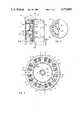
- FIG. 1is an elevation partly in section illustrating a presently preferred embodiment of the invention in which the position transducer is incorporated in a housing with a hybrid stepping motor.
- FIG. 2is an elevation taken on line 2--2 of FIG. 1.
- FIG. 3is an enlarged elevation on a plane perpendicular to the motor axis similar to FIG. 2, showing all of the stator poles of the transducer.
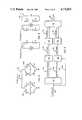
- FIG. 4is a circuit diagram of the pole winding connections corresponding to the numbered poles in FIG. 3, producing output voltages that are amplitude modulated as a function of rotor position.
- FIG. 5is a block diagram showing circuitry for converting the output voltages of FIG. 4 to a useful digital position output.
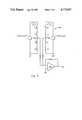
- FIG. 6is a circuit diagram showing first alternative connections to the poles numbered as in FIG. 3, for producing an output voltage that is phase modulated as a function of rotor position.
- FIG. 7is a circuit diagram showing second alternative connections to the poles numbered as in FIG. 3, for producing an output voltage that is phase modulated as a function of rotor position.
- FIG. 8is a block diagram showing circuitry for converting the output voltage of FIG. 6 or FIG. 7 to a useful digital position output.
- a hybrid stepping motor with an integral position transduceris shown generally at 12.
- the motorhas a housing 14 of conventional construction including ends 16 and 18, each having bearings 20 for a shaft 22.
- the housing endsare respectively secured to a housing sleeve 24 of cylindrical shape.
- stator laminations 26 of magnetic materialare securely fitted in spaced relation within the sleeve 24, namely, a motor stator set 28 and a transducer stator set 30.
- the laminations of the stator set 30are identical to those of the stator set 28, as to both the materials of construction and the configurations of the laminations as fully shown in FIG. 3.
- the reference numeral 26applies equally to the laminations in each set.
- Each lamination 26is an integral sheet of iron comprising an outer ring and a portion forming each of the transducer poles P1 to P8, or corresponding stator poles of the motor.
- this setdefines the poles of a hybrid, four phase, eight pole stepping motor 31 which, aside from the position transducer described below, is of conventional construction.
- the motor 31includes a cylindrical permanent magnet 32 polarized axially of the shaft 22 and coaxially secured to the shaft with rotor pole pieces 34 and 36.
- the pole pieces 34 and 36are of laminated construction and formed of magnetic material with annularly spaced teeth. Opposing these teeth are the toothed faces of the poles of the stator set 28.
- the forms of the rotor and stator teeth, as well as their angular spacings and mutual relationshipsmay be chosen in accordance with any of the prior art teachings relating to stepping motor design.
- a cylindrical spacer 38separates the rotor pole piece 36 from a variable reluctance transducer 39 having a rotor 40 comprising a set of identical circular laminations 42 (FIG. 3).
- the laminations 42are formed with a plurality of annularly spaced teeth 44.
- the teeth 44are identical in number and annular spacing to the teeth on the rotor pole pieces 34 and 36.
- the laminations 42may be identical, as to both tooth shape and materials of construction, to those laminations of the pole pieces 34 and 36 that extend beyond the ends of the magnet 32.
- the use of identical laminations in constructing the motor and the transducerresults in substantial economy of manufacturing cost.
- the rotor 40is secured on the shaft 22 peferably in the same manner as the rotor pole pieces 34 and 36.
- the stator set 30 of the transducer 39defines, in this embodiment, eight poles P1 to P8, having corresponding pole windings L1 to L8.
- Each stator poleis formed with stator pole teeth 46 that are preferably identical to the pole teeth on the stator set 28 of the stepping motor 31.
- the opposing rotor teeth 44 and stator pole teeth 46have the same alignment and mutual relationships as do a rotor pole piece and the stator teeth of the stepping motor.
- a four-phase, eight pole stepping motor 31is described as an example, the rotor having 50 teeth.
- the locations of the stator pole teethare preferably chosen so that, for the particular shaft position illustrated in FIG. 3, the rotor and stator teeth of the poles P3 and P7 are exactly aligned, while those of the poles Pl and P5 are exactly out of alignment.
- the rotor teeth opposing the poles P2 and P6are advanced relative to the opposing stator pole teeth by one-fourth tooth pitch, while the rotor teeth opposing the poles P4 and P8 are advanced relative to the opposing teeth of those poles by three-fourths tooth pitch.
- the magnetic reluctance across the air gaps of the teeth of the poles P3 and P7is at a minimum value and the inductance of the windings of those poles is at a maximum value.
- the reluctance of the air gaps across the teeth of the poles P1 and P5is at a maximum value and the inductance of the windings of those poles is at a minimum value.
- the magnetic reluctance of each of the air gaps of the poles L2, L4, L6 and L8is the same for the illustrated position of FIG. 3, and is intermediate between the maximum and minimum values.
- the inductances of the windings of those polesare of equal value.
- pole windings L1 to L8 for the corresponding numbered transducer poles P1 to P8are preferably formed and assembled on the poles in the same manner as the windings of the stepping motor poles as described above.
- the windings L1 to L8are connected to form sensor bridge circuits 48 and 50 as shown in FIG. 4.
- the bridge circuitsare both connected by a lead 52 with a source of sinusoidal carrier alternating voltage of amplitude "V" and frequency "f," the instantaneous value of this voltage being expressed by Vcos ⁇ c t, where " ⁇ c " equals 2 ⁇ times the frequency "f" of the carrier voltage and "t" represents time.
- the output voltage of the bridge circuit 48is represented as “e 1 ", and that of the bridge circuit 50 as "e 2 ".
- the operation of the circuit of FIG. 4may be explained by first considering the assumed rotor position of FIG. 3 and taking into account, for purposes of simplification, only the changes in self inductance of the pole windings as described above.
- the inductances L3 and L7being at maximum value and the inductances L1 and L5 at minimum value, the bridge output voltage e 1 is at a maximum amplitude.
- the inductances L2, L4, L6 and L8are all of equal value and the bridge output voltage e 2 is theoretically at zero amplitude.
- the inductance values in the bridge circuitseach change in a complete cycle.
- the carrier frequency "f"is chosen to have a period that is very short relative to the time duration of one tooth pitch of rotor movement, whereby the voltages e 1 and e 2 are amplitude modulated sinusoidal shaped wave forms in quadrature with one another, i.e. 90 electrical degrees shifted in phase, with each cycle of modulation corresponding to a rotor movement of one tooth pitch.
- FIG. 5represents a typical arrangement for employing the output voltages e 1 and e 2 to obtain a useful digital position output.
- the carrier frequency voltage on the lead 52is connected with the transducer bridge circuits of FIG. 4, schematically represented at 54.
- the output voltages e 1 and e 2 of the bridge circuitsare respectively represented at 56 and 58 as amplitude modulated wave forms.
- the amplitudes of the modulationsvary respectively as the sine and cosine of "A ⁇ ", where "A" equals the number of teeth on the rotor and " ⁇ " equals the angle of rotation of the rotor. Thus there are “A” complete cycles of modulation in each full revolution of the rotor.
- the voltages e 1 and e 2are then decoded into digital binary position information which can be used to indicate or display rotational position, or to control the torque, velocity or position of a motor attached to the transducer.
- these voltagesare separately and synchronously demodulated in circuits 60 and 62 using the original carrier signal on the lead 52, by means of a connection 64. This demodulation serves to remove the carrier frequency "f" from the sensor circuits output.
- the circuits 60 and 62are of a known type that operate by sampling the voltages e 1 and e 2 when they are at maximum amplitude with the term cos( ⁇ c t) at its peak value of "1.” This sampling produces signals at 64 and 66 having the values Vsin(A ⁇ ) and Vcos(A ⁇ ). These signals are then connected to analog-to-digital converters 68 and 70, each adapted to represent the magnitude of its input voltage in a binary form having "m" bits, the value of "m” being selected to provide the desired resolution.
- the outputs of the converters, shown at 72 and 74,are represented by solid arrows to indicate that they are of digital form.
- the binary signals at 72 and 74are applied to a digital, addressable memory array 76 having 2 m address bits.
- the arrayincludes a memory cell for each of the possible combinations of values for the signal 72 and the signal 74.
- Each of the memory cellshas "n" binary bits permanently stored therein that represent in digital form the angle " ⁇ " corresponding to the input values to that cell.
- ⁇appears at the output 78, with "n" bits of resolution.
- 2 n distinct positionscan be determined for each transducer pole. For a transducer having "P" poles a total of P(2 n ) positions can be determined per revolution of the transducer.
- the operation of the bridge circuit of FIG. 4is complicated by the fact that the rotor movement varies not only the self inductance of the pole windings, but also the mutual inductance between the windings. This results from the fact that each lamination of magnetic material, typically iron, passes through each of the windings. Although there is mutual coupling between each winding and every other winding, in practice it is usually necessary to consider only the coupling between any particular winding and the next adjacent windings. Also, the assembled transducer may not have perfect magnetic symmetry, thus causing a variation in the mutual inductances with the angle of rotation.
- An analysis of the bridge output voltages e 1 and e 2 that takes into account the mutual inductancesshows that they have, in addition to the terms shown in FIG. 5, additional terms which are amplitude modulated sine and cosine waves having amplitudes proportional to the ratio As/ ⁇ c , where "s" is the angular speed d ⁇ /dt of the rotor.
- the output connections of the bridge circuits 48 and 50are preferably connected to amplitude demodulation electronics 60 and 62 having a high impedance, thus reducing the magnitudes of the currents flowing through the output circuits. This will reduce the effect of such currents upon the output voltages e 1 and e 2 .
- FIGS. 6 to 8illustrate two alternative schemes for energizing the stator windings of FIG. 3 to produce an output voltage that is phase modulated as a function of rotor position.
- a source 80produces a sinusoidal varying current through the diametrically opposite windings L1 and L5.
- a source 82produces a sinusoidal varying current 90° out of phase therewith, passing through the windings L3 and L7. In this case, because of the flux paths linking adjacent windings, output voltages are produced across the windings L2 and L6.
- the voltage across the winding L2has a characteristic that is a function of the angular position of the rotor which affects the mutual inductance of this winding with each of the windings Ll and L3. It has been found that the voltage across the winding L2 can be expressed as the sum of sinusoidal varying components or terms, one of such terms having a phase angle with respect to the currents produced by the sources 80 and 82 that is dependent on the rotor position.
- the voltage on the winding L6has a term having a phase angle with respect to the currents produced by the sources 80 and 82 that is dependent on the rotor position, such voltage being additive and in phase with the voltage on the winding L2. Together, these voltages produce an output voltage e 0 having the indicated phase angle to the applied currents.
- either of the winding sets L1, L3, L2 or L5, L7, L6could be used without the other to produce a useful phase modulated output.
- phase modulated component of the output voltage e 0there is also an induced voltage component having a constant amplitude and phase. As this component is not useful, it may be subtracted by an operational amplifier summing junction. Then, the resulting output voltage e 0 is simply a phase modulated sinusoidal voltage.
- FIG. 8illustrates a scheme for converting the output voltage e 0 of FIG. 6 to a useful digital position output.
- the winding connections of FIG. 6are schematically illustrated at 84.
- the output signal e 0is represented by the following equation:
- f(t)is a term of constant amplitude and phase.
- a circuit 86operates to subtract this term by applying the inverse function "-f(t)"at 88.
- the output at 90is therefore a time varying voltage of the same frequency and amplitude as the source 82, but with a phase shift relative thereto that is position dependent.
- Circuits 92, 94 and 96process the signals at 90 and a connection 98 from the source 82 to produce a binary position output. This is accomplished by measuring the phase angle between these two signals as further described below.
- the circuit 94is a zero-crossing detector that produces a digital output 100 when the signal at 98 has a null value with a positive slope. This occurs when " ⁇ c t" is a multiple of "2 ⁇ ".
- the signal 100is periodic with a frequency "1/( ⁇ c t)".
- the circuit 92is also a zero-crossing detector, similar in function to the circuit 94.
- the circuit 92processes the signal at 90 to produce a signal at 102 when the signal at 90 has a null value with a positive slope, this signal also having a frequency "1/( ⁇ c t)", but which is phase shifted with respect to the signal at 100 by an angle proportional to the shaft position.
- the circuit 96is a gated, binary counter which, when enabled, counts at a frequency "y" by means of a suitable source connected at 104.
- the enabling and disabling of this counteris controlled by the signals at 100 and 102, whereby the signal at 100 causes the counter to reset and begin counting, and the signal at 102 disables the counting.
- the zero-cross of the signal applied by the source 82causes the counter to start counting and the zero-cross of the signal at 90, which occurs at a position dependent time, causes the counter to stop counting.
- the contents of the counterare available at an output 106 in binary form comprising any selected number of bits, representing the phase shift and therefore the position of the transducer.
- FIG. 7illustrates a second alternative circuit 108, which may be substituted for the circuit 84 of FIG. 6 for generating the signal e 0 .
- this schemeall of the pole windings of the transducer are employed. The windings are connected in such manner that all of the varying inductances that would tend to produce unwanted terms in the voltage e 0 are mutually canceled.
- the pole windingsare placed in the circuit so that the angular variation terms will cancel each other as the rotor is turned. For example, comparing the pole configuration shown in FIG. 3 with the connections of FIG.
- the present inventionprovides an economical and highly accurate transducer suitable for use in the feedback loop of a stepping motor system.
- the transducergives precise position information within one tooth pitch or step of the motor, so that a small amount of noise will not introduce any permanent error in the position.
- the transducercan be readily fitted in the same case or housing as the motor, and adds only a small amount of inertia, since the useful output voltage typically requires only a few windings and laminations.
- the transduceris capable of handling the same harsh conditions as the motor itself, and is insensitive to the temperature extremes created ty the motor.
- the transducerhas no brushes, so that there are no wearing parts requiring service or replacement.
- the transducer of this inventionis relatively insensitive to shaft inconcentricities, since the latter are canceled by the bridge connections, as in FIG. 4. Also, the transducer can be employed with either digital or analog feedback systems for stepping motors.
Landscapes
- Engineering & Computer Science (AREA)
- Power Engineering (AREA)
- Physics & Mathematics (AREA)
- General Physics & Mathematics (AREA)
- Control Of Stepping Motors (AREA)
- Measurement Of Length, Angles, Or The Like Using Electric Or Magnetic Means (AREA)
- Transmission And Conversion Of Sensor Element Output (AREA)
Abstract
Description
e.sub.0 =Vsin(ω.sub.c t+Aθ)+f(t) (1)
Claims (7)
Priority Applications (7)
| Application Number | Priority Date | Filing Date | Title |
|---|---|---|---|
| US07/096,522US4772815A (en) | 1987-09-15 | 1987-09-15 | Variable refluctance position transducer |
| CA000574056ACA1286385C (en) | 1987-09-15 | 1988-08-05 | Variable reluctance position transducer |
| GB8818967AGB2209837B (en) | 1987-09-15 | 1988-08-10 | Stepping motor with variable reluctance position transducer |
| IT8821869AIT1227070B (en) | 1987-09-15 | 1988-09-08 | POSITION TRANSDUCER, WITH VARIABLE RELUCTANCE. |
| JP63228912AJPH01164298A (en) | 1987-09-15 | 1988-09-14 | Variable magnetic resistance transducer |
| DE3831248ADE3831248A1 (en) | 1987-09-15 | 1988-09-14 | TURNING ANGLE ARRANGEMENT |
| FR8812005AFR2622967A1 (en) | 1987-09-15 | 1988-09-14 | POSITION TRANSDUCER AND MOTOR STEP |
Applications Claiming Priority (1)
| Application Number | Priority Date | Filing Date | Title |
|---|---|---|---|
| US07/096,522US4772815A (en) | 1987-09-15 | 1987-09-15 | Variable refluctance position transducer |
Publications (1)
| Publication Number | Publication Date |
|---|---|
| US4772815Atrue US4772815A (en) | 1988-09-20 |
Family
ID=22257753
Family Applications (1)
| Application Number | Title | Priority Date | Filing Date |
|---|---|---|---|
| US07/096,522Expired - LifetimeUS4772815A (en) | 1987-09-15 | 1987-09-15 | Variable refluctance position transducer |
Country Status (7)
| Country | Link |
|---|---|
| US (1) | US4772815A (en) |
| JP (1) | JPH01164298A (en) |
| CA (1) | CA1286385C (en) |
| DE (1) | DE3831248A1 (en) |
| FR (1) | FR2622967A1 (en) |
| GB (1) | GB2209837B (en) |
| IT (1) | IT1227070B (en) |
Cited By (27)
| Publication number | Priority date | Publication date | Assignee | Title |
|---|---|---|---|---|
| US4912389A (en)* | 1987-12-04 | 1990-03-27 | Kabushiki Kaisha Universal | Rotary position detector for stepping motor |
| EP0401084A1 (en)* | 1989-05-30 | 1990-12-05 | S.N.R. Roulements | Device with several angle position sensors |
| US4980594A (en)* | 1987-02-19 | 1990-12-25 | Innoke Oy | Compact servomator having an integrally wound resolver |
| US5023546A (en)* | 1989-11-08 | 1991-06-11 | General Motors Corporation | Variable reluctance rotation sensor with changing coil linkages and a pair of flux producing magnets |
| US5023547A (en)* | 1989-11-08 | 1991-06-11 | General Motors Corporation | Variable reluctance rotation sensor with changing flux linkages and including a pair of oppositely poled magnets |
| US5186269A (en)* | 1990-05-09 | 1993-02-16 | Emik A. Avakian | Method of and apparatus for motorizing manually powered vehicles |
| US5239218A (en)* | 1989-09-01 | 1993-08-24 | Hitachi, Ltd. | Step motor and method for recording position signal of motor rotor |
| FR2694393A1 (en)* | 1992-07-31 | 1994-02-04 | Lpmi | Auto-drive or synchronous variable reluctance polyphase stepper motor rotor shaft angular position detector - connects series pole windings to constant amplitude HF AC generator to obtain at terminals of each phase voltage with envelope modulated uniquely by position of rotor teeth relative to stator |
| US5434504A (en)* | 1993-10-01 | 1995-07-18 | International Business Machines Corporation | Position sensors for linear motors including plural symmetrical fluxes generated by a planar drive coil and received by planar sense coils being colinear along an axis of motion |
| US5763976A (en)* | 1993-12-15 | 1998-06-09 | Parker-Hannifin Corp. | Stator wound resolver with staggered rotor |
| US6121744A (en)* | 1998-03-13 | 2000-09-19 | Oriental Motor Co., Ltd. | Control apparatus for position control motor |
| US6225715B1 (en) | 1997-07-30 | 2001-05-01 | Oriental Motor Co., Ltd. | Construction of a motor with a built-in sensor |
| US6411058B1 (en)* | 1998-03-31 | 2002-06-25 | Tamagawa Seiki Kabushiki Kaisha | Resolver |
| US6429619B2 (en)* | 2000-02-29 | 2002-08-06 | Sagem Sa | Generator comprising two pairs of differential outputs |
| WO2003005530A3 (en)* | 2001-07-03 | 2003-10-23 | Inst Jozef Stefan | An integrated position resolver for hybrid synchronous electric motors |
| EP1369978A3 (en)* | 2002-06-05 | 2004-01-07 | Minebea Co., Ltd. | Stepping motor |
| US6717312B1 (en)* | 2001-01-03 | 2004-04-06 | Dana Corporation | Defense vehicle aiming ordinance platform having variable reluctance motor |
| US20050077789A1 (en)* | 2002-03-04 | 2005-04-14 | Mitsubishi Denki Kabushiki Kaisha | Ac electric machine for vehicle |
| US20060056821A1 (en)* | 2002-12-31 | 2006-03-16 | Jorg Hornberger | Rotor-position sensor assembly and method for detecting a rotor position |
| US7075196B1 (en) | 2002-08-13 | 2006-07-11 | Quicksilver Controls, Inc. | Integrated resolver for high pole count motors |
| WO2007009841A1 (en)* | 2005-07-18 | 2007-01-25 | Robert Bosch Gmbh | Method and system for determining the time differential of a physical parameter determined by means of phase signals |
| US7508154B1 (en) | 2006-05-15 | 2009-03-24 | Quicksilver Controls, Inc. | Integrated motor and resolver including absolute position capability |
| US20100171459A1 (en)* | 2007-05-31 | 2010-07-08 | Thk Co., Ltd. | Linear motor position detection system |
| US9064630B2 (en) | 2011-10-17 | 2015-06-23 | GM Global Technology Operations LLC | Integrated high frequency rotary transformer and resolver for traction motor |
| US20150371747A1 (en)* | 2014-06-18 | 2015-12-24 | Omron Corporation | Operation device |
| CN113922624A (en)* | 2021-06-10 | 2022-01-11 | 上海鸣志电器股份有限公司 | a stepper motor |
| CN115912694A (en)* | 2022-11-25 | 2023-04-04 | 上海鸣志电器股份有限公司 | Stepping motor stator and stepping motor with same |
Families Citing this family (2)
| Publication number | Priority date | Publication date | Assignee | Title |
|---|---|---|---|---|
| GB2358255B (en)* | 2000-01-11 | 2003-09-03 | Stebon Ltd | Load angle determination for electrical motors |
| RU2327222C1 (en)* | 2007-03-01 | 2008-06-20 | Государственное унитарное предприятие "Всероссийский электротехнический институт им. В.И. Ленина" | Converter of the shaft turn angle into electrical data signal |
Citations (7)
| Publication number | Priority date | Publication date | Assignee | Title |
|---|---|---|---|---|
| US2589999A (en)* | 1951-04-27 | 1952-03-18 | Gen Electric | Dynamoelectric machine |
| US2982872A (en)* | 1957-01-04 | 1961-05-02 | Superior Electric Co | Electric motor |
| US3535604A (en)* | 1968-06-14 | 1970-10-20 | Superior Electric Co | Electric stepping motor |
| US4267497A (en)* | 1978-03-20 | 1981-05-12 | Dana Corporation | Resolver interface for servo position control |
| US4489266A (en)* | 1982-03-23 | 1984-12-18 | Sp, El. S.R.L. | Circuit and a method for processing amplitude and phase variable multiphase signals, which are required as current or voltage reference to drive synchronous motors |
| US4551708A (en)* | 1982-06-04 | 1985-11-05 | Motornetics Corporation | Reactance-commutated high resolution servo motor system |
| US4687961A (en)* | 1986-03-17 | 1987-08-18 | Seiberco Incorporated | Polyphase DC motor with sensor poles |
Family Cites Families (3)
| Publication number | Priority date | Publication date | Assignee | Title |
|---|---|---|---|---|
| US3917997A (en)* | 1974-09-20 | 1975-11-04 | Illinois Tool Works | Magnetic flux closure member for an angular velocity sensing device |
| EP0191223A3 (en)* | 1984-11-09 | 1988-02-24 | The Superior Electric Company | Magnetically-coupled transducer means |
| FR2601129B1 (en)* | 1986-07-02 | 1994-06-03 | Commissariat Energie Atomique | ANGULAR POSITION SENSOR AND ANGULAR POSITION DETERMINATION ASSEMBLY PROVIDED WITH SEVERAL SAME |
- 1987
- 1987-09-15USUS07/096,522patent/US4772815A/ennot_activeExpired - Lifetime
- 1988
- 1988-08-05CACA000574056Apatent/CA1286385C/ennot_activeExpired
- 1988-08-10GBGB8818967Apatent/GB2209837B/ennot_activeExpired - Lifetime
- 1988-09-08ITIT8821869Apatent/IT1227070B/enactive
- 1988-09-14JPJP63228912Apatent/JPH01164298A/enactivePending
- 1988-09-14FRFR8812005Apatent/FR2622967A1/ennot_activeWithdrawn
- 1988-09-14DEDE3831248Apatent/DE3831248A1/ennot_activeWithdrawn
Patent Citations (7)
| Publication number | Priority date | Publication date | Assignee | Title |
|---|---|---|---|---|
| US2589999A (en)* | 1951-04-27 | 1952-03-18 | Gen Electric | Dynamoelectric machine |
| US2982872A (en)* | 1957-01-04 | 1961-05-02 | Superior Electric Co | Electric motor |
| US3535604A (en)* | 1968-06-14 | 1970-10-20 | Superior Electric Co | Electric stepping motor |
| US4267497A (en)* | 1978-03-20 | 1981-05-12 | Dana Corporation | Resolver interface for servo position control |
| US4489266A (en)* | 1982-03-23 | 1984-12-18 | Sp, El. S.R.L. | Circuit and a method for processing amplitude and phase variable multiphase signals, which are required as current or voltage reference to drive synchronous motors |
| US4551708A (en)* | 1982-06-04 | 1985-11-05 | Motornetics Corporation | Reactance-commutated high resolution servo motor system |
| US4687961A (en)* | 1986-03-17 | 1987-08-18 | Seiberco Incorporated | Polyphase DC motor with sensor poles |
Cited By (40)
| Publication number | Priority date | Publication date | Assignee | Title |
|---|---|---|---|---|
| US4980594A (en)* | 1987-02-19 | 1990-12-25 | Innoke Oy | Compact servomator having an integrally wound resolver |
| US4912389A (en)* | 1987-12-04 | 1990-03-27 | Kabushiki Kaisha Universal | Rotary position detector for stepping motor |
| EP0401084A1 (en)* | 1989-05-30 | 1990-12-05 | S.N.R. Roulements | Device with several angle position sensors |
| FR2647896A1 (en)* | 1989-05-30 | 1990-12-07 | Roulements Soc Nouvelle | ANGULAR POSITION SENSOR AND MULTI-SENSOR APPLICATION DEVICE |
| US5239218A (en)* | 1989-09-01 | 1993-08-24 | Hitachi, Ltd. | Step motor and method for recording position signal of motor rotor |
| US5023546A (en)* | 1989-11-08 | 1991-06-11 | General Motors Corporation | Variable reluctance rotation sensor with changing coil linkages and a pair of flux producing magnets |
| US5023547A (en)* | 1989-11-08 | 1991-06-11 | General Motors Corporation | Variable reluctance rotation sensor with changing flux linkages and including a pair of oppositely poled magnets |
| US5186269A (en)* | 1990-05-09 | 1993-02-16 | Emik A. Avakian | Method of and apparatus for motorizing manually powered vehicles |
| FR2694393A1 (en)* | 1992-07-31 | 1994-02-04 | Lpmi | Auto-drive or synchronous variable reluctance polyphase stepper motor rotor shaft angular position detector - connects series pole windings to constant amplitude HF AC generator to obtain at terminals of each phase voltage with envelope modulated uniquely by position of rotor teeth relative to stator |
| US5434504A (en)* | 1993-10-01 | 1995-07-18 | International Business Machines Corporation | Position sensors for linear motors including plural symmetrical fluxes generated by a planar drive coil and received by planar sense coils being colinear along an axis of motion |
| US5763976A (en)* | 1993-12-15 | 1998-06-09 | Parker-Hannifin Corp. | Stator wound resolver with staggered rotor |
| US6225715B1 (en) | 1997-07-30 | 2001-05-01 | Oriental Motor Co., Ltd. | Construction of a motor with a built-in sensor |
| US6121744A (en)* | 1998-03-13 | 2000-09-19 | Oriental Motor Co., Ltd. | Control apparatus for position control motor |
| US6411058B1 (en)* | 1998-03-31 | 2002-06-25 | Tamagawa Seiki Kabushiki Kaisha | Resolver |
| US6429619B2 (en)* | 2000-02-29 | 2002-08-06 | Sagem Sa | Generator comprising two pairs of differential outputs |
| US6717312B1 (en)* | 2001-01-03 | 2004-04-06 | Dana Corporation | Defense vehicle aiming ordinance platform having variable reluctance motor |
| WO2003005530A3 (en)* | 2001-07-03 | 2003-10-23 | Inst Jozef Stefan | An integrated position resolver for hybrid synchronous electric motors |
| US20050077789A1 (en)* | 2002-03-04 | 2005-04-14 | Mitsubishi Denki Kabushiki Kaisha | Ac electric machine for vehicle |
| EP1482625A4 (en)* | 2002-03-04 | 2005-06-08 | Mitsubishi Electric Corp | ALTERNATING CURRENT ELECTRIC MACHINE FOR A VEHICLE |
| CN100409546C (en)* | 2002-03-04 | 2008-08-06 | 三菱电机株式会社 | AC Motors for Vehicles |
| US7378767B2 (en) | 2002-03-04 | 2008-05-27 | Mitsubishi Denki Kabushiki Kaisha | AC dynamo electric machine with magnetic reluctance portion linking rotational position detector to AC dynamo electric machine body |
| CN100407559C (en)* | 2002-06-05 | 2008-07-30 | 美蓓亚株式会社 | Stepping motor |
| US6849973B2 (en) | 2002-06-05 | 2005-02-01 | Minebea Company | Stepping motor |
| EP1369978A3 (en)* | 2002-06-05 | 2004-01-07 | Minebea Co., Ltd. | Stepping motor |
| US20040051404A1 (en)* | 2002-06-05 | 2004-03-18 | Minebea Co., Ltd. | Stepping motor |
| US7538460B2 (en) | 2002-08-13 | 2009-05-26 | Quicksilver Controls, Inc. | Integrated resolver for high pole count motors |
| US7075196B1 (en) | 2002-08-13 | 2006-07-11 | Quicksilver Controls, Inc. | Integrated resolver for high pole count motors |
| US20060197393A1 (en)* | 2002-08-13 | 2006-09-07 | Donald Labriola | Integrated resolver for high pole count motors |
| US7049776B2 (en)* | 2002-12-31 | 2006-05-23 | Ebm-Papst St. Georgen Gmbh & Co. Kg | Rotor-position sensor assembly and method for detecting a rotor position |
| US20060056821A1 (en)* | 2002-12-31 | 2006-03-16 | Jorg Hornberger | Rotor-position sensor assembly and method for detecting a rotor position |
| WO2007009841A1 (en)* | 2005-07-18 | 2007-01-25 | Robert Bosch Gmbh | Method and system for determining the time differential of a physical parameter determined by means of phase signals |
| US7508154B1 (en) | 2006-05-15 | 2009-03-24 | Quicksilver Controls, Inc. | Integrated motor and resolver including absolute position capability |
| US7723942B1 (en) | 2006-05-15 | 2010-05-25 | Quicksilver Controls, Inc. | Integrated motor and resolver including absolute position capability |
| US20100171459A1 (en)* | 2007-05-31 | 2010-07-08 | Thk Co., Ltd. | Linear motor position detection system |
| US8362720B2 (en)* | 2007-05-31 | 2013-01-29 | Thk Co., Ltd. | Linear motor position detection system |
| US9064630B2 (en) | 2011-10-17 | 2015-06-23 | GM Global Technology Operations LLC | Integrated high frequency rotary transformer and resolver for traction motor |
| US20150371747A1 (en)* | 2014-06-18 | 2015-12-24 | Omron Corporation | Operation device |
| US9857972B2 (en)* | 2014-06-18 | 2018-01-02 | Omron Corporation | Operation device |
| CN113922624A (en)* | 2021-06-10 | 2022-01-11 | 上海鸣志电器股份有限公司 | a stepper motor |
| CN115912694A (en)* | 2022-11-25 | 2023-04-04 | 上海鸣志电器股份有限公司 | Stepping motor stator and stepping motor with same |
Also Published As
| Publication number | Publication date |
|---|---|
| FR2622967A1 (en) | 1989-05-12 |
| GB2209837B (en) | 1992-03-18 |
| JPH01164298A (en) | 1989-06-28 |
| GB8818967D0 (en) | 1988-09-14 |
| IT1227070B (en) | 1991-03-14 |
| GB2209837A (en) | 1989-05-24 |
| DE3831248A1 (en) | 1989-03-30 |
| CA1286385C (en) | 1991-07-16 |
| IT8821869A0 (en) | 1988-09-08 |
Similar Documents
| Publication | Publication Date | Title |
|---|---|---|
| US4772815A (en) | Variable refluctance position transducer | |
| US4604575A (en) | Multiple output rotational position detection device | |
| CA1276037C (en) | Position and speed sensors | |
| US6433536B1 (en) | Apparatus for measuring the position of a movable member | |
| KR910000099B1 (en) | Direct drive motor system | |
| US4008425A (en) | Motor servo system with multiplier means to drive and servo the motor | |
| US5160886A (en) | Permanent magnet resolver for producing a resolver-to-digital converter compatible output | |
| US3810136A (en) | Digital position sensor | |
| US4659953A (en) | Magnetic structure for synchro and tachometer | |
| US5847535A (en) | Active electronic damping for step motor | |
| US6486656B1 (en) | Magnetoresistive die and position sensor | |
| JP2001183169A (en) | Position detector | |
| JPS6258445B2 (en) | ||
| JPH1019602A (en) | Magnetic encoder | |
| EP1016852B1 (en) | Apparatus for measuring the position of a movable member | |
| JPS60162920A (en) | Resolver device using magnetism sensing element | |
| JP2613059B2 (en) | Magnetic sensor | |
| US3222660A (en) | Magnetic position encoder | |
| JP2556383B2 (en) | Magnetic resolver | |
| JPH0230726Y2 (en) | ||
| USH939H (en) | Commutator pulse tachometer | |
| JPH0125287Y2 (en) | ||
| JPH0125288Y2 (en) | ||
| JP2554472B2 (en) | Rotation position detector | |
| JP2958846B2 (en) | Angle detector |
Legal Events
| Date | Code | Title | Description |
|---|---|---|---|
| AS | Assignment | Owner name:EASTERN AIR DEVICES, INC., 1 PROGRESS DRIVE, DOVER Free format text:ASSIGNMENT OF 1/2 OF ASSIGNORS INTEREST;ASSIGNORS:HARNED, TIMOTHY J.;HUARD, STEVEN R.;LANCISI, DAVID M.;AND OTHERS;REEL/FRAME:004790/0431 Effective date:19870910 Owner name:PARKER HANNIFIN CORPORATION, 17325 EUCLID AVE., CL Free format text:ASSIGNMENT OF 1/2 OF ASSIGNORS INTEREST;ASSIGNORS:HARNED, TIMOTHY J.;HUARD, STEVEN R.;LANCISI, DAVID M.;AND OTHERS;REEL/FRAME:004790/0431 Effective date:19870910 | |
| FEPP | Fee payment procedure | Free format text:PAYOR NUMBER ASSIGNED (ORIGINAL EVENT CODE: ASPN); ENTITY STATUS OF PATENT OWNER: LARGE ENTITY | |
| STCF | Information on status: patent grant | Free format text:PATENTED CASE | |
| AS | Assignment | Owner name:PARKER INTANGIBLES INC., A CORP. OF DE, DELAWARE Free format text:ASSIGNMENT OF ASSIGNORS INTEREST.;ASSIGNOR:PARKER-HANNIFIN CORPORATION;REEL/FRAME:005886/0169 Effective date:19881221 | |
| CC | Certificate of correction | ||
| FPAY | Fee payment | Year of fee payment:4 | |
| FPAY | Fee payment | Year of fee payment:8 | |
| FPAY | Fee payment | Year of fee payment:12 | |
| AS | Assignment | Owner name:PARKER INTANGIBLES LLC, OHIO Free format text:MERGER;ASSIGNOR:PARKER HANNIFIN CUSTOMER SUPPORT INC.;REEL/FRAME:015215/0522 Effective date:20030630 |