US4760939A - Liquid dosing device with digital display - Google Patents
Liquid dosing device with digital displayDownload PDFInfo
- Publication number
- US4760939A US4760939AUS06/855,347US85534786AUS4760939AUS 4760939 AUS4760939 AUS 4760939AUS 85534786 AUS85534786 AUS 85534786AUS 4760939 AUS4760939 AUS 4760939A
- Authority
- US
- United States
- Prior art keywords
- cylinder
- piston
- liquid
- pulse generating
- generating means
- Prior art date
- Legal status (The legal status is an assumption and is not a legal conclusion. Google has not performed a legal analysis and makes no representation as to the accuracy of the status listed.)
- Expired - Fee Related
Links
Images



Classifications
- B—PERFORMING OPERATIONS; TRANSPORTING
- B67—OPENING, CLOSING OR CLEANING BOTTLES, JARS OR SIMILAR CONTAINERS; LIQUID HANDLING
- B67D—DISPENSING, DELIVERING OR TRANSFERRING LIQUIDS, NOT OTHERWISE PROVIDED FOR
- B67D1/00—Apparatus or devices for dispensing beverages on draught
- B67D1/08—Details
- B67D1/12—Flow or pressure control devices or systems, e.g. valves, gas pressure control, level control in storage containers
- B67D1/1202—Flow control, e.g. for controlling total amount or mixture ratio of liquids to be dispensed
- B67D1/1234—Flow control, e.g. for controlling total amount or mixture ratio of liquids to be dispensed to determine the total amount
- B—PERFORMING OPERATIONS; TRANSPORTING
- B67—OPENING, CLOSING OR CLEANING BOTTLES, JARS OR SIMILAR CONTAINERS; LIQUID HANDLING
- B67D—DISPENSING, DELIVERING OR TRANSFERRING LIQUIDS, NOT OTHERWISE PROVIDED FOR
- B67D1/00—Apparatus or devices for dispensing beverages on draught
- B67D1/08—Details
- B67D1/10—Pump mechanism
- B67D1/101—Pump mechanism of the piston-cylinder type
- B67D1/102—Pump mechanism of the piston-cylinder type for one liquid component only
- G—PHYSICS
- G01—MEASURING; TESTING
- G01F—MEASURING VOLUME, VOLUME FLOW, MASS FLOW OR LIQUID LEVEL; METERING BY VOLUME
- G01F11/00—Apparatus requiring external operation adapted at each repeated and identical operation to measure and separate a predetermined volume of fluid or fluent solid material from a supply or container, without regard to weight, and to deliver it
- G01F11/02—Apparatus requiring external operation adapted at each repeated and identical operation to measure and separate a predetermined volume of fluid or fluent solid material from a supply or container, without regard to weight, and to deliver it with measuring chambers which expand or contract during measurement
- G01F11/021—Apparatus requiring external operation adapted at each repeated and identical operation to measure and separate a predetermined volume of fluid or fluent solid material from a supply or container, without regard to weight, and to deliver it with measuring chambers which expand or contract during measurement of the piston type
Definitions
- This inventionrelates to liquid dispensing means.
- European Patent Specification No. 0096088discloses a liquid dispensing device capable of drawing liquid into the device from a container during an intake stroke, and expelling liquid from the device during a delivery stroke.
- the volume of liquid delivered during the delivery strokeis displayed on a digital display.
- the devicedoes not always register liquid delivered. For example, if during an intake stroke a small amount of liquid is delivered, whether deliberately or accidentally, no record of this appears on the digital display. This is a disadvantage which the present invention is intended to overcome.
- liquid dispensing meanscomprise a cylinder, a piston movable with respect to the cylinder in either an intake stroke in which liquid is drawn into the cylinder from a reservoir of the liquid, or a delivery stroke during which the liquid is dispensed from the cylinder, pulse generating means for producing pulses representative of the relative movement of the piston and cylinder, and counting and readout means linked to the pulse generating means and operative to count the pulses and indicate the volume of liquid dispensed from the cylinder during a delivery stroke, wherein any relative movement of the piston and cylinder in a direction corresponding to a delivery stroke causes the counting and readout means to indicate a corresponding volume of liquid dispensed, whereby during an intake stroke any inadvertent relative movement of the piston and cylinder in a direction corresponding to a delivery stroke causes the counting and readout means to register a volume of liquid dispensed corresponding to the magnitude of the inadvertent movement.
- the cylinderis fixed, eg mounted on a bottle forming said reservoir, and said piston is slidable in the cylinder.
- Manually operable actuating meansmay be provided to cause sliding movement of the piston within the cylinder, the manually operable actuating means being connected to the pulse generating means through a drive system which is such that the number of pulses registered in the counting and readout means is representative of the amplitude of piston movement in a dispensing sense and therefore volume of liquid dispensed.
- the drive systemmay include ratchet means which ensure that the pulse generating means are driven whenever the piston is moved in a direction corresponding to the delivery stroke (ie in the dispensing sense), but which prevent the pulse generating means being driven when the piston is moved in a direction corresponding to an intake stroke. Hence, any movement of the piston in the dispensing sense will produce a corresponding number of pulses which will register in the counting and readout means.
- the ratchet meanspreferably comprise two ratchet wheels which operate in opposite rotational directions and which have mounted between them an actuating member of the pulse generating means. Rotation of the actuating member causes pulses to be generated, for example by :
- the inventionapplies particularly to liquid dispensing means in the form of a device for placing on a bottle in order to dispense a liquid contained in the bottle.
- the devicecould also be such that the connection with the bottle is a remote link or whereby the device is handheld and only connected with the bottle intermittently to be charged with liquid.
- the drive systemmay be such that pulses are generated in both the delivery stroke and the intake stroke, with discriminating means being provided to discriminate between a delivery stroke movement and an intake stroke movement and to cause pulses generated in a delivery stroke movement, but not in an intake stroke movement, to actuate the counting and readout means.
- the discriminating meansmay include two stationary electrical contacts and a third electrical contact movable into contact with one or other of the stationary contacts in dependence upon the direction of relative movement of the piston and cylinder.
- the discriminating meansmay alternatively include a magnet and reed switch which cooperate together to provide an electrical signal dependent on the direction of relative movement of the piston and cylinder.
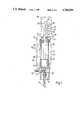
- FIG. 1is a sectional view of a device forming the preferred embodiment of liquid dispensing means
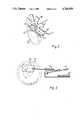
- FIG. 2shows a perspective view of pulse generating means of the embodiment of FIG. 1,
- FIGS. 3 to 5are views respectively illustrating three modified constructions of pulse generating means
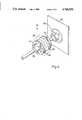
- FIG. 6is a perspective view of ratchet means of the device
- FIG. 7is a sectional view of the ratchet means of FIG. 6,
- FIGS. 8 and 9show two alternatives to the ratchet means of FIGS. 6 and 7.
- the devicecomprises a valve block 10 into which is fixed an upwardly projecting cylinder 12 capped by an end block 14.
- the block 14has a through slot 16 which guides sliding movement of a piston rod 18 carrying at its lower end a piston 20 slidable within the cylinder 12.
- the valve block 10When coupled to a bottle (not shown) the valve block 10 is a rigid mounting point that remains fixed with respect to the bottle throughout the functional cycle of the device.
- the cylinder 12is rigidly attached to the valve block 10 and hence the cylinder 12 also remains fixed relative to the valve block 10 and bottle throughout the functional cycle of the device.
- the piston 20is free to slide in the cylinder 12 between limits determined at one extreme by the base of the cylinder 12 and at the other extreme by the block 14.
- the stop and the bearing for the piston rod 18may be partially separated.
- the piston rod 18has a rack gear 22 formed or fixed to one face, and the rack gear 22 engages with a pinion gear 24 rotatably mounted in the block 14.
- the pinion gear 24is caused to rotate by means of manually operated hand wheels (not shown) mounted on either the shaft through gears 28 and 30 or optionally, on the shaft through gears 24 and 26.
- the coupling between the shaft and handwheelsmay be either rigid or by means of a torque limiting coupling.
- a gear trainconsisting of six meshing spur gears 26, 28, 30, 32, 34, and 36 which drive a ferrous serrated wheel 38 having blades alternating with gaps (FIG. 2).
- the gear ratiosare such that a small movement of the piston 20, caused by a small rotation of the hand wheel, results in a large rotation of the ferrous serrated wheel 38.
- a small reed switch 40 and a permanent magnet 42are positioned parallel to each other with the serrated wheel 38 interposed between them.
- the magnetic field of the reed switch 40is shielded by the blade and falls to a value which allows the contacts to open.
- a gap in the serrated wheel 38is interposed between the magnet 42 and the reed switch 40 the magnetic field at the reed switch 40 rises to a value which causes the contacts to close.
- the contacts of the reed switch 40are connected through electronic circuitry to a counting and display system.
- This systemis energised by a battery 44 contained within an outer casing 46.
- the valve block 10contains two non-return valves 70 and 72.
- a tube 74is also mounted in the valve block 10 and projects into the bottle to be immersed in the liquid during normal operation.
- FIG. 3shows a piezo-electric transducer 48 which is repeatedly compressed and released in response to the turning of a wheel 50 rotated by the hand wheel.
- the transducer 48is repeatedly compressed by the movement of a hammer 52 linked by a tension spring 54 to an eccentric crank 56 on the wheel 50.
- the changes in dimensions of the piezo-electric transducer 48cause electrical charges to be developed which, when passed through electrical circuitry, are fed to a counter and display system.
- the charge developed when the transducer 48 is compressedis of opposite polarity to that developed when the transducer is released.
- the electrical circuitrycan be arranged to use one or both polarities. If both polarities are used, the counter will be incremented on the compression and on the release of the transducer. If only one polarity is used, the counter will be incremented on either the compression or the release of the transducer, but not both.
- FIG. 4shows another alternative method of providing pulses to indicate movement of the piston 20.
- Bar magnets 58are arranged around the circumference of a non-ferrous (eg plastics) disc 60 whch is driven by the train of gears 26 to 36.
- a reed switch 62is positioned close to the periphery of the disc 60 in the same plane as the magnets 58. When the disc 60 rotates and each magnet approaches the reed switch 62, the contacts of the switch close. When the magnet 58 moves away from the reed switch 62, the contacts of the switch open.
- FIG. 5shows a further alternative method of providing pulses.
- a multipole magnetic wheel 64(having alternating North and South poles around its periphery) is rotatably driven by the train of gears 26 to 36, and a reed switch 66 is repeatedly operated and released, as before.
- the counting and display systemconsists of a digital display unit 73 (FIG. 1) connected to electronic circuitry mounted on a panel 80.
- a switch 82is provided to enable the display to be zeroed at the start of the dispensing cycle.
- the liquid dispensing meansensure that the volume of any liquid dispensed through the tube 76 is recorded on the digital display--whether this liquid is dispensed deliberately, or accidently during what should otherwise be an intake stroke. This is achieved by ratchet means which prevent rotation of the pulse generating means in the direction corresponding to the piston 20 rising in the cylinder 12, (ie a liquid intake movement), but allow rotation whenever the piston 20 is caused to move in the dispense direction--whether this be deliberate or accidental.
- FIGS. 6 and 7show the ratchet means 84.
- a ratchet wheel 86is fixed rigidly to a wheel 88 which is constituted by the wheel 38, 50, 60 or 64 of the various types of pulse generating means previously described.
- a second ratchet wheel 90 of opposite hand to the firstis also fixed co-axially with wheels 86 and 88, such that the assembly of wheels 86, 88 and 90 is free to rotate as a unit on a shaft 92.
- the shaft 92is driven by the hand wheel through the gear train 26 to 36 of FIG. 1.
- a pawl wheel 94is mounted on the shaft 92 and engages the ratchet wheel 86.
- a second pawl wheel 96 of opposite hand to the wheel 94is arranged to engage with ratchet wheel 90.
- This second pawl wheel 96is fixed to a backplate 98 by means of some mechanical fixture, such as the flanged coupling 100.
- the shaft 92is free to rotate relative to items 86, 88, 90, 96, 98 and 100 unless prevented from doing so by engagement of the various ratchet/pawl teeth.
- the pawl wheel 94engages with the ratchet wheel 86, and causes the wheel 88 to rotate in the same sense as the shaft 92 (clockwise in FIG. 6). In doing so, the pawls on the wheel 96 slip over the teeth of ratchet wheel 90.
- the pawls on the wheel 96engage with the teeth on the ratchet wheel 90, and prevent the wheel 88 from rotating. In practice, a very small rotation of the magnetic wheel would be experienced to take up the minimum clearance between any of the teeth on items 96 and 90.
- the devicetherefore achieves the objective of only delivering pulses to the counter and digital display when the piston moves in a direction corresponding to a delivery stroke. Movement in the direction corresponding to an intake stroke results in no pulse generation.
- the pawl wheel 94is fixed to the shaft 92 and carries a number of cantilevered pawls.
- the pitch of the pawlsis arranged to be a non-integral multiple of the pitch of the teeth on the ratchet wheel 86, such that the following conditions are satisfied: ##EQU1##
- the techniqueensures that the effective pitch of the ratchet is reduced to the Nth part of the actual ratchet wheel tooth pitch, where N is the number of pawl teeth.
- Tests on the ratchet means of FIGS. 6 and 7have revealed a problem: the inertia of the magnetic wheel 88 causes overrun which, in turn, results in an error in the indicated volume.
- the pulse generating magnetic wheel 88is rigidly fixed to the output shaft 92 of the geartrain described previously.
- the wheel 88therefore rotates clockwise or anti-clockwise depending on which way the hand wheel is being turned.
- a reed switch 102is positioned beside the periphery of the wheel 88.
- a slipping clutchis provided consisting of a driving member 104 which is rigidly fixed on the shaft 92, engaging with a driven member 106 which is free to rotate on the shaft 92.
- the actual angle of rotation of the driven memberis limited by two spaced, stationary stops 108, 110.
- a spring 114is provided to preload the driven member 106 into engagement with the driving member 104.
- the drive member 106carries a movable contact 112.
- the clutch driven member 106will be urged to cause the contact 112 to bear against one of the two stops 108 or 110, depending on the direction of rotation of the shaft 92. Reversal of the direction of rotation of the shaft 92 rapidly leads to the driven member 106 rotating through a small angle before the other stop is engaged, to prevent any further rotation.
- Electronic discriminating meansdetect which of the two stops 108, 110 is engaged, and activate the electronic system to allow the display to accumulate counts from reed switch 102 or to inhibit further counting as appropriate.
- the contact 112forms a ⁇ common ⁇ electrical terminal which engages one or other of the two stops 108, 110 depending on the direction of rotation of the shaft 92. An electrical circuit is therefore created through the common terminal and one limit stop. The electronic system coupled to this circuit either enables or inhibits the counting.
- Thisconsists of a permanent magnet 116 attached to the clutch driven member 106 such that the magnet axis is parallel to the shaft 92, but is offset by a certain distance.
- the magnet 116is therefore caused to rotate through a small arc until engagement of a rod 120 with one or other stop 108, 110 prevents any further movement.
- a reed switch 118is mounted in a fixed position that is radially offset to allow a small working clearance between the magnet 116 and the reed switch 118. In one of the two stable positions, the magnet 116 lies close to the reed switch 118, and in the other stable position, the magnet 116 is offset from the reed switch.
- the magnet 116In the first position, the magnet 116 is close enough to the reed switch 118 to cause the reed switch to operate. In the second position, the magnet 116 is further away from the reed switch 118, which therefore releases.
- the two possible states of the reed switchare used in the electronic discriminating means to enable or disable the counting means which count the pulses, as appropriate to the direction of rotation of the shaft 92.
Landscapes
- Engineering & Computer Science (AREA)
- Mechanical Engineering (AREA)
- Physics & Mathematics (AREA)
- Fluid Mechanics (AREA)
- General Physics & Mathematics (AREA)
- Infusion, Injection, And Reservoir Apparatuses (AREA)
- Containers And Packaging Bodies Having A Special Means To Remove Contents (AREA)
Abstract
Description
This invention relates to liquid dispensing means.
European Patent Specification No. 0096088 discloses a liquid dispensing device capable of drawing liquid into the device from a container during an intake stroke, and expelling liquid from the device during a delivery stroke. The volume of liquid delivered during the delivery stroke is displayed on a digital display. However, the device does not always register liquid delivered. For example, if during an intake stroke a small amount of liquid is delivered, whether deliberately or accidentally, no record of this appears on the digital display. This is a disadvantage which the present invention is intended to overcome.
According to the invention liquid dispensing means comprise a cylinder, a piston movable with respect to the cylinder in either an intake stroke in which liquid is drawn into the cylinder from a reservoir of the liquid, or a delivery stroke during which the liquid is dispensed from the cylinder, pulse generating means for producing pulses representative of the relative movement of the piston and cylinder, and counting and readout means linked to the pulse generating means and operative to count the pulses and indicate the volume of liquid dispensed from the cylinder during a delivery stroke, wherein any relative movement of the piston and cylinder in a direction corresponding to a delivery stroke causes the counting and readout means to indicate a corresponding volume of liquid dispensed, whereby during an intake stroke any inadvertent relative movement of the piston and cylinder in a direction corresponding to a delivery stroke causes the counting and readout means to register a volume of liquid dispensed corresponding to the magnitude of the inadvertent movement. Preferably the cylinder is fixed, eg mounted on a bottle forming said reservoir, and said piston is slidable in the cylinder. Manually operable actuating means may be provided to cause sliding movement of the piston within the cylinder, the manually operable actuating means being connected to the pulse generating means through a drive system which is such that the number of pulses registered in the counting and readout means is representative of the amplitude of piston movement in a dispensing sense and therefore volume of liquid dispensed.
The drive system may include ratchet means which ensure that the pulse generating means are driven whenever the piston is moved in a direction corresponding to the delivery stroke (ie in the dispensing sense), but which prevent the pulse generating means being driven when the piston is moved in a direction corresponding to an intake stroke. Hence, any movement of the piston in the dispensing sense will produce a corresponding number of pulses which will register in the counting and readout means.
The ratchet means preferably comprise two ratchet wheels which operate in opposite rotational directions and which have mounted between them an actuating member of the pulse generating means. Rotation of the actuating member causes pulses to be generated, for example by :
(i) arranging for the actuating member to carry magnetic poles which move past a reed switch which produces electrical pulses,
(ii) arranging for the actuating member to be a ferrous wheel having blades which rotate between a permanent magnet and a reed switch so that the latter produces said pulses, or
(iii) arranging for the actuating member to drive a piezo-electric transducer which generates said pulses.
The invention applies particularly to liquid dispensing means in the form of a device for placing on a bottle in order to dispense a liquid contained in the bottle. The device could also be such that the connection with the bottle is a remote link or whereby the device is handheld and only connected with the bottle intermittently to be charged with liquid.
Alternatively, the drive system may be such that pulses are generated in both the delivery stroke and the intake stroke, with discriminating means being provided to discriminate between a delivery stroke movement and an intake stroke movement and to cause pulses generated in a delivery stroke movement, but not in an intake stroke movement, to actuate the counting and readout means. The discriminating means may include two stationary electrical contacts and a third electrical contact movable into contact with one or other of the stationary contacts in dependence upon the direction of relative movement of the piston and cylinder. The discriminating means may alternatively include a magnet and reed switch which cooperate together to provide an electrical signal dependent on the direction of relative movement of the piston and cylinder.
An embodiment of the invention, and various modified constructions, will now be described, by way of example, with reference to the drawings, in which :
FIG. 1 is a sectional view of a device forming the preferred embodiment of liquid dispensing means,
FIG. 2 shows a perspective view of pulse generating means of the embodiment of FIG. 1,
FIGS. 3 to 5 are views respectively illustrating three modified constructions of pulse generating means,
FIG. 6 is a perspective view of ratchet means of the device,
FIG. 7 is a sectional view of the ratchet means of FIG. 6,
FIGS. 8 and 9 show two alternatives to the ratchet means of FIGS. 6 and 7.
Referring to FIG. 1, the device comprises avalve block 10 into which is fixed an upwardly projectingcylinder 12 capped by anend block 14. Theblock 14 has a throughslot 16 which guides sliding movement of apiston rod 18 carrying at its lower end apiston 20 slidable within thecylinder 12. When coupled to a bottle (not shown) thevalve block 10 is a rigid mounting point that remains fixed with respect to the bottle throughout the functional cycle of the device. Thecylinder 12 is rigidly attached to thevalve block 10 and hence thecylinder 12 also remains fixed relative to thevalve block 10 and bottle throughout the functional cycle of the device.
Thepiston 20 is free to slide in thecylinder 12 between limits determined at one extreme by the base of thecylinder 12 and at the other extreme by theblock 14. In an alternative embodiment, the stop and the bearing for thepiston rod 18 may be partially separated.
Thepiston rod 18 has arack gear 22 formed or fixed to one face, and therack gear 22 engages with apinion gear 24 rotatably mounted in theblock 14. Thepinion gear 24 is caused to rotate by means of manually operated hand wheels (not shown) mounted on either the shaft throughgears gears
Also coupled to thepinion gear 24 is a gear train consisting of six meshingspur gears serrated wheel 38 having blades alternating with gaps (FIG. 2). The gear ratios are such that a small movement of thepiston 20, caused by a small rotation of the hand wheel, results in a large rotation of the ferrousserrated wheel 38.
Asmall reed switch 40 and a permanent magnet 42 (FIG. 2) are positioned parallel to each other with theserrated wheel 38 interposed between them. When a blade of thewheel 38 passes between the magnet 42 and thereed switch 40 the magnetic field of thereed switch 40 is shielded by the blade and falls to a value which allows the contacts to open. When a gap in theserrated wheel 38 is interposed between the magnet 42 and thereed switch 40 the magnetic field at thereed switch 40 rises to a value which causes the contacts to close.
The contacts of thereed switch 40 are connected through electronic circuitry to a counting and display system. This system is energised by abattery 44 contained within anouter casing 46.
Thevalve block 10 contains twonon-return valves tube 74 is also mounted in thevalve block 10 and projects into the bottle to be immersed in the liquid during normal operation.
When the hand wheel is rotated to raise thepiston 20, liquid is drawn up thetube 74 past thenon-return valve 70 and into thecylinder 12. When the hand wheel is rotated to lower thepiston 20, the liquid contained in thecylinder 12 is driven out of the cylinder past thenon-return valve 72 and out of adischarge tube 76. Various types of end termination may be screwed to the discharge tube orifice to suit the discharge characteristics required.
Alternative methods of providing pulses to indicate the movement of thepiston 20 are illustrated in FIGS. 3, 4 and 5. FIG. 3 shows a piezo-electric transducer 48 which is repeatedly compressed and released in response to the turning of awheel 50 rotated by the hand wheel. Thetransducer 48 is repeatedly compressed by the movement of ahammer 52 linked by a tension spring 54 to aneccentric crank 56 on thewheel 50. The changes in dimensions of the piezo-electric transducer 48 cause electrical charges to be developed which, when passed through electrical circuitry, are fed to a counter and display system. The charge developed when thetransducer 48 is compressed is of opposite polarity to that developed when the transducer is released. The electrical circuitry can be arranged to use one or both polarities. If both polarities are used, the counter will be incremented on the compression and on the release of the transducer. If only one polarity is used, the counter will be incremented on either the compression or the release of the transducer, but not both.
FIG. 4 shows another alternative method of providing pulses to indicate movement of thepiston 20.Bar magnets 58 are arranged around the circumference of a non-ferrous (eg plastics)disc 60 whch is driven by the train ofgears 26 to 36. Areed switch 62 is positioned close to the periphery of thedisc 60 in the same plane as themagnets 58. When thedisc 60 rotates and each magnet approaches thereed switch 62, the contacts of the switch close. When themagnet 58 moves away from thereed switch 62, the contacts of the switch open.
FIG. 5 shows a further alternative method of providing pulses. A multipole magnetic wheel 64 (having alternating North and South poles around its periphery) is rotatably driven by the train ofgears 26 to 36, and areed switch 66 is repeatedly operated and released, as before. The counting and display system consists of a digital display unit 73 (FIG. 1) connected to electronic circuitry mounted on apanel 80. A switch 82 is provided to enable the display to be zeroed at the start of the dispensing cycle.
The liquid dispensing means ensure that the volume of any liquid dispensed through thetube 76 is recorded on the digital display--whether this liquid is dispensed deliberately, or accidently during what should otherwise be an intake stroke. This is achieved by ratchet means which prevent rotation of the pulse generating means in the direction corresponding to thepiston 20 rising in thecylinder 12, (ie a liquid intake movement), but allow rotation whenever thepiston 20 is caused to move in the dispense direction--whether this be deliberate or accidental.
FIGS. 6 and 7 show the ratchet means 84. Aratchet wheel 86 is fixed rigidly to awheel 88 which is constituted by thewheel second ratchet wheel 90 of opposite hand to the first is also fixed co-axially withwheels wheels shaft 92. Theshaft 92 is driven by the hand wheel through thegear train 26 to 36 of FIG. 1. Apawl wheel 94 is mounted on theshaft 92 and engages theratchet wheel 86. Asecond pawl wheel 96 of opposite hand to thewheel 94 is arranged to engage withratchet wheel 90. Thissecond pawl wheel 96 is fixed to abackplate 98 by means of some mechanical fixture, such as theflanged coupling 100. Theshaft 92 is free to rotate relative toitems
In a delivery stroke, thepawl wheel 94 engages with theratchet wheel 86, and causes thewheel 88 to rotate in the same sense as the shaft 92 (clockwise in FIG. 6). In doing so, the pawls on thewheel 96 slip over the teeth ofratchet wheel 90. In an intake stroke, the pawls on thewheel 96 engage with the teeth on theratchet wheel 90, and prevent thewheel 88 from rotating. In practice, a very small rotation of the magnetic wheel would be experienced to take up the minimum clearance between any of the teeth onitems
Alternative methods of achieving the drive provided by the pawls and the ratchet wheels would be to use ball/detent ratchet clutches. These devices rely on the drive being transmitted through a ball bearing which is driven into engagement by a tapered slot in the driven member. In use, theshaft 92 is caused to rotate by means of a gear transmission linked to the piston rod. The direction of rotation depends on the direction of piston movement, and it is not critical whichever of the two possible options is chosen, providing the device is handled accordingly. In the case illustrated in FIGS. 6 and 7, the ratchet teeth are handled in the sense corresponding to downward movement of the piston 20 (ie delivery stroke) corresponding to clockwise movement of theshaft 92. Typically the gear ratio causing the rotation of theshaft 92 would be such that 61 turns of theshift 92 correspond to 0.01 ml of liquid being dispensed. Other ratios are, of course, possible depending on the proportion of the cylinder and piston.
Thepawl wheel 94 is fixed to theshaft 92 and carries a number of cantilevered pawls. The pitch of the pawls is arranged to be a non-integral multiple of the pitch of the teeth on theratchet wheel 86, such that the following conditions are satisfied: ##EQU1##
Satisfying these conditions ensures that when any one of the pawl teeth are engaged in a ratchet tooth, then the remaining pawl teeth are not engaged by the non-zero fractional part. Thus, if we had say 20 teeth on the ratchet wheel, and three pawl teeth then the fractional part would be 2/3. One of the pawl teeth would therefore be 1/3 of a pitch away from engagement when any other pawl tooth was engaged.
The technique ensures that the effective pitch of the ratchet is reduced to the Nth part of the actual ratchet wheel tooth pitch, where N is the number of pawl teeth. Tests on the ratchet means of FIGS. 6 and 7 have revealed a problem: the inertia of themagnetic wheel 88 causes overrun which, in turn, results in an error in the indicated volume.
Further tests have shown that the amount of overrun can be reduced to zero for all normal modes of use by fitting a slipping brake mechanism to the magnetic wheel. Unfortunately however, this technique is not sufficiently reliable to be used in a commercial product. It also has the disadvantage that the brake resistance is active at all times, and this results in unacceptable stiffness at the hand wheel.
The alternative systems described below with reference to FIGS. 8 and 9, overcome these problems. In FIG. 8, the pulse generatingmagnetic wheel 88 is rigidly fixed to theoutput shaft 92 of the geartrain described previously. Thewheel 88 therefore rotates clockwise or anti-clockwise depending on which way the hand wheel is being turned. Areed switch 102 is positioned beside the periphery of thewheel 88. A slipping clutch is provided consisting of a drivingmember 104 which is rigidly fixed on theshaft 92, engaging with a drivenmember 106 which is free to rotate on theshaft 92. The actual angle of rotation of the driven member is limited by two spaced,stationary stops spring 114 is provided to preload the drivenmember 106 into engagement with the drivingmember 104. Thedrive member 106 carries amovable contact 112.
During normal use, the clutch drivenmember 106 will be urged to cause thecontact 112 to bear against one of the twostops shaft 92. Reversal of the direction of rotation of theshaft 92 rapidly leads to the drivenmember 106 rotating through a small angle before the other stop is engaged, to prevent any further rotation. Electronic discriminating means detect which of the twostops reed switch 102 or to inhibit further counting as appropriate. Thecontact 112 forms a `common` electrical terminal which engages one or other of the twostops shaft 92. An electrical circuit is therefore created through the common terminal and one limit stop. The electronic system coupled to this circuit either enables or inhibits the counting.
Clearly, one characteristic of this system that potentially detracts from the accuracy of the displayed reading is the fact that a small `dead band ` exists between the limit stops during which no circuit exists. During this period rotation of the pulse generatingmagnetic wheel 88 can occur without either of the limit stops being engaged. This problem is overcome by providing an `electronic latch` in the count enabling electronics such that any given state is retained until the alternative limit stop is actually engaged. A further improvement to the accuracy of the display can be obtained by making the permissible angle of rotation of the drivenmember 106 smaller than the angle between poles of themagnetic wheel 88. This maintains the accuracy to within the limits of resolution of the display. An alternative discriminating means for determining the direction of rotation of theshaft 92 is illustrated in FIG. 9. This consists of apermanent magnet 116 attached to the clutch drivenmember 106 such that the magnet axis is parallel to theshaft 92, but is offset by a certain distance. Themagnet 116 is therefore caused to rotate through a small arc until engagement of arod 120 with one orother stop reed switch 118 is mounted in a fixed position that is radially offset to allow a small working clearance between themagnet 116 and thereed switch 118. In one of the two stable positions, themagnet 116 lies close to thereed switch 118, and in the other stable position, themagnet 116 is offset from the reed switch.
In the first position, themagnet 116 is close enough to thereed switch 118 to cause the reed switch to operate. In the second position, themagnet 116 is further away from thereed switch 118, which therefore releases. The two possible states of the reed switch are used in the electronic discriminating means to enable or disable the counting means which count the pulses, as appropriate to the direction of rotation of theshaft 92.
Claims (9)
1. Liquid dispensing device comprising:
a cylinder;
a piston movable within the cylinder in either an intake stroke for drawing liquid into the cylinder from a reservoir of liquid, or a delivery stroke for dispensing such liquid from the cylinder;
pulse generating means linked to said piston and cylinder for producing pulses representative of the relative movement of the piston in the cylinder;
counting and readout means linked to the pulse generating means and operative to count the pulses and indicate the volume of liquid dispensed from the cylinder during a delivery stroke;
a drive system connected to said piston and said pulse generating means, and
actuating means which is manually operable to operate the drive system to cause sliding movement of the piston within the cylinder, the manually operable actuating means being connected to the pulse generating means through the said drive system, whereby the number of pulses registered in the counting and readout means being representative of the amplitude of piston movement in a dispensing sense and therefore volume of liquid dispensed,
said drive system including ratchet means which ensures that the pulse generating means is driven whenever the piston is moved in a direction corresponding to a delivery stroke, but which prevents the pulse generating means from being driven when the piston is moved in a direction corresponding to an intake stroke, said pulse generating means comprising an actuating member, rotation of which causes pulse to be generated, and in which the ratchet means comprises two ratchet wheels which operate in opposite rotational directions and which have the said actuating member mounted between them whereby, any relative movement of the piston in the cylinder in a direction corresponding to a delivery stroke causes the counting and readout means to indicate a corresponding volume of liquid dispensed and that during an intake stroke any inadvertent relative movement of the piston in the cylinder in a direction corresponding to a delivery stroke causes the counting and readout means to register a volume of liquid dispensed corresponding to the magnitude of the inadvertent movement.
2. Liquid dispensing device according to claim 1, in which the pulse generating means further comprises a reed switch and the actuating member carries magnetic poles which move past the reed switch so as to produce electrical pulses when the actuating member rotates.
3. Liquid dispensing device according to claim 1, in which the pulse generating means further comprises a reed switch and a permanent magnet, and the actuating member is a ferrous wheel having blades which rotate between the permanent magnet and the reed switch so that the latter produces said pulses when the actuating member rotates.
4. Liquid dispensing device according to claim 1, in which the pulse generating means further comprises a piezoelectric transducer which is actuated by the actuating member and generates said pulses when the actuating member rotates.
5. Liquid dispensing device according to claim 1, in which the cylinder is mounted on said reservoir and said reservoir comprises a bottle.
6. Liquid dispensing device according to claim 1, in which said reservoir comprises a remote bottle and said cylinder connectable to the remote bottle to dispense a liquid contained in the bottle.
7. Liquid dispensing device according to claim 1, in which said reservoir comprises a bottle and said cylinder is adapted to be handheld and only connected with the bottle intermittently to be charged with liquid.
8. Liquid dispensing device according to claim 1, in which the cylinder is fixed and the piston is slidable in the cylinder.
9. Liquid dispensing device according to claim 8, in which the cylinder is mounted on said reservoir and said reservoir comprises a bottle.
Applications Claiming Priority (2)
| Application Number | Priority Date | Filing Date | Title |
|---|---|---|---|
| GB8511438 | 1985-05-04 | ||
| GB08511438AGB2174459B (en) | 1985-05-04 | 1985-05-04 | Liquid dispensing means |
Related Child Applications (1)
| Application Number | Title | Priority Date | Filing Date |
|---|---|---|---|
| US07/161,009DivisionUS4815632A (en) | 1985-05-04 | 1988-02-26 | Liquid dosing device with digital display |
Publications (1)
| Publication Number | Publication Date |
|---|---|
| US4760939Atrue US4760939A (en) | 1988-08-02 |
Family
ID=10578703
Family Applications (2)
| Application Number | Title | Priority Date | Filing Date |
|---|---|---|---|
| US06/855,347Expired - Fee RelatedUS4760939A (en) | 1985-05-04 | 1986-04-24 | Liquid dosing device with digital display |
| US07/161,009Expired - Fee RelatedUS4815632A (en) | 1985-05-04 | 1988-02-26 | Liquid dosing device with digital display |
Family Applications After (1)
| Application Number | Title | Priority Date | Filing Date |
|---|---|---|---|
| US07/161,009Expired - Fee RelatedUS4815632A (en) | 1985-05-04 | 1988-02-26 | Liquid dosing device with digital display |
Country Status (2)
| Country | Link |
|---|---|
| US (2) | US4760939A (en) |
| GB (1) | GB2174459B (en) |
Cited By (27)
| Publication number | Priority date | Publication date | Assignee | Title |
|---|---|---|---|---|
| US4929428A (en)* | 1988-02-19 | 1990-05-29 | Fuji Photo Film Co., Ltd. | Quantitative pipette |
| US5062547A (en)* | 1989-05-26 | 1991-11-05 | Metrohm Ag | Volume measurement and dosage device |
| WO1993006449A1 (en)* | 1991-09-18 | 1993-04-01 | Ventana Medical Systems, Inc. | Liquid dispenser |
| US5296194A (en)* | 1991-02-01 | 1994-03-22 | Sanyo Electric Co., Ltd. | Blood analyzing system |
| US5330721A (en)* | 1992-04-13 | 1994-07-19 | Nippon Zeon Company, Ltd. | Step pipette |
| ES2088763A2 (en)* | 1994-02-04 | 1996-09-01 | Sistel Sa | Positive displacement pump |
| US5783451A (en)* | 1994-04-15 | 1998-07-21 | Van Praet; Peter | Pipetting unit and method for liquids |
| US5855852A (en)* | 1995-04-01 | 1999-01-05 | Boehringer Mannheim Gmbh | Vessel for reducing contamination in the treatment of liquids |
| US5947167A (en)* | 1992-05-11 | 1999-09-07 | Cytologix Corporation | Dispensing assembly with interchangeable cartridge pumps |
| US6092695A (en)* | 1992-05-11 | 2000-07-25 | Cytologix Corporation | Interchangeable liquid dispensing cartridge pump |
| US6180061B1 (en) | 1992-05-11 | 2001-01-30 | Cytologix Corporation | Moving platform slide stainer with heating elements |
| US20020110491A1 (en)* | 2001-02-09 | 2002-08-15 | Goodale David L. | Latch system and modified blade design for thick stopper-closed container sampling piercing station |
| US6455006B1 (en)* | 1999-04-20 | 2002-09-24 | Kyoto Electronics Manufacturing Co., Ltd. | Apparatus for aspirating and discharging a sample quantity |
| WO2002064254A3 (en)* | 2001-02-13 | 2003-01-03 | Hirschmann Laborgeraete Gmbh | Digital burette and method for displaying the dose volume in said digital burette |
| USRE38189E1 (en) | 1995-07-12 | 2003-07-15 | Docusys, Inc. | Medication delivery and monitoring system and methods |
| US20040191128A1 (en)* | 1992-05-11 | 2004-09-30 | Cytologix Corporation | Slide stainer with heating |
| US20040241050A1 (en)* | 1998-02-27 | 2004-12-02 | Cytologix Corporation | Random access slide stainer with independent slide heating regulation |
| US20050158211A1 (en)* | 2004-01-16 | 2005-07-21 | Piacenza Donna A. | Pipette device with pivotable nozzle assembly |
| FR2867398A1 (en)* | 2004-03-09 | 2005-09-16 | Gilson Sas | Hand pipette with means of recording number of increments used should pipette be disconnected from its power source during calibration or use |
| USD510629S1 (en) | 2004-01-16 | 2005-10-11 | Heathrow Scientific Llc | Pipette device with pivotable nozzle assembly |
| US7396512B2 (en) | 2003-11-04 | 2008-07-08 | Drummond Scientific Company | Automatic precision non-contact open-loop fluid dispensing |
| US20090007701A1 (en)* | 2007-07-03 | 2009-01-08 | Hadjis Peter T | Pivoting pipette device |
| US20090010809A1 (en)* | 2007-07-03 | 2009-01-08 | Hadjis Peter T | Manual pipette filler |
| US20090105650A1 (en)* | 2007-10-18 | 2009-04-23 | Roche Diagnostics Operations, Inc. | Drug delivery pump drive using linear piezoelectric motor |
| US9022988B1 (en) | 2010-05-07 | 2015-05-05 | Kavan J. Shaban | System and method for controlling a self-injector device |
| US20160059229A1 (en)* | 2013-04-04 | 2016-03-03 | Gilson Sas | Pipetting system with improved control and volume adjustment |
| US10639624B2 (en) | 2014-04-10 | 2020-05-05 | Gilson Sas | Multichannel pipetting system comprising two aspiration chambers that are imbricated in one another |
Families Citing this family (33)
| Publication number | Priority date | Publication date | Assignee | Title |
|---|---|---|---|---|
| FR2621573A1 (en)* | 1987-10-09 | 1989-04-14 | Berge Jacques | Device for quantified dispensing of a beverage |
| DE8800844U1 (en)* | 1988-01-25 | 1988-06-23 | Walter Graf U. Co Gmbh & Co, 6980 Wertheim | Dispenser |
| US5012845A (en)* | 1988-08-18 | 1991-05-07 | Dynatech Precision Sampling Corporation | Fluid injector |
| US5192000A (en)* | 1990-05-14 | 1993-03-09 | The Coca-Cola Company | Beverage dispenser with automatic ratio control |
| IT1246788B (en)* | 1991-04-16 | 1994-11-26 | Ugolini Spa | MACHINE FOR THE DISTRIBUTION OF BEVERAGES |
| US5646049A (en)* | 1992-03-27 | 1997-07-08 | Abbott Laboratories | Scheduling operation of an automated analytical system |
| US5605665A (en)* | 1992-03-27 | 1997-02-25 | Abbott Laboratories | Reaction vessel |
| US5376313A (en)* | 1992-03-27 | 1994-12-27 | Abbott Laboratories | Injection molding a plastic assay cuvette having low birefringence |
| US5635364A (en)* | 1992-03-27 | 1997-06-03 | Abbott Laboratories | Assay verification control for an automated analytical system |
| US6190617B1 (en) | 1992-03-27 | 2001-02-20 | Abbott Laboratories | Sample container segment assembly |
| US5627522A (en)* | 1992-03-27 | 1997-05-06 | Abbott Laboratories | Automated liquid level sensing system |
| US5578494A (en)* | 1992-03-27 | 1996-11-26 | Abbott Laboratories | Cap actuator for opening and closing a container |
| US5540890A (en)* | 1992-03-27 | 1996-07-30 | Abbott Laboratories | Capped-closure for a container |
| US5960160A (en) | 1992-03-27 | 1999-09-28 | Abbott Laboratories | Liquid heater assembly with a pair temperature controlled electric heating elements and a coiled tube therebetween |
| US5507410A (en)* | 1992-03-27 | 1996-04-16 | Abbott Laboratories | Meia cartridge feeder |
| US5536471A (en)* | 1992-03-27 | 1996-07-16 | Abbott Laboratories | Syringe with bubble flushing |
| US5575978A (en)* | 1992-03-27 | 1996-11-19 | Abbott Laboratories | Sample container segment assembly |
| US5610069A (en)* | 1992-03-27 | 1997-03-11 | Abbott Laboratories | Apparatus and method for washing clinical apparatus |
| USD349861S (en) | 1992-07-20 | 1994-08-23 | Abbott Laboratories | Automated analytical instrument |
| JPH09291879A (en)* | 1996-04-26 | 1997-11-11 | Canyon Corp | Pump dispenser |
| US6082204A (en)* | 1998-12-18 | 2000-07-04 | Munderloh; Neil | Titration method using a syringe |
| US6358237B1 (en) | 1999-01-19 | 2002-03-19 | Assistive Technology Products, Inc. | Methods and apparatus for delivering fluids to a patient |
| US6428750B1 (en)* | 2000-02-17 | 2002-08-06 | Rainin Instrument, Llc | Volume adjustable manual pipette with quick set volume adjustment |
| ES2545328T3 (en) | 2003-03-14 | 2015-09-10 | Depuy Spine, Inc. | Bone cement hydraulic injection device in percutaneous vertebroplasty |
| US8066713B2 (en) | 2003-03-31 | 2011-11-29 | Depuy Spine, Inc. | Remotely-activated vertebroplasty injection device |
| US8415407B2 (en) | 2004-03-21 | 2013-04-09 | Depuy Spine, Inc. | Methods, materials, and apparatus for treating bone and other tissue |
| US8579908B2 (en) | 2003-09-26 | 2013-11-12 | DePuy Synthes Products, LLC. | Device for delivering viscous material |
| CN101065080B (en) | 2004-07-30 | 2021-10-29 | 德普伊新特斯产品有限责任公司 | Materials and Instruments for Manipulating Bone and Other Tissues |
| US9381024B2 (en) | 2005-07-31 | 2016-07-05 | DePuy Synthes Products, Inc. | Marked tools |
| US9918767B2 (en) | 2005-08-01 | 2018-03-20 | DePuy Synthes Products, Inc. | Temperature control system |
| US8360629B2 (en) | 2005-11-22 | 2013-01-29 | Depuy Spine, Inc. | Mixing apparatus having central and planetary mixing elements |
| AU2007297097A1 (en) | 2006-09-14 | 2008-03-20 | Depuy Spine, Inc. | Bone cement and methods of use thereof |
| US8950929B2 (en) | 2006-10-19 | 2015-02-10 | DePuy Synthes Products, LLC | Fluid delivery system |
Citations (7)
| Publication number | Priority date | Publication date | Assignee | Title |
|---|---|---|---|---|
| US3319840A (en)* | 1964-03-16 | 1967-05-16 | Polymetron Ag | Burette, especially for dispensing small volumes |
| US4159784A (en)* | 1976-08-18 | 1979-07-03 | Marteau D Autry Eric | Device for dispensing adjustable volumes of a liquid |
| US4192450A (en)* | 1978-09-22 | 1980-03-11 | Nippon Seiki Kabishiki Kaisha | Odometer |
| EP0096088A2 (en)* | 1982-06-04 | 1983-12-21 | Rudolf Brand GmbH & Co. | Plunger type burette mounted on a flask |
| US4475666A (en)* | 1981-08-31 | 1984-10-09 | American Hospital Supply Corporation | Automated liquid dispenser control |
| US4526294A (en)* | 1982-02-22 | 1985-07-02 | Glasgeratebau Hirschmann | Dispenser for dispensing liquids in controlled quantities from a bottle |
| DE3534550A1 (en)* | 1985-04-02 | 1986-10-09 | Walter Graf U. Co Gmbh & Co, 6980 Wertheim | Precision metering appliance with digital display device |
- 1985
- 1985-05-04GBGB08511438Apatent/GB2174459B/ennot_activeExpired
- 1986
- 1986-04-24USUS06/855,347patent/US4760939A/ennot_activeExpired - Fee Related
- 1988
- 1988-02-26USUS07/161,009patent/US4815632A/ennot_activeExpired - Fee Related
Patent Citations (7)
| Publication number | Priority date | Publication date | Assignee | Title |
|---|---|---|---|---|
| US3319840A (en)* | 1964-03-16 | 1967-05-16 | Polymetron Ag | Burette, especially for dispensing small volumes |
| US4159784A (en)* | 1976-08-18 | 1979-07-03 | Marteau D Autry Eric | Device for dispensing adjustable volumes of a liquid |
| US4192450A (en)* | 1978-09-22 | 1980-03-11 | Nippon Seiki Kabishiki Kaisha | Odometer |
| US4475666A (en)* | 1981-08-31 | 1984-10-09 | American Hospital Supply Corporation | Automated liquid dispenser control |
| US4526294A (en)* | 1982-02-22 | 1985-07-02 | Glasgeratebau Hirschmann | Dispenser for dispensing liquids in controlled quantities from a bottle |
| EP0096088A2 (en)* | 1982-06-04 | 1983-12-21 | Rudolf Brand GmbH & Co. | Plunger type burette mounted on a flask |
| DE3534550A1 (en)* | 1985-04-02 | 1986-10-09 | Walter Graf U. Co Gmbh & Co, 6980 Wertheim | Precision metering appliance with digital display device |
Cited By (48)
| Publication number | Priority date | Publication date | Assignee | Title |
|---|---|---|---|---|
| US4929428A (en)* | 1988-02-19 | 1990-05-29 | Fuji Photo Film Co., Ltd. | Quantitative pipette |
| US5062547A (en)* | 1989-05-26 | 1991-11-05 | Metrohm Ag | Volume measurement and dosage device |
| US5296194A (en)* | 1991-02-01 | 1994-03-22 | Sanyo Electric Co., Ltd. | Blood analyzing system |
| WO1993006449A1 (en)* | 1991-09-18 | 1993-04-01 | Ventana Medical Systems, Inc. | Liquid dispenser |
| US5232664A (en)* | 1991-09-18 | 1993-08-03 | Ventana Medical Systems, Inc. | Liquid dispenser |
| US5330721A (en)* | 1992-04-13 | 1994-07-19 | Nippon Zeon Company, Ltd. | Step pipette |
| US5947167A (en)* | 1992-05-11 | 1999-09-07 | Cytologix Corporation | Dispensing assembly with interchangeable cartridge pumps |
| US7718435B1 (en) | 1992-05-11 | 2010-05-18 | Dako Denmark A/S | Automated slide stainer with slide housing |
| US20040191128A1 (en)* | 1992-05-11 | 2004-09-30 | Cytologix Corporation | Slide stainer with heating |
| US6092695A (en)* | 1992-05-11 | 2000-07-25 | Cytologix Corporation | Interchangeable liquid dispensing cartridge pump |
| US6180061B1 (en) | 1992-05-11 | 2001-01-30 | Cytologix Corporation | Moving platform slide stainer with heating elements |
| US6244474B1 (en) | 1992-05-11 | 2001-06-12 | Cytologix Corporation | Interchangeable liquid dispensing cartridge pump |
| ES2088763A2 (en)* | 1994-02-04 | 1996-09-01 | Sistel Sa | Positive displacement pump |
| US5783451A (en)* | 1994-04-15 | 1998-07-21 | Van Praet; Peter | Pipetting unit and method for liquids |
| US5855852A (en)* | 1995-04-01 | 1999-01-05 | Boehringer Mannheim Gmbh | Vessel for reducing contamination in the treatment of liquids |
| USRE38189E1 (en) | 1995-07-12 | 2003-07-15 | Docusys, Inc. | Medication delivery and monitoring system and methods |
| US7217392B2 (en) | 1998-02-27 | 2007-05-15 | Cytologix Corporation | Random access slide stainer with independent slide heating regulation |
| US7553672B2 (en) | 1998-02-27 | 2009-06-30 | Dako Denmark A/S | Random access slide stainer with independent slide heating regulation |
| US20070281364A1 (en)* | 1998-02-27 | 2007-12-06 | Bogen Steven A | Random access slide stainer with independent slide heating regulation |
| US20040241050A1 (en)* | 1998-02-27 | 2004-12-02 | Cytologix Corporation | Random access slide stainer with independent slide heating regulation |
| US6455006B1 (en)* | 1999-04-20 | 2002-09-24 | Kyoto Electronics Manufacturing Co., Ltd. | Apparatus for aspirating and discharging a sample quantity |
| US20090136383A1 (en)* | 2001-02-09 | 2009-05-28 | Goodale David L | Latch system and modified blade design for thick stopper-closed container sampling piercing station |
| US7510684B2 (en)* | 2001-02-09 | 2009-03-31 | Beckman Coulter, Inc. | Latch system and modified blade design for thick stopper-closed container sampling piercing station |
| US7981383B2 (en) | 2001-02-09 | 2011-07-19 | Beckman Coulter, Inc. | Latch system and modified blade design for thick stopper-closed container sampling piercing station |
| US20020110491A1 (en)* | 2001-02-09 | 2002-08-15 | Goodale David L. | Latch system and modified blade design for thick stopper-closed container sampling piercing station |
| GB2388330B (en)* | 2001-02-13 | 2004-09-29 | Hirschmann Laborgeraete Gmbh | Digital burette and method for displaying the dose volume in said digital burette |
| US7244397B2 (en) | 2001-02-13 | 2007-07-17 | Hirschmann Laborgeräte GmbH & Co. KG | Digital burette and method for displaying the dose volume in said digital burette |
| WO2002064254A3 (en)* | 2001-02-13 | 2003-01-03 | Hirschmann Laborgeraete Gmbh | Digital burette and method for displaying the dose volume in said digital burette |
| US20040057875A1 (en)* | 2001-02-13 | 2004-03-25 | Bigus Hans Jurgen | Digital burette and method for displaying the dose volume in said digital burette |
| GB2388330A (en)* | 2001-02-13 | 2003-11-12 | Hirschmann Laborgeraete Gmbh | Digital burette and method for displaying the dose volume in said digital burette |
| US7396512B2 (en) | 2003-11-04 | 2008-07-08 | Drummond Scientific Company | Automatic precision non-contact open-loop fluid dispensing |
| USD510629S1 (en) | 2004-01-16 | 2005-10-11 | Heathrow Scientific Llc | Pipette device with pivotable nozzle assembly |
| US20050158211A1 (en)* | 2004-01-16 | 2005-07-21 | Piacenza Donna A. | Pipette device with pivotable nozzle assembly |
| US7381371B2 (en) | 2004-01-16 | 2008-06-03 | Heathrow Scientific Llc | Pipette device with pivotable nozzle assembly |
| WO2005093787A1 (en)* | 2004-03-09 | 2005-10-06 | Gilson S.A.S. | Hand-held pipette comprising at least one track and one brush for displaying a volume value to be sampled |
| FR2867398A1 (en)* | 2004-03-09 | 2005-09-16 | Gilson Sas | Hand pipette with means of recording number of increments used should pipette be disconnected from its power source during calibration or use |
| US20070199390A1 (en)* | 2004-03-09 | 2007-08-30 | Francois Viot | Hand-held pipette comprising at least one track and one brush for displaying a volume value to be sampled |
| US7373848B2 (en) | 2004-03-09 | 2008-05-20 | Gilson S.A.S. | Hand-held pipette comprising at least one track and one brush for displaying a volume value to be sampled |
| US20090007701A1 (en)* | 2007-07-03 | 2009-01-08 | Hadjis Peter T | Pivoting pipette device |
| US20090010809A1 (en)* | 2007-07-03 | 2009-01-08 | Hadjis Peter T | Manual pipette filler |
| US20090105650A1 (en)* | 2007-10-18 | 2009-04-23 | Roche Diagnostics Operations, Inc. | Drug delivery pump drive using linear piezoelectric motor |
| US7922695B2 (en)* | 2007-10-18 | 2011-04-12 | Roche Diagnostics Operations, Inc. | Drug delivery pump drive using linear piezoelectric motor |
| US8936574B2 (en) | 2007-10-18 | 2015-01-20 | Roche Diagnostics Operations, Inc. | Drug delivery pump drive using linear piezoelectric motor |
| US9022988B1 (en) | 2010-05-07 | 2015-05-05 | Kavan J. Shaban | System and method for controlling a self-injector device |
| US9844628B1 (en) | 2010-05-07 | 2017-12-19 | Kavan J. Shaban | System and method for controlling a self-injector device |
| US20160059229A1 (en)* | 2013-04-04 | 2016-03-03 | Gilson Sas | Pipetting system with improved control and volume adjustment |
| US9649628B2 (en)* | 2013-04-04 | 2017-05-16 | Gilson Sas | Pipetting system with improved control and volume adjustment |
| US10639624B2 (en) | 2014-04-10 | 2020-05-05 | Gilson Sas | Multichannel pipetting system comprising two aspiration chambers that are imbricated in one another |
Also Published As
| Publication number | Publication date |
|---|---|
| US4815632A (en) | 1989-03-28 |
| GB2174459A (en) | 1986-11-05 |
| GB2174459B (en) | 1988-05-25 |
| GB8511438D0 (en) | 1985-06-12 |
Similar Documents
| Publication | Publication Date | Title |
|---|---|---|
| US4760939A (en) | Liquid dosing device with digital display | |
| CA2029597C (en) | Bi-directional snap-action register display mechanism | |
| CA2480035A1 (en) | An indicating device for indicating the number of metered dosages dispensed from a container | |
| CA2590934A1 (en) | Indicating device for aerosol container | |
| US4883199A (en) | Fluid dispensing device | |
| US3027048A (en) | Liquid dispensing apparatus and remote register means therefor | |
| US2841330A (en) | Magnetic-clutch integrator | |
| US3388388A (en) | Cumulative digital pulse remote meter reading | |
| CA1130111A (en) | Counter drive mechanism | |
| US3223205A (en) | Mechanism providing intermittent drive | |
| US3916713A (en) | Snap action transfer pinion | |
| US4973867A (en) | Stepping motor drive | |
| US3057553A (en) | Actuating counter | |
| US4598594A (en) | Pulse generator | |
| US3473390A (en) | Block interval demand register with geneva reset | |
| SU1659736A1 (en) | Level gauge | |
| US2870962A (en) | Counting device | |
| US4521895A (en) | Pulse generator unit for fuel pump register | |
| EP0017874B1 (en) | Gas meter | |
| GB1012346A (en) | Resetting mechanism for counters | |
| GB1406012A (en) | Remotely-operable register resetting mechanism | |
| KR830002411Y1 (en) | Remote flow meter | |
| US3688291A (en) | Electrical unit for fuel delivery pump | |
| US3652011A (en) | Elapsed time recorder | |
| US1185159A (en) | Speed-indicator. |
Legal Events
| Date | Code | Title | Description |
|---|---|---|---|
| AS | Assignment | Owner name:JENCONS (SCIENTIFIC) LIMITED, CHERRYCOURT WAY INDU Free format text:ASSIGNMENT OF ASSIGNORS INTEREST.;ASSIGNORS:BALL, GRAHAM J.;HART, WILLIAM B.;HURST, MICHAEL H.;REEL/FRAME:004550/0020 Effective date:19860407 Owner name:JENCONS (SCIENTIFIC) LIMITED, GREAT BRITAIN Free format text:ASSIGNMENT OF ASSIGNORS INTEREST;ASSIGNORS:BALL, GRAHAM J.;HART, WILLIAM B.;HURST, MICHAEL H.;REEL/FRAME:004550/0020 Effective date:19860407 | |
| FEPP | Fee payment procedure | Free format text:PAYOR NUMBER ASSIGNED (ORIGINAL EVENT CODE: ASPN); ENTITY STATUS OF PATENT OWNER: SMALL ENTITY | |
| FPAY | Fee payment | Year of fee payment:4 | |
| REMI | Maintenance fee reminder mailed | ||
| LAPS | Lapse for failure to pay maintenance fees | ||
| FP | Lapsed due to failure to pay maintenance fee | Effective date:19960807 | |
| STCH | Information on status: patent discontinuation | Free format text:PATENT EXPIRED DUE TO NONPAYMENT OF MAINTENANCE FEES UNDER 37 CFR 1.362 |