US4694124A - Digitizing tablet system including a tablet having a grid structure made of two orthogonal sets of parallel uniformly sized and spaced U shaped loops of conductive material - Google Patents
Digitizing tablet system including a tablet having a grid structure made of two orthogonal sets of parallel uniformly sized and spaced U shaped loops of conductive materialDownload PDFInfo
- Publication number
- US4694124A US4694124AUS06/790,883US79088385AUS4694124AUS 4694124 AUS4694124 AUS 4694124AUS 79088385 AUS79088385 AUS 79088385AUS 4694124 AUS4694124 AUS 4694124A
- Authority
- US
- United States
- Prior art keywords
- loop
- grid structure
- coil
- loops
- grid
- Prior art date
- Legal status (The legal status is an assumption and is not a legal conclusion. Google has not performed a legal analysis and makes no representation as to the accuracy of the status listed.)
- Expired - Fee Related
Links
Images

Classifications
- G—PHYSICS
- G06—COMPUTING OR CALCULATING; COUNTING
- G06F—ELECTRIC DIGITAL DATA PROCESSING
- G06F3/00—Input arrangements for transferring data to be processed into a form capable of being handled by the computer; Output arrangements for transferring data from processing unit to output unit, e.g. interface arrangements
- G06F3/01—Input arrangements or combined input and output arrangements for interaction between user and computer
- G06F3/03—Arrangements for converting the position or the displacement of a member into a coded form
- G06F3/041—Digitisers, e.g. for touch screens or touch pads, characterised by the transducing means
- G06F3/047—Digitisers, e.g. for touch screens or touch pads, characterised by the transducing means using sets of wires, e.g. crossed wires
- G—PHYSICS
- G06—COMPUTING OR CALCULATING; COUNTING
- G06F—ELECTRIC DIGITAL DATA PROCESSING
- G06F3/00—Input arrangements for transferring data to be processed into a form capable of being handled by the computer; Output arrangements for transferring data from processing unit to output unit, e.g. interface arrangements
- G06F3/01—Input arrangements or combined input and output arrangements for interaction between user and computer
- G06F3/03—Arrangements for converting the position or the displacement of a member into a coded form
- G06F3/041—Digitisers, e.g. for touch screens or touch pads, characterised by the transducing means
- G06F3/046—Digitisers, e.g. for touch screens or touch pads, characterised by the transducing means by electromagnetic means
Definitions
- the present inventionrelates generally to digitizing tablet systems and more particularly to digitizing tablet systems which include a conductive grid structure and a stylus structure which is inductively coupled to the conductive grid structure.
- Digitizing tablet systemsare well known in the art and are used in a variety of applications. These systems generally include a tablet, a stylus and some instrumentality for producing some form of interaction between the stylus and the tablet from which is derived data signals representing the position of the stylus on the tablet.
- the tabletincludes a housing having a two dimensional work support surface and a grid of conductive elements and the stylus contains an electric coil.
- the coil in the stylusis inducively coupled to the grid in the tablet by energizing either the coil or the grid with an AC voltage signal.
- the voltage signal induced in the other componentis then measured.
- the measured signalsare then used to determine the position of the stylus relative to the grid.
- the grid in inductive coupling type digitizing tablet systemsvery often comprises a first set of parallel equally spaced straight wires and a second set of parallel equally spaced straight wires which are at right angles to the first set of wires.
- One end of each wire in each setis connected to a common conductor having one end which serves as one terminal for the set.
- the other end of each wire in the setis connected to a multiplexor or other similar device having an end which is connected to a conductor which serves as the other terminal for the set.
- the multiplexorallows the individual wires in the set to be enabled sequentially.
- the two terminals for each setare coupled to the electronics portion of the system where signal processing is performed.
- the size of the induced voltage signalis directly related to the proximity of the coil in the stylus to the particular wire in the grid from which the induced voltage signal is derived.
- the problem with this line of reasoningis that it is not entirely correct. More specifically, the induced voltage generated in or from a wire is not related exclusively to the proximity of the coil in the stylus to the particular wire but rather to the overall loop defined mainly by the particular wire in the grid wire but also including the common conductor, the multiplexor and the connections from the common conductor and the multiplexor to the associated electronics.
- the size or area of the overall loop related to each individual wirewill be different even though the distance between wires is the same. Because the loops are differently sized, the induced voltages related to each wire will be different. For example, assume a voltage signal of 1 volt is applied to the coil of the stylus and that the stylus is positioned 0.1 inches from a wire in the grid which forms part of an overall loop having an area of 12 square inches and that the induced voltage detected by that wire is 0.1 volts. If the stylus is positioned 0.1 inches from another wire in the grid which forms an overall loop having an area of 80 square inches, the induced voltage detected by that wire will not be 0.1 volts but will be somewhat smaller, such as 0.04 volts.
- both of the above phenominawill produce nonlinearities or errors in the relationship between the induced voltage signals and the computed stylus position which in many applications are undesirable and/or unacceptable.
- a tablet having a surface to receive the worksheetincludes a conductor grid defining two perpendicular axes of measurement.
- the conductorsare sequentially excited and a coil in the stylus picks up an impluse having an envelope which shows positive and negative peaks spaced by a distance 2 h, where h is coil height above the grid plane measured along the stylus axis.
- the conductor grid planesare physically displaced from the tablet surface by some small but finite distance thus giving rise to an apparent position error if the stylus is tilted during use; i.e., the indicated position will be the projected intersection of the stylus axis with the grid plane, not the surface.
- Meansare provided for detecting stylus tilt and variations in h and to compensate for position errors.
- a graphic data tabletcomprising a tablet having first and second opposite faces; at least first and second conductor means mounted to said first face of said tablet, said first conductor means disposed in a first path corresponding to a first bit in the Gray Code, said first path occupying a first area of said first face, said second conductor means disposed in a second path corresponding to a second bit in the Gray Code, said second path occupying a second area of said first face, said first and second areas being separate and distinct, said first and second conductor means being coplanar; means for sequentially passing a signal through said first and second conductor means; and sensing means electromagnetically communicating with said first and second conductor means for sensing said signal sequentially passed through said first and second means.
- a digitizing tablet systemconstructed according to the teachings of the present invention includes a stylus structure having a magnetizable element, a housing having a two dimensional work surface, a grid structure in the housing, said grid structure including a first plurality of uniformly sized and spaced U shaped loops of conductive material disposed in a plane parallel to said work surface and defining a first coordinate axis and a second plurality of uniformly sized and spaced U shaped loops of conductive material disposed in a plane parallel to said work surface and defining a second coordinate axis, means for energizing one of said grid structure and said stylus structure with an alternating voltage and producing by electromagnetic induction voltage signals in the other one of said structure related to the position of said stylus structure relative to said grid structure, and processing means for processing said induced voltage signals to produce data signals corresponding to the position of the stylus structure relative to the grid structure.
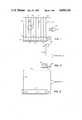
- FIG. 1is a schematic view of a typical prior art straight wire type grid configuration used in an inductive coupling type digitizing tablet system
- FIG. 2is a schematic view of the overall loop which includes the straight wire at one end of the grid configuration shown in FIG. 1;
- FIG. 3is a schematic view of the overall loop which includes the straight wire at the other end of the grid configuration shown in FIG. 1;
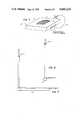
- FIG. 4is a simplified view partly broken away in parts of a digitizing tablet system constructed according to the teachings of the present invention.
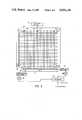
- FIG. 5is a schematic view of the grid structure and associated electronics in the digitizing tablet system shown in FIG. 4;
- FIG. 6is a schematic view of the overall loop containing the loop element at one end of one of the sets of loop elements in the grid structure shown in FIG. 5;
- FIG. 7is a schematic view of the overall loop containing the loop element at the other end of the same set of loop elements in the grid structure shown in FIG. 5;
- FIG. 8is a schematic view of another embodiment of the grid structure of the invention.
- FIGS. 9 and 10are graphs useful in understanding how readings from a set of loop shaped conductive elements are interpolated to determine the exact position of the stylus relative to the grid.
- the present inventionis directed to a digitizing tablet system which includes a conductive grid structure and a stylus structure having a magnetizable element which provides inductive coupling to the conductive grid structure when either one of the conductive grid structure or the magnetizable element are energized and wherein the conductive grid structure is configured to avoid nonlinearities in the relationship between the induced voltage signal and the computed stylus position relative to the grid structure and is configured to minimize noise and interference in the induced voltage signals caused by extraneous sources.
- the present inventionaccomplishes this by providing a grid structure which is configured to define a pair of orthogonal sets of narrow parallel uniformly sized and spaced U shaped loops of conductive material.
- the loopsare connected to the electronics position of the system in an arrangement whereby the overall area of the loop containing a loop element is essentially equal to the area of the loop element itself.
- induced voltage signals derived from the individual conductive loop elementsare processed to produce data signals corresponding to the position of the stylus relative to the grid of loop elements.
- the processingincludes an interpolation technique based on a barabolic curve assumption to determine the coordinates of the position wherein the induced voltage signal would be at a maximum.
- FIG. 1a schematic diagram of a portion of a typical prior art digitizing tablet system of the type wherein a coil structure is inductively coupled to a grid structure, the system being identified generally by reference numeral 11.
- the wires defining only one of the coordinate axesare shown.
- System 11includes a grid 13 having a plurality of parallel uniformly spaced straight wires 15-1 through 15-10.
- Each wire 15is coupled at one end with a respective switch 17-1 through 17-10 in a multiplexor 19.
- the end of each wire 15 opposite the end connected to the respective switch 17is connected to a common conductor 21 which serves as one output line or terminal or grid 13.
- Multiplexor 19is connected to another conductor 23 which serves as a second output line or terminal of grid 13.
- An amplifier 25has two inputs 27 and 29 which are respectively coupled to conductors 21 and 23.
- stylusDisposed above grid 13 is stylus (not shown) having a coil 31.
- the loop containing wire 15-1includes conductor 21, wire 15-1, switch 17-1 common line 17-11 in multiplexor 19 and conductor 23.
- the loop containing wire 15-10includes the section of conductor 21 from terminal 27 in amplifier 25 to junction 28, wire 15-10, switch 17-10, the section of line 17-11 from junction 30 to terminal 32 and conductor 23.
- the loop containing wire 15-1is considerably larger in area than the loop containing wire 15-10. Consequently, the relationship of the voltage signal induced in the loop containing wire 15-1 when coil 31 is at certain distance from wire 15-1 to the stylus position will not be the same as the relationship of voltage signal induced in the loop containing wire 15-10 to the stylus position when coil 31 is at the same distance from wire 15-10. Furthermore, the loop containing wire 15-1 will pick up more stray fringe magnetic fields than the loop containing wire 15-10, because of its larger size.
- the inventionwill hereinafter be described with reference to an inductively coupled digitizing tablet system in which voltage signals are applied to the coil in the stylus causing signals to be induced in the grid.
- the voltage signalsmay be applied to the grid rather than the coil in the stylus, causing signals to be induced in the coil in the stylus rather than the grid.
- FIG. 4there is illustrated a digitizing tablet system constructed according to the teachings of this invention and identified generally by reference numeral 41.
- System 41includes a tablet 43 and a stylus 45.
- Stylus 45includes a coil 47 which is coupled to the electronics in tablet 43 by a pair of wires which are shown for simplicity as a single wire 49.
- Tablet 43includes a generally rectangularly shaped housing having a top flat surface 51 on which may be placed a worksheet (not shown). The worksheet is maintained in place by any suitable means (also not shown).
- Disposed inside tablet 43is a conductive grid structure 53 and the electronics 55. Grid structure 53 is spaced below top surface 51 a finite distance, such as around 0.125".
- FIG. 5there is illustrated the details of the grid structure 53 and the associated electronics 55.
- Grid structure 53includes a first plurality of elongated narrow parallel U shaped conductive loops (identified by reference numerals) 61-1 through 61-10, the number of loops shown being for illustrative purposes only. Loops 61-1 through 61-10 are uniformly spaced, equal in size and shape and disposed in a plane parallel to surface 51, defining one coordinate axis, or the "X" axis of measurement. Each loop 61 includes a first leg or longitudinal loop section, a second leg or longitudinal loop section and a first transverse or connecting loop section. The two longitudinal loop sections are parallel. In loop 61-1 the first and second longitudinal loop sections and the transverse loop sections are identified as 61-1A, 61-1B and 61-1C respectively.
- Grid structurefurther includes a second plurality of elongated parallel narrow U shpaed conductive loops 63-1 through 63-10, the number of loops shown also being for illustrative purposes only.
- Loops 63-1 through 63-10are uniformly spaced, equal in size and shape and disposed in a plane parallel to and spaced from loop elements 61-1 through 61-10 at right angles thereto and defining a second coordinate axis, or the "Y" axis of measurement.
- the loop size and spacing of both pluralities of loopsare preferably the same.
- Loops 61 and 63may either be individual wires of conductive material or lengths of conductive material on a printed circuit board.
- each loop 61One end point E 1 of each loop 61 is connected to a common conductive element 65 which serves as one output terminal or line for loops 61 and the other end point E 2 of each loop 61 is connected to a multiplexor 67 having an output line 69 which serves as the other output terminal or line for loops 61.
- Output line 65is very close to multiplexor 67 and the two output lines 65 and 69 are very close to each other.
- loops 63are connected to a common conductive element 71 and a multiplexor 73 having an output line 75.
- the overall loop containing loop 61-1is shown separately in FIG. 6 and the overall loop containing loop 61-10 is shown separately in FIG. 7. Since conductive element 65 is disposed physically very close to multiplexor 67 and output line 69 the area between wire 65 and multiplexor 67 is very small or negliable. Thus, the overall loop area of the loop containing loop 61-1 is essentially equal to the area of loop 61-1 and the overall loop area of the loop containing loop 61-10 is essentially equal to the area of loop 61-10. Similarly, the overall loop areas of each one of the loops containing loop 63-1 through 63-10 is essentially equal to the areas of loops 63-1 through 63-10.
- the loop elements in each groupare identical in size and shape, the signal induced in one loop, such as loop 61-1, when coil 47 is a certain distance therefrom will be the same as the signal induced in another loop such as loop 61-5 when coil 47 is at the same distance therefrom.
- the stray noise or fringe fields picked up by the loopswill be about the same for each loop.
- the loopsare relatively narrow the stray noise or fringe fields will be at a minimum.
- Coil 47has a diameter that is slightly less than the width of a loop.
- the maximum signal induced in a loopwill occur when the coil 41 is aligned directly between the two longitudinal wires of a loop.
- Conductive elements 65 and 69are connected to an amplifier 77 whose output is fed into a demodulator and filter combination 79.
- the output of demodulator and filter combination 79is fed into a A/D converter 81.
- the output of A/D converter 81is fed into a processor 83.
- Conductive elements 71 and 75are connected to an amplifier 85 whose output is fed into a demodulator and filter combination 87.
- the output of demodulator and filter combination 87is fed into a A/D converter 89 whose output is also connected to processor 83.
- the output of processor 83is connected to a computer or display terminal 83.
- Coil 41is coupled to an AC voltage source 91.
- FIG. 8there is illustrated another embodiment of grid structure identified by reference numeral 101.
- the setincludes a plurality of loop elements 103-1 to 103-5 which are identical in size and shape to loop elements 61.
- the number of loops in the setis for illustrative purposes only.
- Loops 103are uniformly spaced but are disposed in overlapping relationship. Because the loop elements are disposed in overlapping relationship, the number of loop elements and hence the number of readings that may be obtained for a given length along the axis of measurement is increased.
- a voltage signal from AC voltage source 91is applied to coil 47 in stylus 45 producing flux patterns linking coil 47 to grid 53. This will induce voltages in the loop elements of grid 53.
- the amplitude of the induced voltage signals in each loop elementwill be a function of the distance from coil 47 to the particular loop element. The largest induced voltage signal will be generated from a loop element when coil 47 is positioned directly over the loop element.
- the voltage signals generated in loop elements 61are fed sequentially into amplifier 77.
- the amplified voltage signal outputs from amplifier 77are filtered and demodulated by filter and demodulator unit 79 and then converted into digital signals by A/D converter 81.
- the output data signals from A/D converter 81are fed into processor 83.
- the induced voltage signals from loop elements 63are similarly amplified, filtered, demodulated, converted to digital signals and fed into processor 83.
- processor 83the two sets of data signals, one from loop elements 61 and the other from loop elements 63 are processed to produce data signals corresponding to the exact position of stylus 45 relative to grid 61.
- the processing in processer 83involves determining the peak of a parabolic curve defined by three points or readings, the first point corresponding to the largest induced voltage signal detected and the other two points corresponding to the amplitudes of the induced voltage signals from the two loop elements on either side of the loop element producing the largest induced voltage signal.
- the processing in processor 83may be best understood by referring to FIGS. 9 and 10.
- FIG. 9is a graph of voltage amplitude vs. loop element position for loop elements 61-1, 61-2 and 61-3 when coil 47 of stylus 45 is directly over the center of coil element 61-2.
- point R 1represents the amplitude of the induced voltage signal from coil element 61-1
- point S 1represents the amplitude of the induced voltage signal from coil element 61-2
- point T 1represents the amplitude of the induced voltage signal from coil element 61-3.
- P 61-1is the position of loop element 61-1 along the X-axis
- P 61-2is the position of loop element 61-2 along the X axis
- P 61-3is the position of loop element 61-3 along the X axis.
- FIG. 8illustrates a graph of the induced voltages from the same three coil elements when coil 47 is positioned between coils 61-1 and 61-2.
- the three amplitude points, labelled R 2 , S 2 and T 2are joined together by a parabolic curve Z 2 .
- the peak CP 2 of the parabolic curve Z 2is between points R 2 and S 2 and the stylus position P ST2 is between the position P 61-1 of loop 61-1 and the position P 61-2 of loop 61-2.
- P sThe position along the axis of measurement of the loop element having the largest detected induced voltage signal.
- L dthe distance between loop elements along the axis of measurement.
- V sthe amplitude of the largest detected voltage.
- V rthe amplitude of the voltage detected by the loop element on one side of the loop element having the largest detected voltage.
- V rthe amplitude of the voltage detected by the loop element on the other side of the loop element having the largest detected voltage.
- V s9 volts
- the accuracy of the interpolation technique described aboveis based on the assumption that a curve of the amplitude of the electromagnetic field along an axis of measurement is parabolic in shape in the region near the top of the curve.
- the assumptionis dependent somewhat on the exact geometry of the loop width, loop size, loop length, coil diameter and coil length etc.
- the curve of the electromagnetic fieldcan be made to be an almost perfect parabolic shape.
- An example of parameters that will produce a curve that is parabolic in shape at the top regionis as follows:
- the parabolic shape of the top region of the curvemay be further improved by using a coil that is frusto-conically shaped rather than cylindrically shaped.
- the shape of the outer endsmay be slightly tapered rather than rectangular as shown.
- the bottoms of the loopsi.e. where they are coupled to the common conductor and multiplexor may also be slightly tapered.
- the plurality of loops making up each setneed not all terminate on the same side of the tablet. Some loops may terminate on one side and others on the other side, it only being necessary that the loop areas and shapes be equal.
- a single amplifier, demodulator and filter combination and A/D convertermay be shared by both sets of loops through a suitable multiplexing arrangement.
Landscapes
- Engineering & Computer Science (AREA)
- General Engineering & Computer Science (AREA)
- Theoretical Computer Science (AREA)
- Physics & Mathematics (AREA)
- Human Computer Interaction (AREA)
- General Physics & Mathematics (AREA)
- Electromagnetism (AREA)
- Measurement Of Length, Angles, Or The Like Using Electric Or Magnetic Means (AREA)
Abstract
Description
Claims (11)
Priority Applications (1)
| Application Number | Priority Date | Filing Date | Title |
|---|---|---|---|
| US06/790,883US4694124A (en) | 1984-03-23 | 1985-12-09 | Digitizing tablet system including a tablet having a grid structure made of two orthogonal sets of parallel uniformly sized and spaced U shaped loops of conductive material |
Applications Claiming Priority (2)
| Application Number | Priority Date | Filing Date | Title |
|---|---|---|---|
| US06/592,879US4582955A (en) | 1984-03-23 | 1984-03-23 | Digitizing tablet system including a tablet having a grid structure made of two orthogonal sets of parallel uniformly sized and spaced U shaped loops of conductive material |
| US06/790,883US4694124A (en) | 1984-03-23 | 1985-12-09 | Digitizing tablet system including a tablet having a grid structure made of two orthogonal sets of parallel uniformly sized and spaced U shaped loops of conductive material |
Related Parent Applications (1)
| Application Number | Title | Priority Date | Filing Date |
|---|---|---|---|
| US06/592,879ContinuationUS4582955A (en) | 1984-03-23 | 1984-03-23 | Digitizing tablet system including a tablet having a grid structure made of two orthogonal sets of parallel uniformly sized and spaced U shaped loops of conductive material |
Publications (1)
| Publication Number | Publication Date |
|---|---|
| US4694124Atrue US4694124A (en) | 1987-09-15 |
Family
ID=27081566
Family Applications (1)
| Application Number | Title | Priority Date | Filing Date |
|---|---|---|---|
| US06/790,883Expired - Fee RelatedUS4694124A (en) | 1984-03-23 | 1985-12-09 | Digitizing tablet system including a tablet having a grid structure made of two orthogonal sets of parallel uniformly sized and spaced U shaped loops of conductive material |
Country Status (1)
| Country | Link |
|---|---|
| US (1) | US4694124A (en) |
Cited By (9)
| Publication number | Priority date | Publication date | Assignee | Title |
|---|---|---|---|---|
| US4820886A (en)* | 1987-03-16 | 1989-04-11 | Sanders Associates, Inc. | Low-cost, high-accuracy digitizer signal acquisition apparatus and method |
| US4928256A (en)* | 1988-03-16 | 1990-05-22 | Ametek, Inc. | Digitizer for position sensing |
| US5134689A (en)* | 1987-08-24 | 1992-07-28 | Wacom Co., Ltd. | Coordinate input system and input implement used in the system |
| US5136125A (en)* | 1991-05-06 | 1992-08-04 | International Business Machines Corporation | Sensor grid for an electromagnetic digitizer tablet |
| US5194699A (en)* | 1990-04-03 | 1993-03-16 | Summagraphics Corporation | Digitizer tablet with fixed incremented grid portions |
| US5276282A (en)* | 1992-04-15 | 1994-01-04 | International Business Machines | Optimal scan sequence for RF magnetic digitizers |
| US6396005B2 (en) | 1998-06-15 | 2002-05-28 | Rodgers Technology Center, Inc. | Method and apparatus for diminishing grid complexity in a tablet |
| US20040041800A1 (en)* | 2002-09-04 | 2004-03-04 | Daniels John James | Thin, lightweight, flexible, bright, wireless display |
| US20050133279A1 (en)* | 2003-12-17 | 2005-06-23 | Microsoft Corporation | Electromagnetic digitizer sensor array |
Citations (21)
| Publication number | Priority date | Publication date | Assignee | Title |
|---|---|---|---|---|
| US3399401A (en)* | 1964-06-29 | 1968-08-27 | Army Usa | Digital computer and graphic input system |
| US3618019A (en)* | 1969-11-13 | 1971-11-02 | Conversational Systems Corp | Signature identification by means of pressure patterns |
| US3647963A (en)* | 1969-03-10 | 1972-03-07 | Bendix Corp | Automatic coordinate determining device |
| US3700809A (en)* | 1971-08-31 | 1972-10-24 | Donald J Nadon | Inductively coupled grid cursor |
| US3705956A (en)* | 1971-01-25 | 1972-12-12 | Computek Inc | Graphic data tablet |
| US3732369A (en)* | 1971-04-05 | 1973-05-08 | Welland Investment Trust | Coordinate digitizer system |
| US3735044A (en)* | 1971-07-06 | 1973-05-22 | Bendix Corp | Coordinate determining device employing a slowly varying difference signal to determine approximate cursor position |
| US3873770A (en)* | 1974-03-21 | 1975-03-25 | Bendix Corp | Digital position measurement system with stylus tilt error compensation |
| US3974332A (en)* | 1974-12-03 | 1976-08-10 | Pentel Kabushiki Kaisha | Tablet for use in a coordinate digitizer |
| US3975592A (en)* | 1975-01-23 | 1976-08-17 | Applicon Incorporated | Electrographic system |
| US3999012A (en)* | 1975-07-07 | 1976-12-21 | Ibm Corporation | Graphic entry tablet with improved addressing |
| US4009338A (en)* | 1975-12-22 | 1977-02-22 | Ibm Corporation | Tablet with improved pen height compensation |
| US4088842A (en)* | 1975-05-23 | 1978-05-09 | Kabushiki Kaisha Daini Seikosha | Automatic coordinate determining device |
| US4213005A (en)* | 1978-12-13 | 1980-07-15 | Cameron Eugene A | Digitizer tablet |
| US4240065A (en)* | 1978-12-13 | 1980-12-16 | Wigmore Professional Data Services Ltd. | Position sensing apparatus |
| US4243843A (en)* | 1979-02-22 | 1981-01-06 | Summagraphics Corporation | Coarse position digitizer |
| US4289927A (en)* | 1979-11-13 | 1981-09-15 | Kurta Corporation | Graphic communication apparatus |
| GB2080539A (en)* | 1980-07-10 | 1982-02-03 | Seiko Instr & Electronics | Coordinate determining device |
| US4368351A (en)* | 1981-02-12 | 1983-01-11 | Summagraphics Corporation | Amplitude modulated digitizer |
| EP0110131A1 (en)* | 1982-10-28 | 1984-06-13 | Photoron Incorporated | Apparatus and method of electromagnetically reading coordinate data |
| US4471162A (en)* | 1981-12-28 | 1984-09-11 | Fujitsu Limited | Coordinate reading apparatus |
- 1985
- 1985-12-09USUS06/790,883patent/US4694124A/ennot_activeExpired - Fee Related
Patent Citations (21)
| Publication number | Priority date | Publication date | Assignee | Title |
|---|---|---|---|---|
| US3399401A (en)* | 1964-06-29 | 1968-08-27 | Army Usa | Digital computer and graphic input system |
| US3647963A (en)* | 1969-03-10 | 1972-03-07 | Bendix Corp | Automatic coordinate determining device |
| US3618019A (en)* | 1969-11-13 | 1971-11-02 | Conversational Systems Corp | Signature identification by means of pressure patterns |
| US3705956A (en)* | 1971-01-25 | 1972-12-12 | Computek Inc | Graphic data tablet |
| US3732369A (en)* | 1971-04-05 | 1973-05-08 | Welland Investment Trust | Coordinate digitizer system |
| US3735044A (en)* | 1971-07-06 | 1973-05-22 | Bendix Corp | Coordinate determining device employing a slowly varying difference signal to determine approximate cursor position |
| US3700809A (en)* | 1971-08-31 | 1972-10-24 | Donald J Nadon | Inductively coupled grid cursor |
| US3873770A (en)* | 1974-03-21 | 1975-03-25 | Bendix Corp | Digital position measurement system with stylus tilt error compensation |
| US3974332A (en)* | 1974-12-03 | 1976-08-10 | Pentel Kabushiki Kaisha | Tablet for use in a coordinate digitizer |
| US3975592A (en)* | 1975-01-23 | 1976-08-17 | Applicon Incorporated | Electrographic system |
| US4088842A (en)* | 1975-05-23 | 1978-05-09 | Kabushiki Kaisha Daini Seikosha | Automatic coordinate determining device |
| US3999012A (en)* | 1975-07-07 | 1976-12-21 | Ibm Corporation | Graphic entry tablet with improved addressing |
| US4009338A (en)* | 1975-12-22 | 1977-02-22 | Ibm Corporation | Tablet with improved pen height compensation |
| US4213005A (en)* | 1978-12-13 | 1980-07-15 | Cameron Eugene A | Digitizer tablet |
| US4240065A (en)* | 1978-12-13 | 1980-12-16 | Wigmore Professional Data Services Ltd. | Position sensing apparatus |
| US4243843A (en)* | 1979-02-22 | 1981-01-06 | Summagraphics Corporation | Coarse position digitizer |
| US4289927A (en)* | 1979-11-13 | 1981-09-15 | Kurta Corporation | Graphic communication apparatus |
| GB2080539A (en)* | 1980-07-10 | 1982-02-03 | Seiko Instr & Electronics | Coordinate determining device |
| US4368351A (en)* | 1981-02-12 | 1983-01-11 | Summagraphics Corporation | Amplitude modulated digitizer |
| US4471162A (en)* | 1981-12-28 | 1984-09-11 | Fujitsu Limited | Coordinate reading apparatus |
| EP0110131A1 (en)* | 1982-10-28 | 1984-06-13 | Photoron Incorporated | Apparatus and method of electromagnetically reading coordinate data |
Non-Patent Citations (10)
| Title |
|---|
| IBM Technical Disclosure Bulletin, vol. 22, No. 3 (pp. 1245 1251), Aug. 1979.* |
| IBM Technical Disclosure Bulletin, vol. 22, No. 3 (pp. 1245-1251), Aug. 1979. |
| Patent Abstracts of Japan, vol. 7, No. 241, (P 232), 1386 , Oct. 26, 1983.* |
| Patent Abstracts of Japan, vol. 7, No. 241, (P-232), [1386], Oct. 26, 1983. |
| Patent Abstracts of Japan, vol. 8, No. 271 (P 320), 1708 , Dec. 12, 1984.* |
| Patent Abstracts of Japan, vol. 8, No. 271 (P-320), [1708], Dec. 12, 1984. |
| Patent Abstracts of Japan, vol. 8, No. 275 (P 321), 1712 , Dec. 15, 1984.* |
| Patent Abstracts of Japan, vol. 8, No. 275 (P-321), [1712], Dec. 15, 1984. |
| SID International Symposium Digest of Technical Papers (pp. 32 35), May 1985.* |
| SID International Symposium Digest of Technical Papers (pp. 32-35), May 1985. |
Cited By (11)
| Publication number | Priority date | Publication date | Assignee | Title |
|---|---|---|---|---|
| US4820886A (en)* | 1987-03-16 | 1989-04-11 | Sanders Associates, Inc. | Low-cost, high-accuracy digitizer signal acquisition apparatus and method |
| US5134689A (en)* | 1987-08-24 | 1992-07-28 | Wacom Co., Ltd. | Coordinate input system and input implement used in the system |
| US4928256A (en)* | 1988-03-16 | 1990-05-22 | Ametek, Inc. | Digitizer for position sensing |
| US5194699A (en)* | 1990-04-03 | 1993-03-16 | Summagraphics Corporation | Digitizer tablet with fixed incremented grid portions |
| US5136125A (en)* | 1991-05-06 | 1992-08-04 | International Business Machines Corporation | Sensor grid for an electromagnetic digitizer tablet |
| US5276282A (en)* | 1992-04-15 | 1994-01-04 | International Business Machines | Optimal scan sequence for RF magnetic digitizers |
| US6396005B2 (en) | 1998-06-15 | 2002-05-28 | Rodgers Technology Center, Inc. | Method and apparatus for diminishing grid complexity in a tablet |
| US20040041800A1 (en)* | 2002-09-04 | 2004-03-04 | Daniels John James | Thin, lightweight, flexible, bright, wireless display |
| US7161590B2 (en)* | 2002-09-04 | 2007-01-09 | John James Daniels | Thin, lightweight, flexible, bright, wireless display |
| US20050133279A1 (en)* | 2003-12-17 | 2005-06-23 | Microsoft Corporation | Electromagnetic digitizer sensor array |
| US7265303B2 (en)* | 2003-12-17 | 2007-09-04 | Microsoft Corporation | Electromagnetic digitizer sensor array |
Similar Documents
| Publication | Publication Date | Title |
|---|---|---|
| US4582955A (en) | Digitizing tablet system including a tablet having a grid structure made of two orthogonal sets of parallel uniformly sized and spaced U shaped loops of conductive material | |
| US5136125A (en) | Sensor grid for an electromagnetic digitizer tablet | |
| US4577057A (en) | Digitizing tablet system having stylus tilt correction | |
| EP0607694B1 (en) | Cordless digitizer | |
| US4659874A (en) | X-Y position sensor | |
| US5239489A (en) | Pen position and tilt estimators for a digitizer tablet | |
| US4213005A (en) | Digitizer tablet | |
| EP0415051A2 (en) | Coordinate input device | |
| EP0152961B1 (en) | Position detecting apparatus | |
| US4794208A (en) | Frequency shifting digitizer for reducing AC fields interference | |
| CN1051804A (en) | Low-power electromagnetic digitizer tablet | |
| US4694124A (en) | Digitizing tablet system including a tablet having a grid structure made of two orthogonal sets of parallel uniformly sized and spaced U shaped loops of conductive material | |
| US4661656A (en) | Graphic tablet and method | |
| US5276282A (en) | Optimal scan sequence for RF magnetic digitizers | |
| JPS5856912B2 (en) | 2D magnetic scale device | |
| EP0706057B1 (en) | Magnetic image sensor using Matteucci effect | |
| EP0292704B1 (en) | A device for determining position coordinates of points on a surface | |
| EP0806740B1 (en) | Digitizer | |
| EP0220331A1 (en) | Digitizing tablet comprising "U"-shaped loops of conductive material | |
| US5128499A (en) | Wireless coordinate reading system | |
| JPS62125428A (en) | Digitizing tablet apparatus containing tablet having latticestructure section comprising two sets of u-shaped orthogonalloops | |
| US5345044A (en) | Cordless digitizer using electromagnetic locating signals | |
| JPH0424716A (en) | Wireless coordinate reader | |
| KR950002699B1 (en) | Coil arranging method for digitizer | |
| JPS62118422A (en) | Digitized tablet system |
Legal Events
| Date | Code | Title | Description |
|---|---|---|---|
| AS | Assignment | Owner name:NUMONICS CORPORATION Free format text:ASSIGNMENT OF ASSIGNORS INTEREST.;ASSIGNOR:PENCEPT, INC.;REEL/FRAME:005153/0872 Effective date:19890915 Owner name:FIDELITY BANK, NATIONAL ASSOCIATION Free format text:SECURITY INTEREST;ASSIGNOR:NUMONICS CORPORATION A CORP. OF DE;REEL/FRAME:005153/0876 Effective date:19890915 | |
| FEPP | Fee payment procedure | Free format text:PAYOR NUMBER ASSIGNED (ORIGINAL EVENT CODE: ASPN); ENTITY STATUS OF PATENT OWNER: SMALL ENTITY | |
| FPAY | Fee payment | Year of fee payment:4 | |
| AS | Assignment | Owner name:FIDELITY BANK, N.A. Free format text:RELEASE BY SECURED PARTY;ASSIGNOR:NUMONICO CORPORATION;REEL/FRAME:006712/0020 Effective date:19890915 Owner name:BERMUDA TRUST COMPANY LIMITED, BERMUDA Free format text:SECURITY INTEREST;ASSIGNOR:NUMONICS CORPORATION;REEL/FRAME:006712/0008 Effective date:19930715 Owner name:FIDELITY BANK, N.A., PENNSYLVANIA Free format text:SECURITY INTEREST;ASSIGNOR:NUMONICS CORPORATION;REEL/FRAME:006712/0025 Effective date:19890915 | |
| AS | Assignment | Owner name:CONTINENTAL BANK, PENNSYLVANIA Free format text:SECURITY INTEREST;ASSIGNOR:NUMONICS CORPORATION;REEL/FRAME:006696/0201 Effective date:19930913 | |
| REFU | Refund | Free format text:REFUND OF EXCESS PAYMENTS PROCESSED (ORIGINAL EVENT CODE: R169); ENTITY STATUS OF PATENT OWNER: SMALL ENTITY | |
| FPAY | Fee payment | Year of fee payment:8 | |
| REMI | Maintenance fee reminder mailed | ||
| LAPS | Lapse for failure to pay maintenance fees | ||
| FP | Lapsed due to failure to pay maintenance fee | Effective date:19990915 | |
| STCH | Information on status: patent discontinuation | Free format text:PATENT EXPIRED DUE TO NONPAYMENT OF MAINTENANCE FEES UNDER 37 CFR 1.362 |