US4688825A - Seat belt retractor mechanism - Google Patents
Seat belt retractor mechanismDownload PDFInfo
- Publication number
- US4688825A US4688825AUS06/859,832US85983286AUS4688825AUS 4688825 AUS4688825 AUS 4688825AUS 85983286 AUS85983286 AUS 85983286AUS 4688825 AUS4688825 AUS 4688825A
- Authority
- US
- United States
- Prior art keywords
- electromagnet
- improvement
- inertia
- door
- support frame
- Prior art date
- Legal status (The legal status is an assumption and is not a legal conclusion. Google has not performed a legal analysis and makes no representation as to the accuracy of the status listed.)
- Expired - Fee Related
Links
- 230000007246mechanismEffects0.000titleclaimsabstractdescription49
- 230000006872improvementEffects0.000claimsabstractdescription41
- 230000001133accelerationEffects0.000claimsabstractdescription7
- 239000000463materialSubstances0.000claimsdescription11
- 239000002184metalSubstances0.000claimsdescription9
- NJPPVKZQTLUDBO-UHFFFAOYSA-NnovaluronChemical compoundC1=C(Cl)C(OC(F)(F)C(OC(F)(F)F)F)=CC=C1NC(=O)NC(=O)C1=C(F)C=CC=C1FNJPPVKZQTLUDBO-UHFFFAOYSA-N0.000claimsdescription6
- 230000005484gravityEffects0.000claimsdescription4
- 238000007747platingMethods0.000claimsdescription4
- 230000004044responseEffects0.000claimsdescription4
- 229920006395saturated elastomerPolymers0.000claimsdescription4
- 239000000696magnetic materialSubstances0.000claims1
- 230000037433frameshiftEffects0.000abstract1
- 230000009471actionEffects0.000description9
- 238000004519manufacturing processMethods0.000description6
- 230000035699permeabilityEffects0.000description6
- 230000008859changeEffects0.000description5
- CWYNVVGOOAEACU-UHFFFAOYSA-NFe2+Chemical compound[Fe+2]CWYNVVGOOAEACU-UHFFFAOYSA-N0.000description4
- 210000003127kneeAnatomy0.000description4
- 230000004048modificationEffects0.000description4
- 238000012986modificationMethods0.000description4
- 230000001419dependent effectEffects0.000description3
- 230000036961partial effectEffects0.000description3
- 230000003213activating effectEffects0.000description2
- 230000002411adverseEffects0.000description2
- 230000008901benefitEffects0.000description2
- 230000007423decreaseEffects0.000description2
- 238000011161developmentMethods0.000description2
- 238000010586diagramMethods0.000description2
- 238000009429electrical wiringMethods0.000description2
- 230000005389magnetismEffects0.000description2
- 238000000034methodMethods0.000description2
- 235000011449RosaNutrition0.000description1
- 230000035508accumulationEffects0.000description1
- 238000009825accumulationMethods0.000description1
- 238000013459approachMethods0.000description1
- 238000013461designMethods0.000description1
- 230000000694effectsEffects0.000description1
- 230000007613environmental effectEffects0.000description1
- 230000000670limiting effectEffects0.000description1
- 230000007774longtermEffects0.000description1
- 230000010355oscillationEffects0.000description1
- 230000008569processEffects0.000description1
- 230000009467reductionEffects0.000description1
- 238000009877renderingMethods0.000description1
- 230000000284resting effectEffects0.000description1
- 230000000452restraining effectEffects0.000description1
Images



Classifications
- B—PERFORMING OPERATIONS; TRANSPORTING
- B60—VEHICLES IN GENERAL
- B60R—VEHICLES, VEHICLE FITTINGS, OR VEHICLE PARTS, NOT OTHERWISE PROVIDED FOR
- B60R22/00—Safety belts or body harnesses in vehicles
- B60R22/34—Belt retractors, e.g. reels
- B60R22/3405—Belt retractors, e.g. reels of the non-rotary type
- B—PERFORMING OPERATIONS; TRANSPORTING
- B60—VEHICLES IN GENERAL
- B60R—VEHICLES, VEHICLE FITTINGS, OR VEHICLE PARTS, NOT OTHERWISE PROVIDED FOR
- B60R22/00—Safety belts or body harnesses in vehicles
- B60R22/34—Belt retractors, e.g. reels
- B60R22/36—Belt retractors, e.g. reels self-locking in an emergency
- B60R22/41—Belt retractors, e.g. reels self-locking in an emergency with additional means for preventing locking during unwinding under predetermined conditions
- B—PERFORMING OPERATIONS; TRANSPORTING
- B60—VEHICLES IN GENERAL
- B60R—VEHICLES, VEHICLE FITTINGS, OR VEHICLE PARTS, NOT OTHERWISE PROVIDED FOR
- B60R22/00—Safety belts or body harnesses in vehicles
- B60R22/34—Belt retractors, e.g. reels
- B60R22/36—Belt retractors, e.g. reels self-locking in an emergency
- B60R22/40—Belt retractors, e.g. reels self-locking in an emergency responsive only to vehicle movement
- B60R2022/401—Belt retractors, e.g. reels self-locking in an emergency responsive only to vehicle movement with adjustable sensor
Definitions
- the present inventionrelates to the art of seat belt retractor mechanisms and more particularly to an improved seat belt retractor mechanism employed in a passive restraint system for a motor vehicle.
- the present inventionis particularly applicable for use in a passive seat belt restraint system for a motor vehicle of the type employing a seat belt retractor located in a door of the vehicle and will be described with particular reference to this type of system; however, it is appreciated that the invention has much broader applications and may be employed in other seat belt retractor environments wherein there is a desire or need to modify the inertia forces necessary for locking the retractor from paying out a seat belt during rapid deceleration or acceleration of the vehicle.
- Inertiawould either trip or swing the inertia sensing device and this action would result in the seat belt retractor mechanism being locked.
- These active seat belt systemswere quite successful and could be used in either a lap belt system, a shoulder harness system or a combination thereof; however, they all were active systems requiring the definite intervention of the occupant before protection was obtained.
- one of the more popular retractor mechanisms of the type having an inertia sensing arrangementinvolved a rotatable spool having a ratchet plate at one end and the inertia sensor element was a pendulum device engageable with a locking bar to drive the locking bar into the ratchet plate upon rapid acceleration or deceleration of the vehicle.
- two separate ratchet plateswere located at opposite ends of the spool and were engageable with the same locking bar. This system was mechanically sound and obtained the desired results demanded by the rigor of the environment in which it was to be operated.
- One passive system which is now being considered for use on motor vehiclesis a system wherein the one or two belts are attached on the inboard side of the front seats of a motor vehicle and the seat belt retractors for the belts are located in the vehicle door so that as the door is opened the occupants enter the vehicle behind the seat belt or belts. Upon closing the door, the belts surround the occupants and a retractor mechanism within the door for one or two belts retracts the belt or belts into the operative position.
- a further arrangement for employing a permanent magnet to increase the inertia force necessary to trip a door mounted retractor mechanism of the type contemplated by the present inventionis illustrated in Collins U.S. Pat. No. 4,235,455.
- the de Rosa and Collins patentsare also incorporated by reference herein for the purposes of background information.
- electromagnetsBy utilizing an electromagnet concept, disadvantages of the solenoid have been overcome; however, electromagnets, as suggested by the prior art patents described above, have certain disadvantages the most prevalent of which was the susceptibility of the magnetic force to manufacturing tolerances. Since the magnetic force in a magnetic circuit is highly dependent upon mechanical tolerances and electrical parameters, such permanent magnets are susceptible to complex geometrical and electrical variations generally unacceptable from a cost standpoint and operational predictability needed for wide spread use in mass production of motor vehicles.
- the present inventionrelates to an improved seat belt retractor of the type generally disclosed in the prior art mentioned above, which retractor overcomes the disadvantages of prior attempts to employ a low cost, dependable, easily assembled seat belt retractor with a force modifying feature for use in the door of a motor vehicle.
- the primary object of the present inventionis the improvement of a seat belt retractor of the type having an inertia locking arrangement, which improved retractor has a dependable, easily assembled, non-mechanical arrangement for increasing the inertia force needed to lock the tretractor when the door of a vehicle using the retractor is opened.
- Yet another object of the present inventionis the provision of an improved seat belt retractor, as defined above, which seat belt retractor is electrical in operation and overcomes the disadvantages of other electrical arrangements, such as solenoids and prior electromagnetic systems.
- Still a further object of the present inventionis the provision of an improved seat belt retractor, of the type defined above, which seat belt retractor uses an electromagnet having a controlled additional force exerted against the inertia locking device without adverse fluctuations thereof mechanical tolerances and/or electrical variations.
- Yet another object of the present inventionis the provision of an improved seat belt retractor, as defined above, which seat belt retractor employs an electromagnet having a preselected controlled gauss magnetic force exerted upon the mechanism used to move the locking bar or similar arrangement in the seat belt retractor.
- Yet another object of the present inventionis the provision of a seat belt retractor, as defined above, which seat belt retractor employs a unique arrangement for controlling the output of an electromagnet used to control the additional force applied to the sensor element during times when the door of the vehicle is opened.
- the present inventionis a device for locking the payout of a seat belt from a seat belt retractor mechanism in response to a sudden acceleration or deceleration of a vehicle on which the device is mounted, wherein the device comprises an electromagnet with an operating coil and a core with a flat coil piece, an element with a flat keeper surface formed from magnetically permeable material, an inertia sensing member moved by external forces exerted on the vehicle, means for allowing relative movement between the pole piece and keeper element from a first position with the pole piece and keeper surface engaging each other in a coplanar relationship into a second position with the keeper surface pulled away from the engaging, coplanar relationship when the inertia sensing member is moved, means for locking the retractor when the pole piece and element are in the second position and means for selectively causing the electromagnet to exert an attraction force between the pole piece and the surface.
- the keepercan be at the bottom of the pedestal in a standing man arrangment or a surface of the standard locking bar shown in the prior Hollowell and Collins patents.
- the electromagnetas all electromagnets, has a magnetic saturation strength created by an energizing current exceeding a given value and the power circuit for energizing the electromagnet in the retractor utilizes a current source from the vehicle having a value substantially exceeding this given value so that the magnetic core of the electromagnet is operated in the saturation range to avoic variations caused by normal variations in the electrical system of the vehicle in which the retractor is employed.
- the saturated corethe increased force can be controlled easily by the dimensions of the core piece which can be done quite accurately without expensive manufacturing operations or assembly techniques. Consequently, the controlled magnetic force together with a controlled coplanar engaging surface area fixed with respect to either the lock bar or inertia element can control, within precise limits the additional force exerted when the electromagnet is energized by opening the door.
- the effects of manufacturing tolerances and electrical parametersare minimized in the operation of the arrangement for increasing the force on the inertia element and/or sensor when the door of the vehicle is opened.
- Thisdecreases the assembly cost, decreases the complex geometry employed in the total design and assures repeatable operating conditions from one vehicle to the next. Should the electromagnet not operate, there is no moving element; therefore, the retractor will operate normally.
- Thisis a substantial advantage over lever systems and solenoids heretofore employed in this type of device.
- the reduction of mechanical and electrical variations in the electromagnet arrangementovercomes the disadvantages of prior suggestions of using this concept and makes the electromagnet a viable concept for use in seat belt retractors of the type mounted in the door for passive seat belt systems.
- the same arrangementcould be used in an active system although it is not specifically developed for that purpose.
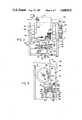
- FIG. 1is a partial pictorial view of a motor vehicle provided with a passive seat belt restraining mechanism employing two separate seat belt retractors constructed in accordance with the present invention
- FIG. 2is an enlarged, partially cross-sectional view taken generally along the line 2--2 of FIG. 1;
- FIG. 3is a cross-sectional view taken generally along line 3--3 of FIG. 2;
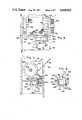
- FIG. 4is a view similar to FIG. 2 illustrating the retractor employed for the lap belt of the system shown in FIG. 1;
- FIG. 5is a cross-sectional view taken generally along line 5--5 of FIG. 4;
- FIG. 6is a partial cross-sectional view taken generally along line 6--6 of FIG. 4;
- FIG. 6Ais a partial cross-sectional view of a modification of the structure shown in FIG. 6 for adjusting the electromagnet with respect to the pivoted locking bar of the retractor mechanism;
- FIG. 6Bis a side view taken generally along line 6B--6B of FIG. 6A;
- FIG. 6Cis an exploded pictorial view of a modification of the invention shown in FIGS. 6A and 6B;
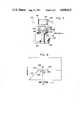
- FIG. 7is a schematic view of the standing man arrangement utilized in the seat belt retractor shown in FIG. 2 in graphic form;
- FIG. 8is a magnetic force output graph showing the saturation operation of the electromagnet in accordance with an aspect of the invention.
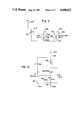
- FIG. 9is an electrical wiring diagram illustrating the doorjamb switch for operating the two seat belt retractors contemplated in the illustrated embodiment of the present invention.
- FIG. 10is an electrical wiring diagram showing one arrangement for obtaining a constant current for use in the electrical circuit illustrated in FIG. 9;
- FIG. 11is a more detailed view of a system contemplated for using the preferred embodiment of the present invention.
- FIG. 1shows a motor vehicle V having a seat A for an occupant, driver in this instance, and two doors, only one of which is shown as door D.
- Vehicle Vis provided with a somewhat standard passive restraint system S, having an upper shoulder harness or belt 10 secured between the occupants of the vehicle at anchor 12 and with a bight defined by guide 14 secured onto the vehicle door D.
- a lap belt 20extends from anchor 12 and is received by a retractor within housing 30 by way of opening 32. Second retractor in housing 30 receives the outboard end of belt 10 as it extends through opening 34 of the housing.
- passive restraint system Sis somewhat standard.
- belts 10, 20extend between the door and passenger seat A.
- belt 10extends over the torso while belt 20 is wrapped over the lap of the occupant.
- retractors within housing 30take up the slack in belts 10, 20 so they remain in a snug position around the person in the seat A.
- a similar system Swould be used on the occupant side of vehicle 1.
- only a single belt 10 or 20may be used in a passive system. In that instance, another belt may be made available as an active restraint system.
- the retractor for each belt in housing 30includes an arrangement for locking the belt from unwinding and lengthening whenever a certain inertia force is exerted on vehicle V by a collision with another vehicle or a collision of the vehicle with another obstacle.
- Such inertia locked seat belt retractorsare well-known in the automotive art. These devices or mechanisms, when mounted on a door, such as door D, present difficulty in that belts 10, 20 must unreel easily to allow door D movement from the closed to the opened position. To accomplish this easy operation, it has been suggested that the door mounted mechanisms have some type of an arrangement to prevent actuation by this normal movement of the door.
- Such mechanismsusually employ the standard doorjamb switch 36 for activating an override arrangement to prevent locking of the retractors within housing 30 when door D is moved from the closed position.
- door Dmay be moved conveniently from the closed to the opened position without obstruction caused by inadvertent locking of retractor mechanisms within the housing 30.
- the retractors within the housing 30operate to take up the slack so that belts 10, 20 do not accumulate within the passenger housing of vehicle V during the door shutting operation.
- the various arrangements for allowing normal operation of door Dhave been discussed above.
- the practical arrangement for accomplishing this purposeis a mechanism allowing the door to be moved normally, but not disabling the retractor locking arrangement upon closing of switch 36. In other words, as the switch is closed by opening the door, the inertia force necessary to lock the retractor mechanisms in housing 30 is increased slightly, but the inertia device is not disabled.
- retractor mechanism Rincludes a reel 50 for convolutions 52 of belt 10. Reel 50 is rotatably mounted by shaft 54 to rotate about axis x on support frame 40.
- a standard torsion spring 56extends between shaft 54 and a tab 58 fixed to wall 42 of housing 40. Torsion spring 56 biases shaft 54 in a rotational direction reeling tape 10 into convolutions 52 to maintain a preselected tension on belt 10 during normal operation.
- Spool or reel 50includes axially spaced circular ratchet wheels 60, 62 having matching teeth orientations and adapted to be engaged by pivoted locking member or plate 70 oscillating between an unlocked and locked position in holes or apertures in walls 42, 44. Formed metal ends 72, 74 allow locking member, plate or bar 70 to pivot about axis y.
- plate or bar 70is formed from a ferrous sheet metal and ends 72, 74 are twisted to produce loose engagement with a butterfly shaped aperture, such as aperture 75 in FIG. 11.
- metal locking bar 70is usually oscillated between an upper position engaging ratchet wheels 60, 62, as shown in the phantom line of FIG. 3, and a lower normal position shown in solid lines in FIG. 3.
- the pivotal axis yis generally parallel to the axis x and allows free oscillating motion of bar 70.
- spring 56maintains tension on belt 10.
- belt 10unreels to the position shown in FIG. 1.
- spring 56maintains tension on belt 10 so that the belt is taken up as the door is moved into the closed position.
- reel RTo protect the person riding in seat A, reel R must lock when vehicle V is subjected to forces indicative of an emergency situation. This force may be as low as 0.5 g.
- fingers 76, 78 on bar 70are pushed or swung upwardly into engagement with the teeth of ratchet wheels 60, 62 by plunger 80 when vehicle V is subjected to a rapid deceleration or acceleration. Movement of plunger 80 is caused by the tiltable inertia sensor element or "standing man" 90 which is best shown in FIG. 7.
- This standing manis somewhat shaped as illustrated and includes an upper conical recess 92 for receiving plunger 80, a vertically elevated head 94 to move the center of gravity of the standing man vertically upward from lower pedestal 96.
- Pedestal 96is frustum in shape and has a relatively small pointed area at the top which intersects the head of pedestal 96 and a lower flat circular surface 98.
- the standing manis formed from a high permeability mangnetic material and is constructed so that the standing man will tip when a force F is applied in any direction to the center of gravity of the standing man. This tipping action is controlled, in accordance with standard practice, by an appropriate mounting plate 100 having an upstanding circular recess 102 and upper clearance opening 104 for allowing the standing man to tilt when a force F exceeding a certain preselected value is exerted transversely against the standing man. When there is no force, the standing man uprights itself. As shown in FIG.
- tilting of the inertia sensing member or element 90causes plunger 80 to move fingers 76, 78 into ratchet plates 60, 62 respectively.
- the standing manis positioned directly on electromagnet 120.
- This electromagnetincludes a fixed core 122; therefor, it is not a solenoid.
- Core 122includes an outwardly facing pole piece 124 with an upper flat surface 126 having a diameter a as shown in FIG. 7. This diameter is greater than the diameter b of high permeability surface 98.
- Electromagnet 120is energized, in accordance with normal practice, by coil 128 having leads 130, 132.
- Electromagnet 120As a voltage is applied across these leads, current flows through coil 128 to energize electromagnet 120 for causing a magnetic force through the high permeability magnetic core 122 and at the upper pole face or surface 126.
- Magnet 120is firmly fixed within opening 102 of plate 100 to create coplanar engaging relationship between the under surface of the standing man and the upper pole surface 126 of electromagnet 120.
- Bracket 140supports magnet 120 and is secured across support frame 40 in accordance with standard assembly practice, which does not form a part of the present invention. As can be seen, there is always coplanar engagement with the under surface of the standing man and the upper pole surface 126.
- the normal operating battery of vehicle Vincludes a positive terminal 200 and a negative terminal 202 connected across coil 128 by closing doorjamb switch 36.
- currentflows through coil 128, in accordance with the voltage across terminals 200, 202.
- This current flowtogether with a number of turns in coil 128, determines the magnetic force applied against standing man 90 to impart a controlled resistence to tilting of the standing man when door D is not shut.
- the operating curve for magnet 120is illustrated in FIG. 8. As the current changes, the ampere-turns changes accordingly.
- the reluctance R of the magnetic circuit for magnet 120remains constant; therefor, at first, increased current causes a proportional increase in the output magnetic force exerted by pole piece 124 to attract standing man 90. As the current continues to increase, ultimately the further current increases do not change the output force in gauss. This occurs at the standard knee 214 which exists for any electromagnet having a ferrous core. What happens, is that the core of the magnet saturates at knee 214. Further increases in current cannot create more lines of force; therefor, the lines of force, or gauss, remains the same as the current increases along line 212. This characteristic is employed in one substantial aspect of the present invention. Coil 128, in accordance with this aspect of the invention, is operated beyond knee 214.
- the operating point OP built into the coilchanges between a minimum value 220, substantially beyond knee 214, and a maximum value 222.
- the current flow through coil 128maintains at least the ampere-turn relationship about the minimum point 220.
- Core 122is operated in the saturated range. Consequently, a fixed magnetic force attracts standing man 90 against pole surface 126 whenever switch 36 is closed.
- the saturation pointcan be exceeded by selecting the diameter and material of core 122 within coil 128.
- the circuit illustrated in FIG. 10can be used to establish a constant current through coil 128.
- This conceptcould be used to operate the electromagnet along sloped portion 210 of FIG. 8; however, it may be employed in accordance with the aspect of the invention relating to the operation of the core in the saturated condition.
- operation of electromagnet 120 in the operating range between points 220, 222is also dependant upon the reluctance R of the magnetic circuit.
- This reluctanceis primarily controlled by the air gap between surfaces 98 and 126. In accordance with the invention, these surfaces engage each other and are coplanar which is allowed by a flat surface of the standing man resting upon the upper flat surface of the pole piece.
- FIG. 7shows a plated surface 230 having a thickness c which is less than 0.001 inches. This plating surface which is often drastically below the indicated level does not change the fact that the two surfaces are coplanar in engaging each other.
- This plating materialis non-magnetic and does not drastically change the reluctance even if it should be worn off.
- surface 230can reduce any residual magnetism which may occur when a magnet 120 is deactivated. Such residual magnetism does not appreciably affect the normal operation of standing man 90 during operation of vehicle V.
- FIG. 11illustrates the commercial embodiment of retractor mechanism R and is self-explanatory.
- the belt reelincludes a takeup pulley 240 biased away from shaft 54 by spring 242. This maintains a certain amount of control over the tension of belt 10.
- the basic changeis the use of an intermediate bracket 250 pivoted about shaft 251 and including upstanding fingers 252 adapted to engage aligning wings 260 as the standing man is tipped. Finger 250 engages wings 260 to rotate ratchet plate 62 to a position allowing locking bar 70 to move into the locking position, as shown in phantom lines in FIG. 11. Otherwise, this commercial embodiment employs the same features and operates in accordance with the previously described concepts.
- magnet 120is energized to attract standing man 90.
- housing 30there is also provided a second retractor mechanism T for lap belt 20.
- This second mechanismemploys the invention in a retractor of the type having a pendulum as the inertia sensing element or member.
- mechanism Tis mounted on the same support frame 40 having generally parallel walls 42, 44.
- the second mechanismcould be mounted on its own support frame secured to door D.
- reel 300has a central shaft 302 which rotatably mounts the reel between walls 42, 44.
- Spring 304exerts a torsional biasing force between tab 306 of housing 40 and shaft 302.
- Spaced ratchet plates 310, 312are secured on opposite axial ends of reel 300 and are adapted to receive locking bar 320 having outward pivot sections 322, 324 to allow oscillation of bar 320 about axis 326, which axis is parallel to the axis of rotation of shaft 302.
- Pendulum 330has a downwardly hanging weight 332 and an upstanding arm 334 connecting weight 332 with a head 336.
- Boss 338engages the underside of locking bar 320, as best shown in FIGS. 4 and 5, at a preselected position between axis 326 and the small axis shaft 302.
- Pendulum 330is supported by plate 340 and extends through a conical aperture 342 in accordance with somewhat standard practice.
- Lap retractor mechanism Toperates generally in the same fashion as previously described retractor R. Inertia forces detected by pendulum 330 pivots the pendulum into the phantom line position shown in FIG. 5. This causes head 336 to lift or tilt locking bar 320 into the phantom line position of FIG. 5. This locks reel 300 and prevents paying out of belts 20.
- electromagnet 350having a core 352 and operating leads 354, 356 is adapted to magnetically attract locking bar 320 formed from a high permeability material.
- the locking barcould include a clip or attachment of high permeability material which would overlie the pole piece 362 of core 360 at the upwardly directed flat pole surface 364.
- the lower flat surface of locking bar 320 or of an attachment to the locking bardefines a keeper surface 366.
- This keeper surfaceis coplanar and engages flat surface 364, as illustrated in FIG. 6.
- the spacing of these coplanar surfaces from axis 326is such to apply the desired increased load on upward movement or pivoting of bar 320 by pendulum 330 when magnet 350 is engergized by the circuit illustrated in FIG. 9.
- coplanar surfaces 364, 366hold locking bar or plate 320 in the unlocked position by a sufficient force to increase the inertia force necessary to shift the locking bar into its phantom line position shown in FIG. 5. This increased force is sufficient to allow normal movement of the door without rendering the pendulum action inoperative in the case of a collision with the door open or with switch 36 inadvertently closed.
- magnet 350is fixedly secured with respect to frame 40.
- Bracket 370 for magnet 350is attached to plate 340 so that extension 372 with flat edge surface 374 engages the lower flat surface 376 of locking bar 320 to complete a low reluctance path through ferrous frame 40 and ferrous bracket 370. In this manner there is no appreciative air gap in the completed magnetic circuit.
- frame or support 370is adjustable on frame 40 and with respect to the pivot axis 326 of locking bar 320. This aspect of the invention is shown in FIG. 6A, 6B, and 6C. Bracket 370 is not fixedly secured to wall 42 or a sub-wall thereof until actual assembly occurs.
- An arcuate protrusion 380has a curvature 382 centered at pivotal axis 326 of locking bar 320, as best shown in FIG. 6B.
- a matching arcuate slot 390 in wall 42 or a sub-wall secured to frame 40receives protrusion 380 and allows movement of bracket 370 about axis 326.
- Bolt 392is adapted to receive lock washer 394 and nut 396. During shipment and assembly, nut 396 is not tightened to lock bracket 370 in a final arcuate position. Consequently, magnet 350 and bar 320 having keeper surface 366 can be pivoted with respect to axis 326. In assembly, the angular position of locking plate 320 can vary as illustrated by the angle z shown in FIG. 6B.
- magnet 350is pivoted with surfaces 364, 366 and surfaces 374, 376 engaging each other in coplanar relationship. Then bracket 370 is locked in position for operation. In this manner, the reluctance R shown in FIG. 8 is fixed and known irrespective of the vicissitudes of assembling process and tolerance variations.
- the attraction force between two surfacesis dependent upon the square of the gap between these two surfaces; therefore, by having the surfaces engaging and coplanar, the force is accurately controlled. With a spacing used, the force would be dependent upon manufacturing tolerances. To cause the added force on the sensor members, the magnetic force must have a selected magnitude which may be at a minimum with the pole surface and keeper surface engaging each other. By using the invention less current is required and accurate control is maintained.
- the keeper surfaceWhen using a pendulum, the keeper surface is away from the pendulum to prevent actual force on the pendulum by a magnet pole surface which would not only change the inertia force to swing the pendulum, but would also obstruct this swinging action.
- the doorjamb switchis not used to actuate the electromagnet. This is done by a switch on the door latch itself so that when the door is released for spring induced rapid initial movement, the magnet is energized. Any appropriate switching arrangement can be used with the present invention to indicate that the door is not closed.
Landscapes
- Engineering & Computer Science (AREA)
- Mechanical Engineering (AREA)
- Automotive Seat Belt Assembly (AREA)
Abstract
Description
Claims (39)
Priority Applications (3)
| Application Number | Priority Date | Filing Date | Title |
|---|---|---|---|
| US06/859,832US4688825A (en) | 1986-05-05 | 1986-05-05 | Seat belt retractor mechanism |
| EP87303805AEP0245015A3 (en) | 1986-05-05 | 1987-04-29 | Seat belt retractor mechanism |
| JP62109098AJPS62273140A (en) | 1986-05-05 | 1987-05-06 | Seat belt retractor mechanism |
Applications Claiming Priority (1)
| Application Number | Priority Date | Filing Date | Title |
|---|---|---|---|
| US06/859,832US4688825A (en) | 1986-05-05 | 1986-05-05 | Seat belt retractor mechanism |
Publications (1)
| Publication Number | Publication Date |
|---|---|
| US4688825Atrue US4688825A (en) | 1987-08-25 |
Family
ID=25331820
Family Applications (1)
| Application Number | Title | Priority Date | Filing Date |
|---|---|---|---|
| US06/859,832Expired - Fee RelatedUS4688825A (en) | 1986-05-05 | 1986-05-05 | Seat belt retractor mechanism |
Country Status (3)
| Country | Link |
|---|---|
| US (1) | US4688825A (en) |
| EP (1) | EP0245015A3 (en) |
| JP (1) | JPS62273140A (en) |
Cited By (18)
| Publication number | Priority date | Publication date | Assignee | Title |
|---|---|---|---|---|
| US4796916A (en)* | 1987-12-16 | 1989-01-10 | General Motors Corporation | Inhibit control of a belted vehicular passive restraint system having door-mounted retractors |
| US4834208A (en)* | 1987-03-27 | 1989-05-30 | Kabushiki Kaisha Tokai-Rika-Denki-Seisakusho | Winding apparatus |
| US4991874A (en)* | 1989-03-31 | 1991-02-12 | Kabushiki Kaisha Tokai-Rika-Denki-Seisakusho | Webbing retractor |
| US5318146A (en)* | 1992-01-24 | 1994-06-07 | Volkswagen Ag | Electric circuit for activating an occupant safety device in an automotive vehicle |
| US5322323A (en)* | 1991-12-20 | 1994-06-21 | Toyota Jidosha Kabushiki Kaisha | Collision sensing system for side air bag system |
| US5538099A (en)* | 1994-05-27 | 1996-07-23 | Trw Vehicle Safety Systems Inc. | Method and apparatus for controlling an air bag restraint system |
| EP1046555A1 (en)* | 1999-04-21 | 2000-10-25 | Breed Automotive Technology, Inc. | Sensor for a seat belt retractor |
| US6386472B1 (en)* | 2000-03-31 | 2002-05-14 | Delphi Technologies, Inc. | Acceleration sensor assembly for a restraint retractor |
| US6443382B1 (en)* | 1999-12-09 | 2002-09-03 | Sungwoo Corporation | Vehicular seatbelt retractor |
| US20030034416A1 (en)* | 2001-08-20 | 2003-02-20 | Trw Occupant Restraint Systems Gmbh & Co.Kg | Belt retractor comprising a locking pawl actuated by an electromagnet |
| US6550810B1 (en)* | 1998-03-19 | 2003-04-22 | Trw Vehicle Safety Systems Inc. | Seat belt retractor |
| US6564895B1 (en)* | 1998-12-07 | 2003-05-20 | Trw Occupant Restraint Systems Gmbh & Co. Kg | Belt retractor for a vehicle safety belt and method for actuating the belt retractor |
| US6648260B2 (en) | 2001-07-25 | 2003-11-18 | Delphi Technologies, Inc. | Selectable load limiting seat restraint retractor |
| US20040021027A1 (en)* | 2000-07-19 | 2004-02-05 | Breed Automotive Technology, Inc. | Seat belt retractor with integrally formed frame |
| USD892595S1 (en)* | 2018-09-26 | 2020-08-11 | Southco, Inc. | Lever for a latch |
| US11505160B2 (en)* | 2019-08-26 | 2022-11-22 | Indiana Mills & Manufacturing, Inc. | Locking web retractor with controllable lock |
| US20240238637A1 (en)* | 2023-01-13 | 2024-07-18 | Bare Mechanics LLC | Fitness cable tensioning apparatus, systems, and methods of use |
| US12043207B2 (en) | 2019-08-26 | 2024-07-23 | Indiana Mills & Manufacturing, Inc. | Locking web retractor with controllable lock |
Families Citing this family (2)
| Publication number | Priority date | Publication date | Assignee | Title |
|---|---|---|---|---|
| JPS63170366U (en)* | 1987-04-27 | 1988-11-07 | ||
| JPH0753500B2 (en)* | 1988-01-28 | 1995-06-07 | 日産車体株式会社 | Seat belt outlet structure |
Citations (15)
| Publication number | Priority date | Publication date | Assignee | Title |
|---|---|---|---|---|
| US3771814A (en)* | 1972-05-22 | 1973-11-13 | American Safety Equip | Free-spooling retractor for vehicle of restraint system |
| US3866944A (en)* | 1972-05-10 | 1975-02-18 | Mitsubishi Motors Corp | Locking device for seat belt for vehicles |
| US3876031A (en)* | 1973-05-02 | 1975-04-08 | Allied Chem | Electrical lock control means for safety belt retractor |
| FR2266524A1 (en)* | 1974-04-08 | 1975-10-31 | Peugeot & Renault | Safety belt rewinder electric remote control - has electromagnet energised on abnormal movement actuating locking mechanism |
| US4007802A (en)* | 1974-07-24 | 1977-02-15 | Regie Nationale Des Usines Renault | Remote control device for safety harness webbing winder |
| US4040645A (en)* | 1974-06-10 | 1977-08-09 | Auto Restraint Systems Limited | Seat-belt apparatus |
| US4042277A (en)* | 1975-08-18 | 1977-08-16 | Fisher Robert C | Seat belt system |
| US4103842A (en)* | 1975-07-07 | 1978-08-01 | Repa Feinstanzwerk Gmbh | Locking sensor for belt retractor |
| US4128261A (en)* | 1976-07-01 | 1978-12-05 | Granges Essem Aktiebolag Fack | Locking device for vehicle safety seat belts |
| DE2821152A1 (en)* | 1978-05-13 | 1979-11-15 | Volkswagenwerk Ag | Vehicle seat belt retractor - has electrically operated device Overriding action of inertia mass while belt is put on |
| US4181326A (en)* | 1978-01-25 | 1980-01-01 | American Safety Equipment Corporation | Vehicle sensing inertia reel lockup inhibitors |
| US4235455A (en)* | 1979-04-12 | 1980-11-25 | Ford Motor Company | Vehicle seat belt retractor mechanism |
| GB1583443A (en)* | 1977-08-10 | 1981-01-28 | Kangol Magnet Ltd | Vehicle with a seat belt system |
| US4251091A (en)* | 1977-11-11 | 1981-02-17 | Volkswagenwerk Aktiengesellschaft | Passive vehicle safety belt |
| US4471918A (en)* | 1981-10-29 | 1984-09-18 | Kabushiki Kaisha Tokai-Rika-Denki Seisakusho | Webbing stretching device |
Family Cites Families (4)
| Publication number | Priority date | Publication date | Assignee | Title |
|---|---|---|---|---|
| JPS5321169A (en)* | 1976-08-11 | 1978-02-27 | Sumitomo Chem Co Ltd | Novel lactone derivatives |
| US4209186A (en)* | 1978-10-16 | 1980-06-24 | American Safety Equipment Corporation | Lock-up inhibitor for door mounted retractor |
| GB8511902D0 (en)* | 1985-05-10 | 1985-06-19 | Ase Uk Ltd | Vehicle seat belt system |
| US4708366A (en)* | 1986-04-11 | 1987-11-24 | Gateway Industries, Inc. | Seat belt retraction apparatus with remote inertia sensor |
- 1986
- 1986-05-05USUS06/859,832patent/US4688825A/ennot_activeExpired - Fee Related
- 1987
- 1987-04-29EPEP87303805Apatent/EP0245015A3/ennot_activeWithdrawn
- 1987-05-06JPJP62109098Apatent/JPS62273140A/enactivePending
Patent Citations (16)
| Publication number | Priority date | Publication date | Assignee | Title |
|---|---|---|---|---|
| US3866944A (en)* | 1972-05-10 | 1975-02-18 | Mitsubishi Motors Corp | Locking device for seat belt for vehicles |
| US3771814A (en)* | 1972-05-22 | 1973-11-13 | American Safety Equip | Free-spooling retractor for vehicle of restraint system |
| US3876031A (en)* | 1973-05-02 | 1975-04-08 | Allied Chem | Electrical lock control means for safety belt retractor |
| FR2266524A1 (en)* | 1974-04-08 | 1975-10-31 | Peugeot & Renault | Safety belt rewinder electric remote control - has electromagnet energised on abnormal movement actuating locking mechanism |
| US4040645B1 (en)* | 1974-06-10 | 1987-07-07 | ||
| US4040645A (en)* | 1974-06-10 | 1977-08-09 | Auto Restraint Systems Limited | Seat-belt apparatus |
| US4007802A (en)* | 1974-07-24 | 1977-02-15 | Regie Nationale Des Usines Renault | Remote control device for safety harness webbing winder |
| US4103842A (en)* | 1975-07-07 | 1978-08-01 | Repa Feinstanzwerk Gmbh | Locking sensor for belt retractor |
| US4042277A (en)* | 1975-08-18 | 1977-08-16 | Fisher Robert C | Seat belt system |
| US4128261A (en)* | 1976-07-01 | 1978-12-05 | Granges Essem Aktiebolag Fack | Locking device for vehicle safety seat belts |
| GB1583443A (en)* | 1977-08-10 | 1981-01-28 | Kangol Magnet Ltd | Vehicle with a seat belt system |
| US4251091A (en)* | 1977-11-11 | 1981-02-17 | Volkswagenwerk Aktiengesellschaft | Passive vehicle safety belt |
| US4181326A (en)* | 1978-01-25 | 1980-01-01 | American Safety Equipment Corporation | Vehicle sensing inertia reel lockup inhibitors |
| DE2821152A1 (en)* | 1978-05-13 | 1979-11-15 | Volkswagenwerk Ag | Vehicle seat belt retractor - has electrically operated device Overriding action of inertia mass while belt is put on |
| US4235455A (en)* | 1979-04-12 | 1980-11-25 | Ford Motor Company | Vehicle seat belt retractor mechanism |
| US4471918A (en)* | 1981-10-29 | 1984-09-18 | Kabushiki Kaisha Tokai-Rika-Denki Seisakusho | Webbing stretching device |
Cited By (21)
| Publication number | Priority date | Publication date | Assignee | Title |
|---|---|---|---|---|
| US4834208A (en)* | 1987-03-27 | 1989-05-30 | Kabushiki Kaisha Tokai-Rika-Denki-Seisakusho | Winding apparatus |
| US4796916A (en)* | 1987-12-16 | 1989-01-10 | General Motors Corporation | Inhibit control of a belted vehicular passive restraint system having door-mounted retractors |
| US4991874A (en)* | 1989-03-31 | 1991-02-12 | Kabushiki Kaisha Tokai-Rika-Denki-Seisakusho | Webbing retractor |
| US5322323A (en)* | 1991-12-20 | 1994-06-21 | Toyota Jidosha Kabushiki Kaisha | Collision sensing system for side air bag system |
| US5318146A (en)* | 1992-01-24 | 1994-06-07 | Volkswagen Ag | Electric circuit for activating an occupant safety device in an automotive vehicle |
| US5538099A (en)* | 1994-05-27 | 1996-07-23 | Trw Vehicle Safety Systems Inc. | Method and apparatus for controlling an air bag restraint system |
| US6550810B1 (en)* | 1998-03-19 | 2003-04-22 | Trw Vehicle Safety Systems Inc. | Seat belt retractor |
| US6564895B1 (en)* | 1998-12-07 | 2003-05-20 | Trw Occupant Restraint Systems Gmbh & Co. Kg | Belt retractor for a vehicle safety belt and method for actuating the belt retractor |
| EP1046555A1 (en)* | 1999-04-21 | 2000-10-25 | Breed Automotive Technology, Inc. | Sensor for a seat belt retractor |
| US6299093B1 (en) | 1999-04-21 | 2001-10-09 | Breed Automotive Technology, Inc. | Sensor for a seat belt retractor |
| US6443382B1 (en)* | 1999-12-09 | 2002-09-03 | Sungwoo Corporation | Vehicular seatbelt retractor |
| US6386472B1 (en)* | 2000-03-31 | 2002-05-14 | Delphi Technologies, Inc. | Acceleration sensor assembly for a restraint retractor |
| US6722601B2 (en)* | 2000-07-19 | 2004-04-20 | Key Safety Systems, Inc. | Seat belt retractor with integrally formed frame |
| US20040021027A1 (en)* | 2000-07-19 | 2004-02-05 | Breed Automotive Technology, Inc. | Seat belt retractor with integrally formed frame |
| US6648260B2 (en) | 2001-07-25 | 2003-11-18 | Delphi Technologies, Inc. | Selectable load limiting seat restraint retractor |
| US20030034416A1 (en)* | 2001-08-20 | 2003-02-20 | Trw Occupant Restraint Systems Gmbh & Co.Kg | Belt retractor comprising a locking pawl actuated by an electromagnet |
| US6755369B2 (en)* | 2001-08-20 | 2004-06-29 | Trw Occupant Restraint Systems Gmbh & Co. Kg | Belt retractor comprising a locking pawl actuated by an electromagnet |
| USD892595S1 (en)* | 2018-09-26 | 2020-08-11 | Southco, Inc. | Lever for a latch |
| US11505160B2 (en)* | 2019-08-26 | 2022-11-22 | Indiana Mills & Manufacturing, Inc. | Locking web retractor with controllable lock |
| US12043207B2 (en) | 2019-08-26 | 2024-07-23 | Indiana Mills & Manufacturing, Inc. | Locking web retractor with controllable lock |
| US20240238637A1 (en)* | 2023-01-13 | 2024-07-18 | Bare Mechanics LLC | Fitness cable tensioning apparatus, systems, and methods of use |
Also Published As
| Publication number | Publication date |
|---|---|
| EP0245015A3 (en) | 1989-03-15 |
| JPS62273140A (en) | 1987-11-27 |
| EP0245015A2 (en) | 1987-11-11 |
Similar Documents
| Publication | Publication Date | Title |
|---|---|---|
| US4688825A (en) | Seat belt retractor mechanism | |
| US5538098A (en) | Magnetically controlled retractor | |
| US3797603A (en) | Electromagnetically controlled safety belt retractor | |
| CA1127132A (en) | Vehicle seat belt retractor mechanism | |
| CA1087706A (en) | Locking sensor for seat belt retractor | |
| US4209186A (en) | Lock-up inhibitor for door mounted retractor | |
| US4382563A (en) | Seat belt winding and retracting apparatus | |
| US4980526A (en) | Device and method for testing acceleration shock sensors | |
| WO1998019891A1 (en) | Seat belt retractor assembly having magnetically actuated locking mechanism | |
| US7946375B2 (en) | Seat belt retractor and seat belt apparatus | |
| GB1599187A (en) | Seat for vehicles | |
| EP0911230A3 (en) | Tilt locking seat belt retractor | |
| US4159848A (en) | Linear locking seat belt retractor | |
| WO1998019891B1 (en) | Seat belt retractor assembly having magnetically actuated locking mechanism | |
| US4708364A (en) | Seat belt retraction apparatus including an inertia sensor | |
| US4708366A (en) | Seat belt retraction apparatus with remote inertia sensor | |
| US4518190A (en) | Hinge unit for a seat, particularly a power vehicle seat | |
| US4262932A (en) | Seatbelt system | |
| EP0056894A1 (en) | Safety belt webbing emergency locking apparatus | |
| CA1054996A (en) | Support for safety belt retractor inertia mechanism | |
| GB1565973A (en) | Safety belts | |
| CA1182082A (en) | Strop restraining means | |
| US4492349A (en) | Programmed pawl control means | |
| US3712401A (en) | Safety belt system for motor vehicles | |
| US4238087A (en) | Safety seat belt retractor |
Legal Events
| Date | Code | Title | Description |
|---|---|---|---|
| AS | Assignment | Owner name:WICKES MANUFACTURING COMPANY, 26261 EVERGREEN ROAD Free format text:ASSIGNMENT OF ASSIGNORS INTEREST.;ASSIGNORS:ARBOGAST, THOMAS P.;CHARBONEAU, BEN J.;HAIR, ROBERT A.;REEL/FRAME:004551/0307 Effective date:19860430 Owner name:WICKES MANUFACTURING COMPANY, MICHIGAN Free format text:ASSIGNMENT OF ASSIGNORS INTEREST;ASSIGNORS:ARBOGAST, THOMAS P.;CHARBONEAU, BEN J.;HAIR, ROBERT A.;REEL/FRAME:004551/0307 Effective date:19860430 | |
| AS | Assignment | Owner name:TRW INC., A CORP. OF OH, OHIO Free format text:ASSIGNMENT OF ASSIGNORS INTEREST.;ASSIGNOR:WICKES MANUFACTURING COMPANY;REEL/FRAME:005366/0975 Effective date:19900402 | |
| FPAY | Fee payment | Year of fee payment:4 | |
| FEPP | Fee payment procedure | Free format text:PAYOR NUMBER ASSIGNED (ORIGINAL EVENT CODE: ASPN); ENTITY STATUS OF PATENT OWNER: LARGE ENTITY | |
| FPAY | Fee payment | Year of fee payment:8 | |
| REMI | Maintenance fee reminder mailed | ||
| LAPS | Lapse for failure to pay maintenance fees | ||
| FP | Lapsed due to failure to pay maintenance fee | Effective date:19990825 | |
| STCH | Information on status: patent discontinuation | Free format text:PATENT EXPIRED DUE TO NONPAYMENT OF MAINTENANCE FEES UNDER 37 CFR 1.362 |