US4653506A - Method of indirect measurement of arterial tension and a device for pulse wave registration - Google Patents
Method of indirect measurement of arterial tension and a device for pulse wave registrationDownload PDFInfo
- Publication number
- US4653506A US4653506AUS06/527,802US52780283AUS4653506AUS 4653506 AUS4653506 AUS 4653506AUS 52780283 AUS52780283 AUS 52780283AUS 4653506 AUS4653506 AUS 4653506A
- Authority
- US
- United States
- Prior art keywords
- pellet
- housing
- pivot axis
- cuff
- patient
- Prior art date
- Legal status (The legal status is an assumption and is not a legal conclusion. Google has not performed a legal analysis and makes no representation as to the accuracy of the status listed.)
- Expired - Fee Related
Links
- 238000005259measurementMethods0.000titleclaimsabstractdescription23
- 238000000034methodMethods0.000titleabstractdescription21
- 239000008188pelletSubstances0.000claimsabstractdescription87
- 230000010355oscillationEffects0.000claimsabstractdescription30
- 239000008280bloodSubstances0.000claimsabstractdescription27
- 210000004369bloodAnatomy0.000claimsabstractdescription27
- 230000006835compressionEffects0.000claimsabstractdescription14
- 238000007906compressionMethods0.000claimsabstractdescription14
- 230000004872arterial blood pressureEffects0.000claimsabstractdescription8
- 230000017531blood circulationEffects0.000claimsdescription5
- 230000006698inductionEffects0.000claimsdescription5
- 210000004204blood vesselAnatomy0.000claims3
- 230000003205diastolic effectEffects0.000abstractdescription17
- 210000001367arteryAnatomy0.000description14
- 230000033001locomotionEffects0.000description7
- 230000004118muscle contractionEffects0.000description6
- 230000006837decompressionEffects0.000description4
- 238000006073displacement reactionMethods0.000description4
- 230000000694effectsEffects0.000description3
- 239000013078crystalSubstances0.000description2
- 230000036039immunityEffects0.000description2
- 235000012431wafersNutrition0.000description2
- 238000013459approachMethods0.000description1
- 230000008321arterial blood flowEffects0.000description1
- 230000036772blood pressureEffects0.000description1
- 230000008602contractionEffects0.000description1
- 238000003745diagnosisMethods0.000description1
- 238000010586diagramMethods0.000description1
- 230000004882diastolic arterial blood pressureEffects0.000description1
- 230000005489elastic deformationEffects0.000description1
- 230000008030eliminationEffects0.000description1
- 238000003379elimination reactionMethods0.000description1
- 239000000463materialSubstances0.000description1
- 239000000203mixtureSubstances0.000description1
- 210000003205muscleAnatomy0.000description1
- 230000003387muscularEffects0.000description1
- 230000003534oscillatory effectEffects0.000description1
- 238000009877renderingMethods0.000description1
- 230000003595spectral effectEffects0.000description1
- 239000000725suspensionSubstances0.000description1
- 230000004873systolic arterial blood pressureEffects0.000description1
Images

Classifications
- A—HUMAN NECESSITIES
- A61—MEDICAL OR VETERINARY SCIENCE; HYGIENE
- A61B—DIAGNOSIS; SURGERY; IDENTIFICATION
- A61B5/00—Measuring for diagnostic purposes; Identification of persons
- A61B5/02—Detecting, measuring or recording for evaluating the cardiovascular system, e.g. pulse, heart rate, blood pressure or blood flow
- A61B5/021—Measuring pressure in heart or blood vessels
- A61B5/02108—Measuring pressure in heart or blood vessels from analysis of pulse wave characteristics
- A61B5/02125—Measuring pressure in heart or blood vessels from analysis of pulse wave characteristics of pulse wave propagation time
- A—HUMAN NECESSITIES
- A61—MEDICAL OR VETERINARY SCIENCE; HYGIENE
- A61B—DIAGNOSIS; SURGERY; IDENTIFICATION
- A61B5/00—Measuring for diagnostic purposes; Identification of persons
- A61B5/02—Detecting, measuring or recording for evaluating the cardiovascular system, e.g. pulse, heart rate, blood pressure or blood flow
- A61B5/021—Measuring pressure in heart or blood vessels
- A61B5/022—Measuring pressure in heart or blood vessels by applying pressure to close blood vessels, e.g. against the skin; Ophthalmodynamometers
- A—HUMAN NECESSITIES
- A61—MEDICAL OR VETERINARY SCIENCE; HYGIENE
- A61B—DIAGNOSIS; SURGERY; IDENTIFICATION
- A61B5/00—Measuring for diagnostic purposes; Identification of persons
- A61B5/02—Detecting, measuring or recording for evaluating the cardiovascular system, e.g. pulse, heart rate, blood pressure or blood flow
- A61B5/026—Measuring blood flow
- A61B5/0285—Measuring or recording phase velocity of blood waves
Definitions
- the present inventionrelates to medical engineering. More particularly the invention relates to a method of indirect measurement of arterial tension and a device for pulse wave registration.
- the inventionwill find most widespread application in indirect determination of patient's arterial tension at an increased ambient noise level, and at an increased level of noise produced by patient's motions.
- One prior-art method of measuring arterial tension with the aid of a compression cuff and a sensor of the Korotkov soundsincludes the application of a compression cuff to the surface of the patient's body.
- the pressure in the cuffis varied within a range covering the systolic and diastolic values of the patient's arterial tension and the Korotkov sounds produced by the arterial pulse waves issuing from under the cuff are simultaneously registered via a microphone, said values corresponding to the instants when the Korotkov sounds appear and disappear.
- the aforesaid methodis disadvantageous because the microphone picks up not only the Korotkov sounds, but also ambient noise, and in some cases it fails to measure the arterial tension value when the measurement process is automated, since the loudness of the Korotkov sounds, their spectral composition and some other characteristics are substantially different in every patient.
- a more perfect method of measuring the arterial tensioncapable of more accurate determination of the extreme values of such tension is a known method, which is based upon registration of a pulse wave and is insensitive to ambient noise.
- This methodincludes the application of a compression cuff to the surface of the patient's body.
- the pressure in the cuffis varied within a range which covers the systolic and diastolic values of arterial tension and pulse waves resulting from the releasing of the artery compressed by the cuff are registered.
- the pressure in the cuffis measured at the instants when these pulse waves appear and disappear.
- the pulse wavesare registered under the cuff on the body surface area located opposite the artery and beyond the midpoint of the cuff as along the direction of the arterial blood flow, against displacement of the surface of the patient's body in a direction square with that surface (cf. "Automatic meter for indirect measurement of arterial tension” by V. M. Bolshov et al., “Medtekhnika", No. 2, 1979, pp. 19-22 (in Russian).
- the aforedescribed methodis disadvantageous in that the accuracy of measurement of the systolic and diastolic arterial pressures is too low.
- This disadvantagestems from the fact that the aforesaid displacement of the patient's body surface in a direction square with that surface may occur without any pulse waves passing under the cuff, that is, without releasing the artery, but may result from pressure fluctuations in the cuff which are liable to arise usually before releasing the compressed artery, or from muscular contractions of the body portion located under the cuff, or else it may be caused by elastic deformation of the walls of the filled artery when the pressure in the cuff is below the diastolic value.
- the heretofore-known device for registering blood pulse waves in indirect measurement of arterial tensioncomprises a housing and a transducer rigidly secured to the housing, said transducer being adapted to convert mechanical motions into electric signals.
- a pelletis secured to the transducer traversable portion, said pellet having a contact surface and being adapted to impart to said transducer the displacements of the patient's body surface square with said surface and hence with the pellet contact area.
- the transduceris in effect a disk-shaped piezocrystal and the pellet, also disk-shaped and made from a hard material such as plastic, located at the central axis of the transducer.
- the known deviceis arranged under the compression cuff past its midpoint in the direction of the blood flow.
- the aforedescribed devicefails to provide high-accuracy measurement of the systolic and diastolic values of arterial tension, since it is sensitive to pressure oscillations in the cuff and to motions of the body surface due to muscular contractions.
- pressure oscillationsarise in the cuff before a first pulse wave passes under the cuff, from which the systolic value of the arterial tension is measured.
- These pressure oscillationscreate a force which is exerted on the housing of the device to cause mutually opposite displacements of the housing and pellet.
- the principal object of the inventionis to provide a method of higher accuracy then the known methods for indirect measurement of a patient's arterial tension.
- Another object of the inventionis to provide measurement of arterial tension in a moving patient.
- One more object of the inventionis to provide higher noise immunity of a device for pulse wave registration in indirect measurement of arterial tension.
- the aforementioned objectsare attained by the method of the invention for indirect measurement of arterial tension, wherein a compression cuff is applied to the surface of the patient's body, the pressure in the cuff is varied within a range which covers the systolic and diastolic values of the arterial tension, pulse waves produced by the releasing of the artery compressed by the cuff in the course of the aforesaid pressure variation therein are registered under the cuff on its area located past its midpoint as along the direction of the blood flow, and the pressure in the cuff is measured at the instants when pulse waves appear and disappear.
- the instants when the pulse waves appear and disappearare registered by measuring the angle between the patient's body surface as displaced by the front of the passing pulse wave and the direction of propagation of such wave.
- the device for registering the blood pulse wavescomprising a housing, a pellet movably mounted in the housing and having a contact surface, and a transducer converting the pellet motions into electric signals.
- the pelletis mounted in the housing in a manner whereby it may oscillate angularly about a pivot axis.
- the deviceis provided with a means for carrying out the pellet angular oscillations about a pivot axis which is parallel to the pellet contact surface and whose projection onto the pellet contact surface coincides with the axis of symmetry of said surface.
- the means for effecting angular pellet oscillationsbe made as a double-bar articulated linkage, one of its bars being rigidly secured to the housing and the other bar, to the pellet, while the axis of rotation of the articulated linkage coincides with the pivot axis about which the pellet oscillates.
- the transducer of the pellet angular oscillations into electric signalsmay be provided as a piezosensitive cell rigidly coupled to the housing and mechanically interacting with the pellet with a possibility of being flexed during angular oscillations of the pellet.
- the transducer of the pellet angular oscillations into electric signalsmay also be made as an electromagnetic pair, containing a magnet and an induction coil of which one member may be fastened on the housing and the other, on the pellet.
- the means for effecting angular pellet oscillationsbe made as a flat spring located in a plane square with the pellet contact surface in such a manner that the axis of symmetry of the spring should coincide with the pellet pivot axis and that the ends of the spring be rigidly secured to the housing and the spring middle portion be rigidly coupled to the pellet.
- the aforesaid flat springis expedient to be made as a flat piezoelectric cell, whereby the spring may perform the function of a transducer converting the pellet angular oscillations into electric signals.
- the method of the inventionpermits more accurate and reliable, then the heretofore known methods, measurement of the systolic and diastolic values of the patient's arterial blood tension, due to elimination of ambient noises, noises caused by pressure fluctuations in the cuff and by contractions of the patient's muscles.
- the method of the inventionenables one to measure the arterial tension in the patient while the latter is in motion, which is the case, for example, when the patient is a sportsman or a newborn infant.
- the method of the inventionis instrumental in rendering the diagnosis more reliable and confident due to its capability of providing a dependable registration of the pulse wave alone against a background of ambient noises.
- the device for registering the passing of the blood pulse wavesmade in accordance with the invention, features high noise immunity, since it is adapted to respond only to a change in the magnitude of the angle between the patient's body surface and the direction of propagation of the blood pulse waves and is insensitive to motions of the patient's body surface square with this surface which are caused by the most probable noises occurring in measuring the arterial tension (such as muscular contractions, pressure fluctuations in the cuff, ambient noises, etc.).
- FIG. 1shows the mutual arrangement of a patient's arm with an indicated artery, the compression cuff and the device for registering the passing of the pulse waves;
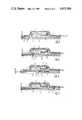
- FIG. 2shows a portion of the patient's body surface demonstrating the device for registering the passing of the blood pulse waves pressed against said portion by the compression cuff at the time instant t 1 when the pulse wave approaches the area of measurement;
- FIG. 3is the same as in FIG. 2 at the time instant t 2 when the pulse wave interacts with the pellet with its front;
- FIG. 4is the same as in FIG. 2 at the time instant t 3 when the pulse wave interacts with the pellet with its back;
- FIG. 5is the same as in FIG. 2 at the time instant t 4 when the pulse wave has come beyond the limits of the area of measurement;
- FIG. 6shows the graphic function of transducer output electric signal (U) vs time (t);
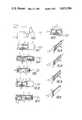
- FIG. 7is a plan view, partially in section, of an embodiment of the device for registering the passing of the pulse waves featuring an articulately suspended pellet and a piezosensitive transducer;
- FIG. 8is a sectional view of the embodiment of FIG. 7;
- FIG. 9is a similar view as in FIG. 7 with the transducer made as an electromagnetic pair;
- FIG. 10is a similar view as in FIG. 7 showing the pellet suspended on a flat spring
- FIG. 11is a sectional view of the embodiment of FIG. 10;
- FIG. 12is a similar view as in FIG. 10 with the flat spring serving at the same time as a transducer;
- FIGS. 13, 14, 15 and 16are the embodiments of the flat spring performing at the same time the function of a transducer converting the pellet oscillations into electric signals.
- FIG. 1illustrates a patient's arm 1 to a surface 2 of which a compression cuff 3 is applied.
- Passing along an artery 4 in a direction 5is a blood pulse wave 6 caused by releasing the artery 4 at the instant when the arterial pressure value exceeds the gas pressure value in the compression cuff 3.
- the aforementioned blood pulse waves 6occurs only in cases where the gas pressure in the cuff 3 is within the diastolic and systolic values of the arterial tension. Therefore, the systolic and diastolic values of the arterial tension can be judged by the values of the gas pressure in the cuff 3 when said pulse waves 6 appear and disappear.
- the blood pulse wave 6passes under the cuff 3 as well, and is registered past a midpoint 7 of the cuff 3 as along the run of the wave 6 on an area 8 of the surface 2 located against the artery 4.
- a device 9 for registering the passing of the blood pulse wave 6is placed for the purpose on the aforesaid area 8 of the patient's body surface 2.
- the passing of the blood wave 6 along the artery 4is registered by measuring the angle made up by the area 8 of the patient's body surface 2 displaced by the front of the passing pulse wave 6, and the direction 5 of propagation of the blood pulse wave 6 along the artery 4. As it can be seen from FIG.
- the gas pressure in the cuff 3is governed by a pump 10 and measured by a pressure gauge 11.
- FIGS. 2 through 5The passing of the blood pulse wave 6 under the preselected area 8 on the patient's body surface 2 and the effect of said wave on the registering device 9 placed on said area 8 are illustrated in FIGS. 2 through 5.
- FIG. 2represents the instant of time t 1 when the blood pulse wave 6 has not yet reached the area 8 of the patient's body surface 2, and an angle ⁇ 1 between said area 8 of the surface 2 and the direction 5 of propagation of the blood pulse wave equals zero.
- FIG. 3shows the instant of time t 2 (at which the pulse wave appears) when the blood pulse wave 6 has produced an angle ⁇ 2 other than zero, defined by the area 8 of the surface 2 and the direction 5 of propagation of the blood pulse wave 6.
- FIG. 4illustrates further propagation of the blood pulse wave along the artery 4 at the instant of time t 3 when the wave 6 interacts with the device with its back (trailing edge) with the resultant sign reversal of the angle ⁇ 3 compared to the angle ⁇ 2 .
- FIG. 5demonstrates the instant of time t 4 when the blood pulse wave 6 has already come off the area 8 of measurement and an angle ⁇ 4 between the surface area 8 and the direction 5 of propagation of the wave 6 has become zero once again.
- the passing of the pulse wave 6 under the area 8 of measurementcauses a pulsatory change of the aforesaid angle and hence of the magnitude of a signal U at the output of the device 9, which is illustrated in FIG. 6.
- the systolic value of the arterial pressureis registered against the appearance of the initial signal at the output of the device 9. As further decompression proceeds the device 9 will generate electric signals in response to each passing of the pulse waves until the pressure becomes equal to the diastolic value. With the pressure in the cuff 3 below the diastolic value no electric signals are generated by the device 9. The instant when the last signal arrives from the device 9 (that is, when the pulse waves disappear) corresponds to the diastolic value of the patient's arterial tension.
- the device 9 for registering the passing of the pulse waves in indirect measurement of arterial tensioncomprises a pellet 13 accommodated in a housing 12 (FIGS. 7, 8) and capable of angular oscillatory motion about a pivot axis 14, which is parallel to a contact surface 15 of the pellet 13 and the projection of said pivot axis onto the contact surface 15 coincides with the axis of symmetry of said surface.
- the device 9is also provided with a means for effecting angular oscillations of the pellet about the pivot axis 14.
- said meansis made as an articulated linkage, one of whose members, that is, a round bar 16 is rigidly secured with its ends to the housing 12, while the other member of the articulated linkage is shaped as a holder made integral with the pellet 13.
- the axis of the bar 16(that is, the axis of rotation of the linkage) coincides with the pivot axis 14 of the pellet 13.
- a piezosensitive cell 17is employed as a transducer converting the angular oscillations of the pellet 13 into electric signal U.
- the cell 17is rigidly coupled to the housing 12 and is adapted to mechanically interact with the pellet 13 with a possibility of being flexed during angular oscillations of the pellet 13 about the pivot axis 14.
- FIG. 9illustrates an alternative embodiment of the device 9, which differs from the embodiment shown in FIGS. 7 and 8 in the type of the transducer converting the angular oscillations of the pellet 13 into an electric signal U.
- the said transduceris made as an electromagnetic pair, comprising a magnet 18 and an induction coil 19.
- One of the components of this pair(the magnet 18 in this particular case) is located on the pellet 13 and the other component, the induction coil 19 is situated in the housing 12.
- FIGS. 10 and 11show one more embodiment of the device 9, wherein as distinct from the embodiment of FIGS. 7 and 8, the means for effecting angular oscillations of the pellet 13 about the pivot axis 14 is made as a flat spring 20 whose axis of symmetry coincides with the pivot axis 14 of the pellet 13.
- Two opposite ends of the flat spring 20are rigidly affixed to the housing 12, while the middle portion of this spring is rigidly attached to the pellet 13.
- the plane in which the flat spring 20 is located,is square with the contact surface 15 of the pellet 13 and intersects it along the axis of symmetry of the contact surface 15.
- the aforedescribed embodiment of suspension of the pellet 13 in the housing 12enables the pellet 13 to oscillate about the pivot axis 14 by virtue of twisting the flat spring 20.
- Still one more embodiment of the device 9 represented in FIG. 12differs from the embodiment of FIGS. 10 and 11 in that the means for imparting angular oscillations to the pellet is made as a flat piezosensitive cell 21 which serves simultaneously as a transducer converting angular pellet oscillations into electric signals and as a flat spring.
- FIGS. 13, 14, 15, 16represent some embodiments of the flat piezosensitive cell 21 capable of producing electric signal U when twisted.
- FIG. 13illustrates a flat piezosensitive cell made as two parallel piezoelectric crystal wafers 22 and 23 with parallel-connected current-conducting plates 24.
- FIG. 14shows the embodiment of FIG. 13, wherein, as distinct from the latter, the current-conducting plates 24 are series-connected.
- FIG. 15depicts a flat piezosensitive cell established on a single piezoelectric crystal wafer 25 with two pairs of parallel-connected current-conducting plates 26.
- the patient's arterial tensionis measured by placing the device 9 for registering the passing of the pulse waves on the surface of the patient's body, e.g., on the arm, in such a manner that the contact surface 15 should fit to the patient's body surface 2.
- the compression cuff 3is applied above the device 9 taking care to see that the device 9 should be located past the midpoint 7 of the cuff 3 as along the flow of blood.
- an excess air pressureis built up in the cuff 3, said pressure exceeding the systolic value of the patient's blood pressure.
- the pressure in the cuff 3is then monitored under slow-rate decompression conditions against, for example, a pressure gauge. In this case, an initial pulse wave (FIG.
- the pellet 13 contacting the patient's body surface 2will oscillate about the pivot axis 14. This in turn causes electric signal U to appear at the output of the transducer 17 due to mechanical linkage of the pellet 13 and said transducer.
- the embodiments of the device for registering the passing of the pulse waves as shown in FIGS. 9, 10, 11 and 12,function in the same manner as the device illustrated in FIGS. 7 and 8.
Landscapes
- Health & Medical Sciences (AREA)
- Life Sciences & Earth Sciences (AREA)
- Cardiology (AREA)
- Heart & Thoracic Surgery (AREA)
- Molecular Biology (AREA)
- Physiology (AREA)
- Biophysics (AREA)
- Pathology (AREA)
- Engineering & Computer Science (AREA)
- Biomedical Technology (AREA)
- Vascular Medicine (AREA)
- Medical Informatics (AREA)
- Physics & Mathematics (AREA)
- Surgery (AREA)
- Animal Behavior & Ethology (AREA)
- General Health & Medical Sciences (AREA)
- Public Health (AREA)
- Veterinary Medicine (AREA)
- Hematology (AREA)
- Ophthalmology & Optometry (AREA)
- Measuring Pulse, Heart Rate, Blood Pressure Or Blood Flow (AREA)
- Measuring Fluid Pressure (AREA)
Abstract
Description
The present Application is a continuation-in-part of Application Ser. No. 165,659 filed on July 3, 1980, and now abandoned.
The present invention relates to medical engineering. More particularly the invention relates to a method of indirect measurement of arterial tension and a device for pulse wave registration.
The invention will find most widespread application in indirect determination of patient's arterial tension at an increased ambient noise level, and at an increased level of noise produced by patient's motions.
One prior-art method of measuring arterial tension with the aid of a compression cuff and a sensor of the Korotkov sounds (cf. "Acoustic method of arterial tension examination" by G. I. Kositsky, Medgiz PH, Moscow 1959, pp. 53-54 (in Russian) includes the application of a compression cuff to the surface of the patient's body. The pressure in the cuff is varied within a range covering the systolic and diastolic values of the patient's arterial tension and the Korotkov sounds produced by the arterial pulse waves issuing from under the cuff are simultaneously registered via a microphone, said values corresponding to the instants when the Korotkov sounds appear and disappear.
However, the aforesaid method is disadvantageous because the microphone picks up not only the Korotkov sounds, but also ambient noise, and in some cases it fails to measure the arterial tension value when the measurement process is automated, since the loudness of the Korotkov sounds, their spectral composition and some other characteristics are substantially different in every patient.
A more perfect method of measuring the arterial tension, capable of more accurate determination of the extreme values of such tension is a known method, which is based upon registration of a pulse wave and is insensitive to ambient noise. This method includes the application of a compression cuff to the surface of the patient's body. The pressure in the cuff is varied within a range which covers the systolic and diastolic values of arterial tension and pulse waves resulting from the releasing of the artery compressed by the cuff are registered. The pressure in the cuff is measured at the instants when these pulse waves appear and disappear. The pulse waves are registered under the cuff on the body surface area located opposite the artery and beyond the midpoint of the cuff as along the direction of the arterial blood flow, against displacement of the surface of the patient's body in a direction square with that surface (cf. "Automatic meter for indirect measurement of arterial tension" by V. M. Bolshov et al., "Medtekhnika", No. 2, 1979, pp. 19-22 (in Russian).
However, the aforedescribed method is disadvantageous in that the accuracy of measurement of the systolic and diastolic arterial pressures is too low. This disadvantage stems from the fact that the aforesaid displacement of the patient's body surface in a direction square with that surface may occur without any pulse waves passing under the cuff, that is, without releasing the artery, but may result from pressure fluctuations in the cuff which are liable to arise usually before releasing the compressed artery, or from muscular contractions of the body portion located under the cuff, or else it may be caused by elastic deformation of the walls of the filled artery when the pressure in the cuff is below the diastolic value.
It becomes evident from the diagrams obtained from determining the arterial tension by the known method that the signals resulting from the noise, e.g., due to the patient's muscular contractions have an amplitude much greater than that of the useful signals produced by the blood pulse waves. This results in that a signal is registered from the noise alone, without any pulse wave passed, which in turn leads to incorrect readings of the arterial tension values.
The heretofore-known device for registering blood pulse waves in indirect measurement of arterial tension (cf. USSR Inventor's Certificate Ser. No. 651,786, class A61B 5/02 dated 1979) comprises a housing and a transducer rigidly secured to the housing, said transducer being adapted to convert mechanical motions into electric signals. A pellet is secured to the transducer traversable portion, said pellet having a contact surface and being adapted to impart to said transducer the displacements of the patient's body surface square with said surface and hence with the pellet contact area.
The transducer is in effect a disk-shaped piezocrystal and the pellet, also disk-shaped and made from a hard material such as plastic, located at the central axis of the transducer.
The known device is arranged under the compression cuff past its midpoint in the direction of the blood flow.
However, the aforedescribed device fails to provide high-accuracy measurement of the systolic and diastolic values of arterial tension, since it is sensitive to pressure oscillations in the cuff and to motions of the body surface due to muscular contractions. Thus for instance, when measuring arterial tension under decompression conditions, pressure oscillations arise in the cuff before a first pulse wave passes under the cuff, from which the systolic value of the arterial tension is measured. These pressure oscillations create a force which is exerted on the housing of the device to cause mutually opposite displacements of the housing and pellet. This results in a false signal appearing at the output indicating the passing of a pulse wave, and in a mismeasured systolic value of the arterial tension. The pellet is displaced in the same manner due to muscular contractions under the device occurring at a pressure in the cuff below the diastolic value and due to an elastic pulsing deformation of the walls of filled artery with the resultant false signals at the output of the known device. All this leads to inaccurate determination of the systolic and diastolic values of the arterial tension and renders it impossible to measure arterial tension with the patient moving.
The principal object of the invention is to provide a method of higher accuracy then the known methods for indirect measurement of a patient's arterial tension.
Another object of the invention is to provide measurement of arterial tension in a moving patient.
One more object of the invention is to provide higher noise immunity of a device for pulse wave registration in indirect measurement of arterial tension.
The aforementioned objects are attained by the method of the invention for indirect measurement of arterial tension, wherein a compression cuff is applied to the surface of the patient's body, the pressure in the cuff is varied within a range which covers the systolic and diastolic values of the arterial tension, pulse waves produced by the releasing of the artery compressed by the cuff in the course of the aforesaid pressure variation therein are registered under the cuff on its area located past its midpoint as along the direction of the blood flow, and the pressure in the cuff is measured at the instants when pulse waves appear and disappear. In accordance with the invention, the instants when the pulse waves appear and disappear are registered by measuring the angle between the patient's body surface as displaced by the front of the passing pulse wave and the direction of propagation of such wave.
The objects of the invention are attained also by the device for registering the blood pulse waves, comprising a housing, a pellet movably mounted in the housing and having a contact surface, and a transducer converting the pellet motions into electric signals. In accordance with the invention, the pellet is mounted in the housing in a manner whereby it may oscillate angularly about a pivot axis. To this effect, the device is provided with a means for carrying out the pellet angular oscillations about a pivot axis which is parallel to the pellet contact surface and whose projection onto the pellet contact surface coincides with the axis of symmetry of said surface.
It is expedient that the means for effecting angular pellet oscillations be made as a double-bar articulated linkage, one of its bars being rigidly secured to the housing and the other bar, to the pellet, while the axis of rotation of the articulated linkage coincides with the pivot axis about which the pellet oscillates.
The transducer of the pellet angular oscillations into electric signals may be provided as a piezosensitive cell rigidly coupled to the housing and mechanically interacting with the pellet with a possibility of being flexed during angular oscillations of the pellet.
The transducer of the pellet angular oscillations into electric signals may also be made as an electromagnetic pair, containing a magnet and an induction coil of which one member may be fastened on the housing and the other, on the pellet.
It is also expedient that the means for effecting angular pellet oscillations be made as a flat spring located in a plane square with the pellet contact surface in such a manner that the axis of symmetry of the spring should coincide with the pellet pivot axis and that the ends of the spring be rigidly secured to the housing and the spring middle portion be rigidly coupled to the pellet.
The aforesaid flat spring is expedient to be made as a flat piezoelectric cell, whereby the spring may perform the function of a transducer converting the pellet angular oscillations into electric signals.
The method of the invention permits more accurate and reliable, then the heretofore known methods, measurement of the systolic and diastolic values of the patient's arterial blood tension, due to elimination of ambient noises, noises caused by pressure fluctuations in the cuff and by contractions of the patient's muscles. The method of the invention enables one to measure the arterial tension in the patient while the latter is in motion, which is the case, for example, when the patient is a sportsman or a newborn infant.
The method of the invention is instrumental in rendering the diagnosis more reliable and confident due to its capability of providing a dependable registration of the pulse wave alone against a background of ambient noises.
The device for registering the passing of the blood pulse waves made in accordance with the invention, features high noise immunity, since it is adapted to respond only to a change in the magnitude of the angle between the patient's body surface and the direction of propagation of the blood pulse waves and is insensitive to motions of the patient's body surface square with this surface which are caused by the most probable noises occurring in measuring the arterial tension (such as muscular contractions, pressure fluctuations in the cuff, ambient noises, etc.).
For a fuller understanding of the invention, reference is had to the following description, taken in conjunction with the accompanying drawings, wherein:
FIG. 1 shows the mutual arrangement of a patient's arm with an indicated artery, the compression cuff and the device for registering the passing of the pulse waves;
FIG. 2 shows a portion of the patient's body surface demonstrating the device for registering the passing of the blood pulse waves pressed against said portion by the compression cuff at the time instant t1 when the pulse wave approaches the area of measurement;
FIG. 3 is the same as in FIG. 2 at the time instant t2 when the pulse wave interacts with the pellet with its front;
FIG. 4 is the same as in FIG. 2 at the time instant t3 when the pulse wave interacts with the pellet with its back;
FIG. 5 is the same as in FIG. 2 at the time instant t4 when the pulse wave has come beyond the limits of the area of measurement;
FIG. 6 shows the graphic function of transducer output electric signal (U) vs time (t);
FIG. 7 is a plan view, partially in section, of an embodiment of the device for registering the passing of the pulse waves featuring an articulately suspended pellet and a piezosensitive transducer;
FIG. 8 is a sectional view of the embodiment of FIG. 7;
FIG. 9 is a similar view as in FIG. 7 with the transducer made as an electromagnetic pair;
FIG. 10 is a similar view as in FIG. 7 showing the pellet suspended on a flat spring;
FIG. 11 is a sectional view of the embodiment of FIG. 10;
FIG. 12 is a similar view as in FIG. 10 with the flat spring serving at the same time as a transducer; and
FIGS. 13, 14, 15 and 16 are the embodiments of the flat spring performing at the same time the function of a transducer converting the pellet oscillations into electric signals.
The method of indirect measurement of arterial tension, according to the invention, is illustrated in FIGS. 1, 2, 3, 4, 5 and 6.
FIG. 1 illustrates a patient's arm 1 to a surface 2 of which acompression cuff 3 is applied. Passing along an artery 4 in adirection 5 is ablood pulse wave 6 caused by releasing the artery 4 at the instant when the arterial pressure value exceeds the gas pressure value in thecompression cuff 3. The aforementioned blood pulse waves 6 occurs only in cases where the gas pressure in thecuff 3 is within the diastolic and systolic values of the arterial tension. Therefore, the systolic and diastolic values of the arterial tension can be judged by the values of the gas pressure in thecuff 3 when said pulse waves 6 appear and disappear. Theblood pulse wave 6 passes under thecuff 3 as well, and is registered past a midpoint 7 of thecuff 3 as along the run of thewave 6 on an area 8 of the surface 2 located against the artery 4. Adevice 9 for registering the passing of theblood pulse wave 6 is placed for the purpose on the aforesaid area 8 of the patient's body surface 2. The passing of theblood wave 6 along the artery 4 is registered by measuring the angle made up by the area 8 of the patient's body surface 2 displaced by the front of the passingpulse wave 6, and thedirection 5 of propagation of theblood pulse wave 6 along the artery 4. As it can be seen from FIG. 1 neither fluctuations of the gas pressure Pcuff in thecuff 3 nor muscular efforts Pmotion of the patient can affect the aforesaid angle and hence the process of registering the passing of theblood pulse wave 6. The gas pressure in thecuff 3 is governed by a pump 10 and measured by a pressure gauge 11.
The passing of theblood pulse wave 6 under the preselected area 8 on the patient's body surface 2 and the effect of said wave on the registeringdevice 9 placed on said area 8 are illustrated in FIGS. 2 through 5.
FIG. 2 represents the instant of time t1 when theblood pulse wave 6 has not yet reached the area 8 of the patient's body surface 2, and an angle α1 between said area 8 of the surface 2 and thedirection 5 of propagation of the blood pulse wave equals zero.
FIG. 3 shows the instant of time t2 (at which the pulse wave appears) when theblood pulse wave 6 has produced an angle α2 other than zero, defined by the area 8 of the surface 2 and thedirection 5 of propagation of theblood pulse wave 6.
FIG. 4 illustrates further propagation of the blood pulse wave along the artery 4 at the instant of time t3 when thewave 6 interacts with the device with its back (trailing edge) with the resultant sign reversal of the angle α3 compared to the angle α2.
FIG. 5 demonstrates the instant of time t4 when theblood pulse wave 6 has already come off the area 8 of measurement and an angle α4 between the surface area 8 and thedirection 5 of propagation of thewave 6 has become zero once again.
Thus, the passing of thepulse wave 6 under the area 8 of measurement causes a pulsatory change of the aforesaid angle and hence of the magnitude of a signal U at the output of thedevice 9, which is illustrated in FIG. 6.
The systolic value of the arterial pressure is registered against the appearance of the initial signal at the output of thedevice 9. As further decompression proceeds thedevice 9 will generate electric signals in response to each passing of the pulse waves until the pressure becomes equal to the diastolic value. With the pressure in thecuff 3 below the diastolic value no electric signals are generated by thedevice 9. The instant when the last signal arrives from the device 9 (that is, when the pulse waves disappear) corresponds to the diastolic value of the patient's arterial tension.
Thedevice 9 for registering the passing of the pulse waves in indirect measurement of arterial tension comprises apellet 13 accommodated in a housing 12 (FIGS. 7, 8) and capable of angular oscillatory motion about apivot axis 14, which is parallel to acontact surface 15 of thepellet 13 and the projection of said pivot axis onto thecontact surface 15 coincides with the axis of symmetry of said surface.
Thedevice 9 is also provided with a means for effecting angular oscillations of the pellet about thepivot axis 14. In the embodiment of the device as illustrated in FIGS. 7 and 8, said means is made as an articulated linkage, one of whose members, that is, around bar 16 is rigidly secured with its ends to thehousing 12, while the other member of the articulated linkage is shaped as a holder made integral with thepellet 13. The axis of the bar 16 (that is, the axis of rotation of the linkage) coincides with thepivot axis 14 of thepellet 13.
Apiezosensitive cell 17 is employed as a transducer converting the angular oscillations of thepellet 13 into electric signal U. Thecell 17 is rigidly coupled to thehousing 12 and is adapted to mechanically interact with thepellet 13 with a possibility of being flexed during angular oscillations of thepellet 13 about thepivot axis 14.
FIG. 9 illustrates an alternative embodiment of thedevice 9, which differs from the embodiment shown in FIGS. 7 and 8 in the type of the transducer converting the angular oscillations of thepellet 13 into an electric signal U. The said transducer is made as an electromagnetic pair, comprising amagnet 18 and aninduction coil 19. One of the components of this pair (themagnet 18 in this particular case) is located on thepellet 13 and the other component, theinduction coil 19 is situated in thehousing 12.
FIGS. 10 and 11 show one more embodiment of thedevice 9, wherein as distinct from the embodiment of FIGS. 7 and 8, the means for effecting angular oscillations of thepellet 13 about thepivot axis 14 is made as aflat spring 20 whose axis of symmetry coincides with thepivot axis 14 of thepellet 13. Two opposite ends of theflat spring 20 are rigidly affixed to thehousing 12, while the middle portion of this spring is rigidly attached to thepellet 13. The plane in which theflat spring 20 is located, is square with thecontact surface 15 of thepellet 13 and intersects it along the axis of symmetry of thecontact surface 15. The aforedescribed embodiment of suspension of thepellet 13 in thehousing 12 enables thepellet 13 to oscillate about thepivot axis 14 by virtue of twisting theflat spring 20.
Still one more embodiment of thedevice 9 represented in FIG. 12 differs from the embodiment of FIGS. 10 and 11 in that the means for imparting angular oscillations to the pellet is made as aflat piezosensitive cell 21 which serves simultaneously as a transducer converting angular pellet oscillations into electric signals and as a flat spring.
FIGS. 13, 14, 15, 16 represent some embodiments of theflat piezosensitive cell 21 capable of producing electric signal U when twisted.
FIG. 13 illustrates a flat piezosensitive cell made as two parallelpiezoelectric crystal wafers plates 24.
FIG. 14 shows the embodiment of FIG. 13, wherein, as distinct from the latter, the current-conductingplates 24 are series-connected.
FIG. 15 depicts a flat piezosensitive cell established on a singlepiezoelectric crystal wafer 25 with two pairs of parallel-connected current-conductingplates 26.
In FIG. 16 the current-conductingplates 26 are series-connected.
In accordance with the invention, the patient's arterial tension is measured by placing thedevice 9 for registering the passing of the pulse waves on the surface of the patient's body, e.g., on the arm, in such a manner that thecontact surface 15 should fit to the patient's body surface 2. Then thecompression cuff 3 is applied above thedevice 9 taking care to see that thedevice 9 should be located past the midpoint 7 of thecuff 3 as along the flow of blood. Next an excess air pressure is built up in thecuff 3, said pressure exceeding the systolic value of the patient's blood pressure. The pressure in thecuff 3 is then monitored under slow-rate decompression conditions against, for example, a pressure gauge. In this case, an initial pulse wave (FIG. 3) will pass at a pressure in thecuff 3 equal to the systolic value of the arterial pressure effective on the patient's body area 8 under measurement and will cause a change in the angle between the body surface 2 and the direction of propagation of said wave from α2 and α3.
As a result, thepellet 13 contacting the patient's body surface 2, will oscillate about thepivot axis 14. This in turn causes electric signal U to appear at the output of thetransducer 17 due to mechanical linkage of thepellet 13 and said transducer.
Further decompression results in appearing an electric signal at the output of thedevice 9, similar to that shown in FIG. 6 until the pressure in thecuff 3 becomes equal to the diastolic value. As soon as the pressure in the cuff drops below the diastolic value, no pulse waves are passing and the signal at the output of thedevice 9 becomes equal to zero. The instant when the last signal arrives from thedevice 9 corresponds to the diastolic value of the patient's arterial pressure.
When pressure fluctuations occur in thecuff 3, or muscular contractions of the patient's body arise under thecuff 3, some forces are developed that act equally upon theentire contact surface 15 of thepellet 13. Inasmuch as the projection of thehorizontal pivot axis 14 coincides with the axis of symmetry of thecontact surface 15 of thepellet 13, the forces exerted upon thecontact surface 15 are divided by the said axis of symmetry and thus balance each other so that they do not cause thepellet 13 to rotate about thepivot axis 14. That is, these forces neither create angular oscillations of thepellet 13 nor generate an electric signal via thedevice 9.
The embodiments of the device for registering the passing of the pulse waves as shown in FIGS. 9, 10, 11 and 12, function in the same manner as the device illustrated in FIGS. 7 and 8.
Claims (12)
1. A device for registering the passing of blood pulse waves in indirect measurement of arterial pressure of a patient, said device comprising
a housing;
a pellet accommodated in said housing, said pellet being mounted for angular oscillation about a pivot axis, said pellet having a symmetrical contact surface adapted to interact with the surface of the body of the patient at said contact surface thereof, said pivot axis being substantially parallel to said contact surface of said pellet, the projection of said pivot axis onto said contact surface coinciding with an axis of symmetry of said surface;
an articulated linkage for effecting angular oscillations of said pellet about said pivot axis, said articulated linkage having a pivot shaft coupled to said pellet and having an axis coinciding with said pivot axis, said pivot shaft being connected to said housing such that said axis of said pivot shaft is fixed with respect to said housing; and
transducer means for converting said angular oscillations of said pellet into electric signals.
2. A device as claimed in claim 1 wherein said transducer means comprises a piezosensitive cell rigidly affixed to said housing and mechanically interacting with said pellet, said piezosensitive cell extending in a direction between said housing and said pellet substantially perpendicular to said pivot axis, said transducer means being mounted for flexure during said angular oscillations of said pellet about said pivot axis.
3. A device as claimed in claim 1, wherein said transducer means comprises an electromagnetic pair including a magnet and an induction coil, one of the components of said electromagnetic pair being affixed to said pellet and the other of the components of said electromagnetic pair being secured to said housing.
4. The device of claim 3, wherein said magnet is affixed to said pellet and said induction coil is affixed to said housing.
5. The device of claim 1, additionally comprising
a compression cuff disposed about said housing, with said housing offset from a midpoint of said cuff,
said device adapted to be applied to the surface of the body of the patient adjacent a blood vessel, with said housing situated downstream of the midpoint of said cuff in the direction of blood flow.
6. The device of claim 1, wherein said pivot shaft extends through said pellet and is connected to said housing at opposite ends thereof.
7. The device of claim 6, wherein said pivot shaft is rigidly connected to said housing at the opposite ends thereof.
8. A device for registering the passing of blood pulse waves in indirect measurement of arterial pressure of a patient, said device comprising
a housing;
a pellet accommodated in said housing, said pellet being mounted for angular oscillation about a pivot axis, said pellet having a symmetrical contact surface adapted to interact with the surface of the body of the patient at the contact surface thereof, said pivot axis being substantially parallel to said contact surface of said pellet, the projection of said pivot axis onto said contact surface coinciding with an axis or symmetry of said surface;
a flat spring having an axis of symmetry coinciding with said pivot axis, said flat spring being located in a plane substantially perpendicular with said contact surface of said pellet, said flat spring having two spaced opposite ends rigidly secured to said housing and a middle portion rigidly attached to said pellet; and
transducer means for converting said angular oscillations of said pellet into electric signals.
9. The device of claim 8, wherein said transducer means comprises a piezosensitive cell rigidly affixed to said housing and mechanically interacting with said pellet, said piezosensitive cell extending in a direction between said housing and said pellet substantially perpendicular to said pivot axis, said transducer means being mounted for flexure during said angular oscillations of said pellet about said pivot axis.
10. The device of claim 8, additionally comprising
a compression cuff disposed about said housing, with said housing offset from a midpoint of said cuff,
said device adapted to be applied to the surface of the body of the patient adjacent a blood vessel, with said housing situated downstream of the midpoint of said cuff in the direction of blood flow.
11. A device for registering the passing of blood pulse waves in indirect measurement of arterial pressure or a patient, said device comprising
a housing;
a pellet accommodated in said housing, said pellet mounted for angular oscillation about a pivot axis, said pellet having a symmetrical contact surface adapted to interact with the surface of the body of the patient at said contact surface thereof, said pivot axis being substantially parallel to said contact surface of said pellet, the projection of said pivot axis onto said contact surface coinciding with an axis of symmetry of said surface;
a flat piezosensitive cell means for effecting angular oscillations of said pellet about said pivot axis, said cell means being rigidly affixed to said housing at opposite ends thereof, and having an axis of symmetry coinciding with said pivot axis and a middle portion mechanically interacting with said pellet;
said cell means also constituting transducer means for converting said angular oscillations of said pellet into electric signals.
12. The device of claim 10 additionally comprising
a compression cuff disposed about said housing, with said housing offset from a midpoint of said cuff,
said device adapted to be applied to the surface of the body of the patient adjacent a blood vessel, with said housing situated downstream of the midpoint of said cuff in the direction of blood flow.
Applications Claiming Priority (2)
| Application Number | Priority Date | Filing Date | Title |
|---|---|---|---|
| SU2778002 | 1979-07-05 | ||
| SU792778002ASU895405A1 (en) | 1979-07-05 | 1979-07-05 | Method and device for determining arterial pressure |
Related Parent Applications (1)
| Application Number | Title | Priority Date | Filing Date |
|---|---|---|---|
| US06165659Continuation-In-Part | 1980-07-03 |
Publications (1)
| Publication Number | Publication Date |
|---|---|
| US4653506Atrue US4653506A (en) | 1987-03-31 |
Family
ID=20832812
Family Applications (1)
| Application Number | Title | Priority Date | Filing Date |
|---|---|---|---|
| US06/527,802Expired - Fee RelatedUS4653506A (en) | 1979-07-05 | 1983-08-30 | Method of indirect measurement of arterial tension and a device for pulse wave registration |
Country Status (5)
| Country | Link |
|---|---|
| US (1) | US4653506A (en) |
| JP (1) | JPS5923203B2 (en) |
| DE (1) | DE3025496C2 (en) |
| NL (1) | NL8003866A (en) |
| SU (1) | SU895405A1 (en) |
Cited By (17)
| Publication number | Priority date | Publication date | Assignee | Title |
|---|---|---|---|---|
| US5054494A (en)* | 1989-12-26 | 1991-10-08 | U.S. Medical Corporation | Oscillometric blood pressure device |
| US5267565A (en)* | 1988-02-18 | 1993-12-07 | Beard Jonathan D | Method and apparatus for determining the patency of a blood vessel |
| US5368039A (en)* | 1993-07-26 | 1994-11-29 | Moses; John A. | Method and apparatus for determining blood pressure |
| DE19531479A1 (en)* | 1995-08-25 | 1997-02-27 | Haase Walter | Appts. for detecting blood pulse through arteries |
| US5840037A (en)* | 1995-04-19 | 1998-11-24 | A & D Company, Limited | Sphygmomanometer |
| US6106478A (en)* | 1995-04-19 | 2000-08-22 | A & D Company, Limited | Sphygmomanometer utilizing optically detected arterial pulsation displacement |
| US6422086B1 (en)* | 2000-09-25 | 2002-07-23 | Welch Allyn, Inc. | Low profile pressure measuring device |
| US20030088267A1 (en)* | 1999-09-28 | 2003-05-08 | Kazunobu Itonaga | Compression device for living being |
| EP1336374A1 (en)* | 2002-02-18 | 2003-08-20 | Colin Corporation | Pressure-pulse-wave detecting apparatus |
| US20060217618A1 (en)* | 2000-09-25 | 2006-09-28 | Welch Allyn, Inc. | Blood pressure measuring apparatus |
| US20060293600A1 (en)* | 2000-09-25 | 2006-12-28 | Welch Allyn, Inc. | Blood pressure measuring apparatus |
| US20100298725A1 (en)* | 2009-05-19 | 2010-11-25 | Vivenzio Robert L | Recyclable or biodegradable blood pressure cuff |
| US20100298724A1 (en)* | 2009-05-19 | 2010-11-25 | Welch Allyn, Inc. | Recyclable or biodegradable blood pressure cuff |
| USD643536S1 (en) | 2009-05-19 | 2011-08-16 | Welch Allyn, Inc. | Blood-pressure cuff |
| US9220422B2 (en) | 2012-11-19 | 2015-12-29 | Welch Allyn, Inc. | Blood pressure sleeve |
| US10413199B2 (en) | 2017-11-02 | 2019-09-17 | Welch Allyn, Inc. | Connectors for medical equipment |
| DE102021005907A1 (en) | 2021-11-30 | 2023-06-01 | Thomas Braun | Mechanical heart rate monitor. (First device for directly detecting a pulse wave palpable over an artery) |
Families Citing this family (5)
| Publication number | Priority date | Publication date | Assignee | Title |
|---|---|---|---|---|
| AU587693B2 (en)* | 1987-04-07 | 1989-08-24 | Vsesojuzny Nauchno-Issledovatelsky I Ispytatelny Institut Meditsinskoi Tekhniki | Device for measurement of arterial blood pressure |
| DE4009970A1 (en)* | 1990-03-28 | 1991-10-10 | Marian Dr Tymiec | METHOD FOR CONTINUOUS, INDIRECT BLOOD PRESSURE MEASUREMENT |
| DE4012856A1 (en)* | 1990-04-18 | 1991-10-24 | Lebrecht Von Dr Klitzing | Medical diagnosis unit for measuring blood pulse - identifies arteriosclerosis using coil system in static magnetic field to determine each local alteration in three dimensions |
| DE4106057A1 (en)* | 1991-02-27 | 1992-09-03 | Simon Pal | Blood pressure monitor with armband bridging artery - has sleeve pref. contg. spring with screwed stopper at one end and sensor fixed at other end as magnetic piston |
| RU2404705C2 (en) | 2008-12-12 | 2010-11-27 | Владимир Федорович Романовский | Method for measurement of arterial pressure and device for its realisation |
Citations (5)
| Publication number | Priority date | Publication date | Assignee | Title |
|---|---|---|---|---|
| US2658505A (en)* | 1949-03-08 | 1953-11-10 | Sheer Charles | Arterial pulse wave velocity meter |
| US3154066A (en)* | 1961-10-11 | 1964-10-27 | Robert L Gannon | Body function sensors |
| US3315662A (en)* | 1964-01-16 | 1967-04-25 | Marvin A Buffington | Oscillometric monitoring system for sphygmomanometers |
| US3903873A (en)* | 1974-05-13 | 1975-09-09 | Douglas E Royal | Pulse contour measuring instrument |
| US4409983A (en)* | 1981-08-20 | 1983-10-18 | Albert David E | Pulse measuring device |
Family Cites Families (1)
| Publication number | Priority date | Publication date | Assignee | Title |
|---|---|---|---|---|
| DE2848198A1 (en)* | 1978-11-07 | 1980-05-08 | Ernst Piffl | Blood pressure monitor using arterial tonometer method - has two piezoelectric sensors monitoring artery expansion and compensating for movement of patient |
- 1979
- 1979-07-05SUSU792778002Apatent/SU895405A1/enactive
- 1980
- 1980-07-03NLNL8003866Apatent/NL8003866A/ennot_activeApplication Discontinuation
- 1980-07-04DEDE3025496Apatent/DE3025496C2/ennot_activeExpired
- 1980-07-05JPJP55092167Apatent/JPS5923203B2/ennot_activeExpired
- 1983
- 1983-08-30USUS06/527,802patent/US4653506A/ennot_activeExpired - Fee Related
Patent Citations (5)
| Publication number | Priority date | Publication date | Assignee | Title |
|---|---|---|---|---|
| US2658505A (en)* | 1949-03-08 | 1953-11-10 | Sheer Charles | Arterial pulse wave velocity meter |
| US3154066A (en)* | 1961-10-11 | 1964-10-27 | Robert L Gannon | Body function sensors |
| US3315662A (en)* | 1964-01-16 | 1967-04-25 | Marvin A Buffington | Oscillometric monitoring system for sphygmomanometers |
| US3903873A (en)* | 1974-05-13 | 1975-09-09 | Douglas E Royal | Pulse contour measuring instrument |
| US4409983A (en)* | 1981-08-20 | 1983-10-18 | Albert David E | Pulse measuring device |
Cited By (32)
| Publication number | Priority date | Publication date | Assignee | Title |
|---|---|---|---|---|
| US5267565A (en)* | 1988-02-18 | 1993-12-07 | Beard Jonathan D | Method and apparatus for determining the patency of a blood vessel |
| US5054494A (en)* | 1989-12-26 | 1991-10-08 | U.S. Medical Corporation | Oscillometric blood pressure device |
| US5368039A (en)* | 1993-07-26 | 1994-11-29 | Moses; John A. | Method and apparatus for determining blood pressure |
| US5551438A (en)* | 1993-07-26 | 1996-09-03 | Moses; John A. | Method and apparatus for determining blood pressure |
| US5840037A (en)* | 1995-04-19 | 1998-11-24 | A & D Company, Limited | Sphygmomanometer |
| US6106478A (en)* | 1995-04-19 | 2000-08-22 | A & D Company, Limited | Sphygmomanometer utilizing optically detected arterial pulsation displacement |
| DE19531479A1 (en)* | 1995-08-25 | 1997-02-27 | Haase Walter | Appts. for detecting blood pulse through arteries |
| DE19531479C2 (en)* | 1995-08-25 | 1998-07-02 | Walter Haase | Device for detecting the pulse of blood pulsing through an artery |
| US6565524B1 (en)* | 1999-09-28 | 2003-05-20 | Omron Corporation | Compression device for living being |
| US20030088267A1 (en)* | 1999-09-28 | 2003-05-08 | Kazunobu Itonaga | Compression device for living being |
| US7780603B2 (en) | 2000-09-25 | 2010-08-24 | Welch Allyn, Inc. | Blood pressure measuring apparatus |
| US8535233B2 (en) | 2000-09-25 | 2013-09-17 | Welch Allyn, Inc. | Blood pressure measuring apparatus |
| US20060217618A1 (en)* | 2000-09-25 | 2006-09-28 | Welch Allyn, Inc. | Blood pressure measuring apparatus |
| US20060293600A1 (en)* | 2000-09-25 | 2006-12-28 | Welch Allyn, Inc. | Blood pressure measuring apparatus |
| US6422086B1 (en)* | 2000-09-25 | 2002-07-23 | Welch Allyn, Inc. | Low profile pressure measuring device |
| US9072435B2 (en) | 2000-09-25 | 2015-07-07 | Welch Allyn, Inc. | Blood pressure measuring apparatus |
| US20030158489A1 (en)* | 2002-02-18 | 2003-08-21 | Colin Corporation | Pressure-pulse-wave detecting apparatus |
| US6802814B2 (en) | 2002-02-18 | 2004-10-12 | Colin Medical Technology Corporation | Pressure-pulse-wave detecting apparatus |
| EP1336374A1 (en)* | 2002-02-18 | 2003-08-20 | Colin Corporation | Pressure-pulse-wave detecting apparatus |
| US8652057B2 (en) | 2009-05-19 | 2014-02-18 | Welch Allyn, Inc. | Recyclable or biodegradable blood pressure cuff |
| USD643536S1 (en) | 2009-05-19 | 2011-08-16 | Welch Allyn, Inc. | Blood-pressure cuff |
| US20100298724A1 (en)* | 2009-05-19 | 2010-11-25 | Welch Allyn, Inc. | Recyclable or biodegradable blood pressure cuff |
| US20100298725A1 (en)* | 2009-05-19 | 2010-11-25 | Vivenzio Robert L | Recyclable or biodegradable blood pressure cuff |
| US10231630B2 (en) | 2009-05-19 | 2019-03-19 | Welch Allyn, Inc. | Recyclable or biodegradable blood pressure cuff |
| US11350834B2 (en) | 2009-05-19 | 2022-06-07 | Welch Allyn, Inc. | Recyclable or biodegradable blood pressure cuff |
| US12268483B2 (en) | 2009-05-19 | 2025-04-08 | Welch Allyn, Inc. | Recyclable or biodegradable blood pressure cuff |
| US9220422B2 (en) | 2012-11-19 | 2015-12-29 | Welch Allyn, Inc. | Blood pressure sleeve |
| US10413199B2 (en) | 2017-11-02 | 2019-09-17 | Welch Allyn, Inc. | Connectors for medical equipment |
| US10820812B2 (en) | 2017-11-02 | 2020-11-03 | Welch Allyn, Inc. | Connectors for medical equipment |
| US11857295B2 (en) | 2017-11-02 | 2024-01-02 | Welch Allyn, Inc. | Connectors for medical equipment |
| DE102021005907A1 (en) | 2021-11-30 | 2023-06-01 | Thomas Braun | Mechanical heart rate monitor. (First device for directly detecting a pulse wave palpable over an artery) |
| DE102021005907B4 (en) | 2021-11-30 | 2023-08-31 | Thomas Braun | Mechanical heart rate monitor |
Also Published As
| Publication number | Publication date |
|---|---|
| SU895405A1 (en) | 1982-01-07 |
| DE3025496A1 (en) | 1981-01-22 |
| JPS5628740A (en) | 1981-03-20 |
| DE3025496C2 (en) | 1983-09-15 |
| JPS5923203B2 (en) | 1984-05-31 |
| NL8003866A (en) | 1981-01-07 |
Similar Documents
| Publication | Publication Date | Title |
|---|---|---|
| US4653506A (en) | Method of indirect measurement of arterial tension and a device for pulse wave registration | |
| US7533571B2 (en) | Apparatus for making high-sensitivity measurements of various parameters, and sensors particularly useful in such apparatus | |
| US4409983A (en) | Pulse measuring device | |
| JPH01501210A (en) | Blood pressure monitoring method and device | |
| JPH0221840A (en) | Apparatus and method for measuring elastic acoustic wave unable to infiltrate into soft organic tissue | |
| US4549436A (en) | Surface-acoustic-wave, digitized angular accelerometer | |
| US4823802A (en) | Device for measurement of arterial blood pressure | |
| JP2003102694A (en) | Heart rate measuring instrument | |
| US2549049A (en) | Diaphragm type blood pressure gauge | |
| JP4680411B2 (en) | Arterial blood pressure measuring method and arterial blood pressure measuring device | |
| US2845060A (en) | Constant volume pressure pick-up | |
| RU93008580A (en) | DEVICE FOR DETERMINING MECHANICAL PROPERTIES OF BIOLOGICAL TISSUES | |
| US2297905A (en) | Apparatus for and method of regis | |
| US5054322A (en) | Piezo electric relative motion sensor | |
| RU1800963C (en) | Device for indirect measurement of blood pressure | |
| US1675799A (en) | Mechanism for measuring the frequency of the pulse | |
| RU50797U1 (en) | PULSE WAVE SENSOR | |
| SU667838A1 (en) | Pressure pickup | |
| PUTAN et al. | Comparative study of various noninvasive methods of arterial pressure recording | |
| SU938069A1 (en) | Force pickup | |
| WO1982000950A1 (en) | Pulse detector | |
| SU1722462A1 (en) | Pulse wave sensor | |
| JPS61244326A (en) | pulse detection device | |
| SU1666061A1 (en) | Detector of vibration-sensible individual | |
| JP2005185729A (en) | Biological information measuring device |
Legal Events
| Date | Code | Title | Description |
|---|---|---|---|
| AS | Assignment | Owner name:VSEOJUZNY NAUCHNO-ISSLEDOVATELSKY I ISPYTATELNY IN Free format text:ASSIGNMENT OF ASSIGNORS INTEREST.;ASSIGNOR:ROMANOVSKAYA, ANTONINA M.;REEL/FRAME:004640/0859 Effective date:19861126 Owner name:VSEOJUZNY NAUCHNO-ISSLEDOVATELSKY,RUSSIAN FEDERATI Free format text:ASSIGNMENT OF ASSIGNORS INTEREST;ASSIGNOR:ROMANOVSKAYA, ANTONINA M.;REEL/FRAME:004640/0859 Effective date:19861126 | |
| FEPP | Fee payment procedure | Free format text:PAYOR NUMBER ASSIGNED (ORIGINAL EVENT CODE: ASPN); ENTITY STATUS OF PATENT OWNER: LARGE ENTITY | |
| FPAY | Fee payment | Year of fee payment:4 | |
| REMI | Maintenance fee reminder mailed | ||
| LAPS | Lapse for failure to pay maintenance fees | ||
| FP | Lapsed due to failure to pay maintenance fee | Effective date:19950405 | |
| STCH | Information on status: patent discontinuation | Free format text:PATENT EXPIRED DUE TO NONPAYMENT OF MAINTENANCE FEES UNDER 37 CFR 1.362 |