US4633280A - Unit of light emitting diode arrays - Google Patents
Unit of light emitting diode arraysDownload PDFInfo
- Publication number
- US4633280A US4633280AUS06/753,393US75339385AUS4633280AUS 4633280 AUS4633280 AUS 4633280AUS 75339385 AUS75339385 AUS 75339385AUS 4633280 AUS4633280 AUS 4633280A
- Authority
- US
- United States
- Prior art keywords
- light emitting
- emitting diode
- unit
- diode arrays
- accordance
- Prior art date
- Legal status (The legal status is an assumption and is not a legal conclusion. Google has not performed a legal analysis and makes no representation as to the accuracy of the status listed.)
- Expired - Lifetime
Links
- 238000003491arrayMethods0.000titleclaimsabstractdescription38
- 238000009792diffusion processMethods0.000claimsabstractdescription13
- 229910001218Gallium arsenideInorganic materials0.000claimsabstractdescription7
- 239000000758substrateSubstances0.000claimsdescription17
- 230000008020evaporationEffects0.000abstractdescription2
- 238000001704evaporationMethods0.000abstractdescription2
- 238000000206photolithographyMethods0.000abstract1
- 230000003287optical effectEffects0.000description11
- 239000004020conductorSubstances0.000description5
- XAGFODPZIPBFFR-UHFFFAOYSA-NaluminiumChemical compound[Al]XAGFODPZIPBFFR-UHFFFAOYSA-N0.000description3
- 229910052782aluminiumInorganic materials0.000description3
- 238000000034methodMethods0.000description3
- 239000013078crystalSubstances0.000description2
- 239000012535impuritySubstances0.000description2
- 239000000463materialSubstances0.000description2
- 239000004065semiconductorSubstances0.000description2
- 229910007277Si3 N4Inorganic materials0.000description1
- 229910001215Te alloyInorganic materials0.000description1
- 230000006978adaptationEffects0.000description1
- 229910021417amorphous siliconInorganic materials0.000description1
- 230000015572biosynthetic processEffects0.000description1
- 150000001875compoundsChemical class0.000description1
- 239000012141concentrateSubstances0.000description1
- 238000010276constructionMethods0.000description1
- 239000002019doping agentSubstances0.000description1
- 230000004907fluxEffects0.000description1
- -1for exampleSubstances0.000description1
- 230000010354integrationEffects0.000description1
- 238000004519manufacturing processMethods0.000description1
- 230000035945sensitivityEffects0.000description1
- 239000012808vapor phaseSubstances0.000description1
Images
Classifications
- H—ELECTRICITY
- H10—SEMICONDUCTOR DEVICES; ELECTRIC SOLID-STATE DEVICES NOT OTHERWISE PROVIDED FOR
- H10H—INORGANIC LIGHT-EMITTING SEMICONDUCTOR DEVICES HAVING POTENTIAL BARRIERS
- H10H20/00—Individual inorganic light-emitting semiconductor devices having potential barriers, e.g. light-emitting diodes [LED]
- H10H20/80—Constructional details
- H10H20/83—Electrodes
- H10H20/832—Electrodes characterised by their material
- H—ELECTRICITY
- H10—SEMICONDUCTOR DEVICES; ELECTRIC SOLID-STATE DEVICES NOT OTHERWISE PROVIDED FOR
- H10H—INORGANIC LIGHT-EMITTING SEMICONDUCTOR DEVICES HAVING POTENTIAL BARRIERS
- H10H20/00—Individual inorganic light-emitting semiconductor devices having potential barriers, e.g. light-emitting diodes [LED]
- H10H20/01—Manufacture or treatment
- H10H20/011—Manufacture or treatment of bodies, e.g. forming semiconductor layers
- H10H20/013—Manufacture or treatment of bodies, e.g. forming semiconductor layers having light-emitting regions comprising only Group III-V materials
- H—ELECTRICITY
- H10—SEMICONDUCTOR DEVICES; ELECTRIC SOLID-STATE DEVICES NOT OTHERWISE PROVIDED FOR
- H10H—INORGANIC LIGHT-EMITTING SEMICONDUCTOR DEVICES HAVING POTENTIAL BARRIERS
- H10H29/00—Integrated devices, or assemblies of multiple devices, comprising at least one light-emitting semiconductor element covered by group H10H20/00
- H10H29/10—Integrated devices comprising at least one light-emitting semiconductor component covered by group H10H20/00
- H10H29/14—Integrated devices comprising at least one light-emitting semiconductor component covered by group H10H20/00 comprising multiple light-emitting semiconductor components
- H—ELECTRICITY
- H01—ELECTRIC ELEMENTS
- H01L—SEMICONDUCTOR DEVICES NOT COVERED BY CLASS H10
- H01L2224/00—Indexing scheme for arrangements for connecting or disconnecting semiconductor or solid-state bodies and methods related thereto as covered by H01L24/00
- H01L2224/01—Means for bonding being attached to, or being formed on, the surface to be connected, e.g. chip-to-package, die-attach, "first-level" interconnects; Manufacturing methods related thereto
- H01L2224/42—Wire connectors; Manufacturing methods related thereto
- H01L2224/47—Structure, shape, material or disposition of the wire connectors after the connecting process
- H01L2224/48—Structure, shape, material or disposition of the wire connectors after the connecting process of an individual wire connector
- H01L2224/4805—Shape
- H01L2224/4809—Loop shape
- H01L2224/48091—Arched
- H—ELECTRICITY
- H01—ELECTRIC ELEMENTS
- H01L—SEMICONDUCTOR DEVICES NOT COVERED BY CLASS H10
- H01L2224/00—Indexing scheme for arrangements for connecting or disconnecting semiconductor or solid-state bodies and methods related thereto as covered by H01L24/00
- H01L2224/01—Means for bonding being attached to, or being formed on, the surface to be connected, e.g. chip-to-package, die-attach, "first-level" interconnects; Manufacturing methods related thereto
- H01L2224/42—Wire connectors; Manufacturing methods related thereto
- H01L2224/47—Structure, shape, material or disposition of the wire connectors after the connecting process
- H01L2224/48—Structure, shape, material or disposition of the wire connectors after the connecting process of an individual wire connector
- H01L2224/484—Connecting portions
- H01L2224/4847—Connecting portions the connecting portion on the bonding area of the semiconductor or solid-state body being a wedge bond
- H01L2224/48472—Connecting portions the connecting portion on the bonding area of the semiconductor or solid-state body being a wedge bond the other connecting portion not on the bonding area also being a wedge bond, i.e. wedge-to-wedge
- H—ELECTRICITY
- H01—ELECTRIC ELEMENTS
- H01L—SEMICONDUCTOR DEVICES NOT COVERED BY CLASS H10
- H01L2224/00—Indexing scheme for arrangements for connecting or disconnecting semiconductor or solid-state bodies and methods related thereto as covered by H01L24/00
- H01L2224/01—Means for bonding being attached to, or being formed on, the surface to be connected, e.g. chip-to-package, die-attach, "first-level" interconnects; Manufacturing methods related thereto
- H01L2224/42—Wire connectors; Manufacturing methods related thereto
- H01L2224/47—Structure, shape, material or disposition of the wire connectors after the connecting process
- H01L2224/49—Structure, shape, material or disposition of the wire connectors after the connecting process of a plurality of wire connectors
- H01L2224/491—Disposition
- H01L2224/4912—Layout
- H01L2224/49175—Parallel arrangements
- H—ELECTRICITY
- H01—ELECTRIC ELEMENTS
- H01L—SEMICONDUCTOR DEVICES NOT COVERED BY CLASS H10
- H01L2924/00—Indexing scheme for arrangements or methods for connecting or disconnecting semiconductor or solid-state bodies as covered by H01L24/00
- H01L2924/30—Technical effects
- H01L2924/301—Electrical effects
- H01L2924/3025—Electromagnetic shielding
- H—ELECTRICITY
- H10—SEMICONDUCTOR DEVICES; ELECTRIC SOLID-STATE DEVICES NOT OTHERWISE PROVIDED FOR
- H10H—INORGANIC LIGHT-EMITTING SEMICONDUCTOR DEVICES HAVING POTENTIAL BARRIERS
- H10H20/00—Individual inorganic light-emitting semiconductor devices having potential barriers, e.g. light-emitting diodes [LED]
- H10H20/80—Constructional details
- H10H20/81—Bodies
- H10H20/822—Materials of the light-emitting regions
- H10H20/824—Materials of the light-emitting regions comprising only Group III-V materials, e.g. GaP
- H—ELECTRICITY
- H10—SEMICONDUCTOR DEVICES; ELECTRIC SOLID-STATE DEVICES NOT OTHERWISE PROVIDED FOR
- H10H—INORGANIC LIGHT-EMITTING SEMICONDUCTOR DEVICES HAVING POTENTIAL BARRIERS
- H10H20/00—Individual inorganic light-emitting semiconductor devices having potential barriers, e.g. light-emitting diodes [LED]
- H10H20/80—Constructional details
- H10H20/83—Electrodes
- H10H20/831—Electrodes characterised by their shape
- H10H20/8314—Electrodes characterised by their shape extending at least partially onto an outer side surface of the bodies
- Y—GENERAL TAGGING OF NEW TECHNOLOGICAL DEVELOPMENTS; GENERAL TAGGING OF CROSS-SECTIONAL TECHNOLOGIES SPANNING OVER SEVERAL SECTIONS OF THE IPC; TECHNICAL SUBJECTS COVERED BY FORMER USPC CROSS-REFERENCE ART COLLECTIONS [XRACs] AND DIGESTS
- Y10—TECHNICAL SUBJECTS COVERED BY FORMER USPC
- Y10S—TECHNICAL SUBJECTS COVERED BY FORMER USPC CROSS-REFERENCE ART COLLECTIONS [XRACs] AND DIGESTS
- Y10S257/00—Active solid-state devices, e.g. transistors, solid-state diodes
- Y10S257/926—Elongated lead extending axially through another elongated lead
Definitions
- the present inventionrelates to a unit of light emitting diode arrays. More particularly, the present invention relates to a unit of light emitting diode arrays to be used in an optical print head and the like, in which a large number of light emitting arrays are provided on a substrate.
- U.S. Pat. No. 3,850,517 to Joseph F. Stephany, "High Speed Printout System”is known as an optical printer using light emitting diode arrays as a light source.
- Japanese Patent Laying-Open Gazette No. 125878/1983, "Light Emitting Device Fixing Substrate” invented by Takeshi Mizutani et al. and Japanese Patent Laying-Open Gazette No. 22372/1984, "Semiconductor Light Emitting Device” invented by Tsutomu Koshimuraare known.
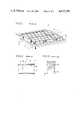
- FIG. 1is a perspective appearance view showing an example of a conventional light emitting device in which the "Light Emitting Device Fixing Substrate" of the above stated Japanese patent Laying-Open Gazette No. 125878/1983 is applied.
- the light emitting device 1comprises a substrate 2 and a large number of light emitting diode arrays 4 having a large number of light emitting areas 3 provided on the substrate 2. Electrodes 5 are formed corresponding to the respective light emitting diode arrays 4 and each electrode 5 is connected through a metallic fine wire 6 to a fine pattern 7 formed in the vicinity of the light emitting diode arrays 4.
- FIG. 2is a sectional view of an essential portion of a conventional light emitting diode array and FIG. 3 is a plane view of the essential portion.
- Each of the light emitting diode arrays 4 shown in FIG. 1includes a P type region 10 formed by selectively diffusing a P type dopant using a mask, an insulating film 8 having an opening 81 on an n type layer 9 of GaAsP and an electrode 5 of aluminum is formed to cover partially the P type region 10.
- the electrode 5has a top end 51 of a width equal to the length of one side of the opening 81 of the insulating film 8, as shown in FIG. 3.
- the electrode 5can be formed by using one side of the opening 81 of the insulating film 8 as a reference line, positioning of a mask having an electrode pattern can be made easily at the time of evaporation of the electrode 5.
- a method to form an electrode 51 having a top end of the same width as that of a P type region 10 as shown in FIG. 3may be considered. This method makes it possible to set a mask for electrodes by using the side edges of the P type region 10 as reference lines and thus, positioning can be made easily.
- a P type region 10 assigned for a light emitting regionis formed by diffusion on the n type layer 9 as show in FIG. 2, the diffused layer, that is, the P type region 10 becomes wider as it comes up to the surface of the n type layer 9, and thus, this P type region 10 has a sectional shape like a saucer due to such enhanced diffusion. Further, light from the P type region 10 is emitted not only perpendicularly to the surface but also radially. Accordingly, if electric current is supplied to the Pn junction to emit light, expansion of the P type region 10 due to such spreading diffusion and enlargement of the luminous flux cause light to be emitted with an area larger than the area of the opening 81 of the insulating film 8 by 2 to 10% as a whole.
- the electrode 5 of aluminumhas naturally the light intercepting property, the light emitted from the surface of the P type region 10 located under the electrode 5 is intercepted.
- the light from the portions spread by the diffusionleaks from both sides of the electrode 51 and as a result, the dot shape corresponds to a printing dot in the shape almost like the letter U as shown by the shaded portion in FIG. 3.
- the depth of the P type region 10is as shallow as 5.0 ⁇ m (generally, approximately 2.0 ⁇ m), the rays of light around the electrode 51 do not cause any serious influence when the density of printing dots is low (for example, the density is 3.85 dots/mm and the width of a printing dot is less than 50% of a spacing of dots).
- the density of printing dotsis high (for example, 9.5 dots/mm or more), the rays of light around the electrode 51 become conspicuously bright and particularly the Pn junction under the electrode 51 is liable to have high brightness since electric current tends to concentrate in the Pn junction.
- a drawbackis involved that if electric current higher than 8 mA/dot flows, the printing dots have a shape nearly coincident to the letter U and thus, the printing quality is deteriorated.
- the above mentioned Japanese Patent Laying-Open Gazette No. 22372/1984discloses the use of an electrode having a top end in the shape of the letter U so as to cover at least three sides of a P type region.
- the above stated rays of lightcan be intercepted by making an electrode surround the P type region or making a sufficiently wide electrode cover one side of the P type region.
- shape of an electrodemakes it difficult to arrange a high density of electrodes. More specifically, positioning of a mask for forming electrodes cannot be made easily and deviation is liable to occur in the position of the electrode pattern.
- a primary object of the present inventionis to provide a unit of light emitting diode arrays having an excellent quality of printing, which can be manufactured easily and is most suitably utilized as a print head of an optical printer.
- a plurality of light emitting regions of a second conductive type each having a protruding portionare formed on the surface of a substrate of a first conductive type so as to emit light corresponding to a dot shape and light intercepting electrodes are formed in ohmic contact to cover the respective protruding portions of the second conductive type.
- a protruding portionis formed in a portion of each light emitting region and an electrode is formed in a portion of each light emitting region and an electrode is formed to cover partially the protruding portion, which makes it possible to make clear the light emitted from each light emitting region corresponding to a dot shape. Further, since it is not needed to widen unnecessarily the top end of each electrode on the side of the associated light emitting region, adaptation for a high density of printing dots can be made and reference lines can be easily determined for positioning of a mask for electrodes. Consequently, manufacturing can be made easily.
- a main bodyis formed of GaAs and layers of n-GaAsP are formed thereon so that a substrate of n-GaAsP is formed. Then, by diffusion of Zn on the surface of the substrate, light emitting regions are formed.
- light emitting regionsare formed to be arrayed in a line, each having a shape corresponding to a dot shape in the rectangular, parallelogram or round shape. Electrodes are disposed alternately to the right and to the left of the light emitting regions arrayed in a line, in the direction intersecting at right angles with the thus arrayed light emitting regions. Consequently, the respective adjacent electrodes will never be too close to each other and the degree of integration can be improved.
- FIG. 1is a perspective view of an essential portion of an optical print head where a conventional unit of light emitting diode arrays is provided.
- FIG. 2is a sectional view of an essential portion of a conventional unit of light emitting diode arrays.
- FIG. 3is a plane view of an essential portion of a conventional unit of light emitting diode arrays.
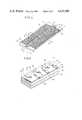
- FIG. 4is a perspective appearance view of an optical printer head where a unit of light emitting diode arrays in accordance with an embodiment of the present invention is applied.
- FIG. 5is a perspective view of a unit of light emitting diode arrays in accordance with an embodiment of the present invention.
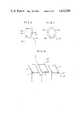
- FIG. 6is a plane view of an essential portion of an embodiment of the present invention.
- FIG. 7is a plane view of an essential portion of another embodiment of the present invention.
- FIG. 8is a plane view of an essential portion of a further embodiment of the present invention.
- FIG. 4is a perspective appearance view of an optical printer head where a unit of light emitting diode arrays in accordance with an embodiment of the present invention is applied.
- descriptionwill be given to the construction of an optical print head where a unit of light emitting diode arrays in accordance with an embodiment of the present invention is applied.
- an elongate printed conductor 12is formed on a substrate 11. This elongate printed conductor 12 is formed so that both longer sides thereof are parallel straight lines, which serve as reference lines for positioning a plurality of light emitting diode arrays 14.
- the elongate printed conductor 12is formed to have a width of 1.4 mm and a length of 220 mm for example.
- a light emitting diode array 14includes a plurality of light emitting areas 15. More specifically, a light emitting diode array 14 having a length of 8 mm for example is obtained in a manner in which a PN junction is formed on GaAsP by selective diffusion and 64 light emitting areas 15 for example are arrayed. A plurality of such light emitting diode arrays 14 are disposed on the elongate printed conductor 12. In the vicinity of the elongate printed conductor 12, fine patterns 13 are formed. The light emitting diode arrays 14 are connected to the fine patterns 13 through metallic fine wires 16 by a wire bonding method or the like.
- FIG. 5is a perspective view of a unit of light emitting diode arrays in accordance with an embodiment of the present invention and FIG. 6 is a plane view of an essential portion of this embodiment of the present invention.
- a GaAsP layer 22 of 50 ⁇ m in thicknesswhich compound ratio changes gradually from GaAs to the main body to GaAs 0 .6 P 0 .4 and a GaAs 0 .6 P 0 .4 layer 23 of 30 ⁇ m in thickness are formed by vapor phase epitaxial growth.
- a mixed crystal ratio of GaAs and GaP of the layer 23is selected according to the photosensitive characteristic of a photosensitive material (not shown); for example, the mixed crystal ratio is 0.6, that is, GaAs 0 .6 P 0 .4 in the case of an amorphous silicon photosensitive material which has the maximum sensitivity at 660 nm.
- a Si 3 N 4 insulating film 26 having an opening 24is formed on the GaAs 0 .6 P 0 .4 layer 23.
- This opening 81has a square base portion 242 and a protruding portion 241 formed on one side of the base portion 242.
- a P type impurityfor example, Zn is selectively diffused on the surface of the GaAs 0 .6 P 0 .4 layer 23 so as to form a P type region 24 of 2 to 5 ⁇ m in thickness having an impurity concentration of ⁇ 10 19 /cm 3 .
- a light intercepting electrode 25 of aluminumis formed on this insulating film 26 or a newly provided equivalent insulating film.
- This electrode 25is positioned so that a lateral side thereof may be aligned with the lateral side 243 of the opening 81.
- One end of the electrode 25covers most part of the protruding portion 241 of the P type region 24 so as to be in ohmic contact with the P type region 24.
- a diffusion mask pattern for light emitting regions 24includes squares of 50 ⁇ m as one side provided respectively with a protruding portion 241 having a length of 20 ⁇ m and a width of 40 ⁇ m. These squares are disposed with the density of 300 dots/inch and selective diffusion of Zn is applied with a depth of 2.5 ⁇ m. After that, electrodes 25 are arranged with a spacing of 2 ⁇ m from the respective base portions 242 of the light emitting regions 24 so that electrodes are formed in ohmic contact with the P type region.
- the light emitting area formed by the thus exposed P type region 24has an almost square shape one side of which has a small protruding portion.
- a unit of light emitting diode arrays for printingcan be formed with a density up to 400 dots/inch, in which a square printing dot can be obtained to have a width equal to 75% of each spacing of dots.
- formation of printing dotscannot be ascertained at present because a high density short focus lens array for analyzing the forms of the printing dots is not available.
- FIG. 7is a plane view of an essential portion of another embodiment of the present invention.
- an almost circular light emitting areais formed instead of the square light emitting area having a small protruding portion on one side as shown in FIG. 6. Therefore, the P type region 26 is formed using a diffusion mask having an opening comprised of the circular base portion 262 and the protruding portion 261 extending from a portion of the circular base portion 262, so that the electrode 25 is formed to cover most part of the protruding portion 261.
- the light emitting areahas the almost circular shape and in consequence, the printed dot shape becomes round, which makes it possible for an optical printer apparatus to print a smoother oblique line compared with the case of the almost square light emitting area, that is, the square dot shape shown in FIG. 6.
- FIG. 8is a plane view of a further embodiment of the present invention.
- the P type region 27is formed by using a diffusion mask having an opening comprised of a parallelogram shaped base portion 272 and a protruding portion 271 extending from one side of the base portion 272, so that the electrode 25 is formed to cover most part of the protruding portion 271.
- a horizontal straight linecan be represented in such a manner as if the printing dots were uninterruptedly connected.
Landscapes
- Led Devices (AREA)
- Printers Or Recording Devices Using Electromagnetic And Radiation Means (AREA)
- Dot-Matrix Printers And Others (AREA)
Abstract
Description
1. Field of the Invention
The present invention relates to a unit of light emitting diode arrays. More particularly, the present invention relates to a unit of light emitting diode arrays to be used in an optical print head and the like, in which a large number of light emitting arrays are provided on a substrate.
2. Description of the Prior Art
In the prior art, U.S. Pat. No. 3,850,517 to Joseph F. Stephany, "High Speed Printout System" is known as an optical printer using light emitting diode arrays as a light source. As light emitting diode arrays to be used in such an optical printer, Japanese Patent Laying-Open Gazette No. 125878/1983, "Light Emitting Device Fixing Substrate" invented by Takeshi Mizutani et al. and Japanese Patent Laying-Open Gazette No. 22372/1984, "Semiconductor Light Emitting Device" invented by Tsutomu Koshimura are known.
FIG. 1 is a perspective appearance view showing an example of a conventional light emitting device in which the "Light Emitting Device Fixing Substrate" of the above stated Japanese patent Laying-Open Gazette No. 125878/1983 is applied.
First, referring to FIG. 1, a light emitting device 1 to be used in a conventional optical printer will be described. The light emitting device 1 comprises asubstrate 2 and a large number of light emitting diode arrays 4 having a large number oflight emitting areas 3 provided on thesubstrate 2.Electrodes 5 are formed corresponding to the respective light emitting diode arrays 4 and eachelectrode 5 is connected through a metallicfine wire 6 to afine pattern 7 formed in the vicinity of the light emitting diode arrays 4.
FIG. 2 is a sectional view of an essential portion of a conventional light emitting diode array and FIG. 3 is a plane view of the essential portion.
Each of the light emitting diode arrays 4 shown in FIG. 1 includes aP type region 10 formed by selectively diffusing a P type dopant using a mask, an insulating film 8 having an opening 81 on ann type layer 9 of GaAsP and anelectrode 5 of aluminum is formed to cover partially theP type region 10.
Theelectrode 5 has atop end 51 of a width equal to the length of one side of the opening 81 of the insulating film 8, as shown in FIG. 3. Thus, since theelectrode 5 can be formed by using one side of the opening 81 of the insulating film 8 as a reference line, positioning of a mask having an electrode pattern can be made easily at the time of evaporation of theelectrode 5.
Therefore, a method to form anelectrode 51 having a top end of the same width as that of aP type region 10 as shown in FIG. 3 may be considered. This method makes it possible to set a mask for electrodes by using the side edges of theP type region 10 as reference lines and thus, positioning can be made easily.
However, if aP type region 10 assigned for a light emitting region is formed by diffusion on then type layer 9 as show in FIG. 2, the diffused layer, that is, theP type region 10 becomes wider as it comes up to the surface of then type layer 9, and thus, thisP type region 10 has a sectional shape like a saucer due to such enhanced diffusion. Further, light from theP type region 10 is emitted not only perpendicularly to the surface but also radially. Accordingly, if electric current is supplied to the Pn junction to emit light, expansion of theP type region 10 due to such spreading diffusion and enlargement of the luminous flux cause light to be emitted with an area larger than the area of the opening 81 of the insulating film 8 by 2 to 10% as a whole.
On the other hand, since theelectrode 5 of aluminum has naturally the light intercepting property, the light emitted from the surface of theP type region 10 located under theelectrode 5 is intercepted. However, the light from the portions spread by the diffusion leaks from both sides of theelectrode 51 and as a result, the dot shape corresponds to a printing dot in the shape almost like the letter U as shown by the shaded portion in FIG. 3. Since the depth of theP type region 10 is as shallow as 5.0 μm (generally, approximately 2.0 μm), the rays of light around theelectrode 51 do not cause any serious influence when the density of printing dots is low (for example, the density is 3.85 dots/mm and the width of a printing dot is less than 50% of a spacing of dots). However, if the density of printing dots is high (for example, 9.5 dots/mm or more), the rays of light around theelectrode 51 become conspicuously bright and particularly the Pn junction under theelectrode 51 is liable to have high brightness since electric current tends to concentrate in the Pn junction. In consequence, a drawback is involved that if electric current higher than 8 mA/dot flows, the printing dots have a shape nearly coincident to the letter U and thus, the printing quality is deteriorated.
On the other hand, the above mentioned Japanese Patent Laying-Open Gazette No. 22372/1984, "Semiconductor Light Emitting Device" discloses the use of an electrode having a top end in the shape of the letter U so as to cover at least three sides of a P type region. Thus, the above stated rays of light can be intercepted by making an electrode surround the P type region or making a sufficiently wide electrode cover one side of the P type region. However, such shape of an electrode makes it difficult to arrange a high density of electrodes. More specifically, positioning of a mask for forming electrodes cannot be made easily and deviation is liable to occur in the position of the electrode pattern. As a result, an electrode in a P type region comes too close to the adjacent P type region or adjacent electrode, which often causes erroneous emission of light or a short circuit due to leakage of electric current. Accordingly, there is a disadvantage that the printed picture quality is rough since P type regions for forming printing dots must be disposed with a sufficient spacing.
Therefore, a primary object of the present invention is to provide a unit of light emitting diode arrays having an excellent quality of printing, which can be manufactured easily and is most suitably utilized as a print head of an optical printer.
Briefly stated, in the present invention, a plurality of light emitting regions of a second conductive type each having a protruding portion are formed on the surface of a substrate of a first conductive type so as to emit light corresponding to a dot shape and light intercepting electrodes are formed in ohmic contact to cover the respective protruding portions of the second conductive type.
Thus, according to the present invention, a protruding portion is formed in a portion of each light emitting region and an electrode is formed in a portion of each light emitting region and an electrode is formed to cover partially the protruding portion, which makes it possible to make clear the light emitted from each light emitting region corresponding to a dot shape. Further, since it is not needed to widen unnecessarily the top end of each electrode on the side of the associated light emitting region, adaptation for a high density of printing dots can be made and reference lines can be easily determined for positioning of a mask for electrodes. Consequently, manufacturing can be made easily.
In a preferred embodiment of the present invention, a main body is formed of GaAs and layers of n-GaAsP are formed thereon so that a substrate of n-GaAsP is formed. Then, by diffusion of Zn on the surface of the substrate, light emitting regions are formed.
Further, in a more preferred embodiment of the present invention, light emitting regions are formed to be arrayed in a line, each having a shape corresponding to a dot shape in the rectangular, parallelogram or round shape. Electrodes are disposed alternately to the right and to the left of the light emitting regions arrayed in a line, in the direction intersecting at right angles with the thus arrayed light emitting regions. Consequently, the respective adjacent electrodes will never be too close to each other and the degree of integration can be improved.
These objects and other objects, features, aspects and advantages of the present invention will become more apparent from the following detailed description of the present invention when taken in conjunction with the accompanying drawings.
FIG. 1 is a perspective view of an essential portion of an optical print head where a conventional unit of light emitting diode arrays is provided.
FIG. 2 is a sectional view of an essential portion of a conventional unit of light emitting diode arrays.
FIG. 3 is a plane view of an essential portion of a conventional unit of light emitting diode arrays.
FIG. 4 is a perspective appearance view of an optical printer head where a unit of light emitting diode arrays in accordance with an embodiment of the present invention is applied.
FIG. 5 is a perspective view of a unit of light emitting diode arrays in accordance with an embodiment of the present invention.
FIG. 6 is a plane view of an essential portion of an embodiment of the present invention.
FIG. 7 is a plane view of an essential portion of another embodiment of the present invention.
FIG. 8 is a plane view of an essential portion of a further embodiment of the present invention.
FIG. 4 is a perspective appearance view of an optical printer head where a unit of light emitting diode arrays in accordance with an embodiment of the present invention is applied. First, referring to FIG. 4, description will be given to the construction of an optical print head where a unit of light emitting diode arrays in accordance with an embodiment of the present invention is applied. On asubstrate 11, an elongate printedconductor 12 is formed. This elongate printedconductor 12 is formed so that both longer sides thereof are parallel straight lines, which serve as reference lines for positioning a plurality of lightemitting diode arrays 14. If a unit of light emitting diode arrays in this embodiment is applied to an optical print head for printing letters and the like on the printing paper of A4 size, the elongate printedconductor 12 is formed to have a width of 1.4 mm and a length of 220 mm for example.
A lightemitting diode array 14 includes a plurality oflight emitting areas 15. More specifically, a lightemitting diode array 14 having a length of 8 mm for example is obtained in a manner in which a PN junction is formed on GaAsP by selective diffusion and 64light emitting areas 15 for example are arrayed. A plurality of such lightemitting diode arrays 14 are disposed on the elongate printedconductor 12. In the vicinity of the elongate printedconductor 12,fine patterns 13 are formed. The light emittingdiode arrays 14 are connected to thefine patterns 13 through metallicfine wires 16 by a wire bonding method or the like.
FIG. 5 is a perspective view of a unit of light emitting diode arrays in accordance with an embodiment of the present invention and FIG. 6 is a plane view of an essential portion of this embodiment of the present invention.
Now, referring to FIGS. 5 and 6, an embodiment of the present invention will be described in more detail. As shown in FIG. 5, on the n type GaAs main body having a thickness of 300 μm, aGaAsP layer 22 of 50 μm in thickness, which compound ratio changes gradually from GaAs to the main body to GaAs0.6 P0.4 and a GaAs0.6 P0.4layer 23 of 30 μm in thickness are formed by vapor phase epitaxial growth. A mixed crystal ratio of GaAs and GaP of thelayer 23 is selected according to the photosensitive characteristic of a photosensitive material (not shown); for example, the mixed crystal ratio is 0.6, that is, GaAs0.6 P0.4 in the case of an amorphous silicon photosensitive material which has the maximum sensitivity at 660 nm. Then, a Si3 N4 insulating film 26 having anopening 24 is formed on the GaAs0.6 P0.4layer 23. This opening 81 has asquare base portion 242 and a protruding portion 241 formed on one side of thebase portion 242. Using the insulatingfilm 26 as a mask, a P type impurity, for example, Zn is selectively diffused on the surface of the GaAs0.6 P0.4layer 23 so as to form aP type region 24 of 2 to 5 μ m in thickness having an impurity concentration of ≃1019 /cm3.
Further, on this insulatingfilm 26 or a newly provided equivalent insulating film alight intercepting electrode 25 of aluminum is formed. Thiselectrode 25 is positioned so that a lateral side thereof may be aligned with thelateral side 243 of the opening 81. One end of theelectrode 25 covers most part of the protruding portion 241 of theP type region 24 so as to be in ohmic contact with theP type region 24. On the back surface of themain body 21 of GaAs, awhole surface electrode 27 of Au-Sn-Te alloy or the like is formed.
More specifically stated by taking an further example, a diffusion mask pattern forlight emitting regions 24 includes squares of 50 μm as one side provided respectively with a protruding portion 241 having a length of 20 μm and a width of 40 μm. These squares are disposed with the density of 300 dots/inch and selective diffusion of Zn is applied with a depth of 2.5 μm. After that,electrodes 25 are arranged with a spacing of 2 μm from therespective base portions 242 of thelight emitting regions 24 so that electrodes are formed in ohmic contact with the P type region. The light emitting area formed by the thus exposedP type region 24 has an almost square shape one side of which has a small protruding portion. Then, if electric current of 5 mA/dot flows, an almost square printing dot having each side of 52 μm can be obtained and if electric current of 10 mA/dot flows, an almost square printing dot having each side of 55 μm can be obtained.
If a size is changed to increase the density of printing dots, a unit of light emitting diode arrays for printing can be formed with a density up to 400 dots/inch, in which a square printing dot can be obtained to have a width equal to 75% of each spacing of dots. However, with respect to a higher degree of resolution, formation of printing dots cannot be ascertained at present because a high density short focus lens array for analyzing the forms of the printing dots is not available.
FIG. 7 is a plane view of an essential portion of another embodiment of the present invention. In the embodiment shown in FIG. 7, an almost circular light emitting area is formed instead of the square light emitting area having a small protruding portion on one side as shown in FIG. 6. Therefore, theP type region 26 is formed using a diffusion mask having an opening comprised of thecircular base portion 262 and the protrudingportion 261 extending from a portion of thecircular base portion 262, so that theelectrode 25 is formed to cover most part of the protrudingportion 261. Thus, the light emitting area has the almost circular shape and in consequence, the printed dot shape becomes round, which makes it possible for an optical printer apparatus to print a smoother oblique line compared with the case of the almost square light emitting area, that is, the square dot shape shown in FIG. 6.
FIG. 8 is a plane view of a further embodiment of the present invention. In the embodiment shown in FIG. 8, for the purpose of obtaining a dot shape in parallelogram, theP type region 27 is formed by using a diffusion mask having an opening comprised of a parallelogram shaped base portion 272 and a protrudingportion 271 extending from one side of the base portion 272, so that theelectrode 25 is formed to cover most part of the protrudingportion 271. By thus forming the dot shape in parallelogram, a horizontal straight line can be represented in such a manner as if the printing dots were uninterruptedly connected.
It goes without saying that the present invention is not limited to the above stated square, circular or parallelogram shape and any other dot shape may by applied.
Although the present invention has been described and illustrated in detail, it is clearly understood that the same is by way of illustration and example only and is not to be taken by way of limitation, the spirit and scope of the present invention being limited only by the terms of the appended claims.
Claims (13)
1. A unit of light emitting diode arrays comprising:
a substrate of a first conductivity type;
a plurality of regions of a second conductivity type formed in the surface of said substrate to emit light corresponding to a dot shape, each of said plurality of regions including a dot-shaped portion and a portion protruding laterally to the dot-shaped portion having narrower width than the dot-shaped portion; and
light intercepting electrodes in ohmic contact covering partially said respective protruding portions of the second conductivity type.
2. A unit of light emitting diode arrays in accordance with claim 1, wherein
said substrate of the first conductivity type is an n type substrate and said plurality of regions of the second conductive type are P type regions.
3. A unit of light emitting diode arrays in accordance with claim 2, wherein
said n type substrate is a n-GaAsP substrate.
4. A unit of light emitting diode arrays in accordance with claim 2, wherein
said n type substrate comprises a main body formed of GaAs and layers of n-GaAsP formed in said main body.
5. A unit of light emitting diode arrays in accordance with claim 1, wherein
said plurality of regions of the second conductivity type are arrayed in a line.
6. A unit of light emitting diode arrays in accordance with claim 3, wherein
said plurality of regions of the second conductivity type are formed by diffusion of Zn in said n-GaAsP substrate.
7. A unit of light emitting diode arrays in accordance with claim 4, wherein
said plurality of regions of the second conductivity type are formed by diffusion of Zn in said n-GaAsP layers.
8. A unit of light emitting diode arrays in accordance with claim 1, wherein
said dot shape has an square shape having four sides, and
said plurality of regions of the second conductivity type each correspond to said angular shape and each have one side including said protruding portion.
9. A unit of light emitting diode arrays in accordance with claim 8, wherein
said square shape is a parallelogram.
10. A unit of light emitting diode arrays in accordance with claim 8, wherein
said square shape is rectangular.
11. A unit of light emitting diode arrays in accordance with claim 1, wherein
said dot shape has a circular shape , and
said plurality of regions of the second conductivity type each correspond to said circular shape and each have a portion including said protruding portion extending therefrom.
12. A unit of light emitting diode arrays in accordance with claim 1, wherein
said each electrode includes a portion covering said protruding portion so that a light emitting pattern from said each region has a shape similar to said dot shape.
13. A unit of light emitting diode arrays in accordance with claim 1, wherein
said electrodes are formed to extend alternately in the direction intersecting at right angles with said plurality of regions of the second conductivity type arrayed in a line.
Applications Claiming Priority (2)
| Application Number | Priority Date | Filing Date | Title |
|---|---|---|---|
| JP15172284AJPS6129562A (en) | 1984-07-20 | 1984-07-20 | Light emitting diode for printing |
| JP59-151722 | 1984-07-20 |
Publications (1)
| Publication Number | Publication Date |
|---|---|
| US4633280Atrue US4633280A (en) | 1986-12-30 |
Family
ID=15524851
Family Applications (1)
| Application Number | Title | Priority Date | Filing Date |
|---|---|---|---|
| US06/753,393Expired - LifetimeUS4633280A (en) | 1984-07-20 | 1985-07-10 | Unit of light emitting diode arrays |
Country Status (2)
| Country | Link |
|---|---|
| US (1) | US4633280A (en) |
| JP (1) | JPS6129562A (en) |
Cited By (39)
| Publication number | Priority date | Publication date | Assignee | Title |
|---|---|---|---|---|
| DE3727488A1 (en)* | 1987-08-18 | 1989-03-02 | Telefunken Electronic Gmbh | OPTOELECTRONIC COMPONENT |
| US4916530A (en)* | 1988-09-02 | 1990-04-10 | Itek Graphix Corp. | High resolution halftone dot generator system including LED array |
| DE3923633A1 (en)* | 1988-12-12 | 1990-06-13 | Samsung Electronics Co Ltd | METHOD FOR PRODUCING A LUMINOUS DIODE MATRIX HEAD |
| US4942405A (en)* | 1988-10-11 | 1990-07-17 | Hewlett-Packard Company | Light emitting diode print head assembly |
| US4951098A (en)* | 1988-12-21 | 1990-08-21 | Eastman Kodak Company | Electrode structure for light emitting diode array chip |
| EP0400982A3 (en)* | 1989-05-30 | 1991-01-23 | Shin-Etsu Handotai Company Limited | Light-emitting diode and a preparing process therefor |
| US5014074A (en)* | 1988-10-11 | 1991-05-07 | Hewlett-Packard Company | Light emitting diode print head assembly |
| US5045895A (en)* | 1988-11-07 | 1991-09-03 | Mitsubishi Denki Kabushiki Kaisha | Light emitting diode array with electrodes |
| US5094970A (en)* | 1988-11-07 | 1992-03-10 | Mitsubishi Denki Kabushiki Kaisha | Method of making a light emitting diode array |
| US5250820A (en)* | 1991-01-30 | 1993-10-05 | Rohm Co., Ltd. | Light emitting diode having uniform light distribution |
| US6367949B1 (en) | 1999-08-04 | 2002-04-09 | 911 Emergency Products, Inc. | Par 36 LED utility lamp |
| US6380865B1 (en) | 1999-04-06 | 2002-04-30 | 911 Emergency Products, Inc. | Replacement led lamp assembly and modulated power intensity for light source |
| US6424269B1 (en) | 1997-10-21 | 2002-07-23 | 911 Emergency Products, Inc. | LED warning signal light and light bar |
| US6462669B1 (en) | 1999-04-06 | 2002-10-08 | E. P . Survivors Llc | Replaceable LED modules |
| US6547410B1 (en) | 2000-07-28 | 2003-04-15 | 911 Emergency Products, Inc. | LED alley/take-down light |
| US6590343B2 (en) | 2000-06-06 | 2003-07-08 | 911Ep, Inc. | LED compensation circuit |
| US6590502B1 (en) | 1992-10-12 | 2003-07-08 | 911Ep, Inc. | Led warning signal light and movable support |
| US6614359B2 (en) | 1999-04-06 | 2003-09-02 | 911 Emergency Products, Inc. | Replacement led lamp assembly and modulated power intensity for light source |
| US6623151B2 (en) | 1999-08-04 | 2003-09-23 | 911Ep, Inc. | LED double light bar and warning light signal |
| US6700502B1 (en) | 1999-06-08 | 2004-03-02 | 911Ep, Inc. | Strip LED light assembly for motor vehicle |
| US6705745B1 (en) | 1999-06-08 | 2004-03-16 | 911Ep, Inc. | Rotational led reflector |
| US6879263B2 (en) | 2000-11-15 | 2005-04-12 | Federal Law Enforcement, Inc. | LED warning light and communication system |
| US7163324B2 (en) | 1999-06-08 | 2007-01-16 | 911Ep, Inc. | Led light stick assembly |
| US7196950B2 (en) | 2002-10-30 | 2007-03-27 | Kabushiki Kaisha Toshiba | Non-volatile semiconductor storage device performing ROM read operation upon power-on |
| US7439847B2 (en) | 2002-08-23 | 2008-10-21 | John C. Pederson | Intelligent observation and identification database system |
| US20080292320A1 (en)* | 2007-05-24 | 2008-11-27 | Federal Law Enforcement Development Service, Inc. | Led light global positioning and routing communication system |
| US20080310850A1 (en)* | 2000-11-15 | 2008-12-18 | Federal Law Enforcement Development Services, Inc. | Led light communication system |
| CN101493214B (en)* | 2008-01-23 | 2011-02-02 | 环隆电气股份有限公司 | Multi-wavelength light-emitting module with high-density electrical connections |
| US8543505B2 (en) | 2011-01-14 | 2013-09-24 | Federal Law Enforcement Development Services, Inc. | Method of providing lumens and tracking of lumen consumption |
| US8890773B1 (en) | 2009-04-01 | 2014-11-18 | Federal Law Enforcement Development Services, Inc. | Visible light transceiver glasses |
| US9100124B2 (en) | 2007-05-24 | 2015-08-04 | Federal Law Enforcement Development Services, Inc. | LED Light Fixture |
| US9258864B2 (en) | 2007-05-24 | 2016-02-09 | Federal Law Enforcement Development Services, Inc. | LED light control and management system |
| US9265112B2 (en) | 2013-03-13 | 2016-02-16 | Federal Law Enforcement Development Services, Inc. | LED light control and management system |
| US9294198B2 (en) | 2007-05-24 | 2016-03-22 | Federal Law Enforcement Development Services, Inc. | Pulsed light communication key |
| US9414458B2 (en) | 2007-05-24 | 2016-08-09 | Federal Law Enforcement Development Services, Inc. | LED light control assembly and system |
| US9455783B2 (en) | 2013-05-06 | 2016-09-27 | Federal Law Enforcement Development Services, Inc. | Network security and variable pulse wave form with continuous communication |
| US10448472B2 (en) | 2015-08-11 | 2019-10-15 | Federal Law Enforcement Development Services, Inc. | Function disabler device and system |
| US11265082B2 (en) | 2007-05-24 | 2022-03-01 | Federal Law Enforcement Development Services, Inc. | LED light control assembly and system |
| US11783345B2 (en) | 2014-01-15 | 2023-10-10 | Federal Law Enforcement Development Services, Inc. | Cyber life electronic networking and commerce operating exchange |
Families Citing this family (4)
| Publication number | Priority date | Publication date | Assignee | Title |
|---|---|---|---|---|
| JPH0648887Y2 (en)* | 1986-04-28 | 1994-12-12 | 三洋電機株式会社 | Light emitting diode array for optical printer |
| JPS63216391A (en)* | 1987-03-04 | 1988-09-08 | Nec Corp | LED recording head |
| JPH0650196Y2 (en)* | 1987-10-02 | 1994-12-21 | 三洋電機株式会社 | Light emitting diode array for optical printer |
| EP0881686A3 (en) | 1997-05-28 | 2000-04-19 | Oki Data Corporation | LED array and LED printer head |
Citations (2)
| Publication number | Priority date | Publication date | Assignee | Title |
|---|---|---|---|---|
| US3850517A (en)* | 1972-09-25 | 1974-11-26 | Xerox Corp | High speed printout system |
| US4145707A (en)* | 1976-06-04 | 1979-03-20 | Tokyo Shibaura Electric Co., Ltd. | Semiconductor luminescent display apparatus |
- 1984
- 1984-07-20JPJP15172284Apatent/JPS6129562A/enactiveGranted
- 1985
- 1985-07-10USUS06/753,393patent/US4633280A/ennot_activeExpired - Lifetime
Patent Citations (2)
| Publication number | Priority date | Publication date | Assignee | Title |
|---|---|---|---|---|
| US3850517A (en)* | 1972-09-25 | 1974-11-26 | Xerox Corp | High speed printout system |
| US4145707A (en)* | 1976-06-04 | 1979-03-20 | Tokyo Shibaura Electric Co., Ltd. | Semiconductor luminescent display apparatus |
Cited By (122)
| Publication number | Priority date | Publication date | Assignee | Title |
|---|---|---|---|---|
| US4924276A (en)* | 1987-08-18 | 1990-05-08 | Telefunken Electronic Gmbh | Optoelectronic component |
| DE3727488A1 (en)* | 1987-08-18 | 1989-03-02 | Telefunken Electronic Gmbh | OPTOELECTRONIC COMPONENT |
| US4916530A (en)* | 1988-09-02 | 1990-04-10 | Itek Graphix Corp. | High resolution halftone dot generator system including LED array |
| EP0357175A3 (en)* | 1988-09-02 | 1991-03-06 | I.C.G. Ltd. | High resolution halftone dot generator system including two-dimensional LED array |
| US5014074A (en)* | 1988-10-11 | 1991-05-07 | Hewlett-Packard Company | Light emitting diode print head assembly |
| US4942405A (en)* | 1988-10-11 | 1990-07-17 | Hewlett-Packard Company | Light emitting diode print head assembly |
| US5094970A (en)* | 1988-11-07 | 1992-03-10 | Mitsubishi Denki Kabushiki Kaisha | Method of making a light emitting diode array |
| US5045895A (en)* | 1988-11-07 | 1991-09-03 | Mitsubishi Denki Kabushiki Kaisha | Light emitting diode array with electrodes |
| DE3923633A1 (en)* | 1988-12-12 | 1990-06-13 | Samsung Electronics Co Ltd | METHOD FOR PRODUCING A LUMINOUS DIODE MATRIX HEAD |
| US4951098A (en)* | 1988-12-21 | 1990-08-21 | Eastman Kodak Company | Electrode structure for light emitting diode array chip |
| EP0400982A3 (en)* | 1989-05-30 | 1991-01-23 | Shin-Etsu Handotai Company Limited | Light-emitting diode and a preparing process therefor |
| US5057442A (en)* | 1989-05-30 | 1991-10-15 | Shin-Etsu Handotai Co., Ltd. | Process for preparing light-emitting diodes using a maximum layer thickness equation |
| US5250820A (en)* | 1991-01-30 | 1993-10-05 | Rohm Co., Ltd. | Light emitting diode having uniform light distribution |
| US5420444A (en)* | 1991-01-30 | 1995-05-30 | Rohm Co., Ltd. | Light emitting diode and light emitting diode array having uniform light distribution |
| US6590502B1 (en) | 1992-10-12 | 2003-07-08 | 911Ep, Inc. | Led warning signal light and movable support |
| US7561036B2 (en) | 1997-10-21 | 2009-07-14 | 911 Emergency Products, Inc. | LED warning signal light and light bar |
| US6788217B2 (en) | 1997-10-21 | 2004-09-07 | 911Ep, Inc. | LED warning signal light and light support having at least one sector |
| US6424269B1 (en) | 1997-10-21 | 2002-07-23 | 911 Emergency Products, Inc. | LED warning signal light and light bar |
| US7394398B2 (en) | 1997-10-21 | 2008-07-01 | 911Ep, Inc. | LED warning signal light and light support having at least one sector |
| US6822578B2 (en) | 1997-10-21 | 2004-11-23 | 911Ep, Inc. | Led warning signal light and light bar |
| US6469631B1 (en) | 1997-10-21 | 2002-10-22 | 911 Emergency Products, Inc. | Led warning signal light and light support having at least one sector |
| US6930615B2 (en) | 1997-10-21 | 2005-08-16 | 911Ep, Inc. | LED warning signal light and light support |
| US6504487B1 (en) | 1997-10-21 | 2003-01-07 | 911 Emergency Products, Inc. | LED warning signal light and light supports |
| US6995681B2 (en) | 1997-10-21 | 2006-02-07 | 911Ep, Inc. | LED warning signal light and movable support |
| US6989743B2 (en) | 1999-04-06 | 2006-01-24 | 911Ep, Inc. | Replacement LED lamp assembly and modulated power intensity for light source |
| US6380865B1 (en) | 1999-04-06 | 2002-04-30 | 911 Emergency Products, Inc. | Replacement led lamp assembly and modulated power intensity for light source |
| US6614359B2 (en) | 1999-04-06 | 2003-09-02 | 911 Emergency Products, Inc. | Replacement led lamp assembly and modulated power intensity for light source |
| US7064674B2 (en) | 1999-04-06 | 2006-06-20 | 911Ep, Inc. | Replaceable LED modules |
| US6693551B2 (en) | 1999-04-06 | 2004-02-17 | 911Ep, Inc. | Replaceable led modules |
| US7498933B2 (en) | 1999-04-06 | 2009-03-03 | 911Ep, Inc. | Replaceable LED modules |
| US6462669B1 (en) | 1999-04-06 | 2002-10-08 | E. P . Survivors Llc | Replaceable LED modules |
| US6700502B1 (en) | 1999-06-08 | 2004-03-02 | 911Ep, Inc. | Strip LED light assembly for motor vehicle |
| US7038593B2 (en) | 1999-06-08 | 2006-05-02 | 911Ep, Inc. | Strip LED light assembly for motor vehicle |
| US6789930B2 (en) | 1999-06-08 | 2004-09-14 | 911Ep, Inc. | LED warning signal light and row of LED's |
| US7163324B2 (en) | 1999-06-08 | 2007-01-16 | 911Ep, Inc. | Led light stick assembly |
| US6705745B1 (en) | 1999-06-08 | 2004-03-16 | 911Ep, Inc. | Rotational led reflector |
| US7153013B2 (en) | 1999-06-08 | 2006-12-26 | 911Ep, Inc. | LED warning signal light and moveable row of LED's |
| US7095334B2 (en) | 1999-06-08 | 2006-08-22 | 911Ep, Inc. | Strip LED light assembly for motor vehicle |
| US7080930B2 (en) | 1999-06-08 | 2006-07-25 | 911Ep, Inc. | LED warning signal light and row of LED's |
| US6461008B1 (en) | 1999-08-04 | 2002-10-08 | 911 Emergency Products, Inc. | Led light bar |
| US6707389B2 (en) | 1999-08-04 | 2004-03-16 | 911Ep, Inc. | LED personal warning light |
| US6367949B1 (en) | 1999-08-04 | 2002-04-09 | 911 Emergency Products, Inc. | Par 36 LED utility lamp |
| US6476726B1 (en) | 1999-08-04 | 2002-11-05 | 911 Emergency Products, Inc. | LED personal warning light |
| US6623151B2 (en) | 1999-08-04 | 2003-09-23 | 911Ep, Inc. | LED double light bar and warning light signal |
| US20020093820A1 (en)* | 1999-08-04 | 2002-07-18 | Pederson John C. | Led reflector |
| US6814459B2 (en) | 1999-08-04 | 2004-11-09 | 911Ep, Inc. | LED light bar |
| US7033036B2 (en) | 1999-08-04 | 2006-04-25 | 911Ep, Inc. | LED light bar |
| US6590343B2 (en) | 2000-06-06 | 2003-07-08 | 911Ep, Inc. | LED compensation circuit |
| US6547410B1 (en) | 2000-07-28 | 2003-04-15 | 911 Emergency Products, Inc. | LED alley/take-down light |
| US9413457B2 (en) | 2000-11-15 | 2016-08-09 | Federal Law Enforcement Development Services, Inc. | LED light communication system |
| US20080136661A1 (en)* | 2000-11-15 | 2008-06-12 | Federal Law Enforcement Development Service, Inc. | Led warning light and communication system |
| US8902076B2 (en) | 2000-11-15 | 2014-12-02 | Federal Law Enforcement Development Services, Inc. | LED light communication system |
| US8188878B2 (en) | 2000-11-15 | 2012-05-29 | Federal Law Enforcement Development Services, Inc. | LED light communication system |
| US20080310850A1 (en)* | 2000-11-15 | 2008-12-18 | Federal Law Enforcement Development Services, Inc. | Led light communication system |
| US6879263B2 (en) | 2000-11-15 | 2005-04-12 | Federal Law Enforcement, Inc. | LED warning light and communication system |
| US7046160B2 (en) | 2000-11-15 | 2006-05-16 | Pederson John C | LED warning light and communication system |
| US7902978B2 (en) | 2002-08-23 | 2011-03-08 | John C. Pederson | Intelligent observation and identification database system |
| US8188861B2 (en) | 2002-08-23 | 2012-05-29 | John C. Pederson | Intelligent observation and identification database system |
| US20090072972A1 (en)* | 2002-08-23 | 2009-03-19 | Pederson John C | Intelligent observation and identification database system |
| US9318009B2 (en) | 2002-08-23 | 2016-04-19 | Federal Law Enforcement Development Services, Inc. | Intelligent observation and identification database system |
| US7439847B2 (en) | 2002-08-23 | 2008-10-21 | John C. Pederson | Intelligent observation and identification database system |
| US20110157369A1 (en)* | 2002-08-23 | 2011-06-30 | Pederson John C | Intelligent Observation And Identification Database System |
| US8890655B2 (en) | 2002-08-23 | 2014-11-18 | Federal Law Enforcement Development Services, Inc. | Intelligent observation and identification database system |
| US8330599B2 (en) | 2002-08-23 | 2012-12-11 | John C. Pederson | Intelligent observation and identification database system |
| US7196950B2 (en) | 2002-10-30 | 2007-03-27 | Kabushiki Kaisha Toshiba | Non-volatile semiconductor storage device performing ROM read operation upon power-on |
| US9461740B2 (en) | 2007-05-24 | 2016-10-04 | Federal Law Enforcement Development Services, Inc. | Building illumination apparatus with integrated communications, security and energy management |
| US10820391B2 (en) | 2007-05-24 | 2020-10-27 | Federal Law Enforcement Development Services, Inc. | LED light control assembly and system |
| US8188879B2 (en) | 2007-05-24 | 2012-05-29 | Federal Law Enforcement Development Services, Inc. | LED light global positioning and routing communication system |
| US11664897B2 (en) | 2007-05-24 | 2023-05-30 | Federal Law Enforcement Development Services, Inc. | LED light fixture |
| US8571411B2 (en) | 2007-05-24 | 2013-10-29 | Federal Law Enforcement Development Services, Inc. | LED light broad band over power line communication system |
| US8593299B2 (en) | 2007-05-24 | 2013-11-26 | Federal Law Enforcement Development Services, Inc. | LED light global positioning and routing communication system |
| US8687965B2 (en) | 2007-05-24 | 2014-04-01 | Federal Law Enforcement Development Services, Inc. | LED light dongle communication system |
| US8744267B2 (en) | 2007-05-24 | 2014-06-03 | Federal Law Enforcement Development Services, Inc. | Building illumination apparatus with integrated communications, security and energy management |
| US11664895B2 (en) | 2007-05-24 | 2023-05-30 | Federal Law Enforcement Development Services, Inc. | LED light control assembly and system |
| US8886045B2 (en) | 2007-05-24 | 2014-11-11 | Federal Law Enforcement Development Services, Inc. | LED light broad band over power line communication system |
| US11265082B2 (en) | 2007-05-24 | 2022-03-01 | Federal Law Enforcement Development Services, Inc. | LED light control assembly and system |
| US20080292320A1 (en)* | 2007-05-24 | 2008-11-27 | Federal Law Enforcement Development Service, Inc. | Led light global positioning and routing communication system |
| US20080317475A1 (en)* | 2007-05-24 | 2008-12-25 | Federal Law Enforcement Development Services, Inc. | Led light interior room and building communication system |
| US9100124B2 (en) | 2007-05-24 | 2015-08-04 | Federal Law Enforcement Development Services, Inc. | LED Light Fixture |
| US9246594B2 (en) | 2007-05-24 | 2016-01-26 | Federal Law Enforcement Development Services, Inc. | LED light dongle communication system |
| US9252883B2 (en) | 2007-05-24 | 2016-02-02 | Federal Law Enforcement Development Services, Inc. | LED light global positioning and routing communication system |
| US9258864B2 (en) | 2007-05-24 | 2016-02-09 | Federal Law Enforcement Development Services, Inc. | LED light control and management system |
| US11201672B2 (en) | 2007-05-24 | 2021-12-14 | Federal Law Enforcement Development Services, Inc. | LED light fixture |
| US9294198B2 (en) | 2007-05-24 | 2016-03-22 | Federal Law Enforcement Development Services, Inc. | Pulsed light communication key |
| US10911144B2 (en) | 2007-05-24 | 2021-02-02 | Federal Law Enforcement Development Services, Inc. | LED light broad band over power line communication system |
| US9363018B2 (en) | 2007-05-24 | 2016-06-07 | Federal Law Enforcement Development Services, Inc. | LED light interior room and building communication system |
| US9414458B2 (en) | 2007-05-24 | 2016-08-09 | Federal Law Enforcement Development Services, Inc. | LED light control assembly and system |
| US9413459B2 (en) | 2007-05-24 | 2016-08-09 | Federal Law Enforcement Development Services, Inc. | LED light dongle communication system |
| US20090003832A1 (en)* | 2007-05-24 | 2009-01-01 | Federal Law Enforcement Development Services, Inc. | Led light broad band over power line communication system |
| US8331790B2 (en) | 2007-05-24 | 2012-12-11 | Federal Law Enforcement Development Services, Inc. | LED light interior room and building communication system |
| US20090129782A1 (en)* | 2007-05-24 | 2009-05-21 | Federal Law Enforcement Development Service, Inc. | Building illumination apparatus with integrated communications, security and energy management |
| US9461748B2 (en) | 2007-05-24 | 2016-10-04 | Federal Law Enforcement Development Services, Inc. | LED light fixture |
| US9577760B2 (en) | 2007-05-24 | 2017-02-21 | Federal Law Enforcement Development Services, Inc. | Pulsed light communication key |
| US10812186B2 (en) | 2007-05-24 | 2020-10-20 | Federal Law Enforcement Development Services, Inc. | LED light fixture |
| US10374706B2 (en) | 2007-05-24 | 2019-08-06 | Federal Law Enforcement Development Services, Inc. | LED light broad band over power line communication system |
| US9660726B2 (en) | 2007-05-24 | 2017-05-23 | Federal Law Enforcement Development Services, Inc. | LED light broad band over power line communication system |
| US9755743B2 (en) | 2007-05-24 | 2017-09-05 | Federal Law Enforcement Development Services, Inc. | LED light global positioning and routing communication system |
| US9768868B2 (en) | 2007-05-24 | 2017-09-19 | Federal Law Enforcement Development Services, Inc. | LED light dongle communication system |
| US9967030B2 (en) | 2007-05-24 | 2018-05-08 | Federal Law Enforcement Development Services, Inc. | Building illumination apparatus with integrated communications, security and energy management |
| US10051714B2 (en) | 2007-05-24 | 2018-08-14 | Federal Law Enforcement Development Services, Inc. | LED light control assembly and system |
| US10050705B2 (en) | 2007-05-24 | 2018-08-14 | Federal Law Enforcement Development Services, Inc. | LED light interior room and building communication system |
| US10250329B1 (en) | 2007-05-24 | 2019-04-02 | Federal Law Enforcement Development Services, Inc. | LED light fixture |
| CN101493214B (en)* | 2008-01-23 | 2011-02-02 | 环隆电气股份有限公司 | Multi-wavelength light-emitting module with high-density electrical connections |
| US8890773B1 (en) | 2009-04-01 | 2014-11-18 | Federal Law Enforcement Development Services, Inc. | Visible light transceiver glasses |
| US9654163B2 (en) | 2009-04-01 | 2017-05-16 | Federal Law Enforcement Development Services, Inc. | Visible light transceiver glasses |
| US10411746B2 (en) | 2009-04-01 | 2019-09-10 | Federal Law Enforcement Development Services, Inc. | Visible light communication transceiver glasses |
| US10763909B2 (en) | 2009-04-01 | 2020-09-01 | Federal Law Enforcement Development Services, Inc. | Visible light communication transceiver glasses |
| US11424781B2 (en) | 2009-04-01 | 2022-08-23 | Federal Law Enforcement Development Services, Inc. | Visible light communication transceiver glasses |
| US8543505B2 (en) | 2011-01-14 | 2013-09-24 | Federal Law Enforcement Development Services, Inc. | Method of providing lumens and tracking of lumen consumption |
| US8751390B2 (en) | 2011-01-14 | 2014-06-10 | Federal Law Enforcement Development Services, Inc. | Method of providing lumens and tracking of lumen consumption |
| US9265112B2 (en) | 2013-03-13 | 2016-02-16 | Federal Law Enforcement Development Services, Inc. | LED light control and management system |
| US9655189B2 (en) | 2013-03-13 | 2017-05-16 | Federal Law Enforcement Development Services, Inc. | LED light control and management system |
| US11018774B2 (en) | 2013-05-06 | 2021-05-25 | Federal Law Enforcement Development Services, Inc. | Network security and variable pulse wave form with continuous communication |
| US10205530B2 (en) | 2013-05-06 | 2019-02-12 | Federal Law Enforcement Development Services, Inc. | Network security and variable pulse wave form with continuous communication |
| US9455783B2 (en) | 2013-05-06 | 2016-09-27 | Federal Law Enforcement Development Services, Inc. | Network security and variable pulse wave form with continuous communication |
| US11552712B2 (en) | 2013-05-06 | 2023-01-10 | Federal Law Enforcement Development Services, Inc. | Network security and variable pulse wave form with continuous communication |
| US11824586B2 (en) | 2013-05-06 | 2023-11-21 | Federal Law Enforcement Development Services, Inc. | Network security and variable pulse wave form with continuous communication |
| US11783345B2 (en) | 2014-01-15 | 2023-10-10 | Federal Law Enforcement Development Services, Inc. | Cyber life electronic networking and commerce operating exchange |
| US11200794B2 (en) | 2015-08-11 | 2021-12-14 | Federal Law Enforcement Development Services, Inc. | Function disabler device and system |
| US10932337B2 (en) | 2015-08-11 | 2021-02-23 | Federal Law Enforcement Development Services, Inc. | Function disabler device and system |
| US11651680B2 (en) | 2015-08-11 | 2023-05-16 | Federal Law Enforcement Development Services, Inc. | Function disabler device and system |
| US10448472B2 (en) | 2015-08-11 | 2019-10-15 | Federal Law Enforcement Development Services, Inc. | Function disabler device and system |
Also Published As
| Publication number | Publication date |
|---|---|
| JPS6129562A (en) | 1986-02-10 |
| JPH0526664B2 (en) | 1993-04-16 |
Similar Documents
| Publication | Publication Date | Title |
|---|---|---|
| US4633280A (en) | Unit of light emitting diode arrays | |
| US5420444A (en) | Light emitting diode and light emitting diode array having uniform light distribution | |
| US6136627A (en) | High-resolution light-sensing and light-emitting diode array and fabrication method thereof | |
| US6023104A (en) | LED array alignment mark, method and mask for forming same, and LED array alignment method | |
| US3930912A (en) | Method of manufacturing light emitting diodes | |
| US4924276A (en) | Optoelectronic component | |
| US6064418A (en) | Led array, print head, and electrophotographic printer | |
| CA1074427A (en) | Solid state display apparatus | |
| EP0180479A2 (en) | Light-emitting diode array | |
| JP3185049B2 (en) | Light emitting element array and method of manufacturing the same | |
| JP3316252B2 (en) | Optical print head | |
| JPH11186594A (en) | Light emitting diode array | |
| US7754512B2 (en) | Method of fabricating semiconductor light-emitting devices with isolation trenches | |
| JP3120450B2 (en) | Multicolor light emitting diode and multicolor light emitting diode display board | |
| US4092561A (en) | Stripe contact providing a uniform current density | |
| JPH0121804Y2 (en) | ||
| JPH0436280Y2 (en) | ||
| US20030017637A1 (en) | Technique for the fabrication of high resolution led printheads | |
| JPH01128480A (en) | Light emitting diode array | |
| JPS6237554B2 (en) | ||
| CA2015462C (en) | Light emitting diode array | |
| JP3500275B2 (en) | Semiconductor light emitting device | |
| JP2824358B2 (en) | LED array head | |
| JP2838182B2 (en) | LED array for monocular lens head | |
| JPH0680840B2 (en) | Optical printer head |
Legal Events
| Date | Code | Title | Description |
|---|---|---|---|
| AS | Assignment | Owner name:TOTTORI SANYO ELECTRIC CO., LTD. 201 MINAMIYOSHIKA Free format text:ASSIGNMENT OF ASSIGNORS INTEREST.;ASSIGNOR:TAKASU, HIROMI;REEL/FRAME:004429/0574 Effective date:19850528 Owner name:SANYO ELECTRIC CO., LTD. 18 KEIHANHONDORI 2-CHOME, Free format text:ASSIGNMENT OF ASSIGNORS INTEREST.;ASSIGNOR:TAKASU, HIROMI;REEL/FRAME:004429/0574 Effective date:19850528 | |
| STCF | Information on status: patent grant | Free format text:PATENTED CASE | |
| FPAY | Fee payment | Year of fee payment:4 | |
| FPAY | Fee payment | Year of fee payment:8 | |
| FPAY | Fee payment | Year of fee payment:12 |