US4604993A - Vibratory massage device - Google Patents
Vibratory massage deviceDownload PDFInfo
- Publication number
- US4604993A US4604993AUS06/560,849US56084983AUS4604993AUS 4604993 AUS4604993 AUS 4604993AUS 56084983 AUS56084983 AUS 56084983AUS 4604993 AUS4604993 AUS 4604993A
- Authority
- US
- United States
- Prior art keywords
- applicator head
- side face
- massage
- rigid
- face
- Prior art date
- Legal status (The legal status is an assumption and is not a legal conclusion. Google has not performed a legal analysis and makes no representation as to the accuracy of the status listed.)
- Expired - Lifetime
Links
Images

Classifications
- A—HUMAN NECESSITIES
- A61—MEDICAL OR VETERINARY SCIENCE; HYGIENE
- A61H—PHYSICAL THERAPY APPARATUS, e.g. DEVICES FOR LOCATING OR STIMULATING REFLEX POINTS IN THE BODY; ARTIFICIAL RESPIRATION; MASSAGE; BATHING DEVICES FOR SPECIAL THERAPEUTIC OR HYGIENIC PURPOSES OR SPECIFIC PARTS OF THE BODY
- A61H23/00—Percussion or vibration massage, e.g. using supersonic vibration; Suction-vibration massage; Massage with moving diaphragms
- A61H23/02—Percussion or vibration massage, e.g. using supersonic vibration; Suction-vibration massage; Massage with moving diaphragms with electric or magnetic drive
- A61H23/0254—Percussion or vibration massage, e.g. using supersonic vibration; Suction-vibration massage; Massage with moving diaphragms with electric or magnetic drive with rotary motor
- A61H23/0263—Percussion or vibration massage, e.g. using supersonic vibration; Suction-vibration massage; Massage with moving diaphragms with electric or magnetic drive with rotary motor using rotating unbalanced masses
- A—HUMAN NECESSITIES
- A61—MEDICAL OR VETERINARY SCIENCE; HYGIENE
- A61H—PHYSICAL THERAPY APPARATUS, e.g. DEVICES FOR LOCATING OR STIMULATING REFLEX POINTS IN THE BODY; ARTIFICIAL RESPIRATION; MASSAGE; BATHING DEVICES FOR SPECIAL THERAPEUTIC OR HYGIENIC PURPOSES OR SPECIFIC PARTS OF THE BODY
- A61H2201/00—Characteristics of apparatus not provided for in the preceding codes
- A61H2201/02—Characteristics of apparatus not provided for in the preceding codes heated or cooled
- A61H2201/0207—Characteristics of apparatus not provided for in the preceding codes heated or cooled heated
- A—HUMAN NECESSITIES
- A61—MEDICAL OR VETERINARY SCIENCE; HYGIENE
- A61H—PHYSICAL THERAPY APPARATUS, e.g. DEVICES FOR LOCATING OR STIMULATING REFLEX POINTS IN THE BODY; ARTIFICIAL RESPIRATION; MASSAGE; BATHING DEVICES FOR SPECIAL THERAPEUTIC OR HYGIENIC PURPOSES OR SPECIFIC PARTS OF THE BODY
- A61H2201/00—Characteristics of apparatus not provided for in the preceding codes
- A61H2201/02—Characteristics of apparatus not provided for in the preceding codes heated or cooled
- A61H2201/0221—Mechanism for heating or cooling
- A61H2201/0228—Mechanism for heating or cooling heated by an electric resistance element
- A—HUMAN NECESSITIES
- A61—MEDICAL OR VETERINARY SCIENCE; HYGIENE
- A61H—PHYSICAL THERAPY APPARATUS, e.g. DEVICES FOR LOCATING OR STIMULATING REFLEX POINTS IN THE BODY; ARTIFICIAL RESPIRATION; MASSAGE; BATHING DEVICES FOR SPECIAL THERAPEUTIC OR HYGIENIC PURPOSES OR SPECIFIC PARTS OF THE BODY
- A61H2201/00—Characteristics of apparatus not provided for in the preceding codes
- A61H2201/02—Characteristics of apparatus not provided for in the preceding codes heated or cooled
- A61H2201/0221—Mechanism for heating or cooling
- A61H2201/0228—Mechanism for heating or cooling heated by an electric resistance element
- A61H2201/0235—Thermistors with Positive Temperature Coefficient [PTC]
Definitions
- This inventionis directed to a vibratory massage device, more particularly, a hand held vibratory massage device with heating facility.
- Vibratory massages device combined with heating facilityhave been provided in the past for enhancing massaging treatment.
- Such prior art devicesare shown, for example, in Japanese Utility Model Publication Nos. 44-20391 and 44-20392.
- an applicator headincludes a heating element together with an eccentric flyweight which is secured on a rotary shaft to be driven thereabout for producing vibrations in the plane perpendicular to the rotary shaft.
- the applicator headis generally employed in two different massaging modes depending on the area of a human body or the demand by an operator, one is for rubbing massage treatment to utilize the top face or the surface perpendicular to the axis of the shaft as a body-contacting surface which moves substantially in the plane of the area of the body upon the vibratory motion of the head, and the other is for tapping massage action to utilize the side face or the surface parallel to that axis as a body-contacting surface which apply a tapping force to the body upon the vibratory motion of the head.
- the heating elementis disposed at the location adjacent either to the top face for use in the rubbing massage or alternatively to the side face for use in the tapping massage.
- the heating treatmentis limited to be added to only one of the above two massages, and cannot be added to each of the rubbing and tapping massage actions, restricting the applicability of the heating treatment and failing to satisfy the operator who may desire to receive a combined heat-massage treatment both in the rubbing and tapping massages.
- Another prior deviceis shown in U.S. Pat. No. 2,067,979 in which a heating element is arranged adjacent the under side of a dome shaped applicator defining the top face of a vibrator head.
- the vibrator headis so designed as to move generally in the direction perpendicular to the plane of the top face, effectuating a tapping massage action only by utilizing the top face as a body-contacting surface.
- the present inventionwhich comprises an applicator head having a top face for rubbing massaging purpose and a side face for tapping massage purpose, a housing with an upwardly extending connecting shaft means for supporting the applicator head, and a heating element disposed within the applicator head.
- a vibration-generating sourceDisposed within the applicator head is a vibration-generating source which is operatively connected to a drive means in the housing to be driven thereby for causing the applicator head to effect vibrations transverse to the axis of the shaft means with respect to the housing.
- the top face when placed against an area of a human bodywill move substantially in the plane of that area to apply a rubbing massage action thereto, and the side face when placed against an area of the human body will move repeatedly to-and-fro substantially perpendicular to that area so as to apply a tapping massage action thereto.
- the top face of the applicatoris defined by a rigid top face to which the heat from said heating element is applicable and one part of the side face is defined by a rigid side face to which the heat is likewise applicable, making it possible to apply the heat to the area of the body along with the massage action irrespective of whether the rubbing massage or the tapping massage action is selected.
- the present inventionprovides a unique and useful feature in which the other part of the side face defined by a resilient side face capable of being compressibly deflected when urged against the body, whereby the strength applied to the body in the above tapping massage can be adjusted depending upon such parts of different deformability being utilized selectively to be placed against the body, that is, when the part of the rigid side face is selected for use, a relatively strong tapping massage force can be obtained as compared to a relatively gentle tapping massage force being obtained when the part of the resilient side face is selected.
- a vibratory massage devicewhich can give a combined effect of heat and massage treatments upon the area of the body in each of the rubbing mode and the tapping mode as well as can effectuate adjusting the strength of the tapping massage force applied to the body only by selecting the part of the side face of the applicator head to be placed against the body.
- said rigid top faceis integrally formed with the rigid side face to extend continuously from the top face to the part of side face of the applicator head, and is made of the material of relatively higher thermal conductivity in order to attain rapid heat transfer from the heating element to the above two rigid faces immediately after the conduction of the heating element.
- a further advantageous feature of the present inventionresides in the employment of a positive temperature coefficient thermistor as the heating element, such thermistor having inherently the self temperature control functions as well as requiring less rise time. This serves to prevent the above rigid faces from being excessively heated and yet to heat the above rigid faces more rapidly.
- said rigid side face and the resilient side faceare respectively designed to have rounded circumferences of substantially the same curvature such that each of the side faces can readily and comfortably fit the body contour to apply an effective tapping massage action.
- Said rigid top faceis shaped to be at least slightly convex in all directions and curves integrally into the rounded rigid side face so as to leave a spot thereunder at the location adjacent to the rigid side face for receiving said heating element, and said spot for the heating element is disposed intermediate both longitudinal ends of a member constituting rigid top and side faces.
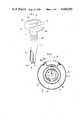
- FIG. 1is a perspective view illustrating a vibratory massage device in accordance with the preferred embodiment of the present invention
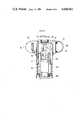
- FIG. 2is a transverse sectional view illustrating an applicator head and a flyweight employed in the above massage device
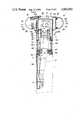
- FIG. 3is a longitudinal sectional view, partially in elevation, of the massage device as taken along line 3--3 of FIG. 2;
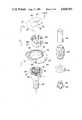
- FIG. 4is an exploded perspective view illustrating an applicator head and a connecting shaft means employed in the above device
- FIG. 5is a cross sectional view taken along line 5--5 of FIG. 4;
- FIG. 6is a schematic wiring diagram illustrating the electrical connections between the elements of the above devices.
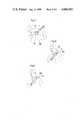
- FIGS. 7 through 9are somewhat schematic views respectively illustrating the use of the above vibratory massage device on the area of a human body for different massaging purposes.
- FIG. 10is a cross sectional view of the applicator head and a connecting shaft means illustrating a modification of the above embodiment.
- a vibratory massage devicein accordance with the present invention which includes a generally cylindrical hollow housing 1 forming a handle to be grasped by the hand of an operator and an applicator head 10 supported thereby.
- an electric motor 2Disposed within the housing 1 is an electric motor 2 which has an output rotary shaft 3 coaxial with the housing 1.
- the motor 2is connected through an electric circuit 4 to an electric source by means of a power cord 5 extending through the lower end wall of the housing 1 and energized by the operation of a switch knob 6 on one side of the housing 1.
- Said applicator head 10comprises, as best shown in FIGS. 3 and 4, a base barrel 11, a core cap 12, a generally torus shaped annulus 13, and a cover plate 14 of rigid material.
- a bearing bracket 15mounted fixedly on the upper wall of the base barrel 11, made of a durable synthetic resin such as polyoxymethylene, is a bearing bracket 15 which includes a drive shaft 16 rotatably journaled therein by a bearing 17 and bushes 18.
- the drive shaft 16is coaxial with said output shaft 3 and connected thereto by means of a flexible coil spring 41 to be driven by the motor 2.
- An eccentric flyweight 19is carried on the drive shaft 16 to produce vibrations transverse to the axis of the drive shaft 16 upon rotation of the shaft 16.
- Said annulus 13is made of a resilient material capable of being compressibly deformed, for example, of soft polyethylene and comprises a generally C-shaped band 20, when viewed in plane, of hollow construction and a narrow rib 21 integrally bridging between both ends of the band 20 to define an opening 22 inwardly thereof.
- the band 20, as shown in FIG. 3,has a generally D-shaped cross-section with the rounded side facing outwardly to define a rounded and resilient side face 23 of the applicator head 10, thus the resilient side face 23 is capable of being compressibly deformed in the radial direction of the applicator head 10 when placed against the area of a human body to be massaged.
- the annulus 13is also provided in its upper surface adjacent closely to the inner edge thereof with an upper groove 24 surrounding the top edge of the opening 22 and is also provided in its lower surface with an lower groove 25 likewise surrounding the bottom edge of the opening 22.
- Said core cap 12being made of the same durable material as the above base barrel 11, encloses the bearing bracket 15 projecting upwardly from the base barrel 11 and has an outwardly and upwardly extending integral rim 26 the lower edge of which fits snugly into the upper groove 24 of the annulus 13 to fasten the core cap 12 coaxially thereto.
- Fitted into the lower groove 25is an upwardly projecting peripheral edge 28 provided on the outmost portion of a flange 27 extending outwardly from said base barrel 11 for uniting coaxially these two members.
- Said cover plate 14is made of aluminium having a relatively rigid characteristic as well as high thermal conductivity to have a generally U-shaped cross section of an elongated top face portion 30 being slightly convex in all directions and a rounded side face portion 31 which has the same curvature of said resilient side face 23.
- the top face portion 30closes the upper opening of the annulus 13 and defines a rigid top face of the applicator head 10 which is engageable with the area of the body to be massaged, while the rounded side face portion 31 covers said narrow rib 21 of the annulus 13 to define a rigid side face which is cooperative with said resilient side face 23 to present the entire side face surrounding the applicator head 10.
- the rigid side face 31 and the resilient side face 23are respectively engageable with the area of the body and is selected to be placed against that area depending upon the types of massage to be applied, as described hereinafter.
- One part of the hem 32is received in said upper groove 24 together with said rim 26 and the rest portion thereof is received in another groove 34 extending from upper to the lower surface of the annulus 13.
- a tab 35 at the lower end of said rounded side face portion 31is provided for securing the annulus 13 to said base barrel 11 by a screw 36.
- a tightly coiled stiff spring 40is employed as a connecting shaft means for interconnecting the applicator head 10 and the housing 1.
- the upper end of the coil spring 40is securely threaded onto a hub 37 extending integrally from said bearing bracket 15 and downwardly through the upper wall of said base barrel 11 to be secured thereto.
- a sleeve 42 with a flange 43which is in turn secured to the upper end of the housing 1.
- the coil spring 40thus connected between the housing 1 and the applicator head 10 surrounds said flexible coil spring 41 to be coaxial therewith, such that the axis of the coil spring 40 or the connecting shaft means is substantially perpendicular to the top face of the applicator head 10 in its normal condition.
- a protective rubber sheath 44fits intimately onto the substantial portion of the coil spring 40 and a bellows 45 is interposed between the housing 1 and the applicator head 10.
- the numeral 46designates a shoulder ring threaded onto the upper side wall of the housing 1 and secured thereto by a screw 47 to enclose said flange 43.
- the coil spring 40Upon rotation of the eccentric flyweight 19 about the drive shaft 16 by the energization of the motor 2, the coil spring 40 allows the applicator head 10 to vibrate with respect to the housing 1 in the directions transverse to the axis of said coil spring 40, more exactly, it vibrates substantially in the plane perpendicular to the axis of coil spring 40 with minor possible vibrations at angles with respect to that axis, performing a somewhat orbital motion with respect to the housing 1. Accordingly, when the top face of the applicator head 10 is for use to be placed against the area of the human body, as illustrated in FIG. 7, the top face moves substantially in the plane of that area to apply a rubbing massage action thereto.
- the heating element 50is a positive temperature coefficient thermistor (PTC) received together with a pair of terminal plates 54 and 55 in a flat case 51 composed of a mold 52 of electrical insulating material and an aluminium cap 53 of relatively high thermal conductivity, as best shown in FIG. 5. Both conducting surfaces of the heating element (PTC) 50 is kept in contact with the terminal plates 54 and 55, which are connected to said electric circuit 4 in the housing 1 by means of a pair of lead wires 56 covered with an insulating sheath.
- PTCpositive temperature coefficient thermistor
- Said cap 53covering the upper opening of the mold 52 and holding the same abuts on its entire upper surface to the under side of the cover plate 14 of the applicator head 10 to transfer the heat from the heating element 50 efficiently to the cover plate 14 which is the body-engaging surface member, and it is bonded thereto by a suitable adhesive of high thermal conductivity, for example, epoxy resin filled with metal oxides.
- a film 57 of electrically insulating materialis inserted between the upper terminal plate 54 and the cap 53 to prevent the electrical conduction therebetween with a minimum loss in the above heat transfer.
- the cap 53is in contact with the under side of the cover plate 14 at the location closely adjacent to said rounded side face portion 31.
- Such locationis apparent from the figure to have a less curved or nearly plane surface and to be intermediate the ends along the elongated length of the cover plate 14, such that said face-bonding between the cap 53 on the side of heating element 50 and the cover plate 14 is easily attained as well as that the heat from the heating element 50 is transferred almost uniformly to each of the top face portion 30 and the side face portion 31.
- Said lead wires 56 extending from the heating element 50pass through a first vertical channel 38 in the peripheral portion of said core cap 12, a second vertical channel 39 in the base barrel 11, and the space between the bellows 45 and the rubber sheath 44, to enter the housing 1 so as to be connected to said electric circuit 4 disposed therein.
- the employment of the PTC heater of higher heat generating capacity as the heating element 50results in a simple construction of the applicator head 10 in which only one heating element is enough for heating each of said rigid top face 30 and said rigid side face 31 which are to be utilized respectively for different massaging purposes as fully discussed hereinafter.
- PTChas another important characteristic of performing self-temperature control function to automatically decrease the amount of current flowing therein as the temperature increases, so that the temperature is kept at a predetermined level. It is therefore a further advantage resulting from the employment of PTC heater that the self-temperature control performance characteristic of a PTC heater will eliminate the necessity of adopting any additional temperature control component such as a thermostat, rendering the device to be simple in construction and therefore to be easily assembled.
- the circuit 4for driving the motor 2 either independently of or concurrently with the heating element 50.
- the circuit 4includes a switch means 60 having a pair of serially connected first and second switch contacts 61 and 62, the first switch 61 being connected through a diode bridge 63 to the motor 2 and the second switch 62 connected to the heating element 50 of the PTC heater.
- These switch contactsare operated by said switch knob 6 which is a three-position slider switch and provided on one side of the housing 1.
- a combination of capacitors 64 through 67 and coils 68 and 69is introduced as noise filter means which is connected across the motor 2 with one joint point between two of the capacitors connected to a motor shield 71.
- variable resistor 72which is operated by a dial 70 mounted on the lower end portion of the housing 1 to vary the rotary speed of the motor 2 for adjusting the strength of the vibration imparted to the applicator head 10.
- the numeral 73designates a protective resistor.
- the operatorcan choose the massage mode or type between the rubbing massage and tapping massage depending upon which one of the top and side faces of the applicator head 10 is placed against the area of the body, that is, the rubbing massage treatment is attained when the top face is selected as illustrated in FIG. 7, and the tapping massage treatment is attained when the side face is selected, as illustrated in FIGS. 8 and 9. It should be noted in the above tapping massage treatment that the operator can enjoy a relatively strong tapping massage force when selecting the rigid side face as the body-contacting surface as in the manner, for example, illustrated in FIG.
- heating element 50is received in a circular cell 80 surrounded by an integrally formed annular rib 81 projecting upwardly on the center portion of said core cap 12.
- the heating element 50is received in said cell 80 together with the mold 52, the cap 53, and the terminal plates of the same construction as in the above embodiment to be centrally positioned in the applicator head 10, such that it will less subject to the effect of the vibrations and therefore be kept securely in place.
Landscapes
- Health & Medical Sciences (AREA)
- Epidemiology (AREA)
- Pain & Pain Management (AREA)
- Physical Education & Sports Medicine (AREA)
- Rehabilitation Therapy (AREA)
- Life Sciences & Earth Sciences (AREA)
- Animal Behavior & Ethology (AREA)
- General Health & Medical Sciences (AREA)
- Public Health (AREA)
- Veterinary Medicine (AREA)
- Percussion Or Vibration Massage (AREA)
- Massaging Devices (AREA)
Abstract
Description
2 1. Fields of the Invention
This invention is directed to a vibratory massage device, more particularly, a hand held vibratory massage device with heating facility.
2. Description of the Prior Art
Vibratory massages device combined with heating facility have been provided in the past for enhancing massaging treatment. Such prior art devices are shown, for example, in Japanese Utility Model Publication Nos. 44-20391 and 44-20392. In these prior devices, an applicator head includes a heating element together with an eccentric flyweight which is secured on a rotary shaft to be driven thereabout for producing vibrations in the plane perpendicular to the rotary shaft. The applicator head is generally employed in two different massaging modes depending on the area of a human body or the demand by an operator, one is for rubbing massage treatment to utilize the top face or the surface perpendicular to the axis of the shaft as a body-contacting surface which moves substantially in the plane of the area of the body upon the vibratory motion of the head, and the other is for tapping massage action to utilize the side face or the surface parallel to that axis as a body-contacting surface which apply a tapping force to the body upon the vibratory motion of the head. In the above prior devices, however, the heating element is disposed at the location adjacent either to the top face for use in the rubbing massage or alternatively to the side face for use in the tapping massage. Therefore, the heating treatment is limited to be added to only one of the above two massages, and cannot be added to each of the rubbing and tapping massage actions, restricting the applicability of the heating treatment and failing to satisfy the operator who may desire to receive a combined heat-massage treatment both in the rubbing and tapping massages. Another prior device is shown in U.S. Pat. No. 2,067,979 in which a heating element is arranged adjacent the under side of a dome shaped applicator defining the top face of a vibrator head. The vibrator head is so designed as to move generally in the direction perpendicular to the plane of the top face, effectuating a tapping massage action only by utilizing the top face as a body-contacting surface. In other words, it is not expected from this device to utilize both top and side faces for the above different massage actions. Consequently, the heat from the heating element can be understood to be applied only to the top face and is not applied to the side face, rendering the device unsatisfactory in the sense of the above discussion.
The above disadvantages or drawbacks have been eliminated by the present invention which comprises an applicator head having a top face for rubbing massaging purpose and a side face for tapping massage purpose, a housing with an upwardly extending connecting shaft means for supporting the applicator head, and a heating element disposed within the applicator head. Disposed within the applicator head is a vibration-generating source which is operatively connected to a drive means in the housing to be driven thereby for causing the applicator head to effect vibrations transverse to the axis of the shaft means with respect to the housing. During this vibratory motion of the applicator head, the top face when placed against an area of a human body will move substantially in the plane of that area to apply a rubbing massage action thereto, and the side face when placed against an area of the human body will move repeatedly to-and-fro substantially perpendicular to that area so as to apply a tapping massage action thereto. The top face of the applicator is defined by a rigid top face to which the heat from said heating element is applicable and one part of the side face is defined by a rigid side face to which the heat is likewise applicable, making it possible to apply the heat to the area of the body along with the massage action irrespective of whether the rubbing massage or the tapping massage action is selected. In addition to the above, the present invention provides a unique and useful feature in which the other part of the side face defined by a resilient side face capable of being compressibly deflected when urged against the body, whereby the strength applied to the body in the above tapping massage can be adjusted depending upon such parts of different deformability being utilized selectively to be placed against the body, that is, when the part of the rigid side face is selected for use, a relatively strong tapping massage force can be obtained as compared to a relatively gentle tapping massage force being obtained when the part of the resilient side face is selected.
Accordingly, it is a primary object of the present invention to provide a vibratory massage device which can give a combined effect of heat and massage treatments upon the area of the body in each of the rubbing mode and the tapping mode as well as can effectuate adjusting the strength of the tapping massage force applied to the body only by selecting the part of the side face of the applicator head to be placed against the body.
In the preferred embodiment of the present invention, said rigid top face is integrally formed with the rigid side face to extend continuously from the top face to the part of side face of the applicator head, and is made of the material of relatively higher thermal conductivity in order to attain rapid heat transfer from the heating element to the above two rigid faces immediately after the conduction of the heating element.
It is therefore another object of the present invention to provide a vibratory massage device with a heating facility in which only one heating element is enough for heating both the top face and the part of the side face which should be located on different sides of the applicator head for applying heat respectively in each of the rubbing and tapping massages, and in which the heating treatment can come immediately in use without substantial warm-up time.
A further advantageous feature of the present invention resides in the employment of a positive temperature coefficient thermistor as the heating element, such thermistor having inherently the self temperature control functions as well as requiring less rise time. This serves to prevent the above rigid faces from being excessively heated and yet to heat the above rigid faces more rapidly.
It is therefore a further object of the present invention to provide a vibratory massage device with heating facility which eliminates the danger of the applicator head being heated excessively without any additional protecting means.
In the preferred embodiment of the invention, said rigid side face and the resilient side face are respectively designed to have rounded circumferences of substantially the same curvature such that each of the side faces can readily and comfortably fit the body contour to apply an effective tapping massage action. Said rigid top face is shaped to be at least slightly convex in all directions and curves integrally into the rounded rigid side face so as to leave a spot thereunder at the location adjacent to the rigid side face for receiving said heating element, and said spot for the heating element is disposed intermediate both longitudinal ends of a member constituting rigid top and side faces. With this arrangement, the heating element is readily attached by face-bonding to the under side of said member and yet can transfer its heat almost uniformly without a substantial temperature gradient therebetween.
The above and other advantages of the present invention will be better understood from the following detailed description when considered in connection with the accompanying drawings.
In the drawings,
FIG. 1 is a perspective view illustrating a vibratory massage device in accordance with the preferred embodiment of the present invention;
FIG. 2 is a transverse sectional view illustrating an applicator head and a flyweight employed in the above massage device;
FIG. 3 is a longitudinal sectional view, partially in elevation, of the massage device as taken alongline 3--3 of FIG. 2;
FIG. 4 is an exploded perspective view illustrating an applicator head and a connecting shaft means employed in the above device;
FIG. 5 is a cross sectional view taken alongline 5--5 of FIG. 4;
FIG. 6 is a schematic wiring diagram illustrating the electrical connections between the elements of the above devices;
FIGS. 7 through 9 are somewhat schematic views respectively illustrating the use of the above vibratory massage device on the area of a human body for different massaging purposes; and
FIG. 10 is a cross sectional view of the applicator head and a connecting shaft means illustrating a modification of the above embodiment.
Referring now to the drawings and particularly to FIGS. 1 through 4, there is illustrated a vibratory massage device in accordance with the present invention which includes a generally cylindrical hollow housing 1 forming a handle to be grasped by the hand of an operator and anapplicator head 10 supported thereby. Disposed within the housing 1 is anelectric motor 2 which has an outputrotary shaft 3 coaxial with the housing 1. Themotor 2 is connected through anelectric circuit 4 to an electric source by means of apower cord 5 extending through the lower end wall of the housing 1 and energized by the operation of aswitch knob 6 on one side of the housing 1.
Saidapplicator head 10 comprises, as best shown in FIGS. 3 and 4, a base barrel 11, acore cap 12, a generally torus shapedannulus 13, and acover plate 14 of rigid material. Mounted fixedly on the upper wall of the base barrel 11, made of a durable synthetic resin such as polyoxymethylene, is abearing bracket 15 which includes adrive shaft 16 rotatably journaled therein by abearing 17 andbushes 18. Thedrive shaft 16 is coaxial with saidoutput shaft 3 and connected thereto by means of aflexible coil spring 41 to be driven by themotor 2. Aneccentric flyweight 19 is carried on thedrive shaft 16 to produce vibrations transverse to the axis of thedrive shaft 16 upon rotation of theshaft 16.
Saidannulus 13 is made of a resilient material capable of being compressibly deformed, for example, of soft polyethylene and comprises a generally C-shaped band 20, when viewed in plane, of hollow construction and anarrow rib 21 integrally bridging between both ends of theband 20 to define an opening 22 inwardly thereof. Theband 20, as shown in FIG. 3, has a generally D-shaped cross-section with the rounded side facing outwardly to define a rounded andresilient side face 23 of theapplicator head 10, thus theresilient side face 23 is capable of being compressibly deformed in the radial direction of theapplicator head 10 when placed against the area of a human body to be massaged. Theannulus 13 is also provided in its upper surface adjacent closely to the inner edge thereof with anupper groove 24 surrounding the top edge of theopening 22 and is also provided in its lower surface with anlower groove 25 likewise surrounding the bottom edge of theopening 22. Saidcore cap 12, being made of the same durable material as the above base barrel 11, encloses thebearing bracket 15 projecting upwardly from the base barrel 11 and has an outwardly and upwardly extendingintegral rim 26 the lower edge of which fits snugly into theupper groove 24 of theannulus 13 to fasten thecore cap 12 coaxially thereto. Fitted into thelower groove 25 is an upwardly projectingperipheral edge 28 provided on the outmost portion of aflange 27 extending outwardly from said base barrel 11 for uniting coaxially these two members. Saidcover plate 14 is made of aluminium having a relatively rigid characteristic as well as high thermal conductivity to have a generally U-shaped cross section of an elongatedtop face portion 30 being slightly convex in all directions and a roundedside face portion 31 which has the same curvature of saidresilient side face 23. Thetop face portion 30 closes the upper opening of theannulus 13 and defines a rigid top face of theapplicator head 10 which is engageable with the area of the body to be massaged, while the roundedside face portion 31 covers saidnarrow rib 21 of theannulus 13 to define a rigid side face which is cooperative with saidresilient side face 23 to present the entire side face surrounding theapplicator head 10. Therigid side face 31 and theresilient side face 23 are respectively engageable with the area of the body and is selected to be placed against that area depending upon the types of massage to be applied, as described hereinafter. Extended inwardly from the periphery of thecover plate 14 is ahem 32 withslots 33 into which hooks 49 on saidrim 26 of thecore cap 12 snap respectively so that thecover plate 14 is secured via thecore cap 12 to theannulus 13. One part of thehem 32 is received in saidupper groove 24 together with saidrim 26 and the rest portion thereof is received in anothergroove 34 extending from upper to the lower surface of theannulus 13. Atab 35 at the lower end of said roundedside face portion 31 is provided for securing theannulus 13 to said base barrel 11 by ascrew 36.
A tightly coiledstiff spring 40 is employed as a connecting shaft means for interconnecting theapplicator head 10 and the housing 1. The upper end of thecoil spring 40 is securely threaded onto ahub 37 extending integrally from saidbearing bracket 15 and downwardly through the upper wall of said base barrel 11 to be secured thereto. Into the lower end portion of thecoil spring 40 is securely threaded asleeve 42 with aflange 43 which is in turn secured to the upper end of the housing 1. Thecoil spring 40 thus connected between the housing 1 and theapplicator head 10 surrounds saidflexible coil spring 41 to be coaxial therewith, such that the axis of thecoil spring 40 or the connecting shaft means is substantially perpendicular to the top face of theapplicator head 10 in its normal condition. Aprotective rubber sheath 44 fits intimately onto the substantial portion of thecoil spring 40 and abellows 45 is interposed between the housing 1 and theapplicator head 10. The numeral 46 designates a shoulder ring threaded onto the upper side wall of the housing 1 and secured thereto by ascrew 47 to enclose saidflange 43.
Upon rotation of theeccentric flyweight 19 about thedrive shaft 16 by the energization of themotor 2, thecoil spring 40 allows theapplicator head 10 to vibrate with respect to the housing 1 in the directions transverse to the axis of saidcoil spring 40, more exactly, it vibrates substantially in the plane perpendicular to the axis ofcoil spring 40 with minor possible vibrations at angles with respect to that axis, performing a somewhat orbital motion with respect to the housing 1. Accordingly, when the top face of theapplicator head 10 is for use to be placed against the area of the human body, as illustrated in FIG. 7, the top face moves substantially in the plane of that area to apply a rubbing massage action thereto. On the other hand, when the side face of theapplicator head 10 is placed against the area of the body during the above vibration, as illustrated in FIGS. 8 and 9, the side face of theapplicator 10 moves to-and-fro substantially perpendicular to that area to apply a tapping force thereto. In this connection, when the resilient side face 23 of theapplicator head 10 is selected to be placed against the body, a relatively gentle tapping massage treatment is obtained due to the deformability of theresilient side face 23, as compared to the case when therigid side face 31 is selected to apply a relatively strong tapping massage force to the body.
Also included in theapplicator head 10 is aheating element 50 to apply along with each of said massage actions heat to the area of the body being massaged. Theheating element 50 in the present embodiment is a positive temperature coefficient thermistor (PTC) received together with a pair ofterminal plates flat case 51 composed of amold 52 of electrical insulating material and analuminium cap 53 of relatively high thermal conductivity, as best shown in FIG. 5. Both conducting surfaces of the heating element (PTC) 50 is kept in contact with theterminal plates electric circuit 4 in the housing 1 by means of a pair oflead wires 56 covered with an insulating sheath. Saidcap 53 covering the upper opening of themold 52 and holding the same abuts on its entire upper surface to the under side of thecover plate 14 of theapplicator head 10 to transfer the heat from theheating element 50 efficiently to thecover plate 14 which is the body-engaging surface member, and it is bonded thereto by a suitable adhesive of high thermal conductivity, for example, epoxy resin filled with metal oxides. Afilm 57 of electrically insulating material is inserted between theupper terminal plate 54 and thecap 53 to prevent the electrical conduction therebetween with a minimum loss in the above heat transfer. As shown in the same figure, thecap 53 is in contact with the under side of thecover plate 14 at the location closely adjacent to said roundedside face portion 31. Such location is apparent from the figure to have a less curved or nearly plane surface and to be intermediate the ends along the elongated length of thecover plate 14, such that said face-bonding between thecap 53 on the side ofheating element 50 and thecover plate 14 is easily attained as well as that the heat from theheating element 50 is transferred almost uniformly to each of thetop face portion 30 and theside face portion 31. Saidlead wires 56 extending from theheating element 50 pass through a firstvertical channel 38 in the peripheral portion of saidcore cap 12, a secondvertical channel 39 in the base barrel 11, and the space between thebellows 45 and therubber sheath 44, to enter the housing 1 so as to be connected to saidelectric circuit 4 disposed therein. As described above, the employment of the PTC heater of higher heat generating capacity as theheating element 50 results in a simple construction of theapplicator head 10 in which only one heating element is enough for heating each of said rigidtop face 30 and saidrigid side face 31 which are to be utilized respectively for different massaging purposes as fully discussed hereinafter. PTC has another important characteristic of performing self-temperature control function to automatically decrease the amount of current flowing therein as the temperature increases, so that the temperature is kept at a predetermined level. It is therefore a further advantage resulting from the employment of PTC heater that the self-temperature control performance characteristic of a PTC heater will eliminate the necessity of adopting any additional temperature control component such as a thermostat, rendering the device to be simple in construction and therefore to be easily assembled.
Referring to FIG. 6, there is illustrated saidelectric circuit 4 for driving themotor 2 either independently of or concurrently with theheating element 50. Thecircuit 4 includes a switch means 60 having a pair of serially connected first andsecond switch contacts first switch 61 being connected through adiode bridge 63 to themotor 2 and thesecond switch 62 connected to theheating element 50 of the PTC heater. These switch contacts are operated by saidswitch knob 6 which is a three-position slider switch and provided on one side of the housing 1. A combination ofcapacitors 64 through 67 and coils 68 and 69 is introduced as noise filter means which is connected across themotor 2 with one joint point between two of the capacitors connected to amotor shield 71. Also included in thecircuit 4 is avariable resistor 72 which is operated by adial 70 mounted on the lower end portion of the housing 1 to vary the rotary speed of themotor 2 for adjusting the strength of the vibration imparted to theapplicator head 10. The numeral 73 designates a protective resistor.
In operation, when theswitch contact 61 is closed while theswitch contact 62 remains open, only themotor 2 is energized to vibrate theapplicator head 10 with respect to the housing 1, as described above. In this condition, the operator can choose the massage mode or type between the rubbing massage and tapping massage depending upon which one of the top and side faces of theapplicator head 10 is placed against the area of the body, that is, the rubbing massage treatment is attained when the top face is selected as illustrated in FIG. 7, and the tapping massage treatment is attained when the side face is selected, as illustrated in FIGS. 8 and 9. It should be noted in the above tapping massage treatment that the operator can enjoy a relatively strong tapping massage force when selecting the rigid side face as the body-contacting surface as in the manner, for example, illustrated in FIG. 9, and enjoy a relatively gentle tapping massage force when selecting the resilient side face as in the manner, for examples, illustrated in FIG. 9. When both switchcontacts heating element 50 is energized to add heat to thecover plate 14 of the vibratingapplicator head 10, so that the operator can enjoy a combined effect of heating and massage treatments in each of said massaging modes, i.e., in the rubbing massage to select the rigid top face of theapplicator head 10 and in the tapping massage to select the rigid side face of the same. With this arrangement, it is successfully achieved that the combined heat-massage treatment can be applied to the area of the body in a most comfortable and effective way depending upon the location and the requirement of the area to be massaged. Referring to FIG. 10, there is illustrated a modification of the above embodiment which is similar to the above embodiment except that theheating element 50 is received in a circular cell 80 surrounded by an integrally formedannular rib 81 projecting upwardly on the center portion of saidcore cap 12. Theheating element 50 is received in said cell 80 together with themold 52, thecap 53, and the terminal plates of the same construction as in the above embodiment to be centrally positioned in theapplicator head 10, such that it will less subject to the effect of the vibrations and therefore be kept securely in place.
The above embodiments and particularly the drawings are set forth for purposes of illustration only. It will be understood that many variations and modifications of the embodiment herein described will be obvious to those skilled in the art, and may be carried out without departing from the spirit and scope of the invention.
Claims (1)
1. A vibratory massage device comprising:
an elongated housing adapted to fit the user's hand and enclosing an electric motor, the housing being outwardly flared at one end to form an applicator head of fungiform shape;
the applicator head having a generally flat to face, a portion thereof being rigid and of good thermal conductivity and a side face which is generally C shaped in cross section;
the C shaped side face having a first portion which is rigid and of good thermal conductivity extending part way circumferentially around the applicator head and a second portion which is resilient and etends around the remainder of the circumference of the applicator head;
a positive temperature coefficient electric heating element within the applicator head and disposed closely adjacent the underside of the rigid portion thereof, and in good thermal conductive contact therewith;
an eccentric weight mounted for rotation within said applicator head about an axis perpendicular to the generally flat top face and means connecting the weight to the motor for rotation thereby;
the rotation of the eccentric weight being such as to cause a rubbing massage when the generally flat end face is contacted by the user and a tapping massage action when either the rigid or resilient side faces are contacted by the user.
Applications Claiming Priority (2)
| Application Number | Priority Date | Filing Date | Title |
|---|---|---|---|
| JP58014149AJPS59139261A (en) | 1983-01-31 | 1983-01-31 | Vibration massage machine |
| JP58-14149 | 1983-01-31 |
Publications (1)
| Publication Number | Publication Date |
|---|---|
| US4604993Atrue US4604993A (en) | 1986-08-12 |
Family
ID=11853089
Family Applications (1)
| Application Number | Title | Priority Date | Filing Date |
|---|---|---|---|
| US06/560,849Expired - LifetimeUS4604993A (en) | 1983-01-31 | 1983-12-13 | Vibratory massage device |
Country Status (4)
| Country | Link |
|---|---|
| US (1) | US4604993A (en) |
| JP (1) | JPS59139261A (en) |
| DE (1) | DE3400587C2 (en) |
| GB (1) | GB2133990B (en) |
Cited By (40)
| Publication number | Priority date | Publication date | Assignee | Title |
|---|---|---|---|---|
| DE3725891A1 (en)* | 1986-08-20 | 1988-02-25 | Matsushita Electric Works Ltd | MASSAGE VIBRATOR |
| US4846158A (en)* | 1986-06-06 | 1989-07-11 | Akihiko Teranishi | Hand type electric massage machine |
| US4878489A (en)* | 1988-07-11 | 1989-11-07 | Tensho Electric Industrial Co., Ltd. | Massage unit |
| USD315408S (en) | 1987-06-04 | 1991-03-12 | Sealand Industrial Co., Ltd. | Massager |
| US5117815A (en)* | 1990-10-31 | 1992-06-02 | Associated Mills Inc. | Massager |
| USD329290S (en) | 1990-03-30 | 1992-09-08 | Associated Mills, Inc. | Massager |
| USD338070S (en) | 1990-08-28 | 1993-08-03 | Sealand Industrial Co., Ltd. | Combined massager and torch |
| USD351660S (en) | 1992-01-17 | 1994-10-18 | Matsushita Electric Works, Ltd. | Electric massager |
| USD367712S (en) | 1995-05-22 | 1996-03-05 | General Physiotherapy | Cordless hand held massager |
| USD374935S (en) | 1993-12-30 | 1996-10-22 | Kolvin Industries Limited | Massager |
| US5606754A (en) | 1989-03-09 | 1997-03-04 | Ssi Medical Services, Inc. | Vibratory patient support system |
| USD400260S (en) | 1997-01-10 | 1998-10-27 | Matsushita Electric Works, Ltd. | Electric massager |
| USD411305S (en) | 1998-03-31 | 1999-06-22 | Matsushita Electric Works, Ltd. | Head for an electric massage apparatus |
| US5925002A (en)* | 1995-09-22 | 1999-07-20 | Hwe, Inc. | Hand-held vibratory massager |
| USD414582S (en) | 1997-11-28 | 1999-09-28 | Hyeon-Bae Hwang | Skin beauty apparatus |
| USD438308S1 (en) | 1999-12-22 | 2001-02-27 | Brookstone Company, Inc. | Hand held massager with rotatable head |
| USD497208S1 (en) | 2003-08-06 | 2004-10-12 | Chininis Product Development Group Llc | Shower massager |
| US20040243031A1 (en)* | 2002-02-21 | 2004-12-02 | Calvert Jay Wynn | Massager and method of using same |
| US6866644B1 (en) | 2002-01-23 | 2005-03-15 | Jonathan Kost | Myotherapy massage device |
| US20050209537A1 (en)* | 2004-03-19 | 2005-09-22 | Gleason J N | Method and apparatus for providing hot and cold massage |
| US20060211961A1 (en)* | 2005-03-18 | 2006-09-21 | Meyer Elizabeth H | Massager with shock absorption, multiple contact surfaces and visual therapy effects |
| US20080091128A1 (en)* | 2006-10-16 | 2008-04-17 | Nanma Manufacturing Co. Ltd. | Massage apparatus with an elastic massage actuator |
| US20090221944A1 (en)* | 2005-12-07 | 2009-09-03 | Merlex Corporation Pty Ltd | Hand Held Massaging Tool |
| US20110087141A1 (en)* | 2009-10-13 | 2011-04-14 | Roger Wagy | Powered Massage Device |
| US20110105964A1 (en)* | 2007-11-05 | 2011-05-05 | Fka Distributing Co. D/B/A Homedics, Inc. | Massage apparatus with heater |
| USD649656S1 (en)* | 2010-10-01 | 2011-11-29 | Brookstone Purchasing, Inc. | Vibratory massager |
| US20120253245A1 (en)* | 2010-12-16 | 2012-10-04 | Stanbridge Stanley R | Therapeutic device and method for scar tissue therapy having intermediate and opposed heads |
| US20130204085A1 (en)* | 2012-02-07 | 2013-08-08 | Ian J. Alexander | System and method for a magnetic endoscope |
| US20140336549A1 (en)* | 2013-05-13 | 2014-11-13 | Tsung-Hsun Yang | Massage Apparatus |
| US20150150479A1 (en)* | 2012-08-14 | 2015-06-04 | Terumo Kabushiki Kaisha | Device for measuring the amount of water in a subject's body |
| US20170273858A1 (en)* | 2016-03-24 | 2017-09-28 | Lyndy Ngu | Method and Apparatus for Affecting Wellness Through Topical Application of Hand-held Rods |
| US10029079B2 (en) | 2011-10-18 | 2018-07-24 | Treble Innovations | Endoscopic peripheral |
| US10201472B2 (en) | 2014-06-17 | 2019-02-12 | Neue Kinetik, LLC | Tri-motion tactile stimulation device |
| US10321807B2 (en) | 2011-10-18 | 2019-06-18 | Treble Innovations, Llc | Methods of performing internal body imaging |
| US10548810B2 (en) | 2015-01-28 | 2020-02-04 | Rapid Release Technology, LLC | Systems and methods for high speed vibration therapy |
| US10633786B2 (en) | 2017-10-11 | 2020-04-28 | Timothy D. Spencer | Aerator |
| US20220151869A1 (en)* | 2018-04-10 | 2022-05-19 | Benjamin J. Blankenship | System, method and computer assisted media in use with a robotic therapy unit for accomplishing muscle lengthening conducted according to best practice protocols |
| US20220304887A1 (en)* | 2021-03-25 | 2022-09-29 | Biboting International Co., Ltd. | Massage device |
| US20240216210A1 (en)* | 2019-02-07 | 2024-07-04 | Age Sciences, Inc. Dba Pmd Beauty | Skin care devices |
| WO2025156164A1 (en)* | 2024-01-24 | 2025-07-31 | 程巧 | Hot and cold massage vibrator |
Families Citing this family (21)
| Publication number | Priority date | Publication date | Assignee | Title |
|---|---|---|---|---|
| DE3416641C2 (en)* | 1984-05-05 | 1986-04-24 | Metronic Electronic GmbH, 7210 Rottweil | Massager |
| DE3430881A1 (en)* | 1984-08-22 | 1986-03-06 | Heddernheimer Metallwarenfabrik GmbH, 7750 Konstanz | Device for carrying out body massage |
| US4632095A (en)* | 1984-11-05 | 1986-12-30 | Tamiko Inc. | Pressure-point attachment for use with electrical hand-held massagers |
| JPS62207478A (en)* | 1986-03-07 | 1987-09-11 | 株式会社 ニユ−ギン | Pinball machine |
| DE3639134A1 (en)* | 1986-11-15 | 1988-05-19 | Moser Gmbh Kuno | HAND MASSAGE MACHINE |
| AU623937B2 (en)* | 1988-12-28 | 1992-05-28 | Bio Pit Co., Ltd. | A massager |
| CA2113524A1 (en)* | 1993-09-03 | 1995-03-04 | Andrew Christopher Burroughs | Hand-held massager with rotating head |
| BE1007557A3 (en)* | 1993-10-27 | 1995-08-01 | Ponnet Gilman En Anthony | Equipment to bring to stoma plates on. |
| FR2746271B1 (en)* | 1996-03-20 | 1998-07-10 | Ronic Ind | DERIDING DEVICE |
| DE19615793C1 (en)* | 1996-04-20 | 1997-10-30 | Siegfried Hoffmann | Swing head for massagers |
| DE19852608C2 (en) | 1998-11-16 | 2000-12-14 | Ruf Helga | Vibration therapy device |
| TW558430B (en) | 2000-11-01 | 2003-10-21 | Kao Corp | Cleaning device |
| HK1200084A1 (en)* | 2011-09-30 | 2015-07-31 | 强生消费者公司 | Handheld device with thermal body- care element |
| WO2014027373A1 (en)* | 2012-08-13 | 2014-02-20 | テルモ株式会社 | Body water content meter, control method for body water content meter, and storage medium |
| CN104411235B (en)* | 2012-08-14 | 2017-05-24 | 泰尔茂株式会社 | Body water content meter |
| JPWO2014027379A1 (en)* | 2012-08-14 | 2016-07-25 | テルモ株式会社 | Body moisture meter |
| CN103690348A (en)* | 2013-12-12 | 2014-04-02 | 樊书印 | Miniaturized face massager |
| CN103655144A (en)* | 2013-12-12 | 2014-03-26 | 樊书印 | Miniature facial massager |
| CN103655145A (en)* | 2013-12-12 | 2014-03-26 | 樊书印 | Miniature facial massager |
| CN103655143A (en)* | 2013-12-12 | 2014-03-26 | 樊书印 | Miniature facial massager |
| JP7281765B2 (en)* | 2019-04-10 | 2023-05-26 | パナソニックIpマネジメント株式会社 | beauty equipment |
Citations (13)
| Publication number | Priority date | Publication date | Assignee | Title |
|---|---|---|---|---|
| DE213040C (en)* | ||||
| DE299415C (en)* | ||||
| DE195939C (en)* | ||||
| US923234A (en)* | 1908-04-16 | 1909-06-01 | William F Acton | Vibrator. |
| US942299A (en)* | 1909-06-26 | 1909-12-07 | Henrik Wiking | Massage device. |
| US1113079A (en)* | 1913-12-06 | 1914-10-06 | Nick E Wilmes | Vibrator massage implement. |
| US1723268A (en)* | 1927-10-29 | 1929-08-06 | Conill Fernan Oscar | Mechanically-driven massage apparatus |
| US2067979A (en)* | 1935-10-03 | 1937-01-19 | Eugene H Cassidy | Therapeutic vibrator |
| DE1095987B (en)* | 1952-04-09 | 1960-12-29 | Louis Grossi | Heatable vibration massage device |
| US3468304A (en)* | 1966-05-19 | 1969-09-23 | Akihiko Teranishi | Electric massager |
| US3503395A (en)* | 1968-02-01 | 1970-03-31 | Wahl Clipper Corp | Heated vibratory massager |
| US3710785A (en)* | 1970-11-27 | 1973-01-16 | Ass Mills Inc | Massager |
| DE2750799A1 (en)* | 1977-11-14 | 1979-05-17 | Otto Eichenauer | HAND DEVICE FOR COSMETIC MASSAGE |
Family Cites Families (1)
| Publication number | Priority date | Publication date | Assignee | Title |
|---|---|---|---|---|
| GB1270202A (en)* | 1970-03-09 | 1972-04-12 | Sakae Oyoshihara | An instrument for applying heat and pressure to the human skin |
- 1983
- 1983-01-31JPJP58014149Apatent/JPS59139261A/enactiveGranted
- 1983-12-13USUS06/560,849patent/US4604993A/ennot_activeExpired - Lifetime
- 1984
- 1984-01-10DEDE3400587Apatent/DE3400587C2/ennot_activeExpired
- 1984-01-20GBGB08401536Apatent/GB2133990B/ennot_activeExpired
Patent Citations (13)
| Publication number | Priority date | Publication date | Assignee | Title |
|---|---|---|---|---|
| DE213040C (en)* | ||||
| DE299415C (en)* | ||||
| DE195939C (en)* | ||||
| US923234A (en)* | 1908-04-16 | 1909-06-01 | William F Acton | Vibrator. |
| US942299A (en)* | 1909-06-26 | 1909-12-07 | Henrik Wiking | Massage device. |
| US1113079A (en)* | 1913-12-06 | 1914-10-06 | Nick E Wilmes | Vibrator massage implement. |
| US1723268A (en)* | 1927-10-29 | 1929-08-06 | Conill Fernan Oscar | Mechanically-driven massage apparatus |
| US2067979A (en)* | 1935-10-03 | 1937-01-19 | Eugene H Cassidy | Therapeutic vibrator |
| DE1095987B (en)* | 1952-04-09 | 1960-12-29 | Louis Grossi | Heatable vibration massage device |
| US3468304A (en)* | 1966-05-19 | 1969-09-23 | Akihiko Teranishi | Electric massager |
| US3503395A (en)* | 1968-02-01 | 1970-03-31 | Wahl Clipper Corp | Heated vibratory massager |
| US3710785A (en)* | 1970-11-27 | 1973-01-16 | Ass Mills Inc | Massager |
| DE2750799A1 (en)* | 1977-11-14 | 1979-05-17 | Otto Eichenauer | HAND DEVICE FOR COSMETIC MASSAGE |
Non-Patent Citations (2)
| Title |
|---|
| "Kaltleiter messen, schalten und heizen", Funkschau, by Peter Kleinschmidt, Dr. Hans Meixner, 1981, pp. 71-75. |
| Kaltleiter messen, schalten und heizen , Funkschau, by Peter Kleinschmidt, Dr. Hans Meixner, 1981, pp. 71 75.* |
Cited By (59)
| Publication number | Priority date | Publication date | Assignee | Title |
|---|---|---|---|---|
| US4846158A (en)* | 1986-06-06 | 1989-07-11 | Akihiko Teranishi | Hand type electric massage machine |
| US4825853A (en)* | 1986-08-20 | 1989-05-02 | Matsushita Electric Works, Ltd. | Hand-held vibratory massager |
| US4958628A (en)* | 1986-08-20 | 1990-09-25 | Matsushita Electric Works, Ltd. | Hand-held vibratory massager |
| DE3725891A1 (en)* | 1986-08-20 | 1988-02-25 | Matsushita Electric Works Ltd | MASSAGE VIBRATOR |
| USD315408S (en) | 1987-06-04 | 1991-03-12 | Sealand Industrial Co., Ltd. | Massager |
| US4878489A (en)* | 1988-07-11 | 1989-11-07 | Tensho Electric Industrial Co., Ltd. | Massage unit |
| US5606754A (en) | 1989-03-09 | 1997-03-04 | Ssi Medical Services, Inc. | Vibratory patient support system |
| US6820640B2 (en) | 1989-03-09 | 2004-11-23 | Hill-Rom Services, Inc. | Vibratory patient support system |
| US6415814B1 (en) | 1989-03-09 | 2002-07-09 | Hill-Rom Services, Inc. | Vibratory patient support system |
| US6098222A (en) | 1989-03-09 | 2000-08-08 | Hill-Rom Company, Inc. | Vibratory patient support system |
| USD329290S (en) | 1990-03-30 | 1992-09-08 | Associated Mills, Inc. | Massager |
| USD338070S (en) | 1990-08-28 | 1993-08-03 | Sealand Industrial Co., Ltd. | Combined massager and torch |
| US5117815A (en)* | 1990-10-31 | 1992-06-02 | Associated Mills Inc. | Massager |
| USD351660S (en) | 1992-01-17 | 1994-10-18 | Matsushita Electric Works, Ltd. | Electric massager |
| USD374935S (en) | 1993-12-30 | 1996-10-22 | Kolvin Industries Limited | Massager |
| USD367712S (en) | 1995-05-22 | 1996-03-05 | General Physiotherapy | Cordless hand held massager |
| US5925002A (en)* | 1995-09-22 | 1999-07-20 | Hwe, Inc. | Hand-held vibratory massager |
| USD400260S (en) | 1997-01-10 | 1998-10-27 | Matsushita Electric Works, Ltd. | Electric massager |
| USD414582S (en) | 1997-11-28 | 1999-09-28 | Hyeon-Bae Hwang | Skin beauty apparatus |
| USD411305S (en) | 1998-03-31 | 1999-06-22 | Matsushita Electric Works, Ltd. | Head for an electric massage apparatus |
| USD438308S1 (en) | 1999-12-22 | 2001-02-27 | Brookstone Company, Inc. | Hand held massager with rotatable head |
| US6866644B1 (en) | 2002-01-23 | 2005-03-15 | Jonathan Kost | Myotherapy massage device |
| US20040243031A1 (en)* | 2002-02-21 | 2004-12-02 | Calvert Jay Wynn | Massager and method of using same |
| US7041072B2 (en) | 2002-02-21 | 2006-05-09 | Matrix Surgical Consulting Corporation | Massager and method of using same |
| US20060155224A1 (en)* | 2002-02-21 | 2006-07-13 | Matrix Surgical Consulting Corporation | Massager and method of using same |
| USD497208S1 (en) | 2003-08-06 | 2004-10-12 | Chininis Product Development Group Llc | Shower massager |
| US7211057B2 (en)* | 2004-03-19 | 2007-05-01 | Brookstone Purchasing | Method and apparatus for providing hot and cold massage |
| US20050209537A1 (en)* | 2004-03-19 | 2005-09-22 | Gleason J N | Method and apparatus for providing hot and cold massage |
| US20060211961A1 (en)* | 2005-03-18 | 2006-09-21 | Meyer Elizabeth H | Massager with shock absorption, multiple contact surfaces and visual therapy effects |
| US7699794B2 (en) | 2005-03-18 | 2010-04-20 | Fka Distributing Co. | Massager with shock absorption, multiple contact surfaces and visual therapy effects |
| US20090221944A1 (en)* | 2005-12-07 | 2009-09-03 | Merlex Corporation Pty Ltd | Hand Held Massaging Tool |
| US8419662B2 (en) | 2005-12-07 | 2013-04-16 | Merlex Corporation Pty Ltd | Hand held massaging tool |
| US20080091128A1 (en)* | 2006-10-16 | 2008-04-17 | Nanma Manufacturing Co. Ltd. | Massage apparatus with an elastic massage actuator |
| US8556835B2 (en)* | 2007-11-05 | 2013-10-15 | Fka Distributing Co. | Massage apparatus with heater |
| US20110105964A1 (en)* | 2007-11-05 | 2011-05-05 | Fka Distributing Co. D/B/A Homedics, Inc. | Massage apparatus with heater |
| US20110087141A1 (en)* | 2009-10-13 | 2011-04-14 | Roger Wagy | Powered Massage Device |
| USD649656S1 (en)* | 2010-10-01 | 2011-11-29 | Brookstone Purchasing, Inc. | Vibratory massager |
| US9265689B2 (en)* | 2010-12-16 | 2016-02-23 | Stanley R. Stanbridge | Therapeutic device and method for scar tissue therapy having intermediate and opposed heads |
| US20120253245A1 (en)* | 2010-12-16 | 2012-10-04 | Stanbridge Stanley R | Therapeutic device and method for scar tissue therapy having intermediate and opposed heads |
| US10321807B2 (en) | 2011-10-18 | 2019-06-18 | Treble Innovations, Llc | Methods of performing internal body imaging |
| US10945589B2 (en) | 2011-10-18 | 2021-03-16 | Treble Innovations, Llc | Flexible endoscopic peripheral |
| US10682042B2 (en) | 2011-10-18 | 2020-06-16 | Treble Innovations, Llc | Wireless viewing system and method |
| US11445891B2 (en) | 2011-10-18 | 2022-09-20 | Treble Innovations, Llc | Portable wireless endoscope |
| US12208225B2 (en) | 2011-10-18 | 2025-01-28 | Treble Innovations, Llc | Flexible endoscopic peripheral |
| US10029079B2 (en) | 2011-10-18 | 2018-07-24 | Treble Innovations | Endoscopic peripheral |
| US20130204085A1 (en)* | 2012-02-07 | 2013-08-08 | Ian J. Alexander | System and method for a magnetic endoscope |
| US10143358B2 (en)* | 2012-02-07 | 2018-12-04 | Treble Innovations, Llc | System and method for a magnetic endoscope |
| US9782105B2 (en)* | 2012-08-14 | 2017-10-10 | Terumo Kabushiki Kaisha | Device for measuring the amount of water in a subject's body |
| US20150150479A1 (en)* | 2012-08-14 | 2015-06-04 | Terumo Kabushiki Kaisha | Device for measuring the amount of water in a subject's body |
| US9364385B2 (en)* | 2013-05-13 | 2016-06-14 | Tsung-Hsun Yang | Massage apparatus |
| US20140336549A1 (en)* | 2013-05-13 | 2014-11-13 | Tsung-Hsun Yang | Massage Apparatus |
| US10201472B2 (en) | 2014-06-17 | 2019-02-12 | Neue Kinetik, LLC | Tri-motion tactile stimulation device |
| US10548810B2 (en) | 2015-01-28 | 2020-02-04 | Rapid Release Technology, LLC | Systems and methods for high speed vibration therapy |
| US20170273858A1 (en)* | 2016-03-24 | 2017-09-28 | Lyndy Ngu | Method and Apparatus for Affecting Wellness Through Topical Application of Hand-held Rods |
| US10633786B2 (en) | 2017-10-11 | 2020-04-28 | Timothy D. Spencer | Aerator |
| US20220151869A1 (en)* | 2018-04-10 | 2022-05-19 | Benjamin J. Blankenship | System, method and computer assisted media in use with a robotic therapy unit for accomplishing muscle lengthening conducted according to best practice protocols |
| US20240216210A1 (en)* | 2019-02-07 | 2024-07-04 | Age Sciences, Inc. Dba Pmd Beauty | Skin care devices |
| US20220304887A1 (en)* | 2021-03-25 | 2022-09-29 | Biboting International Co., Ltd. | Massage device |
| WO2025156164A1 (en)* | 2024-01-24 | 2025-07-31 | 程巧 | Hot and cold massage vibrator |
Also Published As
| Publication number | Publication date |
|---|---|
| JPS59139261A (en) | 1984-08-10 |
| GB2133990A (en) | 1984-08-08 |
| DE3400587A1 (en) | 1984-08-09 |
| JPS6116181B2 (en) | 1986-04-28 |
| GB2133990B (en) | 1986-05-08 |
| GB8401536D0 (en) | 1984-02-22 |
| DE3400587C2 (en) | 1986-07-10 |
Similar Documents
| Publication | Publication Date | Title |
|---|---|---|
| US4604993A (en) | Vibratory massage device | |
| US4441487A (en) | Cosmetic and therapeutic appliance | |
| CA1168536A (en) | Heating pad | |
| US4640340A (en) | Heated or cooled steering wheel | |
| US4631976A (en) | Steering wheel | |
| KR890004510B1 (en) | Portable vibrating massager | |
| US5327886A (en) | Electronic massage device with cold/hot compress function | |
| US4777346A (en) | Electrically heated therapeutic pillow | |
| US3710785A (en) | Massager | |
| US6267736B1 (en) | Articulated multi-directional hand-held massage apparatus | |
| WO1996032915A1 (en) | Finger massage apparatus | |
| US4513736A (en) | Cushioned massager | |
| KR20000043488A (en) | Electronic massage device | |
| US6037078A (en) | Battery compartment | |
| US3811430A (en) | Massaging device | |
| US3885553A (en) | Flexible therapeutic pad and vibratory armature therefor | |
| CN208823396U (en) | A kind of multifunctional instrument for face beauty | |
| US3468304A (en) | Electric massager | |
| JPH09262123A (en) | Hair setting method and device therefor | |
| GB2090746A (en) | Heating pad with vibrator for body massage | |
| US3220405A (en) | Vibrating massage device with wobbling magnet | |
| JPH0249948B2 (en) | ||
| CA1166913A (en) | Cushioned massager | |
| JPH0310744Y2 (en) | ||
| JPH0719472Y2 (en) | Vibrating needle pressure massager |
Legal Events
| Date | Code | Title | Description |
|---|---|---|---|
| AS | Assignment | Owner name:MATSUSHITA ELECTRIC WORKS, LTD. 1048 OAZA KADOMA, Free format text:ASSIGNMENT OF ASSIGNORS INTEREST.;ASSIGNORS:MORIWAKI, HIROSHI;YAMAMURA, YUKIO;FUJIKAWA, KAZUHIKO;REEL/FRAME:004208/0374 Effective date:19831130 | |
| STCF | Information on status: patent grant | Free format text:PATENTED CASE | |
| FEPP | Fee payment procedure | Free format text:PAYOR NUMBER ASSIGNED (ORIGINAL EVENT CODE: ASPN); ENTITY STATUS OF PATENT OWNER: LARGE ENTITY | |
| FPAY | Fee payment | Year of fee payment:4 | |
| FPAY | Fee payment | Year of fee payment:8 | |
| FPAY | Fee payment | Year of fee payment:12 |