US4602621A - Manually actuated, self contained penile implant - Google Patents
Manually actuated, self contained penile implantDownload PDFInfo
- Publication number
- US4602621A US4602621AUS06/683,286US68328684AUS4602621AUS 4602621 AUS4602621 AUS 4602621AUS 68328684 AUS68328684 AUS 68328684AUS 4602621 AUS4602621 AUS 4602621A
- Authority
- US
- United States
- Prior art keywords
- prosthesis
- piston
- fluid
- cylinder
- hydraulic
- Prior art date
- Legal status (The legal status is an assumption and is not a legal conclusion. Google has not performed a legal analysis and makes no representation as to the accuracy of the status listed.)
- Expired - Fee Related
Links
- 239000007943implantSubstances0.000titledescription12
- 210000003899penisAnatomy0.000claimsabstractdescription25
- 239000007788liquidSubstances0.000claimsabstractdescription22
- 239000012530fluidSubstances0.000claimsdescription50
- 238000006073displacement reactionMethods0.000claimsdescription15
- 230000004044responseEffects0.000claimsdescription8
- 229920001296polysiloxanePolymers0.000claimsdescription5
- 238000007789sealingMethods0.000claimsdescription5
- 238000004891communicationMethods0.000claimsdescription4
- 238000004513sizingMethods0.000claims1
- 230000001154acute effectEffects0.000abstractdescription5
- 238000002513implantationMethods0.000abstract1
- 230000009471actionEffects0.000description9
- 238000010276constructionMethods0.000description5
- 239000000463materialSubstances0.000description3
- 229920002529medical grade siliconePolymers0.000description3
- 239000004945silicone rubberSubstances0.000description3
- 230000008901benefitEffects0.000description2
- 210000005226corpus cavernosumAnatomy0.000description2
- 239000013536elastomeric materialSubstances0.000description2
- 239000004033plasticSubstances0.000description2
- 229920003023plasticPolymers0.000description2
- 230000002441reversible effectEffects0.000description2
- 239000007787solidSubstances0.000description2
- 229920004934Dacron®Polymers0.000description1
- 210000001015abdomenAnatomy0.000description1
- 230000004913activationEffects0.000description1
- 230000008878couplingEffects0.000description1
- 238000010168coupling processMethods0.000description1
- 238000005859coupling reactionMethods0.000description1
- 230000009849deactivationEffects0.000description1
- -1e.g.Substances0.000description1
- 230000000694effectsEffects0.000description1
- 238000005516engineering processMethods0.000description1
- 230000001856erectile effectEffects0.000description1
- 201000001881impotenceDiseases0.000description1
- 238000000034methodMethods0.000description1
- 229920001084poly(chloroprene)Polymers0.000description1
- 239000005020polyethylene terephthalateSubstances0.000description1
- 230000008569processEffects0.000description1
- 238000005086pumpingMethods0.000description1
- 230000003014reinforcing effectEffects0.000description1
- 238000009877renderingMethods0.000description1
- 239000012858resilient materialSubstances0.000description1
- 210000004706scrotumAnatomy0.000description1
- 230000001568sexual effectEffects0.000description1
Images
Classifications
- A—HUMAN NECESSITIES
- A61—MEDICAL OR VETERINARY SCIENCE; HYGIENE
- A61F—FILTERS IMPLANTABLE INTO BLOOD VESSELS; PROSTHESES; DEVICES PROVIDING PATENCY TO, OR PREVENTING COLLAPSING OF, TUBULAR STRUCTURES OF THE BODY, e.g. STENTS; ORTHOPAEDIC, NURSING OR CONTRACEPTIVE DEVICES; FOMENTATION; TREATMENT OR PROTECTION OF EYES OR EARS; BANDAGES, DRESSINGS OR ABSORBENT PADS; FIRST-AID KITS
- A61F2/00—Filters implantable into blood vessels; Prostheses, i.e. artificial substitutes or replacements for parts of the body; Appliances for connecting them with the body; Devices providing patency to, or preventing collapsing of, tubular structures of the body, e.g. stents
- A61F2/02—Prostheses implantable into the body
- A61F2/26—Penis implants
Definitions
- This inventionrelates generally to implantable penile prostheses and more particularly to implantable, self-contained penile prostheses.
- Such devicesbasically comprise a pair of cylinders each of which adapted to be implanted in a respective corpus cavernosum of the penis.
- Each cylinderincludes a hollow portion arranged to be pressurized by the pumping of a liquid therein. When the cylinder portions are pressurized the penis assumes an erect, rigid state.
- the liquid used to inflate the cylindersis provided via respective tubes from a liquid supply reservoir.
- a pump and a reversible, one-way valveare also included in the prosthesis and are typically arranged to be implanted in the scrotum and/or the abdomen.
- the pump and valveenable the liquid to be carried from the reservoir into the cylinder to cause the erection when the valve is in a first setting.
- the valveis arranged to be actuated to enable the liquid to pass through it in the opposite direction so that operation of the pump carries the liquid back into the reservoir.
- Examples of penile implants utilizing the foregoing technologyare shown in U.S. Pat. Nos. 3,954,102 (Buuck), 4,009,711 (Uson), 4,267,829 (Burton et al.), and 4,342,308 (Trick). While the foregoing pump-type inflatable penile implants all operate on the same basic principle each of those devices include some different structural features, e.g., reinforcing or constraining materials surrounding the inflatable chamber, cylinders including rigid (solid) tip and tail portions, special actuating valves, etc., all in the interest of providing a device which will closely simulate a natural erection, is easy to operate, and which exhibits a long service life.
- penile prosthesisconstitutes a variation of the externally located pump-type device.
- the alternative type penile implantutilizes a pump and reservoir which are both located within the cylinder, with the pump in either the tip portion or an intermediate portion and with the reservoir located within the intermediate or rear portion.
- the entire prosthesisis self-contained within the cylinder and does not require the use of remotely located reservoirs/valves/pumps. Operation of such a selfcontained type of penile prosthesis is effected by squeezing the portion of the cylinder containing the pump to operate it to cause liquid to flow from the reservoir into an inflatable chamber located at an intermediate point in the cylinder to cause the cylinder to become erect.
- An implantable penile prosthesiscomprising an elongated cylinder having a front portion for disposition in the distal portion of the penis, a rear portion for disposition inside the proximal portion of the penis and an inflatable section located therebetween.
- the inflatable sectionis a hollow member.
- the cylinderincludes manually operable actuating means comprising displacement means for longitudinal movement a first predetermined distance toward one end of the cylinder and a hydraulic chamber of a first predetermined volume and having a hydraulic fluid therein.
- a first pistonis coupled to the displacement means.
- the cylinderalso includes fluid reservoir means coupled to the inflatable section, with the fluid reservoir means being of a second predetermined volume and having an operating fluid therein. The second volume is substantially greater than the first volume.
- a second pistonis provided coupled to the hydraulic chamber.
- the first pistonmoves in response to the movement of the displacement means to cause the hydraulic fluid to be expelled from the hydraulic chamber, whereupon the second piston means moves to cause the operating fluid in the fluid reservoir means to be provided to the inflatable section to pressurize it, whereupon it moves from a non-erect, flaccid state to an erect, rigid state.
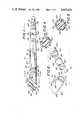
- FIG. 1is a side elevational view, partial broken away, showing one cylinder of a prosthesis constructed in accordance with this invention in its flaccid state;
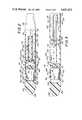
- FIG. 2is an enlarged side elevational view partially in section of a portion of the device shown in FIG. 1 and in its flaccid state;
- FIG. 3is a view similar to that of FIG. 2 but showing the device in its erect state
- FIG. 4is an enlarged sectional view taken along line 4--4 of FIG. 1;
- FIG. 5is an enlarged sectional view taken along line 5--5 of FIG. 1;
- FIG. 6is an exploded perspective view of a portion of the device shown in FIG. 1.
- the prosthesis 20basically comprises an elongated cylindrical member 22 having a substantially rigid front or tip section 24, a substantially rigid rear or tail section 26 and an inflatable intermediate section 28.
- the prosthesis 20basically comprises an elongated cylindrical member 22 having a substantially rigid front or tip section 24, a substantially rigid rear or tail section 26 and an inflatable intermediate section 28.
- two such cylinders 22are utilized to make up a complete penile prosthesis.
- each cylinderis surgically implanted longitudinally in a respective corpus cavernosum (not shown) of the penis, with the tip section 24 located within the distal portion of the penis and with the tail section 26 located within the proximal portion of penis.
- the tip section 24is formed of a mass or body of an elastomeric material, such as medical grade silicone rubber, so that it is substantially rigid.
- the body of the tip sectionincludes a hollow portion in which various components (to be described later) are located.
- the inflatable intermediate section 28is a generally hollow tubular member which is flexible and flaccid in its normal or unactivated state, but is arranged when inflated (pressurized) to become rigid, hard and generally linear. In such a case the three sections making up the cylinder of the prosthesis act like a cantilevered beam, with rear section 26 serving to anchor the intermediate and tip sections of the prosthesis to the body, thereby rendering the penis erect.
- each cylinder 22includes the actuating means for causing the penis to become erect and for allowing the penis to become flaccid when the erection is no longer desired.
- the subject prosthesisdoes not require the use of a manually squeezable pump (whether implanted remotely of the cylinder or included within the cylinder itself) to cause the prosthesis to become erect.
- the means for effecting the erection of the prosthesis 20operates in response to the slight displacement (twisting) of a portion of the cylinder to be described later. When that portion of the cylinder is displaced (twisted) back to its original position the prosthesis becomes flaccid. This feature enables the prosthesis 20 to be quite simple in operation, thereby closely simulating the natural erection process.
- the basic components of the prosthesis 20are an actuating assembly 30, a fluid reservoir assembly 32, and the heretofore identified inflatable section 28.
- the actuating assemblywill be described in detail later. Suffice for now to state that the actuating assembly is located within the tip section 24 of the cylinder 22 and includes a portion (to be described later) arranged to be twisted (rotated through an acute angle) with respect to the longitudinal axis 152 of the cylinder. This twisting action causes another portion of the actuating means (also to be described later) to move longitudinally down the tip section (i.e., toward the intermediate section) a short distance to cause the displacement of a substantial volume of an operating fluid from the reservoir assembly 32 into the inflatable section 28.
- the inflatable section 28basically comprises a tubular member which is inflatable, but is non-distendable.
- the tubular chamberis formed of a sleeve 36 of woven Dacron mesh which has been impregnated with an elastomeric material, such as medical grade silicone rubber.
- an elastomeric materialsuch as medical grade silicone rubber.
- the rear end of the sleeve 36is closed at 38 while its front end 40 is open to form an open ended chamber.
- the open front end 40is in fluid communication with a reservoir chamber (to be described later) of the reservoir assembly 32 and containing the prosthesis' operating liquid 42, e.g., silicone liquid.
- the chamber 28is approximately 10 mm in diameter and 7 cm long.
- the chamber 28Since the material making up the inflatable chamber 28 is flexible but non-distendable, the chamber is flaccid and limp when partially filled with the operating liquid (as is the case prior to activation of the prosthesis as shown in FIGS. 1 and 2). However, when the chamber 28 is fully filled and pressurized by the operating liquid (as is the case after actuation of the prosthesis as shown in FIG. 3) the intermediate section 28 becomes rigid and hard.
- the fluid reservoir assembly 32basically comprises a tubular body 100 formed of a rigid plastic and having a circular sidewall 102 extending a substantial length of said tip section 24 and located between the actuating assembly 30 and the inflatable chamber 28.
- the tubular bodyincludes an intermediate wall 104 perpendicularly oriented with respect to the sidewall 102 and having a central opening 106 serving as the entrance to a longitudinally extending tube 108 projecting from the intermediate wall.
- the central tube 108is approximately 25 mm long.
- the intermediate wall 104 and the circular sidewall 102collectively define a front chamber 110 and a rear chamber 112, with the latter serving as the operating fluid reservoir of the prosthesis.
- a moveable piston 114is located within the front chamber at the front 116 thereof.
- the piston 114includes a piston head 118 of generally conical shape and formed of a resilient material, e.g., neoprene rubber.
- the piston head 118is fixedly mounted on a linearly displaceable element 120 of the actuating assembly so that it moves longitudinally down the chamber 110, i.e., toward the intermediate section 28, when the element 120 is moved toward the rear of the cylinder 20 and moves up the chamber when the element 120 is returned to its normal forwardly located position.
- the front chamber 110is of a diameter (e.g., 9 mm) which is substantially close to the diameter of the cylinder 22 and is of a relatively short length (e.g., 5 mm) whereupon its volume capacity is 0.39 ml and is filled with a suitable hydraulic fluid, e.g., a silicone liquid, such as type DC 550 sold by Dow Corning.
- a suitable hydraulic fluide.g., a silicone liquid, such as type DC 550 sold by Dow Corning.
- the fluid reservoir assembly 32also includes a second moveable piston 122.
- the second piston 122includes an elongated piston rod or shaft 124 extending the length of the tube 108 so that its free end 126 is located at the outlet 106 of the hydraulic chamber 110.
- the piston 122also includes a piston head 128 which is fixedly mounted at the opposite end of the shaft and within the reservoir 112.
- the piston head 128includes a circular sidewall portion 130 extending back over the tube 108 toward the intermediate wall 104 and terminating in a radially extending flanged portion 132 located immediately adjacent the intermediate wall.
- a ring-like resilient sealing gasket 134is disposed about the free end of the piston shaft 124 and located within an annular recess 136 therein. The gasket prevents the leakage of hydraulic fluid from the chamber 110 into the interface between the surface of the piston rod 124 and the tube 108.
- the reservoir 112an annularly shaped hollow member defined between the sidewall 102, the intermediate wall 104 and the tube 108.
- the rear end of the reservoir 112is open and connected to and in fluid communication with the open end 40 of the inflatable chamber 28.
- the chamber 112is filled with the operating fluid, in this case the same type of silicone liquid as in chamber 110.
- the piston head 128is located within the reservoir 112 and is arranged to be moved down the reservoir in automatic response to the movement of the first piston 114. That action occurs as follows: when the element 120 is moved to the rear, as will be described later, the piston 114 is moved from the position shown in FIGS. 1 and 2 down the short length of the chamber 110 to the position shown in FIG. 3. This action forces approximately 0.39 ml of the hydraulic liquid out of the chamber 110 and against the free end of the piston 122 causing the piston to move.
- the volumetric capacity of the interior of the tube 108is slightly less than or equal to the capacity of the hydraulic chamber 110 but its diameter is substantially less, e.g., 3-4 mm, thus the piston 122 moves down tube 108 a much greater distance, e.g., 25 mm, than the distance that piston 114 moves, whereupon a substantially greater volume, e.g., 1.5 ml, of operating fluid located in reservoir 112 is forced into the inflatable chamber 28.
- a substantially greater volume, e.g., 1.5 ml, of operating fluid located in reservoir 112is forced into the inflatable chamber 28.
- a portion of the piston 122moves into the chamber 28. This action causes that chamber to move from a non-erect, flaccid state like that shown in FIG. 2, to an erect, rigid and linear state like that shown in FIG. 3.
- a second, ring-like resilient sealing gasket 140is employed. That gasket is mounted on the flanged portion 132 of the piston head.
- the tail section of the prosthesisbasically comprises a solid body, also preferably formed of a medical grade silicone rubber, and having a front portion 142 and a tapering rear portion 144.
- a plurality of longitudinally spaced, annular recesses 146are provided in the surface of the rear portion 144 of the tail section. These recesses serve as convenient locations for severing a portion of the rear section away from the remainder of the cylinder 22 to configure the prosthesis to the appropriate size for the penis into which it will be implanted.
- the assembly 30basically comprises a rotary actuator member 150 and the heretofore identified element 120.
- the rotary actuator member 150is a cap-like body which is formed of a rigid material, e.g., plastic end is coupled by cam means to the fixed cylindrical body member 100 in a manner to be described in detail later.
- the coupling between the twoallows the cap member 150 to be rotated or twisted through an acute angle, e.g., approximately 15°, about the longitudinal axis 152 of the cylinder, while holding it at a fixed longitudinal position therealong.
- the element 120is coupled via cam means 154 to the member 150 to enable the element 120 to move down axis 152 (i.e., toward section 28) in response to the rotation or twisting of the cap member 150 in one rotational direction and to move up the axis in response to its rotation or twisting in the opposite rotational direction.
- the cap 150is formed a cylindrical member having a generally domed free end 156 and a cylindrical bore 158 in its opposite end.
- the shape of the cap-like actuator 150can be configured as desired to facilitate the securement of it with respect to the penis to minimize relative movement therebetween when the prosthesis is implanted therein. As will be appreciated from the description of the operation of the prosthesis to follow such securement is of considerable importance inasmuch as operation of the prosthesis is based on a slight manual twisting action of the penis being imparted to the actuator cap.
- the member 120is a cylindrical member whose outside diameter is slightly less than the inside diameter of the bore 158 so that the member 120 can slide freely longitudinally therein along axis 152.
- the cam means 154basically comprises a cam track 160 and a cam pin or follower 162.
- the cam trackis an elongated recess in the periphery of the member 120 and extending at an acute angle to the axis 152.
- the cam pin 162is fixedly secured to the actuator cap 150 and extends through a hole 164 therein so that its free end is located within the cam track. At each end of the cam track there is a slight recess 164 which serves as locking means for holding the cam pin in place thereat.
- the body portion 100includes a pair of slots 168 which are oriented perpendicularly to the axis 152.
- a pair of mounting pins 170are fixedly secured in respective holes 172 in the actuator cap 150 at diametrically located positions. The free end of each pin is arranged to be received within an associated slot 168 of the body member 100 so that each pin slides therein when the cap is rotated (twisted).
- the user of the prosthesismerely has to manually grasp or grip the tip of his penis while pulling on it slightly and then rotating or twisting it slightly through a small acute angle, e.g., 15°.
- This actionfrees the cam pin from recess 166 and imparts the twist to the actuator cap 150 which causes the cam pin 162 to slide in down cam track 162 from its locked position within recess 166, as shown in FIG. 2, to the opposite end of the cam track, as shown in FIG. 3.
- the sliding of the cam pin in the trackcauses the member 120 to move longitudinally down the axis 152, thereby carrying the piston head 118 with it.
- This later actioncauses the inflation of the intermediate section 28 as described heretofore.
- the device of the instant inventionis simple in construction and can be readily and efficiently operated.
Landscapes
- Health & Medical Sciences (AREA)
- Reproductive Health (AREA)
- Cardiology (AREA)
- Oral & Maxillofacial Surgery (AREA)
- Transplantation (AREA)
- Engineering & Computer Science (AREA)
- Biomedical Technology (AREA)
- Heart & Thoracic Surgery (AREA)
- Vascular Medicine (AREA)
- Life Sciences & Earth Sciences (AREA)
- Animal Behavior & Ethology (AREA)
- General Health & Medical Sciences (AREA)
- Public Health (AREA)
- Veterinary Medicine (AREA)
- Prostheses (AREA)
Abstract
Description
This invention relates generally to implantable penile prostheses and more particularly to implantable, self-contained penile prostheses.
Various penile implants have been disclosed in the patent literature and are commercially available for curing erectile impotence. Such devices basically comprise a pair of cylinders each of which adapted to be implanted in a respective corpus cavernosum of the penis. Each cylinder includes a hollow portion arranged to be pressurized by the pumping of a liquid therein. When the cylinder portions are pressurized the penis assumes an erect, rigid state. The liquid used to inflate the cylinders is provided via respective tubes from a liquid supply reservoir. A pump and a reversible, one-way valve, are also included in the prosthesis and are typically arranged to be implanted in the scrotum and/or the abdomen. The pump and valve enable the liquid to be carried from the reservoir into the cylinder to cause the erection when the valve is in a first setting. In order to render the penis flaccid the valve is arranged to be actuated to enable the liquid to pass through it in the opposite direction so that operation of the pump carries the liquid back into the reservoir.
Examples of penile implants utilizing the foregoing technology are shown in U.S. Pat. Nos. 3,954,102 (Buuck), 4,009,711 (Uson), 4,267,829 (Burton et al.), and 4,342,308 (Trick). While the foregoing pump-type inflatable penile implants all operate on the same basic principle each of those devices include some different structural features, e.g., reinforcing or constraining materials surrounding the inflatable chamber, cylinders including rigid (solid) tip and tail portions, special actuating valves, etc., all in the interest of providing a device which will closely simulate a natural erection, is easy to operate, and which exhibits a long service life.
While the penile implants such as described above have proven suitable for their intended purposes, they nevertheless leave something to be desired from the standpoint of simplicity of construction and ease of operation. In this regard all of the above identified prior art implants require the use of not only the inflatable cylinders which are to be located within the penis, but also a control valve, pump and reservoir, all of which are implanted within the body remote from the penis. Moreover, operation of such remotely located pump-type penile implants requires the user to first manually operate the valve to its appropriate setting to enable flow from the reservoir to the cylinders and then to manually pump the liquid into cylinders to cause the penis to become erect for sexual intercourse. In order to render the penis flaccid the valve has to be manually returned to its initial position to enable the liquid to flow therethrough in the opposite direction so that operation of the pump carries the liquid from the cylinders back into the reservoir.
Another type of penile prosthesis has been disclosed in various patents. That alternative penile prosthesis constitutes a variation of the externally located pump-type device. In this regard the alternative type penile implant utilizes a pump and reservoir which are both located within the cylinder, with the pump in either the tip portion or an intermediate portion and with the reservoir located within the intermediate or rear portion. Thus the entire prosthesis is self-contained within the cylinder and does not require the use of remotely located reservoirs/valves/pumps. Operation of such a selfcontained type of penile prosthesis is effected by squeezing the portion of the cylinder containing the pump to operate it to cause liquid to flow from the reservoir into an inflatable chamber located at an intermediate point in the cylinder to cause the cylinder to become erect. While this type of penile implant offers the advantage of simplicity of construction over remotely located pump-type implants, it still leaves something to be desired from the standpoint of functionality, simplicity of construction, and ease of operation. Examples of the selfcontained penile prosthesis are shown in U.S. Pat. Nos. 4,353,360 (Finney et al), 4,360,010 (Finney), 4,369,771 (Trick), and 4,399,811 (Finney et al).
Other types of prior art penile prostheses are shown in U.S. Pat. Nos. 4,378,792 (Finney) and 4,383,525 (Burton et al.).
Accordingly, it is the general object of the instant invention to provide a self-contained penile implant which overcomes the disadvantages of the prior art.
It is a further object of the instant invention to provide a self-contained penile implant which is simple in construction.
It is a further object of the instant invention to provide a self-contained penile prosthesis which is readily adapted to assume an erect rigid state with a simple movement of a portion thereof.
It is a further object of the instant invention to provide a self-contained penile prosthesis which includes an inflatable section and means for transferring a substantial volume of an operating fluid to said inflatable section to render it stiff and erect upon the application of limited movement to that means.
An implantable penile prosthesis comprising an elongated cylinder having a front portion for disposition in the distal portion of the penis, a rear portion for disposition inside the proximal portion of the penis and an inflatable section located therebetween. The inflatable section is a hollow member. The cylinder includes manually operable actuating means comprising displacement means for longitudinal movement a first predetermined distance toward one end of the cylinder and a hydraulic chamber of a first predetermined volume and having a hydraulic fluid therein. A first piston is coupled to the displacement means. The cylinder also includes fluid reservoir means coupled to the inflatable section, with the fluid reservoir means being of a second predetermined volume and having an operating fluid therein. The second volume is substantially greater than the first volume. A second piston is provided coupled to the hydraulic chamber. The first piston moves in response to the movement of the displacement means to cause the hydraulic fluid to be expelled from the hydraulic chamber, whereupon the second piston means moves to cause the operating fluid in the fluid reservoir means to be provided to the inflatable section to pressurize it, whereupon it moves from a non-erect, flaccid state to an erect, rigid state.
Other objects and many of the attendant advantages of the instant invention will be readily appreciated when the same becomes better understood by reference to the following detailed description when considered in connection with the accompanying drawing wherein:
FIG. 1 is a side elevational view, partial broken away, showing one cylinder of a prosthesis constructed in accordance with this invention in its flaccid state;
FIG. 2 is an enlarged side elevational view partially in section of a portion of the device shown in FIG. 1 and in its flaccid state;
FIG. 3 is a view similar to that of FIG. 2 but showing the device in its erect state;
FIG. 4 is an enlarged sectional view taken alongline 4--4 of FIG. 1;
FIG. 5 is an enlarged sectional view taken alongline 5--5 of FIG. 1; and
FIG. 6 is an exploded perspective view of a portion of the device shown in FIG. 1.
Referring now in greater detail to the various figures of the drawing wherein like reference characters refer to like parts, there is shown animplantable penile prosthesis 20 constructed in accordance with the subject invention. Theprosthesis 20 basically comprises an elongatedcylindrical member 22 having a substantially rigid front ortip section 24, a substantially rigid rear ortail section 26 and an inflatableintermediate section 28. In normal practice twosuch cylinders 22 are utilized to make up a complete penile prosthesis. In such a case each cylinder is surgically implanted longitudinally in a respective corpus cavernosum (not shown) of the penis, with thetip section 24 located within the distal portion of the penis and with thetail section 26 located within the proximal portion of penis. Thetip section 24 is formed of a mass or body of an elastomeric material, such as medical grade silicone rubber, so that it is substantially rigid. The body of the tip section includes a hollow portion in which various components (to be described later) are located. The inflatableintermediate section 28 is a generally hollow tubular member which is flexible and flaccid in its normal or unactivated state, but is arranged when inflated (pressurized) to become rigid, hard and generally linear. In such a case the three sections making up the cylinder of the prosthesis act like a cantilevered beam, withrear section 26 serving to anchor the intermediate and tip sections of the prosthesis to the body, thereby rendering the penis erect.
As will be fully appreciated from the description to follow theprosthesis 20 of the subject invention is a completely self-contained unit and does not require the use of remotely implanted reservoir/valve/pump arrangements for causing the device to become erect. Thus, eachcylinder 22 includes the actuating means for causing the penis to become erect and for allowing the penis to become flaccid when the erection is no longer desired. Moreover, and quite significantly, the subject prosthesis does not require the use of a manually squeezable pump (whether implanted remotely of the cylinder or included within the cylinder itself) to cause the prosthesis to become erect. In this regard the means for effecting the erection of theprosthesis 20 operates in response to the slight displacement (twisting) of a portion of the cylinder to be described later. When that portion of the cylinder is displaced (twisted) back to its original position the prosthesis becomes flaccid. This feature enables theprosthesis 20 to be quite simple in operation, thereby closely simulating the natural erection process.
As shown clearly in FIG. 1 the basic components of theprosthesis 20 are an actuatingassembly 30, afluid reservoir assembly 32, and the heretofore identifiedinflatable section 28. The actuating assembly will be described in detail later. Suffice for now to state that the actuating assembly is located within thetip section 24 of thecylinder 22 and includes a portion (to be described later) arranged to be twisted (rotated through an acute angle) with respect to thelongitudinal axis 152 of the cylinder. This twisting action causes another portion of the actuating means (also to be described later) to move longitudinally down the tip section (i.e., toward the intermediate section) a short distance to cause the displacement of a substantial volume of an operating fluid from thereservoir assembly 32 into theinflatable section 28.
Theinflatable section 28 basically comprises a tubular member which is inflatable, but is non-distendable. In a preferred embodiment the tubular chamber is formed of asleeve 36 of woven Dacron mesh which has been impregnated with an elastomeric material, such as medical grade silicone rubber. As can be seen in FIG. 1 the rear end of thesleeve 36 is closed at 38 while itsfront end 40 is open to form an open ended chamber. The openfront end 40 is in fluid communication with a reservoir chamber (to be described later) of thereservoir assembly 32 and containing the prosthesis' operatingliquid 42, e.g., silicone liquid. In the preferred embodiment thechamber 28 is approximately 10 mm in diameter and 7 cm long. Since the material making up theinflatable chamber 28 is flexible but non-distendable, the chamber is flaccid and limp when partially filled with the operating liquid (as is the case prior to activation of the prosthesis as shown in FIGS. 1 and 2). However, when thechamber 28 is fully filled and pressurized by the operating liquid (as is the case after actuation of the prosthesis as shown in FIG. 3) theintermediate section 28 becomes rigid and hard.
As shown clearly in FIGS. 1, 2 and 3 thefluid reservoir assembly 32 basically comprises atubular body 100 formed of a rigid plastic and having acircular sidewall 102 extending a substantial length of saidtip section 24 and located between the actuatingassembly 30 and theinflatable chamber 28. The tubular body includes an intermediate wall 104 perpendicularly oriented with respect to thesidewall 102 and having acentral opening 106 serving as the entrance to alongitudinally extending tube 108 projecting from the intermediate wall. In a preferred embodiment thecentral tube 108 is approximately 25 mm long.
The intermediate wall 104 and thecircular sidewall 102 collectively define afront chamber 110 and arear chamber 112, with the latter serving as the operating fluid reservoir of the prosthesis. Amoveable piston 114 is located within the front chamber at thefront 116 thereof. Thepiston 114 includes apiston head 118 of generally conical shape and formed of a resilient material, e.g., neoprene rubber. Thepiston head 118 is fixedly mounted on a linearlydisplaceable element 120 of the actuating assembly so that it moves longitudinally down thechamber 110, i.e., toward theintermediate section 28, when theelement 120 is moved toward the rear of thecylinder 20 and moves up the chamber when theelement 120 is returned to its normal forwardly located position.
Thefront chamber 110 is of a diameter (e.g., 9 mm) which is substantially close to the diameter of thecylinder 22 and is of a relatively short length (e.g., 5 mm) whereupon its volume capacity is 0.39 ml and is filled with a suitable hydraulic fluid, e.g., a silicone liquid, such as type DC 550 sold by Dow Corning.
Thefluid reservoir assembly 32 also includes a secondmoveable piston 122. To that end thesecond piston 122 includes an elongated piston rod orshaft 124 extending the length of thetube 108 so that itsfree end 126 is located at theoutlet 106 of thehydraulic chamber 110. Thepiston 122 also includes apiston head 128 which is fixedly mounted at the opposite end of the shaft and within thereservoir 112. Thepiston head 128 includes acircular sidewall portion 130 extending back over thetube 108 toward the intermediate wall 104 and terminating in a radially extendingflanged portion 132 located immediately adjacent the intermediate wall. A ring-likeresilient sealing gasket 134 is disposed about the free end of thepiston shaft 124 and located within anannular recess 136 therein. The gasket prevents the leakage of hydraulic fluid from thechamber 110 into the interface between the surface of thepiston rod 124 and thetube 108.
As can also be seen in thereservoir 112 an annularly shaped hollow member defined between thesidewall 102, the intermediate wall 104 and thetube 108. The rear end of thereservoir 112 is open and connected to and in fluid communication with theopen end 40 of theinflatable chamber 28. Thechamber 112 is filled with the operating fluid, in this case the same type of silicone liquid as inchamber 110.
Thepiston head 128 is located within thereservoir 112 and is arranged to be moved down the reservoir in automatic response to the movement of thefirst piston 114. That action occurs as follows: when theelement 120 is moved to the rear, as will be described later, thepiston 114 is moved from the position shown in FIGS. 1 and 2 down the short length of thechamber 110 to the position shown in FIG. 3. This action forces approximately 0.39 ml of the hydraulic liquid out of thechamber 110 and against the free end of thepiston 122 causing the piston to move. The volumetric capacity of the interior of thetube 108 is slightly less than or equal to the capacity of thehydraulic chamber 110 but its diameter is substantially less, e.g., 3-4 mm, thus thepiston 122 moves down tube 108 a much greater distance, e.g., 25 mm, than the distance thatpiston 114 moves, whereupon a substantially greater volume, e.g., 1.5 ml, of operating fluid located inreservoir 112 is forced into theinflatable chamber 28. In addition a portion of thepiston 122 moves into thechamber 28. This action causes that chamber to move from a non-erect, flaccid state like that shown in FIG. 2, to an erect, rigid and linear state like that shown in FIG. 3.
When theelement 120 is retracted back toward the tip of the cylinder, an action to be described later, thefront end piston 114 is moved toward the tip of the prosthesis again, whereuponhydraulic chamber 110 refills with the hydraulic fluid, so thatpiston 130 again moves to the front ofreservoir 112 and the reservoir again fills with the operating liquid, thus depressurizing theinflatable chamber 28, whereupon theintermediate section 28 of the prosthesis becomes flaccid once again (i.e., assumes the position shown in FIG. 2).
In order to preclude the egress of the operating fluid between thepiston head 128 and the circular side wall 102 a second, ring-likeresilient sealing gasket 140 is employed. That gasket is mounted on theflanged portion 132 of the piston head.
As can be seen clearly in FIG. 1 the tail section of the prosthesis basically comprises a solid body, also preferably formed of a medical grade silicone rubber, and having afront portion 142 and a taperingrear portion 144. A plurality of longitudinally spaced,annular recesses 146 are provided in the surface of therear portion 144 of the tail section. These recesses serve as convenient locations for severing a portion of the rear section away from the remainder of thecylinder 22 to configure the prosthesis to the appropriate size for the penis into which it will be implanted.
The details of the actuatingassembly 30 will now be described. As can best be seen in FIG. 6 theassembly 30 basically comprises arotary actuator member 150 and the heretofore identifiedelement 120. Therotary actuator member 150 is a cap-like body which is formed of a rigid material, e.g., plastic end is coupled by cam means to the fixedcylindrical body member 100 in a manner to be described in detail later. The coupling between the two allows thecap member 150 to be rotated or twisted through an acute angle, e.g., approximately 15°, about thelongitudinal axis 152 of the cylinder, while holding it at a fixed longitudinal position therealong. In particular, theelement 120 is coupled via cam means 154 to themember 150 to enable theelement 120 to move down axis 152 (i.e., toward section 28) in response to the rotation or twisting of thecap member 150 in one rotational direction and to move up the axis in response to its rotation or twisting in the opposite rotational direction.
Thecap 150 is formed a cylindrical member having a generally domedfree end 156 and acylindrical bore 158 in its opposite end. The shape of the cap-like actuator 150 can be configured as desired to facilitate the securement of it with respect to the penis to minimize relative movement therebetween when the prosthesis is implanted therein. As will be appreciated from the description of the operation of the prosthesis to follow such securement is of considerable importance inasmuch as operation of the prosthesis is based on a slight manual twisting action of the penis being imparted to the actuator cap.
As can be seen in FIG. 6 themember 120 is a cylindrical member whose outside diameter is slightly less than the inside diameter of thebore 158 so that themember 120 can slide freely longitudinally therein alongaxis 152. The cam means 154 basically comprises acam track 160 and a cam pin orfollower 162. The cam track is an elongated recess in the periphery of themember 120 and extending at an acute angle to theaxis 152. Thecam pin 162 is fixedly secured to theactuator cap 150 and extends through ahole 164 therein so that its free end is located within the cam track. At each end of the cam track there is aslight recess 164 which serves as locking means for holding the cam pin in place thereat.
In order to secure thecap 150 to thebody element 100 to permit twisting motion with respect thereto while precluding longitudinal motion, thebody portion 100 includes a pair ofslots 168 which are oriented perpendicularly to theaxis 152. A pair of mountingpins 170 are fixedly secured inrespective holes 172 in theactuator cap 150 at diametrically located positions. The free end of each pin is arranged to be received within an associatedslot 168 of thebody member 100 so that each pin slides therein when the cap is rotated (twisted).
As will be appreciated by those skilled in the art, the user of the prosthesis merely has to manually grasp or grip the tip of his penis while pulling on it slightly and then rotating or twisting it slightly through a small acute angle, e.g., 15°. This action frees the cam pin fromrecess 166 and imparts the twist to theactuator cap 150 which causes thecam pin 162 to slide indown cam track 162 from its locked position withinrecess 166, as shown in FIG. 2, to the opposite end of the cam track, as shown in FIG. 3. The sliding of the cam pin in the track causes themember 120 to move longitudinally down theaxis 152, thereby carrying thepiston head 118 with it. This later action causes the inflation of theintermediate section 28 as described heretofore. When theactuator cap 150 is rotated to the erect position shown in FIG. 3 thecam pin 162 is received within thelocking recess 166 at that end of the cam track. Hence the prosthesis remains in erect condition until it is manually deactivated. Such deactivation occurs by the user merely pulling slightly on the tip of his penis and then twisting it slightly in the opposite direction to cause thepin 162 to move out of its locking recess and then down the track to the opposite end thereof whereupon it becomes locked in place. This reverse twisting action has the effect of pulling thepiston head 114 back toward the tip of the prosthesis, whereupon the actuating fluid flows from theintermediate section 28 back into thereservoir 112, whereupon the intermediate section becomes flaccid.
As will be appreciated from the foregoing the device of the instant invention is simple in construction and can be readily and efficiently operated.
Without further elaboration, the foregoing will so fully illustrate my invention that others may, by applying current or future knowledge, readily adopt the same for use under various conditions of service.
Claims (21)
1. An implantable penile prosthesis comprising an elongated cylinder for disposition within the penis and having a longitudinal axis, said cylinder having a front portion for disposition in the distal portion of the penis, a rear portion for disposition inside the proximal portion of the penis and a hollow inflatable section located therebetween, said cylinder including manually operable actuating means comprising displacement means for moving longitudinally a first predetermined distance toward one end of said cylinder, a hydraulic chamber of a first predetermined volume and having a hydraulic fluid therein, first moveable piston means coupled to said displacement means, fluid reservoir means coupled to said inflatable section, said fluid reservoir means being of a second predetermined volume and having an operating fluid therein, said second volume being substantially greater than said first volume, second piston means coupled to said hydraulic chamber, said first piston means moving in response to the movement of said displacement means for forcing said hydraulic fluid to be expelled from said hydraulic chamber, whereupon said second piston means moves for forcing said operating fluid in said fluid reservoir means into said inflatable section to pressurize said inflatable section, whereupon said section moves from a non-erect, flaccid state to an erect, rigid state.
2. The prosthesis of claim 1 wherein said displacement means comprises rotatable means adapted to be rotated through a predetermined angle about said longitudinal axis from a first rotary position to a second rotary position, whereupon said displacement means moves said first predetermined distance.
3. The prosthesis of claim 2 wherein said rotatable means includes locking means to hold said rotatable means in said second rotary position.
4. The prosthesis of claim 2 wherein said rotatable means is also rotatable about said axis to return it to said first rotary position from said second rotary position, whereupon said displacement means moves said first predetermined distance toward the opposite end of said cylinder.
5. The prosthesis of claim 4 wherein said rotatable means includes locking means to hold said rotatable means in either said first or second rotary positions.
6. The prosthesis of claim 5 wherein said first piston means is arranged to move through a first predetermined length of said hydraulic chamber, and wherein said second piston means is arranged to move a second predetermined length through said fluid reservoir means in response to the movement of said first piston means, said second predetermined length being substantially greater than said first predetermined length.
7. The prosthesis of claim 6 wherein said hydraulic chamber is located adjacent said displacement means and wherein said fluid reservoir means is located between said hydraulic chamber and said inflatable section.
8. The prosthesis of claim 7 wherein said fluid reservoir means comprises an elongated cylindrical chamber extending along the longitudinal axis of said cylinder and including a central passageway extending a substantial distance therethrough, said second piston means comprising an elongated piston shaft and a piston head, said piston shaft extending through said passageway, said hydraulic chamber being in fluid communication with said central passageway, said piston head being located within said cylindrical chamber, whereupon the expulsion of said hydraulic fluid from said hydraulic chamber causes said second piston to move down said cylindrical chamber to force said second fluid into said inflatable section.
9. The prosthesis of claim 8 additionally comprising sealing means for preventing the leakage of said hydraulic fluid and said operating fluid.
10. The prosthesis of claim 9 wherein said hydraulic fluid comprises a silicone liquid.
11. The prosthesis of claim 2 wherein said actuating means is located within said front portion of said cylinder and wherein when said rotary means is rotated from said first rotary position to said second rotary position said displacement means moves said first predetermined distance toward the rear portion of said cylinder.
12. The prosthesis of claim 11 wherein said rotatable means is also rotatable about said axis to return it to said first rotary position from said second rotary position, whereupon said displacement means moves said first predetermined distance toward the front portion of said cylinder.
13. The prosthesis of claim 1 wherein said first piston means is arranged to move through a first predetermined length of said hydraulic chamber, and wherein said second piston means is arranged to move a second predetermined length through said fluid reservoir means in response to the movement of said first piston means, said second predetermined length being substantially greater than said first predetermined length.
14. The prosthesis of claim 13 wherein said hydraulic chamber is located adjacent said displacement means and wherein said fluid reservoir means is located between said hydraulic chamber and said inflatable section.
15. The prosthesis of claim 14 wherein said fluid reservoir means comprises an elongated cylindrical chamber extending along the longitudinal axis of said cylinder and including a central passageway extending a substantial distance therethrough, said second piston means comprising an elongated piston shaft and a piston head, said piston shaft extending through said passageway, said hydraulic chamber being in fluid communication with said central passageway, said piston head being located within said cylindrical chamber, whereupon the expulsion of said hydraulic fluid from said hydraulic chamber causes said second piston to move down said cylindrical chamber to force said second fluid into said inflatable section.
16. The prosthesis of claim 15 additionally comprising sealing means for preventing the leakage of said hydraulic fluid and said operating fluid.
17. The prosthesis of claim 16 wherein said hydraulic fluid comprises a silicone liquid.
18. The prosthesis of claim 1 wherein said inflatable section is flexible but non-distendible.
19. The prosthesis of claim 1 wherein said rear portion is rigid.
20. The prosthesis of claim 19 wherein said rear portion includes means for facilitating the sizing thereof to configure said cylinder to the size of the penis in which it is to be implanted.
21. The prosthesis of claim 1 including sealing means between the hydraulic fluid and the operating fluid for always maintaining said fluids separate from each other.
Priority Applications (2)
| Application Number | Priority Date | Filing Date | Title |
|---|---|---|---|
| US06/683,286US4602621A (en) | 1984-12-18 | 1984-12-18 | Manually actuated, self contained penile implant |
| CA000495769ACA1234954A (en) | 1984-12-18 | 1985-11-20 | Manually actuated, self contained penile implant |
Applications Claiming Priority (1)
| Application Number | Priority Date | Filing Date | Title |
|---|---|---|---|
| US06/683,286US4602621A (en) | 1984-12-18 | 1984-12-18 | Manually actuated, self contained penile implant |
Publications (1)
| Publication Number | Publication Date |
|---|---|
| US4602621Atrue US4602621A (en) | 1986-07-29 |
Family
ID=24743360
Family Applications (1)
| Application Number | Title | Priority Date | Filing Date |
|---|---|---|---|
| US06/683,286Expired - Fee RelatedUS4602621A (en) | 1984-12-18 | 1984-12-18 | Manually actuated, self contained penile implant |
Country Status (2)
| Country | Link |
|---|---|
| US (1) | US4602621A (en) |
| CA (1) | CA1234954A (en) |
Cited By (38)
| Publication number | Priority date | Publication date | Assignee | Title |
|---|---|---|---|---|
| US5629678A (en)* | 1995-01-10 | 1997-05-13 | Paul A. Gargano | Personal tracking and recovery system |
| US6443887B1 (en)* | 2000-12-27 | 2002-09-03 | American Medical Systems Inc. | Switch based spontaneous inflation inhibitor in a pump for an inflation prosthesis |
| US20030100929A1 (en)* | 2000-02-14 | 2003-05-29 | Peter Forsell | Controlled penile prosthesis |
| US20030220539A1 (en)* | 2002-05-24 | 2003-11-27 | George Stephanie A. | Penile prosthesis with improved rear tip extender |
| US20060111791A1 (en)* | 2002-07-29 | 2006-05-25 | Peter Forsell | Durable implant |
| US20080045783A1 (en)* | 2002-07-29 | 2008-02-21 | Peter Forsell | Multi-material incontinence treatment construction device |
| US20080200965A1 (en)* | 2003-01-31 | 2008-08-21 | Potencia Medical Ag | Electrically operable incontinence treatment apparatus |
| US20080200753A1 (en)* | 2003-01-31 | 2008-08-21 | Potencia Medical Ag | Electrically operable incontinence treatment apparatus |
| US20110054250A1 (en)* | 2009-08-27 | 2011-03-03 | Coloplast A/S | Penile prosthesis cap, assembly, and implantation tool |
| US7931582B2 (en) | 2000-02-11 | 2011-04-26 | Obtech Medical Ag | Controlled impotence treatment |
| US7985176B1 (en) | 2010-05-26 | 2011-07-26 | Coloplast A/S | Method of implanting a penile prosthesis |
| US20110201880A1 (en)* | 2010-02-12 | 2011-08-18 | Fogarty Terence M | Inflatable penile prosthesis with spool valve |
| US8096938B2 (en) | 1999-08-12 | 2012-01-17 | Obtech Medical Ag | Controlled anal incontinence disease treatment |
| US8096939B2 (en) | 2000-02-10 | 2012-01-17 | Obtech Medical Ag | Urinary incontinence treatment with wireless energy supply |
| US20120157764A1 (en)* | 2010-12-21 | 2012-06-21 | Ams Research Corporation | Adjustable Length Rear Tip Extender for Penile Prosthesis |
| US8287444B2 (en) | 2000-02-10 | 2012-10-16 | Obtech Medical Ag | Mechanical impotence treatment apparatus |
| US8290594B2 (en) | 2000-02-11 | 2012-10-16 | Obtech Medical Ag | Impotence treatment apparatus with energy transforming means |
| US8313423B2 (en) | 2000-02-14 | 2012-11-20 | Peter Forsell | Hydraulic anal incontinence treatment |
| US8509894B2 (en) | 2008-10-10 | 2013-08-13 | Milux Holding Sa | Heart help device, system, and method |
| US8545384B2 (en) | 1999-08-12 | 2013-10-01 | Obtech Medical Ag | Anal incontinence disease treatment with controlled wireless energy supply |
| US8556796B2 (en) | 2000-02-10 | 2013-10-15 | Obtech Medical Ag | Controlled urinary incontinence treatment |
| US8600510B2 (en) | 2008-10-10 | 2013-12-03 | Milux Holding Sa | Apparatus, system and operation method for the treatment of female sexual dysfunction |
| US8636809B2 (en) | 2008-01-29 | 2014-01-28 | Milux Holding Sa | Device for treating obesity |
| US8678997B2 (en) | 2000-02-14 | 2014-03-25 | Obtech Medical Ag | Male impotence prosthesis apparatus with wireless energy supply |
| US8696745B2 (en) | 2008-10-10 | 2014-04-15 | Kirk Promotion Ltd. | Heart help device, system, and method |
| US8734318B2 (en) | 2000-02-11 | 2014-05-27 | Obtech Medical Ag | Mechanical anal incontinence |
| US8764627B2 (en) | 2000-02-14 | 2014-07-01 | Obtech Medical Ag | Penile prosthesis |
| US8874215B2 (en) | 2008-10-10 | 2014-10-28 | Peter Forsell | System, an apparatus, and a method for treating a sexual dysfunctional female patient |
| US8961448B2 (en) | 2008-01-28 | 2015-02-24 | Peter Forsell | Implantable drainage device |
| EP2962665A1 (en)* | 2009-08-27 | 2016-01-06 | Coloplast A/S | Penile prosthesis cap |
| US9855144B2 (en) | 2015-09-09 | 2018-01-02 | Coloplast A/S | Penile prosthetic with an insertion tool contained inside an inflatable bladder |
| US9949812B2 (en) | 2009-07-17 | 2018-04-24 | Peter Forsell | Vaginal operation method for the treatment of anal incontinence in women |
| US10098741B2 (en) | 2015-09-30 | 2018-10-16 | Coloplast A/S | Penile prosthetic with an insertion sleeve attachable to an inflatable bladder |
| US10219898B2 (en) | 2008-10-10 | 2019-03-05 | Peter Forsell | Artificial valve |
| US10729546B2 (en) | 2017-02-02 | 2020-08-04 | Coloplast A/S | Inflatable penile prosthetic system |
| US10952836B2 (en) | 2009-07-17 | 2021-03-23 | Peter Forsell | Vaginal operation method for the treatment of urinary incontinence in women |
| US11123171B2 (en) | 2008-10-10 | 2021-09-21 | Peter Forsell | Fastening means for implantable medical control assembly |
| EP4039230A1 (en)* | 2021-02-09 | 2022-08-10 | Coloplast A/S | A pump having a volume amplification mechanism for an inflatable penile prosthesis |
Citations (10)
| Publication number | Priority date | Publication date | Assignee | Title |
|---|---|---|---|---|
| US3954102A (en)* | 1974-07-19 | 1976-05-04 | American Medical Systems, Inc. | Penile erection system and methods of implanting and using same |
| US4009711A (en)* | 1976-03-17 | 1977-03-01 | Uson Aurelio C | Penile prosthesis for the management of erectile impotence |
| US4267829A (en)* | 1979-04-11 | 1981-05-19 | American Medical Systems, Inc. | Penile prosthesis |
| US4342308A (en)* | 1980-10-02 | 1982-08-03 | Medical Engineering Corporation | Penile erectile system |
| US4353360A (en)* | 1980-10-31 | 1982-10-12 | Medical Engineering Corporation | Penile erectile system |
| US4360010A (en)* | 1980-05-15 | 1982-11-23 | Medical Engineering Corporation | Penile prosthesis |
| US4369771A (en)* | 1981-09-24 | 1983-01-25 | Medical Engineering Corporation | Penile erectile system |
| US4378792A (en)* | 1980-05-15 | 1983-04-05 | Medical Engineering Corporation | Penile prosthesis |
| US4399811A (en)* | 1981-08-04 | 1983-08-23 | Medical Engineering Corporation | Implantable penile erectile system |
| US4399812A (en)* | 1981-12-31 | 1983-08-23 | Whitehead Edgar D | Penile prosthetic device |
- 1984
- 1984-12-18USUS06/683,286patent/US4602621A/ennot_activeExpired - Fee Related
- 1985
- 1985-11-20CACA000495769Apatent/CA1234954A/ennot_activeExpired
Patent Citations (11)
| Publication number | Priority date | Publication date | Assignee | Title |
|---|---|---|---|---|
| US3954102A (en)* | 1974-07-19 | 1976-05-04 | American Medical Systems, Inc. | Penile erection system and methods of implanting and using same |
| US4009711A (en)* | 1976-03-17 | 1977-03-01 | Uson Aurelio C | Penile prosthesis for the management of erectile impotence |
| US4267829A (en)* | 1979-04-11 | 1981-05-19 | American Medical Systems, Inc. | Penile prosthesis |
| US4383525A (en)* | 1979-12-28 | 1983-05-17 | American Medical Systems, Inc. | Implantable penile prosthetic cylinder with inclusive fluid reservoir |
| US4360010A (en)* | 1980-05-15 | 1982-11-23 | Medical Engineering Corporation | Penile prosthesis |
| US4378792A (en)* | 1980-05-15 | 1983-04-05 | Medical Engineering Corporation | Penile prosthesis |
| US4342308A (en)* | 1980-10-02 | 1982-08-03 | Medical Engineering Corporation | Penile erectile system |
| US4353360A (en)* | 1980-10-31 | 1982-10-12 | Medical Engineering Corporation | Penile erectile system |
| US4399811A (en)* | 1981-08-04 | 1983-08-23 | Medical Engineering Corporation | Implantable penile erectile system |
| US4369771A (en)* | 1981-09-24 | 1983-01-25 | Medical Engineering Corporation | Penile erectile system |
| US4399812A (en)* | 1981-12-31 | 1983-08-23 | Whitehead Edgar D | Penile prosthetic device |
Cited By (58)
| Publication number | Priority date | Publication date | Assignee | Title |
|---|---|---|---|---|
| US5629678A (en)* | 1995-01-10 | 1997-05-13 | Paul A. Gargano | Personal tracking and recovery system |
| US8096938B2 (en) | 1999-08-12 | 2012-01-17 | Obtech Medical Ag | Controlled anal incontinence disease treatment |
| US8545384B2 (en) | 1999-08-12 | 2013-10-01 | Obtech Medical Ag | Anal incontinence disease treatment with controlled wireless energy supply |
| US8602966B2 (en) | 2000-02-10 | 2013-12-10 | Obtech Medical, AG | Mechanical impotence treatment apparatus |
| US8096939B2 (en) | 2000-02-10 | 2012-01-17 | Obtech Medical Ag | Urinary incontinence treatment with wireless energy supply |
| US8556796B2 (en) | 2000-02-10 | 2013-10-15 | Obtech Medical Ag | Controlled urinary incontinence treatment |
| US8287444B2 (en) | 2000-02-10 | 2012-10-16 | Obtech Medical Ag | Mechanical impotence treatment apparatus |
| US9655724B2 (en) | 2000-02-11 | 2017-05-23 | Peter Forsell | Controlled impotence treatment |
| US8734318B2 (en) | 2000-02-11 | 2014-05-27 | Obtech Medical Ag | Mechanical anal incontinence |
| US7931582B2 (en) | 2000-02-11 | 2011-04-26 | Obtech Medical Ag | Controlled impotence treatment |
| US20110184230A1 (en)* | 2000-02-11 | 2011-07-28 | Obtech Medical Ag | Controlled impotence treatment |
| US8290594B2 (en) | 2000-02-11 | 2012-10-16 | Obtech Medical Ag | Impotence treatment apparatus with energy transforming means |
| US8678997B2 (en) | 2000-02-14 | 2014-03-25 | Obtech Medical Ag | Male impotence prosthesis apparatus with wireless energy supply |
| US8764627B2 (en) | 2000-02-14 | 2014-07-01 | Obtech Medical Ag | Penile prosthesis |
| US8313423B2 (en) | 2000-02-14 | 2012-11-20 | Peter Forsell | Hydraulic anal incontinence treatment |
| US20030100929A1 (en)* | 2000-02-14 | 2003-05-29 | Peter Forsell | Controlled penile prosthesis |
| US8126558B2 (en) | 2000-02-14 | 2012-02-28 | Obtech Medical Ag | Controlled penile prosthesis |
| US6443887B1 (en)* | 2000-12-27 | 2002-09-03 | American Medical Systems Inc. | Switch based spontaneous inflation inhibitor in a pump for an inflation prosthesis |
| US6808489B2 (en)* | 2002-05-24 | 2004-10-26 | Ams Research Corporation | Penile prosthesis with improved rear tip extender |
| US20030220539A1 (en)* | 2002-05-24 | 2003-11-27 | George Stephanie A. | Penile prosthesis with improved rear tip extender |
| US9427301B2 (en) | 2002-07-29 | 2016-08-30 | Peter Forsell | Durable implant |
| US20060111791A1 (en)* | 2002-07-29 | 2006-05-25 | Peter Forsell | Durable implant |
| US20080045783A1 (en)* | 2002-07-29 | 2008-02-21 | Peter Forsell | Multi-material incontinence treatment construction device |
| US9278158B2 (en) | 2002-07-29 | 2016-03-08 | Peter Forsell | Multi-material incontinence treatment construction device |
| US20080200753A1 (en)* | 2003-01-31 | 2008-08-21 | Potencia Medical Ag | Electrically operable incontinence treatment apparatus |
| US20080200965A1 (en)* | 2003-01-31 | 2008-08-21 | Potencia Medical Ag | Electrically operable incontinence treatment apparatus |
| US9694165B2 (en)* | 2008-01-28 | 2017-07-04 | Peter Mats Forsell | Implantable drainage device |
| US20150157836A1 (en)* | 2008-01-28 | 2015-06-11 | Peter Mats Forsell | Implantable drainage device |
| US8961448B2 (en) | 2008-01-28 | 2015-02-24 | Peter Forsell | Implantable drainage device |
| US9060771B2 (en) | 2008-01-29 | 2015-06-23 | Peter Forsell | Method and instrument for treating obesity |
| US8636809B2 (en) | 2008-01-29 | 2014-01-28 | Milux Holding Sa | Device for treating obesity |
| US9072907B2 (en) | 2008-10-10 | 2015-07-07 | Peter Forsell | Heart help device, system, and method |
| US8696745B2 (en) | 2008-10-10 | 2014-04-15 | Kirk Promotion Ltd. | Heart help device, system, and method |
| US10583234B2 (en) | 2008-10-10 | 2020-03-10 | Peter Forsell | Heart help device, system and method |
| US11123171B2 (en) | 2008-10-10 | 2021-09-21 | Peter Forsell | Fastening means for implantable medical control assembly |
| US8874215B2 (en) | 2008-10-10 | 2014-10-28 | Peter Forsell | System, an apparatus, and a method for treating a sexual dysfunctional female patient |
| US8600510B2 (en) | 2008-10-10 | 2013-12-03 | Milux Holding Sa | Apparatus, system and operation method for the treatment of female sexual dysfunction |
| US9526649B2 (en) | 2008-10-10 | 2016-12-27 | Peter Forsell | Method and instrument for treating obesity |
| US10219898B2 (en) | 2008-10-10 | 2019-03-05 | Peter Forsell | Artificial valve |
| US9370656B2 (en) | 2008-10-10 | 2016-06-21 | Peter Forsell | System, an apparatus, and a method for treating a sexual dysfunctional female patient |
| US8509894B2 (en) | 2008-10-10 | 2013-08-13 | Milux Holding Sa | Heart help device, system, and method |
| US10952836B2 (en) | 2009-07-17 | 2021-03-23 | Peter Forsell | Vaginal operation method for the treatment of urinary incontinence in women |
| US9949812B2 (en) | 2009-07-17 | 2018-04-24 | Peter Forsell | Vaginal operation method for the treatment of anal incontinence in women |
| EP2962665A1 (en)* | 2009-08-27 | 2016-01-06 | Coloplast A/S | Penile prosthesis cap |
| US7959556B2 (en) | 2009-08-27 | 2011-06-14 | Coloplast A/S | Penile prosthesis cap, assembly, and implantation tool |
| US8070675B2 (en) | 2009-08-27 | 2011-12-06 | Coloplast A/S | Penile prosthesis cap and assembly |
| US20110071346A1 (en)* | 2009-08-27 | 2011-03-24 | Coloplast A/S | Penile prosthesis cap and assembly |
| US20110054250A1 (en)* | 2009-08-27 | 2011-03-03 | Coloplast A/S | Penile prosthesis cap, assembly, and implantation tool |
| US8241203B2 (en) | 2010-02-12 | 2012-08-14 | Fogarty Terence M | Inflatable penile prosthesis with spool valve |
| US20110201880A1 (en)* | 2010-02-12 | 2011-08-18 | Fogarty Terence M | Inflatable penile prosthesis with spool valve |
| US7985176B1 (en) | 2010-05-26 | 2011-07-26 | Coloplast A/S | Method of implanting a penile prosthesis |
| US9474610B2 (en)* | 2010-12-21 | 2016-10-25 | Boston Scientific Scimed, Inc. | Adjustable length rear tip extender for penile prosthesis |
| US20120157764A1 (en)* | 2010-12-21 | 2012-06-21 | Ams Research Corporation | Adjustable Length Rear Tip Extender for Penile Prosthesis |
| US9855144B2 (en) | 2015-09-09 | 2018-01-02 | Coloplast A/S | Penile prosthetic with an insertion tool contained inside an inflatable bladder |
| US10098741B2 (en) | 2015-09-30 | 2018-10-16 | Coloplast A/S | Penile prosthetic with an insertion sleeve attachable to an inflatable bladder |
| US10729546B2 (en) | 2017-02-02 | 2020-08-04 | Coloplast A/S | Inflatable penile prosthetic system |
| EP4039230A1 (en)* | 2021-02-09 | 2022-08-10 | Coloplast A/S | A pump having a volume amplification mechanism for an inflatable penile prosthesis |
| US12036124B2 (en) | 2021-02-09 | 2024-07-16 | Coloplast A/S | Pump having a volume amplification mechanism for an inflatable penile prosthesis |
Also Published As
| Publication number | Publication date |
|---|---|
| CA1234954A (en) | 1988-04-12 |
Similar Documents
| Publication | Publication Date | Title |
|---|---|---|
| US4602621A (en) | Manually actuated, self contained penile implant | |
| US4404968A (en) | Pump and valve assembly for penile implant | |
| US4383525A (en) | Implantable penile prosthetic cylinder with inclusive fluid reservoir | |
| US5437605A (en) | Remote controllable penile prosthetic system | |
| US4407278A (en) | Penile prosthesis with improved fluid control | |
| US4594997A (en) | Self actuated penile implant | |
| US4424807A (en) | Penile implant | |
| US4360010A (en) | Penile prosthesis | |
| CA1298939C (en) | Infusion erectile system | |
| EP0428314B1 (en) | Implantable penile prothesis | |
| CA1318468C (en) | Inflatable penile prosthesis with bend release valve | |
| US4726360A (en) | Penile prosthesis | |
| US4364379A (en) | Penile erectile system | |
| US4342308A (en) | Penile erectile system | |
| JPS6160700B2 (en) | ||
| US4682589A (en) | Penile prosthesis | |
| JPH0452147B2 (en) | ||
| EP0358379A1 (en) | Inflatable penile prosthesis with satellite reservoir | |
| JPS5892344A (en) | Penis erecting apparatus | |
| EP3150175B1 (en) | Implantable penile prosthetic lockout valve assembly | |
| US20170165071A1 (en) | Implantable penile prostheses | |
| EP2767261A1 (en) | Inflatable penile implant | |
| US8795154B1 (en) | Propulsion inflatable penile implant | |
| US4995380A (en) | Penile prosthesis | |
| US4875472A (en) | Flat coil spring penile prosthesis |
Legal Events
| Date | Code | Title | Description |
|---|---|---|---|
| AS | Assignment | Owner name:NORTHSTAR RESEARCH INSTITUE, LTD., PHILADELPHIA, P Free format text:ASSIGNMENT OF ASSIGNORS INTEREST.;ASSIGNOR:HAKKY, SAID I.;REEL/FRAME:004695/0941 Effective date:19861031 | |
| REMI | Maintenance fee reminder mailed | ||
| FPAY | Fee payment | Year of fee payment:4 | |
| SULP | Surcharge for late payment | ||
| FPAY | Fee payment | Year of fee payment:8 | |
| REMI | Maintenance fee reminder mailed | ||
| LAPS | Lapse for failure to pay maintenance fees | ||
| FP | Lapsed due to failure to pay maintenance fee | Effective date:19980729 | |
| STCH | Information on status: patent discontinuation | Free format text:PATENT EXPIRED DUE TO NONPAYMENT OF MAINTENANCE FEES UNDER 37 CFR 1.362 |