US4481568A - Numerical control method and apparatus - Google Patents
Numerical control method and apparatusDownload PDFInfo
- Publication number
- US4481568A US4481568AUS06/313,614US31361481AUS4481568AUS 4481568 AUS4481568 AUS 4481568AUS 31361481 AUS31361481 AUS 31361481AUS 4481568 AUS4481568 AUS 4481568A
- Authority
- US
- United States
- Prior art keywords
- movable member
- area
- forbidden
- entry
- areas
- Prior art date
- Legal status (The legal status is an assumption and is not a legal conclusion. Google has not performed a legal analysis and makes no representation as to the accuracy of the status listed.)
- Expired - Fee Related
Links
- 238000000034methodMethods0.000titleclaimsabstractdescription16
- 230000035515penetrationEffects0.000claimsdescription7
- 238000003860storageMethods0.000claimsdescription6
- 230000004044responseEffects0.000claimsdescription2
- 238000012544monitoring processMethods0.000claims1
- 238000004088simulationMethods0.000description12
- 230000002441reversible effectEffects0.000description10
- 239000013256coordination polymerSubstances0.000description9
- 238000010586diagramMethods0.000description6
- 230000007257malfunctionEffects0.000description5
- 238000010276constructionMethods0.000description3
- 238000005520cutting processMethods0.000description2
- 238000001514detection methodMethods0.000description2
- 238000005192partitionMethods0.000description2
- 230000005856abnormalityEffects0.000description1
- 230000001133accelerationEffects0.000description1
- 230000007547defectEffects0.000description1
- 238000009826distributionMethods0.000description1
- 239000012467final productSubstances0.000description1
- 238000003754machiningMethods0.000description1
- 239000000463materialSubstances0.000description1
- 230000004048modificationEffects0.000description1
- 238000012986modificationMethods0.000description1
Images


Classifications
- G—PHYSICS
- G05—CONTROLLING; REGULATING
- G05B—CONTROL OR REGULATING SYSTEMS IN GENERAL; FUNCTIONAL ELEMENTS OF SUCH SYSTEMS; MONITORING OR TESTING ARRANGEMENTS FOR SUCH SYSTEMS OR ELEMENTS
- G05B19/00—Programme-control systems
- G05B19/02—Programme-control systems electric
- G05B19/18—Numerical control [NC], i.e. automatically operating machines, in particular machine tools, e.g. in a manufacturing environment, so as to execute positioning, movement or co-ordinated operations by means of programme data in numerical form
- G05B19/406—Numerical control [NC], i.e. automatically operating machines, in particular machine tools, e.g. in a manufacturing environment, so as to execute positioning, movement or co-ordinated operations by means of programme data in numerical form characterised by monitoring or safety
- G05B19/4061—Avoiding collision or forbidden zones
- G—PHYSICS
- G05—CONTROLLING; REGULATING
- G05B—CONTROL OR REGULATING SYSTEMS IN GENERAL; FUNCTIONAL ELEMENTS OF SUCH SYSTEMS; MONITORING OR TESTING ARRANGEMENTS FOR SUCH SYSTEMS OR ELEMENTS
- G05B19/00—Programme-control systems
- G05B19/02—Programme-control systems electric
- G05B19/18—Numerical control [NC], i.e. automatically operating machines, in particular machine tools, e.g. in a manufacturing environment, so as to execute positioning, movement or co-ordinated operations by means of programme data in numerical form
- G05B19/19—Numerical control [NC], i.e. automatically operating machines, in particular machine tools, e.g. in a manufacturing environment, so as to execute positioning, movement or co-ordinated operations by means of programme data in numerical form characterised by positioning or contouring control systems, e.g. to control position from one programmed point to another or to control movement along a programmed continuous path
- G05B19/21—Numerical control [NC], i.e. automatically operating machines, in particular machine tools, e.g. in a manufacturing environment, so as to execute positioning, movement or co-ordinated operations by means of programme data in numerical form characterised by positioning or contouring control systems, e.g. to control position from one programmed point to another or to control movement along a programmed continuous path using an incremental digital measuring device
- G05B19/23—Numerical control [NC], i.e. automatically operating machines, in particular machine tools, e.g. in a manufacturing environment, so as to execute positioning, movement or co-ordinated operations by means of programme data in numerical form characterised by positioning or contouring control systems, e.g. to control position from one programmed point to another or to control movement along a programmed continuous path using an incremental digital measuring device for point-to-point control
- G05B19/231—Numerical control [NC], i.e. automatically operating machines, in particular machine tools, e.g. in a manufacturing environment, so as to execute positioning, movement or co-ordinated operations by means of programme data in numerical form characterised by positioning or contouring control systems, e.g. to control position from one programmed point to another or to control movement along a programmed continuous path using an incremental digital measuring device for point-to-point control the positional error is used to control continuously the servomotor according to its magnitude
- G—PHYSICS
- G05—CONTROLLING; REGULATING
- G05B—CONTROL OR REGULATING SYSTEMS IN GENERAL; FUNCTIONAL ELEMENTS OF SUCH SYSTEMS; MONITORING OR TESTING ARRANGEMENTS FOR SUCH SYSTEMS OR ELEMENTS
- G05B2219/00—Program-control systems
- G05B2219/30—Nc systems
- G05B2219/49—Nc machine tool, till multiple
- G05B2219/49157—Limitation, collision, interference, forbidden zones, avoid obstacles
Definitions
- This inventionrelates to a numerical control method and apparatus and, more particularly, to a numerical control method and apparatus in which flawing and attendant loss of a workpiece can be prevented by establishing and then prestoring in memory the areas which a movable member is forbidden to enter, and by adopting an arrangement wherein movement of the movable member is halted instantaneously as soon as the movable member enters the forbidden area during a machining operation.
- Numerically controlled machine toolspossess a movable member such as a tool or a table which is transported by means of a ball screw, and such factors as the length of the ball screw determine the maximum area over which the movable member can be transported. Since the movable member may inadvertently be caused to exceed the boundary of said area (a phenomenon referred to as "over-travel") by a programming error or malfunction, it is conventional practice to detect the overtravel as soon as it occurs and then bring the movable member to an emergency stop.
- over-travela phenomenon referred to as "over-travel”
- forbidden areais that occupied by the chuck provided on a lathe. A tool caused to penetrate this area would strike the chuck and result in damage or breakage of both the tool and chuck.
- Such inadvertent movement of a movable member as described abovecan be caused by a malfunction in the arithmetic unit of a numerical control device, by an error in an NC tape read operation, by operator error, or by failure in a servo system.
- the prior arthas been conspicuously devoid of truly satisfactory means for detecting penetration of a tool into a forbidden area.
- one expedienthas been to attach a sensor or limit switch to the chuck in order to detect contact between it and the tool.
- attaching the sensor or limit switch to the chuckis a difficult operation, the chuck takes on a more complicated structure, and costs are raised.
- Still other defects encountered with this expedientare that it is difficult to change or redefine the forbidden areas, and that it is not possible to detect tool penetration of the area defined by the commanded shape, even if the sensors or the like are mounted on the chuck.
- Another object of the present inventionis to provide a numerical control method and apparatus for detecting, in a reliable and simple manner, the penetration of a movable member such as a tool into a forbidden area.
- a further object of the present inventionis to provide a numerical control method and apparatus which enable a forbidden area to be redefined with facility even when there is a modification in the final shape of a workpiece.
- FIG. 1is an illustrative view useful in describing the relationship between forbidden areas and the maximum area of allowable movement
- FIG. 2is a block diagram for practicing the numerical control method of the present invention
- FIG. 3is a block diagram of a simulator
- FIG. 4is a block diagram of a current position checking circuit
- FIG. 5is a block diagram of a discrimination circuit
- FIG. 6is an illustrative view useful in describing how an area of allowable movement is divided into smaller sub-areas in accordance with the shape of forbidden areas.
- FIG. 7is an illustrative view useful in describing a case where entry forbidden information is written into a memory in accordance with each of the small sub-areas shown in FIG. 6.
- OTArepresents an overtravel area within which is defined an area of allowable movement MA.
- the area MAthere are defined areas EPA 1 , EPA 2 , EPA 3 into which entry of a tool is forbidden. These three areas therefore are referred to as entry forbidden areas.
- the entry forbidden areas EPA 1 , EPA 2define a shape approximating that of a chuck provided on a lathe. A tool, if it were to enter the areas EPA 1 , EPA 2 , would strike the chuck and inflict damage upon both itself and chuck.
- the entry forbidden area EPA 3is decided by the commanded or final shape of the workpiece, that is, by the shape that would result by cutting the starting stock down to the allowable depth. If this area were penetrated by the tool, the workpiece would not be cut to the desired tolerance and would have to be rejected.
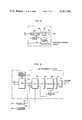
- FIG. 2is a block diagram of an apparatus for practicing the present invention.
- movementwill be described solely along the X-axis for the sake of simplicity. Therefore, the arrangement of FIG. 2 pertains to the X-axis only. A similar arrangement would be provided for each of the other controlled axes.
- numeral 11denotes a numerical control device containing a so-called pulse distributor for executing a pulse distribution operation on the basis of a move command in order to generate distributed pulses CP.
- the amplified analog voltage from servo circuit 12is applied to a DC motor 13, the motor being driven thereby so as to make the computed difference approach a value of zero.
- a ball screw 14is driven by the DC motor 13 to transport a movable member, which is a table 15 in the present embodiment.
- a position sensor 16such as a pulse coder is adapted to generate a single pulse for each prescribed increment of movement of the table 15.
- Each pulseserves as a feedback pulse XFP, which is applied to the input side of the error register 12a in the servo circuit 12.
- the distributed pulses from the numerical control deviceare applied also to a simulator 17.
- the DC motor 13exhibits a primary delay characteristic. In other words, rather than rotating immediately in response to each pulse CP produced by the numerical control device 11, the DC motor 13 rotates and "follows up" pulses CP after a predetermined delay.
- the simulator 17,which is adapted to simulate the servo system characteristics, generates simulation pulses SP, which appear at time intervals approximately the same as those of the feedback pulses XFB. The construction of the simulator 17 is shown in FIG. 3.
- the simulator 17is shown to include a reversible counter 17a which is adapted to count up the distributed pulses CP and to count down the simulation pulses SP, an accumulator 17b whose output is the simulation pulse train, an oscillator 17c for generating pulses P s of a constant frequency, and an adding circuit 17d which adds the value of the count held in reversible counter 17a to the accumulated value in accumulator 17b each time the oscillator 17c generates a pulse. If we assume that accumulator 17b can hold n-number of bits, then an overflow pulse will be obtained from the accumulator when the accumulated value exceeds 2 n .
- the overflow pulses provided by the accumulatorare the simulation pulses SP.
- the simulator 17is capable of simulating the primary delay characteristic of the servo system.
- the simulation pulses SP from the simulator 17are applied to a current position checking circuit 18 whose other input is the train of feedback pulses XFP.
- the circuit 18checks whether the table 15 has entered a forbidden area, or whether the difference between the simulation pulses SP and the feedback pulses XFP has exceeded a predetermined value ME. If the table has entered the forbidden area, or if said difference has exceeded the predetermined value ME, the current position checking circuit 18 issues an alarm signal ALM.
- FIG. 4to describe the construction and operation of this circuit.
- the current position checking circuit 18includes a reversible counter 18a for counting up the feedback pulses XFP and for counting down the simulation pulses SP, a comparator 18b for comparing the predetermined value ME and the content of reversible counter 18a, namely the difference ER between the feedback pulses XFB and the simulation pulses SP, and for producing a "1" logic level when ER is greater than ME (ER>ME), a current position register 18c for storing the current position X p of the table on the X-axis by having its content incremented or decremented by the feedback pulses XFB in accordance with the direction of table movement, a discrimination circuit 18d for determining, based on the current position (X p , Z p of the table and on entry forbidden information, whether the current position of the table is within an entry forbidden area, and for producing a "1" logic level when such is indeed the case, and an OR gate 18e for delivering the alarm signal ALM, the inputs to the OR gate
- FIG. 5is a block diagram showing the construction of the discrimination circuit 18d.
- Numeral 101denotes a parameter storage device, in the form of a random access memory (RAM), for storing such parameters as rapid traverse speed, acceleration/deceleration constants, entry forbidden areas, etc. These parameters can be entered in a manual data input mode MDI, or directly from an NC tape TP. The parameters are written also into a non-volatile memory 102 such as a magnetic bubble memory; when the numerical control device is turned on, the parameter data from the non-volatile memory 102 is read into the parameter storage device and is applied to a processing unit 103. To understand the operation of this unit, reference should also be had to FIG.
- RAMrandom access memory
- the inputs to the processing unit 103 from the parameter storage deviceare coordinate values P 1 (X, Z), P 2 (I, K), P 3 (X 1 , Z 1 ), P 4 (X 2 , Z 2 ) which specify the boundaries of entry forbidden areas.
- the processing unit 103divides the total maximum area of allowable movement MA into 56 sub-areas 00, 01, . . . , 0F,. . . , 37 by making eight partitions along the Z-axis and seven partitions along the X-axis, and creates entry forbidden information for each of these sub-areas 00, 01, . . .
- OTArepresents an overtravel area, defined by the maximum stroke
- EPA 1 , EPA 2represent first and second entry forbidden areas, respectively.
- the entry forbidden information from the processing unit 103is delivered to a write control circuit 104 which writes the information into a memory 105, each single bit of which corresponds to one of the sub-areas mentioned above.
- FIG. 7shows how units of entry forbidden information are written into the memory locations corresponding to respective ones of the sub-areas.
- each bit of memory 104is assigned to each one of the sub-areas, with a "1" being written into each bit constituting an entry forbidden area, and a "0" being written into each of the bits forming the sub-areas that lie outside the entry forbidden areas.
- 00, 01, . . . , 37are hexadecimal numbers, and the hexadecimal numbers in FIG.
- the processing unit 103performs an operation to determine which bit of memory 105 is being referred to on the basis of the current position of the table, this information being provided by X-axis and Z-axis current position counters 108, 109 that will be described in more detail below.
- a read control circuit 106receives the output of memory 105.
- An address register 107designates the storage locations of memory 105 into which the entry forbidden information is to be written, or from which this information is to be read.
- the current position counters 108, 109 mentioned aboveindicate the current position of the table along the X and Z axes by counting up or counting down, in accordance with the travelling direction of the movable member, feedback pulses XFP, ZFP, each of which is generated by a pulse coder or the like (not shown) for each prescribed increment of movement of the movable member.
- feedback pulses XFP, ZFPinstead of these feedback pulses XFP, ZFP, however, pulses distributed along the X and Z axes by a pulse distributor (not shown) can be applied to the current position counters 108, 109 to be counted up or counted down in a similar manner.
- the information read out of the memory 105 by the read control circuit 106is applied to a checking circuit 110, which determines on the basis of this information as to whether the movable member (the table or a tool) has entered a forbidden area.
- FIG. 5operates as follows. First, assume that the movable member, such as a tool, is located at point AP (sub-area 11) in FIG. 6.
- the processing unit 103compares the boundary value X 02 (which is equal to X 1 ) with the current tool position X p and, when the tool is moving in the -X direction, the processing unit 103 compares the boundary value X 01 (which is equal to X) with the current position X p .
- the value "19"(namely 11+8 in hexadecimal notation) is set in address register 107
- the value "09”namely 11-8 in hexadecimal notation
- the value "12”(11+ 1 in hexadecimal notation) is set in the address register when boundary value Z 01 is exceeded in the +Z direction.
- the current address corresponding to the sub-area currently occupied by the toolis set in the address register 107.
- the processing unit 103continues comparing the X- and Z-direction boundary values with X p and Z p in accordance with the direction of tool movement, thereby updating the content of the address register 107 whenever a boundary is exceeded.
- the processing unit 103 in this embodimentproduces the entry forbidden information by using the coordinate values P 1 (X, Z), P 2 (I, K), P 3 (X 1 , Z 1 ), P 4 (X 2 , Z 2 ) which specify the boundaries of the entry forbidden areas, this information being stored in memory 105.
- P 1 (X, Z), P 2 (I, K), P 3 (X 1 , Z 1 ), P 4 (X 2 , Z 2 )which specify the boundaries of the entry forbidden areas, this information being stored in memory 105.
- the boundariesare expressed by mathematical equations.
- the table 15can be transported along a boundary in a dry-run mode instructed by the NC tape or by a manual data input (MDI), or by a jog feed operation, the table path traversed at such time serving as the boundary information input.
- MDImanual data input
- the boundaryWhen defining a boundary for the final shape of the workpiece, the boundary should be so specified as to fall within said final shape by a prescribed tolerance.
- a distributed pulse CPis generated by the pulse distributor in the numerical control device 11, the pulse is accumulated by the error register 12a in the servo circuit 12 and is also applied to the simulator 17.
- the content of error register 12a converted into an analog voltage by the DA converter 12b,is amplified by amplifier 12c and is then applied to the DC motor 13, which responds by rotating the ball screw 14 to transport the table 15 in the commanded direction.
- the position sensor 16produces a single feedback pulse XFP for each prescribed increment of movement of the table 15, the feedback pulse entering the error register 12a to decrement its content by one step.
- the foregoing circuit elementsconstruct a servo loop SL which keeps repeating the described operation, establishing a steady state in which the table 15 is transported at the commanded speed with a constant deviation value being maintained in error register 12a.
- the series of distributed pulsed CPwhich have entered the simulator 17 are imparted with a primary delay characteristic by the simulator, the pulses emerging as the simulation pulses SP.
- the simulation pulses SPenter the reversible counter 18a in the current position checking circuit 18 of FIG. 4 with a characteristic which is identical with that of the feedback pulses FP, the content of the counter being downcounted by each pulse.
- the feedback pulses XFPenter the reversible counter 18a at its upcount input terminal, so that the counter is up-counted each time a feedback pulse XFP is generated.
- These feedback pulses XFPare applied also to the current position register 18c, whose content is updated stepwise in accordance with the direction of movement.
- the current position X p of the table along the X-axisthus is stored in register 18c.
- the feedback pulses XFP and simulation pulses SPare generated at approximately the same time intervals, so the content ER (the difference between XFP and SP) of reversible counter 18a does not exceed the predetermined value ME. If an abnormality should develop in the servo system, however, the content ER of reversible counter 18a will increase excessively and surpass the value ME (i.e., ER>ME).
- the comparator 18bproduces a "1" logic level, causing the OR gate 18e to deliver the alarm signal ALM which halts the machine instantly.
- the table 15is not permitted to move as commanded on the input side of the numerical control device 11 when a situation develops in which the content ER of reversible counter 18a exceeds the predetermined value ME, the alarm signal ALM being issued just as if the tool had entered a forbidden area.
- the discrimination circuit 18duses the entry forbidden information stored in memory 105 (FIG. 5) to determine whether the current position AP resides in an entry forbidden area. If the table 15 should happen to be moved erroneously by a malfunction in the arithmetic circuitry, by an error in the NC tape read operation, or by an error committed by the operator, and if this should cause penetration of a forbidden area, the discrimination circuit 18d immediately detects the event in the manner described, issuing the alarm signal ALM through the OR gate 18e, thereby to bring the machine to an emergency stop.
- the simulatoris provided to enable detection of a servo system error, and entry forbidden areas are defined in accordance with the commanded shape of a workpiece.
- entry forbidden areasare defined in accordance with the commanded shape of a workpiece.
- Another advantage of the present inventionis that forbidden areas can be simply established, and penetration of such areas by a movable member such as a tool is reliably detected, without the use of limit switches or sensors. Furthermore, according to the present invention, whether a forbidden area has been penetrated or not is discriminated by dividing an area of allowable movement into a multiplicity of smaller sub-areas, computing entry forbidden information for each sub-area, storing the results of the computations in a memory beforehand, and reading the information out of the memory in accordance with the current position of the movable member. By virtue of such a method it is unnecessary to execute, on a one-by-one basis, operations to determine whether a forbidden area has been penetrated by the movable member. This permits the discrimination operation to be conducted at a high speed without subjecting the processing circuitry to a heavy load. It is also very simple with the present invention to change and to set the forbidden areas.
- the present inventionhas been described and illustrated above in connection with controlling the movement of a tool or table employed in a numerically controlled machine tool. It is obvious that the invention is not limited to such an arrangement, but that it can be applied to control the movement of a robot arm as well.
- the forbidden areasare rectangularly shaped in the described embodiment, it goes without saying that they can have a triangular or circular configuration.
- the forbidden areas which are definedcan be made to overlap one another.
Landscapes
- Engineering & Computer Science (AREA)
- Human Computer Interaction (AREA)
- Manufacturing & Machinery (AREA)
- Physics & Mathematics (AREA)
- General Physics & Mathematics (AREA)
- Automation & Control Theory (AREA)
- Numerical Control (AREA)
Abstract
Description
This invention relates to a numerical control method and apparatus and, more particularly, to a numerical control method and apparatus in which flawing and attendant loss of a workpiece can be prevented by establishing and then prestoring in memory the areas which a movable member is forbidden to enter, and by adopting an arrangement wherein movement of the movable member is halted instantaneously as soon as the movable member enters the forbidden area during a machining operation.
Numerically controlled machine tools possess a movable member such as a tool or a table which is transported by means of a ball screw, and such factors as the length of the ball screw determine the maximum area over which the movable member can be transported. Since the movable member may inadvertently be caused to exceed the boundary of said area (a phenomenon referred to as "over-travel") by a programming error or malfunction, it is conventional practice to detect the overtravel as soon as it occurs and then bring the movable member to an emergency stop. To achieve such overtravel detection, it is customary to provide limit switches at the points of maximum stroke on the +X, -X and +Z, -Z sides of the area of allowable movement, and to provide a dog on the movable member, the arrangement being such that the dog presses against a limit switch when the movable member overtravels. The actuated limit switch produces a signal indicative of the overtravel event.
It is quite common in systems of the type described above to have a smaller area, within the area of allowable movement mentioned above, which the movable member is forbidden to enter. One example of such is the area defined within the final shape of the workpiece, that is, the final shape into which the workpiece is to be machined, referred to as the "commanded shape". For a tool to penetrate this area to a very small degree would cause only a negligibly small drop off in cutting precision, but penetration beyond a predetermined amount would cause the tool to cut too deeply into the workpiece and render it useless as a final product. Wasting workpieces in this manner obviously represents poor economy since the materials are costly.
Another example of a forbidden area is that occupied by the chuck provided on a lathe. A tool caused to penetrate this area would strike the chuck and result in damage or breakage of both the tool and chuck.
Such inadvertent movement of a movable member as described above can be caused by a malfunction in the arithmetic unit of a numerical control device, by an error in an NC tape read operation, by operator error, or by failure in a servo system. The prior art has been conspicuously devoid of truly satisfactory means for detecting penetration of a tool into a forbidden area. For example, one expedient has been to attach a sensor or limit switch to the chuck in order to detect contact between it and the tool. However, attaching the sensor or limit switch to the chuck is a difficult operation, the chuck takes on a more complicated structure, and costs are raised. Still other defects encountered with this expedient are that it is difficult to change or redefine the forbidden areas, and that it is not possible to detect tool penetration of the area defined by the commanded shape, even if the sensors or the like are mounted on the chuck.
Accordingly, it is an object of the present invention to provide a numerical control method and apparatus for preventing damage to an expensive tool or workpiece caused by a malfunction in the arithmetic unit of a numerical control device, by an error in an NC tape read operation, by operator error, or by a failure in a servo system.
Another object of the present invention is to provide a numerical control method and apparatus for detecting, in a reliable and simple manner, the penetration of a movable member such as a tool into a forbidden area.
A further object of the present invention is to provide a numerical control method and apparatus which enable a forbidden area to be redefined with facility even when there is a modification in the final shape of a workpiece.
These and other objects and features of the present invention will be apparent from the following description taken in conjunction with the accompanying drawings, in which like reference characters designate the same or similar parts throughout the figures thereof.
FIG. 1 is an illustrative view useful in describing the relationship between forbidden areas and the maximum area of allowable movement;
FIG. 2 is a block diagram for practicing the numerical control method of the present invention;
FIG. 3 is a block diagram of a simulator;
FIG. 4 is a block diagram of a current position checking circuit;
FIG. 5 is a block diagram of a discrimination circuit;
FIG. 6 is an illustrative view useful in describing how an area of allowable movement is divided into smaller sub-areas in accordance with the shape of forbidden areas; and
FIG. 7 is an illustrative view useful in describing a case where entry forbidden information is written into a memory in accordance with each of the small sub-areas shown in FIG. 6.
Referring first to FIG. 1, OTA represents an overtravel area within which is defined an area of allowable movement MA. Within the area MA there are defined areas EPA1, EPA2, EPA3 into which entry of a tool is forbidden. These three areas therefore are referred to as entry forbidden areas. The entry forbidden areas EPA1, EPA2 define a shape approximating that of a chuck provided on a lathe. A tool, if it were to enter the areas EPA1, EPA2, would strike the chuck and inflict damage upon both itself and chuck. The entry forbidden area EPA3 is decided by the commanded or final shape of the workpiece, that is, by the shape that would result by cutting the starting stock down to the allowable depth. If this area were penetrated by the tool, the workpiece would not be cut to the desired tolerance and would have to be rejected.
FIG. 2 is a block diagram of an apparatus for practicing the present invention. In the discussion that follows, movement will be described solely along the X-axis for the sake of simplicity. Therefore, the arrangement of FIG. 2 pertains to the X-axis only. A similar arrangement would be provided for each of the other controlled axes.
In FIG. 2, numeral 11 denotes a numerical control device containing a so-called pulse distributor for executing a pulse distribution operation on the basis of a move command in order to generate distributed pulses CP. Awellknown servo circuit 12, which receives the distributed pulses CP, includes anerror register 12a for computing the difference between the distributed pulses CP and feedback pulses XFP (which will be described later), aDA converter 12b for producing an analog voltage corresponding to the difference computed by theerror register 12a, and anamplifier 12c for amplifying the analog voltage. The amplified analog voltage fromservo circuit 12 is applied to aDC motor 13, the motor being driven thereby so as to make the computed difference approach a value of zero. Aball screw 14 is driven by theDC motor 13 to transport a movable member, which is a table 15 in the present embodiment. Aposition sensor 16 such as a pulse coder is adapted to generate a single pulse for each prescribed increment of movement of the table 15. Each pulse serves as a feedback pulse XFP, which is applied to the input side of theerror register 12a in theservo circuit 12. The distributed pulses from the numerical control device are applied also to asimulator 17. Ordinarily, theDC motor 13 exhibits a primary delay characteristic. In other words, rather than rotating immediately in response to each pulse CP produced by the numerical control device 11, theDC motor 13 rotates and "follows up" pulses CP after a predetermined delay. Thesimulator 17, which is adapted to simulate the servo system characteristics, generates simulation pulses SP, which appear at time intervals approximately the same as those of the feedback pulses XFB. The construction of thesimulator 17 is shown in FIG. 3.
In FIG. 3, thesimulator 17 is shown to include areversible counter 17a which is adapted to count up the distributed pulses CP and to count down the simulation pulses SP, anaccumulator 17b whose output is the simulation pulse train, anoscillator 17c for generating pulses Ps of a constant frequency, and an addingcircuit 17d which adds the value of the count held inreversible counter 17a to the accumulated value inaccumulator 17b each time theoscillator 17c generates a pulse. If we assume thataccumulator 17b can hold n-number of bits, then an overflow pulse will be obtained from the accumulator when the accumulated value exceeds 2n. The overflow pulses provided by the accumulator are the simulation pulses SP. Now, let the content ofreversible counter 17a be e, let the pulse rate of the pulse generated byoscillator 17c be fo, and let the pulse rate of the distributed pulses CP and of the simulation pulses SP be Fi and Fo, respectively. The relationships among these values may be expressed by the following equations:
de/dt=F.sub.1 -F.sub.o (1)
F.sub.o =f.sub.o /2.sup.n ·e=k·e (2)
From Eqs. (1) and (2), e and Fo may be written:
e=F.sub.i /k[1-exp (-kt)] (3)
F.sub.o =F.sub.i [1-exp (-kt)] (4)
Thus, thesimulator 17 is capable of simulating the primary delay characteristic of the servo system.
Returning to FIG. 2, the simulation pulses SP from thesimulator 17 are applied to a currentposition checking circuit 18 whose other input is the train of feedback pulses XFP. Thecircuit 18 checks whether the table 15 has entered a forbidden area, or whether the difference between the simulation pulses SP and the feedback pulses XFP has exceeded a predetermined value ME. If the table has entered the forbidden area, or if said difference has exceeded the predetermined value ME, the currentposition checking circuit 18 issues an alarm signal ALM. Reference will now be had to FIG. 4 to describe the construction and operation of this circuit.
As illustrated in FIG. 4, the currentposition checking circuit 18 includes a reversible counter 18a for counting up the feedback pulses XFP and for counting down the simulation pulses SP, acomparator 18b for comparing the predetermined value ME and the content of reversible counter 18a, namely the difference ER between the feedback pulses XFB and the simulation pulses SP, and for producing a "1" logic level when ER is greater than ME (ER>ME), acurrent position register 18c for storing the current position Xp of the table on the X-axis by having its content incremented or decremented by the feedback pulses XFB in accordance with the direction of table movement, adiscrimination circuit 18d for determining, based on the current position (Xp, Zp of the table and on entry forbidden information, whether the current position of the table is within an entry forbidden area, and for producing a "1" logic level when such is indeed the case, and anOR gate 18e for delivering the alarm signal ALM, the inputs to the OR gate being the signals provided by thecomparator 18b and by thediscimination circuit 18d. In the foregoing, Xp is the current position of the table when projected on the X-axis, and Zp the current position when projected on the Z-axis.
FIG. 5 is a block diagram showing the construction of thediscrimination circuit 18d.Numeral 101 denotes a parameter storage device, in the form of a random access memory (RAM), for storing such parameters as rapid traverse speed, acceleration/deceleration constants, entry forbidden areas, etc. These parameters can be entered in a manual data input mode MDI, or directly from an NC tape TP. The parameters are written also into anon-volatile memory 102 such as a magnetic bubble memory; when the numerical control device is turned on, the parameter data from thenon-volatile memory 102 is read into the parameter storage device and is applied to aprocessing unit 103. To understand the operation of this unit, reference should also be had to FIG. 6, which shows how an area of allowable movement is divided into smaller areas in accordance with the shape of entry forbidden areas. The inputs to theprocessing unit 103 from the parameter storage device are coordinate values P1 (X, Z), P2 (I, K), P3 (X1, Z1), P4 (X2, Z2) which specify the boundaries of entry forbidden areas. On the basis of these coordinate values, theprocessing unit 103 divides the total maximum area of allowable movement MA into 56 sub-areas 00, 01, . . . , 0F,. . . , 37 by making eight partitions along the Z-axis and seven partitions along the X-axis, and creates entry forbidden information for each of these sub-areas 00, 01, . . . , 0F, 11, 12, . . . , 37. The hatched portions of FIG. 6 indicate the entry forbidden areas. OTA represents an overtravel area, defined by the maximum stroke, and EPA1, EPA2 represent first and second entry forbidden areas, respectively.
The entry forbidden information from theprocessing unit 103 is delivered to awrite control circuit 104 which writes the information into amemory 105, each single bit of which corresponds to one of the sub-areas mentioned above. This can be understood with reference to FIG. 7 which shows how units of entry forbidden information are written into the memory locations corresponding to respective ones of the sub-areas. It will be appreciated that each bit ofmemory 104 is assigned to each one of the sub-areas, with a "1" being written into each bit constituting an entry forbidden area, and a "0" being written into each of the bits forming the sub-areas that lie outside the entry forbidden areas. Furthermore, 00, 01, . . . , 37 are hexadecimal numbers, and the hexadecimal numbers in FIG. 6 correspond to those in FIG. 7. Theprocessing unit 103 performs an operation to determine which bit ofmemory 105 is being referred to on the basis of the current position of the table, this information being provided by X-axis and Z-axis current position counters 108, 109 that will be described in more detail below. Aread control circuit 106 receives the output ofmemory 105. Anaddress register 107 designates the storage locations ofmemory 105 into which the entry forbidden information is to be written, or from which this information is to be read. The current position counters 108, 109 mentioned above indicate the current position of the table along the X and Z axes by counting up or counting down, in accordance with the travelling direction of the movable member, feedback pulses XFP, ZFP, each of which is generated by a pulse coder or the like (not shown) for each prescribed increment of movement of the movable member. Instead of these feedback pulses XFP, ZFP, however, pulses distributed along the X and Z axes by a pulse distributor (not shown) can be applied to the current position counters 108, 109 to be counted up or counted down in a similar manner. The information read out of thememory 105 by theread control circuit 106 is applied to a checking circuit 110, which determines on the basis of this information as to whether the movable member (the table or a tool) has entered a forbidden area.
The arrangement of FIG. 5 operates as follows. First, assume that the movable member, such as a tool, is located at point AP (sub-area 11) in FIG. 6. When the tool is moving in the +X direction, theprocessing unit 103 compares the boundary value X02 (which is equal to X1) with the current tool position Xp and, when the tool is moving in the -X direction, theprocessing unit 103 compares the boundary value X01 (which is equal to X) with the current position Xp. Similarly, theprocessing unit 103 compares the boundary value Z01 (=K) with the current tool position Zp, and the boundary value Z00 with the current position Zp, for movement in the +Z and -Z directions, respectively. When a boundary value is exceeded in the X direction, theprocessing circuit 103, according to whether such movement is in the + or - direction, adds eight to or subtracts eight from the content (=11) of theaddress register 107 for specifying the current addresses ofmemory 105. Similarly, when a boundary value is exceeded in the Z direction, theprocessing circuit 103, according to whether such movement is in the + or - direction, adds one to, or substracts one from, the content of theaddress register 107. The result of the addition or substraction operation is set in the address register. For instance, if the tool exceeds the boundary value X02 while travelling in the +X direction, the value "19" (namely 11+8 in hexadecimal notation) is set inaddress register 107, and if it exceeds the boundary value X01 while travelling in the -X direction, the value "09" (namely 11-8 in hexadecimal notation) is set inaddress register 107. Similarly, the value "12" (11+ 1 in hexadecimal notation) is set in the address register when boundary value Z01 is exceeded in the +Z direction. Thus the current address corresponding to the sub-area currently occupied by the tool is set in theaddress register 107. At the same time that the above operation is taking place, theprocessing unit 103 continues comparing the X- and Z-direction boundary values with Xp and Zp in accordance with the direction of tool movement, thereby updating the content of theaddress register 107 whenever a boundary is exceeded.
Accordingly, when the tool is moved in the +Z direction and crosses the boundary Z01, "12" is set in theaddress register 107, so that theread control circuit 106 reads the "1" logic from the addressed location (shown by the hatched portion of FIG. 7) ofmemory 105. This "1" logic is applied to the checking circuit 110 which issues an alarm signal by recognizing, on the basis of the "1" logic, that the tool has entered the forbidden area EPA2. The arrangement is such that the alarm signal activates a lamp (not shown) on the numerical control device. When the tool is moved in the +X direction and crosses the boundary X02, "19" is set in theaddress register 107, so that a "0" is read out of the addressed location ofmemory 105. As stated previously, theprocessing unit 103 in this embodiment produces the entry forbidden information by using the coordinate values P1 (X, Z), P2 (I, K), P3 (X1, Z1), P4 (X2, Z2) which specify the boundaries of the entry forbidden areas, this information being stored inmemory 105. It should be noted, however, that an arrangement can be adopted in which the boundaries are expressed by mathematical equations. Furthermore, the table 15 can be transported along a boundary in a dry-run mode instructed by the NC tape or by a manual data input (MDI), or by a jog feed operation, the table path traversed at such time serving as the boundary information input.
When defining a boundary for the final shape of the workpiece, the boundary should be so specified as to fall within said final shape by a prescribed tolerance.
The operation of the present invention will now be described with reference to FIG. 2. When a distributed pulse CP is generated by the pulse distributor in the numerical control device 11, the pulse is accumulated by theerror register 12a in theservo circuit 12 and is also applied to thesimulator 17. The content oferror register 12a converted into an analog voltage by theDA converter 12b, is amplified byamplifier 12c and is then applied to theDC motor 13, which responds by rotating theball screw 14 to transport the table 15 in the commanded direction. Theposition sensor 16 produces a single feedback pulse XFP for each prescribed increment of movement of the table 15, the feedback pulse entering theerror register 12a to decrement its content by one step. The foregoing circuit elements construct a servo loop SL which keeps repeating the described operation, establishing a steady state in which the table 15 is transported at the commanded speed with a constant deviation value being maintained inerror register 12a. As this operation proceeds, the series of distributed pulsed CP which have entered thesimulator 17 are imparted with a primary delay characteristic by the simulator, the pulses emerging as the simulation pulses SP. As a result, the simulation pulses SP enter the reversible counter 18a in the currentposition checking circuit 18 of FIG. 4 with a characteristic which is identical with that of the feedback pulses FP, the content of the counter being downcounted by each pulse. On the other hand, the feedback pulses XFP enter the reversible counter 18a at its upcount input terminal, so that the counter is up-counted each time a feedback pulse XFP is generated. These feedback pulses XFP are applied also to thecurrent position register 18c, whose content is updated stepwise in accordance with the direction of movement. The current position Xp of the table along the X-axis thus is stored inregister 18c.
When the servo system is operating normally, the feedback pulses XFP and simulation pulses SP are generated at approximately the same time intervals, so the content ER (the difference between XFP and SP) of reversible counter 18a does not exceed the predetermined value ME. If an abnormality should develop in the servo system, however, the content ER of reversible counter 18a will increase excessively and surpass the value ME (i.e., ER>ME). When the inequality ER>ME is established, thecomparator 18b produces a "1" logic level, causing theOR gate 18e to deliver the alarm signal ALM which halts the machine instantly. In other words, in accordance with the present invention, the table 15 is not permitted to move as commanded on the input side of the numerical control device 11 when a situation develops in which the content ER of reversible counter 18a exceeds the predetermined value ME, the alarm signal ALM being issued just as if the tool had entered a forbidden area.
In concurrence with the foregoing checking operation, thediscrimination circuit 18d uses the entry forbidden information stored in memory 105 (FIG. 5) to determine whether the current position AP resides in an entry forbidden area. If the table 15 should happen to be moved erroneously by a malfunction in the arithmetic circuitry, by an error in the NC tape read operation, or by an error committed by the operator, and if this should cause penetration of a forbidden area, thediscrimination circuit 18d immediately detects the event in the manner described, issuing the alarm signal ALM through theOR gate 18e, thereby to bring the machine to an emergency stop.
Thus, in accordance with the present invention as described above, the simulator is provided to enable detection of a servo system error, and entry forbidden areas are defined in accordance with the commanded shape of a workpiece. Such an arrangement permits machine tool operation to be halted before the workpiece can be damaged by extraordinary movement of a tool relative to the workpiece, as may be caused by a malfunction in an arithmetic or servo system, by operator error, or by an error in reading an NC tape. Preventing such damage results in fewer wasted workpieces.
Another advantage of the present invention is that forbidden areas can be simply established, and penetration of such areas by a movable member such as a tool is reliably detected, without the use of limit switches or sensors. Furthermore, according to the present invention, whether a forbidden area has been penetrated or not is discriminated by dividing an area of allowable movement into a multiplicity of smaller sub-areas, computing entry forbidden information for each sub-area, storing the results of the computations in a memory beforehand, and reading the information out of the memory in accordance with the current position of the movable member. By virtue of such a method it is unnecessary to execute, on a one-by-one basis, operations to determine whether a forbidden area has been penetrated by the movable member. This permits the discrimination operation to be conducted at a high speed without subjecting the processing circuitry to a heavy load. It is also very simple with the present invention to change and to set the forbidden areas.
The present invention has been described and illustrated above in connection with controlling the movement of a tool or table employed in a numerically controlled machine tool. It is obvious that the invention is not limited to such an arrangement, but that it can be applied to control the movement of a robot arm as well. Moreover, though the forbidden areas are rectangularly shaped in the described embodiment, it goes without saying that they can have a triangular or circular configuration. In addition, the forbidden areas which are defined can be made to overlap one another.
As many apparently widely different embodiments of the present invention can be made without departing from the spirit and scope thereof, it is to be understood that the invention is not limited to the specific embodiment thereof except as defined in the appended claims.
Claims (9)
1. A numerical control method for controlling the movement of a movable member by setting entry forbidden areas which said movable member is forbidden to enter, said method comprising:
entering path data for a movement path of the movable member;
creating and storing in a memory, entry forbidden data relating to the boundaries of said entry forbidden areas, where said entry forbidden data can be noncorresponding to the path data, such that the entry forbidden data defines areas adjacent to the movement path as well as areas not adjacent to the movement path;
monitoring the current position of the movable member;
ascertaining on the basis of said entry forbidden data, whether the current position of said movable member resides within an entry forbidden area; and
halting the movement of said movable member when the current position thereof has entered an entry forbidden area, so that if the movable member, which during normal operation should be moving along the movement path, enters the entry forbidden area, movement will be halted whether or not the area entered is adjacent to the movement path.
2. The numerical control method according to claim 1, in which said creating step comprises the steps of:
entering coordinate values which specify the boundaries of the entry forbidden areas;
dividing an area, over which the movable member is allowed to move, into a multiplicity of small sub-areas;
determining, on the basis of said coordinate values, whether a sub-area is an entry forbidden area; and
storing the entry forbidden data resulting from said determination in a memory location which corresponds to a respective sub-area.
3. The numerical control method according to claim 2, in which said ascertaining step comprises the steps of:
finding a memory location corresponding to a sub-area in which the current position of the movable member resides; and
reading the entry forbidden data from said memory location.
4. The numerical control method according to claim 1, in which said creating step comprises the step of establishing an entry forbidden area corresponding to a commanded shape.
5. The numerical control method according to claim 4, in which said creating step is conducted by supplying the boundaries of said entry forbidden area corresponding to a command shape in the form of mathematical equations.
6. The numerical control method according to claim 4, in which supplying the boundaries of said entry forbidden area corresponding to a command shape is conducted while the movable member is being moved in a dry-run mode on the basis of numerical control data.
7. A numerical control apparatus for setting entry forbidden areas which a movable member is forbidden to enter, and for controlling the movement of said movable member along a movement path on the basis of numerical control data, which apparatus comprises:
memory means for storing entry forbidden data relating to the boundaries of the entry forbidden areas, said entry forbidden data can be noncorresponding to the numerical control data, such that the entry forbidden data defines area adjacent to the movement path as well as areas not adjacent to the movement path;
current position storage means for storing the current position of the movable member;
discrimination means, responsive to said memory means and said current position storage means, for ascertaining, on the basis of the entry forbidden data, whether the current position of the movable member resides within an entry forbidden area; and
means for generating an alarm in response to penetration of an entry forbidden area by the current position of the movable member, so that if the movable member, which during normal operation should be moving along the movement path, enters the entry forbidden area, movement will be halted whether or not the area entered is adjacent to the movement path.
8. The numerical control apparatus according to claim 7, further comprising:
input means for entering coordinate values which specify the boundaries of the entry forbidden areas, and
means for writing entry forbidden data into locations in said memory means corresponding to sub-areas obtained by dividing an area, over which the movable member is allowed to move, into a multiplicity of smaller areas on the basis of said coordinate values.
9. The numerical control apparatus according to claim 7, in which said discrimination means comprises:
means for computing a location in said memory means corresponding to a sub-area in which the current position of the movable member resides; and
means for reading the entry forbidden data for said location in said memory means.
Applications Claiming Priority (2)
| Application Number | Priority Date | Filing Date | Title |
|---|---|---|---|
| JP55148760AJPS5773402A (en) | 1980-10-23 | 1980-10-23 | Numerical control system |
| JP55-148760 | 1980-10-23 |
Publications (1)
| Publication Number | Publication Date |
|---|---|
| US4481568Atrue US4481568A (en) | 1984-11-06 |
Family
ID=15460022
Family Applications (1)
| Application Number | Title | Priority Date | Filing Date |
|---|---|---|---|
| US06/313,614Expired - Fee RelatedUS4481568A (en) | 1980-10-23 | 1981-10-21 | Numerical control method and apparatus |
Country Status (3)
| Country | Link |
|---|---|
| US (1) | US4481568A (en) |
| JP (1) | JPS5773402A (en) |
| DE (1) | DE3141983A1 (en) |
Cited By (19)
| Publication number | Priority date | Publication date | Assignee | Title |
|---|---|---|---|---|
| US4604705A (en)* | 1982-12-29 | 1986-08-05 | Mitsubishi Denki Kabushiki Kaisha | Numerical control machining method and system therefor |
| US4604560A (en)* | 1982-10-13 | 1986-08-05 | Toyoda Koki Kabushiki Kaisha | Numerical control machine tool with an emergency origin returning function |
| US4612487A (en)* | 1983-08-18 | 1986-09-16 | Hitachi, Ltd. | System and method for controlling an industrial robot |
| US4646247A (en)* | 1983-06-17 | 1987-02-24 | Fanuc Ltd. | Numerical control apparatus with function graphic stored stroke limit check |
| US4758961A (en)* | 1986-07-10 | 1988-07-19 | Yamazaki Machinery Works, Ltd. | Tool move control method and apparatus for preventing tool interference with an object. |
| US4794541A (en)* | 1984-04-26 | 1988-12-27 | Fanuc Ltd. | Numerical control method |
| US4949277A (en)* | 1988-03-09 | 1990-08-14 | North American Philips Corporation | Differential budding: method and apparatus for path planning with moving obstacles and goals |
| US5031106A (en)* | 1988-06-30 | 1991-07-09 | Brother Kogyo Kabushiki Kaisha | Machine tool |
| US5083256A (en)* | 1988-03-09 | 1992-01-21 | North American Philips Corporation | Path planning with transition changes |
| EP0335314A3 (en)* | 1988-03-25 | 1992-02-12 | Kabushiki Kaisha Toshiba | Method and apparatus of free space enumeration for collision avoidance |
| US5220497A (en)* | 1987-11-20 | 1993-06-15 | North American Philips Corp. | Method and apparatus for controlling high speed vehicles |
| US5663879A (en)* | 1987-11-20 | 1997-09-02 | North American Philips Corporation | Method and apparatus for smooth control of a vehicle with automatic recovery for interference |
| US5808887A (en)* | 1987-11-20 | 1998-09-15 | Philips Electronics North America Corporation | Animation of path planning |
| US5846121A (en)* | 1994-07-29 | 1998-12-08 | Toyoda Koki Kabushiki Kaisha | Method for machining a workpiece by renewing a tool movable range |
| US5870303A (en)* | 1987-11-20 | 1999-02-09 | Philips Electronics North America Corporation | Method and apparatus for controlling maneuvers of a vehicle |
| US5980082A (en)* | 1995-07-05 | 1999-11-09 | Fanuc Limited | Robot movement control device and movement control method |
| US6324476B1 (en)* | 1987-11-20 | 2001-11-27 | Philips Electronicsnorth America Corporation | Method and apparatus for identifying or controlling travel to a rendezvous |
| US6604005B1 (en)* | 1987-11-20 | 2003-08-05 | Koninklijke Philips Electronics N.V. | Method and apparatus for path planning |
| US20090125139A1 (en)* | 2007-11-13 | 2009-05-14 | Fanuc Ltd | Numerical controller for storing operating history during path table operation |
Families Citing this family (6)
| Publication number | Priority date | Publication date | Assignee | Title |
|---|---|---|---|---|
| US4489377A (en)* | 1982-09-07 | 1984-12-18 | General Electric Company | Method for preventing machine component interference |
| JPS60132208A (en)* | 1983-12-21 | 1985-07-15 | Amada Co Ltd | Moving range controlling method of movable body |
| JPS60230205A (en)* | 1984-04-27 | 1985-11-15 | Fanuc Ltd | Numerical controlling system |
| JPH0197540A (en)* | 1987-10-08 | 1989-04-17 | Mori Seiki Seisakusho:Kk | numerical control machine tools |
| JPH02152748A (en)* | 1988-12-02 | 1990-06-12 | Mitsubishi Electric Corp | Stroke end check device for numerical control machine tools |
| DE10063674B4 (en)* | 2000-12-20 | 2009-05-07 | Siemens Ag | Numerical control and method for automatically retracting an axle after overtravel of safe end positions |
Citations (22)
| Publication number | Priority date | Publication date | Assignee | Title |
|---|---|---|---|---|
| US3725652A (en)* | 1971-06-01 | 1973-04-03 | Houdaille Industries Inc | Computer controlled machine tool system with stored macro language program for effecting pattern type punching operations |
| US3812474A (en)* | 1972-01-03 | 1974-05-21 | Union Carbide Corp | Numerical control system and method for variable shape programming and control of machine motion |
| US3843875A (en)* | 1973-03-07 | 1974-10-22 | Remington Arms Co Inc | Numerical control checkering system |
| US3909600A (en)* | 1972-06-26 | 1975-09-30 | Cincinnati Milacron Inc | Method and apparatus for controlling an automation along a predetermined path |
| US4025838A (en)* | 1974-12-26 | 1977-05-24 | Kawasaki Heavy Industries, Ltd. | Signal modification device for memory controlled manipulator apparatus |
| US4085691A (en)* | 1976-07-27 | 1978-04-25 | The Singer Company | Sewing machine with programmable memory |
| US4116143A (en)* | 1976-03-31 | 1978-09-26 | Toshiba Kikai Kabushiki Kaisha | Programming systems for automatic sewing machines |
| US4125943A (en)* | 1976-02-24 | 1978-11-21 | Hitachi, Ltd. | Method and apparatus for detecting the shapes of weld beads |
| US4131837A (en)* | 1976-11-10 | 1978-12-26 | The Boeing Company | Machine tool monitoring system |
| US4142472A (en)* | 1976-10-12 | 1979-03-06 | Yamamoto Electric Industrial Co., Ltd. | Control apparatus for an electrically driven sewing machine with stitch pattern producing device |
| US4146924A (en)* | 1975-09-22 | 1979-03-27 | Board Of Regents For Education Of The State Of Rhode Island | System for visually determining position in space and/or orientation in space and apparatus employing same |
| US4150326A (en)* | 1977-09-19 | 1979-04-17 | Unimation, Inc. | Trajectory correlation and error detection method and apparatus |
| US4150427A (en)* | 1971-06-07 | 1979-04-17 | Houdaille Industries, Inc. | Machine tool data system and method |
| US4212031A (en)* | 1976-09-29 | 1980-07-08 | Licentia Patent-Verwaltungs-G.M.B.H. | Method of aligning a body |
| US4287459A (en)* | 1978-11-27 | 1981-09-01 | Asea Aktiebolag | Method for generating a pattern by means of an industrial robot and industrial robot for carrying out the method |
| US4302097A (en)* | 1979-05-11 | 1981-11-24 | Gustav Chlestil | Three-dimensional representation of solid objects |
| US4328050A (en)* | 1978-12-11 | 1982-05-04 | Kabushiki Kaisha Tanaka Seisakusho | Method of controlling an operation of a copy-cutting apparatus |
| US4328550A (en)* | 1980-08-08 | 1982-05-04 | Weber John M | Programmer unit with composite calculation capability |
| US4338659A (en)* | 1978-12-15 | 1982-07-06 | Fujitsu Fanuc Ltd. | Position control system for a closed loop type numerical-controlled machine tool |
| US4356554A (en)* | 1980-09-12 | 1982-10-26 | Thermwood Corporation | Method and apparatus for compensating for system error in an industrial robot control |
| US4365301A (en)* | 1980-09-12 | 1982-12-21 | The United States Of America As Represented By The United States Department Of Energy | Positional reference system for ultraprecision machining |
| US4366424A (en)* | 1979-05-23 | 1982-12-28 | Mckechnie Robert E | Method and apparatus for programming and operating a machine tool |
- 1980
- 1980-10-23JPJP55148760Apatent/JPS5773402A/enactivePending
- 1981
- 1981-10-21USUS06/313,614patent/US4481568A/ennot_activeExpired - Fee Related
- 1981-10-22DEDE19813141983patent/DE3141983A1/ennot_activeCeased
Patent Citations (22)
| Publication number | Priority date | Publication date | Assignee | Title |
|---|---|---|---|---|
| US3725652A (en)* | 1971-06-01 | 1973-04-03 | Houdaille Industries Inc | Computer controlled machine tool system with stored macro language program for effecting pattern type punching operations |
| US4150427A (en)* | 1971-06-07 | 1979-04-17 | Houdaille Industries, Inc. | Machine tool data system and method |
| US3812474A (en)* | 1972-01-03 | 1974-05-21 | Union Carbide Corp | Numerical control system and method for variable shape programming and control of machine motion |
| US3909600A (en)* | 1972-06-26 | 1975-09-30 | Cincinnati Milacron Inc | Method and apparatus for controlling an automation along a predetermined path |
| US3843875A (en)* | 1973-03-07 | 1974-10-22 | Remington Arms Co Inc | Numerical control checkering system |
| US4025838A (en)* | 1974-12-26 | 1977-05-24 | Kawasaki Heavy Industries, Ltd. | Signal modification device for memory controlled manipulator apparatus |
| US4146924A (en)* | 1975-09-22 | 1979-03-27 | Board Of Regents For Education Of The State Of Rhode Island | System for visually determining position in space and/or orientation in space and apparatus employing same |
| US4125943A (en)* | 1976-02-24 | 1978-11-21 | Hitachi, Ltd. | Method and apparatus for detecting the shapes of weld beads |
| US4116143A (en)* | 1976-03-31 | 1978-09-26 | Toshiba Kikai Kabushiki Kaisha | Programming systems for automatic sewing machines |
| US4085691A (en)* | 1976-07-27 | 1978-04-25 | The Singer Company | Sewing machine with programmable memory |
| US4212031A (en)* | 1976-09-29 | 1980-07-08 | Licentia Patent-Verwaltungs-G.M.B.H. | Method of aligning a body |
| US4142472A (en)* | 1976-10-12 | 1979-03-06 | Yamamoto Electric Industrial Co., Ltd. | Control apparatus for an electrically driven sewing machine with stitch pattern producing device |
| US4131837A (en)* | 1976-11-10 | 1978-12-26 | The Boeing Company | Machine tool monitoring system |
| US4150326A (en)* | 1977-09-19 | 1979-04-17 | Unimation, Inc. | Trajectory correlation and error detection method and apparatus |
| US4287459A (en)* | 1978-11-27 | 1981-09-01 | Asea Aktiebolag | Method for generating a pattern by means of an industrial robot and industrial robot for carrying out the method |
| US4328050A (en)* | 1978-12-11 | 1982-05-04 | Kabushiki Kaisha Tanaka Seisakusho | Method of controlling an operation of a copy-cutting apparatus |
| US4338659A (en)* | 1978-12-15 | 1982-07-06 | Fujitsu Fanuc Ltd. | Position control system for a closed loop type numerical-controlled machine tool |
| US4302097A (en)* | 1979-05-11 | 1981-11-24 | Gustav Chlestil | Three-dimensional representation of solid objects |
| US4366424A (en)* | 1979-05-23 | 1982-12-28 | Mckechnie Robert E | Method and apparatus for programming and operating a machine tool |
| US4328550A (en)* | 1980-08-08 | 1982-05-04 | Weber John M | Programmer unit with composite calculation capability |
| US4356554A (en)* | 1980-09-12 | 1982-10-26 | Thermwood Corporation | Method and apparatus for compensating for system error in an industrial robot control |
| US4365301A (en)* | 1980-09-12 | 1982-12-21 | The United States Of America As Represented By The United States Department Of Energy | Positional reference system for ultraprecision machining |
Cited By (20)
| Publication number | Priority date | Publication date | Assignee | Title |
|---|---|---|---|---|
| US4604560A (en)* | 1982-10-13 | 1986-08-05 | Toyoda Koki Kabushiki Kaisha | Numerical control machine tool with an emergency origin returning function |
| US4604705A (en)* | 1982-12-29 | 1986-08-05 | Mitsubishi Denki Kabushiki Kaisha | Numerical control machining method and system therefor |
| US4646247A (en)* | 1983-06-17 | 1987-02-24 | Fanuc Ltd. | Numerical control apparatus with function graphic stored stroke limit check |
| US4612487A (en)* | 1983-08-18 | 1986-09-16 | Hitachi, Ltd. | System and method for controlling an industrial robot |
| US4794541A (en)* | 1984-04-26 | 1988-12-27 | Fanuc Ltd. | Numerical control method |
| US4758961A (en)* | 1986-07-10 | 1988-07-19 | Yamazaki Machinery Works, Ltd. | Tool move control method and apparatus for preventing tool interference with an object. |
| US5220497A (en)* | 1987-11-20 | 1993-06-15 | North American Philips Corp. | Method and apparatus for controlling high speed vehicles |
| US5808887A (en)* | 1987-11-20 | 1998-09-15 | Philips Electronics North America Corporation | Animation of path planning |
| US6604005B1 (en)* | 1987-11-20 | 2003-08-05 | Koninklijke Philips Electronics N.V. | Method and apparatus for path planning |
| US6324476B1 (en)* | 1987-11-20 | 2001-11-27 | Philips Electronicsnorth America Corporation | Method and apparatus for identifying or controlling travel to a rendezvous |
| US5870303A (en)* | 1987-11-20 | 1999-02-09 | Philips Electronics North America Corporation | Method and apparatus for controlling maneuvers of a vehicle |
| US5663879A (en)* | 1987-11-20 | 1997-09-02 | North American Philips Corporation | Method and apparatus for smooth control of a vehicle with automatic recovery for interference |
| US4949277A (en)* | 1988-03-09 | 1990-08-14 | North American Philips Corporation | Differential budding: method and apparatus for path planning with moving obstacles and goals |
| US5696674A (en)* | 1988-03-09 | 1997-12-09 | Philips Electronics North America Corp. | Computer animation of planned path in changing space |
| US5083256A (en)* | 1988-03-09 | 1992-01-21 | North American Philips Corporation | Path planning with transition changes |
| EP0335314A3 (en)* | 1988-03-25 | 1992-02-12 | Kabushiki Kaisha Toshiba | Method and apparatus of free space enumeration for collision avoidance |
| US5031106A (en)* | 1988-06-30 | 1991-07-09 | Brother Kogyo Kabushiki Kaisha | Machine tool |
| US5846121A (en)* | 1994-07-29 | 1998-12-08 | Toyoda Koki Kabushiki Kaisha | Method for machining a workpiece by renewing a tool movable range |
| US5980082A (en)* | 1995-07-05 | 1999-11-09 | Fanuc Limited | Robot movement control device and movement control method |
| US20090125139A1 (en)* | 2007-11-13 | 2009-05-14 | Fanuc Ltd | Numerical controller for storing operating history during path table operation |
Also Published As
| Publication number | Publication date |
|---|---|
| DE3141983A1 (en) | 1982-06-16 |
| JPS5773402A (en) | 1982-05-08 |
Similar Documents
| Publication | Publication Date | Title |
|---|---|---|
| US4481568A (en) | Numerical control method and apparatus | |
| US5631851A (en) | Method of monitoring machining load using variable alarm threshold | |
| US5822212A (en) | Machining load monitoring system | |
| US4550378A (en) | Method of numerical control and device therefor | |
| EP0440805B1 (en) | Feed speed control method of numeric controller | |
| US4757457A (en) | Numerical control method and apparatus with feedrate difference | |
| US4748554A (en) | Machine monitoring system using motion detection for synchronization | |
| US4424569A (en) | Method and apparatus for a numerical control device for controlling a machining device having a plurality of tools | |
| EP0299080B1 (en) | Speed controller in a servo system | |
| EP0160096A1 (en) | Approaching method in area machining | |
| US5218281A (en) | Acceleration/deceleration control method for a numerical control device | |
| US4914364A (en) | Numerical control apparatus | |
| EP0131056B1 (en) | Method of controlling profiling | |
| JPS6226041B2 (en) | ||
| US10996655B2 (en) | Numerical controller | |
| EP0647892B1 (en) | Numeric controller | |
| US4689750A (en) | Machine tool method for deciding if a workpiece surface is concave or convex | |
| US4999784A (en) | Axis changeover apparatus | |
| US4591990A (en) | Spindle rotational frequency checking method | |
| EP0646852B1 (en) | Acceleration/deceleration control system of numeric controller | |
| US5155424A (en) | Numerical control method | |
| JP2880211B2 (en) | Tool load monitoring control method | |
| KR0136695B1 (en) | Combined numerical controller | |
| JPH08152908A (en) | Tool moving device for machine tool | |
| JP2895316B2 (en) | Machine tool collision prevention device |
Legal Events
| Date | Code | Title | Description |
|---|---|---|---|
| AS | Assignment | Owner name:FUJITSU FANUC LIMITED, 5-1, ASAHIGAOKA, 3-CHOME, H Free format text:ASSIGNMENT OF ASSIGNORS INTEREST.;ASSIGNORS:INABA, HAJIMU;ONO, YUKIO;HIRAIZUMI, MITSUO;REEL/FRAME:003941/0162 Effective date:19811009 Owner name:FUJITSU FANUC LIMITED, 5-1, ASAHIGAOKA, 3-CHOME, H Free format text:ASSIGNMENT OF ASSIGNORS INTEREST;ASSIGNORS:INABA, HAJIMU;ONO, YUKIO;HIRAIZUMI, MITSUO;REEL/FRAME:003941/0162 Effective date:19811009 | |
| CC | Certificate of correction | ||
| FPAY | Fee payment | Year of fee payment:4 | |
| REMI | Maintenance fee reminder mailed | ||
| LAPS | Lapse for failure to pay maintenance fees | ||
| FP | Lapsed due to failure to pay maintenance fee | Effective date:19921108 | |
| STCH | Information on status: patent discontinuation | Free format text:PATENT EXPIRED DUE TO NONPAYMENT OF MAINTENANCE FEES UNDER 37 CFR 1.362 |