US4416029A - Trileaflet prosthetic heart valve - Google Patents
Trileaflet prosthetic heart valveDownload PDFInfo
- Publication number
- US4416029A US4416029AUS06/262,635US26263581AUS4416029AUS 4416029 AUS4416029 AUS 4416029AUS 26263581 AUS26263581 AUS 26263581AUS 4416029 AUS4416029 AUS 4416029A
- Authority
- US
- United States
- Prior art keywords
- heart valve
- pivot
- leaflet
- short
- leaflets
- Prior art date
- Legal status (The legal status is an assumption and is not a legal conclusion. Google has not performed a legal analysis and makes no representation as to the accuracy of the status listed.)
- Expired - Fee Related
Links
- 210000003709heart valveAnatomy0.000titleclaimsabstractdescription100
- 239000008280bloodSubstances0.000claimsabstractdescription25
- 210000004369bloodAnatomy0.000claimsabstractdescription25
- 238000009958sewingMethods0.000claimsdescription19
- 230000017531blood circulationEffects0.000claimsdescription16
- 238000011144upstream manufacturingMethods0.000claimsdescription11
- 230000002093peripheral effectEffects0.000claimsdescription9
- 238000009826distributionMethods0.000claimsdescription2
- 241000269627Amphiuma meansSpecies0.000claims2
- 230000000004hemodynamic effectEffects0.000abstractdescription4
- 238000002513implantationMethods0.000abstractdescription4
- 230000001360synchronised effectEffects0.000abstract1
- 239000000463materialSubstances0.000description8
- 238000013461designMethods0.000description7
- 230000006870functionEffects0.000description7
- 239000000203mixtureSubstances0.000description6
- 238000007667floatingMethods0.000description5
- 238000000034methodMethods0.000description5
- 230000004044responseEffects0.000description5
- 230000005484gravityEffects0.000description4
- 230000002441reversible effectEffects0.000description4
- 238000005406washingMethods0.000description4
- 208000007536ThrombosisDiseases0.000description3
- 210000001765aortic valveAnatomy0.000description3
- 230000000670limiting effectEffects0.000description3
- 230000001105regulatory effectEffects0.000description3
- 230000035945sensitivityEffects0.000description3
- 238000001356surgical procedureMethods0.000description3
- OKTJSMMVPCPJKN-UHFFFAOYSA-NCarbonChemical compound[C]OKTJSMMVPCPJKN-UHFFFAOYSA-N0.000description2
- 206010053567CoagulopathiesDiseases0.000description2
- RTAQQCXQSZGOHL-UHFFFAOYSA-NTitaniumChemical compound[Ti]RTAQQCXQSZGOHL-UHFFFAOYSA-N0.000description2
- 230000009286beneficial effectEffects0.000description2
- 230000008901benefitEffects0.000description2
- 229910052799carbonInorganic materials0.000description2
- 230000035602clottingEffects0.000description2
- 238000010276constructionMethods0.000description2
- 238000011161developmentMethods0.000description2
- 238000005516engineering processMethods0.000description2
- 238000003780insertionMethods0.000description2
- 230000037431insertionEffects0.000description2
- 230000007774longtermEffects0.000description2
- 230000004048modificationEffects0.000description2
- 238000012986modificationMethods0.000description2
- 239000002296pyrolytic carbonSubstances0.000description2
- 230000002829reductive effectEffects0.000description2
- 229920002994synthetic fiberPolymers0.000description2
- 239000010936titaniumSubstances0.000description2
- 229910052719titaniumInorganic materials0.000description2
- 208000032170Congenital AbnormalitiesDiseases0.000description1
- 206010035148PlagueDiseases0.000description1
- 241000282898Sus scrofaSpecies0.000description1
- 241000607479Yersinia pestisSpecies0.000description1
- 210000000709aortaAnatomy0.000description1
- 230000002146bilateral effectEffects0.000description1
- 230000015572biosynthetic processEffects0.000description1
- 230000007698birth defectEffects0.000description1
- 230000036772blood pressureEffects0.000description1
- 230000007423decreaseEffects0.000description1
- 238000006073displacement reactionMethods0.000description1
- 230000000694effectsEffects0.000description1
- 238000011156evaluationMethods0.000description1
- 239000004744fabricSubstances0.000description1
- 230000002349favourable effectEffects0.000description1
- 239000007943implantSubstances0.000description1
- 230000006872improvementEffects0.000description1
- 230000003993interactionEffects0.000description1
- 239000000314lubricantSubstances0.000description1
- 238000003754machiningMethods0.000description1
- 230000014759maintenance of locationEffects0.000description1
- 238000004519manufacturing processMethods0.000description1
- 229910052751metalInorganic materials0.000description1
- 239000002184metalSubstances0.000description1
- 230000003278mimic effectEffects0.000description1
- 210000004115mitral valveAnatomy0.000description1
- 238000002156mixingMethods0.000description1
- 230000036961partial effectEffects0.000description1
- 238000005192partitionMethods0.000description1
- 230000008569processEffects0.000description1
- 210000001147pulmonary arteryAnatomy0.000description1
- 230000000717retained effectEffects0.000description1
- 241000894007speciesSpecies0.000description1
- 229910001220stainless steelInorganic materials0.000description1
- 239000010935stainless steelSubstances0.000description1
- 230000007704transitionEffects0.000description1
- 210000000591tricuspid valveAnatomy0.000description1
- 238000007631vascular surgeryMethods0.000description1
Images


Classifications
- A—HUMAN NECESSITIES
- A61—MEDICAL OR VETERINARY SCIENCE; HYGIENE
- A61F—FILTERS IMPLANTABLE INTO BLOOD VESSELS; PROSTHESES; DEVICES PROVIDING PATENCY TO, OR PREVENTING COLLAPSING OF, TUBULAR STRUCTURES OF THE BODY, e.g. STENTS; ORTHOPAEDIC, NURSING OR CONTRACEPTIVE DEVICES; FOMENTATION; TREATMENT OR PROTECTION OF EYES OR EARS; BANDAGES, DRESSINGS OR ABSORBENT PADS; FIRST-AID KITS
- A61F2/00—Filters implantable into blood vessels; Prostheses, i.e. artificial substitutes or replacements for parts of the body; Appliances for connecting them with the body; Devices providing patency to, or preventing collapsing of, tubular structures of the body, e.g. stents
- A61F2/02—Prostheses implantable into the body
- A61F2/24—Heart valves ; Vascular valves, e.g. venous valves; Heart implants, e.g. passive devices for improving the function of the native valve or the heart muscle; Transmyocardial revascularisation [TMR] devices; Valves implantable in the body
- A61F2/2403—Heart valves ; Vascular valves, e.g. venous valves; Heart implants, e.g. passive devices for improving the function of the native valve or the heart muscle; Transmyocardial revascularisation [TMR] devices; Valves implantable in the body with pivoting rigid closure members
- Y—GENERAL TAGGING OF NEW TECHNOLOGICAL DEVELOPMENTS; GENERAL TAGGING OF CROSS-SECTIONAL TECHNOLOGIES SPANNING OVER SEVERAL SECTIONS OF THE IPC; TECHNICAL SUBJECTS COVERED BY FORMER USPC CROSS-REFERENCE ART COLLECTIONS [XRACs] AND DIGESTS
- Y10—TECHNICAL SUBJECTS COVERED BY FORMER USPC
- Y10T—TECHNICAL SUBJECTS COVERED BY FORMER US CLASSIFICATION
- Y10T137/00—Fluid handling
- Y10T137/7722—Line condition change responsive valves
- Y10T137/7837—Direct response valves [i.e., check valve type]
- Y10T137/7838—Plural
- Y10T137/7839—Dividing and recombining in a single flow path
- Y—GENERAL TAGGING OF NEW TECHNOLOGICAL DEVELOPMENTS; GENERAL TAGGING OF CROSS-SECTIONAL TECHNOLOGIES SPANNING OVER SEVERAL SECTIONS OF THE IPC; TECHNICAL SUBJECTS COVERED BY FORMER USPC CROSS-REFERENCE ART COLLECTIONS [XRACs] AND DIGESTS
- Y10—TECHNICAL SUBJECTS COVERED BY FORMER USPC
- Y10T—TECHNICAL SUBJECTS COVERED BY FORMER US CLASSIFICATION
- Y10T137/00—Fluid handling
- Y10T137/7722—Line condition change responsive valves
- Y10T137/7837—Direct response valves [i.e., check valve type]
- Y10T137/7898—Pivoted valves
Definitions
- the present inventionrelates to a surgical prosthesis and, more importantly, pertains to a prosthetic heart valve.
- every widely utilized prosthetic heart valvehas had a circular orifice and a conforming flow regulating device such as a ball or disk.
- Caged-disk valves having circular orificesinclude such prostheses as the Starr-Edwards, Kay-Shiley, Beall-Surgitool and Cooley-Cutter heart valves.
- the pivoting/tilting disk valveis a modification of the caged-disk valve. It too has a circular orifice.
- the Gebhei-Kaster, Bjork-Shiley, Wada-Cutter and Hall-Kaster valvesare four examples of pivoting/tilting disk valves.
- the Kalke bileaflet valve developed during the mid to late 1960'sis a generic refinement of the pivoting/tilting disk principle. This bileaflet principle was further improved. It is now being evaluated clinically and is known as the St. Jude valve.
- bioprosthesesIn addition to mechanical prosthetic heart valves there is another group of valves known as bioprostheses. All have the general configuration of the natural aortic valve and are constructed from natural tissue or from synthetic materials. Some bioprostheses are aortic valves harvested from other species such as swine. These valves have flexible parts that regulate blood flow similar to the cusps of the natural arterial valves. Like the mechanical devices listed above, the flexible leaflet valves also have circular orifices. All prosthetic heart valves, including mechanical and bioprostheses, are fitted with a sewing ring that completely encircles the valve orifice. The sewing ring is generally confined to the level of the orifice passage. A pliable fabric sewing ring has been found best suited for heart valves to enable the surgeon to firmly attach the prosthetic valve to the natural tissue orifice by sewing or stitching techniques.
- a diseased natural valvemay be restrictive to the free passage of blood and/or incompetent. Therefore, it is desirable to develop prosthetic valves that mimic the desirable conditions of healthy natural valves.
- the pivoting/tilting disk valves of the Gebhei-Kaster, Bjork-Shiley, Hall-Kaster and St. Jude designsachieve a flow pattern that is more central than any preceding prosthetic valve. However, the flow pattern is diverted from the central axis depending upon the angle of inclination of the disk.
- the bioprosthesespermit the blood to pass centrally through the orifice. But in some cases, the structure of the tissue valve is more restrictive to blood flow than the structure of the pivoting/tilting disk designs.
- the heart valve of the present inventionprovides a mechanical prosthetic valve with true central flow, minimal flow restrictions and negligible wear over extended periods, and produces a better result than existing prostheses of lesser qualities.
- the heart and circulatory systemreact more favorably to the heart valve having a virtual or functional central flow pattern. It is foreseeable that valvular thrombosis, clotting, a problem that plagues many heart valve patients, is reduced by the heart valve that mimics the blood flow characteristics of the healthy natural valves.
- the prosthetic heart valve of the present invention with a virtual or functional central flow pattern and exceptional hemodynamic efficienciesproduces an improved clinical result when compared with other valves of lesser qualities.
- the general purpose of the present inventionis a trileaflet heart valve utilized as a surgical prosthesis for use as a replacement prosthesis for any of the natural valves in the human heart that are malfunctioning due to a birth defect or to an acquired complication.
- Replacement of a human heart valve with the heart valve of the present inventionis achieved by implantation during open-heart surgery.
- the heart valve of the present inventioncan also be used in blood pumps, partial circulatory support devices, and the total artificial heart.
- the valvecan also be included in valved-conduits that are used in vascular surgery of the great vessels such as the aorta and the pulmonary artery in the vicinity of the heart.
- a trileaflet heart valveincluding a valve housing having an orifice ring, the orifice ring including an inflow rim, an outflow rim, an internal orifice and an external sewing ring groove, a plurality of long and short projections extending centrally inward within a plane of the orifice ring with one of each type projection located in three substantially equal circular sections of the orifice, the short projection including a circular cross section and at a blunt end, an open position leaflet stop on the upstream side, a downstream roll surface, an abutment surface at the junction of the circular cross section and the open position leaflet stop, a substantially line contact closed position leaflet stop substantially originating at the wall of the internal orifice, the long projection including a circular cross section pivot extension and at a blunt end, an open position leaflet stop surface on the upstream side, a downstream roll surface, an abutment surface at the junction of the circular cross section and the open position leaflet stop, a curved
- a significant aspect and feature of the present inventionis a trileaflet heart valve having a singular flow aperture with central flow.
- the leaflets of the trileaflet heart valveIn a nonoccluding position, the leaflets of the trileaflet heart valve extend from the orifice wall approximately midway into the orifice and in effect compartmentalize the outer part of the orifice. No structural component or leaflet extends into the central part of the orifice.
- the three compartments of the orifice generated by the three leafletscommunicate directly with each other, providing an unobstructive central portion of the orifice.
- the singular flow aperturecontributes to the overall hemodynamic efficiency of the heart valve by providing for the central passage of blood.
- the singular flow aperture of the trileaflet heart valveprovides a large central flow component and three lesser peripheral components, none of which is isolated from the central component by leaflets.
- the downstream opening of the leaflets with their respective angular positions to the center of the orificeimparts a clockwise spiral wave to the periphery of the central flow component.
- the central flowfacilitates rapid downstream displacement and flow of the blood from the region of the valve orifice contributing to valve efficiency.
- Another significant aspect and feature of the present inventionis free-floating leaflets and positive leaflet retention.
- the three leaflets of the present inventionare provided with considerable freedom of movement with respect to the pivot socket extensions between occluding and nonoccluding positions. This freedom of movement is provided by the predetermined oval concentricity path between the elliptical pivot socket over the pivot extensions of the long and short projections. There is also provided additional clearance between the socket flanges and the side-end abutment surfaces of the open position leaflet stops. Both the location of the pivot axis relative to the occlusive surface of each leaflet and the free-floating relationship between the pivot extension and the pivot socket contribute to the sensitivity of the leaflets reacting to the slightest changes in blood pressure and flow.
- Each of the leafletsis retained by the pivot extensions of the long and short projections respectively which freely engage into two pivot sockets in a direction normal to the forces of blood flow through the trileaflet heart valve.
- Each end of each pivot extension of the long and short projectionsprojects entirely through the socket in a positive manner and likewise retaining each of the respective leaflets.
- a further significant aspect and feature of the present inventionis self-cleansing, thromboresistant sockets of the three leaflets.
- the sockets of the leaflets and the pivot extensions of the long and short projectionsinclude inherent operational washing characteristics by the blood.
- Each of the open-ended sockets on each of the leafletsprovides that the pivot extension extends therethrough and also provides the thorough passage of blood in either direction.
- the entire internal surface of each socketmoves around, about and in contact with the cylindrical surface of each pivot extension of the projections.
- the entire surface of the pivot extensionis swept by the internal surface of the socket providing for inherent washing by the blood.
- the cyclical movement of the socket about the pivotcauses blood to forcefully pass through the socket which effectively washes the internal surface of the socket and its indwelling pivot extension, eliminating any entrapment of blood therein.
- This cyclical washingprevents any formation of thrombus in the confining regions of the trileaflet heart valve.
- the washing between the pivot sockets and the pivot extensionsfurther minimizes the friction between the two members, as the blood acts as a lubricant.
- An additional significant aspect and feature of the present inventionis independent leaflet function with respect to the other leaflets.
- Each of the leaflets of the trileaflet heart valvefunctions independently of each other. In a very unlikely event that should one of the leaflets become partially or even completely immobilized such as due to a thrombus or the free-end of a fixation suture, the other two leaflets would continue to function normally and the patient would not experience a clinical crisis. Independent leaflet function is very clinically desirable.
- trileaflet heart valvehaving low-profile height, streamlined design, a full orifice, cantilevered free-ended projections, and quiet operation.
- FIG. 1illustrates a top view of a trileaflet heart valve of the present invention, with the leaflets illustrated in dashed lines;
- FIG. 2illustrates a top view of one of the leaflets of the trileaflet heart valve
- FIG. 3illustrates an end view of a leaflet
- FIG. 4illustrates a side view of a leaflet
- FIG. 5illustrates a sectional view taken along line 5--5 of FIG. 1;
- FIG. 6illustrates a sectional side view of the trileaflet valve showing a plan view of leaflet 26 in an open position
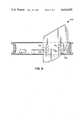
- FIG. 7illustrates a sectional side view of the trileaflet valve showing a side view of a leaflet 26 in an open position
- FIG. 8illustrates a top view of the trileaflet valve with the leaflets shown in an open position
- FIG. 9illustrates a sectional side view of an alternative embodiment of a pivot extension and pivot socket.
- FIG. 1which illustrates a top view of a trileaflet heart valve 10, the present invention, shows the trileaflet heart valve 10 including the components of a valve housing orifice ring 12, short and long projections 22 and 24, 36 and 38, and 50 and 52, and leaflets 26, 40, and 54 respectively, all components now being described in detail.
- the leaflets 26, 40 and 54are illustrated in dashed lines.
- the short and long structural projections 22 and 24, 36 and 38, and 50 and 52 in FIG. 1extend centrally inwardly at substantially 120 degree angles with respect to like projections, as later described in detail.
- the orifice ring 12, also illustrated in FIG. 5,includes an inflow rim 14, an outflow rim 16, an internal orifice 18, and an external sewing ring groove 20.
- Components 14 through 20are substantially parallel and concentric with the central axis of the orifice ring 12.
- the internal orifice 18 and the sewing ring groove 20are coplanar and concentric.
- the inflow rim 14 and the outflow rim 16are spaced from each other by the internal orifice 18 and the sewing ring groove 20.
- the circumference of the internal orifice 18increases progressively with distance in either direction from the central plane of the orifice ring 12 and imparts a bell-mouth curvature to both of the inflow and outflow rims 14 and 16 respectively.
- Internal orifice 18is curved and resembles a portion of an ellipse.
- the external sewing ring groove 20is bounded on three sides by inflow rim 14, outflow rim 16 and in between by the outside wall of the orifice ring 12 which is the bottom of the sewing ring groove 20.
- the rims of the inflow and outflow 14 and 16respectively are of a greater circumference than is the bottom of the sewing ring groove 20.
- Short projection 22, long projection 24, and leaflet 26are now described in particular detail and are structurally identical to the projections 36 and 38 and 50 and 52 and leaflets 40 and 54, which structure is not repeated for purposes of brevity of the patent. All six projections are cantilevered where one end is affixed to the internal orifice wall 18 while the other end is unsupported or free-ended. All six projections project inwardly of the orifice from the wall of the internal orifice 18 in a plane perpendicular to the central axis. The downstream surface of each projection consisting of a linear narrow margin of each of the six projections is coplanar. The longer projection is curved at a localized point along its length. The three short projections are identical to each other; likewise, the three long projections are identical to each other.
- the three short projections 22, 36 and 50extend into the orifice from points spaced substantially 120 degrees from each other about the surface of the internal orifice 18.
- Each of the short projectionsextends along a cord of the internal orifice. All three cords lie in the same plane spaced between the plane of the inflow rim 14 and the central plane of the orifice ring 12.
- the cord of each short projectionis equally spaced from the central axis of the orifice a finite amount about one-half of the radius of the orifice.
- the short projection 22includes an open position leaflet stop 22c and a pivot extension 22a.
- the open position leaflet stop 22cblends with the internal orifice 18 at one end and the pivot extension at the other end.
- a projecting length of the open position leaflet stop 22cincludes an upstream portion and a downstream portion.
- the upstream portion of the open position leaflet stopis wedge shape and angled acutely relative to the central axis of the orifice.
- One surface of the wedge shaped portiongenerally faces the upstream or inflow end of the orifice ring.
- the other surface of the wedge shaped portiongenerally faces toward orifice wall 18 and downstream.
- the angle of the downstream surface relative to the central plane of the orifice ringis equal to the designed full open position angle of the leaflet which is in the range of 45 degrees to 89 degress and shown here as 70 degrees, by way of example and for purposes of illustration only, and not to be construed as limiting of the present invention.
- One side-end of the wedge shaped portionblends with the wall of the internal orifice 18 of the orifice ring 12. The other side end faces into the orifice and is denoted as surface 22e.
- the surface 22ecan be flat or have any other predetermined geometrical surface by way of example and for purposes of illustration only.
- This side-end surface 22eacts as a buttress against which the sidewall of the flange of the leaftlet's outer pivot socket engages to limit the lateral movement of the leaflet during the valving movements as described in later detail.
- the downstream portion of the open position leaflet stop 22dis uniformly radiused along its length and shown to blend smoothly with the pivot extension 22a having a circular cross section and a blunt end 22b.
- the short projection 22originates at origin 22f and includes a line contact closed position stop 22g when the leaflet 26 is in an occluding position.
- the long projections 24, 38 and 52extend into the orifice from points based substantially 120 degrees about the circumference of the internal orifice 18.
- the three long projectionsreside in the same plane spaced between the plane of inflow rim 14 and the central plane of the orifice 12 and the length of each long projection is approximately equal to the radius of the orifice.
- the long projection 24consists of a long segment 24i, a curved segment 24h, and a short segment 24g including the circular cross section pivot extension 24a and the open position leaflet stop 24c.
- the long segment 24i and the curved segment 24hhave a substantially uniform elliptical cross section.
- the long segment 24ioriginates at the wall of the internal orifice 18 of the orifice ring 12 at the origin 24f and continues into the curved segment 24h at the other end.
- One end of the curved segmentaligns with the previously described cord of the short projection 22.
- Part of the long projection in coincident alignment with the cord of the short projectionis denoted as the short segment 24g which is directed along the cord and toward the previously described short projection 22.
- the junction between the curved segment 24H and the short segment 24gconsists of a straight-line transition and blending radii and is not crucial to the operation of the leaflets.
- the short segment 24g of the long projection 24includes an open position leaflet stop 24c and a pivot extension 24a of circular cross section having a blunt end 24b, and substantially similar to that described for the short projection 22.
- the short segment 24gblends with the elliptical cross section of the curved segment 24h at one end and has the pivot extension 24a at the other end.
- the projecting length of the open position leaflet stop 24chas an upstream portion and a downstream portion where the upstream portion is wedge shaped like that of the open position leaflet stop 22c of the short projection 22 as previously described.
- the open position leaflet stop 24cextends slightly upstream beyond the inflow rim 14 of the orifice ring 12.
- One surface of the wedge shaped portiongenerally faces in the inflow direction of the orifice ring 12, while the other surface generally faces toward orifice wall 18 and downstream.
- the angle of the downstream surface relative to the central plane of the orifice ringis equal to the full open position angle of the leaflet which is in the range of 45 to 89 degrees and shown here as 70 degrees, as previously described.
- One side-end of the wedge shaped portionblends generally with the elliptical cross section of the curved segment 24h and the other side-end faces toward side-end surface 22e of open position leaflet stop 22c and is denoted as surface 24e.
- the surface 24ecan be flat or have any other predetermined geometrical surface as previously described.
- This side-end surface 24eacts as a buttress against which the sidewall of the flange of the leaflet's inner pivot socket engages to limit the lateral movement of the leaflet during its valving movements as later described in detail.
- the downstream roll surface 24d of the open position leaflet stop 24cis uniformly radiused along its length and blends smoothly with the pivot extension 24a.
- the pivot extensions 22a and 24a of the short and long projections 22 and 24respectively are mirror images of each other.
- the open position leaflet stops 22c and 24c of the projections 22 and 24respectively form a compatible pair.
- the downstream roll surfaces 22d and 24d of the projectionsare substantially identically angled equally relative to the central plane of the orifice ring 12.
- the pivot extensionsin concert with the sockets of the leaflet control the arcuate valving movements of the leaflet and provide capture of the leaflet during movement.
- Three structural elementssupport the leaflet 26 in a closed occluding position and include the line contact 22g of the short projection 22, the line contact 24j of the short segment 24g of the long projection 24, and line contact 38k of the long segment 38i and curved segment 38h of the long projection 38. Because of the circumferential radiusing of the structural elements, the contact interface between these elements and the surface of the leaflet is a substantially finite thin line.
- FIG. 2which shows a top view of the leaflet 26, shows one of the three identical leaflets, the other two being 40 and 54.
- FIG. 2shows a top view of the leaflet 26
- FIG. 2shows one of the three identical leaflets, the other two being 40 and 54.
- FIG. 2shows a top view of the leaflet 26
- the other leafletsbeing identical in structure.
- Leaflet 26includes an inflow proximal surface 26a and an outflow distal surface 26b as illustrated in FIG. 3, a periphery arcuate edge 26c, and boundary radii edges 26d and 26e.
- An outer socket flange 28 and an inner socket flange 32are positioned on the proximal surface 26a.
- An outer socket orifice 30positioned in the outer socket flange, and an inner socket orifice 34 positioned in the inner socket flange 32.
- the occlusive surface of the leaflet 26includes a 120 degree pie or wedge shaped sector where the peripheral arc edge of the leaflet sector is uniformly radiused and blends smoothly with the proximal and distal surfaces respectively where both surfaces are flat and parallel.
- the peripheral arc edge 26cis slightly undersized providing clearance between the peripheral edge arc and the wall of the internal orifice 18.
- the two boundary radii edges 26d and 26eare generally flat and radiused where they intersect with the proximal and distal surfaces respectively.
- the flat edge boundary radii 26d and 26emay instead be uniformly radiused the same as the peripheral arc edge 26c.
- the boundary radii edges 26d and 26eare slightly undersized providing clearance between the other leaflets.
- the pivot socket flangesextend from the inflow proximal surface 26a.
- the orifices of the pivot socketsare parallel to the boundary radii edge 26e.
- the axes of the pivot socket orifices 30 and 34coincide with each other.
- FIG. 3which illustrates an end view of the leaflet 26, one of the three leaflets, shows numerals which correspond to those elements previously described. Particular detail is pointed out to the lower triangular shaped cross sections 28b and 32b which provide strength and bearing surface to the outer and inner socket orifices 30 and 34 respectively. Depending upon the type of material used, the cross section of the pivot socket flanges may instead be semicircular or oval but are provided purely for reasons of structural strength and bearing surface in function.
- the peripheral arcuate edge 26cis illustrated along with the boundary radii edges 26d and 26e which are generally flat with rounded corners and edges.
- FIG. 4discloses an end view ofthe leaflet 26, where all numerals correspond to those elements previously described, and the inner socket orifice 34 is now described in particular detail which also corresponds to the outer socket orifice 30.
- the inner socket orifice 34is an imperfect ellipse having an oval 34a, a straight-line edge 34b, and ends 34c and 34d having radii substantially approximating the radius of the pivot extensions. Each socket resembles an ellipse and is positioned within the respective socket flange.
- FIG. 5illustrates a sectional view taken along line 5--5 of FIG. 1, where all numerals correspond to those elements previously described.
- the leaflet 26is illustrated in an occluding position with leaflet 40 omitted for purposes of clarity in this figure of the disclosure.
- the diameter of the tissue orifice of any one of the natural valves, aortic, mitral, or tricuspid,is not usually the same from one individual to the next, especially as an example of the case of a small child or female in contrast to the case of an adult male. Therefore, it is necessary to provide a plurality of differing sized heart valves. Depending upon a number of factors, a heart valve can be manufactured in from four to eight sizes. The sizes are determined by the outer diameter of the sewing ring in millimeters, which is also referred to as the mounting diameter. Sewing rings are known to the prior art.
- a heart valvehaving a size that is the same size as the diameter of the tissue orifice and is determined through the use of heart valve sizers known in the prior art.
- a midrange sizewould be 25, for an outer diameter of a sewing ring of 25 millimeters.
- the valve housing and leaflets for the heart valvecan be constructed of a metal such as titanium for the valve housing and Pyrolite carbon for the leaflets, by way of example and for purposes of illustration only, but not to be construed as limiting of the present invention. While other materials are available, titanium, stainless steel, and Pyrolite carbon are three materials currently utilized in heart valves. The specific type of material determines the particular processes for construction. It is important that the materials are radiopaque and lightweight.
- the valve housing 12 and the leaflet occluders 26, 40 and 54are individually constructed.
- the valve housing including the orifice ring 12 and the projections 22, 24, 36, 38 and 50 and 52are made as a single metallic unit such as by machining.
- the elliptical cross sections of the long projections 24, 38 and 52provide predetermined positional memory to the projection which provides for lateral deflection over a differential distance without being permanently distorted.
- the memory characteristicprovides for assembly of the leaflets into the valve housing.
- the long projectionis deflected with a counter force providing for insertion of the free-end of the short projection into the outer pivot socket and then the free-end of the long projection into the inner pivot socket.
- Capture of the leafletoccurs when the free-ends of the projection engage the pivot sockets allowing for limited minimal bilateral movement of the leaflet with minimal force.
- the leafletshould be movable bilaterally along the chordal pivot axis as well as perpendicular to the chordal axis of the pivot extensions which results in light surface contact between a reference boundary radius 26e of one leaflet and a nonreference boundary radius 54d of the adjacent leaflet and vice versa.
- Positional adjustment of the long projectionsachieves optimal assembled conditions consisting of leaflet capture and freedom of movement.
- the sewing ringis ordinarily attached on the orifice ring after leaflet insertion and contributes to the overall successful long-term function of the trileaflet heart valve prosthesis 10, providing the same with a firm compatible anchor on surgical implantation in the heart.
- leaflet 26In discussing the principles of operation of the trileaflet heart valve 10, as illustrated in FIGS. 6-8, it is only necessary to consider one of the three leaflets, in this case leaflet 26.
- leaflet 26Depending upon the position of the leaflet 26 during the valving cycle, the pivot axis of leaflet 26 moves about the chordal axis of the pivot extensions 22a and 24a.
- the leaflet pivot axisWith respect to the leaflet pivot axis, there exists a division of the surface area of the leaflet into an area that responds favorably to the opening pressure and an area that opposes the opening pressure.
- the area of the leaflet favorable to openingis greater than the area opposing opening by an approximate ratio of 2.67:1, by way of example and for purposes of illustration only, but not to be construed as limiting of the present invention. This approximate relationship also exists in the presence of a closing pressure.
- FIG. 5shows that when the leaflet 26 is closed, the peripheral arc or edge 26c of the leaflet is in close proximity with the circumference of the wall of the internal orifice 18.
- the maximum diameter of the three leaflets taken togetheris slightly less than the diameter of the orifice.
- the leafletsocclude the orifice in a free-floating, nonbinding relationship with the wall of the internal orifice 18.
- the leafletsare coplanar with the plane of the orifice, as illustrated in FIG. 5.
- the central plane of each leafletis coplanar with the central plane of the orifice ring 12.
- FIG. 1illustrates that three structural components support each leaflet in the closed position.
- the supporting componentsare more or less equally distributed relative to the surface of each leaflet.
- the componentsinclude one short projection 22, one short segment 24g of a long projection 24, and a curved segment 38h and a long segment 38i of another log projection 38.
- the contact interface 22g, 24j, and 38k between each of these three components respectively and the proximal surface 26a of the leaflet 26is limited.
- the contact interface between the two pivot extensions 22a and 24a and the respective sockets 30 and 34can be a surface substantially one-fourth of the circumference of the pivot extension times the distance the pivot extension extends into the socket. Initially, the contact interface between the curved segment and the long segment of the long projection and the proximal side of the leaflet is a narrow line that can broaden over time.
- FIGS. 6-8illustrate that the leaflets move in response to changes in pressure and blood flow where the characteristic movements of the leaflets are controlled by the interaction between the pivots and the sockets.
- Each leafletmoves between the open and closed positions about each respective pair of pivot extensions.
- the pivot extensionsalso retain the leaflets within the orifice ring during each valving cycle.
- FIGS. 1 and 5illustrate the heart valve 10 closed.
- the proximal surface 26a of the leaflet 26first separates from the segments 38h and 38i of the long projection 38. Thereafter the leaflet 26 continues to move to the open position by pivoting about its own pivot axis in response to the disproportionate relationship of the surface areas of the leaflet.
- the opening sequence of leaflets 26, 40 and 54is an integral combination of movements including pivoting and translational, with the predominant movement being pivoting about a predetermined geometrical path. These different geometrical movements are inherent by the size and shape geometry between the circular cross section of the pivot extensions 22a and 24a and the elliptical contours 30a and 34a on a lower side of the pivot sockets 30 and 34. Throughout the opening phase, the entire curved side of both pivot sockets moves and slides about the pivot extensions. In a size 25 valve, each leaflet is designed to pivot through a 70 degree arc and move translationally downstream approximately one millimeter. The pivotal and translational movements occur simultaneously. The pivotal motion, measured in degrees, is inherently more apparent than the downstream translational movement. When in the full open position, the opposite end of each pivot socket is engaged by a pivot extension as illustrated in FIGS. 6 and 7. This engagement between the pivot extensions and the pivot sockets retains the leaflet in capture.
- the leafletsopen to an angle relative to the central axis of the orifice as determined by the pair of open position leaflet stops 22c and 24c located on the short projection 22 and the short segment 24g of the long projection 24 respectively. In a size 25 valve, these stops are angled 20 degrees relative to the central axis of the orifice. When the leaflet 26 reaches the full open position in FIGS. 6-8, the leaflet 26 forms an angle of 20 degrees with the central axis.
- the full open position angle of the leaflet 26is controlled by the respective geometrical configurations of the components of pivot extensions, open position leaflet stops and pivot sockets, and the location and spatial relationship of each component.
- the location of the sockets 30 and 34 on the surface of the leaflet 26 and the radius of curvature of the end of the sockets 30d and 34dare structural features that interact favorably with the pivot extensions and the leaflet stops resulting in the leaflet 26 positioning at the predetermined open angle, as illustrated in FIG. 7.
- FIG. 8shows the leaflets 26, 40 and 54 in full open position, and the orifice 64 is substantially unobstructed by the inclined leaflets.
- the leaflets 26, 40 and 54partition the orifice without creating isolated areas.
- the center of the valve orifice 64is free of obstruction and, therefore, most of the blood flow volume passes centrally through the orifice 64.
- the angulation of the open leaflets around the outer fringe of the orificecontributes a least clockwise spiral component to the principle central flow component.
- the spiral componentis divided by the plane of each of the leaflets; part passes in front of the leaflet across the proximal surface 26a and part flows behind the leaflet across the distal surface 26b.
- the blood passing in front of the leaflet 26 over the proximal surface 26ais deflected by the leaflet 20 degrees from the central axis of the orifice. Part of the deflected component combines with the principal central component. Another part of the deflected component combines with a component flowing across the distal surface of leaflet 40. This is the principal contribution to the spiral component. The component part flowing across the distal surface 26b combines with the principal central component passing downstream.
- the component of blood flowing behind the leaflethas a generally central flow pattern with minimal if any spiral component.
- the closing sequence of the leaflets 26, 40 and 54includes two types of movements that occur substantially simultaneously.
- the distance of the translational movementequals the translational movement that occurred during the opening sequence. This distance is equal to the difference between the length of the pivot sockets and the diameter of the pivot extensions. In the size 25 valve, this distance is one millimeter.
- the translational movement between the pivot extension and pivot socketoccurs along the flat sides 30b and 34b of the pivot sockets 30 and 34. Pivoting is the second and most predominant movement of the closing event and, in general, begins after the start of the translational movement.
- the pivoting closed movementoccurs as a response of the sockets rotating around the pivot extensions.
- This pivotal type of rotation about the pivot extensionsguides the leaflet into the full closed position as illustrated in FIG. 5.
- the pivot extensionsremain in contact with the wall of the socket orifices.
- the proximal surface 26a of the leaflet 26remains in contact with the downstream aspect roll surfaces 22d and 24d of short projection 22 and short segment 24g of long projection 24.
- the leaflet 26reaches the closed position when its proximal surface engages the contact line 38k of curved segment 38h and long segment 38i of the long projection 38, as illustrated in FIG. 5.
- Blood movement in the reverse direction through the valve orifice 64 of heart valve 10is necessary for leaflet closure. Blood that flows back through the valve orifice represents a loss to the heart and a reflection of the operational efficiency of the heart valve. Therefore, it is important that the leaflets respond with high sensitivity and rapidity to the smallest of reverse blood flow movements.
- the free floating design relationship between the pivots and sockets and the location of the pivot axis of the trileaflet heart valve 10ensures sensitivity and rapid closing in response to the smallest of flow changes.
- There is a direct proportional relationship between angulation, closing time and back flow volumeThe larger the angle of the leaflet relative to the plane of the orifice, the greater the amount of time required for closing and vice versa. Also, the larger the angle of the leaflet, the greater the amount of back flow required for closure.
- the leafletsremain closed as long as the pressure on the proximal side is less than the pressure on the distal side. Due to clearance between the leaflets and the internal orifice wall and between the leaflets themselves, a small amount of blood can leak back to the proximal side while the leaflets are closed. The amount of leakage depends upon a number of factors such as the pressure differential, clearances between valve components, viscosity of the blood and other lesser things. Because of the clearances designed into the heart valve 10, the amount of leakage while closed is considered to be insignificant. Back leakage through areas of small clearances is considered as being beneficial in a heart valve because this reduces stagnation and potential clotting in these critical regions.
- each leafletresponds identically as the other leaflets when subjected to the same changes in pressure and blood flow. Furthermore, the leaflets open and close synchronously when the direction and magnitude of the blood flow both entering and exiting the valve is normal to the plane of the orifice. The leaflets move independently of each other and synchronously throughout the valving cycle. The leaflets can tilt or cant a degree or more from a line normal to the chordal axis of the pivot extensions.
- the tilting of the leafletscan occur during the valving cycle as a result of an oblique flow vector or gravity acting on the leaflets where gravity is the less influential factor.
- Each leafletis inherently realigned and centered upon reaching either the full open or full closed positions.
- the leafletsare also free in moving bilaterally along the chordal axis of the pivot extensions. This movement is permitted by a minimal clearance between the socket flanges and the side-ends 22e and 24e of the open position leaflet stops. In th size 25 valve, the clearance is 0.105 millimeters. The clearance is sufficient so that opposing boundary radii of any two leaflets can abut when both are in the closed position and moved toward each other. Lateral movement of the leaflet 26 is caused by an oblique flow vector or gravity acting upon the leaflet while gravity is the lesser infuential factor.
- the sewing ringwhile it is not a contributing component to the principle of operation, does contribute to the overall successful long-term function of the prosthesis by providing the heart valve 10 with firm compatible anchor for the heart valve when surgically implanted in the heart.
- FIG. 9illustrates an alternative embodiment 100 of a trileaflet heart valve having rounded pivot extensions 102 and 104 in lieu of the blunt ends 22b and 24b which are captured by closed end pivot sockets 106 and 108 on a leaflet, the pivot sockets 106 and 108 having rounded interior sockets 110 and 112. All other structure is identical to that previously described such as in FIG. 6 and the other figures.
- the rounded pivot extensions 102 and 104interactively engage the surfaces of the sockets 106 and 108 throughout the valving cycle. Lateral movement of each leaflet is controlled by the free-ends of the pivot extensions and the closed-end sides of the pivot sockets. Valving operation of FIG. 9 is otherwise identical to that of FIGS. 1-8.
- the interior ends of the socket orifices that face outward of each othercan be closed, as illustrated in FIG. 9, and can have the geometrical shaped contour of the free-end of the indwelling pivot extension for geometrical compatibility between the pivot extension surface and the closed end surface.
- This geometrical relationship between the two surfacescan be flat, round, or any other predetermined geometrical shape.
- Each socket orificecan have a different geometrical shape.
- Each free-end of the pivot extensioncan have a predetermined geometrical shape such as oval, rounded, spherical, pointed, or other predetermined shape.
- Each length and cross section of each of the pivot extensionscan be of a different dimension and configuration.
- the cross section of the pivot extensioncan be oval, square, or rectangular, although the preferred cross section is circular. Likewise, the cross section of the socket orifice would assume a compatible geometrical cross section to that of each of the corresponding pivot extensions.
- Each of the leafletscan be of a different sector size; that is, each leaflet may be greater or lesser than a 120 degree pie sector size.
- the plane of the closed leafletscan be positioned within the geometrical planes of the orifice ring and is not limited to the central plane of the orifice ring.
- the chordal axes of each of the pivot extension pairscan be of a different length and can be at a different location and are not limited to the substantially and equal spacing about the circumference of the orifice ring.
- the valve orificecan assume any predetermined geometrical shape such as oval, elliptical, or any combination thereof and is not limited to the circular geometrical shape as disclosed.
- the orifice ringcan be substantially straight walled and is not limited to the geometrical shape including the inflow and outflow rims.
Landscapes
- Health & Medical Sciences (AREA)
- Cardiology (AREA)
- Oral & Maxillofacial Surgery (AREA)
- Transplantation (AREA)
- Engineering & Computer Science (AREA)
- Biomedical Technology (AREA)
- Heart & Thoracic Surgery (AREA)
- Vascular Medicine (AREA)
- Life Sciences & Earth Sciences (AREA)
- Animal Behavior & Ethology (AREA)
- General Health & Medical Sciences (AREA)
- Public Health (AREA)
- Veterinary Medicine (AREA)
- Prostheses (AREA)
Abstract
Description
Claims (42)
Priority Applications (6)
| Application Number | Priority Date | Filing Date | Title |
|---|---|---|---|
| US06/262,635US4416029A (en) | 1981-05-11 | 1981-05-11 | Trileaflet prosthetic heart valve |
| CA000402005ACA1197057A (en) | 1981-05-11 | 1982-04-30 | Heart valve |
| AU85241/82AAU8524182A (en) | 1981-05-11 | 1982-05-03 | Trileaflet prosthetic heart valve |
| GB08300069AGB2111175B (en) | 1981-05-11 | 1982-05-03 | Trileaflet prosthetic heart valve |
| PCT/US1982/000570WO1982003981A1 (en) | 1981-05-11 | 1982-05-03 | Trileaflet prosthetic heart valve |
| EP19820901769EP0078305A4 (en) | 1981-05-11 | 1982-05-03 | Trileaflet prosthetic heart valve. |
Applications Claiming Priority (1)
| Application Number | Priority Date | Filing Date | Title |
|---|---|---|---|
| US06/262,635US4416029A (en) | 1981-05-11 | 1981-05-11 | Trileaflet prosthetic heart valve |
Publications (1)
| Publication Number | Publication Date |
|---|---|
| US4416029Atrue US4416029A (en) | 1983-11-22 |
Family
ID=22998359
Family Applications (1)
| Application Number | Title | Priority Date | Filing Date |
|---|---|---|---|
| US06/262,635Expired - Fee RelatedUS4416029A (en) | 1981-05-11 | 1981-05-11 | Trileaflet prosthetic heart valve |
Country Status (5)
| Country | Link |
|---|---|
| US (1) | US4416029A (en) |
| EP (1) | EP0078305A4 (en) |
| CA (1) | CA1197057A (en) |
| GB (1) | GB2111175B (en) |
| WO (1) | WO1982003981A1 (en) |
Cited By (15)
| Publication number | Priority date | Publication date | Assignee | Title |
|---|---|---|---|---|
| US4655772A (en)* | 1984-09-19 | 1987-04-07 | Liotta Holga E T De | Cardiac valvular prosthesis |
| US4713071A (en)* | 1984-02-16 | 1987-12-15 | Naum Iofis A | Heart valve prosthesis |
| WO1988010105A1 (en)* | 1987-06-25 | 1988-12-29 | Bukatov Alexandr S | Heart valve prosthesis |
| WO1988010104A1 (en)* | 1987-06-25 | 1988-12-29 | Bukatov Alexandr S | Heart valve prosthesis |
| US5222519A (en)* | 1990-06-30 | 1993-06-29 | Om Industrial Co., Ltd. | Reverse-flow prevention device for fuel tank |
| US5326372A (en)* | 1992-03-26 | 1994-07-05 | Kalke Mhatre Associates | Prosthetic heart valve assembly |
| US5814099A (en)* | 1996-08-12 | 1998-09-29 | Bicer; Demetrio | Central opening curved bileaflet heart valve prosthesis |
| WO2000038597A1 (en)* | 1998-12-31 | 2000-07-06 | St. Jude Medical, Inc. | Mechanical heart valve prosthesis |
| US6475239B1 (en) | 1998-10-13 | 2002-11-05 | Sulzer Carbomedics Inc. | Method for making polymer heart valves with leaflets having uncut free edges |
| US20040263474A1 (en)* | 2002-11-19 | 2004-12-30 | Pedro Gregorio | Haptic feedback devices and methods for simulating an orifice |
| US20050065600A1 (en)* | 2003-09-19 | 2005-03-24 | Mhatre Harischandra K. | Prosthetic heart valve of pyrolytic carbon |
| US20050065599A1 (en)* | 2003-09-19 | 2005-03-24 | Mhatre Harischandra K. | Heart valve prosthesis |
| US20070131284A1 (en)* | 2005-12-13 | 2007-06-14 | Montgomery W C G | Montgomery soft stroke one way valve |
| US7727276B2 (en) | 2006-04-14 | 2010-06-01 | Machiraju Venkat R | System and method for heart valve replacement |
| DE102012216742A1 (en)* | 2012-09-19 | 2014-03-20 | Hans-Hinrich Sievers | Heart valve prosthesis |
Families Citing this family (2)
| Publication number | Priority date | Publication date | Assignee | Title |
|---|---|---|---|---|
| FR2587614B1 (en)* | 1985-09-23 | 1988-01-15 | Biomasys Sa | PROSTHETIC HEART VALVE |
| CN108245281A (en)* | 2016-12-28 | 2018-07-06 | 上海微创心通医疗科技有限公司 | Valve prosthesis |
Citations (5)
| Publication number | Priority date | Publication date | Assignee | Title |
|---|---|---|---|---|
| US3367364A (en)* | 1964-10-19 | 1968-02-06 | Univ Minnesota | Prosthetic heart valve |
| US3546711A (en)* | 1968-04-09 | 1970-12-15 | Gulf Energy & Environ Systems | Heart valve |
| US4078268A (en)* | 1975-04-24 | 1978-03-14 | St. Jude Medical, Inc. | Heart valve prosthesis |
| US4114202A (en)* | 1977-01-28 | 1978-09-19 | Roy Henry A | Prosthetic valve assembly for use in cardiovascular surgery |
| US4159543A (en)* | 1975-11-19 | 1979-07-03 | Alain Carpentier | Heart valve prosthesis |
Family Cites Families (4)
| Publication number | Priority date | Publication date | Assignee | Title |
|---|---|---|---|---|
| US3445863A (en)* | 1965-12-08 | 1969-05-27 | Juro Wada | One-way valve device suitable for use as a heart valve |
| US3689942A (en)* | 1969-11-28 | 1972-09-12 | Richard K Rapp | Prosthetic heart valve |
| US3938197A (en)* | 1974-09-03 | 1976-02-17 | Simcha Milo | Central flow prosthetic cardiac valve |
| ES465824A1 (en)* | 1978-01-07 | 1978-11-01 | Ramos Martinez Wilson | Metallic cardiac valve prosthesis |
- 1981
- 1981-05-11USUS06/262,635patent/US4416029A/ennot_activeExpired - Fee Related
- 1982
- 1982-04-30CACA000402005Apatent/CA1197057A/ennot_activeExpired
- 1982-05-03WOPCT/US1982/000570patent/WO1982003981A1/ennot_activeApplication Discontinuation
- 1982-05-03GBGB08300069Apatent/GB2111175B/ennot_activeExpired
- 1982-05-03EPEP19820901769patent/EP0078305A4/ennot_activeWithdrawn
Patent Citations (5)
| Publication number | Priority date | Publication date | Assignee | Title |
|---|---|---|---|---|
| US3367364A (en)* | 1964-10-19 | 1968-02-06 | Univ Minnesota | Prosthetic heart valve |
| US3546711A (en)* | 1968-04-09 | 1970-12-15 | Gulf Energy & Environ Systems | Heart valve |
| US4078268A (en)* | 1975-04-24 | 1978-03-14 | St. Jude Medical, Inc. | Heart valve prosthesis |
| US4159543A (en)* | 1975-11-19 | 1979-07-03 | Alain Carpentier | Heart valve prosthesis |
| US4114202A (en)* | 1977-01-28 | 1978-09-19 | Roy Henry A | Prosthetic valve assembly for use in cardiovascular surgery |
Cited By (18)
| Publication number | Priority date | Publication date | Assignee | Title |
|---|---|---|---|---|
| US4713071A (en)* | 1984-02-16 | 1987-12-15 | Naum Iofis A | Heart valve prosthesis |
| US4655772A (en)* | 1984-09-19 | 1987-04-07 | Liotta Holga E T De | Cardiac valvular prosthesis |
| WO1988010105A1 (en)* | 1987-06-25 | 1988-12-29 | Bukatov Alexandr S | Heart valve prosthesis |
| WO1988010104A1 (en)* | 1987-06-25 | 1988-12-29 | Bukatov Alexandr S | Heart valve prosthesis |
| JPH01503761A (en)* | 1987-06-25 | 1989-12-21 | ブカトフ,アレクサンドル セメノビチ | artificial heart valve |
| US5222519A (en)* | 1990-06-30 | 1993-06-29 | Om Industrial Co., Ltd. | Reverse-flow prevention device for fuel tank |
| US5326372A (en)* | 1992-03-26 | 1994-07-05 | Kalke Mhatre Associates | Prosthetic heart valve assembly |
| US5814099A (en)* | 1996-08-12 | 1998-09-29 | Bicer; Demetrio | Central opening curved bileaflet heart valve prosthesis |
| US6475239B1 (en) | 1998-10-13 | 2002-11-05 | Sulzer Carbomedics Inc. | Method for making polymer heart valves with leaflets having uncut free edges |
| WO2000038597A1 (en)* | 1998-12-31 | 2000-07-06 | St. Jude Medical, Inc. | Mechanical heart valve prosthesis |
| US6395025B1 (en) | 1998-12-31 | 2002-05-28 | St. Jude Medical, Inc. | Mechanical heart valve prosthesis |
| US20040263474A1 (en)* | 2002-11-19 | 2004-12-30 | Pedro Gregorio | Haptic feedback devices and methods for simulating an orifice |
| US7233315B2 (en)* | 2002-11-19 | 2007-06-19 | Immersion Corporation | Haptic feedback devices and methods for simulating an orifice |
| US20050065600A1 (en)* | 2003-09-19 | 2005-03-24 | Mhatre Harischandra K. | Prosthetic heart valve of pyrolytic carbon |
| US20050065599A1 (en)* | 2003-09-19 | 2005-03-24 | Mhatre Harischandra K. | Heart valve prosthesis |
| US20070131284A1 (en)* | 2005-12-13 | 2007-06-14 | Montgomery W C G | Montgomery soft stroke one way valve |
| US7727276B2 (en) | 2006-04-14 | 2010-06-01 | Machiraju Venkat R | System and method for heart valve replacement |
| DE102012216742A1 (en)* | 2012-09-19 | 2014-03-20 | Hans-Hinrich Sievers | Heart valve prosthesis |
Also Published As
| Publication number | Publication date |
|---|---|
| WO1982003981A1 (en) | 1982-11-25 |
| EP0078305A1 (en) | 1983-05-11 |
| GB2111175A (en) | 1983-06-29 |
| EP0078305A4 (en) | 1985-04-25 |
| GB2111175B (en) | 1985-03-06 |
| CA1197057A (en) | 1985-11-26 |
| GB8300069D0 (en) | 1983-02-09 |
Similar Documents
| Publication | Publication Date | Title |
|---|---|---|
| US4416029A (en) | Trileaflet prosthetic heart valve | |
| US5354330A (en) | Heart valve prosthesis | |
| US4078268A (en) | Heart valve prosthesis | |
| USRE31040E (en) | Heart valve prosthesis | |
| US4597767A (en) | Split leaflet heart valve | |
| US5628791A (en) | Prosthetic trileaflet heart valve | |
| US4692165A (en) | Heart valve | |
| US5919226A (en) | Mechanical heart valve prosthesis | |
| US4488318A (en) | Prosthetic heart valve | |
| CA1196152A (en) | Edge guided heart valves | |
| US4339831A (en) | Dynamic annulus heart valve and reconstruction ring | |
| US4561129A (en) | Low-profile biological bicuspid valve | |
| US4822353A (en) | Heart valve | |
| JPH0214053B2 (en) | ||
| US4057857A (en) | Heart valve with arcuate occluder | |
| US4451937A (en) | Heart valve having ear guided occluders | |
| US3903548A (en) | Heart valve with two valving members | |
| JPH03103253A (en) | Artificial heart valve | |
| JPH0576309B2 (en) | ||
| CN113331999B (en) | Valve prosthesis | |
| EP0541215B1 (en) | Heart valve prosthesis | |
| EP0176337B1 (en) | Heart valve prosthesis | |
| US4601719A (en) | Single leaflet valve | |
| CN215273616U (en) | Valve prosthesis | |
| US4725275A (en) | Artificial heart valve |
Legal Events
| Date | Code | Title | Description |
|---|---|---|---|
| AS | Assignment | Owner name:NORWEST BANK, 12501 RIDGEDALE DRIVE, MINNETONKA, M Free format text:ASSIGNMENT OF ASSIGNORS INTEREST.;ASSIGNOR:ANGICOR LIMITED;REEL/FRAME:004384/0371 Effective date:19850315 | |
| AS | Assignment | Owner name:THIEL, JOHN W., AS TRUSTEE Free format text:SECURITY INTEREST;ASSIGNOR:ANGICOR LIMITED;REEL/FRAME:004445/0968 Effective date:19850807 Owner name:BRANSON, LINDLEY, AS TRUSTEE Free format text:SECURITY INTEREST;ASSIGNOR:ANGICOR LIMITED;REEL/FRAME:004445/0968 Effective date:19850807 Owner name:CROUCH, JOHN S. Free format text:SECURITY INTEREST;ASSIGNOR:ANGICOR LIMITED;REEL/FRAME:004445/0968 Effective date:19850807 | |
| AS | Assignment | Owner name:ANGICOR LIMITED A MN CORP. Free format text:RELEASED BY SECURED PARTY;ASSIGNORS:CROUCH, JOHN S.;THIEL, JOHN W.;BRANSON LINDLEY S.;AND OTHERS;REEL/FRAME:004488/0620 Effective date:19851210 | |
| MAFP | Maintenance fee payment | Free format text:PAYMENT OF MAINTENANCE FEE, 4TH YEAR, PL 96-517 (ORIGINAL EVENT CODE: M170); ENTITY STATUS OF PATENT OWNER: SMALL ENTITY Year of fee payment:4 | |
| AS | Assignment | Owner name:AORTECH, INC., A CORP. OF MN, MINNESOTA Free format text:ASSIGNMENT OF ASSIGNORS INTEREST.;ASSIGNOR:KASTER, ROBERT L.;REEL/FRAME:005371/0141 Effective date:19900706 | |
| MAFP | Maintenance fee payment | Free format text:PAYMENT OF MAINTENANCE FEE, 8TH YEAR, PL 96-517 (ORIGINAL EVENT CODE: M171); ENTITY STATUS OF PATENT OWNER: SMALL ENTITY Year of fee payment:8 | |
| FEPP | Fee payment procedure | Free format text:PAYOR NUMBER ASSIGNED (ORIGINAL EVENT CODE: ASPN); ENTITY STATUS OF PATENT OWNER: SMALL ENTITY | |
| FEPP | Fee payment procedure | Free format text:MAINTENANCE FEE REMINDER MAILED (ORIGINAL EVENT CODE: REM.); ENTITY STATUS OF PATENT OWNER: SMALL ENTITY | |
| LAPS | Lapse for failure to pay maintenance fees | ||
| FP | Lapsed due to failure to pay maintenance fee | Effective date:19951122 | |
| STCH | Information on status: patent discontinuation | Free format text:PATENT EXPIRED DUE TO NONPAYMENT OF MAINTENANCE FEES UNDER 37 CFR 1.362 |