US4392499A - Adaptor for facilitating blood sampling procedures - Google Patents
Adaptor for facilitating blood sampling proceduresDownload PDFInfo
- Publication number
- US4392499A US4392499AUS06/269,261US26926181AUS4392499AUS 4392499 AUS4392499 AUS 4392499AUS 26926181 AUS26926181 AUS 26926181AUS 4392499 AUS4392499 AUS 4392499A
- Authority
- US
- United States
- Prior art keywords
- catheter
- blood
- adaptor
- intravenous
- tube
- Prior art date
- Legal status (The legal status is an assumption and is not a legal conclusion. Google has not performed a legal analysis and makes no representation as to the accuracy of the status listed.)
- Expired - Fee Related
Links
- 238000010241blood samplingMethods0.000titleclaimsabstractdescription34
- 238000001990intravenous administrationMethods0.000claimsabstractdescription20
- 238000000034methodMethods0.000claimsabstractdescription16
- 210000004369bloodAnatomy0.000claimsdescription13
- 239000008280bloodSubstances0.000claimsdescription13
- 210000004204blood vesselAnatomy0.000claimsdescription3
- 239000003978infusion fluidSubstances0.000claims1
- 238000005070samplingMethods0.000abstractdescription5
- 230000002411adverseEffects0.000abstractdescription2
- 230000000694effectsEffects0.000abstractdescription2
- 210000003462veinAnatomy0.000description8
- 239000004033plasticSubstances0.000description3
- 238000007789sealingMethods0.000description3
- 230000000451tissue damageEffects0.000description3
- 231100000827tissue damageToxicity0.000description3
- 238000004891communicationMethods0.000description2
- 238000012840feeding operationMethods0.000description2
- 238000003780insertionMethods0.000description2
- 230000037431insertionEffects0.000description2
- 230000013011matingEffects0.000description2
- 238000010420art techniqueMethods0.000description1
- 230000017531blood circulationEffects0.000description1
- 230000002939deleterious effectEffects0.000description1
- 229940079593drugDrugs0.000description1
- 239000003814drugSubstances0.000description1
- 239000011521glassSubstances0.000description1
- 238000009533lab testMethods0.000description1
- 238000002483medicationMethods0.000description1
- 238000012986modificationMethods0.000description1
- 230000004048modificationEffects0.000description1
- 230000000717retained effectEffects0.000description1
Images
Classifications
- A—HUMAN NECESSITIES
- A61—MEDICAL OR VETERINARY SCIENCE; HYGIENE
- A61B—DIAGNOSIS; SURGERY; IDENTIFICATION
- A61B5/00—Measuring for diagnostic purposes; Identification of persons
- A61B5/15—Devices for taking samples of blood
- A61B5/153—Devices specially adapted for taking samples of venous or arterial blood, e.g. with syringes
- A61B5/154—Devices using pre-evacuated means
- A—HUMAN NECESSITIES
- A61—MEDICAL OR VETERINARY SCIENCE; HYGIENE
- A61B—DIAGNOSIS; SURGERY; IDENTIFICATION
- A61B5/00—Measuring for diagnostic purposes; Identification of persons
- A61B5/15—Devices for taking samples of blood
- A61B5/150007—Details
- A61B5/150015—Source of blood
- A61B5/15003—Source of blood for venous or arterial blood
- A—HUMAN NECESSITIES
- A61—MEDICAL OR VETERINARY SCIENCE; HYGIENE
- A61B—DIAGNOSIS; SURGERY; IDENTIFICATION
- A61B5/00—Measuring for diagnostic purposes; Identification of persons
- A61B5/15—Devices for taking samples of blood
- A61B5/150007—Details
- A61B5/150206—Construction or design features not otherwise provided for; manufacturing or production; packages; sterilisation of piercing element, piercing device or sampling device
- A61B5/150267—Modular design or construction, i.e. subunits are assembled separately before being joined together or the device comprises interchangeable or detachable modules
- A—HUMAN NECESSITIES
- A61—MEDICAL OR VETERINARY SCIENCE; HYGIENE
- A61B—DIAGNOSIS; SURGERY; IDENTIFICATION
- A61B5/00—Measuring for diagnostic purposes; Identification of persons
- A61B5/15—Devices for taking samples of blood
- A61B5/150007—Details
- A61B5/150351—Caps, stoppers or lids for sealing or closing a blood collection vessel or container, e.g. a test-tube or syringe barrel
- A—HUMAN NECESSITIES
- A61—MEDICAL OR VETERINARY SCIENCE; HYGIENE
- A61B—DIAGNOSIS; SURGERY; IDENTIFICATION
- A61B5/00—Measuring for diagnostic purposes; Identification of persons
- A61B5/15—Devices for taking samples of blood
- A61B5/150007—Details
- A61B5/150374—Details of piercing elements or protective means for preventing accidental injuries by such piercing elements
- A61B5/150381—Design of piercing elements
- A61B5/150389—Hollow piercing elements, e.g. canulas, needles, for piercing the skin
- A—HUMAN NECESSITIES
- A61—MEDICAL OR VETERINARY SCIENCE; HYGIENE
- A61B—DIAGNOSIS; SURGERY; IDENTIFICATION
- A61B5/00—Measuring for diagnostic purposes; Identification of persons
- A61B5/15—Devices for taking samples of blood
- A61B5/150007—Details
- A61B5/150374—Details of piercing elements or protective means for preventing accidental injuries by such piercing elements
- A61B5/150381—Design of piercing elements
- A61B5/150503—Single-ended needles
- A61B5/150511—Details of construction of shaft
- A—HUMAN NECESSITIES
- A61—MEDICAL OR VETERINARY SCIENCE; HYGIENE
- A61B—DIAGNOSIS; SURGERY; IDENTIFICATION
- A61B5/00—Measuring for diagnostic purposes; Identification of persons
- A61B5/15—Devices for taking samples of blood
- A61B5/150007—Details
- A61B5/150732—Needle holders, for instance for holding the needle by the hub, used for example with double-ended needle and pre-evacuated tube
- A—HUMAN NECESSITIES
- A61—MEDICAL OR VETERINARY SCIENCE; HYGIENE
- A61B—DIAGNOSIS; SURGERY; IDENTIFICATION
- A61B5/00—Measuring for diagnostic purposes; Identification of persons
- A61B5/15—Devices for taking samples of blood
- A61B5/150992—Blood sampling from a fluid line external to a patient, such as a catheter line, combined with an infusion line; Blood sampling from indwelling needle sets, e.g. sealable ports, luer couplings or valves
Definitions
- the present inventionrelates generally to blood collecting apparatus, and more particularly, to blood collecting apparatus which includes an adaptor capable of operatively mating with an intravenous catheter such that blood sampling operations may be directly achieved from the catheterized site.
- a conventional means utilized to accomplish such procedurecomprises an evacuated tube constructed, for example, of glass and having a sterilized interior for receiving the blood sample.
- the open end of the tubeis sealed by means of a rubber stopper, and the sealed tube is adapted to be disposed within a tube holder in order to accomplish the blood sampling procedure.
- a double-ended needle, having an axial bore defined therein,is threadedly secured to the tube holder, and in a conventional manner, the proximal end of the needle is employed to penetrate the individual's vein while the distal end of the needle will subsequently penetrate the evacuated tube stopper.
- the double-ended needleis maintained within the person's vein while the evacuated tubes are simply interchanged in a successive manner by removing the filled tubes from the tube holder and replacing the same with empty tubes.
- the individualmay be subjected to a substantial amount of discomfort.
- tissue damage within the vein-puncture situsis also a likely deleterious side effect of the foregoing blood sampling procedure.
- intravenous feeding of solutions or medicationsis often established as the requirements of the particular patient dictate.
- a catheteris conventionally employed for accomplishing intravenous feeding operations, and as this procedure is entirely separate from the blood sampling procedure, the catheter is normally inserted into a region of the patient wholly dissociated from the blood-sampling situs, or within the region of the sampling situs, as convenience may warrant. Nevertheless, the insertion of the catheter is accomplished by means of a needle cannula-catheter assembly which is separate and distinct from the blood-sampling needle.
- a needle cannula-catheter assemblywhich is separate and distinct from the blood-sampling needle.
- Another object of the present inventionis to provide new and improved blood sampling apparatus which will overcome the various disadvantages of prior art apparatus.
- Still another object of the present inventionis to provide new and improved blood sampling apparatus which will permit multiple blood-sampling procedures to be achieved with a greater degree of comfort imparted to the patient.
- Yet another object of the present inventionis to provide new and improved blood sampling apparatus which will substantially reduce the amount of tissue damage to which the patient may be subjected during blood-sampling and intravenous-feeding procedures.
- Still yet another object of the present inventionis to provide new and improved apparatus which will permit both blood-sampling and intravenous-feeding procedures to be accomplished by means located at or within the same vein-puncture situs.
- a tubular adaptorthe proximal end of which is adapted to be mated with a plastic intravenous catheter disposed within the patient's vein, while the distal end of the adaptor has a needle disposed therein and projecting axially outwardly therefrom.
- the needleis adapted to be threadedly secured within an evacuated tube-holder conventionally employed to house an evacuated tube during blood-sampling procedures.
- the adaptoris readily separable from the catheter, and as a result, the blood-sampling, as well as subsequent intravenous-feeding procedures may be accomplished at the same catheterized situs.
- the flexibility of the catheter tubesubstantially reduces the discomfort experienced by the patient during the blood-sampling procedures due to the fact that any difficulty encountered in inserting or removing the distal end of the needle into and out of the stopper of the evacuated tube does not adversely affect the intravenous situs.
- the forces affecting the needle assemblyare isolated from the intravenous situs as a result of the assembled relationship defined between the adaptor and the catheter, as well as the flexibility of the catheter tube. Consequently, the problems characteristic of the prior art apparatus wherein the proximal end of the rigid needle is inserted directly within the intravenous puncture situs are overcome.
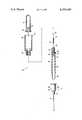
- the SOLE FIGUREis an exploded view, partly in cross-section, of the blood-sampling apparatus of the present invention and showing its cooperative parts.
- the apparatusincludes a plastic catheter, generally indicated by the reference character 12, which comprises a flexible tube 14 the distal end of which is fixedly secured within a hub portion 16.
- the hub 16is integrally formed with a female socket 18 the interior configuration of which tapers radially inwardly as one proceeds from the distal end of the socket toward the proximal end thereof, or alternatively, as one proceeds from right to left as viewed in the FIGURE.
- Hub 26terminates at a flanged portion 28, and a boss 30 projects axially away from flanged portion 28 in a direction opposite that in which hub 26 extends.
- Boss 30is coaxially aligned with hub 26, and the non-pointed, proximal end 32 of needle 20 projects axially outwardly of boss 30.
- the external surface of hub 26is provided with threads 34 which are adapted to threadedly engage an internally threaded neck portion 36 of a conventional evacuated tube-holder 38.
- the tube-holder 38is, of course, adapted to separably house a removable conventional evacuated tube 40 having a rubber sealing stopper 42 fixedly secured within the open end thereof.
- conventional prior art apparatusemploys a needle the opposite ends of which are both pointed or sharpened, the distal end corresponding to end 22 of needle 20, while the proximal end thereof is adapted to penetrate the patient's vein in order to facilitate the intravenous withdrawal of blood for the sampling purposes.
- Such apparatusexhibits disadvantageous characteristics, however, as more fully noted hereinabove, due particularly to the fact that the proximal end of the rigid needle is directly inserted within the patient's vein.
- the proximal, non-pointed end 32 of the needleis disposed within boss 30 of the needle hub assembly, and it is seen that the boss 30 is disposed within the distal end of a plastic, tubular adaptor 44.
- the external surface of boss 30is provided with peripherally extending ribs 46 for frictionally engaging the interior wall surfaces of adaptor 44 whereby the needle assembly will be firmly retained within the adaptor.
- the bore 48 of adaptor 44is, of course, in fluidic communication with the proximal end 32 of needle 20, and the proximal end 50 of adaptor 44 is adapted to be in fluidic communication with the catheter socket 18.
- the external surface of the proximal end 50 of adaptor 44has a reduced diameter and is tapered radially inwardly in a manner corresponding to that of the interior of socket 18 as noted hereinbefore.
- the catheter 12is initially inserted into the patient at a selected intravenous situs by means of a conventional needle cannula-catheter assembly, and subsequent to the withdrawal of the needle cannula, the catheter 12 is readily available for the commencement of blood-sampling or intravenous-feeding procedures. If both blood-sampling and intravenous-feeding procedures are in fact to be conducted, the blood-sampling operations should be conducted prior to the intravenous-feeding operations.
- the adaptor 44along with the needle 20, is mated with the catheter. Subsequently, when a blood sample is to be taken, the tube-holder 38 is threadedly mated to the hub 26. It is to be noted that the length of needle 20, relative to the length of the sleeve-type housing comprising tube-holder 38, is such that upon full threaded engagement between hub 26 and holder neck portion 36, the distal end 22 of needle 20 will still be axially disposed within holder 38 and will not protrude axially therebeyond.
- the evacuated tube 40may then be inserted within the tube holder 38.
- the diametrical extent of the annular flanged portion 52 of stopper 42is such that a sealing fit is established between portion 52 and the interior wall surfaces of holder 38.
- Continued movement of the tube in the direction of arrow 54will force the distal end 22 of needle 20 to penetrate the stopper 42 whereby a pressure differential is established between the evacuated atmosphere of tube 40 and the pressurized environment of the patient's vein. Blood will thus flow from the vein, through catheter 12, through the adaptor 44, through needle 20, and into tube 40.
- the stopper 42When tube 40 becomes filled, the stopper 42 may be disengaged from needle 20 and the tube 40 removed from holder 38. If required, additional tubes 40 may be filled by repeating the aforenoted operational procedures, or alternatively, when the last 40 has been filled, the entire adaptor assemblage may be disconnected from catheter 12, and subsequently, a particular intravenous solution may be operatively connected to the catheter.
- the interexchange of the tubes 40 in fulfillment of the multiple blood-sampling requirementscan be accomplished by means of the adaptor apparatus of the present invention without any substantial discomfort being imparted to the patient due to the fact that the flexible catheter tube 14 is disposed within the patient at the intravenous situs as opposed to a rigid needle cannula. Consequently, the forces impressed upon the entire assemblage during replacement of a filled tube 40 with a new evacuated tube 40 are isolated from the intravenous situs thereby eliminating any substantial degree of discomfort to the patient.
- the blood-sampling assemblageis simply disconnected from the catheter and the intravenous feed tube, not shown, is operatively connected to catheter 12 in a manner similar to the connection procedure utilized in connecting the adaptor 44 to catheter 12.
- the same catheterized situsis employed for both the blood-sampling and intravenous-feeding procedures, and the patient is relieved of the further discomfort of establishing an intravenous situs separate and distinct from the blood-sampling situs as is characteristic of prior art techniques.
Landscapes
- Health & Medical Sciences (AREA)
- Life Sciences & Earth Sciences (AREA)
- Engineering & Computer Science (AREA)
- Heart & Thoracic Surgery (AREA)
- Molecular Biology (AREA)
- Pathology (AREA)
- Physics & Mathematics (AREA)
- Biomedical Technology (AREA)
- Hematology (AREA)
- Medical Informatics (AREA)
- Biophysics (AREA)
- Surgery (AREA)
- Animal Behavior & Ethology (AREA)
- General Health & Medical Sciences (AREA)
- Public Health (AREA)
- Veterinary Medicine (AREA)
- Manufacturing & Machinery (AREA)
- Measurement Of The Respiration, Hearing Ability, Form, And Blood Characteristics Of Living Organisms (AREA)
Abstract
Description
This is a continuation of application Ser. No. 50,601, filed on June 21, 1979, now abandoned.
The present invention relates generally to blood collecting apparatus, and more particularly, to blood collecting apparatus which includes an adaptor capable of operatively mating with an intravenous catheter such that blood sampling operations may be directly achieved from the catheterized site.
The withdrawal and analysis of blood is a common procedure often performed, for example, within hospital facilities as a prelude to the administration of intravenous solutions. A conventional means utilized to accomplish such procedure comprises an evacuated tube constructed, for example, of glass and having a sterilized interior for receiving the blood sample. The open end of the tube is sealed by means of a rubber stopper, and the sealed tube is adapted to be disposed within a tube holder in order to accomplish the blood sampling procedure. A double-ended needle, having an axial bore defined therein, is threadedly secured to the tube holder, and in a conventional manner, the proximal end of the needle is employed to penetrate the individual's vein while the distal end of the needle will subsequently penetrate the evacuated tube stopper. As a result of the pressure differential defined between the evacuated tube and the blood vessel, blood flows from the individual's vein, through the needle, and into the sampling tube.
It is often necessary to take multiple blood samples from the individual in order to perform a battery of laboratory tests. As a matter of procedure, the double-ended needle is maintained within the person's vein while the evacuated tubes are simply interchanged in a successive manner by removing the filled tubes from the tube holder and replacing the same with empty tubes. As the insertion and removal of the distal end of the needle into and out of the sealing stopper is not always readily accomplished in a simple and easy manner, the individual may be subjected to a substantial amount of discomfort. In addition, tissue damage within the vein-puncture situs is also a likely deleterious side effect of the foregoing blood sampling procedure.
Subsequent to the blood sampling procedure, intravenous feeding of solutions or medications is often established as the requirements of the particular patient dictate. A catheter is conventionally employed for accomplishing intravenous feeding operations, and as this procedure is entirely separate from the blood sampling procedure, the catheter is normally inserted into a region of the patient wholly dissociated from the blood-sampling situs, or within the region of the sampling situs, as convenience may warrant. Nevertheless, the insertion of the catheter is accomplished by means of a needle cannula-catheter assembly which is separate and distinct from the blood-sampling needle. As a result, it is readily appreciated that at least two vein-puncture sites must be established in order to accomplish both the blood-sampling and intravenous-feeding procedures. Such techniques, of course, subject the individual to multiple periods of discomfort, and increase the likelihood of tissue damage.
Accordingly, it is an object of the present invention to provide new and improved blood collecting or sampling apparatus.
Another object of the present invention is to provide new and improved blood sampling apparatus which will overcome the various disadvantages of prior art apparatus.
Still another object of the present invention is to provide new and improved blood sampling apparatus which will permit multiple blood-sampling procedures to be achieved with a greater degree of comfort imparted to the patient.
Yet another object of the present invention is to provide new and improved blood sampling apparatus which will substantially reduce the amount of tissue damage to which the patient may be subjected during blood-sampling and intravenous-feeding procedures.
Still yet another object of the present invention is to provide new and improved apparatus which will permit both blood-sampling and intravenous-feeding procedures to be accomplished by means located at or within the same vein-puncture situs.
The foregoing and other objectives are achieved in accordance with the present invention through the provision of a tubular adaptor the proximal end of which is adapted to be mated with a plastic intravenous catheter disposed within the patient's vein, while the distal end of the adaptor has a needle disposed therein and projecting axially outwardly therefrom. The needle is adapted to be threadedly secured within an evacuated tube-holder conventionally employed to house an evacuated tube during blood-sampling procedures.
The adaptor is readily separable from the catheter, and as a result, the blood-sampling, as well as subsequent intravenous-feeding procedures may be accomplished at the same catheterized situs. The flexibility of the catheter tube substantially reduces the discomfort experienced by the patient during the blood-sampling procedures due to the fact that any difficulty encountered in inserting or removing the distal end of the needle into and out of the stopper of the evacuated tube does not adversely affect the intravenous situs. The forces affecting the needle assembly are isolated from the intravenous situs as a result of the assembled relationship defined between the adaptor and the catheter, as well as the flexibility of the catheter tube. Consequently, the problems characteristic of the prior art apparatus wherein the proximal end of the rigid needle is inserted directly within the intravenous puncture situs are overcome.
Various other objects, features, and attendant advantages of the present invention will be more fully appreciated as the same becomes better understood from the following detailed description when considered in connection with the accompanying drawings, wherein:
The SOLE FIGURE is an exploded view, partly in cross-section, of the blood-sampling apparatus of the present invention and showing its cooperative parts.
Referring now to the drawing, there is shown, in combination, the blood-sampling apparatus of the present invention, the same being generally indicated by thereference character 10. The apparatus includes a plastic catheter, generally indicated by thereference character 12, which comprises aflexible tube 14 the distal end of which is fixedly secured within ahub portion 16. Thehub 16 is integrally formed with afemale socket 18 the interior configuration of which tapers radially inwardly as one proceeds from the distal end of the socket toward the proximal end thereof, or alternatively, as one proceeds from right to left as viewed in the FIGURE.
Aneedle 20, having a sharpeneddistal end 22 and anaxial bore 24 defined therethrough, is fixedly secured within ahub 26.Hub 26 terminates at aflanged portion 28, and aboss 30 projects axially away from flangedportion 28 in a direction opposite that in whichhub 26 extends. Boss 30 is coaxially aligned withhub 26, and the non-pointed,proximal end 32 ofneedle 20 projects axially outwardly ofboss 30.
The external surface ofhub 26 is provided withthreads 34 which are adapted to threadedly engage an internally threadedneck portion 36 of a conventional evacuated tube-holder 38. The tube-holder 38 is, of course, adapted to separably house a removable conventional evacuatedtube 40 having arubber sealing stopper 42 fixedly secured within the open end thereof.
In lieu ofneedle 20, conventional prior art apparatus employs a needle the opposite ends of which are both pointed or sharpened, the distal end corresponding toend 22 ofneedle 20, while the proximal end thereof is adapted to penetrate the patient's vein in order to facilitate the intravenous withdrawal of blood for the sampling purposes. Such apparatus exhibits disadvantageous characteristics, however, as more fully noted hereinabove, due particularly to the fact that the proximal end of the rigid needle is directly inserted within the patient's vein.
In accordance with the present invention, the proximal,non-pointed end 32 of the needle is disposed withinboss 30 of the needle hub assembly, and it is seen that theboss 30 is disposed within the distal end of a plastic,tubular adaptor 44. The external surface ofboss 30 is provided with peripherally extendingribs 46 for frictionally engaging the interior wall surfaces ofadaptor 44 whereby the needle assembly will be firmly retained within the adaptor. Thebore 48 ofadaptor 44 is, of course, in fluidic communication with theproximal end 32 ofneedle 20, and theproximal end 50 ofadaptor 44 is adapted to be in fluidic communication with thecatheter socket 18. In order to facilitate the mating engagement ofadaptor 44 withcatheter socket 18, the external surface of theproximal end 50 ofadaptor 44 has a reduced diameter and is tapered radially inwardly in a manner corresponding to that of the interior ofsocket 18 as noted hereinbefore.
In utilizing the apparatus of the present invention, thecatheter 12 is initially inserted into the patient at a selected intravenous situs by means of a conventional needle cannula-catheter assembly, and subsequent to the withdrawal of the needle cannula, thecatheter 12 is readily available for the commencement of blood-sampling or intravenous-feeding procedures. If both blood-sampling and intravenous-feeding procedures are in fact to be conducted, the blood-sampling operations should be conducted prior to the intravenous-feeding operations.
Consequently, with thecatheter 12 already positioned within the patient at the particular situs, theadaptor 44, along with theneedle 20, is mated with the catheter. Subsequently, when a blood sample is to be taken, the tube-holder 38 is threadedly mated to thehub 26. It is to be noted that the length ofneedle 20, relative to the length of the sleeve-type housing comprising tube-holder 38, is such that upon full threaded engagement betweenhub 26 andholder neck portion 36, thedistal end 22 ofneedle 20 will still be axially disposed withinholder 38 and will not protrude axially therebeyond.
When the catheter-adaptor-needle-tube holder assemblage is established, the evacuatedtube 40 may then be inserted within thetube holder 38. The diametrical extent of the annular flangedportion 52 ofstopper 42 is such that a sealing fit is established betweenportion 52 and the interior wall surfaces ofholder 38. Continued movement of the tube in the direction ofarrow 54 will force thedistal end 22 ofneedle 20 to penetrate thestopper 42 whereby a pressure differential is established between the evacuated atmosphere oftube 40 and the pressurized environment of the patient's vein. Blood will thus flow from the vein, throughcatheter 12, through theadaptor 44, throughneedle 20, and intotube 40.
Whentube 40 becomes filled, thestopper 42 may be disengaged fromneedle 20 and thetube 40 removed fromholder 38. If required,additional tubes 40 may be filled by repeating the aforenoted operational procedures, or alternatively, when the last 40 has been filled, the entire adaptor assemblage may be disconnected fromcatheter 12, and subsequently, a particular intravenous solution may be operatively connected to the catheter.
As can readily be appreciated, the interexchange of thetubes 40 in fulfillment of the multiple blood-sampling requirements can be accomplished by means of the adaptor apparatus of the present invention without any substantial discomfort being imparted to the patient due to the fact that theflexible catheter tube 14 is disposed within the patient at the intravenous situs as opposed to a rigid needle cannula. Consequently, the forces impressed upon the entire assemblage during replacement of a filledtube 40 with a new evacuatedtube 40 are isolated from the intravenous situs thereby eliminating any substantial degree of discomfort to the patient.
Similarly, when the blood-sampling procedures are completed and it is desired to establish intravenous feeding, the blood-sampling assemblage is simply disconnected from the catheter and the intravenous feed tube, not shown, is operatively connected tocatheter 12 in a manner similar to the connection procedure utilized in connecting theadaptor 44 tocatheter 12. In this manner, the same catheterized situs is employed for both the blood-sampling and intravenous-feeding procedures, and the patient is relieved of the further discomfort of establishing an intravenous situs separate and distinct from the blood-sampling situs as is characteristic of prior art techniques.
Obviously, many modifications and variations of the present invention are possible in light of the foregoing teachings. It is therefore to be understood that within the scope of the appended claims, the present invention may be practiced otherwise than as specifically described herein.
Claims (6)
1. Apparatus for facilitating both intravenous and blood-sampling procedures, comprising:
evacuated tube means for collecting a blood sample;
needle means operatively connected with said tube means for supplying said blood sample thereto;
an adaptor releasably connected with said needle means for transferring said blood sample from a catheter to said needle means; and
a flexible intravenous catheter having a socket means integrally bound therewith, said socket means constructed to separably receive said adaptor to form a temporary connection with said catheter so as to be able to withdraw blood from a mammalian blood vessel and said socket means being readily connectable to a source of intravenous fluid when said adaptor is not connected to said catheter;
whereby said catheter may be utilized to perform both said blood-sampling and intravenous-feeding procedures without removing said catheter from a blood vessel such that intravenous feeding takes place at the blood-sampling site.
2. The apparatus as set forth in claim 1, wherein:
said socket means is tapered at the distal end thereof
the proximal end of said adaptor is tapered in a manner corresponding to that of said tapered socket.
3. The apparatus as set forth in claim 1, wherein:
said adaptor is a tube interposed between said catheter means and said needle means.
4. The apparatus as set forth in claim 1, wherein:
said socket means has a tapered configuration; and
the proximal end of said adaptor is tapered in a manner corresponding to that of said tapered socket means.
5. The apparatus as set forth in claim 1, further comprising a tube holder for holding said evacuated tube during said blood-sampling procedure.
6. The apparatus as set forth in claim 5, wherein:
said adaptor is a tube interposed between said catheter and said needle means.
Priority Applications (1)
| Application Number | Priority Date | Filing Date | Title |
|---|---|---|---|
| US06/269,261US4392499A (en) | 1979-06-21 | 1981-06-01 | Adaptor for facilitating blood sampling procedures |
Applications Claiming Priority (2)
| Application Number | Priority Date | Filing Date | Title |
|---|---|---|---|
| US5060179A | 1979-06-21 | 1979-06-21 | |
| US06/269,261US4392499A (en) | 1979-06-21 | 1981-06-01 | Adaptor for facilitating blood sampling procedures |
Related Parent Applications (1)
| Application Number | Title | Priority Date | Filing Date |
|---|---|---|---|
| US5060179AContinuation | 1979-06-21 | 1979-06-21 |
Publications (1)
| Publication Number | Publication Date |
|---|---|
| US4392499Atrue US4392499A (en) | 1983-07-12 |
Family
ID=26728446
Family Applications (1)
| Application Number | Title | Priority Date | Filing Date |
|---|---|---|---|
| US06/269,261Expired - Fee RelatedUS4392499A (en) | 1979-06-21 | 1981-06-01 | Adaptor for facilitating blood sampling procedures |
Country Status (1)
| Country | Link |
|---|---|
| US (1) | US4392499A (en) |
Cited By (23)
| Publication number | Priority date | Publication date | Assignee | Title |
|---|---|---|---|---|
| US4784650A (en)* | 1987-03-23 | 1988-11-15 | Coburn Timothy J | Needle holder |
| US4834716A (en)* | 1987-07-17 | 1989-05-30 | Ims, Limited | Protected cannula |
| US4932418A (en)* | 1987-03-23 | 1990-06-12 | Coburn Timothy J | Needle holder |
| DE3932112A1 (en)* | 1989-09-26 | 1991-04-04 | Sarstedt Walter Geraete | BLOOD COLLECTION DEVICE |
| USRE33617E (en)* | 1987-07-17 | 1991-06-18 | International Medication Systems Limited | Protected cannula |
| US5067950A (en)* | 1990-07-30 | 1991-11-26 | Johnson & Johnson Medical, Inc. | Wound drainage tube/reservoir connector |
| US5084032A (en)* | 1989-06-27 | 1992-01-28 | Elliot Kornberg | Method for using a protective sheath in an intravenous assembly |
| US5195992A (en)* | 1988-05-13 | 1993-03-23 | Baxter International Inc. | Protector shield for needles |
| US5360011A (en)* | 1993-07-13 | 1994-11-01 | Mccallister Teresa D | Blood sample collection |
| USD363542S (en) | 1994-04-22 | 1995-10-24 | Mcgaw, Inc. | Winged cannula |
| US5478328A (en)* | 1992-05-22 | 1995-12-26 | Silverman; David G. | Methods of minimizing disease transmission by used hypodermic needles, and hypodermic needles adapted for carrying out the method |
| USD393722S (en) | 1996-04-04 | 1998-04-21 | Icu Medical, Inc. | Locking blunt cannula |
| US5810792A (en)* | 1996-04-03 | 1998-09-22 | Icu Medical, Inc. | Locking blunt cannula |
| US5843046A (en)* | 1997-05-29 | 1998-12-01 | Paul J. Motisi | Catheter apparatus |
| US20020040207A1 (en)* | 1995-12-15 | 2002-04-04 | Lopez George A. | Medical valve with fluid escape space |
| US6572592B1 (en) | 1991-12-18 | 2003-06-03 | Icu Medical, Inc. | Medical valve and method of use |
| US6599273B1 (en) | 1991-12-18 | 2003-07-29 | Icu Medical, Inc. | Fluid transfer device and method of use |
| US20040147855A1 (en)* | 2003-01-23 | 2004-07-29 | Becton, Dickinson And Company | Coupling device for blood collection assembly |
| US7435231B2 (en) | 1999-07-29 | 2008-10-14 | Fenwal, Inc. | Biological sample device receiver |
| US8292150B2 (en) | 2010-11-02 | 2012-10-23 | Tyco Healthcare Group Lp | Adapter for powered surgical devices |
| US20150005669A1 (en)* | 2013-06-26 | 2015-01-01 | Becton, Dickinson And Company | Integrated closed iv line draw system |
| US20210369150A1 (en)* | 2009-10-30 | 2021-12-02 | Seventh Sense Biosystems, Inc. | Relatively small devices applied to the skin, modular systems, and methods of use thereof |
| US12121353B2 (en) | 2010-11-09 | 2024-10-22 | Yourbio Health, Inc. | Systems and interfaces for blood sampling |
Citations (9)
| Publication number | Priority date | Publication date | Assignee | Title |
|---|---|---|---|---|
| US2531667A (en)* | 1947-12-01 | 1950-11-28 | Bernard J Brent | Method of and apparatus for administering repeated injections |
| US2689564A (en)* | 1951-11-29 | 1954-09-21 | Becton Dickinson Co | Blood donor assembly |
| US3181529A (en)* | 1962-07-30 | 1965-05-04 | Edgar H Wilburn | Valved body-fluid sampling tubes |
| US3433215A (en)* | 1965-10-20 | 1969-03-18 | Daniel Silverman | Apparatus for placing in and retrieving a tubular probe from a body conduit |
| US3616789A (en)* | 1970-03-02 | 1971-11-02 | Systematics | Blood specimen apparatus |
| US3739778A (en)* | 1971-08-12 | 1973-06-19 | Bard Inc C R | Catheter introduction system |
| US3753432A (en)* | 1971-03-10 | 1973-08-21 | L Guerra | Hypodermic syringe for blood tests |
| US4140108A (en)* | 1977-08-10 | 1979-02-20 | Becton, Dickinson And Company | Blood collection assembly |
| US4192919A (en)* | 1977-05-17 | 1980-03-11 | Mpl, Inc. | Blood sampling and culturing kit |
- 1981
- 1981-06-01USUS06/269,261patent/US4392499A/ennot_activeExpired - Fee Related
Patent Citations (9)
| Publication number | Priority date | Publication date | Assignee | Title |
|---|---|---|---|---|
| US2531667A (en)* | 1947-12-01 | 1950-11-28 | Bernard J Brent | Method of and apparatus for administering repeated injections |
| US2689564A (en)* | 1951-11-29 | 1954-09-21 | Becton Dickinson Co | Blood donor assembly |
| US3181529A (en)* | 1962-07-30 | 1965-05-04 | Edgar H Wilburn | Valved body-fluid sampling tubes |
| US3433215A (en)* | 1965-10-20 | 1969-03-18 | Daniel Silverman | Apparatus for placing in and retrieving a tubular probe from a body conduit |
| US3616789A (en)* | 1970-03-02 | 1971-11-02 | Systematics | Blood specimen apparatus |
| US3753432A (en)* | 1971-03-10 | 1973-08-21 | L Guerra | Hypodermic syringe for blood tests |
| US3739778A (en)* | 1971-08-12 | 1973-06-19 | Bard Inc C R | Catheter introduction system |
| US4192919A (en)* | 1977-05-17 | 1980-03-11 | Mpl, Inc. | Blood sampling and culturing kit |
| US4140108A (en)* | 1977-08-10 | 1979-02-20 | Becton, Dickinson And Company | Blood collection assembly |
Cited By (49)
| Publication number | Priority date | Publication date | Assignee | Title |
|---|---|---|---|---|
| WO1990004990A1 (en)* | 1987-03-23 | 1990-05-17 | Coburn Timothy J | Needle holder |
| US4932418A (en)* | 1987-03-23 | 1990-06-12 | Coburn Timothy J | Needle holder |
| US4784650A (en)* | 1987-03-23 | 1988-11-15 | Coburn Timothy J | Needle holder |
| US4834716A (en)* | 1987-07-17 | 1989-05-30 | Ims, Limited | Protected cannula |
| USRE33617E (en)* | 1987-07-17 | 1991-06-18 | International Medication Systems Limited | Protected cannula |
| US5195992A (en)* | 1988-05-13 | 1993-03-23 | Baxter International Inc. | Protector shield for needles |
| US5084032A (en)* | 1989-06-27 | 1992-01-28 | Elliot Kornberg | Method for using a protective sheath in an intravenous assembly |
| DE3932112C2 (en)* | 1989-09-26 | 1999-09-23 | Sarstedt Ag & Co | Blood collection device |
| DE3932112A1 (en)* | 1989-09-26 | 1991-04-04 | Sarstedt Walter Geraete | BLOOD COLLECTION DEVICE |
| US5067950A (en)* | 1990-07-30 | 1991-11-26 | Johnson & Johnson Medical, Inc. | Wound drainage tube/reservoir connector |
| AU632955B2 (en)* | 1990-07-30 | 1993-01-14 | Johnson & Johnson Medical, Inc. | Wound drainage tube/reservoir connector |
| US7717883B2 (en) | 1991-12-18 | 2010-05-18 | Icu Medical, Inc. | Medical valve and method of use |
| US7713249B2 (en) | 1991-12-18 | 2010-05-11 | Icu Medical, Inc. | Medical valve and method of use |
| US7722576B2 (en) | 1991-12-18 | 2010-05-25 | Icu Medical, Inc. | Medical valve and method of use |
| US7722575B2 (en) | 1991-12-18 | 2010-05-25 | Icu Medical, Inc. | Medical valve and method of use |
| US7717886B2 (en) | 1991-12-18 | 2010-05-18 | Icu Medical, Inc. | Medical valve and method of use |
| US7717884B2 (en) | 1991-12-18 | 2010-05-18 | Icu Medical, Inc. | Medical valve and method of use |
| US7717885B2 (en) | 1991-12-18 | 2010-05-18 | Icu Medical, Inc. | Medical valve and method of use |
| US6572592B1 (en) | 1991-12-18 | 2003-06-03 | Icu Medical, Inc. | Medical valve and method of use |
| US6599273B1 (en) | 1991-12-18 | 2003-07-29 | Icu Medical, Inc. | Fluid transfer device and method of use |
| US7717887B2 (en) | 1991-12-18 | 2010-05-18 | Icu Medical, Inc. | Medical valve and method of use |
| US6669673B2 (en) | 1991-12-18 | 2003-12-30 | Icu Medical, Inc. | Medical valve |
| US20040002684A1 (en)* | 1991-12-18 | 2004-01-01 | Lopez George A. | Fluid transfer device and method of use |
| US6682509B2 (en) | 1991-12-18 | 2004-01-27 | Icu Medical, Inc. | Medical valve and method of use |
| US6758833B2 (en) | 1991-12-18 | 2004-07-06 | Icu Medical, Inc. | Medical value |
| US7713247B2 (en) | 1991-12-18 | 2010-05-11 | Icu Medical, Inc. | Medical valve and method of use |
| US7713248B2 (en) | 1991-12-18 | 2010-05-11 | Icu Medical, Inc. | Medical valve and method of use |
| US5478328A (en)* | 1992-05-22 | 1995-12-26 | Silverman; David G. | Methods of minimizing disease transmission by used hypodermic needles, and hypodermic needles adapted for carrying out the method |
| US5360011A (en)* | 1993-07-13 | 1994-11-01 | Mccallister Teresa D | Blood sample collection |
| USD363542S (en) | 1994-04-22 | 1995-10-24 | Mcgaw, Inc. | Winged cannula |
| US20020040207A1 (en)* | 1995-12-15 | 2002-04-04 | Lopez George A. | Medical valve with fluid escape space |
| US8002765B2 (en) | 1995-12-15 | 2011-08-23 | Icu Medical, Inc. | Medical valve with fluid escape space |
| US6635044B2 (en) | 1995-12-15 | 2003-10-21 | Icu Medical, Inc. | Medical valve with fluid escape space |
| US5810792A (en)* | 1996-04-03 | 1998-09-22 | Icu Medical, Inc. | Locking blunt cannula |
| USD393722S (en) | 1996-04-04 | 1998-04-21 | Icu Medical, Inc. | Locking blunt cannula |
| US5843046A (en)* | 1997-05-29 | 1998-12-01 | Paul J. Motisi | Catheter apparatus |
| US7435231B2 (en) | 1999-07-29 | 2008-10-14 | Fenwal, Inc. | Biological sample device receiver |
| US7479131B2 (en) | 1999-07-29 | 2009-01-20 | Fenwal, Inc. | Biological fluid sampling apparatus, assembly and method |
| US7063673B2 (en) | 2003-01-23 | 2006-06-20 | Becton Dickinson And Company | Coupling device for blood collection assembly |
| US20040147855A1 (en)* | 2003-01-23 | 2004-07-29 | Becton, Dickinson And Company | Coupling device for blood collection assembly |
| US20210369150A1 (en)* | 2009-10-30 | 2021-12-02 | Seventh Sense Biosystems, Inc. | Relatively small devices applied to the skin, modular systems, and methods of use thereof |
| US8292150B2 (en) | 2010-11-02 | 2012-10-23 | Tyco Healthcare Group Lp | Adapter for powered surgical devices |
| US9282963B2 (en) | 2010-11-02 | 2016-03-15 | Covidien Lp | Adapter for powered surgical devices |
| US10004504B2 (en) | 2010-11-02 | 2018-06-26 | Covidien Lp | Adapter for powered surgical devices |
| US10758235B2 (en) | 2010-11-02 | 2020-09-01 | Covidien Lp | Adapter for powered surgical devices |
| US12121353B2 (en) | 2010-11-09 | 2024-10-22 | Yourbio Health, Inc. | Systems and interfaces for blood sampling |
| US12310728B2 (en) | 2010-11-09 | 2025-05-27 | Yourbio Health, Inc. | Systems and interfaces for blood sampling |
| US9839385B2 (en)* | 2013-06-26 | 2017-12-12 | Becton, Dickinson And Company | Integrated closed IV line draw system |
| US20150005669A1 (en)* | 2013-06-26 | 2015-01-01 | Becton, Dickinson And Company | Integrated closed iv line draw system |
Similar Documents
| Publication | Publication Date | Title |
|---|---|---|
| US4392499A (en) | Adaptor for facilitating blood sampling procedures | |
| US4409990A (en) | Fluid sampling needle assembly and method of use thereof | |
| EP1447072B1 (en) | Method and device for transferring fluids between sampling tubes | |
| US4393882A (en) | Method and device for collecting, transporting, and delivering micro samples of blood | |
| US4643200A (en) | Safety blood donor apparatus | |
| US4177809A (en) | Intravenous catheter apparatus and method | |
| US4445893A (en) | Infusion apparatus | |
| US7063673B2 (en) | Coupling device for blood collection assembly | |
| US5611782A (en) | Method of delivering a blood sample to an evacuated receptacle | |
| US4664655A (en) | High viscosity fluid delivery system | |
| US5360011A (en) | Blood sample collection | |
| US4758234A (en) | High viscosity fluid delivery system | |
| US4444203A (en) | Intravenous catheter placing and specimen gathering device | |
| US6013037A (en) | Syringe with conduit | |
| US7141040B2 (en) | Safety intravenous starter | |
| US20020143297A1 (en) | Adaptor for use with point-of-care testing cartridge | |
| US5147314A (en) | Apparatus for introducing at least one of a catheter and a guide wire into a body cavity | |
| JPH02224742A (en) | Improved blood sampler | |
| JPH07163665A (en) | Catheter introduction device with blood seal | |
| JP4037148B2 (en) | Complete set of tools and methods for pumping blood to a portable clinical analyzer | |
| GB1505349A (en) | Device for securing a length of cannula or catheter tubing to facilitate the introduction of fluids into the tubing | |
| GB2065479A (en) | Devices for introducing a catheter or a probe into a blood vessel | |
| PL185564B1 (en) | Blood sampling device with a canule incorporating holder | |
| GB1506449A (en) | Blood taking device | |
| GB1603187A (en) | Assemblies for collecting blood or other fluids |
Legal Events
| Date | Code | Title | Description |
|---|---|---|---|
| FEPP | Fee payment procedure | Free format text:MAINTENANCE FEE REMINDER MAILED (ORIGINAL EVENT CODE: REM.); ENTITY STATUS OF PATENT OWNER: SMALL ENTITY | |
| LAPS | Lapse for failure to pay maintenance fees | ||
| STCH | Information on status: patent discontinuation | Free format text:PATENT EXPIRED DUE TO NONPAYMENT OF MAINTENANCE FEES UNDER 37 CFR 1.362 | |
| FP | Lapsed due to failure to pay maintenance fee | Effective date:19870712 |