US4244377A - Ear probe for use in closed-loop caloric irrigation - Google Patents
Ear probe for use in closed-loop caloric irrigationDownload PDFInfo
- Publication number
- US4244377A US4244377AUS05/952,690US95269078AUS4244377AUS 4244377 AUS4244377 AUS 4244377AUS 95269078 AUS95269078 AUS 95269078AUS 4244377 AUS4244377 AUS 4244377A
- Authority
- US
- United States
- Prior art keywords
- balloon
- ear
- section
- ear canal
- thickness
- Prior art date
- Legal status (The legal status is an assumption and is not a legal conclusion. Google has not performed a legal analysis and makes no representation as to the accuracy of the status listed.)
- Expired - Lifetime
Links
- 239000000523sampleSubstances0.000titleclaimsabstractdescription56
- 230000002262irrigationEffects0.000titleclaimsabstractdescription6
- 238000003973irrigationMethods0.000titleclaimsabstractdescription6
- 210000000613ear canalAnatomy0.000claimsabstractdescription46
- 239000012530fluidSubstances0.000claimsabstractdescription37
- 238000003780insertionMethods0.000claimsabstractdescription12
- 230000037431insertionEffects0.000claimsabstractdescription12
- 210000003027ear innerAnatomy0.000claimsabstractdescription6
- 239000013013elastic materialSubstances0.000claimsabstractdescription4
- 229920002379silicone rubberPolymers0.000claimsdescription3
- 239000004945silicone rubberSubstances0.000claimsdescription3
- 238000004891communicationMethods0.000claimsdescription2
- XLYOFNOQVPJJNP-UHFFFAOYSA-NwaterSubstancesOXLYOFNOQVPJJNP-UHFFFAOYSA-N0.000description9
- 230000000638stimulationEffects0.000description6
- 238000012546transferMethods0.000description6
- 238000002569electronystagmographyMethods0.000description5
- 238000012360testing methodMethods0.000description5
- 210000003454tympanic membraneAnatomy0.000description5
- 230000002146bilateral effectEffects0.000description4
- 238000010276constructionMethods0.000description4
- 238000001816coolingMethods0.000description4
- 238000010438heat treatmentMethods0.000description4
- 238000000034methodMethods0.000description4
- 208000014674injuryDiseases0.000description3
- 229920001296polysiloxanePolymers0.000description3
- 230000008733traumaEffects0.000description3
- 230000001720vestibularEffects0.000description3
- 206010045210Tympanic Membrane PerforationDiseases0.000description2
- 230000001419dependent effectEffects0.000description2
- 208000037265diseases, disorders, signs and symptomsDiseases0.000description2
- 208000002173dizzinessDiseases0.000description2
- 230000001771impaired effectEffects0.000description2
- 238000007689inspectionMethods0.000description2
- 230000001954sterilising effectEffects0.000description2
- 238000004659sterilization and disinfectionMethods0.000description2
- 230000004936stimulating effectEffects0.000description2
- 230000008602contractionEffects0.000description1
- 229940079593drugDrugs0.000description1
- 239000003814drugSubstances0.000description1
- 210000005069earsAnatomy0.000description1
- 230000010354integrationEffects0.000description1
- 239000007788liquidSubstances0.000description1
- 238000012423maintenanceMethods0.000description1
- 239000000463materialSubstances0.000description1
- 238000012986modificationMethods0.000description1
- 230000004048modificationEffects0.000description1
- 206010029864nystagmusDiseases0.000description1
- 239000004033plasticSubstances0.000description1
- 238000005086pumpingMethods0.000description1
- 230000011514reflexEffects0.000description1
- 230000004044responseEffects0.000description1
- 230000002269spontaneous effectEffects0.000description1
- 230000000007visual effectEffects0.000description1
Images

Classifications
- A—HUMAN NECESSITIES
- A61—MEDICAL OR VETERINARY SCIENCE; HYGIENE
- A61B—DIAGNOSIS; SURGERY; IDENTIFICATION
- A61B5/00—Measuring for diagnostic purposes; Identification of persons
- A61B5/48—Other medical applications
- A61B5/4863—Measuring or inducing nystagmus
- A—HUMAN NECESSITIES
- A61—MEDICAL OR VETERINARY SCIENCE; HYGIENE
- A61B—DIAGNOSIS; SURGERY; IDENTIFICATION
- A61B5/00—Measuring for diagnostic purposes; Identification of persons
- A61B5/40—Detecting, measuring or recording for evaluating the nervous system
- A61B5/4005—Detecting, measuring or recording for evaluating the nervous system for evaluating the sensory system
- A61B5/4023—Evaluating sense of balance
Definitions
- the present inventionrelates to an ear probe for use in closed-loop caloric irrigation and, more particularly, to an improved probe including a disposable silicone rubber balloon for use with caloric irrigation apparatus.
- the human specieshas evolved and developed an elaborate balance system to allow for proper relationship between its surroundings and an erect posture.
- the systemis a complicated one, requiring integration of information from the visual system, the vestibular system, and the skeletal-muscular system.
- ENGelectronystagmography
- the vestibular systemIn order to perform adequate tests utilizing ENG, the vestibular system must be stimulated to create the condition of dizziness and impaired balance. It has been determined that proper stimulation may be achieved by adding heat to or taking heat away from the inner ear. It is for this purpose that several caloric irrigators have been developed.
- a conventional caloric irrigatorconsists of a fluid reservoir, a fluid pump, a heating and cooling system, and a conduit for conducting fluid, pumped by the pump, from the reservoir, through the heating and cooling system, to a probe insertible into the ear canal. While caloric irrigators are widely used, existing equipment has many disadvantages associated therewith. A basin or towel is required to catch the water flowing out of the ear, making the procedure difficult and awkward. The procedure requires trained personnel and it is virtually impossible to stimulate both ears simultaneously, which many experts say is a necessity for a meaningful test. Such a procedure is not applicable in the case of a patient with a perforated eardrum since the water will flow through the perforation. It is also difficult to measure a fixed stimulation parameter such as temperature, fluid volume, and flow rate.
- the proposed systemconsists of a water tank with a stirrer, a heating and cooling system, a temperature control system, a pump system with a timer, and a silicone ear canal balloon.
- the silicone balloonis inserted into the auditory canal and is made to adhere tightly to the canal wall by the pressure of the water as it is pumped from the reservoir, into the balloon, and back to the reservoir. Heat transfer to the ear canal is achieved through the wall of the balloon. Since the water does not directly contact the ear, the system can be used even with a perforated eardrum. Unilateral or bilateral simultaneous stimulation can be performed and the various parameters can be readily controlled.
- the balloon of the proposed systemis a one-piece, molded part having an inlet and an outlet that are positioned side by side. This makes the balloon overly large, preventing its use with very small or partially obstructed ear canals. Furthermore, the one-piece construction is complex and expensive and the entire unit must be replaced periodically.
- a probeGenerally speaking, the purpose of a probe is to maintain a precise temperature, for a given time, in the ear canal, as close to the ear drum as possible. Ear canals vary in size depending on age and physical structure of a patient so it is necessary to construct a probe that can be used in all subjects, thereby eliminating error by a technician. To maintain a given temperature in the ear canal, it is necessary to maintain a given fluid flow. Since the dimensions should be held to a minimum and flow to a maximum, the construction of a total probe is the key to feasibility.
- the ear canalis sensitive to foreign objects. Therefore, the probe must be soft and of low mass so that placement can be done with the least amount of trauma to the patient. For sterilization purposes, the portion of the probe that goes into the ear should be replaceable.
- the probe constructionshould define probe placement relative to the ear so that tests are repeatable. Repeatability of probe placement in the ear canal is also important because total heat transfer is dependent on balloon contact. A probe satisfying all of these requirements has been unavailable heretofore.
- the present probeincludes a manifold and an inflatable balloon adapted to be placed in the ear canal and to have a fluid such as water pumped therethrough for stimulating the ear canal wall and the ear canal.
- a fluidsuch as water pumped therethrough for stimulating the ear canal wall and the ear canal.
- the fluid flow into and out of the balloonis concentric. This allows the tip of the probe to have an extremely small diameter, providing greater applicability with individuals with small or partially obstructed ear canals.
- the probeis not only smaller, but simpler and less costly than prior probes, permitting replacement of the balloon only and not the entire probe.
- Use of a concentric in-flow and out-flow systemalso prevents partial collapse of the balloon because of the ear creating a restriction.
- the present probeis soft and of low mass so that placement can be done with the least amount of trauma to a patient.
- the hoses leading to the probeare small and lightweight and are attached to a right angle to the probe to assure a minimal total mass to be handled.
- the balloonsare easily removed from the manifold and are held in place by the elasticity of the balloon.
- the present ballooncontains three sections.
- a first section, the retainer section, at the open end of the balloon,is used as a stop for probe placement. This permits a repeatable placement of the probe in the ear canal.
- An intermediate sectionhas a heavier wall than the inflatable section and will not inflate. It serves as an extension for the return flow of fluid.
- the inflatable section, at the closed end of the balloon,is very thin, assuring good heat transfer and the ability to conform to irregularities and shapes of different ear canals.
- the inflatable sectionhas a slightly heavier wall at the tip, reducing the risk of damage during insertion and reducing the likelihood of breakage in the direction of the ear drum.
- the present probeincludes a manifold and a balloon, the manifold conducting fluid flow into and out of the balloon concentrically, the balloon being a one-piece, elongate, cylindrical member formed from an elastic material and having open and closed ends and sections of different diameters and thicknesses, the balloon including a first, inflatable section defining the closed end thereof, the first section having a relatively small diameter to permit insertion into the ear canal and a minimum thickness to permit inflation thereof into contact with the inner ear, a second, non-inflatable section intermediate the open and closed ends thereof, the second section having a relatively small diameter to permit insertion into the ear canal and an increased thickness to prevent inflation thereof, the first and second sections being approximately equal in length, and a third, non-inflatable section defining the open end thereof, the third section having a relatively large outside diameter and a substantial thickness so as to contact the exterior ear and limit movement of the first and second sections of the balloon into the ear canal.
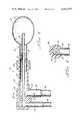
- FIG. 1is a perspective view of a probe constructed in accordance with the teachings of the present invention for use in a closed-loop caloric irrigator;
- FIG. 2is a side elevation view of the probe of FIG. 1 shown in operative, inflated position in the ear canal;
- FIg. 3is a longitudinal sectional view of the probe of FIG. 1;
- FIG. 4is a sectional view taken along the line 4--4 in FIG. 3.
- a probefor use with a caloric irrigator for unilateral or bilateral stimulation for use in ENG.
- a caloric irrigatorfor unilateral or bilateral stimulation for use in ENG.
- my copending U.S. patent application Ser. No. 760,178filed Jan. 17, 1977 and entitled Closed-Loop Caloric Irrigator.
- a caloric irrigator of the type described in my prior applicationincludes a unitary cabinet having a front panel on which is mounted the various gauges and controls required.
- a caloric irrigatoris of the general type previously described for pumping, for a predetermined time, a fluid, such as water, the temperature of which is accurately controlled, to probe 10 insertable in the ear canal 11 of a patient 12.
- a fluid reservoirwhich may consist simply of a cylindrical tank having at least one inlet and at least one outlet the outlet, of the reservoir being connected to the inlet of a pump, the operation of which is controlled by an electrical timer.
- the output of the pumpis typically connected to a conduit having four branches, each of which includes an identical valve, the valves being manually or electrically operated by switches mounted on the front panel of the cabinet. Two of the valves control the flow of fluid into a first heat exchanger for heating the fluid passing therethrough. The other two valves control the flow of fluid into a second heat exchanger for cooling the fluid passing therethrough.
- each probe 10In a caloric irrigator for bilateral simultaneous stimulation, two probes 10 would be utilized for effecting heat transfer between the fluid in the reservoir and the ear canals 11 of patient 12. Each probe 10 has an inlet 13 and an outlet 14. The inlets 13 of probe 10 are connected to the outlets of the heat exchangers by lengths of tubing 15. Outlets 14 are connected by lengths of tubing 16 to the inlets of the reservoir.
- the reservoir, the pump, the valves, the heat exchangers, and the probesare interconnected by means of conduit means, preferably plastic tubing, such as tubing 15 and 16, forming a closed-loop channel whereby the pump pumps fluid from the reservoir through one of the heat exchangers and the probes back to the reservoir.
- conduit meanspreferably plastic tubing, such as tubing 15 and 16, forming a closed-loop channel whereby the pump pumps fluid from the reservoir through one of the heat exchangers and the probes back to the reservoir.
- conduit meanspreferably plastic tubing, such as tubing 15 and 16
- probe 10includes a manifold, generally designated 20, and a balloon, generally designated 40.
- Manifold 20includes an elongate cylindrical body 21 having a central axial channel 22 therein. At one end of body 21, channel 22 is connected to a lateral channel 23 which receives one end of a sleeve 24 which provides the fluid inlet 13 for manifold 20.
- Sleeve 24is connectable to fluid inlet line 15. Sleeve 24 conducts fluid from inlet line 15 into channel 23 and channel 22 and then into one end of an elongate sleeve 25 which terminates in channel 22 and extends through and out of the other end of body 21.
- Adjacent the other end of body 21is an enlarged axial channel 27 which is coaxial with channel 22 and has a diameter greater than the diameter of channel 22.
- Channel 27is in fluid communication with a lateral channel 29 which receives one end of a sleeve 30 which functions as fluid outlet 14 of manifold 20.
- Sleeve 30is connectable to fluid outlet line 16. Thus, sleeve 30 conducts fluid from channel 27 into fluid outlet line 16.
- Channel 27receives one end of an elongate sleeve 31 which is coaxial with sleeve 25, sleeve 25 extending entirely through sleeve 31 which extends slightly beyond the other end of body 21.
- the outside diameter of sleeve 25is less than the inside diameter of sleeve 31 to permit fluid flow therebetween.
- the end of sleeve 25 which extends beyond body 21 of manifold 20receives one end of an elastic tube extension 32 which is preferably made from silicone, for reasons which will appear more fully hereinafter.
- probe 10incorporates balloon 40 which is preferably made from silicone rubber so as to be highly elastic and capable of repeated cycles of expansion and contraction.
- Balloon 40is designed so that probe 10 may maintain a precise temperature, for a given time, in ear canal 11, as close to ear drum 17 of patient 12 as possible.
- balloon 40is readily removable from manifold 20 so that balloon 40 can be discarded.
- balloon 40is a one-piece, elongate, cylindrical member having an open end and a closed end.
- balloon 40has a uniform inside diameter throughout the length thereof and includes sections 41, 42, and 43 of different outside diameters and different thicknesses.
- Section 41 of balloon 40is the inflatable balloon section which defines the closed end of balloon 40.
- Section 41has a relatively small outside diameter to permit insertion into ear canal 11.
- Section 41also has a minimum thickness to permit inflation thereof into contact with the inner ear. This assures good heat transfer and also ensures that balloon section 41 will conform to the irregularities and shapes of ear canal 11.
- balloon section 41has a slightly increased wall thickness at the tip 44 thereof to reduce the risk of damage during insertion into ear canal 11 and making it less likely that balloon section 41 will break in the direction of ear drum 17.
- balloon section 41preferably has an inside diameter of 3.7 mm, a wall thickness of 0.15 mm, an outside diameter of 4 mm, and a length of 13 mm.
- the open end of inflatable section 41is integral with a shaft section 42 which is non-inflatable and positioned intermediate the open and closed ends of balloon 40.
- Section 42has a relatively small diameter to permit insertion into ear canal 11 but an increased wall thickness to prevent inflation thereof.
- Section 42serves as an extension for the return flow of fluid through balloon section 41. If the thicknesses of sections 41 and 42 were the same, it would be very likely that section 42 would inflate outside of ear canal 11 and break. As can be seen from an inspection of FIG. 2, section 42 does not inflate, all the inflation of balloon 40 being in section 41.
- section 42preferably has an inside diameter of 3.7 mm, a wall thickness of 0.4 mm, an outside diameter of 4.5 mm, and a length of 13 mm. It can therefore be seen that the lengths of sections 41 and 42 are approximately equal, again ensuring that there is no inflation of balloon 41 outside of ear canal 11.
- Balloon 40includes a third, non-inflatable, retainer section 43 defining the open end thereof, retainer section 43 having a relatively large outside diameter and a substantial thickness so as to function as a stop for proper placement. That is, as shown in FIG. 2, the outside diameter of retainer section 43 is such that it will contact the exterior ear and limit movement of sections 41 and 42 of balloon 40 into ear canal 11. Since total heat transfer is dependent on balloon contact, it is important that placement in ear canal 11 be repeatable and retainer section 43 ensures that this is the case. Furthermore, retainer section 43 may be fitted onto sleeve 31 of manifold 20 and is held in position thereat by the elasticity of the material of balloon 40. According to the present invention, section 43 preferably has an inside diameter of 3.7 mm, an outside diameter of 9.5 mm, and a length of 4 mm.
- tube extension 32assures a good liquid delivery close to tip 44 of inflatable section 41 where irrigation is most important. Furthermore, when inserting probe 10 into ear canal 11, extension 32 prevents balloon 40 from doubling over.
- fluid conducted to manifold 20 by inlet line 15flows through sleeve 25 and extension 32 into inflatable section 41 of balloon 40. Such fluid then passes between tube extension 32 and shaft section 42 of balloon 40, between sleeves 25 and 31, and through channel 27 and flows via sleeve 30 into fluid outlet line 16.
- Probe 10includes a manifold 20 and an inflatable balloon 40 adapted to be placed in ear canal 11 and to have a fluid such as water pumped therethrough for stimulating ear canal 11. With probe 10, the fluid flow into and out of balloon 40 is concentric. This allows sections 41 and 42 of balloon 40 to have a small diameter, providing greater applicability with individuals with small or partially obstructed ear canals. Probe 10 is not only smaller, but simpler and less costly than prior designs, permitting replacement of balloon 40 only and not the entire probe 10. Use of a concentric in-flow and out-flow system also prevents partial collapse of balloon 40 because of the ear creating a restriction.
- Probe 10is soft and of low mass so that placement can be made with the least amount of trauma to a patient.
- the hoses leading to manifold 20are small and lightweight and are attached to body 21 at a right angle to assure a minimal total mass to be handled.
- Balloon 40is easily removable from manifold 20 and is held in place by the elasticity of balloon 40.
Landscapes
- Life Sciences & Earth Sciences (AREA)
- Health & Medical Sciences (AREA)
- Medical Informatics (AREA)
- Biophysics (AREA)
- Pathology (AREA)
- Engineering & Computer Science (AREA)
- Biomedical Technology (AREA)
- Heart & Thoracic Surgery (AREA)
- Physics & Mathematics (AREA)
- Molecular Biology (AREA)
- Surgery (AREA)
- Animal Behavior & Ethology (AREA)
- General Health & Medical Sciences (AREA)
- Public Health (AREA)
- Veterinary Medicine (AREA)
- Surgical Instruments (AREA)
Abstract
Description
This application is a continuation-in-part of application Ser. No. 760,178, filed Jan. 17, 1977 now abandoned.
1. Field of the Invention
The present invention relates to an ear probe for use in closed-loop caloric irrigation and, more particularly, to an improved probe including a disposable silicone rubber balloon for use with caloric irrigation apparatus.
2. Description of the Prior Art
The human species has evolved and developed an elaborate balance system to allow for proper relationship between its surroundings and an erect posture. The system is a complicated one, requiring integration of information from the visual system, the vestibular system, and the skeletal-muscular system.
For a patient complaining of dizziness and impaired balance, a disorder can exist in any of these systems. To determine the source of the disorder, many different tests are performed. In addition to the spontaneous nystagmus and postual reflex tests, a complex recording technique has been developed called electronystagmography (ENG). ENG provides for a permanent objective recording, obtained in a relatively standardized manner, of responses from the vestibular system.
In order to perform adequate tests utilizing ENG, the vestibular system must be stimulated to create the condition of dizziness and impaired balance. It has been determined that proper stimulation may be achieved by adding heat to or taking heat away from the inner ear. It is for this purpose that several caloric irrigators have been developed.
A conventional caloric irrigator consists of a fluid reservoir, a fluid pump, a heating and cooling system, and a conduit for conducting fluid, pumped by the pump, from the reservoir, through the heating and cooling system, to a probe insertible into the ear canal. While caloric irrigators are widely used, existing equipment has many disadvantages associated therewith. A basin or towel is required to catch the water flowing out of the ear, making the procedure difficult and awkward. The procedure requires trained personnel and it is virtually impossible to stimulate both ears simultaneously, which many experts say is a necessity for a meaningful test. Such a procedure is not applicable in the case of a patient with a perforated eardrum since the water will flow through the perforation. It is also difficult to measure a fixed stimulation parameter such as temperature, fluid volume, and flow rate.
To solve the above problems, it has been proposed by researchers in the Department of Otorhinolaryngology, School of Medicine, Keio University, Tokyo, Japan, to provide a closed-loop channel for conducting fluid from the reservoir to the ear and back to the reservoir. The proposed system consists of a water tank with a stirrer, a heating and cooling system, a temperature control system, a pump system with a timer, and a silicone ear canal balloon. The silicone balloon is inserted into the auditory canal and is made to adhere tightly to the canal wall by the pressure of the water as it is pumped from the reservoir, into the balloon, and back to the reservoir. Heat transfer to the ear canal is achieved through the wall of the balloon. Since the water does not directly contact the ear, the system can be used even with a perforated eardrum. Unilateral or bilateral simultaneous stimulation can be performed and the various parameters can be readily controlled.
Even with the above advantages of a system using an inflatable balloon, several problems still exist with the proposed apparatus. The balloon of the proposed system is a one-piece, molded part having an inlet and an outlet that are positioned side by side. This makes the balloon overly large, preventing its use with very small or partially obstructed ear canals. Furthermore, the one-piece construction is complex and expensive and the entire unit must be replaced periodically.
Generally speaking, the purpose of a probe is to maintain a precise temperature, for a given time, in the ear canal, as close to the ear drum as possible. Ear canals vary in size depending on age and physical structure of a patient so it is necessary to construct a probe that can be used in all subjects, thereby eliminating error by a technician. To maintain a given temperature in the ear canal, it is necessary to maintain a given fluid flow. Since the dimensions should be held to a minimum and flow to a maximum, the construction of a total probe is the key to feasibility.
The ear canal is sensitive to foreign objects. Therefore, the probe must be soft and of low mass so that placement can be done with the least amount of trauma to the patient. For sterilization purposes, the portion of the probe that goes into the ear should be replaceable. The probe construction should define probe placement relative to the ear so that tests are repeatable. Repeatability of probe placement in the ear canal is also important because total heat transfer is dependent on balloon contact. A probe satisfying all of these requirements has been unavailable heretofore.
According to the present invention, these problems are solved in a manner unknown heretofore by the provision of a unique ear probe for use in a closed-loop caloric irrigator. The present probe includes a manifold and an inflatable balloon adapted to be placed in the ear canal and to have a fluid such as water pumped therethrough for stimulating the ear canal wall and the ear canal. With the present probe, the fluid flow into and out of the balloon is concentric. This allows the tip of the probe to have an extremely small diameter, providing greater applicability with individuals with small or partially obstructed ear canals. The probe is not only smaller, but simpler and less costly than prior probes, permitting replacement of the balloon only and not the entire probe. Use of a concentric in-flow and out-flow system also prevents partial collapse of the balloon because of the ear creating a restriction.
The present probe is soft and of low mass so that placement can be done with the least amount of trauma to a patient. The hoses leading to the probe are small and lightweight and are attached to a right angle to the probe to assure a minimal total mass to be handled. The balloons are easily removed from the manifold and are held in place by the elasticity of the balloon.
The present balloon contains three sections. A first section, the retainer section, at the open end of the balloon, is used as a stop for probe placement. This permits a repeatable placement of the probe in the ear canal. An intermediate section has a heavier wall than the inflatable section and will not inflate. It serves as an extension for the return flow of fluid. The inflatable section, at the closed end of the balloon, is very thin, assuring good heat transfer and the ability to conform to irregularities and shapes of different ear canals. The inflatable section has a slightly heavier wall at the tip, reducing the risk of damage during insertion and reducing the likelihood of breakage in the direction of the ear drum.
Briefly, the present probe includes a manifold and a balloon, the manifold conducting fluid flow into and out of the balloon concentrically, the balloon being a one-piece, elongate, cylindrical member formed from an elastic material and having open and closed ends and sections of different diameters and thicknesses, the balloon including a first, inflatable section defining the closed end thereof, the first section having a relatively small diameter to permit insertion into the ear canal and a minimum thickness to permit inflation thereof into contact with the inner ear, a second, non-inflatable section intermediate the open and closed ends thereof, the second section having a relatively small diameter to permit insertion into the ear canal and an increased thickness to prevent inflation thereof, the first and second sections being approximately equal in length, and a third, non-inflatable section defining the open end thereof, the third section having a relatively large outside diameter and a substantial thickness so as to contact the exterior ear and limit movement of the first and second sections of the balloon into the ear canal.
It is therefore an object of the present invention to provide an ear probe for use in a closed-loop caloric irrigator for electronystagmography.
It is a further object of the present invention to provide an ear probe including a manifold and an inflatable balloon adapted to be placed in an ear canal.
It is a still further object of the present invention to provide an ear probe for use in a closed-loop caloric irrigator in which dimensions are held to a minimum and flow to a maximum.
It is another object of the present invention to provide an ear probe which permits maintenance of a precise temperature, close to or at the ear drum, regardless of the physical structure of a patient.
Still other objects, features and attendant advantages of the present invention will become apparent to those skilled in the art from a reading of the following detailed description of the preferred embodiment constructed in accordance therewith, taken in conjunction with the accompanying drawings wherein like numerals designate like parts in the several figures and wherein:
FIG. 1 is a perspective view of a probe constructed in accordance with the teachings of the present invention for use in a closed-loop caloric irrigator;
FIG. 2 is a side elevation view of the probe of FIG. 1 shown in operative, inflated position in the ear canal;
FIg. 3 is a longitudinal sectional view of the probe of FIG. 1; and
FIG. 4 is a sectional view taken along the line 4--4 in FIG. 3.
Referring now to the drawings, there is shown a probe, generally designated 10, for use with a caloric irrigator for unilateral or bilateral stimulation for use in ENG. For a complete description of a closed-loop caloric irrigator, which is not the subject of the present invention, reference should be had to my copending U.S. patent application Ser. No. 760,178, filed Jan. 17, 1977 and entitled Closed-Loop Caloric Irrigator.
For the purposes of the present invention, a caloric irrigator of the type described in my prior application includes a unitary cabinet having a front panel on which is mounted the various gauges and controls required. Such a caloric irrigator is of the general type previously described for pumping, for a predetermined time, a fluid, such as water, the temperature of which is accurately controlled, to probe 10 insertable in the ear canal 11 of apatient 12.
Housed within such unitary cabinet is a fluid reservoir which may consist simply of a cylindrical tank having at least one inlet and at least one outlet the outlet, of the reservoir being connected to the inlet of a pump, the operation of which is controlled by an electrical timer. Where the irrigator is designated for bilateral simultaneous stimulation, the output of the pump is typically connected to a conduit having four branches, each of which includes an identical valve, the valves being manually or electrically operated by switches mounted on the front panel of the cabinet. Two of the valves control the flow of fluid into a first heat exchanger for heating the fluid passing therethrough. The other two valves control the flow of fluid into a second heat exchanger for cooling the fluid passing therethrough.
In a caloric irrigator for bilateral simultaneous stimulation, twoprobes 10 would be utilized for effecting heat transfer between the fluid in the reservoir and the ear canals 11 ofpatient 12. Eachprobe 10 has aninlet 13 and anoutlet 14. Theinlets 13 ofprobe 10 are connected to the outlets of the heat exchangers by lengths oftubing 15.Outlets 14 are connected by lengths oftubing 16 to the inlets of the reservoir.
Generally speaking, the reservoir, the pump, the valves, the heat exchangers, and the probes are interconnected by means of conduit means, preferably plastic tubing, such astubing
Referring now primarily to FIGS. 3 and 4, the construction ofprobe 10 will be described in detail. Specifically,probe 10 includes a manifold, generally designated 20, and a balloon, generally designated 40.Manifold 20 includes an elongatecylindrical body 21 having a central axial channel 22 therein. At one end ofbody 21, channel 22 is connected to a lateral channel 23 which receives one end of asleeve 24 which provides thefluid inlet 13 formanifold 20.Sleeve 24 is connectable tofluid inlet line 15.Sleeve 24 conducts fluid frominlet line 15 into channel 23 and channel 22 and then into one end of an elongate sleeve 25 which terminates in channel 22 and extends through and out of the other end ofbody 21.
Adjacent the other end ofbody 21 is an enlarged axial channel 27 which is coaxial with channel 22 and has a diameter greater than the diameter of channel 22. Channel 27 is in fluid communication with alateral channel 29 which receives one end of asleeve 30 which functions asfluid outlet 14 ofmanifold 20.Sleeve 30 is connectable tofluid outlet line 16. Thus,sleeve 30 conducts fluid from channel 27 intofluid outlet line 16.
Channel 27 receives one end of anelongate sleeve 31 which is coaxial with sleeve 25, sleeve 25 extending entirely throughsleeve 31 which extends slightly beyond the other end ofbody 21. The outside diameter of sleeve 25 is less than the inside diameter ofsleeve 31 to permit fluid flow therebetween. The end of sleeve 25 which extends beyondbody 21 ofmanifold 20 receives one end of anelastic tube extension 32 which is preferably made from silicone, for reasons which will appear more fully hereinafter.
According to the present invention,probe 10 incorporatesballoon 40 which is preferably made from silicone rubber so as to be highly elastic and capable of repeated cycles of expansion and contraction.Balloon 40 is designed so thatprobe 10 may maintain a precise temperature, for a given time, in ear canal 11, as close to ear drum 17 ofpatient 12 as possible. For sterilization purposes,balloon 40 is readily removable frommanifold 20 so thatballoon 40 can be discarded.
More specifically,balloon 40 is a one-piece, elongate, cylindrical member having an open end and a closed end. Preferably,balloon 40 has a uniform inside diameter throughout the length thereof and includessections Section 41 ofballoon 40 is the inflatable balloon section which defines the closed end ofballoon 40.Section 41 has a relatively small outside diameter to permit insertion into ear canal 11.Section 41 also has a minimum thickness to permit inflation thereof into contact with the inner ear. This assures good heat transfer and also ensures thatballoon section 41 will conform to the irregularities and shapes of ear canal 11.
On the other hand,balloon section 41 has a slightly increased wall thickness at thetip 44 thereof to reduce the risk of damage during insertion into ear canal 11 and making it less likely thatballoon section 41 will break in the direction of ear drum 17. According to the present invention,balloon section 41 preferably has an inside diameter of 3.7 mm, a wall thickness of 0.15 mm, an outside diameter of 4 mm, and a length of 13 mm.
The open end ofinflatable section 41 is integral with a shaft section 42 which is non-inflatable and positioned intermediate the open and closed ends ofballoon 40. Section 42 has a relatively small diameter to permit insertion into ear canal 11 but an increased wall thickness to prevent inflation thereof. Section 42 serves as an extension for the return flow of fluid throughballoon section 41. If the thicknesses ofsections 41 and 42 were the same, it would be very likely that section 42 would inflate outside of ear canal 11 and break. As can be seen from an inspection of FIG. 2, section 42 does not inflate, all the inflation ofballoon 40 being insection 41. According to the present invention, section 42 preferably has an inside diameter of 3.7 mm, a wall thickness of 0.4 mm, an outside diameter of 4.5 mm, and a length of 13 mm. It can therefore be seen that the lengths ofsections 41 and 42 are approximately equal, again ensuring that there is no inflation ofballoon 41 outside of ear canal 11.
As can be seen in FIGS. 2 and 3,tube extension 32 assures a good liquid delivery close to tip 44 ofinflatable section 41 where irrigation is most important. Furthermore, when insertingprobe 10 into ear canal 11,extension 32 preventsballoon 40 from doubling over.
As will be apparent from an inspection FIG. 3, fluid conducted tomanifold 20 byinlet line 15 flows through sleeve 25 andextension 32 intoinflatable section 41 ofballoon 40. Such fluid then passes betweentube extension 32 and shaft section 42 ofballoon 40, betweensleeves 25 and 31, and through channel 27 and flows viasleeve 30 intofluid outlet line 16.
It can therefore be seen that according to the present invention, the problems encountered with previous probes for use in a closed-loop caloric irrigator are solved by the provision of aunique probe 10.Probe 10 includes a manifold 20 and aninflatable balloon 40 adapted to be placed in ear canal 11 and to have a fluid such as water pumped therethrough for stimulating ear canal 11. Withprobe 10, the fluid flow into and out ofballoon 40 is concentric. This allowssections 41 and 42 ofballoon 40 to have a small diameter, providing greater applicability with individuals with small or partially obstructed ear canals.Probe 10 is not only smaller, but simpler and less costly than prior designs, permitting replacement ofballoon 40 only and not theentire probe 10. Use of a concentric in-flow and out-flow system also prevents partial collapse ofballoon 40 because of the ear creating a restriction.
While the invention has been described with respect to the preferred physical embodiment constructed in accordance therewith, it will be apparent to those skilled in the art that various modifications and improvements may be made within departing from the scope and spirit of the invention. Accordingly, it is to be understood that the invention is not to be limited by the specific illustrative embodiment, but only by the scope of the appended claims.
Claims (11)
1. An ear canal balloon comprising:
a one-piece, elongate, cylindrical member formed from an elastic material and having open and closed ends and sections of different diameters and thicknesses, said member including:
a first section defining the closed end thereof, said first section having a relatively small diameter to permit insertion into an ear canal and a minimum thickness to permit inflation thereof into contact with the inner ear;
a second section intermediate the open and closed ends thereof, said second section having a relatively small diameter to permit insertion into said ear canal and a thickness which is greater than the thickness of said first section by an amount sufficient to prevent inflation thereof in use, said first and second sections being approximately equal in length; and
a third section defining the open end thereof, said third section having a relatively large outside diameter and a substantial thickness so as to contact the exterior ear and limit movement of said first and second sections of said balloon into said ear canal.
2. An ear balloon according to claim 1, wherein said member is made from silicone rubber.
3. An ear balloon according to claim 1 or 2, wherein said first, second and third sections have the same inside diameter.
4. An ear balloon according to claim 1, wherein said first section has a slightly increased wall thickness at the tip thereof.
5. An ear balloon according to claim 1, wherein said first section has an inside diameter of approximately 3.7 mm and a wall thickness of approximately 0.15 mm.
6. An ear balloon according to claim 5, wherein said second section has an inside diameter of approximately 3.7 mm and a wall thickness of approximately 0.4 mm.
7. An ear balloon according to claim 6, wherein said third section has an inside diameter of approximately 3.7 mm and an outside diameter of approximately 9.5 mm.
8. An ear balloon according to claim 7, wherein said first, second, and third sections have lengths of approximately 13 mm, 13 mm, and 4 mm, respectively.
9. An ear probe for use in closed-loop caloric irrigation comprising:
a manifold including:
an elongate cylindrical body having a side wall, an open end and a closed end and first and second coaxial channels extending therethrough; and
inlets and outlets extending laterally through said side wall of said body into fluid communication with said first and second channels, respectively; and
a one-piece, elongate, cylindrical, ear canal balloon formed from an elastic material and having open and closed ends and sections of different diameters and thicknesses, said open end of said balloon being removably connectable to said open end of said manifold body, said manifold conducting fluid into and out of said balloon.
10. An ear probe according to claim 9, wherein said manifold body has a central axial channel connected to said outlet and a sleeve extending through said channel and connected to said inlet, said open end of said balloon being connected to said body of said manifold and said sleeve extending into said balloon.
11. An ear probe according to claim 9 or 10, wherein said balloon comprises:
a first section defining the closed end thereof, said first section having a relatively small diameter to permit insertion into an ear canal and a minimum thickness to permit inflation thereof into contact with the inner ear;
a second section intermediate the open and closed ends thereof, said second section having a relatively small diameter to permit insertion into said ear canal and a thickness which is greater than the thickness of said first section by an amount sufficient to prevent inflation thereof in use, said first and second sections being approximately equal in length; and
a third section defining the open end thereof, said third section having a relatively large outside diameter and a substantial thickness so as to contact the exterior ear and limit movement of said first and second sections of said balloon into said ear canal.
Priority Applications (1)
| Application Number | Priority Date | Filing Date | Title |
|---|---|---|---|
| US05/952,690US4244377A (en) | 1978-10-19 | 1978-10-19 | Ear probe for use in closed-loop caloric irrigation |
Applications Claiming Priority (1)
| Application Number | Priority Date | Filing Date | Title |
|---|---|---|---|
| US05/952,690US4244377A (en) | 1978-10-19 | 1978-10-19 | Ear probe for use in closed-loop caloric irrigation |
Related Parent Applications (1)
| Application Number | Title | Priority Date | Filing Date |
|---|---|---|---|
| US05760178Continuation-In-Part | 1977-01-17 |
Publications (1)
| Publication Number | Publication Date |
|---|---|
| US4244377Atrue US4244377A (en) | 1981-01-13 |
Family
ID=25493148
Family Applications (1)
| Application Number | Title | Priority Date | Filing Date |
|---|---|---|---|
| US05/952,690Expired - LifetimeUS4244377A (en) | 1978-10-19 | 1978-10-19 | Ear probe for use in closed-loop caloric irrigation |
Country Status (1)
| Country | Link |
|---|---|
| US (1) | US4244377A (en) |
Cited By (49)
| Publication number | Priority date | Publication date | Assignee | Title |
|---|---|---|---|---|
| EP0089647A3 (en)* | 1982-03-22 | 1984-04-04 | The Regents Of The University Of Michigan | Hollow viscus tonometry |
| US4466438A (en)* | 1982-07-20 | 1984-08-21 | Katz Jay Warren | Method and means for treating symptoms of Meniere's disease or the like |
| US4643192A (en)* | 1982-03-22 | 1987-02-17 | Regents Of The University Of Michigan | Hollow viscus tonometry |
| FR2597331A1 (en)* | 1986-04-21 | 1987-10-23 | Denis Alain | HYGIENIC DEVICE FOR THE CLEANING OF EARS BY PRESSURIZED INSTILLATION OF LIQUID PRODUCTS AND EXTRACTION OF CERUMEN CAPS. |
| US5188618A (en)* | 1991-05-03 | 1993-02-23 | Thomas Bruce W | Thrombus-mobilizing thoracostomy tube |
| US5257977A (en)* | 1990-03-22 | 1993-11-02 | Argomed Ltd. | Technique for localized thermal treatment of mammals |
| WO1994026345A1 (en)* | 1993-05-07 | 1994-11-24 | Medispec Ltd. | Heating device particularly useful for gynecological purposes |
| US5421818A (en)* | 1993-10-18 | 1995-06-06 | Inner Ear Medical Delivery Systems, Inc. | Multi-functional inner ear treatment and diagnostic system |
| US5526809A (en)* | 1982-03-22 | 1996-06-18 | Mountpelier Investments, S.A. | Hollow viscous and soild organ tonometry |
| US5549559A (en)* | 1990-03-22 | 1996-08-27 | Argomed Ltd. | Thermal treatment apparatus |
| WO1998040040A1 (en) | 1997-03-13 | 1998-09-17 | Endocare, Inc. | Urethral warming catheter |
| US6010453A (en)* | 1982-03-22 | 2000-01-04 | Instrumentarium Corporation | Tonometric catheter combination |
| WO2000004854A1 (en)* | 1998-07-23 | 2000-02-03 | Durect Corporation | Fluid transfer and diagnostic system for treating the inner ear |
| US6045528A (en)* | 1997-06-13 | 2000-04-04 | Intraear, Inc. | Inner ear fluid transfer and diagnostic system |
| US6210358B1 (en) | 1996-05-09 | 2001-04-03 | Cryptych Pty Ltd | Ear irrigation device |
| US6334064B1 (en) | 1988-08-26 | 2001-12-25 | Instrumentarium Corp. | Remote sensing tonometric catheter apparatus and method |
| US20030120174A1 (en)* | 2001-12-21 | 2003-06-26 | Ferdinando Ippolito | Thermostimulating device for thermographic investigations in dermatology, oncology, angiology and capillaroscopy |
| US20030208155A1 (en)* | 2000-02-17 | 2003-11-06 | Abita Joseph L. | Vestibular irrigator test system (vits) |
| US6706023B1 (en) | 1999-12-03 | 2004-03-16 | Bionix Development Corporation | Device for irrigation of a blind orifice |
| US20040060192A1 (en)* | 2002-10-01 | 2004-04-01 | Gronka Edward A. | Ear canal dryer and method of use thereof |
| US20040133194A1 (en)* | 2003-01-04 | 2004-07-08 | Eum Jay J. | Open system heat exchange catheters and methods of use |
| US20040220557A1 (en)* | 2003-04-30 | 2004-11-04 | Eum Jay J. | Closed system warming catheter and method of use |
| US6849063B1 (en) | 1994-03-11 | 2005-02-01 | Wit Ip Corporation | Thermal treatment apparatus |
| US20060282039A1 (en)* | 2005-06-09 | 2006-12-14 | Endocare, Inc. | Heat exchange catheter with multi-lumen tube having a fluid return passageway |
| US20070005050A1 (en)* | 2005-06-09 | 2007-01-04 | Endocare, Inc. | Heat exchange catheter and method of use |
| US20100198282A1 (en)* | 2007-01-11 | 2010-08-05 | Rogers Lesco L | Devices for vestibular or cranial nerve stimulation |
| WO2012043991A3 (en)* | 2010-09-28 | 2012-06-07 | 서울대학교 산학협력단 | Method for transmitting a signal while avoiding the influences of an interference signal existing in the same channel in a communication system having a main communication device and a plurality of terminal communication devices |
| US20120327426A1 (en)* | 2008-07-24 | 2012-12-27 | Hart Douglas P | Inflatable membrane having non-uniform inflation characteristic |
| EP2829259A1 (en) | 2007-08-03 | 2015-01-28 | Scion Neurostim Llc | Vestibular stimulation apparatus and associated methods of use |
| US9168171B2 (en) | 2009-12-18 | 2015-10-27 | Scion Neurostim, Llc | Combination treatments |
| US20150320591A1 (en)* | 2014-05-09 | 2015-11-12 | Scion Neurostim, Llc | Systems and Methods for In-Ear Fluid Vestibular and/or Cranial Nerve Caloric Stimulation |
| US9283111B2 (en) | 2010-12-16 | 2016-03-15 | Scion Neurostim, Llc | Systems, methods and apparatus for bilateral caloric vestibular stimulation |
| US9291565B2 (en) | 2008-07-24 | 2016-03-22 | Massachusetts Institute Of Technology | Three dimensional scanning using membrane with optical features |
| US9606011B2 (en) | 2010-09-21 | 2017-03-28 | Mayo Foundation For Medical Education And Research | Methods and materials for calibrating a caloric test |
| US9744074B2 (en) | 2010-12-16 | 2017-08-29 | Scion Neurostim, Llc | Combination treatments |
| US10076464B2 (en) | 2013-06-28 | 2018-09-18 | Nocira, Llc | External ear canal pressure regulation system |
| US10251790B2 (en) | 2013-06-28 | 2019-04-09 | Nocira, Llc | Method for external ear canal pressure regulation to alleviate disorder symptoms |
| US10390991B2 (en) | 2007-01-11 | 2019-08-27 | Scion Neurostim, Llc | Medical devices incorporating thermoelectric transducer and controller |
| US10470710B2 (en)* | 2014-02-12 | 2019-11-12 | Duke University | System for accurate measurement of dynamics and kinematics |
| US10512564B2 (en) | 2010-12-16 | 2019-12-24 | Scion Neurostim, Llc | Combination treatments |
| US10537467B2 (en) | 2010-12-16 | 2020-01-21 | Scion Neurostim, Llc | Systems, devices and methods for bilateral caloric vestibular stimulation |
| US10760566B2 (en) | 2016-07-22 | 2020-09-01 | Nocira, Llc | Magnetically driven pressure generator |
| US20200323684A1 (en)* | 2019-04-15 | 2020-10-15 | Mdideafactory, Inc. | Ear apparatus and methods of use |
| US11246793B2 (en) | 2017-02-27 | 2022-02-15 | Nocira, Llc | Ear pumps |
| WO2023017046A1 (en)* | 2021-08-10 | 2023-02-16 | Peus Dominik | Devices, systems and methods for inducing temperature changes in the inner ear and/or labyrinth |
| US20230190522A1 (en)* | 2020-05-19 | 2023-06-22 | Ajou University Industry-Academic Cooperation Foundation | Device for diagnosing and treating ocular deviation |
| US11737923B2 (en) | 2016-04-04 | 2023-08-29 | Mdideafactory, Inc. | Apparatus and methods for ear protection and enhancement |
| US12178966B2 (en) | 2018-06-22 | 2024-12-31 | Nocira, Llc | Systems and methods for treating neurological disorders |
| US12396892B2 (en) | 2013-06-28 | 2025-08-26 | Nocira, Llc | External ear canal pressure regulation device |
Citations (8)
| Publication number | Priority date | Publication date | Assignee | Title |
|---|---|---|---|---|
| SU187217A1 (en)* | А. Н. Каландадзе | DEVICE FOR CLOSED EARNESS CALORIZATION | ||
| US726009A (en)* | 1903-02-18 | 1903-04-21 | Rubber Balloon Company Of America | Toy balloon. |
| US824071A (en)* | 1904-02-04 | 1906-06-19 | Rubber Balloon Company Of America | Rubber balloon-bag. |
| US2190384A (en)* | 1937-07-06 | 1940-02-13 | Louis B Newman | Therapeutic bag |
| US2826000A (en)* | 1957-01-23 | 1958-03-11 | Fischman | Knockdown toy |
| US3049125A (en)* | 1960-03-28 | 1962-08-14 | Kriwkowitsch George | Nose packing device |
| US3848607A (en)* | 1971-10-29 | 1974-11-19 | M Clair | Therapeutic apparatus |
| US4102342A (en)* | 1975-12-29 | 1978-07-25 | Taichiro Akiyama | Valved device |
- 1978
- 1978-10-19USUS05/952,690patent/US4244377A/ennot_activeExpired - Lifetime
Patent Citations (8)
| Publication number | Priority date | Publication date | Assignee | Title |
|---|---|---|---|---|
| SU187217A1 (en)* | А. Н. Каландадзе | DEVICE FOR CLOSED EARNESS CALORIZATION | ||
| US726009A (en)* | 1903-02-18 | 1903-04-21 | Rubber Balloon Company Of America | Toy balloon. |
| US824071A (en)* | 1904-02-04 | 1906-06-19 | Rubber Balloon Company Of America | Rubber balloon-bag. |
| US2190384A (en)* | 1937-07-06 | 1940-02-13 | Louis B Newman | Therapeutic bag |
| US2826000A (en)* | 1957-01-23 | 1958-03-11 | Fischman | Knockdown toy |
| US3049125A (en)* | 1960-03-28 | 1962-08-14 | Kriwkowitsch George | Nose packing device |
| US3848607A (en)* | 1971-10-29 | 1974-11-19 | M Clair | Therapeutic apparatus |
| US4102342A (en)* | 1975-12-29 | 1978-07-25 | Taichiro Akiyama | Valved device |
Non-Patent Citations (2)
| Title |
|---|
| Foti, Thos. et al., "A Closed Flow Water Caloric System", JNMA vol. 69 No. 5, 6/77 pp. 303-305.* |
| Ono, H. et al., "A New Caloric Tester Using an Ear Canal Balloon", Revue de Laryngologie, Otologie and Rhinologie, vol. 97, Nos. 5-6, May-Jun. 1976 pp. 223-230.* |
Cited By (86)
| Publication number | Priority date | Publication date | Assignee | Title |
|---|---|---|---|---|
| US5526809A (en)* | 1982-03-22 | 1996-06-18 | Mountpelier Investments, S.A. | Hollow viscous and soild organ tonometry |
| US4643192A (en)* | 1982-03-22 | 1987-02-17 | Regents Of The University Of Michigan | Hollow viscus tonometry |
| EP0089647A3 (en)* | 1982-03-22 | 1984-04-04 | The Regents Of The University Of Michigan | Hollow viscus tonometry |
| US6010453A (en)* | 1982-03-22 | 2000-01-04 | Instrumentarium Corporation | Tonometric catheter combination |
| US4466438A (en)* | 1982-07-20 | 1984-08-21 | Katz Jay Warren | Method and means for treating symptoms of Meniere's disease or the like |
| WO1987006456A1 (en)* | 1986-04-21 | 1987-11-05 | Sanofi | Device for cleaning a cavity, particularly the auricular cavity |
| EP0243261A1 (en)* | 1986-04-21 | 1987-10-28 | Sanofi | Device for cleaning a cavity, especially the auricular cavity |
| FR2597331A1 (en)* | 1986-04-21 | 1987-10-23 | Denis Alain | HYGIENIC DEVICE FOR THE CLEANING OF EARS BY PRESSURIZED INSTILLATION OF LIQUID PRODUCTS AND EXTRACTION OF CERUMEN CAPS. |
| US6334064B1 (en) | 1988-08-26 | 2001-12-25 | Instrumentarium Corp. | Remote sensing tonometric catheter apparatus and method |
| US5257977A (en)* | 1990-03-22 | 1993-11-02 | Argomed Ltd. | Technique for localized thermal treatment of mammals |
| USRE37704E1 (en) | 1990-03-22 | 2002-05-14 | Argomed Ltd. | Thermal treatment apparatus |
| US5549559A (en)* | 1990-03-22 | 1996-08-27 | Argomed Ltd. | Thermal treatment apparatus |
| US5188618A (en)* | 1991-05-03 | 1993-02-23 | Thomas Bruce W | Thrombus-mobilizing thoracostomy tube |
| WO1994026345A1 (en)* | 1993-05-07 | 1994-11-24 | Medispec Ltd. | Heating device particularly useful for gynecological purposes |
| EP1424050A2 (en) | 1993-10-18 | 2004-06-02 | Durect Corporation | Multi-functional inner ear treatment and diagnostic system |
| EP0724408A4 (en)* | 1993-10-18 | 1997-10-01 | Inner Ear Medical Delivery Sys | MULTIFUNCTIONAL DIAGNOSTICS AND INTERNAL EAR TREATMENT SYSTEM |
| EP1424050A3 (en)* | 1993-10-18 | 2007-02-14 | Durect Corporation | Multi-functional inner ear treatment and diagnostic system |
| US5421818A (en)* | 1993-10-18 | 1995-06-06 | Inner Ear Medical Delivery Systems, Inc. | Multi-functional inner ear treatment and diagnostic system |
| US6849063B1 (en) | 1994-03-11 | 2005-02-01 | Wit Ip Corporation | Thermal treatment apparatus |
| US6210358B1 (en) | 1996-05-09 | 2001-04-03 | Cryptych Pty Ltd | Ear irrigation device |
| US6017361A (en)* | 1997-03-13 | 2000-01-25 | Endo Care, Inc. | Urethral warming catheter |
| WO1998040040A1 (en) | 1997-03-13 | 1998-09-17 | Endocare, Inc. | Urethral warming catheter |
| US6045528A (en)* | 1997-06-13 | 2000-04-04 | Intraear, Inc. | Inner ear fluid transfer and diagnostic system |
| US6440102B1 (en) | 1998-07-23 | 2002-08-27 | Durect Corporation | Fluid transfer and diagnostic system for treating the inner ear |
| WO2000004854A1 (en)* | 1998-07-23 | 2000-02-03 | Durect Corporation | Fluid transfer and diagnostic system for treating the inner ear |
| AU745505B2 (en)* | 1998-07-23 | 2002-03-21 | Durect Corporation | Fluid transfer and diagnostic system for treating the inner ear |
| US6706023B1 (en) | 1999-12-03 | 2004-03-16 | Bionix Development Corporation | Device for irrigation of a blind orifice |
| US6875196B2 (en) | 2000-02-17 | 2005-04-05 | The Johns Hopkins University | Vestibular irrigator test system (VITS) |
| US20030208155A1 (en)* | 2000-02-17 | 2003-11-06 | Abita Joseph L. | Vestibular irrigator test system (vits) |
| US20030120174A1 (en)* | 2001-12-21 | 2003-06-26 | Ferdinando Ippolito | Thermostimulating device for thermographic investigations in dermatology, oncology, angiology and capillaroscopy |
| US20040060192A1 (en)* | 2002-10-01 | 2004-04-01 | Gronka Edward A. | Ear canal dryer and method of use thereof |
| WO2004030589A1 (en)* | 2002-10-01 | 2004-04-15 | Edward Gronka | Ear canal dryer and method of use thereof |
| US6972014B2 (en) | 2003-01-04 | 2005-12-06 | Endocare, Inc. | Open system heat exchange catheters and methods of use |
| US20060015093A1 (en)* | 2003-01-04 | 2006-01-19 | Endocare, Inc. | Open system heat exchange catheters and methods of use |
| US20040133194A1 (en)* | 2003-01-04 | 2004-07-08 | Eum Jay J. | Open system heat exchange catheters and methods of use |
| US20040220557A1 (en)* | 2003-04-30 | 2004-11-04 | Eum Jay J. | Closed system warming catheter and method of use |
| US20050021014A1 (en)* | 2003-04-30 | 2005-01-27 | Eum Jay J. | Closed system warming catheter and method of use |
| US7621890B2 (en) | 2005-06-09 | 2009-11-24 | Endocare, Inc. | Heat exchange catheter with multi-lumen tube having a fluid return passageway |
| US20070005050A1 (en)* | 2005-06-09 | 2007-01-04 | Endocare, Inc. | Heat exchange catheter and method of use |
| US7621889B2 (en) | 2005-06-09 | 2009-11-24 | Endocare, Inc. | Heat exchange catheter and method of use |
| US20060282039A1 (en)* | 2005-06-09 | 2006-12-14 | Endocare, Inc. | Heat exchange catheter with multi-lumen tube having a fluid return passageway |
| US9861518B2 (en) | 2007-01-11 | 2018-01-09 | Scion Neurostim, Llc | Devices for vestibular or cranial nerve stimulation |
| US20100198282A1 (en)* | 2007-01-11 | 2010-08-05 | Rogers Lesco L | Devices for vestibular or cranial nerve stimulation |
| US10874543B2 (en) | 2007-01-11 | 2020-12-29 | Scion Neurostim, Llc | Devices for vestibular or cranial nerve stimulation |
| US8696724B2 (en) | 2007-01-11 | 2014-04-15 | Scion Neurostim, Llc. | Devices for vestibular or cranial nerve stimulation |
| US10390991B2 (en) | 2007-01-11 | 2019-08-27 | Scion Neurostim, Llc | Medical devices incorporating thermoelectric transducer and controller |
| EP2829259A1 (en) | 2007-08-03 | 2015-01-28 | Scion Neurostim Llc | Vestibular stimulation apparatus and associated methods of use |
| US20120327426A1 (en)* | 2008-07-24 | 2012-12-27 | Hart Douglas P | Inflatable membrane having non-uniform inflation characteristic |
| US9291565B2 (en) | 2008-07-24 | 2016-03-22 | Massachusetts Institute Of Technology | Three dimensional scanning using membrane with optical features |
| US9140649B2 (en)* | 2008-07-24 | 2015-09-22 | Massachusetts Institute Of Technology | Inflatable membrane having non-uniform inflation characteristic |
| US9168171B2 (en) | 2009-12-18 | 2015-10-27 | Scion Neurostim, Llc | Combination treatments |
| US9526653B2 (en) | 2009-12-18 | 2016-12-27 | Scion Neurostim, Llc. | Systems, methods and apparatus for delivering nerve stimulation to a patient with physician oversight |
| US9606011B2 (en) | 2010-09-21 | 2017-03-28 | Mayo Foundation For Medical Education And Research | Methods and materials for calibrating a caloric test |
| WO2012043991A3 (en)* | 2010-09-28 | 2012-06-07 | 서울대학교 산학협력단 | Method for transmitting a signal while avoiding the influences of an interference signal existing in the same channel in a communication system having a main communication device and a plurality of terminal communication devices |
| US10660792B2 (en) | 2010-12-16 | 2020-05-26 | Scion NeuorStim, LLC | Systems, devices and methods for caloric vestibular stimulation having an impedance monitor and/or temperature sensor |
| US9283111B2 (en) | 2010-12-16 | 2016-03-15 | Scion Neurostim, Llc | Systems, methods and apparatus for bilateral caloric vestibular stimulation |
| US9849026B2 (en) | 2010-12-16 | 2017-12-26 | Scion Neurostim, Llc | Apparatus and methods for producing brain activation via the vestibular system with time-varying waveforms |
| US11471323B2 (en) | 2010-12-16 | 2022-10-18 | Scion Neurostim, Llc | Combination treatments |
| US9861519B2 (en) | 2010-12-16 | 2018-01-09 | Scion Neurostim, Llc | Apparatus and methods for titrating caloric vestibular stimulation |
| US9744074B2 (en) | 2010-12-16 | 2017-08-29 | Scion Neurostim, Llc | Combination treatments |
| US10537467B2 (en) | 2010-12-16 | 2020-01-21 | Scion Neurostim, Llc | Systems, devices and methods for bilateral caloric vestibular stimulation |
| US10512564B2 (en) | 2010-12-16 | 2019-12-24 | Scion Neurostim, Llc | Combination treatments |
| US9532900B2 (en) | 2010-12-17 | 2017-01-03 | Scion Neurostim, Llc | Systems, devices and methods for bilateral caloric vestibular stimulation |
| US9655772B2 (en) | 2010-12-17 | 2017-05-23 | Scion Neurostim, Llc | Systems, devices and methods for caloric vestibular stimulation having an impedance monitor and/or temperature sensor |
| US10772766B2 (en) | 2013-06-28 | 2020-09-15 | Nocira, Llc | Method for external ear canal pressure regulation to alleviate disorder symptoms |
| US10251790B2 (en) | 2013-06-28 | 2019-04-09 | Nocira, Llc | Method for external ear canal pressure regulation to alleviate disorder symptoms |
| US12102506B2 (en) | 2013-06-28 | 2024-10-01 | Nocira, Llc | Method for external ear canal pressure regulation to alleviate disorder symptoms |
| US10278868B2 (en) | 2013-06-28 | 2019-05-07 | Nocira, Llc | External ear canal pressure regulation system |
| US10076464B2 (en) | 2013-06-28 | 2018-09-18 | Nocira, Llc | External ear canal pressure regulation system |
| US12396892B2 (en) | 2013-06-28 | 2025-08-26 | Nocira, Llc | External ear canal pressure regulation device |
| US11090194B2 (en) | 2013-06-28 | 2021-08-17 | Nocira, Llc | External ear canal pressure regulation device |
| US11096828B2 (en) | 2013-06-28 | 2021-08-24 | Nocira, Llc | System for alleviating symptoms of a neurological disorder |
| US12419786B2 (en) | 2013-06-28 | 2025-09-23 | Nocira, Llc | External ear canal pressure regulation system |
| US10470710B2 (en)* | 2014-02-12 | 2019-11-12 | Duke University | System for accurate measurement of dynamics and kinematics |
| US20150320591A1 (en)* | 2014-05-09 | 2015-11-12 | Scion Neurostim, Llc | Systems and Methods for In-Ear Fluid Vestibular and/or Cranial Nerve Caloric Stimulation |
| US11737923B2 (en) | 2016-04-04 | 2023-08-29 | Mdideafactory, Inc. | Apparatus and methods for ear protection and enhancement |
| US10760566B2 (en) | 2016-07-22 | 2020-09-01 | Nocira, Llc | Magnetically driven pressure generator |
| US11859606B2 (en) | 2016-07-22 | 2024-01-02 | Nocira, Llc | Magnetically driven pressure generator |
| US11246793B2 (en) | 2017-02-27 | 2022-02-15 | Nocira, Llc | Ear pumps |
| US12016816B2 (en) | 2017-02-27 | 2024-06-25 | Nocira, Llc | Ear pumps |
| US12178966B2 (en) | 2018-06-22 | 2024-12-31 | Nocira, Llc | Systems and methods for treating neurological disorders |
| US20200323684A1 (en)* | 2019-04-15 | 2020-10-15 | Mdideafactory, Inc. | Ear apparatus and methods of use |
| US11707380B2 (en)* | 2019-04-15 | 2023-07-25 | Mdideafactory, Inc. | Ear apparatus and methods of use |
| US12357501B2 (en) | 2019-04-15 | 2025-07-15 | Mdideafactory, Inc. | Ear apparatus and methods of use |
| US20230190522A1 (en)* | 2020-05-19 | 2023-06-22 | Ajou University Industry-Academic Cooperation Foundation | Device for diagnosing and treating ocular deviation |
| WO2023017046A1 (en)* | 2021-08-10 | 2023-02-16 | Peus Dominik | Devices, systems and methods for inducing temperature changes in the inner ear and/or labyrinth |
Similar Documents
| Publication | Publication Date | Title |
|---|---|---|
| US4244377A (en) | Ear probe for use in closed-loop caloric irrigation | |
| US6758831B2 (en) | Device and method for aligning with the tubal ostium | |
| FI94028C (en) | Device for diagnosis and care of nasal diseases | |
| US5697886A (en) | Uretha measuring kit and method | |
| JP3492995B2 (en) | In utero sensor | |
| USRE39930E1 (en) | Hygienic, removable toilet attachment for enema, douche or colonic irrigation | |
| ES2355476T3 (en) | APPARATUS FOR MONITORING INTRA-ABDOMINAL PRESSURE. | |
| US4299237A (en) | Closed flow caloric test device | |
| US3848607A (en) | Therapeutic apparatus | |
| US4893634A (en) | Device for cleansing measuring pressure in the colon | |
| US4638806A (en) | Rectal hemorrhoid therapeutic apparatus | |
| US6450963B1 (en) | Apparatus and method for ultrasonic imaging of the uterus and fallopian tubes using air and saline | |
| US4331151A (en) | Hemorrhoid bandage | |
| US20130245380A1 (en) | Hydro-Colonoscopy Combination System | |
| WO2007140020A2 (en) | Apical irrigation fluid delivery apparatus | |
| ES2099053T3 (en) | FLUID SUPPLY SYSTEM FOR HYSTEROSCOPIC SURGERY. | |
| EP0608315A1 (en) | A speculum | |
| CN104080395B (en) | Tear stains drag measurement system | |
| SE512002C2 (en) | Apparatus for hyperthermia treatment | |
| ATE341349T1 (en) | PROBE FOR MICRODIALYSIS | |
| US5123839A (en) | Air and water heater for dental instruments | |
| EP0502485A1 (en) | Device for the lavage, for therapeutic or hygiene purposes, of human and animal internal ducts | |
| US4023561A (en) | Water caloric systems and methods for inducing nystagmus | |
| US5947926A (en) | Apparatus and method for the treatment of the gastrointestinal tract | |
| USRE38690E1 (en) | Hygienic, removable toilet attachment for enema, douche or colonic irrigation |