US4216426A - Self-clocked data transmission system having automatic signal reversing means - Google Patents
Self-clocked data transmission system having automatic signal reversing meansDownload PDFInfo
- Publication number
- US4216426A US4216426AUS06/045,806US4580679AUS4216426AUS 4216426 AUS4216426 AUS 4216426AUS 4580679 AUS4580679 AUS 4580679AUS 4216426 AUS4216426 AUS 4216426A
- Authority
- US
- United States
- Prior art keywords
- level
- signal
- pair
- encoded
- input
- Prior art date
- Legal status (The legal status is an assumption and is not a legal conclusion. Google has not performed a legal analysis and makes no representation as to the accuracy of the status listed.)
- Expired - Lifetime
Links
- 230000005540biological transmissionEffects0.000titleclaimsabstractdescription61
- 230000004044responseEffects0.000claimsdescription20
- 230000007704transitionEffects0.000claimsdescription12
- 230000008878couplingEffects0.000claimsdescription5
- 238000010168coupling processMethods0.000claimsdescription5
- 238000005859coupling reactionMethods0.000claimsdescription5
- 238000000034methodMethods0.000description12
- 239000013256coordination polymerSubstances0.000description10
- 238000010586diagramMethods0.000description10
- 238000013500data storageMethods0.000description9
- QWXYZCJEXYQNEI-OSZHWHEXSA-Nintermediate IChemical compoundCOC(=O)[C@@]1(C=O)[C@H]2CC=[N+](C\C2=C\C)CCc2c1[nH]c1ccccc21QWXYZCJEXYQNEI-OSZHWHEXSA-N0.000description8
- 238000012545processingMethods0.000description4
- 238000009825accumulationMethods0.000description2
- 230000003213activating effectEffects0.000description2
- 238000004891communicationMethods0.000description2
- 230000000694effectsEffects0.000description2
- 238000002955isolationMethods0.000description2
- 238000012986modificationMethods0.000description2
- 230000004048modificationEffects0.000description2
- 238000013459approachMethods0.000description1
- 230000000295complement effectEffects0.000description1
- 238000010276constructionMethods0.000description1
- 238000012937correctionMethods0.000description1
- 238000001514detection methodMethods0.000description1
- 230000007774longtermEffects0.000description1
- 238000012423maintenanceMethods0.000description1
- 238000012546transferMethods0.000description1
Images


Classifications
- H—ELECTRICITY
- H04—ELECTRIC COMMUNICATION TECHNIQUE
- H04L—TRANSMISSION OF DIGITAL INFORMATION, e.g. TELEGRAPHIC COMMUNICATION
- H04L25/00—Baseband systems
- H04L25/38—Synchronous or start-stop systems, e.g. for Baudot code
- H04L25/40—Transmitting circuits; Receiving circuits
- H04L25/49—Transmitting circuits; Receiving circuits using code conversion at the transmitter; using predistortion; using insertion of idle bits for obtaining a desired frequency spectrum; using three or more amplitude levels ; Baseband coding techniques specific to data transmission systems
- H04L25/4917—Transmitting circuits; Receiving circuits using code conversion at the transmitter; using predistortion; using insertion of idle bits for obtaining a desired frequency spectrum; using three or more amplitude levels ; Baseband coding techniques specific to data transmission systems using multilevel codes
- H04L25/4923—Transmitting circuits; Receiving circuits using code conversion at the transmitter; using predistortion; using insertion of idle bits for obtaining a desired frequency spectrum; using three or more amplitude levels ; Baseband coding techniques specific to data transmission systems using multilevel codes using ternary codes
- H04L25/4925—Transmitting circuits; Receiving circuits using code conversion at the transmitter; using predistortion; using insertion of idle bits for obtaining a desired frequency spectrum; using three or more amplitude levels ; Baseband coding techniques specific to data transmission systems using multilevel codes using ternary codes using balanced bipolar ternary codes
Definitions
- This inventionrelates generally to improved serial digital transmission means and methods, and more particularly to improved means and methods useful for providing reliable, high speed communication of digital data between units in a digital data processing system.
- An improved encoding meansuses a 2-bit encoding method wherein two sequential digital bit signals to be transmitted may be represented by a choice of codes of two transmitted voltage levels, one code having a high average level, another having a low average level and a third having an intermediate average level.
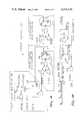
- FIG. 1is an overall block diagram illustrating a preferred embodiment of a serial digital data transmission system in accordance with the invention.
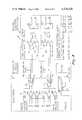
- FIGS. 2A and 2Bare a more detailed block diagram of a preferred embodiment of a serial digital data transmission system illustrated in block form in FIG. 1.
- FIG. 4is an electrical schematic diagram of a preferred embodiment of the input logic illustrated in block form in FIG. 2.
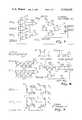
- FIG. 6is a series of idealized graphs illustrating a preferred manner of converting a 3-level transmission signal into a two level signal which includes a signal level on each of two lines in accordance with the invention.
- FIG. 8is an electrical schematic diagram of a preferred embodiment of the clock regenerator illustrated in block form in FIG. 2.
- FIG. 9is an electrical schematic diagram of a preferred embodiment of the data storage illustrated in block form in FIG. 2.
- FIG. 10is an electrical schematic diagram of a preferred embodiment of the data decoder illustrated in block form in FIG. 2.
- FIG. 11is an electrical schematic diagram of a preferred embodiment of the valid decoder illustrated in block form in FIG. 2.
- FIG. 1An overall block diagram of a preferred embodiment of a serial digital data transmission system in accordance with the invention is illustrated in FIG. 1.
- the encoder circuitry 8 together with the 3-state driver 14comprise the transmitter section of the improved data transmission system.
- the receiver section of the data transmission systemcomprises the 3-level receiver 16 and the decoder circuitry 18.
- sequential binary input data signals to be transmittedare applied to encoder circuitry 8 along with a clock and a valid signal.
- the data, clock and valid signalsare applied from sources within a computer or data processing system 6 with which the illustrated serial data transmission system operates for transmitting data from data processor 6 to a remote unit 26.
- Datais transmitted from the 3-state driver 14 to the 3-level receiver 16 over the transmission line 15. Once received, the data is decoded to provide data, clock and valid signals to the remote unit 26.
- the sequential binary input data signals to encoder circuitry 8 in FIG. 1may typically have the waveshape illustrated in graph B of FIG. 3.
- a typical system clockis illustrated in graph C.
- a typical valid signalis illustrated in graph A.
- the significance of the valid signalis that when it is logically true, data is being applied to the data transmission system. When the valid signal is false, no data is being transmitted. In effect, therefore, the valid signal indicates the presence or absence of data for transmission and may thus also be referred to as a data presence signal.
- the waveshapes in FIG. 3are illustrated in an idealized format since the detailed, actual rise and fall times are unnecessary to an understanding of the invention.
- the encoder circuitry 8 of FIG. 1comprises an input logic 10, a binary to 3-level encoder 11 and an excess voltage detector 12.
- the data, clock and valid signalsare first applied to input logic 10 for producing digital output signals A and B which are in turn applied to a binary to 3-level encoder 11.
- input logic 10for producing digital output signals A and B which are in turn applied to a binary to 3-level encoder 11.
- the 3-state driver 14transmits a 3-level signal output along a transmission line 15 as illustrated in graph D of FIG. 3.
- a 1, 0 combination for H d , L drespectively produces a high H level signal.
- a 0, 1 combination for H d , L drespectively produces a low L level signal.
- a 0, 0 combination for H d , L drespectively produces an intermediate I level signal.
- the 3-level signalmay be all positive with reference to a zero level, all negative with reference to a zero level, or may be positive and negative with reference to a zero level.
- the intermediate I levelneed not necessarily occur midway between high H and low L.
- the 3-state driver 14typically has differential outputs and its operation is well known in the prior art.
- a driver for positive-going signals operating in conjunction with a separate driver for negative-going signalscould be implemented to perform the function of the 3-state driver as is well known by those skilled in the art.
- the transmission line 15is illustrated as a twisted pair. It is to be understood that the invention is not limited to driving any one type of line and lines such as a shielded twisted pair, a pair or a coaxial cable can be driven.
- the decoder circuitry 18further comprises a signal reverser 20, a data storage 21, a data decoder 22, a clock regenerator 23, and a valid decoder 24.
- a signal reverser 20At the receiving end of the transmission line 15 in FIG. 2, the received 3-level signal transmitted by the 3-state driver 14 is applied to the inputs of a 3-level receiver 16 which produces a two level signal which includes a signal level on each of two lines Det H and Det L .
- a representative 3-level transmitted signal high H, low L and intermediate Iis illustrated in FIG. 6, graph A, along with the resultant Det H and Det L signals illustrated in graphs B and C respectively.
- a high H levelproduces a 1, 0 for Det H , Det L respectively.
- a low L levelproduces a 0, 1 for Det H , Det L respectively.
- An intermediate I levelproduces a 0, 0 for Det H , Det L respectively.
- the signal illustrated in FIG. 6, graph Ais also shown in FIG. 3, graph D.
- the 3-level receiver 16may also be considered as a 3-level detector with output signals of Detector H and Detector L , or briefly Det H and Det L .
- the F H , F L , S H and S L signals produced by the data storage 21are applied to the inputs of a valid decoder 24 which produces a valid output signal.
- the valid signalis regenerated, as described in detail hereinafter, from decoding the data signals transmitted since data only is sent on the transmission line 15.
- the data, clock and valid signal outputs from the data decoder 22, clock regenerator 23 and valid decoder 24 respectively which are representative of the source data, clock and valid signals applied to the input of the transmitter section of the serial data transmission systemare applied to the inputs of the remote unit 26 illustrated in FIG. 2.
- the F H signal produced by the data storage 21 and the valid signal produced by the valid decoder 24are fed back and applied to the signal reverser 20 as indicated in FIG. 2.
- a preferred embodiment of the signal reverser 20is illustrated in FIG. 7, the clock regenerator 23 in FIG. 8, the data storage 21 in FIG. 9, the data decoder 22 in FIG. 10, and the valid decoder 24 in FIG. 11.
- the system clock CPis applied to the clock input of D-type flip-flop 31.
- the complement of the system valid signal, validis applied to an input of NOR gate 35, the Q output of flip-flop 31 is applied to another NOR gate 35 input.
- the output of NOR gate 35is applied to the D input of flip-flop 31 so as to produce a Q output designated First and a Q output designated First.
- the resulting Q output signal produced by flip-flop 32 in response to the system clock input CP applied to the clock input and the system data applied to the D inputis applied to a NOR gate 42.
- a second input Firstis applied to NOR gate 42.
- Firstis applied to an input of NOR gate 41 and the Q output of flip-flop 33, A, is applied to another input of NOR gate 41.
- the resulting output signal produced by OR gate 43 in response to inputs applied from the outputs of NOR gates 41 and 42is applied to the D input of flip-flop 33 which operates in conjunction with CP applied to the clock input of flip-flop 33 to produce A at the Q output and A at the Q output.
- the resulting output produced by NOR gate 36 in response to the system data inputis applied to an input of NOR gate 37 along with First being applied to another input of NOR gate 37.
- the First signalis applied to an input of NOR gate 38 and the Q output of flip-flop 34, B, is applied to another input of NOR gate 38.
- the resulting output signal produced by OR gate 39 in response to inputs applied from the outputs of NOR gates 37 and 38is applied to the D input of flip-flop 34 having CP applied to its clock input to produce B at the Q output and B at the Q output.
- Flip-flop 31operates effectively as an inverter wherein inversion occurs upon the application of each clock, CP.
- CPclock
- Firstis false.
- Firstgoes true 1 clock after valid goes true, that is on the first clock.
- Firstalternates true and false with the application of each clock, CP.
- Firstis true on clock 1, false on clock 2, true on clock 3, false on clock 4 and so on.
- the data entering flip-flop 32is A of the bit pair.
- Firstis false
- the data entering flip-flop 32is B of the bit pair.
- the objective of the First and First signal outputs of flip-flop 31is to divide the data stream into bit pairs A and B for storage in flip-flops 33 and 34 respectively.
- two (00 and 11) of the four bit combinationshave two codes each by which they may be represented. Also note that, in each case, one code has a high average signal and the other has a low average signal. The accumulated polarity of the transmitted voltage level is detected as to whether the prior accumulated signal levels averaged out to either an excess of high level signals, an excess of low level signals or an intermediate level signal. A choice is made as to which code to transmit next so as to continually seek maintenance of the intermediate level on the transmission line 15. The other two (01 and 10) of the four bit combinations each have only one representation, each of which averages to the intermediate level, thus making a choice unnecessary in these cases.
- the logic in the first two equations (1) and (2) above, for F H and F L ,is performed in 6 logic gates 42-47 of FIG. 5. Since the second two equations (3) and (4) above are identical to the first two with only A and B logically inverted, the entire logic is performed by using flip-flops 33 and 34 of FIG. 2 to Store A and B respectively which is then toggled (inverted) after the first clock to provide the correct decoding for the second transmitted voltage level.
- a 1, 0 combination for F H , F Lrespectively produces a high H level signal.
- a 0, 1 combinations for F H , F Lrespectively produces a low L level signal.
- a 0, 0 combination for F H , F Lrespectively produces an intermediate I level signal.
- the logic for F H and F Lapplies similarly for S H and S L .
- a pair of flip-flops 38 and 39 in the excess voltage detector 12 of FIG. 5is provided to keep track of the accumulation of the levels of previously transmitted signals.
- the logicis implemented so that if M is false, P is assumed true so that the next transmitted voltage levels are selected by the binary to 3-level encoder 11 for a low average whether the prior signal levels averaged an excess of a high level signal or an intermediate level signal. Excess signal polarity information is conveyed from outputs of the excess voltage detector 12 to inputs of the binary to 3-level encoder 11.
- the logical encoding equations (1)-(4) aboveare implemented by the binary to 3-level encoder 11 of FIG. 5 which comprises D-type flip-flops 36 and 37, NOR gates 41, 42, 43, 45, 46, and 48, and OR/NOR gates 44 and 47.
- the encoder 11 outlined by boundary lines in FIG. 5provides means for encoding two sequential digital signal bits into signal levels on two lines designated H d , L d and the logical complements H d , L d respectively are also provided.
- the signals valid A, A, B and Mare applied to the logic group comprising NOR gates 42, 43 and OR/NOR gate 44 to activate the high H d line to 3-state driver 14.
- gates 42-44implement encoding equations (1) and (3) above and apply the logic of equations (1) and (3) to the OR output of gate 44 activating the H d line to driver 14.
- the signals valid A, A, B and Pare applied to the logic group comprising NOR gates 45, 46 and OR/NOR gate 47 to activate the L d line to the 3-state driver 14.
- gates 45-47implement encoding equations (2) and (4) above and apply the logic of equations (2) and (4) to the OR output of gate 47 activating the L d line to driver 14.
- the logic combination of H d and L ddetermines the level to be transmitted as illustrated in FIG. 3, graph D.
- the system clockis illustrated in FIG. 3, graph C, and valid is illustrated in graph A.
- gates 42-43, 45- 46are activated and gates 41 and 48 are de-activated for the remainder of the data transmission.
- the sequential operation of the input logic 10, the binary to 3-level encoder 11, the excess voltage detector 12 and the 3-state driver 14is as follows. After valid goes true, two start bits high H and low L are generated on clocks 1 and 2. At clock 3, load the bit pair, A and B, in flip-flops 33 and 34 respectively and drive the first state of the transmitted voltage level to driver 14. At clock 4, invert the logic states of bit pair A and B on flip-flops 33 and 34 respectively and drive the second state of the transmitted voltage level to driver 14. The operations performed during clock 3 are repeated at clock times 5, 7, 9 and so on. The operations performed during clock 4 are repeated at clock times 6, 8, 10 and so on. FIG.
- the preferred embodiment disclosed hereinis capable of transmitting high frequency signals over long distances.
- High frequency transmissions over long distancesusually require isolation by some means, one practical means being a transformer which cannot pass signals with DC components.
- the preferred embodimentpermits the use of transformer coupling, but direct coupling without transformers can also be implemented in accordance with the invention. If transformer coupling is employed, the high H and low L signal levels are made symmetrical above and below a zero intermediate level.
- this communication methodSince the performance of this communication method depends on utilizing three distinct signal levels on the transmission line, the phasing of the line is important. In some applications it is preferred to make the connecting wire symmetrical, in which case the two signals may or may not be swapped when the system is connected. However, since this transmission method uses a pair of start bits when transmission is started after a rest period, the start bits can be predetermined and used at the receiver to decide whether or not the wires are swapped. If they are, then the signals can be logically swapped after the two start bits. The circuitry to perform this function is shown in FIG. 7 for the signal reverser 20 which will next be described.
- FIG. 8illustrates a particularly advantageous embodiment of the clock regenerator 23 shown in block form in FIG. 2. More specifically the clock regenerator 23 comprises NOR gates 61-68, 72, 73 and 76, OR gate 71, Exclusive OR gates 69 and 70, OR/NOR gates 77 and 78 and delay elements 74 and 75.
- the datais transmitted on line 15 with only one transition per bit and the clock is imbedded in the data in the form of the data transitions so that a second transmission medium need not be included to transmit the system clock.
- Data in the form of Det H and Det Lis applied from the outputs of the signal reverser 20 to the clock regenerator 23 inputs of Exclusive OR gates 69 and 70 respectively.
- Gates 61-71are designed as a standard edge detector circuit.
- a transition on Det H input to gate 69produces a pulse CP1 at the output of gate 71 of a width equal to the delay contributed by gates 61-64 connected to a second input of gate 69.
- a transition on Det L input to gate 70produces a pulse CP1 at the output of gate 71 equal to the width of the delay contributed by gates 65-68 connected to a second input of gate 70.
- the delay of gates 61-64is shown as W1 in FIG. 8 and is designed to be substantially equal to the delay of gates 65-68.
- CP1represents one clock for each transition of data.
- the width of CP1is shown as W1 and the data transmission rate is illustrated as WP.
- a pulse width of W2 equal to the delay of element 74is created out of gate 78.
- the OR output of gate 78 CPis fed back to gate 76 input through delay element 75. If another pulse does not appear at the data rate, WP, the previous pulse will propagate through delay 75 to gate 76 wherein the CP1 input and valid B input will each be false.
- the fed back signalwill go through gate 76 and at gate 77 input it substitutes for the missing clock and creates a clock pulse out of gate 78 NOR output as described above.
- Valid B input to gate 76insures that missing clocks will be created only during data transmission.
- Delay 75is substantially matched to the data transmission rate of the system wherein WP equals the system clock or data rate, td equls the propagation time delay through one gate, and 3td equals the delay through the 3 gates 76-78.
- the delay 75 having a delay time WP-3tdprovides the missing clock at the correct clock rate and not 3td later.
- the delay 74is selected to shape the clock pulses to the width, W2.
- the storage 21comprises four D-type flip-flops 81-84.
- the Q outputs of flip-flops 83, 84, 81 and 82provide storage of the transmitted levels F H , F L , S H , S L respectively. Since a 2-bit coding method is used in the preferred embodiment, the object of storage 21 is to store the F and S levels for 2 clock times and provide output of these levels to the data decoder 22 and the valid decoder 24 described hereinafter.
- the transmitted voltage levels in the preferred embodimentdo not employ the codes II, LL or HH. No transmission is indicated by II.
- the codes LL or HH involving no transition between data bitsare not used in the encoding method.
- the only time the second transmitted voltage level is Iis when A and B are both true.
- the decoding equation (5) abovesatisfies the three possible states when A is true; namely, HL, HI and LI.
- the decoding equation (6) abovesatisfies the three possible states when B is true; namely, LH, HI and LI.
- the expression S H ⁇ S L employed in equations (5) and (6) aboveis understood to mean that the second transmitted level is intermediate I.
- the valid detector 24illustrated in detail in FIG. 11 and shown in block form in FIG. 2.
- the function of the valid decoder 24is to regenerate the valid signal from the data transmitted over line 15.
- the valid decoder 24comprises flip-flops 101 and 102, OR/NOR gate 103 and NOR gates 104 and 105.
- the 2-level signal outputs of data storage 21, F H , F L , S H , S Lare applied to the inputs of gate 103, the outputs of which are applied to gate 104 input and flip-flop 101 input.
- the valid output of flip-flop 102is produced in response to the gate 104 output applied to the input of flip-flop 102.
Landscapes
- Physics & Mathematics (AREA)
- Spectroscopy & Molecular Physics (AREA)
- Engineering & Computer Science (AREA)
- Computer Networks & Wireless Communication (AREA)
- Signal Processing (AREA)
- Dc Digital Transmission (AREA)
Abstract
Description
This is a continuation of application Ser. No. 16,976, filed Mar. 2, 1979, now abandoned.
This invention relates generally to improved serial digital transmission means and methods, and more particularly to improved means and methods useful for providing reliable, high speed communication of digital data between units in a digital data processing system.
Modern data processing systems have a number of different units between which binary digital data must be communicated economically at high speed and over long distances. The problems associated with a system to satisfy the above requirements are to transmit data over one transmission medium with only one transition per bit and with a clock imbedded in the data. In addition, it is often a requirement to provide means for non-continuous operation so that data transmission may be started and stopped. In addition to direct coupling, it is advantageous to have the capability to transmit the data with no long term DC component in the transmitted waveform so that transformer isolation may be used at the ends of the transmission line to electrically isolate separated units which are likely to have different ground potentials.
Although a variety of approaches and circuitry are known in the art for implementing a serial digital data transmission system, most prior art will solve certain ones but not all of the aforementioned problems. Methods which are theoretically capable of solving all of the above problems involve complicated coding schemes and require considerable logic circuitry for implementation of coding and decoding, or require burst methods with start and stop bits which reduces the overall bit transfer rate.
In accordance with the present invention, improved means and methods are provided for implementing a serial digital data transmission system in a manner which solves all the aforementioned problems associated with the performance requirements of modern day data processing systems.
In a particular preferred embodiment incorporating the invention, the binary data to be transmitted is encoded into a 3-level signal having only one transition per bit with clock imbedded in the data. The system provides for either continuous or non-continuous transmission of data.
An improved encoding means uses a 2-bit encoding method wherein two sequential digital bit signals to be transmitted may be represented by a choice of codes of two transmitted voltage levels, one code having a high average level, another having a low average level and a third having an intermediate average level.
An excess voltage detector measures the accumulated excess signal polarity of prior transmitted levels for a high, low or intermediate average. A choice is made as to which code to transmit to represent two sequential digital bit signals so that an intermediate average level is maintained on the transmission line. Improved 3-level decoding means are also provided for the received 3-level signal.
The specific nature of the invention as well as other objects, features, advantages and uses thereof will become readily apparent from the following description of a preferred embodiment of the invention taken in conjunction with the accompanying drawings.
FIG. 1 is an overall block diagram illustrating a preferred embodiment of a serial digital data transmission system in accordance with the invention.
FIGS. 2A and 2B are a more detailed block diagram of a preferred embodiment of a serial digital data transmission system illustrated in block form in FIG. 1.
FIG. 3 is a series of idealized graphs illustrating a preferred manner of encoding binary data into a 3-level transmission signal in accordance with the invention.
FIG. 4 is an electrical schematic diagram of a preferred embodiment of the input logic illustrated in block form in FIG. 2.
FIG. 5 is an electrical schematic diagram of a preferred embodiment of the binary to 3-level encoder and the excess voltage detector illustrated in block form in FIG. 2.
FIG. 6 is a series of idealized graphs illustrating a preferred manner of converting a 3-level transmission signal into a two level signal which includes a signal level on each of two lines in accordance with the invention.
FIG. 7 is an electrical schematic diagram of a preferred embodiment of the signal reverser illustrated in block form in FIG. 2.
FIG. 8 is an electrical schematic diagram of a preferred embodiment of the clock regenerator illustrated in block form in FIG. 2.
FIG. 9 is an electrical schematic diagram of a preferred embodiment of the data storage illustrated in block form in FIG. 2.
FIG. 10 is an electrical schematic diagram of a preferred embodiment of the data decoder illustrated in block form in FIG. 2.
FIG. 11 is an electrical schematic diagram of a preferred embodiment of the valid decoder illustrated in block form in FIG. 2.
An overall block diagram of a preferred embodiment of a serial digital data transmission system in accordance with the invention is illustrated in FIG. 1. Theencoder circuitry 8 together with the 3-state driver 14 comprise the transmitter section of the improved data transmission system. The receiver section of the data transmission system comprises the 3-level receiver 16 and thedecoder circuitry 18. As shown, sequential binary input data signals to be transmitted are applied toencoder circuitry 8 along with a clock and a valid signal. The data, clock and valid signals are applied from sources within a computer ordata processing system 6 with which the illustrated serial data transmission system operates for transmitting data fromdata processor 6 to aremote unit 26. Data is transmitted from the 3-state driver 14 to the 3-level receiver 16 over thetransmission line 15. Once received, the data is decoded to provide data, clock and valid signals to theremote unit 26.
The sequential binary input data signals toencoder circuitry 8 in FIG. 1 may typically have the waveshape illustrated in graph B of FIG. 3. A typical system clock is illustrated in graph C. A typical valid signal is illustrated in graph A. The significance of the valid signal is that when it is logically true, data is being applied to the data transmission system. When the valid signal is false, no data is being transmitted. In effect, therefore, the valid signal indicates the presence or absence of data for transmission and may thus also be referred to as a data presence signal. The waveshapes in FIG. 3 are illustrated in an idealized format since the detailed, actual rise and fall times are unnecessary to an understanding of the invention.
As illustrated in FIG. 2, theencoder circuitry 8 of FIG. 1 comprises aninput logic 10, a binary to 3-level encoder 11 and anexcess voltage detector 12. The data, clock and valid signals are first applied toinput logic 10 for producing digital output signals A and B which are in turn applied to a binary to 3-level encoder 11. In the transmitter section the following definitions apply:
A A signal level representative of the first bit of a digital bit pair to be transmitted, a bit pair comprising two sequential digital signal bits.
B A signal level representative of the second bit of a bit pair to be transmitted, a bit pair comprising two sequential digital signal bits.
Hd Logic output to high voltage driver
Ld Logic output to low voltage driver
F First transmitted signal level (either H or L)
S Second transmitted signal level (either H or L)
P Excess voltage detector output signal indicating that previous data transmitted has accumulated on excess of high level signals.
M Excess voltage detector output signal indicating that previous data transmitted has accumulated an excess of low level signals.
The 3-levels for encoding are high H, low L or intermediate I. The system clock and valid input signals are applied to the inputs of the binary to 3-level encoder 11 along with signals A and B. In response to the signals applied to it, the binary to 3-level encoder 11 produces output voltage levels Hd, Ld, Hd, Ld which are applied to the inputs of anexcess voltage detector 12. The resulting digital output signals P and M produced by thedetector 12 are fed back and applied to the inputs of the binary to 3-level encoder 11. The binary to 3-level encoder 11 provides a means for encoding two sequential digital signal bits. The excess voltage detector provides excess signal polarity detection means. A preferred embodiment is illustrated in FIG. 4 for theinput logic 10 and in FIG. 5 for the binary to 3-level encoder 11 and theexcess voltage detector 12, and will be described in detail hereinafter.
In response to Hd and Ld inputs applied from the binary to 3-level encoder 11, the 3-state driver 14 transmits a 3-level signal output along atransmission line 15 as illustrated in graph D of FIG. 3. A 1, 0 combination for Hd, Ld respectively produces a high H level signal. A 0, 1 combination for Hd, Ld respectively produces a low L level signal. A 0, 0 combination for Hd, Ld respectively produces an intermediate I level signal. The 3-level signal may be all positive with reference to a zero level, all negative with reference to a zero level, or may be positive and negative with reference to a zero level. The intermediate I level need not necessarily occur midway between high H and low L. The 3-state driver 14 typically has differential outputs and its operation is well known in the prior art. A driver for positive-going signals operating in conjunction with a separate driver for negative-going signals could be implemented to perform the function of the 3-state driver as is well known by those skilled in the art. Thetransmission line 15 is illustrated as a twisted pair. It is to be understood that the invention is not limited to driving any one type of line and lines such as a shielded twisted pair, a pair or a coaxial cable can be driven.
Referring to FIG. 2, thedecoder circuitry 18 further comprises asignal reverser 20, adata storage 21, adata decoder 22, aclock regenerator 23, and avalid decoder 24. An overall description of the 3-level receiver 16 and thedecoder circuitry 18 is given below. At the receiving end of thetransmission line 15 in FIG. 2, the received 3-level signal transmitted by the 3-state driver 14 is applied to the inputs of a 3-level receiver 16 which produces a two level signal which includes a signal level on each of two lines DetH and DetL. A representative 3-level transmitted signal high H, low L and intermediate I is illustrated in FIG. 6, graph A, along with the resultant DetH and DetL signals illustrated in graphs B and C respectively. A high H level produces a 1, 0 for DetH, DetL respectively. A low L level produces a 0, 1 for DetH, DetL respectively. An intermediate I level produces a 0, 0 for DetH , DetL respectively. The signal illustrated in FIG. 6, graph A, is also shown in FIG. 3, graph D. The 3-level receiver 16 may also be considered as a 3-level detector with output signals of DetectorH and DetectorL, or briefly DetH and DetL.
The output signals DetH and DetL are applied to the inputs of asignal reverser 20, FIG. 2, for reversing the digital output signals if thetransmission line 15 is reversed from its usual connection, thereby providing correct signal polarities to the further decoding circuits. The DetH and DetL signal outputs from thesignal reverser 20 are applied to the inputs of adata storage 21 providing FH, FL, SH, SL which are representative of the voltage levels of the transmitted data and are applied to the inputs ofdata decoder 22 which produces a signal to duplicate the original input signal received by theencoder circuitry 8.
The DetH and DetL signals produced by thesignal reverser 20 are also applied to the inputs of aclock regenerator 23 which produces a regenerated clock CP representative of the clock signal originally received byencoder circuitry 8. Data only is transmitted on thetransmission line 15 and the regenerated clock is derived from transitions in voltage levels of the 3-level signal transmitted as will be described in detail hereinafter.
The FH, FL, SH and SL signals produced by thedata storage 21 are applied to the inputs of avalid decoder 24 which produces a valid output signal. The valid signal is regenerated, as described in detail hereinafter, from decoding the data signals transmitted since data only is sent on thetransmission line 15. The data, clock and valid signal outputs from thedata decoder 22,clock regenerator 23 andvalid decoder 24 respectively which are representative of the source data, clock and valid signals applied to the input of the transmitter section of the serial data transmission system are applied to the inputs of theremote unit 26 illustrated in FIG. 2. The FH signal produced by thedata storage 21 and the valid signal produced by thevalid decoder 24 are fed back and applied to thesignal reverser 20 as indicated in FIG. 2. A preferred embodiment of thesignal reverser 20 is illustrated in FIG. 7, theclock regenerator 23 in FIG. 8, thedata storage 21 in FIG. 9, thedata decoder 22 in FIG. 10, and thevalid decoder 24 in FIG. 11.
Reference is now directed to FIG. 4 which illustrates a preferred embodiment of theinput logic 10 shown in block form in FIG. 2. As shown, theinput logic 10 comprises a plurality of D-type flip-flops 31-34 operating in conjunction with a plurality of NOR gates 35-38 and 41-42 together with a plurality of ORgates flop 33, A, represents the first bit of two sequential digital signal bits to be transmitted. The Q output of flip-flop 34, B, represents the second bit of two sequential digital signal bits to be transmitted. Theinput logic 10 is divided into first gates and flip-flop means, second gates and flip-flop means and third gates and flip-flop means as illustrated by the boundary lines drawn in FIG. 4. The system clock CP is applied to the clock input of D-type flip-flop 31. The complement of the system valid signal, valid, is applied to an input of NORgate 35, the Q output of flip-flop 31 is applied to another NORgate 35 input. The output of NORgate 35 is applied to the D input of flip-flop 31 so as to produce a Q output designated First and a Q output designated First. The resulting Q output signal produced by flip-flop 32 in response to the system clock input CP applied to the clock input and the system data applied to the D input is applied to a NORgate 42. A second input First is applied to NORgate 42. First is applied to an input of NORgate 41 and the Q output of flip-flop 33, A, is applied to another input of NORgate 41. The resulting output signal produced byOR gate 43 in response to inputs applied from the outputs of NORgates flop 33 which operates in conjunction with CP applied to the clock input of flip-flop 33 to produce A at the Q output and A at the Q output. The resulting output produced by NORgate 36 in response to the system data input is applied to an input of NORgate 37 along with First being applied to another input of NORgate 37. The First signal is applied to an input of NORgate 38 and the Q output of flip-flop 34, B, is applied to another input of NORgate 38. The resulting output signal produced byOR gate 39 in response to inputs applied from the outputs of NORgates flop 34 having CP applied to its clock input to produce B at the Q output and B at the Q output.
Theinput logic 10 function is described below. Flip-flop 31 operates effectively as an inverter wherein inversion occurs upon the application of each clock, CP. Before data transmission begins, valid is true, First is false. When data transmission begins and is applied to theinput logic 10, valid goes true and valid goes false for the remainder of the stream of data transmission. First goes true 1 clock after valid goes true, that is on the first clock. First alternates true and false with the application of each clock, CP. First is true onclock 1, false onclock 2, true onclock 3, false onclock 4 and so on. When valid goes false signifying the end of data transmission, First locks up false. Upon the application of data to the input of theinput logic 10, when First is true, the data entering flip-flop 32 is A of the bit pair. When First is false, the data entering flip-flop 32 is B of the bit pair. Thus, the objective of the First and First signal outputs of flip-flop 31 is to divide the data stream into bit pairs A and B for storage in flip-flops
In the above-described manner the storage of 2 bits of data, A and B, is accomplished for application to the inputs of the binary to 3-level encoder 11, a preferred embodiment of which is illustrated in FIG. 5 along with a preferred embodiment of theexcess voltage detector 12 which are described next.
Table I indicates a 2-bit coding method used in a preferred embodiment ofencoder circuitry 8.
TABLE I ______________________________________ digital signal bits A B transmitted voltage levels ______________________________________ 0 0 IH or IL 0 1LH 1 0HL 1 1 HI or LI ______________________________________
It can be seen that two (00 and 11) of the four bit combinations have two codes each by which they may be represented. Also note that, in each case, one code has a high average signal and the other has a low average signal. The accumulated polarity of the transmitted voltage level is detected as to whether the prior accumulated signal levels averaged out to either an excess of high level signals, an excess of low level signals or an intermediate level signal. A choice is made as to which code to transmit next so as to continually seek maintenance of the intermediate level on thetransmission line 15. The other two (01 and 10) of the four bit combinations each have only one representation, each of which averages to the intermediate level, thus making a choice unnecessary in these cases.
The resultant digital outputs of the binary to 3-level encoder 11 are representable by the following Boolean encoding equations:
F.sub.H =A·B·M+A·B=A·B+A·M (1)
F.sub.L =A·B·M+A·B=A·B+B·M (2)
S.sub.H =A·B·M+A·B=A·B+A·M (3)
S.sub.L =A·B·M+A·B=A·B+B·M (4)
The logic in the first two equations (1) and (2) above, for FH and FL, is performed in 6 logic gates 42-47 of FIG. 5. Since the second two equations (3) and (4) above are identical to the first two with only A and B logically inverted, the entire logic is performed by using flip-flops
A 1, 0 combination for FH, FL respectively produces a high H level signal. A 0, 1 combinations for FH, FL respectively produces a low L level signal. A 0, 0 combination for FH, FL respectively produces an intermediate I level signal. The logic for FH and FL applies similarly for SH and SL.
A pair of flip-flops excess voltage detector 12 of FIG. 5 is provided to keep track of the accumulation of the levels of previously transmitted signals. The accumulation has three possible states; namely, the signal levels averaged out to an excess of high level signals (M=false, P=true), an excess of low level signals (M=true, P=false) or an intermediate level signal (M=false, P=false). The logic is implemented so that if M is false, P is assumed true so that the next transmitted voltage levels are selected by the binary to 3-level encoder 11 for a low average whether the prior signal levels averaged an excess of a high level signal or an intermediate level signal. Excess signal polarity information is conveyed from outputs of theexcess voltage detector 12 to inputs of the binary to 3-level encoder 11.
The logical encoding equations (1)-(4) above are implemented by the binary to 3-level encoder 11 of FIG. 5 which comprises D-type flip-flops gates gates encoder 11 outlined by boundary lines in FIG. 5 provides means for encoding two sequential digital signal bits into signal levels on two lines designated Hd, Ld and the logical complements Hd, Ld respectively are also provided. The signals valid A, A, B and M are applied to the logic group comprising NORgates gate 44 to activate the high Hd line to 3-state driver 14. At the appropriate clocks, gates 42-44 implement encoding equations (1) and (3) above and apply the logic of equations (1) and (3) to the OR output ofgate 44 activating the Hd line todriver 14.
The signals valid A, A, B and P are applied to the logic group comprising NORgates gate 47 to activate the Ld line to the 3-state driver 14. At the appropriate clocks, gates 45-47 implement encoding equations (2) and (4) above and apply the logic of equations (2) and (4) to the OR output ofgate 47 activating the Ld line todriver 14. As explained earlier, the logic combination of Hd and Ld determines the level to be transmitted as illustrated in FIG. 3, graph D.
One feature of the preferred embodiment of the invention is that data transmission need not be continuous. It may be started and stopped and therefore provision is made for the use of a pair of start bits when transmission is started after a rest period to prevent the first transmitted voltage level from being intermediate I which would not be detected. Referring to FIG. 5, when valid is false and even after it has been true for 2 clocks, gates 42-43, 45-46 are de-activated. For the first 2 clocks after valid goes true,gates gates driver 14 to produce a high H transmitted voltage level. On the second clock,gates gates
Referring to FIG. 5, theexcess voltage detector 12 comprises D-type flip-flops gates gates flop 38 having outputs P and P. The signals M, P, the OR output of gate 44 Hd and the NOR output of gate 47 Ld are applied to the inputs of logic group 52-54 to provide an input to flip-flop 39 having outputs M and M. Boundary lines drawn in FIG. 5 outline first detector logic gates and flip-flop means and second detector logic gates and flip-flop means providing P, P and M, M outputs respectively ofdetector 12.
Referring to FIGS. 3, 4 and 5 the sequential operation of theinput logic 10, the binary to 3-level encoder 11, theexcess voltage detector 12 and the 3-state driver 14 is as follows. After valid goes true, two start bits high H and low L are generated onclocks clock 3, load the bit pair, A and B, in flip-flops driver 14. Atclock 4, invert the logic states of bit pair A and B on flip-flops driver 14. The operations performed duringclock 3 are repeated atclock times clock 4 are repeated atclock times clock 3, the second data signal level transmission atclock 4 and so on. Graphs A-I of FIG. 3 illustrate the typical waveshapes and timing relationships existing between the signals pertinent to the operation described above for the transmitter section of the invention, wherein graphs A-D have been previously described. Referring to FIG. 3, graph I represents the valid signal as also illustrated in graph A. Graph H illustrates a string of sequential binary input data signals into the transmission system. Valid B, illustrated in graph F, goes true 1 clock time after valid goes true. Valid A, shown in graph E, goes true 1 clock time after valid B goes true. Graph G illustrates the fact that the digital bit pair A and B appear at the outputs of flip-flops
The preferred embodiment disclosed herein is capable of transmitting high frequency signals over long distances. High frequency transmissions over long distances usually require isolation by some means, one practical means being a transformer which cannot pass signals with DC components. The preferred embodiment permits the use of transformer coupling, but direct coupling without transformers can also be implemented in accordance with the invention. If transformer coupling is employed, the high H and low L signal levels are made symmetrical above and below a zero intermediate level.
Since the performance of this communication method depends on utilizing three distinct signal levels on the transmission line, the phasing of the line is important. In some applications it is preferred to make the connecting wire symmetrical, in which case the two signals may or may not be swapped when the system is connected. However, since this transmission method uses a pair of start bits when transmission is started after a rest period, the start bits can be predetermined and used at the receiver to decide whether or not the wires are swapped. If they are, then the signals can be logically swapped after the two start bits. The circuitry to perform this function is shown in FIG. 7 for thesignal reverser 20 which will next be described.
The initial bit latch section of thereverser 20 comprises D-type flip-flop 111, OR/NORgate 112, NORgates OR gate 115. The section of thereverser 20 which actually reverses the signals, if required, comprises the NOR gates 116-121. When data transmission starts, the first pair of bits get through thereverser 20 to produce DetH and DetL and subsequently FH, FL, SH and SL. At the start, both valid and valid B will be false, the Direct signal on the Q output of flip-flop 111 will be FH and will latch that way as a result of the valid and valid B inputs togate 112 both being false in conjunction with the FH input togate 113.
If thetransmission wires 15 are not reversed, the start bits are high H and low L, FH is true and the Direct signal output of flip-flop 111 is true. The DetH signal input togates gates reverser 20. The DetL input togates gates reverser 20.
On the other hand, if thetransmission wires 15 are in fact reversed, the start bit appears as low L and high H, FH is false and the Direct signal output of flip-flop 111 is false. The DetH signal input togates gates reverser 20. The DetL input togates gates signal recerser 20 functioning, in effect, as an electronic double pole, double throw switch thereby automatically provides correction if thetransmission line 15 is reversed from its usual connection and provides correct signal polarities to the further decoding circuits.
Reference is next directed to FIG. 8 which illustrates a particularly advantageous embodiment of theclock regenerator 23 shown in block form in FIG. 2. More specifically theclock regenerator 23 comprises NOR gates 61-68, 72, 73 and 76, ORgate 71, Exclusive ORgates gates elements line 15 with only one transition per bit and the clock is imbedded in the data in the form of the data transitions so that a second transmission medium need not be included to transmit the system clock. Data in the form of DetH and DetL is applied from the outputs of thesignal reverser 20 to theclock regenerator 23 inputs of Exclusive ORgates gate 69 produces a pulse CP1 at the output ofgate 71 of a width equal to the delay contributed by gates 61-64 connected to a second input ofgate 69. Similarly, a transition on DetL input togate 70 produces a pulse CP1 at the output ofgate 71 equal to the width of the delay contributed by gates 65-68 connected to a second input ofgate 70. The delay of gates 61-64 is shown as W1 in FIG. 8 and is designed to be substantially equal to the delay of gates 65-68. In the above-described manner, CP1 represents one clock for each transition of data. The width of CP1 is shown as W1 and the data transmission rate is illustrated as WP.
The remaining elements 72-78 of theclock regenerator 23 are included to shape the clock pulses and to provide clocks which may be missing in CP1 during transmission of data when two successive bit times may have no transition. Referring to FIG. 3, graph D, for example, there are no transitions atclock times gate 71 are applied to the input ofgate 77 through delayD3 comprising gates gate 77.Gates delay element 74 form a positive edge detector. In response to the positive edge of CP1 applied togate 78, a pulse width of W2 equal to the delay ofelement 74 is created out ofgate 78. The OR output ofgate 78 CP is fed back togate 76 input throughdelay element 75. If another pulse does not appear at the data rate, WP, the previous pulse will propagate throughdelay 75 togate 76 wherein the CP1 input and valid B input will each be false. The fed back signal will go throughgate 76 and atgate 77 input it substitutes for the missing clock and creates a clock pulse out ofgate 78 NOR output as described above. Valid B input togate 76 insures that missing clocks will be created only during data transmission.Delay 75 is substantially matched to the data transmission rate of the system wherein WP equals the system clock or data rate, td equls the propagation time delay through one gate, and 3td equals the delay through the 3 gates 76-78. Thedelay 75 having a delay time WP-3td provides the missing clock at the correct clock rate and not 3td later. Thedelay 74 is selected to shape the clock pulses to the width, W2.
Referring next to FIG. 9 is a preferred embodiment of thedata storage 21 illustrated in block form in FIG. 2. Thestorage 21 comprises four D-type flip-flops 81-84. In response to clock CP applied to flip-flops 81-84 and DetH and DetL applied to flip-flops flops storage 21 is to store the F and S levels for 2 clock times and provide output of these levels to thedata decoder 22 and thevalid decoder 24 described hereinafter.
A preferred embodiment of thedata decoder 22 is illustrated in detail in FIG. 10 and in blockform in FIG. 2. Thedecoder 22 comprises flip-flops 86-88, NOR gates 89-91 and 94-95, ORgate 96 and OR/NORgates remote unit 26 from the Q output of flip-flop 86 in response to combinations of 2-level signals F and S applied to the inputs of gates 89-91 provided from the outputs ofdata storage 21. Data is produced from the output of flip-flop 86 in response to the clock pulses applied to the clock inputs of flip-flops 86-88 provided from the output of theclock regenerator 23. The output of flip-flop 88 is applied to the inputs ofgates decoder 22 provides digital output data responsive to the 2-level signals applied todecoder 22 inputs in accordance with the following Boolean decoding equations:
A=F.sub.H ·S.sub.L +S.sub.H ·S.sub.L (5)
B=F.sub.L ·S.sub.H +S.sub.H ·S.sub.L (6)
The basis for the decoding equations (5) and (6) is derived from a closer examination of the 2-bit encoding method described above in Table I.
It is understood that the transmitted voltage levels in the preferred embodiment do not employ the codes II, LL or HH. No transmission is indicated by II. The codes LL or HH involving no transition between data bits are not used in the encoding method. The only time the second transmitted voltage level is I is when A and B are both true. The decoding equation (5) above satisfies the three possible states when A is true; namely, HL, HI and LI. The decoding equation (6) above satisfies the three possible states when B is true; namely, LH, HI and LI. The expression SH ·SL employed in equations (5) and (6) above is understood to mean that the second transmitted level is intermediate I. The first bit of the two sequential digital signal bits, A, appears at the output ofgate 92 as a result of the logic performed on the F and S inputs togates flop 86 as a result of the logic performed bygates gate 94 from the output ofgate 92. The second bit of the two sequential digital signal bits, B, appears at the output ofgate 93 as a result of the logic performed on the F and S inputs togates flop 86 as a result of logic performed bygates flop 87 being applied to the input ofgate 95 in response to the B output fromgate 93.
Attention is next directed to thevalid detector 24 illustrated in detail in FIG. 11 and shown in block form in FIG. 2. The function of thevalid decoder 24 is to regenerate the valid signal from the data transmitted overline 15. Thevalid decoder 24 comprises flip-flops gate 103 and NORgates data storage 21, FH, FL, SH, SL, are applied to the inputs ofgate 103, the outputs of which are applied togate 104 input and flip-flop 101 input. The valid output of flip-flop 102 is produced in response to thegate 104 output applied to the input of flip-flop 102. The output produced bygate 104 is in response to the inputs togate 104 from OR/NORgate 103 and flip-flop 101. Clock inputs to flip-flops gate 105 in response to the First and CP inputs applied togate 105. It is to be understood that if any F or S input goes true, the valid A output on thegate 103 OR line will go true. After one clock valid B output from flip-flop 101 will go true. After one more clock, the valid output of flip-flop 102 will go true. Valid will remain true until transmission over the system stops, at which time all inputs togate 103 will go false and valid signal out of flip-flop 102 will go false.
It is to be understood that the present invention is subject to many modifications and variations in construction, arrangement and use without departing from the scope of the invention. Accordingly, the present invention is to be considered as including all possible modifications and variations coming within the scope of the invention as defined by the appended claims.
Claims (9)
1. In a digital data transmission system, the improvement comprising:
encoding means responsive to an applied clock signal and to an applied valid signal for encoding input binary signals into a three-level signal having first and second levels and an intermediate level with level transitions occurring at times determined by said clock signal and with encoding being performed in response to the presence of said valid signal;
said encoding means including means responsive to said valid signal for inserting a predetermined start signal at the beginning of the three-level signal provided in response to input binary signals applied along with a valid signal;
a two-wire transmission line;
driving means for coupling said three-level signal to one end of said transmission line for transmission thereby;
receiving and decoding means coupled to the other end of said transmission line for receiving the transmitted three-level signal, deriving said clock and valid signals therefrom, and employing the derived clock signal for decoding the received three-level signal into binary form;
said receiving and decoding means including signal reversing means responsive to the derived valid signal and start signal occurring at the beginning of a received three-level signal for automatically reversing the three-level signals received from said two-wire transmission line.
2. The invention in accordance with claim 1, wherein said encoding means is operable to encode pairs of input binary signals into corresponding pairs of sequential levels, and wherein said start signal comprises a first level followed by a second level.
3. The invention in accordance with claim 2, wherein signal reversing mans provides one polarity when said start signal is received with said first level followed by said second level and provides a reversed polarity when said start signal is received with said second level followed by said first level.
4. The invention in accordance with claim 1, 2 or 3, wherein said encoding means is operable to encode pairs of input binary signals into corresponding encoded pairs of sequential levels in a manner such that at least one encoded input pair is selectably encodable into either a first pair of sequential levels having a positive average value relative to said intermediate level or into a second pair of sequential levels having a negative average value relative to said intermediate level, said encoding means being operable to select said first or second pair in a manner so as to seek a predetermined average level for the encoded three-level signal relative to said intermediate level.
5. The invention in accordance with claim 4, wherein said first and second levels are equal and of opposite polarity relative to said intermediate level.
6. The invention in accordance with claim 5, wherein said intermediate average level is substantially zero.
7. The invention in accordance with claim 4, wherein said three-level signal is comprised of a high level H, a low level L and an intermediate level I, and wherein said encoding means is operable to encode an input pair into a pair of encoded levels as follows:
______________________________________ INPUT PAIR ENCODED PAIR ______________________________________ 00 IH or IL 01 LH 10 HL 11 HI or LI ______________________________________
8. The invention in accordance with claim 7, wherein said encoding means selects between the encoded pair IH and IL for a 00 input pair and between the encoded pair HI and LI for a 11 input pair in response to detecting the accumulated average level of the encoded three-level signal.
9. The invention in accordance with claim 4, wherein said encoding means operates in response to an input pair designatable as AB to produce an encoded pair designatable as FS in accordance with the following Boolean equations:
F.sub.H =A·B+A·M
F.sub.L =A·B+B·M
S.sub.H =A·B+A·M
S.sub.L =A·B+B·M
wherein M is true when the encoded signal has an average level which is between L and I; wherein the FH and FS equations set forth the relationships which determine whether the first encoded level F of an encoded pair will have an H or L level, and wherein the SH and SL equations set forth the relationships which determine whether the second encoded level S of a transmitted pair will have an H or L level, an I encoded level being produced when the respective equations above are inapplicable.
Priority Applications (1)
| Application Number | Priority Date | Filing Date | Title |
|---|---|---|---|
| US06/045,806US4216426A (en) | 1979-03-02 | 1979-06-05 | Self-clocked data transmission system having automatic signal reversing means |
Applications Claiming Priority (2)
| Application Number | Priority Date | Filing Date | Title |
|---|---|---|---|
| US1697679A | 1979-03-02 | 1979-03-02 | |
| US06/045,806US4216426A (en) | 1979-03-02 | 1979-06-05 | Self-clocked data transmission system having automatic signal reversing means |
Related Parent Applications (1)
| Application Number | Title | Priority Date | Filing Date |
|---|---|---|---|
| US1697679AContinuation | 1979-03-02 | 1979-03-02 |
Publications (1)
| Publication Number | Publication Date |
|---|---|
| US4216426Atrue US4216426A (en) | 1980-08-05 |
Family
ID=26689296
Family Applications (1)
| Application Number | Title | Priority Date | Filing Date |
|---|---|---|---|
| US06/045,806Expired - LifetimeUS4216426A (en) | 1979-03-02 | 1979-06-05 | Self-clocked data transmission system having automatic signal reversing means |
Country Status (1)
| Country | Link |
|---|---|
| US (1) | US4216426A (en) |
Cited By (41)
| Publication number | Priority date | Publication date | Assignee | Title |
|---|---|---|---|---|
| US5022051A (en)* | 1988-11-02 | 1991-06-04 | Hewlett-Packard Company | DC-free line code for arbitrary data transmission |
| WO1992009162A1 (en)* | 1990-11-13 | 1992-05-29 | Hewlett-Packard Company | Dc-free line code and bit and frame synchronization for arbitrary data transmission |
| US5438621A (en)* | 1988-11-02 | 1995-08-01 | Hewlett-Packard Company | DC-free line code and bit and frame synchronization for arbitrary data transmission |
| US5825824A (en)* | 1995-10-05 | 1998-10-20 | Silicon Image, Inc. | DC-balanced and transition-controlled encoding method and apparatus |
| US5960038A (en)* | 1994-07-15 | 1999-09-28 | Minolta Co., Ltd. | Serial data transmission apparatus |
| US5974464A (en)* | 1995-10-06 | 1999-10-26 | Silicon Image, Inc. | System for high speed serial video signal transmission using DC-balanced coding |
| US5999571A (en)* | 1995-10-05 | 1999-12-07 | Silicon Image, Inc. | Transition-controlled digital encoding and signal transmission system |
| US6104794A (en)* | 1997-04-22 | 2000-08-15 | Silicon Laboratories, Inc. | Architecture for minimum loop current during ringing and caller ID |
| US6107948A (en)* | 1997-04-22 | 2000-08-22 | Silicon Laboratories, Inc. | Analog isolation system with digital communication across a capacitive barrier |
| US6137827A (en)* | 1997-04-22 | 2000-10-24 | Silicon Laboratories, Inc. | Isolation system with digital communication across a capacitive barrier |
| US6144326A (en)* | 1997-04-22 | 2000-11-07 | Silicon Laboratories, Inc. | Digital isolation system with ADC offset calibration |
| US6160885A (en)* | 1997-04-22 | 2000-12-12 | Silicon Laboratories, Inc. | Caller ID circuit powered through hookswitch devices |
| US6167134A (en)* | 1997-04-22 | 2000-12-26 | Silicon Laboratories, Inc. | External resistor and method to minimize power dissipation in DC holding circuitry for a communication system |
| US6167132A (en)* | 1997-04-22 | 2000-12-26 | Silicon Laboratories, Inc. | Analog successive approximation (SAR) analog-to-digital converter (ADC) |
| US6198816B1 (en) | 1997-04-22 | 2001-03-06 | Silicon Laboratories, Inc. | Capacitively coupled ring detector with power provided across isolation barrier |
| US6201865B1 (en) | 1997-04-22 | 2001-03-13 | Silicon Laboratories, Inc. | Digital access arrangement circuitry and method for connecting to phone lines having a DC holding circuit with switchable time constants |
| US6222922B1 (en) | 1997-04-22 | 2001-04-24 | Silicon Laboratories, Inc. | Loop current monitor circuitry and method for a communication system |
| US6289070B1 (en) | 1997-04-22 | 2001-09-11 | Silicon Laboratories, Inc. | Digital isolation system with ADC offset calibration including coarse offset |
| US6298133B1 (en) | 1997-04-22 | 2001-10-02 | Silicon Laboratories, Inc. | Telephone line interface architecture using ringer inputs for caller ID data |
| US6307891B1 (en) | 1997-04-22 | 2001-10-23 | Silicon Laboratories, Inc. | Method and apparatus for freezing a communication link during a disruptive event |
| US6327308B1 (en)* | 1995-06-07 | 2001-12-04 | Compaq Computers Corporation | Asynchronous differential communication |
| US6359983B1 (en) | 1997-04-22 | 2002-03-19 | Silicon Laboratories, Inc. | Digital isolation system with data scrambling |
| US6385235B1 (en) | 1997-04-22 | 2002-05-07 | Silicon Laboratories, Inc. | Direct digital access arrangement circuitry and method for connecting to phone lines |
| US6389134B1 (en) | 1997-04-22 | 2002-05-14 | Silicon Laboratories, Inc. | Call progress monitor circuitry and method for a communication system |
| US6408034B1 (en) | 1997-04-22 | 2002-06-18 | Silicon Laboratories, Inc. | Framed delta sigma data with unlikely delta sigma data patterns |
| US6430229B1 (en) | 1997-04-22 | 2002-08-06 | Silicon Laboratories Inc. | Capacitive isolation system with digital communication and power transfer |
| US6442271B1 (en) | 1997-04-22 | 2002-08-27 | Silicon Laboratories, Inc. | Digital isolation system with low power mode |
| US6442213B1 (en) | 1997-04-22 | 2002-08-27 | Silicon Laboratories Inc. | Digital isolation system with hybrid circuit in ADC calibration loop |
| US6456712B1 (en) | 1997-04-22 | 2002-09-24 | Silicon Laboratories Inc. | Separation of ring detection functions across isolation barrier for minimum power |
| US6480602B1 (en) | 1997-04-22 | 2002-11-12 | Silicon Laboratories, Inc. | Ring-detect interface circuitry and method for a communication system |
| US6498825B1 (en) | 1997-04-22 | 2002-12-24 | Silicon Laboratories Inc. | Digital access arrangement circuitry and method for connecting to phone lines having a DC holding circuit with programmable current limiting |
| US6504864B1 (en) | 1997-04-22 | 2003-01-07 | Silicon Laboratories Inc. | Digital access arrangement circuitry and method for connecting to phone lines having a second order DC holding circuit |
| US6516024B1 (en) | 1997-04-22 | 2003-02-04 | Silicon Laboratories Inc. | Digital access arrangement circuitry and method for connecting to phone lines having a DC holding circuit with low distortion and current limiting |
| US6522745B1 (en) | 1997-04-22 | 2003-02-18 | Silicon Laboratories Inc. | Digital access arrangement circuitry and method having a synthesized ringer impedance for connecting to phone lines |
| US6587560B1 (en) | 1997-04-22 | 2003-07-01 | Silicon Laboratories Inc. | Low voltage circuits powered by the phone line |
| US20040247108A1 (en)* | 1997-04-22 | 2004-12-09 | Silicon Laboratories Inc. | Digital access arrangement circuitry and method having current ramping control of the hookswitch |
| US20140281076A1 (en)* | 2013-03-15 | 2014-09-18 | Apple Inc. | Methods and apparatus for multi-drop digital bus |
| US9203391B2 (en)* | 2014-04-22 | 2015-12-01 | Qualcomm Incorporated | Pulse-width modulation data decoder |
| US10085224B2 (en) | 2014-11-19 | 2018-09-25 | Apple Inc. | Methods and apparatus for synchronization of media playback within a wireless network |
| US10601573B2 (en)* | 2016-07-19 | 2020-03-24 | Gmk Co., Ltd. | Asynchronous digital communication module |
| US11039408B2 (en) | 2012-06-07 | 2021-06-15 | Apple Inc. | Methods and apparatus for synchronization among integrated circuits within a wireless network |
Citations (2)
| Publication number | Priority date | Publication date | Assignee | Title |
|---|---|---|---|---|
| US4083005A (en)* | 1976-11-01 | 1978-04-04 | Burroughs Corporation | Three-level serial digital data communication system |
| US4097859A (en)* | 1976-11-01 | 1978-06-27 | Burroughs Corporation | Three-level to two-level decoder |
- 1979
- 1979-06-05USUS06/045,806patent/US4216426A/ennot_activeExpired - Lifetime
Patent Citations (2)
| Publication number | Priority date | Publication date | Assignee | Title |
|---|---|---|---|---|
| US4083005A (en)* | 1976-11-01 | 1978-04-04 | Burroughs Corporation | Three-level serial digital data communication system |
| US4097859A (en)* | 1976-11-01 | 1978-06-27 | Burroughs Corporation | Three-level to two-level decoder |
Cited By (73)
| Publication number | Priority date | Publication date | Assignee | Title |
|---|---|---|---|---|
| US5022051A (en)* | 1988-11-02 | 1991-06-04 | Hewlett-Packard Company | DC-free line code for arbitrary data transmission |
| US5438621A (en)* | 1988-11-02 | 1995-08-01 | Hewlett-Packard Company | DC-free line code and bit and frame synchronization for arbitrary data transmission |
| WO1992009162A1 (en)* | 1990-11-13 | 1992-05-29 | Hewlett-Packard Company | Dc-free line code and bit and frame synchronization for arbitrary data transmission |
| US5960038A (en)* | 1994-07-15 | 1999-09-28 | Minolta Co., Ltd. | Serial data transmission apparatus |
| US6327308B1 (en)* | 1995-06-07 | 2001-12-04 | Compaq Computers Corporation | Asynchronous differential communication |
| US5825824A (en)* | 1995-10-05 | 1998-10-20 | Silicon Image, Inc. | DC-balanced and transition-controlled encoding method and apparatus |
| US5999571A (en)* | 1995-10-05 | 1999-12-07 | Silicon Image, Inc. | Transition-controlled digital encoding and signal transmission system |
| US5974464A (en)* | 1995-10-06 | 1999-10-26 | Silicon Image, Inc. | System for high speed serial video signal transmission using DC-balanced coding |
| US6480602B1 (en) | 1997-04-22 | 2002-11-12 | Silicon Laboratories, Inc. | Ring-detect interface circuitry and method for a communication system |
| US6522745B1 (en) | 1997-04-22 | 2003-02-18 | Silicon Laboratories Inc. | Digital access arrangement circuitry and method having a synthesized ringer impedance for connecting to phone lines |
| US6137827A (en)* | 1997-04-22 | 2000-10-24 | Silicon Laboratories, Inc. | Isolation system with digital communication across a capacitive barrier |
| US6144326A (en)* | 1997-04-22 | 2000-11-07 | Silicon Laboratories, Inc. | Digital isolation system with ADC offset calibration |
| US6160885A (en)* | 1997-04-22 | 2000-12-12 | Silicon Laboratories, Inc. | Caller ID circuit powered through hookswitch devices |
| US6167134A (en)* | 1997-04-22 | 2000-12-26 | Silicon Laboratories, Inc. | External resistor and method to minimize power dissipation in DC holding circuitry for a communication system |
| US6167132A (en)* | 1997-04-22 | 2000-12-26 | Silicon Laboratories, Inc. | Analog successive approximation (SAR) analog-to-digital converter (ADC) |
| US6191717B1 (en) | 1997-04-22 | 2001-02-20 | Silicon Laboratories Inc. | Analog isolation system with digital communication across a capactive barrier |
| US6198816B1 (en) | 1997-04-22 | 2001-03-06 | Silicon Laboratories, Inc. | Capacitively coupled ring detector with power provided across isolation barrier |
| US6201865B1 (en) | 1997-04-22 | 2001-03-13 | Silicon Laboratories, Inc. | Digital access arrangement circuitry and method for connecting to phone lines having a DC holding circuit with switchable time constants |
| US6222922B1 (en) | 1997-04-22 | 2001-04-24 | Silicon Laboratories, Inc. | Loop current monitor circuitry and method for a communication system |
| US6225927B1 (en) | 1997-04-22 | 2001-05-01 | Silicon Laboratories, Inc. | Analog isolation system with digital communication across a capacitive barrier |
| US6289070B1 (en) | 1997-04-22 | 2001-09-11 | Silicon Laboratories, Inc. | Digital isolation system with ADC offset calibration including coarse offset |
| US6298133B1 (en) | 1997-04-22 | 2001-10-02 | Silicon Laboratories, Inc. | Telephone line interface architecture using ringer inputs for caller ID data |
| US6297755B2 (en) | 1997-04-22 | 2001-10-02 | Silicon Laboratories, Inc. | Analog isolation system with digital communication across a capacitive barrier |
| US6307891B1 (en) | 1997-04-22 | 2001-10-23 | Silicon Laboratories, Inc. | Method and apparatus for freezing a communication link during a disruptive event |
| US6323796B1 (en) | 1997-04-22 | 2001-11-27 | Silicon Laboratories, Inc. | Digital isolation system with ADC offset calibration |
| US6330330B2 (en) | 1997-04-22 | 2001-12-11 | Silicon Laboratories, Inc. | External resistor and method to minimize power dissipation in DC holding circuitry for a communication system |
| US6359983B1 (en) | 1997-04-22 | 2002-03-19 | Silicon Laboratories, Inc. | Digital isolation system with data scrambling |
| US6385235B1 (en) | 1997-04-22 | 2002-05-07 | Silicon Laboratories, Inc. | Direct digital access arrangement circuitry and method for connecting to phone lines |
| US6389061B1 (en) | 1997-04-22 | 2002-05-14 | Silicon Laboratories Inc. | Isolation system with digital communication across a capacitive barrier |
| US6389134B1 (en) | 1997-04-22 | 2002-05-14 | Silicon Laboratories, Inc. | Call progress monitor circuitry and method for a communication system |
| US6408034B1 (en) | 1997-04-22 | 2002-06-18 | Silicon Laboratories, Inc. | Framed delta sigma data with unlikely delta sigma data patterns |
| US6430229B1 (en) | 1997-04-22 | 2002-08-06 | Silicon Laboratories Inc. | Capacitive isolation system with digital communication and power transfer |
| US6442271B1 (en) | 1997-04-22 | 2002-08-27 | Silicon Laboratories, Inc. | Digital isolation system with low power mode |
| US6442213B1 (en) | 1997-04-22 | 2002-08-27 | Silicon Laboratories Inc. | Digital isolation system with hybrid circuit in ADC calibration loop |
| US6456712B1 (en) | 1997-04-22 | 2002-09-24 | Silicon Laboratories Inc. | Separation of ring detection functions across isolation barrier for minimum power |
| US20020154702A1 (en)* | 1997-04-22 | 2002-10-24 | Silicon Laboratories Inc. | Direct digital access arrangement circuitry and method for connecting to phone lines |
| US6104794A (en)* | 1997-04-22 | 2000-08-15 | Silicon Laboratories, Inc. | Architecture for minimum loop current during ringing and caller ID |
| US6498825B1 (en) | 1997-04-22 | 2002-12-24 | Silicon Laboratories Inc. | Digital access arrangement circuitry and method for connecting to phone lines having a DC holding circuit with programmable current limiting |
| US20030002571A1 (en)* | 1997-04-22 | 2003-01-02 | Silicon Laboratories Inc. | Direct digital access arrangement circuitry and method for connecting to phone lines |
| US6504864B1 (en) | 1997-04-22 | 2003-01-07 | Silicon Laboratories Inc. | Digital access arrangement circuitry and method for connecting to phone lines having a second order DC holding circuit |
| US6107948A (en)* | 1997-04-22 | 2000-08-22 | Silicon Laboratories, Inc. | Analog isolation system with digital communication across a capacitive barrier |
| US20030091140A1 (en)* | 1997-04-22 | 2003-05-15 | Silicon Laboratories Inc. | Digital access arrangment circuitry and method for connecting to phone lines having a DC holding circuit with switchable DC termination impedance |
| US6516024B1 (en) | 1997-04-22 | 2003-02-04 | Silicon Laboratories Inc. | Digital access arrangement circuitry and method for connecting to phone lines having a DC holding circuit with low distortion and current limiting |
| US6570513B2 (en) | 1997-04-22 | 2003-05-27 | Silicon Laboratories Inc. | Isolation system with digital communication across a capacitive barrier |
| US6587560B1 (en) | 1997-04-22 | 2003-07-01 | Silicon Laboratories Inc. | Low voltage circuits powered by the phone line |
| US6611553B1 (en) | 1997-04-22 | 2003-08-26 | Silicon Laboratories Inc. | Isolation system with digital communication across a capacitive barrier |
| US20030194083A1 (en)* | 1997-04-22 | 2003-10-16 | Scott Jeffrey W. | Separation of ring detection functions across isolation barrier for minimum power |
| US20030206626A1 (en)* | 1997-04-22 | 2003-11-06 | Scott Jeffrey W. | Low voltage circuits powered by the phone line |
| US6683548B2 (en) | 1997-04-22 | 2004-01-27 | Silicon Laboratories Inc. | Analog isolation system with digital communication across a capacitive barrier |
| US20040101132A1 (en)* | 1997-04-22 | 2004-05-27 | Silicon Laboratories Inc. | Analog isolation system with digital communication across a capacitive barrier |
| US6754341B2 (en) | 1997-04-22 | 2004-06-22 | Silicon Laboratories, Inc. | External resistor and method to minimize power dissipation in DC holding circuitry for a communication system |
| US20040161024A1 (en)* | 1997-04-22 | 2004-08-19 | Silicon Laboratories, Inc. | Direct digital access arrangement circuitry and method for connecting to phone lines |
| US20040228475A1 (en)* | 1997-04-22 | 2004-11-18 | Silicon Laboratories Inc. | External resistor and method to minimize power dissipation in DC holding circuitry for a communication system |
| US20040247108A1 (en)* | 1997-04-22 | 2004-12-09 | Silicon Laboratories Inc. | Digital access arrangement circuitry and method having current ramping control of the hookswitch |
| US6922469B2 (en) | 1997-04-22 | 2005-07-26 | Silicon Laboratories, Inc. | Separation of ring detection functions across isolation barrier for minimum power |
| US6975723B2 (en) | 1997-04-22 | 2005-12-13 | Silicon Laboratories Inc. | Architecture for minimum loop current during ringing and caller ID |
| US7046793B2 (en) | 1997-04-22 | 2006-05-16 | Silicon Laboratories Inc. | Digital access arrangement circuitry and method having current ramping control of the hookswitch |
| US7050509B2 (en) | 1997-04-22 | 2006-05-23 | Silicon Laboratories Inc. | Digital isolation system with hybrid circuit in ADC calibration loop |
| US7072389B2 (en) | 1997-04-22 | 2006-07-04 | Silicon Laboratories Inc. | Direct digital access arrangement circuitry and method for connecting to phone lines |
| US7200167B2 (en) | 1997-04-22 | 2007-04-03 | Silicon Laboratories Inc. | Direct digital access arrangement circuitry and method for connecting to phone lines |
| US7283584B2 (en) | 1997-04-22 | 2007-10-16 | Silicon Laboratories Inc. | Direct digital access arrangement circuitry and method for connecting to phone lines |
| US7301995B2 (en) | 1997-04-22 | 2007-11-27 | Silicon Laboratories Inc. | Direct digital access arrangement circuitry and method for connecting to phone lines |
| US7362841B2 (en) | 1997-04-22 | 2008-04-22 | Silicon Laboratories Inc. | Digital access arrangement circuitry and method for connecting to phone lines having a DC holding circuit with switchable DC termination impedance |
| US7463675B2 (en) | 1997-04-22 | 2008-12-09 | Silicon Laboratories Inc. | Direct digital access arrangement circuitry and method for connecting to phone lines |
| US11039408B2 (en) | 2012-06-07 | 2021-06-15 | Apple Inc. | Methods and apparatus for synchronization among integrated circuits within a wireless network |
| US20140281076A1 (en)* | 2013-03-15 | 2014-09-18 | Apple Inc. | Methods and apparatus for multi-drop digital bus |
| US10102175B2 (en)* | 2013-03-15 | 2018-10-16 | Apple Inc. | Methods and apparatus for multi-drop digital bus |
| US9203391B2 (en)* | 2014-04-22 | 2015-12-01 | Qualcomm Incorporated | Pulse-width modulation data decoder |
| KR101873864B1 (en) | 2014-04-22 | 2018-07-03 | 퀄컴 인코포레이티드 | Pulse-width modulation data decoder |
| US10085224B2 (en) | 2014-11-19 | 2018-09-25 | Apple Inc. | Methods and apparatus for synchronization of media playback within a wireless network |
| US10645659B2 (en) | 2014-11-19 | 2020-05-05 | Apple Inc. | Methods and apparatus for synchronization of media playback within a wireless network |
| US11272465B2 (en) | 2014-11-19 | 2022-03-08 | Apple Inc. | Methods and apparatus for synchronization of media playback within a wireless network |
| US10601573B2 (en)* | 2016-07-19 | 2020-03-24 | Gmk Co., Ltd. | Asynchronous digital communication module |
Similar Documents
| Publication | Publication Date | Title |
|---|---|---|
| US4216426A (en) | Self-clocked data transmission system having automatic signal reversing means | |
| US4271526A (en) | Three-level, self-clocked data transmission system | |
| US4282601A (en) | Three level data transmission system having means for seeking a constant average value for the transmitted signals | |
| US4083005A (en) | Three-level serial digital data communication system | |
| US4097859A (en) | Three-level to two-level decoder | |
| US4542420A (en) | Manchester decoder | |
| US4910750A (en) | Data transmission system | |
| US4486739A (en) | Byte oriented DC balanced (0,4) 8B/10B partitioned block transmission code | |
| US3967062A (en) | Method and apparatus for encoding data and clock information in a self-clocking data stream | |
| US4337457A (en) | Method for the serial transmission of binary data and devices for its implementation | |
| US4897854A (en) | Alternate pulse inversion encoding scheme for serial data transmission | |
| US20120183024A1 (en) | Digital signal transfer method and apparatus | |
| US4084069A (en) | Encoding and driving means for use in a three-level digital data communication system | |
| GB1578635A (en) | Dc free encoding for data transmission system | |
| EP0040632A4 (en) | Data processing system with serial data transmission between subsystems. | |
| US4325053A (en) | Method and a circuit for decoding a C.M.I. encoded binary signal | |
| US4083010A (en) | Receiving means for use in a digital data communication system | |
| EP0276445B1 (en) | Method and apparatus for detecting transient errors | |
| US4503472A (en) | Bipolar time modulated encoder/decoder system | |
| US3938085A (en) | Transmitting station and receiving station for operating with a systematic recurrent code | |
| JPH0357664B2 (en) | ||
| US4928289A (en) | Apparatus and method for binary data transmission | |
| US4873524A (en) | Decoding unit for CMI-encoded signals | |
| US5101198A (en) | Method and device for the transmission of data between stations of a communications network, in particular for motor vehicles | |
| US4788605A (en) | Receive Manchester clock circuit |
Legal Events
| Date | Code | Title | Description |
|---|---|---|---|
| AS | Assignment | Owner name:BURROUGHS CORPORATION Free format text:MERGER;ASSIGNORS:BURROUGHS CORPORATION A CORP OF MI (MERGED INTO);BURROUGHS DELAWARE INCORPORATEDA DE CORP. (CHANGED TO);REEL/FRAME:004312/0324 Effective date:19840530 | |
| AS | Assignment | Owner name:UNISYS CORPORATION, PENNSYLVANIA Free format text:MERGER;ASSIGNOR:BURROUGHS CORPORATION;REEL/FRAME:005012/0501 Effective date:19880509 |