US4196734A - Combined electrosurgery/cautery system and method - Google Patents
Combined electrosurgery/cautery system and methodDownload PDFInfo
- Publication number
- US4196734A US4196734AUS05/878,529US87852978AUS4196734AUS 4196734 AUS4196734 AUS 4196734AUS 87852978 AUS87852978 AUS 87852978AUS 4196734 AUS4196734 AUS 4196734A
- Authority
- US
- United States
- Prior art keywords
- current
- patient
- electrode
- tissue
- cautery
- Prior art date
- Legal status (The legal status is an assumption and is not a legal conclusion. Google has not performed a legal analysis and makes no representation as to the accuracy of the status listed.)
- Expired - Lifetime
Links
Images
Classifications
- A—HUMAN NECESSITIES
- A61—MEDICAL OR VETERINARY SCIENCE; HYGIENE
- A61B—DIAGNOSIS; SURGERY; IDENTIFICATION
- A61B18/00—Surgical instruments, devices or methods for transferring non-mechanical forms of energy to or from the body
- A61B18/04—Surgical instruments, devices or methods for transferring non-mechanical forms of energy to or from the body by heating
- A61B18/12—Surgical instruments, devices or methods for transferring non-mechanical forms of energy to or from the body by heating by passing a current through the tissue to be heated, e.g. high-frequency current
- A61B18/1206—Generators therefor
- A—HUMAN NECESSITIES
- A61—MEDICAL OR VETERINARY SCIENCE; HYGIENE
- A61B—DIAGNOSIS; SURGERY; IDENTIFICATION
- A61B18/00—Surgical instruments, devices or methods for transferring non-mechanical forms of energy to or from the body
- A61B18/04—Surgical instruments, devices or methods for transferring non-mechanical forms of energy to or from the body by heating
- A61B18/12—Surgical instruments, devices or methods for transferring non-mechanical forms of energy to or from the body by heating by passing a current through the tissue to be heated, e.g. high-frequency current
- A61B18/1206—Generators therefor
- A61B18/1233—Generators therefor with circuits for assuring patient safety
- A—HUMAN NECESSITIES
- A61—MEDICAL OR VETERINARY SCIENCE; HYGIENE
- A61B—DIAGNOSIS; SURGERY; IDENTIFICATION
- A61B18/00—Surgical instruments, devices or methods for transferring non-mechanical forms of energy to or from the body
- A61B18/04—Surgical instruments, devices or methods for transferring non-mechanical forms of energy to or from the body by heating
- A61B18/12—Surgical instruments, devices or methods for transferring non-mechanical forms of energy to or from the body by heating by passing a current through the tissue to be heated, e.g. high-frequency current
- A61B18/1206—Generators therefor
- A61B2018/1273—Generators therefor including multiple generators in one device
Definitions
- This inventionis related to (1) a U.S. application filed Jan. 12, 1978 by Frank W. Harris entitled “Improved Multiple Source Electrosurgical Generator” (hereinafter Application No. 1) and (2) U.S. Application Ser. No. 852,431 filed by Frank W. Harris on Nov. 17, 1977 and entitled “Contact Area Measurement Apparatus and Method for Use with Electrosurgery and Cryosurgery". Both of the foregoing applications are incorporated herein by reference.
- This inventionrelates to a unique electrosurgery/cautery system.
- electrosurgeryradio frequency current flows into the tissue being treated from a first electrode usually termed the active electrode.
- the currentusually exits at a second electrode termed the patient or indifferent electrode although, as will be brought out in more detail hereinafter, the patient electrode does not necessarily have to be employed in accordance with one aspect of the present invention.
- Electrical interaction between the active electrode and tissue at the treated sitemay either be ohmic (to thereby effect a desiccation mode of operation) or by electrical arc (to thereby effect a cut or fulguration mode of operation).
- cauteryan element such as a wire is electrically heated by passing a current therethrough, the cautery element typically being used to seal bleeding blood vessels in hospital surgical procedures and in minor surgery performed in doctors' offices.
- electrosurgeryan important distinction between electrosurgery and cautery is that in the former current flows through the patient's tissue while in the latter current is restricted to the heating element.
- the active electrodeIn cutting, the active electrode is not in good contact with the tissue and electric sparks jump from the electrode to the tissue.
- the voltage waveform usedis generally a sinewave and the sparks are short in length but heat the tissue intensely.
- the cellsburst into steam and the steam maintains the layer of gas between the electrode and the tissue as the incision proceeds.
- the generatorIn order to produce a cutting effect without desiccation, the generator must be current limited to less than about 200 milliamperes.
- fulgurationthe coagulation occurs by means of a high voltage spark which jumps from the active electrode to the tissue.
- a high voltage sparkwhich jumps from the active electrode to the tissue.
- COAG waveforma high crest factor voltage waveform
- desiccationis the primary threat to the patient in the event that a grounded patient electrode loses contact with the patient's body.
- the patient's bodyinvariably has some electrical contact with ground, either by capacitive coupling or by direct contact with a grounded object. Even with a child, his body is large enough to produce a significant capacitance between his body mass and the grounded operating table. As a result of this relatively low impedance to ground, it is difficult for large voltage differences to exist between the patient's body and ground. Therefore, when RF leakage currents leave the patient's body and go to ground via small, grounded contact points, they do so by direct ohmic connection. In order for electric sparks to jump from the patient's body to ground a voltage difference of over 1000 volts is needed. As a result, a patient electrode related burn is almost always in the desiccation mode.
- desiccationis usually needed at the site of surgery even though the intention is to cut or fulgurate. That is, in most electrosurgery, desiccation is combined with cutting or fulguration because the surgeon usually starts his cut or fulguration with the electrode in firm contact with the tissue. Since, by definition, the starting mode is desiccation, the desiccation must be complete before the tissue in contact with the electrode will acquire a high enough impedance so that sparking can begin and cutting or fulguration will occur.
- a typical prior art generatorproduces over an ampere of desiccation current to necrose and dry the tissue at the active electrode so that the tissue impedance will rise to the requisite amount.
- a feedback systemwhich limits the electrosurgical current to less than 200 ma so that only arcing (only cutting or fulguration) can take place.
- a systemsuch as this is safer than an ordinary monopolar electrosurgical system and could even be used without a patient electrode with comparative safety.
- a current limited systemcannot be used for most surgery because there is no way to get the electrode started. That is, since the current is limited to less than 200 ma and since at least an ampere is needed to desiccate the tissue so that arcing can commence, the current limited, arc only system cannot be used by itself for most surgery.
- the necessary tissue desiccationis effected by providing a separate desiccation generator capable of delivering at least 1 ampere of electrical current through the tissue.
- a separate desiccation generatorcapable of delivering at least 1 ampere of electrical current through the tissue.
- neural tissueis so fragile that if one attempts to fulgurate a bleeder, the hard surface eschar seals the bleeder but in doing so shrinks and pulls the surface or the tissue so that bleeding may start at the periphery of the eschar. Desiccation does not dry and shrink the tissue as much as fulguration and thus this mode more effectively seals neural bleeders.
- the use of the separate desiccation generatoris advantageous in this application as well as others.
- desiccationis normally used in connection with electrosurgery
- the term, in the following specification and claims,will also be used with respect to the tissue necrosis effected by cautery since, at low temperatures, the latter necrosis appears to be very similar if not identical to that caused by electrosurgical desiccation except that it appears to be more shallow. Since the cautery desiccates the tissue, no large currents pass through the patient to effect this function.
- the electrosurgical generatormay be optimized for the high output voltage, high output impedance fulguration and cutting functions. That is, heretofore some electrosurgical generators have operated in modes which tend to be incompatible. Hence, it has been difficult to optimize all modes in a single generator.
- Aforementioned related Application No. 1provides one solution to this problem and the subject invention another. That is, by implementing the desiccation mode with cautery, the electrosurgical arcing modes can be optimized without compromising the desiccation function in many applications.
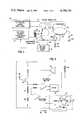
- FIG. 1is a schematic diagram of an illustrative, basic electrosurgery-cautery system in accordance with the invention.
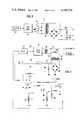
- FIG. 2is a circuit diagram of illustrative circuitry for effecting temperature control of a cautery power source.
- FIG. 3is a circuit diagram of an illustrative, isolated power supply for a cautery source.
- FIG. 4is a circuit diagram of an illustrative arc only, electrosurgical generator.
- FIG. 5is a circuit diagram of an illustrative electrosurgery-cautery system having an alternating current cautery power supply.
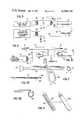
- FIG. 6is a diagrammatic drawing of an illustrative transformer containing handpiece in accordance with the invention.
- FIG. 7is a diagrammatic drawing of an illustrative resectoscope in accordance with the invention.
- FIG. 8Ais a diagrammatic drawing illustrating the manufacture of a high resistance heater element for use in this invention while FIG. 8B is a diagrammatic drawing illustrating the wire of FIG. 8A employed as a high resistance cautery resection loop.
- FIG. 9is a diagrammatic drawing illustrating the manufacture of a high resistance blade in accordance with the invention.
- FIG. 10is a diagrammatic drawing of an illustrative electrosurgery-cautery system having a battery containing handpiece.
- FIG. 1there is illustrated a basic electrosurgery/cautery system.
- a temperature controlled, RF isolated, cautery power source 10is connected via wires 12 and 14 to a heater/electrode element 16.
- a cut and/or fulgurate electrosurgical generator 18is connected via isolation transformer 20 and coupling capacitor 22 to line 14.
- the low side of the secondary winding 21is connected via patient lead 24 to patient electrode 26.
- Lead 24may be connected to ground 28 by optional capacitor 30 via a single pole, double throw switch 27.
- the cautery current pathis indicated in FIG. 1 and includes wire 12, heater/electrode element 16 and wire 14.
- the electrosurgical current pathis also indicated and includes coupling capacitor 22, wire 14, element 16, the patient's body 25, patient electrode 26 and patient lead 24.
- the cautery systemshould include the following features: (a) rapid heating and rapid cooling are desired so that the hot electrode does not need a special holster when it is not being used; (b) temperature feedback control is needed so that the electrode tip temperature can be adjusted for performing cautery without tissue sticking; and (c) the electrode heating system needs to be electrically isolated from ground because an electrosurgical electrode must be isolated from ground, insofar as possible.
- the temperature control of the cautery elementcan be done by two basic methods, both of which are known.
- a thermocouple or themistor temperature sensing elementcan monitor the temperature of element 16 and feedback can modify the current through the element to achieve and maintain the desired temperatures.
- the preferred method of temperature measurementis to make element 16 from a material having a large resistive temperature coefficient so that the change of resistance with heating can be used to measure the temperature of the heater and thus control the current which heats the heater.
- This basic temperature controlcan be effected by two methods.
- a small monitor currentwould be passed through heating element 16 to measure its temperature.
- the currentcould be provided by a current source so that it is essentially constant.
- the voltage drop which is seen across the heater elementwould be proportional to the resistance of the heater.
- the large heating currentis applied at an amplitude or duration determined by the previous temperature measurement.
- the heating intervalsay another 10 ms, the system returns to the measurement phase again.
- the current(s)can be either AC or DC.
- the heating current and the measurement currentare one and the same.
- FIG. 2illustrates a typical cautery power source 10 which may be used in the system of FIG. 1.
- a DC currentdrives the heater element 16.
- This currentalso passes through a series current sensing resistor 40, the resistance of which doesn't vary. Therefore, the voltage drop across resistor 40 is an accurate measure of the current passing through the heater element 16.
- the output of divider 42is a DC voltage which is directly proportional to the temperature of the heater 16. ##EQU1## The resultant DC voltage is used to control the heater current.
- a differential amplifier 44compares the temperature dependent voltage with a voltage from a potentiometer 46 to adjust the temperature.
- the cautery power sourceis activated by a foot-switch 49 via RF isolated keying circuit 47 which ungrounds the input to the heater current controlling transistors 48 and 50.
- Keying circuit 47may comprise a photo-isolator and in particular, a light emitting diode 51 which is actuated when foot switch 49 is closed, a phototransistor 53 which is responsive to LED 51 and NPN transistor 55.
- circuitry of FIG. 2utilizes a DC current to energize element 16.
- AC current sourcesare also known for effecting this function.
- Prior art circuitry using DC and/or AC sourcesis illustrated, for example, by U.S. Pat. Nos. 3,025,706; 3,296,866; 3,406,335; 3,587,318; 3,700,933; 3,789,190; 3,826,263; 3,869,597; and 3,875,503.
- the cautery portion of the system of FIG. 1includes electrically heated element 16 incorporated into an electrosurgical electrode.
- the heat from the element 16sears the surface of the tissue to produce the impedance change required to initiate arcing.
- the electric cautery operated by itselfis a useful surgical tool which is capable of two distinctly different surgical effects. When operated at relatively low temperatures, 95° to 120° C. (as established by potentiometer 46), it produces a tissue necrosis that may be identical to electrosurgical desiccation except that it is relatively superficial. If the temperature is kept below 120° C., the necrotic tissue remains soft and moist and does not adhere to the electrode. If the cautery probe temperature is kept very high (as again established by potentiometer 46), it can boil surface water and even volatilize tissue. In fact, the cautery wire electrode can cut tissue as efficiently as electrosurgery.
- Isolation of the circuitry of FIG. 2 (or any other cautery power source) from groundmay be effected by the isolated power supply of FIG. 3.
- An oscillator generally indicated at 60generates a driving signal of typically 300 KHz which is applied to a push-pull amplifier indicated at 62 via a driver 61.
- the oscillator 60, driver 61 and amplifier 62are chassis ground referenced.
- the use of a 300 KHz signalis advantageous in that any AC leakage which is inadvertently coupled to the element 16 is at too high a frequency to stimulate muscles or nerves and/or to interfere with ECG patient monitors.
- the output of amplifier 62is coupled via an isolation transformer 64 to a diode bridge 66 where it is full wave rectified and then filtered by a filter circuit indicated at 68.
- a reference voltage Cis regulated by zener diode 69.
- the output terminals A, B and Cprovide isolated DC voltages to the terminals A, B and C shown in FIG. 2. Thus, the FIG. 2 circuitry is isolated from ground.
- a cut only and/or fulgurate only generator which may be used as generator 18has been described in the aforementioned related Application No. 1. Such a generator is also shown in FIG. 4.
- an arc only feedback circuit generally indicated at 81 in FIG. 4may be employed in the following manner.
- the current in patient lead 24(FIG. 3) is sensed by a small resistor 80 serially inserted in patient lead 24.
- the value of this resistoris typically approximately 0.1 ohms.
- Leads 82 and 84 connected across resistor 80are connected to a voltage transformer 86 (FIG.
- a potentiometer 108Applied to the non-inverting input of operational amplifier 100 over line 103 is the output from a potentiometer 108 where potentiometer 108 is connected between reference voltage source 114 and ground.
- the purpose of potentiometer 108is to control the level of the cut and/or fulgurate waveform(s) applied to the patient.
- the purpose of the feedback voltage at the output of amplifier 98is to decrease the control voltages developed by potentiometer 108 in accordance with the sensed current passing through the patient.
- the sensitivity of operational amplifier 100is regulated by potentiometer 116.
- the output of operational amplifier 100is applied to driver 70 and output stage 72. Hence, the output of amplifier 100 is employed to regulate the output power of source 18.
- negative current feedbackis employed to limit the current to typically no more than 200 ma in the arcing modes of operation and to thereby prevent desiccation in these modes of operation where the response time of the feedback circuit should be at least less than 10 milliseconds (ms) and preferably less than 1 ms to avoid significant desiccation immediately after the element 16 contacts the patient's tissue.
- positive voltage feedbackcould also be employed to effect the desired current limiting although such a feedback arrangement is not preferred because of the tendency for the system to oscillate.
- Driver 70 and output stage 72may be as described in U.S. Pat. No. 3,963,030 granted to D. Newton which is hereby incorporated herein by reference.
- the feedback circuitry of FIG. 4would be such that the width of the inductor charging current pulses from the generator disclosed in U.S. Pat. No. 3,963,030 would be controlled in accordance with the amount of negative current feedback from amplifier 98 to thereby maintain the average patient current below a predetermined minimum such as 200 ma.
- potentiometer 88 of FIG. 4 of U.S. Pat. No. 3,963,030corresponds to potentiometer 108 of the present invention.
- potentiometer 88would be connected to the non-inverting input of operational amplifier 100 of the present invention while the output of operational amplifier 100 would be connected to the anode of diode 91 of FIG. 4 of U.S. Pat. No. 3,963,030 whereby the desired pulse width control would be effected in response to the feedback current from operational amplifier 98 of the present invention.
- the amplitude of the burstscan be controlled directly.
- the output of operational amplifier 100 of the present inventionmay be used to change the position of the tap of potentiometer R30 in FIG. 4 of U.S. Pat. No. 3,699,967 via a servomechansim (not shown) whereby the amplitude of the fulgurate bursts would be controlled in accordance with the amount of feedback from operational amplifier 98 of the present invention.
- driver 70 and output stage 72may correspond to the cut current source of U.S. Pat. No. 3,699,967 corresponding to the astable multivibrator of FIG. 4 thereof.
- the position of the tap of potentiometer R31 of U.S. Pat. No. 3,699,967may be changed via a servomechanism by the output of operational amplifier 100 of the present invention.
- arc only feedback circuit 81may be eliminated whereby the output impedance of source 18 can be made large by providing a relatively large number of turns on secondary winding 21 to thereby effect the arc only mode of operation. However, it is preferable to employ the feedback circuit 81 to effect this mode.
- the size of patient electrode 26may be quite small (less than 60 sq. cm. and typically as small as 2 sq. cm.) and in many applications it may be eliminated altogether.
- the patient's bodyis quite often at or very near ground potential either because of a direct connection to ground or because of the large capacitance 101 (see FIG. 1) of the patient's body with respect to ground.
- switch 27is actuated to connect resistor 80 to ground 28 via capacitor 30
- an electrosurgical current pathis nevertheless present from element 16 through the patient's body 25 and capacitance 101 (assuming there is no direct connection to ground) to ground 102.
- the currentreturns to the low side of the secondary 21 via ground 28 and resistor 80.
- Switch 27is positioned as shown in FIG. 1 when a return electrode such as return electrode 26 is employed. In this position of the switch, the return lead 24 is isolated from ground. Thus, if the patient loses contact with return electrode 26, there is little, if any, danger to the patient if he is in contact with a small inadvertent ground such as grounded contact point 29. That is, not only is the current limited because the current may be limited by the arc only feedback circuit 81 but also it is limited because of the high impedance between ground and return lead 24.
- the arc only feedback circuit 81is effected by leakage current from active lead 12,14 to ground inasmuch as this current returns to the low side of transformer 20. Some of the current passes through resistor 80 where, ideally resistor 80 senses only the current passing through the patient. The effect of the active lead leakage current is lessened by the isolation of lead 24 when switch 27 is in the position shown in FIG. 1. When the switch connects resistor 80 to ground 28, the effect of the leakage current tends to increase. Regardless of the position of switch 27, the effect of the leakage current can be further lessened by connecting an inductor 23 between active lead 14 and ground to thereby at least partially cancel the active lead leakage current. The use of such as inductor is described in U.S. Pat. No. 3,946,738 granted to D. Newton, see FIG. 2 thereof, this patent being incorporated herein by reference.
- the wires 12 and 14 leading from the generators to the handpiece 34be light weight and suitable for mass production and possibly even part of a disposable system.
- the magnitude of the heating current for the cautery elementdepends on the amount of resistance in the heating element 16. Referring to FIG. 5, there is illustrated a particular embodiment where the heating element 16 may comprise a short piece of resistance wire, the resistance of which is quite low, typically one or two ohms at most and typically no more than 10 ohms. In the case of a one or two ohm resistance, a large current of 5 to 10 amperes is needed to produce, say 25 to 100 watts of of power.
- a current step-up transformer 36is disposed in handpiece 34 which changes the current ratio before it goes through heating element 16.
- Power source 10provides AC heating and measurement currents due to the presence of current transformer 36 in the handpiece. Because of the danger of low frequency leakage currents to the patient and because of the large iron transformer cores required for low AC frequencies, the AC frequency should be as high as possible without introducing excessive reactive impedances into the system that would tend to distort the heating element resistance measurements. The optimum frequency is around 120 KHz. Since all the currents are high frequency AC, including the electrosurgical currents from generator 18, the isolation of the acitve electrode/heating element 16 from ground is easily accomplished with transformers 20 and 32. Capacitor 38 acts as a bypass capacitor for the electrosurgical current.
- FIG. 6there is shown an illustrative handpiece 34 for use with the FIG. 5 system where a "blade" electrode 16 is formed from a hairpin shaped low resistance wire and transformer 36 is disposed within the handpiece.
- the low resistance heater element 16 of FIG. 5has several advantages:
- FIG. 7which shows an illustrative resectoscope employing a cautery element resection loop 16 in accordance with an aspect of this invention where the resectoscope conventionally includes optical telescope 120, eyepiece 122 and finger ring 124 for moving loop 16 back and forth. Loop 16 is connected to transformer 36 as shown in FIG. 7.
- polypectomythe procedure involves the removal of polyps from the gastrointestinal tract by means of a wire snare looped around the stalk of the polyp.
- a snare wiremay correspond to a cautery wire 16 of FIG. 7 and would eliminate the complications of the "contralateral burn” and excessive desiccation which sometimes causes a patient to go to surgery because of a perforated bowel.
- the disadvantages of the wire cautery elementare: (1) the low resistance requires large currents for heating and either AC transformer 36 or large connecting cables 12 and 14 must be used, both of which tend to be expensive and not suitable for use in disposable systems; and (2) the use of two transformers 32 and 36 in the circuit between generator 10 and heating element 16 and a relatively high frequency means that the temperature measurement will have a number of sources of error and will be difficult to calibrate.
- a high resistance heater elementas element 16 of FIG. 1 avoids the foregoing problems but tends to introduce other ones.
- Advantages of the high resistance heater elementare that (1) small heating currents can be used, either as AC or DC; (2) good temperature measurement accuracy is readily obtained; and (3) no transformers are required in the handpiece because the heating current is low. Although somewhat difficult at this time, it is possible that some forms of high resistance electrodes could be mass produced, lending the whole active assembly (wire 12, 14, handpiece 34, and electrode/heater 16) to mass production and a disposable product.
- a high resistance electrode element 16can be made by winding a very fine, high resistance wire 126 around a non-conducting bundle of heat resistant fibers 128 such as glass. This composite wire may then be bent into loop electrodes for polypectomy or transurethral resections as shown in FIG. 8B.
- blade electrodesby printing or depositing a film 130 of low resistance carbon or metal (such as a nickel alloy) on a ceramic base 132.
- the resistancecan be fairly high if the film is printed in a narrow, zig-zag line as shown in FIG. 9.
- the entire bladeshould then be covered with a thin film 134 of very high resistance, conductive material such as carbon which has been processed to give it a high resistivity to protect the metal film and give the advantages of the carbon coated electrode blades disclosed in U.S. patent application Ser. No. 667,849 filed Mar. 17, 1976 by Charles F. Morrison and assigned to the assignee of the present invention where the foregoing patent application is hereby incorporated herein be reference.
- the carbon coatingmust be very resistive so that it won't substantially short out the lines of metal film.
- FIG. 10for a further embodiment of the invention wherein a battery 140 is incorporated in handpiece 34 to provide the heating current for element 16, the element 16 being in series circuit with heavy conductor 142 which extends from the terminals of battery 140 whereby the heating effect is effectively localized in element 16.
- Switch 144 incorporated on handpiece 34permits energization of element 16.
- Battery 140is perferably of the rechargeable type such as a lead-acid rechargeable battery.
- the batterymay be recharged from a low voltage DC supply 146 which is connected to the battery by lines 12 and 14 where line 14 is connected to generator 18 as shown in FIG. 1.
- Circuitrymay also be connected to battery 140 over lines 12 and 14 to monitor DC voltage and/or current and thus provide means for measuring and possibly controlling the temperature of element 16. It can thus be seen that in the embodiment of FIG. 10, battery 140 serves the function of the cautery power source 10 of FIG. 1 and permits the use of fine gauge wire for wires 12 and 14 while at the same time permitting a low resistance heating element.
Landscapes
- Health & Medical Sciences (AREA)
- Surgery (AREA)
- Engineering & Computer Science (AREA)
- Life Sciences & Earth Sciences (AREA)
- Biomedical Technology (AREA)
- Otolaryngology (AREA)
- Nuclear Medicine, Radiotherapy & Molecular Imaging (AREA)
- Plasma & Fusion (AREA)
- Physics & Mathematics (AREA)
- Heart & Thoracic Surgery (AREA)
- Medical Informatics (AREA)
- Molecular Biology (AREA)
- Animal Behavior & Ethology (AREA)
- General Health & Medical Sciences (AREA)
- Public Health (AREA)
- Veterinary Medicine (AREA)
- Surgical Instruments (AREA)
Abstract
Description
This invention is related to (1) a U.S. application filed Jan. 12, 1978 by Frank W. Harris entitled "Improved Multiple Source Electrosurgical Generator" (hereinafter Application No. 1) and (2) U.S. Application Ser. No. 852,431 filed by Frank W. Harris on Nov. 17, 1977 and entitled "Contact Area Measurement Apparatus and Method for Use with Electrosurgery and Cryosurgery". Both of the foregoing applications are incorporated herein by reference.
This invention relates to a unique electrosurgery/cautery system.
In the following specification and claims, a distinction is made between the terms electrosurgery and cautery. In electrosurgery, radio frequency current flows into the tissue being treated from a first electrode usually termed the active electrode. The current usually exits at a second electrode termed the patient or indifferent electrode although, as will be brought out in more detail hereinafter, the patient electrode does not necessarily have to be employed in accordance with one aspect of the present invention. Electrical interaction between the active electrode and tissue at the treated site may either be ohmic (to thereby effect a desiccation mode of operation) or by electrical arc (to thereby effect a cut or fulguration mode of operation). In cautery an element such as a wire is electrically heated by passing a current therethrough, the cautery element typically being used to seal bleeding blood vessels in hospital surgical procedures and in minor surgery performed in doctors' offices. Hence, in summary, an important distinction between electrosurgery and cautery is that in the former current flows through the patient's tissue while in the latter current is restricted to the heating element.
In electrosurgery there are three effects which may be produced by passing radio frequency current through tissue--namely, desiccation, cutting and fulguration. In desiccation, the active electrode is held in firm contact with the tissue with the current passing directly into the tissue and the heating effect being brought about by I2 R heating. Thus, the mode of operation is ohmic.
In cutting, the active electrode is not in good contact with the tissue and electric sparks jump from the electrode to the tissue. The voltage waveform used is generally a sinewave and the sparks are short in length but heat the tissue intensely. The cells burst into steam and the steam maintains the layer of gas between the electrode and the tissue as the incision proceeds. In order to produce a cutting effect without desiccation, the generator must be current limited to less than about 200 milliamperes.
In fulguration, the coagulation occurs by means of a high voltage spark which jumps from the active electrode to the tissue. Thus, an arcing mode of operation occurs in both cuting and fulguration. The spark produces intense heating at every point it strikes, but a high crest factor voltage waveform, called a COAG waveform, makes long sparks and distributes the spark widely. This keeps the energy density down and minimizes the cutting effect.
Of the three electrosurgical modes, desiccation is the primary threat to the patient in the event that a grounded patient electrode loses contact with the patient's body. The patient's body invariably has some electrical contact with ground, either by capacitive coupling or by direct contact with a grounded object. Even with a child, his body is large enough to produce a significant capacitance between his body mass and the grounded operating table. As a result of this relatively low impedance to ground, it is difficult for large voltage differences to exist between the patient's body and ground. Therefore, when RF leakage currents leave the patient's body and go to ground via small, grounded contact points, they do so by direct ohmic connection. In order for electric sparks to jump from the patient's body to ground a voltage difference of over 1000 volts is needed. As a result, a patient electrode related burn is almost always in the desiccation mode.
It is possible that if a small grounded contact were the only electrical connection to ground, then a burn at this location could proceed from desiccation to fulguration after the burn site acquired a high impedance because of the electrosurgical action at that point. However, even in this case, it is clear that the fulguration burn could not have occurred if the desiccation had not taken place first.
Unfortunately, desiccation is usually needed at the site of surgery even though the intention is to cut or fulgurate. That is, in most electrosurgery, desiccation is combined with cutting or fulguration because the surgeon usually starts his cut or fulguration with the electrode in firm contact with the tissue. Since, by definition, the starting mode is desiccation, the desiccation must be complete before the tissue in contact with the electrode will acquire a high enough impedance so that sparking can begin and cutting or fulguration will occur. A typical prior art generator produces over an ampere of desiccation current to necrose and dry the tissue at the active electrode so that the tissue impedance will rise to the requisite amount.
In aforementioned related Application No. 1, a feedback system is described which limits the electrosurgical current to less than 200 ma so that only arcing (only cutting or fulguration) can take place. When used by itself, a system such as this is safer than an ordinary monopolar electrosurgical system and could even be used without a patient electrode with comparative safety. However, as indicated above, a current limited system cannot be used for most surgery because there is no way to get the electrode started. That is, since the current is limited to less than 200 ma and since at least an ampere is needed to desiccate the tissue so that arcing can commence, the current limited, arc only system cannot be used by itself for most surgery. In the abovementioned related Application No. 1, the necessary tissue desiccation is effected by providing a separate desiccation generator capable of delivering at least 1 ampere of electrical current through the tissue. Thus not only is a capability provided for initiating current limited fulguration or cutting but also the advantages inherent in desiccation vis-a-vis fulguration in certain applications are realized. For example, neural tissue is so fragile that if one attempts to fulgurate a bleeder, the hard surface eschar seals the bleeder but in doing so shrinks and pulls the surface or the tissue so that bleeding may start at the periphery of the eschar. Desiccation does not dry and shrink the tissue as much as fulguration and thus this mode more effectively seals neural bleeders. Hence, the use of the separate desiccation generator is advantageous in this application as well as others. However, it is desirable in some situations to effect necrosis of the tissue to thereby permit the establishment the spark needed for fulguration or cutting without employing a high amperage current to do so and thereby avoid the problems associated with such currents as discussed above.
It is thus an object of this invention to provide a system capable of providing (a) desiccation-type tissue necrosis and (b) cutting and/or fulguration where the "desiccation" is effected by cautery and the cutting and/or fulguration is effected by electrosurgery. Although the term "desiccation" is normally used in connection with electrosurgery, the term, in the following specification and claims, will also be used with respect to the tissue necrosis effected by cautery since, at low temperatures, the latter necrosis appears to be very similar if not identical to that caused by electrosurgical desiccation except that it appears to be more shallow. Since the cautery desiccates the tissue, no large currents pass through the patient to effect this function. Further, since the desiccation is not effected electrosurgically, the electrosurgical generator may be optimized for the high output voltage, high output impedance fulguration and cutting functions. That is, heretofore some electrosurgical generators have operated in modes which tend to be incompatible. Hence, it has been difficult to optimize all modes in a single generator. Aforementioned related Application No. 1 provides one solution to this problem and the subject invention another. That is, by implementing the desiccation mode with cautery, the electrosurgical arcing modes can be optimized without compromising the desiccation function in many applications.
It is a further object of this invention to provide in a current limited, cut only or fulgurate only electrosurgical generator, the capability of initiating the requisite arc without passing a large current through the patient's tissue.
It is a further object of this invention to effect the arc initiating function by employing cautery.
It is a further object of this invention to provide an electrosurgical generator of the above type in combination with a cautery power source where the electrosurgical generator and cautery power source both energize an electrode/heater element.
It is a further object of this invention to provide a combined electrosurgery/cautery system of the above type wherein the cautery is used for (a) tissue coagulation to effect shallow necrosis thereof and/or (b) cutting of the tissue.
It is a further object of this invention to provide a combined electrosurgery/cautery system of the above type wherein the electrosurgical function effects the fulgurate only mode when the cautery function is also employed to effect the cut mode of operation.
It is a further object of this invention to provide a combined electrosurgical/cautery system of the above type having a very small patient electrode or none at all.
It is a further object of this invention to provide different electrosurgical/cautery devices for use in combined systems of the above type.
Other objects and advantages of this invention will be apparent from a reading of the following specification and claims taken with the drawing.
FIG. 1 is a schematic diagram of an illustrative, basic electrosurgery-cautery system in accordance with the invention.
FIG. 2 is a circuit diagram of illustrative circuitry for effecting temperature control of a cautery power source.
FIG. 3 is a circuit diagram of an illustrative, isolated power supply for a cautery source.
FIG. 4 is a circuit diagram of an illustrative arc only, electrosurgical generator.
FIG. 5 is a circuit diagram of an illustrative electrosurgery-cautery system having an alternating current cautery power supply.
FIG. 6 is a diagrammatic drawing of an illustrative transformer containing handpiece in accordance with the invention.
FIG. 7 is a diagrammatic drawing of an illustrative resectoscope in accordance with the invention.
FIG. 8A is a diagrammatic drawing illustrating the manufacture of a high resistance heater element for use in this invention while FIG. 8B is a diagrammatic drawing illustrating the wire of FIG. 8A employed as a high resistance cautery resection loop.
FIG. 9 is a diagrammatic drawing illustrating the manufacture of a high resistance blade in accordance with the invention.
FIG. 10 is a diagrammatic drawing of an illustrative electrosurgery-cautery system having a battery containing handpiece.
Reference should be made to the drawing where like numerals refer to like elements.
In FIG. 1 there is illustrated a basic electrosurgery/cautery system. A temperature controlled, RF isolated,cautery power source 10 is connected viawires electrode element 16. A cut and/orfulgurate electrosurgical generator 18 is connected viaisolation transformer 20 andcoupling capacitor 22 toline 14. The low side of the secondary winding 21 is connected viapatient lead 24 topatient electrode 26.Lead 24 may be connected to ground 28 byoptional capacitor 30 via a single pole, double throw switch 27.
The cautery current path is indicated in FIG. 1 and includeswire 12, heater/electrode element 16 andwire 14. The electrosurgical current path is also indicated and includescoupling capacitor 22,wire 14,element 16, the patient'sbody 25,patient electrode 26 andpatient lead 24.
The cautery system should include the following features: (a) rapid heating and rapid cooling are desired so that the hot electrode does not need a special holster when it is not being used; (b) temperature feedback control is needed so that the electrode tip temperature can be adjusted for performing cautery without tissue sticking; and (c) the electrode heating system needs to be electrically isolated from ground because an electrosurgical electrode must be isolated from ground, insofar as possible.
The temperature control of the cautery element can be done by two basic methods, both of which are known. Thus, a thermocouple or themistor temperature sensing element can monitor the temperature ofelement 16 and feedback can modify the current through the element to achieve and maintain the desired temperatures. However, the preferred method of temperature measurement is to makeelement 16 from a material having a large resistive temperature coefficient so that the change of resistance with heating can be used to measure the temperature of the heater and thus control the current which heats the heater. This basic temperature control can be effected by two methods.
In the time sharing method, a small monitor current would be passed throughheating element 16 to measure its temperature. For example, the current could be provided by a current source so that it is essentially constant. The voltage drop which is seen across the heater element would be proportional to the resistance of the heater. After a short interval of temperature measurement time, say 10 ms, the large heating current is applied at an amplitude or duration determined by the previous temperature measurement. After the heating interval, say another 10 ms, the system returns to the measurement phase again. The current(s) can be either AC or DC. In the simultaneous method, the heating current and the measurement current are one and the same. Since the current amplitude is not a constant, and the driving voltage is not constant, the value of current must be divided into the voltage to obtain the cautery element resistance, and therefore the temperature. Such a system is illustrated in FIG. 2 which illustrates a typicalcautery power source 10 which may be used in the system of FIG. 1. In FIG. 2, a DC current drives theheater element 16. This current also passes through a seriescurrent sensing resistor 40, the resistance of which doesn't vary. Therefore, the voltage drop acrossresistor 40 is an accurate measure of the current passing through theheater element 16. By dividing the voltage drop across theheater 16 by the voltage drop across thecurrent sensing resistor 40, the continuously changing current is cancelled as indicated by equation (1) below. The output ofdivider 42 is a DC voltage which is directly proportional to the temperature of theheater 16. ##EQU1## The resultant DC voltage is used to control the heater current. Adifferential amplifier 44 compares the temperature dependent voltage with a voltage from apotentiometer 46 to adjust the temperature. The cautery power source is activated by a foot-switch 49 via RF isolated keyingcircuit 47 which ungrounds the input to the heater currentcontrolling transistors circuit 47 may comprise a photo-isolator and in particular, alight emitting diode 51 which is actuated whenfoot switch 49 is closed, aphototransistor 53 which is responsive toLED 51 andNPN transistor 55.
Hence, the circuitry of FIG. 2 utilizes a DC current to energizeelement 16. AC current sources are also known for effecting this function. Prior art circuitry using DC and/or AC sources is illustrated, for example, by U.S. Pat. Nos. 3,025,706; 3,296,866; 3,406,335; 3,587,318; 3,700,933; 3,789,190; 3,826,263; 3,869,597; and 3,875,503.
From the foregoing it can be seen the cautery portion of the system of FIG. 1 includes electricallyheated element 16 incorporated into an electrosurgical electrode. The heat from theelement 16 sears the surface of the tissue to produce the impedance change required to initiate arcing. Further, the electric cautery operated by itself is a useful surgical tool which is capable of two distinctly different surgical effects. When operated at relatively low temperatures, 95° to 120° C. (as established by potentiometer 46), it produces a tissue necrosis that may be identical to electrosurgical desiccation except that it is relatively superficial. If the temperature is kept below 120° C., the necrotic tissue remains soft and moist and does not adhere to the electrode. If the cautery probe temperature is kept very high (as again established by potentiometer 46), it can boil surface water and even volatilize tissue. In fact, the cautery wire electrode can cut tissue as efficiently as electrosurgery.
Isolation of the circuitry of FIG. 2 (or any other cautery power source) from ground may be effected by the isolated power supply of FIG. 3. An oscillator generally indicated at 60 generates a driving signal of typically 300 KHz which is applied to a push-pull amplifier indicated at 62 via adriver 61. Theoscillator 60,driver 61 andamplifier 62 are chassis ground referenced. The use of a 300 KHz signal is advantageous in that any AC leakage which is inadvertently coupled to theelement 16 is at too high a frequency to stimulate muscles or nerves and/or to interfere with ECG patient monitors. The output ofamplifier 62 is coupled via anisolation transformer 64 to adiode bridge 66 where it is full wave rectified and then filtered by a filter circuit indicated at 68. A reference voltage C is regulated by zener diode 69. The output terminals A, B and C provide isolated DC voltages to the terminals A, B and C shown in FIG. 2. Thus, the FIG. 2 circuitry is isolated from ground.
A cut only and/or fulgurate only generator which may be used asgenerator 18 has been described in the aforementioned related Application No. 1. Such a generator is also shown in FIG. 4. In order to limit the current passing through the patient during the fulguration or cut modes of operation and thereby prevent desiccation during these arcing (or sparking) modes, an arc only feedback circuit generally indicated at 81 in FIG. 4 may be employed in the following manner. The current in patient lead 24 (FIG. 3) is sensed by asmall resistor 80 serially inserted inpatient lead 24. The value of this resistor is typically approximately 0.1 ohms. Leads 82 and 84 connected acrossresistor 80 are connected to a voltage transformer 86 (FIG. 4) which isolates the current feedback signal from the RF output. Thus, a voltage signal proportional to the current is transferred to ground without compromising the RF isolation of the output circuit. This small RF signal is applied to abridge rectifier 88, the output of the rectifier being smoothed byfilter 90. The rectified voltage is then applied tooperational amplifier 98. Switch 118 which may be on the console panel determines whether the arc only mode is selected. Assuming theswitch 118 is open as shown in FIG. 4 so that an arcing mode has been selected, the voltage fed back fromfilter 90 is applied to the inverting input ofoperational amplifier 98 which in turn is connected to anoperational amplifier 100. Applied to the non-inverting input ofoperational amplifier 100 overline 103 is the output from apotentiometer 108 wherepotentiometer 108 is connected between reference voltage source 114 and ground. The purpose ofpotentiometer 108 is to control the level of the cut and/or fulgurate waveform(s) applied to the patient. The purpose of the feedback voltage at the output ofamplifier 98 is to decrease the control voltages developed bypotentiometer 108 in accordance with the sensed current passing through the patient. The sensitivity ofoperational amplifier 100 is regulated bypotentiometer 116. The output ofoperational amplifier 100 is applied todriver 70 andoutput stage 72. Hence, the output ofamplifier 100 is employed to regulate the output power ofsource 18. In particular, negative current feedback is employed to limit the current to typically no more than 200 ma in the arcing modes of operation and to thereby prevent desiccation in these modes of operation where the response time of the feedback circuit should be at least less than 10 milliseconds (ms) and preferably less than 1 ms to avoid significant desiccation immediately after theelement 16 contacts the patient's tissue. Alternatively, positive voltage feedback could also be employed to effect the desired current limiting although such a feedback arrangement is not preferred because of the tendency for the system to oscillate.
Alternatively, the amplitude of the bursts can be controlled directly. Thus, in U.S. Pat. No. 3,699,967 granted to R. Anderson (which is hereby incorporated herein by reference), the output ofoperational amplifier 100 of the present invention may be used to change the position of the tap of potentiometer R30 in FIG. 4 of U.S. Pat. No. 3,699,967 via a servomechansim (not shown) whereby the amplitude of the fulgurate bursts would be controlled in accordance with the amount of feedback fromoperational amplifier 98 of the present invention.
Alternatively,driver 70 andoutput stage 72 may correspond to the cut current source of U.S. Pat. No. 3,699,967 corresponding to the astable multivibrator of FIG. 4 thereof. In order to regulate the output of the multivibrator in acordance with the feedback output fromoperational amplifier 98 of the present invention, the position of the tap of potentiometer R31 of U.S. Pat. No. 3,699,967 may be changed via a servomechanism by the output ofoperational amplifier 100 of the present invention.
It is also within the scope of the present invention to utilize the common cut/fulgurate source disclosed in above U.S. Pat. No. 3,699.967 where transformer T2 of FIG. 3 thereof would take the place oftransformer 20 of FIG. 1 of the present invention.
In accordance with a further possible modification, arc onlyfeedback circuit 81 may be eliminated whereby the output impedance ofsource 18 can be made large by providing a relatively large number of turns on secondary winding 21 to thereby effect the arc only mode of operation. However, it is preferable to employ thefeedback circuit 81 to effect this mode.
In accordance with a further aspect of this invention, the size ofpatient electrode 26 may be quite small (less than 60 sq. cm. and typically as small as 2 sq. cm.) and in many applications it may be eliminated altogether. The patient's body is quite often at or very near ground potential either because of a direct connection to ground or because of the large capacitance 101 (see FIG. 1) of the patient's body with respect to ground. Hence, assuming no patient plate is employed (whereby switch 27 is actuated to connectresistor 80 to ground 28 via capacitor 30), an electrosurgical current path is nevertheless present fromelement 16 through the patient'sbody 25 and capacitance 101 (assuming there is no direct connection to ground) toground 102. The current returns to the low side of the secondary 21 viaground 28 andresistor 80. The current that flows in this path is limited to the value established bygenerator 18 and arc onlyfeedback circuit 81. Hence, there is little, if any, danger of a desiccation burn occurring at an inadvertent grounding point on the patient even if the contact area of the inadvertent ground is very small and even if there is nopatient electrode 26. Such an inadvertent grounding point is indicated at 29, ground being indicated at 31. Further, appropriate steps may be taken to limit the current fromgenerator 18 to a safe value corresponding to the smallest anticipated grounding point.
Switch 27 is positioned as shown in FIG. 1 when a return electrode such asreturn electrode 26 is employed. In this position of the switch, thereturn lead 24 is isolated from ground. Thus, if the patient loses contact withreturn electrode 26, there is little, if any, danger to the patient if he is in contact with a small inadvertent ground such as groundedcontact point 29. That is, not only is the current limited because the current may be limited by the arc onlyfeedback circuit 81 but also it is limited because of the high impedance between ground and returnlead 24.
There is some tendency for the arc onlyfeedback circuit 81 to be effected by leakage current fromactive lead transformer 20. Some of the current passes throughresistor 80 where, ideally resistor 80 senses only the current passing through the patient. The effect of the active lead leakage current is lessened by the isolation oflead 24 when switch 27 is in the position shown in FIG. 1. When the switch connectsresistor 80 toground 28, the effect of the leakage current tends to increase. Regardless of the position of switch 27, the effect of the leakage current can be further lessened by connecting aninductor 23 betweenactive lead 14 and ground to thereby at least partially cancel the active lead leakage current. The use of such as inductor is described in U.S. Pat. No. 3,946,738 granted to D. Newton, see FIG. 2 thereof, this patent being incorporated herein by reference.
It is desirable that thewires handpiece 34 be light weight and suitable for mass production and possibly even part of a disposable system. The magnitude of the heating current for the cautery element depends on the amount of resistance in theheating element 16. Referring to FIG. 5, there is illustrated a particular embodiment where theheating element 16 may comprise a short piece of resistance wire, the resistance of which is quite low, typically one or two ohms at most and typically no more than 10 ohms. In the case of a one or two ohm resistance, a large current of 5 to 10 amperes is needed to produce, say 25 to 100 watts of of power. To avoid large voltage drops acrosswires 12 and 14 (these wires preferably being fine gauge, for example, 22 gauge), a current step-uptransformer 36 is disposed inhandpiece 34 which changes the current ratio before it goes throughheating element 16.Power source 10 provides AC heating and measurement currents due to the presence ofcurrent transformer 36 in the handpiece. Because of the danger of low frequency leakage currents to the patient and because of the large iron transformer cores required for low AC frequencies, the AC frequency should be as high as possible without introducing excessive reactive impedances into the system that would tend to distort the heating element resistance measurements. The optimum frequency is around 120 KHz. Since all the currents are high frequency AC, including the electrosurgical currents fromgenerator 18, the isolation of the acitve electrode/heating element 16 from ground is easily accomplished withtransformers Capacitor 38 acts as a bypass capacitor for the electrosurgical current.
In FIG. 6 there is shown anillustrative handpiece 34 for use with the FIG. 5 system where a "blade"electrode 16 is formed from a hairpin shaped low resistance wire andtransformer 36 is disposed within the handpiece.
The lowresistance heater element 16 of FIG. 5 has several advantages:
(1) It is easy to manufacture. Further, certain configurations of the element would be very similar to existing wire electrodes used in electrosurgery. For example, the resectoscope used for transurethral resections uses a loop of wire as n electrode. If this loop of wire were also a cautery element, the resulting instrument would be very similar to resectoscopes used today and would operate in the same manner, except that the high desiccation currents, urethral strictures and burns due to faulty patient electrodes would be extremely unlikely. Reference should be made to FIG. 7 which shows an illustrative resectoscope employing a cauteryelement resection loop 16 in accordance with an aspect of this invention where the resectoscope conventionally includesoptical telescope 120,eyepiece 122 andfinger ring 124 for movingloop 16 back and forth.Loop 16 is connected totransformer 36 as shown in FIG. 7.
(2) In polypectomy, the procedure involves the removal of polyps from the gastrointestinal tract by means of a wire snare looped around the stalk of the polyp. Such a snare wire may correspond to acautery wire 16 of FIG. 7 and would eliminate the complications of the "contralateral burn" and excessive desiccation which sometimes causes a patient to go to surgery because of a perforated bowel.
(3) The simplicity of thewire electrode 16 itself lends itself well to mass production and disposability.
The disadvantages of the wire cautery element are: (1) the low resistance requires large currents for heating and eitherAC transformer 36 or large connectingcables transformers generator 10 andheating element 16 and a relatively high frequency means that the temperature measurement will have a number of sources of error and will be difficult to calibrate.
Use of a high resistance heater element aselement 16 of FIG. 1 avoids the foregoing problems but tends to introduce other ones. Advantages of the high resistance heater element are that (1) small heating currents can be used, either as AC or DC; (2) good temperature measurement accuracy is readily obtained; and (3) no transformers are required in the handpiece because the heating current is low. Although somewhat difficult at this time, it is possible that some forms of high resistance electrodes could be mass produced, lending the whole active assembly (wire handpiece 34, and electrode/heater 16) to mass production and a disposable product.
Referring to FIG. 8A, a highresistance electrode element 16 can be made by winding a very fine,high resistance wire 126 around a non-conducting bundle of heatresistant fibers 128 such as glass. This composite wire may then be bent into loop electrodes for polypectomy or transurethral resections as shown in FIG. 8B.
Referring to FIG. 9, it is also possible to build blade electrodes by printing or depositing afilm 130 of low resistance carbon or metal (such as a nickel alloy) on aceramic base 132. The resistance can be fairly high if the film is printed in a narrow, zig-zag line as shown in FIG. 9. The entire blade should then be covered with athin film 134 of very high resistance, conductive material such as carbon which has been processed to give it a high resistivity to protect the metal film and give the advantages of the carbon coated electrode blades disclosed in U.S. patent application Ser. No. 667,849 filed Mar. 17, 1976 by Charles F. Morrison and assigned to the assignee of the present invention where the foregoing patent application is hereby incorporated herein be reference. The carbon coating must be very resistive so that it won't substantially short out the lines of metal film.
Reference should be made to FIG. 10 for a further embodiment of the invention wherein abattery 140 is incorporated inhandpiece 34 to provide the heating current forelement 16, theelement 16 being in series circuit withheavy conductor 142 which extends from the terminals ofbattery 140 whereby the heating effect is effectively localized inelement 16. Switch 144 incorporated onhandpiece 34 permits energization ofelement 16.Battery 140 is perferably of the rechargeable type such as a lead-acid rechargeable battery. The battery may be recharged from a lowvoltage DC supply 146 which is connected to the battery bylines line 14 is connected togenerator 18 as shown in FIG. 1. Circuitry (not shown) may also be connected tobattery 140 overlines element 16. It can thus be seen that in the embodiment of FIG. 10,battery 140 serves the function of thecautery power source 10 of FIG. 1 and permits the use of fine gauge wire forwires
Claims (39)
1. A combined electrosurgery and cautery system for use with a patient, said system comprising
a combined heater and electrode element;
cautery power supply means for applying a first electrical current through said combined heater and electrode element to heat said element, said cautery power supply means including means for passing said first current through said element back to the cautery power supply means without passing through said patient so that tissue of said patient is necrosed by said first current in response to the element being positioned adjacent the tissue;
electrosurgical generator means for applying a second electrical current to said combined heater and electrode element, said electrosurgical generator means including means for passing said second current through said patient back to the electrosurgical generator means where said electrosurgical generator means produces a voltage on said element, the magnitude of which is sufficiently high to permit arcing from the element to the patient after said tissue has been necrosed by said first current.
2. A system as in claim 1 including current limiting means for limiting said second electrical current through said patient to an arcing only value at which desiccation of the patient's tissue is not likely.
3. A system as in claim 2 where said arcing only value is not more than about 200 ma.
4. A system as in claim 2 where said electrosurgical generator means includes power adjusting means for adjusting the output power delivered to said combined heater and electrode element and where said current limiting means includes feedback means for providing a feedback signal from said element, said power adjusting means being responsive to said feedback signal to thereby limit said second current to said arcing only value.
5. A system as in claim 2 including a first isolation transformer, the primary winding of which is connected to said electrosurgical generator meanns and the secondary winding of which is connected to said combined heater and electrode element and where the output impedance of said transformer is sufficiently high to limit said second current to said arcing only value.
6. A system as in claim 1 including a handpiece adapted for manual manipulation, said combined heater and electrode element being mounted on said handpiece and a current step-up transformer disposed within said handpiece, the secondary winding of said transformer being connected across said element and first and second wires connected from said cautery power supply means to the respective ends of the primary winding of said transformer whereby said wires may be of a fine gauge due to the current step-up effected by the transformer.
7. A system as in claim 6 where said cautery power supply means is an alternating current source, the frequency of which is high enough to avoid neuromuscular stimulation.
8. A system as in claim 7 where the frequency of said alternating current is about 120 KHz.
9. A system as in claim 8 including an isolating transformer, the primary winding of which is connected to said cautery power supply means and the secondary of which is respectively connected to said first and second wires.
10. A system as in claim 6 where said electrosurgical generator means is connected to one of said first and second wires.
11. A system as in claim 1 including means for isolating said cautery power supply means from ground.
12. A system as in claim 1 where said cautery power supply means is an alternating current source.
13. A system as in claim 1 wherre said combined heater and electrode element comprises a resistance wire wound about an electrically insulative core.
14. A system as in claim 13 where said core comprises glass fibers.
15. A system as in claim 1 where said combined heater and electrode element comprises a substrate of electrically insulating material, an electrically conductive wire deposited thereon, said wire being connected to said cautery power supply means and said electrosurgical generator means and a high resistivity, conductive covering disposed over said electrically conductive wire.
16. A system as in claim 15 where said substrate comprises a ceramic material, said wire comprises a nickel alloy and said cover comprises a carbon film.
17. A system as in claim 1 where said combined heater and electrode element has a loop configuration.
18. A system as in claim 17 including means for moving the loop in a predetermined direction whereby the loop may be encircled about a growth or the like on the patient to thereby effect electrosurgical removal of the growth.
19. A system as in claim 17 where said loop configuration is an elongated hairpin configuration.
20. A system as in claim 1 including means for regulating the amount of said first current passing through said combined heater and electrode element to thereby maintain the temperature of said element at a predetermined value.
21. A system as in claim 20 including means for establishing the predetermined value of the temperature of said combined heater and electrode element.
22. A system as in claim 21 where said temperature establishing means includes means for setting the temperature of said element to a value which will cause desiccation of the patient's tissue.
23. A system as in claim 22 where said temperature establishing means includes means for setting the temperature of said element to a value which will cause cutting of the patient's tissue.
24. A system as in claim 1 where said cautery power supply means is a direct current source.
25. A system as in claim 24 including a handpiece upon which is disposed said combined heater and electrode element and where said direct current source comprises a battery disposed within said handpiece.
26. A system as in claim 25 including means for recharging said battery.
27. A system as in claim 1 including a return electrode adapted for contact with said patient, said return electrode being connected to said electrosurgical generator means to thereby provide a return path for said second current to said electrosurgical generator means.
28. A system as in claim 27 where the surface area of said return electrode adapted for contact with said patient is no more than 60 square centimeters.
29. A system as in claim 28 where said surface area is no more than 10 square centimeters.
30. A system as in claim 27 including switching means having a first position in which said return electrode is connected to said electrosurgical generator means and a second position in which said electrosurgical generator means is disconnected from said return electrode and connected to ground so that, when no return electrode is employed, a return path for said second current is provided through said patient to said ground and then from said ground back to the electrosurgical generator means.
31. A system as in claim 1 including means for providing the intended return path for said second current through said patient to ground and then from said ground back to the electrosurgical generator means whereby a large area return electrode does not have to be applied to said patient to provide a return path for said second current.
32. A system as in claim 1 where said combined heater and electrode element comprises a cautery heater and an electrosurgical electrode.
33. A system as in claim 32 where cautery heater and said electrosurgical electrode are one and the same element.
34. An electrosurgical method comprising
placing a combined heater and electrode element adjacent tissue to a patient to be treated;
passing a first current through said combined heater and electrode element to effect necrosis of said tissue where said first current is passed through said element without passing through said tissue; and
passing a second current through said combined heater and electrode element and through said patient so that an arc is established between said element and said patient after the tissue is necrosed by said first current.
35. A method as in claim 34 where the magnitude of said second current is less than that which is needed to initiate said arc.
36. A method as in claim 35 where said magnitude of the second current is not more than about 200 ma.
37. A method as in claim 34 where said second current comprises a sine wave suitable for cutting said tissue.
38. A method as in claim 34 where said second current comprises bursts of high frequency electrical energy suitable for fulguration of said tissue.
39. A method as in claim 34 where said second current passes directly from said patient without passing through a return electrode.
Priority Applications (4)
| Application Number | Priority Date | Filing Date | Title |
|---|---|---|---|
| US05/878,529US4196734A (en) | 1978-02-16 | 1978-02-16 | Combined electrosurgery/cautery system and method |
| FR7824235AFR2417303A1 (en) | 1978-02-16 | 1978-08-21 | COMBINED DEVICE FOR ELECTROSURGERY AND CAUTERIZATION |
| DE19792901152DE2901152A1 (en) | 1978-02-16 | 1979-01-12 | ELECTROSURGICAL SYSTEM FOR USE ON A PATIENT |
| JP1672179AJPS54118686A (en) | 1978-02-16 | 1979-02-15 | Electric surgery cautery |
Applications Claiming Priority (1)
| Application Number | Priority Date | Filing Date | Title |
|---|---|---|---|
| US05/878,529US4196734A (en) | 1978-02-16 | 1978-02-16 | Combined electrosurgery/cautery system and method |
Publications (1)
| Publication Number | Publication Date |
|---|---|
| US4196734Atrue US4196734A (en) | 1980-04-08 |
Family
ID=25372210
Family Applications (1)
| Application Number | Title | Priority Date | Filing Date |
|---|---|---|---|
| US05/878,529Expired - LifetimeUS4196734A (en) | 1978-02-16 | 1978-02-16 | Combined electrosurgery/cautery system and method |
Country Status (4)
| Country | Link |
|---|---|
| US (1) | US4196734A (en) |
| JP (1) | JPS54118686A (en) |
| DE (1) | DE2901152A1 (en) |
| FR (1) | FR2417303A1 (en) |
Cited By (153)
| Publication number | Priority date | Publication date | Assignee | Title |
|---|---|---|---|---|
| US4402311A (en)* | 1979-03-30 | 1983-09-06 | Olympus Optical Co., Ltd. | Endoscope for medical treatment |
| US4534347A (en)* | 1983-04-08 | 1985-08-13 | Research Corporation | Microwave coagulating scalpel |
| US4607621A (en)* | 1983-10-07 | 1986-08-26 | Welch Allyn Inc. | Endoscopic apparatus |
| US4657018A (en)* | 1983-08-19 | 1987-04-14 | Hakky Said I | Automatic/manual resectoscope |
| US4898169A (en)* | 1987-05-08 | 1990-02-06 | Boston Scientific Corporation | Medical instrument for therapy of hemorrhoidal lesions |
| US4907589A (en)* | 1988-04-29 | 1990-03-13 | Cosman Eric R | Automatic over-temperature control apparatus for a therapeutic heating device |
| US4942313A (en)* | 1987-08-29 | 1990-07-17 | Asea Brown Boveri Aktiengesellschaft | Method for detecting a current flowing over the human body between a forward and a return conductor and a circuit configuration for carrying out the method |
| WO1991000709A3 (en)* | 1989-07-10 | 1991-03-07 | Beacon Lab Inc | Method and apparatus for mobilizing an electrosurgical generator and inert gas system |
| US5105829A (en)* | 1989-11-16 | 1992-04-21 | Fabian Carl E | Surgical implement detector utilizing capacitive coupling |
| US5107862A (en)* | 1991-05-06 | 1992-04-28 | Fabian Carl E | Surgical implement detector utilizing a powered marker |
| US5122137A (en)* | 1990-04-27 | 1992-06-16 | Boston Scientific Corporation | Temperature controlled rf coagulation |
| US5188126A (en)* | 1989-11-16 | 1993-02-23 | Fabian Carl E | Surgical implement detector utilizing capacitive coupling |
| US5190059A (en)* | 1989-11-16 | 1993-03-02 | Fabian Carl E | Surgical implement detector utilizing a powered marker |
| WO1993021845A1 (en)* | 1992-05-01 | 1993-11-11 | Hemostatix Corporation | Bipolar surgical snare and methods of use |
| US5312327A (en)* | 1992-10-09 | 1994-05-17 | Symbiosis Corporation | Cautery override safety systems endoscopic electrosurgical suction-irrigation instrument |
| US5336222A (en)* | 1993-03-29 | 1994-08-09 | Boston Scientific Corporation | Integrated catheter for diverse in situ tissue therapy |
| US5403311A (en)* | 1993-03-29 | 1995-04-04 | Boston Scientific Corporation | Electro-coagulation and ablation and other electrotherapeutic treatments of body tissue |
| US5456682A (en)* | 1991-11-08 | 1995-10-10 | Ep Technologies, Inc. | Electrode and associated systems using thermally insulated temperature sensing elements |
| US5472443A (en)* | 1991-06-07 | 1995-12-05 | Hemostatic Surgery Corporation | Electrosurgical apparatus employing constant voltage and methods of use |
| US5540681A (en)* | 1992-04-10 | 1996-07-30 | Medtronic Cardiorhythm | Method and system for radiofrequency ablation of tissue |
| US5584830A (en)* | 1994-03-30 | 1996-12-17 | Medtronic Cardiorhythm | Method and system for radiofrequency ablation of cardiac tissue |
| US5633578A (en)* | 1991-06-07 | 1997-05-27 | Hemostatic Surgery Corporation | Electrosurgical generator adaptors |
| US5693045A (en)* | 1995-06-07 | 1997-12-02 | Hemostatic Surgery Corporation | Electrosurgical generator cable |
| US5743903A (en)* | 1991-11-08 | 1998-04-28 | Ep Technologies, Inc. | Cardiac ablation systems and methods using tissue temperature monitoring and control |
| WO1998018393A1 (en)* | 1996-10-30 | 1998-05-07 | Hearten Medical, Inc. | Device for the treatment of patent ductus arteriosus and method of using the device |
| US6039732A (en)* | 1995-04-18 | 2000-03-21 | Olympus Optical Co., Ltd. | Electric operation apparatus |
| US6126656A (en)* | 1996-01-30 | 2000-10-03 | Utah Medical Products, Inc. | Electrosurgical cutting device |
| WO2001017449A1 (en) | 1999-09-03 | 2001-03-15 | Urueta Joshua M | Holster for electrocautery tip |
| US6312426B1 (en) | 1997-05-30 | 2001-11-06 | Sherwood Services Ag | Method and system for performing plate type radiofrequency ablation |
| US6468271B1 (en)* | 1999-02-24 | 2002-10-22 | Scimed Life Systems, Inc. | Device and method for percutaneous myocardial revascularization |
| US20030149442A1 (en)* | 2002-02-04 | 2003-08-07 | Gellman Barry N. | Resistance heated tissue morcellation |
| US6626901B1 (en) | 1997-03-05 | 2003-09-30 | The Trustees Of Columbia University In The City Of New York | Electrothermal instrument for sealing and joining or cutting tissue |
| US6692487B2 (en)* | 2002-01-23 | 2004-02-17 | Endocare, Inc. | Cryosurgical monitoring system |
| US20040078035A1 (en)* | 1999-01-25 | 2004-04-22 | Olympus Optical Co., Ltd. | Medical treatment instrument |
| US20040092923A1 (en)* | 2002-11-08 | 2004-05-13 | Olympus Corporation | Heat-emitting treatment device |
| US20050015080A1 (en)* | 2003-07-16 | 2005-01-20 | Paul Ciccone | Device for cutting or heating medical implants |
| US6939346B2 (en) | 1999-04-21 | 2005-09-06 | Oratec Interventions, Inc. | Method and apparatus for controlling a temperature-controlled probe |
| EP1582165A1 (en)* | 2004-03-12 | 2005-10-05 | Olympus Corporation | Operative instrument with heat-generating body |
| US20050288662A1 (en)* | 2004-06-23 | 2005-12-29 | Uchida Andy H | Electrosurgical generator |
| US7044948B2 (en) | 2002-12-10 | 2006-05-16 | Sherwood Services Ag | Circuit for controlling arc energy from an electrosurgical generator |
| US7131860B2 (en) | 2003-11-20 | 2006-11-07 | Sherwood Services Ag | Connector systems for electrosurgical generator |
| US7137980B2 (en) | 1998-10-23 | 2006-11-21 | Sherwood Services Ag | Method and system for controlling output of RF medical generator |
| US20060293649A1 (en)* | 2005-06-22 | 2006-12-28 | Lorang Douglas M | Electrosurgical power control |
| US20070156137A1 (en)* | 2006-01-03 | 2007-07-05 | Geisel Donald J | High efficiency, precision electrosurgical apparatus and method |
| US7255694B2 (en) | 2002-12-10 | 2007-08-14 | Sherwood Services Ag | Variable output crest factor electrosurgical generator |
| US7300435B2 (en) | 2003-11-21 | 2007-11-27 | Sherwood Services Ag | Automatic control system for an electrosurgical generator |
| US7303557B2 (en) | 1998-10-23 | 2007-12-04 | Sherwood Services Ag | Vessel sealing system |
| US7364577B2 (en) | 2002-02-11 | 2008-04-29 | Sherwood Services Ag | Vessel sealing system |
| US20080119841A1 (en)* | 2006-01-03 | 2008-05-22 | Geisel Donald J | High, efficiency, precision electrosurgical apparatus and method |
| USRE40388E1 (en) | 1997-04-09 | 2008-06-17 | Covidien Ag | Electrosurgical generator with adaptive power control |
| US7396336B2 (en) | 2003-10-30 | 2008-07-08 | Sherwood Services Ag | Switched resonant ultrasonic power amplifier system |
| USD574323S1 (en) | 2007-02-12 | 2008-08-05 | Tyco Healthcare Group Lp | Generator |
| US7485092B1 (en) | 1998-08-12 | 2009-02-03 | Maquet Cardiovascular Llc | Vessel harvesting apparatus and method |
| US7513896B2 (en) | 2006-01-24 | 2009-04-07 | Covidien Ag | Dual synchro-resonant electrosurgical apparatus with bi-directional magnetic coupling |
| WO2009050753A1 (en)* | 2007-10-19 | 2009-04-23 | I.T. S.R.L. | Apparatus for effecting aesthetic skinworks through electric treatment |
| US7534243B1 (en) | 1998-08-12 | 2009-05-19 | Maquet Cardiovascular Llc | Dissection and welding of tissue |
| US7628786B2 (en) | 2004-10-13 | 2009-12-08 | Covidien Ag | Universal foot switch contact port |
| US7637907B2 (en) | 2006-09-19 | 2009-12-29 | Covidien Ag | System and method for return electrode monitoring |
| US7648499B2 (en) | 2006-03-21 | 2010-01-19 | Covidien Ag | System and method for generating radio frequency energy |
| US7651492B2 (en) | 2006-04-24 | 2010-01-26 | Covidien Ag | Arc based adaptive control system for an electrosurgical unit |
| US7651493B2 (en) | 2006-03-03 | 2010-01-26 | Covidien Ag | System and method for controlling electrosurgical snares |
| US20100069904A1 (en)* | 2008-09-15 | 2010-03-18 | Tyco Healthcare Group Lp | Electrosurgical Instrument Having a Coated Electrode Utilizing an Atomic Layer Deposition Technique |
| US7695470B1 (en) | 1998-08-12 | 2010-04-13 | Maquet Cardiovascular Llc | Integrated vessel ligator and transector |
| US7722601B2 (en) | 2003-05-01 | 2010-05-25 | Covidien Ag | Method and system for programming and controlling an electrosurgical generator system |
| US7731717B2 (en) | 2006-08-08 | 2010-06-08 | Covidien Ag | System and method for controlling RF output during tissue sealing |
| US7749217B2 (en) | 2002-05-06 | 2010-07-06 | Covidien Ag | Method and system for optically detecting blood and controlling a generator during electrosurgery |
| US7766905B2 (en) | 2004-02-12 | 2010-08-03 | Covidien Ag | Method and system for continuity testing of medical electrodes |
| US7780662B2 (en) | 2004-03-02 | 2010-08-24 | Covidien Ag | Vessel sealing system using capacitive RF dielectric heating |
| US7794457B2 (en) | 2006-09-28 | 2010-09-14 | Covidien Ag | Transformer for RF voltage sensing |
| US20100268216A1 (en)* | 2009-04-17 | 2010-10-21 | Kim Manwaring | Inductively heated multi-mode ultrasonic surgical tool |
| US7834484B2 (en) | 2007-07-16 | 2010-11-16 | Tyco Healthcare Group Lp | Connection cable and method for activating a voltage-controlled generator |
| US7867163B2 (en) | 1998-06-22 | 2011-01-11 | Maquet Cardiovascular Llc | Instrument and method for remotely manipulating a tissue structure |
| US7901400B2 (en) | 1998-10-23 | 2011-03-08 | Covidien Ag | Method and system for controlling output of RF medical generator |
| US20110071520A1 (en)* | 2009-09-23 | 2011-03-24 | Tyco Healthcare Group Lp | Methods and Apparatus for Smart Handset Design in Surgical Instruments |
| US7927328B2 (en) | 2006-01-24 | 2011-04-19 | Covidien Ag | System and method for closed loop monitoring of monopolar electrosurgical apparatus |
| US7938842B1 (en) | 1998-08-12 | 2011-05-10 | Maquet Cardiovascular Llc | Tissue dissector apparatus |
| US7947039B2 (en) | 2005-12-12 | 2011-05-24 | Covidien Ag | Laparoscopic apparatus for performing electrosurgical procedures |
| US7972328B2 (en) | 2006-01-24 | 2011-07-05 | Covidien Ag | System and method for tissue sealing |
| US7972265B1 (en) | 1998-06-22 | 2011-07-05 | Maquet Cardiovascular, Llc | Device and method for remote vessel ligation |
| US7981133B2 (en) | 1995-07-13 | 2011-07-19 | Maquet Cardiovascular, Llc | Tissue dissection method |
| US8034049B2 (en) | 2006-08-08 | 2011-10-11 | Covidien Ag | System and method for measuring initial tissue impedance |
| US8104956B2 (en) | 2003-10-23 | 2012-01-31 | Covidien Ag | Thermocouple measurement circuit |
| US8147485B2 (en) | 2006-01-24 | 2012-04-03 | Covidien Ag | System and method for tissue sealing |
| US8216220B2 (en) | 2007-09-07 | 2012-07-10 | Tyco Healthcare Group Lp | System and method for transmission of combined data stream |
| US8216223B2 (en) | 2006-01-24 | 2012-07-10 | Covidien Ag | System and method for tissue sealing |
| US8226639B2 (en) | 2008-06-10 | 2012-07-24 | Tyco Healthcare Group Lp | System and method for output control of electrosurgical generator |
| US8241210B2 (en) | 1998-06-22 | 2012-08-14 | Maquet Cardiovascular Llc | Vessel retractor |
| EP2499983A1 (en)* | 2011-03-17 | 2012-09-19 | Tyco Healthcare Group LP | Isolated current sensor |
| EP2540242A1 (en)* | 2011-06-28 | 2013-01-02 | Lina Medical ApS | An electrosurgical instrument and apparatus for use with the instrument |
| US8435237B2 (en) | 2008-01-29 | 2013-05-07 | Covidien Lp | Polyp encapsulation system and method |
| US8486061B2 (en) | 2009-01-12 | 2013-07-16 | Covidien Lp | Imaginary impedance process monitoring and intelligent shut-off |
| US8512332B2 (en) | 2007-09-21 | 2013-08-20 | Covidien Lp | Real-time arc control in electrosurgical generators |
| US8551088B2 (en) | 2008-03-31 | 2013-10-08 | Applied Medical Resources Corporation | Electrosurgical system |
| US8617151B2 (en) | 2009-04-17 | 2013-12-31 | Domain Surgical, Inc. | System and method of controlling power delivery to a surgical instrument |
| US8663214B2 (en) | 2006-01-24 | 2014-03-04 | Covidien Ag | Method and system for controlling an output of a radio-frequency medical generator having an impedance based control algorithm |
| US20140081256A1 (en)* | 2012-09-12 | 2014-03-20 | Electromedical Associates Llc | Portable electrosurgical instruments and method of using same |
| US8685016B2 (en) | 2006-01-24 | 2014-04-01 | Covidien Ag | System and method for tissue sealing |
| US8734438B2 (en) | 2005-10-21 | 2014-05-27 | Covidien Ag | Circuit and method for reducing stored energy in an electrosurgical generator |
| US8753334B2 (en) | 2006-05-10 | 2014-06-17 | Covidien Ag | System and method for reducing leakage current in an electrosurgical generator |
| US8777941B2 (en) | 2007-05-10 | 2014-07-15 | Covidien Lp | Adjustable impedance electrosurgical electrodes |
| US8808161B2 (en) | 2003-10-23 | 2014-08-19 | Covidien Ag | Redundant temperature monitoring in electrosurgical systems for safety mitigation |
| US8840609B2 (en) | 2010-07-23 | 2014-09-23 | Conmed Corporation | Tissue fusion system and method of performing a functional verification test |
| US8858544B2 (en) | 2011-05-16 | 2014-10-14 | Domain Surgical, Inc. | Surgical instrument guide |
| US8915909B2 (en) | 2011-04-08 | 2014-12-23 | Domain Surgical, Inc. | Impedance matching circuit |
| US8932279B2 (en) | 2011-04-08 | 2015-01-13 | Domain Surgical, Inc. | System and method for cooling of a heated surgical instrument and/or surgical site and treating tissue |
| US20150094703A1 (en)* | 2013-09-27 | 2015-04-02 | Covidien Lp | Electrosurgical medical device with power modulation |
| US9044238B2 (en) | 2012-04-10 | 2015-06-02 | Covidien Lp | Electrosurgical monopolar apparatus with arc energy vascular coagulation control |
| US9078655B2 (en) | 2009-04-17 | 2015-07-14 | Domain Surgical, Inc. | Heated balloon catheter |
| US9107666B2 (en) | 2009-04-17 | 2015-08-18 | Domain Surgical, Inc. | Thermal resecting loop |
| US9131977B2 (en) | 2009-04-17 | 2015-09-15 | Domain Surgical, Inc. | Layered ferromagnetic coated conductor thermal surgical tool |
| US9186200B2 (en) | 2006-01-24 | 2015-11-17 | Covidien Ag | System and method for tissue sealing |
| WO2015175400A2 (en) | 2014-05-12 | 2015-11-19 | Gyrus Acmi, Inc. | Resistively heated electrosurgical device |
| USD748259S1 (en) | 2014-12-29 | 2016-01-26 | Applied Medical Resources Corporation | Electrosurgical instrument |
| US9265560B2 (en) | 2011-02-25 | 2016-02-23 | Covidien Lp | System and method for detecting and suppressing arc formation during an electrosurgical procedure |
| US9265556B2 (en) | 2009-04-17 | 2016-02-23 | Domain Surgical, Inc. | Thermally adjustable surgical tool, balloon catheters and sculpting of biologic materials |
| US9320563B2 (en) | 2010-10-01 | 2016-04-26 | Applied Medical Resources Corporation | Electrosurgical instruments and connections thereto |
| US9474564B2 (en) | 2005-03-31 | 2016-10-25 | Covidien Ag | Method and system for compensating for external impedance of an energy carrying component when controlling an electrosurgical generator |
| US9526558B2 (en) | 2011-09-13 | 2016-12-27 | Domain Surgical, Inc. | Sealing and/or cutting instrument |
| US9636165B2 (en) | 2013-07-29 | 2017-05-02 | Covidien Lp | Systems and methods for measuring tissue impedance through an electrosurgical cable |
| US20170128126A1 (en)* | 2015-11-09 | 2017-05-11 | First Pass, Llc | Cautery device |
| WO2017120414A3 (en)* | 2016-01-06 | 2017-08-24 | Zuluaga Andrés F | Holographic imaging with improved snr |
| US9872719B2 (en) | 2013-07-24 | 2018-01-23 | Covidien Lp | Systems and methods for generating electrosurgical energy using a multistage power converter |
| WO2018031011A1 (en)* | 2016-08-10 | 2018-02-15 | Colquhoun Steven D | Electrocautery device |
| EP2789305B1 (en)* | 2013-03-13 | 2018-03-28 | Bovie Medical Corporation | Multi-mode electrosurgical apparatus |
| US10149713B2 (en) | 2014-05-16 | 2018-12-11 | Applied Medical Resources Corporation | Electrosurgical system |
| US10299770B2 (en) | 2006-06-01 | 2019-05-28 | Maquet Cardiovascular Llc | Endoscopic vessel harvesting system components |
| US10357306B2 (en) | 2014-05-14 | 2019-07-23 | Domain Surgical, Inc. | Planar ferromagnetic coated surgical tip and method for making |
| US10420603B2 (en) | 2014-12-23 | 2019-09-24 | Applied Medical Resources Corporation | Bipolar electrosurgical sealer and divider |
| US10507012B2 (en) | 2000-11-17 | 2019-12-17 | Maquet Cardiovascular Llc | Vein harvesting system and method |
| US10792092B2 (en) | 2014-05-30 | 2020-10-06 | Applied Medical Resources Corporation | Electrosurgical seal and dissection systems |
| US20200337758A1 (en)* | 2018-01-17 | 2020-10-29 | Olympus Corporation | Treatment system, heating control method, and heating device |
| US10881444B2 (en) | 2010-11-08 | 2021-01-05 | Apyx Medical Corporation | Electrosurgical apparatus with retractable blade |
| US11000328B2 (en) | 2016-11-09 | 2021-05-11 | Gyrus Acmi, Inc. | Resistively heated electrosurgical device |
| US20210205015A1 (en)* | 2016-11-30 | 2021-07-08 | Traceless Biopsy, Llc | Biopsy tract ablation system for tumor seeding prevention and cauterization |
| US11272973B2 (en) | 2015-01-28 | 2022-03-15 | Apyx Medical Corporation | Cold plasma electrosurgical apparatus with bent tip applicator |
| US11399888B2 (en) | 2019-08-14 | 2022-08-02 | Covidien Lp | Bipolar pencil |
| US11446078B2 (en) | 2015-07-20 | 2022-09-20 | Megadyne Medical Products, Inc. | Electrosurgical wave generator |
| US11547471B2 (en) | 2019-03-27 | 2023-01-10 | Gyrus Acmi, Inc. | Device with loop electrodes for treatment of menorrhagia |
| US11596467B2 (en) | 2020-02-04 | 2023-03-07 | Covidien Lp | Articulating tip for bipolar pencil |
| US11602390B2 (en) | 2017-01-30 | 2023-03-14 | Apyx Medical Corporation | Electrosurgical apparatus with flexible shaft |
| US11648046B2 (en) | 2020-04-29 | 2023-05-16 | Covidien Lp | Electrosurgical instrument for cutting tissue |
| US11684413B2 (en) | 2020-05-22 | 2023-06-27 | Covidien Lp | Smoke mitigation assembly for bipolar pencil |
| US11696796B2 (en) | 2018-11-16 | 2023-07-11 | Applied Medical Resources Corporation | Electrosurgical system |
| US11712285B2 (en) | 2020-04-23 | 2023-08-01 | Covidien Lp | Dual-threaded tensioning mechanism for bipolar pencil |
| US11779394B2 (en) | 2020-01-30 | 2023-10-10 | Covidien Lp | Single-sided low profile end effector for bipolar pencil |
| US11864815B2 (en) | 2020-02-06 | 2024-01-09 | Covidien Lp | Electrosurgical device for cutting tissue |
| US11864817B2 (en) | 2020-02-13 | 2024-01-09 | Covidien Lp | Low profile single pole tip for bipolar pencil |
| US11864818B2 (en) | 2020-06-12 | 2024-01-09 | Covidien Lp | End effector assembly for bipolar pencil |
| US11864812B2 (en) | 2018-09-05 | 2024-01-09 | Applied Medical Resources Corporation | Electrosurgical generator control system |
| US11877788B2 (en) | 2017-05-30 | 2024-01-23 | Apyx Medical Corporation | Electrosurgical apparatus with robotic tip |
| US11944367B2 (en) | 2020-02-05 | 2024-04-02 | Covidien Lp | Electrosurgical device for cutting tissue |
| US12137961B2 (en) | 2019-03-25 | 2024-11-12 | Covidien Lp | Electrosurgical pencil with a protective guard |
| US12226143B2 (en) | 2020-06-22 | 2025-02-18 | Covidien Lp | Universal surgical footswitch toggling |
Families Citing this family (3)
| Publication number | Priority date | Publication date | Assignee | Title |
|---|---|---|---|---|
| US4188927A (en)* | 1978-01-12 | 1980-02-19 | Valleylab, Inc. | Multiple source electrosurgical generator |
| US5011483A (en)* | 1989-06-26 | 1991-04-30 | Dennis Sleister | Combined electrosurgery and laser beam delivery device |
| DE9117217U1 (en)* | 1991-01-16 | 1997-05-15 | Erbe Elektromedizin GmbH, 72072 Tübingen | High frequency surgical device |
Citations (10)
| Publication number | Priority date | Publication date | Assignee | Title |
|---|---|---|---|---|
| SU166452A1 (en)* | В. А. Костров , Л. В. Смирнов | STOMATOLOGICAL DIATHERMOKOAGULATOR | ||
| DE179607C (en)* | 1906-11-12 | |||
| US1787709A (en)* | 1928-06-11 | 1931-01-06 | Wappler Frederick Charles | High-frequency surgical cutting device |
| US3461874A (en)* | 1966-08-10 | 1969-08-19 | Miguel Martinez | Electric cautery |
| US3662151A (en)* | 1969-11-17 | 1972-05-09 | Codman & Shurtleff | Cautery |
| US3768482A (en)* | 1972-10-10 | 1973-10-30 | R Shaw | Surgical cutting instrument having electrically heated cutting edge |
| US3826263A (en)* | 1970-08-13 | 1974-07-30 | R Shaw | Electrically heated surgical cutting instrument |
| US3870047A (en)* | 1973-11-12 | 1975-03-11 | Dentsply Res & Dev | Electrosurgical device |
| US3875945A (en)* | 1973-11-02 | 1975-04-08 | Demetron Corp | Electrosurgery instrument |
| US4074719A (en)* | 1975-07-12 | 1978-02-21 | Kurt Semm | Method of and device for causing blood coagulation |
Family Cites Families (6)
| Publication number | Priority date | Publication date | Assignee | Title |
|---|---|---|---|---|
| FR2150586B1 (en)* | 1971-08-11 | 1974-10-11 | Simmho Sa | |
| JPS4949437A (en)* | 1972-09-14 | 1974-05-14 | ||
| US3963030A (en)* | 1973-04-16 | 1976-06-15 | Valleylab, Inc. | Signal generating device and method for producing coagulation electrosurgical current |
| GB1449845A (en)* | 1973-06-08 | 1976-09-15 | Iglesias J J | Cutting loop assembly for a resectoscope |
| US3978312A (en)* | 1974-10-17 | 1976-08-31 | Concept, Inc. | Variable temperature electric cautery assembly |
| JPS5275882A (en)* | 1975-12-20 | 1977-06-25 | Olympus Optical Co | High frequency electric knife |
- 1978
- 1978-02-16USUS05/878,529patent/US4196734A/ennot_activeExpired - Lifetime
- 1978-08-21FRFR7824235Apatent/FR2417303A1/enactivePending
- 1979
- 1979-01-12DEDE19792901152patent/DE2901152A1/enactivePending
- 1979-02-15JPJP1672179Apatent/JPS54118686A/enactivePending
Patent Citations (10)
| Publication number | Priority date | Publication date | Assignee | Title |
|---|---|---|---|---|
| SU166452A1 (en)* | В. А. Костров , Л. В. Смирнов | STOMATOLOGICAL DIATHERMOKOAGULATOR | ||
| DE179607C (en)* | 1906-11-12 | |||
| US1787709A (en)* | 1928-06-11 | 1931-01-06 | Wappler Frederick Charles | High-frequency surgical cutting device |
| US3461874A (en)* | 1966-08-10 | 1969-08-19 | Miguel Martinez | Electric cautery |
| US3662151A (en)* | 1969-11-17 | 1972-05-09 | Codman & Shurtleff | Cautery |
| US3826263A (en)* | 1970-08-13 | 1974-07-30 | R Shaw | Electrically heated surgical cutting instrument |
| US3768482A (en)* | 1972-10-10 | 1973-10-30 | R Shaw | Surgical cutting instrument having electrically heated cutting edge |
| US3875945A (en)* | 1973-11-02 | 1975-04-08 | Demetron Corp | Electrosurgery instrument |
| US3870047A (en)* | 1973-11-12 | 1975-03-11 | Dentsply Res & Dev | Electrosurgical device |
| US4074719A (en)* | 1975-07-12 | 1978-02-21 | Kurt Semm | Method of and device for causing blood coagulation |
Non-Patent Citations (1)
| Title |
|---|
| Sugita et al., "Bipolar Coagulator . . .", J. Neurosurg., vol. 41, Dec. 1944, pp. 777-779.* |
Cited By (298)
| Publication number | Priority date | Publication date | Assignee | Title |
|---|---|---|---|---|
| US4402311A (en)* | 1979-03-30 | 1983-09-06 | Olympus Optical Co., Ltd. | Endoscope for medical treatment |
| US4534347A (en)* | 1983-04-08 | 1985-08-13 | Research Corporation | Microwave coagulating scalpel |
| US4657018A (en)* | 1983-08-19 | 1987-04-14 | Hakky Said I | Automatic/manual resectoscope |
| US4607621A (en)* | 1983-10-07 | 1986-08-26 | Welch Allyn Inc. | Endoscopic apparatus |
| US4898169A (en)* | 1987-05-08 | 1990-02-06 | Boston Scientific Corporation | Medical instrument for therapy of hemorrhoidal lesions |
| US4942313A (en)* | 1987-08-29 | 1990-07-17 | Asea Brown Boveri Aktiengesellschaft | Method for detecting a current flowing over the human body between a forward and a return conductor and a circuit configuration for carrying out the method |
| US4907589A (en)* | 1988-04-29 | 1990-03-13 | Cosman Eric R | Automatic over-temperature control apparatus for a therapeutic heating device |
| GB2251554B (en)* | 1989-07-10 | 1994-02-23 | Beacon Lab Inc | Method and apparatus for mobilizing an electrosurgical generator and inert gas system |
| US5330469A (en)* | 1989-07-10 | 1994-07-19 | Beacon Laboratories, Inc. | Apparatus for supporting an electrosurgical generator and interfacing such with an electrosurgical pencil and an inert gas supply |
| GB2251554A (en)* | 1989-07-10 | 1992-07-15 | Beacon Lab Inc | Mobiliizing an electrosurgical generator and inert gas system |
| WO1991000709A3 (en)* | 1989-07-10 | 1991-03-07 | Beacon Lab Inc | Method and apparatus for mobilizing an electrosurgical generator and inert gas system |
| US5041110A (en)* | 1989-07-10 | 1991-08-20 | Beacon Laboratories, Inc. | Cart for mobilizing and interfacing use of an electrosurgical generator and inert gas supply |
| US5105829A (en)* | 1989-11-16 | 1992-04-21 | Fabian Carl E | Surgical implement detector utilizing capacitive coupling |
| US5188126A (en)* | 1989-11-16 | 1993-02-23 | Fabian Carl E | Surgical implement detector utilizing capacitive coupling |
| US5190059A (en)* | 1989-11-16 | 1993-03-02 | Fabian Carl E | Surgical implement detector utilizing a powered marker |
| US5122137A (en)* | 1990-04-27 | 1992-06-16 | Boston Scientific Corporation | Temperature controlled rf coagulation |
| US5107862A (en)* | 1991-05-06 | 1992-04-28 | Fabian Carl E | Surgical implement detector utilizing a powered marker |
| US5633578A (en)* | 1991-06-07 | 1997-05-27 | Hemostatic Surgery Corporation | Electrosurgical generator adaptors |
| US5472443A (en)* | 1991-06-07 | 1995-12-05 | Hemostatic Surgery Corporation | Electrosurgical apparatus employing constant voltage and methods of use |
| US5456682A (en)* | 1991-11-08 | 1995-10-10 | Ep Technologies, Inc. | Electrode and associated systems using thermally insulated temperature sensing elements |
| US5688266A (en)* | 1991-11-08 | 1997-11-18 | Ep Technologies, Inc. | Electrode and associated systems using thermally insulated temperature sensing elements |
| US5897552A (en)* | 1991-11-08 | 1999-04-27 | Ep Technologies, Inc. | Electrode and associated systems using thermally insulated temperature sensing elements |
| US5743903A (en)* | 1991-11-08 | 1998-04-28 | Ep Technologies, Inc. | Cardiac ablation systems and methods using tissue temperature monitoring and control |
| US5540681A (en)* | 1992-04-10 | 1996-07-30 | Medtronic Cardiorhythm | Method and system for radiofrequency ablation of tissue |
| WO1993021845A1 (en)* | 1992-05-01 | 1993-11-11 | Hemostatix Corporation | Bipolar surgical snare and methods of use |
| US5318564A (en)* | 1992-05-01 | 1994-06-07 | Hemostatic Surgery Corporation | Bipolar surgical snare and methods of use |
| US5312327A (en)* | 1992-10-09 | 1994-05-17 | Symbiosis Corporation | Cautery override safety systems endoscopic electrosurgical suction-irrigation instrument |
| US5336222A (en)* | 1993-03-29 | 1994-08-09 | Boston Scientific Corporation | Integrated catheter for diverse in situ tissue therapy |
| US5403311A (en)* | 1993-03-29 | 1995-04-04 | Boston Scientific Corporation | Electro-coagulation and ablation and other electrotherapeutic treatments of body tissue |
| US5584830A (en)* | 1994-03-30 | 1996-12-17 | Medtronic Cardiorhythm | Method and system for radiofrequency ablation of cardiac tissue |
| US6039732A (en)* | 1995-04-18 | 2000-03-21 | Olympus Optical Co., Ltd. | Electric operation apparatus |
| US5693045A (en)* | 1995-06-07 | 1997-12-02 | Hemostatic Surgery Corporation | Electrosurgical generator cable |
| US7981133B2 (en) | 1995-07-13 | 2011-07-19 | Maquet Cardiovascular, Llc | Tissue dissection method |
| US6126656A (en)* | 1996-01-30 | 2000-10-03 | Utah Medical Products, Inc. | Electrosurgical cutting device |
| US5827268A (en)* | 1996-10-30 | 1998-10-27 | Hearten Medical, Inc. | Device for the treatment of patent ductus arteriosus and method of using the device |
| US6004316A (en)* | 1996-10-30 | 1999-12-21 | Hearten Medical, Inc. | Method for the treatment of patent ductus arteriosus |
| WO1998018393A1 (en)* | 1996-10-30 | 1998-05-07 | Hearten Medical, Inc. | Device for the treatment of patent ductus arteriosus and method of using the device |
| US8016820B2 (en) | 1997-03-05 | 2011-09-13 | The Trustees Of Columbia University In The City Of New York | Electrothermal instrument for sealing and joining or cutting tissue |
| US6908463B2 (en) | 1997-03-05 | 2005-06-21 | The Trustees Of Columbia University In The City Of New York | Electrothermal device for coagulating, sealing and cutting tissue during surgery |
| US6626901B1 (en) | 1997-03-05 | 2003-09-30 | The Trustees Of Columbia University In The City Of New York | Electrothermal instrument for sealing and joining or cutting tissue |
| US20090234347A1 (en)* | 1997-03-05 | 2009-09-17 | The Trustees Of Columbia University In The City Of New York | Electrothermal instrument for sealing and joining or cutting tissue |
| US6860880B2 (en) | 1997-03-05 | 2005-03-01 | The Trustees Of Columbia University In The City Of New York | Electrothermal instrument for sealing and joining or cutting tissue |
| USRE40388E1 (en) | 1997-04-09 | 2008-06-17 | Covidien Ag | Electrosurgical generator with adaptive power control |
| US20020052601A1 (en)* | 1997-05-30 | 2002-05-02 | Goldberg S. Nahum | System and method for performing plate type radiofrequency ablation |
| US6312426B1 (en) | 1997-05-30 | 2001-11-06 | Sherwood Services Ag | Method and system for performing plate type radiofrequency ablation |
| US7972265B1 (en) | 1998-06-22 | 2011-07-05 | Maquet Cardiovascular, Llc | Device and method for remote vessel ligation |
| US8241210B2 (en) | 1998-06-22 | 2012-08-14 | Maquet Cardiovascular Llc | Vessel retractor |
| US7867163B2 (en) | 1998-06-22 | 2011-01-11 | Maquet Cardiovascular Llc | Instrument and method for remotely manipulating a tissue structure |
| US7695470B1 (en) | 1998-08-12 | 2010-04-13 | Maquet Cardiovascular Llc | Integrated vessel ligator and transector |
| US9700398B2 (en) | 1998-08-12 | 2017-07-11 | Maquet Cardiovascular Llc | Vessel harvester |
| US8075559B2 (en) | 1998-08-12 | 2011-12-13 | Maquet Cardiovascular, Llc | Apparatus and method for integrated vessel ligator and transector |
| US7534243B1 (en) | 1998-08-12 | 2009-05-19 | Maquet Cardiovascular Llc | Dissection and welding of tissue |
| US7938842B1 (en) | 1998-08-12 | 2011-05-10 | Maquet Cardiovascular Llc | Tissue dissector apparatus |
| US9730782B2 (en) | 1998-08-12 | 2017-08-15 | Maquet Cardiovascular Llc | Vessel harvester |
| US8460331B2 (en) | 1998-08-12 | 2013-06-11 | Maquet Cardiovascular, Llc | Tissue dissector apparatus and method |
| US7485092B1 (en) | 1998-08-12 | 2009-02-03 | Maquet Cardiovascular Llc | Vessel harvesting apparatus and method |
| US8986335B2 (en) | 1998-08-12 | 2015-03-24 | Maquet Cardiovascular Llc | Tissue dissector apparatus and method |
| US20100234843A1 (en)* | 1998-08-12 | 2010-09-16 | Maquet Cardiovascular Llc | Apparatus and method for integrated vessel ligator and transector |
| US8287528B2 (en) | 1998-10-23 | 2012-10-16 | Covidien Ag | Vessel sealing system |
| US9113900B2 (en) | 1998-10-23 | 2015-08-25 | Covidien Ag | Method and system for controlling output of RF medical generator |
| US7137980B2 (en) | 1998-10-23 | 2006-11-21 | Sherwood Services Ag | Method and system for controlling output of RF medical generator |
| US7901400B2 (en) | 1998-10-23 | 2011-03-08 | Covidien Ag | Method and system for controlling output of RF medical generator |
| US7303557B2 (en) | 1998-10-23 | 2007-12-04 | Sherwood Services Ag | Vessel sealing system |
| US8105323B2 (en) | 1998-10-23 | 2012-01-31 | Covidien Ag | Method and system for controlling output of RF medical generator |
| US9168089B2 (en) | 1998-10-23 | 2015-10-27 | Covidien Ag | Method and system for controlling output of RF medical generator |
| US20040078035A1 (en)* | 1999-01-25 | 2004-04-22 | Olympus Optical Co., Ltd. | Medical treatment instrument |
| US7329257B2 (en) | 1999-01-25 | 2008-02-12 | Olympus Optical Co., Ltd. | Medical treatment instrument |
| US6468271B1 (en)* | 1999-02-24 | 2002-10-22 | Scimed Life Systems, Inc. | Device and method for percutaneous myocardial revascularization |
| US6939346B2 (en) | 1999-04-21 | 2005-09-06 | Oratec Interventions, Inc. | Method and apparatus for controlling a temperature-controlled probe |
| WO2001017449A1 (en) | 1999-09-03 | 2001-03-15 | Urueta Joshua M | Holster for electrocautery tip |
| US6367110B1 (en) | 1999-09-03 | 2002-04-09 | Joshua M. Urueta | Self-cleaning holster for electrocautery tip |
| US10507012B2 (en) | 2000-11-17 | 2019-12-17 | Maquet Cardiovascular Llc | Vein harvesting system and method |
| US6692487B2 (en)* | 2002-01-23 | 2004-02-17 | Endocare, Inc. | Cryosurgical monitoring system |
| US20030149442A1 (en)* | 2002-02-04 | 2003-08-07 | Gellman Barry N. | Resistance heated tissue morcellation |
| US6997926B2 (en) | 2002-02-04 | 2006-02-14 | Boston Scientific Scimed, Inc. | Resistance heated tissue morcellation |
| US7364577B2 (en) | 2002-02-11 | 2008-04-29 | Sherwood Services Ag | Vessel sealing system |
| US7749217B2 (en) | 2002-05-06 | 2010-07-06 | Covidien Ag | Method and system for optically detecting blood and controlling a generator during electrosurgery |
| US7108694B2 (en)* | 2002-11-08 | 2006-09-19 | Olympus Corporation | Heat-emitting treatment device |
| US20040092923A1 (en)* | 2002-11-08 | 2004-05-13 | Olympus Corporation | Heat-emitting treatment device |
| US7824400B2 (en) | 2002-12-10 | 2010-11-02 | Covidien Ag | Circuit for controlling arc energy from an electrosurgical generator |
| US7044948B2 (en) | 2002-12-10 | 2006-05-16 | Sherwood Services Ag | Circuit for controlling arc energy from an electrosurgical generator |
| US8523855B2 (en) | 2002-12-10 | 2013-09-03 | Covidien Ag | Circuit for controlling arc energy from an electrosurgical generator |
| US7255694B2 (en) | 2002-12-10 | 2007-08-14 | Sherwood Services Ag | Variable output crest factor electrosurgical generator |
| US8303580B2 (en) | 2003-05-01 | 2012-11-06 | Covidien Ag | Method and system for programming and controlling an electrosurgical generator system |
| US8080008B2 (en) | 2003-05-01 | 2011-12-20 | Covidien Ag | Method and system for programming and controlling an electrosurgical generator system |
| US7722601B2 (en) | 2003-05-01 | 2010-05-25 | Covidien Ag | Method and system for programming and controlling an electrosurgical generator system |
| US8267929B2 (en) | 2003-05-01 | 2012-09-18 | Covidien Ag | Method and system for programming and controlling an electrosurgical generator system |
| US8298223B2 (en) | 2003-05-01 | 2012-10-30 | Covidien Ag | Method and system for programming and controlling an electrosurgical generator system |
| US8012150B2 (en) | 2003-05-01 | 2011-09-06 | Covidien Ag | Method and system for programming and controlling an electrosurgical generator system |
| US20050015080A1 (en)* | 2003-07-16 | 2005-01-20 | Paul Ciccone | Device for cutting or heating medical implants |
| US8647340B2 (en) | 2003-10-23 | 2014-02-11 | Covidien Ag | Thermocouple measurement system |
| US8104956B2 (en) | 2003-10-23 | 2012-01-31 | Covidien Ag | Thermocouple measurement circuit |
| US8808161B2 (en) | 2003-10-23 | 2014-08-19 | Covidien Ag | Redundant temperature monitoring in electrosurgical systems for safety mitigation |
| US8966981B2 (en) | 2003-10-30 | 2015-03-03 | Covidien Ag | Switched resonant ultrasonic power amplifier system |
| US8485993B2 (en) | 2003-10-30 | 2013-07-16 | Covidien Ag | Switched resonant ultrasonic power amplifier system |
| US7396336B2 (en) | 2003-10-30 | 2008-07-08 | Sherwood Services Ag | Switched resonant ultrasonic power amplifier system |
| US8113057B2 (en) | 2003-10-30 | 2012-02-14 | Covidien Ag | Switched resonant ultrasonic power amplifier system |
| US8096961B2 (en) | 2003-10-30 | 2012-01-17 | Covidien Ag | Switched resonant ultrasonic power amplifier system |
| US9768373B2 (en) | 2003-10-30 | 2017-09-19 | Covidien Ag | Switched resonant ultrasonic power amplifier system |
| US7416437B2 (en) | 2003-11-20 | 2008-08-26 | Sherwood Services Ag | Connector systems for electrosurgical generator |
| US7131860B2 (en) | 2003-11-20 | 2006-11-07 | Sherwood Services Ag | Connector systems for electrosurgical generator |
| US7766693B2 (en) | 2003-11-20 | 2010-08-03 | Covidien Ag | Connector systems for electrosurgical generator |
| US7300435B2 (en) | 2003-11-21 | 2007-11-27 | Sherwood Services Ag | Automatic control system for an electrosurgical generator |
| US7766905B2 (en) | 2004-02-12 | 2010-08-03 | Covidien Ag | Method and system for continuity testing of medical electrodes |
| US7780662B2 (en) | 2004-03-02 | 2010-08-24 | Covidien Ag | Vessel sealing system using capacitive RF dielectric heating |
| US20050222560A1 (en)* | 2004-03-12 | 2005-10-06 | Kenichi Kimura | Operative instrument |
| EP1582165A1 (en)* | 2004-03-12 | 2005-10-05 | Olympus Corporation | Operative instrument with heat-generating body |
| US20050288662A1 (en)* | 2004-06-23 | 2005-12-29 | Uchida Andy H | Electrosurgical generator |
| US7226447B2 (en) | 2004-06-23 | 2007-06-05 | Smith & Nephew, Inc. | Electrosurgical generator |
| US7628786B2 (en) | 2004-10-13 | 2009-12-08 | Covidien Ag | Universal foot switch contact port |
| US8025660B2 (en) | 2004-10-13 | 2011-09-27 | Covidien Ag | Universal foot switch contact port |
| US9474564B2 (en) | 2005-03-31 | 2016-10-25 | Covidien Ag | Method and system for compensating for external impedance of an energy carrying component when controlling an electrosurgical generator |
| US11013548B2 (en) | 2005-03-31 | 2021-05-25 | Covidien Ag | Method and system for compensating for external impedance of energy carrying component when controlling electrosurgical generator |
| US8052675B2 (en) | 2005-06-22 | 2011-11-08 | Smith & Nephew, Inc. | Electrosurgical power control |
| US20100121317A1 (en)* | 2005-06-22 | 2010-05-13 | Smith & Nephew, Inc. | Electrosurgical Power Control |
| US8348934B2 (en) | 2005-06-22 | 2013-01-08 | Smith & Nephew, Inc. | Electrosurgical power control |
| US20060293649A1 (en)* | 2005-06-22 | 2006-12-28 | Lorang Douglas M | Electrosurgical power control |
| US7655003B2 (en) | 2005-06-22 | 2010-02-02 | Smith & Nephew, Inc. | Electrosurgical power control |
| US8603082B2 (en) | 2005-06-22 | 2013-12-10 | Smith & Nephew, Inc. | Electrosurgical power control |
| US9522032B2 (en) | 2005-10-21 | 2016-12-20 | Covidien Ag | Circuit and method for reducing stored energy in an electrosurgical generator |
| US8734438B2 (en) | 2005-10-21 | 2014-05-27 | Covidien Ag | Circuit and method for reducing stored energy in an electrosurgical generator |
| US7947039B2 (en) | 2005-12-12 | 2011-05-24 | Covidien Ag | Laparoscopic apparatus for performing electrosurgical procedures |
| US8241278B2 (en) | 2005-12-12 | 2012-08-14 | Covidien Ag | Laparoscopic apparatus for performing electrosurgical procedures |
| US7922713B2 (en) | 2006-01-03 | 2011-04-12 | Geisel Donald J | High efficiency, precision electrosurgical apparatus and method |
| US8382748B2 (en) | 2006-01-03 | 2013-02-26 | Donald J. Geisel | High efficiency, precision electrosurgical apparatus and method |
| US20070156137A1 (en)* | 2006-01-03 | 2007-07-05 | Geisel Donald J | High efficiency, precision electrosurgical apparatus and method |
| US20080119841A1 (en)* | 2006-01-03 | 2008-05-22 | Geisel Donald J | High, efficiency, precision electrosurgical apparatus and method |
| US8202271B2 (en) | 2006-01-24 | 2012-06-19 | Covidien Ag | Dual synchro-resonant electrosurgical apparatus with bi-directional magnetic coupling |
| US9642665B2 (en) | 2006-01-24 | 2017-05-09 | Covidien Ag | Method and system for controlling an output of a radio-frequency medical generator having an impedance based control algorithm |
| US9186200B2 (en) | 2006-01-24 | 2015-11-17 | Covidien Ag | System and method for tissue sealing |
| US8147485B2 (en) | 2006-01-24 | 2012-04-03 | Covidien Ag | System and method for tissue sealing |
| US8216223B2 (en) | 2006-01-24 | 2012-07-10 | Covidien Ag | System and method for tissue sealing |
| US7513896B2 (en) | 2006-01-24 | 2009-04-07 | Covidien Ag | Dual synchro-resonant electrosurgical apparatus with bi-directional magnetic coupling |
| US7927328B2 (en) | 2006-01-24 | 2011-04-19 | Covidien Ag | System and method for closed loop monitoring of monopolar electrosurgical apparatus |
| US8685016B2 (en) | 2006-01-24 | 2014-04-01 | Covidien Ag | System and method for tissue sealing |
| US8663214B2 (en) | 2006-01-24 | 2014-03-04 | Covidien Ag | Method and system for controlling an output of a radio-frequency medical generator having an impedance based control algorithm |
| US8267928B2 (en) | 2006-01-24 | 2012-09-18 | Covidien Ag | System and method for closed loop monitoring of monopolar electrosurgical apparatus |
| US8475447B2 (en) | 2006-01-24 | 2013-07-02 | Covidien Ag | System and method for closed loop monitoring of monopolar electrosurgical apparatus |
| US10582964B2 (en) | 2006-01-24 | 2020-03-10 | Covidien Lp | Method and system for controlling an output of a radio-frequency medical generator having an impedance based control algorithm |
| US8187262B2 (en) | 2006-01-24 | 2012-05-29 | Covidien Ag | Dual synchro-resonant electrosurgical apparatus with bi-directional magnetic coupling |
| US7972328B2 (en) | 2006-01-24 | 2011-07-05 | Covidien Ag | System and method for tissue sealing |
| US7972332B2 (en) | 2006-03-03 | 2011-07-05 | Covidien Ag | System and method for controlling electrosurgical snares |
| US7651493B2 (en) | 2006-03-03 | 2010-01-26 | Covidien Ag | System and method for controlling electrosurgical snares |
| US7648499B2 (en) | 2006-03-21 | 2010-01-19 | Covidien Ag | System and method for generating radio frequency energy |
| US9119624B2 (en) | 2006-04-24 | 2015-09-01 | Covidien Ag | ARC based adaptive control system for an electrosurgical unit |
| US7651492B2 (en) | 2006-04-24 | 2010-01-26 | Covidien Ag | Arc based adaptive control system for an electrosurgical unit |
| US8556890B2 (en) | 2006-04-24 | 2013-10-15 | Covidien Ag | Arc based adaptive control system for an electrosurgical unit |
| US8753334B2 (en) | 2006-05-10 | 2014-06-17 | Covidien Ag | System and method for reducing leakage current in an electrosurgical generator |
| US11141055B2 (en) | 2006-06-01 | 2021-10-12 | Maquet Cardiovascular Llc | Endoscopic vessel harvesting system components |
| US11134835B2 (en) | 2006-06-01 | 2021-10-05 | Maquet Cardiovascular Llc | Endoscopic vessel harvesting system components |
| US10299770B2 (en) | 2006-06-01 | 2019-05-28 | Maquet Cardiovascular Llc | Endoscopic vessel harvesting system components |
| US8034049B2 (en) | 2006-08-08 | 2011-10-11 | Covidien Ag | System and method for measuring initial tissue impedance |
| US7731717B2 (en) | 2006-08-08 | 2010-06-08 | Covidien Ag | System and method for controlling RF output during tissue sealing |
| US7637907B2 (en) | 2006-09-19 | 2009-12-29 | Covidien Ag | System and method for return electrode monitoring |
| US7794457B2 (en) | 2006-09-28 | 2010-09-14 | Covidien Ag | Transformer for RF voltage sensing |
| US8231616B2 (en) | 2006-09-28 | 2012-07-31 | Covidien Ag | Transformer for RF voltage sensing |
| USD574323S1 (en) | 2007-02-12 | 2008-08-05 | Tyco Healthcare Group Lp | Generator |
| US8777941B2 (en) | 2007-05-10 | 2014-07-15 | Covidien Lp | Adjustable impedance electrosurgical electrodes |
| US7834484B2 (en) | 2007-07-16 | 2010-11-16 | Tyco Healthcare Group Lp | Connection cable and method for activating a voltage-controlled generator |
| US8353905B2 (en) | 2007-09-07 | 2013-01-15 | Covidien Lp | System and method for transmission of combined data stream |
| US8216220B2 (en) | 2007-09-07 | 2012-07-10 | Tyco Healthcare Group Lp | System and method for transmission of combined data stream |
| US9271790B2 (en) | 2007-09-21 | 2016-03-01 | Coviden Lp | Real-time arc control in electrosurgical generators |
| US8512332B2 (en) | 2007-09-21 | 2013-08-20 | Covidien Lp | Real-time arc control in electrosurgical generators |
| WO2009050753A1 (en)* | 2007-10-19 | 2009-04-23 | I.T. S.R.L. | Apparatus for effecting aesthetic skinworks through electric treatment |
| US8435237B2 (en) | 2008-01-29 | 2013-05-07 | Covidien Lp | Polyp encapsulation system and method |
| US9017328B2 (en) | 2008-01-29 | 2015-04-28 | Covidien Lp | Polyp encapsulation system and method |
| US8551088B2 (en) | 2008-03-31 | 2013-10-08 | Applied Medical Resources Corporation | Electrosurgical system |
| US11660136B2 (en) | 2008-03-31 | 2023-05-30 | Applied Medical Resources Corporation | Electrosurgical system |
| US8562598B2 (en) | 2008-03-31 | 2013-10-22 | Applied Medical Resources Corporation | Electrosurgical system |
| US10342604B2 (en) | 2008-03-31 | 2019-07-09 | Applied Medical Resources Corporation | Electrosurgical system |
| US8568411B2 (en) | 2008-03-31 | 2013-10-29 | Applied Medical Resources Corporation | Electrosurgical system |
| US8915910B2 (en) | 2008-03-31 | 2014-12-23 | Applied Medical Resources Corporation | Electrosurgical system |
| US8579894B2 (en) | 2008-03-31 | 2013-11-12 | Applied Medical Resources Corporation | Electrosurgical system |
| US10888371B2 (en) | 2008-03-31 | 2021-01-12 | Applied Medical Resources Corporation | Electrosurgical system |
| US9566108B2 (en) | 2008-03-31 | 2017-02-14 | Applied Medical Resources Corporation | Electrosurgical system |
| US12295642B2 (en) | 2008-03-31 | 2025-05-13 | Applied Medical Resources Corporation | Electrosurgical system |
| US8226639B2 (en) | 2008-06-10 | 2012-07-24 | Tyco Healthcare Group Lp | System and method for output control of electrosurgical generator |
| US20100069904A1 (en)* | 2008-09-15 | 2010-03-18 | Tyco Healthcare Group Lp | Electrosurgical Instrument Having a Coated Electrode Utilizing an Atomic Layer Deposition Technique |
| US8303582B2 (en) | 2008-09-15 | 2012-11-06 | Tyco Healthcare Group Lp | Electrosurgical instrument having a coated electrode utilizing an atomic layer deposition technique |
| US8486061B2 (en) | 2009-01-12 | 2013-07-16 | Covidien Lp | Imaginary impedance process monitoring and intelligent shut-off |
| US8377052B2 (en) | 2009-04-17 | 2013-02-19 | Domain Surgical, Inc. | Surgical tool with inductively heated regions |
| US20100268209A1 (en)* | 2009-04-17 | 2010-10-21 | Kim Manwaring | Inductively heated snare |
| US20140074082A1 (en)* | 2009-04-17 | 2014-03-13 | Domain Surgical, Inc. | System and method of controlling power delivery to a surgical instrument |
| US10149712B2 (en) | 2009-04-17 | 2018-12-11 | Domain Surgical, Inc. | Layered ferromagnetic coated conductor thermal surgical tool |
| US8617151B2 (en) | 2009-04-17 | 2013-12-31 | Domain Surgical, Inc. | System and method of controlling power delivery to a surgical instrument |
| US9730749B2 (en) | 2009-04-17 | 2017-08-15 | Domain Surgical, Inc. | Surgical scalpel with inductively heated regions |
| US20100268216A1 (en)* | 2009-04-17 | 2010-10-21 | Kim Manwaring | Inductively heated multi-mode ultrasonic surgical tool |
| US10213247B2 (en) | 2009-04-17 | 2019-02-26 | Domain Surgical, Inc. | Thermal resecting loop |
| US20130296838A1 (en)* | 2009-04-17 | 2013-11-07 | Domain Surgical, Inc. | Inductively heated multi-mode surgical tool |
| US20100268215A1 (en)* | 2009-04-17 | 2010-10-21 | Kim Manwaring | Catheter with inductively heated regions |
| US20100268212A1 (en)* | 2009-04-17 | 2010-10-21 | Kim Manwaring | Method for inductively heating a surgical implement |
| US8523852B2 (en) | 2009-04-17 | 2013-09-03 | Domain Surgical, Inc. | Thermally adjustable surgical tool system |
| US20100268208A1 (en)* | 2009-04-17 | 2010-10-21 | Kim Manwaring | Surgical scalpel with inductively heated regions |
| US8523851B2 (en) | 2009-04-17 | 2013-09-03 | Domain Surgical, Inc. | Inductively heated multi-mode ultrasonic surgical tool |
| US20100268206A1 (en)* | 2009-04-17 | 2010-10-21 | Kim Manwaring | Method of treatment with multi-mode surgical tool |
| US9078655B2 (en) | 2009-04-17 | 2015-07-14 | Domain Surgical, Inc. | Heated balloon catheter |
| US9107666B2 (en) | 2009-04-17 | 2015-08-18 | Domain Surgical, Inc. | Thermal resecting loop |
| US8523850B2 (en) | 2009-04-17 | 2013-09-03 | Domain Surgical, Inc. | Method for heating a surgical implement |
| US8506561B2 (en) | 2009-04-17 | 2013-08-13 | Domain Surgical, Inc. | Catheter with inductively heated regions |
| US9131977B2 (en) | 2009-04-17 | 2015-09-15 | Domain Surgical, Inc. | Layered ferromagnetic coated conductor thermal surgical tool |
| US11123127B2 (en) | 2009-04-17 | 2021-09-21 | Domain Surgical, Inc. | System and method of controlling power delivery to a surgical instrument |
| US20130197502A1 (en)* | 2009-04-17 | 2013-08-01 | Domain Surgical, Inc. | Thermally adjustable surgical system and method |
| US8430870B2 (en) | 2009-04-17 | 2013-04-30 | Domain Surgical, Inc. | Inductively heated snare |
| US20100268207A1 (en)* | 2009-04-17 | 2010-10-21 | Kim Manwaring | Adjustable ferromagnetic coated conductor thermal surgical tool |
| US9220557B2 (en) | 2009-04-17 | 2015-12-29 | Domain Surgical, Inc. | Thermal surgical tool |
| US20100268213A1 (en)* | 2009-04-17 | 2010-10-21 | Kim Manwaring | Inductively heated multi-mode surgical tool |
| US9265553B2 (en)* | 2009-04-17 | 2016-02-23 | Domain Surgical, Inc. | Inductively heated multi-mode surgical tool |
| US10405914B2 (en) | 2009-04-17 | 2019-09-10 | Domain Surgical, Inc. | Thermally adjustable surgical system and method |
| US9265555B2 (en) | 2009-04-17 | 2016-02-23 | Domain Surgical, Inc. | Multi-mode surgical tool |
| US9265556B2 (en) | 2009-04-17 | 2016-02-23 | Domain Surgical, Inc. | Thermally adjustable surgical tool, balloon catheters and sculpting of biologic materials |
| US9265554B2 (en)* | 2009-04-17 | 2016-02-23 | Domain Surgical, Inc. | Thermally adjustable surgical system and method |
| US8425503B2 (en) | 2009-04-17 | 2013-04-23 | Domain Surgical, Inc. | Adjustable ferromagnetic coated conductor thermal surgical tool |
| US8372066B2 (en)* | 2009-04-17 | 2013-02-12 | Domain Surgical, Inc. | Inductively heated multi-mode surgical tool |
| US9320560B2 (en) | 2009-04-17 | 2016-04-26 | Domain Surgical, Inc. | Method for treating tissue with a ferromagnetic thermal surgical tool |
| US20160249971A1 (en)* | 2009-04-17 | 2016-09-01 | Domain Surgical, Inc. | Multi-mode surgical tool |
| US8419724B2 (en) | 2009-04-17 | 2013-04-16 | Domain Surgical, Inc. | Adjustable ferromagnetic coated conductor thermal surgical tool |
| US10639089B2 (en) | 2009-04-17 | 2020-05-05 | Domain Surgical, Inc. | Thermal surgical tool |
| US8414569B2 (en) | 2009-04-17 | 2013-04-09 | Domain Surgical, Inc. | Method of treatment with multi-mode surgical tool |
| US20100268214A1 (en)* | 2009-04-17 | 2010-10-21 | Kim Manwaring | Surgical tool with inductively heated regions |
| US9549774B2 (en)* | 2009-04-17 | 2017-01-24 | Domain Surgical, Inc. | System and method of controlling power delivery to a surgical instrument |
| US20100268210A1 (en)* | 2009-04-17 | 2010-10-21 | Kim Manwaring | Inductively heated surgical implement driver |
| US10441342B2 (en)* | 2009-04-17 | 2019-10-15 | Domain Surgical, Inc. | Multi-mode surgical tool |
| US8568400B2 (en)* | 2009-09-23 | 2013-10-29 | Covidien Lp | Methods and apparatus for smart handset design in surgical instruments |
| US20110071520A1 (en)* | 2009-09-23 | 2011-03-24 | Tyco Healthcare Group Lp | Methods and Apparatus for Smart Handset Design in Surgical Instruments |
| US8840609B2 (en) | 2010-07-23 | 2014-09-23 | Conmed Corporation | Tissue fusion system and method of performing a functional verification test |
| US9320563B2 (en) | 2010-10-01 | 2016-04-26 | Applied Medical Resources Corporation | Electrosurgical instruments and connections thereto |
| US10874452B2 (en) | 2010-10-01 | 2020-12-29 | Applied Medical Resources Corporation | Electrosurgical instruments and connections thereto |
| US9962222B2 (en) | 2010-10-01 | 2018-05-08 | Applied Medical Resources Corporation | Electrosurgical instruments and connections thereto |
| US11864823B2 (en) | 2010-10-01 | 2024-01-09 | Applied Medical Resources Corporation | Electrosurgical instruments and connections thereto |
| US12357374B2 (en) | 2010-10-01 | 2025-07-15 | Applied Medical Resources Corporation | Electrosurgical instruments and connections thereto |
| US10064675B2 (en) | 2010-11-08 | 2018-09-04 | Bovie Medical Corporation | Multi-mode electrosurgical apparatus |
| US11903630B2 (en) | 2010-11-08 | 2024-02-20 | Apyx Medical Corporation | Electrosurgical apparatus with retractable blade |
| US10881444B2 (en) | 2010-11-08 | 2021-01-05 | Apyx Medical Corporation | Electrosurgical apparatus with retractable blade |
| US10507054B2 (en) | 2011-02-25 | 2019-12-17 | Covidien Lp | System and method for detecting and supressing arc formation during an electrosurgical procedure |
| US9265560B2 (en) | 2011-02-25 | 2016-02-23 | Covidien Lp | System and method for detecting and suppressing arc formation during an electrosurgical procedure |
| EP2499983A1 (en)* | 2011-03-17 | 2012-09-19 | Tyco Healthcare Group LP | Isolated current sensor |
| AU2012201623B2 (en)* | 2011-03-17 | 2014-03-13 | Covidien Lp | Isolated current sensor |
| US9149321B2 (en) | 2011-04-08 | 2015-10-06 | Domain Surgical, Inc. | System and method for cooling of a heated surgical instrument and/or surgical site and treating tissue |
| US8915909B2 (en) | 2011-04-08 | 2014-12-23 | Domain Surgical, Inc. | Impedance matching circuit |
| US8932279B2 (en) | 2011-04-08 | 2015-01-13 | Domain Surgical, Inc. | System and method for cooling of a heated surgical instrument and/or surgical site and treating tissue |
| US8858544B2 (en) | 2011-05-16 | 2014-10-14 | Domain Surgical, Inc. | Surgical instrument guide |
| EP2540242A1 (en)* | 2011-06-28 | 2013-01-02 | Lina Medical ApS | An electrosurgical instrument and apparatus for use with the instrument |
| WO2013001000A3 (en)* | 2011-06-28 | 2013-02-28 | Lina Medical Aps | An electrosurgical instrument |
| US9504512B2 (en) | 2011-06-28 | 2016-11-29 | Lina Medical Aps | Electrosurgical instrument |
| US11266459B2 (en) | 2011-09-13 | 2022-03-08 | Domain Surgical, Inc. | Sealing and/or cutting instrument |
| US9526558B2 (en) | 2011-09-13 | 2016-12-27 | Domain Surgical, Inc. | Sealing and/or cutting instrument |
| US9044238B2 (en) | 2012-04-10 | 2015-06-02 | Covidien Lp | Electrosurgical monopolar apparatus with arc energy vascular coagulation control |
| US20140081256A1 (en)* | 2012-09-12 | 2014-03-20 | Electromedical Associates Llc | Portable electrosurgical instruments and method of using same |
| EP2789305B1 (en)* | 2013-03-13 | 2018-03-28 | Bovie Medical Corporation | Multi-mode electrosurgical apparatus |
| EP3366247A1 (en)* | 2013-03-13 | 2018-08-29 | Bovie Medical Corporation | Multi-mode electrosurgical apparatus |
| US11135001B2 (en) | 2013-07-24 | 2021-10-05 | Covidien Lp | Systems and methods for generating electrosurgical energy using a multistage power converter |
| US9872719B2 (en) | 2013-07-24 | 2018-01-23 | Covidien Lp | Systems and methods for generating electrosurgical energy using a multistage power converter |
| US9636165B2 (en) | 2013-07-29 | 2017-05-02 | Covidien Lp | Systems and methods for measuring tissue impedance through an electrosurgical cable |
| US9655670B2 (en) | 2013-07-29 | 2017-05-23 | Covidien Lp | Systems and methods for measuring tissue impedance through an electrosurgical cable |
| US10448986B2 (en)* | 2013-09-27 | 2019-10-22 | Covidien Lp | Electrosurgical medical device with power modulation |
| US20150094703A1 (en)* | 2013-09-27 | 2015-04-02 | Covidien Lp | Electrosurgical medical device with power modulation |
| US9918774B2 (en) | 2014-05-12 | 2018-03-20 | Gyrus Acmi, Inc. | Resistively heated electrosurgical device |
| WO2015175400A2 (en) | 2014-05-12 | 2015-11-19 | Gyrus Acmi, Inc. | Resistively heated electrosurgical device |
| US11701160B2 (en) | 2014-05-14 | 2023-07-18 | Domain Surgical, Inc. | Planar ferromagnetic coated surgical tip and method for making |
| US10357306B2 (en) | 2014-05-14 | 2019-07-23 | Domain Surgical, Inc. | Planar ferromagnetic coated surgical tip and method for making |
| US10149713B2 (en) | 2014-05-16 | 2018-12-11 | Applied Medical Resources Corporation | Electrosurgical system |
| US11672589B2 (en) | 2014-05-16 | 2023-06-13 | Applied Medical Resources Corporation | Electrosurgical system |
| US10792092B2 (en) | 2014-05-30 | 2020-10-06 | Applied Medical Resources Corporation | Electrosurgical seal and dissection systems |
| US12239359B2 (en) | 2014-05-30 | 2025-03-04 | Applied Medical Resources Corporation | Electrosurgical seal and dissection systems |
| US11540871B2 (en) | 2014-12-23 | 2023-01-03 | Applied Medical Resources Corporation | Bipolar electrosurgical sealer and divider |
| US10420603B2 (en) | 2014-12-23 | 2019-09-24 | Applied Medical Resources Corporation | Bipolar electrosurgical sealer and divider |
| US12029472B2 (en) | 2014-12-23 | 2024-07-09 | Applied Medical Resources Corporation | Bipolar electrosurgical sealer and divider |
| USD748259S1 (en) | 2014-12-29 | 2016-01-26 | Applied Medical Resources Corporation | Electrosurgical instrument |
| US11272973B2 (en) | 2015-01-28 | 2022-03-15 | Apyx Medical Corporation | Cold plasma electrosurgical apparatus with bent tip applicator |
| US11446078B2 (en) | 2015-07-20 | 2022-09-20 | Megadyne Medical Products, Inc. | Electrosurgical wave generator |
| US20170128126A1 (en)* | 2015-11-09 | 2017-05-11 | First Pass, Llc | Cautery device |
| US9901393B2 (en)* | 2015-11-09 | 2018-02-27 | First Pass, Llc | Cautery device |
| US20180132929A1 (en)* | 2015-11-09 | 2018-05-17 | First Pass, Llc | Cautery device |
| US11116567B2 (en)* | 2015-11-09 | 2021-09-14 | Single Pass, Llc | Cautery device |
| WO2017120414A3 (en)* | 2016-01-06 | 2017-08-24 | Zuluaga Andrés F | Holographic imaging with improved snr |
| WO2018031011A1 (en)* | 2016-08-10 | 2018-02-15 | Colquhoun Steven D | Electrocautery device |
| US11000328B2 (en) | 2016-11-09 | 2021-05-11 | Gyrus Acmi, Inc. | Resistively heated electrosurgical device |
| US12137972B2 (en)* | 2016-11-30 | 2024-11-12 | Traceless Biopsy, Llc | Biopsy tract ablation system for tumor seeding prevention and cauterization |
| US20210205015A1 (en)* | 2016-11-30 | 2021-07-08 | Traceless Biopsy, Llc | Biopsy tract ablation system for tumor seeding prevention and cauterization |
| US11602390B2 (en) | 2017-01-30 | 2023-03-14 | Apyx Medical Corporation | Electrosurgical apparatus with flexible shaft |
| US11877788B2 (en) | 2017-05-30 | 2024-01-23 | Apyx Medical Corporation | Electrosurgical apparatus with robotic tip |
| US20200337758A1 (en)* | 2018-01-17 | 2020-10-29 | Olympus Corporation | Treatment system, heating control method, and heating device |
| US11925404B2 (en)* | 2018-01-17 | 2024-03-12 | Olympus Corporation | Treatment system, heating control method, and heating device |
| US11864812B2 (en) | 2018-09-05 | 2024-01-09 | Applied Medical Resources Corporation | Electrosurgical generator control system |
| US11696796B2 (en) | 2018-11-16 | 2023-07-11 | Applied Medical Resources Corporation | Electrosurgical system |
| US12137961B2 (en) | 2019-03-25 | 2024-11-12 | Covidien Lp | Electrosurgical pencil with a protective guard |
| US11547471B2 (en) | 2019-03-27 | 2023-01-10 | Gyrus Acmi, Inc. | Device with loop electrodes for treatment of menorrhagia |
| US11399888B2 (en) | 2019-08-14 | 2022-08-02 | Covidien Lp | Bipolar pencil |
| US11779394B2 (en) | 2020-01-30 | 2023-10-10 | Covidien Lp | Single-sided low profile end effector for bipolar pencil |
| US11596467B2 (en) | 2020-02-04 | 2023-03-07 | Covidien Lp | Articulating tip for bipolar pencil |
| US11944367B2 (en) | 2020-02-05 | 2024-04-02 | Covidien Lp | Electrosurgical device for cutting tissue |
| US11864815B2 (en) | 2020-02-06 | 2024-01-09 | Covidien Lp | Electrosurgical device for cutting tissue |
| US11864817B2 (en) | 2020-02-13 | 2024-01-09 | Covidien Lp | Low profile single pole tip for bipolar pencil |
| US11712285B2 (en) | 2020-04-23 | 2023-08-01 | Covidien Lp | Dual-threaded tensioning mechanism for bipolar pencil |
| US11648046B2 (en) | 2020-04-29 | 2023-05-16 | Covidien Lp | Electrosurgical instrument for cutting tissue |
| US11684413B2 (en) | 2020-05-22 | 2023-06-27 | Covidien Lp | Smoke mitigation assembly for bipolar pencil |
| US11864818B2 (en) | 2020-06-12 | 2024-01-09 | Covidien Lp | End effector assembly for bipolar pencil |
| US12226143B2 (en) | 2020-06-22 | 2025-02-18 | Covidien Lp | Universal surgical footswitch toggling |
Also Published As
| Publication number | Publication date |
|---|---|
| DE2901152A1 (en) | 1979-08-23 |
| JPS54118686A (en) | 1979-09-14 |
| FR2417303A1 (en) | 1979-09-14 |
Similar Documents
| Publication | Publication Date | Title |
|---|---|---|
| US4196734A (en) | Combined electrosurgery/cautery system and method | |
| US4188927A (en) | Multiple source electrosurgical generator | |
| EP1990019B1 (en) | Adjustable impedance electrosurgical electrodes | |
| US5456682A (en) | Electrode and associated systems using thermally insulated temperature sensing elements | |
| US6309386B1 (en) | Linear power control with PSK regulation | |
| US4200104A (en) | Contact area measurement apparatus for use in electrosurgery | |
| US5817093A (en) | Impedance feedback monitor with query electrode for electrosurgical instrument | |
| JP2671965B2 (en) | Device and associated method for ESU leakage current control | |
| US5423808A (en) | Systems and methods for radiofrequency ablation with phase sensitive power detection | |
| US5342357A (en) | Fluid cooled electrosurgical cauterization system | |
| EP1905373B1 (en) | Transformer for RF voltage sensing | |
| JP3857345B2 (en) | Electrosurgical device and electrosurgical impedance feedback control device | |
| US7842033B2 (en) | Methods, systems, and devices for performing electrosurgical procedures | |
| EP0771176B2 (en) | An electrosurgical instrument | |
| KR20190086454A (en) | Electrosurgical device with dynamic leakage current compensation and dynamic RF modulation | |
| JP2009183710A (en) | Hybrid contact quality monitoring return electrode | |
| WO1999037227A1 (en) | Tissue resection using resistance heating | |
| JPH0663056A (en) | High-frequency cautery device for medical treatment | |
| MXPA98000249A (en) | An electroquirurg instrument |