US4188953A - Hemostatic clip - Google Patents
Hemostatic clipDownload PDFInfo
- Publication number
- US4188953A US4188953AUS05/822,095US82209577AUS4188953AUS 4188953 AUS4188953 AUS 4188953AUS 82209577 AUS82209577 AUS 82209577AUS 4188953 AUS4188953 AUS 4188953A
- Authority
- US
- United States
- Prior art keywords
- clip
- arm
- grooves
- hemostatic
- opposing
- Prior art date
- Legal status (The legal status is an assumption and is not a legal conclusion. Google has not performed a legal analysis and makes no representation as to the accuracy of the status listed.)
- Expired - Lifetime
Links
- 230000002439hemostatic effectEffects0.000titleclaimsabstractdescription31
- 206010003497AsphyxiaDiseases0.000claimsabstractdescription14
- 239000000463materialSubstances0.000claimsabstractdescription9
- 210000004204blood vesselAnatomy0.000description8
- 239000002023woodSubstances0.000description4
- 239000012530fluidSubstances0.000description3
- 231100000252nontoxicToxicity0.000description3
- 230000003000nontoxic effectEffects0.000description3
- 238000010276constructionMethods0.000description2
- 238000000034methodMethods0.000description2
- 238000001356surgical procedureMethods0.000description2
- 210000001367arteryAnatomy0.000description1
- 210000001124body fluidAnatomy0.000description1
- 239000010839body fluidSubstances0.000description1
- 230000008878couplingEffects0.000description1
- 238000010168coupling processMethods0.000description1
- 238000005859coupling reactionMethods0.000description1
- 238000006073displacement reactionMethods0.000description1
- 239000002874hemostatic agentSubstances0.000description1
- 230000008520organizationEffects0.000description1
- 239000004033plasticSubstances0.000description1
- 229920003023plasticPolymers0.000description1
- 239000010935stainless steelSubstances0.000description1
- 229910001220stainless steelInorganic materials0.000description1
- 229910052715tantalumInorganic materials0.000description1
- GUVRBAGPIYLISA-UHFFFAOYSA-Ntantalum atomChemical compound[Ta]GUVRBAGPIYLISA-UHFFFAOYSA-N0.000description1
- 210000003462veinAnatomy0.000description1
Images
Classifications
- A—HUMAN NECESSITIES
- A61—MEDICAL OR VETERINARY SCIENCE; HYGIENE
- A61B—DIAGNOSIS; SURGERY; IDENTIFICATION
- A61B17/00—Surgical instruments, devices or methods
- A61B17/12—Surgical instruments, devices or methods for ligaturing or otherwise compressing tubular parts of the body, e.g. blood vessels or umbilical cord
- A61B17/122—Clamps or clips, e.g. for the umbilical cord
- Y—GENERAL TAGGING OF NEW TECHNOLOGICAL DEVELOPMENTS; GENERAL TAGGING OF CROSS-SECTIONAL TECHNOLOGIES SPANNING OVER SEVERAL SECTIONS OF THE IPC; TECHNICAL SUBJECTS COVERED BY FORMER USPC CROSS-REFERENCE ART COLLECTIONS [XRACs] AND DIGESTS
- Y10—TECHNICAL SUBJECTS COVERED BY FORMER USPC
- Y10T—TECHNICAL SUBJECTS COVERED BY FORMER US CLASSIFICATION
- Y10T24/00—Buckles, buttons, clasps, etc.
- Y10T24/14—Bale and package ties, hose clamps
- Y10T24/1457—Metal bands
- Y10T24/1459—Separate connections
- Y10T24/1461—One piece
Definitions
- the inventionrelates to the field of devices useful in the strangulation of tubular members, and more specifically, to hemostatic clips used in the strangulation of blood vessels and other fluid ducts.
- SkoldU.S. Pat. No. 3,120,230.
- Skoldutilizes a clip formed from a length of smooth round wire stock which has been bent into a generally V-shaped configuration. This length of wire is squeezed around the vessel, which is to be closed, by an application device.
- SamuelsU.S. Pat. No. 3,867,944.
- the clip disclosed by Samuelsis also a generally V-shaped configuration, although it has teeth-like projections extending inwardly on two opposing arms. When the clip is closed about a vessel, the opposing teeth of the clip engaged the vessel from both sides and squeeze it shut.
- WoodU.S. Pat. No. 3,363,628.
- the Wood clipis formed of a strip of non-toxic material which is triangular in cross-section, having a flat side facing inwardly and at least one valley along the outer length of the material. Across the flat inwardly facing sides are serations configured so as to run parallel to the direction of the vessel.
- a fourth prior art attempt to provide an effective clip designis disclosed by Wood, U.S. Pat. No. 3,326,216. This Wood clip is also formed of an elongate strip of non-toxic material which has at least one longitudinal valley and at least one crosswise serration in the interior surface of its pair of arms.
- a hemostatic clip useful for strangulation of blood vessels and the likeis provided.
- the cliphas a pair of arms coupled at one end to a bail portion and open at the other, each arm having a substantially flat surface facing inwardly.
- each flat surfaceIn each flat surface are a multiple of recesses, having a V-shaped cross-section, which extend diagonally across each surface.
- the diagonal recessesare arranged in the opposing flat surfaces so that when the surfaces are brought into contact by squeezing the clip together the recesses in the opposing surfaces form a generally cross-hatched pattern.
- the bail portion of the cliphas a substantially rectangular cross-section, while the arm portions are generally hexagonal in cross-section.
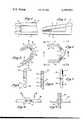
- FIG. 1is a side view of the clip of the present invention in an applicating device
- FIG. 2is a side view of the clip of the present invention in its closed configuration in an applicating device
- FIG. 3is a perspective view of the clip
- FIG. 4is a side view of the clip
- FIG. 5is a vertical cross-sectional view of the clip taken on the line 5--5 of FIG. 4;
- FIG. 6is a horizontal cross-sectional view of the clip taken on the line 6--6 of FIG. 4;
- FIG. 7is a vertical cross-sectional view of the clip taken on substantially the line 7--7 of FIG. 6;
- FIG. 8is a view of the clip as it is closed around a vessel.
- FIG. 9is a view of the cross-hatched pattern formed by the clip when it is closed about a vessel.
- a hemostatic clipis disclosed which is useful in the strangulation of blood vessels and other fluid ducts.
- the hemostatic clip of the present inventionmay be used with an applicator device such as is described in our copending application Ser. No. 822,096, filed on Aug. 5, 1977, entitled “Surgical Stapler”, or in our copending application Ser. No. 822,076 filed on Aug. 5, 1977, entitled HEMOSTATIC CLIP APPLICATOR or in any other suitably adapted applicator device.
- the hemostatic clipis formed from tantalum, although any other deformable, non-toxic, biologically inert material such as stainless steel, plastics and materials which are slowly absorbed in body fluids may also be used, provided such material generally retains the shape to which it is deformed.
- any other deformable, non-toxic, biologically inert materialsuch as stainless steel, plastics and materials which are slowly absorbed in body fluids may also be used, provided such material generally retains the shape to which it is deformed.
- the hemostatic clip 6 of the present inventionis shown in its open configuration as it is disposed in groove 4 in applicating instrument 3. Also shown in FIG. 1 are jaws 2 of the applicating instrument 3. In operation, hemostatic clip 6 is loaded into the extreme end of grove 4 of applicator 3. When the clip 6 is to be used, opposing jaws 2 of applicator 3 close on clip 6, deforming the clip into a closed configuration about a vessel which is to be strangled. In FIG. 2, hemostatic clip 6 is shown in its closed configuration resulting from the squeezing of jaws 2 of applicating instrument 3, thereby causing clip 6 to bend and ultimately collapse.
- FIG. 3is an enlarged view of hemostatic clip 6 in its open configuration. Illustrated here are arm portions 12 as they are coupled to bail portion 10. As is shown in FIG. 3, arm portions 12 are of a generally hexagonal cross-section, having an outwardly facing side 24 and an inwardly facing flat surface 26. Of course, a variety of other configurations may be utilized in the construction of arm portions 12. For example, arm portions 12 may have a generally flat outer side which has cut-away surfaces sloping up and away therefrom so that the outer side is smaller than the remainder of the arm portion. Thus, the cut-away surfaces may be of a rounded configuration or generally flat.
- flat surface 26is the widest side of the hexagonal cross-section while outward facing side 24 is generally parallel to flat surface 26.
- bail portion 10is generally rectangular at its apex 11, while it assumes the hexagonal cross-sectional shape of arm portions 12 near its extremity 13.
- apex 11has a generally sharp exterior surface to provide positive coupling in the applicator device being utilized, while apex 11 is centered between arm portions 12. Diagonally disposed across flat surface 26 are recesses 16.
- hemostatic clip 6provides a large surface area of contact when arms 12 are squeezed together, due to the extensive area provided by flat surface 26. This large surface area of contact provides a more sure closure of the vessel since a large area of the vessel being strangled is collapsed against itself. Thus, the possible failure of the clip 6 is greatly minimized.
- arms 12are essentially of equal length and substantially longer than bail portion 10. The equality of length allows the clip 6 to collapse in a parallel and uniform manner since the outer extremities of each arm are the first to meet during squeezing of clip 6, allowing the more interior surfaces to bend and meet in a uniform manner.
- each arm 12is provided in the presently preferred embodiment so as to provide rotational stability of the clip 6 in its applicator device. That is, if each arm 12 was not generally longer than bail portion 10, clip 6 may have a tendency to rotate and become displaced in the applicator device.
- FIG. 4is a side view of hemostatic clip 6, showing the V-shaped cross-section of recesses 16. Also shown in FIG. 4 is the junction 17 of the hexagonal portion 20 of arm portions 12 as they converge on the rectangular cross-sectional area of bail portion 10.
- bail portion 10is illustrated in FIG. 4 as having a generally V-shaped configuration, of course, it can be of a rounded configuration or a variety of other configurations which are suitably adapted to cooperate with the applicator device being utilized.
- FIGS. 5, 6, and 7,three views of the clip illustrated in FIG. 4 are shown.
- an end view of hemostatic clip 6is shown from a view along line 5--5 of FIG. 4.
- This viewillustrates the hexagonal shape 20 of arm portion 12, and the wide surface 22 of arm portion 12.
- Also shown in FIG. 5is outward facing side 24 of arm portion 12.
- FIG. 6is a vertical cross-section of FIG. 4 taken along lines 6--6.
- This FIG. 6illustrates the rectangular cross-section 28 of bail portion 10 at its apex 11.
- flat surface 26 of arm portion 12 and recesses 16in both the lower part of arm portion 12 and upper part of arm portion 12.
- FIG. 7is a side view of hemostatic clip 6 taken along line 7--7 of FIG. 4.
- apex 11has a generally flat outwardly facing surface which is substantially normal to the length of the clip 6. This surface provides a sure contact with the feed mechanism of the instrument being used to apply clip 6, although other configurations, such as a concave surface may be used.
- FIG. 8illustrates a blood vessel 30 or similar vessel as it is constricted by hemostatic clip 6.
- the constricted portions 32 of vessel 30show opposing walls of the vessel collapsed against one another. It can be seen in FIG. 8 that the flat wide surface 22 of arm portions 12 provide expansive constriction of vessel 30, thereby providing complete and secure strangulation.
- FIG. 9is a cross-sectional view taken along line 9--9 of FIG. 8.
- FIG. 9illustrates collapsed vessel 30 and the resulting configuration of recesses 16 as they are disposed in both the upper part and lower part of arm portions 12. It can be seen from both FIG. 9 and FIG. 3 that recesses 16 are disposed in one arm portion 12 in such a way as to be angularly displaced in relationship to the recesses 16 disposed in the opposing arm portion 12. This angular displacement of recesses 16 results in a cross-hatched pattern 34 when flat surfaces 26 of the opposing arm portions 12 are brought together following closure of clip 6. It is important to note that recesses 16 are all angularly displaced with respect to the length and width of vessel 30.
- this cross-hatched configuration 34will oppose any movement of the clip either in a longitudinal or lateral direction with respect to vessel 30. Therefore, hemostatic clip 6, when it is squeezed around vessel 30, will not have a tendancy to slip along the length or width of the vessel.
Landscapes
- Health & Medical Sciences (AREA)
- Surgery (AREA)
- Life Sciences & Earth Sciences (AREA)
- Heart & Thoracic Surgery (AREA)
- Nuclear Medicine, Radiotherapy & Molecular Imaging (AREA)
- Vascular Medicine (AREA)
- Engineering & Computer Science (AREA)
- Biomedical Technology (AREA)
- Reproductive Health (AREA)
- Medical Informatics (AREA)
- Molecular Biology (AREA)
- Animal Behavior & Ethology (AREA)
- General Health & Medical Sciences (AREA)
- Public Health (AREA)
- Veterinary Medicine (AREA)
- Surgical Instruments (AREA)
Abstract
Description
1. Copending Pat. Applications
In copending U.S. Pat. application Ser. No. 822,096 entitled SURGICAL STAPLER filed Aug. 5, 1966, and in copending U.S. patent application Ser. No. 822,076 entitled HEMOSTATIC CLIP APPLICATOR filed Aug. 5, 1977, both assigned to the present assignee, hemostatic clip applicators for the strangulation of tubular members in a rapid and automatic manner is disclosed. The present invention is directed toward hemostatic clips useful in the above cited devices and similar applying devices.
2. Field of the Invention:
The invention relates to the field of devices useful in the strangulation of tubular members, and more specifically, to hemostatic clips used in the strangulation of blood vessels and other fluid ducts.
3. Prior Art:
Many surgical procedures require the severence and closure of numerous veins, arteries or other blood vessels and fluid ducts. Typically, this severence and closure has been accomplished by first severing the vessel and then clamping it with a hemostat. A ligature is then secured about each vessel which provides closure and permits removal of the clamps. This procedure is quite time consuming and some surgical procedures are further complicated by the fact that they require the closure of a great many vessels in a very limited area.
One prior art attempt to provide more rapid yet effective strangulation of blood vessels and the like is described by Skold, U.S. Pat. No. 3,120,230. Skold utilizes a clip formed from a length of smooth round wire stock which has been bent into a generally V-shaped configuration. This length of wire is squeezed around the vessel, which is to be closed, by an application device. Another prior art attempt to provide effective strangulation is described by Samuels, U.S. Pat. No. 3,867,944. The clip disclosed by Samuels is also a generally V-shaped configuration, although it has teeth-like projections extending inwardly on two opposing arms. When the clip is closed about a vessel, the opposing teeth of the clip engaged the vessel from both sides and squeeze it shut. A third prior art attempt to provide rapid yet effective strangulation is disclosed by Wood, U.S. Pat. No. 3,363,628. The Wood clip is formed of a strip of non-toxic material which is triangular in cross-section, having a flat side facing inwardly and at least one valley along the outer length of the material. Across the flat inwardly facing sides are serations configured so as to run parallel to the direction of the vessel. A fourth prior art attempt to provide an effective clip design is disclosed by Wood, U.S. Pat. No. 3,326,216. This Wood clip is also formed of an elongate strip of non-toxic material which has at least one longitudinal valley and at least one crosswise serration in the interior surface of its pair of arms.
Two problems are associated with all of the prior art clip constructions noted above. First, the surface area of contact between the opposing faces of the clips is severely limited by the configuration of the faces. This limited surface area could prevent thorough strangulation, resulting in the possibility of incomplete closure. Second, the configuration of the surface areas which contact the vessel allow possible slippage of the clip along the vessel. That is, the surface areas contacting the vessel are configured such that they do not oppose slippage of the clip along the length of the vessel being secured.
Accordingly, it is a general object of the present invention to provide an improved hemostatic clip for the strangulation of blood vessels and the like.
It is another object of the present invention to provide an improved hemostatic clip with a large surface area of contact between the opposing surfaces of the clips.
It is yet another object of the present inveniton to provide an improved hemostatic clip which will not slip along the length and width of the vessel.
A hemostatic clip useful for strangulation of blood vessels and the like is provided. The clip has a pair of arms coupled at one end to a bail portion and open at the other, each arm having a substantially flat surface facing inwardly. In each flat surface are a multiple of recesses, having a V-shaped cross-section, which extend diagonally across each surface. The diagonal recesses are arranged in the opposing flat surfaces so that when the surfaces are brought into contact by squeezing the clip together the recesses in the opposing surfaces form a generally cross-hatched pattern. The bail portion of the clip has a substantially rectangular cross-section, while the arm portions are generally hexagonal in cross-section.
The novel features which are believed to be characteristic of the invention, both as to its organization and its method of operation, together with further objects and advantages thereof, will be better understood from the following description in connection with accompanying drawings in which a presently preferred embodiment of the invention is illustrated by way of example. It is to be expressly understood, however, that the drawings are for purposes of illustration and description only and are not intended as a definition of the limits of the invention.
FIG. 1 is a side view of the clip of the present invention in an applicating device;
FIG. 2 is a side view of the clip of the present invention in its closed configuration in an applicating device;
FIG. 3 is a perspective view of the clip;
FIG. 4 is a side view of the clip;
FIG. 5 is a vertical cross-sectional view of the clip taken on theline 5--5 of FIG. 4;
FIG. 6 is a horizontal cross-sectional view of the clip taken on theline 6--6 of FIG. 4;
FIG. 7 is a vertical cross-sectional view of the clip taken on substantially the line 7--7 of FIG. 6;
FIG. 8 is a view of the clip as it is closed around a vessel; and
FIG. 9 is a view of the cross-hatched pattern formed by the clip when it is closed about a vessel.
A hemostatic clip is disclosed which is useful in the strangulation of blood vessels and other fluid ducts. The hemostatic clip of the present invention may be used with an applicator device such as is described in our copending application Ser. No. 822,096, filed on Aug. 5, 1977, entitled "Surgical Stapler", or in our copending application Ser. No. 822,076 filed on Aug. 5, 1977, entitled HEMOSTATIC CLIP APPLICATOR or in any other suitably adapted applicator device.
In the presently preferred embodiment, the hemostatic clip is formed from tantalum, although any other deformable, non-toxic, biologically inert material such as stainless steel, plastics and materials which are slowly absorbed in body fluids may also be used, provided such material generally retains the shape to which it is deformed. The utilization of the materials noted above allow the hemostatic clip of the present invention to be tolerated in the body for indefinite periods of time.
Referring to FIG. 1, thehemostatic clip 6 of the present invention is shown in its open configuration as it is disposed ingroove 4 in applicating instrument 3. Also shown in FIG. 1 arejaws 2 of the applicating instrument 3. In operation,hemostatic clip 6 is loaded into the extreme end ofgrove 4 of applicator 3. When theclip 6 is to be used, opposingjaws 2 of applicator 3 close onclip 6, deforming the clip into a closed configuration about a vessel which is to be strangled. In FIG. 2,hemostatic clip 6 is shown in its closed configuration resulting from the squeezing ofjaws 2 of applicating instrument 3, thereby causingclip 6 to bend and ultimately collapse.
FIG. 3 is an enlarged view ofhemostatic clip 6 in its open configuration. Illustrated here arearm portions 12 as they are coupled to bailportion 10. As is shown in FIG. 3,arm portions 12 are of a generally hexagonal cross-section, having an outwardly facingside 24 and an inwardly facingflat surface 26. Of course, a variety of other configurations may be utilized in the construction ofarm portions 12. For example,arm portions 12 may have a generally flat outer side which has cut-away surfaces sloping up and away therefrom so that the outer side is smaller than the remainder of the arm portion. Thus, the cut-away surfaces may be of a rounded configuration or generally flat. However, in the presently preferred embodimentflat surface 26 is the widest side of the hexagonal cross-section while outward facingside 24 is generally parallel toflat surface 26. It can also be seen in FIG.3 thatbail portion 10 is generally rectangular at its apex 11, while it assumes the hexagonal cross-sectional shape ofarm portions 12 near itsextremity 13. Also, in the presently preferred embodiment, apex 11 has a generally sharp exterior surface to provide positive coupling in the applicator device being utilized, whileapex 11 is centered betweenarm portions 12. Diagonally disposed acrossflat surface 26 are recesses 16.
It can be seen from FIG. 3 thathemostatic clip 6 provides a large surface area of contact whenarms 12 are squeezed together, due to the extensive area provided byflat surface 26. This large surface area of contact provides a more sure closure of the vessel since a large area of the vessel being strangled is collapsed against itself. Thus, the possible failure of theclip 6 is greatly minimized. It can also be seen from FIG. 3 that in the presently preferredembodiment arms 12 are essentially of equal length and substantially longer thanbail portion 10. The equality of length allows theclip 6 to collapse in a parallel and uniform manner since the outer extremities of each arm are the first to meet during squeezing ofclip 6, allowing the more interior surfaces to bend and meet in a uniform manner. The substantial length of eacharm 12 is provided in the presently preferred embodiment so as to provide rotational stability of theclip 6 in its applicator device. That is, if eacharm 12 was not generally longer thanbail portion 10,clip 6 may have a tendency to rotate and become displaced in the applicator device.
FIG. 4 is a side view ofhemostatic clip 6, showing the V-shaped cross-section ofrecesses 16. Also shown in FIG. 4 is thejunction 17 of thehexagonal portion 20 ofarm portions 12 as they converge on the rectangular cross-sectional area ofbail portion 10. Althoughbail portion 10 is illustrated in FIG. 4 as having a generally V-shaped configuration, of course, it can be of a rounded configuration or a variety of other configurations which are suitably adapted to cooperate with the applicator device being utilized.
Now referring to FIGS. 5, 6, and 7, three views of the clip illustrated in FIG. 4 are shown. In FIG. 5 an end view ofhemostatic clip 6 is shown from a view alongline 5--5 of FIG. 4. This view illustrates thehexagonal shape 20 ofarm portion 12, and thewide surface 22 ofarm portion 12. Also shown in FIG. 5 is outward facingside 24 ofarm portion 12. FIG. 6 is a vertical cross-section of FIG. 4 taken alonglines 6--6. This FIG. 6 illustrates therectangular cross-section 28 ofbail portion 10 at itsapex 11. Also shown isflat surface 26 ofarm portion 12 and recesses 16 in both the lower part ofarm portion 12 and upper part ofarm portion 12. FIG. 7 is a side view ofhemostatic clip 6 taken along line 7--7 of FIG. 4. This Figure illustrates therectangular bail portion 10 as it converges into thehexagonal shape 20 ofarm portions 12. In the presently preferred embodiment, apex 11 has a generally flat outwardly facing surface which is substantially normal to the length of theclip 6. This surface provides a sure contact with the feed mechanism of the instrument being used to applyclip 6, although other configurations, such as a concave surface may be used.
FIG. 8 illustrates ablood vessel 30 or similar vessel as it is constricted byhemostatic clip 6. The constrictedportions 32 ofvessel 30 show opposing walls of the vessel collapsed against one another. It can be seen in FIG. 8 that the flatwide surface 22 ofarm portions 12 provide expansive constriction ofvessel 30, thereby providing complete and secure strangulation.
FIG. 9 is a cross-sectional view taken along line 9--9 of FIG. 8. FIG. 9 illustrates collapsedvessel 30 and the resulting configuration ofrecesses 16 as they are disposed in both the upper part and lower part ofarm portions 12. It can be seen from both FIG. 9 and FIG. 3 that recesses 16 are disposed in onearm portion 12 in such a way as to be angularly displaced in relationship to therecesses 16 disposed in theopposing arm portion 12. This angular displacement ofrecesses 16 results in across-hatched pattern 34 whenflat surfaces 26 of theopposing arm portions 12 are brought together following closure ofclip 6. It is important to note that recesses 16 are all angularly displaced with respect to the length and width ofvessel 30. Thus, thiscross-hatched configuration 34 will oppose any movement of the clip either in a longitudinal or lateral direction with respect tovessel 30. Therefore,hemostatic clip 6, when it is squeezed aroundvessel 30, will not have a tendancy to slip along the length or width of the vessel.
There has been described herein a new and novel hemostatic clip which has special utility for strangulation of blood vessels and the like. While a specific embodiment of the present invention has been disclosed and described in detail herein, it will be understood by those skilled in the art that various changes in form and detail may be made therein without departing from the spirit and scope of the invention.
Claims (2)
1. A hemostatic clip formed of elongate deformable material for use in the strangulation of tubular members by means of a hemostatic clip applicator, the clip applicator of the type having jaw portions adapted to receive and maintain hemostatic clips via grooves in said jaws, said jaws further having stop portions at the extremity thereof adapted to maintain said hemostatic clips within said grooves, the hemostatic clip being generally U-shaped and comprising:
(i) a bail portion forming the base of said U-shape;
(ii) a pair of arms extending from said bail portion and forming the extremities of said U-shape, said arms being separated in a substantially opposed relationship and having opposing substantially flat surfaces, each arm being substantially longer than said bail portion, whereby said substantial length of said arm portions results in stability of said clip in said clip applicator, each arm having a generally trapezoidal cross-section with a narrower outer portion adapted to be received in a respective groove of said clip applicator; and
(iii) a plurality of spaced parallel diagonally disposed grooves extending downwardly into each of said clip arm opposing surfaces, said grooves extending below each clip arm flat surface and being spaced apart sufficiently so that substantial portions of said flat surface remain between adjacent grooves, the grooves on one arm extending solely in one direction, the grooves on the other arm extending solely in an opposite direction such that the grooves in opposing surfaces are angularly displaced with respect to one another, whereby said grooves form a generally cross-hatched pattern when said opposing substantially flat surfaces are brought into facing contact with one another.
2. The clip of claim 1 wherein said bail portion is V-shaped and each arm is coupled to one extremity of said bail portion.
Priority Applications (2)
| Application Number | Priority Date | Filing Date | Title |
|---|---|---|---|
| US05/822,095US4188953A (en) | 1977-08-05 | 1977-08-05 | Hemostatic clip |
| CA291,946ACA1102197A (en) | 1977-08-05 | 1977-11-29 | Hemostatic clip |
Applications Claiming Priority (1)
| Application Number | Priority Date | Filing Date | Title |
|---|---|---|---|
| US05/822,095US4188953A (en) | 1977-08-05 | 1977-08-05 | Hemostatic clip |
Publications (1)
| Publication Number | Publication Date |
|---|---|
| US4188953Atrue US4188953A (en) | 1980-02-19 |
Family
ID=25235125
Family Applications (1)
| Application Number | Title | Priority Date | Filing Date |
|---|---|---|---|
| US05/822,095Expired - LifetimeUS4188953A (en) | 1977-08-05 | 1977-08-05 | Hemostatic clip |
Country Status (2)
| Country | Link |
|---|---|
| US (1) | US4188953A (en) |
| CA (1) | CA1102197A (en) |
Cited By (59)
| Publication number | Priority date | Publication date | Assignee | Title |
|---|---|---|---|---|
| US4333649A (en)* | 1980-03-07 | 1982-06-08 | Amf Incorporated | Racket string clamp |
| US4556058A (en)* | 1983-08-17 | 1985-12-03 | United States Surgical Corporation | Apparatus for ligation and division with fixed jaws |
| US4702247A (en)* | 1985-08-20 | 1987-10-27 | American Hospital Supply Corporation | Ligating clip |
| GB2190297A (en)* | 1986-05-10 | 1987-11-18 | Femcare Ltd | Sexual sterilisation device |
| EP0287275A1 (en)* | 1987-04-08 | 1988-10-19 | Ethicon, Inc. | Surgical hemostatic clips |
| US4787391A (en)* | 1985-06-17 | 1988-11-29 | Elefteriades John A | Anastomotic marking device and related method |
| US4800879A (en)* | 1987-07-09 | 1989-01-31 | Vladimir Golyakhovsky | Disposable vascular occluder |
| US4822348A (en)* | 1987-05-13 | 1989-04-18 | Donn Casey | Surgical clips |
| US4938765A (en)* | 1989-06-22 | 1990-07-03 | Life Centers, Inc. | Surgical silicon loops |
| US4971198A (en)* | 1988-04-18 | 1990-11-20 | Edward Weck Incorporated | Hemostatic clip and cartridge assembly |
| US4976722A (en)* | 1989-05-22 | 1990-12-11 | Ethicon, Inc. | Surgical hemostatic clips |
| US5002552A (en)* | 1987-11-10 | 1991-03-26 | Donn Casey | Surgical clip |
| USD323555S (en) | 1989-06-22 | 1992-01-28 | Life Centers, Inc. | Surgical vessel loop |
| EP0476956A1 (en)* | 1990-09-18 | 1992-03-25 | Femcare Limited | Suture apparatus |
| US5201746A (en)* | 1991-10-16 | 1993-04-13 | United States Surgical Corporation | Surgical hemostatic clip |
| US5282811A (en)* | 1992-04-16 | 1994-02-01 | Cook Pacemaker Corporation | Two part surgical ligating clip, applicator and method of use |
| US5300081A (en)* | 1992-10-09 | 1994-04-05 | United States Surgical Corporation | Surgical clip applier having clip advancement control |
| US5382255A (en)* | 1993-01-08 | 1995-01-17 | United States Surgical Corporation | Apparatus and method for assembly of surgical instruments |
| US5382254A (en)* | 1989-07-18 | 1995-01-17 | United States Surgical Corporation | Actuating handle for surgical instruments |
| US5383881A (en)* | 1989-07-18 | 1995-01-24 | United States Surgical Corporation | Safety device for use with endoscopic instrumentation |
| US5487746A (en)* | 1994-11-23 | 1996-01-30 | Yu; George W. | Surgical clip having a longitudinal opening through which clamped tissue protrudes |
| US5501693A (en)* | 1994-07-06 | 1996-03-26 | United States Surgical Corporation | Surgical hemostatic clip |
| US5509920A (en)* | 1993-04-16 | 1996-04-23 | United States Surgical Corporation | Surgical hemostatic clip |
| DE19520158A1 (en)* | 1995-06-01 | 1996-12-05 | Aesculap Ag | Chip for surgical use |
| US5607436A (en)* | 1993-10-08 | 1997-03-04 | United States Surgical Corporation | Apparatus for applying surgical clips |
| US5713911A (en)* | 1996-10-03 | 1998-02-03 | United States Surgical Corporation | Surgical clip |
| US5833696A (en)* | 1996-10-03 | 1998-11-10 | United States Surgical Corporation | Apparatus for applying surgical clips |
| US6015417A (en)* | 1996-01-25 | 2000-01-18 | Reynolds, Jr.; Walker | Surgical fastener |
| US6217590B1 (en) | 1999-01-22 | 2001-04-17 | Scion International, Inc. | Surgical instrument for applying multiple staples and cutting blood vessels and organic structures and method therefor |
| US6228097B1 (en) | 1999-01-22 | 2001-05-08 | Scion International, Inc. | Surgical instrument for clipping and cutting blood vessels and organic structures |
| US20020082621A1 (en)* | 2000-09-22 | 2002-06-27 | Schurr Marc O. | Methods and devices for folding and securing tissue |
| USD472631S1 (en) | 2001-04-05 | 2003-04-01 | Tyco Healthcare Group Lp | Clip |
| US6610073B1 (en) | 1999-10-19 | 2003-08-26 | Scion International, Inc. | Surgical clip, clip applicator and method therefor |
| USD488228S1 (en) | 2001-04-05 | 2004-04-06 | Tyc Healthcare Group Lp | Clip |
| US20060100649A1 (en)* | 2002-12-17 | 2006-05-11 | Hart Charles C | Surgical staple-clip and applier |
| US20060235437A1 (en)* | 2005-04-14 | 2006-10-19 | Ethicon Endo-Surgery, Inc. | Surgical clip applier methods |
| US20060235468A1 (en)* | 2005-04-14 | 2006-10-19 | Ethicon Endo-Surgery, Inc. | Surgical clip |
| US20060235444A1 (en)* | 2005-04-14 | 2006-10-19 | Ethicon Endo-Surgery, Inc. | Clip advancer mechanism with alignment features |
| US20060235441A1 (en)* | 2005-04-14 | 2006-10-19 | Ethicon Endo-Surgery, Inc. | Surgical Clip Advancement and Alignment Mechanism |
| US20060235443A1 (en)* | 2005-04-14 | 2006-10-19 | Ethicon Endo-Surgery, Inc. | Clip applier configured to prevent clip fallout |
| US20060235440A1 (en)* | 2005-04-14 | 2006-10-19 | Ethicon Endo-Surgery, Inc. | Surgical clip applier ratchet mechanism |
| US20060235439A1 (en)* | 2005-04-14 | 2006-10-19 | Ethicon Endo-Surgery, Inc. | Surgical clip advancement mechanism |
| US20070073314A1 (en)* | 2005-09-29 | 2007-03-29 | Applied Medical Resources Corporation | Manually actuated surgical clip applier |
| EP1810622A1 (en) | 2006-01-23 | 2007-07-25 | Tyco Healthcare Group Lp | Surgical hemostatic clip |
| US7288098B2 (en) | 2005-04-14 | 2007-10-30 | Ethicon Endo-Surgery, Inc. | Force limiting mechanism for medical instrument |
| US20090014002A1 (en)* | 2005-04-14 | 2009-01-15 | Honeywell International Inc. | Air filter assembly |
| US7740641B2 (en) | 2005-04-14 | 2010-06-22 | Ethicon Endo-Surgery, Inc. | Clip applier with migrational resistance features |
| US20110082347A1 (en)* | 2009-10-07 | 2011-04-07 | Tyco Healthcare Group Lp | Spring jaw retraction device |
| US20110087241A1 (en)* | 2009-10-09 | 2011-04-14 | Ethicon Endo-Surgery, Inc. | Clip Advancer |
| US20110087243A1 (en)* | 2009-10-09 | 2011-04-14 | Ethicon Endo-Surgery, Inc. | Clip advancer with lockout mechanism |
| US20110108603A1 (en)* | 2000-10-20 | 2011-05-12 | Tyco Healthcare Group Lp | Directionally biased staple and method of manufacturing |
| US20110224701A1 (en)* | 2010-03-10 | 2011-09-15 | Pavel Menn | Surgical Clips For Laparoscopic Procedures |
| US20120109158A1 (en)* | 2010-11-02 | 2012-05-03 | Tyco Healthcare Group Lp | Self-centering clip and jaw |
| US20140018830A1 (en)* | 2013-09-13 | 2014-01-16 | Ethicon Endo-Surgery, Inc. | Surgical Clip Having Compliant Portion |
| US20140018832A1 (en)* | 2013-09-13 | 2014-01-16 | Ethicon Endo-Surgery, Inc. | Method For Applying A Surgical Clip Having A Compliant Portion |
| US9370400B2 (en) | 2011-10-19 | 2016-06-21 | Ethicon Endo-Surgery, Inc. | Clip applier adapted for use with a surgical robot |
| USD809659S1 (en)* | 2011-03-10 | 2018-02-06 | Conmed Corporation | Surgical clip |
| US10201353B2 (en) | 2017-02-03 | 2019-02-12 | Pavel Menn | Ligation clip |
| US11304702B2 (en) | 2013-09-13 | 2022-04-19 | Cilag Gmbh International | Surgical clip having compliant portion |
Citations (6)
| Publication number | Priority date | Publication date | Assignee | Title |
|---|---|---|---|---|
| FR529919A (en)* | 1921-01-18 | 1921-12-09 | Joseph Bruneau & Cie | Hemostasis forceps allowing the sectioning, without trial and error, of the ligature wire |
| US2598901A (en)* | 1950-03-10 | 1952-06-03 | Garland Mather | Clamp for constricting flexible tubular elements and the like |
| US3270745A (en)* | 1963-06-11 | 1966-09-06 | Rene G Le Vaux | Hemostatic clip constructions |
| US3363628A (en)* | 1964-09-28 | 1968-01-16 | Peter B Samuels | Hemostatic clip |
| US3766926A (en)* | 1972-08-29 | 1973-10-23 | R Bliss | Vasectomy prosthesis |
| US3867944A (en)* | 1972-10-27 | 1975-02-25 | Wood Ernest C | Hemostatic clip and applicator therefor |
- 1977
- 1977-08-05USUS05/822,095patent/US4188953A/ennot_activeExpired - Lifetime
- 1977-11-29CACA291,946Apatent/CA1102197A/ennot_activeExpired
Patent Citations (6)
| Publication number | Priority date | Publication date | Assignee | Title |
|---|---|---|---|---|
| FR529919A (en)* | 1921-01-18 | 1921-12-09 | Joseph Bruneau & Cie | Hemostasis forceps allowing the sectioning, without trial and error, of the ligature wire |
| US2598901A (en)* | 1950-03-10 | 1952-06-03 | Garland Mather | Clamp for constricting flexible tubular elements and the like |
| US3270745A (en)* | 1963-06-11 | 1966-09-06 | Rene G Le Vaux | Hemostatic clip constructions |
| US3363628A (en)* | 1964-09-28 | 1968-01-16 | Peter B Samuels | Hemostatic clip |
| US3766926A (en)* | 1972-08-29 | 1973-10-23 | R Bliss | Vasectomy prosthesis |
| US3867944A (en)* | 1972-10-27 | 1975-02-25 | Wood Ernest C | Hemostatic clip and applicator therefor |
Cited By (116)
| Publication number | Priority date | Publication date | Assignee | Title |
|---|---|---|---|---|
| US4333649A (en)* | 1980-03-07 | 1982-06-08 | Amf Incorporated | Racket string clamp |
| US4556058A (en)* | 1983-08-17 | 1985-12-03 | United States Surgical Corporation | Apparatus for ligation and division with fixed jaws |
| US4787391A (en)* | 1985-06-17 | 1988-11-29 | Elefteriades John A | Anastomotic marking device and related method |
| US4702247A (en)* | 1985-08-20 | 1987-10-27 | American Hospital Supply Corporation | Ligating clip |
| GB2190297B (en)* | 1986-05-10 | 1991-02-20 | Femcare Ltd | Sexual sterilisation device |
| GB2190297A (en)* | 1986-05-10 | 1987-11-18 | Femcare Ltd | Sexual sterilisation device |
| EP0287275A1 (en)* | 1987-04-08 | 1988-10-19 | Ethicon, Inc. | Surgical hemostatic clips |
| JPS63275333A (en)* | 1987-04-08 | 1988-11-14 | エシコン・インコーポレイテツド | Surgical hemostatic clip |
| JP2612025B2 (en) | 1987-04-08 | 1997-05-21 | エシコン・インコーポレイテツド | Surgical hemostatic clip |
| AU602206B2 (en)* | 1987-04-08 | 1990-10-04 | Ethicon Inc. | Surgical hemostatic clips |
| US4822348A (en)* | 1987-05-13 | 1989-04-18 | Donn Casey | Surgical clips |
| US4800879A (en)* | 1987-07-09 | 1989-01-31 | Vladimir Golyakhovsky | Disposable vascular occluder |
| US5002552A (en)* | 1987-11-10 | 1991-03-26 | Donn Casey | Surgical clip |
| US4971198A (en)* | 1988-04-18 | 1990-11-20 | Edward Weck Incorporated | Hemostatic clip and cartridge assembly |
| US4976722A (en)* | 1989-05-22 | 1990-12-11 | Ethicon, Inc. | Surgical hemostatic clips |
| US4938765A (en)* | 1989-06-22 | 1990-07-03 | Life Centers, Inc. | Surgical silicon loops |
| USD323555S (en) | 1989-06-22 | 1992-01-28 | Life Centers, Inc. | Surgical vessel loop |
| US5382254A (en)* | 1989-07-18 | 1995-01-17 | United States Surgical Corporation | Actuating handle for surgical instruments |
| US5383881A (en)* | 1989-07-18 | 1995-01-24 | United States Surgical Corporation | Safety device for use with endoscopic instrumentation |
| EP0476956A1 (en)* | 1990-09-18 | 1992-03-25 | Femcare Limited | Suture apparatus |
| US5219359A (en)* | 1990-09-18 | 1993-06-15 | Femcare Limited | Suture apparatus |
| US5201746A (en)* | 1991-10-16 | 1993-04-13 | United States Surgical Corporation | Surgical hemostatic clip |
| US5282811A (en)* | 1992-04-16 | 1994-02-01 | Cook Pacemaker Corporation | Two part surgical ligating clip, applicator and method of use |
| US5300081A (en)* | 1992-10-09 | 1994-04-05 | United States Surgical Corporation | Surgical clip applier having clip advancement control |
| US5382255A (en)* | 1993-01-08 | 1995-01-17 | United States Surgical Corporation | Apparatus and method for assembly of surgical instruments |
| US5509920A (en)* | 1993-04-16 | 1996-04-23 | United States Surgical Corporation | Surgical hemostatic clip |
| US5626592A (en)* | 1993-04-16 | 1997-05-06 | United States Surgical Corporation | Surgical hemostatic clip |
| US5792150A (en)* | 1993-10-08 | 1998-08-11 | United States Surgical Corporation | Apparatus for applying surgical clips with improved jaw and closure mechanisms |
| US5607436A (en)* | 1993-10-08 | 1997-03-04 | United States Surgical Corporation | Apparatus for applying surgical clips |
| US5501693A (en)* | 1994-07-06 | 1996-03-26 | United States Surgical Corporation | Surgical hemostatic clip |
| US5487746A (en)* | 1994-11-23 | 1996-01-30 | Yu; George W. | Surgical clip having a longitudinal opening through which clamped tissue protrudes |
| DE19520158A1 (en)* | 1995-06-01 | 1996-12-05 | Aesculap Ag | Chip for surgical use |
| DE19520158C2 (en)* | 1995-06-01 | 1998-10-15 | Aesculap Ag & Co Kg | Surgical clip |
| US6015417A (en)* | 1996-01-25 | 2000-01-18 | Reynolds, Jr.; Walker | Surgical fastener |
| US5713911A (en)* | 1996-10-03 | 1998-02-03 | United States Surgical Corporation | Surgical clip |
| US5833696A (en)* | 1996-10-03 | 1998-11-10 | United States Surgical Corporation | Apparatus for applying surgical clips |
| US6460749B1 (en) | 1999-01-22 | 2002-10-08 | Scion International, Inc. | Surgical instrument for stapling and cutting blood vessels and organic structures |
| US6306150B1 (en) | 1999-01-22 | 2001-10-23 | Scion International, Inc. | Surgical clips for surgical instrument for stapling and cutting blood vessels and organic structures |
| US6217590B1 (en) | 1999-01-22 | 2001-04-17 | Scion International, Inc. | Surgical instrument for applying multiple staples and cutting blood vessels and organic structures and method therefor |
| US6228097B1 (en) | 1999-01-22 | 2001-05-08 | Scion International, Inc. | Surgical instrument for clipping and cutting blood vessels and organic structures |
| US6610073B1 (en) | 1999-10-19 | 2003-08-26 | Scion International, Inc. | Surgical clip, clip applicator and method therefor |
| US20050277958A1 (en)* | 1999-10-19 | 2005-12-15 | Levinson Melvin E | Surgical clip, clip applicator and method therefor |
| US10245026B2 (en) | 2000-09-22 | 2019-04-02 | Boston Scientific Scimed, Inc. | Methods and devices for folding and securing tissue |
| US20020082621A1 (en)* | 2000-09-22 | 2002-06-27 | Schurr Marc O. | Methods and devices for folding and securing tissue |
| US9173656B2 (en) | 2000-09-22 | 2015-11-03 | Boston Scientific Scimed, Inc. | Methods and devices for folding and securing tissue |
| US20110108603A1 (en)* | 2000-10-20 | 2011-05-12 | Tyco Healthcare Group Lp | Directionally biased staple and method of manufacturing |
| US9517066B2 (en)* | 2000-10-20 | 2016-12-13 | Covidien Lp | Directionally biased staple and method of manufacturing |
| USD472631S1 (en) | 2001-04-05 | 2003-04-01 | Tyco Healthcare Group Lp | Clip |
| USD488228S1 (en) | 2001-04-05 | 2004-04-06 | Tyc Healthcare Group Lp | Clip |
| US10383627B2 (en) | 2002-12-17 | 2019-08-20 | Applied Medical Resources Corporation | Surgical staple-clip and applier |
| US20060100649A1 (en)* | 2002-12-17 | 2006-05-11 | Hart Charles C | Surgical staple-clip and applier |
| US8998935B2 (en) | 2002-12-17 | 2015-04-07 | Applied Medical Resources Corporation | Surgical staple-clip and applier |
| US20080319456A1 (en)* | 2002-12-17 | 2008-12-25 | Applied Medical Resources Corporation | Surgical staple-clip and applier |
| US7297149B2 (en) | 2005-04-14 | 2007-11-20 | Ethicon Endo-Surgery, Inc. | Surgical clip applier methods |
| US20060235440A1 (en)* | 2005-04-14 | 2006-10-19 | Ethicon Endo-Surgery, Inc. | Surgical clip applier ratchet mechanism |
| US10667824B2 (en) | 2005-04-14 | 2020-06-02 | Ethicon Llc | Surgical clip applier methods |
| US7261724B2 (en) | 2005-04-14 | 2007-08-28 | Ethicon Endo-Surgery, Inc. | Surgical clip advancement mechanism |
| US7288098B2 (en) | 2005-04-14 | 2007-10-30 | Ethicon Endo-Surgery, Inc. | Force limiting mechanism for medical instrument |
| US10639045B2 (en) | 2005-04-14 | 2020-05-05 | Ethicon Llc | Clip applier with clip follower |
| US20080027466A1 (en)* | 2005-04-14 | 2008-01-31 | Ethicon Endo-Surgery, Inc. | Surgical clip applier methods |
| US20060235439A1 (en)* | 2005-04-14 | 2006-10-19 | Ethicon Endo-Surgery, Inc. | Surgical clip advancement mechanism |
| US20090014002A1 (en)* | 2005-04-14 | 2009-01-15 | Honeywell International Inc. | Air filter assembly |
| US7686820B2 (en) | 2005-04-14 | 2010-03-30 | Ethicon Endo-Surgery, Inc. | Surgical clip applier ratchet mechanism |
| US7699860B2 (en) | 2005-04-14 | 2010-04-20 | Ethicon Endo-Surgery, Inc. | Surgical clip |
| US20100114133A1 (en)* | 2005-04-14 | 2010-05-06 | Ethicon Endo-Surgery, Inc. | Surgical clip |
| US7731724B2 (en) | 2005-04-14 | 2010-06-08 | Ethicon Endo-Surgery, Inc. | Surgical clip advancement and alignment mechanism |
| US7740641B2 (en) | 2005-04-14 | 2010-06-22 | Ethicon Endo-Surgery, Inc. | Clip applier with migrational resistance features |
| US20100185215A1 (en)* | 2005-04-14 | 2010-07-22 | Ethicon Endo-Surgery, Inc. | Surgical clip applier ratchet mechanism |
| US20100249804A1 (en)* | 2005-04-14 | 2010-09-30 | Ethicon Endo-Surgery, Inc. | Clip applier with migrational resistance features |
| US20060235437A1 (en)* | 2005-04-14 | 2006-10-19 | Ethicon Endo-Surgery, Inc. | Surgical clip applier methods |
| US20060235468A1 (en)* | 2005-04-14 | 2006-10-19 | Ethicon Endo-Surgery, Inc. | Surgical clip |
| US9782181B2 (en) | 2005-04-14 | 2017-10-10 | Ethicon Llc | Surgical clip applier methods |
| US8753356B2 (en) | 2005-04-14 | 2014-06-17 | Ethicon Endo-Surgery, Inc. | Surgical clip applier methods |
| US20110218555A1 (en)* | 2005-04-14 | 2011-09-08 | Ethicon Endo-Surgery, Inc. | Clip applier with migrational resistance features |
| US9717504B2 (en) | 2005-04-14 | 2017-08-01 | Ethicon Llc | Clip applier with migrational resistance features |
| US20110218553A1 (en)* | 2005-04-14 | 2011-09-08 | Ethicon Endo-Surgery, Inc. | Surgical clip applier ratchet mechanism |
| US20060235444A1 (en)* | 2005-04-14 | 2006-10-19 | Ethicon Endo-Surgery, Inc. | Clip advancer mechanism with alignment features |
| US20110224696A1 (en)* | 2005-04-14 | 2011-09-15 | Ethicon Endo-Surgery, Inc. | Clip applier configured to prevent clip fallout |
| US8038686B2 (en) | 2005-04-14 | 2011-10-18 | Ethicon Endo-Surgery, Inc. | Clip applier configured to prevent clip fallout |
| US8075571B2 (en) | 2005-04-14 | 2011-12-13 | Ethicon Endo-Surgery, Inc. | Surgical clip applier methods |
| US20060235441A1 (en)* | 2005-04-14 | 2006-10-19 | Ethicon Endo-Surgery, Inc. | Surgical Clip Advancement and Alignment Mechanism |
| US8216257B2 (en) | 2005-04-14 | 2012-07-10 | Ethicon Endo-Surgery, Inc. | Clip applier configured to prevent clip fallout |
| US8236012B2 (en) | 2005-04-14 | 2012-08-07 | Ethicon Endo-Surgery, Inc. | Surgical clip advancement mechanism |
| US8246635B2 (en) | 2005-04-14 | 2012-08-21 | Ethicon Endo-Surgery, Inc. | Clip applier with migrational resistance features |
| US8246634B2 (en) | 2005-04-14 | 2012-08-21 | Ethicon Endo-Surgery, Inc. | Surgical clip applier ratchet mechanism |
| US20060235443A1 (en)* | 2005-04-14 | 2006-10-19 | Ethicon Endo-Surgery, Inc. | Clip applier configured to prevent clip fallout |
| US8915930B2 (en) | 2005-04-14 | 2014-12-23 | Ethicon Endo-Surgery, Inc. | Force limiting mechanism for medical instrument |
| US8328822B2 (en) | 2005-04-14 | 2012-12-11 | Ethicon Endo-Surgery, Inc. | Surgical clip applier ratchet mechanism |
| US8821516B2 (en) | 2005-04-14 | 2014-09-02 | Ethicon Endo-Surgery, Inc. | Clip applier with migrational resistance features |
| US8523882B2 (en) | 2005-04-14 | 2013-09-03 | Ethicon Endo-Surgery, Inc. | Clip advancer mechanism with alignment features |
| US8556920B2 (en) | 2005-04-14 | 2013-10-15 | Ethicon Endo-Surgery, Inc. | Surgical clip |
| US9326776B2 (en) | 2005-09-29 | 2016-05-03 | Applied Medical Resources Corporation | Manually actuated surgical clip applier |
| US20070073314A1 (en)* | 2005-09-29 | 2007-03-29 | Applied Medical Resources Corporation | Manually actuated surgical clip applier |
| EP1810622A1 (en) | 2006-01-23 | 2007-07-25 | Tyco Healthcare Group Lp | Surgical hemostatic clip |
| US20070173866A1 (en)* | 2006-01-23 | 2007-07-26 | Tyco Healthcare Group, Lp | Surgical hemostatic clip |
| US20110082347A1 (en)* | 2009-10-07 | 2011-04-07 | Tyco Healthcare Group Lp | Spring jaw retraction device |
| US20110087243A1 (en)* | 2009-10-09 | 2011-04-14 | Ethicon Endo-Surgery, Inc. | Clip advancer with lockout mechanism |
| US20110218556A1 (en)* | 2009-10-09 | 2011-09-08 | Ethicon Endo-Surgery, Inc. | Clip advancer with lockout mechanism |
| US8496673B2 (en) | 2009-10-09 | 2013-07-30 | Ethicon Endo-Surgery, Inc. | Clip advancer with lockout mechanism |
| US8262679B2 (en) | 2009-10-09 | 2012-09-11 | Ethicon Endo-Surgery, Inc. | Clip advancer |
| US8267945B2 (en) | 2009-10-09 | 2012-09-18 | Ethicon Endo-Surgery, Inc. | Clip advancer with lockout mechanism |
| US20110087241A1 (en)* | 2009-10-09 | 2011-04-14 | Ethicon Endo-Surgery, Inc. | Clip Advancer |
| US20110224701A1 (en)* | 2010-03-10 | 2011-09-15 | Pavel Menn | Surgical Clips For Laparoscopic Procedures |
| US11490897B2 (en)* | 2010-03-10 | 2022-11-08 | Conmed Corporation | Surgical clip for laparoscopic procedures |
| US9597089B2 (en) | 2010-03-10 | 2017-03-21 | Conmed Corporation | Surgical clips for laparoscopic procedures |
| US10702277B2 (en) | 2010-03-10 | 2020-07-07 | Conmed Corporation | Surgical clip for laparoscopic procedures |
| US20120109158A1 (en)* | 2010-11-02 | 2012-05-03 | Tyco Healthcare Group Lp | Self-centering clip and jaw |
| US9011464B2 (en)* | 2010-11-02 | 2015-04-21 | Covidien Lp | Self-centering clip and jaw |
| USD809659S1 (en)* | 2011-03-10 | 2018-02-06 | Conmed Corporation | Surgical clip |
| US10039548B2 (en) | 2011-10-19 | 2018-08-07 | Ethicon Llc | Clip applier adapted for use with a surgical robot |
| US9370400B2 (en) | 2011-10-19 | 2016-06-21 | Ethicon Endo-Surgery, Inc. | Clip applier adapted for use with a surgical robot |
| US11191544B2 (en) | 2011-10-19 | 2021-12-07 | Ethicon Endo-Surgery, Inc. | Clip applier adapted for use with a surgical robot |
| US20140018830A1 (en)* | 2013-09-13 | 2014-01-16 | Ethicon Endo-Surgery, Inc. | Surgical Clip Having Compliant Portion |
| US11304702B2 (en) | 2013-09-13 | 2022-04-19 | Cilag Gmbh International | Surgical clip having compliant portion |
| US20140018832A1 (en)* | 2013-09-13 | 2014-01-16 | Ethicon Endo-Surgery, Inc. | Method For Applying A Surgical Clip Having A Compliant Portion |
| US10201353B2 (en) | 2017-02-03 | 2019-02-12 | Pavel Menn | Ligation clip |
Also Published As
| Publication number | Publication date |
|---|---|
| CA1102197A (en) | 1981-06-02 |
Similar Documents
| Publication | Publication Date | Title |
|---|---|---|
| US4188953A (en) | Hemostatic clip | |
| US3363628A (en) | Hemostatic clip | |
| US4702247A (en) | Ligating clip | |
| US3439523A (en) | Hemostatic clip constructions | |
| US3867944A (en) | Hemostatic clip and applicator therefor | |
| US3326216A (en) | Hemostatic clip constructions | |
| US3270745A (en) | Hemostatic clip constructions | |
| US5201746A (en) | Surgical hemostatic clip | |
| US4414721A (en) | Occlusive clip and applicator for constricting flexible tubular members | |
| US11490897B2 (en) | Surgical clip for laparoscopic procedures | |
| US3120230A (en) | Surgical clamp | |
| US3631707A (en) | Hemostatic clip applicator | |
| KR960006658B1 (en) | Surgical hemostatic clips | |
| US3032039A (en) | Arterial and veinous clamp and clamp applicator | |
| CA1162126A (en) | Double-latched plastic ligating clip | |
| US5219353A (en) | Surgical endoclip | |
| CA2120828C (en) | Surgical hemostatic clip | |
| US6226843B1 (en) | Ligating clip | |
| US4726372A (en) | Hemostatic clip | |
| US4556060A (en) | Surgical clip | |
| US5620452A (en) | Surgical clip with ductile tissue penetrating members | |
| US3409014A (en) | Surgical ligating disk having a noose forming ligature threaded therethrough | |
| US3056408A (en) | Ligature clip | |
| GB1152849A (en) | Hemostatic Clip | |
| US5026382A (en) | Hemostatic clip |
Legal Events
| Date | Code | Title | Description |
|---|---|---|---|
| AS | Assignment | Owner name:COVELL, L. DAVID; 5234 WEST SECOND ST., LOS ANGELE Free format text:ASSIGNMENT OF 1/4 OF ASSIGNORS INTEREST;ASSIGNOR:KLIEMAN, CHARLES H.;REEL/FRAME:004000/0980 Effective date:19820611 Owner name:COVELL, L. DAVID,CALIFORNIA Free format text:ASSIGNMENT OF 1/4 OF ASSIGNORS INTEREST;ASSIGNOR:KLIEMAN, CHARLES H.;REEL/FRAME:004000/0980 Effective date:19820611 |