US4154240A - Electric power source for electrosurgical apparatus - Google Patents
Electric power source for electrosurgical apparatusDownload PDFInfo
- Publication number
- US4154240A US4154240AUS05/866,224US86622478AUS4154240AUS 4154240 AUS4154240 AUS 4154240AUS 86622478 AUS86622478 AUS 86622478AUS 4154240 AUS4154240 AUS 4154240A
- Authority
- US
- United States
- Prior art keywords
- signal
- gate circuit
- high frequency
- output
- circuit
- Prior art date
- Legal status (The legal status is an assumption and is not a legal conclusion. Google has not performed a legal analysis and makes no representation as to the accuracy of the status listed.)
- Expired - Lifetime
Links
- 239000000203mixtureSubstances0.000claimsabstractdescription61
- 230000015271coagulationEffects0.000claimsabstractdescription33
- 238000005345coagulationMethods0.000claimsabstractdescription33
- 230000001131transforming effectEffects0.000claims1
- 238000010586diagramMethods0.000description4
- 230000004048modificationEffects0.000description3
- 238000012986modificationMethods0.000description3
- 239000008280bloodSubstances0.000description2
- 210000004369bloodAnatomy0.000description2
- 238000013329compoundingMethods0.000description2
- 238000010276constructionMethods0.000description2
- 239000002131composite materialSubstances0.000description1
- 150000001875compoundsChemical class0.000description1
Images


Classifications
- A—HUMAN NECESSITIES
- A61—MEDICAL OR VETERINARY SCIENCE; HYGIENE
- A61B—DIAGNOSIS; SURGERY; IDENTIFICATION
- A61B18/00—Surgical instruments, devices or methods for transferring non-mechanical forms of energy to or from the body
- A61B18/04—Surgical instruments, devices or methods for transferring non-mechanical forms of energy to or from the body by heating
- A61B18/12—Surgical instruments, devices or methods for transferring non-mechanical forms of energy to or from the body by heating by passing a current through the tissue to be heated, e.g. high-frequency current
- A61B18/1206—Generators therefor
- A—HUMAN NECESSITIES
- A61—MEDICAL OR VETERINARY SCIENCE; HYGIENE
- A61B—DIAGNOSIS; SURGERY; IDENTIFICATION
- A61B18/00—Surgical instruments, devices or methods for transferring non-mechanical forms of energy to or from the body
- A61B18/04—Surgical instruments, devices or methods for transferring non-mechanical forms of energy to or from the body by heating
- A61B18/12—Surgical instruments, devices or methods for transferring non-mechanical forms of energy to or from the body by heating by passing a current through the tissue to be heated, e.g. high-frequency current
- A—HUMAN NECESSITIES
- A61—MEDICAL OR VETERINARY SCIENCE; HYGIENE
- A61B—DIAGNOSIS; SURGERY; IDENTIFICATION
- A61B18/00—Surgical instruments, devices or methods for transferring non-mechanical forms of energy to or from the body
- A61B2018/00636—Sensing and controlling the application of energy
- A61B2018/0066—Sensing and controlling the application of energy without feedback, i.e. open loop control
Definitions
- This inventionrelates to an electric power source for electrosurgical apparatus which selectively generates a cutting signal, a coagulation signal and a blend signal.
- An electrosurgical apparatusis generally constructed to selectively generate cutting current, coagulation current and blend current.
- cutting currentapplies stronger cutting effect to a human body than the coagulation effect caused by coagulation current.
- blend currentthe coagulation effect can be expected only when a small blend current is used.
- the ratio between the cutting current and the coagulation current which are contained in the blend currentvaries so that stable cutting effect and coagulation effect can not be obtained.
- an electric power source for electrosurgical apparatuscomprising a high frequency cutting signal generator, a low frequency signal generator, means for modulating the high frequency cutting signal with the low frequency signal for producing a coagulation signal, and means to compound the cutting signal and the coagulation signal on the time division basis for producing a blend signal.
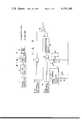
- FIG. 1is a block diagram showing one example of the electric power source for electrosurgical apparatus according to this invention
- FIG. 2is a connection diagram showing a signal generating circuit shown in FIG. 1 and selectively generates a cutting signal, a coagulation signal and a blend signal;
- FIG. 3shows waveforms of electric signals at various portions of the circuit shown in FIG. 2;
- FIG. 4is a diagrammatic representation showing the effect of an electric knife on a biological structure
- FIG. 5shows a waveform of a blend current
- FIG. 6is a connection diagram showing another modification of the signal generating circuit.
- FIG. 7is a circuit diagram modified the circuit of FIG. 2.
- An electrical power source for electrosurgical apparatus shown in FIG. 1comprises a signal generating circuit 11 which is constructed to selectively generate a cutting signal, a coagulation signal and a blend signal as will be described later in more detail.
- the output signal of the signal generating circuit 11is amplified by a voltage amplifier 12 and then by a power amplifier 13.
- the output of the power amplifier 13is applied across an electric knife (not shown) through a transformer 14 and a body of a patient (not shown).
- FIG. 2shows the detail of the circuit construction of the signal generating circuit 11. More particularly, it comprises a high frequency oscillator 15 which generates a high frequency pulse having a frequency of 575 KHz, for example, a low frequency oscillator 16 which generates a low frequency pulse having a frequency of 5 KHz, for example, and a blend control signal generator 17 constituted by a multivibrator, for example.
- the output of the high frequency oscillator 15is applied to the first inputs of AND gate circuits 19 and 21 while the output of the low frequency oscillator 16 is applied to the first input of an AND gate circuit 20.
- the output terminals S and S of the blend control signal generator 17are connected to the second inputs of the AND gate circuits 19 and 20 respectively.
- An input terminal corresponding to the output terminal S of the blend control signal generator 17is connected to a source +V CC via switches 23 and 25 which are connected in series, while an input terminal corresponding to output terminal S is connected to the source +V CC via a switch 24.
- the source +V CCis connected to the anode electrodes of diodes 27 and 28 via switch 26 interlocked with switches 23, 24 and 25, and the cathode electrodes of these diodes are connected to the third inputs of AND gate circuits 19 and 20 respectively and to the ground via resistors 29 and 30 respectively.
- the output of the AND gate circuit 20is connected to the second input of AND gate circuit 21 via a differentiating circuit 21 and the outputs of AND gate circuits 19 and 21 are connected to the first and second inputs of an OR gate circuit 22 having an output connected to the input of the voltage amplifier 12 shown in FIG. 1.
- the signal generating circuit described aboveoperates as follows.
- the high frequency oscillator 15generates a high frequency pulse signal a shown in FIG. 3 which is applied to AND gate circuits 19 and 21.
- the low frequency oscillator 16generates a low frequency pulse signal b which is applied to AND gate circuit 20.
- the blend control signal switch 25When the blend control signal switch 25 is closed, the coagulation switch 24 is opened and the cutting signal switch 13 is closed, the output S of the blend control signal generating circuit 17 becomes a high level, whereas the output S becomes a low level.
- the blend signal switch 25 and the coagulation signal switch 24are closed while the cutting signal switch 23 is opened the output S of the blend control signal generating circuit 17 becomes the low level while the output S becomes the high level.
- the blend control signal generating circuit 17oscillates to produce signals d and e shown in FIG. 3 on the outputs S and S respectively.
- the blend control signal generating circuit 17generates output signals in a manner as above described, and the cutting signal, the coagulation signal and blend signal are generated as follows:
- the cutting switch 23 and the blend switch 25are closed while the coagulation switch 24 is opened.
- the output S of the blend signal generating circuit 17becomes the high level.
- the switch 26 interlocked therewithis also closed. Consequently, the AND gate circuit 19 is enabled to supply the high frequency pulse signal a generated by the high frequency oscillator 15 to the voltage amplifier 12 via AND gate circuit 19, and OR gate circuit 22.
- the high frequency signalis amplified by the voltage amplifier 12 and the power amplifier 13 and then supplied to the electric knife as the high frequency cutting current through transformer 14.
- the coagulation switch 24 and the blend switch 25are closed, and the cutting switch 23 is opened with the result that the output S of the blend signal generating circuit 17 becomes the high level.
- the switch 26 interlocked with switch 24is also closed. Consequently, AND gate circuit 20 is enabled to apply the low frequency signal b generated by the low frequency oscillator 16 to the differentiating circuit 18. Accordingly, the differentiating circuit 18 produces a differentiated signal c shown in FIG. 3.
- the high frequency signal ais modulated by the differentiated signal c to form the coagulation signal which is applied to the electric knife (not shown) via the OR gate circuit 22 and the amplifiers 12 and 13.
- switches 23, 24 and 25which are provided for the purpose of causing the blend control signal generating circuit 17 to self-oscillate are opened.
- the blend control signal generating circuit 17oscillates, signals d and e are produced on the outputs S and S as shown in FIG. 3.
- the output b of the low frequency oscillator 16is applied to the differentiating circuit 18 via AND gate circuit 20 only when the blend control signal e is at the high level. Accordingly, the differentiating circuit 18 produces a differentiated signal f shown in FIG. 3.
- the AND gate circuit 21When this signal f is applied to the inputs of AND gate circuit 21 together with the high frequency signal a, the AND gate circuit 21 is enabled to produce an output signal g which is formed by modulating the high frequency signal a with the differentiated signal f.
- the high frequency signal apasses through the AND gate circuit 19 only when the blend control signal d is at the high level.
- the AND gate circuit 19produces a signal h corresponding to the high frequency signal a modulated by the blend control signal d.
- signals g and hare supplied to the inputs of the OR gate circuit 22 from AND gate circuits 19 and 21 a mixture of these signals g and h, that is a blend signal i is produced.
- the blend signal icorresponds to a composite signal which is formed by compounding, on a time division basis, the high frequency signal, or the cutting signal, and a signal which is formed by amplitude modulating the high frequency signal with the differentiated signal, that is, the coagulation signal.
- This blend signal iis supplied to the electric knife as the blend current 1 via amplifiers 12 and 13 and transformer 14.
- the blend currentis produced by compounding the cutting current and the coagulation current on the time division basis and not by merely superposing each other these two currents so that the cutting current and the coagulation current do not interfere with each other. Accordingly, the cutting effect and the coagulation effect are manifested independently.
- FIG. 4shows the cutting and coagulation effects produced by the electric knife 31
- FIG. 5shows the waveform of the blend current which flows for producing the cutting and coagulation effects.
- the biological structure 32is out for a length L C and then the coagulation current flows through the knife for an interval of t g . Then the biological structure 32 coagulates in a direction shown by an arrow due to the heat produced by the coagulation current.
- the cutting knife 31cuts the biological structure after its cut portion has been coagulated thus manifesting efficient blood stopping function.
- FIG. 6shows a modified blend control signal generating circuit 11 in which the high frequency signal generated by the high frequency oscillator 15 is applied to one input of an AND gate circuit 34, whereas to the input of an AND gate circuit 33 are applied the output S of the blend control signal generating circuit 17 and the voltage of the source +V CC which is supplied through switch 26.
- the outputs of the AND gate circuit 33 and the differentiating circuit 18are applied to the inputs of an OR gate circuit 35, and the output thereof is applied to the second input of the AND gate circuit 34.
- the other circuit constructionis the same as that of the circuit shown in FIG. 2. In the modification shown in FIG.
- the differentiated signal f produced by the differentiating circuit 18 and the blend control signal d passing through the AND gate circuit 33are compounded by the OR gate circuit 35 to produce signal k by the AND gate circuit 34.
- the high frequency signal a produced by the high frequency oscillator 15is modulated by this signal k by AND gate circuit 34 to produce a blend signal i.
- the circuit shown in FIG. 6functions in the same manner as that shown in FIG. 2.
- a cutting signalis produced by a high frequency oscillator and the cutting signal is modulated by a low frequency differentiated signal which is formed by differentiating a low frequency signal produced by a low frequency oscillator to form a coagulation signal.
- the cutting signal and the coagulation signalare compounded on a time division basis to produce a blend signal. Accordingly, a blend current based on the blend signal thus formed manifests stable cutting effect and coagulation effect whereby efficient blood stopping function can be obtained.
- the output S of the blend control signal generating circuit 17may be the connected to one input of AND gate circuit 21 instead of AND gate circuit 20, as shown in FIG. 7.
Landscapes
- Health & Medical Sciences (AREA)
- Surgery (AREA)
- Engineering & Computer Science (AREA)
- Life Sciences & Earth Sciences (AREA)
- Biomedical Technology (AREA)
- Otolaryngology (AREA)
- Nuclear Medicine, Radiotherapy & Molecular Imaging (AREA)
- Plasma & Fusion (AREA)
- Physics & Mathematics (AREA)
- Heart & Thoracic Surgery (AREA)
- Medical Informatics (AREA)
- Molecular Biology (AREA)
- Animal Behavior & Ethology (AREA)
- General Health & Medical Sciences (AREA)
- Public Health (AREA)
- Veterinary Medicine (AREA)
- Surgical Instruments (AREA)
Abstract
Description
This invention relates to an electric power source for electrosurgical apparatus which selectively generates a cutting signal, a coagulation signal and a blend signal.
An electrosurgical apparatus is generally constructed to selectively generate cutting current, coagulation current and blend current. Usually, cutting current applies stronger cutting effect to a human body than the coagulation effect caused by coagulation current. For this reason, where blend current is used the coagulation effect can be expected only when a small blend current is used. Furthermore when the blend current varies, the ratio between the cutting current and the coagulation current which are contained in the blend current varies so that stable cutting effect and coagulation effect can not be obtained.
It is an object of this invention to provide an improved electric power source for electrosurgical apparatus capable of always providing stable cutting effect and coagulation effect.
According to this invention, there is provided an electric power source for electrosurgical apparatus comprising a high frequency cutting signal generator, a low frequency signal generator, means for modulating the high frequency cutting signal with the low frequency signal for producing a coagulation signal, and means to compound the cutting signal and the coagulation signal on the time division basis for producing a blend signal.
FIG. 1 is a block diagram showing one example of the electric power source for electrosurgical apparatus according to this invention;
FIG. 2 is a connection diagram showing a signal generating circuit shown in FIG. 1 and selectively generates a cutting signal, a coagulation signal and a blend signal;
FIG. 3 shows waveforms of electric signals at various portions of the circuit shown in FIG. 2;
FIG. 4 is a diagrammatic representation showing the effect of an electric knife on a biological structure;
FIG. 5 shows a waveform of a blend current;
FIG. 6 is a connection diagram showing another modification of the signal generating circuit; and
FIG. 7 is a circuit diagram modified the circuit of FIG. 2.
An electrical power source for electrosurgical apparatus shown in FIG. 1 comprises a signal generating circuit 11 which is constructed to selectively generate a cutting signal, a coagulation signal and a blend signal as will be described later in more detail. The output signal of the signal generating circuit 11 is amplified by avoltage amplifier 12 and then by apower amplifier 13. The output of thepower amplifier 13 is applied across an electric knife (not shown) through atransformer 14 and a body of a patient (not shown).
FIG. 2 shows the detail of the circuit construction of the signal generating circuit 11. More particularly, it comprises ahigh frequency oscillator 15 which generates a high frequency pulse having a frequency of 575 KHz, for example, alow frequency oscillator 16 which generates a low frequency pulse having a frequency of 5 KHz, for example, and a blendcontrol signal generator 17 constituted by a multivibrator, for example. The output of thehigh frequency oscillator 15 is applied to the first inputs ofAND gate circuits low frequency oscillator 16 is applied to the first input of anAND gate circuit 20. The output terminals S and S of the blendcontrol signal generator 17 are connected to the second inputs of theAND gate circuits control signal generator 17 is connected to a source +VCC viaswitches switch 24. The source +VCC is connected to the anode electrodes ofdiodes 27 and 28 viaswitch 26 interlocked withswitches AND gate circuits resistors
The output of theAND gate circuit 20 is connected to the second input ofAND gate circuit 21 via adifferentiating circuit 21 and the outputs ofAND gate circuits OR gate circuit 22 having an output connected to the input of thevoltage amplifier 12 shown in FIG. 1. The signal generating circuit described above operates as follows. Thus, thehigh frequency oscillator 15 generates a high frequency pulse signal a shown in FIG. 3 which is applied toAND gate circuits low frequency oscillator 16 generates a low frequency pulse signal b which is applied toAND gate circuit 20. Under these conditions when the blendcontrol signal switch 25 is closed, thecoagulation switch 24 is opened and thecutting signal switch 13 is closed, the output S of the blend controlsignal generating circuit 17 becomes a high level, whereas the output S becomes a low level. On the other hand, when theblend signal switch 25 and thecoagulation signal switch 24 are closed while thecutting signal switch 23 is opened the output S of the blend controlsignal generating circuit 17 becomes the low level while the output S becomes the high level. When the inputs of the blend controlsignal generating circuit 17 corresponding to the outputs S, S are opened, the blend controlsignal generating circuit 17 oscillates to produce signals d and e shown in FIG. 3 on the outputs S and S respectively.
The blend controlsignal generating circuit 17 generates output signals in a manner as above described, and the cutting signal, the coagulation signal and blend signal are generated as follows:
(i) A case in which only the cutting signal is generated.
In this case, thecutting switch 23 and theblend switch 25 are closed while thecoagulation switch 24 is opened. As a consequence, the output S of the blendsignal generating circuit 17 becomes the high level. When thecutting switch 23 is closed, theswitch 26 interlocked therewith is also closed. Consequently, theAND gate circuit 19 is enabled to supply the high frequency pulse signal a generated by thehigh frequency oscillator 15 to thevoltage amplifier 12 via ANDgate circuit 19, andOR gate circuit 22. The high frequency signal is amplified by thevoltage amplifier 12 and thepower amplifier 13 and then supplied to the electric knife as the high frequency cutting current throughtransformer 14.
(ii) A case wherein only the coagulation signal is generated.
In this case, thecoagulation switch 24 and theblend switch 25 are closed, and thecutting switch 23 is opened with the result that the output S of the blendsignal generating circuit 17 becomes the high level. At this time, theswitch 26 interlocked withswitch 24 is also closed. Consequently, ANDgate circuit 20 is enabled to apply the low frequency signal b generated by thelow frequency oscillator 16 to the differentiatingcircuit 18. Accordingly, the differentiatingcircuit 18 produces a differentiated signal c shown in FIG. 3. When this differentiated signal c and the high frequency signal a are applied to the inputs of theAND gate circuit 21, the high frequency signal a is modulated by the differentiated signal c to form the coagulation signal which is applied to the electric knife (not shown) via theOR gate circuit 22 and theamplifiers
(iii) A case wherein a blend signal is produced.
In this case, switches 23, 24 and 25 which are provided for the purpose of causing the blend controlsignal generating circuit 17 to self-oscillate are opened. When the blend controlsignal generating circuit 17 oscillates, signals d and e are produced on the outputs S and S as shown in FIG. 3. Under these conditions, whencutting switch 23 is closed in order to close theswitch 26, the output b of thelow frequency oscillator 16 is applied to the differentiatingcircuit 18 via ANDgate circuit 20 only when the blend control signal e is at the high level. Accordingly, the differentiatingcircuit 18 produces a differentiated signal f shown in FIG. 3. When this signal f is applied to the inputs ofAND gate circuit 21 together with the high frequency signal a, theAND gate circuit 21 is enabled to produce an output signal g which is formed by modulating the high frequency signal a with the differentiated signal f. On the other hand, the high frequency signal a passes through theAND gate circuit 19 only when the blend control signal d is at the high level. In other words, theAND gate circuit 19 produces a signal h corresponding to the high frequency signal a modulated by the blend control signal d. When signals g and h are supplied to the inputs of theOR gate circuit 22 fromAND gate circuits 19 and 21 a mixture of these signals g and h, that is a blend signal i is produced. Thus, the blend signal i corresponds to a composite signal which is formed by compounding, on a time division basis, the high frequency signal, or the cutting signal, and a signal which is formed by amplitude modulating the high frequency signal with the differentiated signal, that is, the coagulation signal. This blend signal i is supplied to the electric knife as the blend current 1 viaamplifiers transformer 14. As above described, the blend current is produced by compounding the cutting current and the coagulation current on the time division basis and not by merely superposing each other these two currents so that the cutting current and the coagulation current do not interfere with each other. Accordingly, the cutting effect and the coagulation effect are manifested independently.
FIG. 4 shows the cutting and coagulation effects produced by theelectric knife 31, and FIG. 5 shows the waveform of the blend current which flows for producing the cutting and coagulation effects. In FIGS. 4 and 5 during an interval tc in which the cutting current flows through theelectric knife 31, thebiological structure 32 is out for a length LC and then the coagulation current flows through the knife for an interval of tg. Then thebiological structure 32 coagulates in a direction shown by an arrow due to the heat produced by the coagulation current. As the cutting current flows again through theelectric knife 31 thebiological structure 32 is cut again. In this manner, thecutting knife 31 cuts the biological structure after its cut portion has been coagulated thus manifesting efficient blood stopping function.
FIG. 6 shows a modified blend control signal generating circuit 11 in which the high frequency signal generated by thehigh frequency oscillator 15 is applied to one input of an ANDgate circuit 34, whereas to the input of an ANDgate circuit 33 are applied the output S of the blend controlsignal generating circuit 17 and the voltage of the source +VCC which is supplied throughswitch 26. The outputs of the ANDgate circuit 33 and the differentiatingcircuit 18 are applied to the inputs of anOR gate circuit 35, and the output thereof is applied to the second input of the ANDgate circuit 34. The other circuit construction is the same as that of the circuit shown in FIG. 2. In the modification shown in FIG. 6, the differentiated signal f produced by the differentiatingcircuit 18 and the blend control signal d passing through the ANDgate circuit 33 are compounded by theOR gate circuit 35 to produce signal k by the ANDgate circuit 34. The high frequency signal a produced by thehigh frequency oscillator 15 is modulated by this signal k by ANDgate circuit 34 to produce a blend signal i. As above described, the circuit shown in FIG. 6 functions in the same manner as that shown in FIG. 2.
As above described, according to this invention a cutting signal is produced by a high frequency oscillator and the cutting signal is modulated by a low frequency differentiated signal which is formed by differentiating a low frequency signal produced by a low frequency oscillator to form a coagulation signal. The cutting signal and the coagulation signal are compounded on a time division basis to produce a blend signal. Accordingly, a blend current based on the blend signal thus formed manifests stable cutting effect and coagulation effect whereby efficient blood stopping function can be obtained.
Although the invention has been shown and described in terms of some preferred embodiments thereof it is clear that many changes and modifications will be obvious to one skilled in the art without departing from the scope of the invention. For example, in the embodiment shown in FIG. 2, the output S of the blend controlsignal generating circuit 17 may be the connected to one input of ANDgate circuit 21 instead of ANDgate circuit 20, as shown in FIG. 7.
Claims (3)
1. An electric power source for electrosurgical apparatus comprising a high frequency oscillator for generating a high frequency cutting signal; a low frequency oscillator for generating a low frequency signal; a blend control signal generating circuit including means for generating two blend control signals having opposite phases; a first AND gate circuit operatively connected to said high frequency oscillator to receive said high frequency cutting signal therefrom and operatively connected to said generating circuit to receive one of said blend control signals for producing a signal corresponding to a logical product of said cutting signal and said one blend control signal; a second AND gate circuit operatively connected to at least said low frequency oscillator and said generating circuit to receive respectively therefrom said low frequency signal and the other blend control signal, for producing a signal corresponding to a logical product thereof; a differentiating circuit operatively connected to the output of said second AND gate circuit for differentiating the output signal of said second AND gate circuit and having an output; a third AND gate circuit operatively connected to said high frequency oscillator for receiving said high frequency cutting signal and to the output of said differentiating circuit for producing a coagulation signal corresponding to a logical product thereof; and an OR gate circuit respectively operatively connected to said first AND gate circuit and said third AND gate circuit for receiving the signal of said first and third AND gate circuits, and having an output to thereby output a blend signal when the blend control signal generating circuit generates the signals having opposite phases.
2. An electric power source for electrosurgical apparatus according to claim 1 which further includes means for amplifying the output signal from said OR gate circuit and transformer means for transforming the amplified signal from said amplifying means.
3. An electric power source of electrosurgical apparatus comprising a high frequency oscillator for producing a high frequency cutting signal; a low frequency oscillator for producing a low frequency signal; a blend control signal generating circuit including means for producing first and second blend control signals having opposite phases; a first AND gate circuit operatively connected to at least said low frequency oscillator and to said generating circuit for receiving said low frequency signal and said first blend control signal for passing said low frequency signal when said first blend control signal is at a high level; a differentiating circuit operatively connected to said first AND gate circuit for differentiating the output signal of said first AND gate circuit and having an output; an OR gate circuit operatively connected to the output of said differentiating circuit and operatively connected to said generating circuit for receiving said second blend control signal and having an output; and a second AND gate circuit operatively connected to said high frequency oscillator for receiving said high frequency cutting signal and operatively connected to the output of said OR gate circuit.
Applications Claiming Priority (2)
| Application Number | Priority Date | Filing Date | Title |
|---|---|---|---|
| JP329277AJPS5389293A (en) | 1977-01-14 | 1977-01-14 | High frequency cauterization power supply |
| JP52-3292 | 1977-01-14 |
Publications (1)
| Publication Number | Publication Date |
|---|---|
| US4154240Atrue US4154240A (en) | 1979-05-15 |
Family
ID=11553305
Family Applications (1)
| Application Number | Title | Priority Date | Filing Date |
|---|---|---|---|
| US05/866,224Expired - LifetimeUS4154240A (en) | 1977-01-14 | 1978-01-03 | Electric power source for electrosurgical apparatus |
Country Status (3)
| Country | Link |
|---|---|
| US (1) | US4154240A (en) |
| JP (1) | JPS5389293A (en) |
| DE (1) | DE2801503C3 (en) |
Cited By (41)
| Publication number | Priority date | Publication date | Assignee | Title |
|---|---|---|---|---|
| EP0030003A1 (en)* | 1979-12-04 | 1981-06-10 | Olympus Optical Co., Ltd. | Electric surgical knife device |
| US4318409A (en)* | 1979-12-17 | 1982-03-09 | Medical Research Associates, Ltd. #2 | Electrosurgical generator |
| US4378801A (en)* | 1979-12-17 | 1983-04-05 | Medical Research Associates Ltd. #2 | Electrosurgical generator |
| US4467809A (en)* | 1982-09-17 | 1984-08-28 | Biolectron, Inc. | Method for non-invasive electrical stimulation of epiphyseal plate growth |
| US4467808A (en)* | 1982-09-17 | 1984-08-28 | Biolectron, Inc. | Method for preventing and treating osteoporosis in a living body by using electrical stimulation non-invasively |
| US4949721A (en)* | 1988-08-11 | 1990-08-21 | Omron Tateisi Electronics Co. | Transcutaneous electric nerve stimulater |
| US5472443A (en)* | 1991-06-07 | 1995-12-05 | Hemostatic Surgery Corporation | Electrosurgical apparatus employing constant voltage and methods of use |
| US5633578A (en)* | 1991-06-07 | 1997-05-27 | Hemostatic Surgery Corporation | Electrosurgical generator adaptors |
| US5693045A (en)* | 1995-06-07 | 1997-12-02 | Hemostatic Surgery Corporation | Electrosurgical generator cable |
| US6013076A (en)* | 1996-01-09 | 2000-01-11 | Gyrus Medical Limited | Electrosurgical instrument |
| US6015406A (en)* | 1996-01-09 | 2000-01-18 | Gyrus Medical Limited | Electrosurgical instrument |
| US6027501A (en)* | 1995-06-23 | 2000-02-22 | Gyrus Medical Limited | Electrosurgical instrument |
| US6056746A (en)* | 1995-06-23 | 2000-05-02 | Gyrus Medical Limited | Electrosurgical instrument |
| US6090106A (en)* | 1996-01-09 | 2000-07-18 | Gyrus Medical Limited | Electrosurgical instrument |
| US6093186A (en)* | 1996-12-20 | 2000-07-25 | Gyrus Medical Limited | Electrosurgical generator and system |
| US6210405B1 (en) | 1996-06-20 | 2001-04-03 | Gyrus Medical Limited | Under water treatment |
| US6261286B1 (en) | 1995-06-23 | 2001-07-17 | Gyrus Medical Limited | Electrosurgical generator and system |
| US6277114B1 (en) | 1998-04-03 | 2001-08-21 | Gyrus Medical Limited | Electrode assembly for an electrosurical instrument |
| US6562037B2 (en)* | 1998-02-12 | 2003-05-13 | Boris E. Paton | Bonding of soft biological tissues by passing high frequency electric current therethrough |
| US6565561B1 (en) | 1996-06-20 | 2003-05-20 | Cyrus Medical Limited | Electrosurgical instrument |
| US20040013852A1 (en)* | 1997-02-21 | 2004-01-22 | The Proctor & Gamble Company | Tear resistant porous extensible web |
| US20040049836A1 (en)* | 2002-07-03 | 2004-03-18 | The Procter & Gamble Company | Radiation curable low stress relaxation elastomeric materials |
| US6733498B2 (en) | 2002-02-19 | 2004-05-11 | Live Tissue Connect, Inc. | System and method for control of tissue welding |
| US6780180B1 (en) | 1995-06-23 | 2004-08-24 | Gyrus Medical Limited | Electrosurgical instrument |
| US20040172015A1 (en)* | 2001-06-08 | 2004-09-02 | Pavel Novak | Electrosurgical apparatus |
| WO2009090017A1 (en)* | 2008-01-14 | 2009-07-23 | Erbe Elektromedizin Gmbh | Method for controlling an electro-surgical hf generator and electro-surgical device |
| US8551088B2 (en) | 2008-03-31 | 2013-10-08 | Applied Medical Resources Corporation | Electrosurgical system |
| US20140128864A1 (en)* | 2012-11-08 | 2014-05-08 | Gyrus Medical Limited | Electrosurgical generator |
| US8915948B2 (en) | 2002-06-19 | 2014-12-23 | Palomar Medical Technologies, Llc | Method and apparatus for photothermal treatment of tissue at depth |
| US9028536B2 (en) | 2006-08-02 | 2015-05-12 | Cynosure, Inc. | Picosecond laser apparatus and methods for its operation and use |
| USD748259S1 (en) | 2014-12-29 | 2016-01-26 | Applied Medical Resources Corporation | Electrosurgical instrument |
| US9320563B2 (en) | 2010-10-01 | 2016-04-26 | Applied Medical Resources Corporation | Electrosurgical instruments and connections thereto |
| US9780518B2 (en) | 2012-04-18 | 2017-10-03 | Cynosure, Inc. | Picosecond laser apparatus and methods for treating target tissues with same |
| US10149713B2 (en) | 2014-05-16 | 2018-12-11 | Applied Medical Resources Corporation | Electrosurgical system |
| US10245107B2 (en) | 2013-03-15 | 2019-04-02 | Cynosure, Inc. | Picosecond optical radiation systems and methods of use |
| US10420603B2 (en) | 2014-12-23 | 2019-09-24 | Applied Medical Resources Corporation | Bipolar electrosurgical sealer and divider |
| US10434324B2 (en) | 2005-04-22 | 2019-10-08 | Cynosure, Llc | Methods and systems for laser treatment using non-uniform output beam |
| US10792092B2 (en) | 2014-05-30 | 2020-10-06 | Applied Medical Resources Corporation | Electrosurgical seal and dissection systems |
| US11418000B2 (en) | 2018-02-26 | 2022-08-16 | Cynosure, Llc | Q-switched cavity dumped sub-nanosecond laser |
| US11696796B2 (en) | 2018-11-16 | 2023-07-11 | Applied Medical Resources Corporation | Electrosurgical system |
| US11864812B2 (en) | 2018-09-05 | 2024-01-09 | Applied Medical Resources Corporation | Electrosurgical generator control system |
Families Citing this family (1)
| Publication number | Priority date | Publication date | Assignee | Title |
|---|---|---|---|---|
| JPS6035905U (en)* | 1983-08-19 | 1985-03-12 | 昌一金属株式会社 | Branch wire band for composite columns |
Citations (5)
| Publication number | Priority date | Publication date | Assignee | Title |
|---|---|---|---|---|
| US3699967A (en)* | 1971-04-30 | 1972-10-24 | Valleylab Inc | Electrosurgical generator |
| US3804096A (en)* | 1972-11-30 | 1974-04-16 | Dentsply Int Inc | Electrosurgical device |
| US3885569A (en)* | 1972-11-21 | 1975-05-27 | Birtcher Corp | Electrosurgical unit |
| US3897787A (en)* | 1972-12-29 | 1975-08-05 | Olympus Optical Co | Power source device for an electric surgical knife |
| US3898991A (en)* | 1972-12-20 | 1975-08-12 | Olympus Optical Co | Electrosurgical apparatus and method of operating same |
- 1977
- 1977-01-14JPJP329277Apatent/JPS5389293A/enactiveGranted
- 1978
- 1978-01-03USUS05/866,224patent/US4154240A/ennot_activeExpired - Lifetime
- 1978-01-12DEDE2801503Apatent/DE2801503C3/ennot_activeExpired
Patent Citations (5)
| Publication number | Priority date | Publication date | Assignee | Title |
|---|---|---|---|---|
| US3699967A (en)* | 1971-04-30 | 1972-10-24 | Valleylab Inc | Electrosurgical generator |
| US3885569A (en)* | 1972-11-21 | 1975-05-27 | Birtcher Corp | Electrosurgical unit |
| US3804096A (en)* | 1972-11-30 | 1974-04-16 | Dentsply Int Inc | Electrosurgical device |
| US3898991A (en)* | 1972-12-20 | 1975-08-12 | Olympus Optical Co | Electrosurgical apparatus and method of operating same |
| US3897787A (en)* | 1972-12-29 | 1975-08-05 | Olympus Optical Co | Power source device for an electric surgical knife |
Cited By (95)
| Publication number | Priority date | Publication date | Assignee | Title |
|---|---|---|---|---|
| EP0030003A1 (en)* | 1979-12-04 | 1981-06-10 | Olympus Optical Co., Ltd. | Electric surgical knife device |
| US4318409A (en)* | 1979-12-17 | 1982-03-09 | Medical Research Associates, Ltd. #2 | Electrosurgical generator |
| US4378801A (en)* | 1979-12-17 | 1983-04-05 | Medical Research Associates Ltd. #2 | Electrosurgical generator |
| US4467809A (en)* | 1982-09-17 | 1984-08-28 | Biolectron, Inc. | Method for non-invasive electrical stimulation of epiphyseal plate growth |
| US4467808A (en)* | 1982-09-17 | 1984-08-28 | Biolectron, Inc. | Method for preventing and treating osteoporosis in a living body by using electrical stimulation non-invasively |
| US4949721A (en)* | 1988-08-11 | 1990-08-21 | Omron Tateisi Electronics Co. | Transcutaneous electric nerve stimulater |
| US5472443A (en)* | 1991-06-07 | 1995-12-05 | Hemostatic Surgery Corporation | Electrosurgical apparatus employing constant voltage and methods of use |
| US5633578A (en)* | 1991-06-07 | 1997-05-27 | Hemostatic Surgery Corporation | Electrosurgical generator adaptors |
| US5693045A (en)* | 1995-06-07 | 1997-12-02 | Hemostatic Surgery Corporation | Electrosurgical generator cable |
| US6261286B1 (en) | 1995-06-23 | 2001-07-17 | Gyrus Medical Limited | Electrosurgical generator and system |
| US6027501A (en)* | 1995-06-23 | 2000-02-22 | Gyrus Medical Limited | Electrosurgical instrument |
| US6174308B1 (en) | 1995-06-23 | 2001-01-16 | Gyrus Medical Limited | Electrosurgical instrument |
| US6780180B1 (en) | 1995-06-23 | 2004-08-24 | Gyrus Medical Limited | Electrosurgical instrument |
| US6416509B1 (en) | 1995-06-23 | 2002-07-09 | Gyrus Medical Limited | Electrosurgical generator and system |
| US6056746A (en)* | 1995-06-23 | 2000-05-02 | Gyrus Medical Limited | Electrosurgical instrument |
| US6364877B1 (en) | 1995-06-23 | 2002-04-02 | Gyrus Medical Limited | Electrosurgical generator and system |
| US6306134B1 (en) | 1995-06-23 | 2001-10-23 | Gyrus Medical Limited | Electrosurgical generator and system |
| US6293942B1 (en) | 1995-06-23 | 2001-09-25 | Gyrus Medical Limited | Electrosurgical generator method |
| US6015406A (en)* | 1996-01-09 | 2000-01-18 | Gyrus Medical Limited | Electrosurgical instrument |
| US6234178B1 (en) | 1996-01-09 | 2001-05-22 | Gyrus Medical Limited | Electrosurgical instrument |
| US6090106A (en)* | 1996-01-09 | 2000-07-18 | Gyrus Medical Limited | Electrosurgical instrument |
| US6013076A (en)* | 1996-01-09 | 2000-01-11 | Gyrus Medical Limited | Electrosurgical instrument |
| US6210405B1 (en) | 1996-06-20 | 2001-04-03 | Gyrus Medical Limited | Under water treatment |
| US6482202B1 (en) | 1996-06-20 | 2002-11-19 | Gyrus Medical Limited | Under water treatment |
| US6565561B1 (en) | 1996-06-20 | 2003-05-20 | Cyrus Medical Limited | Electrosurgical instrument |
| US6093186A (en)* | 1996-12-20 | 2000-07-25 | Gyrus Medical Limited | Electrosurgical generator and system |
| US20040013852A1 (en)* | 1997-02-21 | 2004-01-22 | The Proctor & Gamble Company | Tear resistant porous extensible web |
| US20060113698A1 (en)* | 1997-02-21 | 2006-06-01 | Curro John J | Tear resistant porous extensible web |
| US7087287B2 (en) | 1997-02-21 | 2006-08-08 | The Procter & Gamble Company | Tear resistant porous extensible web |
| US20050234447A1 (en)* | 1998-02-12 | 2005-10-20 | Paton Boris E | Bonding of soft biological tissues by passing high frequency electric current therethrough |
| US6562037B2 (en)* | 1998-02-12 | 2003-05-13 | Boris E. Paton | Bonding of soft biological tissues by passing high frequency electric current therethrough |
| US7025764B2 (en) | 1998-02-12 | 2006-04-11 | Live Tissue Connect, Inc. | Bonding of soft biological tissues by passing high frequency electric current therethrough |
| US20040068304A1 (en)* | 1998-02-12 | 2004-04-08 | Paton Boris E. | Bonding of soft biological tissues by passing high freouency electric current therethrough |
| US7431721B2 (en) | 1998-02-12 | 2008-10-07 | Livo Tissue Connect, Inc. | Bonding of soft biological tissues by passing high frequency electric current therethrough |
| US6277114B1 (en) | 1998-04-03 | 2001-08-21 | Gyrus Medical Limited | Electrode assembly for an electrosurical instrument |
| US20040172015A1 (en)* | 2001-06-08 | 2004-09-02 | Pavel Novak | Electrosurgical apparatus |
| US7115121B2 (en)* | 2001-06-08 | 2006-10-03 | Storz Endoskop Gmbh | Electrosurgical apparatus |
| US6733498B2 (en) | 2002-02-19 | 2004-05-11 | Live Tissue Connect, Inc. | System and method for control of tissue welding |
| US8915948B2 (en) | 2002-06-19 | 2014-12-23 | Palomar Medical Technologies, Llc | Method and apparatus for photothermal treatment of tissue at depth |
| US10500413B2 (en) | 2002-06-19 | 2019-12-10 | Palomar Medical Technologies, Llc | Method and apparatus for treatment of cutaneous and subcutaneous conditions |
| US10556123B2 (en) | 2002-06-19 | 2020-02-11 | Palomar Medical Technologies, Llc | Method and apparatus for treatment of cutaneous and subcutaneous conditions |
| US7445831B2 (en) | 2002-07-03 | 2008-11-04 | The Procter & Gamble Company | Radiation curable low stress relaxation elastomeric materials |
| US20040049836A1 (en)* | 2002-07-03 | 2004-03-18 | The Procter & Gamble Company | Radiation curable low stress relaxation elastomeric materials |
| US10434324B2 (en) | 2005-04-22 | 2019-10-08 | Cynosure, Llc | Methods and systems for laser treatment using non-uniform output beam |
| US11712299B2 (en) | 2006-08-02 | 2023-08-01 | Cynosure, LLC. | Picosecond laser apparatus and methods for its operation and use |
| US10966785B2 (en) | 2006-08-02 | 2021-04-06 | Cynosure, Llc | Picosecond laser apparatus and methods for its operation and use |
| US10849687B2 (en) | 2006-08-02 | 2020-12-01 | Cynosure, Llc | Picosecond laser apparatus and methods for its operation and use |
| US9028536B2 (en) | 2006-08-02 | 2015-05-12 | Cynosure, Inc. | Picosecond laser apparatus and methods for its operation and use |
| JP2011509702A (en)* | 2008-01-14 | 2011-03-31 | エルベ エレクトロメディツィン ゲーエムベーハー | Electrosurgical HF generator and method for controlling an electrosurgical device |
| CN101909538B (en)* | 2008-01-14 | 2013-06-19 | 爱尔博电子医疗仪器股份有限公司 | Method of controlling an electrosurgical high frequency generator and electrosurgical device |
| US20110054463A1 (en)* | 2008-01-14 | 2011-03-03 | Peter Selig | Method for controlling an electro-surgical hf generator and electro-surgical device |
| WO2009090017A1 (en)* | 2008-01-14 | 2009-07-23 | Erbe Elektromedizin Gmbh | Method for controlling an electro-surgical hf generator and electro-surgical device |
| US9585710B2 (en) | 2008-01-14 | 2017-03-07 | Erbe Elektromedizin Gmbh | Method for controlling an electro-surgical HF generator and electro-surgical device |
| EP2878277A1 (en)* | 2008-01-14 | 2015-06-03 | ERBE Elektromedizin GmbH | Method for controlling an electrosurgical HF generators |
| US8568411B2 (en) | 2008-03-31 | 2013-10-29 | Applied Medical Resources Corporation | Electrosurgical system |
| US10342604B2 (en) | 2008-03-31 | 2019-07-09 | Applied Medical Resources Corporation | Electrosurgical system |
| US9566108B2 (en) | 2008-03-31 | 2017-02-14 | Applied Medical Resources Corporation | Electrosurgical system |
| US8551088B2 (en) | 2008-03-31 | 2013-10-08 | Applied Medical Resources Corporation | Electrosurgical system |
| US11660136B2 (en) | 2008-03-31 | 2023-05-30 | Applied Medical Resources Corporation | Electrosurgical system |
| US10888371B2 (en) | 2008-03-31 | 2021-01-12 | Applied Medical Resources Corporation | Electrosurgical system |
| US12295642B2 (en) | 2008-03-31 | 2025-05-13 | Applied Medical Resources Corporation | Electrosurgical system |
| US8915910B2 (en) | 2008-03-31 | 2014-12-23 | Applied Medical Resources Corporation | Electrosurgical system |
| US8562598B2 (en) | 2008-03-31 | 2013-10-22 | Applied Medical Resources Corporation | Electrosurgical system |
| US8579894B2 (en) | 2008-03-31 | 2013-11-12 | Applied Medical Resources Corporation | Electrosurgical system |
| US11864823B2 (en) | 2010-10-01 | 2024-01-09 | Applied Medical Resources Corporation | Electrosurgical instruments and connections thereto |
| US9320563B2 (en) | 2010-10-01 | 2016-04-26 | Applied Medical Resources Corporation | Electrosurgical instruments and connections thereto |
| US12357374B2 (en) | 2010-10-01 | 2025-07-15 | Applied Medical Resources Corporation | Electrosurgical instruments and connections thereto |
| US9962222B2 (en) | 2010-10-01 | 2018-05-08 | Applied Medical Resources Corporation | Electrosurgical instruments and connections thereto |
| US10874452B2 (en) | 2010-10-01 | 2020-12-29 | Applied Medical Resources Corporation | Electrosurgical instruments and connections thereto |
| US10305244B2 (en) | 2012-04-18 | 2019-05-28 | Cynosure, Llc | Picosecond laser apparatus and methods for treating target tissues with same |
| US11664637B2 (en) | 2012-04-18 | 2023-05-30 | Cynosure, Llc | Picosecond laser apparatus and methods for treating target tissues with same |
| US12068571B2 (en) | 2012-04-18 | 2024-08-20 | Cynosure, Llc | Picosecond laser apparatus and methods for treating target tissues with same |
| US10581217B2 (en) | 2012-04-18 | 2020-03-03 | Cynosure, Llc | Picosecond laser apparatus and methods for treating target tissues with same |
| US12431683B2 (en) | 2012-04-18 | 2025-09-30 | Cynosure, Llc | Picosecond laser apparatus and methods for treating target tissues with same |
| US11095087B2 (en) | 2012-04-18 | 2021-08-17 | Cynosure, Llc | Picosecond laser apparatus and methods for treating target tissues with same |
| US9780518B2 (en) | 2012-04-18 | 2017-10-03 | Cynosure, Inc. | Picosecond laser apparatus and methods for treating target tissues with same |
| US20140128864A1 (en)* | 2012-11-08 | 2014-05-08 | Gyrus Medical Limited | Electrosurgical generator |
| CN103800070A (en)* | 2012-11-08 | 2014-05-21 | 佳乐医疗设备有限公司 | Electrosurgical generator |
| US11446086B2 (en) | 2013-03-15 | 2022-09-20 | Cynosure, Llc | Picosecond optical radiation systems and methods of use |
| US10765478B2 (en) | 2013-03-15 | 2020-09-08 | Cynosurce, Llc | Picosecond optical radiation systems and methods of use |
| US10245107B2 (en) | 2013-03-15 | 2019-04-02 | Cynosure, Inc. | Picosecond optical radiation systems and methods of use |
| US10285757B2 (en) | 2013-03-15 | 2019-05-14 | Cynosure, Llc | Picosecond optical radiation systems and methods of use |
| US12193734B2 (en) | 2013-03-15 | 2025-01-14 | Cynosure, Llc | Picosecond optical radiation systems and methods of use |
| US10149713B2 (en) | 2014-05-16 | 2018-12-11 | Applied Medical Resources Corporation | Electrosurgical system |
| US11672589B2 (en) | 2014-05-16 | 2023-06-13 | Applied Medical Resources Corporation | Electrosurgical system |
| US12239359B2 (en) | 2014-05-30 | 2025-03-04 | Applied Medical Resources Corporation | Electrosurgical seal and dissection systems |
| US10792092B2 (en) | 2014-05-30 | 2020-10-06 | Applied Medical Resources Corporation | Electrosurgical seal and dissection systems |
| US10420603B2 (en) | 2014-12-23 | 2019-09-24 | Applied Medical Resources Corporation | Bipolar electrosurgical sealer and divider |
| US12029472B2 (en) | 2014-12-23 | 2024-07-09 | Applied Medical Resources Corporation | Bipolar electrosurgical sealer and divider |
| US11540871B2 (en) | 2014-12-23 | 2023-01-03 | Applied Medical Resources Corporation | Bipolar electrosurgical sealer and divider |
| USD748259S1 (en) | 2014-12-29 | 2016-01-26 | Applied Medical Resources Corporation | Electrosurgical instrument |
| US11791603B2 (en) | 2018-02-26 | 2023-10-17 | Cynosure, LLC. | Q-switched cavity dumped sub-nanosecond laser |
| US11418000B2 (en) | 2018-02-26 | 2022-08-16 | Cynosure, Llc | Q-switched cavity dumped sub-nanosecond laser |
| US11864812B2 (en) | 2018-09-05 | 2024-01-09 | Applied Medical Resources Corporation | Electrosurgical generator control system |
| US11696796B2 (en) | 2018-11-16 | 2023-07-11 | Applied Medical Resources Corporation | Electrosurgical system |
Also Published As
| Publication number | Publication date |
|---|---|
| DE2801503B2 (en) | 1979-11-22 |
| JPS5389293A (en) | 1978-08-05 |
| JPS5540259B2 (en) | 1980-10-16 |
| DE2801503A1 (en) | 1978-08-03 |
| DE2801503C3 (en) | 1980-07-31 |
Similar Documents
| Publication | Publication Date | Title |
|---|---|---|
| US4154240A (en) | Electric power source for electrosurgical apparatus | |
| US3675655A (en) | Method and apparatus for high frequency electric surgery | |
| DE2363917C2 (en) | Electrically operated surgical knife | |
| US4038984A (en) | Method and apparatus for high frequency electric surgery | |
| ES8400666A1 (en) | Electrosurgical generator | |
| WO2004078050A3 (en) | Electrosurgical generator and system | |
| JPS6476846A (en) | Feedback electrode monitor | |
| JPS59104824A (en) | Triangular wave generator | |
| KR870008661A (en) | High frequency generator | |
| SU1410959A1 (en) | Electrosurgical generator | |
| GB2158663A (en) | Pulse width modulated inverter | |
| JPS56153713A (en) | Supply system of electric power and control signal | |
| KR840005942A (en) | Current sensing circuit | |
| SU752281A2 (en) | Stabilized voltage converter | |
| SU741417A1 (en) | Current generator for electric geosurvey | |
| ES8201374A1 (en) | High-power electrical signals generator. | |
| JPS5671472A (en) | Driving method of piezoelectric porcelain transformer | |
| US20030158546A1 (en) | High frequency surgical instrument | |
| JPS6152698B2 (en) | ||
| EP0237488A3 (en) | Arrangement for the generation of a welding current having a d.c. portion and superimposed current pulses | |
| SU928604A1 (en) | Pulse-width converter control device | |
| JPS57169290A (en) | Photopulse modulating device | |
| SU605620A1 (en) | "elan" electric analgesia apparatus | |
| JPS5676638A (en) | Automatic output controlling system for am transmitter | |
| Brandt et al. | Pulsed Current Inert-Gas Tungsten-Arc Welding Using Transistorized Power Sources--How the Type of the Power Source Affects the Current Waveform |