US4121739A - Dispenser with unitary plunger and seal construction - Google Patents
Dispenser with unitary plunger and seal constructionDownload PDFInfo
- Publication number
- US4121739A US4121739AUS05/789,049US78904977AUS4121739AUS 4121739 AUS4121739 AUS 4121739AUS 78904977 AUS78904977 AUS 78904977AUS 4121739 AUS4121739 AUS 4121739A
- Authority
- US
- United States
- Prior art keywords
- piston
- piston head
- extremity
- compartments
- dispenser
- Prior art date
- Legal status (The legal status is an assumption and is not a legal conclusion. Google has not performed a legal analysis and makes no representation as to the accuracy of the status listed.)
- Expired - Lifetime
Links
- 238000010276constructionMethods0.000titledescription3
- 230000002093peripheral effectEffects0.000claimsabstractdescription6
- 239000012530fluidSubstances0.000claimsabstractdescription5
- 230000003213activating effectEffects0.000claimsdescription3
- 230000000694effectsEffects0.000claims1
- 239000007788liquidSubstances0.000claims1
- 239000000463materialSubstances0.000abstractdescription9
- 239000004033plasticSubstances0.000abstractdescription2
- 229920003023plasticPolymers0.000abstractdescription2
- 238000007789sealingMethods0.000description7
- 239000000853adhesiveSubstances0.000description4
- 230000001070adhesive effectEffects0.000description4
- 230000004048modificationEffects0.000description4
- 238000012986modificationMethods0.000description4
- 239000004593EpoxySubstances0.000description3
- 230000009471actionEffects0.000description2
- 238000007790scrapingMethods0.000description2
- 230000004913activationEffects0.000description1
- 238000005452bendingMethods0.000description1
- 230000001680brushing effectEffects0.000description1
- 230000000295complement effectEffects0.000description1
- 230000003247decreasing effectEffects0.000description1
- 239000003822epoxy resinSubstances0.000description1
- 229920001903high density polyethylenePolymers0.000description1
- 239000004700high-density polyethyleneSubstances0.000description1
- 229920000647polyepoxidePolymers0.000description1
- 230000008439repair processEffects0.000description1
- 239000011347resinSubstances0.000description1
- 229920005989resinPolymers0.000description1
- 239000003566sealing materialSubstances0.000description1
- 239000011345viscous materialSubstances0.000description1
Images
Classifications
- B—PERFORMING OPERATIONS; TRANSPORTING
- B05—SPRAYING OR ATOMISING IN GENERAL; APPLYING FLUENT MATERIALS TO SURFACES, IN GENERAL
- B05C—APPARATUS FOR APPLYING FLUENT MATERIALS TO SURFACES, IN GENERAL
- B05C17/00—Hand tools or apparatus using hand held tools, for applying liquids or other fluent materials to, for spreading applied liquids or other fluent materials on, or for partially removing applied liquids or other fluent materials from, surfaces
- B05C17/005—Hand tools or apparatus using hand held tools, for applying liquids or other fluent materials to, for spreading applied liquids or other fluent materials on, or for partially removing applied liquids or other fluent materials from, surfaces for discharging material from a reservoir or container located in or on the hand tool through an outlet orifice by pressure without using surface contacting members like pads or brushes
- B05C17/00553—Hand tools or apparatus using hand held tools, for applying liquids or other fluent materials to, for spreading applied liquids or other fluent materials on, or for partially removing applied liquids or other fluent materials from, surfaces for discharging material from a reservoir or container located in or on the hand tool through an outlet orifice by pressure without using surface contacting members like pads or brushes with means allowing the stock of material to consist of at least two different components
- B—PERFORMING OPERATIONS; TRANSPORTING
- B65—CONVEYING; PACKING; STORING; HANDLING THIN OR FILAMENTARY MATERIAL
- B65D—CONTAINERS FOR STORAGE OR TRANSPORT OF ARTICLES OR MATERIALS, e.g. BAGS, BARRELS, BOTTLES, BOXES, CANS, CARTONS, CRATES, DRUMS, JARS, TANKS, HOPPERS, FORWARDING CONTAINERS; ACCESSORIES, CLOSURES, OR FITTINGS THEREFOR; PACKAGING ELEMENTS; PACKAGES
- B65D81/00—Containers, packaging elements, or packages, for contents presenting particular transport or storage problems, or adapted to be used for non-packaging purposes after removal of contents
- B65D81/32—Containers, packaging elements, or packages, for contents presenting particular transport or storage problems, or adapted to be used for non-packaging purposes after removal of contents for packaging two or more different materials which must be maintained separate prior to use in admixture
- B65D81/325—Containers having parallel or coaxial compartments, provided with a piston or a movable bottom for discharging contents
- B—PERFORMING OPERATIONS; TRANSPORTING
- B05—SPRAYING OR ATOMISING IN GENERAL; APPLYING FLUENT MATERIALS TO SURFACES, IN GENERAL
- B05C—APPARATUS FOR APPLYING FLUENT MATERIALS TO SURFACES, IN GENERAL
- B05C17/00—Hand tools or apparatus using hand held tools, for applying liquids or other fluent materials to, for spreading applied liquids or other fluent materials on, or for partially removing applied liquids or other fluent materials from, surfaces
- B05C17/005—Hand tools or apparatus using hand held tools, for applying liquids or other fluent materials to, for spreading applied liquids or other fluent materials on, or for partially removing applied liquids or other fluent materials from, surfaces for discharging material from a reservoir or container located in or on the hand tool through an outlet orifice by pressure without using surface contacting members like pads or brushes
- B05C17/01—Hand tools or apparatus using hand held tools, for applying liquids or other fluent materials to, for spreading applied liquids or other fluent materials on, or for partially removing applied liquids or other fluent materials from, surfaces for discharging material from a reservoir or container located in or on the hand tool through an outlet orifice by pressure without using surface contacting members like pads or brushes with manually mechanically or electrically actuated piston or the like
Definitions
- Still a further object of the inventionis to provide a plunger for use in a plurality of chambers simultaneously and more particularly a plunger for use with viscous materials which include an integral double lipped seal at the piston head.
- the dispenser of the present inventionwhich consists of two parts, namely a cartridge having two or more cylindrical compartments and a piston or plunger unit which includes a corresponding number of piston shafts integrally joined at the top and including particularly configured seal rings unitarily configured at the opposite extremity of the shafts.
- each shaftincludes a pair of axially spaced seal rings having sharp edges at their outer periphery.
- the outer peripheral region of each seal ringincludes a frustoconical surface with the frustoconical surface of the ring nearest the extremity tapering backwardly from the extremity while the frustoconical surface of the rearward ring tapers forwardly toward the extremity.
- the forward ringis further configured to include a step-like surface resulting from an inner, shallow, frustoconical surface being connected to the outer surface by a short cylindrical surface.
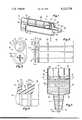
- FIG. 1is an isometric view, partially cut away, of a two-compartment dispenser using the features of this invention.
- FIG. 2is a partial side view of the plunger unit of the present invention showing the piston head regions thereof.
- FIG. 3is an end view of the plunger unit of FIG. 2 taken along lines 3--3 thereof showing one of the piston heads in cross section.
- FIG. 4is an enlarged partial side view, taken along lines 4--4 of FIG. 3.
- FIG. 5is a fragmentary side view, partially in section, of the dispenser in operation.
- the dispenser unit 10consists of two, totally unitary portions.
- a unitary plunger unit 12is telescopically associated with a unitary cartridge body 36.
- the plunger unitconsists of, preferably a pair of parallel piston shafts 28 interconnected at their uppermost extremities by a flange-like plunger activating bridging portion 32.
- the opposite extremity of each shaftincludes a piston head 14 to be described in detail later herein.
- the cartridge body 36will include an integral radially extending flange 40 at the mouth a pair of parallel compartments in the form of cylindrical bores 38. These bores are interconnected with an adjoining wall region 42.
- a pair of compartmentsare provided for receiving two dissimilar components of an epoxy-type adhesive system which are designed to interact with one another upon admixing.
- the extremitites opposite the mouth of the compartmentslead into smaller channels forming a nozzle region 44.
- the invention described hereinparticularly the unitary configuration of the plunger unit 12 and piston head 14, has particular significance in the dispensing of two-part epoxy material, which are relatively viscous and thus are difficult to seal when applied in a pressure plunger-type of system.
- nozzle seals 49will be cut away from the extremity of the nozzle region forming a pair of closely adjacent, small diameter orifices 50 and 52.
- the orifices 50 and 52are interconnected to the bases 46 and 48 of the compartments through channels of decreasing transverse dimensions.
- the viscous epoxy resin material 54 and 56are forced through the nozzle into a mixed or closely adjacent path 58. Thereafter, a simple brushing or swipe with a knife blade or the like will create the necessary admixing of the two elements permitting the epoxy to cure.
- Piston heads 14include two, axially spaced, sealing ring configurations. Sealing ring 19, which is nearest the free extremity of the piston head, is spaced from piston ring 22 and interconnected thereto by a cruciform shaped shaft element 26.
- the front face 16 of the piston headis configured as a frustonical surface which is in part complementary to the end surface 46 and 48 at the base of the compartments in cartridge 36 and which form the entrance to the nozzle region 44.
- a short, cylindrical surface 18is formed on the piston head interconnecting the front surface 16 with the sealing ring 19.
- the seal ring 19is also configured to have a frustoconical surface 20 tapering backwardly from the free extremity of the piston head. This frustoconical surface merges with a generally flat surface 21 extending perpendicularly to the axis of the associated piston shaft 28. A sharp edge is thus formed at the intersection of the surfaces 20 and 21.
- Rear seal 22is essentially a reverse configuration of the front seal 19 in that a frustoconical surface 23 tapers toward the free extremity and intersects a generally flat surface 24 extending perpendicularly to the axis of the associated shaft 28. Again, a sharp sealing edge is formed at the intersection of the two surfaces 24 and 23.
- a short cylindrical surface 25interconnects the conical surface 23 to the shaft 28.
- the shaft 28is shown to comprise a pair of intersecting surfaces forming a cruciform shaped structure. Ribs 30 may be formed to interconnect the intersecting surfaces at spaced axial locations to reinforce the shaft.
- the outer diameter of the seal rings 19 and 22will be slightly greater than the inner diameter of the respective bores 38 in the cartridge. This will create a resilient impingement between the two seal rings on each piston head and the respective compartment walls.
- the maximum transverse dimension of the ribs comprising the shaft 28will be slightly less than the inner diameter of the compartment bores enabling feee movement but yet providing alignment and stability to the dispenser.
- the frontal surfaces 16provide the majority of the surface contact area between the piston head and the fluids 54 and 56.
- the outer peripheral regions of the piston headcomprise the conical surface 20. Due to the backwardly tapered configuration of the first sealing ring 19, the downward activation of the piston units allows the sharp tips to deflect backwardly, creating a wiping seal against the walls. Since the material 54 and 56 is viscous, the step-like structure created by surface 18 allows the front seal region to be properly supported structurally and yet permit the resilience required to create the wiping action.
- the region created between flat surfaces 21 and 24thus may serve as a reservoir for any viscous fluid which may escape the front ring 19.
- the dispenser of the inventionbe made from a rigid plastic material such as high density polyethylene.
- the unitary construction of the piston head 14permits this material to be structurally capable of dispensing a viscous fluid-like resin epoxy and yet capable of providing a firm seal without the use of a secondary sealing material.
Landscapes
- Engineering & Computer Science (AREA)
- Mechanical Engineering (AREA)
- Containers And Packaging Bodies Having A Special Means To Remove Contents (AREA)
Abstract
Description
Dispensers for epoxy-type adhesives including two distinct compartments in a single cartridge body, such as that shown in U.S. Pat. No. 3,828,980, are currently available. Such dispensers permit the precise metering of two viscous adhesive components onto a discrete work surface. While such dispensers currently available do provide a convenient and reliable metering of such component adhesives, they have heretofore required a two-part plunger consisting of the plunger shaft, configured to have certain structural capabilities, and a seal cap, of a material dissimilar from the shaft and designed to have certain sealing capabilities. Since the use of such a dispenser is generally for consumers' home repair or industrial use, it must be of a rugged and reliable configuration. Thus, the structural characteristics of the plunger shaft could not heretofore be configured to provide the necessary sealing characteristics. The use of such two-part plungers has proven to be costly due to material costs and production time.
While certain modifications to the dispenser described above have been made to provide a unitary construction of a pair of parallel plunger shafts to be accommodated within a unitary cartridge including a pair of parallel compartments, such modifications still require the placement of discrete seal members at the extremity of each plunger shaft.
Accordingly, it is a primary object of this invention to provide a dispenser for metering fluids which minimizes the number of parts used in such a unit.
A more specific object of this invention is the provision of a plunger member in a dispenser which includes integrally formed seal means at the piston head, therefore eliminating separate seal elements.
Still a further object of the invention is to provide a plunger for use in a plurality of chambers simultaneously and more particularly a plunger for use with viscous materials which include an integral double lipped seal at the piston head.
In general, these objects are obtained by the dispenser of the present invention which consists of two parts, namely a cartridge having two or more cylindrical compartments and a piston or plunger unit which includes a corresponding number of piston shafts integrally joined at the top and including particularly configured seal rings unitarily configured at the opposite extremity of the shafts.
The seal region of each shaft includes a pair of axially spaced seal rings having sharp edges at their outer periphery. The outer peripheral region of each seal ring includes a frustoconical surface with the frustoconical surface of the ring nearest the extremity tapering backwardly from the extremity while the frustoconical surface of the rearward ring tapers forwardly toward the extremity. The forward ring is further configured to include a step-like surface resulting from an inner, shallow, frustoconical surface being connected to the outer surface by a short cylindrical surface. The particular elements making up the unitary configuration of the piston shafts and the advantages of these features will become apparent from the following description when read in conjunction with the accompanying drawings.
FIG. 1 is an isometric view, partially cut away, of a two-compartment dispenser using the features of this invention.
FIG. 2 is a partial side view of the plunger unit of the present invention showing the piston head regions thereof.
FIG. 3 is an end view of the plunger unit of FIG. 2 taken alonglines 3--3 thereof showing one of the piston heads in cross section.
FIG. 4 is an enlarged partial side view, taken alonglines 4--4 of FIG. 3. FIG. 5 is a fragmentary side view, partially in section, of the dispenser in operation.
As shown in FIG. 1, thedispenser unit 10 consists of two, totally unitary portions. Aunitary plunger unit 12 is telescopically associated with aunitary cartridge body 36. The plunger unit consists of, preferably a pair ofparallel piston shafts 28 interconnected at their uppermost extremities by a flange-like plunger activatingbridging portion 32. The opposite extremity of each shaft includes apiston head 14 to be described in detail later herein. Thecartridge body 36 will include an integral radially extendingflange 40 at the mouth a pair of parallel compartments in the form ofcylindrical bores 38. These bores are interconnected with anadjoining wall region 42. Thus a pair of compartments are provided for receiving two dissimilar components of an epoxy-type adhesive system which are designed to interact with one another upon admixing. The extremitites opposite the mouth of the compartments lead into smaller channels forming anozzle region 44.
The invention described herein, particularly the unitary configuration of theplunger unit 12 andpiston head 14, has particular significance in the dispensing of two-part epoxy material, which are relatively viscous and thus are difficult to seal when applied in a pressure plunger-type of system. To use a dispenser such as the type described herein, and more particularly shown in FIG. 5,nozzle seals 49 will be cut away from the extremity of the nozzle region forming a pair of closely adjacent,small diameter orifices orifices bases flange 32, facilitated by thecartridge flange 40, the viscousepoxy resin material adjacent path 58. Thereafter, a simple brushing or swipe with a knife blade or the like will create the necessary admixing of the two elements permitting the epoxy to cure.
A reference to FIGS. 2-4 will facilitate the description of theunitary piston head 14. Since each of the piston heads are identical, only one will be described in detail. Pistonheads 14 include two, axially spaced, sealing ring configurations.Sealing ring 19, which is nearest the free extremity of the piston head, is spaced frompiston ring 22 and interconnected thereto by a cruciformshaped shaft element 26. Thefront face 16 of the piston head is configured as a frustonical surface which is in part complementary to theend surface cartridge 36 and which form the entrance to thenozzle region 44.
A short,cylindrical surface 18 is formed on the piston head interconnecting thefront surface 16 with the sealingring 19. Theseal ring 19 is also configured to have afrustoconical surface 20 tapering backwardly from the free extremity of the piston head. This frustoconical surface merges with a generallyflat surface 21 extending perpendicularly to the axis of the associatedpiston shaft 28. A sharp edge is thus formed at the intersection of thesurfaces
Theshaft 28 is shown to comprise a pair of intersecting surfaces forming a cruciform shaped structure.Ribs 30 may be formed to interconnect the intersecting surfaces at spaced axial locations to reinforce the shaft.
Since it is a desire of the invention to reduce the cost of making a plunger and yet have an effective seal at the piston head, the configuration of a unitary piston head as just described is vitally important.
It will be noted that the outer diameter of theseal rings respective bores 38 in the cartridge. This will create a resilient impingement between the two seal rings on each piston head and the respective compartment walls. The maximum transverse dimension of the ribs comprising theshaft 28 will be slightly less than the inner diameter of the compartment bores enabling feee movement but yet providing alignment and stability to the dispenser.
In use, thefrontal surfaces 16 provide the majority of the surface contact area between the piston head and thefluids conical surface 20. Due to the backwardly tapered configuration of thefirst sealing ring 19, the downward activation of the piston units allows the sharp tips to deflect backwardly, creating a wiping seal against the walls. Since thematerial surface 18 allows the front seal region to be properly supported structurally and yet permit the resilience required to create the wiping action. The region created betweenflat surfaces front ring 19. Due to the configuration of therear ring 22, the material which may enter the reservoir area is effectively scraped from the walls since conical surface 23 is tapered toward the direction of movement. This configuration results in an effective flattening of the edge rather than a bending over of thefront edge 19. The in-use configuration of these front andback seal edges frontal seal ring 19 is slightly bent backwardly, while therear seal 22 is flattened at point B during its scraping action. Again thecylindrical section 25 serves as a support to thescraping ring 22.
It is preferable that the dispenser of the invention be made from a rigid plastic material such as high density polyethylene. The unitary construction of thepiston head 14 permits this material to be structurally capable of dispensing a viscous fluid-like resin epoxy and yet capable of providing a firm seal without the use of a secondary sealing material.
Thus it is apparent that there has been provided in accordance with the invention of a dispenser unit, and particularly a unitary piston head on a plunger used in a dispenser unit, that fully satisfies the objects, aims and advantages set forth above. While the invention has been described in conjunction with specific embodiments thereof, it is evident that may alternatives, modifications and variations will be apparent to those skilled in the art in light of the foregoing description. Accordingly, it is intended to embrace all such alternatives, modifications and variations as fall within the spirit and broad scope of the appended claims.
Claims (2)
1. A dispenser for precisely and substantially simultaneously metering small quantities of a plurality of viscous fluids stored therein with segregated compartments comprising a unitary cartridge body including a plurality of adjacent, parallel compartments with adjoining walls, a first extremity of said cartridge body including a flange extending outwardly of annular openings communicating with and of a diameter equal to the diameter of the respective compartment, the second extremity of said cartridge body including a plurality of nozzles creating closely adjacent aperture means communicating with respective compartments through channels of transverse dimensions less than the diameter of the respective compartment, a one-piece piston unit telescopically associated with said cartridge body, the unit comprising a plurality of piston shafts integrally joined at one end with a piston activating bight portion, the opposite ends of each piston shaft forming a piston head including integral seal means configured thereon, the seal means on each piston head including a pair of axially spaced seal rings having sharp edges at their outer peripheries, a first of said pair of spaced seal rings nearest the free extremity of each piston head including a frustoconical surface at the outer peripheral region thereof forming one side of the sharp edge, the frustoconical surface tapering backwards from said free extremity, the free extremity of each piston head further including a central, substantially frustoconical region representing a major portion of the frontal area and which is interconnected to the outer peripheral region by a short cylindrical surface region substantially about the axis of the piston shaft presenting a step-like piston head surface and defining the outer extremity of a primary liquid contacting surface, a second of said pair of seal rings which is disposed farthest from the free extremity of each piston head including a frustoconical surface at the outer peripheral region thereof forming one side of the sharp edge, the frustoconical surface on said second ring tapering forward toward the free extremity, the surface of the opposing sides of each frustoconical seal ring surface extending substantially perpendicular to the axis of the piston shaft, the diameter of each of the seal rings being substantially equal to one another and at least slightly greater than the inner diameter of the respective compartment so as to effect a resilient, wiping, press-fit with the inner walls of the compartments at two axial spaced regions of each compartment.
2. The dispenser of claim 1, wherein the piston shafts are substantially cruciform in cross section with a constant radial dimension throughout the length thereof which is substantially equal to the radial dimension of the associated compartments.
Priority Applications (1)
| Application Number | Priority Date | Filing Date | Title |
|---|---|---|---|
| US05/789,049US4121739A (en) | 1977-04-20 | 1977-04-20 | Dispenser with unitary plunger and seal construction |
Applications Claiming Priority (1)
| Application Number | Priority Date | Filing Date | Title |
|---|---|---|---|
| US05/789,049US4121739A (en) | 1977-04-20 | 1977-04-20 | Dispenser with unitary plunger and seal construction |
Publications (1)
| Publication Number | Publication Date |
|---|---|
| US4121739Atrue US4121739A (en) | 1978-10-24 |
Family
ID=25146422
Family Applications (1)
| Application Number | Title | Priority Date | Filing Date |
|---|---|---|---|
| US05/789,049Expired - LifetimeUS4121739A (en) | 1977-04-20 | 1977-04-20 | Dispenser with unitary plunger and seal construction |
Country Status (1)
| Country | Link |
|---|---|
| US (1) | US4121739A (en) |
Cited By (46)
| Publication number | Priority date | Publication date | Assignee | Title |
|---|---|---|---|---|
| EP0057465A3 (en)* | 1981-02-03 | 1982-10-13 | Gebruder Kommerling Kunststoffwerke Gmbh | Handgun mixer |
| WO1988000498A1 (en)* | 1986-07-11 | 1988-01-28 | Advanced Adhesives Limited | Improvements in or relating to a dispensing arrangement |
| EP0388185A1 (en)* | 1989-03-16 | 1990-09-19 | Unilever Plc | Multi-cavity dispensing container |
| GB2232910A (en)* | 1986-07-11 | 1991-01-02 | Uni Continental | Dispensing nozzle for reactive components |
| US5236108A (en)* | 1991-09-25 | 1993-08-17 | Minnesota Mining And Manufacturing Company | Multiple-barrel dispensing container assembly with induction seal |
| US5290259A (en)* | 1993-02-18 | 1994-03-01 | Ultradent Products, Inc. | Double syringe delivery system |
| US5289949A (en)* | 1992-06-22 | 1994-03-01 | Chesebrough-Pond's Usa Co., Division Of Conopco, Inc. | Multi-cavity dispensing refill cartridge |
| US5332124A (en)* | 1993-05-17 | 1994-07-26 | Chesebrough-Pond's, Usa Co., A Division Of Conopco, Inc. | Multi-cavity dispensing refill cartridge |
| US5335827A (en)* | 1992-12-22 | 1994-08-09 | Chesebrough-Pond's Usa Co., A Division Of Conopco, Inc. | Multi-cavity dispensing refill cartridge |
| US5395345A (en)* | 1994-01-27 | 1995-03-07 | The Kendall Company | Aspirating syringe |
| US5411485A (en)* | 1993-04-19 | 1995-05-02 | Hyprotek | Catheter access system and method |
| DE19628552A1 (en)* | 1995-08-04 | 1997-02-06 | Illinois Tool Works | Anti-cross contamination double cartridge dispenser |
| WO1997021394A1 (en)* | 1995-12-08 | 1997-06-19 | Minnesota Mining And Manufacturing Company | Applicator for dispensing material from a dual chamber cartridge |
| WO1998008751A1 (en)* | 1996-08-29 | 1998-03-05 | Unilever Plc | Multi-cavity dispensing container |
| US5899360A (en)* | 1995-06-09 | 1999-05-04 | Colgate - Palmolive Company | Multi-chamber refillable dispenser |
| US5902568A (en)* | 1997-01-15 | 1999-05-11 | Chesebrough-Pond's Usa Co., Division Of Conopco, Inc. | Method for whitening teeth |
| USD415413S (en) | 1997-10-08 | 1999-10-19 | Colgate-Palmolive Company | Dispenser |
| US6315171B1 (en) | 2000-09-29 | 2001-11-13 | The Plastek Group | Telescoping ram dispenser |
| US6394982B1 (en) | 1997-07-11 | 2002-05-28 | United States Surgical Corporation | Fibrin glue applicator system |
| US20020117512A1 (en)* | 2000-12-21 | 2002-08-29 | Eastman Kodak Company | Photoprocessing method and apparatus |
| US6471670B1 (en) | 1998-10-05 | 2002-10-29 | Karl Enrenfels | Fibrin sealant applicator system |
| US6494348B2 (en)* | 2000-01-28 | 2002-12-17 | Sulzer Chemtech Ag | Cartridge piston |
| US6527749B1 (en) | 1997-12-19 | 2003-03-04 | United States Surgical Corporation | Two component dispenser system |
| JP2003527946A (en)* | 1998-10-12 | 2003-09-24 | ディスカス デンタル インプレッションズ,インコーポレイティド | Twin-body syringe with separable fixed mixing tip |
| US6764467B1 (en) | 1997-12-19 | 2004-07-20 | United States Surgical Corporation | Fibrin mixture and dispenser assembly |
| US20040159715A1 (en)* | 2003-02-03 | 2004-08-19 | Leach Michael D. | Spray applicator |
| US6783514B2 (en) | 1997-01-31 | 2004-08-31 | United States Surgical Corporation | Fibrin sealant applicator |
| US7018357B2 (en) | 2001-02-27 | 2006-03-28 | Tyco Healthcare Group Lp | External mixer assembly |
| US20060253082A1 (en)* | 2005-04-21 | 2006-11-09 | Mcintosh Kevin D | Fluid dispenser |
| US20070009607A1 (en)* | 2005-07-11 | 2007-01-11 | George Jones | Antibacterial/anti-infalmmatory composition and method |
| US20070012806A1 (en)* | 2004-02-13 | 2007-01-18 | Muhlhausen Hans G | Dispenser bottle for at least two active fluids |
| US20070164047A1 (en)* | 2003-08-14 | 2007-07-19 | 3M Innovative Properties Company | Capsule for two-component materials |
| US20090298010A1 (en)* | 2006-03-09 | 2009-12-03 | Broyles Bruce R | Device for dispensing material |
| US7709268B1 (en)* | 1999-08-17 | 2010-05-04 | Ttp Labtech Limited | Sampling/dispensing device with plunger and housing set onto plunger |
| US7766900B2 (en) | 2005-02-21 | 2010-08-03 | Biomet Manufacturing Corp. | Method and apparatus for application of a fluid |
| US20110303703A1 (en)* | 2009-10-28 | 2011-12-15 | Yeager Don F | Apparatus for dispensing a controlled dose |
| USD657876S1 (en) | 2010-02-02 | 2012-04-17 | 3M Innovative Properties Company | Dental capsule |
| US8182769B2 (en) | 2008-04-04 | 2012-05-22 | Biomet Biologics, Llc | Clean transportation system |
| US8518272B2 (en) | 2008-04-04 | 2013-08-27 | Biomet Biologics, Llc | Sterile blood separating system |
| US20130269806A1 (en)* | 2012-04-13 | 2013-10-17 | Rooftop Research, LLC. | Vee Manifold |
| US20140058442A1 (en)* | 2012-08-24 | 2014-02-27 | St. Jude Medical Puerto Rico Llc | Sealant storage, preparation, and delivery systems and related methods |
| US20140124508A1 (en)* | 2012-11-08 | 2014-05-08 | Sulzer Mixpac Ag | Cartridge for at least two flowable components |
| US8985394B1 (en) | 2013-11-22 | 2015-03-24 | Bryan Tapocik | Pen removably retaining single use capsule containing tooth whitening compounds, dental bonding compounds and adhesives and removably retaining disposable tooth whitening applicators, disposable dental bonding compound applicators and disposable adhesive applicators |
| US9572646B2 (en) | 2015-03-20 | 2017-02-21 | Bryan Tapocik | Electrical pen with improvements for pen removably retaining single use cartridge containing tooth whitening compounds, dental bonding compounds, nail polish, and adhesives and removably retaining disposable tooth whitening applicators, disposable dental bonding compound applicators, nail polish applicators and disposable adhesive applicators |
| US9707052B2 (en) | 2015-01-29 | 2017-07-18 | Bryan Tapocik | Mechanical pen with improvements for pen removably retaining single use capsule containing tooth whitening compounds, dental bonding compounds and adhesives and removably retaining disposable tooth whitening applicators, disposable dental bonding compound applicators and disposable adhesive applicators |
| US11352247B2 (en) | 2018-08-24 | 2022-06-07 | Rooftop Research, Llc | Manifold and fluid dispensing systems |
Citations (6)
| Publication number | Priority date | Publication date | Assignee | Title |
|---|---|---|---|---|
| FR536511A (en)* | 1921-06-06 | 1922-05-04 | Syringe | |
| FR1242737A (en)* | 1958-12-16 | 1960-09-30 | S & R J Everett & Co Ltd | Hypodermic syringe |
| US3766918A (en)* | 1971-09-07 | 1973-10-23 | J Kessel | Self-aspirating hypodermic ampule |
| US3827602A (en)* | 1970-10-26 | 1974-08-06 | A Nicholls | Dual tubular dispensing device |
| US3828980A (en)* | 1972-11-06 | 1974-08-13 | Chem Dev Corp | Dispenser for precisely metered dispensing of viscous fluids |
| FR2291702A1 (en)* | 1974-11-22 | 1976-06-18 | Zejma Marie | Hypodermic syringe has moulded plastic plunger and plunger rod - the diametric cross section of plunger being approx W-shaped |
- 1977
- 1977-04-20USUS05/789,049patent/US4121739A/ennot_activeExpired - Lifetime
Patent Citations (6)
| Publication number | Priority date | Publication date | Assignee | Title |
|---|---|---|---|---|
| FR536511A (en)* | 1921-06-06 | 1922-05-04 | Syringe | |
| FR1242737A (en)* | 1958-12-16 | 1960-09-30 | S & R J Everett & Co Ltd | Hypodermic syringe |
| US3827602A (en)* | 1970-10-26 | 1974-08-06 | A Nicholls | Dual tubular dispensing device |
| US3766918A (en)* | 1971-09-07 | 1973-10-23 | J Kessel | Self-aspirating hypodermic ampule |
| US3828980A (en)* | 1972-11-06 | 1974-08-13 | Chem Dev Corp | Dispenser for precisely metered dispensing of viscous fluids |
| FR2291702A1 (en)* | 1974-11-22 | 1976-06-18 | Zejma Marie | Hypodermic syringe has moulded plastic plunger and plunger rod - the diametric cross section of plunger being approx W-shaped |
Cited By (73)
| Publication number | Priority date | Publication date | Assignee | Title |
|---|---|---|---|---|
| EP0057465A3 (en)* | 1981-02-03 | 1982-10-13 | Gebruder Kommerling Kunststoffwerke Gmbh | Handgun mixer |
| GB2232910B (en)* | 1986-07-11 | 1991-03-20 | Uni Continental | Dispensing nozzle for reactive components. |
| WO1988000498A1 (en)* | 1986-07-11 | 1988-01-28 | Advanced Adhesives Limited | Improvements in or relating to a dispensing arrangement |
| GB2232910A (en)* | 1986-07-11 | 1991-01-02 | Uni Continental | Dispensing nozzle for reactive components |
| GB2192354B (en)* | 1986-07-11 | 1991-01-30 | Advanced Adhesives Ltd | Dispensing nozzle for reactive components |
| US5020694A (en)* | 1989-03-16 | 1991-06-04 | Chesebrough-Pond's, Inc. | Multi-cavity dispensing container |
| EP0388185A1 (en)* | 1989-03-16 | 1990-09-19 | Unilever Plc | Multi-cavity dispensing container |
| US5236108A (en)* | 1991-09-25 | 1993-08-17 | Minnesota Mining And Manufacturing Company | Multiple-barrel dispensing container assembly with induction seal |
| US5289949A (en)* | 1992-06-22 | 1994-03-01 | Chesebrough-Pond's Usa Co., Division Of Conopco, Inc. | Multi-cavity dispensing refill cartridge |
| US5335827A (en)* | 1992-12-22 | 1994-08-09 | Chesebrough-Pond's Usa Co., A Division Of Conopco, Inc. | Multi-cavity dispensing refill cartridge |
| US5290259A (en)* | 1993-02-18 | 1994-03-01 | Ultradent Products, Inc. | Double syringe delivery system |
| US5411485A (en)* | 1993-04-19 | 1995-05-02 | Hyprotek | Catheter access system and method |
| US5332124A (en)* | 1993-05-17 | 1994-07-26 | Chesebrough-Pond's, Usa Co., A Division Of Conopco, Inc. | Multi-cavity dispensing refill cartridge |
| US5395345A (en)* | 1994-01-27 | 1995-03-07 | The Kendall Company | Aspirating syringe |
| US5899360A (en)* | 1995-06-09 | 1999-05-04 | Colgate - Palmolive Company | Multi-chamber refillable dispenser |
| DE19628552C2 (en)* | 1995-08-04 | 1999-01-21 | Illinois Tool Works | Device for dispensing a two-component adhesive |
| DE19628552A1 (en)* | 1995-08-04 | 1997-02-06 | Illinois Tool Works | Anti-cross contamination double cartridge dispenser |
| US5743436A (en)* | 1995-12-08 | 1998-04-28 | Minnesota Mining & Manufacturing Co. | Applicator for dispensing material from a dual chamber cartridge |
| WO1997021394A1 (en)* | 1995-12-08 | 1997-06-19 | Minnesota Mining And Manufacturing Company | Applicator for dispensing material from a dual chamber cartridge |
| WO1998008751A1 (en)* | 1996-08-29 | 1998-03-05 | Unilever Plc | Multi-cavity dispensing container |
| US5902568A (en)* | 1997-01-15 | 1999-05-11 | Chesebrough-Pond's Usa Co., Division Of Conopco, Inc. | Method for whitening teeth |
| US6783514B2 (en) | 1997-01-31 | 2004-08-31 | United States Surgical Corporation | Fibrin sealant applicator |
| US6394982B1 (en) | 1997-07-11 | 2002-05-28 | United States Surgical Corporation | Fibrin glue applicator system |
| USD415413S (en) | 1997-10-08 | 1999-10-19 | Colgate-Palmolive Company | Dispenser |
| US6527749B1 (en) | 1997-12-19 | 2003-03-04 | United States Surgical Corporation | Two component dispenser system |
| US6764467B1 (en) | 1997-12-19 | 2004-07-20 | United States Surgical Corporation | Fibrin mixture and dispenser assembly |
| US6471670B1 (en) | 1998-10-05 | 2002-10-29 | Karl Enrenfels | Fibrin sealant applicator system |
| JP2003527946A (en)* | 1998-10-12 | 2003-09-24 | ディスカス デンタル インプレッションズ,インコーポレイティド | Twin-body syringe with separable fixed mixing tip |
| US7709268B1 (en)* | 1999-08-17 | 2010-05-04 | Ttp Labtech Limited | Sampling/dispensing device with plunger and housing set onto plunger |
| US6494348B2 (en)* | 2000-01-28 | 2002-12-17 | Sulzer Chemtech Ag | Cartridge piston |
| US6315171B1 (en) | 2000-09-29 | 2001-11-13 | The Plastek Group | Telescoping ram dispenser |
| US20020117512A1 (en)* | 2000-12-21 | 2002-08-29 | Eastman Kodak Company | Photoprocessing method and apparatus |
| US7018357B2 (en) | 2001-02-27 | 2006-03-28 | Tyco Healthcare Group Lp | External mixer assembly |
| US20040159715A1 (en)* | 2003-02-03 | 2004-08-19 | Leach Michael D. | Spray applicator |
| US7077339B2 (en) | 2003-02-03 | 2006-07-18 | Biomet, Inc. | Spray applicator |
| US8561845B2 (en) | 2003-08-14 | 2013-10-22 | 3M Innovative Properties Company | Capsule for two-component materials |
| US20110084094A1 (en)* | 2003-08-14 | 2011-04-14 | 3M Innovative Properties Company | Capsule for two-component materials |
| US7882983B2 (en) | 2003-08-14 | 2011-02-08 | 3M Innovative Properties Company | Capsule for two-component materials |
| US20070164047A1 (en)* | 2003-08-14 | 2007-07-19 | 3M Innovative Properties Company | Capsule for two-component materials |
| US7232082B2 (en)* | 2004-02-13 | 2007-06-19 | Henkel Kommanditgesellschaft Auf Aktien | Dispenser bottle for at least two active fluids |
| US20070012806A1 (en)* | 2004-02-13 | 2007-01-18 | Muhlhausen Hans G | Dispenser bottle for at least two active fluids |
| US9028457B2 (en) | 2005-02-21 | 2015-05-12 | Biomet Biologics, Llc | Method and apparatus for application of a fluid |
| US7766900B2 (en) | 2005-02-21 | 2010-08-03 | Biomet Manufacturing Corp. | Method and apparatus for application of a fluid |
| US8444620B2 (en) | 2005-02-21 | 2013-05-21 | Biomet Biologics, Llc | Method and apparatus for application of a fluid |
| US20060253082A1 (en)* | 2005-04-21 | 2006-11-09 | Mcintosh Kevin D | Fluid dispenser |
| US20100076399A1 (en)* | 2005-04-21 | 2010-03-25 | Arteriocyte Medical Systems, Inc. | Fluid dispenser |
| US7635343B2 (en)* | 2005-04-21 | 2009-12-22 | Arteriocyte Medical Systems, Inc. | Fluid dispenser |
| US8088099B2 (en)* | 2005-04-21 | 2012-01-03 | Arteriocyte Medical Systems, Inc. | Fluid dispenser |
| US20070009607A1 (en)* | 2005-07-11 | 2007-01-11 | George Jones | Antibacterial/anti-infalmmatory composition and method |
| US9211168B2 (en) | 2006-03-09 | 2015-12-15 | 3M Innovative Properties Company | Device for dispensing material |
| US8328553B2 (en) | 2006-03-09 | 2012-12-11 | 3M Innovative Properties Company | Device for dispensing material |
| US20090298010A1 (en)* | 2006-03-09 | 2009-12-03 | Broyles Bruce R | Device for dispensing material |
| US8182769B2 (en) | 2008-04-04 | 2012-05-22 | Biomet Biologics, Llc | Clean transportation system |
| US8518272B2 (en) | 2008-04-04 | 2013-08-27 | Biomet Biologics, Llc | Sterile blood separating system |
| US9211487B2 (en) | 2008-04-04 | 2015-12-15 | Biomet Biologics, Llc | Sterile blood separating system |
| US20110303703A1 (en)* | 2009-10-28 | 2011-12-15 | Yeager Don F | Apparatus for dispensing a controlled dose |
| USD658763S1 (en) | 2010-02-02 | 2012-05-01 | 3M Innovative Properties Company | Dental capsule |
| USD657876S1 (en) | 2010-02-02 | 2012-04-17 | 3M Innovative Properties Company | Dental capsule |
| US20130269806A1 (en)* | 2012-04-13 | 2013-10-17 | Rooftop Research, LLC. | Vee Manifold |
| US12023705B2 (en) | 2012-04-13 | 2024-07-02 | Rooftop Research, Llc | Vee manifold |
| US12005472B2 (en) | 2012-04-13 | 2024-06-11 | Rooftop Research, Llc | Vee manifold |
| US10610837B2 (en)* | 2012-04-13 | 2020-04-07 | Rooftop Research, Llc | Vee manifold |
| US9242846B2 (en)* | 2012-04-13 | 2016-01-26 | Rooftop Research, Llc | Vee manifold |
| US20160207012A1 (en)* | 2012-04-13 | 2016-07-21 | Rooftop Research, Llc | Vee Manifold |
| US20140058442A1 (en)* | 2012-08-24 | 2014-02-27 | St. Jude Medical Puerto Rico Llc | Sealant storage, preparation, and delivery systems and related methods |
| US9398913B2 (en)* | 2012-08-24 | 2016-07-26 | St. Jude Medical Puerto Rico Llc | Sealant storage, preparation, and delivery systems and related methods |
| US9611074B2 (en)* | 2012-11-08 | 2017-04-04 | Sulzer Mixpac Ag | Cartridge for at least two flowable components |
| US20140124508A1 (en)* | 2012-11-08 | 2014-05-08 | Sulzer Mixpac Ag | Cartridge for at least two flowable components |
| US8985394B1 (en) | 2013-11-22 | 2015-03-24 | Bryan Tapocik | Pen removably retaining single use capsule containing tooth whitening compounds, dental bonding compounds and adhesives and removably retaining disposable tooth whitening applicators, disposable dental bonding compound applicators and disposable adhesive applicators |
| US9707052B2 (en) | 2015-01-29 | 2017-07-18 | Bryan Tapocik | Mechanical pen with improvements for pen removably retaining single use capsule containing tooth whitening compounds, dental bonding compounds and adhesives and removably retaining disposable tooth whitening applicators, disposable dental bonding compound applicators and disposable adhesive applicators |
| US9572646B2 (en) | 2015-03-20 | 2017-02-21 | Bryan Tapocik | Electrical pen with improvements for pen removably retaining single use cartridge containing tooth whitening compounds, dental bonding compounds, nail polish, and adhesives and removably retaining disposable tooth whitening applicators, disposable dental bonding compound applicators, nail polish applicators and disposable adhesive applicators |
| US11352247B2 (en) | 2018-08-24 | 2022-06-07 | Rooftop Research, Llc | Manifold and fluid dispensing systems |
| US11873206B2 (en) | 2018-08-24 | 2024-01-16 | Rooftop Research, Llc | Manifold and fluid dispensing systems |
Similar Documents
| Publication | Publication Date | Title |
|---|---|---|
| US4121739A (en) | Dispenser with unitary plunger and seal construction | |
| US3828980A (en) | Dispenser for precisely metered dispensing of viscous fluids | |
| US4261481A (en) | Fluid packaging kit for pressurized dispensing | |
| US3827602A (en) | Dual tubular dispensing device | |
| US4678107A (en) | Dripless dispenser for liquids and viscous fluids | |
| US4198756A (en) | Manual extruder | |
| US7635070B2 (en) | Dropper bottle and accessories therefor | |
| US5358349A (en) | Glue applicator | |
| US3376999A (en) | Packaging, mixing and dispensing apparatus | |
| US6612465B2 (en) | Multi-component mixing storage and dispensing device | |
| EP0645122B1 (en) | Syringe for dosing viscous substances, in particular for dental substances | |
| US5322440A (en) | Dental syringe tip | |
| US3738535A (en) | Mixing and proportioning syringe | |
| US20080138765A1 (en) | Mixing tip for dental materials | |
| JP2003135487A (en) | Injector for preventing subsequent dripping and plunger and sealing body for this injector | |
| US20040159678A1 (en) | Apparatus and method for mixing and dispensing components of a composition | |
| EP0521434A1 (en) | Modular fluid dosing device | |
| WO2007131634A1 (en) | Dispensing device | |
| US5843043A (en) | Syringe and process for dispensing treatment fluid | |
| US3007611A (en) | Metering dispenser for flowable materials | |
| US5405056A (en) | Stereo dispensing container and system | |
| US20220192784A1 (en) | Dental capsule | |
| US3315847A (en) | Plunger | |
| EP3900663A1 (en) | Mixing and dispensing container | |
| US20050049558A1 (en) | Dispensing cartridge |