US4102418A - Borehole drilling apparatus - Google Patents
Borehole drilling apparatusDownload PDFInfo
- Publication number
- US4102418A US4102418AUS05/761,627US76162777AUS4102418AUS 4102418 AUS4102418 AUS 4102418AUS 76162777 AUS76162777 AUS 76162777AUS 4102418 AUS4102418 AUS 4102418A
- Authority
- US
- United States
- Prior art keywords
- body member
- borehole
- passageways
- drill bit
- fluid
- Prior art date
- Legal status (The legal status is an assumption and is not a legal conclusion. Google has not performed a legal analysis and makes no representation as to the accuracy of the status listed.)
- Expired - Lifetime
Links
- 238000005553drillingMethods0.000titleclaimsabstractdescription50
- 239000012530fluidSubstances0.000claimsabstractdescription54
- 238000005520cutting processMethods0.000claimsabstractdescription20
- 230000015572biosynthetic processEffects0.000claimsabstractdescription13
- 230000009977dual effectEffects0.000claimsdescription7
- 230000002093peripheral effectEffects0.000claims2
- 230000003068static effectEffects0.000claims2
- 239000000463materialSubstances0.000abstractdescription12
- 238000007599dischargingMethods0.000description9
- 238000007789sealingMethods0.000description4
- 230000004888barrier functionEffects0.000description2
- 238000011109contaminationMethods0.000description2
- 238000004519manufacturing processMethods0.000description2
- 230000000694effectsEffects0.000description1
- 238000005552hardfacingMethods0.000description1
- 230000035515penetrationEffects0.000description1
- 238000004904shorteningMethods0.000description1
- UONOETXJSWQNOL-UHFFFAOYSA-Ntungsten carbideChemical compound[W+]#[C-]UONOETXJSWQNOL-UHFFFAOYSA-N0.000description1
Images
Classifications
- E—FIXED CONSTRUCTIONS
- E21—EARTH OR ROCK DRILLING; MINING
- E21B—EARTH OR ROCK DRILLING; OBTAINING OIL, GAS, WATER, SOLUBLE OR MELTABLE MATERIALS OR A SLURRY OF MINERALS FROM WELLS
- E21B17/00—Drilling rods or pipes; Flexible drill strings; Kellies; Drill collars; Sucker rods; Cables; Casings; Tubings
- E21B17/10—Wear protectors; Centralising devices, e.g. stabilisers
- E21B17/1078—Stabilisers or centralisers for casing, tubing or drill pipes
- E—FIXED CONSTRUCTIONS
- E21—EARTH OR ROCK DRILLING; MINING
- E21B—EARTH OR ROCK DRILLING; OBTAINING OIL, GAS, WATER, SOLUBLE OR MELTABLE MATERIALS OR A SLURRY OF MINERALS FROM WELLS
- E21B21/00—Methods or apparatus for flushing boreholes, e.g. by use of exhaust air from motor
- E—FIXED CONSTRUCTIONS
- E21—EARTH OR ROCK DRILLING; MINING
- E21B—EARTH OR ROCK DRILLING; OBTAINING OIL, GAS, WATER, SOLUBLE OR MELTABLE MATERIALS OR A SLURRY OF MINERALS FROM WELLS
- E21B21/00—Methods or apparatus for flushing boreholes, e.g. by use of exhaust air from motor
- E21B21/12—Methods or apparatus for flushing boreholes, e.g. by use of exhaust air from motor using drilling pipes with plural fluid passages, e.g. closed circulation systems
Definitions
- the present inventionrelates to apparatus for borehole drilling, and more particularly to apparatus in which the cuttings are conveyed to the top of the borehole free from contamination by other formation material.
- a seal apparatusfor sealing off a borehole during drilling so as to permit drilling fluid circulation without introducing such fluid into the annulus between the wall of the well bore and the drill pipe.
- a flexible ringsuch as an air inflated vehicle tire, which is adapted to engage the wall of the borehole to form a seal therewith above the drill bit to prevent circulating fluid from passing into the annulus above such seal.
- an object of the inventionto provide drilling apparatus having an improved sealing device for preventing cuttings from passing upwardly around the apparatus into the drilling string annulus thereabove, and which effects conveyance of formation material away from the drilling region through the drilling string annulus to the top of the borehole.
- Another object of the inventionis to provide drilling apparatus embodying a drill bit and an improved seal device that does not substantially engage the borehole wall, minimizing frictional resistance to downward feeding of the apparatus in the borehole during drilling, and which prevents the formation cuttings from moving upwardly past the seal device into the drilling string annulus thereabove.
- the seal deviceis slightly smaller in diameter than the diameter of the borehole being drilled, drilling fluid being discharged into the hole above and below the device to provide a substantially immovable fluid zone around the seal device that prevents upward and downward flow of fluid along the exterior of the seal device.
- formation material that might otherwise drop from above into the drilling string annulusis carried by the fluid discharged above the device upwardly out of the borehole, while fluid discharged below the device carries all cuttings toward the center of the bit for upward conveyance therethrough and through the drilling string to the top of the borehole.
- a drilling apparatusincluding a labyrinth type of seal device slightly less in diameter than the diameter of the borehole being drilled, which is rotatable with a bit for drilling the borehole, downwardly and upwardly extending fluid passages being provided for discharging drilling fluid into the annular space around the apparatus and drill pipe string, the passages discharging drilling fluid, such as compressed air, downwardly below the labyrinth seal to carry formation cuttings to and through the center of the drill bit for conveyance through the drill pipe string to the top of the borehole, and upwardly into the annulus around the drill pipe string and above the labyrinth seal.
- the upwardly discharging drilling fluidforces formation debris, which drops or tends to drop into the borehole, upwardly through the annulus around the drill pipe string out of the borehole.
- the pressure of the fluid discharging into the annulus above the labyrinth seal and the pressure of the fluid discharging into the annulus below the sealare substantially the same, whereby the labyrinth seal adjacent the wall of the borehole, and positioned between the oppositely directed outlets of the fluid passages, functions as a stagnation collar preventing drilling fluid and debris from flowing past the seal in upward and downward directions.
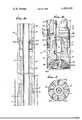
- FIGS. 1a and 1btogether constitute a longitudinal section through a drilling apparatus embodying the invention, with a portion of FIG. 1b being disclosed in side elevation, FIG. 1b being a lower continuation of FIG. 1a; and
- FIG. 2is a cross-section taken along the line 2--2 on FIG. 1b.
- a drill bit apparatus 10for drilling a borehole 11 to a desired diameter, the apparatus including a known type of drill bit 12 having an upper pin 13 threadedly secured into a companion lower threaded box 14 of a sub or body member 15.
- the upper end of the body memberhas a threaded pin 16 threadedly secured into a companion box 17 of outer sections 18 of a dual drill pipe string 19 extending to the top of the borehole.
- This dual stringincludes an inner string of drill pipe sections 20 spaced from the inner wall of the outer drill pipe sections 18 to form an annular passage 21 therebetween.
- the outer drill pipe sections 18are threadedly secured to one another, whereas the inner drill pipe sections 20 are suitably held coaxially in the outer sections by suitable and known arrangements, such as disclosed in U.S. Pat. No. 3,970,335.
- suitable and known arrangementssuch as disclosed in U.S. Pat. No. 3,970,335.
- leakage of fluid from the inner drill pipe string sectionsis prevented by piloting the upper end 20a of each section within a companion box 20b in the lower end of the adjacent inner section, there being a suitable seal 20c mounted in the box and engaging the periphery of the upper end of the inner section to prevent leakage therefrom.
- the lowermost inner drill pipe section 20extends through the body member 15, and may terminate within the upper portion of the drill bit 12, which has a central opening 25 therein through which cuttings can pass in an upward direction through the bit and into the inner drill pipe string 20 for conveyance to the top of the borehole. Fluid is prevented from passing upwardly around the lower portion of the lowermost drill pipe section 20 by a seal 26, such as an O-ring seal, mounted in an inwardly directed flange 27 of a body member, and sealing against the periphery of the lowermost inner section 20.
- a seal 26such as an O-ring seal
- the drill bit 12is of any suitable type.
- a rotary drill bitis disclosed having suitable cutters 28, such as roller type cutters, which engage the bottom of the borehole 11 to perform their drilling action as a result of rotation of the inner and outer drill pipe strings 19 and drill bit, with suitable drilling weight being imposed upon the drill bit and its cutters, to obtain penetration of the cutting elements 28a into the bottom of the borehole.
- drilling fluidsuch as drilling mud or compressed air
- drilling fluidis pumped downwardly through the annulus 21 between the inner and outer pipe strings 20, 18 which will discharge from the body member 15, part of such fluid being directed downwardly to sweep the cuttings toward the center of the bit and upwardly through the central passage 25 for continued upward passage through the inner pipe string 20 to the top of the borehole.
- a plurality of circumferentially spaced longitudinal passages, jets or ports 30, 31,are provided, the jets 30 discharging fluid from the body member in a downward direction, the jets 31 discharging fluid in an upward direction into the annular space 32 between the wall of the borehole 11 and the body member 15, as well as between the wall of the borehole and the dual pipe string extending to the top of the borehole.
- the fluid pumped down through the annular space 21 between the inner and outer pipe stringsflows through radial ports 33 in the body member, communicating with the longitudinal passages 30, 31 so that fluid is being discharged simultaneously in a downward direction around the drill bit 12 to engage the bottom of the borehole and sweep the cuttings inwardly and up through the bit passage 25 and the passage through the inner pipe string 20 to the top of the borehole.
- the drilling fluidis discharging in an upward direction from the longitudinal passages 31 to be assured that any formation and other materials that might be present in the drill pipe - borehole annulus 32 are carried through such annulus to the top of the borehole, thereby insuring that undesired materials do not settle toward the body member 15, and thereby possibly tend to stick the drilling string in the borehole, to restrict its rotation at the desired drilling speed, as well as resist its elevation in the well bore when the drilling string and apparatus 10 are being withdrawn from the borehole.
- the longitudinal passages 30, 31are made of such size that the fluid pressure in the annulus above the body member 15 will be substantially the same as the pressure in the borehole immediately below the body member.
- Thisprovides a stagnant body of drilling fluid along the exterior of the body member 15 which can function as the fluid seal or barrier against upward flow of the drilling fluid and cuttings around the body member, and downward flow of the fluid in the annulus 32 between the wall of the well bore and the outer drill string member 18 along the exterior of the body member 15.
- the body member 15may have an external diameter substantially equal to and slightly less than the diameter of the borehole 11 being drilled leaving little, if any, space around the body member 15 through which external fluid below the body member and external fluid above the longitudinal passages and around the body member can pass.
- a labyrinth sealis provided.
- This sealconsists of rings or bands 40 of hardfaced material welded or otherwise suitably secured to the body, or they may consist of hardfacing material, such as tungsten carbide, welded around the body, with such bands of material being in spaced relation to each other. Any fluid that might tend to migrate upwardly or downwardly along the exterior of the body member will have its flow greatly impeded by virtue of the tortuous path it will be required to pursue in attempting to move through the labyrinth seal, which is provided by the spaced bands or rings of hardfaced material.
- the cuttings passing upwardly into and through the inner drill pipe string 20represents the cuttings just drilled by the cutters 28 at the bottom of the well bore and are not contaminated by material that might be present in the annular space 32 surrounding the dual drill pipe string.
- the labyrinth seal memberprevents contamination of the cuttings by equalizing the pressure at the lower and upper dischrge ends of the longitudinal passages 30, 31, providing the dead fluid space along and within the seal member 15, 40.
- the labyrinth seal body memberwill have a long life, since its bands do not bear with a high degree of friction against the wall of the borehole 11, either as a result of rotation of the body member 15 or as a result of its longitudinal movement.
- the apparatusis relatively simple and economical to manufacture, as compared with prior devices that have been presented for the drilling of the borehole, insuring that the cuttings will pass upwardly through the central portion 25 of the bit and into the inner pipe 20 of the dual pipe string 19.
Landscapes
- Engineering & Computer Science (AREA)
- Life Sciences & Earth Sciences (AREA)
- Geology (AREA)
- Mining & Mineral Resources (AREA)
- Mechanical Engineering (AREA)
- Physics & Mathematics (AREA)
- Environmental & Geological Engineering (AREA)
- Fluid Mechanics (AREA)
- General Life Sciences & Earth Sciences (AREA)
- Geochemistry & Mineralogy (AREA)
- Earth Drilling (AREA)
Abstract
Description
The present invention relates to apparatus for borehole drilling, and more particularly to apparatus in which the cuttings are conveyed to the top of the borehole free from contamination by other formation material.
Pat. the U.S. Pat. No. 3,638,742, a seal apparatus is disclosed for sealing off a borehole during drilling so as to permit drilling fluid circulation without introducing such fluid into the annulus between the wall of the well bore and the drill pipe. For this purpose there is provided a flexible ring, such as an air inflated vehicle tire, which is adapted to engage the wall of the borehole to form a seal therewith above the drill bit to prevent circulating fluid from passing into the annulus above such seal. However, with apparatus of the type disclosed in the above patent, as the drill bit rotates and drills downwardly, the vehicle tire slides frictionally against and along the wall of the borehole, effecting damage to the tire and shortening its life. Additionally, formation materials above the tire can dislodge from the wall of the borehole into the annulus around the drill pipe and drop toward the tire, forming a barrier to subsequent elevation of the drilling apparatus in the borehole.
It is, accordingly, an object of the invention to provide drilling apparatus having an improved sealing device for preventing cuttings from passing upwardly around the apparatus into the drilling string annulus thereabove, and which effects conveyance of formation material away from the drilling region through the drilling string annulus to the top of the borehole.
Another object of the invention is to provide drilling apparatus embodying a drill bit and an improved seal device that does not substantially engage the borehole wall, minimizing frictional resistance to downward feeding of the apparatus in the borehole during drilling, and which prevents the formation cuttings from moving upwardly past the seal device into the drilling string annulus thereabove. More specifically, the seal device is slightly smaller in diameter than the diameter of the borehole being drilled, drilling fluid being discharged into the hole above and below the device to provide a substantially immovable fluid zone around the seal device that prevents upward and downward flow of fluid along the exterior of the seal device. Accordingly, formation material that might otherwise drop from above into the drilling string annulus is carried by the fluid discharged above the device upwardly out of the borehole, while fluid discharged below the device carries all cuttings toward the center of the bit for upward conveyance therethrough and through the drilling string to the top of the borehole.
It is a further object of the invention to provide a sealing device for use in conjunction with a bit for drilling a borehole in a formation, the device being capable of discharging drilling fluid into the borehole both above and below the device, to provide a stagnant fluid zone around the device, the device being much simpler than prior devices, more economical to manufacture, and possessing a longer useful life.
In accordance with an embodiment of the invention, there is provided a drilling apparatus including a labyrinth type of seal device slightly less in diameter than the diameter of the borehole being drilled, which is rotatable with a bit for drilling the borehole, downwardly and upwardly extending fluid passages being provided for discharging drilling fluid into the annular space around the apparatus and drill pipe string, the passages discharging drilling fluid, such as compressed air, downwardly below the labyrinth seal to carry formation cuttings to and through the center of the drill bit for conveyance through the drill pipe string to the top of the borehole, and upwardly into the annulus around the drill pipe string and above the labyrinth seal. The upwardly discharging drilling fluid forces formation debris, which drops or tends to drop into the borehole, upwardly through the annulus around the drill pipe string out of the borehole.
The pressure of the fluid discharging into the annulus above the labyrinth seal and the pressure of the fluid discharging into the annulus below the seal are substantially the same, whereby the labyrinth seal adjacent the wall of the borehole, and positioned between the oppositely directed outlets of the fluid passages, functions as a stagnation collar preventing drilling fluid and debris from flowing past the seal in upward and downward directions.
This invention possesses many other advantages, and has other purposes which may be made more clearly apparent from a consideration of a form in which it may be embodied. This form is shown in the drawings accompanying and forming part of the present specification. It will now be described in detail, for the purpose of illustrating the general principles of the invention; but it is to be understood that such detailed description is not to be taken in a limiting sense.
Referring to the drawings:
FIGS. 1a and 1b together constitute a longitudinal section through a drilling apparatus embodying the invention, with a portion of FIG. 1b being disclosed in side elevation, FIG. 1b being a lower continuation of FIG. 1a; and
FIG. 2 is a cross-section taken along theline 2--2 on FIG. 1b.
As disclosed in the drawings, a drill bit apparatus 10 is disclosed for drilling a borehole 11 to a desired diameter, the apparatus including a known type ofdrill bit 12 having anupper pin 13 threadedly secured into a companion lower threadedbox 14 of a sub orbody member 15. The upper end of the body member has a threadedpin 16 threadedly secured into a companion box 17 ofouter sections 18 of a dual drill pipe string 19 extending to the top of the borehole. This dual string includes an inner string ofdrill pipe sections 20 spaced from the inner wall of the outerdrill pipe sections 18 to form anannular passage 21 therebetween. The outerdrill pipe sections 18 are threadedly secured to one another, whereas the innerdrill pipe sections 20 are suitably held coaxially in the outer sections by suitable and known arrangements, such as disclosed in U.S. Pat. No. 3,970,335. As specifically shown, leakage of fluid from the inner drill pipe string sections is prevented by piloting the upper end 20a of each section within acompanion box 20b in the lower end of the adjacent inner section, there being asuitable seal 20c mounted in the box and engaging the periphery of the upper end of the inner section to prevent leakage therefrom. The lowermost innerdrill pipe section 20 extends through thebody member 15, and may terminate within the upper portion of thedrill bit 12, which has acentral opening 25 therein through which cuttings can pass in an upward direction through the bit and into the innerdrill pipe string 20 for conveyance to the top of the borehole. Fluid is prevented from passing upwardly around the lower portion of the lowermostdrill pipe section 20 by aseal 26, such as an O-ring seal, mounted in an inwardly directedflange 27 of a body member, and sealing against the periphery of the lowermostinner section 20.
Thedrill bit 12 is of any suitable type. As shown, a rotary drill bit is disclosed havingsuitable cutters 28, such as roller type cutters, which engage the bottom of the borehole 11 to perform their drilling action as a result of rotation of the inner and outer drill pipe strings 19 and drill bit, with suitable drilling weight being imposed upon the drill bit and its cutters, to obtain penetration of thecutting elements 28a into the bottom of the borehole. As specifically described hereinbelow, drilling fluid, such as drilling mud or compressed air, is pumped downwardly through theannulus 21 between the inner andouter pipe strings body member 15, part of such fluid being directed downwardly to sweep the cuttings toward the center of the bit and upwardly through thecentral passage 25 for continued upward passage through theinner pipe string 20 to the top of the borehole. As specifically shown, a plurality of circumferentially spaced longitudinal passages, jets orports jets 30 discharging fluid from the body member in a downward direction, thejets 31 discharging fluid in an upward direction into theannular space 32 between the wall of the borehole 11 and thebody member 15, as well as between the wall of the borehole and the dual pipe string extending to the top of the borehole.
The fluid pumped down through theannular space 21 between the inner and outer pipe strings flows throughradial ports 33 in the body member, communicating with thelongitudinal passages drill bit 12 to engage the bottom of the borehole and sweep the cuttings inwardly and up through thebit passage 25 and the passage through theinner pipe string 20 to the top of the borehole. At the same time, the drilling fluid is discharging in an upward direction from thelongitudinal passages 31 to be assured that any formation and other materials that might be present in the drill pipe -borehole annulus 32 are carried through such annulus to the top of the borehole, thereby insuring that undesired materials do not settle toward thebody member 15, and thereby possibly tend to stick the drilling string in the borehole, to restrict its rotation at the desired drilling speed, as well as resist its elevation in the well bore when the drilling string and apparatus 10 are being withdrawn from the borehole.
To insure that the cuttings are all swept toward the central portion of the bit, for upward movement through itspassage 25 and into the innerdrill pipe string 20, thelongitudinal passages body member 15 will be substantially the same as the pressure in the borehole immediately below the body member. This provides a stagnant body of drilling fluid along the exterior of thebody member 15 which can function as the fluid seal or barrier against upward flow of the drilling fluid and cuttings around the body member, and downward flow of the fluid in theannulus 32 between the wall of the well bore and the outerdrill string member 18 along the exterior of thebody member 15. Thebody member 15 may have an external diameter substantially equal to and slightly less than the diameter of the borehole 11 being drilled leaving little, if any, space around thebody member 15 through which external fluid below the body member and external fluid above the longitudinal passages and around the body member can pass.
To reduce the ability of the external fluid to move in either direction around the body member, a labyrinth seal is provided. This seal consists of rings orbands 40 of hardfaced material welded or otherwise suitably secured to the body, or they may consist of hardfacing material, such as tungsten carbide, welded around the body, with such bands of material being in spaced relation to each other. Any fluid that might tend to migrate upwardly or downwardly along the exterior of the body member will have its flow greatly impeded by virtue of the tortuous path it will be required to pursue in attempting to move through the labyrinth seal, which is provided by the spaced bands or rings of hardfaced material.
The cuttings passing upwardly into and through the innerdrill pipe string 20 represents the cuttings just drilled by thecutters 28 at the bottom of the well bore and are not contaminated by material that might be present in theannular space 32 surrounding the dual drill pipe string. The labyrinth seal member prevents contamination of the cuttings by equalizing the pressure at the lower and upper dischrge ends of thelongitudinal passages seal member body member 15 or as a result of its longitudinal movement. The apparatus is relatively simple and economical to manufacture, as compared with prior devices that have been presented for the drilling of the borehole, insuring that the cuttings will pass upwardly through thecentral portion 25 of the bit and into theinner pipe 20 of the dual pipe string 19.
Claims (11)
1. Apparatus for use in drilling a borehole in an earth formation by means of a drill bit and a dual drilling string having an outer annular passage through which drilling fluid is forced downwardly for discharge into the region being drilled by the bit and an inner passage through which the cuttings are conveyed upwardly to the top of the borehole; comprising a body member operatively connectable at one end to the drill bit and at the other end to the drilling string, said body member having an outside diameter substantially the same as the diameter of the borehole to be drilled, said body having passageways for conducting fluid from said annular passage simultaneously into the borehole below said body member and above and outside the drill bit and into the borehole above said body member to create a zone of substantially static fluid along the outside of said body member, said body member having longitudinally spaced peripheral ring portions intermediate the outlet ends of said passageways to provide a labyrinth seal around said body member.
2. Apparatus as defined in claim 1; said body member having an opening into which said inner passage can extend in leak-proof relation to said body member.
3. Apparatus as defined in claim 1; said passageways comprising circumferentially spaced longitudinally extending passageways adjacent to the outer surface of said body member having outlet ends opening above and below said body member, and passageways interconnecting said first named passageways and said annular passage.
4. Apparatus as defined in claim 3; said longitudinally extending passageways being so proportioned that the pressure of the fluid discharged therefrom below said body member and the pressure of the fluid discharged therefrom above said body member are substantially the same.
5. Apparatus as defined in claim 3; said longitudinally extending passageways being so proportioned that the pressure of the fluid discharged therefrom below said body member and the pressure of the fluid discharged therefrom above said body member are substantially the same, said body member having an opening into which the second passage can extend in leak-proof relation to said body member, said body member having a lower threaded connection for securing said body member to the drill bit, said body member having an upper threaded connection for securing said body member to the drilling string.
6. Apparatus for drilling a borehole in an earth formation; comprising a dual drilling string including inner and outer concentric pipe sections providing an annular passage therebetween, a body member connected to said drilling string, a drill bit connected to said body member and having a central passage opening directly into the open end of said inner pipe section to conduct cuttings produced by the bit upwardly through said drill bit and through said inner pipe section, said body member having passageways for conducting fluid from said annular passage simultaneously into the borehole below said body member and outside and above said drill bit and into the borehole above said body member to create a zone of substantial static fluid along the outside of said body member, said body member having longitudinally spaced peripheral ring portions intermediate the outlet ends of said passageways to provide a labyrinth seal around said body member.
7. Apparatus as defined in claim 6; and seal means between said body member and said inner pipe section.
8. Apparatus as defined in claim 6; said drill bit being a rotary drill bit.
9. Apparatus as defined in claim 6; said passageways comprising circumferentially spaced longitudinally extending pssageways adjacent to the outer surface of said body member having outlet ends opening above and below said body member, and passageways interconnecting said first named passageways and said outer pipe section.
10. Apparatus as defined in claim 9; said longitudinally extending passageways being so proportioned that the pressure of the fluid discharged therefrom below said body member and the pressure of the fluid discharged therefrom above said body member are substantially the same.
11. Apparatus as defined in claim 9; said longitudinally extending passages being so proportioned that the pressure of the fluid discharged therefrom below said body member and the pressure of the fluid discharged therefrom above said body member are substantially the same, and seal means between said body member and said inner pipe section, said drill bit being a rotary drill bit.
Priority Applications (1)
| Application Number | Priority Date | Filing Date | Title |
|---|---|---|---|
| US05/761,627US4102418A (en) | 1977-01-24 | 1977-01-24 | Borehole drilling apparatus |
Applications Claiming Priority (1)
| Application Number | Priority Date | Filing Date | Title |
|---|---|---|---|
| US05/761,627US4102418A (en) | 1977-01-24 | 1977-01-24 | Borehole drilling apparatus |
Publications (1)
| Publication Number | Publication Date |
|---|---|
| US4102418Atrue US4102418A (en) | 1978-07-25 |
Family
ID=25062801
Family Applications (1)
| Application Number | Title | Priority Date | Filing Date |
|---|---|---|---|
| US05/761,627Expired - LifetimeUS4102418A (en) | 1977-01-24 | 1977-01-24 | Borehole drilling apparatus |
Country Status (1)
| Country | Link |
|---|---|
| US (1) | US4102418A (en) |
Cited By (28)
| Publication number | Priority date | Publication date | Assignee | Title |
|---|---|---|---|---|
| US4285408A (en)* | 1980-05-01 | 1981-08-25 | Well Tools, Inc. | Reverse circulating tool |
| US4312415A (en)* | 1980-05-01 | 1982-01-26 | Well Tools, Inc. | Reverse circulating tool |
| EP0087917A1 (en)* | 1982-02-24 | 1983-09-07 | Dualco Manufacturing Ltd. | Drilling apparatus |
| US4565394A (en)* | 1982-02-24 | 1986-01-21 | Becker Floyd W | Dual-wall drill pipe |
| US4582146A (en)* | 1982-02-24 | 1986-04-15 | Becker Floyd W | Earth drilling apparatus |
| US4619335A (en)* | 1984-08-16 | 1986-10-28 | Mccullough Doyle W | Enhanced circulation drill bit |
| EP0258115A1 (en)* | 1986-08-27 | 1988-03-02 | TOTAL Compagnie Française des Pétroles | Drill stem stabilizer |
| GB2197897A (en)* | 1986-11-22 | 1988-06-02 | Hughes Drilling Limited | Drill bit |
| US5775443A (en)* | 1996-10-15 | 1998-07-07 | Nozzle Technology, Inc. | Jet pump drilling apparatus and method |
| US6095261A (en)* | 1998-07-23 | 2000-08-01 | Baker Hughes Incorporated | Drill bit reverse circulation apparatus and method |
| US20030155156A1 (en)* | 2002-01-22 | 2003-08-21 | Livingstone James I. | Two string drilling system using coil tubing |
| US20040050589A1 (en)* | 1998-05-15 | 2004-03-18 | Philip Head | Method of downhole drilling and apparatus therefor |
| WO2005024173A1 (en)* | 2003-09-08 | 2005-03-17 | Camstar Nominees Pty Ltd | Drilling arrangement |
| US20050098351A1 (en)* | 2000-10-02 | 2005-05-12 | Tennoey Andor S. | Downhole valve device |
| US20070007002A1 (en)* | 2005-07-05 | 2007-01-11 | Skf Usa, Inc., A Delaware Corporation | Washpipe seal |
| US20070007044A1 (en)* | 2005-07-05 | 2007-01-11 | Skf Usa Inc. | Washpipe seal |
| US20080230274A1 (en)* | 2007-02-22 | 2008-09-25 | Svein Stubstad | Top drive washpipe system |
| US20090078461A1 (en)* | 2007-04-20 | 2009-03-26 | Arthur James Mansure | Drilling subsurface wellbores with cutting structures |
| US20100000797A1 (en)* | 2007-02-01 | 2010-01-07 | Aulis Kataja | Drilling tool |
| US20100006340A1 (en)* | 2008-07-11 | 2010-01-14 | Houston Norman Deverne | Downhole reservoir effluent column pressure restraining apparatus and methods |
| US8011451B2 (en) | 2007-10-19 | 2011-09-06 | Shell Oil Company | Ranging methods for developing wellbores in subsurface formations |
| US20120067643A1 (en)* | 2008-08-20 | 2012-03-22 | Dewitt Ron A | Two-phase isolation methods and systems for controlled drilling |
| US20140190751A1 (en)* | 2011-08-31 | 2014-07-10 | Reelwell As | Method and System for Drilling with Reduced Surface Pressure |
| US9089928B2 (en) | 2008-08-20 | 2015-07-28 | Foro Energy, Inc. | Laser systems and methods for the removal of structures |
| US9129728B2 (en) | 2008-10-13 | 2015-09-08 | Shell Oil Company | Systems and methods of forming subsurface wellbores |
| US9528322B2 (en) | 2008-04-18 | 2016-12-27 | Shell Oil Company | Dual motor systems and non-rotating sensors for use in developing wellbores in subsurface formations |
| US9664012B2 (en) | 2008-08-20 | 2017-05-30 | Foro Energy, Inc. | High power laser decomissioning of multistring and damaged wells |
| US9669492B2 (en) | 2008-08-20 | 2017-06-06 | Foro Energy, Inc. | High power laser offshore decommissioning tool, system and methods of use |
Citations (7)
| Publication number | Priority date | Publication date | Assignee | Title |
|---|---|---|---|---|
| US3208539A (en)* | 1958-09-17 | 1965-09-28 | Walker Neer Mfg Co | Apparatus for drilling wells |
| US3439757A (en)* | 1968-03-12 | 1969-04-22 | Wayland D Elenburg | Drilling apparatus |
| US3503461A (en)* | 1968-07-03 | 1970-03-31 | Shirley Kirk Risinger | Reverse circulation tool |
| US3596720A (en)* | 1969-11-03 | 1971-08-03 | Wayland D Elenburg | Method of forming a borehole using a compressible and noncompressible fluid in a dual pipe string |
| US3638742A (en)* | 1970-01-06 | 1972-02-01 | William A Wallace | Well bore seal apparatus for closed fluid circulation assembly |
| US3667555A (en)* | 1970-05-11 | 1972-06-06 | Wayland D Elenburg | Air drilling method using controlled split stream |
| US3991834A (en)* | 1975-07-07 | 1976-11-16 | Curington Alfred R | Sampling airhammer apparatus |
- 1977
- 1977-01-24USUS05/761,627patent/US4102418A/ennot_activeExpired - Lifetime
Patent Citations (7)
| Publication number | Priority date | Publication date | Assignee | Title |
|---|---|---|---|---|
| US3208539A (en)* | 1958-09-17 | 1965-09-28 | Walker Neer Mfg Co | Apparatus for drilling wells |
| US3439757A (en)* | 1968-03-12 | 1969-04-22 | Wayland D Elenburg | Drilling apparatus |
| US3503461A (en)* | 1968-07-03 | 1970-03-31 | Shirley Kirk Risinger | Reverse circulation tool |
| US3596720A (en)* | 1969-11-03 | 1971-08-03 | Wayland D Elenburg | Method of forming a borehole using a compressible and noncompressible fluid in a dual pipe string |
| US3638742A (en)* | 1970-01-06 | 1972-02-01 | William A Wallace | Well bore seal apparatus for closed fluid circulation assembly |
| US3667555A (en)* | 1970-05-11 | 1972-06-06 | Wayland D Elenburg | Air drilling method using controlled split stream |
| US3991834A (en)* | 1975-07-07 | 1976-11-16 | Curington Alfred R | Sampling airhammer apparatus |
Cited By (40)
| Publication number | Priority date | Publication date | Assignee | Title |
|---|---|---|---|---|
| US4285408A (en)* | 1980-05-01 | 1981-08-25 | Well Tools, Inc. | Reverse circulating tool |
| US4312415A (en)* | 1980-05-01 | 1982-01-26 | Well Tools, Inc. | Reverse circulating tool |
| EP0087917A1 (en)* | 1982-02-24 | 1983-09-07 | Dualco Manufacturing Ltd. | Drilling apparatus |
| US4565394A (en)* | 1982-02-24 | 1986-01-21 | Becker Floyd W | Dual-wall drill pipe |
| US4582146A (en)* | 1982-02-24 | 1986-04-15 | Becker Floyd W | Earth drilling apparatus |
| US4619335A (en)* | 1984-08-16 | 1986-10-28 | Mccullough Doyle W | Enhanced circulation drill bit |
| US4673045A (en)* | 1984-08-16 | 1987-06-16 | Mccullough Doyle W | Enhanced circulation drill bit |
| EP0258115A1 (en)* | 1986-08-27 | 1988-03-02 | TOTAL Compagnie Française des Pétroles | Drill stem stabilizer |
| FR2603329A1 (en)* | 1986-08-27 | 1988-03-04 | Total Petroles | STABILIZER FOR DRILLING LINING |
| GB2197897B (en)* | 1986-11-22 | 1991-02-06 | Hughes Drilling Limited | Drill bit |
| GB2197897A (en)* | 1986-11-22 | 1988-06-02 | Hughes Drilling Limited | Drill bit |
| US5775443A (en)* | 1996-10-15 | 1998-07-07 | Nozzle Technology, Inc. | Jet pump drilling apparatus and method |
| US20040050589A1 (en)* | 1998-05-15 | 2004-03-18 | Philip Head | Method of downhole drilling and apparatus therefor |
| US7134512B2 (en)* | 1998-05-15 | 2006-11-14 | Philip Head | Method of downhole drilling and apparatus therefor |
| US6095261A (en)* | 1998-07-23 | 2000-08-01 | Baker Hughes Incorporated | Drill bit reverse circulation apparatus and method |
| US20050098351A1 (en)* | 2000-10-02 | 2005-05-12 | Tennoey Andor S. | Downhole valve device |
| US7044229B2 (en)* | 2000-10-02 | 2006-05-16 | Tennoey Andor Svein | Downhole valve device |
| US20030155156A1 (en)* | 2002-01-22 | 2003-08-21 | Livingstone James I. | Two string drilling system using coil tubing |
| US6854534B2 (en)* | 2002-01-22 | 2005-02-15 | James I. Livingstone | Two string drilling system using coil tubing |
| WO2005024173A1 (en)* | 2003-09-08 | 2005-03-17 | Camstar Nominees Pty Ltd | Drilling arrangement |
| US20070007002A1 (en)* | 2005-07-05 | 2007-01-11 | Skf Usa, Inc., A Delaware Corporation | Washpipe seal |
| US7213660B2 (en) | 2005-07-05 | 2007-05-08 | Skf Usa Inc. | Washpipe seal |
| US20070007044A1 (en)* | 2005-07-05 | 2007-01-11 | Skf Usa Inc. | Washpipe seal |
| US20100000797A1 (en)* | 2007-02-01 | 2010-01-07 | Aulis Kataja | Drilling tool |
| US20080230274A1 (en)* | 2007-02-22 | 2008-09-25 | Svein Stubstad | Top drive washpipe system |
| US8327681B2 (en) | 2007-04-20 | 2012-12-11 | Shell Oil Company | Wellbore manufacturing processes for in situ heat treatment processes |
| US20090078461A1 (en)* | 2007-04-20 | 2009-03-26 | Arthur James Mansure | Drilling subsurface wellbores with cutting structures |
| US7841425B2 (en)* | 2007-04-20 | 2010-11-30 | Shell Oil Company | Drilling subsurface wellbores with cutting structures |
| US8011451B2 (en) | 2007-10-19 | 2011-09-06 | Shell Oil Company | Ranging methods for developing wellbores in subsurface formations |
| US8146669B2 (en) | 2007-10-19 | 2012-04-03 | Shell Oil Company | Multi-step heater deployment in a subsurface formation |
| US8272455B2 (en) | 2007-10-19 | 2012-09-25 | Shell Oil Company | Methods for forming wellbores in heated formations |
| US9528322B2 (en) | 2008-04-18 | 2016-12-27 | Shell Oil Company | Dual motor systems and non-rotating sensors for use in developing wellbores in subsurface formations |
| US8579047B2 (en)* | 2008-07-11 | 2013-11-12 | Norman DeVerne Houston | Downhole reservoir effluent column pressure restraining apparatus and methods |
| US20100006340A1 (en)* | 2008-07-11 | 2010-01-14 | Houston Norman Deverne | Downhole reservoir effluent column pressure restraining apparatus and methods |
| US20120067643A1 (en)* | 2008-08-20 | 2012-03-22 | Dewitt Ron A | Two-phase isolation methods and systems for controlled drilling |
| US9089928B2 (en) | 2008-08-20 | 2015-07-28 | Foro Energy, Inc. | Laser systems and methods for the removal of structures |
| US9664012B2 (en) | 2008-08-20 | 2017-05-30 | Foro Energy, Inc. | High power laser decomissioning of multistring and damaged wells |
| US9669492B2 (en) | 2008-08-20 | 2017-06-06 | Foro Energy, Inc. | High power laser offshore decommissioning tool, system and methods of use |
| US9129728B2 (en) | 2008-10-13 | 2015-09-08 | Shell Oil Company | Systems and methods of forming subsurface wellbores |
| US20140190751A1 (en)* | 2011-08-31 | 2014-07-10 | Reelwell As | Method and System for Drilling with Reduced Surface Pressure |
Similar Documents
| Publication | Publication Date | Title |
|---|---|---|
| US4102418A (en) | Borehole drilling apparatus | |
| US4057118A (en) | Bit packer for dual tube drilling | |
| US4169510A (en) | Drilling and belling apparatus | |
| US3215215A (en) | Diamond bit | |
| CA1054140A (en) | Vacuum, vacuum-pressure, or pressure circulation bit having jet-assisted vacuum | |
| US3055443A (en) | Drill bit | |
| US5111893A (en) | Device for drilling in and/or lining holes in earth | |
| US2638988A (en) | Well drilling apparatus | |
| US3709308A (en) | Diamond drill bits | |
| CA1048486A (en) | Vacuum, vacuum-pressure, or pressure reverse circulation bit | |
| US3997009A (en) | Well drilling apparatus | |
| US3382925A (en) | Reverse circulating junk basket | |
| US3075592A (en) | Drilling device | |
| US1850403A (en) | Mechanism for drilling angular channels | |
| US3151690A (en) | Well drilling apparatus | |
| US2925097A (en) | Covered tubular member for positioning in well flow pipe | |
| US3297100A (en) | Dual drill stem method and apparatus | |
| GB1412344A (en) | Transfer sub for dual wall drilling string | |
| US3268018A (en) | Air or gas circulation rock bit anticontamination valve | |
| US3656565A (en) | Rotary drilling tool | |
| US3439757A (en) | Drilling apparatus | |
| US3739864A (en) | Pressure equalizing system for rock bits | |
| US2595126A (en) | Well-drilling machine | |
| US3194327A (en) | Method and apparatus for deflection drilling | |
| US2890022A (en) | Replaceable drill bit |
Legal Events
| Date | Code | Title | Description |
|---|---|---|---|
| AS | Assignment | Owner name:REED MINING TOOLS, INC., HOUSTON, TEX. Free format text:ASSIGNMENT OF ASSIGNORS INTEREST.;ASSIGNOR:REED TOOL COMPANY (DELAWARE);REEL/FRAME:003936/0168 Effective date:19800320 |