US4079616A - Draw bench for producing cylindrical tubular items by drawing - Google Patents
Draw bench for producing cylindrical tubular items by drawingDownload PDFInfo
- Publication number
- US4079616A US4079616AUS05/668,590US66859076AUS4079616AUS 4079616 AUS4079616 AUS 4079616AUS 66859076 AUS66859076 AUS 66859076AUS 4079616 AUS4079616 AUS 4079616A
- Authority
- US
- United States
- Prior art keywords
- item
- die
- carriage
- bed
- chuck
- Prior art date
- Legal status (The legal status is an assumption and is not a legal conclusion. Google has not performed a legal analysis and makes no representation as to the accuracy of the status listed.)
- Expired - Lifetime
Links
Images
Classifications
- B—PERFORMING OPERATIONS; TRANSPORTING
- B21—MECHANICAL METAL-WORKING WITHOUT ESSENTIALLY REMOVING MATERIAL; PUNCHING METAL
- B21C—MANUFACTURE OF METAL SHEETS, WIRE, RODS, TUBES, PROFILES OR LIKE SEMI-MANUFACTURED PRODUCTS OTHERWISE THAN BY ROLLING; AUXILIARY OPERATIONS USED IN CONNECTION WITH METAL-WORKING WITHOUT ESSENTIALLY REMOVING MATERIAL
- B21C1/00—Manufacture of metal sheets, wire, rods, tubes or like semi-manufactured products by drawing
- B21C1/16—Metal drawing by machines or apparatus in which the drawing action is effected by means other than drums, e.g. by a longitudinally-moved carriage pulling or pushing the work or stock for making metal sheets, rods or tubes
- B21C1/27—Carriages; Drives
- B21C1/28—Carriages; Connections of grippers thereto; Grippers
- B—PERFORMING OPERATIONS; TRANSPORTING
- B21—MECHANICAL METAL-WORKING WITHOUT ESSENTIALLY REMOVING MATERIAL; PUNCHING METAL
- B21C—MANUFACTURE OF METAL SHEETS, WIRE, RODS, TUBES, PROFILES OR LIKE SEMI-MANUFACTURED PRODUCTS OTHERWISE THAN BY ROLLING; AUXILIARY OPERATIONS USED IN CONNECTION WITH METAL-WORKING WITHOUT ESSENTIALLY REMOVING MATERIAL
- B21C1/00—Manufacture of metal sheets, wire, rods, tubes or like semi-manufactured products by drawing
- B21C1/16—Metal drawing by machines or apparatus in which the drawing action is effected by means other than drums, e.g. by a longitudinally-moved carriage pulling or pushing the work or stock for making metal sheets, rods or tubes
- B21C1/22—Metal drawing by machines or apparatus in which the drawing action is effected by means other than drums, e.g. by a longitudinally-moved carriage pulling or pushing the work or stock for making metal sheets, rods or tubes specially adapted for making tubular articles
- B—PERFORMING OPERATIONS; TRANSPORTING
- B21—MECHANICAL METAL-WORKING WITHOUT ESSENTIALLY REMOVING MATERIAL; PUNCHING METAL
- B21C—MANUFACTURE OF METAL SHEETS, WIRE, RODS, TUBES, PROFILES OR LIKE SEMI-MANUFACTURED PRODUCTS OTHERWISE THAN BY ROLLING; AUXILIARY OPERATIONS USED IN CONNECTION WITH METAL-WORKING WITHOUT ESSENTIALLY REMOVING MATERIAL
- B21C3/00—Profiling tools for metal drawing; Combinations of dies and mandrels for metal drawing
- B21C3/02—Dies; Selection of material therefor; Cleaning thereof
- B21C3/12—Die holders; Rotating dies
- B21C3/14—Die holders combined with devices for guiding the drawing material or combined with devices for cooling, heating, or lubricating
Definitions
- the present inventionrelates to methods and devices for plastic working of metals in a cold state and more particularly to methods of producing cylindrical tubular items by drawing and to draw benches for effecting said methods.
- the axis of the working die passageis not sufficiently in alignment with the direction of the drawing force which results in the item curving in the same direction in which the drawing force deviates from the die axis.
- Nonuniform deformation over the circumference and along the length of the itemare also the result of unavoidable segregation in the properties of the item material and inaccurate geometry (variations in wall thickness) of the items subjected to drawing. As a result of said nonuniform deformations the item is curved.
- a device for drawing tubesin which a die having a spherical external surface is inserted in a spherical seat in a die holder. Due to congruent spherical mating surfaces of the die and its holder, the die is self-oriented in the holder during drawing, this precluding the curving of the items resulting from the deviation of the axis of the die working passage from the direction of the drawing force.
- a straightening gearis arranged on the exit side of the die, said gear having an annular guide in high-strength metal through which the item passes.
- the guideis set up in a driven bushing eccentric to the drawing axis. When the driven bushing is rotating, the guide oscillates about the drawing axis, the item being therefore subjected to an alternating bending force, and subsequent straightening of said item.
- said deviceis not capable of providing adequate straightening due to the lack of a support on the exit side of said device. Moreover, it is characterized by a sophisticated design, since it must comprise an additional drive to rotate the guide and requires a longer received end, this resulting in higher metal consumption.
- the main object of the present inventionis to provide a method of producing cylindrical tubular items by drawing and a draw bench for effecting said method which will ensure the production of items, such as, tubes, featuring adequate rectilinearity so that they can be transferred to subsequent technological operations without intermediate and ultimate straightening, this being achieved by improving the existing method of drawing and introducing simple modifications into the design of a draw bench.
- the proposed methodis realized by means of a draw bench, comprising a bed which mounts a case with a die, a device for drawing the item through the die, said device being made as a driven carriage mounted in the bed guides on the exit side of the die and carrying a chuck having workpiece holding jaws, and a device for imparting the item a torsional moment.
- the device for imparting a torsional moment to the itemis located on the driven carriage and is linked mechanically with its jaws mounted in the carriage rotatable coaxially about the die, a device for restricting the item from torsion being disposed in generally close proximity to the die entry. This ensures a rectilinear nature of the item by using a draw bench of a simple and compact construction.
- the draw benchis characterized by a device for imparting a torsional moment to the item which is made as a reducer whose output shaft carries the jaws mounted with facility for longitudinal movement, while its input shaft is indirectly linked with a carriage drive.
- the output shaft of the reducerbe linked mechanically with the carriage drive with the aid of a sprocket wheel mounted on the input shaft and interacting with a roller chain running along the bed guide, with the chain ends being fixed in the bed.
- an angle of rotation of the chuckis not dependent on the carriage travel rate and is determined only by the length of its path. Therefore an angle of torsion per unit length of an item being drawn will have a constant value along the entire length of the item.
- a feature of the inventionconsists also in that the device for restricting the item from torsion comprises a casing accommodating the case with the die, said case being mounted movably along the die axis, spring-biased rods articulated with the case, and a pair of grooved rollers set up directly in front of the item entering in the die, the rollers spaced from each other allow mounting an item therebetween and are adapted to hold it in place when a torsional moment has been imparted.
- the grooved rollersare advisable to be mounted in the casing with the help of two pairs of arms, the arms of each pair being articulated with their ends with each other and with the spring-biased rod, while their free ends are articulated accordingly with the roller axis and with the casing.
- the proposed method of drawing and the draw benchenable the production of items featuring sufficient rectilinearity upon drawing to be transferred to subsequent technological operations without intermediate and final straightening, a feature which adds considerably to labor productivity and diminishes the production cost of finished products.
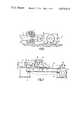
- FIG. 1is a schematic drawing illustrating the proposed method, according to the invention:
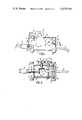
- FIG. 2is a further schematic-like drawing in side elevation showing a draw bench, according to the invention.
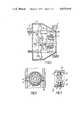
- FIG. 3is a longitudinal fragmentary section through a device for restricting an item from torsion
- FIG. 4is a side elevational view of a gear or driven carriage for drawing an item, with said driven carriage partially shown in section;
- FIG. 5section V -- V of FIG. 4;
- FIG. 6section VI -- VI of FIG. 3;
- FIG. 7section VII -- VII of FIG. 3;
- a method of producing cylindrical tubular items by drawingconsists in that an item 1 (FIG. 1) is subjected to deformation on being drawn through a die 2 in the direction indicated by arrow A.
- the item 1is imparted a torsional moment acting in the direction indicated by arrow B, said torsional moment being imparted to that portion 1a of the item 1 which emerges from the die 2, while the portion 1b which is found to be in front of the die 2 is restricted from torsion, e.g., by an additional die 3, that is set up directly in front of the item entering the die 2, and has an oval opening which contributes to the longitudinal transfer of the item but rules out its turning.
- a draw benchFor carrying said method into effect a draw bench is proposed whose bed 4 (FIG. 2) mounts a device 5 for restriction the item from torsion having a case 6, (FIG. 3) with the die 2, guides 7 (FIG. 2) a device for drawing the item through the die 2, said device being made as a driven carriage 8, a device 9 for imparting the item a torsional moment.
- the carriage 8(FIG. 2) is arranged on the exit side of the die 2 and comprises a body 11 (FIG. 4) mounted on rollers 10 travelling on the guide 7 (FIG. 2) of the bed 4, said body 11 carrying a hook 12 and a chuck 13 for gripping the item (the design of the jaws is not discussed here, since it is commonly known).
- the carriage 8is driven by an endless chain 14 (shown with a dotted line in FIG. 2) encompassing a driven sprocket wheel 15 and a driving sprocket wheel 16 mounted on the bed 4.
- the driving sprocket wheel 16is coupled by any known means, such as a gear, not shown in FIG. 2, with an electric motor 17.
- the hook 12 of the carriageis engaged with the endless chain 14 when drawing.
- the device 9(FIG. 5) for imparting a torsional moment to the item is placed on the carriage 8 and is linked mechanically with its chuck 13.
- Said device 9is made as a geared reducer arranged in the body 11 and comprising an output shaft 18, an input shaft 19 and intermediate shaft 20, spur pinions 21 and 22 and bevel pinions 23 and 24.
- the input shaft 19is linked mechanically with a carriage drive and through an overrunning clutch 25 with the intermediate shaft 20 which carries the spur pinion 21 on its end.
- the pinion 21is in mesh with the pinion 22 mounted on a shaft 26. Fixed on the opposite end of the shaft 26 is the bevel pinion 23 in mesh with the bevel pinion 24 secured on the output shaft 18.
- the carriage chuck 13is disposed on the output shaft 18 with means for longitudinal transfer.
- the shafts 33, 19 as well as the intermediate shaft 20 and shafts 26 and 18are mounted in bearings 27 of the body 11, shown in FIG. 5 conventionally so as not to impair the gearing relationship.
- Longitudinal transfer of the chuck 13is provided by coupling it with the shaft 18 by resorting to any known means, e.g., such as with a key, through which the jaws can rotate together with said shaft.
- the axis of the chuck 13(FIG. 1) is aligned axially with the axis of the die 2, with the resulting effect of the geometric axis of rotation O--O of the shaft 18 coinciding thereby with the axis of the die 2.
- the input shaft 19(FIG. 5) is indirectly linked with the carriage drive 8 by means of a sprocket wheel 28, fixed on the shaft 19, and a roller chain 29, shown in FIG. 4 conventionally with a solid line, said chain 29 running along the guide 7 (FIG. 2) of the bed 4.
- the ends of the chain 29are secured on bed uprights by means of screws 30.
- the roller chain 29passes through ports 31 (FIG. 4) provided in the body 11 and interacts with the sprocket wheel 29.
- the body 11accommodates an additional sprocket wheel 32 mounted on a shaft 33 (FIG. 5) that is secured in the bearings 27 of the body 11.
- a wall 38a of the casing 38is provided with slots 41 (FIG. 6) receiving projections 42 of the case 6, by which virtue the case 6 can move together with the die 2 along its axis.
- the transfer of the case 6 with the die 2is restricted by the wall 38a of the casing 38.
- the case 6(FIG. 3) accommodates a screw-down seat 43 of the die 2.
- the case 6has two diametrically opposite forks 44 the rods 39 being articulated with said forks 44. Connected to the ends of the rods 39 are bars 45 extending out of the casing 38 through its openings 46.
- the bars 45mount springs 47 which are held in place by nuts 48 and adapted to bias the rods and to return the rollers 40 into their initial position.
- each paircomprising two arms 49 and 50 accordingly, articulated with their ends with each other and with the rod 39.
- the free end of the arm 49is articulated with the roller 40 and that of the arm 50 with the casing 38.
- the arms 49can be made as a fork encompassing the roller 40 from both sides, as shown in FIG. 7.
- Each grooved roller 40has a configuration shown in FIG. 7 and is fixed on a spindle 51 whose ends are arranged in bushings 52 inserted into the slots 53 of the casing 38.
- the arms 49are located intermediate of the bushings 52 and roller 40.
- the proposed draw benchoperates in the following manner.
- the case 6is set up in the device 5 by rotating the seat 43 (FIG. 3), said case 6 being spaced at a distance from the wall 38a of the casing 38 so that the grooved rollers 40 will reliably hold the item portion 1b (FIG. 2) against torsion.
- the electric motor 17is cut in and sets in motion the chain 14, after which an item is fed through the die 2 (FIG. 1) so that its received end protrudes from the die 2.
- the carriage 8is advanced to the received end of the item and the air cylinder 34 (FIG. 2) is cut in.
- the case 6(FIG. 3) will move in the direction of the motion of the item 1 unitl it strikes against the wall 38a of the casing 38.
- the forks 44will transfer the rods 39 and bars 45 compressing the springs 47, the arms 49 and 50 turning thereby with respect to the rods 39.
- the spindles 51 of the rollers 40are mounted in the bushings 52 fitted into the slots 53, when the arms 50 and 49 rotate with respect to the grooved rollers 40, the latter will move towards each other, gripping the portion 1b of the item which is formed of the die 2 and holding it thereby against torsion but enabling its passage through the die 2.
- the portion 1b of the item 1is restricted from torsion by the grooved rollers 40, while the portion 1a of said item is subjected to turning owing to rotation of the chuck 13, the torsion pitch of the item being constant along the entire drawing path and is not dependent on the drawing rate, since the angle of rotation of the chuck jaws is in a linear relationship (through the sprocket wheel 28 (FIG. 4) and chain 29 with the path of the carriage 8.
- the compressed springs 47drive the bars 45 and rods 39 together with the case 6 in the direction opposite to the drawing direction, the arms 49 and 50 turning with respect to the rods 39 and drawing the grooved rollers apart, providing thereby free space for the next item to be fed therein.
- the air cylinder 34is engaged by the rod 35 coming out and when the pull rod 36 is rotated, the chuck 13 moves, and the item 8 is released in a known way.
Landscapes
- Engineering & Computer Science (AREA)
- Mechanical Engineering (AREA)
- Metal Extraction Processes (AREA)
Abstract
Description
The present invention relates to methods and devices for plastic working of metals in a cold state and more particularly to methods of producing cylindrical tubular items by drawing and to draw benches for effecting said methods.
At present tubular metal cylinder-shaped items produced by drawing usually depart essentially from rectilinearity. This stems from the factors inherent in the drawing method so far adapted and discussed below.
The axis of the working die passage is not sufficiently in alignment with the direction of the drawing force which results in the item curving in the same direction in which the drawing force deviates from the die axis.
In manufacturing dies insignificant deviations from accurate geometry are unavoidable which causes nonuniform distribution of internal stresses over the circumference of the item that is being drawn through the die and, consequently, to its distortion.
Nonuniform deformation over the circumference and along the length of the item are also the result of unavoidable segregation in the properties of the item material and inaccurate geometry (variations in wall thickness) of the items subjected to drawing. As a result of said nonuniform deformations the item is curved.
Under the effect of the above-outlined and other factors the items produced by drawing depart from rectilinearity, which presents serious problems and on a number of cases requires intermediate straightening which alone enables the subsequent technological operations. The need for such intermediate straightening cuts down the output of draw shops, required additional straightening facilities and floor areas to mount them thereon and, finally, adds to the production cost of finished products.
Nowadays various devices are resorted to take care of said distortion of items during the drawing operation.
Thus, known in the art is a device for drawing tubes, in which a die having a spherical external surface is inserted in a spherical seat in a die holder. Due to congruent spherical mating surfaces of the die and its holder, the die is self-oriented in the holder during drawing, this precluding the curving of the items resulting from the deviation of the axis of the die working passage from the direction of the drawing force.
However, the items produced by drawing nevertheless depart considerably from rectilinearity, insofar as the spherical die holder obviates only one of the causes of such distortion, the need for intermediate straightening being therefore not eliminated. Moreover, machining and subsequent fitting-in of the spherical surfaces of both the die and its holder are complicated technological operations which are inexpedient economically, insofar as the dies of the spherical surfaces do not eliminate the curvature but only diminish it slightly.
Also known in the prior-art is a device, in which an item is straightened during the drawing operation by applying to it alternating bending forces. In the above device a straightening gear is arranged on the exit side of the die, said gear having an annular guide in high-strength metal through which the item passes. The guide is set up in a driven bushing eccentric to the drawing axis. When the driven bushing is rotating, the guide oscillates about the drawing axis, the item being therefore subjected to an alternating bending force, and subsequent straightening of said item.
However, said device is not capable of providing adequate straightening due to the lack of a support on the exit side of said device. Moreover, it is characterized by a sophisticated design, since it must comprise an additional drive to rotate the guide and requires a longer received end, this resulting in higher metal consumption.
Known as well is a method of producing cylindrical tubular items by drawing, in which the items are subjected to deformation on being drawn through a die and imparted simultaneously a torsional moment, said moment being applied to the end of that portion of the item which is found in front of the die. This method could have provided not only better deformation conditions and lower drawing forces but it could have decreased the distortion of the items being drawn. However, it has not found industrial application due to high intricacy of the devices required for its realization.
The main object of the present invention is to provide a method of producing cylindrical tubular items by drawing and a draw bench for effecting said method which will ensure the production of items, such as, tubes, featuring adequate rectilinearity so that they can be transferred to subsequent technological operations without intermediate and ultimate straightening, this being achieved by improving the existing method of drawing and introducing simple modifications into the design of a draw bench.
With this and other objects in view, in a method of producing cylindrical tubular items by drawing, in which the item is subjected to deformation in the course of drawing through a die and is imparted simultaneously a torsional moment, according to the invention, said torsional moment is imparted to that portion of the item which emerges the die, while the item portion found in front of the area of deformation is restricted from torsion.
By combining deformation by reduction and deformation by torsion in the reduction and non-contact zones of the die, it is possible to ensure a uniform distribution of the total plastic deformation over the cross-section and along the length of the tube, as a result of which the tube is not required to be treated in a straightening apparatus prior to any subsequent manufacturing stages.
It is expedient that an item portion arranged directly in front of the die entry be restricted from torsion. This will make it possible to have the desirable angle of torsion of the item to ensure its rectilinearity.
The proposed method is realized by means of a draw bench, comprising a bed which mounts a case with a die, a device for drawing the item through the die, said device being made as a driven carriage mounted in the bed guides on the exit side of the die and carrying a chuck having workpiece holding jaws, and a device for imparting the item a torsional moment. According to the invention, in said draw bench the device for imparting a torsional moment to the item is located on the driven carriage and is linked mechanically with its jaws mounted in the carriage rotatable coaxially about the die, a device for restricting the item from torsion being disposed in generally close proximity to the die entry. This ensures a rectilinear nature of the item by using a draw bench of a simple and compact construction.
The draw bench, according to the invention, is characterized by a device for imparting a torsional moment to the item which is made as a reducer whose output shaft carries the jaws mounted with facility for longitudinal movement, while its input shaft is indirectly linked with a carriage drive.
It is sound practice that the output shaft of the reducer be linked mechanically with the carriage drive with the aid of a sprocket wheel mounted on the input shaft and interacting with a roller chain running along the bed guide, with the chain ends being fixed in the bed. With the above embodiment an angle of rotation of the chuck is not dependent on the carriage travel rate and is determined only by the length of its path. Therefore an angle of torsion per unit length of an item being drawn will have a constant value along the entire length of the item.
A feature of the invention consists also in that the device for restricting the item from torsion comprises a casing accommodating the case with the die, said case being mounted movably along the die axis, spring-biased rods articulated with the case, and a pair of grooved rollers set up directly in front of the item entering in the die, the rollers spaced from each other allow mounting an item therebetween and are adapted to hold it in place when a torsional moment has been imparted.
The grooved rollers are advisable to be mounted in the casing with the help of two pairs of arms, the arms of each pair being articulated with their ends with each other and with the spring-biased rod, while their free ends are articulated accordingly with the roller axis and with the casing.
Said embodiment of the device for restricting the item from torsion, though seemingly complicated, it is sufficiently easy and the most reliable one.
Thus, the proposed method of drawing and the draw bench enable the production of items featuring sufficient rectilinearity upon drawing to be transferred to subsequent technological operations without intermediate and final straightening, a feature which adds considerably to labor productivity and diminishes the production cost of finished products.
The nature of the invention will be clear from the following detailed description of particular embodiments of the proposed method of producing cylindrical tubular items by drawing and of the draw bench to be had in conjunction with the accompanying drawings, in which:
FIG. 1 is a schematic drawing illustrating the proposed method, according to the invention:
FIG. 2 is a further schematic-like drawing in side elevation showing a draw bench, according to the invention;
FIG. 3 is a longitudinal fragmentary section through a device for restricting an item from torsion;
FIG. 4 is a side elevational view of a gear or driven carriage for drawing an item, with said driven carriage partially shown in section;
FIG. 5 section V -- V of FIG. 4;
FIG. 6 -- section VI -- VI of FIG. 3;
FIG. 7 -- section VII -- VII of FIG. 3;
A method of producing cylindrical tubular items by drawing consists in that an item 1 (FIG. 1) is subjected to deformation on being drawn through adie 2 in the direction indicated by arrow A. During drawing the item 1 is imparted a torsional moment acting in the direction indicated by arrow B, said torsional moment being imparted to that portion 1a of the item 1 which emerges from thedie 2, while the portion 1b which is found to be in front of thedie 2 is restricted from torsion, e.g., by anadditional die 3, that is set up directly in front of the item entering thedie 2, and has an oval opening which contributes to the longitudinal transfer of the item but rules out its turning.
For carrying said method into effect a draw bench is proposed whose bed 4 (FIG. 2) mounts a device 5 for restriction the item from torsion having a case 6, (FIG. 3) with thedie 2, guides 7 (FIG. 2) a device for drawing the item through thedie 2, said device being made as a driven carriage 8, adevice 9 for imparting the item a torsional moment.
The carriage 8 (FIG. 2) is arranged on the exit side of thedie 2 and comprises a body 11 (FIG. 4) mounted onrollers 10 travelling on the guide 7 (FIG. 2) of thebed 4, saidbody 11 carrying ahook 12 and a chuck 13 for gripping the item (the design of the jaws is not discussed here, since it is commonly known). The carriage 8 is driven by an endless chain 14 (shown with a dotted line in FIG. 2) encompassing a drivensprocket wheel 15 and a drivingsprocket wheel 16 mounted on thebed 4. The drivingsprocket wheel 16 is coupled by any known means, such as a gear, not shown in FIG. 2, with an electric motor 17. Thehook 12 of the carriage is engaged with theendless chain 14 when drawing.
The device 9 (FIG. 5) for imparting a torsional moment to the item is placed on the carriage 8 and is linked mechanically with its chuck 13. Saiddevice 9 is made as a geared reducer arranged in thebody 11 and comprising anoutput shaft 18, an input shaft 19 andintermediate shaft 20,spur pinions bevel pinions intermediate shaft 20 which carries thespur pinion 21 on its end. Thepinion 21 is in mesh with thepinion 22 mounted on ashaft 26. Fixed on the opposite end of theshaft 26 is thebevel pinion 23 in mesh with thebevel pinion 24 secured on theoutput shaft 18. The carriage chuck 13 is disposed on theoutput shaft 18 with means for longitudinal transfer.
Theshafts 33, 19 as well as theintermediate shaft 20 andshafts bearings 27 of thebody 11, shown in FIG. 5 conventionally so as not to impair the gearing relationship. Longitudinal transfer of the chuck 13 is provided by coupling it with theshaft 18 by resorting to any known means, e.g., such as with a key, through which the jaws can rotate together with said shaft. The axis of the chuck 13 (FIG. 1) is aligned axially with the axis of thedie 2, with the resulting effect of the geometric axis of rotation O--O of theshaft 18 coinciding thereby with the axis of thedie 2.
The input shaft 19 (FIG. 5) is indirectly linked with the carriage drive 8 by means of asprocket wheel 28, fixed on the shaft 19, and aroller chain 29, shown in FIG. 4 conventionally with a solid line, saidchain 29 running along the guide 7 (FIG. 2) of thebed 4. The ends of thechain 29 are secured on bed uprights by means ofscrews 30. Theroller chain 29 passes through ports 31 (FIG. 4) provided in thebody 11 and interacts with thesprocket wheel 29. To increase an angle of contact of thechain 29 andsprocket wheel 28 thebody 11 accommodates anadditional sprocket wheel 32 mounted on a shaft 33 (FIG. 5) that is secured in thebearings 27 of thebody 11.
Longitudinal transfer of the chuck 13 is effected with the help of an air cylinder 34 (FIG. 4) fixed on thebody 11. Anair cylinder rod 35 is articulated with apull rod 36 which in turn is articulated with the chuck 13 and abracket 37 secured on thebody 11.
The device 5 (FIG. 3) for restricting the item from torsion comprises acasing 38 fixed on thebed 4, said casing accommodating the case 6 with thedie 2, a pair of spring-biasedrods 39 and a pair ofgrooved rollers 40 spaced at a distance l from each other, as best shown in FIG. 3, to let the item pass therebetween and adapted to restrict the portion 1b of the item from torsion.
A wall 38a of thecasing 38 is provided with slots 41 (FIG. 6) receivingprojections 42 of the case 6, by which virtue the case 6 can move together with thedie 2 along its axis. The transfer of the case 6 with thedie 2 is restricted by the wall 38a of thecasing 38. The case 6 (FIG. 3) accommodates a screw-downseat 43 of thedie 2.
The case 6 has two diametricallyopposite forks 44 therods 39 being articulated with saidforks 44. Connected to the ends of therods 39 are bars 45 extending out of thecasing 38 through itsopenings 46. The bars 45 mount springs 47 which are held in place by nuts 48 and adapted to bias the rods and to return therollers 40 into their initial position.
To restrict the portion 1b of the item from torsion toggle-likemounted rollers 40 are set up in thecasing 38 with the aid of two pairs of arms, each pair comprising twoarms 49 and 50 accordingly, articulated with their ends with each other and with therod 39. The free end of thearm 49 is articulated with theroller 40 and that of the arm 50 with thecasing 38. To hold therollers 40 reliably in place thearms 49 can be made as a fork encompassing theroller 40 from both sides, as shown in FIG. 7. Eachgrooved roller 40 has a configuration shown in FIG. 7 and is fixed on aspindle 51 whose ends are arranged inbushings 52 inserted into theslots 53 of thecasing 38. Thearms 49 are located intermediate of thebushings 52 androller 40.
The proposed draw bench operates in the following manner.
To prepare the bench for operation the case 6 is set up in the device 5 by rotating the seat 43 (FIG. 3), said case 6 being spaced at a distance from the wall 38a of thecasing 38 so that thegrooved rollers 40 will reliably hold the item portion 1b (FIG. 2) against torsion. Following that the electric motor 17 is cut in and sets in motion thechain 14, after which an item is fed through the die 2 (FIG. 1) so that its received end protrudes from thedie 2. Next the carriage 8 is advanced to the received end of the item and the air cylinder 34 (FIG. 2) is cut in.
When the air cylinder is cut in, therod 35 is pulled in, turning thepull rod 36 which carries the chuck 13 ensuring a rigid connection with the received end of the item. After that thehook 12 is engaged with thechain 14, as a result the carriage 8 will travel over the guides 7 of thebed 4. At the same time as the carriage 8 commences to move the driven sprocket wheel 28 (FIG. 4) rolls along theroller chain 29 bringing into rotation the shaft 19 and through the overrunning clutch 25 (FIG. 5) theshaft 20pinion 21 andpinion 22 in mesh therewith. The latter (pinion 22) brings into rotation through theshaft 26 the bevel pinions 23 and 24. As thepinion 24 is fixed on theshaft 18, which carries the chuck 13, the latter on being rotated transmits the torsional moment to the portion 1a of the item 1 (FIG. 2), said portion 1a projecting from thedie 2. Simultaneously it draws the item through thedie 2.
At the beginning when the item 1 is being drawn through thedie 2, the case 6 (FIG. 3) will move in the direction of the motion of the item 1 unitl it strikes against the wall 38a of thecasing 38. During said travel of the case 6, theforks 44 will transfer therods 39 and bars 45 compressing thesprings 47, thearms 49 and 50 turning thereby with respect to therods 39. Since thespindles 51 of therollers 40 are mounted in thebushings 52 fitted into theslots 53, when thearms 50 and 49 rotate with respect to thegrooved rollers 40, the latter will move towards each other, gripping the portion 1b of the item which is formed of thedie 2 and holding it thereby against torsion but enabling its passage through thedie 2.
Thus, the portion 1b of the item 1 is restricted from torsion by thegrooved rollers 40, while the portion 1a of said item is subjected to turning owing to rotation of the chuck 13, the torsion pitch of the item being constant along the entire drawing path and is not dependent on the drawing rate, since the angle of rotation of the chuck jaws is in a linear relationship (through the sprocket wheel 28 (FIG. 4) andchain 29 with the path of the carriage 8.
After the item 1 has emerged from thedie 2, thecompressed springs 47 drive the bars 45 androds 39 together with the case 6 in the direction opposite to the drawing direction, thearms 49 and 50 turning with respect to therods 39 and drawing the grooved rollers apart, providing thereby free space for the next item to be fed therein.
Theair cylinder 34 is engaged by therod 35 coming out and when thepull rod 36 is rotated, the chuck 13 moves, and the item 8 is released in a known way.
During an idle stroke of the carriage 8 (FIG. 5) the chuck 13 does not rotate owing to the overrunning clutch 25 which provides favorable conditions for gripping the next item.
Claims (4)
1. A drawbench, comprising: a bed; bed guides; a case with a die mounted on said bed to effect the deformation of a tubular item which is being drawn through the die; a device for drawing the item through the die consisting of a carriage set up in said bed guides on the exit side of the die, a drive for said carriage, and a chuck with jaws for gripping the item mounted on said carriage, said chuck being axially aligned with said die; a device for imparting to the item a torsional moment mounted in the carriage, and consisting of a geared reducer having an output shaft carrying said chuck with means associated therewith for longitudinal transfer of said chuck and having an input shaft indirectly mechanically linked by means of a chain and sprocket with the drive of the carriage; and a device for restricting the item from torsional moment positioned on said bed in generally close proximity to the die entry and having a pair of toggle-like mounted rollers having grooves to hold said item, whereby a satisfactory rectilinearity of the item is obtained.
2. A draw bench according to claim 1, in which the geared reducer output shaft is indirectly linked with the drive of the carriage with the aid of a sprocket wheel fixed on the input shaft and interacting with a roller chain running along the bed guide and having fixed ends.
3. A drawbench, comprising: a bed; bed guides; a case with a die mounted on said bed to effect the deformation of a tubular item which is being drawn through the die; a device for drawing the item through the die consisting of a carriage set up in said bed guides on the exit side of the die, a drive for said carriage, and a chuck with jaws for gripping the item mounted on said carriage, said chuck being axially aligned with said die; a device for imparting to the item a torsional moment mounted in the carriage and being linked mechanically by means of a chain and sprocket with said chuck; and a device for restricting the item from torsional moment positioned on said bed in generally close proximity to the die entry, a pair of toggle-like mounted rollers having grooves to hold said item, whereby a satisfactory rectilinearity of the item is obtained, and consisting of a casing accommodating the case with a die mounted so as to be movable along the axis of the die, spring-biased rods articulated with the case, and said pair of rollers arranged at the die entry, spaced from each other to provide a passage therebetween for the item, and holding the item to prevent any torsional moment.
4. A draw bench according to claim 3, in which the grooved rollers are mounted in the casing by means of two pairs of arms, the arms of each pair being articulated at a common end with respect to each other and with the spring-biased rods, while their other ends are articulated with the rollers with respect to one pair of arms and with the casing with respect to the other pair of arms.
Priority Applications (1)
| Application Number | Priority Date | Filing Date | Title |
|---|---|---|---|
| US05/668,590US4079616A (en) | 1976-03-19 | 1976-03-19 | Draw bench for producing cylindrical tubular items by drawing |
Applications Claiming Priority (1)
| Application Number | Priority Date | Filing Date | Title |
|---|---|---|---|
| US05/668,590US4079616A (en) | 1976-03-19 | 1976-03-19 | Draw bench for producing cylindrical tubular items by drawing |
Publications (1)
| Publication Number | Publication Date |
|---|---|
| US4079616Atrue US4079616A (en) | 1978-03-21 |
Family
ID=24682960
Family Applications (1)
| Application Number | Title | Priority Date | Filing Date |
|---|---|---|---|
| US05/668,590Expired - LifetimeUS4079616A (en) | 1976-03-19 | 1976-03-19 | Draw bench for producing cylindrical tubular items by drawing |
Country Status (1)
| Country | Link |
|---|---|
| US (1) | US4079616A (en) |
Cited By (7)
| Publication number | Priority date | Publication date | Assignee | Title |
|---|---|---|---|---|
| EP0104955A3 (en)* | 1982-09-29 | 1984-07-11 | Fujikura Ltd. | Apparatus for and method of drawing wire |
| US5119661A (en)* | 1988-11-22 | 1992-06-09 | Abdrakhmanov Gabdrashit S | Apparatus for manufacturing profile pipes used in well construction |
| US5165268A (en)* | 1989-11-16 | 1992-11-24 | Granco Clark, Inc. | Extrusion puller mounting |
| US6298542B1 (en)* | 1998-04-17 | 2001-10-09 | Nexans | Process for the manufacture of an optical cable |
| US20060053859A1 (en)* | 2004-09-16 | 2006-03-16 | Paul Fullerton | Push bench and method of manufacturing small diameter tubing |
| CN102935449A (en)* | 2012-12-03 | 2013-02-20 | 楚雄云星铜材有限公司 | Metal cold-drawing device with automatic unhooking function |
| CN114682638A (en)* | 2022-04-01 | 2022-07-01 | 南通星诺冷冻设备有限公司 | A hollow self-cooling copper busbar blank production equipment |
Citations (9)
| Publication number | Priority date | Publication date | Assignee | Title |
|---|---|---|---|---|
| DE182939C (en)* | ||||
| US1525730A (en)* | 1922-04-18 | 1925-02-10 | Samuel C Gates | Method of making spirally-grained seamless tubing |
| US1967487A (en)* | 1930-03-20 | 1934-07-24 | Mechanics Universal Joint Comp | Method and apparatus for making propeller shafts |
| US2250610A (en)* | 1938-12-06 | 1941-07-29 | Simons Morris | Wire and wire making |
| US2864271A (en)* | 1953-02-11 | 1958-12-16 | Kendall Edgar Homer | Forging manipulator |
| US3077131A (en)* | 1961-08-03 | 1963-02-12 | Pittsburgh Steel Co | Die rolling apparatus for knurling wire |
| US3466916A (en)* | 1966-05-05 | 1969-09-16 | Rotary Profile Anstalt | Working of plastically deformable materials |
| US3520165A (en)* | 1967-10-27 | 1970-07-14 | Clayton Mark & Co | Method of treating welded tubing |
| US3955390A (en)* | 1973-02-21 | 1976-05-11 | Brunswick Corporation | Twist drawn wire, process and apparatus for making same |
- 1976
- 1976-03-19USUS05/668,590patent/US4079616A/ennot_activeExpired - Lifetime
Patent Citations (9)
| Publication number | Priority date | Publication date | Assignee | Title |
|---|---|---|---|---|
| DE182939C (en)* | ||||
| US1525730A (en)* | 1922-04-18 | 1925-02-10 | Samuel C Gates | Method of making spirally-grained seamless tubing |
| US1967487A (en)* | 1930-03-20 | 1934-07-24 | Mechanics Universal Joint Comp | Method and apparatus for making propeller shafts |
| US2250610A (en)* | 1938-12-06 | 1941-07-29 | Simons Morris | Wire and wire making |
| US2864271A (en)* | 1953-02-11 | 1958-12-16 | Kendall Edgar Homer | Forging manipulator |
| US3077131A (en)* | 1961-08-03 | 1963-02-12 | Pittsburgh Steel Co | Die rolling apparatus for knurling wire |
| US3466916A (en)* | 1966-05-05 | 1969-09-16 | Rotary Profile Anstalt | Working of plastically deformable materials |
| US3520165A (en)* | 1967-10-27 | 1970-07-14 | Clayton Mark & Co | Method of treating welded tubing |
| US3955390A (en)* | 1973-02-21 | 1976-05-11 | Brunswick Corporation | Twist drawn wire, process and apparatus for making same |
Cited By (13)
| Publication number | Priority date | Publication date | Assignee | Title |
|---|---|---|---|---|
| EP0104955A3 (en)* | 1982-09-29 | 1984-07-11 | Fujikura Ltd. | Apparatus for and method of drawing wire |
| US5119661A (en)* | 1988-11-22 | 1992-06-09 | Abdrakhmanov Gabdrashit S | Apparatus for manufacturing profile pipes used in well construction |
| US5165268A (en)* | 1989-11-16 | 1992-11-24 | Granco Clark, Inc. | Extrusion puller mounting |
| US6298542B1 (en)* | 1998-04-17 | 2001-10-09 | Nexans | Process for the manufacture of an optical cable |
| US20080028815A1 (en)* | 2004-09-16 | 2008-02-07 | Paul Fullerton | Push Bench and Method of Manufacturing Small Diameter Tubing |
| US7290424B2 (en)* | 2004-09-16 | 2007-11-06 | Lone Star Steel Company, L.P. | Push bench method for manufacturing small diameter tubing |
| US20060053859A1 (en)* | 2004-09-16 | 2006-03-16 | Paul Fullerton | Push bench and method of manufacturing small diameter tubing |
| US7621164B2 (en)* | 2004-09-16 | 2009-11-24 | United States Steel Corporation | Push bench and method of manufacturing small diameter tubing |
| US20100064757A1 (en)* | 2004-09-16 | 2010-03-18 | Paul Fullerton | Push Bench and Method of Manufacturing Small Diameter Tubing |
| US8387434B2 (en) | 2004-09-16 | 2013-03-05 | United States Steel Corporation | Push bench and method of manufacturing small diameter tubing |
| CN102935449A (en)* | 2012-12-03 | 2013-02-20 | 楚雄云星铜材有限公司 | Metal cold-drawing device with automatic unhooking function |
| CN114682638A (en)* | 2022-04-01 | 2022-07-01 | 南通星诺冷冻设备有限公司 | A hollow self-cooling copper busbar blank production equipment |
| CN114682638B (en)* | 2022-04-01 | 2023-10-13 | 台州市品冠洁具有限公司 | A hollow self-cooling copper busbar blank production equipment |
Similar Documents
| Publication | Publication Date | Title |
|---|---|---|
| US3812702A (en) | Multi-pass method and apparatus for cold-drawing of metallic tubes | |
| CN100467155C (en) | Wire Straightening Mechanism of Wire Hook Forming Machine | |
| US6134932A (en) | Machine for bending or cambering a profile section, and bending head therefor | |
| US4079616A (en) | Draw bench for producing cylindrical tubular items by drawing | |
| CN210253662U (en) | Stainless steel tubular product multi-roll straightening equipment | |
| US4184352A (en) | Method for pilger rolling of tubes and mill for effecting same | |
| CN111250565B (en) | A straightening device for metal thin-walled round pipes | |
| US2321878A (en) | Strip uncoiler | |
| US5351515A (en) | Apparatus and method for reducing the diameter of a cylindrical workpiece | |
| CN109127805B (en) | Special-shaped pipe bending machine for air conditioner and operation method of special-shaped pipe bending machine | |
| CN221231985U (en) | Copper pipe straightener | |
| US3400567A (en) | Method and apparatus for straightening and untwisting elongated metal sections | |
| CN217315620U (en) | Stainless steel wire straightening device | |
| CN219562124U (en) | Straightening device for processing steel wire rope | |
| CN218486936U (en) | Bending equipment | |
| US2901930A (en) | Tube bending machines | |
| CN212884233U (en) | A precision straightening unit for thin-walled metal pipes | |
| CN112849918B (en) | A continuous flexible incremental forming clamping and conveying device for sheet metal | |
| US3213659A (en) | Apparatus and method for straightening metal shafts | |
| US3410126A (en) | Machine for straightening tubes and rods | |
| US3303679A (en) | Machine for coiling strip metal | |
| US4090381A (en) | Device for drawing-off and straightening cylindrically shaped stock | |
| US2668461A (en) | Tube finishing machine | |
| CN220658836U (en) | Metal product bending device | |
| CN221246509U (en) | A drawing device for cold drawing production line |