US3980991A - Apparatus for controlling microprogram jumps in a microprogrammable electronic computer - Google Patents
Apparatus for controlling microprogram jumps in a microprogrammable electronic computerDownload PDFInfo
- Publication number
- US3980991A US3980991AUS05/527,975US52797574AUS3980991AUS 3980991 AUS3980991 AUS 3980991AUS 52797574 AUS52797574 AUS 52797574AUS 3980991 AUS3980991 AUS 3980991A
- Authority
- US
- United States
- Prior art keywords
- jump
- microinstruction
- bistable circuits
- flip
- register
- Prior art date
- Legal status (The legal status is an assumption and is not a legal conclusion. Google has not performed a legal analysis and makes no representation as to the accuracy of the status listed.)
- Expired - Lifetime
Links
Images

Classifications
- G—PHYSICS
- G06—COMPUTING OR CALCULATING; COUNTING
- G06F—ELECTRIC DIGITAL DATA PROCESSING
- G06F9/00—Arrangements for program control, e.g. control units
- G06F9/06—Arrangements for program control, e.g. control units using stored programs, i.e. using an internal store of processing equipment to receive or retain programs
- G06F9/22—Microcontrol or microprogram arrangements
- G06F9/26—Address formation of the next micro-instruction ; Microprogram storage or retrieval arrangements
- G06F9/262—Arrangements for next microinstruction selection
- G06F9/264—Microinstruction selection based on results of processing
Definitions
- the present inventionrelates to an electronic computer including a device for controlling jumps in microprograms, comprising a central unit controlled by the microprograms.
- the central unitcomprises a plurality of bistable circuits for memorizing predetermined binary conditions of the microprograms, and means for transferring the predetermined conditions into the bistable circuits.
- microinstructions of logical typememorize in particular registers of the central unit the result of the executed logical operation.
- a resultis composed of one bit which takes one of the two possible logical values corresponding to the result obtained.
- the operation carried out by the microinstructionis an exclusive OR between two words of eight bits, the result may be 0 or 1 according to whether the two words are the same or different, respectively.
- Such a result as statedis memorized by the microinstruction directly into a special flip-flop or register at a cell allocated in the central unit.
- the third bit of a wordFor example, if it is desired to analyze the third bit of a word, the latter is transferred to a register, an AND microinstruction is carried out between the word registered in it and a marked word which has the third bit at the level 1 and all the other bits at the level 0. Consequently the result of the AND is a bit which takes the level 1 or 0 according to whether the third bit of the word being analyzed is at the level 1 to 0 respectively.
- a programmable electronic computer apparatusfor controlling jumps in microprograms, comprising a central unit controlled by the microprograms, a plurality of bistable circuits for memorizing predetermined binary conditions of the microprograms, means for transferring selected words into the bistable circuits, means for transferring the predetermined conditions into the bistable circuits, the transferring means comprising means for selecting at least one of the plurality of bistable circuits, means for writing into the selected bistable circuit a binary signal associated with one of the predetermined condition and means responsive to the state of a selected one of the bistable circuits to alternatively effect or not effect the jump in the microprogram to control the address of a succeeding microinstruction of the microprogram.
- the major feature of the inventionconsists of providing a specialized hardware capability permitting the test and the jump operation that may be executed by only one microinstruction (SADO or SADI), the test being executed over the bit of the control flip-flops 30 addressed by the field DEV of the microinstructions.
- SADOmicroinstruction
- SADImicroinstruction
- FIG. 1is a block diagram of the computer embodying the invention
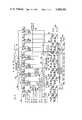
- FIG. 2shows a detailed diagram of the jump control unit of the computer.
- FIG. 1the functional blocks will now be described of a computer utilizing the device according to the invention.
- Thisis composed of a timing unit 10 which times the operation of executing the data within the arithmetic unit, a read and write memory RAM 11 which contains the data and the instructions of the programs and a read only memory ROM 12 which contains the microprograms designed to carry out the instructions of the RAM 11.
- the ROM 12is linked with an instruction register 13 of sixteen bits which holds in succession the codes of the microinstructions read from the ROM 12.
- the register 13is linked to a sequential logic matrix 14 which specifies and interprets the codes of the microinstructions read from the ROM 12, and generates the commands required for their execution.
- the output of the RAM 11is linked to two data lines NA 15 and NB 16 which are linked to the inputs to two corresponding registers BA 17 and BB 18.
- the latterare linked respectively with a group of working registers RA 19 and RB 20 designed to hold the data or the addresses of the operands furnished by the RAM 11.
- RA and RBeach contain 16 8-bit registers addressable by a four bit address.
- the outputs of the registers RA 19 and RB 20are also connected to two arithmetic units UA 28 and UB 29, whose outputs are in turn connected to the data lines NA 15 and NB 16.
- the arithmetic units UA 28 and UB 29operate with eight bits in parallel and make it possible to carry out all arithmetical and logical operations on data furnished by the registers RA 19 and RB 20.
- the unit UB 29can be operated as an extension of UA 28 whenever the operands are of double length.
- Access to the data lines NA 15 and NB 16is effected by switching circuits or gates 40, 41, 42, 43, 44, and 45 which are controlled by the sequential logic matrix 14 for transferring the data present at their inputs either on the data line NA 15 or the data line NB 16 in response to commands M0 to M5.
- Husson, Prentice Hall, Inc., 1970are disclosed all details relating to the channel logic 26 (see paragraph 8.14, page 333) and the UA-28, UB-29 (see paragraph 7.2.2 page 227). Other details relating registers, read only memory and other components shown as a black block in this specification, may be found in the above mentioned book.
- This decoding circuit 68has as inputs three signals R1, R2, and R3, generated by the sequential logic matrix 14 and an enabling signal R4 which constitutes the logic AND of a command C1 and a signal R5 also both generated by the sequential logic matrix 14.
- the clocked reset inputs of the flip-flops 50-57are linked to eight conductors 70-77 which come from a second decoding circuit 78, whose inputs are composed of the signals R1, R2, and R3 whose enabling signal R4 is obtained from the logic AND of C1 and the negation of the signal R5 (R5).
- the OR gate 88b for the flip-flop 51can also be enabled by CD 11 or CD 12 to enable UZA to be written in via AND gate 98 in the presence of CD 11 or UZB to be written in via AND gate 99 in the presence of CD 12.
- the gates 98 and 99correspond to the gating circuit 31 or FIG. 1.
- the flip-flops 50, 51, and 52are used for storing the results of the logical or arithmetical operations developed by the units UA 28 and UB 29. For example, if during a microinstruction of addition between the contents of the two function registers, a carry is generated after the 4th bit, the arithmetic unit generates the signal UR 04. In this way there will be on the conductor 92 a signal with level one, by which the AND gate 82 is enabled and the AND gate 102 disabled, and consequently the flip-flop 52 is forced to one.
- the sequential logic matrix 14is capable of recognizing a predetermined microinstruction TADI with the function code 1011 A 1110 0111 which effects transference into the flip-flops of the contents of the working register RA 19 indicated by the four bits of the field A.
- a first phase of the microinstruction TADIthere is read in known manner the contents of the register RA 19 selected by the field A of the microinstruction, and transferred to the input conductors of the AND gates 120-127 by means of the signals RA 00-RA 07.
- the maxtrix 14After this the maxtrix 14 generates the signal CD 13 which enables transference of the signals RA 00-RA 07 to the AND gates 80-87 and 100-107 of the flip-flops 50-57. In this way the outputs DI 00-DI 07 of the latter are set according to the signals RA 00-RA 07.
- the flip-flops 50-57are positioned according to the signals RB 00-RB 07 if the matrix 14 generates the signal CD 14 following recognition of the microinstruction TBDI.
- microinstructions SEDI and REDIare available, having respectively the following format:
- the 5th bitenables the signal R5 which activates the decoder 78 which resets the flip-flop 54 of the cited example.
- SADImicroinstruction
- the AND gate 203 or 204are activated to generate AS.
- the address registered in the second half of the register 13, i.e. 0011 0111can pass through the gate 207, since the signal AS is brought to 1 on the wire 206; hence the address is transferred to the data lines NA 15 or NB 16.
- jump control flip-flopsare utilized, either as normal circuits specifying the results of arithmetical and logical operations, or as specifiers of more individually, either for setting them or for testing their content in order to control the operative sequence of the microprograms.
Landscapes
- Engineering & Computer Science (AREA)
- Software Systems (AREA)
- Theoretical Computer Science (AREA)
- Physics & Mathematics (AREA)
- General Engineering & Computer Science (AREA)
- General Physics & Mathematics (AREA)
- Executing Machine-Instructions (AREA)
Abstract
Description
The present invention relates to an electronic computer including a device for controlling jumps in microprograms, comprising a central unit controlled by the microprograms. The central unit comprises a plurality of bistable circuits for memorizing predetermined binary conditions of the microprograms, and means for transferring the predetermined conditions into the bistable circuits.
It is known during the development of microprograms it is often necessary to analyze conditions generated by particular microinstructions to condition the development of the microprogram itself, i.e. to determine whether or not jumps are to take place.
For example, microinstructions of logical type, (AND, OR, exclusive OR, etc.), memorize in particular registers of the central unit the result of the executed logical operation. Such a result is composed of one bit which takes one of the two possible logical values corresponding to the result obtained. In particular, if the operation carried out by the microinstruction is an exclusive OR between two words of eight bits, the result may be 0 or 1 according to whether the two words are the same or different, respectively. Such a result as stated is memorized by the microinstruction directly into a special flip-flop or register at a cell allocated in the central unit.
Another case which frequently occurs is that of having to analyze, during the development of a microprogram, the content of particular words, for example words of eight bits, which specify particular conditions of the program during its execution. Such words are normally compiled from instructions of the program or else by the effect of a command from the computer console.
With each bit in such a word there is associated information significant for execution of the microprogram. This involves, therefore, the need to be able to determine the logical level reached by them. In order to do this, the technique usually employed is to transfer into a register of the central unit the entire word, to zeroize by means of a so-called "mask" all the bits except those whose logical level it is desired to test, and then to analyze those bits by means of an AND microinstruction.
For example, if it is desired to analyze the third bit of a word, the latter is transferred to a register, an AND microinstruction is carried out between the word registered in it and a marked word which has the third bit at thelevel 1 and all the other bits at the level 0. Consequently the result of the AND is a bit which takes thelevel 1 or 0 according to whether the third bit of the word being analyzed is at thelevel 1 to 0 respectively.
Such a bit is memorized as already stated by a flip-flop of the central unit, and is then analyzed by special microinstructions for conditioning jumps which test the content of such a flip-flop for carrying out or leading the jump to a predetermined address. It is evident that this kind of technique has the disadvantage of being slow and laborious.
In a known computer, such as that disclosed in U.S. Pat. No. 3,793,631, there is provided an eight bit designator register adapted for storing five particular conditions reached in the course of the program and having a group bit manipulation instructions for setting or resetting an addressed bit of the register. These bits are: zero, positive link, overflow and flag. The limitation of this device becomes apparent during the execution of a BRANCH instruction. In fact, only the FLAG bit is directly testable by the BRANCH instruction while the other bits of the register, previously requires the execution of one of the following instructions:
Set flag if bit true
set flag if bit false
reset flag if bit true
reset flag if bit false
it follows that the execution of a jump instruction on a condition specified by a bit different from the FLAG bit requires two instructions:
Set flag if bit true
branch on flag true.
these and other disadvantages are resolved by the present invention, which provides in a programmable electronic computer apparatus for controlling jumps in microprograms, comprising a central unit controlled by the microprograms, a plurality of bistable circuits for memorizing predetermined binary conditions of the microprograms, means for transferring selected words into the bistable circuits, means for transferring the predetermined conditions into the bistable circuits, the transferring means comprising means for selecting at least one of the plurality of bistable circuits, means for writing into the selected bistable circuit a binary signal associated with one of the predetermined condition and means responsive to the state of a selected one of the bistable circuits to alternatively effect or not effect the jump in the microprogram to control the address of a succeeding microinstruction of the microprogram.
Briefly the major feature of the invention consists of providing a specialized hardware capability permitting the test and the jump operation that may be executed by only one microinstruction (SADO or SADI), the test being executed over the bit of the control flip-flops 30 addressed by the field DEV of the microinstructions.
The characteristics of the invention will be more evident from the following description, given by way of non-limiting example, with reference to the accompaying drawings.
FIG. 1 is a block diagram of the computer embodying the invention;
FIG. 2 shows a detailed diagram of the jump control unit of the computer.
With reference to FIG. 1 the functional blocks will now be described of a computer utilizing the device according to the invention. This is composed of atiming unit 10 which times the operation of executing the data within the arithmetic unit, a read and writememory RAM 11 which contains the data and the instructions of the programs and a read onlymemory ROM 12 which contains the microprograms designed to carry out the instructions of theRAM 11.
TheROM 12 is linked with aninstruction register 13 of sixteen bits which holds in succession the codes of the microinstructions read from theROM 12. Theregister 13 is linked to asequential logic matrix 14 which specifies and interprets the codes of the microinstructions read from theROM 12, and generates the commands required for their execution.
The output of theRAM 11 is linked to twodata lines NA 15 andNB 16 which are linked to the inputs to twocorresponding registers BA 17 andBB 18. The latter are linked respectively with a group of working registers RA 19 and RB 20 designed to hold the data or the addresses of the operands furnished by theRAM 11. RA and RB each contain 16 8-bit registers addressable by a four bit address.
The functions of theregisters RA 19 and RB 20 include that of providing the addresses of theROM 12 associated with the microprograms which carry out the instructions read from theRAM 11.
The output of theRAM 11 is also linked through adata line NC 25 with a channel-selectionlogical network 26 which generates all the commands required for controlling the transfer of data and commands to a group ofperipheral units 27.
The outputs of the registers RA 19 and RB 20 are also connected to two arithmetic units UA 28 and UB 29, whose outputs are in turn connected to the data lines NA 15 and NB 16. The arithmetic units UA 28 and UB 29 operate with eight bits in parallel and make it possible to carry out all arithmetical and logical operations on data furnished by theregisters RA 19 and RB 20. The unit UB 29 can be operated as an extension of UA 28 whenever the operands are of double length.
Theregisters RA 19 and RB 20 can in addition be linked with a group of eight flip-flops 30 of D-type which form the jump control device for the microprograms; in what follows the flip-flops 30 will be identified collectively by 30, and by DI 00 - DI 07 (FIG. 2) when they are mentioned individually. The flip-flops 30 receive as inputs through thegating circuits registers RA 19 and RB 20.
The output of the flip-flops 30 is linked to thedata lines NA 15 andNB 16. The computer comprises also ashift network 36 which executes all the shift and cyclic shift operations on the eight bits arriving from theregisters shift network 36 is connected to the data lines NA 15 and NB 16 throughgates 42, and then to theregisters RA 19 and RB 20.
Access to the data lines NA 15 and NB 16 is effected by switching circuits orgates sequential logic matrix 14 for transferring the data present at their inputs either on thedata line NA 15 or thedata line NB 16 in response to commands M0 to M5.
The flow of data between the blocks as described is regulated by the commands generated by thesequential logic matrix 14, and is synchronized by the signals generated by thetiming unit 10. The way in which this transfer is managed will not be described in detail since it is carried out in a known manner, as for example as described in Digital Computer Design Fundamentals by Y. Chu, McGraw-Hill Book Co., 1962. In paragraph 5.13 (page 209) is described thetiming Circuit 10; thelogic matrix 14 is described in paragraph 12.8 (page 265). Moreover, in the book "Microprogramming: principles and Practices" By Samir S. Husson, Prentice Hall, Inc., 1970 are disclosed all details relating to the channel logic 26 (see paragraph 8.14, page 333) and the UA-28, UB-29 (see paragraph 7.2.2 page 227). Other details relating registers, read only memory and other components shown as a black block in this specification, may be found in the above mentioned book.
There will now be described in detail with reference to FIG. 2 the method by which the jump control flip-flops 30 are controlled.
The flip-flops 30 consist of eight flip-flops of D-type 50-57 which are normal set-reset flip-flops in which the input "reset" is the negation of the input "set". The flip-flops 50-57 are synchronized by a timing signal CK generated by thetiming unit 10.
Their direct clocked inputs are linked to eight conductors 60-67, which come from adecoding circuit 68. Thisdecoding circuit 68 has as inputs three signals R1, R2, and R3, generated by thesequential logic matrix 14 and an enabling signal R4 which constitutes the logic AND of a command C1 and a signal R5 also both generated by thesequential logic matrix 14.
Similarly the clocked reset inputs of the flip-flops 50-57 are linked to eight conductors 70-77 which come from asecond decoding circuit 78, whose inputs are composed of the signals R1, R2, and R3 whose enabling signal R4 is obtained from the logic AND of C1 and the negation of the signal R5 (R5).
Theoutputs 60 to 67 and 70 to 77 of thedecoding circuits logical level 1. One such output may be addressed by the signals R1, R2 and R3 in the presence of the appropriate microninstruction. The addressed output assumes the logical level 0 and in this way it is possible to set or reset any single addressed jump flip-flop.
The setting inputs of the flip-flops 50-57 are constituted by AND gates 80 to 87 for the direct set inputs and 100 to 107 for the negated resetting inputs.Lines 90 to 97 apply either thebits RA 00 toRA 07 fromregister RA 19 or thebits RB 00 toRB 07 fromregister RB 20, depending upon whetherCD 13 enables gates 120 to 127 or whetherCD 14 enablesgates 130 to 137, to the gates 80 to 87 and, with inversion to thegates 100 to 107. The gates 120 to 127 and 130 to 137 are thegating circuits 32 of FIG. 1.
To this end all of the gates 80 to 87 and 100 to 107 are enabled byCD 13 orCD 14 by way of ORgates RA 19 orRB 20 may thus be copied into the flip-flops 50 to 57.
In addition, theOR gate 88a for the flip-flop 50 (DI 00) can be enabled byCD 15 to allow asignal DR 70 to be written in via ANDgate 98 in the presence ofCD 15 via ANDgate 34. Thesignal DR 70 is generated by thearithmetic unit UA 28 when this produces a carry from the eighth bit.DI 00 can thus be conditioned to two distinct modes, either in accordance withRA 00 or RB 00 (in the presence ofCD 13 andCD 14 respectively) or in accordance with the carry bit DR 70 (in the presence ofCD 15 to enable gate 34).
The ORgate 88b for the flip-flop 51 (DI 01) can also be enabled byCD 11 orCD 12 to enable UZA to be written in via ANDgate 98 in the presence ofCD 11 or UZB to be written in via ANDgate 99 in the presence ofCD 12. Thegates gating circuit 31 or FIG. 1. The signals UZA and UZB are generated by thearithmetic units UA 28 andUB 29 respectively when the result of an arithmetical or logical operation is zero, in which case theUA 28 generates UZA=1 or theunit UB 29 generates UZB=1,DI 00 can thus be conditioned either byRA 01 orRB 01, or by UZA or UZB.
Finally, theOR gate 88c for the flip-flop 52 (DI 02) can also be enabled byCU 05 to enable asignal UR 04 to be written in via ANDgate 33.UR 04 is generated by theunit UA 28 when there is a carry from the fourth to the fifth bit therein.DI 02 can therefore either be conditioned byRA 02 orRB 02, or byUR 04.
From what has been said it is clear how the flip-flops units UA 28 andUB 29. For example, if during a microinstruction of addition between the contents of the two function registers, a carry is generated after the 4th bit, the arithmetic unit generates thesignal UR 04. In this way there will be on the conductor 92 a signal with level one, by which the ANDgate 82 is enabled and the ANDgate 102 disabled, and consequently the flip-flop 52 is forced to one.
The way in which thesequential logic matrix 14 generates the commands and the signals cited above is not described in detail, since they do not constitute the object of the present invention. Also it is a known technique in planning circuits to design a logical matrix based on the codes for the microinstructions and on the operations which they have to carry out.
The outputs DI 00 -DI 07 are connected to a selector 200 (FIG. 2) for which the enable signals are R1, R2, and R3. Theselector 200 is designed for selecting one of its eight inputs based on the signals R1, R2, and R3. There will however be present on itsoutputs outputs gates matrix 14. These AND gates are in turn connected to an ORcircuit 205 whose output 206 (AS) enables a gate circuit 207 (FIG. 1). The latter permits transfer of the address stored in the second half of theregister 13 on to the data line NA or NB during a jump microinstruction.
We shall now describe the method of operation of the jump flip-flops 30 used for conditioning the jumps during the execution of a microprogram.
In particular, thesequential logic matrix 14 is capable of recognizing a predetermined microinstruction TADI with the function code 1011 A 1110 0111 which effects transference into the flip-flops of the contents of the workingregister RA 19 indicated by the four bits of the field A.
During a first phase of the microinstruction TADI, there is read in known manner the contents of theregister RA 19 selected by the field A of the microinstruction, and transferred to the input conductors of the AND gates 120-127 by means of the signals RA 00-RA 07. After this themaxtrix 14 generates thesignal CD 13 which enables transference of the signals RA 00-RA 07 to the AND gates 80-87 and 100-107 of the flip-flops 50-57. In this way the outputs DI 00-DI 07 of the latter are set according to the signals RA 00-RA 07. Similarly, the flip-flops 50-57 are positioned according to the signals RB 00-RB 07 if thematrix 14 generates thesignal CD 14 following recognition of the microinstruction TBDI.
Let us assume now that it is required to bring the level "1" or "0" one of the flip-flops 50-57. For this purpose the microinstructions SEDI and REDI are available, having respectively the following format:
Sedi = 10011 1 dev 0110 0110
redi = 10011 0 dev 0110 0110
assuming that thematrix 14 recognizes SEDI, it generates the signals R1, R2, and R3 which are the three bits indicated by DEV in the microinstruction, and the signal R5 = 1 which is generated directly by the 5th bit from the left of the microinstruction SEDI. Besides this, thematrix 14 generates the signal C1. If, for example, the three bits DEV indicate the fifth flip-flop (flip-flop 54), their configuration will be 101, for which thedecoding circuit 68 activates only theoutput 64, and hence at the instant of CK the flip-flop 54 is forced to one. In this way it is possible to set in general one or other of the flip-flop 50-57 and hence to modify the individual bit of a word. This is particularly useful when, for example, it is desired to modify, during the changing of a microprogram, a particular condition to be used in continuation. As can be seen this has been done with a single microinstruction without the necessity of using "masking" codes.
Similarly, if it is desired to reset one of the flip-flops 50-57 by means of the microinstruction REDI, the 5th bit enables the signal R5 which activates thedecoder 78 which resets the flip-flop 54 of the cited example.
We shall now describe the functioning of the jump flip-flops 50-57 in the case in which it is desired to execute a jump conditioned by a particular bit of a word.
In order to proceed as explained above, there is transferred by means of a microinstruction TADI or TBDI the contents of aregister RA 19 orRB 20 respectively into the flip-flops 50-57. Then, by means of a microinstruction SADO or SADI, the addressed flip-flop is tested, and the jump is carried out in dependence upon the state of the flip-flop. In particular, the format of such microinstruction is: SADO = 0010 0 DEV XXXX XXXX and SADI = 0011 0 DEV XXXX XXXX, in which the final eight bits represent the address of the jump which will be forced into the address register of the microprogram (which is allocated for example in one of the function registersRA 19 and RB 20) if the condition is verified.
If we assume that it is necessary to execute a jump in the address 0011 0111 if the flip-flop DI 05 (i.e., the flip-flop 55) is at the level one, in this case the 4th bit of the microinstruction is at the level 1 (to denote SADI) and the bits DEV are = 110.
Assume now that the condition is verified, i.e. that theoutput DI 05 of the deviator flip-flop 55 is at thelevel 1. Theselector 200 selects theinput DI 05 by means of the signals R1 = 1, R2 = 1, R3 = 0 generated by thematrix 14 using the address DEV = 110 of the microinstruction. The outputs S1 and S1 present on theconductors DI 05 = 1, and conversely S1 = 0 and S1 = 1 ifDI 05 = 0. The signals S4 and S4 will be at 1 and 0 if the microinstruction (SADI) is a jump under the condition DEV = 1 conversely S4 = 0 and S4 = 1 if the jump is under the condition DEV = 0, i.e. the microinstruction is SADO.
In this way, if there is concordance between the pair of signals S1 and S4 or S1 and S4, i.e. if the condition is verified, the ANDgate register 13, i.e. 0011 0111 can pass through thegate 207, since the signal AS is brought to 1 on thewire 206; hence the address is transferred to the data linesNA 15 orNB 16.
From thedata line NA 15 orNB 16 the address of the jump is transferred into the register RA or RB in a precedence selected by the microinstruction. This register therefore contains the address of the jump 0011 0111 at which the microinstruction which is to be followed will be read.
It therefore is apparent from what has been said above how it is possible to carry out a jump to a condition by selectively addressing one bit of one word.
It is also clear how the jump control flip-flops are utilized, either as normal circuits specifying the results of arithmetical and logical operations, or as specifiers of more individually, either for setting them or for testing their content in order to control the operative sequence of the microprograms.
Claims (2)
1. In a microprogrammable electronic computer:
means for storing data comprising a plurality of bistable circuits;
means for storing a plurality of microinstructions;
means for generating state defining words;
means for transferring a selected state defining word to the bistable circuits in response to the execution of one of said plurality of microinstructions by the computer;
means for selecting one of the bistable circuits which have the selected state word stored therein and setting or resetting same according to one of said plurality of microinstructions to define a jump condition; and
means controlled by a jump microinstruction for executing a conditional jump or a jump address specified by said jump microinstruction, said means comprising
first means controlled by a first field of said jump microinstruction for addressing any one of said bistable circuits,
second means controlled by a second field of said jump microinstruction for generating a condition signal for specifying a predetermined jump condition,
third means responsive to said first and second means, for testing whether the state of the condition signal corresponds to the state of the addressed bistable circuit, and
fourth means responsive to the correspondence in said third means for executing a jump at said jump address specified by said jump instruction.
2. In a microprogrammable electronic computer according to claim 1, further comprising
an addressing register for addressing the next microinstruction to be executed,
a microinstruction register comprising a jump address position for storing the jump address specified by said jump microinstruction,
decoding means having an output and a plurality of inputs connected to the outputs of said bistable circuits and controlled by a plurality of signals included in said first field of said jump microinstruction for selecting one of the outputs of said bistable circuits at the output thereof,
wherein said third means includes means for generating a command signal when the binary information stored in said bistable circuits is equal to the condition specified by said jump microinstruction, and
wherein said fourth means comprises means controlled by said command signal for connecting said jump address position of said microinstruction register to said addressing register.
Applications Claiming Priority (2)
| Application Number | Priority Date | Filing Date | Title |
|---|---|---|---|
| IT70874/73AIT1000638B (en) | 1973-12-28 | 1973-12-28 | ELECTRONIC CALCULATOR WITH DEVIATION DEVIATION OF MICROPRO GRAMS |
| IT70874/73 | 1973-12-28 |
Publications (1)
| Publication Number | Publication Date |
|---|---|
| US3980991Atrue US3980991A (en) | 1976-09-14 |
Family
ID=11314436
Family Applications (1)
| Application Number | Title | Priority Date | Filing Date |
|---|---|---|---|
| US05/527,975Expired - LifetimeUS3980991A (en) | 1973-12-28 | 1974-11-29 | Apparatus for controlling microprogram jumps in a microprogrammable electronic computer |
Country Status (3)
| Country | Link |
|---|---|
| US (1) | US3980991A (en) |
| GB (1) | GB1472270A (en) |
| IT (1) | IT1000638B (en) |
Cited By (20)
| Publication number | Priority date | Publication date | Assignee | Title |
|---|---|---|---|---|
| US4087857A (en)* | 1976-10-04 | 1978-05-02 | Honeywell Information Systems Inc. | ROM-initializing apparatus |
| US4156900A (en)* | 1976-04-22 | 1979-05-29 | Nixdorf Computer Ag | Method and circuit arrangement for sequencing microinstruction sequences in data processing equipment |
| US4181942A (en)* | 1978-03-31 | 1980-01-01 | International Business Machines Corporation | Program branching method and apparatus |
| US4212060A (en)* | 1975-04-30 | 1980-07-08 | Siemens Aktiengesellschaft | Method and apparatus for controlling the sequence of instructions in stored-program computers |
| US4271484A (en)* | 1979-01-03 | 1981-06-02 | Honeywell Information Systems Inc. | Condition code accumulator apparatus for a data processing system |
| US4309753A (en)* | 1979-01-03 | 1982-01-05 | Honeywell Information System Inc. | Apparatus and method for next address generation in a data processing system |
| US4310881A (en)* | 1979-09-21 | 1982-01-12 | Bell Telephone Laboratories, Incorporated | Conditional transfer control circuit |
| US4374411A (en)* | 1980-02-14 | 1983-02-15 | Hayes Microcomputer Products, Inc. | Relocatable read only memory |
| US4446518A (en)* | 1980-12-18 | 1984-05-01 | Honeywell Information Systems Inc. | Microprogrammed control unit with multiple branch capability |
| WO1984001843A1 (en)* | 1982-11-03 | 1984-05-10 | Burroughs Corp | Multiple control stores in a pipelined microcontroller for handling jump and return subroutines |
| US4449196A (en)* | 1979-04-27 | 1984-05-15 | Pritchard Eric K | Data processing system for multi-precision arithmetic |
| EP0063458A3 (en)* | 1981-04-13 | 1985-05-29 | Texas Instruments Incorporated | Microcomputer system |
| US4882701A (en)* | 1985-08-22 | 1989-11-21 | Nec Corporation | Lookahead program loop controller with register and memory for storing number of loop times for branch on count instructions |
| US6076157A (en)* | 1997-10-23 | 2000-06-13 | International Business Machines Corporation | Method and apparatus to force a thread switch in a multithreaded processor |
| US6105051A (en)* | 1997-10-23 | 2000-08-15 | International Business Machines Corporation | Apparatus and method to guarantee forward progress in execution of threads in a multithreaded processor |
| US6212544B1 (en) | 1997-10-23 | 2001-04-03 | International Business Machines Corporation | Altering thread priorities in a multithreaded processor |
| US6567839B1 (en) | 1997-10-23 | 2003-05-20 | International Business Machines Corporation | Thread switch control in a multithreaded processor system |
| US6697935B1 (en) | 1997-10-23 | 2004-02-24 | International Business Machines Corporation | Method and apparatus for selecting thread switch events in a multithreaded processor |
| US20050198481A1 (en)* | 2001-07-03 | 2005-09-08 | Ip First Llc | Apparatus and method for densely packing a branch instruction predicted by a branch target address cache and associated target instructions into a byte-wide instruction buffer |
| US20070083741A1 (en)* | 2003-09-08 | 2007-04-12 | Ip-First, Llc | Apparatus and method for selectively overriding return stack prediction in response to detection of non-standard return sequence |
Citations (7)
| Publication number | Priority date | Publication date | Assignee | Title |
|---|---|---|---|---|
| US3560933A (en)* | 1968-01-02 | 1971-02-02 | Honeywell Inc | Microprogram control apparatus |
| US3570006A (en)* | 1968-01-02 | 1971-03-09 | Honeywell Inc | Multiple branch technique |
| US3699526A (en)* | 1971-03-26 | 1972-10-17 | Ibm | Program selection based upon intrinsic characteristics of an instruction stream |
| US3713108A (en)* | 1971-03-25 | 1973-01-23 | Ibm | Branch control for a digital machine |
| US3745533A (en)* | 1970-05-27 | 1973-07-10 | Hughes Aircraft Co | Digital data storage register modules |
| US3760369A (en)* | 1972-06-02 | 1973-09-18 | Ibm | Distributed microprogram control in an information handling system |
| US3793631A (en)* | 1972-09-22 | 1974-02-19 | Westinghouse Electric Corp | Digital computer apparatus operative with jump instructions |
- 1973
- 1973-12-28ITIT70874/73Apatent/IT1000638B/enactive
- 1974
- 1974-11-29USUS05/527,975patent/US3980991A/ennot_activeExpired - Lifetime
- 1974-12-06GBGB5286174Apatent/GB1472270A/ennot_activeExpired
Patent Citations (7)
| Publication number | Priority date | Publication date | Assignee | Title |
|---|---|---|---|---|
| US3560933A (en)* | 1968-01-02 | 1971-02-02 | Honeywell Inc | Microprogram control apparatus |
| US3570006A (en)* | 1968-01-02 | 1971-03-09 | Honeywell Inc | Multiple branch technique |
| US3745533A (en)* | 1970-05-27 | 1973-07-10 | Hughes Aircraft Co | Digital data storage register modules |
| US3713108A (en)* | 1971-03-25 | 1973-01-23 | Ibm | Branch control for a digital machine |
| US3699526A (en)* | 1971-03-26 | 1972-10-17 | Ibm | Program selection based upon intrinsic characteristics of an instruction stream |
| US3760369A (en)* | 1972-06-02 | 1973-09-18 | Ibm | Distributed microprogram control in an information handling system |
| US3793631A (en)* | 1972-09-22 | 1974-02-19 | Westinghouse Electric Corp | Digital computer apparatus operative with jump instructions |
Cited By (23)
| Publication number | Priority date | Publication date | Assignee | Title |
|---|---|---|---|---|
| US4212060A (en)* | 1975-04-30 | 1980-07-08 | Siemens Aktiengesellschaft | Method and apparatus for controlling the sequence of instructions in stored-program computers |
| US4156900A (en)* | 1976-04-22 | 1979-05-29 | Nixdorf Computer Ag | Method and circuit arrangement for sequencing microinstruction sequences in data processing equipment |
| US4087857A (en)* | 1976-10-04 | 1978-05-02 | Honeywell Information Systems Inc. | ROM-initializing apparatus |
| US4181942A (en)* | 1978-03-31 | 1980-01-01 | International Business Machines Corporation | Program branching method and apparatus |
| US4271484A (en)* | 1979-01-03 | 1981-06-02 | Honeywell Information Systems Inc. | Condition code accumulator apparatus for a data processing system |
| US4309753A (en)* | 1979-01-03 | 1982-01-05 | Honeywell Information System Inc. | Apparatus and method for next address generation in a data processing system |
| US4449196A (en)* | 1979-04-27 | 1984-05-15 | Pritchard Eric K | Data processing system for multi-precision arithmetic |
| US4310881A (en)* | 1979-09-21 | 1982-01-12 | Bell Telephone Laboratories, Incorporated | Conditional transfer control circuit |
| US4374411A (en)* | 1980-02-14 | 1983-02-15 | Hayes Microcomputer Products, Inc. | Relocatable read only memory |
| US4446518A (en)* | 1980-12-18 | 1984-05-01 | Honeywell Information Systems Inc. | Microprogrammed control unit with multiple branch capability |
| EP0063458A3 (en)* | 1981-04-13 | 1985-05-29 | Texas Instruments Incorporated | Microcomputer system |
| WO1984001843A1 (en)* | 1982-11-03 | 1984-05-10 | Burroughs Corp | Multiple control stores in a pipelined microcontroller for handling jump and return subroutines |
| US4546431A (en)* | 1982-11-03 | 1985-10-08 | Burroughs Corporation | Multiple control stores in a pipelined microcontroller for handling jump and return subroutines |
| US4882701A (en)* | 1985-08-22 | 1989-11-21 | Nec Corporation | Lookahead program loop controller with register and memory for storing number of loop times for branch on count instructions |
| US6105051A (en)* | 1997-10-23 | 2000-08-15 | International Business Machines Corporation | Apparatus and method to guarantee forward progress in execution of threads in a multithreaded processor |
| US6076157A (en)* | 1997-10-23 | 2000-06-13 | International Business Machines Corporation | Method and apparatus to force a thread switch in a multithreaded processor |
| US6212544B1 (en) | 1997-10-23 | 2001-04-03 | International Business Machines Corporation | Altering thread priorities in a multithreaded processor |
| US6567839B1 (en) | 1997-10-23 | 2003-05-20 | International Business Machines Corporation | Thread switch control in a multithreaded processor system |
| US6697935B1 (en) | 1997-10-23 | 2004-02-24 | International Business Machines Corporation | Method and apparatus for selecting thread switch events in a multithreaded processor |
| US20050198481A1 (en)* | 2001-07-03 | 2005-09-08 | Ip First Llc | Apparatus and method for densely packing a branch instruction predicted by a branch target address cache and associated target instructions into a byte-wide instruction buffer |
| US7162619B2 (en) | 2001-07-03 | 2007-01-09 | Ip-First, Llc | Apparatus and method for densely packing a branch instruction predicted by a branch target address cache and associated target instructions into a byte-wide instruction buffer |
| US20070083741A1 (en)* | 2003-09-08 | 2007-04-12 | Ip-First, Llc | Apparatus and method for selectively overriding return stack prediction in response to detection of non-standard return sequence |
| US7631172B2 (en) | 2003-09-08 | 2009-12-08 | Ip-First, Llc | Apparatus and method for selectively overriding return stack prediction in response to detection of non-standard return sequence |
Also Published As
| Publication number | Publication date |
|---|---|
| IT1000638B (en) | 1976-04-10 |
| GB1472270A (en) | 1977-05-04 |
Similar Documents
| Publication | Publication Date | Title |
|---|---|---|
| US3980991A (en) | Apparatus for controlling microprogram jumps in a microprogrammable electronic computer | |
| US3781823A (en) | Computer control unit capable of dynamically reinterpreting instructions | |
| US4168523A (en) | Data processor utilizing a two level microaddressing controller | |
| US4179737A (en) | Means and methods for providing greater speed and flexibility of microinstruction sequencing | |
| US3991404A (en) | Apparatus for carrying out macroinstructions in a microprogrammed computer | |
| US3766532A (en) | Data processing system having two levels of program control | |
| US3739352A (en) | Variable word width processor control | |
| US4558411A (en) | Polymorphic programmable units employing plural levels of sub-instruction sets | |
| US3983541A (en) | Polymorphic programmable units employing plural levels of phased sub-instruction sets | |
| US4118773A (en) | Microprogram memory bank addressing system | |
| US4095278A (en) | Instruction altering system | |
| US4075687A (en) | Microprogram controlled digital computer | |
| US3953833A (en) | Microprogrammable computer having a dual function secondary storage element | |
| GB1429379A (en) | Lsi programmable processor | |
| US4451885A (en) | Bit operation method and circuit for microcomputer | |
| US3949372A (en) | System for extending the interior decor of a microprogrammed computer | |
| US4045782A (en) | Microprogrammed processor system having external memory | |
| US4005391A (en) | Peripheral interrupt priority resolution in a micro program data processor having plural levels of subinstruction sets | |
| US4388682A (en) | Microprogrammable instruction translator | |
| KR860008500A (en) | Data processing device | |
| US3996566A (en) | Shift and rotate circuit for a data processor | |
| US3969704A (en) | Word transformation apparatus for digital information processing | |
| US3958221A (en) | Method and apparatus for locating effective operand of an instruction | |
| US3979725A (en) | Multi-way program branching circuits | |
| JPS6254359A (en) | Computer apparatus |