US3979730A - Interface adaptor having control register - Google Patents
Interface adaptor having control registerDownload PDFInfo
- Publication number
- US3979730A US3979730AUS05/519,131US51913174AUS3979730AUS 3979730 AUS3979730 AUS 3979730AUS 51913174 AUS51913174 AUS 51913174AUS 3979730 AUS3979730 AUS 3979730A
- Authority
- US
- United States
- Prior art keywords
- data
- conductor
- register
- control
- input
- Prior art date
- Legal status (The legal status is an assumption and is not a legal conclusion. Google has not performed a legal analysis and makes no representation as to the accuracy of the status listed.)
- Expired - Lifetime
Links
Images
Classifications
- G—PHYSICS
- G06—COMPUTING OR CALCULATING; COUNTING
- G06F—ELECTRIC DIGITAL DATA PROCESSING
- G06F13/00—Interconnection of, or transfer of information or other signals between, memories, input/output devices or central processing units
- G06F13/38—Information transfer, e.g. on bus
Definitions
- a major consideration in the design of microprocessor data processing systemsis the system structure required for effective control of the various peripheral circuits being serviced and efficient data transfer to and from those peripheral circuits.
- the system structure associated with peripheral circuitsusually has a high degree of specialized wiring and requires special purpose buffer circuits for interfacing between the peripheral circuits (which control peripheral devices controlled by the data processing system, such as displays, printers, keyboards, etc.) and the microprocessor data processing system.
- peripheral circuitswhich control peripheral devices controlled by the data processing system, such as displays, printers, keyboards, etc.
- Various types of peripheral circuitsusually have different requirements relative to the address selection of the peripheral circuit, the number of input pins, the number of output pins, and signal characteristics required for correct peripheral circuit operation.
- MPU systemsmay be required to be capable of automatic operation such that an interruption in operation due to power supply failure or other system abnormalities can be overcome without manual intervention by an operator.
- a further object of this inventionis to provide an improved peripheral interface adaptor circuit having a reduced number of external connections thereto.
- a further object of this inventionis to provide an improved peripheral interface adaptor circuit containing a register and signal direction defining logic elements such that the number of data channels connectable to peripheral devices and the direction of data flow to and from the peripheral devices may be modified under program control.
- the inventionis an interface circuit coupled to a first bus and a second bus including control register circuitry coupled to the first bus and the second bus for defining a data transfer function of the interface circuit under program control during a data transfer between the first data bus and the second data bus.
- control register circuitrycoupled to the first bus and the second bus for defining a data transfer function of the interface circuit under program control during a data transfer between the first data bus and the second data bus.
- at least one of the first bus and the second busare bidirectional.
- the interface circuitis provided on a semiconductor chip.
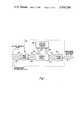
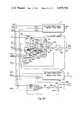
- FIG. 1is a general block diagram showing a control register logic organization.
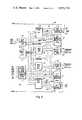
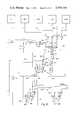
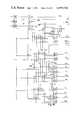
- FIG. 2is a detailed block diagrm of a PIA showing all functional elements and their interconnection.
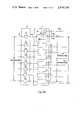
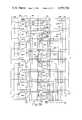
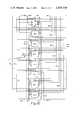
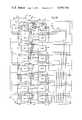
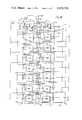
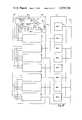
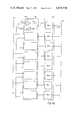
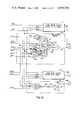
- FIGS. 3A-3Hare the portions of a complete logic diagram of a peripheral interface adaptor circuit according to the invention.
- FIG. 3Ishows part of the chip select and Read/Write control circuitry.
- FIG. 3Jshows interrupt/status control logic circuitry.
- FIG. 3Kshows part of the chip select and Read/Write control logic circuitry.
- PDAperipheral interface adaptor
- control registerfor the storage of information which determines the function of control logic of the peripheral interface adaptor circuit, referred to herein as a PIA circuit.
- FIG. 1illustrates a general block diagram of a PIA.
- PIA 8Mis structured to have connections to a data processing system (not shown) via a system address bus 5M and a bidirectional system data bus 6M. These buses are connected to the input logic circuit 1M.
- This input logic circuitcontains address selection circuitry which determines when the PIA is selected and data input logic and memory circuitry for receiving data from the system data bus, providing temporary storage for the data and routing it to other logic elements within the PIA. The routing of data to and from the input logic is performed under the control of the control logic circuit 2M.
- the control logic circuit 2Mhas the ability to transmit specified data from the data processing system to the control register circuit 3M via data path 9M. Once this information is stored in the control register it can feed back logic information via the data path 10M. This logic state information can be used to change the logic structure of the control logic circuit 2M such that data contents of the control register 3M will change the combinatorial or sequential logic functions of the control logic. Thus, use of the control register allows a restructuring of the logic functions of the PIA circuit under program control, since the data processing system program can be used to transmit the required sequence of data to the PIA circuit via the data processing systems data bus 6M. Control logic circuit 2M also transmits and receives data from output logic circuit 4M via data paths 13M and 14M. The output logic circuit 4M contains the interface circuitry and temporary buffer storage required for interconnection to external peripheral devices (not shown) required to communicate with the data processing system. This interconnection is via the bidirectional peripheral data bus 7M.
- An instruction set of the data processing systemallows the control register storage and the resultant restructuring of the PIA logic to be accomplished under program control both during system initilization sequences and during various times throughout the normal data transfer sequence of a given peripheral unit.
- the restructuring of the PIA logic structure according to this conceptprovides broad flexibility to a data system designer. For example, this concept allows address expansion relative to the selection of peripheral devices for peripheral input-output (I/O) lines since portions of the information stored in the control register can be assigned to the definition of expanded address locations of other registers within the control portion of the PIA.
- the structure of the PIA control logiccan be altered at will by the programmer both in terms of its combinatorial logic characteristics and its sequential logic characteristics as required by the sequence of events associated with some particular combination of peripherals.
- the peripheral interface pins (external lead connections) of the PIAcan be redefined as output-directed pins or input-directed pins at any time the programmer desires.
- microprocessor chipMPU
- a PIA chip specifically designed to meet this requirement in a recently developed microprocessing systemis discussed hereinafter.
- the PIAprovides means of interfacing a wide variety of peripheral equipment to a microprocessor unit (MPU).
- MPUmicroprocessor unit
- This preferred embodimentis capable of interfacing the MPU to peripherals through two eight-bit bidirectional peripheral data buses and four control lines. No external logic is required for interfacing to most peripheral devices.
- the functional configuration of the PIAis programmed by the MPU during system operation.
- Each of the peripheral data linescan be programmed to act as an input or output, and each of the four control/interrupt lines may be programmed for one of several control modes. This allows a high degree of flexibility in the over-all operation of the interface.
- FIG. 2is a block diagram of a preferred embodiment of the PIA according to the invention.
- the PIA 10includes control circuitry, a plurality of registers, data buffer circuitry, peripheral interface circuitry, and three internal buses (an input bus, an output bus, and a control bus) and a MPU data bus (D ⁇ -D7), and peripheral data bus A (PA ⁇ -PA7), and peripheral data bus B (PB ⁇ -PB7).
- the input bus and the output buseach include a plurality of conductors.
- the control busincludes a plurality of control signal conductors which enable coupling circuitry between the various buses and registers.
- Peripheral interface adaptor 10includes MPU data bus 13 and eight data bus buffer circuits 15.
- Data bus buffer circuitry 15is coupled to output bus 18 and is coupled by means of conductors 14 to input register 12, which is coupled to input bus 16 and control conductors 17.
- Control bus conductors 17are coupled to and controlled by chip select and Read/Write control circuitry 11, which has as its inputs the conductors designated CS1 (chip select 1), CS2, CS3, RS ⁇ (register select), RS1, R/W (Read/Write), E(Enable), and RS (reset).
- Peripheral interface adaptor 10also includes control registers 21 and 24, each of which are coupled to input bus 16, output bus 18 and certain of the control conductors 17.
- Control register 21is coupled by means of conductors 35 to interrupt/status control circuitry 25 which is coupled to conductors 26, designated IRQA and to conductors 26' and 26" designated CA1 and CA2, respectively. IRQA is an abbreviation for interrupt request for register section A.
- Control register 21is also coupled by conductor 19 to I/O (input/output) control register 27.
- I/O control register 27is also coupled to output bus 18, input bus 16 and control conductors 17, and is coupled by means of conductors 32 to the peripheral interface buffers 28, which are respectively connected to the conductors of peripheral data register 22 and output bus 18.
- Data register 22is also coupled to control conductors 17 and inptu bus 16.
- Control register 24, data register 23, peripheral interface buffer circuitry 30, I/O control register 34, and interrupt/status control circuitry 37are interconnected in a manner entirely similar to the corresponding sections described above.
- Data register 23is coupled to input bus 16, control conductor 17, and is connected to the peripheral interface of circuitry 30, which in turn is coupled to external peripheral data bus conductors B designated by reference numeral 31, and to output bus 18 and to I/O control register 34.
- I/O control register 34is coupled to certain control conductors 17, input bus 16, and output bus 18.
- Control register 24is coupled to input bus 16, certain of control conductors of control bus 17, output bus 18, and conductor 20, the latter being coupled also to I/O control register 34.
- Control register 34is also coupled by means of conductors 36 to interrupt/status control circuitry 37, which is connected to conductors CB1, CB2, and IRQB conductor 38.
- the PIA circuit shown in FIG. 2When the PIA circuit shown in FIG. 2 is provided necessary address, data, control and timing interconnections to a MPU and is connected to one or more peripheral units, the resulting capability for functional operation, modifiable under program control, meets the needs of a wide variety of different peripheral devices (i.e., display units, keyborads, industrial process control equipment, etc).
- peripheral devicesi.e., display units, keyborads, industrial process control equipment, etc.
- the definition of allowable configurations and the internal control established by the functional elements of FIG. 2are described in the following discussion.
- the nomenclature used to refer to detailed elements within the structuresuch as register stages, internal signal lines, etc. are shown in the detailed logic diagrams of FIGS. 3A-3K.
- a reset pulse applied to the RS inputhas the effect of zeroing all PIA registers. This will set PA ⁇ -PA7, PB ⁇ -PB7, CA2 and CB2 as inputs, and all interrupts disabled.
- the PIAmust be configured during the restart program which follows the reset pulse. Details of possible configurations of the I/O data direction registers 27 and 34, also designated ADD and BDD, respectively, and A or B control registers 21 and 24, respectively, are as follows.
- the two I/O data direction registersallow the MPU to control the direction of data through each corresponding peripheral data line.
- a data direction register bit set to a logical 0configures the corresponding peripheral data line as an input; a 1 causes the peripheral data line to act as an output.
- the two control registers AC and BCallow the MPU to control the operation of the four peripheral control lines CA1, CA2, CB1 and CB2. In addition they allow the MPU to enable the interrupt flags. Bits ⁇ through 5 of the two registers may be written or read by the MPU when the proper chip select and register select signals are applied. Bits 6 and 7 of the two registers are read only and are modified by external interrupts occurring on control lines CA1, CA2, CB1 or CB2.
- the bit format of the A and B control registersis shown in Table 2.
- control register bitsare as follows. Bit 2 in each control register AC and BC allows selection of either a peripheral interface register or the I/O control register when the proper register select signals are applied to RS ⁇ and RS1.
- the forced interrupt flag bits AC-6, AC-7, BC-6, and BC-7are set by active transitions of signals on the four interrupt/peripheral status lines when those lines are programmed to be interrupt inputs. These bits cannot be set directly from the MPU data bus and are reset indirectly by a MPU Read Peripheral Data operation on the appropriate section.
- the two lowest order bits of the control registersare used to control the interrupt input lines CA1 and CB1. Bits AC- ⁇ and BC- ⁇ are used to enable the MPU interrupt signals IRQA and IRQS, respectively.
- Bits AC-1 and AB1determine the active transition of the interrupt input signals CA1 and CB1. The definition of these transitions together with the other functional requirements for interrupt inputs CA1 and CB1 are shown in Table 3.
- Bits AC-3, AC-4, AC-5, BC, BC-4, and BC-5 of the two control registers AC and BCare used to control the CA2 and CB2 Peripheral control lines. These bits determine if the control lines will be an interrupt input or an output control signal. If bit AC-5 (BC-5) is low, CA2 (CB2) is an interrupt input line with functional requirements similar to CA1 (CB1) as shown in (Table 4). When AC-5 (BC-5) is high, CA2 (CB2) becomes an output signal that may be used to control peripheral data transfers. When in the output mode, CA2 and CB2 have slightly different characteristics as defined in Tables 5 and 6, respectively. When in the output mode, the low state of CA2 (CB2) is established by an MPU read or write operation, while the high state may be determined by an active transition of CA1 (CB1), and E pulse transition, or by an MPU write operation.
- FIG. 2also shows the various external electrical signal lines required. These signal lines fall into either the PIA to MPU category or the PIA to peripheral unit category and operate as follows.
- the PIAinterfaces to the MPU with an eight-bit bidirectional data bus, three chip select lines, two register select lines, two interrupt request lines, a read/write (R/W) line, an enable line and a reset line. These signals permit the MPU to have complete control over the PIA.
- the bidirectional data lines(D ⁇ -D7) allow the transfer of data between the MPU and the PIA.
- the data bus output driversare three-state devices that remain in the high-impedance (off) state except when the MPU performs a PIA read operation.
- the read/write lineis in the read (high) state when the PIA is selected for a read operation.
- the enable pulse, Eis the only timing signal that is supplied to the PIA. Timing of all other signals is referenced to the leading and trailing edges of the E pulse.
- this inputis a MPU "valid memory address" signal (designated VMA) ANDed with the phase two clock (VMA. ⁇ 2).
- VMAMPU "valid memory address” signal
- VMA. ⁇ 2phase two clock
- This PIA Read/Write (R/W) signalis generated by the MPU to control the direction of data transfers on the data bus.
- a low state on the PIA R/W lineenables the input buffers and data is transferred from the MPU to the PIA on the E signal if the device has been selected.
- a high on the R/W linesets up the PIA for a transfer of data to the bus.
- the PIA output buffersare enabled when the proper address and the enable pulse E are present.
- the active low RS lineis used to reset all register bits in the PIA to a logical zero (low). This line can be used as a power-on reset and as a master reset during system operation.
- the three PIA chip select input signals CS, CS1 and CS2are used to select the PIA.
- CS0 and CS1must be high and CS2 must be low for selection of the device.
- Data transfersare then performed under the control of the enable and read/write signals.
- the chip select linesmust be stable for the duration of the E pulse.
- the two register select lines RS ⁇ and RS1are used to select the various registers inside the PIA. These two lines are used in conjunction with internal control registers to select a particular register that is to be written or read.
- the register select linesshould be stable for the duration of the E pulse while in a read or write cycle.
- the active low interrupt request linesact to interrupt the MPU either directly or through interrupt priority circuitry. These lines are open source (no load device on the chip) and are capable of sinking a current of 1.6 mA from an external source. This permits all interrupt request lines to be tied together in a wire-OR configuration.
- Each peripheral interrupt linehas two internal interrupt flag bits that will cause the appropriate interrupt request line (IRQA or IRQB) to go low. Each flag bit is associated with a particular peripheral interrupt line. Also four interrupt enable bits are provided in the PIA which may be used to inhibit a particular interrupt from a peripheral device. Servicing an interrupt by the MPU is accomplished by a software routine that, on a prioritized basis, sequentially reads and tests the two control registers in each PIA for interrupt flag bits that are set. The interrupt flag is cleared (zeroed) as a result of an MPU read peripheral data operation.
- the PIAprovides two 8-bit bi-directional data buses and four interrupt/control lines for interfacing to peripheral devices.
- Each of the peripheral data lines of Section Acan be programmed to act as an input or output. This is accomplished by setting a 1 in the corresponding I/O data direction register bit for those lines which are to be output. A 0 in a bit of the I/O data direction register causes the corresponding peripheral data line to act as an input. During an MPU read peripheral data operation, the data on peripheral lines programmed to act as inputs appears directly on the corresponding MPU data bus lines.
- peripheral interface register Awill appear on the data lines that are programmed to be outputs.
- a logical 1 written into the reigsterwill cause a high on the corresponding data line while a 0 results in a low.
- Data in peripheral interface register Amay be read by an MPU read peripheral data A operation when the corresponding lines are programmed as outputs.
- peripheral data lines PB ⁇ -PB7 in the B Section of the PIAcan be programmed to act as either inputs or outputs in a similar manner to PA ⁇ -PA7.
- the output buffers driving these linesdiffer from those driving lines PA ⁇ -PA7. They have a three-state capability, which allows them to be switched to a high-impedance state when the peripheral data line is used as an input.
- Peripheral input lines CA1 and CB1are input only lines that set the interrupt flags of the control registers. The active transition for these signals is also programmed by the two control registers.
- the peripheral control line CA2can be progammed to act as an interrupt input or as a peripheral control output.
- the function of this signal line as an input or an outputis programmed with control register A as shown in Tables 4 and 6.
- Peripheral control line CB2may also be programmed to act as an interrupt input or peripheral control output.
- the fucntion of this signal line as an input or an outputis programmed by control register B as shown in Tables 4 and 5.
- FIGS. 3A through 3Kshow the detailed logic structure of the functional elements shown in the block diagram of FIG. 2.
- FIG. 3Ashows the MPU data bus 13 and the data bus buffers 15 which function to allow the bidirectional transfer of data between the MPU and the PIA.
- the data bus conductors from the MPU system AAare connected to MPU data bus 13.
- MPU data bus 13includes the eight bonding pads and conductors D ⁇ - D7. For each there is a conducting path like that shown by the input conductor 1A connected to the integrated circuit pad D7 connected to the output conductor 3A which couples to the data bus buffer circuit.
- the data bus buffer circuit 15consists of eight identical circuit blocks 4A, each of which contain receiving inverter 5A which receives data from conductor 3A and re-transmits it via conductor 9A and a transmitting inverter 6A which receives data via conductor 8A and transmits it to the MPU system via conductor 3A.
- Each of the receiving inverters 6Aalso are fed by a three-state control line 7A, which can force the output of 6A into a high impedance state.
- Each bufferwill stay in a high-impedance input mode except when the PIA has received the proper set of signals for a MPU read operation.
- the three-state control 7A for each of the eight buffer circuitsare connected together to form the three-state control line TSC which is coupled to circuitry shown in FIG. 3I.
- the conductor 9A for each data bufferform the eight conductors DA which are connected to the input register shown in FIG. 3B.
- the conductor 8A which is connected to each buffer circuitform the eight conductor data bus 18 which is connected to the register circuitry in FIGS. 3B, 3C, 3D, and 3E.
- FIG. 3Bshows the input register 12 and the A control register 21.
- the function of the A control register 21is to allow the MPU to control the operation of the peripheral control lines CA1 and CA2 and to enable and monitor interrupt signals.
- the A control register 21also contains one bit (AC2) which controls the access to the A data direction register ADD.
- the input register 12consists of eight identical register stages DB ⁇ -DBI7. Each register stage has a data input conductor 1B from the eight conductor group, DA. Each register stage has a clock input which connects to the common clock line 23B which connects to the CS and R/W control logic circuit 11 shown in FIG. 3K.
- Each input register stage DBI ⁇ - DBI7has a conductor 15B connected to its output and a conductor 16B connected to its complementary output. These eight pairs of conductors form the input bus 16 which transmits data to other registers of the PIA circuit.
- Control register 21consists of eight register stages AC ⁇ - AC7.
- Register stage AC6has a SET input 11B and register stage AC7 has a SET input 12B, which is connected to interrupt/status control circuitry 25, shown in FIG. 3K.
- Register stages AC6 and AC7have a common reset input 13B from the chip select and Read/Write control circuit 11 shown in FIG. 3I.
- Register stage A6also has a second reset input 15B which is connected to a non-complimentary output of register stage AC5.
- the remaining six register stages AC ⁇ - AC5each have a SET input 10B which is the uncomplimented output of the corresponding input register stage and a reset input 9B connected to the complimented output of the corresponding input register stage.
- control register 24The function of control register 24 is to allow the MPU to control the operation of the peripheral control lines CB1 and CB2 and to enable and monitor interrupts. Control register 24 also contains one stage (CB2) which controls the access to BDD. The complimentary output of register bit AC5 connects to conductor AC5. The non-complimentary output of the other seven register stages connect to conductors AC ⁇ - AC4, and AC6 and AC7 to form the eight conductor group AB which is part of the interconnection 35 to the A interrupt/status control circuit 25, shown in FIG. 3J.
- the eight A control register stagesall connect to a common master reset conductor RD from the chip select and Read/Write control logic 11 shown in FIG. 3K. All eight control register stages are connected to an output clock conductor 19B which coupled to the register select logic shown in FIG. 3k.
- Each of the eight A control register stageshas a conductor 20B connected to its clocked output. This conductor is connected to corresponding conductor 21B which is part of the output bus 18.
- Each conductor of the output bus 18also is connected to a load circuit 22B.
- FIG. 3Cshows the logic structure of the B control register 24.
- Clock conductor E from the CS and R/W control circuit 11 shown in FIG. 3Iis connected to the gate of clock driver MOSFET 4B whose source connects to ground.
- the drain of MOSFET 4Bis connected to conductor 24B which connects to the register select logic shown in FIG. 3K.
- the B control register 24consists of eight register stages BC ⁇ - BC7. Register stage BC6 and register stage BC7 have special input connections, the remaining six register stages BC ⁇ - BC5 are identical.
- Register stage BC6 and register stage BC7have a common reset input conductor 1C which is coupled to the CS and R/W control logic circuits shown in FIG. 3I.
- Register stage BC7has a SET input conductor SB7 and register stage BC6 has a SET input conductor SB6 which is connected to the edge sense circuits shown in FIG. 3H.
- the SET and RESET inputs of the remaining six register stages BC ⁇ - BC5are connected to the corresponding complimentary and non-complimentary conductors of the input bus 16.
- the input clock for register stages BC ⁇ - BC6is derived from the clock signal on conductor E which drives the gate of the clock driver MOSFET 13C.
- the drain of 13Cis coupled to conductor 12C which in turn is coupled to the register select logic of FIG. 3K.
- Conductor 12Ccouples to the input clock connection of each of the six register stages BC ⁇ - BC5.
- All eight of the register stages of the B control register 24are coupled to the master reset conductor RD which is coupled to the register select logic 11 of FIG. 3K.
- Each of the eight register stageshas an output clock conductor which is coupled to conductor 11C which is coupled to register select logic of FIG. 3K.
- Each of the eight register stageshas a corresponding clocked data output 13C which is coupled to the corresponding conductor of the output bus 18.
- Register bit BC2has its non-complimented output coupled to conductor BC2 which is connected to the register select logic of FIG. 3K.
- the remaining seven register stageseach have their non-complimentary output connected to conductors BC ⁇ , BC1 and BC3 - BC7 to form the conductor group AC which is coupled to the B interrupt/status control logic circuitry shown in FIG. 3H.
- FIG. 3Dshows data register 22 and the I/O data direction register 27.
- data register 22stores output data from the MPU. This data appears on the corresponding peripheral data line if that line is programmed to act as an output.
- the function of the data direction register 27is to allow each of the peripheral data lines to be programmed to act as an input or output. Writing 1 in a given I/O control register stage programs the corresponding peripheral data line to be an output. Similarly, writing a 0 programs the peripheral data line to be an input.
- the 16 conductors of the input bus 16provide the data input for both registers.
- a noncomplimented input bus conductor 11Dconnects to the set input of each of the data register stages AD0 - AD7 and each of the control register stages AI ⁇ 0 - AI ⁇ 7.
- a complimented input bus conductor 12Bconnects to the reset input of each of the data register stages and each of the control register stages.
- Each stage of the data register 22also has an input clock connection 13D to a common input clock conductor 6B.
- Conductor 6Bconnects to the drain of a clock driver MOSFET 2D whose gate is driven by the clock conductor E from the CS and R/W control logic circuitry shown in FIG. 3I.
- Clock conductor Ealso drives the base of a second clock driver MOSFET 4D whose drain connects to an input clock conductor 5D which connects to each of the input clock connections 16D of the control register stages.
- the two input clock conductors 6D and 5Dalso are coupled to the register select circuitry logic shown in FIG. 3K.
- Each data register stagehas a input 15D
- each control register stagehas an input 16D all of which couple together to connect to a master reset line RD which connects to the CS and R/W control logic circuitry shown in FIG. 3K.
- Each of the data register stages AD0 - AD7has an output clock connection 22D which connects to an output clock conductor 7D which connects to the register select circuitry shown in FIG. 3K.
- each of the control register stages AI/ ⁇ - AI/ ⁇ 7has an output clock connection to an output clock conductor 8D, which connects to the register select circuitry shown in FIG. 3K.
- Data register stage AD7has a clocked data output 23D and control register stages AI ⁇ 7 has a clocked data output 18D which is connected to one conductor 10D of the output bus 18.
- Data register stage AD7has a set input connection 25D to one of the eight conductors AD which are part of input bus 18.
- Data register stage AD7has an output conductor 24D which couples to an additional set input of the corresponding control register stage AI ⁇ 7.
- the control register stage AI ⁇ 7logically combines the data state transmitted by conductor 24D to produce an output signal which couples to conductor 19D.
- the logic state on conductor 19Dis the same as that of conductor 24D, if register stage AI ⁇ 7 contains a logical 1.
- register state AI ⁇ 7contains a logical 0, the logical state of conductor 19D stays fixed at 0.
- the conductors analogous to conductor 19Dare connected to the output of each control register stage 21D and form the eight conductors of the output data bus 40, which is coupled to the B peripheral interface buffer circuitry shown in FIG. 3F.
- FIG. 3Eshows the B data register 23 and the data direction register 34.
- the function of these two registersis the same as that of the registers of FIG. 3D discussed above except that they serve the B peripheral data lines.
- the 16 conductors of the input bus 16provide the data input for both registers.
- a non-complemented input bus conductor 11Eis connected to the set input of a data register stage BD7 and a control register stage DI ⁇ 7.
- a complemented input bus conductor 12Eis connected to the reset input of a data register stage BD7 and a control register stage DI ⁇ 7.
- the input bus connections for the remaining stages of both registersfollow the same pattern.
- Each stage of the B data register 23also has an input clock connection 13E to a common input clock conductor 6E. This conductor connects to the drain of a clock driver MOSFET 2E whose gate is driven by the clock conductor E from CS and R/W control logic shown in FIG. 3I.
- This clock conductor Ealso drives the gate of a second clock driver MOSFET 4E whose drain is connected to an input clock conductor 5E which is connected to each of the input clock connections 14E of the control register stages.
- the two input clock conductors 6E and 5Ealso are coupled to the register select control logic shown in FIG. 3K.
- Conductor 6Ealso is coupled to the B interrupt and status control logic circuitry shown in FIG. 3H.
- Each data register stagehas an input 15E and each control register stage has an input 16E all of which are coupled together and connected to a master reset line RD which couples to the CS and R/W control logic shown in FIG. 3K.
- Data register stage BD7has an output clock connection 22E which is coupled to an output clock conductor 7E which is coupled to the register select circuitry shown in FIG. 3K.
- the control register stage BI ⁇ 7has an output clock connection 17E to an output clock conductor 8E which is connected to the register select circuitry shown in FIG. 3K.
- Data register stage BD7has a clocked data output 23E and control register stage BI ⁇ 7 has a clocked data output 18E which is connected to one conductor 10E of the output bus 18.
- Data register stage BD7has a set input connection 25D to one of the eight conductors AE which are part of input bus 18.
- Data register stage BD7has an output conductor 24E which is part of the eight-conductor group BE which is part of the bus 39 coupled to the B peripheral interface buffer circuitry shown in FIG. 3F.
- the conductors analogous to conductor 19E which connects to the output of each control register stage 21Eform the eight conductor group CE which is part of 39, which coupled to the B peripheral interface buffer circuitry shown in FIG. 3F.
- FIG. 3Fshows the B peripheral interface buffer 30 and the B peripheral data bus 31, which function to allow the bidirectional transfer of data between the B portion of the PIA and the associated peripheral unit.
- B peripheral data bus 31consists of the 8 pads PB ⁇ - PB7.
- Pad PB7connects to a circuit of the peripheral interface buffer 30 via conductor 15F' and to the associated peripheral unit via conductor 16F. Each of the remaining pads is connected in the same way forming the eight-conductor group FA to the peripheral unit.
- the interface buffer 30consists of eight identical logic circuits. Each circuit has an input conductor 1F from the eight conductor group CE which is coupled to data direction Register 34 shown in FIG. 3E.
- a logic signal on conductor 1Fdefines the direction of data flow for the interface buffer circuit 18F.
- a logical 1 on conductor 1Fdefines the direction of data flow from the buffer circuit 18F, to the peripheral conductor 16F.
- a logical 0 on conductor 1Fdefines the direction of the data flow from conductor 16F to the interface buffer circuit 18F.
- the inverted data at the output of inverter 17Fis provided at an input to inverter 7F via conductor 19F.
- the twice inverted data at the output of inverter 7Fis coupled to pad PB7 of the B peripheral data bus 31 via conductors 8F and 15F.
- data flowis from the B data register of FIG. 3E through the peripheral data bus buffer circuit 18F to the B peripheral data bus 31.
- the logic 1 signal on conductor 1Fis coupled to an input of AND gate 10F, via conductor 2F, enabling the AND gate 10F.
- the inverted data present on conductor 19Fis connected to the other input of AND gate 10F via conductor 20F. Since AND gate is enabled, the inverted data on conductor 20F is transmitted via AND gate 10F to NOR gate 12F which is connected back to the B data register shown in FIG. 3E via conductor 14F. This feedback of data to the B data register from which it originated provides an internal diagnostic capability for reading back the contents of the B data register to verify that they are the same as written.
- Conductor 2Fcouples a logical 0 to the input of AND gate 10F, which is then disabled. This prevents the data state on conductor 13F from feeding back to the B data register via inverter 17F, conductor 20F, AND gate 10F, and NOR gate 12F.
- the logical 0 on conductor 1Fis inverted by inverter 3F to produce a logical 1 on conductor 4F which is coupled to conductor 6F, the three-state input to inverter 7F.
- the logical 1 on conductor 6Fforces the output of inverter 7F to the high impedance state.
- the conductor 8F which is connected to the output of inverter 7Fis essentially coupled to an open circuit and logical conditions at the input to inverter 7F can have no effect on the data bus pad PB7 and the peripheral conductor 16F.
- a logic 1is applied to conductor 4F which is connected to an input to AND gate 11F via conductor 5F, thus enabling AND gate 11F.
- Data from peripheral devicesis transmitted via conductor 16F, pad 15F, conductor 15F', and conductor 8F', which is coupled to the input to inverter 9F.
- the resulting inverted data at the output to inverter 9Fis transmitted via conductor 18F which is connected to the second input AND gate 11F, which is connected to the input to NOR gate 12F so that data twice inverted is produced on conductor 14F which is coupled to a data input of the B data register circuitry shown in FIG. 3E.
- a logical 0 on the data direction defining conductor 1Fallows data to flow from the peripheral unit to the B data register and prevents extraneous data (on conductor 13F) from interferring with this data flow by disabling the AND gate 10F and the inverter 7F.
- the eight conductors 1Fform the eight conductor group CE which is connected to the B I/O control register 34 shown in FIG. 3E.
- the logical state present on the eight conductors 1Fcan be envisioned as a control register word which defines the data direction for each conductor 16F of B peripheral data bus 31.
- the eight conductors 13Fform the group BE which is connected to the B data register 23 shown in FIG. 3E are similarly connected.
- the logical state on the eight conductors 13Fcan be thought of as a data word being transmitted to the peripheral unit via the B peripheral data bus 31.
- the eight conductors 14Fform the group AE which also is connected to the B data register 23 shown in FIG. 3E.
- the logical states on the eight conductors 14Fcan be thought of as a data word being transmitted from the B peripheral data bus 31 to the B data register 23.
- B peripheral interface buffer 30can be programmed to accommodate any combination of input bus conductors and output bus conductors simultaneously.
- FIG. 3Gshows the A peripheral interface buffer 28 and the eight peripheral interface bus conductors 29 which function to allow the bidirectional transfer of data between the A portion of the PIA and the associated peripheral unit.
- the A peripheral interface buffer 28consists of eight identical buffer circuits 10G. Each buffer circuit contains circuitry for the transmission of data from the data and control register circuitry of FIG. 3D to a peripheral unit via the A peripheral data bus 29. Each buffer circuit 10G also contains circuitry for the transmission of data from the A peripheral data bus 29 to the data register circuitry of FIG. 3D.
- Conductor 1Gprovides the data input signal for the buffer circuit 10G. As previously discussed for FIG.
- the logical signal on conductor 1Gis conditioned by the contents of the data direction register 27 such that data will be present only when the data direction is towards the A peripheral data bus 29.
- the logic signal on conductor 1Gconnects to the input inverter 2G to produce an inverted logic signal on conductor 3G which connects to conductor 4G, pad PA7, and conductor 6G.
- Conductor 6Gis one of the eight conductors forming the eight conductor group GA.
- the conductors 1G for each of the eight buffer circuits 10Gare grouped to form the internal bus 40 which connects to the data direction register 27 shown in FIG. 3D.
- the logic signal on conductor 6Gis transmitted via pad PA7, conductor 4G, and conductor 7G to the input of non-inverting driver AG.
- the resulting logic signal on the output of driver AGis connected to conductor 9G.
- the eight conductors 9G for the eight buffer circuits 10Gform the eight conductor group AD which is connected to the A data register 22 of FIG. 3D.
- FIG. 3Hshows the B interrupt/status control logic 37, which consists of a CB2 edge sense circuit 1H, a CB2 output circuit 2H, a CB1 edge sense circuit 3H, and a IRQB logic circuit 4H.
- the B interrupt/control status logicis connected to three external signal lines.
- conductor CB1is an interrupt input line which transmits interrupt signals from the associated peripheral unit to the PIA.
- Conductor CB2is a peripheral control signal line which may be programmed to act as an interrupt input from the associated peripheral or as a peripheral control output to the associated peripheral.
- Conductor IRQBis an interrupt request signal line which transmits a interrupt request from the PIA to the MPU.
- the function of the two edge sense circuits 1H and 3His to sense either positive going transitions, negative going transitions or a DC level as the active signal state being transmitted by the associated peripheral unit.
- the definition of which signal state is activeis determined by connections to the B control register who's contents can be altered under program control.
- the CB2 edge sense circuit 1Hhas its input conductor CB2 from the associated peripheral unit, conductor BC4 and BC6 from the B control register circuitry of FIG. 3C and conductor E from the CS and R/W control logic circuitry of
- the CB2 edge sense circuit 1Hhas as an output conductor SB6' which is connected to the set input of register stage 6 of the B control register circuit shown in FIG. 3C.
- the CB1 edge sense circuithas input conductors CB1, BC1, BC7, and E and output conductor SB7 which is connected to the set input of register stage 7 in the B control register circuit of FIG. 3C.
- edge circuits 1H and 3Hare provided in the copending Motorola application Ser. No. 503,993, by William D. Kohl, Jr., filed on the same date as this application.
- the conductor CB2functions as an input from the peripheral unit or an output to the peripheral unit depending on the programming of the B control register.
- the logic signal on conductor BC5 from the B control register circuit of FIG. 3Cdetermines whether conductor CB2 is an input or an output.
- conductor BC5is a logical 1
- conductor CB2functions as an interrupt input and operates as previously described in the functional operation section above and in accordance with Table 4. Operation as an interrupt input implies that the CB2 output circuit must be decoupled from conductor CB2. This decoupling is accomplished by the logical 0 on conductor BC5 which is connected to the three-state input of noninverting driver 12H via conductor 38H.
- the logical 0 on conductor 38Hforces the output of driver 12H to be in the high impedance state.
- the conducting path from conductor CB2 to conductor 39H to the output of driver of 12His essentially a connection to an open circuit and the CB2 output circuit is effectively decoupled from conductor CB2 and can have no effect on its operation as an interrupt input.
- conductor BC5When conductor BC5 is a logical 1, conductor CB2 is defined to be a control output signal line to the associated peripheral unit and the functional operation of the CB2 output circuit 2H is as previously described in the functional operation section and in Table 5.
- the logical 1 on conductor BC5is applied to the three-state input to non-inverting driver 12H via conductor 38H and the driver is enabled to allow functioning as a normal logic driver.
- the logical 1 on conductor BC5also is connected to the input to inverter 8H via conductor 40H.
- the resulting logic 0 at the output of inverter 8His connected to an input of NOR gate 10H via conductor 30H such that NOR gate 10H is enabled.
- NOR gate 10Hhas three inputs connected to conductors 10H', 30H and 34H. A logical 1 on any of these three inputs will force the output of NOR gate 10H to a logical 0. This logical 0 is coupled to one input to NOR gate 7H by conductor 35H. If the other input conductor 7H' of NOR gate 7H is also at a logical 0, the output of NOR gate 7H will be at a logical 1. The resulting logical 1 on conductor 34H is connected back to one input of NOR gate 10H, holding the output of NOR gate 10H at a logical 0 level. Thus the flip-flop formed by NOR gate 10H and NOR gate 7H has been locked into a steady state, which we refer to as the set state.
- the flip-flop formed by NOR gates 7H and 10Hcan be reset if a logical 1 at input 7H' of NOR gate 7H forces the output of NOR gate 7H to a logical 0, which is then maintained at a steady state by the cross-coupling action of conductor 34H, NOR gate 10H and conductor 35H.
- This reset stateproduces a logical 1 on conductor 36H which is coupled to the input of inverter 11H.
- the resulting logical 0 at the output of inverter 11His coupled to the input of noninverting driver 12H via conductor 37H. This results in a logical 0 on conductor 39H and conductor CB2.
- NOR gates 5H, 6H and 7Hform an AND-NOR structure and NOR gates 10H, 13H, 15H and 17H also form such a structure.
- NOR gate 7H and NOR gate 10HWith such a structure and the cross-coupled connection of NOR gate 7H and NOR gate 10H via conductors 34H and 35H, a flip-flop structure is formed which can only be set or reset by unique combinations of logic levels at the AND gate inputs.
- conductor CB2As previously discussed, the definition of conductor CB2 as an output requires that a logical 0 on conductor 30H so that conductor 30H has no effect on the operation of CB2 as an output.
- AND gate 13Hwhich has one input connected to conductor BC3 via conductor 44H and 46H; and a second input connected to conductor BC4 via conductor 48H and 47H.
- AND gate 13Hwill set the flip-flop if both conductor BC3 and conductor BC4, which connect to the B control register circuitry of FIG. 3C, are at a logical 1.
- AND gate 15HThe inputs to this gate are derived from conductors BC3, BC4 and BC7 which connect to the B control register circuitry of FIG. 3C.
- Conductor BC3connects to the input to inverter 9H via conductors 43H and 41H.
- the output of inverter 9Hconnects to an input of AND gate 15H via conductors 42H and 52H.
- Conductor BC4is connected to the input of inverter 14H via conductors 49H' and 49H.
- the output of inverter 14His connected to another input to AND gate 15H via conductors 50H and 51H.
- Conductor BC7connects to conductor 15H' which is connected to the third input to AND gate 15H.
- AND gate 15Hwill set the flip-flop when conductor BC3 is a logical 0, conductor BC4 is a logical 0 and conductor BC7 is a logical 1.
- One inputwill be a logical 1 when conductor BC4 is a logical 0 because of its connection to the output of inverter 14H via conductors 50H and 53H.
- a second inputwill be a logical 1 when conductor BC3 is a logical 1 because of its connection via conductors 43H, 44H and 45H.
- Conductor Eis connected to the input of inverter 16H via conductor 27H.
- the output of inverter 16His connected to the other the of NAND gate 18H via conductor 55H.
- the logical action of NAND gate 18H and its connection to the input of AND gate 17H via conductor 54Hresults in a logic 1 at the input to AND gate 17H when conductor E and the write conductor are at a logical 1 level.
- a logical 1 on conductor Eis coupled to one input of AND gate 5H via conductors 26H' and 26H.
- Conductor 6Ewhich is connected to the B data register circuitry of FIG. 3E, will be at a logical 1 whenever data is clocked into the B data register as discussed above.
- This logical 1is coupled to the reset input of the flip-flop formed by NOR gates 20H and which then couples a logical 1 to the other input of AND gate 5H via conductors 58H and 28H.
- AND gate 5Hwill reset the control flip-flop formed by NOR gates 7H and 10H when conductor E is a logical 1 and conductor 6E is a logical 0.
- the remaining functional element of the E interrupt/status control logic 47is the IRQB logic circuit 4H.
- the interrupt request line IRQBacts to interrupt the MPU either directly or through interrupt priority circuity.
- the IRQB linegoes low when bit 7 in the B control register is at a logical 1 and bit 0 of the B control register is at a logical 1, or when bit 6 in the B control register is at a logical 1 and bit 3 in the B control register is a logical 1.
- Tables 2, 3 and 4The system conditions leading to these logical states for the B control register stages are summarized in Tables 2, 3 and 4 and the associated discussion above. These required functional conditions are accomplished by the IRQB logic circuit 4H as follows.
- Conductors BC ⁇ , BC3, BC6, and BC7are connected, respectively, to register stages 0, 3, 6, and 7 of the B control register shown in FIG. 3C such that when a register stage is in the logical 1 state, the corresponding BC conductor will be at a logical 1.
- a logical 1 on conductor BC6applies a logical 1 to one input of AND gate 21H via conductor 64H and a logical 1 on conductor BC3 applies a logical 1 to the other input of AND gate 21H via conductor 65H.
- the action of the AND-NOR gate formed by 21H and 22Hresults in a logical 0 at the output of NOR gate 22H.
- This logical 0is connected to the input to inverter 23H via conductor 59H producing a logical 1 on conductor 68H, which is connected to the gate of MOSFET 61H.
- the logical 1 on the gate of MOSFET 61Hdrives it into saturation such that there is a low impedance path from the drain of MOSFET 61H to the source of MOSFET 61H which is connected to conductor 62H which connects to ground. This results in ground voltage on conductor 63H which is connected to the IRQB conductor which is the B interrupt request signal line to the MPU system.
- a logical 1 on conductor BC7is applied to one input of AND gate 25H via conductor 66H and a logical 1 on conductor BC ⁇ is applied to the other input of AND gate 25H, connecting the IRQB conductor to ground via the same logical sequence as was just described for AND gate 21H etc.
- FIG. 3Ishows one part of the CS and R/W control logic 11. This circuit has five input connections from the MPU.
- Pad Ewhich provides the timing for the PIA chip, is connected to conductor 1I.
- Pad R/W connected to conductor 211provides a signal path to the MPU which determines whether the MPU system is reading from the PIA chip or writing into the PIA chip.
- the CS2 signal on conductor 5Iis coupled to one input on NAND gate 25I via inverter 6I, conductor 7I, and conductor 15I.
- the CS3 signal on conductor 9Iis coupled to another input of NAND gate 25I via inverter 10I, inverter 11I, conductor 12I, and conductor 14I.
- the CS1 signal on conductor 20Iis coupled to the third input to NAND gate 25I via inverter 19I, conductor 18I and conductor 16I.
- the logic signals on the MPU address buswill result in a logical 1 on pad CS1, a logical 1 on pad CS2 and a logical 0 on pad CS3. These signals result in logical 0's on all three inputs to NAND gate 25I to produce a logical 1 at the output of NAND gate 25I.
- NAND gate 25Imakes use of special bootstrap circuitry in its implementation for improved signal level and signal timing performance. This notation on other gates in FIG. 3I should be interpreted in the same way.
- the logic 1 at the output of NAND gate 25Iis connected to one input to NAND gate 35I' via conductor 35I.
- the clock signal on conductor 1Iis inverted and connected to the other input to NAND gate 35I' via conductors 35I, and 33I, and inverter 36I.
- the active time for the clock signal on conductor 1Iis when the signal is at a logical 0. This logical 0 results in a logical 1 at the output of inverter 36I which is connected to the input to NAND gate 35I'.
- the output of NAND gate 35Iis thus a clocked selection signal which will be at a logical 1 when the PIA chip is selected at the active time of the clock signal.
- the output of NAND gate 35I'is connected to the set input of a first register timing flip-flop formed by NOR gate 55I, NOR gate 58I and cross coupling conductors 57I and 58I, via conductor 53I and to the set input of a second register timing flip-flop formed by NOR gate 59I, NOR gate 60I and cross coupling conductors 61I and 62I via conductor 54I.
- NAND gate 27Iis connected to one input of NAND gate 3I via conductor 4I.
- the other input of NAND gate 3Iis connected to the clock signal on conductor 1I via conductor 2I.
- NAND gate 3Iis connected to conductor TSC, which is the three-state control line connecting the data bus buffer circuitry of FIG. 3A. As previously discussed under FIG. 3A, the three-state control line must be at a logical 1 during operations when the MPU wishes to write information into the PIA.
- TSCthe three-state control line
- the three-state control linemust be at a logical 1 during operations when the MPU wishes to write information into the PIA.
- MPUwhich is indicated by a logical 0 on the R/W pad which will result in a logical 0 being applied to one input of NAND gate 27I.
- the other three inputs of NAND gate 27Iwill all be at logical 0 when the PIA chip is selected. This results in a logical 1 at the output of NAND gate 27I, which is connected to the input of NAND gate 3I via conductor 4I.
- the active time of the clock signalapplies a logical 1 to the other input to NAND gate 3I via conductor 2I resulting in a logical 0 on conductor TSC which is the three-state control line to the data bus buffer circuitry of FIG. 3A.
- This logical 0allows the transmitting inverters of the data bus buffer circuitry to function as normal inverters as required for an MPU read operation.
- the logical 0 on the R/W padresults in a logical 0 on conductor 4I, such that conductor TSC is forced to a logical 1.
- This logical 1forces the transmitting inverters of the data bus buffer circuitry of FIG. 3A to the high impedance state such that they cannot interfere with an MPU write operation.
- the logical 0 at the output of NAND gate 3I during a read operationis coupled to inverter 30I via conductor 29I to produce a logical 1 on conductor 43I.
- This logical 1is applied to one input of AND gates 56I' and 60I' via conductors 43I' and 52I.
- a register select signal from FIG. 3Dis applied to the other input of AND gate 56I' via conductor 1D and a register select signal from FIG. 3E is applied to the other input to AND gate 60I' via conductor 1E.
- This resettingwill force conductor 13B which is connected to the A control register circuitry of FIG. 3B or conductor 1C which is connected to the B control register circuitry of FIG. 3C to a logical 1 to meet the control register requirements discussed in the functional operation section above.
- This circuitryconsists of AND gate 37I, the flip-flop formed by NOR gates 38I' and 38I and the cross coupling conductors 39I and 40I, and the NAND gate 51I.
- This flip-flopwhich is normally set, will be reset to produce a signal on the WRITE conductor whenever the MPU wishes to write into the PIA.
- the clocked selection signal at the output of NAND gate 35Iis coupled to the one set input of the flip-flop via conductor 41E.
- Conductor 41Ewill be a logical 1 during the active clock time of each cycle when the PIA is selected and this logical 1 will reset the flip-flop formed by NOR gates 38I' and 38.
- the resulting logical 0is coupled to one input to NAND gate 51I via conductor 50I.
- the conductor 44Iapplies a logical 0 to the other input of NAND gate 51I during the inactive portion of the clock cycle.
- the output of NAND gate 51Iwill thus produce a signal which is a logical 1 during the inactive clock time and a logical 0 during the active clock time, this signal connecting to the CB2 output circuitry of FIG. 3H via the WRITE conductor.
- the R/W pad connected to conductor 21is a logical 0.
- the inversion of 22Iresults in a logical 1, which is coupled to one input of AND gate 37I via conductors 23I and 32I.
- Conductor 34Iapplies a logical 1 to another input of AND gate 37I during the time that the PIA chip is selected.
- Conductor 31Iis connected to the third input to AND gate 37I and applies a clock signal which is a logical 1 during the active clock time.
- the three inputs of AND gate 37Iall logical 1's, reset the flip-flop producing a logical 0 at the output of NOR gate 38I, which is connected to the input of NOR gate 38I' via conductor 39I. Since the other inputs of NOR gate 39I are both logical 0, the output of NOR gate 38I' will apply a logical 1 to one input of NAND gate 51I via conductor 50I.
- This logical 1will force the output of NAND gate 51I which connects to the CB2 output circuit of FIG. 3H via the WRITE conductor to a logical 0 which will be maintained as long as the flip-flop stays in the write or reset condition.
- the flip-flopwill be set to resume normal read operations when the chip select interval is completed and the output of NAND gate 35I' couples a logical 1 to the input of NOR gate 38I' via conductor 41E.
- the flip-flopis also reset by a master reset signal to the PIA which causes the RD conductor from the CS and R/W control logic circuitry of FIG. 3K to be a logical 1 which is then connected to another input of NOR gate 38I'.
- the flip-flop formed by NOR gates 38I and 38I' and the cross-coupling conductors 39I and 40Iis also used to generate an enable signal for the register select circuitry of FIG. 3K.
- the output of NOR gate 38I'is connected to the input of the bootstrapped inverter 45I via conductor 42I.
- the output of inverter 45Iis connected to conductor FCS which is connected to the register select circuitry of FIG. 3K.
- the logical 1 at the output of NOR gate 38I' during a MPU write operationcauses conductor FCS to be at logical 0 which enables the register select circuitry of FIG. 3K.
- FIG. 3Jshows the A interrupt/status control logic 25.
- the logic structure of this circuitis very similar to that of the B interrupt/status control logic 37 shown in FIG. 3H and the detailed description of that logic figure applies.
- the logic element designationshave been chosen so that the numerical portion is the same and the letter suffix has been changed from H to J.
- the A interrupt/status control logic 25consists of a CA2 edge sense circuit 1J, a CA2 output circuit 2J, a CA1 edge sense circuit 3J and a IRQA logic circuit 4J.
- the general functional operation of these four circuitsis the same as discussed under FIG. 3H except that they relate to a peripheral unit associated with the A control, data, input-output, and peripheral circuitry.
- the two edge sense circuits 1J and 3J and the IRQA logic circuit 4Jhave exactly the same structure and function as the corresponding circuits shown in FIG. 3H, and the discussion of FIG. 3H suffices to completely define their operation.
- the CA2 output circuit 2Jhas the same general function as the corresponding CB2 output circuit 2H, but there are minor functional and structural differences as is explained below.
- the peripheral control line CA2differs from the peripheral control line CB2 in that as an input, it represents one standard TTL load.
- the three-state non-inverting driver 12H and the three-state control conductor 38H required in the B circuitare not used in the A circuit and are omitted in FIG. 3J so that inverter 11J connects to conductor 37J which connects directly to the pad CA2 and the CA2 input conductor to edge sense circuit 1J.
- the disabling of the CA2 output circuit 2Jindicating that conductor CA2 is to provide an input path from the associated peripheral unit, is accomplished by a logical 1 on conductor AC5 from the A control register circuit of FIG. 3B.
- Conductor AC5is connected to one input of the NOR gate 10J, forcing the control flip-flop formed by NOR gate 7J, NOR gate 10J and cross coupling conductors 34J and 35J to the reset state.
- the resulting logical 0 on conductor 36Jforces the output of inverter 11J to a logical 1 which connects to the CA2 pad via conductor 37J.
- conductor 37Jwill not impede the operation of conductor CA2 as an input from the associated peripheral unit to the edge sense circuit 1J.
- AND gate 5JOne input to AND gate 5J is connected to the clock conductor E from the CS and R/W control logic shown in FIG. 3K via conductor 26J', inverter 28J' and conductor 26J.
- the other input of AND gate 5Jis connected to the reset timing signal on conductor 13B from the input register and A control register circuitry of FIG. 3B via conductor 28J so that the control flip-flop formed by NOR gate 7J NOR gate 10J and cross coupling conductors 34J and 35J is reset when conductor E is a logical 0 and conductor 13B is a logical 1.
- Conductor 13Balso is connected to one input of NAND gate 18J via conductor 58J.
- NAND gate 18JThe other input of NAND gate 18J is connected to conductor E via conductor 55J and its output is connected to one input of AND gate 17J via conductor 54J.
- Another input of AND gate 17Jis connected to conductor AC3 from the A control register circuitry of FIG. 3B via conductors 43J, 44J, and 45J.
- the third input to AND gate 17Jis connected to conductor AC4 from the A control register of FIG. 3B via conductors 49J', 49J, inverter 14J and conductors 50J and 53J.
- FIG. 3Kshows the register select portion of the CS and R/W control logic circuit 11.
- two register select lines connected to the MPU address bus plus bit 2 of the A or B control registerare used as the basic information for selecting the various registers within the PIA circuit.
- the circuitry of this figuregives the detailed logic structure by which this register selection is accomplished.
- This figurealso shows circuitry associated with the master reset signal which can be used to reset all register bits in the PIA to a logical 0.
- Pad RS ⁇which is connected to the MPU address bus is connected to the input of inverter 3K via conductor 3K'.
- the output of inverter 3Kis connected to conductor RS0, which multiples to the appropriate NAND gate and which will be a logical 0 when pad RS ⁇ is a logical 1.
- pad RS1which connects to the MPU address bus, is coupled to the input of inverter 2K via conductor 2K'.
- inverter 2KThe output of inverter 2K is connected to conductor RS1, which multiples to the appropriate NAND gate and will be a logical 0 when pad RS1 is a logical 1.
- Conductor RS ⁇also is connected to the input of delay flip-flop 5K whose set and reset output are connected to conductors R ⁇ and R ⁇ , respectively, to provide additional coded select information to the appropriate NAND gates.
- Conductor R0also is connected to the input of inverter 11K whose output is connected to conductor RS ⁇ which is multipled to the appropriate NAND gates providing the logical complement of the logic signal on conductor RS ⁇ .
- conductor RS1is connected to an input of delay flip-flop 6K, whose set and reset outputs connect to conductors R1 and R1, respectively, providing additional coded selection information to the appropriate NAND gates.
- the logical input conditions applied to flip-flops 5K and 6K by conductors RS0 and RS1are clocked into the flip-flops by the clock signal on conductor E which is connected to the CS and R/W control logic circuitry shown in FIG. 3I and to the clock input of each flip-flop.
- the remaining coded register selection information required by the circuitis provided by conductor AC2 which is connected to the A control register circuitry of FIG. 3B and by conductor BC2 which is connected to the B control register circuitry of FIG. 3C.
- these two conductorsare connected to inverters 12K and 17K whose outputs produce the logical complement on conductors AC2 and BC2 which then are connected to the appropriate NAND gate inputs.
- the basic timing for the register select signals generated by this circuitis provided by the clock signal on conductor E which is connected to the CS and R/W control logic circuitry of FIG. 3I and which multiples to the appropriate NAND gate inputs.
- the enable signal on conductors FCS discussed in FIG. 3Ialso is connected to the appropriate NAND gate inputs.
- the output of NAND gate 7Kprovides an input selection signal for the A control register circuit of FIG. 3B via conductor 24B which is connected to the input clock of each register stage.
- Conductor 24Bwill be a logical 1 when inputs R1, R ⁇ , FSC, and E are all at logical 0.
- all NAND gates of FIG. 3Bcontain bootstrap circuitry to provide better dynamic performance.
- the line 7K' associated with NAND gate 7Kshows the notation used to indicate a bootstrap output.
- the output of NAND gate 8Kprovides and additional selection signal for the A control register circuit of FIG. 3B via conductor 19B, which is connected to the output clock terminal of each register stage.
- Connector 19Bwill be at a logical 1 when the two inputs of NAND gate 8K, which is connected to conductors RS1 and RS ⁇ , are both at a logical 0.
- the output of NAND gate 9Kprovides a selection signal for the B control register of FIG. 3C via conductor 12C which is connected to the input clock of each register stage.
- Conductor 12Cis at a logical 1 when the inputs of NAND gate 9K, which are connected to conductors R1, R ⁇ , FCS, and E, are all at a logical 0.
- NAND gate 10Kprovides additional selection for B control register of FIG. 3C via conductor 11C, which connects to the output clock terminal of each register stage.
- Conductor 11Cwill be at a logical 1 when the inputs of NAND gate 10K which are connected to conductors RS1 and RS ⁇ , are both logical 0.
- the output of NAND gate 13Kprovides selection for the A data register of FIG. 3D via conductor 6D, which is connected to the input clock of each register stage.
- Conductor 6Dwill be at a logical 1 when the inputs of NAND gate 13K, which are connected to conductors AC2, R1, R ⁇ , FCS and E, are all logical 0.
- the output of NAND gate 14Kprovides additional selection for the data direction register of FIG. 3D via conductor 5D which is connected to the input clock terminal of each register stage.
- Conductor 5Dwill be at a logical 1 when the inputs of NAND gates 15K, which are connected to conductors AC2, R1, R ⁇ , FCS, and E are all logical 0's.
- the output of NAND gate 16Kprovides additional selection for the data direction register of FIG. 3D via conductor 8D which is connected to the output clock terminal of each register stage.
- Conductor 8Dwill be at a logical 1 when the inputs of NAND gate 16K which are connected to conductors AC2, RS1 and RS0 are all logical 0.
- the output of NAND gate 18Kprovides selection for the B data register of FIG. 3E via conductor 6E which is connected to the input clock terminal of each register stage.
- Conductor 6Ewill be at a logical 1 when the inputs of NAND gate 18K, which are connected to conductors DC2, R1, R ⁇ , CS1 and E are all logical 0.
- the output of NAND gate 19Kprovides additional selection for the B data register of FIG. 3E via conductor 7E, which is connected to the output clock terminal of each register stage.
- Conductor 7Ewill be at a logical 1 when the inputs of NAND gates 16K, which are connected to conductors BC2, RS1, and RS ⁇ are all logical 0.
- the output of NAND gate 20Kprovides selection for the B input-output control register of FIG. 3E via conductor 5E, which connects to the input clock terminal of each register stage.
- Conductor 5Ewill be at a logical 1 when the inputs of NAND gate 20K, which are connected to conductors BC2, R1, R ⁇ , FCS and E, are all logical 0.
- the output of NAND gate 21Kprovides additional selection for the B input-output control register of FIG. 3E via conductor 8E, which is connected to the output clock terminal of each register stage.
- Conductor 8Ewill be at a logical 1 when the inputs to NAND gate 21K which are connected to conductors BC2, RS1, and RS ⁇ , are all logical 0.
- FIG. 3Kalso contains circuitry for the master reset feature of the PIA chip used to reset all register bits in the PIA to a logical 0.
- the master reset signal from the MPUis connected to pad RS which is connected to the input of inverter 1K via conductor 1K'.
- the output of inverter 1Kis connected to conductor RD, which connects to the register circuitry of FIGS. 3B, 3C, 3D, and 3E and to the CS and R/W control logic of FIG. 3I.
- the reset padgoes to a logical 0
- the active levelconductor RD goes to a logical 1 to provide the register reset function described in the PIA systems operation section above.
Landscapes
- Engineering & Computer Science (AREA)
- Theoretical Computer Science (AREA)
- Physics & Mathematics (AREA)
- General Engineering & Computer Science (AREA)
- General Physics & Mathematics (AREA)
- Bus Control (AREA)
Abstract
Description
This invention is related to the following patent applications filed simultaneously herewith and assigned to the assignee of this application: Ser. No. 519,150, By Bennett et al, entitled MICROPROCESSOR ARCHITECTURE; Ser. No. 519,138 by Bennett et al entitled INTERFACE ADAPTOR ARCHITECTURE; Ser. No. 519,149 by Bennett et al entitled MICROPROCESSOR SYSTEM; Ser. No. 519,131 by Bennett et al entitled INTERFACE ADAPTOR HAVING CONTROL REGISTER; Ser. No. 519,132, by Bennett et al entitled MICROPROCESSOR CHIP BUS CONTROL SYSTEM; Ser. No. 519,133 by Bennett et al entitled MICROPROCESSOR CHIP REGISTER-BUS STRUCTURE; Ser. No. 519,134, by Bennett, et al entitled MICROPROCESSOR CHIP CIRCUITRY; Ser. No. 519,135, by Bennett et al entitled MICROPROCESSOR SYSTEM DATA BUS; Ser. No. 519,136 by Bennett et al entitled SPLIT LOW ORDER INTERNAL ADDRESS BUS FOR MICROPROCESSOR; Ser. No. 519,137 by Bennett et al entitled INTERRUPT CIRCUITRY FOR MICROPROCESSOR CHIP; Ser. No. 519,139 by Bennett et al entitled MULTIPLE INTERRUPT MICROPROCESSOR SYSTEM; Ser. No. 519,140 by Bennett et al entitled INTERRUPT CIRCUITRY FOR MICROPROCESSOR CHIP; Ser. No. 519,141, by Mathys et al entitled CONTROL REGISTER FOR INTERFACE ADAPTOR ADDRESS EXPANSION; Ser. No. 519,142 by Carlow et al entitled DATA DIRECTION REGISTER FOR INTERFACEE ADAPTOR CHIP; Ser. No. 519,143 by Carlow et al entitled INTERRUPT STATUS REGISTER FOR INTERFACE ADAPTOR CHIP; Ser. No. 519,144 by Wiles entitled NON-MASKABLE INTERRUPT MICROPROCESSOR SYSTEM; Ser. No. 519,145 by Hepworth et al entitled MASTER-SLAVE CONTROL REGISTER FOR INTERFACE ADAPTOR CHIP; Ser. No. 519,146 by Bennett et al entitled MICROPROCESSOR SYSTEM INCLUDING PLURALITY OF CONTROLLER CHIPS.
A major consideration in the design of microprocessor data processing systems is the system structure required for effective control of the various peripheral circuits being serviced and efficient data transfer to and from those peripheral circuits. In conventional data processing systems, the system structure associated with peripheral circuits usually has a high degree of specialized wiring and requires special purpose buffer circuits for interfacing between the peripheral circuits (which control peripheral devices controlled by the data processing system, such as displays, printers, keyboards, etc.) and the microprocessor data processing system. Various types of peripheral circuits usually have different requirements relative to the address selection of the peripheral circuit, the number of input pins, the number of output pins, and signal characteristics required for correct peripheral circuit operation. The use of special wiring and special purpose buffer circuits reduces the flexibility of the data processing system, since a change in the type of peripheral circuits interfacing with the data system may require that part of the system be rewired for the new circuit connection and that the section of the stored program associated with interfacing with the previous peripheral circuit be modified to suit the requirements of the new peripheral circuit. Recent development of compact and economical integrated circuit data systems involving a microprocessing unit (MPU) on a single chip has opened up broad areas of application where it was previously not feasible to use stored program digital data processing approaches. In many of the new application areas there are constraints which affect the design requirements of monolithic integrated circuits used to build MPU system. A MPU system may be required to interface with a wide variety of peripheral devices having many different electrical signal requirements for receiving and transmitting data. It is desirable that a standardized interconnecting scheme exist between an interface circuit and the MPU system such that wiring variations are not required for various system applications and a minimum number of wires and integrated circuit pins are used. MPU systems may be required to be capable of automatic operation such that an interruption in operation due to power supply failure or other system abnormalities can be overcome without manual intervention by an operator.
It is an object of this invention to provide an improved peripheral interface adaptor circuit whose logical functions may be modified under program control.
A further object of this invention is to provide an improved peripheral interface adaptor circuit having a reduced number of external connections thereto.
A further object of this invention is to provide an improved peripheral interface adaptor circuit containing a register and signal direction defining logic elements such that the number of data channels connectable to peripheral devices and the direction of data flow to and from the peripheral devices may be modified under program control.
Briefly described, the invention is an interface circuit coupled to a first bus and a second bus including control register circuitry coupled to the first bus and the second bus for defining a data transfer function of the interface circuit under program control during a data transfer between the first data bus and the second data bus. In a preferred embodiment of the invention at least one of the first bus and the second bus are bidirectional. In another preferred embodiment of the invention the interface circuit is provided on a semiconductor chip.
FIG. 1 is a general block diagram showing a control register logic organization.
FIG. 2 is a detailed block diagrm of a PIA showing all functional elements and their interconnection.
FIGS. 3A-3H are the portions of a complete logic diagram of a peripheral interface adaptor circuit according to the invention.
FIG. 3I shows part of the chip select and Read/Write control circuitry.
FIG. 3J shows interrupt/status control logic circuitry.
FIG. 3K shows part of the chip select and Read/Write control logic circuitry.
This application describes a peripheral interface adaptor (PIA) logic circuit which makes use of a digital logic organization to provide a solution to the problems associated with interfacing a bus-organized data processing system to a variety of data peripheral units having varying logical and electrical interfacing requirements.
The essence of the digital organization is to provide a special element, referred to herein as a control register, for the storage of information which determines the function of control logic of the peripheral interface adaptor circuit, referred to herein as a PIA circuit.
FIG. 1 illustrates a general block diagram of a PIA. PIA 8M is structured to have connections to a data processing system (not shown) via asystem address bus 5M and a bidirectionalsystem data bus 6M. These buses are connected to the input logic circuit 1M. This input logic circuit contains address selection circuitry which determines when the PIA is selected and data input logic and memory circuitry for receiving data from the system data bus, providing temporary storage for the data and routing it to other logic elements within the PIA. The routing of data to and from the input logic is performed under the control of thecontrol logic circuit 2M.
Thecontrol logic circuit 2M has the ability to transmit specified data from the data processing system to thecontrol register circuit 3M viadata path 9M. Once this information is stored in the control register it can feed back logic information via the data path 10M. This logic state information can be used to change the logic structure of thecontrol logic circuit 2M such that data contents of thecontrol register 3M will change the combinatorial or sequential logic functions of the control logic. Thus, use of the control register allows a restructuring of the logic functions of the PIA circuit under program control, since the data processing system program can be used to transmit the required sequence of data to the PIA circuit via the data processingsystems data bus 6M.Control logic circuit 2M also transmits and receives data fromoutput logic circuit 4M viadata paths 13M and 14M. Theoutput logic circuit 4M contains the interface circuitry and temporary buffer storage required for interconnection to external peripheral devices (not shown) required to communicate with the data processing system. This interconnection is via the bidirectionalperipheral data bus 7M.
An instruction set of the data processing system allows the control register storage and the resultant restructuring of the PIA logic to be accomplished under program control both during system initilization sequences and during various times throughout the normal data transfer sequence of a given peripheral unit. The restructuring of the PIA logic structure according to this concept provides broad flexibility to a data system designer. For example, this concept allows address expansion relative to the selection of peripheral devices for peripheral input-output (I/O) lines since portions of the information stored in the control register can be assigned to the definition of expanded address locations of other registers within the control portion of the PIA. Similarly, the structure of the PIA control logic can be altered at will by the programmer both in terms of its combinatorial logic characteristics and its sequential logic characteristics as required by the sequence of events associated with some particular combination of peripherals. For example, the peripheral interface pins (external lead connections) of the PIA can be redefined as output-directed pins or input-directed pins at any time the programmer desires. There exist a large number of possibilities for control of functions of a concept.
In recently developed microprocessing systems which are implemented using a family of monolithic integrated circuits, circuits must be provided to interface with the peripheral which a microprocessor chip (MPU) is to service. A PIA chip specifically designed to meet this requirement in a recently developed microprocessing system is discussed hereinafter.
The PIA provides means of interfacing a wide variety of peripheral equipment to a microprocessor unit (MPU). This preferred embodiment is capable of interfacing the MPU to peripherals through two eight-bit bidirectional peripheral data buses and four control lines. No external logic is required for interfacing to most peripheral devices.
The functional configuration of the PIA is programmed by the MPU during system operation. Each of the peripheral data lines can be programmed to act as an input or output, and each of the four control/interrupt lines may be programmed for one of several control modes. This allows a high degree of flexibility in the over-all operation of the interface.
FIG. 2 is a block diagram of a preferred embodiment of the PIA according to the invention. ThePIA 10 includes control circuitry, a plurality of registers, data buffer circuitry, peripheral interface circuitry, and three internal buses (an input bus, an output bus, and a control bus) and a MPU data bus (Dφ -D7), and peripheral data bus A (PAφ-PA7), and peripheral data bus B (PBφ-PB7). The input bus and the output bus each include a plurality of conductors. The control bus includes a plurality of control signal conductors which enable coupling circuitry between the various buses and registers.
When the PIA circuit shown in FIG. 2 is provided necessary address, data, control and timing interconnections to a MPU and is connected to one or more peripheral units, the resulting capability for functional operation, modifiable under program control, meets the needs of a wide variety of different peripheral devices (i.e., display units, keyborads, industrial process control equipment, etc). The definition of allowable configurations and the internal control established by the functional elements of FIG. 2 are described in the following discussion. The nomenclature used to refer to detailed elements within the structure such as register stages, internal signal lines, etc. are shown in the detailed logic diagrams of FIGS. 3A-3K.
There are six locations within the PIA accessible to the MPU data bus including two peripheral interface buffers 28, 30, two I/O control registers 27, 34, and twocontrol registers bit 2 in the appropriate control register, as shown in Table 1.
A reset pulse applied to the RS input has the effect of zeroing all PIA registers. This will set PAφ-PA7, PBφ-PB7, CA2 and CB2 as inputs, and all interrupts disabled. The PIA must be configured during the restart program which follows the reset pulse. Details of possible configurations of the I/O data direction registers 27 and 34, also designated ADD and BDD, respectively, and A or B control registers 21 and 24, respectively, are as follows.
The two I/O data direction registers allow the MPU to control the direction of data through each corresponding peripheral data line. A data direction register bit set to a logical 0 configures the corresponding peripheral data line as an input; a 1 causes the peripheral data line to act as an output.
The two control registers AC and BC allow the MPU to control the operation of the four peripheral control lines CA1, CA2, CB1 and CB2. In addition they allow the MPU to enable the interrupt flags. Bits φ through 5 of the two registers may be written or read by the MPU when the proper chip select and register select signals are applied.Bits
The functional definition of control register bits is as follows.Bit 2 in each control register AC and BC allows selection of either a peripheral interface register or the I/O control register when the proper register select signals are applied to RSφ and RS1. The forced interrupt flag bits AC-6, AC-7, BC-6, and BC-7 are set by active transitions of signals on the four interrupt/peripheral status lines when those lines are programmed to be interrupt inputs. These bits cannot be set directly from the MPU data bus and are reset indirectly by a MPU Read Peripheral Data operation on the appropriate section. The two lowest order bits of the control registers are used to control the interrupt input lines CA1 and CB1. Bits AC-φ and BC-φ are used to enable the MPU interrupt signals IRQA and IRQS, respectively. Bits AC-1 and AB1 determine the active transition of the interrupt input signals CA1 and CB1. The definition of these transitions together with the other functional requirements for interrupt inputs CA1 and CB1 are shown in Table 3.
Bits AC-3, AC-4, AC-5, BC, BC-4, and BC-5 of the two control registers AC and BC are used to control the CA2 and CB2 Peripheral control lines. These bits determine if the control lines will be an interrupt input or an output control signal. If bit AC-5 (BC-5) is low, CA2 (CB2) is an interrupt input line with functional requirements similar to CA1 (CB1) as shown in (Table 4). When AC-5 (BC-5) is high, CA2 (CB2) becomes an output signal that may be used to control peripheral data transfers. When in the output mode, CA2 and CB2 have slightly different characteristics as defined in Tables 5 and 6, respectively. When in the output mode, the low state of CA2 (CB2) is established by an MPU read or write operation, while the high state may be determined by an active transition of CA1 (CB1), and E pulse transition, or by an MPU write operation.
FIG. 2 also shows the various external electrical signal lines required. These signal lines fall into either the PIA to MPU category or the PIA to peripheral unit category and operate as follows. The PIA interfaces to the MPU with an eight-bit bidirectional data bus, three chip select lines, two register select lines, two interrupt request lines, a read/write (R/W) line, an enable line and a reset line. These signals permit the MPU to have complete control over the PIA. The bidirectional data lines (Dφ-D7) allow the transfer of data between the MPU and the PIA. The data bus output drivers are three-state devices that remain in the high-impedance (off) state except when the MPU performs a PIA read operation. The read/write line is in the read (high) state when the PIA is selected for a read operation.
The enable pulse, E, is the only timing signal that is supplied to the PIA. Timing of all other signals is referenced to the leading and trailing edges of the E pulse. In normal operation with the MPU this input is a MPU "valid memory address" signal (designated VMA) ANDed with the phase two clock (VMA.φ2). This PIA Read/Write (R/W) signal is generated by the MPU to control the direction of data transfers on the data bus. A low state on the PIA R/W line enables the input buffers and data is transferred from the MPU to the PIA on the E signal if the device has been selected. A high on the R/W line sets up the PIA for a transfer of data to the bus. The PIA output buffers are enabled when the proper address and the enable pulse E are present.
The active low RS line is used to reset all register bits in the PIA to a logical zero (low). This line can be used as a power-on reset and as a master reset during system operation.
The three PIA chip select input signals CS, CS1 and CS2, are used to select the PIA. CS0 and CS1 must be high and CS2 must be low for selection of the device. Data transfers are then performed under the control of the enable and read/write signals. The chip select lines must be stable for the duration of the E pulse.
The two register select lines RSφ and RS1 are used to select the various registers inside the PIA. These two lines are used in conjunction with internal control registers to select a particular register that is to be written or read. The register select lines should be stable for the duration of the E pulse while in a read or write cycle.
The active low interrupt request lines (IRQA and IRQB) act to interrupt the MPU either directly or through interrupt priority circuitry. These lines are open source (no load device on the chip) and are capable of sinking a current of 1.6 mA from an external source. This permits all interrupt request lines to be tied together in a wire-OR configuration.
Each peripheral interrupt line has two internal interrupt flag bits that will cause the appropriate interrupt request line (IRQA or IRQB) to go low. Each flag bit is associated with a particular peripheral interrupt line. Also four interrupt enable bits are provided in the PIA which may be used to inhibit a particular interrupt from a peripheral device. Servicing an interrupt by the MPU is accomplished by a software routine that, on a prioritized basis, sequentially reads and tests the two control registers in each PIA for interrupt flag bits that are set. The interrupt flag is cleared (zeroed) as a result of an MPU read peripheral data operation.
The PIA provides two 8-bit bi-directional data buses and four interrupt/control lines for interfacing to peripheral devices.
Each of the peripheral data lines of Section A can be programmed to act as an input or output. This is accomplished by setting a 1 in the corresponding I/O data direction register bit for those lines which are to be output. A 0 in a bit of the I/O data direction register causes the corresponding peripheral data line to act as an input. During an MPU read peripheral data operation, the data on peripheral lines programmed to act as inputs appears directly on the corresponding MPU data bus lines.
The data in peripheral interface register A will appear on the data lines that are programmed to be outputs. A logical 1 written into the reigster will cause a high on the corresponding data line while a 0 results in a low. Data in peripheral interface register A may be read by an MPU read peripheral data A operation when the corresponding lines are programmed as outputs.
The peripheral data lines PBφ-PB7 in the B Section of the PIA can be programmed to act as either inputs or outputs in a similar manner to PAφ-PA7. However, the output buffers driving these lines differ from those driving lines PAφ-PA7. They have a three-state capability, which allows them to be switched to a high-impedance state when the peripheral data line is used as an input.
Peripheral input lines CA1 and CB1 are input only lines that set the interrupt flags of the control registers. The active transition for these signals is also programmed by the two control registers.
The peripheral control line CA2 can be progammed to act as an interrupt input or as a peripheral control output. The function of this signal line as an input or an output is programmed with control register A as shown in Tables 4 and 6.
Peripheral control line CB2 may also be programmed to act as an interrupt input or peripheral control output. The fucntion of this signal line as an input or an output is programmed by control register B as shown in Tables 4 and 5.
FIGS. 3A through 3K show the detailed logic structure of the functional elements shown in the block diagram of FIG. 2.
FIG. 3A shows theMPU data bus 13 and the data bus buffers 15 which function to allow the bidirectional transfer of data between the MPU and the PIA. The data bus conductors from the MPU system AA are connected toMPU data bus 13.MPU data bus 13 includes the eight bonding pads and conductors Dφ - D7. For each there is a conducting path like that shown by the input conductor 1A connected to the integrated circuit pad D7 connected to the output conductor 3A which couples to the data bus buffer circuit. The databus buffer circuit 15 consists of eight identical circuit blocks 4A, each of which contain receivinginverter 5A which receives data from conductor 3A and re-transmits it via conductor 9A and a transmittinginverter 6A which receives data viaconductor 8A and transmits it to the MPU system via conductor 3A. Each of the receivinginverters 6A also are fed by a three-state control line 7A, which can force the output of 6A into a high impedance state. Each buffer will stay in a high-impedance input mode except when the PIA has received the proper set of signals for a MPU read operation. The three-state control 7A for each of the eight buffer circuits are connected together to form the three-state control line TSC which is coupled to circuitry shown in FIG. 3I. The conductor 9A for each data buffer form the eight conductors DA which are connected to the input register shown in FIG. 3B. Theconductor 8A which is connected to each buffer circuit form the eightconductor data bus 18 which is connected to the register circuitry in FIGS. 3B, 3C, 3D, and 3E.
FIG. 3B shows theinput register 12 and theA control register 21. The function of theA control register 21 is to allow the MPU to control the operation of the peripheral control lines CA1 and CA2 and to enable and monitor interrupt signals. TheA control register 21 also contains one bit (AC2) which controls the access to the A data direction register ADD. The input register 12 consists of eight identical register stages DBφ-DBI7. Each register stage has a data input conductor 1B from the eight conductor group, DA. Each register stage has a clock input which connects to the common clock line 23B which connects to the CS and R/W control logic circuit 11 shown in FIG. 3K. Each input register stage DBIφ - DBI7 has aconductor 15B connected to its output and aconductor 16B connected to its complementary output. These eight pairs of conductors form theinput bus 16 which transmits data to other registers of the PIA circuit.
The eight A control register stages all connect to a common master reset conductor RD from the chip select and Read/Write control logic 11 shown in FIG. 3K. All eight control register stages are connected to anoutput clock conductor 19B which coupled to the register select logic shown in FIG. 3k. Each of the eight A control register stages has aconductor 20B connected to its clocked output. This conductor is connected to correspondingconductor 21B which is part of theoutput bus 18. Each conductor of theoutput bus 18 also is connected to aload circuit 22B.
FIG. 3C shows the logic structure of theB control register 24. Clock conductor E from the CS and R/W control circuit 11 shown in FIG. 3I is connected to the gate ofclock driver MOSFET 4B whose source connects to ground. The drain ofMOSFET 4B is connected to conductor 24B which connects to the register select logic shown in FIG. 3K. The B control register 24 consists of eight register stages BCφ - BC7. Register stage BC6 and register stage BC7 have special input connections, the remaining six register stages BCφ - BC5 are identical. Register stage BC6 and register stage BC7 have a common reset input conductor 1C which is coupled to the CS and R/W control logic circuits shown in FIG. 3I. Register stage BC7 has a SET input conductor SB7 and register stage BC6 has a SET input conductor SB6 which is connected to the edge sense circuits shown in FIG. 3H. The SET and RESET inputs of the remaining six register stages BCφ - BC5 are connected to the corresponding complimentary and non-complimentary conductors of theinput bus 16. The input clock for register stages BCφ - BC6 is derived from the clock signal on conductor E which drives the gate of theclock driver MOSFET 13C. The drain of 13C is coupled to conductor 12C which in turn is coupled to the register select logic of FIG. 3K. Conductor 12C couples to the input clock connection of each of the six register stages BCφ - BC5. All eight of the register stages of the B control register 24 are coupled to the master reset conductor RD which is coupled to the register select logic 11 of FIG. 3K. Each of the eight register stages has an output clock conductor which is coupled to conductor 11C which is coupled to register select logic of FIG. 3K. Each of the eight register stages has a corresponding clockeddata output 13C which is coupled to the corresponding conductor of theoutput bus 18. Register bit BC2 has its non-complimented output coupled to conductor BC2 which is connected to the register select logic of FIG. 3K. The remaining seven register stages each have their non-complimentary output connected to conductors BCφ, BC1 and BC3 - BC7 to form the conductor group AC which is coupled to the B interrupt/status control logic circuitry shown in FIG. 3H.
FIG. 3D shows data register 22 and the I/O data direction register 27. As explained in the functional operation section above, data register 22 stores output data from the MPU. This data appears on the corresponding peripheral data line if that line is programmed to act as an output. The function of the data direction register 27 is to allow each of the peripheral data lines to be programmed to act as an input or output.Writing 1 in a given I/O control register stage programs the corresponding peripheral data line to be an output. Similarly, writing a 0 programs the peripheral data line to be an input. The 16 conductors of theinput bus 16 provide the data input for both registers. A noncomplimented input bus conductor 11D connects to the set input of each of the data register stages AD0 - AD7 and each of the control register stages AIφ0 - AIφ7. Similarly, a complimentedinput bus conductor 12B connects to the reset input of each of the data register stages and each of the control register stages. Each stage of the data register 22 also has an input clock connection 13D to a common input clock conductor 6B. Conductor 6B connects to the drain of aclock driver MOSFET 2D whose gate is driven by the clock conductor E from the CS and R/W control logic circuitry shown in FIG. 3I.
Clock conductor E also drives the base of a second clock driver MOSFET 4D whose drain connects to an input clock conductor 5D which connects to each of theinput clock connections 16D of the control register stages. The two input clock conductors 6D and 5D also are coupled to the register select circuitry logic shown in FIG. 3K. Each data register stage has ainput 15D, and each control register stage has aninput 16D all of which couple together to connect to a master reset line RD which connects to the CS and R/W control logic circuitry shown in FIG. 3K.
Each of the data register stages AD0 - AD7 has anoutput clock connection 22D which connects to an output clock conductor 7D which connects to the register select circuitry shown in FIG. 3K. Similarly, each of the control register stages AI/φφ - AI/φ7 has an output clock connection to anoutput clock conductor 8D, which connects to the register select circuitry shown in FIG. 3K.
Output operation is explained by considering one data register stage AD7 and the corresponding control register state AIφ7. The operation of each of the remaining stages in each register is exactly the same.
Data register stage AD7 has a clocked data output 23D and control register stages AIφ7 has a clockeddata output 18D which is connected to one conductor 10D of theoutput bus 18. Data register stage AD7 has a set input connection 25D to one of the eight conductors AD which are part ofinput bus 18. Data register stage AD7 has anoutput conductor 24D which couples to an additional set input of the corresponding control register stage AIφ7. The control register stage AIφ7 logically combines the data state transmitted byconductor 24D to produce an output signal which couples toconductor 19D. The logic state onconductor 19D is the same as that ofconductor 24D, if register stage AIφ7 contains a logical 1. If register state AIφ7 contains a logical 0, the logical state ofconductor 19D stays fixed at 0. The conductors analogous toconductor 19D are connected to the output of each control register stage 21D and form the eight conductors of theoutput data bus 40, which is coupled to the B peripheral interface buffer circuitry shown in FIG. 3F.
FIG. 3E shows the B data register 23 and the data direction register 34. The function of these two registers is the same as that of the registers of FIG. 3D discussed above except that they serve the B peripheral data lines. The 16 conductors of theinput bus 16 provide the data input for both registers. A non-complemented input bus conductor 11E is connected to the set input of a data register stage BD7 and a control register stage DIφ7. Similarly, a complementedinput bus conductor 12E is connected to the reset input of a data register stage BD7 and a control register stage DIφ7. The input bus connections for the remaining stages of both registers follow the same pattern. Each stage of the B data register 23 also has aninput clock connection 13E to a commoninput clock conductor 6E. This conductor connects to the drain of aclock driver MOSFET 2E whose gate is driven by the clock conductor E from CS and R/W control logic shown in FIG. 3I.
This clock conductor E also drives the gate of a secondclock driver MOSFET 4E whose drain is connected to aninput clock conductor 5E which is connected to each of theinput clock connections 14E of the control register stages. The twoinput clock conductors Conductor 6E also is coupled to the B interrupt and status control logic circuitry shown in FIG. 3H. Each data register stage has aninput 15E and each control register stage has aninput 16E all of which are coupled together and connected to a master reset line RD which couples to the CS and R/W control logic shown in FIG. 3K.
Output operation is explained by considering one data register stage BD7 and the corresponding control register stage BIφ7. The operation of each of the remaining stages in each register is exactly the same.
Data register stage BD7 has anoutput clock connection 22E which is coupled to anoutput clock conductor 7E which is coupled to the register select circuitry shown in FIG. 3K. Similarly, the control register stage BIφ7 has anoutput clock connection 17E to anoutput clock conductor 8E which is connected to the register select circuitry shown in FIG. 3K. Data register stage BD7 has a clocked data output 23E and control register stage BIφ7 has a clockeddata output 18E which is connected to one conductor 10E of theoutput bus 18. Data register stage BD7 has a set input connection 25D to one of the eight conductors AE which are part ofinput bus 18. Data register stage BD7 has anoutput conductor 24E which is part of the eight-conductor group BE which is part of the bus 39 coupled to the B peripheral interface buffer circuitry shown in FIG. 3F. The conductors analogous toconductor 19E which connects to the output of each control register stage 21E form the eight conductor group CE which is part of 39, which coupled to the B peripheral interface buffer circuitry shown in FIG. 3F.
FIG. 3F shows the Bperipheral interface buffer 30 and the Bperipheral data bus 31, which function to allow the bidirectional transfer of data between the B portion of the PIA and the associated peripheral unit.
Bperipheral data bus 31 consists of the 8 pads PBφ - PB7. Pad PB7 connects to a circuit of theperipheral interface buffer 30 via conductor 15F' and to the associated peripheral unit via conductor 16F. Each of the remaining pads is connected in the same way forming the eight-conductor group FA to the peripheral unit.
Theinterface buffer 30 consists of eight identical logic circuits. Each circuit has an input conductor 1F from the eight conductor group CE which is coupled todata direction Register 34 shown in FIG. 3E. A logic signal on conductor 1F defines the direction of data flow for theinterface buffer circuit 18F. A logical 1 on conductor 1F defines the direction of data flow from thebuffer circuit 18F, to the peripheral conductor 16F. Conversely, a logical 0 on conductor 1F defines the direction of the data flow from conductor 16F to theinterface buffer circuit 18F.
Consider the operation of thebuffer circuit 18F when conductor 1F is a logical 1. This signal on conductor 1F is inverted by theinverter circuit 3F to make conductor 4F a logical 0. Conductor 4F is coupled toconductor 6F which is the three-state input toinverter 7F. For this case, thelogic 0 signal onconductor 6F leavesinverter 7F uneffected. Thelogic 0 signal on conductor 4F also couples toconductor 5F to form a disabling input to AND gate 11F. Thus, AND gate 11F blocks the flow of data from the peripheral data bus viainverter 9F andcoupling conductor 18F. With this condition, data from the B data register circuit of FIG. 3E is transmitted via conductor 13F, which is coupled toinverter 17F. The inverted data at the output ofinverter 17F is provided at an input toinverter 7F viaconductor 19F. The twice inverted data at the output ofinverter 7F is coupled to pad PB7 of the Bperipheral data bus 31 viaconductors 8F and 15F. Thus, data flow is from the B data register of FIG. 3E through the peripheral databus buffer circuit 18F to the Bperipheral data bus 31.
Thelogic 1 signal on conductor 1F is coupled to an input of AND gate 10F, viaconductor 2F, enabling the AND gate 10F. The inverted data present onconductor 19F is connected to the other input of AND gate 10F viaconductor 20F. Since AND gate is enabled, the inverted data onconductor 20F is transmitted via AND gate 10F to NORgate 12F which is connected back to the B data register shown in FIG. 3E via conductor 14F. This feedback of data to the B data register from which it originated provides an internal diagnostic capability for reading back the contents of the B data register to verify that they are the same as written.
Now consider the case where the signal on conductor 1F is a logical 0.Conductor 2F couples a logical 0 to the input of AND gate 10F, which is then disabled. This prevents the data state on conductor 13F from feeding back to the B data register viainverter 17F,conductor 20F, AND gate 10F, and NORgate 12F.
The logical 0 on conductor 1F is inverted byinverter 3F to produce a logical 1 on conductor 4F which is coupled toconductor 6F, the three-state input toinverter 7F. The logical 1 onconductor 6F forces the output ofinverter 7F to the high impedance state. Thus theconductor 8F which is connected to the output ofinverter 7F, is essentially coupled to an open circuit and logical conditions at the input toinverter 7F can have no effect on the data bus pad PB7 and the peripheral conductor 16F. Alogic 1 is applied to conductor 4F which is connected to an input to AND gate 11F viaconductor 5F, thus enabling AND gate 11F. Data from peripheral devices is transmitted via conductor 16F, pad 15F, conductor 15F', andconductor 8F', which is coupled to the input toinverter 9F. The resulting inverted data at the output toinverter 9F is transmitted viaconductor 18F which is connected to the second input AND gate 11F, which is connected to the input to NORgate 12F so that data twice inverted is produced on conductor 14F which is coupled to a data input of the B data register circuitry shown in FIG. 3E.
Thus a logical 0 on the data direction defining conductor 1F allows data to flow from the peripheral unit to the B data register and prevents extraneous data (on conductor 13F) from interferring with this data flow by disabling the AND gate 10F and theinverter 7F.
The operation of the remaining seven buffer circuits is exactly the same as described above. Thus the eight conductors 1F form the eight conductor group CE which is connected to the B I/O control register 34 shown in FIG. 3E. The logical state present on the eight conductors 1F can be envisioned as a control register word which defines the data direction for each conductor 16F of Bperipheral data bus 31. The eight conductors 13F form the group BE which is connected to the B data register 23 shown in FIG. 3E are similarly connected. The logical state on the eight conductors 13F can be thought of as a data word being transmitted to the peripheral unit via the Bperipheral data bus 31. The eight conductors 14F form the group AE which also is connected to the B data register 23 shown in FIG. 3E. The logical states on the eight conductors 14F can be thought of as a data word being transmitted from the Bperipheral data bus 31 to the B data register 23.
It is important to note that the logical 0 or 1 present on conductor 1F of any given buffer circuit is independent of the other buffer circuits. Thus the Bperipheral interface buffer 30 can be programmed to accommodate any combination of input bus conductors and output bus conductors simultaneously.
FIG. 3G shows the Aperipheral interface buffer 28 and the eight peripheralinterface bus conductors 29 which function to allow the bidirectional transfer of data between the A portion of the PIA and the associated peripheral unit. The Aperipheral interface buffer 28 consists of eight identical buffer circuits 10G. Each buffer circuit contains circuitry for the transmission of data from the data and control register circuitry of FIG. 3D to a peripheral unit via the Aperipheral data bus 29. Each buffer circuit 10G also contains circuitry for the transmission of data from the Aperipheral data bus 29 to the data register circuitry of FIG. 3D. Consider first the case of data transmission from the register circuitry of FIG. 3D to the peripheral unit. Conductor 1G provides the data input signal for the buffer circuit 10G. As previously discussed for FIG. 3D, the logical signal on conductor 1G is conditioned by the contents of the data direction register 27 such that data will be present only when the data direction is towards the Aperipheral data bus 29. The logic signal on conductor 1G connects to theinput inverter 2G to produce an inverted logic signal onconductor 3G which connects toconductor 4G, pad PA7, andconductor 6G.Conductor 6G is one of the eight conductors forming the eight conductor group GA. The conductors 1G for each of the eight buffer circuits 10G are grouped to form theinternal bus 40 which connects to the data direction register 27 shown in FIG. 3D.
For the case of data transmission from the Aperipheral data bus 29 to the A data register 22 of FIG. 3D, the logic signal onconductor 6G is transmitted via pad PA7,conductor 4G, andconductor 7G to the input of non-inverting driver AG. The resulting logic signal on the output of driver AG is connected toconductor 9G. The eightconductors 9G for the eight buffer circuits 10G form the eight conductor group AD which is connected to the A data register 22 of FIG. 3D.
FIG. 3H shows the B interrupt/status control logic 37, which consists of a CB2 edge sense circuit 1H, aCB2 output circuit 2H, a CB1edge sense circuit 3H, and aIRQB logic circuit 4H. The B interrupt/control status logic is connected to three external signal lines. As previously discussed in the PIA systems operation section above, conductor CB1 is an interrupt input line which transmits interrupt signals from the associated peripheral unit to the PIA. Conductor CB2 is a peripheral control signal line which may be programmed to act as an interrupt input from the associated peripheral or as a peripheral control output to the associated peripheral. Conductor IRQB is an interrupt request signal line which transmits a interrupt request from the PIA to the MPU.
The function of the twoedge sense circuits 1H and 3H, is to sense either positive going transitions, negative going transitions or a DC level as the active signal state being transmitted by the associated peripheral unit. The definition of which signal state is active is determined by connections to the B control register who's contents can be altered under program control. The CB2 edge sense circuit 1H has its input conductor CB2 from the associated peripheral unit, conductor BC4 and BC6 from the B control register circuitry of FIG. 3C and conductor E from the CS and R/W control logic circuitry of The CB2 edge sense circuit 1H has as an output conductor SB6' which is connected to the set input ofregister stage 6 of the B control register circuit shown in FIG. 3C. Similarly, the CB1 edge sense circuit has input conductors CB1, BC1, BC7, and E and output conductor SB7 which is connected to the set input ofregister stage 7 in the B control register circuit of FIG. 3C.
Further details on the structure and the functional operation of theedge circuits 1H and 3H are provided in the copending Motorola application Ser. No. 503,993, by William D. Mensch, Jr., filed on the same date as this application.
As previously discussed, the conductor CB2 functions as an input from the peripheral unit or an output to the peripheral unit depending on the programming of the B control register. The logic signal on conductor BC5 from the B control register circuit of FIG. 3C determines whether conductor CB2 is an input or an output. When conductor BC5 is a logical 0, conductor CB2 functions as an interrupt input and operates as previously described in the functional operation section above and in accordance with Table 4. Operation as an interrupt input implies that the CB2 output circuit must be decoupled from conductor CB2. This decoupling is accomplished by the logical 0 on conductor BC5 which is connected to the three-state input ofnoninverting driver 12H viaconductor 38H. The logical 0 onconductor 38H forces the output ofdriver 12H to be in the high impedance state. Thus the conducting path from conductor CB2 toconductor 39H to the output of driver of 12H is essentially a connection to an open circuit and the CB2 output circuit is effectively decoupled from conductor CB2 and can have no effect on its operation as an interrupt input.
When conductor BC5 is a logical 1, conductor CB2 is defined to be a control output signal line to the associated peripheral unit and the functional operation of theCB2 output circuit 2H is as previously described in the functional operation section and in Table 5. The logical 1 on conductor BC5 is applied to the three-state input tonon-inverting driver 12H viaconductor 38H and the driver is enabled to allow functioning as a normal logic driver. The logical 1 on conductor BC5 also is connected to the input toinverter 8H viaconductor 40H. The resultinglogic 0 at the output ofinverter 8H is connected to an input of NOR gate 10H viaconductor 30H such that NOR gate 10H is enabled. This allows the flip-flop formed by NOR gate 10H, NORgate 7H and thecross-connecting conductors 34H and 35H to be set and reset by the logical operations of the preceding gates and inverters of the output circuit. As previously shown in Table 5 and the associated discussion, the control of CB2 as an output requires that it be set i.e., be at a logical 1 level and be clear i.e, be at a logical 0 level in accordance with given sets of conditions of contents of the B control register, the E pulse and the write pulse. In discussing how the CB2 output circuit logic accomplishes these required functions, first con-sider the flip-flop formed by NOR gate 10H, NORgate 7H, andcross-connecting conductors 34H and 35H. NOR gate 10H has three inputs connected to conductors 10H', 30H and 34H. A logical 1 on any of these three inputs will force the output of NOR gate 10H to a logical 0. This logical 0 is coupled to one input to NORgate 7H by conductor 35H. If theother input conductor 7H' of NORgate 7H is also at a logical 0, the output of NORgate 7H will be at a logical 1. The resulting logical 1 onconductor 34H is connected back to one input of NOR gate 10H, holding the output of NOR gate 10H at a logical 0 level. Thus the flip-flop formed by NOR gate 10H and NORgate 7H has been locked into a steady state, which we refer to as the set state. With the flip-flop set, the logical 0 onconductor 34H is connected to the input of inverter 11H. The resulting logical 1 at the output of inverter 11H is connected to the input ofnoninverting driver 12H viaconductor 37H. The resulting logical 1 at the output ofdriver 12H is connected toconductor 39H, which is connected to conductor CB2, which is the peripheral control line to the associated peripheral unit. Thus, it is shown that when the flip-flop formed by NORgates 7H and 10H is set, the set condition required for output conductor CB2 by Table 5 is established. Conversely, the flip-flop formed by NORgates 7H and 10H can be reset if a logical 1 atinput 7H' of NORgate 7H forces the output of NORgate 7H to a logical 0, which is then maintained at a steady state by the cross-coupling action ofconductor 34H, NOR gate 10H and conductor 35H. This reset state produces a logical 1 onconductor 36H which is coupled to the input of inverter 11H. The resulting logical 0 at the output of inverter 11H is coupled to the input ofnoninverting driver 12H viaconductor 37H. This results in a logical 0 onconductor 39H and conductor CB2.
Next consider the logical conditions under which the flip-flop formed by NORgate 7H and NOR gate 10H is either set or reset. NORgates gates gate 7H and NOR gate 10H viaconductors 34H and 35H, a flip-flop structure is formed which can only be set or reset by unique combinations of logic levels at the AND gate inputs. Thus, for example, a logical 1 onconductor 26H connected to one input of ANDgate 5H and a logical 1 onconductor 28H connected to the other input to ANDgate 5H will result in a logical 0 at the output of ANDgate 5H which is connected to input 7H' of NORgate 7H. This logical 0 resets the flip-flop formed by NORgate 7H, NOR gate 10H and thecross-coupling conductors 34H and 35H as previously discussed. Now consider the four sets of conditions which will set flip-flop formed by NORgate 7H and NOR gate 10H. First, set will occur ifconductor 30H is a logical 1. As previously discussed, the definition of conductor CB2 as an output requires that a logical 0 onconductor 30H so thatconductor 30H has no effect on the operation of CB2 as an output. Second, consider ANDgate 13H which has one input connected to conductor BC3 viaconductor gate 13H will set the flip-flop if both conductor BC3 and conductor BC4, which connect to the B control register circuitry of FIG. 3C, are at a logical 1. Third, consider ANDgate 15H. The inputs to this gate are derived from conductors BC3, BC4 and BC7 which connect to the B control register circuitry of FIG. 3C. Conductor BC3 connects to the input toinverter 9H viaconductors inverter 9H connects to an input of ANDgate 15H viaconductors gate 15H via conductors 50H and 51H. Conductor BC7 connects toconductor 15H' which is connected to the third input to ANDgate 15H. Thus, because of the logical inversion of theinverters 9H and 14H, ANDgate 15H will set the flip-flop when conductor BC3 is a logical 0, conductor BC4 is a logical 0 and conductor BC7 is a logical 1. Finally, consider the required logical input conditions for ANDgate 17H. One input will be a logical 1 when conductor BC4 is a logical 0 because of its connection to the output of inverter 14H viaconductors 50H and 53H. A second input will be a logical 1 when conductor BC3 is a logical 1 because of its connection viaconductors gate 17H, consider the flip-flop formed by NORgate 19H, NORgate 20H andcross-coupling conductors gate 19H to a logical 0. This logical 0 is coupled to one input ofNAND gate 18H viaconductor 58H. The other input ofNAND gate 18H is the logical complement of the signal on conductor E which is connected to the CS and R/W control logic circuitry shown in FIG. 3I. Conductor E is connected to the input ofinverter 16H viaconductor 27H. The output ofinverter 16H is connected to the other the ofNAND gate 18H viaconductor 55H. The logical action ofNAND gate 18H and its connection to the input of ANDgate 17H viaconductor 54H results in alogic 1 at the input to ANDgate 17H when conductor E and the write conductor are at a logical 1 level.
Now consider the logical conditions which will reset the control flip-flop formed by NOR 7H and 10H. A logical 1 on conductor E is coupled to one input of ANDgate 5H viaconductors 26H' and 26H.Conductor 6E which is connected to the B data register circuitry of FIG. 3E, will be at a logical 1 whenever data is clocked into the B data register as discussed above. This logical 1 is coupled to the reset input of the flip-flop formed by NORgates 20H and which then couples a logical 1 to the other input of ANDgate 5H viaconductors gate 5H will reset the control flip-flop formed by NORgates 7H and 10H when conductor E is a logical 1 andconductor 6E is a logical 0. Next consider the logical action of ANDgate 6H. A logical 0 on conductor BC3 connected to theinverter 9H viaconductors conductor 42H which is connected to one input of ANDgate 6H viaconductor 29H. A logical 1 on conductor BC4 results in a logical 1 at the other input of ANDgate 6H via conductors 49H' and 32H. Thus ANDgate 6H will reset the control flip-flop formed by NORgate 7H and 10H, when conductor BC3 is at a logical 0 and conductor BC4 is at a logical 1. Thus the logical conditions required for correct operation of conductor CB2 as a control output to the associated peripheral unit are fulfilled by the logical functions of the CB2 output circuit logic, in accordance with Table 5 and the associated discussion in the functional operation section above.
The remaining functional element of the E interrupt/status control logic 47 is theIRQB logic circuit 4H. As previously discussed in the functional operation section above, the interrupt request line IRQB acts to interrupt the MPU either directly or through interrupt priority circuity. The IRQB line goes low whenbit 7 in the B control register is at a logical 1 andbit 0 of the B control register is at a logical 1, or whenbit 6 in the B control register is at a logical 1 andbit 3 in the B control register is a logical 1. The system conditions leading to these logical states for the B control register stages are summarized in Tables 2, 3 and 4 and the associated discussion above. These required functional conditions are accomplished by theIRQB logic circuit 4H as follows.
Conductors BCφ, BC3, BC6, and BC7 are connected, respectively, to registerstages conductor 64H and a logical 1 on conductor BC3 applies a logical 1 to the other input of AND gate 21H viaconductor 65H. The action of the AND-NOR gate formed by 21H and 22H results in a logical 0 at the output of NORgate 22H. This logical 0 is connected to the input toinverter 23H viaconductor 59H producing a logical 1 on conductor 68H, which is connected to the gate of MOSFET 61H. The logical 1 on the gate of MOSFET 61H drives it into saturation such that there is a low impedance path from the drain of MOSFET 61H to the source of MOSFET 61H which is connected toconductor 62H which connects to ground. This results in ground voltage onconductor 63H which is connected to the IRQB conductor which is the B interrupt request signal line to the MPU system. Similarly, a logical 1 on conductor BC7 is applied to one input of ANDgate 25H viaconductor 66H and a logical 1 on conductor BCφ is applied to the other input of ANDgate 25H, connecting the IRQB conductor to ground via the same logical sequence as was just described for AND gate 21H etc.
FIG. 3I shows one part of the CS and R/W control logic 11. This circuit has five input connections from the MPU. Pad E, which provides the timing for the PIA chip, is connected to conductor 1I. Pad CS1 connected to conductor 20I, pad CS2 connected to conductor 5I, and pad CS3, connected to conductor 9I, provide links to the MPU address bus for selection of a particular PIA chip. Pad R/W connected toconductor 211 provides a signal path to the MPU which determines whether the MPU system is reading from the PIA chip or writing into the PIA chip. The CS2 signal on conductor 5I is coupled to one input on NAND gate 25I via inverter 6I, conductor 7I, and conductor 15I. The CS3 signal on conductor 9I is coupled to another input of NAND gate 25I via inverter 10I, inverter 11I, conductor 12I, and conductor 14I. The CS1 signal on conductor 20I is coupled to the third input to NAND gate 25I via inverter 19I, conductor 18I and conductor 16I. When a given PIA chip is to be selected, the logic signals on the MPU address bus will result in a logical 1 on pad CS1, a logical 1 on pad CS2 and a logical 0 on pad CS3. These signals result in logical 0's on all three inputs to NAND gate 25I to produce a logical 1 at the output of NAND gate 25I. The line 26I shown in FIG. 3I denotes that NAND gate 25I makes use of special bootstrap circuitry in its implementation for improved signal level and signal timing performance. This notation on other gates in FIG. 3I should be interpreted in the same way. Thelogic 1 at the output of NAND gate 25I is connected to one input to NAND gate 35I' via conductor 35I. The clock signal on conductor 1I is inverted and connected to the other input to NAND gate 35I' via conductors 35I, and 33I, and inverter 36I. The active time for the clock signal on conductor 1I is when the signal is at a logical 0. This logical 0 results in a logical 1 at the output of inverter 36I which is connected to the input to NAND gate 35I'. The output of NAND gate 35I is thus a clocked selection signal which will be at a logical 1 when the PIA chip is selected at the active time of the clock signal. The output of NAND gate 35I' is connected to the set input of a first register timing flip-flop formed by NOR gate 55I, NOR gate 58I and cross coupling conductors 57I and 58I, via conductor 53I and to the set input of a second register timing flip-flop formed by NOR gate 59I, NOR gate 60I and cross coupling conductors 61I and 62I via conductor 54I. When these two flip-flops are set by a logical 1 on conductor 49I, a logical 1 is transmitted to the A control register shown in FIG. 3B viaconductor 13B and a logical 1 is transmitted to the B control register shown in FIG. 3C via conductor 1C. The chip select signals on conductors 7I, 12I and 18I are coupled to three inputs of NOR gate 27I via conductors 8I, 13I and 17I, respectively. The logical complement of the read/write signal from the MPU is connected to the fourth input of NAND gate 27I via the R/W pad, conductor 21I, inverter 22I and conductor 23I. The output of NAND gate 27I is connected to one input of NAND gate 3I via conductor 4I. The other input of NAND gate 3I is connected to the clock signal on conductor 1I via conductor 2I. The output of NAND gate 3I is connected to conductor TSC, which is the three-state control line connecting the data bus buffer circuitry of FIG. 3A. As previously discussed under FIG. 3A, the three-state control line must be at a logical 1 during operations when the MPU wishes to write information into the PIA. First consider an MPU which is indicated by a logical 0 on the R/W pad which will result in a logical 0 being applied to one input of NAND gate 27I. The other three inputs of NAND gate 27I will all be at logical 0 when the PIA chip is selected. This results in a logical 1 at the output of NAND gate 27I, which is connected to the input of NAND gate 3I via conductor 4I. The active time of the clock signal applies a logical 1 to the other input to NAND gate 3I via conductor 2I resulting in a logical 0 on conductor TSC which is the three-state control line to the data bus buffer circuitry of FIG. 3A. This logical 0 allows the transmitting inverters of the data bus buffer circuitry to function as normal inverters as required for an MPU read operation. For the case of an MPU write operation the logical 0 on the R/W pad results in a logical 0 on conductor 4I, such that conductor TSC is forced to a logical 1. This logical 1 forces the transmitting inverters of the data bus buffer circuitry of FIG. 3A to the high impedance state such that they cannot interfere with an MPU write operation. The logical 0 at the output of NAND gate 3I during a read operation is coupled to inverter 30I via conductor 29I to produce a logical 1 on conductor 43I. This logical 1 is applied to one input of AND gates 56I' and 60I' via conductors 43I' and 52I. A register select signal from FIG. 3D is applied to the other input of AND gate 56I' via conductor 1D and a register select signal from FIG. 3E is applied to the other input to AND gate 60I' via conductor 1E. A logical 1 on these register select lines combined with a logical 1 on conductor 43I' or on conductor 52I due to an MPU read operation as discussed above, results in resetting the flip-flop formed by NOR gates 55I, 56I, and cross coupling conductors 57I and 58I or of the flip-flop formed by NOR gates 59I and 60I and cross coupling conductor 61I and 62I. This resetting will forceconductor 13B which is connected to the A control register circuitry of FIG. 3B or conductor 1C which is connected to the B control register circuitry of FIG. 3C to a logical 1 to meet the control register requirements discussed in the functional operation section above. The remaining logic circuitry of FIG. 3I concerns the generation of a write signal to the peripheral output circuitry of FIG. 3H. This circuitry consists of AND gate 37I, the flip-flop formed by NOR gates 38I' and 38I and the cross coupling conductors 39I and 40I, and the NAND gate 51I. This flip-flop, which is normally set, will be reset to produce a signal on the WRITE conductor whenever the MPU wishes to write into the PIA. The clocked selection signal at the output of NAND gate 35I is coupled to the one set input of the flip-flop via conductor 41E. Conductor 41E will be a logical 1 during the active clock time of each cycle when the PIA is selected and this logical 1 will reset the flip-flop formed by NOR gates 38I' and 38. The resulting logical 0 is coupled to one input to NAND gate 51I via conductor 50I. The conductor 44I applies a logical 0 to the other input of NAND gate 51I during the inactive portion of the clock cycle. The output of NAND gate 51I will thus produce a signal which is a logical 1 during the inactive clock time and a logical 0 during the active clock time, this signal connecting to the CB2 output circuitry of FIG. 3H via the WRITE conductor. During an MPU write operation the R/W pad connected toconductor 21 is a logical 0. The inversion of 22I results in a logical 1, which is coupled to one input of AND gate 37I via conductors 23I and 32I. Conductor 34I applies a logical 1 to another input of AND gate 37I during the time that the PIA chip is selected. Conductor 31I is connected to the third input to AND gate 37I and applies a clock signal which is a logical 1 during the active clock time. The three inputs of AND gate 37I all logical 1's, reset the flip-flop producing a logical 0 at the output of NOR gate 38I, which is connected to the input of NOR gate 38I' via conductor 39I. Since the other inputs of NOR gate 39I are both logical 0, the output of NOR gate 38I' will apply a logical 1 to one input of NAND gate 51I via conductor 50I. This logical 1 will force the output of NAND gate 51I which connects to the CB2 output circuit of FIG. 3H via the WRITE conductor to a logical 0 which will be maintained as long as the flip-flop stays in the write or reset condition. The flip-flop will be set to resume normal read operations when the chip select interval is completed and the output of NAND gate 35I' couples a logical 1 to the input of NOR gate 38I' via conductor 41E. The flip-flop is also reset by a master reset signal to the PIA which causes the RD conductor from the CS and R/W control logic circuitry of FIG. 3K to be a logical 1 which is then connected to another input of NOR gate 38I'.
The flip-flop formed by NOR gates 38I and 38I' and the cross-coupling conductors 39I and 40I is also used to generate an enable signal for the register select circuitry of FIG. 3K. The output of NOR gate 38I' is connected to the input of the bootstrappedinverter 45I via conductor 42I. The output ofinverter 45I is connected to conductor FCS which is connected to the register select circuitry of FIG. 3K. The logical 1 at the output of NOR gate 38I' during a MPU write operation causes conductor FCS to be at logical 0 which enables the register select circuitry of FIG. 3K.
FIG. 3J shows the A interrupt/status control logic 25. The logic structure of this circuit is very similar to that of the B interrupt/status control logic 37 shown in FIG. 3H and the detailed description of that logic figure applies. To aid in the application of the detailed logic description of FIG. 3H to the structure of FIG. 3J, the logic element designations have been chosen so that the numerical portion is the same and the letter suffix has been changed from H to J. Thus the A interrupt/status control logic 25 consists of a CA2 edge sense circuit 1J, aCA2 output circuit 2J, a CA1edge sense circuit 3J and aIRQA logic circuit 4J. The general functional operation of these four circuits is the same as discussed under FIG. 3H except that they relate to a peripheral unit associated with the A control, data, input-output, and peripheral circuitry.
The twoedge sense circuits 1J and 3J and theIRQA logic circuit 4J have exactly the same structure and function as the corresponding circuits shown in FIG. 3H, and the discussion of FIG. 3H suffices to completely define their operation. TheCA2 output circuit 2J has the same general function as the correspondingCB2 output circuit 2H, but there are minor functional and structural differences as is explained below.
It is noted in the PIA systems operation section above, the peripheral control line CA2 differs from the peripheral control line CB2 in that as an input, it represents one standard TTL load. Thus the three-state non-inverting driver 12H and the three-state control conductor 38H required in the B circuit are not used in the A circuit and are omitted in FIG. 3J so that inverter 11J connects toconductor 37J which connects directly to the pad CA2 and the CA2 input conductor to edge sense circuit 1J. The disabling of theCA2 output circuit 2J, indicating that conductor CA2 is to provide an input path from the associated peripheral unit, is accomplished by a logical 1 on conductor AC5 from the A control register circuit of FIG. 3B. Conductor AC5 is connected to one input of the NOR gate 10J, forcing the control flip-flop formed by NORgate 7J, NOR gate 10J andcross coupling conductors conductor 36J forces the output of inverter 11J to a logical 1 which connects to the CA2 pad viaconductor 37J. Except for its presence as an additional TTL load,conductor 37J will not impede the operation of conductor CA2 as an input from the associated peripheral unit to the edge sense circuit 1J. The operation of the control flip-flop formed by NORgates 7J and 10J and the various signal combinations applied to the inputs of ANDgates gates NAND gate 18J to set the control flip-flop are the same as recited for the corresponding logic structures in FIG. 3H. As indicated in Table 6 and the associated discussion in the functional operation section above, however, the operating conditions and sequences for conductor CA1 as an output differ slightly from the requirements for conductors CB2 as an output. To accomplish the differences in Table 6 from Table 5, the circuitry of FIG. 3J differs from that of FIG. 3H in the following ways.
One input to ANDgate 5J is connected to the clock conductor E from the CS and R/W control logic shown in FIG. 3K viaconductor 26J',inverter 28J' andconductor 26J. The other input of ANDgate 5J is connected to the reset timing signal onconductor 13B from the input register and A control register circuitry of FIG. 3B viaconductor 28J so that the control flip-flop formed by NORgate 7J NOR gate 10J andcross coupling conductors conductor 13B is a logical 1.Conductor 13B also is connected to one input ofNAND gate 18J viaconductor 58J. The other input ofNAND gate 18J is connected to conductor E viaconductor 55J and its output is connected to one input of ANDgate 17J viaconductor 54J. Another input of ANDgate 17J is connected to conductor AC3 from the A control register circuitry of FIG. 3B viaconductors gate 17J is connected to conductor AC4 from the A control register of FIG. 3B viaconductors 49J', 49J,inverter 14J andconductors 50J and 53J. This results in the control flip-flop being set whenconductor 13B andconductor 55J are both logical 0 producing a logical 1 at one input to ANDgate 17J viaconductor 54J and when conductor AC3 is a logical 1 and conductor AC4 is a logical 0 resulting in logical 1 at the other two inputs of ANDgate 17J. All other logic elements of theCA2 output circuit 2J correspond to those elements shown in theCB2 output circuit 2H of FIG. 3H so that the logic description of that figure applies and the functioning of theCA2 output circuit 2J has been shown to meet the requirements of Table 6 and the associated discussion in the functional operation section above.
FIG. 3K shows the register select portion of the CS and R/W control logic circuit 11. As previously discussed in the functional operation section and in Table 2 above, two register select lines connected to the MPU address bus plusbit 2 of the A or B control register are used as the basic information for selecting the various registers within the PIA circuit. The circuitry of this figure gives the detailed logic structure by which this register selection is accomplished. This figure also shows circuitry associated with the master reset signal which can be used to reset all register bits in the PIA to a logical 0.
The selection operations of this circuit are performed by a series of NAND gates which decode the binary coded selection information provided by the MPU address bus and the contents of the A and B control registers. Pad RSφ which is connected to the MPU address bus is connected to the input ofinverter 3K viaconductor 3K'. The output ofinverter 3K is connected to conductor RS0, which multiples to the appropriate NAND gate and which will be a logical 0 when pad RSφ is a logical 1. Similarly, pad RS1 which connects to the MPU address bus, is coupled to the input ofinverter 2K viaconductor 2K'. The output ofinverter 2K is connected to conductor RS1, which multiples to the appropriate NAND gate and will be a logical 0 when pad RS1 is a logical 1. Conductor RSφ also is connected to the input of delay flip-flop 5K whose set and reset output are connected to conductors Rφ and Rφ, respectively, to provide additional coded select information to the appropriate NAND gates. Conductor R0 also is connected to the input of inverter 11K whose output is connected to conductor RSφ which is multipled to the appropriate NAND gates providing the logical complement of the logic signal on conductor RSφ. Similarly, conductor RS1 is connected to an input of delay flip-flop 6K, whose set and reset outputs connect to conductors R1 and R1, respectively, providing additional coded selection information to the appropriate NAND gates. The logical input conditions applied to flip-flops inverters
Continuing in accordance with the requirements set out in Table 2 and the associated discussion in the functional operation section above, the output ofNAND gate 7K provides an input selection signal for the A control register circuit of FIG. 3B via conductor 24B which is connected to the input clock of each register stage. Conductor 24B will be a logical 1 when inputs R1, Rφ, FSC, and E are all at logical 0. It should be noted that all NAND gates of FIG. 3B contain bootstrap circuitry to provide better dynamic performance. Theline 7K' associated withNAND gate 7K shows the notation used to indicate a bootstrap output. The output ofNAND gate 8K provides and additional selection signal for the A control register circuit of FIG. 3B viaconductor 19B, which is connected to the output clock terminal of each register stage.Connector 19B will be at a logical 1 when the two inputs ofNAND gate 8K, which is connected to conductors RS1 and RSφ, are both at a logical 0. The output ofNAND gate 9K provides a selection signal for the B control register of FIG. 3C via conductor 12C which is connected to the input clock of each register stage. Conductor 12C is at a logical 1 when the inputs ofNAND gate 9K, which are connected to conductors R1, Rφ, FCS, and E, are all at a logical 0. NAND gate 10K provides additional selection for B control register of FIG. 3C via conductor 11C, which connects to the output clock terminal of each register stage. Conductor 11C will be at a logical 1 when the inputs of NAND gate 10K which are connected to conductors RS1 and RSφ, are both logical 0. The output ofNAND gate 13K provides selection for the A data register of FIG. 3D via conductor 6D, which is connected to the input clock of each register stage. Conductor 6D will be at a logical 1 when the inputs ofNAND gate 13K, which are connected to conductors AC2, R1, Rφ, FCS and E, are all logical 0. The output ofNAND gate 14K provides additional selection for the data direction register of FIG. 3D via conductor 5D which is connected to the input clock terminal of each register stage. Conductor 5D will be at a logical 1 when the inputs ofNAND gates 15K, which are connected to conductors AC2, R1, Rφ, FCS, and E are all logical 0's. The output ofNAND gate 16K provides additional selection for the data direction register of FIG. 3D viaconductor 8D which is connected to the output clock terminal of each register stage.Conductor 8D will be at a logical 1 when the inputs ofNAND gate 16K which are connected to conductors AC2, RS1 and RS0 are all logical 0. The output of NAND gate 18K provides selection for the B data register of FIG. 3E viaconductor 6E which is connected to the input clock terminal of each register stage.Conductor 6E will be at a logical 1 when the inputs of NAND gate 18K, which are connected to conductors DC2, R1, Rφ, CS1 and E are all logical 0. The output of NAND gate 19K provides additional selection for the B data register of FIG. 3E viaconductor 7E, which is connected to the output clock terminal of each register stage.Conductor 7E will be at a logical 1 when the inputs ofNAND gates 16K, which are connected to conductors BC2, RS1, and RSφ are all logical 0. The output of NAND gate 20K provides selection for the B input-output control register of FIG. 3E viaconductor 5E, which connects to the input clock terminal of each register stage.Conductor 5E will be at a logical 1 when the inputs of NAND gate 20K, which are connected to conductors BC2, R1, Rφ, FCS and E, are all logical 0. The output of NAND gate 21K provides additional selection for the B input-output control register of FIG. 3E viaconductor 8E, which is connected to the output clock terminal of each register stage.Conductor 8E will be at a logical 1 when the inputs to NAND gate 21K which are connected to conductors BC2, RS1, and RSφ, are all logical 0.
FIG. 3K also contains circuitry for the master reset feature of the PIA chip used to reset all register bits in the PIA to a logical 0. The master reset signal from the MPU is connected to pad RS which is connected to the input of inverter 1K via conductor 1K'. The output of inverter 1K is connected to conductor RD, which connects to the register circuitry of FIGS. 3B, 3C, 3D, and 3E and to the CS and R/W control logic of FIG. 3I. When the reset pad goes to a logical 0, the active level, conductor RD goes to a logical 1 to provide the register reset function described in the PIA systems operation section above.
While the invention has been described mainly with reference to a particular presently preferred embodiment thereof, those skilled in the art will recognize that variations in arrangement and placement of parts may be made within to suit varying requirements with the scope of this invention.
TABLE 1 ______________________________________ INTERNAL ADDRESSING ______________________________________ Control Register Bit RS1 RS0 AC-2 BC-2 Location Selected ______________________________________ 0 0 1 XPeripheral Interface A 0 0 0 X I/OControl Register A 0 1 X XControl Register A 1 0X 1Peripheral Interface B 1 0 X 0 I/OControl Register B 1 1 X X Control Register B ______________________________________
TABLE 2 ______________________________________ CONTROL WORD FORMAT ______________________________________ 7 6 5 4 3 2 1 0 ______________________________________ AC IRQA1 IRQA2 CA2 Control DDRACA1 Control Access 7 6 5 4 3 2 1 0 BC IRQB1 IRQB2 CB2 Control DDRB CB1 Control Access ______________________________________
TABLE 3 __________________________________________________________________________CONTROL OF INTERRUPT INPUTS CA1 and CB1 __________________________________________________________________________ MPU Interrupt AC-1 AC-0 Interrupt Input Interrupt Flag Request (BC-1) (BC-0) CA1 (CB1) AC-7 (BC-7) IRQA (IRQB) __________________________________________________________________________0 0 ↓Active Set high on ↓ of Masked-IRQ remains CA1 (CB1) high 0 1 ↓Active Set high on ↓ of Goes low when the CA1 (CB1) interrupt flag bit AC-7 (BC-7) goes high 1 0 ↑Active Set high on ↑ of Masked-IRQ remains CA1 (CB1) high 1 1 ↑Active Set high on↑ of Goes low when the CA1 (CB1) interrupt flag bit AC-7 (BC-7) goes high __________________________________________________________________________ Notes:- 1. Indicates positive transition (low to 2. Indicates negative transition (high to 3. The Interrupt flag bit AC-7 is cleared by an MPU Read of the A Data Register and BC-7 is cleared by an MPU Read of theB Data 4. If AC-0 (BC-0) is low when an interrupt occurs (Interrupt masked) and is later brought high, IRQA (IRQB) occurs on the positive transition of CAC-0 (CBC-0).
TABLE 4 __________________________________________________________________________CONTROL OF CA2 AND CB2 AS INTERRUPT INPUTS AC-5 (BC-5) is low __________________________________________________________________________ MPU Interrupt AC-5 AC-4 AC-3 Interrupt Input Interrupt Flag Request (BC-5) (BC-4) (BC-3) CA2 (CB2) AC-6 (CRB-6) IRQA (IRQB) __________________________________________________________________________0 0 0 ↓Active Set high on ↓ of Masked-IRQ remains CA2 (CB2) high 0 0 1 ↓Active Set high on ↓ of Goes low when CA2 (CB2) the interrupt flag bit AC-6 (BC-6) goes high 0 1 0 ↑Active Set high on ↑ of Masked-IRQ re- CA2 (CB2) mains high 0 1 1 ↑Active Set high ↑ of Goes low when CA2 (CB2) the interrupt flag bit AC-6 (BC-6) goes high __________________________________________________________________________ Notes:- 1. ↑ Indicates positive transition (low to 2. ↓ Indicates negative transition (high to 3. The interrupt flag bit AC-6 is cleared by an MPU Read of the A Data Register and BC-6 is cleared by an MPU Read of theB Data 4. If AC-3 (BC-3) is low when an interrupt occurs (interrupt masked) and is later brought high, IRQA (IRQB) occurs on the positive transition of AC-3 (BC-3).
TABLE 5 __________________________________________________________________________CONTROL OF CB2 AS AS OUTPUT BC-5 is high __________________________________________________________________________ CB2 BC-5 BC-4 BC-3 Cleared Set __________________________________________________________________________1 0 0 Low on the positive transition of High when the interrupt the first E pulse following an BC-7 is set by an active MPU Write "B" Data Register transition of theCB1 operation signal 1 0 1 Low on the positive transition of High on the positive the first E pulse following an transition of the next MPU Write "B" Data Register "E" pulse operation. 1 1 0 Low when BC-3 goes low as a Always low as long as BC-3 result of an MPU Write in Control is low. Will go high on an Register "B". MPU Write in Control Regis- ter "B" that changes to "one" 1 1 1 Always high as long as BC-3 is High when BC-3 goes high high. Will be cleared when an as a result of an MPU MPU Write Control Register "B" Write into control regis- results in clearing BC-3 to ter "B" "zero" __________________________________________________________________________
TABLE 6 __________________________________________________________________________CONTROL OF CA2 AS AN OUTPUT AC-5 is high __________________________________________________________________________ CA2 AC-5 AC-4 AC-3 Cleared Set __________________________________________________________________________1 0 0 Low on negative transition of High on an active trans- E after an MPU Read "A" Data ition of the CA1 signal. operaton. 1 0 1 Low immediately after an MPU High on the negative edge Read "A" Data operation. of the next "E" pulse. 1 1 0 Low when AC-3 goes low as a Always low as long as result of an MPU Write in AC-3 is low. Control Register "A". 1 1 1 Always high as long as AC-3 High when AC-3 goes high is high. as a result of a Write in Control Register "A". __________________________________________________________________________
Claims (12)
1. In an interface circuit coupled to a data bus and a peripheral data bus, said data bus and said peripheral data bus being bidirectional, circuitry comprising control register means coupled to said data bus and said peripheral data bus for controlling, under program control by a separate processor, a direction of data on a conductor of said peripheral data bus irrespectively of a direction of data on another conductor of said peripheral data bus.
2. Circuitry as recited in claim 1 wherein the number of data conductors in said peripheral data bus is greater than the number of data conductors in said data bus.
3. Circuitry as recited in claim 1, including first circuit means coupled to said data bus, second circuit means coupled to said peripheral data bus, control circuit means coupled to said first and second circuit means for controlling bidirectional data transfers between said data bus and said peripheral data bus, said control circuit means also coupled to said control register means for controlling said control register means during said bidirectional data transfers.
4. Circuitry as recited in claim 3 wherein said first circuit means includes a plurality of data bus buffer circuits each including a receiving means and a transmitting means, each receiving means and transmitting means coupled, respectively, to a respective one of said conductors of said data bus.
5. Circuitry as recited in claim 1 wherein each of said transmitting means is a three-state inverter.
6. Circuitry as recited in claim 3 wherein first circuit means includes an input register including a plurality of input register flip-flops for temporary storage of data bits received from said processor.
7. Circuitry as recited in claim 5 wherein said first circuit means includes an input register including a plurality of input register flip-flops for temporary storage of data bits received from said processor.
8. Circuitry as recited in claim 3 wherein said second circuit means includes a plurality of peripheral data bus buffer circuits each including a receiving inverter and a transmitting inverter, each coupled, respectively, to a respective one of said conductors of said peripheral data bus.
9. Circuitry as recited in claim 1 further including a data register coupled between said data bus and said peripheral data bus for storage of information being transmitted to a perpheral unit coupled to said interface circuit.
10. Circuitry as recited in claim 5 wherein said control circuit means includes chip select, register select and read/write logic circuitry for generating required selection and read/write control signals required by a data processing sequence.
11. Circuitry as recited in claim 1 wherein said control register means includes a plurality of control registers for the storage of control information for controlling a sequence of data transfers in said interface circuit.
12. A method of operating an interface circuit in a data processing system comprising the steps of:
loading digital information into a control register of said interface circuit from a first data bus coupled to said interface circuit;
utilizing said digital information to control a direction of data on a second data bus coupled to said interface circuit and also coupled to a peripheral unit, the direction of data transfer on each conductor of said second data bus being separately controlled by said digital information;
reading the status of said control register by transferring information representative of said loaded digital information to said first data bus upon request by a processor means coupled to said first data bus.
Priority Applications (1)
| Application Number | Priority Date | Filing Date | Title |
|---|---|---|---|
| US05/519,131US3979730A (en) | 1974-10-30 | 1974-10-30 | Interface adaptor having control register |
Applications Claiming Priority (1)
| Application Number | Priority Date | Filing Date | Title |
|---|---|---|---|
| US05/519,131US3979730A (en) | 1974-10-30 | 1974-10-30 | Interface adaptor having control register |
Publications (1)
| Publication Number | Publication Date |
|---|---|
| US3979730Atrue US3979730A (en) | 1976-09-07 |
Family
ID=24066966
Family Applications (1)
| Application Number | Title | Priority Date | Filing Date |
|---|---|---|---|
| US05/519,131Expired - LifetimeUS3979730A (en) | 1974-10-30 | 1974-10-30 | Interface adaptor having control register |
Country Status (1)
| Country | Link |
|---|---|
| US (1) | US3979730A (en) |
Cited By (27)
| Publication number | Priority date | Publication date | Assignee | Title |
|---|---|---|---|---|
| US4126779A (en)* | 1976-06-04 | 1978-11-21 | Amer-O-Matic Corporation | Remittance processor |
| US4130882A (en)* | 1975-07-29 | 1978-12-19 | Xerox Corporation | Language translating apparatus and methods therefor |
| US4145751A (en)* | 1974-10-30 | 1979-03-20 | Motorola, Inc. | Data direction register for interface adaptor chip |
| US4174536A (en)* | 1977-01-21 | 1979-11-13 | Massachusetts Institute Of Technology | Digital communications controller with firmware control |
| US4222038A (en)* | 1978-02-24 | 1980-09-09 | Motorola, Inc. | Microcomputer keyboard input circuitry |
| US4236209A (en)* | 1978-10-31 | 1980-11-25 | Honeywell Information Systems Inc. | Intersystem transaction identification logic |
| US4237534A (en)* | 1978-11-13 | 1980-12-02 | Motorola, Inc. | Bus arbiter |
| US4301505A (en)* | 1979-06-27 | 1981-11-17 | Burroughs Corporation | Microprocessor having word and byte handling |
| US4360891A (en)* | 1980-04-14 | 1982-11-23 | Sperry Corporation | Address and data interface unit |
| US4390963A (en)* | 1980-09-15 | 1983-06-28 | Motorola, Inc. | Interface adapter architecture |
| US4398265A (en)* | 1980-09-15 | 1983-08-09 | Motorola, Inc. | Keyboard and display interface adapter architecture |
| US4434461A (en) | 1980-09-15 | 1984-02-28 | Motorola, Inc. | Microprocessor with duplicate registers for processing interrupts |
| US4435763A (en) | 1981-04-13 | 1984-03-06 | Texas Instruments Incorporated | Multiprogrammable input/output circuitry |
| US4486624A (en)* | 1980-09-15 | 1984-12-04 | Motorola, Inc. | Microprocessor controlled radiotelephone transceiver |
| US4554530A (en)* | 1981-12-21 | 1985-11-19 | At&T Bell Laboratories | Method and apparatus for scanning a matrix of switchable elements |
| US5062073A (en)* | 1986-09-19 | 1991-10-29 | Fujitsu Limited | Input output control system using a fifo to record access information of control registers by a master device |
| EP0506060A1 (en)* | 1991-03-28 | 1992-09-30 | Hughes Aircraft Company | Bidirectional programmable I/O driver |
| US5220215A (en)* | 1992-05-15 | 1993-06-15 | Micron Technology, Inc. | Field programmable logic array with two or planes |
| US5235221A (en)* | 1992-04-08 | 1993-08-10 | Micron Technology, Inc. | Field programmable logic array with speed optimized architecture |
| US5287017A (en)* | 1992-05-15 | 1994-02-15 | Micron Technology, Inc. | Programmable logic device macrocell with two OR array inputs |
| US5298803A (en)* | 1992-07-15 | 1994-03-29 | Micron Semiconductor, Inc. | Programmable logic device having low power microcells with selectable registered and combinatorial output signals |
| US5300830A (en)* | 1992-05-15 | 1994-04-05 | Micron Semiconductor, Inc. | Programmable logic device macrocell with an exclusive feedback and exclusive external input lines for registered and combinatorial modes using a dedicated product term for control |
| US5331227A (en)* | 1992-05-15 | 1994-07-19 | Micron Semiconductor, Inc. | Programmable logic device macrocell with an exclusive feedback line and an exclusive external input line |
| US5384500A (en)* | 1992-05-15 | 1995-01-24 | Micron Semiconductor, Inc. | Programmable logic device macrocell with an exclusive feedback and an exclusive external input line for a combinatorial mode and accommodating two separate programmable or planes |
| US5804985A (en)* | 1996-04-02 | 1998-09-08 | Motorola, Inc. | Programmable output buffer and method for programming |
| US5812798A (en)* | 1996-01-26 | 1998-09-22 | Motorola, Inc. | Data processing system for accessing an external device and method therefore |
| US20070211627A1 (en)* | 2006-03-13 | 2007-09-13 | Alcatel | Distributed communication traffic control systems and methods |
Citations (9)
| Publication number | Priority date | Publication date | Assignee | Title |
|---|---|---|---|---|
| US3061192A (en)* | 1958-08-18 | 1962-10-30 | Sylvania Electric Prod | Data processing system |
| US3331057A (en)* | 1964-09-04 | 1967-07-11 | Gen Electric | Data processing system employing logic for distinguishing between information and extraneous signals |
| US3470542A (en)* | 1967-03-17 | 1969-09-30 | Wang Laboratories | Modular system design |
| US3585599A (en)* | 1968-07-09 | 1971-06-15 | Ibm | Universal system service adapter |
| US3602889A (en)* | 1969-02-05 | 1971-08-31 | Honeywell Inc | Extended addressing for programmed data processor having improved register loading means |
| US3753236A (en)* | 1972-03-31 | 1973-08-14 | Honeywell Inf Systems | Microprogrammable peripheral controller |
| US3757306A (en)* | 1971-08-31 | 1973-09-04 | Texas Instruments Inc | Computing systems cpu |
| US3771134A (en)* | 1971-02-11 | 1973-11-06 | Honeywell Inf Systems | Communication control device utilized as an input/output module for a remote terminal system |
| US3821715A (en)* | 1973-01-22 | 1974-06-28 | Intel Corp | Memory system for a multi chip digital computer |
- 1974
- 1974-10-30USUS05/519,131patent/US3979730A/ennot_activeExpired - Lifetime
Patent Citations (9)
| Publication number | Priority date | Publication date | Assignee | Title |
|---|---|---|---|---|
| US3061192A (en)* | 1958-08-18 | 1962-10-30 | Sylvania Electric Prod | Data processing system |
| US3331057A (en)* | 1964-09-04 | 1967-07-11 | Gen Electric | Data processing system employing logic for distinguishing between information and extraneous signals |
| US3470542A (en)* | 1967-03-17 | 1969-09-30 | Wang Laboratories | Modular system design |
| US3585599A (en)* | 1968-07-09 | 1971-06-15 | Ibm | Universal system service adapter |
| US3602889A (en)* | 1969-02-05 | 1971-08-31 | Honeywell Inc | Extended addressing for programmed data processor having improved register loading means |
| US3771134A (en)* | 1971-02-11 | 1973-11-06 | Honeywell Inf Systems | Communication control device utilized as an input/output module for a remote terminal system |
| US3757306A (en)* | 1971-08-31 | 1973-09-04 | Texas Instruments Inc | Computing systems cpu |
| US3753236A (en)* | 1972-03-31 | 1973-08-14 | Honeywell Inf Systems | Microprogrammable peripheral controller |
| US3821715A (en)* | 1973-01-22 | 1974-06-28 | Intel Corp | Memory system for a multi chip digital computer |
Cited By (29)
| Publication number | Priority date | Publication date | Assignee | Title |
|---|---|---|---|---|
| US4145751A (en)* | 1974-10-30 | 1979-03-20 | Motorola, Inc. | Data direction register for interface adaptor chip |
| US4130882A (en)* | 1975-07-29 | 1978-12-19 | Xerox Corporation | Language translating apparatus and methods therefor |
| US4126779A (en)* | 1976-06-04 | 1978-11-21 | Amer-O-Matic Corporation | Remittance processor |
| US4174536A (en)* | 1977-01-21 | 1979-11-13 | Massachusetts Institute Of Technology | Digital communications controller with firmware control |
| US4222038A (en)* | 1978-02-24 | 1980-09-09 | Motorola, Inc. | Microcomputer keyboard input circuitry |
| US4236209A (en)* | 1978-10-31 | 1980-11-25 | Honeywell Information Systems Inc. | Intersystem transaction identification logic |
| US4237534A (en)* | 1978-11-13 | 1980-12-02 | Motorola, Inc. | Bus arbiter |
| US4301505A (en)* | 1979-06-27 | 1981-11-17 | Burroughs Corporation | Microprocessor having word and byte handling |
| US4360891A (en)* | 1980-04-14 | 1982-11-23 | Sperry Corporation | Address and data interface unit |
| US4390963A (en)* | 1980-09-15 | 1983-06-28 | Motorola, Inc. | Interface adapter architecture |
| US4398265A (en)* | 1980-09-15 | 1983-08-09 | Motorola, Inc. | Keyboard and display interface adapter architecture |
| US4434461A (en) | 1980-09-15 | 1984-02-28 | Motorola, Inc. | Microprocessor with duplicate registers for processing interrupts |
| US4486624A (en)* | 1980-09-15 | 1984-12-04 | Motorola, Inc. | Microprocessor controlled radiotelephone transceiver |
| US4435763A (en) | 1981-04-13 | 1984-03-06 | Texas Instruments Incorporated | Multiprogrammable input/output circuitry |
| US4554530A (en)* | 1981-12-21 | 1985-11-19 | At&T Bell Laboratories | Method and apparatus for scanning a matrix of switchable elements |
| US5062073A (en)* | 1986-09-19 | 1991-10-29 | Fujitsu Limited | Input output control system using a fifo to record access information of control registers by a master device |
| EP0506060A1 (en)* | 1991-03-28 | 1992-09-30 | Hughes Aircraft Company | Bidirectional programmable I/O driver |
| US5488736A (en)* | 1991-03-28 | 1996-01-30 | Hughes Aircraft Company | Bidirectional programmable I/O driver array |
| US5235221A (en)* | 1992-04-08 | 1993-08-10 | Micron Technology, Inc. | Field programmable logic array with speed optimized architecture |
| US5287017A (en)* | 1992-05-15 | 1994-02-15 | Micron Technology, Inc. | Programmable logic device macrocell with two OR array inputs |
| US5300830A (en)* | 1992-05-15 | 1994-04-05 | Micron Semiconductor, Inc. | Programmable logic device macrocell with an exclusive feedback and exclusive external input lines for registered and combinatorial modes using a dedicated product term for control |
| US5331227A (en)* | 1992-05-15 | 1994-07-19 | Micron Semiconductor, Inc. | Programmable logic device macrocell with an exclusive feedback line and an exclusive external input line |
| US5384500A (en)* | 1992-05-15 | 1995-01-24 | Micron Semiconductor, Inc. | Programmable logic device macrocell with an exclusive feedback and an exclusive external input line for a combinatorial mode and accommodating two separate programmable or planes |
| US5220215A (en)* | 1992-05-15 | 1993-06-15 | Micron Technology, Inc. | Field programmable logic array with two or planes |
| US5298803A (en)* | 1992-07-15 | 1994-03-29 | Micron Semiconductor, Inc. | Programmable logic device having low power microcells with selectable registered and combinatorial output signals |
| US5812798A (en)* | 1996-01-26 | 1998-09-22 | Motorola, Inc. | Data processing system for accessing an external device and method therefore |
| US5804985A (en)* | 1996-04-02 | 1998-09-08 | Motorola, Inc. | Programmable output buffer and method for programming |
| US20070211627A1 (en)* | 2006-03-13 | 2007-09-13 | Alcatel | Distributed communication traffic control systems and methods |
| US7688721B2 (en)* | 2006-03-13 | 2010-03-30 | Alcatel Lucent | Distributed communication traffic control systems and methods |
Similar Documents
| Publication | Publication Date | Title |
|---|---|---|
| US4218740A (en) | Interface adaptor architecture | |
| US3979730A (en) | Interface adaptor having control register | |
| US4069510A (en) | Interrupt status register for interface adaptor chip | |
| US4349870A (en) | Microcomputer with programmable multi-function port | |
| US4145751A (en) | Data direction register for interface adaptor chip | |
| US4471427A (en) | Direct memory access logic system for a data transfer network | |
| US4458313A (en) | Memory access control system | |
| US4050096A (en) | Pulse expanding system for microprocessor systems with slow memory | |
| US4162520A (en) | Intelligent input-output interface control unit for input-output subsystem | |
| US4263650A (en) | Digital data processing system with interface adaptor having programmable, monitorable control register therein | |
| EP0073710B1 (en) | Data communications network | |
| US4590551A (en) | Memory control circuit for subsystem controller | |
| US4443850A (en) | Interface circuit for subsystem controller | |
| JP3194576B2 (en) | Bus interface | |
| EP0057511B1 (en) | Information processing unit | |
| US4456970A (en) | Interrupt system for peripheral controller | |
| WO1998048357A1 (en) | Data transfer method and device | |
| US4430710A (en) | Subsystem controller | |
| KR19990071464A (en) | Solid-State Data Processor with General-Purpose Multi-Source Interrupt Configuration | |
| EP0104545A2 (en) | Input and output port control unit | |
| EP0331487B1 (en) | Data transfer control system | |
| US5019962A (en) | Direct memory access controller for a multi-microcomputer system | |
| CA2005698A1 (en) | Programmable option selection and paged memory cache coherency control | |
| JP2761326B2 (en) | Multiprocessor one-chip microcomputer | |
| US5222227A (en) | Direct memory access controller for a multi-microcomputer system |