US3783258A - Fft processor utilizing variable length shift registers - Google Patents
Fft processor utilizing variable length shift registersDownload PDFInfo
- Publication number
- US3783258A US3783258AUS00195394AUS3783258DAUS3783258AUS 3783258 AUS3783258 AUS 3783258AUS 00195394 AUS00195394 AUS 00195394AUS 3783258D AUS3783258D AUS 3783258DAUS 3783258 AUS3783258 AUS 3783258A
- Authority
- US
- United States
- Prior art keywords
- input
- register means
- output
- switch
- terminals
- Prior art date
- Legal status (The legal status is an assumption and is not a legal conclusion. Google has not performed a legal analysis and makes no representation as to the accuracy of the status listed.)
- Expired - Lifetime
Links
Images


Classifications
- G—PHYSICS
- G06—COMPUTING OR CALCULATING; COUNTING
- G06F—ELECTRIC DIGITAL DATA PROCESSING
- G06F17/00—Digital computing or data processing equipment or methods, specially adapted for specific functions
- G06F17/10—Complex mathematical operations
- G06F17/14—Fourier, Walsh or analogous domain transformations, e.g. Laplace, Hilbert, Karhunen-Loeve, transforms
- G06F17/141—Discrete Fourier transforms
- G06F17/142—Fast Fourier transforms, e.g. using a Cooley-Tukey type algorithm
Definitions
- ABSTRACTA processor for radar and multichannel sonar spectral analysis of band-limited input signals, is based on a shift register implementation of a fast Fourier transform algorithm coupled with a single flow-through arithmetic unit. Speed is obtained by using an organi zation that performs the rapid data reordering required for execution of the algorithm.
- a postprocessing unitis used to increase the quality of estimation of line spectra in statistically short term spectra. The unit can be used either as an integrator or as a first order recursive filter.
- the post-processing unitis implemented in a floating point format to maintain the dynamic range.
- the inventionrelates to a device for performing data processing and reorganization by implementing a fast Fourier transform algorithm. More specifically, this invention relates to a processor that performs the fast Fourier transform by utilizing the Cooley-Tukey algorithm.
- the fast Fourier transformis a computational tool which facilitates signal analysis such as power spectrum analysis and filter simulation by means of digital computers. It is a method for efficiently computing the discrete Fourier transform of a series of dats samples referred to as a time series.
- Spectral analysis using the fast Fourier transform algorithmhas proven to be important in both sonar and radar data processing.
- the core memory orientated implementations of the algorithmhave provided-an inherent hinderance, i.e., a limitation in their speed of operation.
- Prior art deviceswill handle a relatively large number of data points but at a correspondingly long computational time. If less computation time is desired, then a corresponding drop in the number of data points must be accepted.
- the subject inventioncan handle a large volume of data points in less time than has been possible heretofore. More specifically, the present invention is able to reduce computational time by a factor of 10.
- the fast Fourier transformis a method for efficiently computing the discrete Fourier transform (DFT) of a time series (discrete data samples).
- DFTdiscrete Fourier transform
- the fast Fourier transformis a highly efficient procedure for computing the DFT of a time series. It takes advantage of the fact that the calculation of the coefficients of the DFT can be carried out iteratively, which results in a considerable savings of computation time.
- the Digital Fourier Analyzer (DFA) of the present inventionwas designed for on-line, multi-channel sonar and radar spectral analysis. In its basic-mode, it can digitize band-limited complex analog data, obtain the power spectra from the Fourier coefficients, and display filtered power spectra. Its alternate and more flexible usage is as a computer peripheral.
- the inputs to the analyzercan be either analog or digital.
- the Cooley-Tukey algorithmhas been used as a basis for the present invention.
- Speedis obtained by using shift registers in an organization that allows rapid reordering of the data as required in executing the algorithm, and further by using a single pipeline arithmetic unit capable of obtaining vector products at the shift register clock rate.
- the Fast Fourier Transform (F FT) unitcan transform 4,096 complex points into Fourier coefiicients in 10 ms, which qualifies it as one of the fastest units known.
- a post-processing unitis incorporated in the processor to increase quality of estimation of line spectra in statistically random short term spectra.
- the unitcan be used either as an integrator or as a first order digital filter. It is implemented in a floating point word format to maintain dynamic range with a resonable word length. Hardware is kept to a minimum by establishing minimum and maximum ratios of the input and filter loop words.
- Another object of this inventionis to provide a Digital Fourier Analyzer that can obtain the power spectra from Fourier coefficients.
- Another object of the inventionis to provide a Digital Fourier Analyzer that efficiently utilizes shift registers in the execution and reordering of data as required in the computation of the algorithm.
- a further object of the inventionis to provide a Digital Fourier Analyzer that keeps hardware to a minimum by establishing minimum and maximum ratios of the input and recursive filterloop words.
- Still another object of the inventionis to provide a Digital Fourier Analyzer that can transform a large number of complex points into Fourier coefficients in an extremely short time.
- FIG. 1is a general block diagram of the Digital Fourier Analyzer
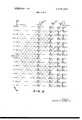
- FIG. 2is a flow graph for naturally ordered time samples
- FIG. 3is a block diagram of the Digital Fourier Analyzer reiterative fast Fourier transform unit
- FIG. 4is a block diagram of the Digital Fourier Analyzer reiterative fast Fourier transform unit utilizing variable delay
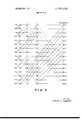
- FIG. 5is a flow graph showing a rearrangement to obtain ordered outputs
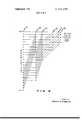
- FIG. 6is a flow graph showing a minimal switching tree for binary to floating point operation.
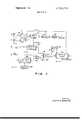
- FIG. 7is a block diagram for the floating point postdetection processing unit.
- FIG. IThe block diagram of the DFA system is shown in FIG. I. This organization can be broken into three basic areas: (a) an input memory for large scale multiplexing of input data channels, (b) a shift register Fast Fourier Transform (FFT) unit, and (c) a postprocessing and display unit.
- FFTFast Fourier Transform
- Incoming raw analog data 1is first applied to an A/D converter 2 whose digital output 3 is applied to a memory input bus 4.
- the output digital data 3is applied to a core memory 6 which is controlled by a control unit 8 and a memory address unit 10.
- the 12, core memoryis utilized at this point in the operation as a large scale multiplexer of the input data.
- the bit core memory 6is also used for postprocessing. Multiplexed digital data output on a conductor 7, emergent from the core memory 6, is fed at input 11 into a complex arithmetic unit 12 of the FFT unit via an output bus 9.
- the complex arithmetic unit 12along with a shift register unit 14 performs a Fourier transform on the incoming data set, requiring multiple passes of the data through the arithmetic unit 22, with data modification on each pass.
- a trigonometric function generator 16as controlled by a FFT control unit 18, provides sine and cosine waveform generation necessary for the algorithm computation.
- One additional pass of the data through the complex arithmetic unit 12is required to obtain power from the Fourier coefficients.
- the post-processingis accomplished by routing output 13 of the complex arithmetic unit 12 to a recursive filter unit via a data path 15. Simultaneously, previously stored filter data is read from core memory via data path 7. After circuit delays, the updated filter data is stored back into the core memory 6 via a path defined by a conductor 5. The operation of the FFT unit and post-processing unit will be explained in greater detail hereinafter.
- the FFT shift register memory 14has storage capabilities for 4,096 complex data points. These can be either a single set of 4,096 points, or a number of sets from M different input channels, provided the number of points per set (N) is reduced so that NM 4,096.
- the input memoryextends the number of data points the system is capable of handling.
- the FFT algorithmessentially utilizes a series of two point transform computations where the foldover ambiguities are reduced at each stage until the full sampling frequency is reached.
- the set of time samplesis transformed into the frequency domain by a series of computations, each requiring only two data points of the original data set of from partially processed data sets.
- a flow graph for naturally ordered time samplesis shown in FIG. 2.
- the flow graphconsists of nodes shown in columns 20, 22 and 24 and directed branches preceding and following each node. Each node represents a variable which is the weighted sum of the variables of all the branch nodes on the left that terminate on that node. The mechanics of its general usage will aid in understanding the FFT as it is implemented.
- the left hand row of small dotscorresponds to the input data points with index numbers 0 through 15 for the N 16 array.
- the index numbersare printed in digital format and shown generally at 28. In a random access system, this would correspond to a memory address.
- the nodes of the remaining columns 20, 22 and 24represent an operation of A B exp(j21rZ/N), where the A inputs can be determined by following the dotted line to the left of the node 20, and the B inputs by following the solid line.
- the Z factoris the rotational value listed in the nodes of the flow graph.
- a passis defined as a completion of all operations in a column, resulting in a set of N intermediate data points.
- the intermediate answers obtainedare indexed 0 through 15 to correspond to the input data set.
- both the input multiplexing memory (a) and the post-processing unit (c)share the single core memory unit 6.
- the core memory 6can store up to 8,192 input samples and 8,192 post-computation processing filter positions. The normal operating procedure is to load raw data into the memory core 6 via conductor 5, process it in the FFT unit (b) via input 11 of the complex arithmetic unit 12 perform the algorithm and power computation in the rotation is supplied by the negative sign.
- the 16-point transformis used to establish flow and control patterns in the DFA reiterative FFT unit (b), as shown in FIG. 3.
- Datais initially stored respectively in shift registers 30 and 31.
- the first passbased on data points separated by 8 (or, for the general case, N/2) is obtained by shifting both shift register 30 and shift register 31.
- the data stream at the register 31 output 37is delayed by 4 (or N/4P for the general case where P is the data pass number) in a delay device 32. This delay makes it possible, by a switch 33,.to switch between the register 30 and the delayed register 31 outputs so that data words leaving the switch 33 are staggered in time but in proper order for the next pass.
- the switch positionis changed every 4 (or N/4P) clock pulses.
- the data entering shift register 30is delayed by 4 (or N/4P) clock pulses by a delay device 34 to eliminate the staggering without stopping the shift register clock.
- Thisallows use of dynamic MOS (metal oxide semiconductor) shift registers, and simplifies system timing.
- Successive passes through the intermediate data pointsfollow the same format until the single delay last pass has been completed. This is shown by pass 4 in FIG. 2 which is labelled P4. If the output data is used at the processing rate, new data may enter the system during the last pass.
- minimum time between data setsbecomes 0.5 Nt log (N+l), where t is the clock period.
- the addressing of a sine-cosine table 35is accomplished by stepping a memory address counter 36 every N/4P during a pass.
- the counter bit weightsare used in reverse order (i.e., the least significant bit (LSB) of the counter is used to address the most significant bit (MSB) of the memory, etc.)
- variable delay unitsFor a small number of points per data set, digitally controlled variable delay units (30, 34 and 31, 32 of FIG. 3) offer the most economical implementations.
- Ni.e., N 64
- the register 31 of FIG. 3can be replaced by a variable delay 40.
- switches 38, 39, 41 and 46Additional switching is required and provided by switches 38, 39, 41 and 46.
- Switch 46operates in conjunction with switches 38, 39 and 41 such that when the first switching occurs the A output is connected through delay unit 45 to the B input of the arithmetic unit 12 by actuating switch 41, and switch 46 actuates to connect the B output with shift register 30 through delay units 42, 43 and 44.
- switch 46moves back to its original position connecting the A output to the shift register 30 and the B output is again connected through delay units 42, 43, 44 and 45 to the B input of the arithmetic unit 12.
- output A'is connected through delay units 44 and 45 to input B and output B is connected through delay units 42 and 43 to shift register 30.
- switchesare next actuated all switches move to their original position (as shown) connecting output A to shift register 30 and output B through delay units 42, 43, 44 and 45 to input B.
- This switching sequencecontinues for the number of passes required to process the number of data samples N. Again, switching occurs every N/4P, and shifting is continuous.
- the processingis performed in partial sequences by shift registers 42, 43, 44 and 45 and the processing time reduces to 0.5 Nt log, N where t is the clock time.
- the shift registerscan be replaced by delay lines in order to lower system cost.
- the above two formatsare combined in the shift register unit 14 of the FFT unit (b) used in the analyzer (FIG. 1).
- the variable shift register implementation of FIG. 3is used to save switching circuitry.
- the switching circuits as shown in FIG. 4are used, which results in a. savings of 448 delay stages when used in the 4,096-point system and an increase in processing rate at the expense of additional data switching.
- the DFA processing time for N 64equals [128 (N/2) log Nlt
- the DFA of the present inventiontakes in data in naturally ordered sequence. Due to the nature of the algorithm, frequency outputs will be disordered.
- the post-processing unitwhich primarily comprises the core memory unit 6 and the recursive filters unit 20, both of FIG. 1, represents a blend of speed, performance and component minimization.
- the circuitcan be used for the power averaging of ensemble sets, or for recursive filtering.
- the basic steps performed in the post-processing unit (c) of FIG. 1are to:
- the input to the post-processing unitis two 24-bit words (the square of the real and imaginary parts of the Fourier coefficients and referred to as the I and Q components) plus 5 bits of block floating point.
- the block floating point numberrepresents an exponent common to the entire array of coefficients. This represents a dynamic range equivalent to 27 bits 81 dB) for a 4,096 point transform with an 8-bit input word.
- An additional 7 bits of rangeis required for implementation of the k 7 mode of the recursive filter for a maximum possible dynamic range of 100 dB.
- the above dynamic rangeshould be preserved.
- accuracy of representationseldom requires magnitudes to be expressed to greater than i 0.15 dB.
- Limiting the accuracyreduces the floating point conversion hardware.
- the raw power spectracan be represented by a 6-bit exponent (characteristic) plus 5 accuracy bits (mantissa).
- the core memory used for the storing of the P(i) valueshas avaiable bits total, and all were used, allowing 6 bits for characteristic and 14 bits for the mantissa.
- FIG. 6The principle of the floating point operation used is illustrated in FIG. 6. After adding the I and Q terms, the most significant l6 bits are examined for zero. The input bits are shown as black circles in column 46. The bits are presented in binary format with the most significant bit (MSB) appearing at. the top of the order. The least significant bit (LSB) is presented at the bottom. If the bits are zero, the lower order bits are logic shifted l6 bits. If not, the bits transfer to the next level of logic shown in column 47 without shifting. This process is repeated for 8, 4, 2 and 1 bits each time making a decision to logic shift or not. The number of shifts determine the characteristic, and the output is a number between (LOD and 1.74),.
- MSBmost significant bit
- LSBleast significant bit
- the block floating point number from the FFT unitis added to the characteristic prior to sending the reformatted number to the filter cards. Since no clocking is used, it requires 0.15 as for ripple delays. Speed is not important, since the core memory read-modify-write cycle time predominates.
- FIG. 7is a block diagram of the apparatus used to add two floating point numbers.
- the numbersare in the form of A A2 where a" indicates point position and A indicates accuracy. Steps for adding two numbers (A and B) are as follows:
- the first restr ictionaffects iiiitial buildup when A is noise-like.
- the average value of Ais approximately 2" times smaller than B.
- the probability of A B for k 2is less than 0.001 percent. (This value decreases rapidly for higher values of k).
- the second restrictionaffects B when it is 36 dB larger than A. By limiting integration gains to 21 dB, the probability of a low input not being counted is less than 0.2 percent for worst case (k 7) with Rayleigh type inputs.
- FIG. 7shows the block diagram for the recursive filter implemented.
- a full adderdetermines the difference of exponents. If a b, then a and A input words shown at 64 and 66 are switched to the outputs via logic shift circuit 62 l fl 3 2 (b a) 2 0, the b input bits shown at 68, are selected for output via a NOR logic circuit 70, a shift by logic circuit 72, and an adder circuit 74. More specifically, the bits are right shifted by shift by logic circuit 72 and applied to summing circuit 74. The output of the summing circuit 74 is applied to the logic shift circuit 62 which shifts by (b a) bits. If (b a) 13, the b bits are selected for output by a select circuit 76 and an adder circuit 78.
- the B inputs 79meanwhile are logic shifted right by k via a decode circuit 80 and logic shift circuit 82, inverted, and added in an adder 84 with the B input to form the multiplication by K.
- the mantissa formedmay be in improper form since the value may fall below 1.0.
- the output of adder 74is examined in logic circuit 84 to ascertain if the sum is between the value of l and 2. If too large, a logic right shift is performed in logic shift circuit 62 on the mantissa and a one is added to the characteristic. Correspondingly, a one is subtracted if the value of the mantissa falls below one.
- a digital spectral analyzercontaining a fast Fourier transfonn unit utilizing the Cooley-Tukey algorithm for computing the Fourier transform coefficients from a number N of digitized samples of an input signal and including an arithmetic unit controlled by a clock actuated trigonometric function generator, said arithmetic unit receiving at first and second input terminals respectively a pair of signals A and B each comprising N/2 digitized values and on reiterative passes P performing rotation Z in rectangular co-ordinates and complex addition on said pair of signals to produce first and second output signals A A B exp J21rZ/N) and B A B exp j21rZ/N) the improvement comprising:
- first and second shift register meanshaving input and output terminals and having lengths which vary according to the relationship N/4P, said first register means input terminal connected to receive the second output signal B of said arithmetric unit, said second register means output terminal connected to the first input of said arithmetic unit,
- third shift register meansof fixed length equal to N/2having an inputand output terminal said output terminal connected to the second input of said arithmetic unit
- switching meansalternately operable between a first and second condition at a rate according to the relationship N/4P, having a first input terminal connected to receive the first output signal A of said arithmetic unit, having a second input terminal connected to said first shift register means output terminal and having a first output terminal connected to said second shift register means input terminal, having a second output terminal connected to said third shift register means input terminal, said switching means being such that in said first condition said first and second input terminals are connected respectively to said first and second output terminals and in said alternate second condition said first input terminal is connected to said second output terminal and said second input terminal is connected to said first output terminal, said shift registers having lengths such that in said first switch condition the length of said second shift register means equals the combined lengths of said first and third shift register means,
- a digital spectral analyzercontaining a fast Fourier transform unit utilizing the Cooley-Tukey algorithm for computing the Fourier transform coefficients from a number N of digitized samples of an input signal and including an arithmetic unit controlled by a clock actuated trigonometric function generator, said arithmetic unit receiving at first and second input terminals respectively a pair of signals A and B each comprising N/2 digitized values and on reiterative passes P performing rotation Z in rectangular coordinates and complex addition on said pair of sigals to produce first and second output signals A A B exp j 21r,Z /Nl and ing:
- first shift register meanshaving input and output tr- B A B exp j 2 'n'Z/N) the improvement comprissecond and third shift register means each having input and output terminals and each having a length equal to one-eighth the length of said first register means, the input terminal of said second register means being connected to receive the second output signal B of said arithmetic unit,
- fourth shift register meanshaving input and output terminals and having a length equal to one-fourth the length of said first register means
- fifth shift register meanshaving input and output terminals and having a length equal to one-half the length of said first register means, the output terminal of said fifth register means being connected to the second input terminal of said arithmetic unit, and
- switching meanshaving first, second, third and fourth input terminals and first, second, third and fourth output terminals and being operable among first, second, third and fourth switch conditions at a rate N/4P and in the condition sequence: first, second, first, third, first, fourth, first,
- the first, second, third and fourth input terminals of said switching meansbeing connected respectively to the first output terminal of said arithmetic unit, the output terminal of said fourth register means, the output terminal of said third register means, and the output terminal of said second register means,
- the first, second, third and fourth output terminals of said switching meansbeing connected respectively to the input terminal of said first register means, the input terminal of said fifth register means, the input terminal of said fourth register means, and the input terminal of said third register means,
- said first and fourth switch input terminalsbeing connected respectively to said fourth and first switch output terminals and said second and third switch input terminals being connected respectively to said second and third switch output terminals.
Landscapes
- Physics & Mathematics (AREA)
- Mathematical Physics (AREA)
- Engineering & Computer Science (AREA)
- General Physics & Mathematics (AREA)
- Computational Mathematics (AREA)
- Mathematical Analysis (AREA)
- Mathematical Optimization (AREA)
- Pure & Applied Mathematics (AREA)
- Data Mining & Analysis (AREA)
- Theoretical Computer Science (AREA)
- Discrete Mathematics (AREA)
- Algebra (AREA)
- Databases & Information Systems (AREA)
- Software Systems (AREA)
- General Engineering & Computer Science (AREA)
- Complex Calculations (AREA)
Abstract
Description
lJited States Patent [191 Chwastyk FF T PROCESSOR UTILIZING VARIABLE LENGTH SHIFT REGISTERS Inventor: Adolph M. Chwastyk, Silver Spring,
The United States of America as represented by the Secretary of the Navy, Washington, DC.
Filed: Nov. 3, 1971 Appl. No.: 195,394
[73] Assignee:
5/1969 Trimble 235/152 11/1971 Gentleman 235/156 OTHER PUBLICATIONS P. D. Welch, The Use of FFT for the Estimation of Power Spectra: A Method Based on Time Averaging Jan. 1, 1974 Primary ExaminerMalcolm A. Morrison Assistant ExaminerDavid H. Malzahn Att0meyR. S. Sciascia et al.
[57] ABSTRACT A processor for radar and multichannel sonar spectral analysis of band-limited input signals, is based on a shift register implementation of a fast Fourier transform algorithm coupled with a single flow-through arithmetic unit. Speed is obtained by using an organi zation that performs the rapid data reordering required for execution of the algorithm. A postprocessing unit is used to increase the quality of estimation of line spectra in statistically short term spectra. The unit can be used either as an integrator or as a first order recursive filter. The post-processing unit is implemented in a floating point format to maintain the dynamic range.
2 Claims, 7 Drawing Figures 3o 34 smr-"r I o REGISTER 2 i 38 A 'ARITHMEITIC 1 l A UNIT D SHIFT I B 1 1 O REGISTER I 32 \3| sm/cos I 35/ TABLE /-LSB LSB 36 COUNTER INPUT CLOCK PULSES.
PATENTEDJAM 1 i914 3783; 258
SHEET 2 [IF 262O 22 24l 2/ 3 4 A INPUT (PASS I) FREQUENCY oooow WWW lOOlw A Z//YY IOO IOlw IIIO... IIIIW INVENTOR. ADOLPH M. CHWASTYK PATENTEDJAH mm 37833258 SHEET 3 U? 63o 34SHIFT l2 9 0 REGIsTER 38 A ARITHMETIC (*1 0 SHIFT B I i o-REGISTER 32 SIN/COS 3| 35 TABLE MSB use /LSB LSB F I 3 36 COUNTERFI INPUT CLOCK PULSES SHIFT REGISTER A A ARITIIMETIG UNIT 5'p 45 SIN/COS L l l I 35 TABLE F'B W g #ro-ula a 4 use MSB D iBHK 39 4| J "L56 L88 SHIFTREGISTER BI 36 couIvTER l INPUT CLOCK PULSES F I G. 4
INVENTOR.
ADOLPH M. CHWASTYK PATENTEB 3,783,258
SHEU '40F 6 FREQUENCY INVENTOR. ADOLPH M. CHWASTYK PATENTEB 3.783.258
//Z //l /////K Pow //////////K ////l IIIIIIIIIIIIIII IIIIIIIIIIIIIII IIIIIIIIIIIIIII BINARY FORMAT INPUTWORD LS8 F I 6 INVENTOR.
' ADOLPH M. CHWAST-YK NOR g s z izcr ADD To 2 L06; MEMORY PATENTEDH974 SHEET 8BF 6 /ENABLE \66 SHIFT BY LOGIC LOGIC 2o SHIFT BY 82 L- 2 1 LOGIC z LOGIC SHIFT I '7 ung To MEMORY RIGHT BYK 84 2 A K DECODE /80 FIG. 7
INVENTOR. ADOLPH M. CHWASTYK FFT PROCESSOR UTILIZING VARIABLE LENGTH SHIFT REGISTERS BACKGROUND OF THE INVENTION The invention relates to a device for performing data processing and reorganization by implementing a fast Fourier transform algorithm. More specifically, this invention relates to a processor that performs the fast Fourier transform by utilizing the Cooley-Tukey algorithm.
The fast Fourier transform is a computational tool which facilitates signal analysis such as power spectrum analysis and filter simulation by means of digital computers. It is a method for efficiently computing the discrete Fourier transform of a series of dats samples referred to as a time series. Spectral analysis using the fast Fourier transform algorithm has proven to be important in both sonar and radar data processing. However, the core memory orientated implementations of the algorithm have provided-an inherent hinderance, i.e., a limitation in their speed of operation. Prior art devices will handle a relatively large number of data points but at a correspondingly long computational time. If less computation time is desired, then a corresponding drop in the number of data points must be accepted. However, the subject invention can handle a large volume of data points in less time than has been possible heretofore. More specifically, the present invention is able to reduce computational time by a factor of 10.
SUMMARY OF THE INVENTION The fast Fourier transform (FFT) is a method for efficiently computing the discrete Fourier transform (DFT) of a time series (discrete data samples). The efficiency of this method is such that solutions to many problems can now be obtained substantially more economically than in the past.
If digital analysis techniques are to be used for analyzing a' continuous waveform, then it is necessary that the data be sampled (usually at equally spaced intervals of time) in order to produce a time series of discrete samples which can be fed into a digital computer. As is well known, such a time series completely represents the continuous waveform, provided this waveform is frequency band-limited and the samples are taken at a rate that is at least twice the highest frequency present in the waveform. When these samples are equally spaced they are known as Nyquist samples. It will be shown that the DFT of such a time series is closely related to the Fourier transform of the continuous waveform from which samples have been taken to form the time series. This makes the DFT particularly useful for power spectrum analysis and filter simulationon digital computers.
Thus, the fast Fourier transform (FFT) is a highly efficient procedure for computing the DFT of a time series. It takes advantage of the fact that the calculation of the coefficients of the DFT can be carried out iteratively, which results in a considerable savings of computation time.
The Digital Fourier Analyzer (DFA) of the present invention was designed for on-line, multi-channel sonar and radar spectral analysis. In its basic-mode, it can digitize band-limited complex analog data, obtain the power spectra from the Fourier coefficients, and display filtered power spectra. Its alternate and more flexible usage is as a computer peripheral. The inputs to the analyzer can be either analog or digital.
The Cooley-Tukey algorithm has been used as a basis for the present invention. Speed is obtained by using shift registers in an organization that allows rapid reordering of the data as required in executing the algorithm, and further by using a single pipeline arithmetic unit capable of obtaining vector products at the shift register clock rate. The Fast Fourier Transform (F FT) unit can transform 4,096 complex points into Fourier coefiicients in 10 ms, which qualifies it as one of the fastest units known.
A post-processing unit is incorporated in the processor to increase quality of estimation of line spectra in statistically random short term spectra. The unit can be used either as an integrator or as a first order digital filter. It is implemented in a floating point word format to maintain dynamic range with a resonable word length. Hardware is kept to a minimum by establishing minimum and maximum ratios of the input and filter loop words.
It is an object of this invention, therefore, to provide a Digital Fourier Analyzer that can be used for radar and multi-channel sonar spectral analysis of bandlimited input signals.
It is another object of this invention to provide a Digital Fourier Analyzer that can transform complex data points into Fourier coefficients with a minimum amount of time.
Another object of this invention is to provide a Digital Fourier Analyzer that can obtain the power spectra from Fourier coefficients.
It is a further object of this invention to provide a Digital Fourier Analyzer that has means to increase the quality of estimation of line spectra in statistically random short term spectra.
It is still another object of this invention to provide a Digital Fourier Analyzer that can utilize the Cooley- Tukey algorithm in the computation of Fourier coefficients.
Another object of the invention is to provide a Digital Fourier Analyzer that efficiently utilizes shift registers in the execution and reordering of data as required in the computation of the algorithm.
A further object of the invention is to provide a Digital Fourier Analyzer that keeps hardware to a minimum by establishing minimum and maximum ratios of the input and recursive filterloop words.
And still another object of the invention is to provide a Digital Fourier Analyzer that can transform a large number of complex points into Fourier coefficients in an extremely short time.
Further objects and many of the attendant advantages of this invention will be readily appreciated as the same becomes better understood by reference to the following detailed description when considered in connection with the accompanying drawings.
BRIEF DESCRIPTION OF THE DRAWINGS FIG. 1 is a general block diagram of the Digital Fourier Analyzer;
FIG. 2 is a flow graph for naturally ordered time samples;
FIG. 3 is a block diagram of the Digital Fourier Analyzer reiterative fast Fourier transform unit;
FIG. 4 is a block diagram of the Digital Fourier Analyzer reiterative fast Fourier transform unit utilizing variable delay;
FIG. 5 is a flow graph showing a rearrangement to obtain ordered outputs;
FIG. 6 is a flow graph showing a minimal switching tree for binary to floating point operation; and
FIG. 7 is a block diagram for the floating point postdetection processing unit.
BRIEF DESCRIPTION OF THE PREFERRED EMBODIMENT The block diagram of the DFA system is shown in FIG. I. This organization can be broken into three basic areas: (a) an input memory for large scale multiplexing of input data channels, (b) a shift register Fast Fourier Transform (FFT) unit, and (c) a postprocessing and display unit.
Incoming raw analog data 1 is first applied to an A/D converter 2 whosedigital output 3 is applied to amemory input bus 4. The outputdigital data 3 is applied to acore memory 6 which is controlled by acontrol unit 8 and amemory address unit 10. The 12, core memory is utilized at this point in the operation as a large scale multiplexer of the input data. As will be explained hereinafter, the bitcore memory 6 is also used for postprocessing. Multiplexed digital data output on aconductor 7, emergent from thecore memory 6, is fed atinput 11 into a complexarithmetic unit 12 of the FFT unit via anoutput bus 9. The complexarithmetic unit 12 along with ashift register unit 14 performs a Fourier transform on the incoming data set, requiring multiple passes of the data through thearithmetic unit 22, with data modification on each pass. Atrigonometric function generator 16, as controlled by aFFT control unit 18, provides sine and cosine waveform generation necessary for the algorithm computation. One additional pass of the data through the complexarithmetic unit 12 is required to obtain power from the Fourier coefficients. The post-processing is accomplished by routingoutput 13 of the complexarithmetic unit 12 to a recursive filter unit via adata path 15. Simultaneously, previously stored filter data is read from core memory viadata path 7. After circuit delays, the updated filter data is stored back into thecore memory 6 via a path defined by aconductor 5. The operation of the FFT unit and post-processing unit will be explained in greater detail hereinafter.
The FFTshift register memory 14 has storage capabilities for 4,096 complex data points. These can be either a single set of 4,096 points, or a number of sets from M different input channels, provided the number of points per set (N) is reduced so that NM 4,096. The input memory extends the number of data points the system is capable of handling. The post-processing FFT unit (b), and update the post-processing recursive filters stored in core memory viarecursive filter electronics 20. Then the processed data is returned to the core memory unit prior to display in adisplay unit 21.
The basic FFT algorithm used for solving discrete Fourier transforms is well covered in the literature, e.g., (1) IEEE Transactions on Audio and Electroacoustics, Special Issue on Fast Fourier Transform, Vol. AU-l7, No. 2, June 1969; (2) IEEE Transactions on Audio and Electroacoustics, Special Issue on Fast Fourier Transform, Vol. AU-l5, No. 2, June 1967; (3) RB. Blackman and J.W. Tukey, The Measurement of Power Spectra, Dover Publication, New York, 1958; (4) F.E. Nathanson, Radar Design Principles, McGraw-I-Iill, New York, 1969; (5) B. Gold and CM. Rader, Digital Processing of Signals, McGraw-Hill, New York, 1969. The FFT algorithm essentially utilizes a series of two point transform computations where the foldover ambiguities are reduced at each stage until the full sampling frequency is reached. In other words, the set of time samples is transformed into the frequency domain by a series of computations, each requiring only two data points of the original data set of from partially processed data sets. A flow graph for naturally ordered time samples is shown in FIG. 2. The flow graph consists of nodes shown incolumns index numbers 0 through 15 for theN 16 array. The index numbers are printed in digital format and shown generally at 28. In a random access system, this would correspond to a memory address. The nodes of the remainingcolumns node 20, and the B inputs by following the solid line. The Z factor is the rotational value listed in the nodes of the flow graph. A pass is defined as a completion of all operations in a column, resulting in a set of N intermediate data points. The intermediate answers obtained are indexed 0 through 15 to correspond to the input data set.
-To minimize computations memory operations in implementing the flow graph, it is desirable to rotate the B inputs only once per two-point transform. This is done by:
where Z is now modulo N/2, and the additional 180 unit also requires memory storage if any kind of long term averaging is required for spectral estimation and data reduction purposes. As stated above, for reasons of economy, both the input multiplexing memory (a) and the post-processing unit (c) share the singlecore memory unit 6. As presently programmed, thecore memory 6 can store up to 8,192 input samples and 8,192 post-computation processing filter positions. The normal operating procedure is to load raw data into thememory core 6 viaconductor 5, process it in the FFT unit (b) viainput 11 of the complexarithmetic unit 12 perform the algorithm and power computation in the rotation is supplied by the negative sign.
The 16-point transform is used to establish flow and control patterns in the DFA reiterative FFT unit (b), as shown in FIG. 3. Data is initially stored respectively inshift registers shift register 30 andshift register 31. As output pairs of words are obtained, the data stream at theregister 31output 37 is delayed by 4 (or N/4P for the general case where P is the data pass number) in adelay device 32. This delay makes it possible, by aswitch 33,.to switch between theregister 30 and the delayedregister 31 outputs so that data words leaving theswitch 33 are staggered in time but in proper order for the next pass. The switch position is changed every 4 (or N/4P) clock pulses. The data enteringshift register 30 is delayed by 4 (or N/4P) clock pulses by adelay device 34 to eliminate the staggering without stopping the shift register clock. This allows use of dynamic MOS (metal oxide semiconductor) shift registers, and simplifies system timing. Successive passes through the intermediate data points follow the same format until the single delay last pass has been completed. This is shown bypass 4 in FIG. 2 which is labelled P4. If the output data is used at the processing rate, new data may enter the system during the last pass. Thus, minimum time between data sets becomes 0.5 Nt log (N+l), where t is the clock period.
The addressing of a sine-cosine table 35 is accomplished by stepping amemory address counter 36 every N/4P during a pass. The counter bit weights are used in reverse order (i.e., the least significant bit (LSB) of the counter is used to address the most significant bit (MSB) of the memory, etc.)
The two above paragraphs establish the control mechanics for any value of N whereN 2 7 and y is an integer. Since all values of one pass are available prior to the start of the following pass, array scaling or normalization of the entire data block is used to reduce the number of bits required in the shift registers and the arithmetic unit.
For a small number of points per data set, digitally controlled variable delay units (30, 34 and 31, 32 of FIG. 3) offer the most economical implementations. Referring now to FIG. 4, for systems requiring large values of N (i.e., N 64), theregister 31 of FIG. 3 can be replaced by avariable delay 40. However, additional switching is required and provided byswitches Switch 46 operates in conjunction withswitches delay unit 45 to the B input of thearithmetic unit 12 by actuatingswitch 41, and switch 46 actuates to connect the B output withshift register 30 throughdelay units switch 46 moves back to its original position connecting the A output to theshift register 30 and the B output is again connected throughdelay units arithmetic unit 12. Upon the next switching occurrence output A' is connected throughdelay units delay units register 30. When a the switches are next actuated all switches move to their original position (as shown) connecting output A toshift register 30 and output B throughdelay units shift registers
The above two formats are combined in theshift register unit 14 of the FFT unit (b) used in the analyzer (FIG. 1). For shifting operations requiring delays of l to 64 bits, the variable shift register implementation of FIG. 3 is used to save switching circuitry. For the larger delays, the switching circuits as shown in FIG. 4 are used, which results in a. savings of 448 delay stages when used in the 4,096-point system and an increase in processing rate at the expense of additional data switching. The DFA processing time for N 64 equals [128 (N/2) log Nlt The DFA of the present invention takes in data in naturally ordered sequence. Due to the nature of the algorithm, frequency outputs will be disordered. As previously discussed, this can be corrected by examining the sine-cosine counter and using bit wieghts reversed end-for-end for the frequency identification. However, for smoothing operations in the frequency domain and to ease oscilloscope display problems, it is desirable to have frequency bin units in order. The flow graph shown in FIG. 5 establishes the pattern implemented in the DFA for meeting this objective. Reordering the input data stream is readily achievable, since a random access memory is used in the system.
The post-processing unit which primarily comprises thecore memory unit 6 and therecursive filters unit 20, both of FIG. 1, represents a blend of speed, performance and component minimization. The circuit can be used for the power averaging of ensemble sets, or for recursive filtering.
The basic steps performed in the post-processing unit (c) of FIG. 1 are to:
1. sum the output products obtained from the FFTarithmetic unit 12 of FIG. 1;
2. convert the sum word into floating point format;
3. interrogate thecore memory unit 6 of FIG. 1 for previous filter value;
4. update previous filter value by multiplying by a K factor and adding the product to the new value obtained instep 2, and to 5. store updated value into thecore memory unit 6.
The above steps are repeated for all frequency bins (8,192 maximum) and are confined to one clock period per frequency bin update, to be compatible with the memory read-modify-write cycle.
When analyzing a signal containing wideband noise, the short term spectra are statistically random and, when detected (as in the FFT output power spectra) exhibit a Rayleigh distribution. These short term statistical fluctuations of the spectra tend to mask the long term, relatively stationary lines desired. Averaging (or summing) of a number of ensembles improves the quality of the estimate in direct proportion to the square root of the number of statistically independent spectra averaged. Since the processor is programmed to take in essentially contiguous time data sets, the noise spectra where T= time between ensemble sets and p (i) represents a point from the frequency ensemble at time i. To
implement this directly would require a storage of the latest M values for each filter bin. To minimize the storage memory to one word per frequency bin, an inverse time exponential weighting is used. This can be expressed in non-recursive form as P(iT) =2 K p(iThT),
Where the filter coefficient (K) is always less than one. Expressed as a first order linear difference equation, the equation as implemented becomes where K is limited to values formed byk
Except for the discrete nature of the above difference equation, it is similar to a resistor-capacitor low-pass filter with a gain of 2". If a single one in a field of zeroes is used as an input, the transfer function is obtained and can be completely described by the filter decay rates. For k values of 3 or more, the effective time constant of the circuit is equal to 2"T. T can be controlled independently of the data gathering time. However, in normal usage, T N/f, compute time.
The input to the post-processing unit is two 24-bit words (the square of the real and imaginary parts of the Fourier coefficients and referred to as the I and Q components) plus 5 bits of block floating point. The block floating point number represents an exponent common to the entire array of coefficients. This represents a dynamic range equivalent to 27 bits 81 dB) for a 4,096 point transform with an 8-bit input word. An additional 7 bits of range is required for implementation of thek 7 mode of the recursive filter for a maximum possible dynamic range of 100 dB.
For useful outputs, the above dynamic range should be preserved. However, from an engineering viewpoint, accuracy of representation seldom requires magnitudes to be expressed to greater than i 0.15 dB. Limiting the accuracy reduces the floating point conversion hardware. Thus, the raw power spectra can be represented by a 6-bit exponent (characteristic) plus 5 accuracy bits (mantissa). However, a minimum of 7 more bits is required in themantissa of the fi ltered o 1tput Q1 since there is an integration gain of 2 for k =7 The core memory used for the storing of the P(i) values has avaiable bits total, and all were used, allowing 6 bits for characteristic and 14 bits for the mantissa.
The principle of the floating point operation used is illustrated in FIG. 6. After adding the I and Q terms, the most significant l6 bits are examined for zero. The input bits are shown as black circles incolumn 46. The bits are presented in binary format with the most significant bit (MSB) appearing at. the top of the order. The least significant bit (LSB) is presented at the bottom. If the bits are zero, the lower order bits are logic shifted l6 bits. If not, the bits transfer to the next level of logic shown incolumn 47 without shifting. This process is repeated for 8, 4, 2 and 1 bits each time making a decision to logic shift or not. The number of shifts determine the characteristic, and the output is a number between (LOD and 1.74),. The block floating point number from the FFT unit is added to the characteristic prior to sending the reformatted number to the filter cards. Since no clocking is used, it requires 0.15 as for ripple delays. Speed is not important, since the core memory read-modify-write cycle time predominates.
FIG. 7 is a block diagram of the apparatus used to add two floating point numbers. The numbers are in the form of A A2 where a" indicates point position and A indicates accuracy. Steps for adding two numbers (A and B) are as follows:
2. Logic shift right the accuracy bits of the smallest of the two numbers by la bl so that the bit weights of the accuracy words match.
3. Add the shifted accuracy bit to the larger number. If the sum is 2 or greater, it is logic shifted right by one bit and one is added to the larger characteristic. If not, the larger of the two characteristics is used directly for the point position indicator of the sum.
Assuming A =p(n) and B K P(n-l the following hardware reducing restrictions are used in implementing the recursive filter:
1. If a 2b,A is used as the output.
2.Ifb 2 13a, B is used as the output.
The first restr iction affects iiiitial buildup when A is noise-like. For steady state conditions, the average value of A is approximately 2" times smaller than B. For Rayleight distribution inputs, the probability of A B fork 2 is less than 0.001 percent. (This value decreases rapidly for higher values of k). The second restriction affects B when it is 36 dB larger than A. By limiting integration gains to 21 dB, the probability of a low input not being counted is less than 0.2 percent for worst case (k 7) with Rayleigh type inputs.
FIG. 7 shows the block diagram for the recursive filter implemented. A full adder determines the difference of exponents. If a b, then a and A input words shown at 64 and 66 are switched to the outputs via logic shift circuit 62l fl 3 2 (b a) 2 0, the b input bits shown at 68, are selected for output via a NORlogic circuit 70, a shift bylogic circuit 72, and anadder circuit 74. More specifically, the bits are right shifted by shift bylogic circuit 72 and applied to summingcircuit 74. The output of the summingcircuit 74 is applied to thelogic shift circuit 62 which shifts by (b a) bits. If (b a) 13, the b bits are selected for output by aselect circuit 76 and anadder circuit 78.
TheB inputs 79 meanwhile are logic shifted right by k via adecode circuit 80 andlogic shift circuit 82, inverted, and added in anadder 84 with the B input to form the multiplication by K. As a result of this action, the mantissa formed may be in improper form since the value may fall below 1.0. However, there is no need to reformat at this point. After adding it to the shifted A bits inadder 74 the output ofadder 74 is examined inlogic circuit 84 to ascertain if the sum is between the value of l and 2. If too large, a logic right shift is performed inlogic shift circuit 62 on the mantissa and a one is added to the characteristic. Correspondingly, a one is subtracted if the value of the mantissa falls below one.
I claim:
1. In a digital spectral analyzer containing a fast Fourier transfonn unit utilizing the Cooley-Tukey algorithm for computing the Fourier transform coefficients from a number N of digitized samples of an input signal and including an arithmetic unit controlled by a clock actuated trigonometric function generator, said arithmetic unit receiving at first and second input terminals respectively a pair of signals A and B each comprising N/2 digitized values and on reiterative passes P performing rotation Z in rectangular co-ordinates and complex addition on said pair of signals to produce first and second output signals A A B exp J21rZ/N) and B A B exp j21rZ/N) the improvement comprising:
first and second shift register means having input and output terminals and having lengths which vary according to the relationship N/4P, said first register means input terminal connected to receive the second output signal B of said arithmetric unit, said second register means output terminal connected to the first input of said arithmetic unit,
third shift register means of fixed length equal to N/2having an inputand output terminal said output terminal connected to the second input of said arithmetic unit, and
switching means alternately operable between a first and second condition at a rate according to the relationship N/4P, having a first input terminal connected to receive the first output signal A of said arithmetic unit, having a second input terminal connected to said first shift register means output terminal and having a first output terminal connected to said second shift register means input terminal, having a second output terminal connected to said third shift register means input terminal, said switching means being such that in said first condition said first and second input terminals are connected respectively to said first and second output terminals and in said alternate second condition said first input terminal is connected to said second output terminal and said second input terminal is connected to said first output terminal, said shift registers having lengths such that in said first switch condition the length of said second shift register means equals the combined lengths of said first and third shift register means,
whereby said digitized values are staggered in time and are placed in order for a next reiterative pass through said arithmetic unit.
2. In a digital spectral analyzer containing a fast Fourier transform unit utilizing the Cooley-Tukey algorithm for computing the Fourier transform coefficients from a number N of digitized samples of an input signal and including an arithmetic unit controlled by a clock actuated trigonometric function generator, said arithmetic unit receiving at first and second input terminals respectively a pair of signals A and B each comprising N/2 digitized values and on reiterative passes P performing rotation Z in rectangular coordinates and complex addition on said pair of sigals to produce first and second output signals A A B exp j 21r,Z /Nl and ing:
first shift register means having input and output tr- B A B exp j 2 'n'Z/N) the improvement comprissecond and third shift register means each having input and output terminals and each having a length equal to one-eighth the length of said first register means, the input terminal of said second register means being connected to receive the second output signal B of said arithmetic unit,
fourth shift register means having input and output terminals and having a length equal to one-fourth the length of said first register means,
fifth shift register means having input and output terminals and having a length equal to one-half the length of said first register means, the output terminal of said fifth register means being connected to the second input terminal of said arithmetic unit, and
switching means having first, second, third and fourth input terminals and first, second, third and fourth output terminals and being operable among first, second, third and fourth switch conditions at a rate N/4P and in the condition sequence: first, second, first, third, first, fourth, first,
the first, second, third and fourth input terminals of said switching means being connected respectively to the first output terminal of said arithmetic unit, the output terminal of said fourth register means, the output terminal of said third register means, and the output terminal of said second register means,
the first, second, third and fourth output terminals of said switching means being connected respectively to the input terminal of said first register means, the input terminal of said fifth register means, the input terminal of said fourth register means, and the input terminal of said third register means,
in said first switch condition said first, second, third and fourth switch input terminals being connected respectively to said first, second, third and fourth switch output terminals,
in said second switch condition said first and second switch input terminals being connected respectively to said second and first switch output terminals and said third and fourth switch input terminals being connected respectively to said third and fourth switch output terminals,
in said third switch condition said first and third switch input terminals being connected respectively to said third and first switch output terminals and said second and fourth switch input terminals being connected respectively to said second and fourth switch output terminals,
in said fourth switch condition said first and fourth switch input terminals being connected respectively to said fourth and first switch output terminals and said second and third switch input terminals being connected respectively to said second and third switch output terminals.
Claims (2)
1. In a digital spectral analyzer containing a fast Fourier transform unit utilizing the Cooley-Tukey algorithm for computing the Fourier transform coefficients from a number N of digitized samples of an input signal and including an arithmetic unit controlled by a clock actuated trigonometric function generator, said arithmetic unit receiving at first and second input terminals respectively a pair of signals A and B each comprising N/2 digitized values and on reiterative passes P performing rotation Z in rectangular co-ordinates and complex addition on said pair of signals to produce first and second output signals A'' A + B exp (- J2 pi Z/N) and B'' A - B exp (- j2 pi Z/N) the improvement comprising: first and second shift register means having input and output terminals and having lengths which vary according to the relationship N/4P, said first register means input terminal connected to receive the second output signal B'' of said arithmetic unit, said second register means output terminal connected to the first input of said arithmetic unit, third shift register means of fixed length equal to N/2having an input and output terminal said output terminal connected to the second input of said arithmetic unit, and switching means alternately operable between a first and second condition at a rate according to the relationship N/4P, having a first input terminal connected to receive the first output signal A'' of said arithmetic unit, having a second input terminal connected to said first shift register means output terminal and having a first output terminal connected to said second shift register means input terminal, having a second output terminal connected to said third shift register means input terminal, said switching means being such that in said first condition said first and second input terminals are connected respectively to said first and second output terminals and in said alternate second condition said first input terminal is connected to said second output terminal and said second input terminal is connected to said first output terminal, said shift registers having lengths such that in said first switch condition the length of said secOnd shift register means equals the combined lengths of said first and third shift register means, whereby said digitized values are staggered in time and are placed in order for a next reiterative pass through said arithmetic unit.
2. In a digital spectral analyzer containing a fast Fourier transform unit utilizing the Cooley-Tukey algorithm for computing the Fourier transform coefficients from a number N of digitized samples of an input signal and including an arithmetic unit controlled by a clock actuated trigonometric function generator, said arithmetic unit receiving at first and second input terminals respectively a pair of signals A and B each comprising N/2 digitized values and on reiterative passes P performing rotation Z in rectangular coordinates and complex addition on said pair of signals to produce first and second output signals A'' A + B exp (- j2 pi Z N) Z/NB'' A - B exp ( -j290 Z/N) the improvement comprising: first shift register means having input and output terminals and having a length given by the relationship N/2, said output terminal being connected to the first input terminal of said arithmetic unit, second and third shift register means each having input and output terminals and each having a length equal to one-eighth the length of said first register means, the input terminal of said second register means being connected to receive the second output signal B'' of said arithmetic unit, fourth shift register means having input and output terminals and having a length equal to one-fourth the length of said first register means, fifth shift register means having input and output terminals and having a length equal to one-half the length of said first register means, the output terminal of said fifth register means being connected to the second input terminal of said arithmetic unit, and switching means having first, second, third and fourth input terminals and first, second, third and fourth output terminals and being operable among first, second, third and fourth switch conditions at a rate N/4P and in the condition sequence: first, second, first, third, first, fourth, first, the first, second, third and fourth input terminals of said switching means being connected respectively to the first output terminal of said arithmetic unit, the output terminal of said fourth register means, the output terminal of said third register means, and the output terminal of said second register means, the first, second, third and fourth output terminals of said switching means being connected respectively to the input terminal of said first register means, the input terminal of said fifth register means, the input terminal of said fourth register means, and the input terminal of said third register means, in said first switch condition said first, second, third and fourth switch input terminals being connected respectively to said first, second, third and fourth switch output terminals, in said second switch condition said first and second switch input terminals being connected respectively to said second and first switch output terminals and said third and fourth switch input terminals being connected respectively to said third and fourth switch output terminals, in said third switch condition said first and third switch input terminals being connected respectively to said third and first switch output terminals and said second and fourth switch input terminals being connected respectively to said second and fourth switch output terminals, in said fourth switch condition said first and fourth switch input terminals being connected respectively to said fourth and first switch output terminals and said second and third switch input terminals being connected respectively to said second and third switch output terminals.
Applications Claiming Priority (1)
| Application Number | Priority Date | Filing Date | Title |
|---|---|---|---|
| US19539471A | 1971-11-03 | 1971-11-03 |
Publications (1)
| Publication Number | Publication Date |
|---|---|
| US3783258Atrue US3783258A (en) | 1974-01-01 |
Family
ID=22721254
Family Applications (1)
| Application Number | Title | Priority Date | Filing Date |
|---|---|---|---|
| US00195394AExpired - LifetimeUS3783258A (en) | 1971-11-03 | 1971-11-03 | Fft processor utilizing variable length shift registers |
Country Status (1)
| Country | Link |
|---|---|
| US (1) | US3783258A (en) |
Cited By (24)
| Publication number | Priority date | Publication date | Assignee | Title |
|---|---|---|---|---|
| US3881097A (en)* | 1973-05-14 | 1975-04-29 | Weston Instruments Inc | Fully digital spectrum analyzer using time compression and discrete fourier transform techniques |
| US3899667A (en)* | 1972-12-26 | 1975-08-12 | Raytheon Co | Serial three point discrete fourier transform apparatus |
| US3920978A (en)* | 1974-02-25 | 1975-11-18 | Sanders Associates Inc | Spectrum analyzer |
| US3965343A (en)* | 1975-03-03 | 1976-06-22 | The United States Of America As Represented By The Secretary Of The Navy | Modular system for performing the discrete fourier transform via the chirp-Z transform |
| US3988601A (en)* | 1974-12-23 | 1976-10-26 | Rca Corporation | Data processor reorder shift register memory |
| FR2363835A1 (en)* | 1976-09-01 | 1978-03-31 | Raytheon Co | SIGNAL PROCESSOR, ESPECIALLY FOR ON-BOARD RADAR |
| US4234880A (en)* | 1977-11-23 | 1980-11-18 | Siemens Aktiengesellschaft | Adaptive method and a radar receiver for suppression of disturbing portions of the Doppler spectrum |
| US4293921A (en)* | 1979-06-15 | 1981-10-06 | Martin Marietta Corporation | Method and signal processor for frequency analysis of time domain signals |
| WO1983001136A1 (en)* | 1981-09-17 | 1983-03-31 | Martin Marietta Corp | Method and signal processor for frequency analysis of time domain signals |
| US4417313A (en)* | 1981-05-18 | 1983-11-22 | Herman Medwin | Method for optimizing the design of a finite noise barrier |
| US4563750A (en)* | 1983-03-04 | 1986-01-07 | Clarke William L | Fast Fourier transform apparatus with data timing schedule decoupling |
| US4612626A (en)* | 1983-12-27 | 1986-09-16 | Motorola Inc. | Method of performing real input fast fourier transforms simultaneously on two data streams |
| US4764974A (en)* | 1986-09-22 | 1988-08-16 | Perceptics Corporation | Apparatus and method for processing an image |
| US4829307A (en)* | 1985-04-25 | 1989-05-09 | Westinghouse Electric Corp. | Recursive radar clutter filter |
| US5343208A (en)* | 1993-08-28 | 1994-08-30 | Martin Marietta Corporation | Radar with individually optimized doppler filters |
| US5563604A (en)* | 1995-02-08 | 1996-10-08 | Alliedsignal Inc. | Weather radar using spectral gaussian envelope discrimination for clutter rejection |
| US5774388A (en)* | 1993-08-11 | 1998-06-30 | France Telecom | Device for electronically calculating a fourier transform and method of minimizing the size of internal data paths within such a device |
| US6313621B1 (en)* | 1997-09-16 | 2001-11-06 | Siemens Aktiengesellschaft | Method and arrangement for determining the phase difference between two timing signals |
| US6490226B2 (en) | 2000-02-04 | 2002-12-03 | Nippon Soken, Inc. | Ultrasonic sonar and method using transmission frequency different from reverberation frequency |
| US20040090955A1 (en)* | 2002-11-13 | 2004-05-13 | International Business Machines Corporation | System and method for routing IP datagrams |
| US6751641B1 (en)* | 1999-08-17 | 2004-06-15 | Eric Swanson | Time domain data converter with output frequency domain conversion |
| US20050010628A1 (en)* | 2000-06-05 | 2005-01-13 | Gil Vinitzky | In-place memory management for FFT |
| US20060010188A1 (en)* | 2004-07-08 | 2006-01-12 | Doron Solomon | Method of and apparatus for implementing fast orthogonal transforms of variable size |
| US20060235918A1 (en)* | 2004-12-29 | 2006-10-19 | Yan Poon Ada S | Apparatus and method to form a transform |
Citations (4)
| Publication number | Priority date | Publication date | Assignee | Title |
|---|---|---|---|---|
| US3446949A (en)* | 1966-10-28 | 1969-05-27 | Hewlett Packard Co | Signal-to-noise ratio enhancement methods and means |
| US3573446A (en)* | 1967-06-06 | 1971-04-06 | Univ Iowa State Res Found Inc | Real-time digital spectrum analyzer utilizing the fast fourier transform |
| US3617720A (en)* | 1967-09-12 | 1971-11-02 | Bell Telephone Labor Inc | Fast fourier transform using hierarchical store |
| US3673399A (en)* | 1970-05-28 | 1972-06-27 | Ibm | Fft processor with unique addressing |
- 1971
- 1971-11-03USUS00195394Apatent/US3783258A/ennot_activeExpired - Lifetime
Patent Citations (4)
| Publication number | Priority date | Publication date | Assignee | Title |
|---|---|---|---|---|
| US3446949A (en)* | 1966-10-28 | 1969-05-27 | Hewlett Packard Co | Signal-to-noise ratio enhancement methods and means |
| US3573446A (en)* | 1967-06-06 | 1971-04-06 | Univ Iowa State Res Found Inc | Real-time digital spectrum analyzer utilizing the fast fourier transform |
| US3617720A (en)* | 1967-09-12 | 1971-11-02 | Bell Telephone Labor Inc | Fast fourier transform using hierarchical store |
| US3673399A (en)* | 1970-05-28 | 1972-06-27 | Ibm | Fft processor with unique addressing |
Non-Patent Citations (2)
| Title |
|---|
| C. Bingham, Modern Techniques of Power Spectrum Estimation, IEEE Trans. on Audio & Electroacoustics June, 1967, pp. 56 66.* |
| P. D. Welch, The Use of FFT for the Estimation of Power Spectra: A Method Based on Time Averaging Over Short, Modified Periodograms , IEEE Trans. on Audio & Electroacoustics, Vol. AU 15 No. 2. June, 1967, pp. 70 73.* |
Cited By (27)
| Publication number | Priority date | Publication date | Assignee | Title |
|---|---|---|---|---|
| US3899667A (en)* | 1972-12-26 | 1975-08-12 | Raytheon Co | Serial three point discrete fourier transform apparatus |
| US3881097A (en)* | 1973-05-14 | 1975-04-29 | Weston Instruments Inc | Fully digital spectrum analyzer using time compression and discrete fourier transform techniques |
| US3920978A (en)* | 1974-02-25 | 1975-11-18 | Sanders Associates Inc | Spectrum analyzer |
| US3988601A (en)* | 1974-12-23 | 1976-10-26 | Rca Corporation | Data processor reorder shift register memory |
| US3965343A (en)* | 1975-03-03 | 1976-06-22 | The United States Of America As Represented By The Secretary Of The Navy | Modular system for performing the discrete fourier transform via the chirp-Z transform |
| FR2363835A1 (en)* | 1976-09-01 | 1978-03-31 | Raytheon Co | SIGNAL PROCESSOR, ESPECIALLY FOR ON-BOARD RADAR |
| US4234880A (en)* | 1977-11-23 | 1980-11-18 | Siemens Aktiengesellschaft | Adaptive method and a radar receiver for suppression of disturbing portions of the Doppler spectrum |
| US4293921A (en)* | 1979-06-15 | 1981-10-06 | Martin Marietta Corporation | Method and signal processor for frequency analysis of time domain signals |
| US4417313A (en)* | 1981-05-18 | 1983-11-22 | Herman Medwin | Method for optimizing the design of a finite noise barrier |
| WO1983001136A1 (en)* | 1981-09-17 | 1983-03-31 | Martin Marietta Corp | Method and signal processor for frequency analysis of time domain signals |
| US4563750A (en)* | 1983-03-04 | 1986-01-07 | Clarke William L | Fast Fourier transform apparatus with data timing schedule decoupling |
| US4612626A (en)* | 1983-12-27 | 1986-09-16 | Motorola Inc. | Method of performing real input fast fourier transforms simultaneously on two data streams |
| US4829307A (en)* | 1985-04-25 | 1989-05-09 | Westinghouse Electric Corp. | Recursive radar clutter filter |
| US4764974A (en)* | 1986-09-22 | 1988-08-16 | Perceptics Corporation | Apparatus and method for processing an image |
| US5774388A (en)* | 1993-08-11 | 1998-06-30 | France Telecom | Device for electronically calculating a fourier transform and method of minimizing the size of internal data paths within such a device |
| US5343208A (en)* | 1993-08-28 | 1994-08-30 | Martin Marietta Corporation | Radar with individually optimized doppler filters |
| US5563604A (en)* | 1995-02-08 | 1996-10-08 | Alliedsignal Inc. | Weather radar using spectral gaussian envelope discrimination for clutter rejection |
| US6313621B1 (en)* | 1997-09-16 | 2001-11-06 | Siemens Aktiengesellschaft | Method and arrangement for determining the phase difference between two timing signals |
| US6751641B1 (en)* | 1999-08-17 | 2004-06-15 | Eric Swanson | Time domain data converter with output frequency domain conversion |
| US6490226B2 (en) | 2000-02-04 | 2002-12-03 | Nippon Soken, Inc. | Ultrasonic sonar and method using transmission frequency different from reverberation frequency |
| DE10103936C2 (en)* | 2000-02-04 | 2003-05-15 | Nippon Soken | Ultrasound sonar system and method using a transmit frequency that is different from a ringing frequency |
| US20050010628A1 (en)* | 2000-06-05 | 2005-01-13 | Gil Vinitzky | In-place memory management for FFT |
| US20040090955A1 (en)* | 2002-11-13 | 2004-05-13 | International Business Machines Corporation | System and method for routing IP datagrams |
| US7660255B2 (en)* | 2002-11-13 | 2010-02-09 | International Business Machines Corporation | System and method for routing IP datagrams |
| US20060010188A1 (en)* | 2004-07-08 | 2006-01-12 | Doron Solomon | Method of and apparatus for implementing fast orthogonal transforms of variable size |
| US7870176B2 (en)* | 2004-07-08 | 2011-01-11 | Asocs Ltd. | Method of and apparatus for implementing fast orthogonal transforms of variable size |
| US20060235918A1 (en)* | 2004-12-29 | 2006-10-19 | Yan Poon Ada S | Apparatus and method to form a transform |
Similar Documents
| Publication | Publication Date | Title |
|---|---|---|
| US3783258A (en) | Fft processor utilizing variable length shift registers | |
| Groginsky et al. | A pipeline fast Fourier transform | |
| US3303335A (en) | Digital correlation system having an adjustable impulse generator | |
| US4054785A (en) | Spectrum analyzer with multiple operational modes | |
| US4041284A (en) | Signal processing devices using residue class arithmetic | |
| US4231102A (en) | Cordic FFT processor | |
| US5941939A (en) | Logarithm/inverse-logarithm converter and method of using same | |
| US4468794A (en) | Digital coherent detector | |
| US4899301A (en) | Signal processor for rapidly calculating a predetermined calculation a plurality of times to typically carrying out FFT or inverse FFT | |
| US5694347A (en) | Digital signal processing system | |
| US4486850A (en) | Incremental digital filter | |
| US3988606A (en) | Digital filter device for processing binary-coded signal samples | |
| US3932737A (en) | Spectrum analyzer establishing a nonlinear frequency distribution of power-density spectra | |
| US4115867A (en) | Special-purpose digital computer for computing statistical characteristics of random processes | |
| US3721812A (en) | Fast fourier transform computer and method for simultaneously processing two independent sets of data | |
| US6065031A (en) | Log converter utilizing offset and method of use thereof | |
| JP2004528742A (en) | High-speed filter | |
| US3544894A (en) | Apparatus for performing complex wave analysis | |
| US4680727A (en) | Complex multiplier for binary two's complement numbers | |
| Martinson et al. | Digital matched filtering with pipelined floating point fast Fourier transforms (FFT's) | |
| US3984669A (en) | Fully digital spectrum analyzer using time compression and Discrete Fourier Transform techniques | |
| US3689750A (en) | Phase-independent digital correlator for use in radar systems | |
| US3899667A (en) | Serial three point discrete fourier transform apparatus | |
| US4020334A (en) | Integrated arithmetic unit for computing summed indexed products | |
| Blankenship et al. | Digital pulse compression via fast convolution |