US3737056A - Plural number control system for an automatic warehouse - Google Patents
Plural number control system for an automatic warehouseDownload PDFInfo
- Publication number
- US3737056A US3737056AUS00135397AUS3737056DAUS3737056AUS 3737056 AUS3737056 AUS 3737056AUS 00135397 AUS00135397 AUS 00135397AUS 3737056D AUS3737056D AUS 3737056DAUS 3737056 AUS3737056 AUS 3737056A
- Authority
- US
- United States
- Prior art keywords
- binary
- bcd
- bin
- article conveyor
- binary digits
- Prior art date
- Legal status (The legal status is an assumption and is not a legal conclusion. Google has not performed a legal analysis and makes no representation as to the accuracy of the status listed.)
- Expired - Lifetime
Links
- 229910002056binary alloyInorganic materials0.000claimsdescription2
- 238000009877renderingMethods0.000claimsdescription2
- 238000013459approachMethods0.000abstractdescription3
- 238000010586diagramMethods0.000description6
- 238000000034methodMethods0.000description3
- 102100038509E3 ubiquitin-protein ligase ARIH1Human genes0.000description2
- 230000008859changeEffects0.000description2
- 238000010276constructionMethods0.000description2
- 238000000151depositionMethods0.000description2
- 230000008569processEffects0.000description2
- 230000004044responseEffects0.000description2
- 229920000742CottonPolymers0.000description1
- 101710165507E3 ubiquitin-protein ligase ARIH1Proteins0.000description1
- VYPSYNLAJGMNEJ-UHFFFAOYSA-NSilicium dioxideChemical compoundO=[Si]=OVYPSYNLAJGMNEJ-UHFFFAOYSA-N0.000description1
- 230000001133accelerationEffects0.000description1
- 230000002457bidirectional effectEffects0.000description1
- 150000001768cationsChemical class0.000description1
- 238000006243chemical reactionMethods0.000description1
- 230000000295complement effectEffects0.000description1
- 239000013256coordination polymerSubstances0.000description1
- 230000008878couplingEffects0.000description1
- 238000010168coupling processMethods0.000description1
- 238000005859coupling reactionMethods0.000description1
- 238000001514detection methodMethods0.000description1
- 230000006872improvementEffects0.000description1
- 230000007246mechanismEffects0.000description1
- 230000004048modificationEffects0.000description1
- 238000012986modificationMethods0.000description1
- 229920000136polysorbatePolymers0.000description1
- 239000007787solidSubstances0.000description1
Images

Classifications
- G—PHYSICS
- G05—CONTROLLING; REGULATING
- G05B—CONTROL OR REGULATING SYSTEMS IN GENERAL; FUNCTIONAL ELEMENTS OF SUCH SYSTEMS; MONITORING OR TESTING ARRANGEMENTS FOR SUCH SYSTEMS OR ELEMENTS
- G05B19/00—Programme-control systems
- G05B19/02—Programme-control systems electric
- G05B19/18—Numerical control [NC], i.e. automatically operating machines, in particular machine tools, e.g. in a manufacturing environment, so as to execute positioning, movement or co-ordinated operations by means of programme data in numerical form
- G05B19/19—Numerical control [NC], i.e. automatically operating machines, in particular machine tools, e.g. in a manufacturing environment, so as to execute positioning, movement or co-ordinated operations by means of programme data in numerical form characterised by positioning or contouring control systems, e.g. to control position from one programmed point to another or to control movement along a programmed continuous path
- G05B19/27—Numerical control [NC], i.e. automatically operating machines, in particular machine tools, e.g. in a manufacturing environment, so as to execute positioning, movement or co-ordinated operations by means of programme data in numerical form characterised by positioning or contouring control systems, e.g. to control position from one programmed point to another or to control movement along a programmed continuous path using an absolute digital measuring device
- G05B19/29—Numerical control [NC], i.e. automatically operating machines, in particular machine tools, e.g. in a manufacturing environment, so as to execute positioning, movement or co-ordinated operations by means of programme data in numerical form characterised by positioning or contouring control systems, e.g. to control position from one programmed point to another or to control movement along a programmed continuous path using an absolute digital measuring device for point-to-point control
- G05B19/291—Numerical control [NC], i.e. automatically operating machines, in particular machine tools, e.g. in a manufacturing environment, so as to execute positioning, movement or co-ordinated operations by means of programme data in numerical form characterised by positioning or contouring control systems, e.g. to control position from one programmed point to another or to control movement along a programmed continuous path using an absolute digital measuring device for point-to-point control the positional error is used to control continuously the servomotor according to its magnitude
- B—PERFORMING OPERATIONS; TRANSPORTING
- B65—CONVEYING; PACKING; STORING; HANDLING THIN OR FILAMENTARY MATERIAL
- B65G—TRANSPORT OR STORAGE DEVICES, e.g. CONVEYORS FOR LOADING OR TIPPING, SHOP CONVEYOR SYSTEMS OR PNEUMATIC TUBE CONVEYORS
- B65G1/00—Storing articles, individually or in orderly arrangement, in warehouses or magazines
- B65G1/02—Storage devices
- B65G1/04—Storage devices mechanical
- B65G1/0407—Storage devices mechanical using stacker cranes
- B65G1/0421—Storage devices mechanical using stacker cranes with control for stacker crane operations
Definitions
- This inventionrelates to an automatic warehousing system, and more particularly to a control for a warehousing system utilizable with a storage rack having a plurality of storage bins, the location of each bin being identified and detected by means of unique indicia individually related to each bin.
- the present control systemis of the type in which each individual bin in a warehouse is uniquely identified, and more particularly is an improvement on the control system shown in U.S. Pat. No. 3,402,836, issued Sept. 24, 1968 to R].
- Debrey, et al.and assigned to the assignee of the present application.
- a comparisonis made between a sensed binary address at which a stacker crane is located and a binary address identifying a selected bin.
- the Debrey bin identifying addressesare located at the beginning of each-bin, and thereby indicate that the stacker crane must be slowed and stopped somewhere after a desired address is sensed and before the occurrence of the next address. To accomplish this, the speed of the stacker crane is reduced from fast to slow when a match is found by a comparator. Fine positioning within the zone of a bin iseffected by means of a protruding abutment which is mechanically sensed to brake the stacker crane and thereby fine position the crane directly in position for depositing or retrieving a load.
- the applicants control system disclosed hereinprovides a simplification. of the control circuit, such as used in Debrey, which are necessary for operating an automatic warehousing system using uniquely identified bins, and provides improved operation, while retaining all of the advantages of this type of automatic warehousing apparatus as compared with prior counting and other types of automatic warehousing apparatus.
- the uniquely identified binsare identified by unique sets of coded indicia representative of the middle position of the bin, and more particularly the position at which the stacker crane should stop for load deposit or retrieval.
- the control systemincludes means for subtracting the unique sets of indicia which are read by a sensor from a stored unique set of indicia, to control direction of travel and the speed and stopping operations of a stacker crane or other article conveyor. When a subtracted difference of zero is found, the article conveyor is abruptly stopped at its'instant lccation, which corresponds to the middle position of the selected bin.
- the present control systemeliminates the need for a fine positioning sensor which is independent of the indicia being sensed, and allows the fine position and bin indicating indicia'to be combined.
- the necessity for a translator operative in only one direction of travelis also eliminated by using subtractor and detector units which are effective in both directions of travel.
- the subtractor and detector unitsalso are more adaptable for providing a plurality of output signals which can control one or more stages of speed slowdown prior to reaching a desired bin position.
- One object of this inventionis to provide an automatic warehousing system using a subtractor for controlling the operation of an article conveyor in response to a subtracted difference between coded indicia representing a desired bin location and a present bin loca- 7 tion.
- Another object of this inventionis to provide an automatic warehousing system wherein coded indicia used to identify bin locations are read bysensing means located on an article conveyor and are used to both control the speed of operation and stopping of the article conveyor and to control the fine positioning of the article conveyor for load deposit and retrieval.
- One feature of the present inventionis an automatic warehousing apparatus with uniquely identified bins and a subtractor unit for providing a plurality of absolute value signals which indicate the distance the article conveyor is located in either direction from a desired bin.
- Another feature of the inventionis the provision of an automatic warehousing system using a control unit which subtracts desired and present bin positionsas identified by binary numbers.
- Theunitincludes difference and borrow elements for each subtracted bit position forming the binary numbers.
- the borrow elementscontrol the direction of travel of the article conveyor.
- a difference detectoris responsive to both the true and complemented value of the difference and borrow elements to provide absolute value indications of relative position.
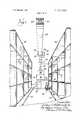
- FIG. 1is a perspective view of a warehouse including an aisle with spaced apart storage racks and incorporat-- of storage bins whose locations are identified by means of unique indicia in the form of binary coded decimal numbers;
- FIG. 3is a perspective view of a horizontal guide beam with structure attached thereto defining indicia sensed by a photoelectric sensing unit carried by the stacker crane;
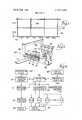
- FIG. 4is a block diagram of the command apparatus for controlling the operation of the stacker crane shown in FIG. 1; a
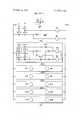
- FIG. 5is a partly schematic and partly block diagram illustrating the subtractor unit shown in FIG. 4;
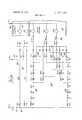
- FIG. 6is an across-the-line diagram illustrating'the units connected to the subtractor unit shown in FIG. 4;
- FIG. 7is a key diagram for the relay coils and contacts shown in the across-the-line diagram of FIG. 6.
- FIG. 1illustrates an automatic warehousing system embodying the invention.
- a number of storage racks 20, each having a plurality of bins 21 or other loadsupporting means for holding articles therein,are arranged in parallel rows in a warehouse.
- a basic form of article conveyor or article handling device as a stacker crane 23,travels in an aisle or other travel zone between two parallel rows of storage racks 20.
- the stacker crane 23is guided in a horizontal direction between the rows by means of an overhead horizontal guide and support rail 25, here a I-beam.
- the stacker crane 23is propelled along the overhead support rail 25 by a motor 26 contained in a conveyor housing 27 attached to a Y-shaped carriage 28 which is suspended from the rail 25.
- the motor 26is bidirectional and has both fast and slow operation in either a forward or reverse direction.
- the motor 26can be abruptly stopped by conventional electric braking, which may be supplemented by a mechanical disc brake housed in the unit 27.
- a vertical guide means in the form of a column 30extends from the carriage 28 to a transverse leg member 31 located adjacent the floor of the warehouse.
- the ends of the leg 31have rollers 32 which abut rails 33 attached to the floor of the warehouse.
- the rollers 32help to guide the stacker crane 23 as it moves horizontally along the rows of storage racks 20.
- a vertical carriage 34 containing a drive motor 35is movably attached to the vertical column 30.
- the motor 35drives pinions engaging racks on the column for moving the carriage along the column.
- Motor 35is similar to motor 26, having fast and slow speed operation in either a forward or reverse direction.
- the motor 35is abruptly stopped by electric braking supplemented with a disc brake housed in carriage 34.
- An article holding orload handling means in the form of a conventional fork lift 36is mounted on the carriage 34 and can be propelled into and out of the individual bins 21 located on either side of the aisle by an electric motor 37.
- the various loads or articles 38 to be stored in the bins 21are placed on conventional skids 39.
- the fork 36When removing an article 38 from its bin, the fork 36 is inserted under the skid 39 by the motor 37. The fork 36 is then raised a slight amount by an upward motion of the carriage 34, and the article 38 is withdrawn from the bin 21 by the retraction of fork 36, as is well known in the art.
- the fork 36When depositing an article 38 in a bin,
- the fork 36is inserted into'the bin in a high position.
- the stacker crane 23is suspended from the horizontal guide rail 25 by means of rollers 41 and 42 that are rotatably mounted on the carriage 28.
- the rollers 41 and 42roll over the inner surface 43 of the bottommost flange of the I-beam rail 25.
- Roller 42isdriven by the motor 26 contained in the conveyor unit 27, and
- Power for the motors 26, 35 and 37can be supplied through conventional parallel bus bars or other techniques (not illustrated). These bus bars can, for example, belocated above or attached to the horizontal rail 25, with the unit 27 having a pair of wiper contacts which press against the bus bars to obtain thepower for the stacker crane 23.
- the stacker crane describedis conventional and the detailed construction thereof forms no part of the applicants invention.
- Any article conveyor having article holding means that can be positioned to a horizontal and vertical location in spacecan be used with the applicants novel matching identification system and control apparatus.
- the'cranemay be guided by a pair of rails attached to the top of the storage racks.
- the cranewould have a T-shape, the topmost ends of the T-resting on the pair of rails.
- only a floor mounted rail or trackcould be used to guide the stacker crane.
- the stacker crane 23iscontrolled by means of novel and improved control apparatus used jointly with a bin identification system which uniquely identifies the location of individual bins 21. External control information is fed into an information input unit 45 attached to the vertical column 30.
- the logic control unit 46 for positioning the article holding fork 36 at a predetermined binis housed on the vertical carriage 34.
- Each bin 21is provided with a unique addressfor locating only that particular bin in the rack 20.
- Each addressis formed from a combination of indicia, which in the preferred form of the invention form a binary code. While a pure binary code is perhaps the simplest, many input devices use a binary coded decimal (BCD) code,
- the fork 36 of the stacker crane 23it is desirable for the fork 36 of the stacker crane 23 to be able to move simultaneously in both a vertical and a horizontal direction while travelling to a preselected bin. Therefore, in the preferred embodiment of Each bin could have attached theretoindicia or The location of the fork 36 is determined by means of a horizontal sensing unit 48 and a vertical sensing unit 49 which read the binary codes for identifying the bins 21.
- the address systemis essentially independent of the bins 21, and consequently it is possible to have simultaneous horizontal and vertical coordinate positioning of the fork 36 to a location in space that corresponds to the location of the predetermined bin.
- FIG. 2a plurality of storage bins 21 in storage rack are diagrammatically illustrated.
- Each binis located in a two-dimensional coordinate system by means of a pairof binary numbers which uniquely identify its vertical and horizontal position in space.
- the binary numbers located along a path 51.indicate the vertically disposed row at which the bin is located. Since the number of of vertical rows is often substantially less than the number of bins spaced along thehorizontal direction, and therefore vertical control is less critical, the binary numbers along path 51 may be either pure binary or BCD, or may be single abutments for use in a control system similar to conventional counting type control systems.
- the binary numbers located along a path 52indicate the column of the storage bin.
- the numbers along path 52are in BCD form.
- a specific storage bin 54for example, is identified in the storage rack 20 of FIG. 2 by means of the horizontal BCD number 010 0000, representingcolumn 20'(and by the vertical,
- binary numbers for the horizontal positionsare thus composed of a set of three bits representing the tens decimal position, and a set of four bits representing the units decimal position.
- This BCD codeallows up to 79 bins to be identified. Of course, if more bins are provided in the warehouse, the number of bits may be correspondingly increased, in accordance with the known BCD code.
- each bit of a binary numberis composed of only two basic digits, namely zero or one, such basic digits can be represented by means of any type of device having an on or of characteristic that can be detected.
- the presence or absence of a digitcould be indicated by projecting pins, ormagnetic fields.
- each horizontal digitis indicated by the presence or absence of an opaque plate 55 which blocks or passes, respectively, a photoelectric light beam, see FIG. 3.
- the presence of a plate 55may be chosen to represent a binary l digit and the absence of the plate will thus represent a binary 0 digit.
- the groups or sets of plates 55are attached to rail 33 to identify the horizontal position of the bin.
- the present disclosurewill explain the horizontal positioning system in detail, it being understood that the same system may be used for vertical positioning. While the horizontal plates 55 are illustrated as attached to the rail 33 mounted to the floor of the warehouse, it will be understood that the rail may be located at any position. For example, when using the article conveyor disclosed in the before identified patent, the plates 55 may be located on rails attached to the top of the storage racks, which guide the topmost ends of a T-shaped crane.
- Horizontal sensing unit 48is illustrated in detail in FIG, 3.
- a light source 60For each bit of the BCD code, a light source 60 generates a photoelectric beam which passes through space and impinges a corresponding photoelectric cell 61.
- the photoelectric sensors for only three bitsare illustrated in FIG. 3.
- All of the light sources 60are mounted on an L-beam 63 which is rigidly attached to an upstanding L-beam 64 connected toleg 31 of the stacker crane.
- all of the photoelectric cells 61are mounted to an L-beam 66 which is connected by means of an elbow rail68 to L-beam 64..
- th plates 55 mounted to rail 33block the photoelectric beams for each bit having a 1 digit, thereby terminating the output signals normally generated by photoelectric cells 61.
- plates 55block the left-hand and centermost photobeams, but allow the right-hand photobeam to pass to its photoelectric cell 61 and produce an output.
- plate 70is riveted to rail 33.
- rail 63carries a fine position sensor 72.
- the plate 70includes a reflector strip 74 which reflects the photobeam from the light source in sensor 72 back to the photoelectric cell therein, when sensing unit 48 is properly'horizontally aligned to read the BCD address represented by plates 55 and associated spaces.
- Strip 74may be formed by covering a reflector with an opaque mask having a narrow aperture slit corresponding to strip 74. While the photoelectric cells 61 have been illustrated as mounted on beam 66,.
- the cells 61could be mounted adjacent their light source 60, similar to sensor 72, and positioned to respond to a photobeam reflected off reflectors located on beam 66. r 1
- the location of the BCD address plates along the rail 33is not critical as long as their position can be related to the corresponding horizontal position of the bin they represent.
- the BCD numbersare positioned so that the stacker crane, when reading a BCD address, has its fork 36 located at the middle or column center (CC) position of each bin.
- the output signal from sensor 72, indicating sensing of the plate 70is used to both effectively gate information from all the photoelectric cells 61 to the control circuit, and to provide a fine positioning indication, eliminating the necessity for separate abutments or the like in order to provide fine posi tioning information.
- CONTROL APPARATUSblock diagram form in FIG. 4. Only the control apparatus for horizontal movement is illustrated in detail. As previously described, vertical control apparatus may, if desired, be similar to the horizontal control apparatus, or could be patterned after known prior control apparatus.
- External control or command informationmay originate from any desired source, as a computer or a manual .input, which provides or is modified to provide BCD coded information. By any suitable means, this information is transmitted to information input unit 45,
- the memorymay include storage for other command information which is to control the stacker crane.
- the stored address or command Cwhich identifies a preselected bin, is coupled to one of a pair of inputs of a subtractor unit 83.
- the other input to the subtractor unit 83is a horizontal position address P, from a horizontal position unit 85 coupled to the indicia sensor 48.
- Unit 85includes circuitry which energizes bit position representing relays in response to the signals from sensor 48.
- Subtractor unit 83which always subtracts the command address C from the actual position address P, may take any of several forms. It may be analog or digital, decimal or binary, or serial or parallel. The C and P inputs may be coded in many different ways, although preferably they use the same coding scheme to avoid the necessity of making a code conversion.
- subtractor unit 83For purposes of comparing the actual position with the desired or commanded address, subtractor unit 83 has outputs which are coupled to a difference detector 85 and an overflow detector 87.
- Direction of travel informationis determined by overflow detector 87 which senses whether subtractor unit 83 has an overflow borrow condition. That is, if the subtracted difference (C-P) is positive, the borrow computations do not overflow, as will appear. This indicates that the selected address is in advance of the present position, and therefore the stacker crane should move in a direction to decrease the difference, which may be arbitrarily designated forward.
- the stacker craneshould All of the outputs 95 are coupled to a conventional drive control unit 97, which controls the motors and brakes within crane drive 93, to thereby control speed and stopping of the stacker crane.
- a conventional drive control unit 97which controls the motors and brakes within crane drive 93, to thereby control speed and stopping of the stacker crane.
- the other blocks95are used to slow the stacker crane as it approaches its preselected bin.
- the eddy current brakeis actuated in order to decelerate the crane from its fast to its slow speed of traverse.
- the overflow detector unit 87is gated or rendered effective each time the fine position sensor 72 detects the column center plate 70, FIG. 3.
- the detection of plate 70gates the signal from overflow detector 87 to a direction control 92.
- the direction controlwhich itself may be of known construction, controls a conventional crane drive 93 which includes motor 26, FIG. 1.
- the difference detector 85determines the absolute value of the difference number (C-P) from subtractor unit 83.
- C-Pdifference number
- Fine position sensor 72serves as a gate for the difference detector 85, in order to indicate when the outputs from subtractor unit 83 represent a valid different signal, namely, when the input P to subtractor unit 83 represents a complete address.
- the gating controlled by sensor 72could occur elsewhere than illustrated.
- DETAILED CONTROL CIRCUIT parallel binary subtractordesignis utilized, in which 55 the BCD position P is subtracted from the BCD command C. Since the circuit is shown for only horizontal positioning, all inputs are represented either by the symbol I-IP for horizontal position, or the symbol I-IC for horizontal command.
- a corresponding stageFor each bit in the BCD address code, a corresponding stage is'provided. Thus, four separate stages 100 are provided for the set of four bits representing the units decimal position, i.e., bits I, 2, 4, and 8, and
- Each stage 100includes relay coils, indicated by circles, which are energized when certain conditions are satisfied.
- a difference relay D in each stage 100indicates whether the subtraction of the HP bit from the corresponding HC bit is one. When the subtraction yields one, the relay coil D is energized. If the subtraction process within any stage 100 requires that a bit be borrowed, a borrow relay B will be energized in that stage 100.
- the subtractor 83may be any unit which solves the known Boolean equation for subtraction, namely: u n' 1+ n u) il 1 n n n n) (I) It will be seen that relay D1 in the upper stage 100 is energized in accordance with equation (3) above, and that the borrow relay B1 in the same stage is energized in accordance with the equation (4) above. Because FIG. 5 implements only horizontal positioning, the designations C,, and P, in the equations are represented in FIG. 5 by the relay contacts HCn and HPn, respectively. Relay coils HC are located in the command address memory 80 of FIG. 4, and the relay coils HP are located in the horizontal position unit 85 of FIG. 4.
- the corresponding relay coils HC and H?are energized to cause the corresponding relay contacts in FIG. 5 to change states.
- the least significant bit of Pis a l
- relay coil HPlis energized, changing the state of all relay contacts of I-IPl.
- the above equations (1) and (2)may be calculated as above described for the first bit position.
- the implementation of such calculationis shown in stage 100 for relays D2 and B2.
- any relay D or relay Bcauses the corresponding contacts thereof to change state. As can be seen from the drawings, these contacts are both used in succeeding stages 100,
- FIG. 6which shows the units connected to the subtractor unit 83.
- FIG. 6the circuits for overflow detector 87, and difference detector 85 and its outputs 95 are illustrated in detail. These circuits control the direction control unit 92 and the drive control unit 97-, which may be conventional in nature, and only a portion of which are illustrated in FIG. 6.
- the circuit of FIG. 6is operative only when the fine position sensor 72 of FIG. 4 indicates that indicia sensor 48 is in an aligned reading position, and when other controls forthe automatic warehousing apparatus indicates that the system should be operative. These conditions are represented by a relay contact S from a conventional sequence control (not illustrated) for the system. If all conditions are proper and the system is in cycle,, a conventional relay coil in the sequence control will be energized, to close contact S and connect positive DC voltage to a relay contact CC.
- the normally open relay contact CCis a contact controlled by fine position sensor 72.
- a signalis provided which energizes a relay (not illustrated) to close contact CC, which serves as agate for both the difference detector 85 and the overflow detector 87.
- a relaynot illustrated
- close contact CCwhich serves as agate for both the difference detector 85 and the overflow detector 87.
- Difference detector 85consists of a branch 1 l0 operative when C is equal to or greater than P (C 2 P), and
- the difference detectoroperates essentially on straight binary, but includes interconnections between branches 110 and 112 to compensate for the fact that the actual output from the subtractor represents a BCD subtraction process.
- difference detector 85By use of difference detector 85, the BCD subtraction is directly converted into absolute difference values D at output lines 95.
- Relay I-IShas contacts shown in FIG. 6, and in addition has conventional contacts (not illustrated) which are used in the drive control unit 97 forconventional stopping purposes.
- relayHSWhen relayHS is energized, a mechanical disk brake housed in unit 27 of FIG. 1 is activated, thereby abruptly stopping horizontal movement of the stacker crane.
- Relay AR-2 in drive control 97is connected to control operations which must occur before a slowdown initiated by relay AR-l will occur.
- Relay AR-2is connected to supply bias to the eddy current brake, so that upon energization of relay AR-l, the stacker crane will be slowed from its fast to its slow speed of traverse.
- relay AR-2may be used to initiate a slowdown prior to the final slowdown initiated by relay AR-l.
- Relays AR-l and AR-2desirably remain energized as long as the absolute difference is equal to or less than the value that initially energized the relay. While the circuit has been illustrated for such a circumstance, it will be understood that the circuit could be designed to energize the relays only when the absolute difference is equal to the value which initially energizes the relay, and to deenergize the relay for all other absolute difference values.
- a forward relay FR in direction control 92is ate relay contact of relay D40 in the path for energizing the output line 95 corresponding to the equation being solved For the illustrated circuit, as previously described, l
- relay AR-2is to be energized not only when the absolute valve of D is two, but also when the absolute value is one and zero.
- the detector 85 of FIG. 6implements the above equations (5), (6) and (7) and the special conditions above by eliminating contacts 112 illustrated by the dashed lines in FIG. 6, and by adding the contacts ARI-1 and AR2-2 which form holding contacts for relays ARI and ARZ, respectively.
- the overflow detector 87is used to determine whether the stacker crane should move in a forward or a reverse'direction. If movement is to be in the forward energized. Conversely, if the stacker crane is to move in the reverse direction, a reverse relay RR is energized.
- the contacts FR and RR used in direction control 92are connected in a conventional manner, in order to control the direction of movement of the stacker crane.
- the stacker craneis to stop, as represented by the energization of relay HS, contacts HS-l and I-IS-2 in detector 87 open, thereby deenergizing relays FR and RR. Thus, neither direction control relay is energized when the crane is at a desired bin position.
- Detector 87includes a branch 1 15 which is energized when C is greater than or equal to P (C B P), and a branch 117 which is energized when C is less than P (C P).
- Branchindicates that C B P when borrow relay 8-40 is not energized, thus allowing contact 840-1 to remain closed. This indicates that the subtractor was able to subtract P from C, without borrowing from the last most significant bit.
- relay 8-40is energized, opening contact 1340-1 and closing contact B40-2, thereby completing branch 117 and energizing relay RR.
- the overflow of a borrowindicates that reverse direction of travel is necessary.
- relay FR or RRWhen either relay FR or RR is energized, it completes its own holding path, in order to remain energized until a stop condition occurs. Namely, contact FR-l closes to maintain relay FR energized, or contact RRJ closes to maintain energized relay RR.
- D and relay HSWhen the stacker crane is positioned at the column center position of the desired bin, D and relay HS is energized, as previously described, thereby opening contacts HS-l and HS-Z in order to deenergize the direction control relay FR or RR which had previously been energized.
- a warehousing systemcomprising:
- detector meansresponsive to the pure binary subtraction of said subtractor means for modifying the speed of said article conveyor whenever said article conveyor is a preselected numberaway from said selected load storing means
- said drive meansmoves said article conveyor in forward or reverse directions in said travel zone
- said detector meansincludes first branch means energized when the number at said first input is greater than the number at said second input and second branch means energized when the number at said first input is less than the number at said second input,and direction of travel means responsive to energization of one of said branch means for controlling said drive means to move said article conveyor in only one direction in said travel zon'e.
- said detector meansincludes third branch'mea'ns responsive when all of the difference means in said subtractor means register zero numerical difference therein for resetting said direction of travel means.
- unique group of binary digits for each of said location meansincludes a trigger indicia for indicating when the sensing means is disposed for correctly reading the unique group of binary digits adjacent thereto,
- sensing meansincludes means for reading said unique group of binary digits and means for reading said trigger indicia
- control meansfurther includes means responsive to said trigger indicia readingmeans for rendering effective a stopping means, whereby said location means serves as a fine positioning element
- sensing meanscomprise sensors for detecting an energy wave field
- binary digitscomprise the presence or absence of binary representing elementsin said energy wave field
- trigger indiciacomprises an element in said'energy wave-field having a narrow width substantially less than the width of each binaryjrepresenting element.
Landscapes
- Engineering & Computer Science (AREA)
- Mechanical Engineering (AREA)
- Human Computer Interaction (AREA)
- Manufacturing & Machinery (AREA)
- Physics & Mathematics (AREA)
- General Physics & Mathematics (AREA)
- Automation & Control Theory (AREA)
- Warehouses Or Storage Devices (AREA)
Abstract
Description
United StatesPatent 1 1 3,737,056 Hathcock, Jr. [451 June 5, 1973 s41 PLURAL NUMBER CONTROL SYSTEM 3,490,616 1/1970 Castaldi. ..'..1 ..214/16.4 A
FOR AN AUTOMATIC WAREHOUSE 3,486,640 12/1969 Lemelson .....214/16.4 A i 3,504,245 3/1970 Cotton et a1 ..214/16.4 X [75] Inventor: James S. Hathcock, Jr., Mendota, Primary ExaminerGerald M. Forlenza [73] Assignee: Conco Inc., Mendota, lll. Assistant Examiner-Raymond Johnson Attorney-l-lofgren, Wegner, Allen, Stellman & Mc- [22] Filed: Apr. 19,1971 Cord v [21] App]. No.: 135,397
' i [57] ABSTRACT I R l I v e and U S Apphcahon Data Each bin in a warehouse is uniquely identified by a' bi- 1 Continuation of March 1969. nary coded decimal number which locates its position abandonedwith relation to the remaining bins. A control circuit stores the address of a selected bin and moves a U-S- Cl. A, tacker rane in a forward or reverse direction toward the elected subtracting a sensed address at Fleld of Search A the tacker crane is located from stored ad dress identifying the selected bin. As the absolute References Clted value of the subtracted difference approaches zero-,- the stacker crane speed is slowed, and finally stopped UNITED STATES PATENTS when the subtractor reaches zero. The sensed address 2,988,237 6/1961 Devol ..2l4/1l R also controls fine positioning of the crane and various 3,105,927 /1963 Flatten et al.... ...'...3l8/20.310 X gating for the control circuit. 3,399,753 9/1968 Revelle ..'....318/20.315 X 3,402,836 9/1968 Debrey et al. ..214/16.4A 5 Claims, 7 Drawing Figures INFORMATIONI/ INDICIA INPUT SENSOR (2% ggswgg c SUBTRACTOR P HORIZONTAL CP PO SITlON vERF|.ow DIFFERENCE GATE FINE Pos.
DETECTOR DETECTOR' SENSOR v F-fl DIRECTION 2 CONTROL D-O o 2 r- }D-H} L 1 DRlVE CONTROL Y PATENTEDJUH 5 I975 SHEET 2 [IF 5INFORMATION 45 43 INDICIA INPUT SENSOR g'gg g c' SUBTRACTOR P HORIZONTALMEMORY C-P POSITION 87 70VERFL0W DIFFERENCE GATE FINE Pos.
DETECTOR DETECTOR SENSOR v l 1 ...L.., {DIRECTION g2 CONTROL 0 oD D 2 1-95 L 11 J I T n j[ CRAN E DRWE 97 DRWE CONTROL 'PAIENTEUJun s 1975 NME ly n cation Ser. No. 810,494 filed Mar. 26, 1969 which is now abandoned.
This invention relates to an automatic warehousing system, and more particularly to a control for a warehousing system utilizable with a storage rack having a plurality of storage bins, the location of each bin being identified and detected by means of unique indicia individually related to each bin.
The present control system is of the type in which each individual bin in a warehouse is uniquely identified, and more particularly is an improvement on the control system shown in U.S. Pat. No. 3,402,836, issued Sept. 24, 1968 to R]. Debrey, et al., and assigned to the assignee of the present application. In the Debrey control system, a comparison is made between a sensed binary address at which a stacker crane is located and a binary address identifying a selected bin.
The Debrey bin identifying addresses are located at the beginning of each-bin, and thereby indicate that the stacker crane must be slowed and stopped somewhere after a desired address is sensed and before the occurrence of the next address. To accomplish this, the speed of the stacker crane is reduced from fast to slow when a match is found by a comparator. Fine positioning within the zone of a bin iseffected by means of a protruding abutment which is mechanically sensed to brake the stacker crane and thereby fine position the crane directly in position for depositing or retrieving a load.
When the Debrey control system operates in a reverse direction of travel, a translator is used to convert the stored address into a new address for identifying the selected bin which now will be approached from the rear. Upon the occurrence of a match, another slowdown and fine positioning operation is initiated, similar to the forward direction of travel. Such a control system provides numerous advantages over prior counting type control systems. v
The applicants control system disclosed herein provides a simplification. of the control circuit, such as used in Debrey, which are necessary for operating an automatic warehousing system using uniquely identified bins, and provides improved operation, while retaining all of the advantages of this type of automatic warehousing apparatus as compared with prior counting and other types of automatic warehousing apparatus. The uniquely identified bins are identified by unique sets of coded indicia representative of the middle position of the bin, and more particularly the position at which the stacker crane should stop for load deposit or retrieval. The control system includes means for subtracting the unique sets of indicia which are read by a sensor from a stored unique set of indicia, to control direction of travel and the speed and stopping operations of a stacker crane or other article conveyor. When a subtracted difference of zero is found, the article conveyor is abruptly stopped at its'instant lccation, which corresponds to the middle position of the selected bin. I v
The present control system eliminates the need for a fine positioning sensor which is independent of the indicia being sensed, and allows the fine position and bin indicating indicia'to be combined. The necessity for a translator operative in only one direction of travel is also eliminated by using subtractor and detector units which are effective in both directions of travel. The subtractor and detector units also are more adaptable for providing a plurality of output signals which can control one or more stages of speed slowdown prior to reaching a desired bin position. Other advantages will become apparent from the following description.
One object of this invention is to provide an automatic warehousing system using a subtractor for controlling the operation of an article conveyor in response to a subtracted difference between coded indicia representing a desired bin location and a present bin loca- 7 tion.
Another object of this invention is to provide an automatic warehousing system wherein coded indicia used to identify bin locations are read bysensing means located on an article conveyor and are used to both control the speed of operation and stopping of the article conveyor and to control the fine positioning of the article conveyor for load deposit and retrieval.
One feature of the present inventionis an automatic warehousing apparatus with uniquely identified bins and a subtractor unit for providing a plurality of absolute value signals which indicate the distance the article conveyor is located in either direction from a desired bin.
Another feature of the invention is the provision of an automatic warehousing system using a control unit which subtracts desired and present bin positionsas identified by binary numbers. Theunit includes difference and borrow elements for each subtracted bit position forming the binary numbers. The borrow elements control the direction of travel of the article conveyor. A difference detector is responsive to both the true and complemented value of the difference and borrow elements to provide absolute value indications of relative position. Certain of the above operations are rendered effective only when coded indicia are directly opposite a reading unit carried by the article conveyor.
Further objects and features will become apparent from the following specification and from the drawings, in which: Y
FIG. 1 is a perspective view of a warehouse including an aisle with spaced apart storage racks and incorporat-- of storage bins whose locations are identified by means of unique indicia in the form of binary coded decimal numbers;
FIG. 3 is a perspective view of a horizontal guide beam with structure attached thereto defining indicia sensed by a photoelectric sensing unit carried by the stacker crane;
FIG. 4 is a block diagram of the command apparatus for controlling the operation of the stacker crane shown in FIG. 1; a
FIG. 5 is a partly schematic and partly block diagram illustrating the subtractor unit shown in FIG. 4;
FIG. 6 is an across-the-line diagram illustrating'the units connected to the subtractor unit shown in FIG. 4;
and
FIG. 7 is a key diagram for the relay coils and contacts shown in the across-the-line diagram of FIG. 6.
While an illustrative embodiment of the inventionis shown in the drawings and will be described in detail many different forms and it should be understood that the present disclosure is to be considered as an exemplification of the principles of the invention and is not intended to limit the invention to the embodimentillustrated. The scope of the invention will be pointed out in the appended claims.
GENERAL OPERATION FIG. 1 illustrates an automatic warehousing system embodying the invention. A number of storage racks 20, each having a plurality ofbins 21 or other loadsupporting means for holding articles therein, are arranged in parallel rows in a warehouse. A basic form of article conveyor or article handling device as astacker crane 23, travels in an aisle or other travel zone between two parallel rows of storage racks 20. Thestacker crane 23 is guided in a horizontal direction between the rows by means of an overhead horizontal guide andsupport rail 25, here a I-beam. Thestacker crane 23 is propelled along theoverhead support rail 25 by amotor 26 contained in aconveyor housing 27 attached to a Y-shaped carriage 28 which is suspended from therail 25. Themotor 26 is bidirectional and has both fast and slow operation in either a forward or reverse direction. Themotor 26 can be abruptly stopped by conventional electric braking, which may be supplemented by a mechanical disc brake housed in theunit 27. v
A vertical guide means in the form of acolumn 30 extends from thecarriage 28 to atransverse leg member 31 located adjacent the floor of the warehouse. The ends of theleg 31 haverollers 32 which abutrails 33 attached to the floor of the warehouse. Therollers 32 help to guide thestacker crane 23 as it moves horizontally along the rows ofstorage racks 20. Avertical carriage 34 containing adrive motor 35 is movably attached to thevertical column 30. As an example, themotor 35 drives pinions engaging racks on the column for moving the carriage along the column.Motor 35 is similar tomotor 26, having fast and slow speed operation in either a forward or reverse direction. Themotor 35 is abruptly stopped by electric braking supplemented with a disc brake housed incarriage 34. An article holding orload handling means in the form of aconventional fork lift 36 is mounted on thecarriage 34 and can be propelled into and out of theindividual bins 21 located on either side of the aisle by anelectric motor 37.
The various loads orarticles 38 to be stored in thebins 21 are placed onconventional skids 39. When removing anarticle 38 from its bin, thefork 36 is inserted under theskid 39 by themotor 37. Thefork 36 is then raised a slight amount by an upward motion of thecarriage 34, and thearticle 38 is withdrawn from thebin 21 by the retraction offork 36, as is well known in the art. Similarly, when depositing anarticle 38 in a bin,
thefork 36 is inserted into'the bin in a high position.
on opposite sides of the path of horizontal travel of thecrane 23.
Thestacker crane 23 is suspended from thehorizontal guide rail 25 by means ofrollers carriage 28. Therollers inner surface 43 of the bottommost flange of the I-beam rail 25.Roller 42 isdriven by themotor 26 contained in theconveyor unit 27, and
causes horizontal motion of thestacker crane 23. I
Power for themotors horizontal rail 25, with theunit 27 having a pair of wiper contacts which press against the bus bars to obtain thepower for thestacker crane 23.
The stacker crane described is conventional and the detailed construction thereof forms no part of the applicants invention. Any article conveyor having article holding means that can be positioned to a horizontal and vertical location in space can be used with the applicants novel matching identification system and control apparatus. For example, the'crane may be guided by a pair of rails attached to the top of the storage racks. In such a system the crane would have a T-shape, the topmost ends of the T-resting on the pair of rails. In other possible systems, only a floor mounted rail or track could be used to guide the stacker crane. For a more complete description of a stacker crane that can be used with the applicants invention, reference is made herein to US. Pat. No. 3,232,455 of Fountain and Thompson entitled Automatically Operated Crane Mechanism, issued Feb. 1, 1966, and assigned to the assignee of this application. I v Thestacker crane 23 iscontrolled by means of novel and improved control apparatus used jointly with a bin identification system which uniquely identifies the location ofindividual bins 21. External control information is fed into aninformation input unit 45 attached to thevertical column 30. Thelogic control unit 46 for positioning thearticle holding fork 36 at a predetermined bin is housed on thevertical carriage 34.
BIN IDENTIFICATION SYSTEM Eachbin 21 is provided with a unique addressfor locating only that particular bin in therack 20. Each address is formed from a combination of indicia, which in the preferred form of the invention form a binary code. While a pure binary code is perhaps the simplest, many input devices use a binary coded decimal (BCD) code,
and, accordingly, the control system described herein will be disclosed for a BCD code, which is preferred in order to be compatible with existing input devices.
structure representing a unique BCD number. However, it is desirable for thefork 36 of thestacker crane 23 to be able to move simultaneously in both a vertical and a horizontal direction while travelling to a preselected bin. Therefore, in the preferred embodiment of Each bin could have attached theretoindicia or The location of thefork 36 is determined by means of ahorizontal sensing unit 48 and avertical sensing unit 49 which read the binary codes for identifying thebins 21. Since thesensing units fork 36, but rather to members that al-v ways move in a straight path regardless of the position offork 36, the address system is essentially independent of thebins 21, and consequently it is possible to have simultaneous horizontal and vertical coordinate positioning of thefork 36 to a location in space that corresponds to the location of the predetermined bin. The operation of the sensing units in connection with the bin identification system will now be described.
In FIG. 2, a plurality ofstorage bins 21 in storage rack are diagrammatically illustrated. Each bin is located in a two-dimensional coordinate system by means of a pairof binary numbers which uniquely identify its vertical and horizontal position in space. The binary numbers located along apath 51. indicate the vertically disposed row at which the bin is located. Since the number of of vertical rows is often substantially less than the number of bins spaced along thehorizontal direction, and therefore vertical control is less critical, the binary numbers alongpath 51 may be either pure binary or BCD, or may be single abutments for use in a control system similar to conventional counting type control systems.
' The binary numbers located along apath 52 indicate the column of the storage bin. Preferably, the numbers alongpath 52 are in BCD form. Aspecific storage bin 54, for example, is identified in thestorage rack 20 of FIG. 2 by means of thehorizontal BCD number 010 0000, representingcolumn 20'(and by the vertical,
purebinary number 0010, representing row 2). In the present control system, binary numbers for the horizontal positions are thus composed of a set of three bits representing the tens decimal position, and a set of four bits representing the units decimal position. This BCD code allows up to 79 bins to be identified. Of course, if more bins are provided in the warehouse, the number of bits may be correspondingly increased, in accordance with the known BCD code.
A Since each bit of a binary number is composed of only two basic digits, namely zero or one, such basic digits can be represented by means of any type of device having an on or of characteristic that can be detected. For example, the presence or absence of a digit could be indicated by projecting pins, ormagnetic fields. In the preferred embodiment of this invention, each horizontal digit is indicated by the presence or absence of anopaque plate 55 which blocks or passes, respectively, a photoelectric light beam, see FIG. 3. Arbitrarily, the presence of aplate 55 may be chosen to represent a binary l digit and the absence of the plate will thus represent a binary 0 digit. The groups or sets ofplates 55 are attached to rail 33 to identify the horizontal position of the bin.
For simplification, the present disclosure will explain the horizontal positioning system in detail, it being understood that the same system may be used for vertical positioning. While thehorizontal plates 55 are illustrated as attached to therail 33 mounted to the floor of the warehouse, it will be understood that the rail may be located at any position. For example, when using the article conveyor disclosed in the before identified patent, theplates 55 may be located on rails attached to the top of the storage racks, which guide the topmost ends of a T-shaped crane.
When sensingunit 48 is properly positioned,th plates 55 mounted to rail 33 block the photoelectric beams for each bit having a 1 digit, thereby terminating the output signals normally generated byphotoelectric cells 61. In the figure,plates 55 block the left-hand and centermost photobeams, but allow the right-hand photobeam to pass to itsphotoelectric cell 61 and produce an output. To indicate whenunit 48 is positioned so that th parallel outputs ofcells 61 carry valid information, i.e., indicate that each photobeamis impinging a plate or passing through the space corresponding to the BCD bit represented thereby,plate 70 is riveted to rail 33. To detectplate 70,rail 63 carries afine position sensor 72.Sensor 72 mounts both a light source and a photoelectric cell. Theplate 70 includes areflector strip 74 which reflects the photobeam from the light source insensor 72 back to the photoelectric cell therein, when sensingunit 48 is properly'horizontally aligned to read the BCD address represented byplates 55 and associated spaces.Strip 74 may be formed by covering a reflector with an opaque mask having a narrow aperture slit corresponding to strip 74. While thephotoelectric cells 61 have been illustrated as mounted onbeam 66,.
thecells 61 could be mounted adjacent theirlight source 60, similar tosensor 72, and positioned to respond to a photobeam reflected off reflectors located onbeam 66.r 1
The location of the BCD address plates along therail 33 is not critical as long as their position can be related to the corresponding horizontal position of the bin they represent. In the preferred form of the invention, the BCD numbers are positioned so that the stacker crane, when reading a BCD address, has itsfork 36 located at the middle or column center (CC) position of each bin. Thus, the output signal fromsensor 72, indicating sensing of theplate 70, is used to both effectively gate information from all thephotoelectric cells 61 to the control circuit, and to provide a fine positioning indication, eliminating the necessity for separate abutments or the like in order to provide fine posi tioning information.
The control apparatus that positions the stacker crane at any desired location by using the BCD number system will now be described in detail.
CONTROL APPARATUS block diagram form in FIG. 4. Only the control apparatus for horizontal movement is illustrated in detail. As previously described, vertical control apparatus may, if desired, be similar to the horizontal control apparatus, or could be patterned after known prior control apparatus.
External control or command information may originate from any desired source, as a computer or a manual .input, which provides or is modified to provide BCD coded information. By any suitable means, this information is transmitted toinformation input unit 45,
which couples it to a commandaddress memory unit 80. The memory may include storage for other command information which is to control the stacker crane. The stored address or command C, which identifies a preselected bin, is coupled to one of a pair of inputs of asubtractor unit 83. The other input to thesubtractor unit 83 is a horizontal position address P, from ahorizontal position unit 85 coupled to theindicia sensor 48.Unit 85 includes circuitry which energizes bit position representing relays in response to the signals fromsensor 48.
For purposes of comparing the actual position with the desired or commanded address,subtractor unit 83 has outputs which are coupled to adifference detector 85 and anoverflow detector 87. Direction of travel information is determined byoverflow detector 87 which senses whethersubtractor unit 83 has an overflow borrow condition. That is, if the subtracted difference (C-P) is positive, the borrow computations do not overflow, as will appear. This indicates that the selected address is in advance of the present position, and therefore the stacker crane should move in a direction to decrease the difference, which may be arbitrarily designated forward. Conversely, if the subtracted difference (C-P) is a negative number, as indicated by an overflow borrow condition, the stacker crane should All of theoutputs 95 are coupled to a conventionaldrive control unit 97, which controls the motors and brakes withincrane drive 93, to thereby control speed and stopping of the stacker crane. When D=0, the stacker crane is located at column center of the preselected bin. The D=output 95, coupled to drivecontrol 97, is used to set the mechanical brake incrane drive 93.
In order to decelerate prior to final stopping as controlled by D=0, the other blocks95 are used to slow the stacker crane as it approaches its preselected bin. In the present embodiment, when the stacker crane is located two bins away, the D=2output 95 is used to bias an eddy current brake indrive control 97. Upon the occurrence of the D=1output 95, the eddy current brake is actuated in order to decelerate the crane from its fast to its slow speed of traverse. As previously explained,
move in the opposite direction, arbitrarily designated reverse.
Theoverflow detector unit 87 is gated or rendered effective each time thefine position sensor 72 detects thecolumn center plate 70, FIG. 3. The detection ofplate 70 gates the signal fromoverflow detector 87 to adirection control 92. The direction control, which itself may be of known construction, controls aconventional crane drive 93 which includesmotor 26, FIG. 1.
To control the speed of travel of the stacker crane, including slowdown and stopping at a selected bin, thedifference detector 85 determines the absolute value of the difference number (C-P) fromsubtractor unit 83. When one of a plurality of preselected absolute value differences D is recognized, a correspondingoutput 95 is generated. Any number ofoutputs 95 may be provided, through D=n, where n represents an absolute value difference which is to cause some type of control operation. In the present system, outputs 95 are provided when the stacker crane is located two, one, and zero bins away in either direction from the selected bin, namely when D=2, D=l, and D=0, respectively.
when D=0, the mechanical brake is set and the crane is abruptly stopped.
For certain speed and brake controls, it is desirable to maintain actuation of the control, once actuated, until the crane is finally stopped. This is accomplished by maintaining outputs energized after they are first energized, until D=0. The detailed control to be described later used this modified embodiment. Thus, outputs 95 actually are provided for D=0, D s l, and D s 2, in place of D=0, D=l, and D=2, respectively.
Desirably, no forward or reverse direction indication should be maintained when (CF) is zero, namely,
when the stacker crane is finally positioned directly in front of a selected bin. Accordingly, the D=0output 95 is coupled todirection control 92 to deenergize or reset all direction indicating relays indirection control unit 92 when an output is generated by the D=0 block, thus placing the control system in a rest or cleared state in preparation for the next operation inputted atunit 45.
A detailed description of thesubtractor 83,difference detector 85 andoutputs 95, andoverflow detector 87 will now be presented.
DETAILED CONTROL CIRCUIT parallel binary subtractordesign is utilized, in which 55 the BCD position P is subtracted from the BCD command C. Since the circuit is shown for only horizontal positioning, all inputs are represented either by the symbol I-IP for horizontal position, or the symbol I-IC for horizontal command.
For each bit in the BCD address code, a corresponding stage is'provided. Thus, fourseparate stages 100 are provided for the set of four bits representing the units decimal position, i.e., bits I, 2, 4, and 8, and
threeseparate stages 100 are provided for the set of three bits representing the tens decimal positions, i.e., bits10, 20 and 40. Eachstage 100 includes relay coils, indicated by circles, which are energized when certain conditions are satisfied. A difference relay D in eachstage 100 indicates whether the subtraction of the HP bit from the corresponding HC bit is one. When the subtraction yields one, the relay coil D is energized. If the subtraction process within anystage 100 requires that a bit be borrowed, a borrow relay B will be energized in thatstage 100.
Thesubtractor 83 may be any unit which solves the known Boolean equation for subtraction, namely: u n' 1+ n u)il 1 n n n n) (I) It will be seen that relay D1 in theupper stage 100 is energized in accordance with equation (3) above, and that the borrow relay B1 in the same stage is energized in accordance with the equation (4) above. Because FIG. 5 implements only horizontal positioning, the designations C,, and P,, in the equations are represented in FIG. 5 by the relay contacts HCn and HPn, respectively. Relay coils HC are located in thecommand address memory 80 of FIG. 4, and the relay coils HP are located in thehorizontal position unit 85 of FIG. 4. When the bits of the BCD number are present, i.e., a l, the corresponding relay coils HC and H? are energized to cause the corresponding relay contacts in FIG. 5 to change states. Thus, if the least significant bit of P is a l, relay coil HPl is energized, changing the state of all relay contacts of I-IPl.
For the second least significant bit n=2, the above equations (1) and (2) may be calculated as above described for the first bit position. The implementation of such calculation is shown instage 100 for relays D2 and B2. The detailed implementations of the remaining bits are not illustrated in detail, it being understood that the circuits instages 100 for the remaining bits n=4, 8, 10, and 40 are identical with thecircuit instage 100 for n=2, with the appropriate relay contacts HCn and HPn, replacing relay contacts I-IC2 and HPZ.
For seven bit position stages 100, a total of 79 different horizontal bin locations may be handled. Additional horizontal bin locations may be provided for byfurther stages 100 which implement the Boolean equations (1) and 2) above. The 'energization of any relay D or relay B causes the corresponding contacts thereof to change state. As can be seen from the drawings, these contacts are both used in succeedingstages 100,
and in the'circuit of FIG. 6, which shows the units connected to thesubtractor unit 83.
Turning to FIG. 6, the circuits foroverflow detector 87, anddifference detector 85 and itsoutputs 95 are illustrated in detail. These circuits control thedirection control unit 92 and the drive control unit 97-, which may be conventional in nature, and only a portion of which are illustrated in FIG. 6.
The circuit of FIG. 6 is operative only when thefine position sensor 72 of FIG. 4 indicates thatindicia sensor 48 is in an aligned reading position, and when other controls forthe automatic warehousing apparatus indicates that the system should be operative. These conditions are represented by a relay contact S from a conventional sequence control (not illustrated) for the system. If all conditions are proper and the system is in cycle,,a conventional relay coil in the sequence control will be energized, to close contact S and connect positive DC voltage to a relay contact CC.
The normally open relay contact CC is a contact controlled byfine position sensor 72. When the stacker crane is located so thatsensor 72 is directly opposite slit 74, see FIG. 3, a signal is provided which energizes a relay (not illustrated) to close contact CC, which serves as agate for both thedifference detector 85 and theoverflow detector 87. Thus, when the gating signals are present, positive DC potential is connected to aline 103. The same positive DC potential is at all times connected to aline 105, and negative DC potential is con-v nected to aline 106, for purposes of energizing relays indirection control 92 and drivecontrol 97.
abranch 112 operative when C is less than P (C P). The difference detector operates essentially on straight binary, but includes interconnections betweenbranches difference detector 85, the BCD subtraction is directly converted into absolute difference values D atoutput lines 95.
When thedetector 85 determines that the absolute value of the difference between horizontal command and horizontal position is zero,output line 95 labeled D=0 is coupled through closed relay contacts inbranch 110 toline 103, thereby coupling power across a horizontal stop relay I-IS. Relay I-IS has contacts shown in FIG. 6, and in addition has conventional contacts (not illustrated) which are used in thedrive control unit 97 forconventional stopping purposes. When relayHS is energized, a mechanical disk brake housed inunit 27 of FIG. 1 is activated, thereby abruptly stopping horizontal movement of the stacker crane.
this brake slows the motor from its fast to its slow speed of traverse. i
, When the absolute difference between the horizontal command and position is two, the output line labeled D s 2 is coupled toline 103 via closed relay contacts inbranch 112, thereby energizing an acceleration relay AR-2. Relay AR-2 indrive control 97 is connected to control operations which must occur before a slowdown initiated by relay AR-l will occur. in the case of a conventional magnetic eddy current brake, bias must be applied before the brake is actually energized. Relay AR-2 is connected to supply bias to the eddy current brake, so that upon energization of relay AR-l, the stacker crane will be slowed from its fast to its slow speed of traverse. Alternatively, if several stages of slowdown are desired, relay AR-2 may be used to initiate a slowdown prior to the final slowdown initiated by relay AR-l.
Relays AR-l and AR-2 desirably remain energized as long as the absolute difference is equal to or less than the value that initially energized the relay. While the circuit has been illustrated for such a circumstance, it will be understood that the circuit could be designed to energize the relays only when the absolute difference is equal to the value which initially energizes the relay, and to deenergize the relay for all other absolute difference values.
' be explained. If a series of logic tables are formed of the difference and borrow results of pure binary subtraction of position P (in BCD) from command C (in BCD) for all combinations of numbers equal to, one away, and two away from the other, a list is obtained of all difference bit positions D,, and all borrow bit positions 8,, which are 1 when the absolute difference between the numbers is zero, one, and two. When C is smaller than P, the difference bits D,, will represent a complement of the difference number, and the borrow bit 8,, will indicate that the command C is less than P. For example, if C 24 andP 26, then (C-P) is:
l l l l In this example, D,=0,D 1,D 1,D 1, D l, D =1 and D l; and B,=O,B 1, B,: 1, B l, B, 1,B 1 andB 1, when in fact the absolute value of (C-P) [2| Thus, the presence of certain borrow bits 8,, when D,, I
represents a large number, in fact represents an absolute difference of two. Similarly, the presence of certain borrowbits 3,, when D,, represents a large number indicates that the absolute value is one. A study of such tables will result in the following Boolean equations, which indicate when the subtractions in fact produce the absolute ylut differegei of zerl one, and two:
- direction, a forward relay FR indirection control 92 is ate relay contact of relay D40 in the path for energizing theoutput line 95 corresponding to the equation being solved For the illustrated circuit, as previously described, l
the relay AR-2 is to be energized not only when the absolute valve of D is two, but also when the absolute value is one and zero. Similarly, relay AR-l is to'be energized when D=l, and when D=0. Thedetector 85 of FIG. 6 implements the above equations (5), (6) and (7) and the special conditions above by eliminatingcontacts 112 illustrated by the dashed lines in FIG. 6, and by adding the contacts ARI-1 and AR2-2 which form holding contacts for relays ARI and ARZ, respectively. Thus, relays ARl and AR2 remain energize d until D=0 is detected, at which time energization of relay HS opens contacts HS-3 and H84, thereby breaking the holding circuit.
Theoverflow detector 87 is used to determine whether the stacker crane should move in a forward or a reverse'direction. If movement is to be in the forward energized. Conversely, if the stacker crane is to move in the reverse direction, a reverse relay RR is energized. The contacts FR and RR used indirection control 92 are connected in a conventional manner, in order to control the direction of movement of the stacker crane. When the stacker crane is to stop, as represented by the energization of relay HS, contacts HS-l and I-IS-2 indetector 87 open, thereby deenergizing relays FR and RR. Thus, neither direction control relay is energized when the crane is at a desired bin position.
When either relay FR or RR is energized, it completes its own holding path, in order to remain energized until a stop condition occurs. Namely, contact FR-l closes to maintain relay FR energized, or contact RRJ closes to maintain energized relay RR. When the stacker crane is positioned at the column center position of the desired bin, D and relay HS is energized, as previously described, thereby opening contacts HS-l and HS-Z in order to deenergize the direction control relay FR or RR which had previously been energized.
While the detailed circuits in FIGS. 5 and 6 have been implemented by relay logic, it will be understood that solid state control may be substituted therefore, or that other types of controls may be used, all of which solve the Boolean equations previously described. Other equivalent modifications will be apparent to those skilled in the art.
I claim:
1. A warehousing system comprising:
a plurality of load storing means;
an article conveyor, load handling means mounted on said conveyor to remove or deposit a load from a selected one of said load storing means; drive means for moving said article conveyor in a travel zone adjacent said load storing means; a plurality of location means disposed in relation to said load storing means and each embodying a pure binary subtractor means having a first input coupled to said sensing means and a second input coupled to said address means for effecting be tween the pair of BCD binary digits at said inputs subtraction in a pure binary system having an arrangement of binary digits in continuous sequence representing successive powers of two, said subtractor means includes a plurality of difference means for generating at least difference bits D D D D D D D and a plurality of borrow means for generating at least borrow bits B B B B B B B resulting from pure binary subtraction of the pair of BCD binary digits'at said inputs; and
detector means responsive to the pure binary subtraction of said subtractor means for modifying the speed of said article conveyor whenever said article conveyor is a preselected numberaway from said selected load storing means,
said detector means determining when said article conveyor is a preselected different X away from said selected load storing means by solving the Boolean equation X= I EEB YB H S+ IE O f 40 40 20 10a a 1 4 2 1) or by solving theBoolean equation 2. The warehousing system ofclaim 1 wherein said drive means moves said article conveyor in forward or reverse directions in said travel zone,
said detector means includes first branch means energized when the number at said first input is greater than the number at said second input and second branch means energized when the number at said first input is less than the number at said second input,and direction of travel means responsive to energization of one of said branch means for controlling said drive means to move said article conveyor in only one direction in said travel zon'e.
3. The warehousing system ofclaim 2 wherein said detector means includes third branch'mea'ns responsive when all of the difference means in said subtractor means register zero numerical difference therein for resetting said direction of travel means. 4. The warehousing system ofclaim 1 unique group of binary digits for each of said location means includes a trigger indicia for indicating when the sensing means is disposed for correctly reading the unique group of binary digits adjacent thereto,
said sensing means includes means for reading said unique group of binary digits and means for reading said trigger indicia, said control means further includes means responsive to said trigger indicia readingmeans for rendering effective a stopping means, whereby said location means serves as a fine positioning element; 5. The warehousing system ofclaim 4 wherein said sensing means comprise sensors for detecting an energy wave field, said binary digits comprise the presence or absence of binary representing elementsin said energy wave field, and said trigger indicia comprises an element in said'energy wave-field having a narrow width substantially less than the width of each binaryjrepresenting element. 5
wherein each
Claims (5)
1. A warehousing system comprising: a plurality of load storing means; an article conveyor, load handling means mounted on said coNveyor to remove or deposit a load from a selected one of said load storing means; drive means for moving said article conveyor in a travel zone adjacent said load storing means; a plurality of location means disposed in relation to said load storing means and each embodying a BCD system having an arrangement of groups of binary digits in BCD form with each group representing a different decimal power of ten for identifying a location along said travel zone effectively related to a load storing means; sensing means mounted on said article conveyor for reading the BCD binary digits embodied in each location means; control means for said drive means including address means for receiving an arrangement of binary digits in BCD or pure binary form and representing a number identifying a selected load storing means, pure binary subtractor means having a first input coupled to said sensing means and a second input coupled to said address means for effecting between the pair of BCD binary digits at said inputs subtraction in a pure binary system having an arrangement of binary digits in continuous sequence representing successive powers of two, said subtractor means includes a plurality of difference means for generating at least difference bits D1, D2, D4, D8, D10, D20, D40 and a plurality of borrow means for generating at least borrow bits B1, B2, B4, B8, B10, B20, B40 resulting from pure binary subtraction of the pair of BCD binary digits at said inputs; and detector means responsive to the pure binary subtraction of said subtractor means for modifying the speed of said article conveyor whenever said article conveyor is a preselected number away from said selected load storing means, said detector means determining when said article conveyor is a preselected different X away from said selected load storing means by solving the Boolean equation X B40 D40 D20 D10 D8 (B8 + D4 D2 D1) + B40 D40 D20 D10 D8 (B8 D1 + D4 D2 D1) or by solving the Boolean equation X B40 D40 D20 D10 D8 (B8 D4 D2 D1 + D4 D2 D1) + B40 D40 D20 D10 D8 (B8 D8 D1 + D4 D2 D1).
2. The warehousing system of claim 1 wherein said drive means moves said article conveyor in forward or reverse directions in said travel zone, said detector means includes first branch means energized when the number at said first input is greater than the number at said second input and second branch means energized when the number at said first input is less than the number at said second input, and direction of travel means responsive to energization of one of said branch means for controlling said drive means to move said article conveyor in only one direction in said travel zone.
3. The warehousing system of claim 2 wherein said detector means includes third branch means responsive when all of the difference means in said subtractor means register zero numerical difference therein for resetting said direction of travel means.
4. The warehousing system of claim 1 wherein each unique group of binary digits for each of said location means includes a trigger indicia for indicating when the sensing means is disposed for correctly reading the unique group of binary digits adjacent thereto, said sensing means includes means for reading said unique group of binary digits and means for reading said trigger indicia, said control means further includes means responsive to said trigger indicia reading means for rendering effective a stopping means, whereby said location means serves as a fIne positioning element.
5. The warehousing system of claim 4 wherein said sensing means comprise sensors for detecting an energy wave field, said binary digits comprise the presence or absence of binary representing elements in said energy wave field, and said trigger indicia comprises an element in said energy wave field having a narrow width substantially less than the width of each binary representing element.
Applications Claiming Priority (1)
| Application Number | Priority Date | Filing Date | Title |
|---|---|---|---|
| US13539771A | 1971-04-19 | 1971-04-19 |
Publications (1)
| Publication Number | Publication Date |
|---|---|
| US3737056Atrue US3737056A (en) | 1973-06-05 |
Family
ID=22467925
Family Applications (1)
| Application Number | Title | Priority Date | Filing Date |
|---|---|---|---|
| US00135397AExpired - LifetimeUS3737056A (en) | 1971-04-19 | 1971-04-19 | Plural number control system for an automatic warehouse |
Country Status (1)
| Country | Link |
|---|---|
| US (1) | US3737056A (en) |
Cited By (29)
| Publication number | Priority date | Publication date | Assignee | Title |
|---|---|---|---|---|
| US3951271A (en)* | 1974-05-03 | 1976-04-20 | Mette Klaus Hermann | Robot control device |
| US4035904A (en)* | 1975-10-02 | 1977-07-19 | Kabushiki Kaisha Komatsu Seisakusho | Automatic article working system |
| US4067461A (en)* | 1976-11-15 | 1978-01-10 | Bethlehem Steel Corporation | Safety control apparatus for coke oven batteries |
| US4195347A (en)* | 1978-06-19 | 1980-03-25 | Jervis B. Webb Company | Buffer apparatus for article processing systems |
| EP0013831A1 (en)* | 1979-01-03 | 1980-08-06 | Lansing Bagnall Limited | Programmable controller for an auxiliary mechanism of an industrial truck |
| US4217530A (en)* | 1976-04-27 | 1980-08-12 | Jan Dahm | System or the accurate positioning of an apparatus along a path of movement by means of a digital position reader unit |
| US4415975A (en)* | 1980-12-31 | 1983-11-15 | Mid-West Conveyor Company, Inc. | Apparatus and method for rough positioning a vehicle at a storage bin in an automatic storage and retrieval system |
| US4428708A (en) | 1980-12-31 | 1984-01-31 | Midwest Conveyor Co., Inc. | Apparatus and method for fine positioning a vehicle at a storage bin in an automatic storage and retrieval system |
| US6325586B1 (en) | 1999-12-08 | 2001-12-04 | Protosight, Inc. | Automated storage and retrieval system |
| US20070183870A1 (en)* | 2005-08-17 | 2007-08-09 | Siemens Aktiengesellschaft | Storage and retrieval system |
| US20100316468A1 (en)* | 2009-04-10 | 2010-12-16 | Casepick Systems, Llc | Storage and retrieval system |
| US8919801B2 (en) | 2010-12-15 | 2014-12-30 | Symbotic, LLC | Suspension system for autonomous transports |
| US8965619B2 (en) | 2010-12-15 | 2015-02-24 | Symbotic, LLC | Bot having high speed stability |
| CN104428219A (en)* | 2012-09-05 | 2015-03-18 | 村田机械株式会社 | Transfer device |
| US9187244B2 (en) | 2010-12-15 | 2015-11-17 | Symbotic, LLC | BOT payload alignment and sensing |
| US9321591B2 (en) | 2009-04-10 | 2016-04-26 | Symbotic, LLC | Autonomous transports for storage and retrieval systems |
| US9499338B2 (en) | 2010-12-15 | 2016-11-22 | Symbotic, LLC | Automated bot transfer arm drive system |
| US9561905B2 (en) | 2010-12-15 | 2017-02-07 | Symbotic, LLC | Autonomous transport vehicle |
| US10562705B2 (en) | 2014-12-12 | 2020-02-18 | Symbotic, LLC | Storage and retrieval system |
| US10781060B2 (en) | 2015-01-23 | 2020-09-22 | Symbotic Llc | Storage and retrieval system transport vehicle |
| US10822168B2 (en) | 2010-12-15 | 2020-11-03 | Symbotic Llc | Warehousing scalable storage structure |
| US10839347B2 (en) | 2015-01-16 | 2020-11-17 | Symbotic Llc | Storage and retrieval system |
| US10850921B2 (en) | 2015-01-16 | 2020-12-01 | Symbotic Llc | Storage and retrieval system |
| US10894663B2 (en) | 2013-09-13 | 2021-01-19 | Symbotic Llc | Automated storage and retrieval system |
| US10954066B2 (en) | 2015-01-16 | 2021-03-23 | Symbolic Llc | Storage and retrieval system |
| US11078017B2 (en) | 2010-12-15 | 2021-08-03 | Symbotic Llc | Automated bot with transfer arm |
| US11254502B2 (en) | 2015-01-16 | 2022-02-22 | Symbotic Llc | Storage and retrieval system |
| US11893533B2 (en) | 2015-01-16 | 2024-02-06 | Symbotic Llc | Storage and retrieval system |
| US12280953B2 (en) | 2015-01-16 | 2025-04-22 | Symbotic Llc | Storage and retrieval system |
Citations (7)
| Publication number | Priority date | Publication date | Assignee | Title |
|---|---|---|---|---|
| US2988237A (en)* | 1954-12-10 | 1961-06-13 | Jr George C Devol | Programmed article transfer |
| US3105927A (en)* | 1960-11-25 | 1963-10-01 | Orris H Flatten | Digital motor positioning servo |
| US3399753A (en)* | 1966-01-10 | 1968-09-03 | Theresa Beckman | Printer with type wheel rotatable in either direction |
| US3402836A (en)* | 1964-11-23 | 1968-09-24 | Conco Inc | Control system for an automatic warehouse apparatus |
| US3486640A (en)* | 1965-04-07 | 1969-12-30 | Triax Co | Multi-speed control system for a load carrier in a warehouse system |
| US3490616A (en)* | 1967-11-07 | 1970-01-20 | Supreme Equip & Syst | Storage system with an automatic search and retrieval vehicle with an article guide means thereon |
| US3504245A (en)* | 1965-10-20 | 1970-03-31 | Cutler Hammer Inc | Automatic storage and retrieval system |
- 1971
- 1971-04-19USUS00135397Apatent/US3737056A/ennot_activeExpired - Lifetime
Patent Citations (7)
| Publication number | Priority date | Publication date | Assignee | Title |
|---|---|---|---|---|
| US2988237A (en)* | 1954-12-10 | 1961-06-13 | Jr George C Devol | Programmed article transfer |
| US3105927A (en)* | 1960-11-25 | 1963-10-01 | Orris H Flatten | Digital motor positioning servo |
| US3402836A (en)* | 1964-11-23 | 1968-09-24 | Conco Inc | Control system for an automatic warehouse apparatus |
| US3486640A (en)* | 1965-04-07 | 1969-12-30 | Triax Co | Multi-speed control system for a load carrier in a warehouse system |
| US3504245A (en)* | 1965-10-20 | 1970-03-31 | Cutler Hammer Inc | Automatic storage and retrieval system |
| US3399753A (en)* | 1966-01-10 | 1968-09-03 | Theresa Beckman | Printer with type wheel rotatable in either direction |
| US3490616A (en)* | 1967-11-07 | 1970-01-20 | Supreme Equip & Syst | Storage system with an automatic search and retrieval vehicle with an article guide means thereon |
Cited By (80)
| Publication number | Priority date | Publication date | Assignee | Title |
|---|---|---|---|---|
| US3951271A (en)* | 1974-05-03 | 1976-04-20 | Mette Klaus Hermann | Robot control device |
| US4035904A (en)* | 1975-10-02 | 1977-07-19 | Kabushiki Kaisha Komatsu Seisakusho | Automatic article working system |
| US4217530A (en)* | 1976-04-27 | 1980-08-12 | Jan Dahm | System or the accurate positioning of an apparatus along a path of movement by means of a digital position reader unit |
| US4067461A (en)* | 1976-11-15 | 1978-01-10 | Bethlehem Steel Corporation | Safety control apparatus for coke oven batteries |
| US4195347A (en)* | 1978-06-19 | 1980-03-25 | Jervis B. Webb Company | Buffer apparatus for article processing systems |
| EP0013831A1 (en)* | 1979-01-03 | 1980-08-06 | Lansing Bagnall Limited | Programmable controller for an auxiliary mechanism of an industrial truck |
| US4415975A (en)* | 1980-12-31 | 1983-11-15 | Mid-West Conveyor Company, Inc. | Apparatus and method for rough positioning a vehicle at a storage bin in an automatic storage and retrieval system |
| US4428708A (en) | 1980-12-31 | 1984-01-31 | Midwest Conveyor Co., Inc. | Apparatus and method for fine positioning a vehicle at a storage bin in an automatic storage and retrieval system |
| US6325586B1 (en) | 1999-12-08 | 2001-12-04 | Protosight, Inc. | Automated storage and retrieval system |
| US20070183870A1 (en)* | 2005-08-17 | 2007-08-09 | Siemens Aktiengesellschaft | Storage and retrieval system |
| US12358723B2 (en) | 2009-04-10 | 2025-07-15 | Symbotic Llc | Storage and retrieval system |
| US11939158B2 (en) | 2009-04-10 | 2024-03-26 | Symbotic Llc | Storage and retrieval system |
| US20100316469A1 (en)* | 2009-04-10 | 2010-12-16 | Casepick Systems, Llc | Autonomous transports for storage and retrieval systems |
| US20100322746A1 (en)* | 2009-04-10 | 2010-12-23 | Casepick Systems, Llc | Lift interface for storage and retrieval systems |
| US20100322747A1 (en)* | 2009-04-10 | 2010-12-23 | Casepick Systems, Llc | Storage and retrieval system |
| US8425173B2 (en) | 2009-04-10 | 2013-04-23 | Symbotic Llc | Autonomous transports for storage and retrieval systems |
| US8594835B2 (en) | 2009-04-10 | 2013-11-26 | Symbotic, LLC | Control system for storage and retrieval systems |
| US8740538B2 (en) | 2009-04-10 | 2014-06-03 | Symbotic, LLC | Storage and retrieval system |
| US10207870B2 (en) | 2009-04-10 | 2019-02-19 | Symbotic, LLC | Autonomous transports for storage and retrieval systems |
| US20100316468A1 (en)* | 2009-04-10 | 2010-12-16 | Casepick Systems, Llc | Storage and retrieval system |
| US12084279B2 (en) | 2009-04-10 | 2024-09-10 | Symbotic Llc | Control system for storage and retrieval systems |
| US9051120B2 (en) | 2009-04-10 | 2015-06-09 | Symbotic Llc | Control system for storage and retrieval systems |
| US9096375B2 (en) | 2009-04-10 | 2015-08-04 | Symbotic, LLC | Storage and retrieval system |
| US20100316470A1 (en)* | 2009-04-10 | 2010-12-16 | Casepick Systems, Llc | Control system for storage and retrieval systems |
| US11858740B2 (en) | 2009-04-10 | 2024-01-02 | Symbotic Llc | Storage and retrieval system |
| US9321591B2 (en) | 2009-04-10 | 2016-04-26 | Symbotic, LLC | Autonomous transports for storage and retrieval systems |
| US11661279B2 (en) | 2009-04-10 | 2023-05-30 | Symbotic Llc | Autonomous transports for storage and retrieval systems |
| US11608228B2 (en) | 2009-04-10 | 2023-03-21 | Symbotic Llc | Control system for storage and retrieval systems |
| US11254501B2 (en) | 2009-04-10 | 2022-02-22 | Symbotic Llc | Storage and retrieval system |
| US11124361B2 (en) | 2009-04-10 | 2021-09-21 | Symbotic Llc | Storage and retrieval system |
| US10759600B2 (en) | 2009-04-10 | 2020-09-01 | Symbotic Llc | Autonomous transports for storage and retrieval systems |
| US10717599B2 (en) | 2009-04-10 | 2020-07-21 | Symbotic, LLC | Control system for storage and retrieval systems |
| US10442622B2 (en) | 2009-04-10 | 2019-10-15 | Symbotic, LLC | Control system for storage and retrieval systems |
| US9694975B2 (en) | 2009-04-10 | 2017-07-04 | Symbotic, LLC | Lift interface for storage and retrieval systems |
| US9725239B2 (en) | 2009-04-10 | 2017-08-08 | Symbotic, LLC | Storage and retrieval system |
| US9771217B2 (en) | 2009-04-10 | 2017-09-26 | Symbotic, LLC | Control system for storage and retrieval systems |
| US10239691B2 (en) | 2009-04-10 | 2019-03-26 | Symbotic, LLC | Storage and retrieval system |
| US10035649B2 (en) | 2009-04-10 | 2018-07-31 | Symbotic Llc | Control system for storage and retrieval systems |
| US8965619B2 (en) | 2010-12-15 | 2015-02-24 | Symbotic, LLC | Bot having high speed stability |
| US9423796B2 (en) | 2010-12-15 | 2016-08-23 | Symbotic Llc | Bot having high speed stability |
| US10227177B2 (en) | 2010-12-15 | 2019-03-12 | Symbotic, LLC | Automated bot transfer arm drive system |
| US9862543B2 (en) | 2010-12-15 | 2018-01-09 | Symbiotic, LLC | Bot payload alignment and sensing |
| US10280000B2 (en) | 2010-12-15 | 2019-05-07 | Symbotic, LLC | Suspension system for autonomous transports |
| US9676551B2 (en) | 2010-12-15 | 2017-06-13 | Symbotic, LLC | Bot payload alignment and sensing |
| US8919801B2 (en) | 2010-12-15 | 2014-12-30 | Symbotic, LLC | Suspension system for autonomous transports |
| US10683169B2 (en) | 2010-12-15 | 2020-06-16 | Symbotic, LLC | Automated bot transfer arm drive system |
| US9561905B2 (en) | 2010-12-15 | 2017-02-07 | Symbotic, LLC | Autonomous transport vehicle |
| US9550225B2 (en) | 2010-12-15 | 2017-01-24 | Symbotic Llc | Bot having high speed stability |
| US12214959B2 (en) | 2010-12-15 | 2025-02-04 | Symbotic Llc | Automated bot with transfer arm |
| US10822168B2 (en) | 2010-12-15 | 2020-11-03 | Symbotic Llc | Warehousing scalable storage structure |
| US11952214B2 (en) | 2010-12-15 | 2024-04-09 | Symbotic Llc | Automated bot transfer arm drive system |
| US9156394B2 (en) | 2010-12-15 | 2015-10-13 | Symbotic, LLC | Suspension system for autonomous transports |
| US9187244B2 (en) | 2010-12-15 | 2015-11-17 | Symbotic, LLC | BOT payload alignment and sensing |
| US9327903B2 (en) | 2010-12-15 | 2016-05-03 | Symbotic, LLC | Suspension system for autonomous transports |
| US11078017B2 (en) | 2010-12-15 | 2021-08-03 | Symbotic Llc | Automated bot with transfer arm |
| US9499338B2 (en) | 2010-12-15 | 2016-11-22 | Symbotic, LLC | Automated bot transfer arm drive system |
| US11273981B2 (en) | 2010-12-15 | 2022-03-15 | Symbolic Llc | Automated bot transfer arm drive system |
| US10106322B2 (en) | 2010-12-15 | 2018-10-23 | Symbotic, LLC | Bot payload alignment and sensing |
| CN104428219A (en)* | 2012-09-05 | 2015-03-18 | 村田机械株式会社 | Transfer device |
| CN104428219B (en)* | 2012-09-05 | 2016-04-27 | 村田机械株式会社 | Transfer device |
| US11708218B2 (en) | 2013-09-13 | 2023-07-25 | Symbolic Llc | Automated storage and retrieval system |
| US10894663B2 (en) | 2013-09-13 | 2021-01-19 | Symbotic Llc | Automated storage and retrieval system |
| US10562705B2 (en) | 2014-12-12 | 2020-02-18 | Symbotic, LLC | Storage and retrieval system |
| US11130631B2 (en) | 2014-12-12 | 2021-09-28 | : Symbolic LLC | Storage and retrieval system |
| US11731832B2 (en) | 2014-12-12 | 2023-08-22 | Symbotic Llc | Storage and retrieval system |
| US11623822B2 (en) | 2015-01-16 | 2023-04-11 | Symbotic Llc | Storage and retrieval system |
| US10839347B2 (en) | 2015-01-16 | 2020-11-17 | Symbotic Llc | Storage and retrieval system |
| US12410010B2 (en) | 2015-01-16 | 2025-09-09 | Symbotic Llc | Storage and retrieval system |
| US11787634B2 (en) | 2015-01-16 | 2023-10-17 | Symbotic Llc | Storage and retrieval system |
| US10954066B2 (en) | 2015-01-16 | 2021-03-23 | Symbolic Llc | Storage and retrieval system |
| US11893533B2 (en) | 2015-01-16 | 2024-02-06 | Symbotic Llc | Storage and retrieval system |
| US10850921B2 (en) | 2015-01-16 | 2020-12-01 | Symbotic Llc | Storage and retrieval system |
| US11254502B2 (en) | 2015-01-16 | 2022-02-22 | Symbotic Llc | Storage and retrieval system |
| US11562321B2 (en) | 2015-01-16 | 2023-01-24 | Symbotic Llc | Storage and retrieval system |
| US12299633B2 (en) | 2015-01-16 | 2025-05-13 | Symbotic Llc | Storage and retrieval system |
| US12280953B2 (en) | 2015-01-16 | 2025-04-22 | Symbotic Llc | Storage and retrieval system |
| US10781060B2 (en) | 2015-01-23 | 2020-09-22 | Symbotic Llc | Storage and retrieval system transport vehicle |
| US11230447B2 (en) | 2015-01-23 | 2022-01-25 | Symbolic Llc | Storage and retrieval system transport vehicle |
| US11745964B2 (en) | 2015-01-23 | 2023-09-05 | Symbotic Llc | Storage and retrieval system transport vehicle |
| US12415689B2 (en) | 2015-01-23 | 2025-09-16 | Symbotic Llc | Storage and retrieval system transport vehicle |
Similar Documents
| Publication | Publication Date | Title |
|---|---|---|
| US3737056A (en) | Plural number control system for an automatic warehouse | |
| US3402836A (en) | Control system for an automatic warehouse apparatus | |
| US3786929A (en) | Warehousing system using slowdown and stop bin indicators | |
| US3554390A (en) | Warehouse system with automatic means to selectively transfer a single or plurality of articles | |
| US3978995A (en) | Mobile tier picking apparatus for a warehousing system | |
| US3866767A (en) | Mobile tier picking apparatus for a warehousing system | |
| US3486640A (en) | Multi-speed control system for a load carrier in a warehouse system | |
| US3232455A (en) | Crane mechanism | |
| US3402835A (en) | Control system for a zoned automatic warehouse arrangement | |
| CA1146477A (en) | Storage vehicle alignment system | |
| US4195347A (en) | Buffer apparatus for article processing systems | |
| US3389814A (en) | Load responsive control means for a material handling apparatus | |
| US3406846A (en) | Position control system for an article handling apparatus | |
| US3873902A (en) | Positioning control system for material handling vehicles | |
| US3455468A (en) | Automatic warehouse control for storing loads of varying size | |
| US3520424A (en) | Automatic storage apparatus | |
| US3387723A (en) | Remote carrier control apparatus for a warehouse system | |
| US3519149A (en) | Over height load protection for automatic storage system | |
| US3638575A (en) | Analog control system | |
| US3531705A (en) | Method and apparatus for automatic load transfer | |
| US3795852A (en) | Device ensuring the automatic stoppage of a guided moving body at desired positions not defined by exterior reference or guide marks | |
| US3519151A (en) | Automatic storage apparatus | |
| US3734310A (en) | Stacker crane control system | |
| US3791536A (en) | Warehousing system using a stacker crane with an improved brake mechanism | |
| US3790006A (en) | Position control system for a warehouse apparatus |
Legal Events
| Date | Code | Title | Description |
|---|---|---|---|
| AS | Assignment | Owner name:CONCO-TELLUS INC., MENDOTA, IL. A CORP. OF DE. Free format text:ASSIGNMENT OF ASSIGNORS INTEREST.;ASSIGNOR:HEICO, INC.,;REEL/FRAME:003828/0909 Effective date:19810101 | |
| AS | Assignment | Owner name:INTERLAKE COMPANIES, INC., THE, A CORP. OF DE, DEL Free format text:ASSIGNMENT OF ASSIGNORS INTEREST.;ASSIGNOR:CONCO-TELLUS INC.;REEL/FRAME:005199/0803 Effective date:19891113 |