US3683422A - Bone prosthesis - Google Patents
Bone prosthesisDownload PDFInfo
- Publication number
- US3683422A US3683422AUS62536AUS3683422DAUS3683422AUS 3683422 AUS3683422 AUS 3683422AUS 62536 AUS62536 AUS 62536AUS 3683422D AUS3683422D AUS 3683422DAUS 3683422 AUS3683422 AUS 3683422A
- Authority
- US
- United States
- Prior art keywords
- bone
- fabric
- prosthetic device
- prosthesis
- elastomer
- Prior art date
- Legal status (The legal status is an assumption and is not a legal conclusion. Google has not performed a legal analysis and makes no representation as to the accuracy of the status listed.)
- Expired - Lifetime
Links
- 210000000988bone and boneAnatomy0.000titleclaimsabstractdescription63
- 239000004744fabricSubstances0.000claimsabstractdescription67
- 230000003014reinforcing effectEffects0.000claimsabstractdescription44
- 229920004934Dacron®Polymers0.000claimsabstractdescription25
- 239000011248coating agentSubstances0.000claimsabstractdescription25
- 238000000576coating methodMethods0.000claimsabstractdescription25
- 239000005020polyethylene terephthalateSubstances0.000claimsabstractdescription25
- 239000011148porous materialSubstances0.000claimsabstractdescription23
- 229920002379silicone rubberPolymers0.000claimsabstractdescription22
- 239000004945silicone rubberSubstances0.000claimsabstractdescription22
- 229920001971elastomerPolymers0.000claimsabstractdescription21
- 239000000806elastomerSubstances0.000claimsabstractdescription17
- 239000000835fiberSubstances0.000claimsabstractdescription11
- 239000002759woven fabricSubstances0.000claimsabstractdescription7
- 210000004373mandibleAnatomy0.000claimsdescription18
- 229910052751metalInorganic materials0.000claimsdescription18
- 239000002184metalSubstances0.000claimsdescription18
- 210000001519tissueAnatomy0.000claimsdescription16
- 210000001124body fluidAnatomy0.000claimsdescription10
- 239000010839body fluidSubstances0.000claimsdescription10
- 230000008439repair processEffects0.000claimsdescription8
- 238000009434installationMethods0.000claimsdescription6
- 239000000853adhesiveSubstances0.000claimsdescription5
- 230000001070adhesive effectEffects0.000claimsdescription5
- 238000005304joiningMethods0.000claimsdescription4
- 239000000463materialSubstances0.000claimsdescription4
- 238000001356surgical procedureMethods0.000claimsdescription4
- 238000002513implantationMethods0.000claimsdescription3
- 238000009966trimmingMethods0.000claimsdescription3
- 238000000034methodMethods0.000abstractdescription4
- 230000008407joint functionEffects0.000abstractdescription3
- 238000003780insertionMethods0.000abstractdescription2
- 230000037431insertionEffects0.000abstractdescription2
- 239000010410layerSubstances0.000description30
- 239000004033plasticSubstances0.000description5
- 229920003023plasticPolymers0.000description5
- 239000000126substanceSubstances0.000description5
- 208000006735PeriostitisDiseases0.000description3
- RTAQQCXQSZGOHL-UHFFFAOYSA-NTitaniumChemical compound[Ti]RTAQQCXQSZGOHL-UHFFFAOYSA-N0.000description3
- 210000003460periosteumAnatomy0.000description3
- 239000012744reinforcing agentSubstances0.000description3
- 239000002657fibrous materialSubstances0.000description2
- 238000004519manufacturing processMethods0.000description2
- 210000003582temporal boneAnatomy0.000description2
- 239000010936titaniumSubstances0.000description2
- 229910052719titaniumInorganic materials0.000description2
- 235000001674Agaricus brunnescensNutrition0.000description1
- 230000009471actionEffects0.000description1
- 230000006978adaptationEffects0.000description1
- 230000003044adaptive effectEffects0.000description1
- 239000012790adhesive layerSubstances0.000description1
- 230000002917arthritic effectEffects0.000description1
- 239000007767bonding agentSubstances0.000description1
- 210000001185bone marrowAnatomy0.000description1
- 239000004568cementSubstances0.000description1
- 238000005520cutting processMethods0.000description1
- 238000013461designMethods0.000description1
- 238000011161developmentMethods0.000description1
- 239000006185dispersionSubstances0.000description1
- 230000000694effectsEffects0.000description1
- 229920002457flexible plasticPolymers0.000description1
- 230000006870functionEffects0.000description1
- 230000035876healingEffects0.000description1
- 210000001981hip boneAnatomy0.000description1
- 238000011065in-situ storageMethods0.000description1
- 208000015181infectious diseaseDiseases0.000description1
- 230000001788irregularEffects0.000description1
- 210000001847jawAnatomy0.000description1
- 230000007774longtermEffects0.000description1
- 230000004048modificationEffects0.000description1
- 238000012986modificationMethods0.000description1
- 230000037452primingEffects0.000description1
Images


Classifications
- A—HUMAN NECESSITIES
- A61—MEDICAL OR VETERINARY SCIENCE; HYGIENE
- A61F—FILTERS IMPLANTABLE INTO BLOOD VESSELS; PROSTHESES; DEVICES PROVIDING PATENCY TO, OR PREVENTING COLLAPSING OF, TUBULAR STRUCTURES OF THE BODY, e.g. STENTS; ORTHOPAEDIC, NURSING OR CONTRACEPTIVE DEVICES; FOMENTATION; TREATMENT OR PROTECTION OF EYES OR EARS; BANDAGES, DRESSINGS OR ABSORBENT PADS; FIRST-AID KITS
- A61F2/00—Filters implantable into blood vessels; Prostheses, i.e. artificial substitutes or replacements for parts of the body; Appliances for connecting them with the body; Devices providing patency to, or preventing collapsing of, tubular structures of the body, e.g. stents
- A61F2/02—Prostheses implantable into the body
- A61F2/30—Joints
- A61F2/30988—Other joints not covered by any of the groups A61F2/32 - A61F2/4425
- A61F2/3099—Other joints not covered by any of the groups A61F2/32 - A61F2/4425 for temporo-mandibular [TM, TMJ] joints
- A—HUMAN NECESSITIES
- A61—MEDICAL OR VETERINARY SCIENCE; HYGIENE
- A61F—FILTERS IMPLANTABLE INTO BLOOD VESSELS; PROSTHESES; DEVICES PROVIDING PATENCY TO, OR PREVENTING COLLAPSING OF, TUBULAR STRUCTURES OF THE BODY, e.g. STENTS; ORTHOPAEDIC, NURSING OR CONTRACEPTIVE DEVICES; FOMENTATION; TREATMENT OR PROTECTION OF EYES OR EARS; BANDAGES, DRESSINGS OR ABSORBENT PADS; FIRST-AID KITS
- A61F2/00—Filters implantable into blood vessels; Prostheses, i.e. artificial substitutes or replacements for parts of the body; Appliances for connecting them with the body; Devices providing patency to, or preventing collapsing of, tubular structures of the body, e.g. stents
- A61F2/02—Prostheses implantable into the body
- A61F2/28—Bones
- A61F2/2803—Bones for mandibular reconstruction
- A—HUMAN NECESSITIES
- A61—MEDICAL OR VETERINARY SCIENCE; HYGIENE
- A61F—FILTERS IMPLANTABLE INTO BLOOD VESSELS; PROSTHESES; DEVICES PROVIDING PATENCY TO, OR PREVENTING COLLAPSING OF, TUBULAR STRUCTURES OF THE BODY, e.g. STENTS; ORTHOPAEDIC, NURSING OR CONTRACEPTIVE DEVICES; FOMENTATION; TREATMENT OR PROTECTION OF EYES OR EARS; BANDAGES, DRESSINGS OR ABSORBENT PADS; FIRST-AID KITS
- A61F2/00—Filters implantable into blood vessels; Prostheses, i.e. artificial substitutes or replacements for parts of the body; Appliances for connecting them with the body; Devices providing patency to, or preventing collapsing of, tubular structures of the body, e.g. stents
- A61F2/02—Prostheses implantable into the body
- A61F2/28—Bones
- A61F2/2846—Support means for bone substitute or for bone graft implants, e.g. membranes or plates for covering bone defects
- A—HUMAN NECESSITIES
- A61—MEDICAL OR VETERINARY SCIENCE; HYGIENE
- A61F—FILTERS IMPLANTABLE INTO BLOOD VESSELS; PROSTHESES; DEVICES PROVIDING PATENCY TO, OR PREVENTING COLLAPSING OF, TUBULAR STRUCTURES OF THE BODY, e.g. STENTS; ORTHOPAEDIC, NURSING OR CONTRACEPTIVE DEVICES; FOMENTATION; TREATMENT OR PROTECTION OF EYES OR EARS; BANDAGES, DRESSINGS OR ABSORBENT PADS; FIRST-AID KITS
- A61F2/00—Filters implantable into blood vessels; Prostheses, i.e. artificial substitutes or replacements for parts of the body; Appliances for connecting them with the body; Devices providing patency to, or preventing collapsing of, tubular structures of the body, e.g. stents
- A61F2/02—Prostheses implantable into the body
- A61F2/30—Joints
- A61F2/30767—Special external or bone-contacting surface, e.g. coating for improving bone ingrowth
- A—HUMAN NECESSITIES
- A61—MEDICAL OR VETERINARY SCIENCE; HYGIENE
- A61F—FILTERS IMPLANTABLE INTO BLOOD VESSELS; PROSTHESES; DEVICES PROVIDING PATENCY TO, OR PREVENTING COLLAPSING OF, TUBULAR STRUCTURES OF THE BODY, e.g. STENTS; ORTHOPAEDIC, NURSING OR CONTRACEPTIVE DEVICES; FOMENTATION; TREATMENT OR PROTECTION OF EYES OR EARS; BANDAGES, DRESSINGS OR ABSORBENT PADS; FIRST-AID KITS
- A61F2/00—Filters implantable into blood vessels; Prostheses, i.e. artificial substitutes or replacements for parts of the body; Appliances for connecting them with the body; Devices providing patency to, or preventing collapsing of, tubular structures of the body, e.g. stents
- A61F2/02—Prostheses implantable into the body
- A61F2/30—Joints
- A61F2/3094—Designing or manufacturing processes
- A61F2/30965—Reinforcing the prosthesis by embedding particles or fibres during moulding or dipping
- A—HUMAN NECESSITIES
- A61—MEDICAL OR VETERINARY SCIENCE; HYGIENE
- A61F—FILTERS IMPLANTABLE INTO BLOOD VESSELS; PROSTHESES; DEVICES PROVIDING PATENCY TO, OR PREVENTING COLLAPSING OF, TUBULAR STRUCTURES OF THE BODY, e.g. STENTS; ORTHOPAEDIC, NURSING OR CONTRACEPTIVE DEVICES; FOMENTATION; TREATMENT OR PROTECTION OF EYES OR EARS; BANDAGES, DRESSINGS OR ABSORBENT PADS; FIRST-AID KITS
- A61F2/00—Filters implantable into blood vessels; Prostheses, i.e. artificial substitutes or replacements for parts of the body; Appliances for connecting them with the body; Devices providing patency to, or preventing collapsing of, tubular structures of the body, e.g. stents
- A61F2/02—Prostheses implantable into the body
- A61F2/30—Joints
- A61F2002/30001—Additional features of subject-matter classified in A61F2/28, A61F2/30 and subgroups thereof
- A61F2002/30003—Material related properties of the prosthesis or of a coating on the prosthesis
- A61F2002/3006—Properties of materials and coating materials
- A61F2002/30069—Properties of materials and coating materials elastomeric
- A61F2002/3007—Coating or prosthesis-covering structure made of elastic material, e.g. of elastomer
- A—HUMAN NECESSITIES
- A61—MEDICAL OR VETERINARY SCIENCE; HYGIENE
- A61F—FILTERS IMPLANTABLE INTO BLOOD VESSELS; PROSTHESES; DEVICES PROVIDING PATENCY TO, OR PREVENTING COLLAPSING OF, TUBULAR STRUCTURES OF THE BODY, e.g. STENTS; ORTHOPAEDIC, NURSING OR CONTRACEPTIVE DEVICES; FOMENTATION; TREATMENT OR PROTECTION OF EYES OR EARS; BANDAGES, DRESSINGS OR ABSORBENT PADS; FIRST-AID KITS
- A61F2/00—Filters implantable into blood vessels; Prostheses, i.e. artificial substitutes or replacements for parts of the body; Appliances for connecting them with the body; Devices providing patency to, or preventing collapsing of, tubular structures of the body, e.g. stents
- A61F2/02—Prostheses implantable into the body
- A61F2/30—Joints
- A61F2002/30001—Additional features of subject-matter classified in A61F2/28, A61F2/30 and subgroups thereof
- A61F2002/30316—The prosthesis having different structural features at different locations within the same prosthesis; Connections between prosthetic parts; Special structural features of bone or joint prostheses not otherwise provided for
- A61F2002/30535—Special structural features of bone or joint prostheses not otherwise provided for
- A61F2002/30563—Special structural features of bone or joint prostheses not otherwise provided for having elastic means or damping means, different from springs, e.g. including an elastomeric core or shock absorbers
- A—HUMAN NECESSITIES
- A61—MEDICAL OR VETERINARY SCIENCE; HYGIENE
- A61F—FILTERS IMPLANTABLE INTO BLOOD VESSELS; PROSTHESES; DEVICES PROVIDING PATENCY TO, OR PREVENTING COLLAPSING OF, TUBULAR STRUCTURES OF THE BODY, e.g. STENTS; ORTHOPAEDIC, NURSING OR CONTRACEPTIVE DEVICES; FOMENTATION; TREATMENT OR PROTECTION OF EYES OR EARS; BANDAGES, DRESSINGS OR ABSORBENT PADS; FIRST-AID KITS
- A61F2/00—Filters implantable into blood vessels; Prostheses, i.e. artificial substitutes or replacements for parts of the body; Appliances for connecting them with the body; Devices providing patency to, or preventing collapsing of, tubular structures of the body, e.g. stents
- A61F2/02—Prostheses implantable into the body
- A61F2/30—Joints
- A61F2/30767—Special external or bone-contacting surface, e.g. coating for improving bone ingrowth
- A61F2002/3092—Special external or bone-contacting surface, e.g. coating for improving bone ingrowth having an open-celled or open-pored structure
Definitions
- ABSTRACTA prosthetic device with sub-periosteal, periosteal, or bone surface attachment for stress support, comprising a rigid reinforcing member and'an elastomer-impregnated fibrous or woven fabric covering such member and firmly fixed to it.
- a fibrous reinforced elastomer condyle-like memberis affixed to one end of such reinforcing member, and a flexible pedicle extends outwardly from such condylelike member and has at its remote end a bone-attaching head comprising a flat or disc base with a bone-exposed covering or coating of a tissue-ingrowth-receptive, open-pore fabric, to assist in providing a joint function.
- the fiber and fabric partsare advantageously of Dacron, the fabric being preferably of Dacron velour; and the elastomer is advantageously silicone rubber.
- the deviceis adapted for insertion as a load-bearing element. A method for making the above device is also provided.
- FIG. 8AUGUST L. STEMMER PAUL KAHN BY JAMES A. STUBSTAD (Q ALLJ... wQ L-h ATTORNEYS PATENTEDAus 1 5 m2 SHEET 3 OF 5 33W" FIG. 8
- BACKGROUND OF THE INVENTION exampleis for the jawbone, and it takes into account a flexible plastic which is in general use along with the .combination of another plastic that has a rough and irregular surface for adaptation to bone.
- the present inventionprovides a prosthetic device which can be affixed sub-periosteally to a bone surface and in an advantageous embodiment provides also a condyle-like member and a pedicle, the latter being likewise sub-periosteally attached to maintain the condyle-like member in proper operating position and condition.
- This inventionconcerns a prosthesis for the addition or repair to a missing or damaged bone; in the addition the prosthesis may be attached periosteally.
- the prosthesismay be applied to a substantially flat bone surface, and then at least one component of the prosthesis is a substantially flat element.
- the design and plan as herein set forthencompasses the use of any preformed readily modifiable plastic substance that permits porosity and is sufficiently flexible to be lapped around the end of the bone, while at the same time the center core of the prosthetic device has sufficient rigidity to maintain support.
- the flattened edges of the leaf-like configuration of the supporting areais then rolled over the end of the bone and with or without further fixation, it is possible in many instances to maintain extension and support sufficient to carry the necessary load that is applied in normal function after a suitable period of healing.
- a main stemcarries compressive loads, with rotation at the condyle; a pedicle carries tensile loads with flexibility.
- the prosthesiscomprises a flat, shaped, rigid reinforcing element (which may be of relatively rigid plastic, or, advantageously of light metal, especially titanium) and a covering thereover (suitably of fibrous material impregnated with silicone rubber or like material compatible with body fluids or tissues).
- the elastomer-impregnated fibrous or fabric coveringis also flat, or substantially flat, and is contoured generally to the metal element.
- the coveringis preferably made of a layer of fabric at each flat surface of the reinforcing element, preferably of Dacron fabric. A layer of such impregnated fabric may be placed on each flat face or surface of the metal or other rigid element and the whole sutured or adhered or otherwise secured together and eventually vulcanized in forming the desired prosthesis or component thereof.
- the metal elementis suitably curved and tapered to conform to the shape of the mandible section to be repaired or replaced.
- the metal piecemay also be sutured to the reinforced elastomer, e.g., by cross-stitching which passes around the metal element and through the layers of impregnated woven fabric.
- the metal and clothmay be joined by adhesives or through chemical priming.
- the mandibular prosthesisis also provided at its bone-adjacent surface with one or two flexible flaps of open-pore, tissue-ingrowth-receptive fabric, especially of Dacron velour laminated with silicone rubber, and the Dacron velour surface in each instance is adapted to abut a bone surface when emplaced.
- each flapis folded over a cut end of bone, the periosteal tissue layer having been laid back so that the flap can also abut the bone surface itself inside and outside of the mandible, so that tissue ingrowth can occur at these bone surfaces over a period of time, thoroughly bonding the prosthesis to the mandible.
- part of the elastomer-impregnated fibrous layer, properly surfaced with open-pore fabric,is cut and folded over the cut end of bone. Affixation of the flap to the bone enables extension of the load-bearing element across the resected portion of the bone, which can also extend, if desired, to a bearing at the next available portion of bone. In any event, firm affixation to the mandible is effected by such flap or pair of flaps. The area of the prosthesis between a pair of tumedback flaps bridges the resected portion of the mandible, where this has occurred. Both surfaces of such a flap are of the tissue-ingrowth-receptive material, so that such ingrowth eventually occurs with respect both to the bone and to the periosteum.
- Yet another embodiment of the inventionprovides a temporomandibular prosthesis with the mandibular component as described above, but also having a condyle-like element extending from one end of the rigid or metal reinforcing agent.
- This condyle-like elementcomprises a rigid stem or center bar, preferably terminating in a rounded head.
- a pedicle or ligamentous elementwhich may be shaped like a mushroom, extends from the rigid stem and has a terminal head, preferably shaped like a disc.
- the terminal headmay be flat, being flexible and adaptive, and it supports a disc of tissue-ingrowth-receptive fabric, preferably of Dacron and especially Dacron velour.
- Such a disccan be round, square or of any desired shape, depending upon the bone surface available or other conditions.
- the discis joined or affixed to the stem by a layer of silicone rubber.
- the pedicleextends from the rigid stem; in an optimal arrangement it joins the stem about midway of the stems length, but it can originate at other locations.
- the ligamentous element or pedicle stemis of flexible elastomer internally reinforced with a fiber material such as Dacron.
- the disc of the pediclecan abut upon and conform to a tissue such as a bone surface freed of periosteal tissue and affixes thereto by tissue ingrowth, bony tissue or other tissue, especially fibrous tissue, being encouraged by the fabric structure to grow into the pile or open pores and thereby fix or secure the prosthesis to the bone.
- the rounded head of the condyle-like elementfits movably or rotatably into a recess in the bone intended to receive it, such as a temporal bone, hip bone or other, and it is held in place without affixation by the action of the pedicle and disc or ligamentous element.
- the condyle-pedicle featuresare also useful at other skeletal sites, specially where joint function is desired, and it may there be used along with the straight or bridging element and the condyle-like articular ball surface mentioned before.
- a flat, shaped, relatively rigid reinforcing elementsuch as a titanium element
- fabrice.g., woven Dacron cloth
- the fabric and reinforcing agentare then sutured or adhered to bind them together.
- a layer of an open-pore fabric, such as a mesh or pile fabric, for example,may be thoroughly coated on the back, or non-pile face, with a dispersion of unvulcanized silicone rubber or other polymerizable bonding agent, without closing the pores of the face, and applied over the fabric layers covering the reinforcing element. The whole is vulcanized and cured to assure firm bonding.
- a condyle-like or joint-like elementis employed, it is afiixed to a rigid reinforcing agent covered with a fabric impregnated with rubber as described above.
- the condyle stemis splayed at the base and spread over the reinforcing element at one end thereof, and the fabric overlayer is fixed in place by suturing; or the open-pore fabric may be placed over the same around the condyle element and the whole vulcanized.
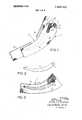
- FIG. 1is a perspective view of a temporomandibular prosthesis.
- FIG. 2is a top view of a rigid reinforcing element useful in the prosthesis.
- FIG. 3is a top or plan view showing a mandibular prosthesis. The view is partially cut away to show the rigid element, the layers of impregnated fabric, and the binding suturing.
- FIG. 4is a view in elevation of the condyle-like element and pedicle of FIG. 1.
- FIG. 5is a view in elevation of the device of FIG. 4 taken from FIG. 4.
- FIG. 5Ais a view in section of a portion of the pedicle, taken on the line 5A5A of FIG. 5.
- FIG. 6is a plan view of a mandibular prosthesis, with the upper layer partly turned back to show suturing of the rigid member and attachment of the condyle element thereto.
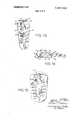
- FIG. 7is a view in elevation of the mandibular prosthesis, showing two flaps.
- FIG. 8is a view in section taken on line 8-8 of FIG. 7.
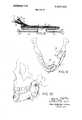
- FIG. 9is a top view of a human lower jaw, showing use or placement of a mandible prosthesis when the condyle element is not used.
- FIG. 10is a view in side elevation of the skeletal structure only, showing the device and placement of FIG. 9.
- FIG. 11is a top view of a human jaw showing use of the mandible prosthesis when the condyle and pedicle are used.
- FIG. 12is a view in side elevation of the device and placement of FIG. 1 1.
- FIG. 13is a view in perspective of a modified form of a mandible prosthesis.
- FIG. 14is a side view in perspective of the prosthesis of FIG. 13.
- FIG. 15is a top plan view of the mandible prosthesis of FIGS. 13 and 14.
- FIG. 1a temporomandibular prosthesis 10 comprising a mandible element 11 which has a fiat, shaped, rigid reinforcing element 12 of titanium metal of curved configuration to conform to that of the mandible portion to be replaced.
- the element 12is disposed between two layers 13 and 13' of woven Dacron fabric, which has been impregnated on both sides with silicone rubber 14.
- Apertures 15may be provided at the ends of element 12 to receive sutures and assist in affixing the element 12 and the layers 13, 13 to each other.
- Sutures 16are applied, suitably in crossstitching as shown in FIG. 3, and through the apertures 15, to pass around the element 12 and through the layers 13, 13'. Dacron sutures are suitable.
- the metal element 12may have its surface suitably primed and secured to the layers 13, 13' by an adhesrve.
- the condyle-like element 17comprises a rigid stem 18 and rounded head or knob 19.
- the stem 18is preferably made of Dacron woven fabric impregnated with silicone rubber, then rolled up in jelly-roll fashion and coated with a smooth surface of elastomer.
- the head 19is vulcanized to the stem 18, and the base 20 is affixed to the mandible member 1 1 by splaying the base 20, placing the splayed ends over the end of the rigid or metal element 12, and vulcanizing the base 20 to the upper layer 13, prior to placement of the open-pore coating 14, which bears an adhesive layer 30,.as shown in FIG. 6.
- a suitable aperture 21 and split 22are provided in the fabric layer 14 to enable fitting this layer over the condyle element and down over the layer 13, after which the layers are vulcanized together. If desired, the condyle 17 can be sutured in place on the element 12 and the layer 13, and the vulcanizing done then in one step.
- the condyle element 17is shown in FIGS. 4, 5, and 5A also, and these figures show the'structure of the ligamentous element or pedicle 23 in more detail.
- the pedicle 23is made up of a flexible stem 24 and a head 26.
- the stem 24may suitably be of silicone rubber internally reinforced with flexible Dacron fibers or fabric 25.
- the head 26may be of flat or disc shape and to it is affixed a discv 27 of open-pore, tissue-ingrowth-receptive fabric, suitably substantially larger than the head or joining layer 26.
- the layer 26is preferably of silicone rubber reinforced with Dacron.
- the fabric 27is preferably Dacron and preferably has a pile such as Dacron velour, and it is coated on the back with medical rubber cement and vulcanized to the support 26, which is vulcanized to the stem 24; the latter, in turn, is vulcanized to the rigid stem 18.
- Perforations 28are made in the disc 27 and the support 26 to promote gross tissue ingrowth.
- the condyle head 19fits into a receptive skeletal bone cavity, e.g., in the temporal bone, and the disc 27 is placed against an adjacent face of the bone, underneath the periosteum, where it attaches by tissue ingrowth and provides ligamentous support for the condyle-like element 17 preventing its shifting or dislocation.
- a pair of flaps 32At the bone-facing surface 31 of the mandible prosthesis or element 11 are provided in the embodiments shown in the present drawings, a pair of flaps 32,
- the prosthesisif so furnished, or it can be omitted in the manufacture thereof and the device applied in a lower jaw as shown in FIGS. 9 and 10.
- the condyle element and pedicleare employed, such application is shown in FIGS. 11 and 12, and the rear flap is cut away as unnecessary.
- FIGS. 13, 14, and 15show another modification.
- a relatively rigid reinforcing member 40is embedded in an elastomeric covering 41, which, in this instance is 15 adhered to a bottom oversize layer 42 of fabric,
- a prosthetic device for replacement or repair of a damaged or missing bone structure and adapted to emplacement by sub-periosteal, periosteal or bone surface attachmentincluding in combination:
- tissue-ingrowth-receptive fabric coatingdisposed over at least a portion of a surface of said impregnated fabric and being adapted to abut upon a bone surface when emplaced
- said reinforcing element and elastomer-impregnated fabricbeing firmly afiixed to each other, and being 45 compatible with body fluids, and at least a portion of said open-pore fabric being affixed to said elastomer-impregnated fabric.
- said reinforcing elementis substantially flat.
- the open-pore fabric described abovesuitably Dacron velour, joined together by a layer of medical rubber adhesive 34.
- the flaps 32, 32'are affixed to one face of the mandible element 11, especially by vulcanizing through a layer of medical rubber adhesive over only a pair of their length, sufficient to effect firm bonding. The flaps 32, 32' then turn back upon themselves.
- each flapabuts the concerned bone face, beneath the periosteum 36, which is held away'during surgery; the device is temporarily bonded in place by suturing at '33, and tissue ingrowth occurs in very few weeks at the interface of element, covering and enclosing said reinforcing element, one said surface being adapted to face a mandible bone when emplaced,
- tissue-ingrowth-receptive clothdisposed over at least a portion of said one flat surface and adapted to abut said bone and to receive tissue ingrowth therefrom
- said securing meansis a layer of elastomeric adhesive disposed between said silicone rubber and said cloth and polymerized to said silicone rubber.
- said means for bindingcomprises sutures passing around said metal element and through said woven fabric layers.
- a prosthetic device for repair of a damaged bone structure and adapted to emplacement by periosteal attachmentcomprising in combination:
- an open-pore, tissue-ingrowth-receptive fabric coatingdisposed over at least a portion of a surface of said fibrous coating and being adapted to abut upon and attach to a bone surface when emplaced
- said reinforcing element, fibrous coating and fabric coatingbeing firmly affixed to each other and being compatible with body fluids
- a condyle-like elementextending from one end of said reinforcing element and having a rigid stem and a rounded terminal head
- a flexible pedicleprojecting from said stern and having a flat terminal head, said head having an outer face adapted to fit against a bone surface when emplaced, and
- tissue-ingrowth-receptive fabricdisposed over said outer face
- said condyle-like elementis of non-porous, smooth silicone rubber, stiffened and reinforced internally with woven Dacron fiber.
- prosthetic device of claim 9wherein said pedicle is of non-porous, smooth silicone rubber reinforced internally with flexible Dacron fibers.
- tissue-ingrowth-receptive fabricis Dacron velour.
- suturesare disposed around said reinforcing element and through said elastomer-impregnated fibrous coating to bind the same together.
- a generally flat imperforate discadapted to serve as an ingrowth anchor for said prosthesis on a periosteal surface adjacent the intended position of said prosthesis
- a skeletal prosthetic element having a condyle-like elementcomprising part of said skeletal prosthetic element
- a generally flat discadapted to serve as an anchor for said prosthesis on a periosteal surface adjacent the intended position of said prosthesis
- a slender flexible pediclejoining said disc to said skeletal prosthetic element for continuously guiding it into a predetermined position by a hinge-like motion.
- 'A bone prosthesiscomprising a main member having a generally flattened shape
- a condyle-like memberconnected to said main member by a thick stem portion and having a head
- a pediclehaving a thin stem connected to said thick stem portion and a head.
- a prosthetic device for replacement or repair of a damaged or missing bone structure and adapted to emplacement by sub-periosteal, periosteal or bone surface attachmentincluding in combination:
- tissue-ingrowth-receptive fabric coatingdisposed over at least a portion of a surface of said elastomeric covering and being adapted to abut upon a supporting tissue surface when emplaced
- said reinforcing element and elastomeric coveringbeing fimily afiixed to each other, and being compatible with body fluids, and at least a portion of said open-pore fabric being affixed to said elastomeric coating.
Landscapes
- Health & Medical Sciences (AREA)
- Transplantation (AREA)
- Heart & Thoracic Surgery (AREA)
- Vascular Medicine (AREA)
- Oral & Maxillofacial Surgery (AREA)
- Orthopedic Medicine & Surgery (AREA)
- Engineering & Computer Science (AREA)
- Biomedical Technology (AREA)
- Veterinary Medicine (AREA)
- Cardiology (AREA)
- Life Sciences & Earth Sciences (AREA)
- Animal Behavior & Ethology (AREA)
- General Health & Medical Sciences (AREA)
- Public Health (AREA)
- Plastic & Reconstructive Surgery (AREA)
- Prostheses (AREA)
Abstract
Description
United States Patent Stemmer et al.
[54] BONE PROSTHESIS [72] Inventors; August L. Stemmer; Paul Kahn, 1 both of San Francisco; James A.
Stubstad, Lafayette, all of Calif.
[73] Assignee: Cutter Laboratories, Inc., Berkeley,
Calif.
[22] Filed: Aug. 10, 1970 [21] Appl. No.: 62,536
, Related US. Application Data [63] Continuation-in-part of Ser. No. 833,824, June 16, 1969, abandoned.
[52] US. Cl. ..3/1, l28/92'C [51] Int. Cl ..A6lf 1/24, A6lf H00 [58] Field of Search.. 128/92 R, 92 C, 92 CA, 92 BC,
Silicone Rubber .lmplants for Replacement of Arthritic or Destroyed Joints in the Hand" by A. B. Swanson, M.D., Surgical Clinics of North America,
[151 3,683,422 [451 Aug. 15, 1972 Vol. 48, N0. 5, Oct. 1968, pp. 1113- 1127.
[571 ABSTRACT A prosthetic device with sub-periosteal, periosteal, or bone surface attachment for stress support, comprising a rigid reinforcing member and'an elastomer-impregnated fibrous or woven fabric covering such member and firmly fixed to it. In one embodiment, a fibrous reinforced elastomer condyle-like member is affixed to one end of such reinforcing member, and a flexible pedicle extends outwardly from such condylelike member and has at its remote end a bone-attaching head comprising a flat or disc base with a bone-exposed covering or coating of a tissue-ingrowth-receptive, open-pore fabric, to assist in providing a joint function. There is also affixed to the boneexposed face of the elastomer-covered reinforcing member a coating of such tissue-ingrowth-receptive, open-pore fabric. All the elements where attached are firmly-fixed to each other, the reinforcing member being also suitably sutured to the elastomer-impregnated fabric. The fiber and fabric parts are advantageously of Dacron, the fabric being preferably of Dacron velour; and the elastomer is advantageously silicone rubber. The device is adapted for insertion as a load-bearing element. A method for making the above device is also provided.
25 Claims, 16 Drawing Figures PATENTEDMINSIQTZ 3.6 3.422
INVENTOR. AUGUST L. STEMMER PAUL KAHN BY JAMES A. STUBSTAD (Q ALLJ... wQ L-h ATTORNEYS PATENTEDAus 1 5 m2 SHEET 3 OF 5 33W" FIG. 8
R m v m AUGUST L. STEMMER PAUL KAHN BY JAMES A. STUBSTAD 0, MM M ATTOR N EYS P'ATENTEBAIJB 1 m2 3.583.422
saw u0F 5 INVENTOR. AUGUST L. STEMMER PAUL KAHN JAI IES A. STUBSTAD 0M, ATTORNEYS mtmzmumlsrz 3.683.422
SHEEI 5UF 5 INVENTOR AUGUST L. STEMMER PAUL KAHN JAMES A STUBSTAD 0M, (,l/(AZI 4A1M ATTORNEYS BONE PROSTHESIS This application is a continuation-in-part of application Ser. No. 833,824, filed June 16, 1969, now abandoned.
BACKGROUND OF THE INVENTION example is for the jawbone, and it takes into account a flexible plastic which is in general use along with the .combination of another plastic that has a rough and irregular surface for adaptation to bone.
In the instance where a flat bone must be dealt with from the standpoint of loss of extension, a way has been needed for enabling restoration without the necessity of multiple screws and other cumbersome and time consuming methods of handling in the operating room, most of which constitute short form repair, limited by the biological incompatibility of screws, plates etc. Thus, although methods may exist for extensions, they have been created for implantation of foreign sub stances by their placement in the center of a long bone directly into the bone marrow. There has as yet been no development that would provide finn fixation to the outside of the bone where it may or may not be flat and requires extension.
It is important that affixation of the prosthesis to the exterior of the bone be firm and long-term or even permanent, with minimal risk of infection. It is also very important in the case of a mandibular or temporomandibular prosthesis where a condyle or ball-and-socket restoration is provided, that no fixation of such condyle per se occur in situ, while means are provided to maintain the ball-and-socket relationship and free normal movement on the condyle stem.
The above and other objects and advantages are obtained by the present inventionas will be evident from the description below. The present invention provides a prosthetic device which can be affixed sub-periosteally to a bone surface and in an advantageous embodiment provides also a condyle-like member and a pedicle, the latter being likewise sub-periosteally attached to maintain the condyle-like member in proper operating position and condition.
SUMMARY OF THE INVENTION This invention concerns a prosthesis for the addition or repair to a missing or damaged bone; in the addition the prosthesis may be attached periosteally. The prosthesis may be applied to a substantially flat bone surface, and then at least one component of the prosthesis is a substantially flat element.
The design and plan as herein set forth encompasses the use of any preformed readily modifiable plastic substance that permits porosity and is sufficiently flexible to be lapped around the end of the bone, while at the same time the center core of the prosthetic device has sufficient rigidity to maintain support. By simple cutting or separating along the perforations, the flattened edges of the leaf-like configuration of the supporting area is then rolled over the end of the bone and with or without further fixation, it is possible in many instances to maintain extension and support sufficient to carry the necessary load that is applied in normal function after a suitable period of healing.
The additional or optional use of the flattened mushroom-like end or disc of the pedicle permits the prefashioned prosthesis to be fitted into any socket or flattened area, while its perforations and the character of the plastic substances chosen will enable firm union into the socket allowing permanent movement on a flexible stem. There can be no permanent fixation of a ball and socket on a stem-like narrow section of the same plastic substance that is not subject to fatigue under repeated movements or stress. In the invention a main stem carries compressive loads, with rotation at the condyle; a pedicle carries tensile loads with flexibility.
In one embodiment the prosthesis comprises a flat, shaped, rigid reinforcing element (which may be of relatively rigid plastic, or, advantageously of light metal, especially titanium) and a covering thereover (suitably of fibrous material impregnated with silicone rubber or like material compatible with body fluids or tissues). The elastomer-impregnated fibrous or fabric covering is also flat, or substantially flat, and is contoured generally to the metal element. The covering is preferably made of a layer of fabric at each flat surface of the reinforcing element, preferably of Dacron fabric. A layer of such impregnated fabric may be placed on each flat face or surface of the metal or other rigid element and the whole sutured or adhered or otherwise secured together and eventually vulcanized in forming the desired prosthesis or component thereof. In a mandibular prosthesis, the metal element is suitably curved and tapered to conform to the shape of the mandible section to be repaired or replaced. Advantageously, the metal piece may also be sutured to the reinforced elastomer, e.g., by cross-stitching which passes around the metal element and through the layers of impregnated woven fabric. Alternatively, the metal and cloth may be joined by adhesives or through chemical priming.
The mandibular prosthesis is also provided at its bone-adjacent surface with one or two flexible flaps of open-pore, tissue-ingrowth-receptive fabric, especially of Dacron velour laminated with silicone rubber, and the Dacron velour surface in each instance is adapted to abut a bone surface when emplaced. In use, each flap is folded over a cut end of bone, the periosteal tissue layer having been laid back so that the flap can also abut the bone surface itself inside and outside of the mandible, so that tissue ingrowth can occur at these bone surfaces over a period of time, thoroughly bonding the prosthesis to the mandible. In another embodiment, part of the elastomer-impregnated fibrous layer, properly surfaced with open-pore fabric, is cut and folded over the cut end of bone. Affixation of the flap to the bone enables extension of the load-bearing element across the resected portion of the bone, which can also extend, if desired, to a bearing at the next available portion of bone. In any event, firm affixation to the mandible is effected by such flap or pair of flaps. The area of the prosthesis between a pair of tumedback flaps bridges the resected portion of the mandible, where this has occurred. Both surfaces of such a flap are of the tissue-ingrowth-receptive material, so that such ingrowth eventually occurs with respect both to the bone and to the periosteum.
Yet another embodiment of the invention provides a temporomandibular prosthesis with the mandibular component as described above, but also having a condyle-like element extending from one end of the rigid or metal reinforcing agent. This condyle-like element comprises a rigid stem or center bar, preferably terminating in a rounded head. A pedicle or ligamentous element, which may be shaped like a mushroom, extends from the rigid stem and has a terminal head, preferably shaped like a disc. The terminal head may be flat, being flexible and adaptive, and it supports a disc of tissue-ingrowth-receptive fabric, preferably of Dacron and especially Dacron velour. Such a disc can be round, square or of any desired shape, depending upon the bone surface available or other conditions. The disc is joined or affixed to the stem by a layer of silicone rubber. The pedicle extends from the rigid stem; in an optimal arrangement it joins the stem about midway of the stems length, but it can originate at other locations. The ligamentous element or pedicle stem is of flexible elastomer internally reinforced with a fiber material such as Dacron. The disc of the pedicle can abut upon and conform to a tissue such as a bone surface freed of periosteal tissue and affixes thereto by tissue ingrowth, bony tissue or other tissue, especially fibrous tissue, being encouraged by the fabric structure to grow into the pile or open pores and thereby fix or secure the prosthesis to the bone. The rounded head of the condyle-like element fits movably or rotatably into a recess in the bone intended to receive it, such as a temporal bone, hip bone or other, and it is held in place without affixation by the action of the pedicle and disc or ligamentous element. Although this embodiment is described with respect to a temporomandibular prosthesis, the condyle-pedicle features are also useful at other skeletal sites, specially where joint function is desired, and it may there be used along with the straight or bridging element and the condyle-like articular ball surface mentioned before.
In practicing the method of making the device of this invention, a flat, shaped, relatively rigid reinforcing element, such as a titanium element, is placed between two layers of fabric, e.g., woven Dacron cloth, which have each been thoroughly impregnated with a silicone rubber or like physiologically compatible elastomer. The fabric and reinforcing agent are then sutured or adhered to bind them together. A layer of an open-pore fabric, such as a mesh or pile fabric, for example, may be thoroughly coated on the back, or non-pile face, with a dispersion of unvulcanized silicone rubber or other polymerizable bonding agent, without closing the pores of the face, and applied over the fabric layers covering the reinforcing element. The whole is vulcanized and cured to assure firm bonding.
Where a condyle-like or joint-like element is employed, it is afiixed to a rigid reinforcing agent covered with a fabric impregnated with rubber as described above. The condyle stem is splayed at the base and spread over the reinforcing element at one end thereof, and the fabric overlayer is fixed in place by suturing; or the open-pore fabric may be placed over the same around the condyle element and the whole vulcanized.
BRIEF DESCRIPTION OF DRAWINGS The invention and some modes of carrying it out will be illustrated by the annexed drawings which, without limiting the invention, show some embodiments of the device of the invention. In the drawings:
FIG. 1 is a perspective view of a temporomandibular prosthesis.
FIG. 2 is a top view of a rigid reinforcing element useful in the prosthesis.
FIG. 3 is a top or plan view showing a mandibular prosthesis. The view is partially cut away to show the rigid element, the layers of impregnated fabric, and the binding suturing.
FIG. 4 is a view in elevation of the condyle-like element and pedicle of FIG. 1.
FIG. 5 is a view in elevation of the device of FIG. 4 taken from FIG. 4.
FIG. 5A is a view in section of a portion of the pedicle, taken on the line 5A5A of FIG. 5.
FIG. 6 is a plan view of a mandibular prosthesis, with the upper layer partly turned back to show suturing of the rigid member and attachment of the condyle element thereto.
FIG. 7 is a view in elevation of the mandibular prosthesis, showing two flaps.
FIG. 8 is a view in section taken on line 8-8 of FIG. 7.
FIG. 9 is a top view of a human lower jaw, showing use or placement of a mandible prosthesis when the condyle element is not used.
FIG. 10 is a view in side elevation of the skeletal structure only, showing the device and placement of FIG. 9.
FIG. 11 is a top view of a human jaw showing use of the mandible prosthesis when the condyle and pedicle are used.
FIG. 12 is a view in side elevation of the device and placement of FIG. 1 1.
FIG. 13 is a view in perspective of a modified form of a mandible prosthesis.
FIG. 14 is a side view in perspective of the prosthesis of FIG. 13.
FIG. 15 is a top plan view of the mandible prosthesis of FIGS. 13 and 14.
DETAILED DESCRIPTION OF THE INVENTION The invention will be described more specifically with reference to two embodiments and with reference to the accompanying drawings.
In FIG. 1 is shown atemporomandibular prosthesis 10 comprising amandible element 11 which has a fiat, shaped, rigid reinforcingelement 12 of titanium metal of curved configuration to conform to that of the mandible portion to be replaced. Theelement 12 is disposed between twolayers 13 and 13' of woven Dacron fabric, which has been impregnated on both sides withsilicone rubber 14.Apertures 15 may be provided at the ends ofelement 12 to receive sutures and assist in affixing theelement 12 and thelayers Sutures 16 are applied, suitably in crossstitching as shown in FIG. 3, and through theapertures 15, to pass around theelement 12 and through thelayers 13, 13'. Dacron sutures are suitable. Altematively, themetal element 12 may have its surface suitably primed and secured to thelayers 13, 13' by an adhesrve.
The condyle-like element 17 comprises arigid stem 18 and rounded head orknob 19. Thestem 18 is preferably made of Dacron woven fabric impregnated with silicone rubber, then rolled up in jelly-roll fashion and coated with a smooth surface of elastomer. Thehead 19 is vulcanized to thestem 18, and thebase 20 is affixed to the mandible member 1 1 by splaying thebase 20, placing the splayed ends over the end of the rigid ormetal element 12, and vulcanizing the base 20 to theupper layer 13, prior to placement of the open-pore coating 14, which bears anadhesive layer 30,.as shown in FIG. 6. Asuitable aperture 21 and split 22 are provided in thefabric layer 14 to enable fitting this layer over the condyle element and down over thelayer 13, after which the layers are vulcanized together. If desired, thecondyle 17 can be sutured in place on theelement 12 and thelayer 13, and the vulcanizing done then in one step.
Thecondyle element 17 is shown in FIGS. 4, 5, and 5A also, and these figures show the'structure of the ligamentous element orpedicle 23 in more detail. Thepedicle 23 is made up of aflexible stem 24 and ahead 26. Thestem 24 may suitably be of silicone rubber internally reinforced with flexible Dacron fibers orfabric 25. Thehead 26 may be of flat or disc shape and to it is affixed adiscv 27 of open-pore, tissue-ingrowth-receptive fabric, suitably substantially larger than the head or joininglayer 26. Thelayer 26 is preferably of silicone rubber reinforced with Dacron. Thefabric 27 is preferably Dacron and preferably has a pile such as Dacron velour, and it is coated on the back with medical rubber cement and vulcanized to thesupport 26, which is vulcanized to thestem 24; the latter, in turn, is vulcanized to therigid stem 18.Perforations 28 are made in thedisc 27 and thesupport 26 to promote gross tissue ingrowth. In use, thecondyle head 19 fits into a receptive skeletal bone cavity, e.g., in the temporal bone, and thedisc 27 is placed against an adjacent face of the bone, underneath the periosteum, where it attaches by tissue ingrowth and provides ligamentous support for the condyle-like element 17 preventing its shifting or dislocation.
At the bone-facingsurface 31 of the mandible prosthesis orelement 11 are provided in the embodiments shown in the present drawings, a pair offlaps 32,
5 the prosthesis if so furnished, or it can be omitted in the manufacture thereof and the device applied in a lower jaw as shown in FIGS. 9 and 10. Where the condyle element and pedicle are employed, such application is shown in FIGS. 11 and 12, and the rear flap is cut away as unnecessary.
FIGS. 13, 14, and 15 show another modification. A relatively rigid reinforcingmember 40 is embedded in anelastomeric covering 41, which, in this instance is 15 adhered to a bottomoversize layer 42 of fabric,
25 pended claims.
Having now described the invention, what is claimed rs:
1. A prosthetic device for replacement or repair of a damaged or missing bone structure and adapted to emplacement by sub-periosteal, periosteal or bone surface attachment, including in combination:
a shaped, relatively rigid reinforcing element, which when bent retains its shape, extending continuously from one end to the other,
an elastomer-impregnated fabric fully covering and fully enclosing said element, and contoured thereto, and
an open-pore, tissue-ingrowth-receptive fabric coating disposed over at least a portion of a surface of said impregnated fabric and being adapted to abut upon a bone surface when emplaced,
said reinforcing element and elastomer-impregnated fabric being firmly afiixed to each other, and being 45 compatible with body fluids, and at least a portion of said open-pore fabric being affixed to said elastomer-impregnated fabric. 2. The prosthetic device of claim 1 wherein said reinforcing element is substantially flat.
3. The prosthetic device of claim 1 wherein said reinforcing element is metal.
4. The prosthetic device of claim 1 wherein said reinforcing element is covered on each side with a layer of woven fiber compatible with body fluids and im- 32', each of which is made up of twolayers 35, 35' of pregnated with silicone rubber.
the open-pore fabric described above, suitably Dacron velour, joined together by a layer ofmedical rubber adhesive 34. Theflaps 32, 32' are affixed to one face of themandible element 11, especially by vulcanizing through a layer of medical rubber adhesive over only a pair of their length, sufficient to effect firm bonding. Theflaps 32, 32' then turn back upon themselves.
As shown in FIGS. 9 through 12, each flap abuts the concerned bone face, beneath theperiosteum 36, which is held away'during surgery; the device is temporarily bonded in place by suturing at '33, and tissue ingrowth occurs in very few weeks at the interface of element, covering and enclosing said reinforcing element, one said surface being adapted to face a mandible bone when emplaced,
a coating of tissue-ingrowth-receptive cloth disposed over at least a portion of said one flat surface and adapted to abut said bone and to receive tissue ingrowth therefrom,
securing means for fastening together said cloth and said elastomer, and
means for binding said metal element to said elastomer,
said elastomer being cured.
7. The prosthetic device of claim 6 wherein said securing means is a layer of elastomeric adhesive disposed between said silicone rubber and said cloth and polymerized to said silicone rubber.
8. The prosthetic device of claim 6 wherein said means for binding comprises sutures passing around said metal element and through said woven fabric layers.
9. A prosthetic device for repair of a damaged bone structure and adapted to emplacement by periosteal attachment, comprising in combination:
a. a substantially flat, shaped, rigid reinforcing element,
b. a elastomer-impregnated fibrous coating contoured to and enclosing said element,
c. an open-pore, tissue-ingrowth-receptive fabric coating disposed over at least a portion of a surface of said fibrous coating and being adapted to abut upon and attach to a bone surface when emplaced,
d. said reinforcing element, fibrous coating and fabric coating being firmly affixed to each other and being compatible with body fluids,
. a condyle-like element extending from one end of said reinforcing element and having a rigid stem and a rounded terminal head,
f. a flexible pedicle projecting from said stern and having a flat terminal head, said head having an outer face adapted to fit against a bone surface when emplaced, and
g. a tissue-ingrowth-receptive fabric disposed over said outer face,
h. all of said components being firmly affixed to each other, and being compatible with body fluids.
10. The prosthetic device of claim 9 wherein said condyle-like element is of non-porous, smooth silicone rubber, stiffened and reinforced internally with woven Dacron fiber.
11. The prosthetic device of claim 9 wherein said pedicle is of non-porous, smooth silicone rubber reinforced internally with flexible Dacron fibers.
12. The prosthetic device of claim 9 wherein said tissue-ingrowth-receptive fabric is Dacron velour.
13. The prosthetic device of claim 9 wherein sutures are disposed around said reinforcing element and through said elastomer-impregnated fibrous coating to bind the same together.
14. The prosthetic device of claim 9 wherein said flat terminal head is disc shaped and said fabric extends substantially beyond the edges thereof.
15. In a bone prosthesis of physiologically compatible material suitable for implantation in a living body,
a skeletal prosthetic element,
a generally flat imperforate disc adapted to serve as an ingrowth anchor for said prosthesis on a periosteal surface adjacent the intended position of said prosthesis, and
a single slender flexible pedicle joining said disc to said skeletal prosthetic element for continuously guiding it into a predetermined position by a hinge-like motion.
16. In a bone prosthesis a skeletal prosthetic element having a condyle-like element comprising part of said skeletal prosthetic element,
a generally flat disc adapted to serve as an anchor for said prosthesis on a periosteal surface adjacent the intended position of said prosthesis, and
a slender flexible pedicle joining said disc to said skeletal prosthetic element for continuously guiding it into a predetermined position by a hinge-like motion.
17. The prosthesis ofclaim 16 wherein said pedicle is joined to said condyle-like element.
18. 'A bone prosthesis, comprising a main member having a generally flattened shape,
a condyle-like member connected to said main member by a thick stem portion and having a head, and
a pedicle having a thin stem connected to said thick stem portion and a head.
19. The bone prosthesis ofclaim 18 wherein said main member, said condyle-like member, and said pedicle comprise a physiologically compatible elastomer, said main member containing a relatively rigid reinforcing member.
20. The bone prosthesis ofclaim 19 wherein said main member, said stem portion, and said pedicle are covered with s physiologically compatible open-pore pile fabric.
21. The bone prosthesis ofclaim 20 wherein said main member is oversize relative to intended installations enabling trimming at time of surgery for each individual installation.
22. A prosthetic device for replacement or repair of a damaged or missing bone structure and adapted to emplacement by sub-periosteal, periosteal or bone surface attachment, including in combination:
a shaped, relatively rigid reinforcing element, which when bent retains its shape, extending continuously from one end to the other,
an elastomeric covering fully enclosing said element,
and contoured generally thereto, and
an open-pore, tissue-ingrowth-receptive fabric coating disposed over at least a portion of a surface of said elastomeric covering and being adapted to abut upon a supporting tissue surface when emplaced,
said reinforcing element and elastomeric covering being fimily afiixed to each other, and being compatible with body fluids, and at least a portion of said open-pore fabric being affixed to said elastomeric coating.
23. The prosthetic device ofclaim 22 wherein said reinforcing element is substantially flat and sufficiently flexible for shape confonnation at the time of emplacement.
' 9 24. The prosthetic device ofclaim 22 wherein said elastomeric element is reinforced by contained physiologically compatible fibers.
25. The prosthetic device ofclaim 22 wherein said
Claims (24)
- 2. The prosthetic device of claim 1 wherein said reinforcing element is substantially flat.
- 3. The prosthetic device of claim 1 wherein said reinforcing element is metal.
- 4. The prosthetic device of claim 1 wherein said reinforcing element is covered on each side with a layer of woven fiber compatible with body fluids and impregnated with silicone rubber.
- 5. The prosthetic device of claim 1 wherein an amount of openpore fabric is in part unattached to said impregnated fabric to form at least one flap, said flap being adapted to fold over and attach to a cut bone end and interior bone face when emplaced.
- 6. A prosthetic device for repair of a resected mandible and adapted to emplacement by periosteal attachment, comprising in combination: a flat, rigid, mandible shaped metal reinforcing element, a layer of woven fabric embedded in elastomer and disposed at each flat surface of said reinforcing element, covering and enclosing said reinforcing element, one said surface being adapted to face a mandible bone when emplaced, a coating of tissue-ingrowth-receptive cloth disposed over at least a portion of said one flat surface and adapted to abut said bone and to receive tissue ingrowth therefrom, securing means for fastening together said cloth and said elastomer, and means for binding said metal element to said elastomer, said elastomer being cured.
- 7. The prosthetic device of claim 6 wherein said securing means is a layer of elastomeric adhesive disposed between said silicone rubber and said cloth and polymerized to said silicone rubber.
- 8. The prosthetic device of claim 6 wherein said means for binding comprises sutures passing around said metal element and through said woven fabric layers.
- 9. A prosthetic device for repair of a damaged bone structure and adapted to emplacement by periosteal attachment, comprising in combination: a. a substantially flat, shaped, rigid reinforcing element, b. a elastomer-impregnated fibrous coating contoured to and enclosing said element, c. an open-pore, tissue-ingrowth-receptive fabric coating disposed over at least a portion of a surface of said fibrous coating and being adapted to abut upon and attach to a bone surface when emplaced, d. said reinforcing element, fibrous coating and fabric coating being firmly affixed to each other and being compatible with body fluids, e. a condyle-like element extending from one end of said reinforcing element and having a rigid stem and a rounded terminal head, f. a flexible pedicle projecting from said stem and having a flat terminal head, said head having an outer face adapted to fit against a bone surface when emplaced, and g. a tissue-ingrowth-receptive fabric disposed over said outer face, h. all of said components being firmly affixed to each other, and being compatible with body fluids.
- 10. The prosthetic device of claim 9 wherein said condyle-like element is of non-porous, smooth silicone rubber, stiffened and reinforced internally with woven Dacron fiber.
- 11. The prosthetic device of claim 9 wherein said pedicle is of non-porous, smooth silicone rubber reinforced internally with flexible Dacron fibers.
- 12. The prosthetic device of claim 9 wherein said tissue-ingrowth-receptive fabric is Dacron velour.
- 13. The prosthetic device of claim 9 wherein Sutures are disposed around said reinforcing element and through said elastomer-impregnated fibrous coating to bind the same together.
- 14. The prosthetic device of claim 9 wherein said flat terminal head is disc shaped and said fabric extends substantially beyond the edges thereof.
- 15. In a bone prosthesis of physiologically compatible material suitable for implantation in a living body, a skeletal prosthetic element, a generally flat imperforate disc adapted to serve as an ingrowth anchor for said prosthesis on a periosteal surface adjacent the intended position of said prosthesis, and a single slender flexible pedicle joining said disc to said skeletal prosthetic element for continuously guiding it into a predetermined position by a hinge-like motion.
- 16. In a bone prosthesis a skeletal prosthetic element having a condyle-like element comprising part of said skeletal prosthetic element, a generally flat disc adapted to serve as an anchor for said prosthesis on a periosteal surface adjacent the intended position of said prosthesis, and a slender flexible pedicle joining said disc to said skeletal prosthetic element for continuously guiding it into a predetermined position by a hinge-like motion.
- 17. The prosthesis of claim 16 wherein said pedicle is joined to said condyle-like element.
- 18. A bone prosthesis, comprising a main member having a generally flattened shape, a condyle-like member connected to said main member by a thick stem portion and having a head, and a pedicle having a thin stem connected to said thick stem portion and a head.
- 19. The bone prosthesis of claim 18 wherein said main member, said condyle-like member, and said pedicle comprise a physiologically compatible elastomer, said main member containing a relatively rigid reinforcing member.
- 20. The bone prosthesis of claim 19 wherein said main member, said stem portion, and said pedicle are covered with s physiologically compatible open-pore pile fabric.
- 21. The bone prosthesis of claim 20 wherein said main member is oversize relative to intended installations enabling trimming at time of surgery for each individual installation.
- 22. A prosthetic device for replacement or repair of a damaged or missing bone structure and adapted to emplacement by sub-periosteal, periosteal or bone surface attachment, including in combination: a shaped, relatively rigid reinforcing element, which when bent retains its shape, extending continuously from one end to the other, an elastomeric covering fully enclosing said element, and contoured generally thereto, and an open-pore, tissue-ingrowth-receptive fabric coating disposed over at least a portion of a surface of said elastomeric covering and being adapted to abut upon a supporting tissue surface when emplaced, said reinforcing element and elastomeric covering being firmly affixed to each other, and being compatible with body fluids, and at least a portion of said open-pore fabric being affixed to said elastomeric coating.
- 23. The prosthetic device of claim 22 wherein said reinforcing element is substantially flat and sufficiently flexible for shape conformation at the time of emplacement.
- 24. The prosthetic device of claim 22 wherein said elastomeric element is reinforced by contained physiologically compatible fibers.
- 25. The prosthetic device of claim 22 wherein said elastomeric covering and the fabric coating thereon are oversize relative to intended installations enabling trimming at time of surgery for each individual installation.
Applications Claiming Priority (1)
| Application Number | Priority Date | Filing Date | Title |
|---|---|---|---|
| US6253670A | 1970-08-10 | 1970-08-10 |
Publications (1)
| Publication Number | Publication Date |
|---|---|
| US3683422Atrue US3683422A (en) | 1972-08-15 |
Family
ID=22043141
Family Applications (1)
| Application Number | Title | Priority Date | Filing Date |
|---|---|---|---|
| US62536AExpired - LifetimeUS3683422A (en) | 1970-08-10 | 1970-08-10 | Bone prosthesis |
Country Status (1)
| Country | Link |
|---|---|
| US (1) | US3683422A (en) |
Cited By (83)
| Publication number | Priority date | Publication date | Assignee | Title |
|---|---|---|---|---|
| DE2641906A1 (en)* | 1976-09-08 | 1978-03-23 | Inst Mekh Polimerov Akademii N | MATERIAL FOR MANUFACTURING BONE ENDOPROSTHESIS AND ENDOPROTHESIS FROM THIS MATERIAL |
| US4187558A (en)* | 1977-10-25 | 1980-02-12 | Cutter Laboratories, Inc. | Prosthetic ligament |
| US4268468A (en)* | 1976-01-30 | 1981-05-19 | Robert Bosch Gmbh | Method of making a medical prosthesis |
| US4636215A (en)* | 1984-01-11 | 1987-01-13 | Rei, Inc. | Combination tray and condylar prosthesis for mandibular reconstruction and the like |
| US4750905A (en)* | 1985-07-10 | 1988-06-14 | Harrington Arthritis Research Center | Beam construction and method |
| US4812120A (en)* | 1987-11-02 | 1989-03-14 | Flanagan Dennis F | Implantable percutaneous device |
| US4966599A (en)* | 1987-04-07 | 1990-10-30 | Pollock Richard A | Anatomical precontoured plating, instruments and methods |
| US5171281A (en)* | 1988-08-18 | 1992-12-15 | University Of Medicine & Dentistry Of New Jersey | Functional and biocompatible intervertebral disc spacer containing elastomeric material of varying hardness |
| US5306301A (en)* | 1993-02-11 | 1994-04-26 | American Cyanamid Company | Graft attachment device and method of using same |
| US5545229A (en)* | 1988-08-18 | 1996-08-13 | University Of Medicine And Dentistry Of Nj | Functional and biocompatible intervertebral disc spacer containing elastomeric material of varying hardness |
| US6030218A (en)* | 1999-04-12 | 2000-02-29 | Robinson; Dane Q. | Osseo-integrated sub-periosteal implant |
| US6056752A (en)* | 1997-10-24 | 2000-05-02 | Smith & Nephew, Inc. | Fixation of cruciate ligament grafts |
| WO2001023014A1 (en)* | 1999-09-28 | 2001-04-05 | Depuy International Limited | Bone tissue repair kit |
| US7500983B1 (en) | 2004-06-09 | 2009-03-10 | Biomet Sports Medicine, Llc | Apparatus for soft tissue attachment |
| US7601165B2 (en) | 2006-09-29 | 2009-10-13 | Biomet Sports Medicine, Llc | Method and apparatus for forming a self-locking adjustable suture loop |
| US7608092B1 (en) | 2004-02-20 | 2009-10-27 | Biomet Sports Medicince, LLC | Method and apparatus for performing meniscus repair |
| US7695503B1 (en) | 2004-06-09 | 2010-04-13 | Biomet Sports Medicine, Llc | Method and apparatus for soft tissue attachment |
| US7749250B2 (en) | 2006-02-03 | 2010-07-06 | Biomet Sports Medicine, Llc | Soft tissue repair assembly and associated method |
| US7819898B2 (en) | 2004-06-09 | 2010-10-26 | Biomet Sports Medicine, Llc | Method and apparatus for soft tissue fixation |
| US7828820B2 (en) | 2006-03-21 | 2010-11-09 | Biomet Sports Medicine, Llc | Method and apparatuses for securing suture |
| US7857830B2 (en) | 2006-02-03 | 2010-12-28 | Biomet Sports Medicine, Llc | Soft tissue repair and conduit device |
| US7905903B2 (en) | 2006-02-03 | 2011-03-15 | Biomet Sports Medicine, Llc | Method for tissue fixation |
| US7905904B2 (en) | 2006-02-03 | 2011-03-15 | Biomet Sports Medicine, Llc | Soft tissue repair device and associated methods |
| US7909851B2 (en) | 2006-02-03 | 2011-03-22 | Biomet Sports Medicine, Llc | Soft tissue repair device and associated methods |
| US7959650B2 (en) | 2006-09-29 | 2011-06-14 | Biomet Sports Medicine, Llc | Adjustable knotless loops |
| US8088130B2 (en) | 2006-02-03 | 2012-01-03 | Biomet Sports Medicine, Llc | Method and apparatus for coupling soft tissue to a bone |
| US8109965B2 (en) | 2004-06-09 | 2012-02-07 | Biomet Sports Medicine, LLP | Method and apparatus for soft tissue fixation |
| US8118836B2 (en) | 2004-11-05 | 2012-02-21 | Biomet Sports Medicine, Llc | Method and apparatus for coupling soft tissue to a bone |
| US8128658B2 (en) | 2004-11-05 | 2012-03-06 | Biomet Sports Medicine, Llc | Method and apparatus for coupling soft tissue to bone |
| US8137382B2 (en) | 2004-11-05 | 2012-03-20 | Biomet Sports Medicine, Llc | Method and apparatus for coupling anatomical features |
| US8251998B2 (en) | 2006-08-16 | 2012-08-28 | Biomet Sports Medicine, Llc | Chondral defect repair |
| US8298262B2 (en) | 2006-02-03 | 2012-10-30 | Biomet Sports Medicine, Llc | Method for tissue fixation |
| US8303604B2 (en) | 2004-11-05 | 2012-11-06 | Biomet Sports Medicine, Llc | Soft tissue repair device and method |
| US8317825B2 (en) | 2004-11-09 | 2012-11-27 | Biomet Sports Medicine, Llc | Soft tissue conduit device and method |
| US8343227B2 (en) | 2009-05-28 | 2013-01-01 | Biomet Manufacturing Corp. | Knee prosthesis assembly with ligament link |
| US8361113B2 (en) | 2006-02-03 | 2013-01-29 | Biomet Sports Medicine, Llc | Method and apparatus for coupling soft tissue to a bone |
| US8500818B2 (en) | 2006-09-29 | 2013-08-06 | Biomet Manufacturing, Llc | Knee prosthesis assembly with ligament link |
| US8506597B2 (en) | 2011-10-25 | 2013-08-13 | Biomet Sports Medicine, Llc | Method and apparatus for interosseous membrane reconstruction |
| US8562645B2 (en) | 2006-09-29 | 2013-10-22 | Biomet Sports Medicine, Llc | Method and apparatus for forming a self-locking adjustable loop |
| US8562647B2 (en) | 2006-09-29 | 2013-10-22 | Biomet Sports Medicine, Llc | Method and apparatus for securing soft tissue to bone |
| US8574235B2 (en) | 2006-02-03 | 2013-11-05 | Biomet Sports Medicine, Llc | Method for trochanteric reattachment |
| US8597327B2 (en) | 2006-02-03 | 2013-12-03 | Biomet Manufacturing, Llc | Method and apparatus for sternal closure |
| US8652172B2 (en) | 2006-02-03 | 2014-02-18 | Biomet Sports Medicine, Llc | Flexible anchors for tissue fixation |
| US8652171B2 (en) | 2006-02-03 | 2014-02-18 | Biomet Sports Medicine, Llc | Method and apparatus for soft tissue fixation |
| US8672969B2 (en) | 2006-09-29 | 2014-03-18 | Biomet Sports Medicine, Llc | Fracture fixation device |
| US8771352B2 (en) | 2011-05-17 | 2014-07-08 | Biomet Sports Medicine, Llc | Method and apparatus for tibial fixation of an ACL graft |
| US8801783B2 (en) | 2006-09-29 | 2014-08-12 | Biomet Sports Medicine, Llc | Prosthetic ligament system for knee joint |
| US8840645B2 (en) | 2004-11-05 | 2014-09-23 | Biomet Sports Medicine, Llc | Method and apparatus for coupling soft tissue to a bone |
| US8936621B2 (en) | 2006-02-03 | 2015-01-20 | Biomet Sports Medicine, Llc | Method and apparatus for forming a self-locking adjustable loop |
| US8968364B2 (en) | 2006-02-03 | 2015-03-03 | Biomet Sports Medicine, Llc | Method and apparatus for fixation of an ACL graft |
| US8998949B2 (en) | 2004-11-09 | 2015-04-07 | Biomet Sports Medicine, Llc | Soft tissue conduit device |
| US9017381B2 (en) | 2007-04-10 | 2015-04-28 | Biomet Sports Medicine, Llc | Adjustable knotless loops |
| US9078644B2 (en) | 2006-09-29 | 2015-07-14 | Biomet Sports Medicine, Llc | Fracture fixation device |
| US9149267B2 (en) | 2006-02-03 | 2015-10-06 | Biomet Sports Medicine, Llc | Method and apparatus for coupling soft tissue to a bone |
| US9259217B2 (en) | 2012-01-03 | 2016-02-16 | Biomet Manufacturing, Llc | Suture Button |
| US9271713B2 (en) | 2006-02-03 | 2016-03-01 | Biomet Sports Medicine, Llc | Method and apparatus for tensioning a suture |
| US9314241B2 (en) | 2011-11-10 | 2016-04-19 | Biomet Sports Medicine, Llc | Apparatus for coupling soft tissue to a bone |
| US9357991B2 (en) | 2011-11-03 | 2016-06-07 | Biomet Sports Medicine, Llc | Method and apparatus for stitching tendons |
| US9370350B2 (en) | 2011-11-10 | 2016-06-21 | Biomet Sports Medicine, Llc | Apparatus for coupling soft tissue to a bone |
| US9381013B2 (en) | 2011-11-10 | 2016-07-05 | Biomet Sports Medicine, Llc | Method for coupling soft tissue to a bone |
| US9538998B2 (en) | 2006-02-03 | 2017-01-10 | Biomet Sports Medicine, Llc | Method and apparatus for fracture fixation |
| US9615822B2 (en) | 2014-05-30 | 2017-04-11 | Biomet Sports Medicine, Llc | Insertion tools and method for soft anchor |
| US9700291B2 (en) | 2014-06-03 | 2017-07-11 | Biomet Sports Medicine, Llc | Capsule retractor |
| US9757119B2 (en) | 2013-03-08 | 2017-09-12 | Biomet Sports Medicine, Llc | Visual aid for identifying suture limbs arthroscopically |
| US9801708B2 (en) | 2004-11-05 | 2017-10-31 | Biomet Sports Medicine, Llc | Method and apparatus for coupling soft tissue to a bone |
| US9918827B2 (en) | 2013-03-14 | 2018-03-20 | Biomet Sports Medicine, Llc | Scaffold for spring ligament repair |
| US9918826B2 (en) | 2006-09-29 | 2018-03-20 | Biomet Sports Medicine, Llc | Scaffold for spring ligament repair |
| US9955980B2 (en) | 2015-02-24 | 2018-05-01 | Biomet Sports Medicine, Llc | Anatomic soft tissue repair |
| US10039543B2 (en) | 2014-08-22 | 2018-08-07 | Biomet Sports Medicine, Llc | Non-sliding soft anchor |
| WO2018172982A1 (en)* | 2017-03-23 | 2018-09-27 | Cadskills Bvba | Bone protheses |
| US10136886B2 (en) | 2013-12-20 | 2018-11-27 | Biomet Sports Medicine, Llc | Knotless soft tissue devices and techniques |
| US20190000628A1 (en)* | 2011-02-28 | 2019-01-03 | DePuy Synthes Products, Inc. | Modular tissue scaffolds |
| US10517587B2 (en) | 2006-02-03 | 2019-12-31 | Biomet Sports Medicine, Llc | Method and apparatus for forming a self-locking adjustable loop |
| US10912551B2 (en) | 2015-03-31 | 2021-02-09 | Biomet Sports Medicine, Llc | Suture anchor with soft anchor of electrospun fibers |
| US11259792B2 (en) | 2006-02-03 | 2022-03-01 | Biomet Sports Medicine, Llc | Method and apparatus for coupling anatomical features |
| US11259794B2 (en) | 2006-09-29 | 2022-03-01 | Biomet Sports Medicine, Llc | Method for implanting soft tissue |
| US11311287B2 (en) | 2006-02-03 | 2022-04-26 | Biomet Sports Medicine, Llc | Method for tissue fixation |
| US11337816B2 (en) | 2019-10-18 | 2022-05-24 | Industrial Technology Research Institute | Reconstruction prosthesis |
| US11801125B2 (en) | 2019-10-23 | 2023-10-31 | Industrial Technology Research Institute | Reconstruction prosthesis |
| US12096928B2 (en) | 2009-05-29 | 2024-09-24 | Biomet Sports Medicine, Llc | Method and apparatus for coupling soft tissue to a bone |
| US12245759B2 (en) | 2008-08-22 | 2025-03-11 | Biomet Sports Medicine, Llc | Method and apparatus for coupling soft tissue to bone |
| US12329373B2 (en) | 2011-05-02 | 2025-06-17 | Biomet Sports Medicine, Llc | Method and apparatus for soft tissue fixation |
| US12419632B2 (en) | 2008-08-22 | 2025-09-23 | Biomet Sports Medicine, Llc | Method and apparatus for coupling anatomical features |
Citations (5)
| Publication number | Priority date | Publication date | Assignee | Title |
|---|---|---|---|---|
| US2679245A (en)* | 1950-03-20 | 1954-05-25 | Timmermans Frans Donatus | Prosthesis for femoral heads |
| US3176316A (en)* | 1963-01-07 | 1965-04-06 | Bruce R Bodell | Plastic prosthetic tendon |
| US3491376A (en)* | 1965-10-06 | 1970-01-27 | Donald P Shiley | Heart valve with separate suturing ring sub-assembly |
| US3513484A (en)* | 1967-10-27 | 1970-05-26 | Extracorporeal Med Spec | Artificial tendon |
| US3593342A (en)* | 1969-01-27 | 1971-07-20 | Cutter Lab | Prosthetic joint |
- 1970
- 1970-08-10USUS62536Apatent/US3683422A/ennot_activeExpired - Lifetime
Patent Citations (5)
| Publication number | Priority date | Publication date | Assignee | Title |
|---|---|---|---|---|
| US2679245A (en)* | 1950-03-20 | 1954-05-25 | Timmermans Frans Donatus | Prosthesis for femoral heads |
| US3176316A (en)* | 1963-01-07 | 1965-04-06 | Bruce R Bodell | Plastic prosthetic tendon |
| US3491376A (en)* | 1965-10-06 | 1970-01-27 | Donald P Shiley | Heart valve with separate suturing ring sub-assembly |
| US3513484A (en)* | 1967-10-27 | 1970-05-26 | Extracorporeal Med Spec | Artificial tendon |
| US3593342A (en)* | 1969-01-27 | 1971-07-20 | Cutter Lab | Prosthetic joint |
Non-Patent Citations (1)
| Title |
|---|
| Silicone Rubber Implants for Replacement of Arthritic or Destroyed Joints in the Hand by A. B. Swanson, M.D., Surgical Clinics of North America, Vol. 48, No. 5, Oct. 1968, pp. 1113 1127.* |
Cited By (215)
| Publication number | Priority date | Publication date | Assignee | Title |
|---|---|---|---|---|
| US4268468A (en)* | 1976-01-30 | 1981-05-19 | Robert Bosch Gmbh | Method of making a medical prosthesis |
| US4089071A (en)* | 1976-09-08 | 1978-05-16 | Kalnberz Viktor Konstantinovic | Material for making bone endoprosthesis and endoprosthesis made of said material |
| DE2641906A1 (en)* | 1976-09-08 | 1978-03-23 | Inst Mekh Polimerov Akademii N | MATERIAL FOR MANUFACTURING BONE ENDOPROSTHESIS AND ENDOPROTHESIS FROM THIS MATERIAL |
| US4187558A (en)* | 1977-10-25 | 1980-02-12 | Cutter Laboratories, Inc. | Prosthetic ligament |
| US4636215A (en)* | 1984-01-11 | 1987-01-13 | Rei, Inc. | Combination tray and condylar prosthesis for mandibular reconstruction and the like |
| US4750905A (en)* | 1985-07-10 | 1988-06-14 | Harrington Arthritis Research Center | Beam construction and method |
| US4966599A (en)* | 1987-04-07 | 1990-10-30 | Pollock Richard A | Anatomical precontoured plating, instruments and methods |
| US4812120A (en)* | 1987-11-02 | 1989-03-14 | Flanagan Dennis F | Implantable percutaneous device |
| US5545229A (en)* | 1988-08-18 | 1996-08-13 | University Of Medicine And Dentistry Of Nj | Functional and biocompatible intervertebral disc spacer containing elastomeric material of varying hardness |
| US5171281A (en)* | 1988-08-18 | 1992-12-15 | University Of Medicine & Dentistry Of New Jersey | Functional and biocompatible intervertebral disc spacer containing elastomeric material of varying hardness |
| US5306301A (en)* | 1993-02-11 | 1994-04-26 | American Cyanamid Company | Graft attachment device and method of using same |
| US5645588A (en)* | 1993-02-11 | 1997-07-08 | Acufex Microsurgical, Inc. | Graft attachment device |
| US6056752A (en)* | 1997-10-24 | 2000-05-02 | Smith & Nephew, Inc. | Fixation of cruciate ligament grafts |
| US6030218A (en)* | 1999-04-12 | 2000-02-29 | Robinson; Dane Q. | Osseo-integrated sub-periosteal implant |
| WO2001023014A1 (en)* | 1999-09-28 | 2001-04-05 | Depuy International Limited | Bone tissue repair kit |
| US7608092B1 (en) | 2004-02-20 | 2009-10-27 | Biomet Sports Medicince, LLC | Method and apparatus for performing meniscus repair |
| US8221454B2 (en) | 2004-02-20 | 2012-07-17 | Biomet Sports Medicine, Llc | Apparatus for performing meniscus repair |
| US8308780B2 (en) | 2004-06-09 | 2012-11-13 | Biomet Sports Medicine, Llc | Method for soft tissue attachment |
| US7967843B2 (en) | 2004-06-09 | 2011-06-28 | Biomet Sports Medicine, Llc | Method for soft tissue attachment |
| US8491632B2 (en) | 2004-06-09 | 2013-07-23 | Biomet Sports Medicine, Llc | Method and apparatus for soft tissue fixation |
| US7695503B1 (en) | 2004-06-09 | 2010-04-13 | Biomet Sports Medicine, Llc | Method and apparatus for soft tissue attachment |
| US7776077B2 (en) | 2004-06-09 | 2010-08-17 | Biomet Sports Medicince, LLC | Method for soft tissue attachment |
| US7819898B2 (en) | 2004-06-09 | 2010-10-26 | Biomet Sports Medicine, Llc | Method and apparatus for soft tissue fixation |
| US8109965B2 (en) | 2004-06-09 | 2012-02-07 | Biomet Sports Medicine, LLP | Method and apparatus for soft tissue fixation |
| US9622851B2 (en) | 2004-06-09 | 2017-04-18 | Biomet Sports Medicine, Llc | Method and apparatus for soft tissue attachment |
| US7500983B1 (en) | 2004-06-09 | 2009-03-10 | Biomet Sports Medicine, Llc | Apparatus for soft tissue attachment |
| US9572655B2 (en) | 2004-11-05 | 2017-02-21 | Biomet Sports Medicine, Llc | Method and apparatus for coupling soft tissue to a bone |
| US8840645B2 (en) | 2004-11-05 | 2014-09-23 | Biomet Sports Medicine, Llc | Method and apparatus for coupling soft tissue to a bone |
| US9504460B2 (en) | 2004-11-05 | 2016-11-29 | Biomet Sports Medicine, LLC. | Soft tissue repair device and method |
| US8551140B2 (en) | 2004-11-05 | 2013-10-08 | Biomet Sports Medicine, Llc | Method and apparatus for coupling soft tissue to bone |
| US9801708B2 (en) | 2004-11-05 | 2017-10-31 | Biomet Sports Medicine, Llc | Method and apparatus for coupling soft tissue to a bone |
| US8118836B2 (en) | 2004-11-05 | 2012-02-21 | Biomet Sports Medicine, Llc | Method and apparatus for coupling soft tissue to a bone |
| US8128658B2 (en) | 2004-11-05 | 2012-03-06 | Biomet Sports Medicine, Llc | Method and apparatus for coupling soft tissue to bone |
| US8137382B2 (en) | 2004-11-05 | 2012-03-20 | Biomet Sports Medicine, Llc | Method and apparatus for coupling anatomical features |
| US10265064B2 (en) | 2004-11-05 | 2019-04-23 | Biomet Sports Medicine, Llc | Soft tissue repair device and method |
| US8303604B2 (en) | 2004-11-05 | 2012-11-06 | Biomet Sports Medicine, Llc | Soft tissue repair device and method |
| US11109857B2 (en) | 2004-11-05 | 2021-09-07 | Biomet Sports Medicine, Llc | Soft tissue repair device and method |
| US8998949B2 (en) | 2004-11-09 | 2015-04-07 | Biomet Sports Medicine, Llc | Soft tissue conduit device |
| US8317825B2 (en) | 2004-11-09 | 2012-11-27 | Biomet Sports Medicine, Llc | Soft tissue conduit device and method |
| US10729421B2 (en) | 2006-02-03 | 2020-08-04 | Biomet Sports Medicine, Llc | Method and apparatus for soft tissue fixation |
| US10987099B2 (en) | 2006-02-03 | 2021-04-27 | Biomet Sports Medicine, Llc | Method for tissue fixation |
| US8292921B2 (en) | 2006-02-03 | 2012-10-23 | Biomet Sports Medicine, Llc | Soft tissue repair device and associated methods |
| US8273106B2 (en) | 2006-02-03 | 2012-09-25 | Biomet Sports Medicine, Llc | Soft tissue repair and conduit device |
| US12096931B2 (en) | 2006-02-03 | 2024-09-24 | Biomet Sports Medicine, Llc | Method and apparatus for coupling soft tissue to a bone |
| US8337525B2 (en) | 2006-02-03 | 2012-12-25 | Biomet Sports Medicine, Llc | Soft tissue repair device and associated methods |
| US12064101B2 (en) | 2006-02-03 | 2024-08-20 | Biomet Sports Medicine, Llc | Method and apparatus for forming a self-locking adjustable loop |
| US8361113B2 (en) | 2006-02-03 | 2013-01-29 | Biomet Sports Medicine, Llc | Method and apparatus for coupling soft tissue to a bone |
| US8409253B2 (en) | 2006-02-03 | 2013-04-02 | Biomet Sports Medicine, Llc | Soft tissue repair assembly and associated method |
| US11998185B2 (en) | 2006-02-03 | 2024-06-04 | Biomet Sports Medicine, Llc | Method and apparatus for coupling soft tissue to a bone |
| US11896210B2 (en) | 2006-02-03 | 2024-02-13 | Biomet Sports Medicine, Llc | Method and apparatus for coupling soft tissue to a bone |
| US11819205B2 (en) | 2006-02-03 | 2023-11-21 | Biomet Sports Medicine, Llc | Soft tissue repair device and associated methods |
| US11786236B2 (en) | 2006-02-03 | 2023-10-17 | Biomet Sports Medicine, Llc | Method and apparatus for coupling anatomical features |
| US8088130B2 (en) | 2006-02-03 | 2012-01-03 | Biomet Sports Medicine, Llc | Method and apparatus for coupling soft tissue to a bone |
| US11730464B2 (en) | 2006-02-03 | 2023-08-22 | Biomet Sports Medicine, Llc | Soft tissue repair assembly and associated method |
| US11723648B2 (en) | 2006-02-03 | 2023-08-15 | Biomet Sports Medicine, Llc | Method and apparatus for soft tissue fixation |
| US8574235B2 (en) | 2006-02-03 | 2013-11-05 | Biomet Sports Medicine, Llc | Method for trochanteric reattachment |
| US8597327B2 (en) | 2006-02-03 | 2013-12-03 | Biomet Manufacturing, Llc | Method and apparatus for sternal closure |
| US8608777B2 (en) | 2006-02-03 | 2013-12-17 | Biomet Sports Medicine | Method and apparatus for coupling soft tissue to a bone |
| US8632569B2 (en) | 2006-02-03 | 2014-01-21 | Biomet Sports Medicine, Llc | Soft tissue repair device and associated methods |
| US8652172B2 (en) | 2006-02-03 | 2014-02-18 | Biomet Sports Medicine, Llc | Flexible anchors for tissue fixation |
| US8652171B2 (en) | 2006-02-03 | 2014-02-18 | Biomet Sports Medicine, Llc | Method and apparatus for soft tissue fixation |
| US11617572B2 (en) | 2006-02-03 | 2023-04-04 | Biomet Sports Medicine, Llc | Soft tissue repair device and associated methods |
| US11589859B2 (en) | 2006-02-03 | 2023-02-28 | Biomet Sports Medicine, Llc | Method and apparatus for coupling soft tissue to bone |
| US8721684B2 (en) | 2006-02-03 | 2014-05-13 | Biomet Sports Medicine, Llc | Method and apparatus for coupling anatomical features |
| US8771316B2 (en) | 2006-02-03 | 2014-07-08 | Biomet Sports Medicine, Llc | Method and apparatus for coupling anatomical features |
| US11471147B2 (en) | 2006-02-03 | 2022-10-18 | Biomet Sports Medicine, Llc | Method and apparatus for coupling soft tissue to a bone |
| US11446019B2 (en) | 2006-02-03 | 2022-09-20 | Biomet Sports Medicine, Llc | Method and apparatus for coupling soft tissue to a bone |
| US11317907B2 (en) | 2006-02-03 | 2022-05-03 | Biomet Sports Medicine, Llc | Method and apparatus for forming a self-locking adjustable loop |
| US11311287B2 (en) | 2006-02-03 | 2022-04-26 | Biomet Sports Medicine, Llc | Method for tissue fixation |
| US11284884B2 (en) | 2006-02-03 | 2022-03-29 | Biomet Sports Medicine, Llc | Method and apparatus for coupling soft tissue to a bone |
| US8932331B2 (en) | 2006-02-03 | 2015-01-13 | Biomet Sports Medicine, Llc | Method and apparatus for coupling soft tissue to bone |
| US8936621B2 (en) | 2006-02-03 | 2015-01-20 | Biomet Sports Medicine, Llc | Method and apparatus for forming a self-locking adjustable loop |
| US8968364B2 (en) | 2006-02-03 | 2015-03-03 | Biomet Sports Medicine, Llc | Method and apparatus for fixation of an ACL graft |
| US7909851B2 (en) | 2006-02-03 | 2011-03-22 | Biomet Sports Medicine, Llc | Soft tissue repair device and associated methods |
| US9005287B2 (en) | 2006-02-03 | 2015-04-14 | Biomet Sports Medicine, Llc | Method for bone reattachment |
| US11259792B2 (en) | 2006-02-03 | 2022-03-01 | Biomet Sports Medicine, Llc | Method and apparatus for coupling anatomical features |
| US11116495B2 (en) | 2006-02-03 | 2021-09-14 | Biomet Sports Medicine, Llc | Soft tissue repair assembly and associated method |
| US9149267B2 (en) | 2006-02-03 | 2015-10-06 | Biomet Sports Medicine, Llc | Method and apparatus for coupling soft tissue to a bone |
| US9173651B2 (en) | 2006-02-03 | 2015-11-03 | Biomet Sports Medicine, Llc | Soft tissue repair device and associated methods |
| US11065103B2 (en) | 2006-02-03 | 2021-07-20 | Biomet Sports Medicine, Llc | Method and apparatus for fixation of an ACL graft |
| US11039826B2 (en) | 2006-02-03 | 2021-06-22 | Biomet Sports Medicine, Llc | Method and apparatus for forming a self-locking adjustable loop |
| US9271713B2 (en) | 2006-02-03 | 2016-03-01 | Biomet Sports Medicine, Llc | Method and apparatus for tensioning a suture |
| US8298262B2 (en) | 2006-02-03 | 2012-10-30 | Biomet Sports Medicine, Llc | Method for tissue fixation |
| US10973507B2 (en) | 2006-02-03 | 2021-04-13 | Biomet Sports Medicine, Llc | Method and apparatus for coupling soft tissue to a bone |
| US10932770B2 (en) | 2006-02-03 | 2021-03-02 | Biomet Sports Medicine, Llc | Soft tissue repair device and associated methods |
| US10729430B2 (en) | 2006-02-03 | 2020-08-04 | Biomet Sports Medicine, Llc | Method and apparatus for coupling soft tissue to a bone |
| US10716557B2 (en) | 2006-02-03 | 2020-07-21 | Biomet Sports Medicine, Llc | Method and apparatus for coupling anatomical features |
| US9402621B2 (en) | 2006-02-03 | 2016-08-02 | Biomet Sports Medicine, LLC. | Method for tissue fixation |
| US10702259B2 (en) | 2006-02-03 | 2020-07-07 | Biomet Sports Medicine, Llc | Soft tissue repair assembly and associated method |
| US9414833B2 (en) | 2006-02-03 | 2016-08-16 | Biomet Sports Medicine, Llc | Soft tissue repair assembly and associated method |
| US10695052B2 (en) | 2006-02-03 | 2020-06-30 | Biomet Sports Medicine, Llc | Method and apparatus for coupling soft tissue to a bone |
| US10687803B2 (en) | 2006-02-03 | 2020-06-23 | Biomet Sports Medicine, Llc | Method and apparatus for coupling soft tissue to a bone |
| US9468433B2 (en) | 2006-02-03 | 2016-10-18 | Biomet Sports Medicine, Llc | Method and apparatus for forming a self-locking adjustable loop |
| US10675073B2 (en) | 2006-02-03 | 2020-06-09 | Biomet Sports Medicine, Llc | Method and apparatus for sternal closure |
| US9492158B2 (en) | 2006-02-03 | 2016-11-15 | Biomet Sports Medicine, Llc | Method and apparatus for coupling soft tissue to a bone |
| US9498204B2 (en) | 2006-02-03 | 2016-11-22 | Biomet Sports Medicine, Llc | Method and apparatus for coupling anatomical features |
| US7905904B2 (en) | 2006-02-03 | 2011-03-15 | Biomet Sports Medicine, Llc | Soft tissue repair device and associated methods |
| US9510821B2 (en) | 2006-02-03 | 2016-12-06 | Biomet Sports Medicine, Llc | Method and apparatus for coupling anatomical features |
| US9510819B2 (en) | 2006-02-03 | 2016-12-06 | Biomet Sports Medicine, Llc | Soft tissue repair device and associated methods |
| US9532777B2 (en) | 2006-02-03 | 2017-01-03 | Biomet Sports Medicine, Llc | Method and apparatus for coupling soft tissue to a bone |
| US10603029B2 (en) | 2006-02-03 | 2020-03-31 | Biomet Sports Medicine, Llc | Method and apparatus for coupling soft tissue to bone |
| US9538998B2 (en) | 2006-02-03 | 2017-01-10 | Biomet Sports Medicine, Llc | Method and apparatus for fracture fixation |
| US9561025B2 (en) | 2006-02-03 | 2017-02-07 | Biomet Sports Medicine, Llc | Soft tissue repair device and associated methods |
| US7905903B2 (en) | 2006-02-03 | 2011-03-15 | Biomet Sports Medicine, Llc | Method for tissue fixation |
| US9603591B2 (en) | 2006-02-03 | 2017-03-28 | Biomet Sports Medicine, Llc | Flexible anchors for tissue fixation |
| US10595851B2 (en) | 2006-02-03 | 2020-03-24 | Biomet Sports Medicine, Llc | Method and apparatus for coupling soft tissue to a bone |
| US7857830B2 (en) | 2006-02-03 | 2010-12-28 | Biomet Sports Medicine, Llc | Soft tissue repair and conduit device |
| US9622736B2 (en) | 2006-02-03 | 2017-04-18 | Biomet Sports Medicine, Llc | Soft tissue repair device and associated methods |
| US9642661B2 (en) | 2006-02-03 | 2017-05-09 | Biomet Sports Medicine, Llc | Method and Apparatus for Sternal Closure |
| US10542967B2 (en) | 2006-02-03 | 2020-01-28 | Biomet Sports Medicine, Llc | Method and apparatus for coupling soft tissue to a bone |
| US10517587B2 (en) | 2006-02-03 | 2019-12-31 | Biomet Sports Medicine, Llc | Method and apparatus for forming a self-locking adjustable loop |
| US10441264B2 (en) | 2006-02-03 | 2019-10-15 | Biomet Sports Medicine, Llc | Soft tissue repair assembly and associated method |
| US10398428B2 (en) | 2006-02-03 | 2019-09-03 | Biomet Sports Medicine, Llc | Method and apparatus for coupling anatomical features |
| US9763656B2 (en) | 2006-02-03 | 2017-09-19 | Biomet Sports Medicine, Llc | Method and apparatus for soft tissue fixation |
| US10321906B2 (en) | 2006-02-03 | 2019-06-18 | Biomet Sports Medicine, Llc | Method for tissue fixation |
| US9801620B2 (en) | 2006-02-03 | 2017-10-31 | Biomet Sports Medicine, Llc | Method and apparatus for coupling soft tissue to bone |
| US7749250B2 (en) | 2006-02-03 | 2010-07-06 | Biomet Sports Medicine, Llc | Soft tissue repair assembly and associated method |
| US10251637B2 (en) | 2006-02-03 | 2019-04-09 | Biomet Sports Medicine, Llc | Soft tissue repair device and associated methods |
| US10154837B2 (en) | 2006-02-03 | 2018-12-18 | Biomet Sports Medicine, Llc | Method and apparatus for coupling soft tissue to a bone |
| US10098629B2 (en) | 2006-02-03 | 2018-10-16 | Biomet Sports Medicine, Llc | Method and apparatus for coupling soft tissue to a bone |
| US10092288B2 (en) | 2006-02-03 | 2018-10-09 | Biomet Sports Medicine, Llc | Method and apparatus for coupling soft tissue to a bone |
| US10022118B2 (en) | 2006-02-03 | 2018-07-17 | Biomet Sports Medicine, Llc | Method and apparatus for coupling soft tissue to a bone |
| US9993241B2 (en) | 2006-02-03 | 2018-06-12 | Biomet Sports Medicine, Llc | Method and apparatus for forming a self-locking adjustable loop |
| US10004588B2 (en) | 2006-02-03 | 2018-06-26 | Biomet Sports Medicine, Llc | Method and apparatus for fixation of an ACL graft |
| US10004489B2 (en) | 2006-02-03 | 2018-06-26 | Biomet Sports Medicine, Llc | Method and apparatus for coupling soft tissue to a bone |
| US8506596B2 (en) | 2006-03-21 | 2013-08-13 | Biomet Sports Medicine, Llc | Methods and apparatuses for securing suture |
| US7828820B2 (en) | 2006-03-21 | 2010-11-09 | Biomet Sports Medicine, Llc | Method and apparatuses for securing suture |
| US8251998B2 (en) | 2006-08-16 | 2012-08-28 | Biomet Sports Medicine, Llc | Chondral defect repair |
| US8777956B2 (en) | 2006-08-16 | 2014-07-15 | Biomet Sports Medicine, Llc | Chondral defect repair |
| US11672527B2 (en) | 2006-09-29 | 2023-06-13 | Biomet Sports Medicine, Llc | Method for implanting soft tissue |
| US9724090B2 (en) | 2006-09-29 | 2017-08-08 | Biomet Manufacturing, Llc | Method and apparatus for attaching soft tissue to bone |
| US8562645B2 (en) | 2006-09-29 | 2013-10-22 | Biomet Sports Medicine, Llc | Method and apparatus for forming a self-locking adjustable loop |
| US8562647B2 (en) | 2006-09-29 | 2013-10-22 | Biomet Sports Medicine, Llc | Method and apparatus for securing soft tissue to bone |
| US10743925B2 (en) | 2006-09-29 | 2020-08-18 | Biomet Sports Medicine, Llc | Fracture fixation device |
| US8672968B2 (en) | 2006-09-29 | 2014-03-18 | Biomet Sports Medicine, Llc | Method for implanting soft tissue |
| US9833230B2 (en) | 2006-09-29 | 2017-12-05 | Biomet Sports Medicine, Llc | Fracture fixation device |
| US10004493B2 (en) | 2006-09-29 | 2018-06-26 | Biomet Sports Medicine, Llc | Method for implanting soft tissue |
| US8500818B2 (en) | 2006-09-29 | 2013-08-06 | Biomet Manufacturing, Llc | Knee prosthesis assembly with ligament link |
| US9788876B2 (en) | 2006-09-29 | 2017-10-17 | Biomet Sports Medicine, Llc | Fracture fixation device |
| US10349931B2 (en) | 2006-09-29 | 2019-07-16 | Biomet Sports Medicine, Llc | Fracture fixation device |
| US8672969B2 (en) | 2006-09-29 | 2014-03-18 | Biomet Sports Medicine, Llc | Fracture fixation device |
| US8231654B2 (en) | 2006-09-29 | 2012-07-31 | Biomet Sports Medicine, Llc | Adjustable knotless loops |
| US10398430B2 (en) | 2006-09-29 | 2019-09-03 | Biomet Sports Medicine, Llc | Method for implanting soft tissue |
| US11376115B2 (en) | 2006-09-29 | 2022-07-05 | Biomet Sports Medicine, Llc | Prosthetic ligament system for knee joint |
| US9918826B2 (en) | 2006-09-29 | 2018-03-20 | Biomet Sports Medicine, Llc | Scaffold for spring ligament repair |
| US8801783B2 (en) | 2006-09-29 | 2014-08-12 | Biomet Sports Medicine, Llc | Prosthetic ligament system for knee joint |
| US10517714B2 (en) | 2006-09-29 | 2019-12-31 | Biomet Sports Medicine, Llc | Ligament system for knee joint |
| US7959650B2 (en) | 2006-09-29 | 2011-06-14 | Biomet Sports Medicine, Llc | Adjustable knotless loops |
| US9681940B2 (en) | 2006-09-29 | 2017-06-20 | Biomet Sports Medicine, Llc | Ligament system for knee joint |
| US11259794B2 (en) | 2006-09-29 | 2022-03-01 | Biomet Sports Medicine, Llc | Method for implanting soft tissue |
| US9539003B2 (en) | 2006-09-29 | 2017-01-10 | Biomet Sports Medicine, LLC. | Method and apparatus for forming a self-locking adjustable loop |
| US10610217B2 (en) | 2006-09-29 | 2020-04-07 | Biomet Sports Medicine, Llc | Method and apparatus for forming a self-locking adjustable loop |
| US9486211B2 (en) | 2006-09-29 | 2016-11-08 | Biomet Sports Medicine, Llc | Method for implanting soft tissue |
| US9078644B2 (en) | 2006-09-29 | 2015-07-14 | Biomet Sports Medicine, Llc | Fracture fixation device |
| US7601165B2 (en) | 2006-09-29 | 2009-10-13 | Biomet Sports Medicine, Llc | Method and apparatus for forming a self-locking adjustable suture loop |
| US10695045B2 (en) | 2006-09-29 | 2020-06-30 | Biomet Sports Medicine, Llc | Method and apparatus for attaching soft tissue to bone |
| US9414925B2 (en) | 2006-09-29 | 2016-08-16 | Biomet Manufacturing, Llc | Method of implanting a knee prosthesis assembly with a ligament link |
| US11096684B2 (en) | 2006-09-29 | 2021-08-24 | Biomet Sports Medicine, Llc | Method and apparatus for forming a self-locking adjustable loop |
| US10835232B2 (en) | 2006-09-29 | 2020-11-17 | Biomet Sports Medicine, Llc | Fracture fixation device |
| US7658751B2 (en) | 2006-09-29 | 2010-02-09 | Biomet Sports Medicine, Llc | Method for implanting soft tissue |
| US11612391B2 (en) | 2007-01-16 | 2023-03-28 | Biomet Sports Medicine, Llc | Soft tissue repair device and associated methods |
| US12303122B2 (en) | 2007-04-10 | 2025-05-20 | Biomet Sports Medicine, Llc | Adjustable knotless loops |
| US9017381B2 (en) | 2007-04-10 | 2015-04-28 | Biomet Sports Medicine, Llc | Adjustable knotless loops |
| US9861351B2 (en) | 2007-04-10 | 2018-01-09 | Biomet Sports Medicine, Llc | Adjustable knotless loops |
| US11185320B2 (en) | 2007-04-10 | 2021-11-30 | Biomet Sports Medicine, Llc | Adjustable knotless loops |
| US10729423B2 (en) | 2007-04-10 | 2020-08-04 | Biomet Sports Medicine, Llc | Adjustable knotless loops |
| US12419632B2 (en) | 2008-08-22 | 2025-09-23 | Biomet Sports Medicine, Llc | Method and apparatus for coupling anatomical features |
| US11534159B2 (en) | 2008-08-22 | 2022-12-27 | Biomet Sports Medicine, Llc | Method and apparatus for coupling soft tissue to a bone |
| US12245759B2 (en) | 2008-08-22 | 2025-03-11 | Biomet Sports Medicine, Llc | Method and apparatus for coupling soft tissue to bone |
| US10149767B2 (en) | 2009-05-28 | 2018-12-11 | Biomet Manufacturing, Llc | Method of implanting knee prosthesis assembly with ligament link |
| US8900314B2 (en) | 2009-05-28 | 2014-12-02 | Biomet Manufacturing, Llc | Method of implanting a prosthetic knee joint assembly |
| US8343227B2 (en) | 2009-05-28 | 2013-01-01 | Biomet Manufacturing Corp. | Knee prosthesis assembly with ligament link |
| US12251093B2 (en) | 2009-05-29 | 2025-03-18 | Biomet Sports Medicine, Llc | Method and apparatus for coupling soft tissue to a bone |
| US12096928B2 (en) | 2009-05-29 | 2024-09-24 | Biomet Sports Medicine, Llc | Method and apparatus for coupling soft tissue to a bone |
| US11793644B2 (en) | 2011-02-28 | 2023-10-24 | DePuy Synthes Products, Inc. | Modular tissue scaffolds |
| US12023251B2 (en) | 2011-02-28 | 2024-07-02 | DePuy Synthes Products, Inc. | Modular tissue scaffolds |
| US20190000628A1 (en)* | 2011-02-28 | 2019-01-03 | DePuy Synthes Products, Inc. | Modular tissue scaffolds |
| US10500053B2 (en)* | 2011-02-28 | 2019-12-10 | DePuy Synthes Products, Inc. | Modular tissue scaffolds |
| US12329373B2 (en) | 2011-05-02 | 2025-06-17 | Biomet Sports Medicine, Llc | Method and apparatus for soft tissue fixation |
| US12336701B2 (en) | 2011-05-02 | 2025-06-24 | Biomet Sports Medicine, Llc | Method and apparatus for soft tissue fixation |
| US9216078B2 (en) | 2011-05-17 | 2015-12-22 | Biomet Sports Medicine, Llc | Method and apparatus for tibial fixation of an ACL graft |
| US8771352B2 (en) | 2011-05-17 | 2014-07-08 | Biomet Sports Medicine, Llc | Method and apparatus for tibial fixation of an ACL graft |
| US9445827B2 (en) | 2011-10-25 | 2016-09-20 | Biomet Sports Medicine, Llc | Method and apparatus for intraosseous membrane reconstruction |
| US8506597B2 (en) | 2011-10-25 | 2013-08-13 | Biomet Sports Medicine, Llc | Method and apparatus for interosseous membrane reconstruction |
| US10265159B2 (en) | 2011-11-03 | 2019-04-23 | Biomet Sports Medicine, Llc | Method and apparatus for stitching tendons |
| US9357991B2 (en) | 2011-11-03 | 2016-06-07 | Biomet Sports Medicine, Llc | Method and apparatus for stitching tendons |
| US11241305B2 (en) | 2011-11-03 | 2022-02-08 | Biomet Sports Medicine, Llc | Method and apparatus for stitching tendons |
| US9381013B2 (en) | 2011-11-10 | 2016-07-05 | Biomet Sports Medicine, Llc | Method for coupling soft tissue to a bone |
| US9370350B2 (en) | 2011-11-10 | 2016-06-21 | Biomet Sports Medicine, Llc | Apparatus for coupling soft tissue to a bone |
| US10363028B2 (en) | 2011-11-10 | 2019-07-30 | Biomet Sports Medicine, Llc | Method for coupling soft tissue to a bone |
| US9314241B2 (en) | 2011-11-10 | 2016-04-19 | Biomet Sports Medicine, Llc | Apparatus for coupling soft tissue to a bone |
| US10368856B2 (en) | 2011-11-10 | 2019-08-06 | Biomet Sports Medicine, Llc | Apparatus for coupling soft tissue to a bone |
| US11534157B2 (en) | 2011-11-10 | 2022-12-27 | Biomet Sports Medicine, Llc | Method for coupling soft tissue to a bone |
| US9357992B2 (en) | 2011-11-10 | 2016-06-07 | Biomet Sports Medicine, Llc | Method for coupling soft tissue to a bone |
| US9259217B2 (en) | 2012-01-03 | 2016-02-16 | Biomet Manufacturing, Llc | Suture Button |
| US9433407B2 (en) | 2012-01-03 | 2016-09-06 | Biomet Manufacturing, Llc | Method of implanting a bone fixation assembly |
| US9757119B2 (en) | 2013-03-08 | 2017-09-12 | Biomet Sports Medicine, Llc | Visual aid for identifying suture limbs arthroscopically |
| US10758221B2 (en) | 2013-03-14 | 2020-09-01 | Biomet Sports Medicine, Llc | Scaffold for spring ligament repair |
| US9918827B2 (en) | 2013-03-14 | 2018-03-20 | Biomet Sports Medicine, Llc | Scaffold for spring ligament repair |
| US10136886B2 (en) | 2013-12-20 | 2018-11-27 | Biomet Sports Medicine, Llc | Knotless soft tissue devices and techniques |
| US10806443B2 (en) | 2013-12-20 | 2020-10-20 | Biomet Sports Medicine, Llc | Knotless soft tissue devices and techniques |
| US12251100B2 (en) | 2013-12-20 | 2025-03-18 | Biomet Sports Medicine, Llc | Knotless soft tissue devices and techniques |
| US11648004B2 (en) | 2013-12-20 | 2023-05-16 | Biomet Sports Medicine, Llc | Knotless soft tissue devices and techniques |
| US9615822B2 (en) | 2014-05-30 | 2017-04-11 | Biomet Sports Medicine, Llc | Insertion tools and method for soft anchor |
| US9700291B2 (en) | 2014-06-03 | 2017-07-11 | Biomet Sports Medicine, Llc | Capsule retractor |
| US12193656B2 (en) | 2014-08-22 | 2025-01-14 | Biomet Sports Medicine, Llc | Non-sliding soft anchor |
| US10039543B2 (en) | 2014-08-22 | 2018-08-07 | Biomet Sports Medicine, Llc | Non-sliding soft anchor |
| US11219443B2 (en) | 2014-08-22 | 2022-01-11 | Biomet Sports Medicine, Llc | Non-sliding soft anchor |
| US10743856B2 (en) | 2014-08-22 | 2020-08-18 | Biomet Sports Medicine, Llc | Non-sliding soft anchor |
| US9955980B2 (en) | 2015-02-24 | 2018-05-01 | Biomet Sports Medicine, Llc | Anatomic soft tissue repair |
| US10912551B2 (en) | 2015-03-31 | 2021-02-09 | Biomet Sports Medicine, Llc | Suture anchor with soft anchor of electrospun fibers |
| WO2018172982A1 (en)* | 2017-03-23 | 2018-09-27 | Cadskills Bvba | Bone protheses |
| US11612486B2 (en) | 2017-03-23 | 2023-03-28 | Cadskills Bvba | Bone prosthesis and method for its placement |
| US11337816B2 (en) | 2019-10-18 | 2022-05-24 | Industrial Technology Research Institute | Reconstruction prosthesis |
| US11801125B2 (en) | 2019-10-23 | 2023-10-31 | Industrial Technology Research Institute | Reconstruction prosthesis |
Similar Documents
| Publication | Publication Date | Title |
|---|---|---|
| US3683422A (en) | Bone prosthesis | |
| US3745590A (en) | Articulating prosthesis with ligamentous attachment | |
| EP0080510B1 (en) | Bioprosthesis | |
| US3938198A (en) | Hip joint prosthesis | |
| US3879767A (en) | Prosthesis for articulating body structures | |
| US5147404A (en) | Vertebra prosthesis | |
| US4585458A (en) | Means and method of implanting bioprosthetics | |
| EP0372811B1 (en) | Implant | |
| JP2638057B2 (en) | Shim for implantable femoral knee joint parts | |
| US5769637A (en) | Dental implant and alveolar process augmentation structures and method of installation | |
| US5681310A (en) | Vertebral auxiliary fixation device having holding capability | |
| US4158894A (en) | Patellar prosthesis and method of implanting the same | |
| US5087260A (en) | Total femoral hip system | |
| US5336258A (en) | Stentless heart valve and holder | |
| US5749874A (en) | Cartilage repair unit and method of assembling same | |
| US5861028A (en) | Natural tissue heart valve and stent prosthesis and method for making the same | |
| US3849805A (en) | Bone induction in an alloplastic tray | |
| US4636215A (en) | Combination tray and condylar prosthesis for mandibular reconstruction and the like | |
| US7160326B2 (en) | Method and apparatus for implantation of soft tissue implant | |
| US3867728A (en) | Prosthesis for spinal repair | |
| US6783556B1 (en) | System and method for making a calotte-shaped implantable sheath | |
| US3902198A (en) | Method of replacing a body part with expanded porous polytetrafluoroethylene | |
| US20070123984A1 (en) | Ligament attachment and repair device | |
| JP2002513628A5 (en) | ||
| US20130178947A1 (en) | Porous metal implants with bone cement |