US3680141A - Antenna device - Google Patents
Antenna deviceDownload PDFInfo
- Publication number
- US3680141A US3680141AUS93795AUS3680141DAUS3680141AUS 3680141 AUS3680141 AUS 3680141AUS 93795 AUS93795 AUS 93795AUS 3680141D AUS3680141D AUS 3680141DAUS 3680141 AUS3680141 AUS 3680141A
- Authority
- US
- United States
- Prior art keywords
- reflector
- plane
- sub
- electromagnetic waves
- antenna device
- Prior art date
- Legal status (The legal status is an assumption and is not a legal conclusion. Google has not performed a legal analysis and makes no representation as to the accuracy of the status listed.)
- Expired - Lifetime
Links
Images


Classifications
- H—ELECTRICITY
- H01—ELECTRIC ELEMENTS
- H01Q—ANTENNAS, i.e. RADIO AERIALS
- H01Q19/00—Combinations of primary active antenna elements and units with secondary devices, e.g. with quasi-optical devices, for giving the antenna a desired directional characteristic
- H01Q19/10—Combinations of primary active antenna elements and units with secondary devices, e.g. with quasi-optical devices, for giving the antenna a desired directional characteristic using reflecting surfaces
- H01Q19/18—Combinations of primary active antenna elements and units with secondary devices, e.g. with quasi-optical devices, for giving the antenna a desired directional characteristic using reflecting surfaces having two or more spaced reflecting surfaces
- H01Q19/19—Combinations of primary active antenna elements and units with secondary devices, e.g. with quasi-optical devices, for giving the antenna a desired directional characteristic using reflecting surfaces having two or more spaced reflecting surfaces comprising one main concave reflecting surface associated with an auxiliary reflecting surface
- H01Q19/191—Combinations of primary active antenna elements and units with secondary devices, e.g. with quasi-optical devices, for giving the antenna a desired directional characteristic using reflecting surfaces having two or more spaced reflecting surfaces comprising one main concave reflecting surface associated with an auxiliary reflecting surface wherein the primary active element uses one or more deflecting surfaces, e.g. beam waveguide feeds
- H—ELECTRICITY
- H01—ELECTRIC ELEMENTS
- H01Q—ANTENNAS, i.e. RADIO AERIALS
- H01Q3/00—Arrangements for changing or varying the orientation or the shape of the directional pattern of the waves radiated from an antenna or antenna system
- H01Q3/12—Arrangements for changing or varying the orientation or the shape of the directional pattern of the waves radiated from an antenna or antenna system using mechanical relative movement between primary active elements and secondary devices of antennas or antenna systems
- H01Q3/16—Arrangements for changing or varying the orientation or the shape of the directional pattern of the waves radiated from an antenna or antenna system using mechanical relative movement between primary active elements and secondary devices of antennas or antenna systems for varying relative position of primary active element and a reflecting device
Definitions
- An antenna devicecomprising a main spherical reflector; a sub-reflector for reflecting electromagnetic waves to said [52] [1.8. CI. ..343/758, 343/761, 343/781, main reflector so as to compensate for the spherical abena 343/839 343/914 tion of said main reflector, a primary radiator, plane reflectors [51 1 Int.
- the present inventionrelates to an antenna device comprising a main spherical reflector and a sub-reflector for compensating the spherical aberration of the main reflector, and more particularly to an antenna device capable of deflecting electromagnetic waves without moving the main spherical reflector.
- the conventional antenna device of a ground stationhas been so designed as to track an object space satellite by turning the main reflector upward or downward or rotating it in accordance with the movement of said satellite. Even in the case of a stationary satellite, for example, which travels only through an extremely limited angle with respect to the ground station, it has been necessary to operate the whole of an antenna device in tracking such stationary satellite.
- the main reflectorSince the main reflector has a considerably large diameter there must be built a gigantic antenna mount with the resulting complicated construction in order to firmly support and drive the main reflector against a certain magnitude of wind force. Obviously, the structure and weight of said main reflector is subject to limitation from the standpoint of constructing said antenna mount.
- the aforesaid stationary satellitetravels through an extremely minute angle with respect to a ground station, so that beams for tracking the satellite have only to be deflected through a small angle.
- the antenna deviceis so designed as to permit the tracking of the stationary satellite simply by deflecting radiated beams within the range of angles through which the satellite travels, with the greater part of the antenna device including the main reflector fixed in place, then the construction of the antenna device will obviously be considerably simplified.
- the antenna deviceis so arranged as to include a single main reflector and separately control the deflections of a plurality of radiated beams without moving said reflector, then it will enable the antenna device to display a more effective action and also offer economic advantage.
- a ground station antenna device for satellite telecommunicationhas heretofore consisted of a Cassegrain type in many cases.
- the Cassegrain antenna deviceis known to be capable of deflecting radiated beams by inclining a sub-reflector (not intended to compensate spherical aberration) with respect to the main reflector.
- both Cassegrain and parabola antenna devicescan radiate a plurality of beams by providing a plurality of primary radiators, using a single main reflector. In either case, however, the optogeometrical conditions demanded of an antenna device are obstructed with the resulting loss of gain expected therefrom. Therefore, such a process has not yet been practically applied in an antenna device.
- Another object of the present inventionis to provide an antenna device capable of radiating a plurality of beams whose deflection can be controlled independently, using a single main reflector.
- the antenna device of the present inventioncomprises a main spherical reflector for reflecting electromagnetic waves; a sub-reflector disposed between the curvature center and reflecting surface of the main reflector so as to compensate for the spherical aberration of the main reflector; a parabolic reflector whose focal point is coincident with the curvature center of the main spherical reflector so as to reflect electromagnetic waves to the sub-reflector; a plane reflector for reflecting electromagnetic waves to the parabolic reflector; a primary radiator conducting plane waves to the plane reflector; means for rotating said sub-reflector around an axial line passing through said curvature center of said main spherical reflector, with the central axis of said sub-reflector directed to said curvature center; and means for moving said plane reflector in interlocking relationship with the rotation of said subreflector so as to cause the plane electromagnetic waves to be conducted from said primary radiator to said subreflector through said parabolic reflector.
- the reflecting surface of the main spherical reflectoris faced to its center side.
- said effective surface plane waves parallel with a main axial line connecting the center of the reflecting surface and the curvature centerthen the resulting reflected waves are not converged exactly at a focal point due to the spherical aberration of the main reflector.
- the path of electromagnetic wavesis made to have a fixed length and there is provided a subreflector having its mirror curve so calculated as to satisfy the opto-geometrical law of reflection, then compensation of the aforesaid spherical aberration will be accomplished.
- Said compensationis conducted in such a manner that electromagnetic waves reflected by the sub-reflector may be deemed as spherical waves from the curvature center.
- the aforementioned compensatory meansis based on opto-geometrical considerations, so that, strictly speaking, there may be required some correction by taking into consideration the concept of wave mechanics. With an antenna device whose main spherical reflector has a much longer diameter than the wavelength of electromagnetic waves brought thereto, the above-mentioned opto-geometrical consideration will fully serve the practical purpose.
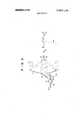
- FIG. 1is an elevation of an antenna device according to an embodiment of the present invention, showing the schematic arrangement of its major parts;
- FIG. 2is an elevation of the antenna device of FIG. 1, indicating the relationship of the reflector system and the direction in which there are reflected electromagnetic waves;
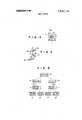
- FIG. 3is a plan view showing the positional relationship of the primary radiator and the plane reflector used in FIG. 2;
- FIG. 4is an elevation of-a mechanism for rotating the subreflector of FIG. 1 in a vertical plane
- FIG. 5is an elevation of a mechanism for causing the pane reflectors of FIG. 1 to move parallel with their respective original positions;
- FIG. 6is a block diagram of a beam deflection control system for causing the mechanisms of FIGS. 4 and 5 to be electrically driven in interlocking relationship by signals for detecting errors in defining the deflection of electromagnetic waves;
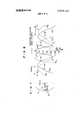
- FIG. 7illustrates the arrangement of a Cassegrain antenna device using a parabola reflector and a primary radiator
- FIG. 8represents the directional characteristics of electromagnetic waves in the horizontal plane of the antenna device using the reflector system of FIG. 7;
- FIGS. 9 and 10respectively are elevations of the reflector systems of the present antenna device and the conventional Cassegrain antenna device using a parabola reflector;
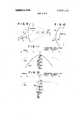
- FIG. 11is a diagram comprising the gains of the antenna devices of FIGS. 9 and 10 for a frequency of 4 GHz;
- FIG. 12is a diagram comparing the gains of the antenna devices of FIGS. 9 and 10 for a frequency of 18 Gl-Iz;
- FIG. 13illustrates the arrangement of reflectors in an antenna device according to another embodiment of the invention.
- FIG. 14shows the arrangement of reflectors in an antenna device according to still another embodiment of the invention.
- a main spherical reflector I having a prescribed curvature radiusis fixed on a mount 3 by a support 2.
- a sub-reflector 4for compensating the spherical aberration of the reflecting surface.
- Means 6 for driving the sub-reflector 4is held by supports 7 fixed to the main reflector 1 so as to rotate the subreflector 4 in the later described direction.
- part 8 of a parabolic reflectorwhose focal point is constituted by the curvature center 5 of the main spherical reflector 1.
- Numerals 9 and 10are plane reflectors each so designed as to move parallel with its original position.
- Numeral 12is the conical horn reflector of the primary radiator fixed at a prescribed point. This horn reflector 12 is connected to a stationary transmission and reception apparatus and radiates plane waves.
- the horizontal positional relationship of the horn reflector l2, and the plane reflectors 9 and 10 of FIG. 2is presented in FIG. 3.
- numeral 14denotes a central axial line connecting the center of the reflecting surface of the main spherical reflector l and its curvature center 5, 15 the central axial line of the parabolic reflectors 8 and 16 the central axial line of the conical horn reflector 12.
- the central axial line 17 (shown in a solid line) of the sub-reflector 4assumes a position rotated about the curvature center 5 in a verfical plane (that is, a plane parallel with the surface of the drawing sheet) through an angle with respect to the first mentioned central axial line 14.
- Said sub-reflector 4is so designed as to compensate the spherical aberration of the main spherical reflector l, with respect to, for example, electromagnetic waves introduced in the direction of the central axial line 17.
- plane waves from the conical horn reflector 12are reflected, as indicated in solid lines, by the plane reflectors 10 and 9 in turn.
- the plane waves thus reflectedare conducted to the parabolic reflector 8 in parallel with a line 15' which is also parallel with the central axial line 15.
- the parabolic reflector 8has a focal point on said central axial line 15, so that electromagnetical beams brought to said reflector 8 are so reflected as to be focussed at said focal point 15.
- the beamsare further reflected by the sub-reflector 4 and main reflector 1, rearranged in phase in the direction of the central axial line 17, and emitted in the form of beams having a sharp directivity in said direction.
- electromagnetic wavesare conducted through a route indicated by dotted lines, that is, plane waves from the conical horn reflector 12 are reflected by the plane reflector at point 9' and parabolic reflector 8, and advance to the focal point 5 or the curvature center of the main reflector 1, again reflected by the sub-reflector at point 4' and main reflector l and emitted in the form of waves fully rearranged in phase inthe direction of the central axial line 17'.
- the plane reflectoris brought, as shown in FIG. 3, to point 10 parallel with its original position along the axial line 18, a direction in which there are conducted plane waves from the horn reflector 12, and the subreflector 4 is made to rotate about the focal point 5 in a plane perpendicular to the surface of the drawing sheet.
- the antenna device of the present inventioncan track a stationary satellite without moving the main reflector and reducing the radiation property.
- the sub-reflector 4has, as shown in FIG. 4, a rotary shaft 19 extending in the direction of the axial line 17 and engaged with a gear 20, which in turn is rotated by a motor 22.
- a movable guide member 25comprising a toothed section 23 engaged with said gear 20 which jointly act as a sort of rack-pinion mechanism, and a groove 24 through which there are guided two rollers rotatably fitted to two supports respectively which are fixed to the back of the sub-reflector 4.
- rotation of the motor 22causes the sub-reflector 4 to be inclined in a vertical plane.
- the axial line 17 of the sub-reflector 4is so designed as to be deflected through an angle 0 at maximum with respect to the cenu'al axial line 14.
- a drive mechanism used in such casemay consist of a horizontally disposed guide member 25, a gear 20' engaged with the toothed section 23 of said guide member 25' and a motor 27 (FIG. 6) for driving said gear 20 (20', 23', 25', are not shown).
- the guide member 25is fixed to the support member 7 of FIG. I.
- FIG. 5whereby one plane reflector 9 is made to move parallel with its original position along the axial line 16 of FIG. 2.
- the plane reflector 9is fitted with a gear 33 driven by a motor 32 and engaged with a toothed guide member 34 fixed at a prescribed-position, said gear 33 and toothed member 34 jointly acting as a sort of rack-pinion mechanism. Accordingly, rotation of the motor 32 enables the plane reflector 9 to move parallel along the axial line 16.
- a detector 36for finding errors in deflecting radiated beams or waves.
- errorsmeans those degrees of an angle through which the radiated beam should be deflected in order to properly track a space satellite which has happened to shift its position.
- Error signalsare supplied to a generator or an analyzer 37 for generating signals indicating errorsoccurring in a vertical plane (EL plane) and also to another generator 38 for producing signals representing errors in a horizontal plane (AZ plane), thereby obtaining control signals 39 and 40 respectively.
- control signals 39 and 40are conducted to a circuit 42 for controlling the rotation of motors 22 and 32, namely, a circuit for driving said motors 22 and 32 so as to eliminate errors in the EL plane and also to a circuit 43 for controlling the rotation of motors 27 and 35, namely, a circuit for driving said motors 22and 32 so as to eliminate errors in the AZ plane so as to actuate the servo motors of these circuits.
- a circuit 42 for controlling the rotation of motors 22 and 32namely, a circuit for driving said motors 22 and 32 so as to eliminate errors in the EL plane
- a circuit 43 for controlling the rotation of motors 27 and 35namely, a circuit for driving said motors 22and 32 so as to eliminate errors in the AZ plane so as to actuate the servo motors of these circuits.
- the motors 22, 32, 27 and 35are driven by outputs from said circuits 42 and 43.
- detection signals from the detector 36can vary the angle at which there are radiated electromagnetical beams in the EL plane and such angle in the AZ plane separately, so that electromagnetical beams can be collectively deflected in an arbitrary direction passing through the previously mentioned conical region having a half vertical angle 0 which is disposed about the central axial line 14.
- FIG. 7represents a Cassegrain antenna device comprising a parabola reflector 1a 100 cm in outer diameter, subreflector 4a 12 cm in outer diameter and a conical horn reflector 12a having a beam hole 9.84 cm in diameter.
- the subreflector 4ais so designed as to be deflected through an angle d) with respect to its original axis about point 41.
- FIG. 8indicates the directional characteristics and gain loss of electromagnetic waves having a frequency of 50 GI-Iz which were radiated by said prior art antenna device.
- the abscissadenotes the actual inclination (in a horizontal plane) of electromagnetic waves with respect to the direction of the beams which were radiated when the sub-reflector 4a was inclined at angle q5 0.
- the ordinateindicates gain loss by dB as against a gain of 51.2 dB in the case of the aforesaid inclination at angle of the sub-reflector 4a.
- Curves 44a to 44hrepresent the directional characteristics of electromagnetic wave radiated when the inclination of the sub-reflector 4a assumed angles of 0, -8, +8, 16, +16, 20 and +20. As seen from FIG. 8, a 1 to 2 inclination in either way of the radiated beams from the standard direction causes an appreciable decline in their directional characteristics.
- FIG. 9shows the reflector system of the present invention used in an antenna device and FIG. 10 that of the conventional Cassegrain antenna device using a parabola reflector.
- the experimentally determined directional characteristics of radiated beams when the main reflectors of both antenna devices were alike 125 cm in center diameterare compared in both FIGS. 1 1 and 12.
- FIG. 1 1represents the case where there were used beams having a frequency of 4 GI-Iz and FIG. 12 18 GI-Iz.
- the abscissadenotes the deflection of radiated beams in a horizontal plane with respect to the axis of the main reflector, and the ordinate the antenna gain as measured on a comparative basis.
- the curves 46a and 46bshow the directional characteristics of electromagnetic waves radiated from the conventional antenna device of FIG. 10 and the curves 47a and 47b those obtained with the present antenna device.
- all these curveswere drawn by joining the peaks of curves representing the directional characteristics of radiated beams, that is, the points of highest gain.
- the antenna device of the present inventiondisplays a substantially fixed gain when radiated beams are deflected through an angle falling within a range of E", and, what describes particular notice, presents a prominently increased gain as radiated beams have a higher frequency.
- the aforementioned favorable characteristics of radiated beamsprove that the antenna device of the present invention is well adapted for space satellite telecommunication.
- FIG. 13illustrates another embodiment of the present invention capable of generating a plurality of beams in such a manner that their deflections can be separately controlled using a single spherical reflector.
- a pair of parabolic reflectors 8b and 8bin symmetrical relationship with respect to the axis 14 of the main spherical reflector l, the focal point of said paired parabolic reflectors being constituted by the curvature center 5 of the main reflector 1.
- the corresponding sub-reflectors 4b and 4bthere are provided, as illustrated, the corresponding sub-reflectors 4b and 4b, two groups of plane reflectors 9b-9'b and 10b-10'b and conical horn reflectors 12b and 12b.
- each primary radiator systemincluding from the conical horn reflector to the sub-reflector.
- the arrangement of each primary radiator system and its optical position with respect to the main spherical reflector 1are the same as in the embodiment of FIG. 2. Accordingly, when the axis of the sub-reflector 4b is deflected from the central axial line 14b and the plane reflectors 9b and 10b are moved in interlocking relationship with said deflection by the same means as used in the embodiment of FIG. 2, then radiated beams 17b can be deflected.
- FIG. 14represents still another embodiment of the present invention wherein there is positioned a primary radiator system in front of a main spherical reflector l. Namely, outside of the passage of electromagnetic waves radiated from the main reflector l, is disposed a primary radiator system including a sub-reflector 4. Under this arrangement, it is possible to provide a space satellite tracking antenna device capable of eliminating blocking and radiating a plurality of electromagnetic waves in such a manner that even when there are juxtaposed a plurality of primary radiator systems like that illustrated in FIG. 14, there does not occur mutual interference.
- the present inventioncan deflect radiated beams through a specified range of angles without moving the main spherical reflector simply by operating the movable constituent units of the primary radiator system in interlocking relationship, and further can deflect a plurality of electromagnetic waves separately, without degrading the directional characteristics of said waves or beams, so that the antenna device of the present invention is particularly adapted for use in a ground station tracking a stationary space satellite.
- An antenna devicecomprising:
- a sub-reflectordisposed between the curvature center and reflecting surface of the main reflector so as to reflect electromagnetic waves to said surface and having a mirror surface which is arranged to compensate for the spherical aberration of said main spherical reflector;
- a parabolic reflectorwhose focal point is coincident with said curvature center so as to reflect electromagnetic waves to said sub-reflector;
- a plane reflectorfor reflecting said electromagnetic waves to said parabolic reflector
- An antenna deviceaccording to claim 1 wherein said primary radiator, plane reflector, parabolic reflector, sub-reflector, means for rotating said sub-reflector and means for moving said plane reflector are respectively provided in a sufficient number to constitute a plurality of wave radiating and conducting systems and are so as to reflect a plurality of electromagnetic waves to said main reflector in such a manner that the deflections of said electromagnetic waves are separately controllable.
- An antenna devicecomprising said primary radiator, plane reflector, parabolic reflector, sub-reflector, means for rotating said sub-reflector and means for moving said plane reflector is positioned outside of the path of electromagnetic waves reflected from said main spherical reflector.
- a detectorfor detecting deflection errors in radiated waves and for generating error signals corresponding to vertical plane errors and horizontal plane errors
- said means responsive to said error signalsfurther includes motor means responsive to said control signals and coupled to said plane reflector for selectively rotating said plane reflector to reduce said deflection errors.
Landscapes
- Variable-Direction Aerials And Aerial Arrays (AREA)
- Aerials With Secondary Devices (AREA)
Abstract
Description
United States Patent Karikomi [4 July 25, 1972 54] ANTENNA DEVICE [56] References Cited UNITED STATES PATENTS [72] inventor: Mashahiro Karikomi, Tokyo, Japan 2,975,419 3/1961 Brown ..343/839 [73] Assignee: Nippon Telegraph and Telephone Public Corporation, Tokyo, Japan OTHER PUBLICATIONS [22] Filed;N 30, 1970 Electronics; Oct. 30, 1967 Vol. 40, No. 22, pp. 169, 170
1 1 pp 93. Primary Examiner-Eli Lieberman Attorney-Flynn & Frishauf [30] Foreign Application Priority Data 57] ABSTRACT Nov. 28, 1969 Japan ..44/94962 An antenna device comprising a main spherical reflector; a sub-reflector for reflecting electromagnetic waves to said [52] [1.8. CI. ..343/758, 343/761, 343/781, main reflector so as to compensate for the spherical abena 343/839 343/914 tion of said main reflector, a primary radiator, plane reflectors [51 1 Int. Cland a arabolic reflector wherein the subqeflector and plane Field 0f Search reflectors are interlocked with each other so as to causeplane 3/7 914 waves to be brought from the primary radiator to the subreflector through the plane reflectors and parabolic reflector.
6 Claims, 14 Drawing Figures PATENTEII 3.680.141
ANGLE (DEGREE) 18GHZ F I HORIZONTAL DEFLECTON ANGLE (DEGREE) -1 1 2 H E3443 MAM/Calm:
ANTENNA DEVICE The present invention relates to an antenna device comprising a main spherical reflector and a sub-reflector for compensating the spherical aberration of the main reflector, and more particularly to an antenna device capable of deflecting electromagnetic waves without moving the main spherical reflector.
Where telecommunication is conducted through a space satellite using signals in a superhigh frequency band (SI-IF band), the conventional antenna device of a ground station has been so designed as to track an object space satellite by turning the main reflector upward or downward or rotating it in accordance with the movement of said satellite. Even in the case of a stationary satellite, for example, which travels only through an extremely limited angle with respect to the ground station, it has been necessary to operate the whole of an antenna device in tracking such stationary satellite.
Since the main reflector has a considerably large diameter there must be built a gigantic antenna mount with the resulting complicated construction in order to firmly support and drive the main reflector against a certain magnitude of wind force. Obviously, the structure and weight of said main reflector is subject to limitation from the standpoint of constructing said antenna mount.
The aforesaid stationary satellite travels through an extremely minute angle with respect to a ground station, so that beams for tracking the satellite have only to be deflected through a small angle. If, therefore, the antenna device is so designed as to permit the tracking of the stationary satellite simply by deflecting radiated beams within the range of angles through which the satellite travels, with the greater part of the antenna device including the main reflector fixed in place, then the construction of the antenna device will obviously be considerably simplified. Further, if the antenna device is so arranged as to include a single main reflector and separately control the deflections of a plurality of radiated beams without moving said reflector, then it will enable the antenna device to display a more effective action and also offer economic advantage.
A ground station antenna device for satellite telecommunication has heretofore consisted of a Cassegrain type in many cases. There has also been employed a parabola antenna. The Cassegrain antenna device is known to be capable of deflecting radiated beams by inclining a sub-reflector (not intended to compensate spherical aberration) with respect to the main reflector. It is also known that both Cassegrain and parabola antenna devices can radiate a plurality of beams by providing a plurality of primary radiators, using a single main reflector. In either case, however, the optogeometrical conditions demanded of an antenna device are obstructed with the resulting loss of gain expected therefrom. Therefore, such a process has not yet been practically applied in an antenna device.
It is accordingly an object of the present invention to provide an antenna device capable of deflecting beams within a prescribed range of angles satisfying the opto-geometrical conditions without moving a main reflector.
Another object of the present invention is to provide an antenna device capable of radiating a plurality of beams whose deflection can be controlled independently, using a single main reflector.
SUMMARY OF INVENTION The antenna device of the present invention comprises a main spherical reflector for reflecting electromagnetic waves; a sub-reflector disposed between the curvature center and reflecting surface of the main reflector so as to compensate for the spherical aberration of the main reflector; a parabolic reflector whose focal point is coincident with the curvature center of the main spherical reflector so as to reflect electromagnetic waves to the sub-reflector; a plane reflector for reflecting electromagnetic waves to the parabolic reflector; a primary radiator conducting plane waves to the plane reflector; means for rotating said sub-reflector around an axial line passing through said curvature center of said main spherical reflector, with the central axis of said sub-reflector directed to said curvature center; and means for moving said plane reflector in interlocking relationship with the rotation of said subreflector so as to cause the plane electromagnetic waves to be conducted from said primary radiator to said subreflector through said parabolic reflector.
The reflecting surface of the main spherical reflector is faced to its center side. When there are brought to said effective surface plane waves parallel with a main axial line connecting the center of the reflecting surface and the curvature center, then the resulting reflected waves are not converged exactly at a focal point due to the spherical aberration of the main reflector. If, however, the path of electromagnetic waves is made to have a fixed length and there is provided a subreflector having its mirror curve so calculated as to satisfy the opto-geometrical law of reflection, then compensation of the aforesaid spherical aberration will be accomplished. Said compensation is conducted in such a manner that electromagnetic waves reflected by the sub-reflector may be deemed as spherical waves from the curvature center. The aforementioned compensatory means is based on opto-geometrical considerations, so that, strictly speaking, there may be required some correction by taking into consideration the concept of wave mechanics. With an antenna device whose main spherical reflector has a much longer diameter than the wavelength of electromagnetic waves brought thereto, the above-mentioned opto-geometrical consideration will fully serve the practical purpose.
The present invention will be more fully understood from the following description taken by reference to the appended drawings, in which:
FIG. 1 is an elevation of an antenna device according to an embodiment of the present invention, showing the schematic arrangement of its major parts;
FIG. 2 is an elevation of the antenna device of FIG. 1, indicating the relationship of the reflector system and the direction in which there are reflected electromagnetic waves;
FIG. 3 is a plan view showing the positional relationship of the primary radiator and the plane reflector used in FIG. 2;
FIG. 4 is an elevation of-a mechanism for rotating the subreflector of FIG. 1 in a vertical plane;
FIG. 5 is an elevation of a mechanism for causing the pane reflectors of FIG. 1 to move parallel with their respective original positions;
FIG. 6 is a block diagram of a beam deflection control system for causing the mechanisms of FIGS. 4 and 5 to be electrically driven in interlocking relationship by signals for detecting errors in defining the deflection of electromagnetic waves;
FIG. 7 illustrates the arrangement of a Cassegrain antenna device using a parabola reflector and a primary radiator;
FIG. 8 represents the directional characteristics of electromagnetic waves in the horizontal plane of the antenna device using the reflector system of FIG. 7;
FIGS. 9 and 10 respectively are elevations of the reflector systems of the present antenna device and the conventional Cassegrain antenna device using a parabola reflector;
FIG. 11 is a diagram comprising the gains of the antenna devices of FIGS. 9 and 10 for a frequency of 4 GHz;
FIG. 12 is a diagram comparing the gains of the antenna devices of FIGS. 9 and 10 for a frequency of 18 Gl-Iz;
FIG. 13 illustrates the arrangement of reflectors in an antenna device according to another embodiment of the invention; and
FIG. 14 shows the arrangement of reflectors in an antenna device according to still another embodiment of the invention.
Referring to FIGS. 1 and 2, a main spherical reflector I having a prescribed curvature radius is fixed on amount 3 by asupport 2. Between thecurvature center 5 and the reflecting surface of the main reflector l is disposed asub-reflector 4 for compensating the spherical aberration of the reflecting surface. Means 6 for driving thesub-reflector 4 is held bysupports 7 fixed to themain reflector 1 so as to rotate thesubreflector 4 in the later described direction. At the center of themain reflector 1 is positionedpart 8 of a parabolic reflector whose focal point is constituted by thecurvature center 5 of the mainspherical reflector 1.Numerals 9 and 10 are plane reflectors each so designed as to move parallel with its original position.Numeral 12 is the conical horn reflector of the primary radiator fixed at a prescribed point. Thishorn reflector 12 is connected to a stationary transmission and reception apparatus and radiates plane waves. The horizontal positional relationship of the horn reflector l2, and theplane reflectors 9 and 10 of FIG. 2 is presented in FIG. 3. Referring to FIG. 2,numeral 14 denotes a central axial line connecting the center of the reflecting surface of the main spherical reflector l and itscurvature center parabolic reflectors conical horn reflector 12.
In the above-mentioned antenna device, the central axial line 17 (shown in a solid line) of thesub-reflector 4 assumes a position rotated about thecurvature center 5 in a verfical plane (that is, a plane parallel with the surface of the drawing sheet) through an angle with respect to the first mentioned centralaxial line 14. Saidsub-reflector 4 is so designed as to compensate the spherical aberration of the main spherical reflector l, with respect to, for example, electromagnetic waves introduced in the direction of the central axial line 17. On the other hand, plane waves from theconical horn reflector 12 are reflected, as indicated in solid lines, by theplane reflectors 10 and 9 in turn. The plane waves thus reflected are conducted to theparabolic reflector 8 in parallel with a line 15' which is also parallel with the centralaxial line 15. Theparabolic reflector 8 has a focal point on said centralaxial line 15, so that electromagnetical beams brought to saidreflector 8 are so reflected as to be focussed at saidfocal point 15. The beams are further reflected by thesub-reflector 4 andmain reflector 1, rearranged in phase in the direction of the central axial line 17, and emitted in the form of beams having a sharp directivity in said direction.
There will now be described the case where radiated waves are deflected without moving themain reflector 1. When, there are emitted beams in the direction 17 in a vertical plane, the central axial line 17 is made to rotate aboutpoint 5 so as to be aligned with the line 17. In this case, thesubreflector 4 is inclined to a position indicated by 4. At the same time the plane reflector 9 is moved up to point 9' parallel with its original position along theaxial line 16. In this case, electromagnetic waves are conducted through a route indicated by dotted lines, that is, plane waves from theconical horn reflector 12 are reflected by the plane reflector at point 9' andparabolic reflector 8, and advance to thefocal point 5 or the curvature center of themain reflector 1, again reflected by the sub-reflector at point 4' and main reflector l and emitted in the form of waves fully rearranged in phase inthe direction of the central axial line 17'.
Next where radiated waves are deflected in a horizontal plane (that is, a plane perpendicular to the surface of the drawing sheet), then the plane reflector is brought, as shown in FIG. 3, to point 10 parallel with its original position along theaxial line 18, a direction in which there are conducted plane waves from thehorn reflector 12, and thesubreflector 4 is made to rotate about thefocal point 5 in a plane perpendicular to the surface of the drawing sheet.
There have been described the cases where radiated waves are deflected in vertical and horizontal planes. If, in this case, theplane reflectors 9 and 10 andsub-reflector 4 are made to move in interlocking relationship according to the direction in which electromagnetic waves are to be deflected, such deflection can be effected in a state fully meeting the opto-geometrical conditions involved with respect to any direction in which said electromagnetical beams pass through a conical region having a halfvertical angle 0 which is disposed about the centralaxial line 14. Accordingly, the antenna device of the present invention can track a stationary satellite without moving the main reflector and reducing the radiation property.
There will now be described means for causing thesubreflector 4 andplane reflectors 9 and 10 to interlock with each other. Thesub-reflector 4 has, as shown in FIG. 4, a rotary shaft 19 extending in the direction of the axial line 17 and engaged with agear 20, which in turn is rotated by amotor 22. For the sub-reflector 4 there is also provided amovable guide member 25 comprising atoothed section 23 engaged with saidgear 20 which jointly act as a sort of rack-pinion mechanism, and agroove 24 through which there are guided two rollers rotatably fitted to two supports respectively which are fixed to the back of thesub-reflector 4. As seen from FIG. 4, rotation of themotor 22 causes the sub-reflector 4 to be inclined in a vertical plane. In this case, the axial line 17 of thesub-reflector 4 is so designed as to be deflected through anangle 0 at maximum with respect to the cenu'alaxial line 14. To incline the sub-reflector 4 in a horizontal plane, it is only required to deflect theentire assembly 26 of FIG. 4 in a horizontal plane through anangle 0 at maximum aboutpoint 5 of FIG. 2. A drive mechanism used in such case may consist of a horizontally disposedguide member 25, a gear 20' engaged with thetoothed section 23 of said guide member 25' and a motor 27 (FIG. 6) for driving said gear 20 (20', 23', 25', are not shown). In this case theguide member 25 is fixed to thesupport member 7 of FIG. I.
There will now be described a mechanism (FIG. 5 whereby one plane reflector 9 is made to move parallel with its original position along theaxial line 16 of FIG. 2. In this case, there are provided twoguide members 28 disposed at a prescribed position with respect to themain reflector 1, each of saidguide members 28 having aguide groove 30 through which there slides one of the tworollers 29 rotatably fitted to the plane reflector 9 so as to cause it to move parallel along theaxial line 16 of FIG. 2. The plane reflector 9 is fitted with agear 33 driven by amotor 32 and engaged with atoothed guide member 34 fixed at a prescribed-position, saidgear 33 andtoothed member 34 jointly acting as a sort of rack-pinion mechanism. Accordingly, rotation of themotor 32 enables the plane reflector 9 to move parallel along theaxial line 16.
When theother plane reflector 10 is made to move parallel along theaxial line 18, there is used the same drive arrangement as that of FIG. 5 though it is fitted in a different direction. The gear 33' (not shown) of the drive arrangement for theplane reflector 10 is driven by a motor 35 (FIG. 6).
There will now be described means for causing thesubreflector 4 and theplane reflectors 9 and 10 to be moved in interlocking relationship. As shown in FIG. 6, there is provided adetector 36 for finding errors in deflecting radiated beams or waves. As used herein, the term errors" means those degrees of an angle through which the radiated beam should be deflected in order to properly track a space satellite which has happened to shift its position. Error signals are supplied to a generator or ananalyzer 37 for generating signals indicating errorsoccurring in a vertical plane (EL plane) and also to anothergenerator 38 for producing signals representing errors in a horizontal plane (AZ plane), thereby obtainingcontrol signals circuit 42 for controlling the rotation ofmotors motors circuit 43 for controlling the rotation ofmotors motors circuits detector 36 can vary the angle at which there are radiated electromagnetical beams in the EL plane and such angle in the AZ plane separately, so that electromagnetical beams can be collectively deflected in an arbitrary direction passing through the previously mentioned conical region having a halfvertical angle 0 which is disposed about the centralaxial line 14.
There will now be described the deflection characteristics of electromagnetic waves radiated by the antenna device of the present invention in comparison with those obtained with the conventional Cassegrain antenna device using a parabola reflector. FIG. 7 represents a Cassegrain antenna device comprising aparabola reflector 1a 100 cm in outer diameter,subreflector 4a 12 cm in outer diameter and aconical horn reflector 12a having a beam hole 9.84 cm in diameter. The subreflector 4a is so designed as to be deflected through an angle d) with respect to its original axis aboutpoint 41. FIG. 8 indicates the directional characteristics and gain loss of electromagnetic waves having a frequency of 50 GI-Iz which were radiated by said prior art antenna device. The abscissa denotes the actual inclination (in a horizontal plane) of electromagnetic waves with respect to the direction of the beams which were radiated when the sub-reflector 4a was inclined atangle q5 0. The ordinate indicates gain loss by dB as against a gain of 51.2 dB in the case of the aforesaid inclination at angle of the sub-reflector 4a. Curves 44a to 44h represent the directional characteristics of electromagnetic wave radiated when the inclination of the sub-reflector 4a assumed angles of 0, -8, +8, 16, +16, 20 and +20. As seen from FIG. 8, a 1 to 2 inclination in either way of the radiated beams from the standard direction causes an appreciable decline in their directional characteristics.
FIG. 9 shows the reflector system of the present invention used in an antenna device and FIG. 10 that of the conventional Cassegrain antenna device using a parabola reflector. The experimentally determined directional characteristics of radiated beams when the main reflectors of both antenna devices were alike 125 cm in center diameter are compared in both FIGS. 1 1 and 12. FIG. 1 1 represents the case where there were used beams having a frequency of 4 GI-Iz and FIG. 12 18 GI-Iz. Throughout these figures, the abscissa denotes the deflection of radiated beams in a horizontal plane with respect to the axis of the main reflector, and the ordinate the antenna gain as measured on a comparative basis. Thecurves curves
FIG. 13 illustrates another embodiment of the present invention capable of generating a plurality of beams in such a manner that their deflections can be separately controlled using a single spherical reflector. There are provided a pair ofparabolic reflectors axis 14 of the main spherical reflector l, the focal point of said paired parabolic reflectors being constituted by thecurvature center 5 of themain reflector 1. For these pairedparabolic reflectors plane reflectors 9b-9'b and 10b-10'b andconical horn reflectors spherical reflector 1 are the same as in the embodiment of FIG. 2. Accordingly, when the axis of the sub-reflector 4b is deflected from the centralaxial line 14b and theplane reflectors beams 17b can be deflected.
Similarly when the axis of the sub-reflector 4'b is deflected from the central axial line 14'!) and theplane reflectors 9 b and l0b are moved in interlocking relationship with said deflection, then radiated beams l7'b can be deflected independently of the first mentionedbeams 17b. Though the embodiment of FIG. 13 includes two primary radiator system the present invention is obviously not limited to said number.
FIG. 14 represents still another embodiment of the present invention wherein there is positioned a primary radiator system in front of a main spherical reflector l. Namely, outside of the passage of electromagnetic waves radiated from the main reflector l, is disposed a primary radiator system including asub-reflector 4. Under this arrangement, it is possible to provide a space satellite tracking antenna device capable of eliminating blocking and radiating a plurality of electromagnetic waves in such a manner that even when there are juxtaposed a plurality of primary radiator systems like that illustrated in FIG. 14, there does not occur mutual interference.
As mentioned above, the present invention can deflect radiated beams through a specified range of angles without moving the main spherical reflector simply by operating the movable constituent units of the primary radiator system in interlocking relationship, and further can deflect a plurality of electromagnetic waves separately, without degrading the directional characteristics of said waves or beams, so that the antenna device of the present invention is particularly adapted for use in a ground station tracking a stationary space satellite.
What is claimed is:
1. An antenna device comprising:
a main spherical reflector for reflecting electromagnetic waves;
a sub-reflector disposed between the curvature center and reflecting surface of the main reflector so as to reflect electromagnetic waves to said surface and having a mirror surface which is arranged to compensate for the spherical aberration of said main spherical reflector;
a parabolic reflector whose focal point is coincident with said curvature center so as to reflect electromagnetic waves to said sub-reflector;
a primary radiator for radiating plane electromagnetic waves;
a plane reflector for reflecting said electromagnetic waves to said parabolic reflector;
means for rotating said sub-reflector around an axial line passing through said curvature center of said main spherical reflector, with the central axis of said sub-reflector directed to said curvature center; and
means for moving said plane reflector in interlocking relationship with the rotation of said sub-reflector so as to cause the plane electromagnetic waves to be conducted from said primary radiator to said sub-reflector through said parabolic reflector.
2. An antenna device according toclaim 1 wherein said primary radiator, plane reflector, parabolic reflector, sub-reflector, means for rotating said sub-reflector and means for moving said plane reflector are respectively provided in a sufficient number to constitute a plurality of wave radiating and conducting systems and are so as to reflect a plurality of electromagnetic waves to said main reflector in such a manner that the deflections of said electromagnetic waves are separately controllable.
3. An antenna device according toclaim 1 wherein a wave radiating and conducting system comprising said primary radiator, plane reflector, parabolic reflector, sub-reflector, means for rotating said sub-reflector and means for moving said plane reflector is positioned outside of the path of electromagnetic waves reflected from said main spherical reflector.
4. An antenna device according toclaim 1 wherein said means for moving said plane reflector in interlocking relationship with the rotation of said sub-reflector comprises:
a detector for detecting deflection errors in radiated waves and for generating error signals corresponding to vertical plane errors and horizontal plane errors; and
signals.
6. An antenna device according toclaim 5 wherein said means responsive to said error signals further includes motor means responsive to said control signals and coupled to said plane reflector for selectively rotating said plane reflector to reduce said deflection errors.
* I I I! i
Claims (6)
1. An antenna device comprising: a main spherical reflector for reflecting electromagnetic waves; a sub-reflector disposed between the curvature center and reflecting surface of the main reflector so as to reflect electromagnetic waves to said surface and having a mirror surface which is arranged to compensate for the spherical aberration of said main spherical reflector; a parabolic reflector whose focal point is coincident with said curvature center so as to reflect electromagnetic waves to said sub-reflector; a primary radiator for radiating plane electromagnetic waves; a plane reflector for reflecting said electromagnetic waves to said parabolic reflector; means for rotating said sub-reflector around an axial line passing through said curvature center of said main spherical reflector, with the central axis of said sub-reflector directed to said curvature center; and means for moving said plane reflector in interlocking relationship with the rotation of said sub-reflector so as to cause the plane electromagnetic waves to be conducted from said primary radiator to said sub-reflector through said parabolic reflector.
2. An antenna device according to claim 1 wherein said primary radiator, plane reflector, parabolic reflector, sub-reflector, means for rotating said sub-reflector and means for moving said plane reflector are respectively provided in a sufficient number to constitute a plurality of wave radiating and conducting systems and are so as to reflect a plurality of electromagnetic waves to said main reflector in such a manner that the deflections of said electromagnetic waves are separately controllable.
3. An antenna device according to claim 1 wherein a wave radiating and conducting system comprising said primary radiator, plane reflector, parabolic reflector, sub-reflector, means for rotating said sub-reflector and means for moving said plane reflector is positioned outside of the path of electromagnetic waves reflected from said main spherical reflector.
4. An antenna device according to claim 1 wherein said means for moving said plane reflector in interlocking relationship with the rotation of said sub-reflector comprises: a detector for detecting deflection errors in radiated waves and for generating error signals corresponding to vertical plane errors and horizontal plane errors; and means responsive to said error signals for selectively rotating said plane reflector so as to reduce said deflection errors.
5. An antenna device according to claim 4 wherein said means responsive to said error signals includes means for generating respective control signals corresponding to said vertical plane and horizontal plane error signals, said plane reflector being selectively rotated in response to said control signals.
6. An antenna device according to claim 5 wherein said means responsive to said error signals further includes motor means responsive to said control signals and coupled to said plane reflector for selectively rotating said plane reflector to reduce said deflection errors.
Applications Claiming Priority (1)
| Application Number | Priority Date | Filing Date | Title |
|---|---|---|---|
| JP44094962AJPS5028148B1 (en) | 1969-11-28 | 1969-11-28 |
Publications (1)
| Publication Number | Publication Date |
|---|---|
| US3680141Atrue US3680141A (en) | 1972-07-25 |
Family
ID=14124537
Family Applications (1)
| Application Number | Title | Priority Date | Filing Date |
|---|---|---|---|
| US93795AExpired - LifetimeUS3680141A (en) | 1969-11-28 | 1970-11-30 | Antenna device |
Country Status (5)
| Country | Link |
|---|---|
| US (1) | US3680141A (en) |
| JP (1) | JPS5028148B1 (en) |
| DE (1) | DE2058550C3 (en) |
| FR (1) | FR2073432B1 (en) |
| GB (1) | GB1302399A (en) |
Cited By (16)
| Publication number | Priority date | Publication date | Assignee | Title |
|---|---|---|---|---|
| US3795003A (en)* | 1973-02-26 | 1974-02-26 | Us Army | Schwarzschild radar antenna with a unidirectional turnstile scanner |
| US3803619A (en)* | 1973-02-26 | 1974-04-09 | Us Army | Multi-horn wheel scanner with stationary feed pipe for schwarzschild radar antenna |
| US3953858A (en)* | 1975-05-30 | 1976-04-27 | Bell Telephone Laboratories, Incorporated | Multiple beam microwave apparatus |
| US4062018A (en)* | 1973-12-21 | 1977-12-06 | Kokusai Denshin Denwa Kabushiki Kaisha | Scanning antenna with moveable beam waveguide feed and defocusing adjustment |
| US4365252A (en)* | 1979-12-18 | 1982-12-21 | Societe Nationale Industrielle Aerospatiale | Correction method for transverse defocussing of parabolic antenna |
| US4462034A (en)* | 1980-08-28 | 1984-07-24 | Mitsubishi Denki Kabushiki Kaisha | Antenna system with plural horn feeds |
| US4535338A (en)* | 1982-05-10 | 1985-08-13 | At&T Bell Laboratories | Multibeam antenna arrangement |
| US4638322A (en)* | 1984-02-14 | 1987-01-20 | The Boeing Company | Multiple feed antenna |
| US4668955A (en)* | 1983-11-14 | 1987-05-26 | Ford Aerospace & Communications Corporation | Plural reflector antenna with relatively moveable reflectors |
| US4692771A (en)* | 1985-03-28 | 1987-09-08 | Satellite Technology Services, Inc. | Antenna dish reflector with integral azimuth track |
| US4712111A (en)* | 1984-12-26 | 1987-12-08 | Sharp Kabushiki Kaisha | Antenna system |
| US4716416A (en)* | 1985-03-28 | 1987-12-29 | Satellite Technology Services, Inc. | Antenna dish reflector with integral declination adjustment |
| US5003321A (en)* | 1985-09-09 | 1991-03-26 | Sts Enterprises, Inc. | Dual frequency feed |
| EP0517976A1 (en)* | 1983-10-31 | 1992-12-16 | Raytheon Company | Pulse radar |
| US6456253B1 (en)* | 1999-11-02 | 2002-09-24 | RR Elektronische Geräte GmbH & Co. KG | Reflector antenna and method of producing a sub-reflector |
| US9774095B1 (en)* | 2011-09-22 | 2017-09-26 | Space Systems/Loral, Llc | Antenna system with multiple independently steerable shaped beams |
Families Citing this family (1)
| Publication number | Priority date | Publication date | Assignee | Title |
|---|---|---|---|---|
| FR2513820A1 (en)* | 1981-09-30 | 1983-04-01 | Alsthom Atlantique | Feed system for satellite tracking antenna - uses additional reflector perpendicular to rectangularly disposed reflectors on azimuth axis to radiate along low longitudinal axis |
Citations (1)
| Publication number | Priority date | Publication date | Assignee | Title |
|---|---|---|---|---|
| US2975419A (en)* | 1959-10-13 | 1961-03-14 | Newell H Brown | Microwave antenna reflector system for scanning by displacement of focal image |
Family Cites Families (3)
| Publication number | Priority date | Publication date | Assignee | Title |
|---|---|---|---|---|
| US2976533A (en)* | 1954-11-12 | 1961-03-21 | Zenith Radio Corp | Radio astronomy antenna having spherical reflector formed integral with earth's surface |
| US3392397A (en)* | 1966-02-15 | 1968-07-09 | Gen Precision Systems Inc | Cassegrain antenna for scanning with elliptically shaped beam |
| FR1569747A (en)* | 1968-03-12 | 1969-06-06 |
- 1969
- 1969-11-28JPJP44094962Apatent/JPS5028148B1/jaactivePending
- 1970
- 1970-11-27FRFR7042678Apatent/FR2073432B1/frnot_activeExpired
- 1970-11-28DEDE2058550Apatent/DE2058550C3/ennot_activeExpired
- 1970-11-30GBGB5688070Apatent/GB1302399A/ennot_activeExpired
- 1970-11-30USUS93795Apatent/US3680141A/ennot_activeExpired - Lifetime
Patent Citations (1)
| Publication number | Priority date | Publication date | Assignee | Title |
|---|---|---|---|---|
| US2975419A (en)* | 1959-10-13 | 1961-03-14 | Newell H Brown | Microwave antenna reflector system for scanning by displacement of focal image |
Non-Patent Citations (1)
| Title |
|---|
| Electronics; Oct. 30, 1967 Vol. 40, No. 22, pp. 169, 170* |
Cited By (17)
| Publication number | Priority date | Publication date | Assignee | Title |
|---|---|---|---|---|
| US3803619A (en)* | 1973-02-26 | 1974-04-09 | Us Army | Multi-horn wheel scanner with stationary feed pipe for schwarzschild radar antenna |
| US3795003A (en)* | 1973-02-26 | 1974-02-26 | Us Army | Schwarzschild radar antenna with a unidirectional turnstile scanner |
| US4062018A (en)* | 1973-12-21 | 1977-12-06 | Kokusai Denshin Denwa Kabushiki Kaisha | Scanning antenna with moveable beam waveguide feed and defocusing adjustment |
| US3953858A (en)* | 1975-05-30 | 1976-04-27 | Bell Telephone Laboratories, Incorporated | Multiple beam microwave apparatus |
| US4365252A (en)* | 1979-12-18 | 1982-12-21 | Societe Nationale Industrielle Aerospatiale | Correction method for transverse defocussing of parabolic antenna |
| US4462034A (en)* | 1980-08-28 | 1984-07-24 | Mitsubishi Denki Kabushiki Kaisha | Antenna system with plural horn feeds |
| US4559540A (en)* | 1980-08-28 | 1985-12-17 | Mitsubishi Denki Kabushiki Kaisha | Antenna system with plural horn feeds |
| US4535338A (en)* | 1982-05-10 | 1985-08-13 | At&T Bell Laboratories | Multibeam antenna arrangement |
| EP0517976A1 (en)* | 1983-10-31 | 1992-12-16 | Raytheon Company | Pulse radar |
| US4668955A (en)* | 1983-11-14 | 1987-05-26 | Ford Aerospace & Communications Corporation | Plural reflector antenna with relatively moveable reflectors |
| US4638322A (en)* | 1984-02-14 | 1987-01-20 | The Boeing Company | Multiple feed antenna |
| US4712111A (en)* | 1984-12-26 | 1987-12-08 | Sharp Kabushiki Kaisha | Antenna system |
| US4716416A (en)* | 1985-03-28 | 1987-12-29 | Satellite Technology Services, Inc. | Antenna dish reflector with integral declination adjustment |
| US4692771A (en)* | 1985-03-28 | 1987-09-08 | Satellite Technology Services, Inc. | Antenna dish reflector with integral azimuth track |
| US5003321A (en)* | 1985-09-09 | 1991-03-26 | Sts Enterprises, Inc. | Dual frequency feed |
| US6456253B1 (en)* | 1999-11-02 | 2002-09-24 | RR Elektronische Geräte GmbH & Co. KG | Reflector antenna and method of producing a sub-reflector |
| US9774095B1 (en)* | 2011-09-22 | 2017-09-26 | Space Systems/Loral, Llc | Antenna system with multiple independently steerable shaped beams |
Also Published As
| Publication number | Publication date |
|---|---|
| DE2058550B2 (en) | 1973-08-02 |
| FR2073432B1 (en) | 1976-09-03 |
| DE2058550A1 (en) | 1971-06-16 |
| FR2073432A1 (en) | 1971-10-01 |
| GB1302399A (en) | 1973-01-10 |
| DE2058550C3 (en) | 1974-03-14 |
| JPS5028148B1 (en) | 1975-09-12 |
Similar Documents
| Publication | Publication Date | Title |
|---|---|---|
| US3680141A (en) | Antenna device | |
| US4062018A (en) | Scanning antenna with moveable beam waveguide feed and defocusing adjustment | |
| US3835469A (en) | Optical limited scan antenna system | |
| US6204822B1 (en) | Multibeam satellite communication antenna | |
| US3763493A (en) | Antenna device applicable for two different frequency bands | |
| US3914768A (en) | Multiple-beam Cassegrainian antenna | |
| US4529990A (en) | Antenna system for a jamming transmitter | |
| CA1067204A (en) | Satellite tracking antenna with multiple reflectors | |
| US20080238790A1 (en) | Rotating Screen Dual Reflector Antenna | |
| US3045237A (en) | Antenna system having beam control members consisting of array of spiral elements | |
| US3189907A (en) | Zone plate radio transmission system | |
| US2413085A (en) | Antenna system | |
| US2408373A (en) | Antenna | |
| US3562753A (en) | Casseyrain antenna system with rotatable main reflector for scanning | |
| US6061033A (en) | Magnified beam waveguide antenna system for low gain feeds | |
| EP0100466B1 (en) | Dual-band antenna system of a beam waveguide type | |
| US6747604B2 (en) | Steerable offset antenna with fixed feed source | |
| US2530098A (en) | Antenna | |
| US3745582A (en) | Dual reflector antenna capable of steering radiated beams | |
| US4937587A (en) | Low profile scanning antenna | |
| US4464666A (en) | Multiple reflector antenna | |
| US3852765A (en) | Spherical double reflector antenna | |
| US3968497A (en) | Antenna with a periscope arrangement | |
| US3605105A (en) | Stabilizer for reflector of a pole-mounted antenna | |
| US3147479A (en) | Plural juxtaposed parabolic reflectors with frequency independent feeds |
Legal Events
| Date | Code | Title | Description |
|---|---|---|---|
| AS | Assignment | Owner name:NIPPON TELEGRAPH & TELEPHONE CORPORATION Free format text:CHANGE OF NAME;ASSIGNOR:NIPPON TELEGRAPH AND TELEPHONE PUBLIC CORPORATION;REEL/FRAME:004454/0001 Effective date:19850718 |