US3675083A - Universal bus arrangement for data processing systems - Google Patents
Universal bus arrangement for data processing systemsDownload PDFInfo
- Publication number
- US3675083A US3675083AUS72092AUS3675083DAUS3675083AUS 3675083 AUS3675083 AUS 3675083AUS 72092 AUS72092 AUS 72092AUS 3675083D AUS3675083D AUS 3675083DAUS 3675083 AUS3675083 AUS 3675083A
- Authority
- US
- United States
- Prior art keywords
- board
- connector
- module
- circuit
- data processing
- Prior art date
- Legal status (The legal status is an assumption and is not a legal conclusion. Google has not performed a legal analysis and makes no representation as to the accuracy of the status listed.)
- Expired - Lifetime
Links
Images
Classifications
- G—PHYSICS
- G06—COMPUTING OR CALCULATING; COUNTING
- G06F—ELECTRIC DIGITAL DATA PROCESSING
- G06F13/00—Interconnection of, or transfer of information or other signals between, memories, input/output devices or central processing units
- G06F13/38—Information transfer, e.g. on bus
- G06F13/40—Bus structure
- G06F13/4063—Device-to-bus coupling
- G06F13/409—Mechanical coupling
- H—ELECTRICITY
- H05—ELECTRIC TECHNIQUES NOT OTHERWISE PROVIDED FOR
- H05K—PRINTED CIRCUITS; CASINGS OR CONSTRUCTIONAL DETAILS OF ELECTRIC APPARATUS; MANUFACTURE OF ASSEMBLAGES OF ELECTRICAL COMPONENTS
- H05K1/00—Printed circuits
- H05K1/02—Details
- H05K1/14—Structural association of two or more printed circuits
- H—ELECTRICITY
- H05—ELECTRIC TECHNIQUES NOT OTHERWISE PROVIDED FOR
- H05K—PRINTED CIRCUITS; CASINGS OR CONSTRUCTIONAL DETAILS OF ELECTRIC APPARATUS; MANUFACTURE OF ASSEMBLAGES OF ELECTRICAL COMPONENTS
- H05K7/00—Constructional details common to different types of electric apparatus
- H05K7/14—Mounting supporting structure in casing or on frame or rack
- H05K7/1438—Back panels or connecting means therefor; Terminals; Coding means to avoid wrong insertion
- H05K7/1439—Back panel mother boards
Definitions
- Corresponding contacts on each boardare reserved for a specific signal.
- the boardsare inserted in connector blocks which have corresponding terminal pins in circuit with the individual contacts.
- Another circuit boardsupports each connector block. Conductors on this board connect corresponding terminal pins on all the connector blocks in parallel so that any individual circuit board can be inserted in any connector block.
- This inventionis generally related to data processing systems and more specifically to means for interconnecting circuits in such data processing systems.
- Data processing systemscomprise groups of electrical components which are arranged to perform specific functions with respect to particular electrical signals. Most of these components, including resistors, transistors and other solid state devices, and integrated circuits, are mounted on individual printed circuit boards.
- module boarddefines such a printed circuit board and its mounted components in the following discussion.
- a given module boardmight include several such circuits to perform several functions.
- a single module boardmight include the components for a portion of the arithmetic unit or for a register memory in a data processing system.
- a data processing systemcomprises several module boards; and contacts along the edge of each module board couple signals to or from that board.
- a connector blocksupports one or more module boards in the data processing system.
- Each connector blockcomprises a plurality of rearwardly extending terminal pins which are in circuit with contacts on an inserted module board.
- the extender-boardcomprises contacts for insertion in the system connector block and a connector for accepting the module board being tested with conductors interconnecting the contacts and the connector. This makes the module board more accessible for testing.
- Yet another object of this inventionis to provide a data processing system in which theinterconnection of individual module boards is simplified.
- module boardscomprise a plurality of contacts which engage connector blocks. Corresponding contacts in a specific location on all module boards-are reserved for the same signal so corresponding ter-. minal pins on the connector blocks and in-circuit with the contacts are also reserved for the same signal.
- Another circuit boardsupports the connector blocks so electrically corresponding terminal pins are aligned. Conductors on this circuit board electrically connect all corresponding terminal pins. As a result, a module board can operate in any connector block location.
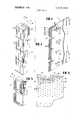
- FIG. 1is a perspective view of a module board used in data processing systems
- FIG. 2is a perspective view of a connector block for receiving a module board such as shown in FIG. 1;
- FIG. 3is another perspective view of a portion of the connector block shown in FIG. 2;
- FIG. 4illustrates a back circuit board for interconnecting connector blocks in accordance with this invention
- FIG. 5is a perspective view of an assembled back circuit board, connector blocks and module boards.
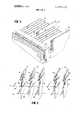
- FIG. 6schematically illustrates how the back circuit board interconnects the module boards in accordance with this invention.
- a module boardhas a plurality of contact locations along one edge. Each location is reserved for a specific signal and a corresponding location on all the module boards is reserved for the same signal. For example, a first contact location on each module board might be reserved for a particular supply voltage, while another location is reserved for a specific gating pulse. Each module board has contacts formed at the locations for carrying signals involving that module board. Otherwise, the contacts are usually omitted.
- this interconnection arrangementfacilitates the installation of module boards. No unique module board locations exist. This arrangement also facilitates testing because a malfunctioning module board in a cluster can be relocated in a vacant position. This enables test leads to be connected directly to the various test points on the board and to allow in situ testing.
- each module boardmust be increased when this invention is implemented.
- One contact locationmust be reserved for each different signal which must be interconnected between any two boards. Since any single board normally responds to fewer than allthe interconnected signals, each module board contains unused contact locations. Further, increased module board sizes are necessary to accept the increased number of contact locations.
- a typical module board 10comprises a printed circuit board 12 with a plurality of conductive layers 14 soldered to components 16 so that the components I6 perfonn some function.
- These module boardsare well known in the art.
- Each signalbe it a supply voltage, a gating pulse or other signal, has a specifically reserved contact location on the printed circuit board 12.
- contacts 18a, 18b and 180might be reserved for power supply voltages.
- Contact 18dcould be an electrical ground, while the location l8e might be reserved for a gating pulse. As there is no contact at the location l8e of the printed circuit board 12 shown in the FIGURE this module board does not generate or use that gating pulse.
- FIGS. 2 and 3show a connector block for the module boards.
- a row of contact fingers 22 at the front of the connector block 20engages the contacts 18 of an inserted module board.
- Each contact finger 22is in circuit with one of a plurality of terminal pins 24 which extend from the rear of the block 20.
- the contact fingers 22are aligned to accept the planar module boards and engage the contacts 18, while terminal pins 24 connected to adjacent contact fingers are offset to form a pair of staggered pin rows 26 and 28 for each module board. This arrangement increases the terminal pin spacing and is known in the art.
- a back circuit board 40replaces the prior point-to point wiring. It supports all the connector blocks 20.
- the terminal pins 24pass through apertures 42 in, the board 40 as shown in FIGS. 4 and 5.
- the back circuit board 40also includes a plurality of conductive layers 44 on each plane or surface. Each conductive layer is soldered to all corresponding terminal pins. For example, the layer 44a (FIG. 6) is soldered to all terminal pins corresponding to terminal pin 24a. Another conductive layer 44b on the other side of the back circuit board 40 connects all the terminal pins corresponding to terminal pin 24b. Hence, as shown in FIG.
- the pulsepasses through a connector block and terminal pin onto the conductive layer 44. If any other module has a contact at a position corresponding to the contact l8e, it receives the gating pulse regardless of its location because a corresponding contact finger in each connector block is energized by this pulse. In this specific context, the module board in FIG. 1 would not receive the gating pulse.
- a data processing systemcomprising this invention provides random module board 10- cations.
- random module boards 50 and 52 in FIG. 5can be interchanged without altering system operation. That is, the module boards 50 and 52 can be interchanged without adversely affecting the operation of the system provided they are oriented properly in a connector block.
- Several keying and other locating arrangementsexist to assure proper orientation.
- this inventionsimplifies testing procedures, especially those performed in situ. Normally, there are several unused connector blocks adjacent to one another, while other adjacent connector blocks support the module boards as shown in FIG. 5. As any module board operates properly in any connector block, it can be installed in a vacant connector block and tested with the surrounding open space facilitating the attachment of leads from testing equipment.
- the circuit board 40has conductive layers on both sides and the contact fingers m the connector blocks are connected to two rows of terminal pins. Both these features increase the effective connection density.
- the terminal pinscould be spaced further apart or in a single line. If sufficient spacing exists, the circuit board 40 may only have conductive layers deposited on one side.
- a data processing apparatuscomprising:
- iiimeans for coupling a signal between its respective contact positions and circuit means when the module board has circuit means for receiving or sending that signal
- each connector meansincluding i. means for supporting a module board,
- each conductive meansinterconnecting a corresponding terminal pin on each connector means whereby all corresponding coupling means on each of said module boards are connected to each other.
- each connector meansA. a corresponding terminal pin in each connector means is aligned in a row, and
- said interconnecting meanscomprises a connector board extending transversely with respect to said terminal pins
- said connector boardincluding; I
Landscapes
- Engineering & Computer Science (AREA)
- General Engineering & Computer Science (AREA)
- Theoretical Computer Science (AREA)
- Microelectronics & Electronic Packaging (AREA)
- Computer Hardware Design (AREA)
- Physics & Mathematics (AREA)
- General Physics & Mathematics (AREA)
- Coupling Device And Connection With Printed Circuit (AREA)
- Mounting Of Printed Circuit Boards And The Like (AREA)
Abstract
Description
United States Patent White [451 July 4,1972
[54] UNIVERSAL BUS ARRANGEMENT FOR DATA PROCESSING SYSTEMS [721 ln ventor: Donald A. White, Westminster, Mass.
[73] Assignee: Digital Equipment Corporation, Maynard,
Mass.
[22] Filed Sept. I4, 1970 [2H App]. No; 72,092
[52] U.S.CI ..317/101,339/17 LM,339/176 MP [51] Int. Cl. ..I*I05k 1/02 [58] Field ofseal'ch ..339/17 L, 17 LM, [7 M, 17 R, 339/176 M, 176 MP;174/68.5;317/101D,101DH [56] References Cited I UNITED STATES PATENTS 3,496,514 2/1970 Gallentine ..339/17 L 3,543,226 11/1970 La Bove ..339/176 MP 3,470,421 9/1969 Shore 6131 ..339/l7 L X 3,015,755 1/1962 Wright et al. ..339/17 LM X 3,001,171 9/1961 Schultz ..339/17 LM X FOREIGN PATENTS OR APPLICATIONS 1,143,559 2/1963 Germany ..339/l7 L OTHER PUBLICATIONS Article from Electrical Manufacturing Magazine, Nov., 1959 issue, pgs. 133- 135. Standard Modular System for Transistorized Computers by A. H. Johnson Primary Examiner-Marvin A. Champion Assistant Examiner-Terrell P. Lears Attorney-Cesari and McKenna 57 ABSTRACT An arrangement for interconnecting circuit boards in a data processing system. Signals are coupled to and from individual circuit boards over contacts formed on the boards. Corresponding contacts on each board are reserved for a specific signal. In use, the boards are inserted in connector blocks which have corresponding terminal pins in circuit with the individual contacts. Another circuit board supports each connector block. Conductors on this board connect corresponding terminal pins on all the connector blocks in parallel so that any individual circuit board can be inserted in any connector block.
4 Claims, 6 Drawing Figures PATENTEDJuL 4 I972SHEET 2 OF 2 FIG. 6
BACKGROUND OF THE INVENTION This invention is generally related to data processing systems and more specifically to means for interconnecting circuits in such data processing systems.
Data processing systems comprise groups of electrical components which are arranged to perform specific functions with respect to particular electrical signals. Most of these components, including resistors, transistors and other solid state devices, and integrated circuits, are mounted on individual printed circuit boards. The phrase module board defines such a printed circuit board and its mounted components in the following discussion.
A given module board might include several such circuits to perform several functions. For example, a single module board might include the components for a portion of the arithmetic unit or for a register memory in a data processing system. Normally, a data processing system, then, comprises several module boards; and contacts along the edge of each module board couple signals to or from that board.
Commonly, a connector block supports one or more module boards in the data processing system. Each connector block comprises a plurality of rearwardly extending terminal pins which are in circuit with contacts on an inserted module board.
Individual conductors interconnect various terminal pins to route signals among the various module boards in present data processing systems. These interconnecting conductors are usually soldered to or wrapped around theindividual terminal pins. Where a minimal amount of interconnection is necessary, another printed circuit board may join randomly located terminal pins. All these priorapproaches constitute point-topoint wiring and are characterized by several problems and limitations.
Once the terminal pins on different connector blocks are wired, the module boards cannot be moved. This complicates circuit board installation because each module board must be properly located.
Related module boards, such as those constituting the arithmetic unit, normally reside in adjacent locations and are closely spaced. As a result, many of the module boards are inaccessible for testing purposes; so a person testing the module boards must remove the board and test it out of the system or insert an intermediate extender board :because the module board cannot be moved to another position in the data processing system. The extender-board comprises contacts for insertion in the system connector block anda connector for accepting the module board being tested with conductors interconnecting the contacts and the connector. This makes the module board more accessible for testing.
Manufacturing problems also result when point-to-point wiring is used. Most manufactures use expensive and automated machinery to connect the conductors and pins. Even when hand wiring is used, errors often occur because the pins are in close proximity and easily confused.
Therefore, it is an object of this invention to provide a data processing system in which module boards can be randomly located.
It is another object of this invention to provide a data processing system wherein testing procedures for module boards are simplified.
Yet another object of this invention is to provide a data processing system in which theinterconnection of individual module boards is simplified.
SUMMARY In. accordance with this invention, module boards comprise a plurality of contacts which engage connector blocks. Corresponding contacts in a specific location on all module boards-are reserved for the same signal so corresponding ter-. minal pins on the connector blocks and in-circuit with the contacts are also reserved for the same signal. Another circuit board supports the connector blocks so electrically corresponding terminal pins are aligned. Conductors on this circuit board electrically connect all corresponding terminal pins. As a result, a module board can operate in any connector block location.
This invention is pointed out with particularity in the appended claims. A more thorough understanding of the above and further objects and advantages of this invention may be attained by referring to the following detailed description taken in conjunction with the accompanying drawings.
BRIEF DESCRIPTION OF THE DRAWINGS FIG. 1 is a perspective view of a module board used in data processing systems;
FIG. 2 is a perspective view of a connector block for receiving a module board such as shown in FIG. 1;
FIG. 3 is another perspective view of a portion of the connector block shown in FIG. 2;
FIG. 4 illustrates a back circuit board for interconnecting connector blocks in accordance with this invention;
FIG. 5 is a perspective view of an assembled back circuit board, connector blocks and module boards; and
FIG. 6 schematically illustrates how the back circuit board interconnects the module boards in accordance with this invention.
DESCRIPTION OF AN ILLUSTRATIVE EMBODIMENT In accordance with this invention, a module board has a plurality of contact locations along one edge. Each location is reserved for a specific signal and a corresponding location on all the module boards is reserved for the same signal. For example, a first contact location on each module board might be reserved for a particular supply voltage, while another location is reserved for a specific gating pulse. Each module board has contacts formed at the locations for carrying signals involving that module board. Otherwise, the contacts are usually omitted.
When the module boards are inserted into the connector blocks, all corresponding contacts are interconnected because each set of corresponding terminal pins is interconnected and connected to corresponding contacts on each module board. As a result, a signal from any module board is transferred to all connectorboard blocks through a corresponding terminal pin on each block. The signal is thereby transferred to all other module boards having a contact formed at the corresponding location.
It is now apparent that this interconnection arrangement facilitates the installation of module boards. No unique module board locations exist. This arrangement also facilitates testing because a malfunctioning module board in a cluster can be relocated in a vacant position. This enables test leads to be connected directly to the various test points on the board and to allow in situ testing.
It is also apparent that the number of contact locations on each module board must be increased when this invention is implemented. One contact location must be reserved for each different signal which must be interconnected between any two boards. Since any single board normally responds to fewer than allthe interconnected signals, each module board contains unused contact locations. Further, increased module board sizes are necessary to accept the increased number of contact locations. However, it has been found that the installation, testing and manufacturing advantages achieved by implementing this invention outweigh these apparent disadvantages.
With reference to the FIG. I, a typical module board 10 comprises a printedcircuit board 12 with a plurality of conductive layers 14 soldered tocomponents 16 so that the components I6 perfonn some function. These module boards are well known in the art.
Each signal, be it a supply voltage, a gating pulse or other signal, has a specifically reserved contact location on the printedcircuit board 12. In the contact portion 18 along one edge of the printed circuit board,contacts Contact 18d could be an electrical ground, while the location l8e might be reserved for a gating pulse. As there is no contact at the location l8e of the printedcircuit board 12 shown in the FIGURE this module board does not generate or use that gating pulse.
FIGS. 2 and 3 show a connector block for the module boards. A row ofcontact fingers 22 at the front of theconnector block 20 engages the contacts 18 of an inserted module board. Eachcontact finger 22 is in circuit with one of a plurality ofterminal pins 24 which extend from the rear of theblock 20. With most connector blocks, thecontact fingers 22 are aligned to accept the planar module boards and engage the contacts 18, whileterminal pins 24 connected to adjacent contact fingers are offset to form a pair of staggeredpin rows
A back circuit board 40, FIG. 4, replaces the prior point-to point wiring. It supports all the connector blocks 20. The terminal pins 24 pass throughapertures 42 in, the board 40 as shown in FIGS. 4 and 5. The back circuit board 40 also includes a plurality of conductive layers 44 on each plane or surface. Each conductive layer is soldered to all corresponding terminal pins. For example, the layer 44a (FIG. 6) is soldered to all terminal pins corresponding to terminal pin 24a. Another conductive layer 44b on the other side of the back circuit board 40 connects all the terminal pins corresponding toterminal pin 24b. Hence, as shown in FIG. 6, if one module board generates a gating pulse at thecontact 18e, the pulse passes through a connector block and terminal pin onto the conductive layer 44. If any other module has a contact at a position corresponding to the contact l8e, it receives the gating pulse regardless of its location because a corresponding contact finger in each connector block is energized by this pulse. In this specific context, the module board in FIG. 1 would not receive the gating pulse.
As is now apparent, the location of a specific module board is not important because any module board can be inserted in any connector block. Therefore, a data processing system comprising this invention provides random module board 10- cations. For example,random module boards module boards
In accordance with another object, this invention simplifies testing procedures, especially those performed in situ. Normally, there are several unused connector blocks adjacent to one another, while other adjacent connector blocks support the module boards as shown in FIG. 5. As any module board operates properly in any connector block, it can be installed in a vacant connector block and tested with the surrounding open space facilitating the attachment of leads from testing equipment.
It is also apparent that the adoption of this invention simplifies data processing manufacturing. The steps for forming the conductive layers 44, locating the terminal pins in the apertures and soldering the terminal pins 24 to conductive layers 44 are conventional and straightforward. This arrangement eliminates the need for the prior tedious point-to-point wiring and the requirements for identifying unique module board locations. It is only necessary to assure that the given module board is oriented properly with respect to any connector block.
As will be obvious to those skilled in the art, many modifications can be made to a wiring arrangement incorporating this invention. For example, in the disclosed embodiment, the circuit board 40 has conductive layers on both sides and the contact fingers m the connector blocks are connected to two rows of terminal pins. Both these features increase the effective connection density. On the other hand, if the system requires a reduced number of module board interconnections, the terminal pins could be spaced further apart or in a single line. If sufficient spacing exists, the circuit board 40 may only have conductive layers deposited on one side.
A number of factors usually limit the number of connector blocks in a single row mounted to a specific back circuit board 40. ln many data processing systems, this is sufficient to accept all the module boards necessary. In other, larger systems, a number of back circuit boards equivalent to the circuit board 40 might be necessary. lt will be apparent, however, from the foregoing description of this invention that such terminal boards can be simply interconnected. For example, a cable with terminal members adapted to be inserted in connector blocks might interconnect one connector block on each back circuit board to thereby interconnect the various back circuit boards.
Therefore, it is an object of the appended claims to cover all such objects and advantages which come within the true spirit and scope of this invention.
What I claim as new and desire to secure by Letters Patent of the United States is:
' l. A data processing apparatus comprising:
A. a plurality of module boards adapted to send or receive selected signals, each module board having i. circuit means for sending or receiving certain of said selected signals,
ii. a plurality of contact positions at least equal to the total number of selected signals, a corresponding contact position of each module board being assigned to only one of the selected signals, and
iii. means for coupling a signal between its respective contact positions and circuit means when the module board has circuit means for receiving or sending that signal,
B. a plurality of connector means, each connector means including i. means for supporting a module board,
ii. a different contact means for engaging each module board contact position, and
iii. a different temiinal pin in circuit with each contact means and, thereby, each contact position on the module board supported by said connector means, and
C. a plurality of conductive means, each conductive means interconnecting a corresponding terminal pin on each connector means whereby all corresponding coupling means on each of said module boards are connected to each other.
2. A data processing apparatus as recited in claim 5 wherein:
A. a corresponding terminal pin in each connector means is aligned in a row, and
B. said interconnecting means comprises a connector board extending transversely with respect to said terminal pins,
said connector board including; I
1. apertures through which said terminal pins pass, and
2. a different conductor in circuit with each set of corresponding terminal pins.
3. A data processing apparatus as recited inclaim 2 wherein conductors for adjacent rows of said terminal pins are formed on opposite sides of said connector board.
4. A data processing apparatus as recited in claim 3 wherein adjacent temrinal pins are offset into columns, terminal pins in one column being in circuit with conductors on one side of said connector board and terminal pins in the other column being in circuit with conductors on the other side of said connector board.
Claims (5)
1. A data processing apparatus comprising: A. a plurality of module boards adapted to send or receive selected signals, each module board having i. circuit means for sending or receiving certain of said selected signals, ii. a plurality of contact positions at least equal to the total number of selected signals, a corresponding contact position of each module board being assigned to only one of the selected signals, and iii. means for coupling a signal between its respective contact positions and circuit means when the module board has circuit means for receiving or sending that signal, B. a plurality of connector means, each connector means including i. means for supporting a module board, ii. a different contact means for engaging each module board contact position, and iii. a different terminal pin in circuit with each contact means and, thereby, each contact position on the module board supported by said connector means, and C. a plurality of conductive means, each conductive means interconnecting a corresponding terminal pin on each connector means whereby all corresponding coupling means on each of said module boards are connected to each other.
2. A data processing apparatus as recited in claim 5 wherein: A. a corresponding terminal pin in each conneCtor means is aligned in a row, and B. said interconnecting means comprises a connector board extending transversely with respect to said terminal pins, said connector board including:
2. a different conductor in circuit with each set of corresponding terminal pins.
3. A data processing apparatus as recited in claim 2 wherein conductors for adjacent rows of said terminal pins are formed on opposite sides of said connector board.
4. A data processing apparatus as recited in claim 3 wherein adjacent terminal pins are offset into columns, terminal pins in one column being in circuit with conductors on one side of said connector board and terminal pins in the other column being in circuit with conductors on the other side of said connector board.
Applications Claiming Priority (1)
| Application Number | Priority Date | Filing Date | Title |
|---|---|---|---|
| US7209270A | 1970-09-14 | 1970-09-14 |
Publications (1)
| Publication Number | Publication Date |
|---|---|
| US3675083Atrue US3675083A (en) | 1972-07-04 |
Family
ID=22105514
Family Applications (1)
| Application Number | Title | Priority Date | Filing Date |
|---|---|---|---|
| US72092AExpired - LifetimeUS3675083A (en) | 1970-09-14 | 1970-09-14 | Universal bus arrangement for data processing systems |
Country Status (5)
| Country | Link |
|---|---|
| US (1) | US3675083A (en) |
| JP (1) | JPS478004A (en) |
| CA (1) | CA925179A (en) |
| GB (1) | GB1342008A (en) |
| IE (1) | IE35622B1 (en) |
Cited By (28)
| Publication number | Priority date | Publication date | Assignee | Title |
|---|---|---|---|---|
| EP0018116A1 (en)* | 1979-04-13 | 1980-10-29 | Pitney Bowes, Inc. | Postal data memory |
| US4511950A (en)* | 1983-06-27 | 1985-04-16 | Northern Telecom Limited | Backpanel assemblies |
| US4514799A (en)* | 1981-02-24 | 1985-04-30 | Bell & Howell Company | Bus system architecture and microprocessor system |
| US4575780A (en)* | 1984-04-03 | 1986-03-11 | Northern Telecom Limited | Backpanel assemblies |
| US4647123A (en)* | 1983-02-07 | 1987-03-03 | Gulf & Western Manufacturing Company | Bus networks for digital data processing systems and modules usable therewith |
| US4677527A (en)* | 1984-07-09 | 1987-06-30 | International Business Machines Corp. | Compact electrical connection and distribution system for pluggable modular devices |
| FR2611394A1 (en)* | 1987-02-26 | 1988-09-02 | Ibm | MOUNTING OF AN ADAPTATION CARD IN A LOW PROFILE COMPUTER |
| US4807088A (en)* | 1985-10-03 | 1989-02-21 | Aktiebolaget Bofors | Multi-polar contactors |
| US4887353A (en)* | 1985-05-01 | 1989-12-19 | Amp Incorporated | Conduction cooled module connector system and method of making |
| US4905182A (en)* | 1987-03-13 | 1990-02-27 | Apple Computer, Inc. | Self-configuring memory management system with on card circuitry for non-contentious allocation of reserved memory space among expansion cards |
| US4931923A (en)* | 1987-03-13 | 1990-06-05 | Apple Computer, Inc. | Computer system for automatically reconfigurating memory space to avoid overlaps of memory reserved for expansion slots |
| EP0394031A1 (en)* | 1989-04-21 | 1990-10-24 | Graphico Co. Ltd. | Parallel system bus structure |
| US5056060A (en)* | 1987-03-13 | 1991-10-08 | Apple Computer, Inc. | Printed circuit card with self-configuring memory system for non-contentious allocation of reserved memory space among expansion cards |
| EP0503456A1 (en)* | 1991-03-11 | 1992-09-16 | GEC Alsthom T&D AG | Microprocessor controlled apparatus for medium and high voltage voltage switchgear |
| US5173845A (en)* | 1989-12-26 | 1992-12-22 | Star Technologies, Inc. | High density frontplane interconnection system |
| AU640850B2 (en)* | 1987-03-13 | 1993-09-02 | Apple Computer, Inc. | A printed circuit board |
| US5257387A (en)* | 1988-09-09 | 1993-10-26 | Compaq Computer Corporation | Computer implemented method and apparatus for dynamic and automatic configuration of a computer system and circuit boards including computer resource allocation conflict resolution |
| US5903744A (en)* | 1997-05-15 | 1999-05-11 | Logic Express System, Inc. | Logic emulator using a disposable wire-wrap interconnect board with an FPGA emulation board |
| US6040701A (en)* | 1998-06-17 | 2000-03-21 | Tektronix, Inc. | Thin profile vertically oriented probe adapter |
| US6160408A (en)* | 1998-06-17 | 2000-12-12 | Tektronix, Inc. | Thin profile vertically oriented probe adapter with code disassembly capability |
| US6275375B1 (en) | 1997-01-10 | 2001-08-14 | Samsung Electronics Co., Ltd. | Monitor stand with hub mount |
| WO2004047224A3 (en)* | 2002-11-18 | 2004-09-02 | World Of Medicine Lemke Gmbh | Device for the electrical wiring and control of a number of peripheral devices |
| US20120019115A1 (en)* | 2010-07-21 | 2012-01-26 | GraphStream Incorporated | Mobile universal hardware platform |
| US8410364B2 (en) | 2010-07-21 | 2013-04-02 | Birchbridge Incorporated | Universal rack cable management system |
| US8411440B2 (en) | 2010-07-21 | 2013-04-02 | Birchbridge Incorporated | Cooled universal hardware platform |
| US8441792B2 (en) | 2010-07-21 | 2013-05-14 | Birchbridge Incorporated | Universal conduction cooling platform |
| US8441793B2 (en) | 2010-07-21 | 2013-05-14 | Birchbridge Incorporated | Universal rack backplane system |
| US20210329806A1 (en)* | 2018-08-27 | 2021-10-21 | Sew-Eurodrive Gmbh & Co. Kg | Electrical device including a connection part and a cover part connected to the connection part |
Families Citing this family (1)
| Publication number | Priority date | Publication date | Assignee | Title |
|---|---|---|---|---|
| US4356532A (en)* | 1980-07-18 | 1982-10-26 | Thomas & Betts Corporation | Electronic package and accessory component assembly |
Citations (6)
| Publication number | Priority date | Publication date | Assignee | Title |
|---|---|---|---|---|
| US3001171A (en)* | 1955-12-27 | 1961-09-19 | Ibm | Electrical connector |
| US3015755A (en)* | 1955-03-31 | 1962-01-02 | Int Standard Electric Corp | Electronic equipment practice |
| DE1143559B (en)* | 1961-06-13 | 1963-02-14 | Siemens Ag | Circuit board, in particular a printed circuit board |
| US3470421A (en)* | 1967-08-30 | 1969-09-30 | Sperry Rand Corp | Continuous bus bar for connector plate back panel machine wiring |
| US3496514A (en)* | 1967-04-12 | 1970-02-17 | Gen Dynamics Corp | Test fixture |
| US3543226A (en)* | 1967-08-23 | 1970-11-24 | Ind Bull General Electric Sa S | Connectors for printed circuit cards and the like |
- 1970
- 1970-09-14USUS72092Apatent/US3675083A/ennot_activeExpired - Lifetime
- 1971
- 1971-09-01GBGB4084171Apatent/GB1342008A/ennot_activeExpired
- 1971-09-01CACA121922Apatent/CA925179A/ennot_activeExpired
- 1971-09-03IEIE1124/71Apatent/IE35622B1/enunknown
- 1971-09-11JPJP7081671Apatent/JPS478004A/jaactivePending
Patent Citations (6)
| Publication number | Priority date | Publication date | Assignee | Title |
|---|---|---|---|---|
| US3015755A (en)* | 1955-03-31 | 1962-01-02 | Int Standard Electric Corp | Electronic equipment practice |
| US3001171A (en)* | 1955-12-27 | 1961-09-19 | Ibm | Electrical connector |
| DE1143559B (en)* | 1961-06-13 | 1963-02-14 | Siemens Ag | Circuit board, in particular a printed circuit board |
| US3496514A (en)* | 1967-04-12 | 1970-02-17 | Gen Dynamics Corp | Test fixture |
| US3543226A (en)* | 1967-08-23 | 1970-11-24 | Ind Bull General Electric Sa S | Connectors for printed circuit cards and the like |
| US3470421A (en)* | 1967-08-30 | 1969-09-30 | Sperry Rand Corp | Continuous bus bar for connector plate back panel machine wiring |
Non-Patent Citations (1)
| Title |
|---|
| Article from Electrical Manufacturing Magazine, Nov., 1959 issue, pgs. 133 135. Standard Modular System for Transistorized Computers by A. H. Johnson* |
Cited By (34)
| Publication number | Priority date | Publication date | Assignee | Title |
|---|---|---|---|---|
| EP0018116A1 (en)* | 1979-04-13 | 1980-10-29 | Pitney Bowes, Inc. | Postal data memory |
| US4514799A (en)* | 1981-02-24 | 1985-04-30 | Bell & Howell Company | Bus system architecture and microprocessor system |
| US4647123A (en)* | 1983-02-07 | 1987-03-03 | Gulf & Western Manufacturing Company | Bus networks for digital data processing systems and modules usable therewith |
| US4511950A (en)* | 1983-06-27 | 1985-04-16 | Northern Telecom Limited | Backpanel assemblies |
| US4575780A (en)* | 1984-04-03 | 1986-03-11 | Northern Telecom Limited | Backpanel assemblies |
| US4677527A (en)* | 1984-07-09 | 1987-06-30 | International Business Machines Corp. | Compact electrical connection and distribution system for pluggable modular devices |
| US4887353A (en)* | 1985-05-01 | 1989-12-19 | Amp Incorporated | Conduction cooled module connector system and method of making |
| US4807088A (en)* | 1985-10-03 | 1989-02-21 | Aktiebolaget Bofors | Multi-polar contactors |
| BE1000953A3 (en)* | 1987-02-26 | 1989-05-23 | Ibm | Mounting card fitness for a computer low profile. |
| EP0279906A3 (en)* | 1987-02-26 | 1988-12-28 | International Business Machines Corporation | Adapter card mounting in a low profile microcomputer |
| FR2611394A1 (en)* | 1987-02-26 | 1988-09-02 | Ibm | MOUNTING OF AN ADAPTATION CARD IN A LOW PROFILE COMPUTER |
| AU640850B2 (en)* | 1987-03-13 | 1993-09-02 | Apple Computer, Inc. | A printed circuit board |
| US4905182A (en)* | 1987-03-13 | 1990-02-27 | Apple Computer, Inc. | Self-configuring memory management system with on card circuitry for non-contentious allocation of reserved memory space among expansion cards |
| US4931923A (en)* | 1987-03-13 | 1990-06-05 | Apple Computer, Inc. | Computer system for automatically reconfigurating memory space to avoid overlaps of memory reserved for expansion slots |
| US5056060A (en)* | 1987-03-13 | 1991-10-08 | Apple Computer, Inc. | Printed circuit card with self-configuring memory system for non-contentious allocation of reserved memory space among expansion cards |
| US5257387A (en)* | 1988-09-09 | 1993-10-26 | Compaq Computer Corporation | Computer implemented method and apparatus for dynamic and automatic configuration of a computer system and circuit boards including computer resource allocation conflict resolution |
| EP0394031A1 (en)* | 1989-04-21 | 1990-10-24 | Graphico Co. Ltd. | Parallel system bus structure |
| US5173845A (en)* | 1989-12-26 | 1992-12-22 | Star Technologies, Inc. | High density frontplane interconnection system |
| CH681942A5 (en)* | 1991-03-11 | 1993-06-15 | Sprecher Energie Ag | |
| EP0503456A1 (en)* | 1991-03-11 | 1992-09-16 | GEC Alsthom T&D AG | Microprocessor controlled apparatus for medium and high voltage voltage switchgear |
| US6275375B1 (en) | 1997-01-10 | 2001-08-14 | Samsung Electronics Co., Ltd. | Monitor stand with hub mount |
| US5903744A (en)* | 1997-05-15 | 1999-05-11 | Logic Express System, Inc. | Logic emulator using a disposable wire-wrap interconnect board with an FPGA emulation board |
| US6040701A (en)* | 1998-06-17 | 2000-03-21 | Tektronix, Inc. | Thin profile vertically oriented probe adapter |
| US6160408A (en)* | 1998-06-17 | 2000-12-12 | Tektronix, Inc. | Thin profile vertically oriented probe adapter with code disassembly capability |
| WO2004047224A3 (en)* | 2002-11-18 | 2004-09-02 | World Of Medicine Lemke Gmbh | Device for the electrical wiring and control of a number of peripheral devices |
| US8259450B2 (en)* | 2010-07-21 | 2012-09-04 | Birchbridge Incorporated | Mobile universal hardware platform |
| US20120019115A1 (en)* | 2010-07-21 | 2012-01-26 | GraphStream Incorporated | Mobile universal hardware platform |
| US8410364B2 (en) | 2010-07-21 | 2013-04-02 | Birchbridge Incorporated | Universal rack cable management system |
| US8411440B2 (en) | 2010-07-21 | 2013-04-02 | Birchbridge Incorporated | Cooled universal hardware platform |
| US8441792B2 (en) | 2010-07-21 | 2013-05-14 | Birchbridge Incorporated | Universal conduction cooling platform |
| US8441793B2 (en) | 2010-07-21 | 2013-05-14 | Birchbridge Incorporated | Universal rack backplane system |
| US9113580B2 (en) | 2010-07-21 | 2015-08-18 | Birchbridge Incorporated | Cooled universal hardware platform |
| US20210329806A1 (en)* | 2018-08-27 | 2021-10-21 | Sew-Eurodrive Gmbh & Co. Kg | Electrical device including a connection part and a cover part connected to the connection part |
| US11895797B2 (en)* | 2018-08-27 | 2024-02-06 | Sew-Eurodrive Gmbh & Co. Kg | Electrical device including a connection part and a cover part connected to the connection part |
Also Published As
| Publication number | Publication date |
|---|---|
| IE35622B1 (en) | 1976-03-31 |
| JPS478004A (en) | 1972-04-27 |
| CA925179A (en) | 1973-04-24 |
| GB1342008A (en) | 1973-12-25 |
| IE35622L (en) | 1972-03-14 |
Similar Documents
| Publication | Publication Date | Title |
|---|---|---|
| US3675083A (en) | Universal bus arrangement for data processing systems | |
| US5335146A (en) | High density packaging for device requiring large numbers of unique signals utilizing orthogonal plugging and zero insertion force connetors | |
| US5530623A (en) | High speed memory packaging scheme | |
| US3891898A (en) | Panel board mounting and interconnection system for electronic logic circuitry | |
| RU2013897C1 (en) | Electronic system | |
| US4331370A (en) | Connection system for printed circuit boards | |
| US4468612A (en) | Arrangement for indicating when different types of electrical components are interconnected | |
| US4998180A (en) | Bus device with closely spaced double sided daughter board | |
| US7045891B2 (en) | Sockets for module extension and memory system using same | |
| US4012095A (en) | Coaxial interface adaptor having dual-in-line configuration | |
| JPH06334368A (en) | Switched midplane and interconnect device for interconnecting large numbers of signals | |
| US2951184A (en) | Printed wiring assembly | |
| GB1519338A (en) | Flexible ciruit connection arrangement for interconnection modules | |
| US3197766A (en) | Stacked circuit boards | |
| US4272141A (en) | Electronic card cage interfacing assembly | |
| US3631300A (en) | Circuit distribution board with wire receiving channel | |
| US5282112A (en) | Backplane having a jumper plug to connect socket connections to a bus line | |
| CA1124406A (en) | Circuit board and card interconnection system | |
| US3850492A (en) | Inter-module connector system | |
| US5446621A (en) | Platform module system for a larger electronic system | |
| US4195896A (en) | Program plug | |
| US3260982A (en) | Flat cable strain relief | |
| EP0643448B1 (en) | Coaxial connector for connection to a printed circuit board | |
| US3365539A (en) | Strain-relieved electrical lead connector system for wire-wrap electronic module | |
| US5061190A (en) | Double density backward and forward compatible card edge connector system |