US3628854A - Flexible fresnel refracting membrane adhered to ophthalmic lens - Google Patents
Flexible fresnel refracting membrane adhered to ophthalmic lensDownload PDFInfo
- Publication number
- US3628854A US3628854AUS878975AUS3628854DAUS3628854AUS 3628854 AUS3628854 AUS 3628854AUS 878975 AUS878975 AUS 878975AUS 3628854D AUS3628854D AUS 3628854DAUS 3628854 AUS3628854 AUS 3628854A
- Authority
- US
- United States
- Prior art keywords
- membrane
- lens
- fresnel
- spectacle
- eye
- Prior art date
- Legal status (The legal status is an assumption and is not a legal conclusion. Google has not performed a legal analysis and makes no representation as to the accuracy of the status listed.)
- Expired - Lifetime
Links
- 239000012528membraneSubstances0.000titleclaimsabstractdescription113
- 239000004033plasticSubstances0.000claimsabstractdescription14
- 229920003023plasticPolymers0.000claimsabstractdescription14
- MEGHWIAOTJPCHQ-UHFFFAOYSA-Nethenyl butanoateChemical compoundCCCC(=O)OC=CMEGHWIAOTJPCHQ-UHFFFAOYSA-N0.000claimsdescription8
- 230000003287optical effectEffects0.000abstractdescription37
- 239000000463materialSubstances0.000description14
- 239000011521glassSubstances0.000description12
- 230000000007visual effectEffects0.000description11
- 238000000034methodMethods0.000description8
- 230000004048modificationEffects0.000description7
- 238000012986modificationMethods0.000description7
- 230000002093peripheral effectEffects0.000description6
- 208000004350StrabismusDiseases0.000description5
- 239000002537cosmeticSubstances0.000description5
- 238000003745diagnosisMethods0.000description4
- 239000010408filmSubstances0.000description4
- 238000012937correctionMethods0.000description3
- 238000009792diffusion processMethods0.000description3
- 208000037265diseases, disorders, signs and symptomsDiseases0.000description3
- 239000007788liquidSubstances0.000description3
- 230000008447perceptionEffects0.000description3
- 210000001525retinaAnatomy0.000description3
- 239000007787solidSubstances0.000description3
- 206010025421MaculeDiseases0.000description2
- 230000003044adaptive effectEffects0.000description2
- 239000000853adhesiveSubstances0.000description2
- 230000001070adhesive effectEffects0.000description2
- 230000008901benefitEffects0.000description2
- 230000005540biological transmissionEffects0.000description2
- 230000008859changeEffects0.000description2
- 238000013461designMethods0.000description2
- 238000004049embossingMethods0.000description2
- 208000030533eye diseaseDiseases0.000description2
- 238000004519manufacturing processMethods0.000description2
- 239000002985plastic filmSubstances0.000description2
- 230000000750progressive effectEffects0.000description2
- 230000003595spectral effectEffects0.000description2
- 239000010409thin filmSubstances0.000description2
- 238000012549trainingMethods0.000description2
- 244000089409Erythrina poeppigianaSpecies0.000description1
- 208000019749Eye movement diseaseDiseases0.000description1
- 239000004820Pressure-sensitive adhesiveSubstances0.000description1
- 235000009776Rathbunia alamosensisNutrition0.000description1
- 230000000996additive effectEffects0.000description1
- 230000004075alterationEffects0.000description1
- 208000003464asthenopiaDiseases0.000description1
- 230000002238attenuated effectEffects0.000description1
- 230000003749cleanlinessEffects0.000description1
- 238000004040coloringMethods0.000description1
- 238000010276constructionMethods0.000description1
- 238000009826distributionMethods0.000description1
- 239000000975dyeSubstances0.000description1
- 230000000694effectsEffects0.000description1
- 210000000887faceAnatomy0.000description1
- 239000012530fluidSubstances0.000description1
- 239000011888foilSubstances0.000description1
- 230000006870functionEffects0.000description1
- 230000014509gene expressionEffects0.000description1
- 238000005286illuminationMethods0.000description1
- 230000006698inductionEffects0.000description1
- 239000000976inkSubstances0.000description1
- 239000003607modifierSubstances0.000description1
- 210000003205muscleAnatomy0.000description1
- 208000001491myopiaDiseases0.000description1
- 238000012148non-surgical treatmentMethods0.000description1
- 230000008520organizationEffects0.000description1
- 238000004806packaging method and processMethods0.000description1
- 230000000704physical effectEffects0.000description1
- 229920006255plastic filmPolymers0.000description1
- 238000003825pressingMethods0.000description1
- 230000008569processEffects0.000description1
- 230000004936stimulating effectEffects0.000description1
- 238000003860storageMethods0.000description1
- 238000006467substitution reactionMethods0.000description1
- 239000000758substrateSubstances0.000description1
- 239000013589supplementSubstances0.000description1
- 230000001502supplementing effectEffects0.000description1
- 230000001225therapeutic effectEffects0.000description1
- XLYOFNOQVPJJNP-UHFFFAOYSA-NwaterSubstancesOXLYOFNOQVPJJNP-UHFFFAOYSA-N0.000description1
Images

Classifications
- G—PHYSICS
- G02—OPTICS
- G02C—SPECTACLES; SUNGLASSES OR GOGGLES INSOFAR AS THEY HAVE THE SAME FEATURES AS SPECTACLES; CONTACT LENSES
- G02C5/00—Constructions of non-optical parts
- G02C5/001—Constructions of non-optical parts specially adapted for particular purposes, not otherwise provided for or not fully classifiable according to technical characteristics, e.g. therapeutic glasses
- G—PHYSICS
- G02—OPTICS
- G02C—SPECTACLES; SUNGLASSES OR GOGGLES INSOFAR AS THEY HAVE THE SAME FEATURES AS SPECTACLES; CONTACT LENSES
- G02C7/00—Optical parts
- G02C7/02—Lenses; Lens systems ; Methods of designing lenses
- G02C7/08—Auxiliary lenses; Arrangements for varying focal length
- G02C7/086—Auxiliary lenses located directly on a main spectacle lens or in the immediate vicinity of main spectacles
- G—PHYSICS
- G02—OPTICS
- G02C—SPECTACLES; SUNGLASSES OR GOGGLES INSOFAR AS THEY HAVE THE SAME FEATURES AS SPECTACLES; CONTACT LENSES
- G02C7/00—Optical parts
- G02C7/10—Filters, e.g. for facilitating adaptation of the eyes to the dark; Sunglasses
- G02C7/104—Filters, e.g. for facilitating adaptation of the eyes to the dark; Sunglasses having spectral characteristics for purposes other than sun-protection
- G—PHYSICS
- G02—OPTICS
- G02C—SPECTACLES; SUNGLASSES OR GOGGLES INSOFAR AS THEY HAVE THE SAME FEATURES AS SPECTACLES; CONTACT LENSES
- G02C7/00—Optical parts
- G02C7/10—Filters, e.g. for facilitating adaptation of the eyes to the dark; Sunglasses
- G02C7/105—Filters, e.g. for facilitating adaptation of the eyes to the dark; Sunglasses having inhomogeneously distributed colouring
- G—PHYSICS
- G02—OPTICS
- G02C—SPECTACLES; SUNGLASSES OR GOGGLES INSOFAR AS THEY HAVE THE SAME FEATURES AS SPECTACLES; CONTACT LENSES
- G02C7/00—Optical parts
- G02C7/14—Mirrors; Prisms
- G—PHYSICS
- G02—OPTICS
- G02C—SPECTACLES; SUNGLASSES OR GOGGLES INSOFAR AS THEY HAVE THE SAME FEATURES AS SPECTACLES; CONTACT LENSES
- G02C7/00—Optical parts
- G02C7/16—Shades; shields; Obturators, e.g. with pinhole, with slot
- G—PHYSICS
- G02—OPTICS
- G02C—SPECTACLES; SUNGLASSES OR GOGGLES INSOFAR AS THEY HAVE THE SAME FEATURES AS SPECTACLES; CONTACT LENSES
- G02C2202/00—Generic optical aspects applicable to one or more of the subgroups of G02C7/00
- G02C2202/10—Optical elements and systems for visual disorders other than refractive errors, low vision
Definitions
- the membranemay be embossed on one of1ts surfaces 511 1111.01 GlJZc 7/08 FresneHYPc Prism G026 7H4 G02: 7/6' deviation of the light ray, may be partially or entirely tinted to [50] Field of Search 351/4447 pass only certain wavelengths of light, may be diffused, or 1 286 blurred uniformly or differentially, may have selective l opaqued or transmitting areas or a combination thereof. [56] References Clted UNITED STATES PATENTS 2,248,638 7/l941 Merton 350/l62UX Wwwmm $628,854
- This inventionrelates to a method of impermanently modifying spectacle lenses and, more particularly, to a thin, flexible, membrane which is pressure adhesively attachable to the surface of the spectacle lens, and which allows the optical characteristic of the spectacle lens to be changed in'many useful ways for purposes of diagnosing and treating human vision problems.
- spectacle or spectacle lensas used herein is defined as any light refracting or nonrefracting elements mounted in a frame suitable for wearing before theeyes.
- the press-on optical membrane of this inventionhas a much wider field of application and may modify the optical characteristics of lenses in many other ways and lends itself to solving a large variety of diagnostic and treatment problems known to eye specialists.
- the inventionalso is useful for simply changing the amount and quality of light reaching the eye for reasons such as convenience, comfort or appearance as well as the management of vision problems.
- the inventionis also useful to change the optical characteristic of any optical element, whatever its kind or use.
- both types of prior art devicesalso have been found subjectively objectionable because of field distortion.
- the required thicknessis primarily responsible for the field distortion.
- the distance between it and the eyeis primarily responsible for field distortion.
- Another disadvantage of the thick prismatic lensis that it has to be specially ground making it very expensive.
- One type of the nonsurgical treatment of strabismususually involves a sequential modification of the prismatic correction from time to time.
- a specially ground prismatic lenshas a fairly short useful life, and then must be discarded in favor of another lens of a different prismatic correction.
- thin, fully conformable membranewhich can be quickly and impermanently attached to a supporting element, as in specta cle lenses, and which has the function of a lens supplement, deviating prism, spectral filter, diffusion filter, intensity filter, semi-occluding element or selective aperture or combination thereof.
- the present inventionaccomplishes these objects by providing a conforming, plastic material which has the desired optical properties.
- the total thickness of the membrane and the type of plastic material utilizedis selected so that the membrane fully conforms to the curved surface of an ordinary spectacle lens, or any part of it, or any optical element, under ordinary finger pressure.
- the plastic material and the nature of its surfaceis selected so that it will adhere to the optical element surface by one or more of the following phenomena: vacuum, electrostatic attraction, presence of an interfacial pressure sensitive adhesive, or inherent adhesive (intermolecular) forces between the membrane material and the lens material.
- one surface of the membranemay have embossed on it a plurality of parallel, narrow prisms of a preselected refractive power.
- a configuration of this typeis known as a Fresnel prism.
- a plurality of such prismatically embossed membranesare provided, each having a different refractive power.
- These Fresnel prism membranesbeing adapted to be pressed onto the spectacle surface, can rapidly be exchanged or rotated about an axis normal to the spectacle.
- the patientmay be provided with a prismatic membrane suitable for his particular needs which is exchanged as necessary with a similar membrane of a different prism strength, or the prism axis may be rotated differentially between the two eyes, or the light through the respective spectacle elements may be attenuated or diffused independently either interdaily or intradaily.
- optical propertiesmay be obtained by partially or entirely coloring (tinting), diffusing or opaquing the optical membrane, either uniformly, or differentially, or, according to a special pattern, so as to regulate the quantity and character of light entering one or both eyes.
- combinations of the above optical propertiesmay be desirable and are obtained by special treatment of the optical membrane, or by superimposing several membranes, or by combining parts, in segmental fashion, directly upon the spectacle lens.
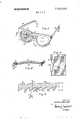
- FIG. Iis a perspective view of a pair of spectacles having a prismatically embossed membrane adhesively affixed to one of its spectacle lenses;
- FIG. 2is a partial cross-sectional view taken along line 2-2 of FIG. 1;
- FIG. 3is an enlarged fractional cross-sectional view taken through a prismatically embossed membrane constructed in accordance with this invention when not pressed onto a lens;
- FIG. 4is a sheet of prismatically embossed membrane from which the spectacle lens applique of this invention may be cut.
- FIGS. 5 through I3are various alternate embodiments of the optical modifying membranes of this invention, each providing a different optical modifying characteristic.
- FIG. 5illustrates a two-tint filter membrane
- FIG. 6illustrates a partially occluded membrane
- FIG. 7illustrates a diffused membrane
- FIG. 8illustrates a multiple pinhole membrane
- FIGS. 9 and 10illustrate membranes having transparent strips
- FIG. IIillustrates multiprism membranes
- FIG. I2illustrates a partially prismed and partially occluded membrane
- FIG. 13illustrates a combination membrane including a filter section, a prism section, a pinhole section, a diffused section and an opaque section.
- FIGS. I and 2 of the drawingthere is shown a pair ofspectacles I0 which conventionally comprise a pair of lenses I2 and 14 carried in a spectacle frame l6 having a bridge 18 and a pair of ear bows 20 and 22.
- a thin membrane 24, embossed with a stepped surfaceis provided which is shown adhesively affixed to the posterior surface of lens I2 to deviate (refract) the light beam through a preselected angle.
- the stepped surface of membrane 24is of the straight ridge type, but may also comprise a series of concentric echelon surfaces of constant or progressively varying angles of inclination as the step" recedes from the center of the lens.
- the basic design in which the angle of inclination varies progressively with the distance from the centerwas proposed by Fresnel in 1822 as a means of constructing large aperture lenses for lighthouses on the French coast, and lenses or prisms constructed with an echelon or stepped surface are commonly designated as Fresnel lenses or prisms. See, for example, the Encyclopedia Britannica, published by Encyclopedia Britannica, Inc. (I965), Volume l3, pp. 953. Accordingly, optical membrane 24 embossed with a stepped surface will also be referred to as having a Fresnel construction.
- Fresnel-type prismatic membrane 24is made of a conformable, pressure adherable, water clear material such as, for example, vinyl butyrate. As best seen in FIG. 3, it has a smooth planar surface 30 which is pressure adhesively affixed to the posterior lens surface so that the distance between the eye of the spectacle wearer and membrane 24 is a minimum, thereby reducing distortion in the visual field and reducing cosmetic objections for wearer and observer.
- the other surface 32 of membrane 24is linearly ridged or stepped across the entire membrane to form prismatic ridges 34 having an inclined face 36 and a perpendicular face 38.
- the angle of inclination a of inclined face 36is selected to provide a desired angular deviation 8 ofa light ray 37, which is defined as the power of the prism and is usually measured in prism diopters."
- the angle of deviation 8 of line of sight 37, the angle of inclination a, and the index of refraction n of the plastic material of membrane 24are related by the expressions:
- Membrane thickness Awhich is defined as the distance between surface 30 and the crest of prismatic ridges 34
- membrane thickness Bwhich is defined as the distance between surface 30 and the troughs of prismatic ridges 34
- Thickness Ashould be as small as possible so that membrane 24 readily and easily conforms to either the posterior or the anterior surface of any commonly encountered lens configuration, and to make the membrane as cosmetically acceptable as possible to the wearer. It has been found that for a vinyl butyrate membrane, thickness A" up to as much as one-sixteenth inch is entirely acceptable. For thicknesses very much in excess of one-sixteenth inch, the membrane conformability and its cosmetic acceptability are less than optimum.
- Dimension "B”should likewise be as small as possible, but is limited by the physical strength necessary to minimize the danger of tearing. Further, the smaller the dimension "B” can be made, the greater is the possible beam deviating ability ofa given thickness A" of the plastic film. It has been found that for a vinyl butyrate membrane, a thickness 8" on the order of one sixty-fourth inch is entirely satisfactory from a physical strength point of view. The distance from one prism ridge to the next is not critical but, for the best cosmetic results, should be held to a minimum. It has been found feasible to fabricate Fresnel type prisms and lenses of excellent optical quality having a prism width as small as 0.002 inch.
- the materialshould be optically clear, capable of accepting colored dyes and of being overprinted with opaque or transparent inks. It should have sufficient flexiblity, strength and elasticity to permit handling thin films as well as being able to conform to toric and spherical surfaces characteristic of most spectacle lenses. The greater the index of refraction the thinner the foil that will be needed and, consequently, the easier to conform to doubly curved surfaces.
- the materialshould be embossable by pressure and/or temperature and able to hold with excellent precision the embossed contours at ambient temperatures and under pressures encountered in storage, packaging and handling.
- the quality of conformabilityis further defined by stipulating that the membrane can be pressure adhesively attached to the surface of a lens and remain there under the influence of the available bonding forces which hold the membrane and the lens together.
- the membranecan also be realized that, for relatively thin films as the membrane herein, the elasticity or resilience should be sufiiciently small so that the membrane adhesively adheres to the lens with a force greater than its inherent restoring force. This latter statement is applicable to restoring forces parallel and perpendicular to the plane of the membrane, the latter being controllable, at least to some extent, by the thickness A.”
- the conforming forcemay also be electrostatic or result from the vacuum effect between the film and the smooth substrate.
- only a temporary modification of the spectacle lensmay be desired, such being the case where a person is to train his visual apparatus, to relieve eye strain or modify the spectacles for temporary, special tasks.
- the membraneis attached during the required use periods and thereafter is removed so that the wearer requires only a single pair ofglasses.
- prismatic press-on membrane describedabovehas planar inclined faces 36, is linearly ridged across the entire membrane, and has a constant thickness B," many modifications within the scope of this invention are readily made. For example, thickness 3" may he made to vary over the entire surface of the press-on membrane in the manner ofa prescription lens. A press-on membrane so modified would enable a user to convert an ordinary pair of sun glasses or a pair ofordinary clear glasses to a combination prescription glass with a prismatic structure, or the reversev Further, inclined surfaces 36 may be the segment of a cylinder, or the sawtooth ridges themselves may be concentric instead of linear and thereby produce a Fresnel-type cylindrical or spherical lens structure.
- this inventionmay be utilized to provide a variety of visual modifying elements, each consisting of a thin, flexible, conformable plastic sheet cut to fit a spectacle lens and being embossed, colored, overprinted, diffused or partially or completely opaqued, being finger pressed onto either surface of a spectacle lens so as to make bubble free contact and adhere impermanently to the surface.
- the membranesmay be changed in rapid succession during diagnosis of ocular condi' tions, periodically during treatment and management of visual anomalies or orthoptic training, or on a random or intermittent program for convenience, cleanliness of therapeutic reasons. They can be used to control the degree of transmission and spectral quality of light reaching the eye from time to time, the direction from which light is admitted or the amount or quality reaching a given portion of the eye at any time as well as the degree of image sharpness over the field of view.
- membrane 50 of the filter typehaving a peripheral portion 51 which is tinted blue and a central portion 52 which is tinted yellow.
- This particular transmission combinationwill allow induction or enhancement of macular perception by stimulating the peripheral retina with blue to enhance the macular perception to yellow.
- Providing portions 51 and 52 with different shapes and/or different tintsalso provides the eye specialist with means by which he may, be way ofexample, differentially stimulate the macula of one eye and the peripheral retina of the other eye.
- a press-on membraneis provided which is useful to convert ordinary clear prescription glasses into prescription sun glasses.
- Press-on membrane 50, orparts 51 and 52also may be constructed of a polarizing material, which may or may not be tinted, to con vert either clear prescription glasses or ordinary sun glasses to polarized glasses.
- the tintmay be graded, ranging from a deep tint at the top portion to almost no tint at the bottom portion, to afford maximum protection from light coming from the horizon and above and allowing substantially clear vision in a downward direction.
- Such press-on membraneswould be extremely useful in the cockpit of an airplane where a minimum tint is desired when viewing the instrument panel and a maximum tint is desired to protect against sunlight when looking out through the windshield.
- FIG. 6illustrates press-on membrane 60 which includes a pair of occluded portions 61 and 62 and a centrally disposed clear portion 63.
- Partially occluded membrane 60finds extensiveapplication in redirecting and controlling visual fixation of the eyes by occluding parts of the visual field where one does not wish the subject to use his two eyes together and to force the subject to use the two eyes together on those parts of the lens which are not occluded.
- Occluded membrane 60may also be used to control fixation such as by switching the adaptive patterns so that first one eye is made to fix in a certain way and then the other eye is made to fix in a certain way.
- occluded membrane 60has the great advantage of being readily removable and affixable at will and for short times.
- FIG. 7shows a press-on membrane 70 which is gradcdly diffused, the diffusion bcing heaviest on the left side of FIG. 7 and becoming lighter toward the right side.
- Membrane 70is useful to control disorders of visual fixation.
- Diffuser mcmbrane 70is constructed in such a manner that it degrades or washes out either the peripheral or the macular contours of the visual image in such a way so as to alter dominance from one eye to the other.
- Diffusion membrane 70may be combined with a tint over the entire or part of the field and also with occluded portions where this is desirable.
- FIG. 8shows a press-on type lens 80 having aplurality of pinholes 81 which are spaced sufficiently close to one another so that the pinholes are not disturbing to the wearer when adhesively attached to one surface of the spectacle.
- the pinhole aperturesmay be varied as to size and distribution according to the particular visual needs.
- the entire membrane 80may be opaque, or may be flesh colored for cosmetic reasons.
- FIG. 9shows a press-on membrane having a transparent stenopaic slit portion 91 and a pair of occluded portions 92 and 93.
- the width of stenopaic slit 91is selected to suit the needs of home or outdoor illumination.
- One application for membrane 90is to convert ordinary lenses to snow lenses.
- FIG.shows a press-on membrane 100 having a number of stenopaic slits such as 101, 102, and 103.
- Portions 104, 105, 106 and 107may either be opaque or heavily tinted, in which case the optical properties of membrane 50 closely simulate a structure known as Eskimo sun glasses which are useful for protecting the eyes from very intense light conditions such as are encountered when the sun is shining on snow.
- FIG. 11illustrates a press-on membrane 110 which includes three different prismatic sections 111, 112 and 113. These three sections may be formed by embossing techniques or may be assembled from three different portions, each portion comprising a different one of the prisms. lf constructed in different portions, each portion may be separately pressure adhesively affixed to the eye glass or, in the alternative, may be mounted on a common base which is then prexure adhesively affixed to the eye glass.
- Membranes such as 110are useful in correcting for eye muscle problems by causing the patient to use his eyes together in different fields when one eye does not track or travel in the same manner as the other eye.
- Press'on membrane 120 of FIG. 12, which illustrates the combination of an upper prismatic portion 121 and a lower occluded portion 122,is useful in those instance where both eyes are used for distant vision through a corrective prism but only one is ordinarily used for near vision such as for reading.
- FIG. 13illustrates membrane 130 constructed of many different portions, each having different optical characteristics, and is included herein to show the many combinations possible for a single press-on membrane.
- portion 131may be a prism (Fresnel-type or otherwise) or may have a curved surface to form a lens, or a combination of a prism and a lens.
- Portion 132may be a tinted filter, with or without pinholes 133, and with or without a central aperture 134 of a different tint.
- Portion 135may be occluded and portion 136 may be diffused, either uniformly or gradedly. It is also desirable to be able to provide the additive effect of two or more membranes such as, for instance, a stenopaic slit with tinted aperture and refraction of the line of sight.
- the membrane of FIG. 13is shown primarily to indicate the large variety of optical characteristics which can be incorporated in a single membrane structure or a combination of membranes. Heretofore such different optical properties could not practically be combined into a single structure.
- a device for ophthalmic use in treating a disorder of the eyecomprising the combination of:
- a thin, flexible mem raneformed of light-transmitting plastic material and having opposed surfaces, one of which is planarly smooth and adhered to a light-transmitting surface of said ophthalmic lens in conforming relationship thereto; the surface of said membrane opposite said planarly smooth surface having formed therein a plurality of stepped ridges each having a sloping face providing refractive power and a face substantially normal to the planarly smooth surface, said ridges constituting a Fresnel refracting surface which refracts the light rays transmitted through said ophthalmic lens and said membrane to said eye in a manner enabling treatment of said disorder;
- the thickness of said membrane from said planarly smooth surface to the crest of said ridgesbeing of a magnitude which permits conformability of the membrane to the lens and is cosmetically acceptable, said thickness from the planarly smooth surface to said crest being not substantially greater than approximately one-sixteenth inch, the thickness of said membrane from the planarly smooth surface to the troughs of said ridges being of a magnitude which permits conformability of the membrane to the lens and provides sufficient physical strength to prevent tearing of the membrane, said thickness from the planarly smooth surface to said trough being not substantially less than approximately one sixty-fourth inch, and ridge spacing being held to a minimum value, but not less than approximately 0.002 inch to provide cosmetic acceptability.
Landscapes
- Physics & Mathematics (AREA)
- Health & Medical Sciences (AREA)
- Ophthalmology & Optometry (AREA)
- General Physics & Mathematics (AREA)
- Optics & Photonics (AREA)
- General Health & Medical Sciences (AREA)
- Spectroscopy & Molecular Physics (AREA)
- Eyeglasses (AREA)
Abstract
Description
SHEET 2 BF 2 Fig. 10
Fig-12 INVENTOR ARTHUR JAM POLSKY Lww.
CROSS REFERENCE TO RELATED APPLICATIONS This application is a continuation of U8. Pat. application Ser. No. 647,533, filed June 20, I967, and now abandoned.
BACKGROUND OF THEINVENTION 1. Field of the Invention This invention relates to a method of impermanently modifying spectacle lenses and, more particularly, to a thin, flexible, membrane which is pressure adhesively attachable to the surface of the spectacle lens, and which allows the optical characteristic of the spectacle lens to be changed in'many useful ways for purposes of diagnosing and treating human vision problems.
The term spectacle or spectacle lens as used herein is defined as any light refracting or nonrefracting elements mounted in a frame suitable for wearing before theeyes.
One of the very important types of applications would be the use of prismatic light beam deviators in the diagnosis and management of strabismus, and the invention will be described in particular detail in connection with this ocular deviation. However, it is to be understood that the press-on optical membrane of this invention has a much wider field of application and may modify the optical characteristics of lenses in many other ways and lends itself to solving a large variety of diagnostic and treatment problems known to eye specialists. The invention also is useful for simply changing the amount and quality of light reaching the eye for reasons such as convenience, comfort or appearance as well as the management of vision problems. The invention is also useful to change the optical characteristic of any optical element, whatever its kind or use.
2. Description of the Prior Art Heretofore, one aspect of diagnosing and nonsurgically treating strabismus was accomplished either by inserting thick prismatic lenses of different power in the optical path of the two eyes, or by supplementing the usual lens with modifying prisms of glass or plastic. The modifying prisms have been attached to the spectacle frame in front of the normal lens, and have been either Fresnel design or normal prisms. Neither of these prior art devices have been found cosmetically acceptable by the wearer and by observers.
In addition to being cosmetically unacceptable, both types of prior art devices also have been found subjectively objectionable because of field distortion. In the thick prismatic lens, the required thickness is primarily responsible for the field distortion. In case of the anteriorly placed thick and rigid Fresnel prismatic structure, the distance between it and the eye is primarily responsible for field distortion.
Another disadvantage of the thick prismatic lens is that it has to be specially ground making it very expensive. One type of the nonsurgical treatment of strabismus usually involves a sequential modification of the prismatic correction from time to time. A specially ground prismatic lens has a fairly short useful life, and then must be discarded in favor of another lens of a different prismatic correction.
Other problems for which the prior art has offered no acceptable, inexpensive or readily available solution include: modifying the optical characteristics of spectacle lensesto allow selective vision or perception by either the macula or the peripheral retina, occluding all or part ofthe visual field to control fixation, totally or gradually diffusing the visual field such as is done to degrade peripheral or macular contours.
It is therefore a primary object of this invention to impermanently modify the optical characteristic of an optical element, utilizing a press-on optical modifier which modification can be quickly done by untrained individuals and with materials that are low enough in cost as to be disposable.
It is also a primary object of the present invention toprovide an inexpensive method for impermanently modifying the optical characteristic of spectacles which method can be practiced easily and readily by the eye specialist for diagnostic or training purposes and by the patient or other personnel for treatment purposes.
It is another object of the present invention to provide a method for modifying the optical characteristics of spectacles: by pressing-on" to one or both surfaces suitable thin flexible It is still another object of the present invention to provide a;
thin, fully conformable membrane which can be quickly and impermanently attached to a supporting element, as in specta cle lenses, and which has the function of a lens supplement, deviating prism, spectral filter, diffusion filter, intensity filter, semi-occluding element or selective aperture or combination thereof.
It is still another object of the present invention to provide a,
means for modifying the optical characteristics of spectacle lenses, or like optical elements, which is inexpensive, impermanent from the point of view that it may readily be changed,
and which allows an unskilled person to undertake such modifications for continuous orthoptic treatment requiringv progressive sequential correction as well as by eye specialists for temporary treatment as well as diagnosis of eye disorders.
It is still a further object of the present invention to provide a spectacle lens having a specified prismatic power which is cosmetically acceptable.
It is a further object of the present invention to provide a membrane having the ability to refract or deviate the light passing through it, which is readily and easily attached to either surface of a spectacle lens, is inexpensive, and is readily replaceable when different prism diopter power is desired or required, or when the direction of deviation is to be altered E transversely or longitudinally for treatment purposes, even: though the frequency of alteration may be only hours or' minutes in duration.
it is still another object of the present invention to provide an inexpensive, disposable, membrane which is readily attachable to the surface of a spectacle lens byfinger pressure 1 adhesion and easily removed by finger manipulation.
It is still a further object of the present invention to provide an inexpensive and readily exchangeable means for modifying SUMMARY OF THE INVENTION The present invention accomplishes these objects by providing a conforming, plastic material which has the desired optical properties. The total thickness of the membrane and the type of plastic material utilized is selected so that the membrane fully conforms to the curved surface of an ordinary spectacle lens, or any part of it, or any optical element, under ordinary finger pressure. Further, the plastic material and the nature of its surface is selected so that it will adhere to the optical element surface by one or more of the following phenomena: vacuum, electrostatic attraction, presence of an interfacial pressure sensitive adhesive, or inherent adhesive (intermolecular) forces between the membrane material and the lens material. Since the exact theory of adhesion is not yet fully understood and still subject to some dispute amongst the experts, and since such adhesion may bring into play one or more of the above phenomena, Applicant defines-the term pressure adhesive, for the purpose of this application, as the property of the membrane to adhere to the optical element by the application of pressure, regardless of the phenomenon or phenomena which are responsible for such a result.
If the desired optical property is deviation, such as is commonly used for diagnosing and treating strabismus, one surface of the membrane may have embossed on it a plurality of parallel, narrow prisms of a preselected refractive power. A configuration of this type is known as a Fresnel prism.
For diagnostic purposes, a plurality of such prismatically embossed membranes are provided, each having a different refractive power. These Fresnel prism membranes, being adapted to be pressed onto the spectacle surface, can rapidly be exchanged or rotated about an axis normal to the spectacle. For treatment purposes, the patient may be provided with a prismatic membrane suitable for his particular needs which is exchanged as necessary with a similar membrane of a different prism strength, or the prism axis may be rotated differentially between the two eyes, or the light through the respective spectacle elements may be attenuated or diffused independently either interdaily or intradaily.
Other optical properties may be obtained by partially or entirely coloring (tinting), diffusing or opaquing the optical membrane, either uniformly, or differentially, or, according to a special pattern, so as to regulate the quantity and character of light entering one or both eyes. For some applications, combinations of the above optical properties may be desirable and are obtained by special treatment of the optical membrane, or by superimposing several membranes, or by combining parts, in segmental fashion, directly upon the spectacle lens.
Further objects and advantages of the present invention will become apparent to those skilled in the art to which the invention pertains as the ensuing description proceeds.
The features of novelty that are considered characteristic of this invention are set forth with particularity in the appended claims. The organization and method of operation of the invention itself will best be understood from the following description when read in connection with the accompanying drawings in which:
BRIEF DESCRIPTION OF THE DRAWINGS FIG. I is a perspective view of a pair of spectacles having a prismatically embossed membrane adhesively affixed to one of its spectacle lenses;
FIG. 2 is a partial cross-sectional view taken along line 2-2 of FIG. 1;
FIG. 3 is an enlarged fractional cross-sectional view taken through a prismatically embossed membrane constructed in accordance with this invention when not pressed onto a lens;
FIG. 4 is a sheet of prismatically embossed membrane from which the spectacle lens applique of this invention may be cut; and
FIGS. 5 through I3 are various alternate embodiments of the optical modifying membranes of this invention, each providing a different optical modifying characteristic.
FIG. 5 illustrates a two-tint filter membrane;
FIG. 6 illustrates a partially occluded membrane;
FIG. 7 illustrates a diffused membrane;
FIG. 8 illustrates a multiple pinhole membrane;
FIGS. 9 and 10 illustrate membranes having transparent strips;
FIG. II illustrates multiprism membranes;
FIG. I2 illustrates a partially prismed and partially occluded membrane; and
FIG. 13 illustrates a combination membrane including a filter section, a prism section, a pinhole section, a diffused section and an opaque section.
DESCRIPTION OF THE PREFERRED EMBODIMENT Referring now to FIGS. I and 2 of the drawing, there is shown a pair ofspectacles I0 which conventionally comprise a pair of lenses I2 and 14 carried in a spectacle frame l6 having abridge 18 and a pair of ear bows 20 and 22. In accordance with one embodiment of the present invention, athin membrane 24, embossed with a stepped surface, is provided which is shown adhesively affixed to the posterior surface of lens I2 to deviate (refract) the light beam through a preselected angle.
The stepped surface ofmembrane 24 is of the straight ridge type, but may also comprise a series of concentric echelon surfaces of constant or progressively varying angles of inclination as the step" recedes from the center of the lens. The basic design in which the angle of inclination varies progressively with the distance from the center was proposed by Fresnel in 1822 as a means of constructing large aperture lenses for lighthouses on the French coast, and lenses or prisms constructed with an echelon or stepped surface are commonly designated as Fresnel lenses or prisms. See, for example, the Encyclopedia Britannica, published by Encyclopedia Britannica, Inc. (I965), Volume l3, pp. 953. Accordingly,optical membrane 24 embossed with a stepped surface will also be referred to as having a Fresnel construction.
Fresnel-typeprismatic membrane 24 is made of a conformable, pressure adherable, water clear material such as, for example, vinyl butyrate. As best seen in FIG. 3, it has a smooth planar surface 30 which is pressure adhesively affixed to the posterior lens surface so that the distance between the eye of the spectacle wearer andmembrane 24 is a minimum, thereby reducing distortion in the visual field and reducing cosmetic objections for wearer and observer. Theother surface 32 ofmembrane 24 is linearly ridged or stepped across the entire membrane to formprismatic ridges 34 having aninclined face 36 and a perpendicular face 38.
The angle of inclination a ofinclined face 36 is selected to provide a desired angular deviation 8 ofalight ray 37, which is defined as the power of the prism and is usually measured in prism diopters." The angle of deviation 8 of line ofsight 37, the angle of inclination a, and the index of refraction n of the plastic material ofmembrane 24 are related by the expressions:
8 sin (n sina)a Membrane thickness A," which is defined as the distance between surface 30 and the crest ofprismatic ridges 34, and membrane thickness B, which is defined as the distance between surface 30 and the troughs ofprismatic ridges 34, are selected in accordance with the following criteria. Thickness A" should be as small as possible so thatmembrane 24 readily and easily conforms to either the posterior or the anterior surface of any commonly encountered lens configuration, and to make the membrane as cosmetically acceptable as possible to the wearer. It has been found that for a vinyl butyrate membrane, thickness A" up to as much as one-sixteenth inch is entirely acceptable. For thicknesses very much in excess of one-sixteenth inch, the membrane conformability and its cosmetic acceptability are less than optimum.
Dimension "B" should likewise be as small as possible, but is limited by the physical strength necessary to minimize the danger of tearing. Further, the smaller the dimension "B" can be made, the greater is the possible beam deviating ability ofa given thickness A" of the plastic film. It has been found that for a vinyl butyrate membrane, a thickness 8" on the order of one sixty-fourth inch is entirely satisfactory from a physical strength point of view. The distance from one prism ridge to the next is not critical but, for the best cosmetic results, should be held to a minimum. It has been found feasible to fabricate Fresnel type prisms and lenses of excellent optical quality having a prism width as small as 0.002 inch.
While vinyl butyrate sheet plastic has been found desirable for fabrication ofthe various spectacle modifying membranes, any material meeting the following specifications would be suitable. The material should be optically clear, capable of accepting colored dyes and of being overprinted with opaque or transparent inks. It should have sufficient flexiblity, strength and elasticity to permit handling thin films as well as being able to conform to toric and spherical surfaces characteristic of most spectacle lenses. The greater the index of refraction the thinner the foil that will be needed and, consequently, the easier to conform to doubly curved surfaces. The material should be embossable by pressure and/or temperature and able to hold with excellent precision the embossed contours at ambient temperatures and under pressures encountered in storage, packaging and handling.
The quality of conformability is further defined by stipulating that the membrane can be pressure adhesively attached to the surface of a lens and remain there under the influence of the available bonding forces which hold the membrane and the lens together. In this connection, it should also be realized that, for relatively thin films as the membrane herein, the elasticity or resilience should be sufiiciently small so that the membrane adhesively adheres to the lens with a force greater than its inherent restoring force. This latter statement is applicable to restoring forces parallel and perpendicular to the plane of the membrane, the latter being controllable, at least to some extent, by the thickness A." These two physical properties are defined herein as "pressure adhesively attachable" and remaining confonned when adhesively bonded."
in the use of different plastic materials, there will be differences in conformability or in refractive properties which will modify the thicknesses A and 8" to some extent. in all instances it is necessary that the elastic restoring forces of the conformed film be less than the bond strength between the film and the spectacle lens.
While the above description of the membrane, and particularly the term pressure adhesively attachable" have primary reference to the process of pressing the membrane directly on the lens surface, it is to be understood that attachment may also be made by interposing a fluid film between the membrane and the lens surface which brings into play the physical phenomena of surface tension. Since surface tension is generally understood to result from molecules close to the surface of the liquid which exerts a force of attraction to the molecules of the surface of the solid, and thereby bring into play intermolecular forces, the term adhesively affixed is not limited to a bond between two solids, but includes the interposition of a liquid. Because the field of intermolecular adhesion is not entirely understood, and no uniformity exits relative to a definition, the term "adhesively attachable as used herein, because it involves intermolecular forces, refers to both solid-solid adhesion and solid-liquid adhesion. The conforming force may also be electrostatic or result from the vacuum effect between the film and the smooth substrate.
ln the use of the invention, a determination is made of the necessary prism diopter required for the treatment or diagnosis of the specific case. Thereafter, a membrane is output ofa suitable sheet of membrane stock, such as 40 shown in FIG. 4, of a specific prism power and pressed onto the surface of the lens by finger pressure. if, for some reason, it is desirable to change the prism diopter of the lens membrane combination, such as is usually the case in progressive management of strabismus, the membrane in place is peeled off from the lens surface and a new membrane is pressed on.
In certain applications, only a temporary modification of the spectacle lens may be desired, such being the case where a person is to train his visual apparatus, to relieve eye strain or modify the spectacles for temporary, special tasks. In such cases, the membrane is attached during the required use periods and thereafter is removed so that the wearer requires only a single pair ofglasses.
While the prismatic press-on membrane describedabove has planar inclined faces 36, is linearly ridged across the entire membrane, and has a constant thickness B," many modifications within the scope of this invention are readily made. For example, thickness 3" may he made to vary over the entire surface of the press-on membrane in the manner ofa prescription lens. A press-on membrane so modified would enable a user to convert an ordinary pair of sun glasses or a pair ofordinary clear glasses to a combination prescription glass with a prismatic structure, or the reversev Further, inclined surfaces 36 may be the segment of a cylinder, or the sawtooth ridges themselves may be concentric instead of linear and thereby produce a Fresnel-type cylindrical or spherical lens structure. Of course, two or more of the above described modifications may be combined readily to modify the optical properties of lenses in a manner not heretofore economically feasible. Since the press-on membrane may be readily constructed by embossing techniques, any of the above-mentioned modifications are readily and economically made.
Further, this invention may be utilized to provide a variety of visual modifying elements, each consisting of a thin, flexible, conformable plastic sheet cut to fit a spectacle lens and being embossed, colored, overprinted, diffused or partially or completely opaqued, being finger pressed onto either surface of a spectacle lens so as to make bubble free contact and adhere impermanently to the surface. The membranes may be changed in rapid succession during diagnosis of ocular condi' tions, periodically during treatment and management of visual anomalies or orthoptic training, or on a random or intermittent program for convenience, cleanliness of therapeutic reasons. They can be used to control the degree of transmission and spectral quality of light reaching the eye from time to time, the direction from which light is admitted or the amount or quality reaching a given portion of the eye at any time as well as the degree of image sharpness over the field of view.
Referring now to FIG. 5 of the drawing, there is shownmembrane 50 of the filter type having a peripheral portion 51 which is tinted blue and acentral portion 52 which is tinted yellow. This particular transmission combination will allow induction or enhancement of macular perception by stimulating the peripheral retina with blue to enhance the macular perception to yellow. Providingportions 51 and 52 with different shapes and/or different tints also provides the eye specialist with means by which he may, be way ofexample, differentially stimulate the macula of one eye and the peripheral retina of the other eye. By tinting all ofmembrane 50 entirely with one color, or only 51 or 52, such as gray or green, a press-on membrane is provided which is useful to convert ordinary clear prescription glasses into prescription sun glasses. Press-onmembrane 50, orparts 51 and 52, also may be constructed of a polarizing material, which may or may not be tinted, to con vert either clear prescription glasses or ordinary sun glasses to polarized glasses. Finally, the tint may be graded, ranging from a deep tint at the top portion to almost no tint at the bottom portion, to afford maximum protection from light coming from the horizon and above and allowing substantially clear vision in a downward direction. Such press-on membranes would be extremely useful in the cockpit of an airplane where a minimum tint is desired when viewing the instrument panel and a maximum tint is desired to protect against sunlight when looking out through the windshield.
FIG. 6 illustrates press-onmembrane 60 which includes a pair ofoccluded portions clear portion 63. Partially occludedmembrane 60 finds extensiveapplication in redirecting and controlling visual fixation of the eyes by occluding parts of the visual field where one does not wish the subject to use his two eyes together and to force the subject to use the two eyes together on those parts of the lens which are not occluded.Occluded membrane 60 may also be used to control fixation such as by switching the adaptive patterns so that first one eye is made to fix in a certain way and then the other eye is made to fix in a certain way. For treatment of eye disorders requiring a switching of the adaptive pattern,occluded membrane 60 has the great advantage of being readily removable and affixable at will and for short times.
FIG. 7 shows a press-onmembrane 70 which is gradcdly diffused, the diffusion bcing heaviest on the left side of FIG. 7 and becoming lighter toward the right side.Membrane 70 is useful to control disorders of visual fixation.Diffuser mcmbrane 70 is constructed in such a manner that it degrades or washes out either the peripheral or the macular contours of the visual image in such a way so as to alter dominance from one eye to the other.Diffusion membrane 70 may be combined with a tint over the entire or part of the field and also with occluded portions where this is desirable.
ars" it r FIG. 8 shows a press-ontype lens 80 having aplurality ofpinholes 81 which are spaced sufficiently close to one another so that the pinholes are not disturbing to the wearer when adhesively attached to one surface of the spectacle. The pinhole apertures may be varied as to size and distribution according to the particular visual needs. Theentire membrane 80 may be opaque, or may be flesh colored for cosmetic reasons.
FIG. 9 shows a press-on membrane having a transparentstenopaic slit portion 91 and a pair ofoccluded portions membrane 90 is to convert ordinary lenses to snow lenses.
FIG. shows a press-onmembrane 100 having a number of stenopaic slits such as 101, 102, and 103.Portions membrane 50 closely simulate a structure known as Eskimo sun glasses which are useful for protecting the eyes from very intense light conditions such as are encountered when the sun is shining on snow.
FIG. 11 illustrates a press-onmembrane 110 which includes three differentprismatic sections
FIG. 13 illustratesmembrane 130 constructed of many different portions, each having different optical characteristics, and is included herein to show the many combinations possible for a single press-on membrane. For example inmembrane 130,portion 131 may be a prism (Fresnel-type or otherwise) or may have a curved surface to form a lens, or a combination of a prism and a lens.Portion 132 may be a tinted filter, with or withoutpinholes 133, and with or without acentral aperture 134 of a different tint.Portion 135 may be occluded andportion 136 may be diffused, either uniformly or gradedly. It is also desirable to be able to provide the additive effect of two or more membranes such as, for instance, a stenopaic slit with tinted aperture and refraction of the line of sight.
The membrane of FIG. 13 is shown primarily to indicate the large variety of optical characteristics which can be incorporated in a single membrane structure or a combination of membranes. Heretofore such different optical properties could not practically be combined into a single structure.
There has been described herein an optical membrane of the press-on type which can readily and impermanently modify the optical characteristics of spectacles in almost an infinite number of useful ways. The membranes are inexpensive to manufacture so that they may be regarded as disposable, and
are pressure adhesively affixable to the spectacle lens surface by finger pressure.
While theabove detailed description has shown, described and pointed out the fundamental novel features of the invention as applied to various embodiments, will be understood that various omissions an substitutions and changes in the form and details of the device illustrated may be made by those skilled in the art, without departing from the spirit of the invention. It is the intention, therefore to be limited only as indicated by the scope of the following claims.
What is claimed is:
A device for ophthalmic use in treating a disorder of the eye comprising the combination of:
a. an ophthalmic lens of predetermined prescription through which light ra s are transmitted to an eye;
b. a thin, flexible mem rane formed of light-transmitting plastic material and having opposed surfaces, one of which is planarly smooth and adhered to a light-transmitting surface of said ophthalmic lens in conforming relationship thereto; the surface of said membrane opposite said planarly smooth surface having formed therein a plurality of stepped ridges each having a sloping face providing refractive power and a face substantially normal to the planarly smooth surface, said ridges constituting a Fresnel refracting surface which refracts the light rays transmitted through said ophthalmic lens and said membrane to said eye in a manner enabling treatment of said disorder;
c. the thickness of said membrane from said planarly smooth surface to the crest of said ridges being of a magnitude which permits conformability of the membrane to the lens and is cosmetically acceptable, said thickness from the planarly smooth surface to said crest being not substantially greater than approximately one-sixteenth inch, the thickness of said membrane from the planarly smooth surface to the troughs of said ridges being of a magnitude which permits conformability of the membrane to the lens and provides sufficient physical strength to prevent tearing of the membrane, said thickness from the planarly smooth surface to said trough being not substantially less than approximately one sixty-fourth inch, and ridge spacing being held to a minimum value, but not less than approximately 0.002 inch to provide cosmetic acceptability.
2. The device ofclaim 1 wherein (d) said Fresnel refracting surface is a Fresnel prism.
3. The device ofclaim 1 wherein ((1) said Fresnel refracting surface is a Fresnel lens.
4. The device ofclaim 1 wherein (d) said adherence is effected by the molecular surface adhesion between said membrane and said ophthalmic lens.
5. The device ofclaim 1 wherein (d) said membrane is formed of a vinyl butyrate plastic.
6. The device ofclaim 1 wherein (d) said ophthalmic lens surface is the posterior surface thereof.
7. The device ofclaim 1 wherein (d) said membrane is formed of a vinyl butyrate plastic and (e) said adherence is effected by finger-pressure adhesion.
: e a I e
Claims (6)
- 2. The device of claim 1 wherein (d) said Fresnel refracting surface is a Fresnel prism.
- 3. The device of claim 1 wherein (d) said Fresnel refracting surface is a Fresnel lens.
- 4. The device of claim 1 wherein (d) said adherence is effected by the molecular surface adhesion between said membrane and said ophthalmic lens.
- 5. The device of claim 1 wherein (d) said membrane is formed of a vinyl butyrate plastic.
- 6. The device of claim 1 wherein (d) said ophthalmic lens surface is the posterior surface thereof.
- 7. The device of claim 1 wherein (d) said membrane is formed of a vinyl butyrate plastic and (e) said adherence is effected by finger-pressure adhesion.
Applications Claiming Priority (1)
| Application Number | Priority Date | Filing Date | Title |
|---|---|---|---|
| US87897569A | 1969-12-08 | 1969-12-08 |
Publications (1)
| Publication Number | Publication Date |
|---|---|
| US3628854Atrue US3628854A (en) | 1971-12-21 |
Family
ID=25373192
Family Applications (1)
| Application Number | Title | Priority Date | Filing Date |
|---|---|---|---|
| US878975AExpired - LifetimeUS3628854A (en) | 1969-12-08 | 1969-12-08 | Flexible fresnel refracting membrane adhered to ophthalmic lens |
Country Status (1)
| Country | Link |
|---|---|
| US (1) | US3628854A (en) |
Cited By (113)
| Publication number | Priority date | Publication date | Assignee | Title |
|---|---|---|---|---|
| US3904281A (en)* | 1969-12-08 | 1975-09-09 | Optical Sciences Group Inc | Flexible refracting membrane adhered to spectacle lens |
| US4070105A (en)* | 1976-03-05 | 1978-01-24 | Marzouk Youssef Marzouk | Laminar fresnel reduced ophthalmic lens construction |
| US4315665A (en)* | 1979-09-07 | 1982-02-16 | Eidetic Images, Inc. | Composite optical element having controllable light transmission and reflection characteristics |
| DE3123862A1 (en)* | 1981-06-16 | 1982-12-30 | Peter Dipl.-Kfm. 7410 Reutlingen Müh | Spectacles |
| US4493535A (en)* | 1980-09-12 | 1985-01-15 | Andre Champeau | Hybrid transmissive focalizing optical system |
| WO1987002477A1 (en)* | 1985-10-11 | 1987-04-23 | C & H Contact Lens, Inc. | Composite ophthalmic lens system |
| US4673263A (en)* | 1982-10-21 | 1987-06-16 | Michael Onufryk | Optical image deflector assembly and method for locating visually sensitive peripheral areas of an eye, and determining corrective prismatic eye glasses therefore |
| US4761196A (en)* | 1987-01-02 | 1988-08-02 | Brown Hugh L | Method for overcoming optical deficiencies of shooters |
| GB2204146A (en)* | 1987-04-24 | 1988-11-02 | Hoya Corp | Producing ophthalmic lens by laminating surface-treated lens elements |
| US4859261A (en)* | 1988-05-11 | 1989-08-22 | Ace Ronald S | Method of making multi-focus ophthalmic lens |
| US4957295A (en)* | 1989-09-20 | 1990-09-18 | Mcconkey Sam A | Head movement indicating device and method |
| US4960326A (en)* | 1989-03-06 | 1990-10-02 | Dauvergne Hector A | Lenticular eyewear and method of fabrication |
| US4997268A (en)* | 1989-07-24 | 1991-03-05 | Dauvergne Hector A | Corrective lens configuration |
| US5002383A (en)* | 1989-07-10 | 1991-03-26 | Sisler Hampson A | Polyprismatic lens for enhancing human ocular motility |
| WO1992005464A1 (en)* | 1990-09-24 | 1992-04-02 | Dauvergne Hector A | Lenticular eyewear and method of fabrication |
| US5182588A (en)* | 1991-07-01 | 1993-01-26 | Maurer Robert D | Lens for filtering visible and ultraviolet electromagnetic waves during dental procedures |
| US5191479A (en)* | 1991-03-28 | 1993-03-02 | Nipox Kabushiki Kaisha | Fresnel lens |
| WO1994014096A1 (en)* | 1992-12-11 | 1994-06-23 | Unilens Corp. Usa | Low vision lens and coupling ring mounting assembly |
| US5349393A (en)* | 1993-06-01 | 1994-09-20 | Kreft James P | Light-transmitting elastomeric suction lens |
| US5390050A (en)* | 1988-11-10 | 1995-02-14 | Canon Kabushiki Kaisha | Eccentric Fresnel lens sheet and method of making same |
| WO1995016220A1 (en)* | 1993-12-07 | 1995-06-15 | La Haye Laboratories, Inc. | Aliphatic thermoplastic poyurethane press-on lenses and eyeglasses embodying the same |
| US5428407A (en)* | 1993-12-15 | 1995-06-27 | Crews Inc | Prescription lens attachable to safety glasses |
| WO1995022780A1 (en)* | 1994-02-17 | 1995-08-24 | Gargoyles, Inc. | Adherent corrective lens |
| US5452027A (en)* | 1993-01-11 | 1995-09-19 | Tylec; David E. | Tylec optical occluders for correcting double vision |
| US5521653A (en)* | 1994-05-31 | 1996-05-28 | Anderson; Paul A. | Vision restricting sports training glasses |
| US5617153A (en)* | 1996-02-08 | 1997-04-01 | Allen; Lawrence L. | Eyeglass lens shield having peripheral band |
| US5748279A (en)* | 1996-06-10 | 1998-05-05 | Glanzbergh; Mitchel | Kit for momentary correction of vision to aid in the selection of eyeglass frames |
| US5764333A (en)* | 1997-02-27 | 1998-06-09 | Somsel; John R. | Sunshields for eyeglasses |
| US6003990A (en)* | 1998-09-25 | 1999-12-21 | Einhorn; Norman | Press-on lenses for relieving computer related eye problems |
| WO2000011498A1 (en)* | 1998-08-25 | 2000-03-02 | Physical Optics Corporation | Optical element having an integral surface diffuser |
| US6108141A (en)* | 1997-06-29 | 2000-08-22 | Gadberry; John W. | Signal viewing device |
| US6113233A (en)* | 1998-11-25 | 2000-09-05 | Robert G. Miller | Lens cover system |
| US6170952B1 (en) | 1993-12-07 | 2001-01-09 | Neoptx, Inc. | Adherent corrective lenses and eyeglasses embodying the same |
| US6347012B1 (en) | 2000-03-06 | 2002-02-12 | Lockheed Martin Corporation | Display system with improved luminosity |
| US6347869B1 (en)* | 1999-05-24 | 2002-02-19 | Shuxiang Xu | Convex lens and stepped prism combined glasses |
| GB2367903A (en)* | 2000-10-05 | 2002-04-17 | Jacqueline Donnelly | Releasably adhered filter for lens |
| US20030035214A1 (en)* | 2001-08-20 | 2003-02-20 | Ranjana Pandya | Thinner, lighter and lower aberration prisms for ophthalmic applications |
| EP1429173A1 (en)* | 2002-12-14 | 2004-06-16 | ESCHENBACH OPTIK GmbH + Co. | Binocular viewing aid for close-range viewing |
| US20040119940A1 (en)* | 1999-12-22 | 2004-06-24 | Kerns David V. | Eyeglass lens with multiple optical zones having varying optical properties for enhanced visualization of different scenes in outdoor recreational activities |
| US20040207927A1 (en)* | 2003-04-18 | 2004-10-21 | Takayoshi Togino | Eyepiece optical system, and display device using the eyepiece optical system |
| US20050036110A1 (en)* | 2003-07-17 | 2005-02-17 | Aguilar Michael J. | Viewing apparatus for simulating impairment |
| US20050049699A1 (en)* | 2001-11-30 | 2005-03-03 | Charles Claoue | Intraocular lens |
| US20050157248A1 (en)* | 2004-01-20 | 2005-07-21 | Heisman Elliott R. | Eyeglass display and demonstration system |
| US20050168682A1 (en)* | 2002-01-16 | 2005-08-04 | Renard Paula A. | Hybrid lens with polarizer for eyeglasses |
| US20050190341A1 (en)* | 2003-12-29 | 2005-09-01 | St. Moritz Limited Partnership | Training aid using vision restriction and method of use |
| US7036929B1 (en) | 2004-04-12 | 2006-05-02 | William Rolf Harvey | Method and device for the application and removal of disposable corrective optical film to an eyeglass lens |
| RU2285510C2 (en)* | 2004-12-24 | 2006-10-20 | Государственное учреждение Межотраслевой научно-технический комплекс "Микрохирургия глаза" имени академика С.Н. Федорова Министерства здравоохранения Российской Федерации | Means for treating the cases of paralytic heterotropia |
| FR2893748A1 (en)* | 2005-11-23 | 2007-05-25 | Essilor Int | Transparent glass substrate`s e.g. ophthalmic lens, antistatic properties demonstrating device, has hollow box containing elements i.e. balls or foams, moving under action of electrostatic attraction, and static effect activator object |
| US20070247588A1 (en)* | 2004-07-02 | 2007-10-25 | Essilor International (Compagnie Generale D Optique) | Method for Producing an Ophthalmic Lens and an Optical Component for Carrying Out Said Method |
| US20080062378A1 (en)* | 2006-09-07 | 2008-03-13 | Mccracken Brian | Glasses with removable lens layers |
| WO2008059178A1 (en)* | 2006-11-17 | 2008-05-22 | Essilor International (Compagnie Generale D'optique) | Multitint ophthalmic lenses for the shortsighted |
| WO2008059175A1 (en) | 2006-11-17 | 2008-05-22 | Essilor International (Compagnie Generale D'optique) | Multi-tint coloured ophthalmic lenses |
| US20080212018A1 (en)* | 2005-07-20 | 2008-09-04 | Essilor International | Transparent Pixelized Optical Component with Absorbing Walls, its Method of Manufacture and its Use in the Manufacture of a Transparent Optical Element |
| US20080225402A1 (en)* | 2005-07-20 | 2008-09-18 | Essilor International (Compagnie General D' Optique) | Optical Component with Cells |
| US20080309868A1 (en)* | 2007-06-14 | 2008-12-18 | Donald Eugene Hodgson | Customized glasses |
| US20090002627A1 (en)* | 2007-06-28 | 2009-01-01 | The Research Foundation Of State University Of New York | Optical elements having variable power prisms |
| WO2009015489A1 (en)* | 2007-08-01 | 2009-02-05 | Lyse-Anne Roy | Decorative vision occluding patch, kit and method |
| US20090115962A1 (en)* | 2005-07-20 | 2009-05-07 | Essilor International (Compagnie Generale D'optique) | Randomly pixellated optical component, its fabrication method and its use in the fabrication of a transparent optical element |
| WO2009103207A1 (en)* | 2008-02-22 | 2009-08-27 | Chen Chu | Eyeglass paster convenient for improving observing attention |
| US20090316110A1 (en)* | 2004-12-17 | 2009-12-24 | Essilor International (Compagnie Gerale D'optique) | Method for making a transparent optical element, optical component used in said method and resulting optical element |
| USD608808S1 (en)* | 2009-03-19 | 2010-01-26 | Foxsemicon Integrated Technology, Inc. | Optical lens |
| USD608806S1 (en)* | 2009-04-08 | 2010-01-26 | Foxsemicon Integrated Technology, Inc. | Optical lens |
| USD608807S1 (en)* | 2009-04-08 | 2010-01-26 | Foxsemicon Integrated Technology, Inc. | Optical lens |
| USD609260S1 (en)* | 2009-04-21 | 2010-02-02 | Foxsemicon Integrated Technology, Inc. | Optical lens |
| US20100039611A1 (en)* | 2007-01-17 | 2010-02-18 | Samuel Archambeau | Transparent optical component having cells filled with optical material |
| USD611077S1 (en)* | 2009-04-21 | 2010-03-02 | Foxsemicon Integrated Technology, Inc. | Optical lens |
| USD616478S1 (en)* | 2009-03-21 | 2010-05-25 | Foxsemicon Integrated Technology, Inc. | Optical lens |
| US20110013136A1 (en)* | 2006-10-19 | 2011-01-20 | Essilor International ( Compagnie Generale D'optique) | Electrically controllable optical component comprising an array of cells |
| US20110043925A1 (en)* | 2006-12-26 | 2011-02-24 | Pierre Chavel | Optically transparent component with two sets of cells |
| US20110094141A1 (en)* | 2006-08-08 | 2011-04-28 | Summers Charles L | Vision enhancement apparatus to improve both near and far vision |
| US20110141434A1 (en)* | 2006-11-17 | 2011-06-16 | Guillaume Giraudet | Multi-tint ophthalmic lenses for night vision |
| US20110181828A1 (en)* | 2010-01-28 | 2011-07-28 | Jung Soo Yi | Attachable/detachable covering lens |
| US8162477B2 (en) | 2007-05-31 | 2012-04-24 | Essilor International (Compagnie Generale D'optique) | Progressive ophthalmic lens for myopia correction and method for making such a lens |
| US8231217B2 (en) | 2005-07-20 | 2012-07-31 | Essilor International (Compagnie Generale D'optique) | Pixellized transparent optical component comprising an absorbing coating, production method thereof and use thereof in an optical element |
| US20130194538A1 (en)* | 2011-12-14 | 2013-08-01 | Mitch Junkins | Multi-functional glasses |
| US8714739B2 (en) | 2009-05-11 | 2014-05-06 | Essilor International (Compagnie Generale D'optique) | Product comprising a flexible ophtalmic lens, and method for mounting such a flexible ophtalmic lens on an eyeglasses lens |
| US20140211152A1 (en)* | 2011-09-06 | 2014-07-31 | Essilor International (Compagnie Generale D'optique) | Method for determining front and rear surfaces for optical patches |
| US20140362336A1 (en)* | 2013-06-10 | 2014-12-11 | Charles J. Schmitz | Method and device for improving aiming ability |
| US20150116658A1 (en)* | 2013-10-28 | 2015-04-30 | Giorgio Trapani | Method and apparatus for making polarized sunglasses |
| US9110635B2 (en) | 2013-12-03 | 2015-08-18 | Lenova (Singapore) Pte. Ltd. | Initiating personal assistant application based on eye tracking and gestures |
| US20150309332A1 (en)* | 2012-11-28 | 2015-10-29 | Ilmenau Optics Solutions Gmbh | Vision Aid for Manipulating the Retinal Image for Eyes Having Macular Degeneration |
| US9213659B2 (en) | 2013-12-03 | 2015-12-15 | Lenovo (Singapore) Pte. Ltd. | Devices and methods to receive input at a first device and present output in response on a second device different from the first device |
| US20160341980A1 (en)* | 2011-06-24 | 2016-11-24 | Jeffrey H. Farris | Athletics Visual Aid Focus Device |
| EP3097591A1 (en)* | 2014-01-21 | 2016-11-30 | Solar Cloth System | High-efficiency flexible photovoltaic film, manufacturing process and use |
| USD775678S1 (en)* | 2015-07-30 | 2017-01-03 | Gulden Ophthalmics Inc. | Vertical prism bar |
| US9535497B2 (en) | 2014-11-20 | 2017-01-03 | Lenovo (Singapore) Pte. Ltd. | Presentation of data on an at least partially transparent display based on user focus |
| US20170097522A1 (en)* | 2015-06-12 | 2017-04-06 | Alan D. Parks | Method and Portable Aid for Mindfulness Meditation |
| US9633252B2 (en) | 2013-12-20 | 2017-04-25 | Lenovo (Singapore) Pte. Ltd. | Real-time detection of user intention based on kinematics analysis of movement-oriented biometric data |
| US9709708B2 (en) | 2013-12-09 | 2017-07-18 | Lenovo (Singapore) Pte. Ltd. | Adjustable display optics |
| US9753294B2 (en) | 2015-02-09 | 2017-09-05 | Leslie C. Hardison | Eyewear system, apparatus and method for stereoscopically viewing motion pictures |
| US9778829B2 (en) | 2012-02-17 | 2017-10-03 | Lenovo (Singapore) Pte. Ltd. | Magnification based on eye input |
| US9811095B2 (en) | 2014-08-06 | 2017-11-07 | Lenovo (Singapore) Pte. Ltd. | Glasses with fluid-fillable membrane for adjusting focal length of one or more lenses of the glasses |
| US20180157065A1 (en)* | 2013-08-06 | 2018-06-07 | E. Thomas CURLEY | Temporary corrective optical lenses |
| US9995948B2 (en) | 2014-05-11 | 2018-06-12 | AddOn Optics Ltd. | Adhesive optical film to convert an eyeglass lens to a progressive lens |
| US10013540B2 (en) | 2015-03-10 | 2018-07-03 | Lenovo (Singapore) Pte. Ltd. | Authentication based on body movement |
| US20180231778A1 (en)* | 2017-02-14 | 2018-08-16 | Oculus Vr, Llc | Lens Assembly Including a Silicone Fresnel Lens |
| US10073671B2 (en) | 2014-01-20 | 2018-09-11 | Lenovo (Singapore) Pte. Ltd. | Detecting noise or object interruption in audio video viewing and altering presentation based thereon |
| US10163455B2 (en) | 2013-12-03 | 2018-12-25 | Lenovo (Singapore) Pte. Ltd. | Detecting pause in audible input to device |
| US10180716B2 (en) | 2013-12-20 | 2019-01-15 | Lenovo (Singapore) Pte Ltd | Providing last known browsing location cue using movement-oriented biometric data |
| US20190049220A1 (en)* | 2017-08-08 | 2019-02-14 | Resident Artist Studio, Llc | Vision enhancement apparatus |
| US10499164B2 (en) | 2015-03-18 | 2019-12-03 | Lenovo (Singapore) Pte. Ltd. | Presentation of audio based on source |
| US10621431B2 (en) | 2015-03-27 | 2020-04-14 | Lenovo (Singapore) Pte. Ltd. | Camera that uses light from plural light sources disposed on a device |
| US10860094B2 (en) | 2015-03-10 | 2020-12-08 | Lenovo (Singapore) Pte. Ltd. | Execution of function based on location of display at which a user is looking and manipulation of an input device |
| US20200405575A1 (en)* | 2009-02-19 | 2020-12-31 | S.M Balance Holdings | Methods and systems for diagnosis and treatment of a defined condition, and methods for operating such systems |
| US20210072563A1 (en)* | 2019-09-06 | 2021-03-11 | Marcus Boggs | Disposable Film for Modifying a Property of an Eyeglass Lens |
| US10955988B1 (en) | 2020-02-14 | 2021-03-23 | Lenovo (Singapore) Pte. Ltd. | Execution of function based on user looking at one area of display while touching another area of display |
| US11029540B2 (en) | 2015-11-06 | 2021-06-08 | Hoya Lens Thailand Ltd. | Spectacle lens and method of using a spectacle lens |
| WO2021207103A1 (en)* | 2020-04-05 | 2021-10-14 | Tuecke Eva | Stackable, semi-rigid optical film for semi-permanent eyeglass lens prescription correction and methods of using same |
| US11378821B2 (en) | 2019-09-26 | 2022-07-05 | AddOn Optics Ltd. | Progressive lens and method of manufacture thereof |
| US20240061274A1 (en)* | 2021-07-29 | 2024-02-22 | Smooth Sees Llc | Eye glasses to alleviate motion sickness |
| US20240276851A1 (en)* | 2019-11-08 | 2024-08-15 | 3M Innovative Properties Company | Optical system including light control film and fresnel lens |
| WO2024253631A1 (en)* | 2023-06-05 | 2024-12-12 | Анатолий Николаевич ОЩЕПКОВ | Protective eyeglasses for driving at night |
| US12416820B2 (en) | 2019-09-26 | 2025-09-16 | AddOn Optics Ltd. | Progressive lens and manufacture thereof |
Citations (9)
| Publication number | Priority date | Publication date | Assignee | Title |
|---|---|---|---|---|
| FR369993A (en)* | 1906-09-25 | 1907-01-25 | Emile Recordon | Glassless glasses for use by motorists, cyclists, etc. |
| CH207794A (en)* | 1938-06-14 | 1939-11-30 | Erwin Prof Dr Med Zweifel | Glare protection for glasses and the like. |
| US2248638A (en)* | 1937-02-22 | 1941-07-08 | Merton Thomas Ralph | Sheet material with prismatic surfaces |
| US2511329A (en)* | 1946-12-26 | 1950-06-13 | Craig Edward | Lens shield |
| GB717775A (en)* | 1952-02-26 | 1954-11-03 | Douglas Henry Webber | Coloured viewers |
| US2884833A (en)* | 1953-09-16 | 1959-05-05 | Pohl Frederic | Optical system for viewing pictures |
| US3004470A (en)* | 1956-07-28 | 1961-10-17 | Zeiss Ikon A G Stuttgart | Multiple focal length lens |
| US3033359A (en)* | 1960-05-03 | 1962-05-08 | Sam N Mercer | Disposable lens shield |
| US3203306A (en)* | 1961-09-25 | 1965-08-31 | Lefferts Peter | Optical ray concentrator |
- 1969
- 1969-12-08USUS878975Apatent/US3628854A/ennot_activeExpired - Lifetime
Patent Citations (9)
| Publication number | Priority date | Publication date | Assignee | Title |
|---|---|---|---|---|
| FR369993A (en)* | 1906-09-25 | 1907-01-25 | Emile Recordon | Glassless glasses for use by motorists, cyclists, etc. |
| US2248638A (en)* | 1937-02-22 | 1941-07-08 | Merton Thomas Ralph | Sheet material with prismatic surfaces |
| CH207794A (en)* | 1938-06-14 | 1939-11-30 | Erwin Prof Dr Med Zweifel | Glare protection for glasses and the like. |
| US2511329A (en)* | 1946-12-26 | 1950-06-13 | Craig Edward | Lens shield |
| GB717775A (en)* | 1952-02-26 | 1954-11-03 | Douglas Henry Webber | Coloured viewers |
| US2884833A (en)* | 1953-09-16 | 1959-05-05 | Pohl Frederic | Optical system for viewing pictures |
| US3004470A (en)* | 1956-07-28 | 1961-10-17 | Zeiss Ikon A G Stuttgart | Multiple focal length lens |
| US3033359A (en)* | 1960-05-03 | 1962-05-08 | Sam N Mercer | Disposable lens shield |
| US3203306A (en)* | 1961-09-25 | 1965-08-31 | Lefferts Peter | Optical ray concentrator |
Cited By (177)
| Publication number | Priority date | Publication date | Assignee | Title |
|---|---|---|---|---|
| US3904281A (en)* | 1969-12-08 | 1975-09-09 | Optical Sciences Group Inc | Flexible refracting membrane adhered to spectacle lens |
| US4070105A (en)* | 1976-03-05 | 1978-01-24 | Marzouk Youssef Marzouk | Laminar fresnel reduced ophthalmic lens construction |
| US4315665A (en)* | 1979-09-07 | 1982-02-16 | Eidetic Images, Inc. | Composite optical element having controllable light transmission and reflection characteristics |
| US4493535A (en)* | 1980-09-12 | 1985-01-15 | Andre Champeau | Hybrid transmissive focalizing optical system |
| DE3123862A1 (en)* | 1981-06-16 | 1982-12-30 | Peter Dipl.-Kfm. 7410 Reutlingen Müh | Spectacles |
| US4673263A (en)* | 1982-10-21 | 1987-06-16 | Michael Onufryk | Optical image deflector assembly and method for locating visually sensitive peripheral areas of an eye, and determining corrective prismatic eye glasses therefore |
| WO1987002477A1 (en)* | 1985-10-11 | 1987-04-23 | C & H Contact Lens, Inc. | Composite ophthalmic lens system |
| US4761196A (en)* | 1987-01-02 | 1988-08-02 | Brown Hugh L | Method for overcoming optical deficiencies of shooters |
| GB2204146A (en)* | 1987-04-24 | 1988-11-02 | Hoya Corp | Producing ophthalmic lens by laminating surface-treated lens elements |
| FR2615005A1 (en)* | 1987-04-24 | 1988-11-10 | Hoya Corp | METHOD FOR MANUFACTURING AN OPHTHALMIC LENS |
| GB2204146B (en)* | 1987-04-24 | 1991-03-27 | Hoya Corp | Producing surfacc-treated ophthalmic lenses by laminating lens elements |
| US4859261A (en)* | 1988-05-11 | 1989-08-22 | Ace Ronald S | Method of making multi-focus ophthalmic lens |
| US5390050A (en)* | 1988-11-10 | 1995-02-14 | Canon Kabushiki Kaisha | Eccentric Fresnel lens sheet and method of making same |
| US4960326A (en)* | 1989-03-06 | 1990-10-02 | Dauvergne Hector A | Lenticular eyewear and method of fabrication |
| US5002383A (en)* | 1989-07-10 | 1991-03-26 | Sisler Hampson A | Polyprismatic lens for enhancing human ocular motility |
| US4997268A (en)* | 1989-07-24 | 1991-03-05 | Dauvergne Hector A | Corrective lens configuration |
| US4957295A (en)* | 1989-09-20 | 1990-09-18 | Mcconkey Sam A | Head movement indicating device and method |
| WO1992005464A1 (en)* | 1990-09-24 | 1992-04-02 | Dauvergne Hector A | Lenticular eyewear and method of fabrication |
| US5191479A (en)* | 1991-03-28 | 1993-03-02 | Nipox Kabushiki Kaisha | Fresnel lens |
| US5182588A (en)* | 1991-07-01 | 1993-01-26 | Maurer Robert D | Lens for filtering visible and ultraviolet electromagnetic waves during dental procedures |
| WO1994014096A1 (en)* | 1992-12-11 | 1994-06-23 | Unilens Corp. Usa | Low vision lens and coupling ring mounting assembly |
| US5381190A (en)* | 1992-12-11 | 1995-01-10 | Unilens Corp, U.S.A. | Low vision lens assembly with adhesive coupling ring |
| US5452027A (en)* | 1993-01-11 | 1995-09-19 | Tylec; David E. | Tylec optical occluders for correcting double vision |
| US5349393A (en)* | 1993-06-01 | 1994-09-20 | Kreft James P | Light-transmitting elastomeric suction lens |
| WO1995016220A1 (en)* | 1993-12-07 | 1995-06-15 | La Haye Laboratories, Inc. | Aliphatic thermoplastic poyurethane press-on lenses and eyeglasses embodying the same |
| US6170952B1 (en) | 1993-12-07 | 2001-01-09 | Neoptx, Inc. | Adherent corrective lenses and eyeglasses embodying the same |
| KR100381637B1 (en)* | 1993-12-07 | 2003-09-26 | 브이에스아이 인터내셔날 인코포레이티드 | Aliphatic thermoplastic polyurethane compression lens and glasses comprising it |
| AU699682B2 (en)* | 1993-12-07 | 1998-12-10 | VSI International, Inc. | Press-on lenses and eyeglasses incorporating same |
| US5428407A (en)* | 1993-12-15 | 1995-06-27 | Crews Inc | Prescription lens attachable to safety glasses |
| WO1995022780A1 (en)* | 1994-02-17 | 1995-08-24 | Gargoyles, Inc. | Adherent corrective lens |
| US5478824A (en)* | 1994-02-17 | 1995-12-26 | Gargoyles, Inc. | Adherent corrective lens |
| US5521653A (en)* | 1994-05-31 | 1996-05-28 | Anderson; Paul A. | Vision restricting sports training glasses |
| US5617153A (en)* | 1996-02-08 | 1997-04-01 | Allen; Lawrence L. | Eyeglass lens shield having peripheral band |
| US5748279A (en)* | 1996-06-10 | 1998-05-05 | Glanzbergh; Mitchel | Kit for momentary correction of vision to aid in the selection of eyeglass frames |
| US5764333A (en)* | 1997-02-27 | 1998-06-09 | Somsel; John R. | Sunshields for eyeglasses |
| US6108141A (en)* | 1997-06-29 | 2000-08-22 | Gadberry; John W. | Signal viewing device |
| WO2000011498A1 (en)* | 1998-08-25 | 2000-03-02 | Physical Optics Corporation | Optical element having an integral surface diffuser |
| US6266476B1 (en)* | 1998-08-25 | 2001-07-24 | Physical Optics Corporation | Optical element having an integral surface diffuser |
| US6003990A (en)* | 1998-09-25 | 1999-12-21 | Einhorn; Norman | Press-on lenses for relieving computer related eye problems |
| US6113233A (en)* | 1998-11-25 | 2000-09-05 | Robert G. Miller | Lens cover system |
| US6347869B1 (en)* | 1999-05-24 | 2002-02-19 | Shuxiang Xu | Convex lens and stepped prism combined glasses |
| EP1184710A4 (en)* | 1999-05-24 | 2004-03-10 | Shuxiang Xu | A spectacle with lens and prisms |
| AU773051B2 (en)* | 1999-05-24 | 2004-05-13 | Shuxiang Xu | A spectacle with lens and prisms |
| US20040119940A1 (en)* | 1999-12-22 | 2004-06-24 | Kerns David V. | Eyeglass lens with multiple optical zones having varying optical properties for enhanced visualization of different scenes in outdoor recreational activities |
| US6979083B2 (en)* | 1999-12-22 | 2005-12-27 | Peakvision Llc | Eyeglass lens with multiple optical zones having varying optical properties for enhanced visualization of different scenes in outdoor recreational activities |
| US6347012B1 (en) | 2000-03-06 | 2002-02-12 | Lockheed Martin Corporation | Display system with improved luminosity |
| GB2367903A (en)* | 2000-10-05 | 2002-04-17 | Jacqueline Donnelly | Releasably adhered filter for lens |
| US6934084B2 (en)* | 2001-08-20 | 2005-08-23 | Ranjana Pandya | Thinner, lighter and lower aberration prisms for ophthalmic applications |
| US20030035214A1 (en)* | 2001-08-20 | 2003-02-20 | Ranjana Pandya | Thinner, lighter and lower aberration prisms for ophthalmic applications |
| US20050049699A1 (en)* | 2001-11-30 | 2005-03-03 | Charles Claoue | Intraocular lens |
| US7410500B2 (en)* | 2001-11-30 | 2008-08-12 | Rayner Intraocular Lenses Ltd | Intraocular lens |
| US7537335B2 (en)* | 2002-01-16 | 2009-05-26 | Renard Paula A | Hybrid lens with polarizer for eyeglasses |
| US20050168682A1 (en)* | 2002-01-16 | 2005-08-04 | Renard Paula A. | Hybrid lens with polarizer for eyeglasses |
| EP1429173A1 (en)* | 2002-12-14 | 2004-06-16 | ESCHENBACH OPTIK GmbH + Co. | Binocular viewing aid for close-range viewing |
| US20040207927A1 (en)* | 2003-04-18 | 2004-10-21 | Takayoshi Togino | Eyepiece optical system, and display device using the eyepiece optical system |
| US7009775B2 (en)* | 2003-04-18 | 2006-03-07 | Olympus Corporation | Eyepiece optical system, and display device using the eyepiece optical system |
| US7232219B2 (en) | 2003-07-17 | 2007-06-19 | Innocorp, Ltd. | Viewing apparatus for simulating impairment |
| US20050036110A1 (en)* | 2003-07-17 | 2005-02-17 | Aguilar Michael J. | Viewing apparatus for simulating impairment |
| US20050190341A1 (en)* | 2003-12-29 | 2005-09-01 | St. Moritz Limited Partnership | Training aid using vision restriction and method of use |
| US7328997B2 (en)* | 2003-12-29 | 2008-02-12 | St. Moritz Limited Partnership | Training aid using vision restriction and method of use |
| US6988799B2 (en)* | 2004-01-20 | 2006-01-24 | Heisman Elliott R | Eyeglass display and demonstration system |
| US20050157248A1 (en)* | 2004-01-20 | 2005-07-21 | Heisman Elliott R. | Eyeglass display and demonstration system |
| US7036929B1 (en) | 2004-04-12 | 2006-05-02 | William Rolf Harvey | Method and device for the application and removal of disposable corrective optical film to an eyeglass lens |
| US20070247588A1 (en)* | 2004-07-02 | 2007-10-25 | Essilor International (Compagnie Generale D Optique) | Method for Producing an Ophthalmic Lens and an Optical Component for Carrying Out Said Method |
| US8092017B2 (en) | 2004-07-02 | 2012-01-10 | Essilor International (Compangie Generale d'optique) | Method for producing an ophthalmic lens and an optical component for carrying out said method |
| US20090316110A1 (en)* | 2004-12-17 | 2009-12-24 | Essilor International (Compagnie Gerale D'optique) | Method for making a transparent optical element, optical component used in said method and resulting optical element |
| RU2285510C2 (en)* | 2004-12-24 | 2006-10-20 | Государственное учреждение Межотраслевой научно-технический комплекс "Микрохирургия глаза" имени академика С.Н. Федорова Министерства здравоохранения Российской Федерации | Means for treating the cases of paralytic heterotropia |
| WO2006116414A3 (en)* | 2005-04-25 | 2007-10-25 | Penllyn Ltd Partnership | Training aid using vision restriction and method of use |
| US20080225402A1 (en)* | 2005-07-20 | 2008-09-18 | Essilor International (Compagnie General D' Optique) | Optical Component with Cells |
| US8079702B2 (en)* | 2005-07-20 | 2011-12-20 | Essillor International (Compangie Generale d'optique) | Optical component with cells |
| US8172397B2 (en) | 2005-07-20 | 2012-05-08 | Essilor International (Compagnie Generale D'optique) | Transparent pixelized optical component with absorbing walls, its method of manufacture and its use in the manufacture of a transparent optical element |
| US20090115962A1 (en)* | 2005-07-20 | 2009-05-07 | Essilor International (Compagnie Generale D'optique) | Randomly pixellated optical component, its fabrication method and its use in the fabrication of a transparent optical element |
| US20080212018A1 (en)* | 2005-07-20 | 2008-09-04 | Essilor International | Transparent Pixelized Optical Component with Absorbing Walls, its Method of Manufacture and its Use in the Manufacture of a Transparent Optical Element |
| US8231217B2 (en) | 2005-07-20 | 2012-07-31 | Essilor International (Compagnie Generale D'optique) | Pixellized transparent optical component comprising an absorbing coating, production method thereof and use thereof in an optical element |
| US8052278B2 (en)* | 2005-07-20 | 2011-11-08 | Essilor International (Compagnie Generale D'optique | Randomly pixellated optical component, its fabrication method and its use in the fabrication of a transparent optical element |
| WO2007060346A1 (en)* | 2005-11-23 | 2007-05-31 | Essilor International (Compagnie Generale D'optique) | Antistatic demonstrator |
| US20080272763A1 (en)* | 2005-11-23 | 2008-11-06 | Essilor International (Compagnie Generale D'optique) | Antistatic Demonstrator |
| FR2893748A1 (en)* | 2005-11-23 | 2007-05-25 | Essilor Int | Transparent glass substrate`s e.g. ophthalmic lens, antistatic properties demonstrating device, has hollow box containing elements i.e. balls or foams, moving under action of electrostatic attraction, and static effect activator object |
| AU2006318981B2 (en)* | 2005-11-23 | 2011-02-10 | Essilor International (Compagnie Generale D'optique) | Antistatic demonstrator |
| US7850457B2 (en)* | 2005-11-23 | 2010-12-14 | Essilor International (Compagnie Generale D'optique) | Antistatic demonstrator |
| US8418395B2 (en)* | 2006-08-08 | 2013-04-16 | Resident Artist Studio, Llc | Vision enhancement apparatus to improve both near and far vision |
| US20110094141A1 (en)* | 2006-08-08 | 2011-04-28 | Summers Charles L | Vision enhancement apparatus to improve both near and far vision |
| US20080062378A1 (en)* | 2006-09-07 | 2008-03-13 | Mccracken Brian | Glasses with removable lens layers |
| US8801177B2 (en) | 2006-10-19 | 2014-08-12 | Essilor International (Compagnie Generale D'optique) | Electrically controllable optical component comprising an array of cells |
| US20110013136A1 (en)* | 2006-10-19 | 2011-01-20 | Essilor International ( Compagnie Generale D'optique) | Electrically controllable optical component comprising an array of cells |
| JP2010510535A (en)* | 2006-11-17 | 2010-04-02 | エシロール アンテルナシオナル (コンパニー ジェネラレ ドプテイク) | Multi-colored ophthalmic lens |
| US8192021B2 (en)* | 2006-11-17 | 2012-06-05 | Essilor International (Compagnie Generale D'optique) | Multi-tint ophthalmic lenses for night vision |
| US8096656B2 (en) | 2006-11-17 | 2012-01-17 | Essilor International (Compagnie Generale D'optique) | Multi-tint coloured ophtalmic lenses |
| US20100053550A1 (en)* | 2006-11-17 | 2010-03-04 | Essilor International (Compagnie Generale D'optique) | Multi-tint coloured ophtalmic lenses |
| WO2008059178A1 (en)* | 2006-11-17 | 2008-05-22 | Essilor International (Compagnie Generale D'optique) | Multitint ophthalmic lenses for the shortsighted |
| JP2010510536A (en)* | 2006-11-17 | 2010-04-02 | エシロール アンテルナシオナル (コンパニー ジェネラレ ドプテイク) | Multi-colored ophthalmic lens for myopia |
| US20100091240A1 (en)* | 2006-11-17 | 2010-04-15 | Bjorn Drobe | Multitint ophthalmic lenses for the shortsighted |
| KR101423620B1 (en) | 2006-11-17 | 2014-07-25 | 에씰로아 인터내셔날(콩파니에 제네랄 도프티크) | Multi-Tint Ophthalmic Lenses For The Short-Sighted |
| WO2008059175A1 (en) | 2006-11-17 | 2008-05-22 | Essilor International (Compagnie Generale D'optique) | Multi-tint coloured ophthalmic lenses |
| CN101548222B (en)* | 2006-11-17 | 2011-12-28 | 埃西勒国际通用光学公司 | Multitint ophthalmic lenses for the shortsighted |
| FR2908897A1 (en)* | 2006-11-17 | 2008-05-23 | Essilor Int | COLORED OPHTHALMIC LENSES MULTI-SHADED. |
| US7971996B2 (en)* | 2006-11-17 | 2011-07-05 | Essilor International (Compagnie Generale D'optique) | Multi-tint colored ophthalmic lenses for the short-sighted |
| US20110141434A1 (en)* | 2006-11-17 | 2011-06-16 | Guillaume Giraudet | Multi-tint ophthalmic lenses for night vision |
| FR2908896A1 (en)* | 2006-11-17 | 2008-05-23 | Essilor Int | COLORFUL COLOR OPHTHALMIC LENSES FOR MYOPES. |
| US20110043925A1 (en)* | 2006-12-26 | 2011-02-24 | Pierre Chavel | Optically transparent component with two sets of cells |
| US8331007B2 (en) | 2006-12-26 | 2012-12-11 | Essilor International (Compagnie Generale D'optique) | Optically transparent component with two sets of cells |
| US8134782B2 (en) | 2007-01-17 | 2012-03-13 | Essilor International (Compagnie Generale D'optique) | Transparent optical component having cells filled with optical material |
| US20100039611A1 (en)* | 2007-01-17 | 2010-02-18 | Samuel Archambeau | Transparent optical component having cells filled with optical material |
| US8162477B2 (en) | 2007-05-31 | 2012-04-24 | Essilor International (Compagnie Generale D'optique) | Progressive ophthalmic lens for myopia correction and method for making such a lens |
| US20080309868A1 (en)* | 2007-06-14 | 2008-12-18 | Donald Eugene Hodgson | Customized glasses |
| US20090002627A1 (en)* | 2007-06-28 | 2009-01-01 | The Research Foundation Of State University Of New York | Optical elements having variable power prisms |
| WO2009015489A1 (en)* | 2007-08-01 | 2009-02-05 | Lyse-Anne Roy | Decorative vision occluding patch, kit and method |
| WO2009103207A1 (en)* | 2008-02-22 | 2009-08-27 | Chen Chu | Eyeglass paster convenient for improving observing attention |
| US20200405575A1 (en)* | 2009-02-19 | 2020-12-31 | S.M Balance Holdings | Methods and systems for diagnosis and treatment of a defined condition, and methods for operating such systems |
| USD608808S1 (en)* | 2009-03-19 | 2010-01-26 | Foxsemicon Integrated Technology, Inc. | Optical lens |
| USD616478S1 (en)* | 2009-03-21 | 2010-05-25 | Foxsemicon Integrated Technology, Inc. | Optical lens |
| USD623674S1 (en)* | 2009-03-21 | 2010-09-14 | Foxsemicon Integrated Technology, Inc. | Optical lens |
| USD608806S1 (en)* | 2009-04-08 | 2010-01-26 | Foxsemicon Integrated Technology, Inc. | Optical lens |
| USD608807S1 (en)* | 2009-04-08 | 2010-01-26 | Foxsemicon Integrated Technology, Inc. | Optical lens |
| USD611077S1 (en)* | 2009-04-21 | 2010-03-02 | Foxsemicon Integrated Technology, Inc. | Optical lens |
| USD609260S1 (en)* | 2009-04-21 | 2010-02-02 | Foxsemicon Integrated Technology, Inc. | Optical lens |
| US8714739B2 (en) | 2009-05-11 | 2014-05-06 | Essilor International (Compagnie Generale D'optique) | Product comprising a flexible ophtalmic lens, and method for mounting such a flexible ophtalmic lens on an eyeglasses lens |
| US20110181828A1 (en)* | 2010-01-28 | 2011-07-28 | Jung Soo Yi | Attachable/detachable covering lens |
| US8702230B2 (en)* | 2010-01-28 | 2014-04-22 | Jung Soo Yi | Attachable/detachable covering lens |
| US9229246B2 (en) | 2010-01-28 | 2016-01-05 | Jung Soo Yi | Attachable/detachable covering lens |
| US20160341980A1 (en)* | 2011-06-24 | 2016-11-24 | Jeffrey H. Farris | Athletics Visual Aid Focus Device |
| US9709828B2 (en)* | 2011-06-24 | 2017-07-18 | Jeffrey H. Farris | Athletics visual aid focus device |
| US20140211152A1 (en)* | 2011-09-06 | 2014-07-31 | Essilor International (Compagnie Generale D'optique) | Method for determining front and rear surfaces for optical patches |
| US9285608B2 (en)* | 2011-09-06 | 2016-03-15 | Essilor International (Compagnie Generale D'optique) | Method for determining front and rear surfaces for optical patches |
| US10649237B2 (en) | 2011-12-14 | 2020-05-12 | Mitch Junkins | Multi-functional glasses |
| US20130194538A1 (en)* | 2011-12-14 | 2013-08-01 | Mitch Junkins | Multi-functional glasses |
| US10126571B2 (en)* | 2011-12-14 | 2018-11-13 | Mitch Junkins | Multi-functional glasses |
| US9778829B2 (en) | 2012-02-17 | 2017-10-03 | Lenovo (Singapore) Pte. Ltd. | Magnification based on eye input |
| US20150309332A1 (en)* | 2012-11-28 | 2015-10-29 | Ilmenau Optics Solutions Gmbh | Vision Aid for Manipulating the Retinal Image for Eyes Having Macular Degeneration |
| US9028060B2 (en)* | 2013-06-10 | 2015-05-12 | Charles J. Schmitz | Method and device for improving aiming ability |
| US20140362336A1 (en)* | 2013-06-10 | 2014-12-11 | Charles J. Schmitz | Method and device for improving aiming ability |
| US10429672B2 (en)* | 2013-08-06 | 2019-10-01 | E. Thomas CURLEY | Temporary corrective optical lenses |
| US20180157065A1 (en)* | 2013-08-06 | 2018-06-07 | E. Thomas CURLEY | Temporary corrective optical lenses |
| US9128302B2 (en)* | 2013-10-28 | 2015-09-08 | Distributed Polarization Inc. | Method and apparatus for making polarized sunglasses |
| US20150116658A1 (en)* | 2013-10-28 | 2015-04-30 | Giorgio Trapani | Method and apparatus for making polarized sunglasses |
| US10269377B2 (en) | 2013-12-03 | 2019-04-23 | Lenovo (Singapore) Pte. Ltd. | Detecting pause in audible input to device |
| US9213659B2 (en) | 2013-12-03 | 2015-12-15 | Lenovo (Singapore) Pte. Ltd. | Devices and methods to receive input at a first device and present output in response on a second device different from the first device |
| US10254936B2 (en) | 2013-12-03 | 2019-04-09 | Lenovo (Singapore) Pte. Ltd. | Devices and methods to receive input at a first device and present output in response on a second device different from the first device |
| US10163455B2 (en) | 2013-12-03 | 2018-12-25 | Lenovo (Singapore) Pte. Ltd. | Detecting pause in audible input to device |
| US9110635B2 (en) | 2013-12-03 | 2015-08-18 | Lenova (Singapore) Pte. Ltd. | Initiating personal assistant application based on eye tracking and gestures |
| US9709708B2 (en) | 2013-12-09 | 2017-07-18 | Lenovo (Singapore) Pte. Ltd. | Adjustable display optics |
| US9633252B2 (en) | 2013-12-20 | 2017-04-25 | Lenovo (Singapore) Pte. Ltd. | Real-time detection of user intention based on kinematics analysis of movement-oriented biometric data |
| US10180716B2 (en) | 2013-12-20 | 2019-01-15 | Lenovo (Singapore) Pte Ltd | Providing last known browsing location cue using movement-oriented biometric data |
| US10073671B2 (en) | 2014-01-20 | 2018-09-11 | Lenovo (Singapore) Pte. Ltd. | Detecting noise or object interruption in audio video viewing and altering presentation based thereon |
| EP3097591A1 (en)* | 2014-01-21 | 2016-11-30 | Solar Cloth System | High-efficiency flexible photovoltaic film, manufacturing process and use |
| US9995948B2 (en) | 2014-05-11 | 2018-06-12 | AddOn Optics Ltd. | Adhesive optical film to convert an eyeglass lens to a progressive lens |
| US11719959B2 (en) | 2014-05-11 | 2023-08-08 | AddOn Optics Ltd. | Optical element for converting a single-vision lens to a progressive lens |
| US10712591B2 (en) | 2014-05-11 | 2020-07-14 | AddOn Optics Ltd. | Adhesive optical film to convert an eyeglass lens to a progressive lens |
| DE202015009729U1 (en) | 2014-05-11 | 2019-08-20 | AddOn Optics Ltd. | Adherent optical film for converting a spectacle lens into a progressive lens |
| US9811095B2 (en) | 2014-08-06 | 2017-11-07 | Lenovo (Singapore) Pte. Ltd. | Glasses with fluid-fillable membrane for adjusting focal length of one or more lenses of the glasses |
| US9535497B2 (en) | 2014-11-20 | 2017-01-03 | Lenovo (Singapore) Pte. Ltd. | Presentation of data on an at least partially transparent display based on user focus |
| US9753294B2 (en) | 2015-02-09 | 2017-09-05 | Leslie C. Hardison | Eyewear system, apparatus and method for stereoscopically viewing motion pictures |
| US10013540B2 (en) | 2015-03-10 | 2018-07-03 | Lenovo (Singapore) Pte. Ltd. | Authentication based on body movement |
| US10860094B2 (en) | 2015-03-10 | 2020-12-08 | Lenovo (Singapore) Pte. Ltd. | Execution of function based on location of display at which a user is looking and manipulation of an input device |
| US10499164B2 (en) | 2015-03-18 | 2019-12-03 | Lenovo (Singapore) Pte. Ltd. | Presentation of audio based on source |
| US10621431B2 (en) | 2015-03-27 | 2020-04-14 | Lenovo (Singapore) Pte. Ltd. | Camera that uses light from plural light sources disposed on a device |
| US10162197B2 (en)* | 2015-06-12 | 2018-12-25 | Alan D. Parks | Method and portable aid for mindfulness meditation |
| US10678070B2 (en) | 2015-06-12 | 2020-06-09 | Alan D. Parks | Method and portable aid for mindfulness meditation |
| US20170097522A1 (en)* | 2015-06-12 | 2017-04-06 | Alan D. Parks | Method and Portable Aid for Mindfulness Meditation |
| USD775678S1 (en)* | 2015-07-30 | 2017-01-03 | Gulden Ophthalmics Inc. | Vertical prism bar |
| US11029540B2 (en) | 2015-11-06 | 2021-06-08 | Hoya Lens Thailand Ltd. | Spectacle lens and method of using a spectacle lens |
| US12019312B2 (en) | 2015-11-06 | 2024-06-25 | Hoya Lens Thailand Ltd. | Spectacle lens |
| US11726348B2 (en) | 2015-11-06 | 2023-08-15 | The Hong Kong Polytechnic University | Spectacle lens |
| US11397335B2 (en) | 2015-11-06 | 2022-07-26 | Hoya Lens Thailand Ltd. | Spectacle lens |
| US20180231778A1 (en)* | 2017-02-14 | 2018-08-16 | Oculus Vr, Llc | Lens Assembly Including a Silicone Fresnel Lens |
| US10705340B2 (en)* | 2017-02-14 | 2020-07-07 | Facebook Technologies, Llc | Lens assembly including a silicone fresnel lens |
| US10473430B2 (en)* | 2017-08-08 | 2019-11-12 | Resident Artist Studio, Llc | Vision enhancement apparatus |
| US20190049220A1 (en)* | 2017-08-08 | 2019-02-14 | Resident Artist Studio, Llc | Vision enhancement apparatus |
| US20210072563A1 (en)* | 2019-09-06 | 2021-03-11 | Marcus Boggs | Disposable Film for Modifying a Property of an Eyeglass Lens |
| US11378821B2 (en) | 2019-09-26 | 2022-07-05 | AddOn Optics Ltd. | Progressive lens and method of manufacture thereof |
| US12416820B2 (en) | 2019-09-26 | 2025-09-16 | AddOn Optics Ltd. | Progressive lens and manufacture thereof |
| US20240276851A1 (en)* | 2019-11-08 | 2024-08-15 | 3M Innovative Properties Company | Optical system including light control film and fresnel lens |
| US12201005B2 (en)* | 2019-11-08 | 2025-01-14 | 3M Innovative Properties Company | Optical system including light control film and Fresnel lens |
| US10955988B1 (en) | 2020-02-14 | 2021-03-23 | Lenovo (Singapore) Pte. Ltd. | Execution of function based on user looking at one area of display while touching another area of display |
| WO2021207103A1 (en)* | 2020-04-05 | 2021-10-14 | Tuecke Eva | Stackable, semi-rigid optical film for semi-permanent eyeglass lens prescription correction and methods of using same |
| US20240061274A1 (en)* | 2021-07-29 | 2024-02-22 | Smooth Sees Llc | Eye glasses to alleviate motion sickness |
| WO2024253631A1 (en)* | 2023-06-05 | 2024-12-12 | Анатолий Николаевич ОЩЕПКОВ | Protective eyeglasses for driving at night |
Similar Documents
| Publication | Publication Date | Title |
|---|---|---|
| US3628854A (en) | Flexible fresnel refracting membrane adhered to ophthalmic lens | |
| US3904281A (en) | Flexible refracting membrane adhered to spectacle lens | |
| US3507566A (en) | Contact lens and spectacle lens structure | |
| US5434630A (en) | Corrective contact lens system | |
| US4958922A (en) | Universal vision corrector | |
| US9028064B2 (en) | Method of making and prescribing tinted lenses | |
| US3586423A (en) | Method of improving color discrimination | |
| US8210677B2 (en) | Patch for modification of the power of an optical component | |
| US8721073B2 (en) | Ophthalmic lens with repeating wave patterns | |
| US20200355942A1 (en) | Liquid crystal lens and liquid crystal spectacles | |
| US8414127B2 (en) | Method of making and prescribing tinted lenses | |
| EP2506064B1 (en) | Method of making and prescribing tinted lenses | |
| US11686954B2 (en) | Contact lens with improved visual performance and minimized halo utilizing pupil apodization | |
| CN101918881A (en) | Be used to revise the curved surface disk of optical module refractive index | |
| BRPI0713008A2 (en) | progressive surface region of static in optical communication with a dynamic optical | |
| US3037425A (en) | Bifocal corneal contact lens | |
| US5440359A (en) | Lenses and spectacles for reducing nystagmic oscillations, and a method for achieving this purpose | |
| US5349393A (en) | Light-transmitting elastomeric suction lens | |
| US3698802A (en) | Hydrophilic contact lens | |
| CN108351520A (en) | Optical device compatible with wearer | |
| US11543684B2 (en) | Non-corrective plastic spectacle lens | |
| US5002383A (en) | Polyprismatic lens for enhancing human ocular motility | |
| US4898459A (en) | Reading spectacles | |
| JPH031857A (en) | Visual power correcting instrument | |
| CN116149081A (en) | Ultrathin lens and glasses comprising ultrathin lens |
Legal Events
| Date | Code | Title | Description |
|---|---|---|---|
| AS | Assignment | Owner name:MINNESOTA MINING AND MANUFACTURING COMPANY, 3M CEN Free format text:ASSIGNMENT OF ASSIGNORS INTEREST.;ASSIGNOR:OPTICAL SCIENCES GROUP, INC. (OSG) A ORP. OF CA;REEL/FRAME:004131/0956 Effective date:19830331 |