US3592186A - Cytologic scraper - Google Patents
Cytologic scraperDownload PDFInfo
- Publication number
- US3592186A US3592186AUS794520*AUS3592186DAUS3592186AUS 3592186 AUS3592186 AUS 3592186AUS 3592186D AUS3592186D AUS 3592186DAUS 3592186 AUS3592186 AUS 3592186A
- Authority
- US
- United States
- Prior art keywords
- scraper
- body member
- handle
- elongated body
- lobes
- Prior art date
- Legal status (The legal status is an assumption and is not a legal conclusion. Google has not performed a legal analysis and makes no representation as to the accuracy of the status listed.)
- Expired - Lifetime
Links
Images
Classifications
- A—HUMAN NECESSITIES
- A61—MEDICAL OR VETERINARY SCIENCE; HYGIENE
- A61B—DIAGNOSIS; SURGERY; IDENTIFICATION
- A61B10/00—Instruments for taking body samples for diagnostic purposes; Other methods or instruments for diagnosis, e.g. for vaccination diagnosis, sex determination or ovulation-period determination; Throat striking implements
- A61B10/02—Instruments for taking cell samples or for biopsy
- A61B10/0291—Instruments for taking cell samples or for biopsy for uterus
Definitions
- ABSTRACTAn apparatus adapted to be self-administered for obtaining surface cells from a human being, particularly Cm from the vaginal and cervical areas of a female, for use in diag- UNITED STATES PATENTS nosing cancer, the apparatus having a spatulalike scraper of D. 196,412 9/1963 Ayre 083/12 heartlike configuration with two dissimilarly shaped lobes for 217L088 5/1949 Ayre [28/304 taking a cellular smear, the scraper telescoping within a pro- 2,90$,l69 9/1959 Nieburgs doi:
- This inventionrelates to a medical instrument for collecting cells from a female body for cytologic evaluation and, in particular, to an apparatus having a scraper and a protective cover engaged in a telescopic relationship for the scraper to extend therefrom and to collect, upon rotation, cells from surfaces contacted when the apparatus is disposed substantially within the female body.
- the present inventionprovides such an apparatus.
- the medical instrument of the present inventionis particularly useful as a screening device and greatly facilitates the administration of medical attention and the conduction of examinations to large numbers of people, including those in remote areas of the world.
- the medical instrumentcomprises a substantially resilient scraper having a generally irregular heart-shape which is telescopically engaged with a protective cover.
- the scraperis shaped to collect cells from the walls of the vagina and the fornix and s portions of the cervix, regardless of the orientation of the cervix.
- An indexeris provided to give external indication to the operator of the relative position of the scraper when in operation.
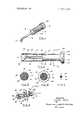
- FIG. 1is a perspective view of an example of an embodiment according to the principles of the present invention showing a scraper in an extended position;
- FIG. 2is a plan view of the exemplary embodiment illustrated in FIG. I, showing a scraper, a scraper handle and a cross section of a protective cover, with the scraper in a retracted position;
- FIG. 3is a cross-sectional view through FIG. 2 on the plane of the line 33, looking in the direction ofthe arrows;
- FIG. 4is a cross-sectional view through FIG. 2 on the plane of the line 4-4, looking in the direction of the arrows;
- FIG. 5is a cross-sectional view through FIG. 2 on the plane ofline 5-5, looking in the direction of the arrows;
- FIG. 6is an illustration of the application of the apparatus illustrated in FIG. I showing a suggested method of holding during operation thereof and a fragmentary cross-sectional view of the vaginal and cervical areas of the female human body.
- FIG. 1illustrates in perspective a cytologic scraping apparatus, generally shown at 10, having a scraper, generally shown at l2, extending from a cover 14.
- the extended positionis the operative position and operation is accomplished by manipulation of a knob 16, which is connected to the scraper 12 through a handle 20 and on an intermediate shaft I8.
- the disposed relationship of the scraper 12, the intermediate shaft 18, the handle 20 and the knob I6is best seen in FIG. 2.
- the cover 14is of cylindrical configuration, preferably having thin substantially rigid wall construction. It is desirable that the cover 14 be relatively nonabsorbent and/or have a low rate of absorption, and to have a low coefficient of friction on its exterior surface when in contact with the human skin, in order to retain its configuration and to be applied without difficulty or discomfort.
- the entrant end 24 of the cover 14may be ferruled inwardly (not shown) as an added measure to facilitate its administration to the female body at the vaginal opening.
- the sectional view of FIG. 3,best illustrates longitudinally extending protruding ribs 25, which are optionally included to provide a gripping surface for use when the cytologic scraping apparatus 10 is being applied.
- the inner surface of the cover 14is slidably engaged with the handle 20 and in combination, they are of such material and size so as to maintain engagement under static conditions, but to be free to be rotated and slid one within the other when external force is applied.
- the handle 20, accordingly,is also cylindrical and is able to register its entire length within the cover 14, as illustrated in FIG. I.
- the knob 16is in contact with the cover 14.
- the surfaces which meet to form that contactare surfaces 26 and 28 of the cover I4 and the knob 16, respectively.
- the scraper [2cannot be extended farther into the body when in an operative position. This stop acts to preclude injury caused by undue penetration of the scraper 12.
- penetration of the scraper 12is relative to the location of the cover 14. As is described hereinafter, the penetration depth of the cover 14 is readily controllable.
- FIG. 4is a section along the plane of the line 4-4 viewed in the direction of the arrows and best illustrates longitudinally extending ribs 30, similar in nature to the ribs 25, but of shorter length.
- the ribs 30are provided to enable the knob 16 to be rotated without undue difficulty. Since after the cytologic scraping apparatus 10 is inserted into the vaginal opening of the female, the relative rotated position of the scraper 12 is no longer particularly evident, an indexer 32 is provided on the knob 16. Various views of the indexer 32 are shown in FIGS. 1, 2 and 4. In the absence of the ribs 30, the indexer 32 can also be used to aid in the rotation of the knob 16.
- the intermediate shaft 18, as hereinabove mentioned,is connected and preferably integral with the handle 20 and the scraper 12.
- the shaft 18 and the scraper 12are of suitable resilient material in order to flex a slight amount under normal operating forces and yet be rigid enough to scrape the areas of contact upon rotation.
- the intermediate shaft [8is substantialiy cylindrical, as best seen in the sectional view of FIG. 5, and is free to flex equally in all directions upon exertion of a given force.
- the cylindrical shape of the intermediate shaft [8is reduced into the area ofthe scraper 12.
- the scraper I2is substantially flat and is in the shape of a heart having dissimilarly shaped lobes 34 and 36.
- the lobe 34also takes on the appearance of a fin diagonally disposed to the longitudinal axis established by the shaft [8.
- the finhas an apex or outwardmost point of generally convex shape, and when viewed from the side has a slightly bulging appearance, as best seen in FIG. 5, which is a sectional view in the direction of the arrows at the plane of the line -5.
- the lobe 36is of oblong shape with convex end and is similarly diagonally disposed to the axis established by the shaft 18.
- the lobe 36extends a greater diagonal distance from the axis of the shaft 18 than does lobe 34.
- FIG. 5also best shows the rounded and slightly bulging side view of the lobe 36.
- the cytologic scraping apparatus 10is particularly capable of being self-administered for vaginal and cervical examinations, and further it can be operated effectively regardless of the position assumed by the examined person as she operates the apparatus. Reliable results are obtainable whether the examined person is stand ing, squatting, sitting or lying.
- the womanIn operation, the woman assumes a comfortable position and after having removed the cytologic scraping apparatus from its protective and sterile packaging, grasps the cover 14 at the end closest to the knob 16 with one hand and knob l6 with the other hand.
- HO. 6illustrates the general area involved in the examination. She then, without undue force, inserts the apparatus into her body, entrant end 24 preceding, past the ulva 38 substantially into the vagina 40, practically until the hand grasping the cover [4 would need to release its grip if penetrated farther.
- the knob 16is now ready to be rotated and should be for a minimum of one full turn, taking note of the initial location of the indexer 32 so it can be returned to at least that position to accomplish one full turn. Because of the resilience of the scraper l2 and the intermediate shaft l8 and the freedom of the cover 14 to pivot slightly in its location, relatively little discomfort will be felt as the scraper 12 is rotated.
- the dissimilarly shaped lobes 34 and 36are configured to contact the vaginal walls 46, the ectocervix 48 and the 0s 42 of the cervix 44 to allow the scraper 12 to collect cells on its roughened surface for cytologic evaluation.
- the scraper 12is successful in collecting cells from the cervix 44 regardless of the orientation it may assume After a scraping has been accomplished, the knob X6 is urged outwardly thereby retracting the scraper 12 to assume a retracted position with respect to the cover [4, as best shown in FIG. 2.
- the womanthen extracts the cytologic scraping apparatus 10 from her body and then presents it to a clinic aid for deposition of the cellular scraping upon a slide for cytologic examination.
- the womancould once again extend the scraper l2 and smear the scrapings from the lobes 34 and 36 upon a slide and apply a usual fixative thereto and send the slide, properly identified, to a laboratory for examination.
- An apparatus for obtaining cells for cytologic examinationcomprising:
- an elongated body memberhaving a central axis with a generally flexible scraper portion at one end of the body member and a handle at the opposite end, disposed between and integral with the scraper portion and the handle is an intermediate portion, the scraper end being formed of substantially nondeformable material defining a flat section and two lobe sections, the two lobe sections are of differing shape and each extends outwardly from the elongated body member defining a plane passing through the axis of the elongated body member, the lobes being of greater thickness in a direction extending trans versely to the plane than the flat section joining the lobes and integrally connecting the lobes to the intermediate portion, the lobes having a rough grained surface texture for obtaining cells, the intermediate portion having a flexible portion extending from the scraper end to a cylindrical portion extending therefrom to the handle, the handle having a circular cross section and protruding gripping ribs disposed about the circular periphery, the ribs extending
- tubular coverslidably engaging the elongated body member at the cylindrical portion, the tubular cover having protruding positive gripping ribs about its periphery, the ribs extending in length in the direction of the axis of the elongated body member, the elongated body member being slidable between a retracted position whereat the scraper portion is disposed substantially interiorally ofthe tubular cover and an extended position whereat the scraper portion is disposed substantially exteriorally of the tubular cover for rotational manipulation of the handle and the lobes at the scraper portion when the apparatus is disposed for obtaining cells for cytologic examination.
Landscapes
- Health & Medical Sciences (AREA)
- Life Sciences & Earth Sciences (AREA)
- Medical Informatics (AREA)
- Molecular Biology (AREA)
- Reproductive Health (AREA)
- Engineering & Computer Science (AREA)
- Biomedical Technology (AREA)
- Heart & Thoracic Surgery (AREA)
- Gynecology & Obstetrics (AREA)
- Pathology (AREA)
- Surgery (AREA)
- Animal Behavior & Ethology (AREA)
- General Health & Medical Sciences (AREA)
- Public Health (AREA)
- Veterinary Medicine (AREA)
- Surgical Instruments (AREA)
Abstract
Description
D United States Patent 3,592,186
72; Inventor ChodeOeter 3,352,299 ll/l967 Sagiroglu 123 2 16206 Addison, Soulhfleld, Mlcll. 48075 3,404,677 l0/l968 Springer r l a r r r a I28/2 [2|] Appl. No. 794,520 3,438,366 4/l969 Kariher et al l28l2 [22] Filed Jill. 28,1969 3,485,236 l2/l969 Frost l28/2 [4S] Patented July I3, [971 3,49l,747 [/1970 Robinson r. l28/2 OTHER REFERENCES SURGERY, GYNECOLOGY AND OBSTETRICS, Vol. (54] CYTODOGIC 8cm 87, No. 3, Sept. 1948, p, [8 (copy in SL335 128/213) 1 Chill, 6Drawing Flgs. Primary Examiner-Richard A. Gaudet Assistant Examiner- Kyle L. Howell [52] US. Cl. Anomey acmard D Bosdon ,[Sl] lll. A6") 10/00 [50] Flekld'seareh 128/128,
304 ABSTRACT: An apparatus adapted to be self-administered for obtaining surface cells from a human being, particularly Cm from the vaginal and cervical areas of a female, for use in diag- UNITED STATES PATENTS nosing cancer, the apparatus having a spatulalike scraper of D. 196,412 9/1963 Ayre 083/12 heartlike configuration with two dissimilarly shaped lobes for 217L088 5/1949 Ayre [28/304 taking a cellular smear, the scraper telescoping within a pro- 2,90$,l69 9/1959 Nieburgs..... l28/2 tective cover and being operable to be extended therefrom 2,955,591 Ill/I960 MacLean l28/B and to be rotated for cell collecting when the apparatus is 2.955.592 l0/l960 Macbean l28/2 disposed within the human body.
INVENTOR CLAUDE OSTER CYTOLOGIC SCRAPER BACKGROUND OF THE INVENTION l. Field of the Invention This invention relates to a medical instrument for collecting cells from a female body for cytologic evaluation and, in particular, to an apparatus having a scraper and a protective cover engaged in a telescopic relationship for the scraper to extend therefrom and to collect, upon rotation, cells from surfaces contacted when the apparatus is disposed substantially within the female body.
2. Description of the Prior Art In the past, devices used to gather cells from both the vaginal and cervical areas of the female body for cytologic evaluation had to be inserted and operated by a person having a special skill, in order to preclude injury to the individual being examined. The prior art scraper devices are generally of a configuration and material which, if not handled by trained personnel, could result in a puncture or abrasive injury to the areas being examined. Further, those devices which purport to have elements which act to stop the scraper from being disposed unduly into the vaginal opening. either are not designed to gather cells from the immediately accessible potential growth areas of cancer in the vaginal and cervical regions or are ofsuch construction as to be inherently dangerous if not operated by a trained person.
SUMMARY OF THE INVENTION Accordingly. there is need for an apparatus capable of being self-administered for collecting cells from both the vaginal and cervical regions of the female body for cytologic evaluation. The present invention provides such an apparatus. The medical instrument of the present invention is particularly useful as a screening device and greatly facilitates the administration of medical attention and the conduction of examinations to large numbers of people, including those in remote areas of the world. The medical instrument comprises a substantially resilient scraper having a generally irregular heart-shape which is telescopically engaged with a protective cover. When the apparatus is disposed substantially within the female body at the vaginal opening, the scraper is extensible and rotatable by the individual from whom the cells are to be obtained. The scraper is shaped to collect cells from the walls of the vagina and the fornix and s portions of the cervix, regardless of the orientation of the cervix. An indexer is provided to give external indication to the operator of the relative position of the scraper when in operation.
BRIEF DESCRIPTION OF THE DRAWINGS FIG. 1 is a perspective view of an example of an embodiment according to the principles of the present invention showing a scraper in an extended position;
FIG. 2 is a plan view of the exemplary embodiment illustrated in FIG. I, showing a scraper, a scraper handle and a cross section of a protective cover, with the scraper in a retracted position;
FIG. 3 is a cross-sectional view through FIG. 2 on the plane of the line 33, looking in the direction ofthe arrows;
FIG. 4 is a cross-sectional view through FIG. 2 on the plane of the line 4-4, looking in the direction of the arrows;
FIG. 5 is a cross-sectional view through FIG. 2 on the plane ofline 5-5, looking in the direction of the arrows; and
FIG. 6 is an illustration of the application of the apparatus illustrated in FIG. I showing a suggested method of holding during operation thereof and a fragmentary cross-sectional view of the vaginal and cervical areas of the female human body.
DETAILED DESCRIPTION OF THE ILLUSTRATED EMBODIMENT Since the apparatus is capable of being self-administered, it lends itself to widespread geographical use. It is now possible to effectively service remotely located areas which are still without medical facilities. Because of its intended universal use and because many of the areas have no sterilization equipment, it is practical that the apparatus be disposed of after a single use. Accordingly, its manufacturing design and the material used throughout, although in keeping with the purpose of the apparatus, are selected to minimize its cost. Addi tionally, it will be appreciated that the physical dimensions of a single unit apparatus are selected to accommodate the vast majority of the people.
Referring now to the drawings, FIG. 1 illustrates in perspective a cytologic scraping apparatus, generally shown at 10, having a scraper, generally shown at l2, extending from acover 14. The extended position is the operative position and operation is accomplished by manipulation of aknob 16, which is connected to thescraper 12 through ahandle 20 and on an intermediate shaft I8. The disposed relationship of thescraper 12, theintermediate shaft 18, thehandle 20 and the knob I6 is best seen in FIG. 2.
Further to FIG. 2, wherein the apparatus is shown in plan view and in partial section, thecover 14 is of cylindrical configuration, preferably having thin substantially rigid wall construction. It is desirable that thecover 14 be relatively nonabsorbent and/or have a low rate of absorption, and to have a low coefficient of friction on its exterior surface when in contact with the human skin, in order to retain its configuration and to be applied without difficulty or discomfort. Optionally, theentrant end 24 of thecover 14 may be ferruled inwardly (not shown) as an added measure to facilitate its administration to the female body at the vaginal opening. The sectional view of FIG. 3, best illustrates longitudinally extendingprotruding ribs 25, which are optionally included to provide a gripping surface for use when thecytologic scraping apparatus 10 is being applied.
The inner surface of thecover 14 is slidably engaged with thehandle 20 and in combination, they are of such material and size so as to maintain engagement under static conditions, but to be free to be rotated and slid one within the other when external force is applied. Thehandle 20, accordingly, is also cylindrical and is able to register its entire length within thecover 14, as illustrated in FIG. I.
Also shown in FIG. I, theknob 16 is in contact with thecover 14. As best seen in FIG. 2, the surfaces which meet to form that contact aresurfaces knob 16, respectively. When thesurfaces scraper 12. As will be appreciated, penetration of thescraper 12 is relative to the location of thecover 14. As is described hereinafter, the penetration depth of thecover 14 is readily controllable.
FIG. 4 is a section along the plane of the line 4-4 viewed in the direction of the arrows and best illustrates longitudinally extendingribs 30, similar in nature to theribs 25, but of shorter length. Theribs 30 are provided to enable theknob 16 to be rotated without undue difficulty. Since after thecytologic scraping apparatus 10 is inserted into the vaginal opening of the female, the relative rotated position of thescraper 12 is no longer particularly evident, anindexer 32 is provided on theknob 16. Various views of theindexer 32 are shown in FIGS. 1, 2 and 4. In the absence of theribs 30, theindexer 32 can also be used to aid in the rotation of theknob 16.
Theintermediate shaft 18, as hereinabove mentioned, is connected and preferably integral with thehandle 20 and thescraper 12. Theshaft 18 and thescraper 12 are of suitable resilient material in order to flex a slight amount under normal operating forces and yet be rigid enough to scrape the areas of contact upon rotation. The intermediate shaft [8 is substantialiy cylindrical, as best seen in the sectional view of FIG. 5, and is free to flex equally in all directions upon exertion of a given force. At the junction of theintermediate shaft 18 and thescraper 12. the cylindrical shape of the intermediate shaft [8 is reduced into the area ofthescraper 12. The scraper I2 is substantially flat and is in the shape of a heart having dissimilarly shapedlobes lobe 34 also takes on the appearance of a fin diagonally disposed to the longitudinal axis established by the shaft [8. The fin has an apex or outwardmost point of generally convex shape, and when viewed from the side has a slightly bulging appearance, as best seen in FIG. 5, which is a sectional view in the direction of the arrows at the plane of the line -5. Thelobe 36 is of oblong shape with convex end and is similarly diagonally disposed to the axis established by theshaft 18. Thelobe 36 extends a greater diagonal distance from the axis of theshaft 18 than doeslobe 34. FIG. 5 also best shows the rounded and slightly bulging side view of thelobe 36.
[t is well accepted that a roughened surface texture is more desirable to collect cells from the vaginal and cervical regions of a female. Not all scraper instruments necessarily need have a roughened texture created thereon, since certain materials inherently have suitable surfaces. Certain grades of wood and gauze have been successfully used to collect cells from the areas under examination. Thescraper 12, as illustrated in FIG. 2, has a rather extensive textured surface, which extends substantially up to the junction with theintermediate shaft 18. It will be appreciated that the texture plays a most important part along the outer perimeter of thelobes
As mentioned hereinabove, thecytologic scraping apparatus 10 is particularly capable of being self-administered for vaginal and cervical examinations, and further it can be operated effectively regardless of the position assumed by the examined person as she operates the apparatus. Reliable results are obtainable whether the examined person is stand ing, squatting, sitting or lying.
In operation, the woman assumes a comfortable position and after having removed the cytologic scraping apparatus from its protective and sterile packaging, grasps thecover 14 at the end closest to theknob 16 with one hand and knob l6 with the other hand. HO. 6 illustrates the general area involved in the examination. She then, without undue force, inserts the apparatus into her body,entrant end 24 preceding, past theulva 38 substantially into the vagina 40, practically until the hand grasping the cover [4 would need to release its grip if penetrated farther. Once thecover 14 is comfortably inside, the woman exerts slight force against theknob 16 thereby extending the scraper l2 farther into the vagina 40 until she senses that thescraper 12 cannot be extended farther or until thecover surface 26 and theknob surface 28 are in contact (FIG. 1). When thecover 14 has been properly positioned, thesurface lobe 34 is in contact with theos 42 of the cervix 44 and thelobe 36 is in contact with thevaginal wall 46. The above-described arrangement will accommodate the majority ofwomen.
Theknob 16 is now ready to be rotated and should be for a minimum of one full turn, taking note of the initial location of theindexer 32 so it can be returned to at least that position to accomplish one full turn. Because of the resilience of the scraper l2 and the intermediate shaft l8 and the freedom of thecover 14 to pivot slightly in its location, relatively little discomfort will be felt as thescraper 12 is rotated. The dissimilarly shapedlobes vaginal walls 46, theectocervix 48 and the0s 42 of the cervix 44 to allow thescraper 12 to collect cells on its roughened surface for cytologic evaluation. Thescraper 12 is successful in collecting cells from the cervix 44 regardless of the orientation it may assume After a scraping has been accomplished, the knob X6 is urged outwardly thereby retracting thescraper 12 to assume a retracted position with respect to the cover [4, as best shown in FIG. 2. The woman then extracts thecytologic scraping apparatus 10 from her body and then presents it to a clinic aid for deposition of the cellular scraping upon a slide for cytologic examination. Alternatively, the woman could once again extend the scraper l2 and smear the scrapings from thelobes
The ease of operation of the apparatus, the reliable results achieved through its use, the fact that it is capable of self-ad ministration and can be made inexpensively, renders this inventive apparatus a ideal instrument for screening great mul titudes of women to determine the existence or nonexistence of cancerous growth in the cervical and vaginal areas, This apparatus will enable medical personnel presently involved in conducting such examinations to devote their time to other critical matters. Because instruction in the use of thecytologic scraping apparatus 10 is possible through printed picture form on instructional sheets, the apparatus can be used by the literate and nonliterate alike, making it ideally suited to be used in remote underdeveloped areas of the world.
This invention is described by way ofillustration rather than limitation, and accordingly it is understood that this invention is to be limited only by the appended claim taken in view of the prior art.
I claim:
I. An apparatus for obtaining cells for cytologic examination, comprising:
an elongated body member having a central axis with a generally flexible scraper portion at one end of the body member and a handle at the opposite end, disposed between and integral with the scraper portion and the handle is an intermediate portion, the scraper end being formed of substantially nondeformable material defining a flat section and two lobe sections, the two lobe sections are of differing shape and each extends outwardly from the elongated body member defining a plane passing through the axis of the elongated body member, the lobes being of greater thickness in a direction extending trans versely to the plane than the flat section joining the lobes and integrally connecting the lobes to the intermediate portion, the lobes having a rough grained surface texture for obtaining cells, the intermediate portion having a flexible portion extending from the scraper end to a cylindrical portion extending therefrom to the handle, the handle having a circular cross section and protruding gripping ribs disposed about the circular periphery, the ribs extending in length in the direction of the axis of the elongated body member, the handle having an index tab protruding from the circular periphery of the handle outwardly beyond the gripping ribs; and
a tubular cover slidably engaging the elongated body member at the cylindrical portion, the tubular cover having protruding positive gripping ribs about its periphery, the ribs extending in length in the direction of the axis of the elongated body member, the elongated body member being slidable between a retracted position whereat the scraper portion is disposed substantially interiorally ofthe tubular cover and an extended position whereat the scraper portion is disposed substantially exteriorally of the tubular cover for rotational manipulation of the handle and the lobes at the scraper portion when the apparatus is disposed for obtaining cells for cytologic examination.
Claims (1)
1. An apparatus for obtaining cells for cytologic examination, comprising: an elongated body member having a central axis with a generally flexible scraper portion at one end of the body member and a handle at the opposite end, disposed between and integral with the scraper portion and the handle is an intermediate portion, the scraper end being formed of substantially nondeformable material defining a flat section and two lobe sections, the two lobe sections are of differing shape and each extends outwardly from the elongated body member defining a plane passing through the axis of the elongated body member, the lobes being of greater thickness in a direction extending transversely to the plane than the flat section joining the lobes and integrally connecting the lobes to the intermediate portion, the lobes having a rough grained surface texture for obtaining cells, the intermediate portion having a flexible portion extending from the scraper end to a cylindrical portion extending therefrom to the handle, the handle having a circular croSs section and protruding gripping ribs disposed about the circular periphery, the ribs extending in length in the direction of the axis of the elongated body member, the handle having an index tab protruding from the circular periphery of the handle outwardly beyond the gripping ribs; and a tubular cover slidably engaging the elongated body member at the cylindrical portion, the tubular cover having protruding positive gripping ribs about its periphery, the ribs extending in length in the direction of the axis of the elongated body member, the elongated body member being slidable between a retracted position whereat the scraper portion is disposed substantially interiorally of the tubular cover and an extended position whereat the scraper portion is disposed substantially exteriorally of the tubular cover for rotational manipulation of the handle and the lobes at the scraper portion when the apparatus is disposed for obtaining cells for cytologic examination.
Applications Claiming Priority (1)
| Application Number | Priority Date | Filing Date | Title |
|---|---|---|---|
| US79452069A | 1969-01-28 | 1969-01-28 |
Publications (1)
| Publication Number | Publication Date |
|---|---|
| US3592186Atrue US3592186A (en) | 1971-07-13 |
Family
ID=25162872
Family Applications (1)
| Application Number | Title | Priority Date | Filing Date |
|---|---|---|---|
| US794520*AExpired - LifetimeUS3592186A (en) | 1969-01-28 | 1969-01-28 | Cytologic scraper |
Country Status (2)
| Country | Link |
|---|---|
| US (1) | US3592186A (en) |
| CA (1) | CA936061A (en) |
Cited By (90)
| Publication number | Priority date | Publication date | Assignee | Title |
|---|---|---|---|---|
| US3776219A (en)* | 1972-09-15 | 1973-12-04 | Metpath Inc | Cervical scraper |
| US3796211A (en)* | 1972-08-07 | 1974-03-12 | Medics Res & Dev Inc | Biopsy sampling method and device for the female genital tract |
| US3800781A (en)* | 1972-05-30 | 1974-04-02 | K Zalucki | Specimen-taking device |
| US3828765A (en)* | 1971-11-24 | 1974-08-13 | Medical Testing Syst Inc | Genitourinary test instrument |
| US3857384A (en)* | 1973-04-09 | 1974-12-31 | G Watson | Cervical tissue cell specimen gathering device |
| US3961620A (en)* | 1971-03-12 | 1976-06-08 | Research Industries Corporation | Cervical sampling apparatus |
| US4054127A (en)* | 1974-09-13 | 1977-10-18 | Milan Albert R | Endometrial sampling instrument |
| WO1981002974A1 (en)* | 1980-04-21 | 1981-10-29 | R Hasselbrack | Pap smear t-zone sampler |
| US4327744A (en)* | 1980-06-23 | 1982-05-04 | Smith Louise W | Apparatus for the self-collection of cervical cell specimens |
| US4620548A (en)* | 1980-04-21 | 1986-11-04 | Accupap, Inc. | Pap smear T-zone sampler |
| US4785796A (en)* | 1986-09-12 | 1988-11-22 | Mattson Philip D | Otoscope and flexible, disposable curette for use therewith |
| US4877037A (en)* | 1985-11-12 | 1989-10-31 | Minnesota Mining And Manufacturing Company | Tissue or mucus sampling device |
| WO1989010724A1 (en)* | 1988-05-10 | 1989-11-16 | Stormby, Nils | Brush and method in the manufacture thereof |
| US4981143A (en)* | 1985-04-20 | 1991-01-01 | Anne Company Limited | Cell sampler |
| GB2248396A (en)* | 1990-10-05 | 1992-04-08 | Elizabeth Tingsu Houang | Swab with telescoping sheath |
| US5121752A (en)* | 1985-01-28 | 1992-06-16 | Canna Cheral J | Apparatus and method for self-obtaining PAP smears |
| EP0594786A4 (en)* | 1991-07-17 | 1995-02-22 | Lonsten Pty Ltd | DEVICE FOR SAMPLING VAGINAL FROTTIS. |
| US5476104A (en)* | 1994-08-01 | 1995-12-19 | Sheahon; John A. | Cervical and endometrial biopsy instrument |
| US5623941A (en)* | 1988-05-10 | 1997-04-29 | Nils Stormby | Cervical sampling velour brush |
| EP0804122A4 (en)* | 1993-05-11 | 1998-11-11 | Gynetech Inc | DEVICE FOR TAKING CERVIX TISSUE |
| RU2125403C1 (en)* | 1996-04-24 | 1999-01-27 | Новгородский государственный университет им.Ярослава Мудрого | Device for material intake from neck of uterus for cytodiagnostics |
| USD423669S (en)* | 1999-01-08 | 2000-04-25 | Bionix Development Corporation | Curette |
| USD428489S (en)* | 1998-09-09 | 2000-07-18 | Bionix Development Corp. | Ear curette |
| US6129739A (en)* | 1999-07-30 | 2000-10-10 | Incept Llc | Vascular device having one or more articulation regions and methods of use |
| US6179861B1 (en) | 1999-07-30 | 2001-01-30 | Incept Llc | Vascular device having one or more articulation regions and methods of use |
| US6179859B1 (en) | 1999-07-16 | 2001-01-30 | Baff Llc | Emboli filtration system and methods of use |
| US6203561B1 (en) | 1999-07-30 | 2001-03-20 | Incept Llc | Integrated vascular device having thrombectomy element and vascular filter and methods of use |
| USD439338S1 (en) | 1999-09-14 | 2001-03-20 | Bionix Development Corp. | Curette tip |
| US6214026B1 (en) | 1999-07-30 | 2001-04-10 | Incept Llc | Delivery system for a vascular device with articulation region |
| USD447237S1 (en) | 1999-06-21 | 2001-08-28 | Bionix Development Corporation | Curette |
| USD449888S1 (en) | 2001-01-05 | 2001-10-30 | Bionix Development Corporation | Curette |
| USD450676S1 (en) | 2001-01-05 | 2001-11-20 | Bionix Development Corporation | Curette tip |
| US20010044632A1 (en)* | 1997-03-06 | 2001-11-22 | Scimed Life Systems, Inc. | Distal protection device and method |
| US6352513B1 (en) | 1999-06-25 | 2002-03-05 | Ampersand Medical Corporation | Personal cervical cell collector |
| US6371970B1 (en) | 1999-07-30 | 2002-04-16 | Incept Llc | Vascular filter having articulation region and methods of use in the ascending aorta |
| US6371969B1 (en) | 1997-05-08 | 2002-04-16 | Scimed Life Systems, Inc. | Distal protection device and method |
| US6371971B1 (en) | 1999-11-15 | 2002-04-16 | Scimed Life Systems, Inc. | Guidewire filter and methods of use |
| US6379315B1 (en) | 1998-04-01 | 2002-04-30 | Medscand Medical Ab | Spatula for taking of sampling |
| US6468291B2 (en) | 1999-07-16 | 2002-10-22 | Baff Llc | Emboli filtration system having integral strut arrangement and methods of use |
| US6537295B2 (en) | 2001-03-06 | 2003-03-25 | Scimed Life Systems, Inc. | Wire and lock mechanism |
| US6544280B1 (en) | 1999-02-24 | 2003-04-08 | Scimed Life Systems, Inc. | Intravascular filter and method |
| US6544279B1 (en) | 2000-08-09 | 2003-04-08 | Incept, Llc | Vascular device for emboli, thrombus and foreign body removal and methods of use |
| US6589263B1 (en) | 1999-07-30 | 2003-07-08 | Incept Llc | Vascular device having one or more articulation regions and methods of use |
| US20030150821A1 (en)* | 1999-07-16 | 2003-08-14 | Bates Mark C. | Emboli filtration system and methods of use |
| US6616681B2 (en) | 2000-10-05 | 2003-09-09 | Scimed Life Systems, Inc. | Filter delivery and retrieval device |
| US6620148B1 (en) | 1999-08-04 | 2003-09-16 | Scimed Life Systems, Inc. | Filter flush system and methods of use |
| US6620182B1 (en) | 1999-07-30 | 2003-09-16 | Incept Llc | Vascular filter having articulation region and methods of use in the ascending aorta |
| US6652505B1 (en) | 1999-08-03 | 2003-11-25 | Scimed Life Systems Inc. | Guided filter with support wire and methods of use |
| US6663651B2 (en) | 2001-01-16 | 2003-12-16 | Incept Llc | Systems and methods for vascular filter retrieval |
| US6673090B2 (en) | 1999-08-04 | 2004-01-06 | Scimed Life Systems, Inc. | Percutaneous catheter and guidewire for filtering during ablation of myocardial or vascular tissue |
| US6676682B1 (en) | 1997-05-08 | 2004-01-13 | Scimed Life Systems, Inc. | Percutaneous catheter and guidewire having filter and medical device deployment capabilities |
| US6689151B2 (en) | 2001-01-25 | 2004-02-10 | Scimed Life Systems, Inc. | Variable wall thickness for delivery sheath housing |
| US6726703B2 (en) | 2000-11-27 | 2004-04-27 | Scimed Life Systems, Inc. | Distal protection device and method |
| US6755847B2 (en) | 2001-10-05 | 2004-06-29 | Scimed Life Systems, Inc. | Emboli capturing device and method of manufacture therefor |
| US6951570B2 (en) | 2001-07-02 | 2005-10-04 | Rubicon Medical, Inc. | Methods, systems, and devices for deploying a filter from a filter device |
| US20050256483A1 (en)* | 2004-04-30 | 2005-11-17 | Przepasniak Ann M | Disposable vaginal insertion device |
| US20050288695A1 (en)* | 2004-06-24 | 2005-12-29 | Scimed Life Systems, Inc. | Apparatus and method for treating occluded vasculature |
| US6997939B2 (en) | 2001-07-02 | 2006-02-14 | Rubicon Medical, Inc. | Methods, systems, and devices for deploying an embolic protection filter |
| US7052500B2 (en) | 2001-10-19 | 2006-05-30 | Scimed Life Systems, Inc. | Embolus extractor |
| US7094249B1 (en) | 1997-03-06 | 2006-08-22 | Boston Scientific Scimed, Inc. | Distal protection device and method |
| USD539426S1 (en) | 2005-10-28 | 2007-03-27 | Veteren Medical Products, Inc. | Ear curette |
| US7204464B2 (en) | 2005-01-21 | 2007-04-17 | Boston Scientific Scimed, Inc. | Medical wire holder |
| AU2004201513B2 (en)* | 1995-01-17 | 2007-07-19 | Gynetech, Inc | Cervical tissue sampling device |
| US7320697B2 (en) | 1999-07-30 | 2008-01-22 | Boston Scientific Scimed, Inc. | One piece loop and coil |
| US7473265B2 (en) | 2004-03-15 | 2009-01-06 | Boston Scientific Scimed, Inc. | Filter media and methods of manufacture |
| US7478465B1 (en) | 2005-01-10 | 2009-01-20 | Boston Scientific Scimed, Inc. | Method of securing a restraining member on a medical device |
| US7594926B2 (en) | 2001-11-09 | 2009-09-29 | Boston Scientific Scimed, Inc. | Methods, systems and devices for delivering stents |
| US7621904B2 (en) | 2004-10-21 | 2009-11-24 | Boston Scientific Scimed, Inc. | Catheter with a pre-shaped distal tip |
| US7651514B2 (en) | 2003-12-11 | 2010-01-26 | Boston Scientific Scimed, Inc. | Nose rider improvement for filter exchange and methods of use |
| US7695465B2 (en) | 2001-07-30 | 2010-04-13 | Boston Scientific Scimed, Inc. | Chronic total occlusion device with variable stiffness shaft |
| US7708770B2 (en) | 2001-11-09 | 2010-05-04 | Boston Scientific Scimed, Inc. | Stent delivery device with embolic protection |
| US7780611B2 (en) | 2003-05-01 | 2010-08-24 | Boston Scientific Scimed, Inc. | Medical instrument with controlled torque transmission |
| US20100222806A1 (en)* | 2001-10-19 | 2010-09-02 | Boston Scientific Scimed, Inc. | Embolus extractor |
| US7794472B2 (en) | 2004-08-11 | 2010-09-14 | Boston Scientific Scimed, Inc. | Single wire intravascular filter |
| DE202009005225U1 (en)* | 2009-09-02 | 2011-01-13 | Süddeutsche Feinmechanik GmbH | curette |
| US7875050B2 (en) | 1997-09-30 | 2011-01-25 | Target Therapeutics, Inc. | Mechanical clot treatment device |
| US7993329B2 (en) | 2002-08-13 | 2011-08-09 | Cook Medical Technologies Llc | ERCP catheter with a removable handle for lithotriptor compatible basket |
| US7998163B2 (en) | 2002-10-03 | 2011-08-16 | Boston Scientific Scimed, Inc. | Expandable retrieval device |
| US8038696B2 (en) | 2004-12-06 | 2011-10-18 | Boston Scientific Scimed, Inc. | Sheath for use with an embolic protection filter |
| US8123777B2 (en) | 2001-07-24 | 2012-02-28 | Incept, Llc | Apparatus and methods for aspirating emboli |
| US8236024B2 (en) | 2001-02-20 | 2012-08-07 | Boston Scientific Scimed, Inc. | Low profile emboli capture device |
| US8444669B2 (en) | 2008-12-15 | 2013-05-21 | Boston Scientific Scimed, Inc. | Embolic filter delivery system and method |
| US8468678B2 (en) | 2002-10-02 | 2013-06-25 | Boston Scientific Scimed, Inc. | Expandable retrieval device |
| US8480629B2 (en) | 2005-01-28 | 2013-07-09 | Boston Scientific Scimed, Inc. | Universal utility board for use with medical devices and methods of use |
| US8535344B2 (en) | 2003-09-12 | 2013-09-17 | Rubicon Medical, Inc. | Methods, systems, and devices for providing embolic protection and removing embolic material |
| US8821478B2 (en) | 2011-03-04 | 2014-09-02 | Boston Scientific Scimed, Inc. | Catheter with variable stiffness |
| US9826920B2 (en) | 2012-01-20 | 2017-11-28 | Deepak Pahuja | Disposable dual tipped ear curette incorporating depth measurement system |
| US20210100539A1 (en)* | 2014-02-11 | 2021-04-08 | All Cape Gynecology Llc | Endocyte cannula |
| US11129702B2 (en) | 2018-05-09 | 2021-09-28 | Boston Scientific Scimed, Inc. | Pedal access embolic filtering sheath |
| US11246577B2 (en)* | 2016-03-11 | 2022-02-15 | Oncogenesis, Inc. | Personal cervical cell collection device, kit and method |
Citations (9)
| Publication number | Priority date | Publication date | Assignee | Title |
|---|---|---|---|---|
| US2471088A (en)* | 1947-10-01 | 1949-05-24 | Clay Adams Company Inc | Cervical scraper |
| US2905169A (en)* | 1955-03-10 | 1959-09-22 | Herbert E Nieburgs | Device for cancer detection |
| US2955591A (en)* | 1954-05-20 | 1960-10-11 | Kenneth S Maclean | Abrasive cytologic instruments |
| US2955592A (en)* | 1955-12-29 | 1960-10-11 | Kenneth S Maclean | Diagnostic instrument |
| US3352299A (en)* | 1964-11-25 | 1967-11-14 | Dept Of Cytopathology And Cell | Cyologic pan-scraper |
| US3404677A (en)* | 1965-07-08 | 1968-10-08 | Henry A. Springer | Biopsy and tissue removing device |
| US3438366A (en)* | 1966-01-27 | 1969-04-15 | Hollister Inc | Specimen collector |
| US3485236A (en)* | 1965-12-09 | 1969-12-23 | Becton Dickinson Co | Biopsy specimen collecting and spreading device |
| US3491747A (en)* | 1966-08-12 | 1970-01-27 | Ralph R Robinson | Curette device |
- 1969
- 1969-01-28USUS794520*Apatent/US3592186A/ennot_activeExpired - Lifetime
- 1970
- 1970-01-27CACA073182Apatent/CA936061A/ennot_activeExpired
Patent Citations (9)
| Publication number | Priority date | Publication date | Assignee | Title |
|---|---|---|---|---|
| US2471088A (en)* | 1947-10-01 | 1949-05-24 | Clay Adams Company Inc | Cervical scraper |
| US2955591A (en)* | 1954-05-20 | 1960-10-11 | Kenneth S Maclean | Abrasive cytologic instruments |
| US2905169A (en)* | 1955-03-10 | 1959-09-22 | Herbert E Nieburgs | Device for cancer detection |
| US2955592A (en)* | 1955-12-29 | 1960-10-11 | Kenneth S Maclean | Diagnostic instrument |
| US3352299A (en)* | 1964-11-25 | 1967-11-14 | Dept Of Cytopathology And Cell | Cyologic pan-scraper |
| US3404677A (en)* | 1965-07-08 | 1968-10-08 | Henry A. Springer | Biopsy and tissue removing device |
| US3485236A (en)* | 1965-12-09 | 1969-12-23 | Becton Dickinson Co | Biopsy specimen collecting and spreading device |
| US3438366A (en)* | 1966-01-27 | 1969-04-15 | Hollister Inc | Specimen collector |
| US3491747A (en)* | 1966-08-12 | 1970-01-27 | Ralph R Robinson | Curette device |
Non-Patent Citations (1)
| Title |
|---|
| SURGERY, GYNECOLOGY AND OBSTETRICS, Vol. 87, No. 3, Sept. 1948, p. 18 (copy in Gr.335 128/2B)* |
Cited By (130)
| Publication number | Priority date | Publication date | Assignee | Title |
|---|---|---|---|---|
| US3961620A (en)* | 1971-03-12 | 1976-06-08 | Research Industries Corporation | Cervical sampling apparatus |
| US3828765A (en)* | 1971-11-24 | 1974-08-13 | Medical Testing Syst Inc | Genitourinary test instrument |
| US3800781A (en)* | 1972-05-30 | 1974-04-02 | K Zalucki | Specimen-taking device |
| US3796211A (en)* | 1972-08-07 | 1974-03-12 | Medics Res & Dev Inc | Biopsy sampling method and device for the female genital tract |
| US3776219A (en)* | 1972-09-15 | 1973-12-04 | Metpath Inc | Cervical scraper |
| US3857384A (en)* | 1973-04-09 | 1974-12-31 | G Watson | Cervical tissue cell specimen gathering device |
| US4054127A (en)* | 1974-09-13 | 1977-10-18 | Milan Albert R | Endometrial sampling instrument |
| WO1981002974A1 (en)* | 1980-04-21 | 1981-10-29 | R Hasselbrack | Pap smear t-zone sampler |
| US4620548A (en)* | 1980-04-21 | 1986-11-04 | Accupap, Inc. | Pap smear T-zone sampler |
| US4327744A (en)* | 1980-06-23 | 1982-05-04 | Smith Louise W | Apparatus for the self-collection of cervical cell specimens |
| US5121752A (en)* | 1985-01-28 | 1992-06-16 | Canna Cheral J | Apparatus and method for self-obtaining PAP smears |
| US4981143A (en)* | 1985-04-20 | 1991-01-01 | Anne Company Limited | Cell sampler |
| US4877037A (en)* | 1985-11-12 | 1989-10-31 | Minnesota Mining And Manufacturing Company | Tissue or mucus sampling device |
| US4785796A (en)* | 1986-09-12 | 1988-11-22 | Mattson Philip D | Otoscope and flexible, disposable curette for use therewith |
| WO1989010724A1 (en)* | 1988-05-10 | 1989-11-16 | Stormby, Nils | Brush and method in the manufacture thereof |
| US5623941A (en)* | 1988-05-10 | 1997-04-29 | Nils Stormby | Cervical sampling velour brush |
| GB2248396B (en)* | 1990-10-05 | 1994-11-16 | Elizabeth Tinsou Houang | Swab |
| GB2248396A (en)* | 1990-10-05 | 1992-04-08 | Elizabeth Tingsu Houang | Swab with telescoping sheath |
| EP0594786A4 (en)* | 1991-07-17 | 1995-02-22 | Lonsten Pty Ltd | DEVICE FOR SAMPLING VAGINAL FROTTIS. |
| EP0804122A4 (en)* | 1993-05-11 | 1998-11-11 | Gynetech Inc | DEVICE FOR TAKING CERVIX TISSUE |
| US5476104A (en)* | 1994-08-01 | 1995-12-19 | Sheahon; John A. | Cervical and endometrial biopsy instrument |
| AU2004201513B2 (en)* | 1995-01-17 | 2007-07-19 | Gynetech, Inc | Cervical tissue sampling device |
| RU2125403C1 (en)* | 1996-04-24 | 1999-01-27 | Новгородский государственный университет им.Ярослава Мудрого | Device for material intake from neck of uterus for cytodiagnostics |
| US20010044632A1 (en)* | 1997-03-06 | 2001-11-22 | Scimed Life Systems, Inc. | Distal protection device and method |
| US7094249B1 (en) | 1997-03-06 | 2006-08-22 | Boston Scientific Scimed, Inc. | Distal protection device and method |
| US6676682B1 (en) | 1997-05-08 | 2004-01-13 | Scimed Life Systems, Inc. | Percutaneous catheter and guidewire having filter and medical device deployment capabilities |
| US6964673B2 (en) | 1997-05-08 | 2005-11-15 | Scimed Life Systems, Inc. | Percutaneous catheter and guidewire having filter and medical device deployment capabilities |
| US20100160955A1 (en)* | 1997-05-08 | 2010-06-24 | Boston Scientific Scimed, Inc. | Percutaneous catheter and guidewire having filter and medical device deployment capabilities |
| US7691123B2 (en) | 1997-05-08 | 2010-04-06 | Boston Scientific Scimed, Inc. | Percutaneous catheter and guidewire having filter and medical device deployment capabilities |
| US6371969B1 (en) | 1997-05-08 | 2002-04-16 | Scimed Life Systems, Inc. | Distal protection device and method |
| US20110224716A1 (en)* | 1997-05-08 | 2011-09-15 | Boston Scientific Scimed, Inc. | Percutaneous catheter and guidewire having filter and medical device deployment capabilities |
| US7875050B2 (en) | 1997-09-30 | 2011-01-25 | Target Therapeutics, Inc. | Mechanical clot treatment device |
| US8486104B2 (en) | 1997-09-30 | 2013-07-16 | Stryker Corporation | Mechanical clot treatment device with distal filter |
| US6379315B1 (en) | 1998-04-01 | 2002-04-30 | Medscand Medical Ab | Spatula for taking of sampling |
| USD428489S (en)* | 1998-09-09 | 2000-07-18 | Bionix Development Corp. | Ear curette |
| USD423669S (en)* | 1999-01-08 | 2000-04-25 | Bionix Development Corporation | Curette |
| US8303618B2 (en) | 1999-02-24 | 2012-11-06 | Boston Scientific Scimed, Inc. | Intravascular filter and method |
| US9119706B2 (en) | 1999-02-24 | 2015-09-01 | Boston Scientific Scimed Inc. | Intravascular filter and method |
| US7618433B2 (en) | 1999-02-24 | 2009-11-17 | Boston Scientific Scimed, Inc. | Intravascular filter and method |
| US6544280B1 (en) | 1999-02-24 | 2003-04-08 | Scimed Life Systems, Inc. | Intravascular filter and method |
| USD447237S1 (en) | 1999-06-21 | 2001-08-28 | Bionix Development Corporation | Curette |
| US6352513B1 (en) | 1999-06-25 | 2002-03-05 | Ampersand Medical Corporation | Personal cervical cell collector |
| US6468291B2 (en) | 1999-07-16 | 2002-10-22 | Baff Llc | Emboli filtration system having integral strut arrangement and methods of use |
| US7563272B2 (en) | 1999-07-16 | 2009-07-21 | Boston Scientific Scimed, Inc. | Emboli filtration system and methods of use |
| US7699866B2 (en) | 1999-07-16 | 2010-04-20 | Boston Scientific Scimed, Inc. | Emboli filtration system and methods of use |
| US20030150821A1 (en)* | 1999-07-16 | 2003-08-14 | Bates Mark C. | Emboli filtration system and methods of use |
| US8177807B2 (en) | 1999-07-16 | 2012-05-15 | Boston Scientific Scimed, Inc. | Emboli filtration system and methods of use |
| US6179859B1 (en) | 1999-07-16 | 2001-01-30 | Baff Llc | Emboli filtration system and methods of use |
| US6371970B1 (en) | 1999-07-30 | 2002-04-16 | Incept Llc | Vascular filter having articulation region and methods of use in the ascending aorta |
| US7410491B2 (en) | 1999-07-30 | 2008-08-12 | Incept Llc | Vascular device for emboli, thrombus and foreign body removal and methods of use |
| US6589263B1 (en) | 1999-07-30 | 2003-07-08 | Incept Llc | Vascular device having one or more articulation regions and methods of use |
| US6530939B1 (en) | 1999-07-30 | 2003-03-11 | Incept, Llc | Vascular device having articulation region and methods of use |
| USRE43902E1 (en) | 1999-07-30 | 2013-01-01 | Incept, Llc | Vascular device for emboli, thrombus and foreign body removal and methods of use |
| US6620182B1 (en) | 1999-07-30 | 2003-09-16 | Incept Llc | Vascular filter having articulation region and methods of use in the ascending aorta |
| US6214026B1 (en) | 1999-07-30 | 2001-04-10 | Incept Llc | Delivery system for a vascular device with articulation region |
| USRE43882E1 (en) | 1999-07-30 | 2012-12-25 | Incept, Llc | Vascular device for emboli, thrombus and foreign body removal and methods of use |
| US6203561B1 (en) | 1999-07-30 | 2001-03-20 | Incept Llc | Integrated vascular device having thrombectomy element and vascular filter and methods of use |
| US9283066B2 (en) | 1999-07-30 | 2016-03-15 | Incept Llc | Vascular device for emboli, thrombus and foreign body removal and methods of use |
| US7320697B2 (en) | 1999-07-30 | 2008-01-22 | Boston Scientific Scimed, Inc. | One piece loop and coil |
| US6179861B1 (en) | 1999-07-30 | 2001-01-30 | Incept Llc | Vascular device having one or more articulation regions and methods of use |
| US6129739A (en)* | 1999-07-30 | 2000-10-10 | Incept Llc | Vascular device having one or more articulation regions and methods of use |
| US7235061B2 (en) | 1999-08-03 | 2007-06-26 | Boston Scientific Scimed, Inc. | Guided filter with support wire and methods of use |
| US6652505B1 (en) | 1999-08-03 | 2003-11-25 | Scimed Life Systems Inc. | Guided filter with support wire and methods of use |
| US8444665B2 (en) | 1999-08-04 | 2013-05-21 | Boston Scientific Scimed, Inc. | Filter flush system and methods of use |
| US6620148B1 (en) | 1999-08-04 | 2003-09-16 | Scimed Life Systems, Inc. | Filter flush system and methods of use |
| US6673090B2 (en) | 1999-08-04 | 2004-01-06 | Scimed Life Systems, Inc. | Percutaneous catheter and guidewire for filtering during ablation of myocardial or vascular tissue |
| US7326226B2 (en) | 1999-08-04 | 2008-02-05 | Boston Scientific Scimed, Inc. | Percutaneous catheter and guidewire for filtering during ablation of myocardial or vascular tissue |
| USD439338S1 (en) | 1999-09-14 | 2001-03-20 | Bionix Development Corp. | Curette tip |
| US6371971B1 (en) | 1999-11-15 | 2002-04-16 | Scimed Life Systems, Inc. | Guidewire filter and methods of use |
| US6544279B1 (en) | 2000-08-09 | 2003-04-08 | Incept, Llc | Vascular device for emboli, thrombus and foreign body removal and methods of use |
| US6616681B2 (en) | 2000-10-05 | 2003-09-09 | Scimed Life Systems, Inc. | Filter delivery and retrieval device |
| US7229464B2 (en) | 2000-10-05 | 2007-06-12 | Scimed Life Systems, Inc. | Filter delivery and retrieval device |
| US6726703B2 (en) | 2000-11-27 | 2004-04-27 | Scimed Life Systems, Inc. | Distal protection device and method |
| USD449888S1 (en) | 2001-01-05 | 2001-10-30 | Bionix Development Corporation | Curette |
| USD450676S1 (en) | 2001-01-05 | 2001-11-20 | Bionix Development Corporation | Curette tip |
| US6663651B2 (en) | 2001-01-16 | 2003-12-16 | Incept Llc | Systems and methods for vascular filter retrieval |
| US20100100118A1 (en)* | 2001-01-16 | 2010-04-22 | Incept Llc | Systems and methods for vascular filter retrieval |
| US20040082968A1 (en)* | 2001-01-16 | 2004-04-29 | Incept Llc | Systems and methods for vascular filter retrieval |
| US8460336B2 (en) | 2001-01-16 | 2013-06-11 | Incept Llc | Systems and methods for vascular filter retrieval |
| US6689151B2 (en) | 2001-01-25 | 2004-02-10 | Scimed Life Systems, Inc. | Variable wall thickness for delivery sheath housing |
| US7097652B2 (en) | 2001-01-25 | 2006-08-29 | Scimed Life Systems, Inc. | Variable wall thickness for delivery sheath housing |
| US8236024B2 (en) | 2001-02-20 | 2012-08-07 | Boston Scientific Scimed, Inc. | Low profile emboli capture device |
| US6537295B2 (en) | 2001-03-06 | 2003-03-25 | Scimed Life Systems, Inc. | Wire and lock mechanism |
| US20030176887A1 (en)* | 2001-03-06 | 2003-09-18 | Scimed Life Systems, Inc. | Wire and lock mechanism |
| US8262690B2 (en) | 2001-03-06 | 2012-09-11 | Boston Scientific Scimed, Inc. | Wire and lock mechanism |
| US6991642B2 (en) | 2001-03-06 | 2006-01-31 | Scimed Life Systems, Inc. | Wire and lock mechanism |
| US6997939B2 (en) | 2001-07-02 | 2006-02-14 | Rubicon Medical, Inc. | Methods, systems, and devices for deploying an embolic protection filter |
| US6951570B2 (en) | 2001-07-02 | 2005-10-04 | Rubicon Medical, Inc. | Methods, systems, and devices for deploying a filter from a filter device |
| US8123777B2 (en) | 2001-07-24 | 2012-02-28 | Incept, Llc | Apparatus and methods for aspirating emboli |
| US7695465B2 (en) | 2001-07-30 | 2010-04-13 | Boston Scientific Scimed, Inc. | Chronic total occlusion device with variable stiffness shaft |
| US6755847B2 (en) | 2001-10-05 | 2004-06-29 | Scimed Life Systems, Inc. | Emboli capturing device and method of manufacture therefor |
| US7320698B2 (en) | 2001-10-05 | 2008-01-22 | Boston Scientific Scimed, Inc. | Emboli capturing device and method of manufacture therefor |
| US7052500B2 (en) | 2001-10-19 | 2006-05-30 | Scimed Life Systems, Inc. | Embolus extractor |
| US20100222806A1 (en)* | 2001-10-19 | 2010-09-02 | Boston Scientific Scimed, Inc. | Embolus extractor |
| US7708770B2 (en) | 2001-11-09 | 2010-05-04 | Boston Scientific Scimed, Inc. | Stent delivery device with embolic protection |
| US8579957B2 (en) | 2001-11-09 | 2013-11-12 | Boston Scientific Scimed, Inc. | Stent delivery device with embolic protection |
| US7594926B2 (en) | 2001-11-09 | 2009-09-29 | Boston Scientific Scimed, Inc. | Methods, systems and devices for delivering stents |
| US7993329B2 (en) | 2002-08-13 | 2011-08-09 | Cook Medical Technologies Llc | ERCP catheter with a removable handle for lithotriptor compatible basket |
| US8468678B2 (en) | 2002-10-02 | 2013-06-25 | Boston Scientific Scimed, Inc. | Expandable retrieval device |
| US7998163B2 (en) | 2002-10-03 | 2011-08-16 | Boston Scientific Scimed, Inc. | Expandable retrieval device |
| US8292829B2 (en) | 2003-05-01 | 2012-10-23 | Boston Scientific Scimed, Inc. | Medical instrument with controlled torque transmission |
| US20100280415A1 (en)* | 2003-05-01 | 2010-11-04 | Boston Scientific Scimed, Inc. | Medical instrument with controlled torque transmission |
| US8845552B2 (en) | 2003-05-01 | 2014-09-30 | Boston Scientific Scimed, Inc. | Medical instrument with controlled torque transmission |
| US7780611B2 (en) | 2003-05-01 | 2010-08-24 | Boston Scientific Scimed, Inc. | Medical instrument with controlled torque transmission |
| US8535344B2 (en) | 2003-09-12 | 2013-09-17 | Rubicon Medical, Inc. | Methods, systems, and devices for providing embolic protection and removing embolic material |
| US7651514B2 (en) | 2003-12-11 | 2010-01-26 | Boston Scientific Scimed, Inc. | Nose rider improvement for filter exchange and methods of use |
| US7473265B2 (en) | 2004-03-15 | 2009-01-06 | Boston Scientific Scimed, Inc. | Filter media and methods of manufacture |
| US20050256483A1 (en)* | 2004-04-30 | 2005-11-17 | Przepasniak Ann M | Disposable vaginal insertion device |
| WO2005110315A1 (en)* | 2004-04-30 | 2005-11-24 | Kimberly-Clark Worldwide, Inc. | Disposable vaginal insertion device |
| US20050288695A1 (en)* | 2004-06-24 | 2005-12-29 | Scimed Life Systems, Inc. | Apparatus and method for treating occluded vasculature |
| US8241315B2 (en) | 2004-06-24 | 2012-08-14 | Boston Scientific Scimed, Inc. | Apparatus and method for treating occluded vasculature |
| US7794472B2 (en) | 2004-08-11 | 2010-09-14 | Boston Scientific Scimed, Inc. | Single wire intravascular filter |
| US20110112514A1 (en)* | 2004-10-21 | 2011-05-12 | Boston Scientific Scimed, Inc. | Catheter with a pre-shaped distal tip |
| US7896861B2 (en) | 2004-10-21 | 2011-03-01 | Boston Scientific Scimed, Inc. | Catheter with a pre-shaped distal tip |
| US8403912B2 (en) | 2004-10-21 | 2013-03-26 | Boston Scientific Scimed, Inc. | Catheter with a pre-shaped distal tip |
| US7621904B2 (en) | 2004-10-21 | 2009-11-24 | Boston Scientific Scimed, Inc. | Catheter with a pre-shaped distal tip |
| US8038696B2 (en) | 2004-12-06 | 2011-10-18 | Boston Scientific Scimed, Inc. | Sheath for use with an embolic protection filter |
| US7478465B1 (en) | 2005-01-10 | 2009-01-20 | Boston Scientific Scimed, Inc. | Method of securing a restraining member on a medical device |
| US7204464B2 (en) | 2005-01-21 | 2007-04-17 | Boston Scientific Scimed, Inc. | Medical wire holder |
| US8480629B2 (en) | 2005-01-28 | 2013-07-09 | Boston Scientific Scimed, Inc. | Universal utility board for use with medical devices and methods of use |
| USD539426S1 (en) | 2005-10-28 | 2007-03-27 | Veteren Medical Products, Inc. | Ear curette |
| US8444669B2 (en) | 2008-12-15 | 2013-05-21 | Boston Scientific Scimed, Inc. | Embolic filter delivery system and method |
| WO2011026840A1 (en) | 2009-09-02 | 2011-03-10 | Süddeutsche Feinmechanik GmbH | Curette |
| DE202009005225U1 (en)* | 2009-09-02 | 2011-01-13 | Süddeutsche Feinmechanik GmbH | curette |
| US8821478B2 (en) | 2011-03-04 | 2014-09-02 | Boston Scientific Scimed, Inc. | Catheter with variable stiffness |
| US9826920B2 (en) | 2012-01-20 | 2017-11-28 | Deepak Pahuja | Disposable dual tipped ear curette incorporating depth measurement system |
| US20210100539A1 (en)* | 2014-02-11 | 2021-04-08 | All Cape Gynecology Llc | Endocyte cannula |
| US11246577B2 (en)* | 2016-03-11 | 2022-02-15 | Oncogenesis, Inc. | Personal cervical cell collection device, kit and method |
| US11957322B2 (en) | 2016-03-11 | 2024-04-16 | Oncogenesis, Inc. | Personal cervical cell collection device, kit and method |
| US11129702B2 (en) | 2018-05-09 | 2021-09-28 | Boston Scientific Scimed, Inc. | Pedal access embolic filtering sheath |
Also Published As
| Publication number | Publication date |
|---|---|
| CA936061A (en) | 1973-10-30 |
Similar Documents
| Publication | Publication Date | Title |
|---|---|---|
| US3592186A (en) | Cytologic scraper | |
| US3587591A (en) | Obstetrical instrument for rupturing the amniotic sac | |
| US6352513B1 (en) | Personal cervical cell collector | |
| ES2610927T3 (en) | Self-sampling device of cervical cell tissue | |
| US3776219A (en) | Cervical scraper | |
| US11957322B2 (en) | Personal cervical cell collection device, kit and method | |
| US6409734B1 (en) | Amniotomy glove | |
| CN109528243B (en) | Anal canal cell sampling device, introduction dilator and anal canal cell sampling method | |
| CN204016361U (en) | A kind of breast biopsy device | |
| US3844274A (en) | Instrument for inserting bead chain into urethea and bladder | |
| CN209751106U (en) | cervical canal and cervical cell sampler | |
| US5643232A (en) | PAP smear glove | |
| Brush et al. | A device for relief of lymphedema | |
| CN211324932U (en) | Speculum for obstetrics and gynecology department | |
| CN210277962U (en) | Portable multi-medicine applicable cervical medicine feeding device | |
| CN219595559U (en) | Fixing device for chest tube | |
| WO1997025897A9 (en) | Pap smear glove | |
| CN213883442U (en) | Obstetrician's obstetric forceps convenient to adjustment application of force dynamics | |
| CN215777975U (en) | Heatable vaginal dilator for gynecological examination | |
| CN213098213U (en) | Clinical gynaecology and obstetrics's gynaecology and obstetrics examines treatment vaginal dilator | |
| CN222150055U (en) | Female dilation sampler | |
| US3327702A (en) | Biopsy knife for cutting a conical specimen | |
| CN213430865U (en) | Multi-functional splint of clinical use of orthopedics | |
| CN215688070U (en) | Gynecological examination sampling device | |
| CN215503849U (en) | Gynaecology and obstetrics's edge of a knife birth canal double-purpose nursing device |