US3589815A - Noncontact measuring probe - Google Patents
Noncontact measuring probeDownload PDFInfo
- Publication number
- US3589815A US3589815AUS739128AUS3589815DAUS3589815AUS 3589815 AUS3589815 AUS 3589815AUS 739128 AUS739128 AUS 739128AUS 3589815D AUS3589815D AUS 3589815DAUS 3589815 AUS3589815 AUS 3589815A
- Authority
- US
- United States
- Prior art keywords
- axis
- lens
- point
- movement
- prism
- Prior art date
- Legal status (The legal status is an assumption and is not a legal conclusion. Google has not performed a legal analysis and makes no representation as to the accuracy of the status listed.)
- Expired - Lifetime
Links
- 239000000523sampleSubstances0.000titleclaimsabstractdescription37
- 230000003287optical effectEffects0.000claimsabstractdescription34
- 230000005855radiationEffects0.000claimsdescription4
- 238000013519translationMethods0.000abstractdescription4
- 238000005259measurementMethods0.000description5
- 238000013461designMethods0.000description2
- 238000010586diagramMethods0.000description2
- 230000000694effectsEffects0.000description2
- 230000010355oscillationEffects0.000description2
- 230000003466anti-cipated effectEffects0.000description1
- 238000010276constructionMethods0.000description1
- 230000007812deficiencyEffects0.000description1
- 230000001419dependent effectEffects0.000description1
- 238000011161developmentMethods0.000description1
- 230000009977dual effectEffects0.000description1
- 235000013601eggsNutrition0.000description1
- 238000005516engineering processMethods0.000description1
- QSHDDOUJBYECFT-UHFFFAOYSA-NmercuryChemical compound[Hg]QSHDDOUJBYECFT-UHFFFAOYSA-N0.000description1
- 229910052753mercuryInorganic materials0.000description1
- 238000000034methodMethods0.000description1
- 230000000007visual effectEffects0.000description1
Images


Classifications
- G—PHYSICS
- G01—MEASURING; TESTING
- G01B—MEASURING LENGTH, THICKNESS OR SIMILAR LINEAR DIMENSIONS; MEASURING ANGLES; MEASURING AREAS; MEASURING IRREGULARITIES OF SURFACES OR CONTOURS
- G01B11/00—Measuring arrangements characterised by the use of optical techniques
- G01B11/24—Measuring arrangements characterised by the use of optical techniques for measuring contours or curvatures
- G—PHYSICS
- G01—MEASURING; TESTING
- G01B—MEASURING LENGTH, THICKNESS OR SIMILAR LINEAR DIMENSIONS; MEASURING ANGLES; MEASURING AREAS; MEASURING IRREGULARITIES OF SURFACES OR CONTOURS
- G01B11/00—Measuring arrangements characterised by the use of optical techniques
- G01B11/02—Measuring arrangements characterised by the use of optical techniques for measuring length, width or thickness
- G01B11/026—Measuring arrangements characterised by the use of optical techniques for measuring length, width or thickness by measuring distance between sensor and object
Definitions
- the beamis deviated at a slight angle towards the surface to be measured, with the angle defining a projection axis.
- a lens assemblyfocuses the collimated beam to a very small diameter image point in front of the objective lens on the measuring axis. Translation of the lens assembly causes the image point to move along the measuring axis a distance equal to the movement of the assembly.
- the spotis not defocused along the axis.
- the light reflected from the surfaceis collected by the objective lens, directed through a filter and focused towards a prism lying in the focal plane of the lens.
- the prismis a 90 prism with the faces forming the 90 angle brought to a sharp edge at the focal plane of the lens. The amount of light reflected from the respective surfaces of the 90 angle are detected by photocells.
- the movement of the lens assemblyis measured, and compared with the point at which the amount of light detected by the two photocells is equal and above a predetermined value.
- the distance from the lens assembly to the surfaceis measured at this instant. Linear reading can be presented in digital form with a resolution of 0.0001 inch, and to an accuracy of 0.0001 if desired.
- PROJECTION LENSCDLLIMATED BEAM 111mm I 3o so PHOT 5a T DIODE 54 oIeIrIzER FILTER 52 62 I sII.vEREo t PRISM 42 5e tense PHOTO suRFAcE oIooE 22 EEKI'E TOBEDIGITIZED PATENTEU JUN29 IBYI SHEET 1 BF 4 m ZmJ ZOEUm 60mm ENEQR 3 8. 6 mm IN VIjNTOR. HARRY L. HOSTERMAN 6mm 6 W MOO-Q OPOIQ mUZ ZOmum OP QmZDP 023mm ATTORNEYS.
- a further object of the inventionis to provide a noncontacting optical probe capable of giving a continuous reading of the distance from a given reference to a contoured surface in digital form with a resolution of0.000l inch to an accuracy of 0.0001 inch with a reading frequency as high as 50 times per second.
- a noncontacting probe to measure surfacesthe combination of means to produce a directed beam of radiating waves having an axis, first lens means to focus the beam to a point onto a surface to be measured, means defining a line in space away from the surface, second lens means to focus the waves reflected from the surface to a point on the line when the beam is in focus on the surface, means to continuously move the focused point in focus on the axis of the second lens so the point passes through the surface, means to detect when an equal amount of radiated waves of predetermined magnitude passing through the second lens means fall on each side of the line in space and produce a signal on this condition, and means to record the distance of the first lens means with respect to the surface upon receipt of the signal from the means to detect.
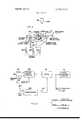
- FIG. 1is a schematic illustration of the preferred embodiment of the invention showing the relationship of the components to each other;
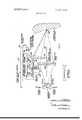
- FIG. 2is a schematic illustration of the principle of the invention showing how measurement takes place
- FIG. 3is an enlarged, perspective schematic of the structure utilized to detect the position of the reciprocating lens
- FIG. 4is a block diagram illustration of the electronic components necessary to record the measured information.
- FIG. 5is a schematic illustration of a modified embodiment of the invention showing the relationship of the components to each other.
- the numeralindicates generally a laser beam or other collimated radiating waveform in beam configuration which is generated by known means from suitable mechanism indicated by block 12.
- the beam 10is directed parallel to the optical axis indicated by dotted line 14 of a lens assembly indicated generally by numeral 16.
- the beam 10is also parallel to the optical axis 18 of an objective lens 20 which is mounted in a frame 22 in spaced relationship from assembly 16.
- the assembly 16comprises a prism 24 and a projection lens 26 carried within a housing 28.
- the housing 28is axially slidable in alignment on its axis 14 by means ofappropriate ball bearings 30 holding housing 28 within an outer housing 32.
- Linear translation of housing 28 with respect to housing 32is accomplished by a spring 34 connected at one end to housing 28 and at the other end to frame 36.
- the prism 24bends the beam 10 at an angle of approximately 10 from axis 14 towards the objective lens optical axis 18 which is also called the measuring axis.
- This axis which is indicated by dotted line 40is called the projection axis.
- the projection lens 26focuses the beam 10 to approximately a 0.00l-inch diameter image point at 42 which is positioned on the measuring axis 18 from between 1 inch to 20 inches in front of the objective lens 20, depending upon original design requirements.
- the deviation of the projection axis 40 from the assembly axis 14could be anywhere from about 5 to about 25, and that the focus point might be anywhere from between about 0.005 inch to about 0.015 inch in diameter.
- the translation or reciprocation of the prism lens assembly in housing 28causes the image point 42 to move along the measuring axis 18 a distance equal to the movement of housing 28.
- This movementcan be anywhere between 0.050 inch to about 0.400 inch in the direction indicated by a doubleended arrow 44.
- No defocusing of the point 42occurs while it is scanning a length along the axis 18, so the amplitude of scan can be as large as it is mechanically feasible to move the housing 28.
- the spring-mass systemcan provide large amplitudes with very low power requirements in the driver coil 38.
- a dynamic balancer assembly indicated generally by numeral 46can be provided, as selectively desired.
- a linewill be formed by the point traversing the surface.
- the length of this linewill be a function of the design, involving the excursion amplitude of the projection lens 26 and the angular offset caused by prism 24. Regardless of these parameters, the line will always be in sharp focus as the image point 42 crosses the intersection of the measuring axis 18 and the surface 50. At all other positions, the point will be slightly defocused with respect to surface 50, but since it is only used for precision measurement as it crosses the axis, this does not affect the accuracy of the probe.
- the prism 52is a or right angular prism, with the faces 52a and 52b forming the 90 angle brought to an extremely sharp edge. These faces 52a and 52b are reflectively coated, thereby forming a precision beam splitter when the image of the point 42 falls on the sharp edge.
- the prism 52is positioned with the 90 edge facing the objective lens and lying exactly on the measuring axis 18. The edge is nonnal to the plane of projection and measuring axes 40 and 18, respectively.
- the spot 42 projected on the surface being measuredis imaged on one of the reflective faces of the prism when the housing 28 is at one end of its travel. As the housing 28 moves back, the image of the spot 42 on the prism travels towards the 90 edge; crossing it to the other face as the housing 28 completes its scan. The point at which it crosses the 90 edge of the prism 52 is dependent upon where the measured surface lies in the linear range of the point 42 on the optical axis 18. This crossing point is the only instant in the cycle that the output of the photodiodes 58 and 60 are equal in amplitude.
- the measured surfacemust be at the intersection of the projecting spot when it is in optimum focus. This can be seen by referring to FIG. 2 of the drawings.
- the projection lens 26When the projection lens 26 is at position Ll (the midpoint of its excursion) the projected light spot falls at P1. Since the surface 50 is at this point also, spot SI indicative of point 42 is at the same position. The image of spot 81 falls at II, or exactly on the 90 edge of the prism 52.
- the point image 42moves along the measuring axis 18 to a position P2. Since there is no surface at this point, the light passes the axis 18 and strikes the measured surface 50 at position S2, forming a slightly defocused point image.
- the objective lens 20images this at point I2 on the upper side of prism 52, as indicated.
- the projection lens 26moves to position L3
- the pointwould be projected to position P3, but since the surface 50 intercepts the beam before it reaches the point, a spot is formed at $3, which is imaged on the lower side of prism 52 at I3.
- the surface 50was positioned at the center of the reading range. If it had been at a position indicated by the dashed line 50a in FIG. 2, the point 42 would be imaged exactly at position P3 on the surface 50a forming a spot that would be imaged at II on the edge of prism 52 by the objective lens 20. Thus, it can be seen that there is a direct linear relationship between the surface 50 and the position of the projection lens 26 when the objective lens 20 images the spot on the edge of the prism 52. If the surface to be measured were farther from the objective lens 20 than shown by the dashed position 500 in FIG. 2, the image of the spot on the surface would never cross the prism edge during the reciprocating scanning movement of the projection lens 26.
- Suitable mechanism to interpret a no signal utput and cause movement of the entire assembly 16 to or from the surfaceis illustrated by block 69, and is preferably a standard servosystem well understood by those skilled in the art.
- the digitizercomprises a grid plate 72 having a moire grid pattern of slot 74 through the surface thereof.
- the grid lines or slots 74are actually divided into digitizing moire lines 74a and quadrature moire lines 74b.
- the plate 72is mounted in fixed relationship to a fixed from 76.
- a moving plate 78is connected directly to housing 28, and has a corresponding moire slot arrangement indicated generally by numeral 80, which has slots arranged to generally conform to the digitizing moire lines 74a and the quadrature moire lines 74b.
- the plate 78moves in reciprocating relationship indicated by the double-ended arrow 82 which is substantially perpendicular to the direction of the moire lines 74 and 80, respectively, so as to create a light-dark effect as the lines in the moving plate 78 come into and out of alignment with the lines in the fixed plate 72.
- a lamp 84In order to detect the alignment and misalignment of the lines, a lamp 84, appropriately energized and focused by respective lenses 86, 88, and 90, passes light through the respective slots to be detected by respective photodiodes 86a, 88a, and 90a. Suitable mounting for the lenses and diodes is anticipated, but is not shown to clarify the schematic perspective.
- the lens 90coordinates with a single slot in moving plate 78 and a single slot in fixed plate 72 to provide a midpoint pulse indication to the system.
- lens 86 cooperating with the digitizing moire lines 74aprovides output pulses for counting the smallest increment of movement of plate 78, which normally will be 0.001 inch.
- the lens 88 cooperating with moire lines 74bhas a quadrature relationship to the digitizing moire lines 74a.
- the quadrature-related pulse trainsenable a count to be obtained that reverses when the direction of the moving plate 78 changes.
- pulses detected by diode agive an indication of the center of travel of the moving plate 78.
- the pulses obtained within the photodiodes 86a, 88a, and 90aare fed to counting circuits operating as shown in the block diagram of FIG. 4. Specifically, a plus/minus counter which is accurate to three digits, and which might be a component as manufactured by the Information Development Corporation, Akron Ohio, is utilized.
- the counter 100counts the digitizing pulses 102 and the quadrature pulses 104 with zero being set by a zero pulse 106 obtained from the photodiode 90a indicating the center of travel of the projection lens assembly 16. Therefore, the counter 100 digitally in dicates the position and direction from center with zero being set in the counter every time the housing 28 passes its center position.
- the voltages from photodiodes 58 and 60are sent as signals 58a and 60a to a comparator 108 which produces a pulse indicated by numeral 110 at its output every time they are equal.
- the comparatormight be a conventional element as used for similar purposes in the electronics field.
- the count from counter 100is fed to a storage register 112 which stores the count every time a pulse 110 is received from the comparator 108. Because of the previously discussed optomechanical relationships, this count represents the distance and direction of the surface from the center of the linear reading range along axis 40, as seen in FIG. 1.
- the resultant signals from storage register 112can be sent to a plus and minus nixie readout visual indicator to three digits indicated by block 114, or to a computer over line 116 as selectively desired.
- the informationcan be stored every time a pulse is generated by comparator 108, and this in effect depends exactly upon the reciprocating relationship of housing 28.
- the optimum reciprocating speedis between 5 cycles per second to about 20 cycles per second, with the optimum being about 10 cycles per second as generated by driver coil 38 operating through the spring 34 and mass 36.
- FIG. 1requires large mechanical excursions for the housing 28 where long reading ranges on the model surface are involved, due to the l-to-l correspondence between the projection lens 26 and the travel of the projected image point 42 on the measuring axis.
- FIG. 5it is desirable to reduce this dependence on mechanical movement and under these circumstances a modified embodiment of the invention as illustrated in FIG. 5 can be utilized.
- the system of FIG. 5moves the projected image point twice the distance that the mechanical element moves.
- the incoming beam 10ais reflected back towards the probe assembly by means of a fixed 95 included angle prism 120. It is projected onto an oscillating 45 mirror 122 by a fixed projection lens 124. The beam 10 is then directed to a fixed front surface mirror 126 positioned with its surface on the optical axis so that it does not cause any distortion or blancing of the image projected by the objective lens 20a.
- the beamis returned to the 45 oscillating mirror, and then forms a point image on the measuring axis 18a some distance in front of the objective lens 20a.
- This optical arrangementcauses the projected image point 42a to scan twice the distance that the oscillating mirror 122 moves.
- the operation of the remainder of the systemis the same as the arrangement previously described.
- the digitizer, indicated generally by numeral 70ais the same as that used in the embodiment in FIG. 1, with the moving member attached to the laterally oscillating mirror 122.
- the lateral oscillationis in the direction indicated by the double-ended arrow 440 at a preferred oscillation of cycles per second.
- the mirror 122can be mounted on a spring support arrangement comprising springs 34a and 34b and supporting brackets 122a and 12212.
- the slightly circular path that the mirror movesdoes not affect the accuracy of movement of the projected spot, as long as the movement is substantially perpendicular to the axis 180 of the objective lens 200.
- a laser beamis used as the light source, a small amount of light can be directed into an optical interferometer that is part of the moving element of either arrangement.
- This interferometerwould replace the moire unit for the fringe source. This is especially desirable if the unit is to measure very accurate tolerances, for example, down to 0.000 1 -inch increments.
- a suitable interferometerwould be one using a Michelson Dual Path principle common in optics technology.
- a dynamic balanceris incorporated into the probe to prevent any vibration of the structure.
- This unitconsists of a mass-spring member tuned to the same frequency as the oscillating optical element. When it is properly oriented, it is self-excited with the phase relationship of the lens or mirror assembly. This cancels out most of the vibration present in the support.
- an optical probewhich utilizes a reciprocating focused point of light in conjunction with an objective lens and right angle prism to determine the exact time and point where the light is in focus on the exposed portion of the surface being measured.
- the accuracies available with such a techniqueare easily to 0.001 inch, and in many instances to as great as 0.0001 inch.
- the readoutcan be done as many times per second as is mechanically possible, thus providing an extremely fine record of the surface characteristics of a model to be measured.
- a noncontact probe to measure surface distances from a predetermined referencewhich comprises means to produce a directed beam of light energy having an axis
- first lens meansdefining an optical measuring axis parallel to the axis of the directed beam of light energy
- optical redirecting meansincluding second lens means to angle the light beam from its axis at between about 5 to about and focus the beam to a point at such angled relationship where the point falls on the axis of the first lens means,
- reference meansto coordinate the movement of the point with the means to detect to measure the distance of the surface therefrom.
- a probe according to claim 1which includes the sharp edge of a right angular silvered prism coincident with the optical axis of the first lens means of the opposite side thereof from the surface with the faces of the prism at substantially 45 relation to the plane of the first lens means.
- a probe according to claim 3 where the means to detectis a pair of photodiodes each mounted at -a similar angular spacing and distance with respect to a respective face of the prism so as to measure the light beam impinging thereon, and a comparator receiving the signals from each photodiode to determine when the signals are equal.
- a probe according to claim 4 where the means to record the contours of the surfacecomprises Pi means to move the redirecting means in a direction coincident with the axis of the beam,
- a fixed slotted grida movable slotted grid connected to the second lens means and positioned adjacent the fixed slotted grid, and each grid having similarly spaced slots substantially aligned in their adjacent relationship whereby the movement of the second lens means causes movement of the movable slotted grid in a direction substantially normal to the direction of the slots therein, and
- radiation meansdirected through the grids, and means to detect the radiation passing through the grids to measure the amount and direction of movement of the movable slotted grid to the fixed slotted grid.
- each of the gridsincludes a single center position slot, a group of quadrature slots to determine direction of movement, and measuring slots spaced at about 0.001-inch intervals to measure the distance from the center position slot.
- a probe according to claim 6 where the means to move the focused pointis a tuned spring connected to the redirecting means, and includes other means to drive the spring at a predetermined resonant frequency.
- a noncontact probe according to claim 1which includes an optical system associated with the second lens means whereby physical movement of the second lens means is at least doubled in the movement of the focused point on the axis of the first lens means.
- a noncontact probewhich comprises means defining an optical measuring axis in space
- a probe according to claim 9where the beam is bent at an angle of at least 5 from its axis, and where the measuring axis is substantially perpendicular to the surface to be measured.
Landscapes
- Physics & Mathematics (AREA)
- General Physics & Mathematics (AREA)
- Length Measuring Devices By Optical Means (AREA)
Abstract
Description
United States Patent [72] lnventor Harry L. Hosterman Akron, Ohio [21] Appl. No. 739,128 [22] Filed June 21,1968 [45] Patented June 29, 1971 [73] Assignee Information DevelopmentCorporation Akron, Ohio [54]NONCONTACT MEASURING PROBE 10 Claims, 5 Drawing Figs.
[52] U.S.Cl 356/167, 350/6. 356/120, 356/4 [51] lnt.Cl ..G01b11/30, GOlc 3/08 [50] Field ofSearch 356/1,4,5, 28, 161, 167, 120, 152, 156, 172, 169; 350/6 [56] References Cited UNITED STATES PATENTS 2,429,066 10/1947 Kuehni 356/161 2,506,946 5/1950 Walker..... 356/1 2,607,270 8/1952 Briggs 356/156 2,665,607 1/1954 Blakeslee et a1. 356/1 3,016,464 1/1962 Bailey 221/9 3,137,756 6/1964 Guntheret al... 356/157 3,180,205 4/1965 Heppe et a1 356/1 3,218,911 11/1965 Boweretal 356/169 3,330,964 7/1967 Hobrough et a1. 250/237 3,396,626 8/1968 Hughes 356/16 Assistant ExaminerJ. Rothenberg AIlorneyOldham & Oldham ABSTRACT: A noncontacting optical probe capable of giving a continuous reading of the distance from a given reference to a contoured surface. A collimated beam is directed parallel to the optical axis of a fixed objective lens whose optical axis defines a measuring axis. The beam is deviated at a slight angle towards the surface to be measured, with the angle defining a projection axis. A lens assembly focuses the collimated beam to a very small diameter image point in front of the objective lens on the measuring axis. Translation of the lens assembly causes the image point to move along the measuring axis a distance equal to the movement of the assembly. The spot is not defocused along the axis. The light reflected from the surface is collected by the objective lens, directed through a filter and focused towards a prism lying in the focal plane of the lens. The prism is a 90 prism with the faces forming the 90 angle brought to a sharp edge at the focal plane of the lens. The amount of light reflected from the respective surfaces of the 90 angle are detected by photocells. The movement of the lens assembly is measured, and compared with the point at which the amount of light detected by the two photocells is equal and above a predetermined value. The distance from the lens assembly to the surface is measured at this instant. Linear reading can be presented in digital form with a resolution of 0.0001 inch, and to an accuracy of 0.0001 if desired.
SPRING TUNED TO RESONANCE 38 DRIVER con. 24 5 loc s 44 PRISM 26 ,I4
PROJECTION LENS CDLLIMATED BEAM 111mm I 3o so PHOT 5aT DIODE 54oIeIrIzER FILTER 52 62 I sII.vEREot PRISM 42 5e tense PHOTO suRFAcE oIooE 22 EEKI'E TOBEDIGITIZED PATENTEU JUN29 IBYI SHEET 1 BF 4 m ZmJ ZOEUm 60mm ENEQR 3 8. 6 mm IN VIjNTOR. HARRY L. HOSTERMAN 6mm 6 W MOO-Q OPOIQ mUZ ZOmum OP QmZDP 023mm ATTORNEYS.
NOE
INVENTOR. HARRY L.HOSTERMAN ATTORNEYS.
PATENTEDJHnz 9 I9?! I SHEEI 2 BF 4 PATENTEUJUM29|971 3,589,815
SHEET 3 UP 4LAMP 70 35/86 80LENSES 90 %'IE\Z+OENARY a eggs;
78 74 M VING MID POINT PEATE PULSE LINES 01c QUADRATURE MOIRE LINES MOlRELINES 88 88 90 PH T 0|0%E% I02 I80 n2; n r iPULSE t NIXIE COUNT E D T m a DIGITS STORE R3 810%?) QUADRATURE I06 fi ZERO SET i [I08 no "6 TO COMPUTER .Ji IF USED C COMPARATOR 80 INVkNTUR. HARRY L.HOSTERMAN BY F|G.4
flw ww ATTORNEYS NONCONTACT MEASURING PROBE Heretofore, it has been known that in order to reproduce a contoured surface by mechanical means, it is necessary to know the exact dimensions and configurations of the surface. To this end, mechanical probes have been utilized for some time to take measurement readings to prepare blueprints or other information presentation facilities with sufficient information to enable reproduction of the surface by manual or other automatic means. However, in many instances, it is undesirable to utilize a contact probe to make such measurements as the probe tends to damage the surface being measured, and further because extremely accurate measurements with such probe are not possible.
Therefore, it is the general object of the present invention to avoid the deficiencies of the prior art by providing a noncontacting probe which is preferably optical in operation and which is relatively simple in construction, and extremely efficient in operation.
A further object of the invention is to provide a noncontacting optical probe capable of giving a continuous reading of the distance from a given reference to a contoured surface in digital form with a resolution of0.000l inch to an accuracy of 0.0001 inch with a reading frequency as high as 50 times per second.
The aforesaid objects of the invention and other objects which will become apparent as the description proceeds are achieved by providing in a noncontacting probe to measure surfaces the combination of means to produce a directed beam of radiating waves having an axis, first lens means to focus the beam to a point onto a surface to be measured, means defining a line in space away from the surface, second lens means to focus the waves reflected from the surface to a point on the line when the beam is in focus on the surface, means to continuously move the focused point in focus on the axis of the second lens so the point passes through the surface, means to detect when an equal amount of radiated waves of predetermined magnitude passing through the second lens means fall on each side of the line in space and produce a signal on this condition, and means to record the distance of the first lens means with respect to the surface upon receipt of the signal from the means to detect.
For a better understanding of the invention, reference should be had to the accompanying drawings wherein:
FIG. 1 is a schematic illustration of the preferred embodiment of the invention showing the relationship of the components to each other; 1
FIG. 2 is a schematic illustration of the principle of the invention showing how measurement takes place;
FIG. 3 is an enlarged, perspective schematic of the structure utilized to detect the position of the reciprocating lens;
FIG. 4 is a block diagram illustration of the electronic components necessary to record the measured information; and
FIG. 5 is a schematic illustration of a modified embodiment of the invention showing the relationship of the components to each other.
With reference to the embodiment of the invention illustrated in FIG. 1 of the drawings, the numeral indicates generally a laser beam or other collimated radiating waveform in beam configuration which is generated by known means from suitable mechanism indicated byblock 12. Thebeam 10 is directed parallel to the optical axis indicated bydotted line 14 of a lens assembly indicated generally bynumeral 16. Thebeam 10 is also parallel to theoptical axis 18 of anobjective lens 20 which is mounted in aframe 22 in spaced relationship fromassembly 16. Theassembly 16 comprises aprism 24 and aprojection lens 26 carried within ahousing 28. Thehousing 28 is axially slidable in alignment on itsaxis 14 by meansofappropriate ball bearings 30 holdinghousing 28 within anouter housing 32. Linear translation ofhousing 28 with respect tohousing 32 is accomplished by aspring 34 connected at one end tohousing 28 and at the other end toframe 36. A springmass system 15 formed by 34 and 28 that can be driven at resonance by adriver coil 38, all in a manner well known in the art to cause uniform reciprocal linear motion ofhousing 28.
Theprism 24 bends thebeam 10 at an angle of approximately 10 fromaxis 14 towards the objective lensoptical axis 18 which is also called the measuring axis. This axis which is indicated bydotted line 40 is called the projection axis. Theprojection lens 26 focuses thebeam 10 to approximately a 0.00l-inch diameter image point at 42 which is positioned on themeasuring axis 18 from between 1 inch to 20 inches in front of theobjective lens 20, depending upon original design requirements. Also, it should be understood that the deviation of theprojection axis 40 from theassembly axis 14 could be anywhere from about 5 to about 25, and that the focus point might be anywhere from between about 0.005 inch to about 0.015 inch in diameter.
The translation or reciprocation of the prism lens assembly inhousing 28 causes theimage point 42 to move along the measuring axis 18 a distance equal to the movement ofhousing 28. This movement can be anywhere between 0.050 inch to about 0.400 inch in the direction indicated by a doubleended arrow 44. No defocusing of thepoint 42 occurs while it is scanning a length along theaxis 18, so the amplitude of scan can be as large as it is mechanically feasible to move thehousing 28. The spring-mass system can provide large amplitudes with very low power requirements in thedriver coil 38. In order to eliminate vibration within the system, a dynamic balancer assembly indicated generally bynumeral 46 can be provided, as selectively desired.
If a surface indicated generally bynumeral 50, and shown in cross section, is positioned across themeasuring axis 18 within the point image scan distance, a line will be formed by the point traversing the surface. The length of this line will be a function of the design, involving the excursion amplitude of theprojection lens 26 and the angular offset caused byprism 24. Regardless of these parameters, the line will always be in sharp focus as theimage point 42 crosses the intersection of themeasuring axis 18 and thesurface 50. At all other positions, the point will be slightly defocused with respect tosurface 50, but since it is only used for precision measurement as it crosses the axis, this does not affect the accuracy of the probe.
Theobjective lens 20, which is fixed to themain frame 22, and to whichhousing 32 is fixed, also, images thepoint 42 moving on the surface being measured onto aprism 52 lying in the focal plane of theobjective lens 20. Theprism 52 is a or right angular prism, with thefaces 52a and 52b forming the 90 angle brought to an extremely sharp edge. Thesefaces 52a and 52b are reflectively coated, thereby forming a precision beam splitter when the image of thepoint 42 falls on the sharp edge. Theprism 52 is positioned with the 90 edge facing the objective lens and lying exactly on the measuringaxis 18. The edge is nonnal to the plane of projection and measuringaxes objective lens 20 falls on the 90 edge when thehousing 28 is in the midpoint of its excursion of reciprocating motion. Condensinglenses prism 52 focus the reflected light onto a pair ofphotodiodes faces 52a and 52b as shown. If a laser or green line of mercury is used as the beam source, it will be advantageous to use afilter 62 in front of the prism to exclude room light from the photodiodes.
Thespot 42 projected on the surface being measured is imaged on one of the reflective faces of the prism when thehousing 28 is at one end of its travel. As thehousing 28 moves back, the image of thespot 42 on the prism travels towards the 90 edge; crossing it to the other face as thehousing 28 completes its scan. The point at which it crosses the 90 edge of theprism 52 is dependent upon where the measured surface lies in the linear range of thepoint 42 on theoptical axis 18. This crossing point is the only instant in the cycle that the output of thephotodiodes
Since the projected point orspot 42 is always on theaxis 18, the measured surface must be at the intersection of the projecting spot when it is in optimum focus. This can be seen by referring to FIG. 2 of the drawings. When theprojection lens 26 is at position Ll (the midpoint of its excursion) the projected light spot falls at P1. Since thesurface 50 is at this point also, spot SI indicative ofpoint 42 is at the same position. The image of spot 81 falls at II, or exactly on the 90 edge of theprism 52. As theprojector lens 26 moves to the position L2, thepoint image 42 moves along the measuringaxis 18 to a position P2. Since there is no surface at this point, the light passes theaxis 18 and strikes the measuredsurface 50 at position S2, forming a slightly defocused point image. Theobjective lens 20 images this at point I2 on the upper side ofprism 52, as indicated. In a similar manner, when theprojection lens 26 moves to position L3, the point would be projected to position P3, but since thesurface 50 intercepts the beam before it reaches the point, a spot is formed at $3, which is imaged on the lower side ofprism 52 at I3.
In the example shown in FIG. 2, thesurface 50 was positioned at the center of the reading range. If it had been at a position indicated by the dashed line 50a in FIG. 2, thepoint 42 would be imaged exactly at position P3 on the surface 50a forming a spot that would be imaged at II on the edge ofprism 52 by theobjective lens 20. Thus, it can be seen that there is a direct linear relationship between thesurface 50 and the position of theprojection lens 26 when theobjective lens 20 images the spot on the edge of theprism 52. If the surface to be measured were farther from theobjective lens 20 than shown by the dashed position 500 in FIG. 2, the image of the spot on the surface would never cross the prism edge during the reciprocating scanning movement of theprojection lens 26. In this instance, since only one of thediodes surface 50 would still be available depending upon which diode output was actuated. Suitable mechanism to interpret a no signal utput and cause movement of theentire assembly 16 to or from the surface is illustrated by block 69, and is preferably a standard servosystem well understood by those skilled in the art.
Thus, it should be understood that the exact position ofhousing 28 with respect tohousing 32 whenpoint 42 is imaged bylens 20 exactly on the edge ofprism 52 will indicate the position ofsurface 50 with respect tohousing 28. Means necessary to determine the position ofhousing 28 are provided by a digitizer indicated generally by numeral 70 in FIG. I of the drawings, with this being shown in perspective detail in FIG. 3 of the drawings. Specifically, the digitizer comprises agrid plate 72 having a moire grid pattern ofslot 74 through the surface thereof. The grid lines orslots 74 are actually divided into digitizing moire lines 74a andquadrature moire lines 74b. Theplate 72 is mounted in fixed relationship to a fixed from 76. A movingplate 78 is connected directly tohousing 28, and has a corresponding moire slot arrangement indicated generally by numeral 80, which has slots arranged to generally conform to the digitizing moire lines 74a and thequadrature moire lines 74b. Theplate 78 moves in reciprocating relationship indicated by the double-endedarrow 82 which is substantially perpendicular to the direction of themoire lines 74 and 80, respectively, so as to create a light-dark effect as the lines in the movingplate 78 come into and out of alignment with the lines in the fixedplate 72.
In order to detect the alignment and misalignment of the lines, alamp 84, appropriately energized and focused byrespective lenses lens 90 coordinates with a single slot in movingplate 78 and a single slot in fixedplate 72 to provide a midpoint pulse indication to the system. Thus, lens 86 cooperating with the digitizing moire lines 74a provides output pulses for counting the smallest increment of movement ofplate 78, which normally will be 0.001 inch. Thelens 88 cooperating withmoire lines 74b has a quadrature relationship to the digitizing moire lines 74a. The quadrature-related pulse trains enable a count to be obtained that reverses when the direction of the movingplate 78 changes. Naturally, pulses detected by diode a give an indication of the center of travel of the movingplate 78.
The pulses obtained within the photodiodes 86a, 88a, and 90a, are fed to counting circuits operating as shown in the block diagram of FIG. 4. Specifically, a plus/minus counter which is accurate to three digits, and which might be a component as manufactured by the Information Development Corporation, Akron Ohio, is utilized. Thecounter 100 counts the digitizingpulses 102 and thequadrature pulses 104 with zero being set by a zeropulse 106 obtained from the photodiode 90a indicating the center of travel of theprojection lens assembly 16. Therefore, thecounter 100 digitally in dicates the position and direction from center with zero being set in the counter every time thehousing 28 passes its center position. The voltages fromphotodiodes comparator 108 which produces a pulse indicated by numeral 110 at its output every time they are equal. The comparator might be a conventional element as used for similar purposes in the electronics field. The count fromcounter 100 is fed to astorage register 112 which stores the count every time apulse 110 is received from thecomparator 108. Because of the previously discussed optomechanical relationships, this count represents the distance and direction of the surface from the center of the linear reading range alongaxis 40, as seen in FIG. 1. The resultant signals fromstorage register 112 can be sent to a plus and minus nixie readout visual indicator to three digits indicated byblock 114, or to a computer overline 116 as selectively desired. Naturally, the information can be stored every time a pulse is generated bycomparator 108, and this in effect depends exactly upon the reciprocating relationship ofhousing 28. As indicated previously, the optimum reciprocating speed is between 5 cycles per second to about 20 cycles per second, with the optimum being about 10 cycles per second as generated bydriver coil 38 operating through thespring 34 andmass 36.
It should be understood that the optical arrangement shown in FIG. 1 requires large mechanical excursions for thehousing 28 where long reading ranges on the model surface are involved, due to the l-to-l correspondence between theprojection lens 26 and the travel of the projectedimage point 42 on the measuring axis. In some instances, it is desirable to reduce this dependence on mechanical movement and under these circumstances a modified embodiment of the invention as illustrated in FIG. 5 can be utilized. The system of FIG. 5 moves the projected image point twice the distance that the mechanical element moves.
With reference to the embodiment shown in FIG. 5, it should be understood that the arrangement of the objective lens, prism, and phototube setup, as well as the digitizer, driving coil, and springs are substantially similar, and hence these are indicated by the same numeral with the suffix a. In this embodiment, the incoming beam 10a is reflected back towards the probe assembly by means of a fixed 95 includedangle prism 120. It is projected onto an oscillating 45mirror 122 by a fixedprojection lens 124. Thebeam 10 is then directed to a fixedfront surface mirror 126 positioned with its surface on the optical axis so that it does not cause any distortion or blancing of the image projected by the objective lens 20a. From themirror 126, the beam is returned to the 45 oscillating mirror, and then forms a point image on the measuring axis 18a some distance in front of the objective lens 20a. This optical arrangement causes the projected image point 42a to scan twice the distance that theoscillating mirror 122 moves. The operation of the remainder of the system is the same as the arrangement previously described. The digitizer, indicated generally by numeral 70a, is the same as that used in the embodiment in FIG. 1, with the moving member attached to the laterally oscillatingmirror 122. The lateral oscillation is in the direction indicated by the double-ended arrow 440 at a preferred oscillation of cycles per second. Themirror 122 can be mounted on a spring supportarrangement comprising springs 34a and 34b and supporting brackets 122a and 12212. The slightly circular path that the mirror moves does not affect the accuracy of movement of the projected spot, as long as the movement is substantially perpendicular to the axis 180 of theobjective lens 200. I
if a laser beam is used as the light source, a small amount of light can be directed into an optical interferometer that is part of the moving element of either arrangement. This interferometer would replace the moire unit for the fringe source. This is especially desirable if the unit is to measure very accurate tolerances, for example, down to 0.000 1 -inch increments. A suitable interferometer would be one using a Michelson Dual Path principle common in optics technology.
Since both arrangements involve oscillating mechanical components, a dynamic balancer is incorporated into the probe to prevent any vibration of the structure. This unit consists of a mass-spring member tuned to the same frequency as the oscillating optical element. When it is properly oriented, it is self-excited with the phase relationship of the lens or mirror assembly. This cancels out most of the vibration present in the support.
Thus, it is seen that the objects of the invention have been achieved by providing an optical probe which utilizes a reciprocating focused point of light in conjunction with an objective lens and right angle prism to determine the exact time and point where the light is in focus on the exposed portion of the surface being measured. The accuracies available with such a technique are easily to 0.001 inch, and in many instances to as great as 0.0001 inch. The readout can be done as many times per second as is mechanically possible, thus providing an extremely fine record of the surface characteristics of a model to be measured.
While in accordance with the patent statutes only the best known embodiment of the invention has been illustrated and described in detail, it is to be particularly understood that the invention is not limited thereto or thereby, and'that the inventive scope is defined in the appended claims.
What i claim is:
l. A noncontact probe to measure surface distances from a predetermined reference which comprises means to produce a directed beam of light energy having an axis,
first lens means defining an optical measuring axis parallel to the axis of the directed beam of light energy,
optical redirecting means including second lens means to angle the light beam from its axis at between about 5 to about and focus the beam to a point at such angled relationship where the point falls on the axis of the first lens means,
means to move the point in focus parallel to the axis of the directed beam of light energy and coincident with the optical axis of the first lens means so that at some time the point is in focus on the surface,
means aligned with the optical axis of the first lens means on the opposite side thereof from the surface to detect when the point is in focus on the surface, and
reference means to coordinate the movement of the point with the means to detect to measure the distance of the surface therefrom.
2. A probe according to claim 1 where a laser is utilized for the beam of light en rgy, and the beam axis parallel to the optical axis of the first lens is substantially normal to the surface.
3. A probe according to claim 1 which includes the sharp edge of a right angular silvered prism coincident with the optical axis of the first lens means of the opposite side thereof from the surface with the faces of the prism at substantially 45 relation to the plane of the first lens means.
. A probe according toclaim 3 where the means to detect is a pair of photodiodes each mounted at -a similar angular spacing and distance with respect to a respective face of the prism so as to measure the light beam impinging thereon, and a comparator receiving the signals from each photodiode to determine when the signals are equal.
5. A probe according to claim 4 where the means to record the contours of the surface comprises Pi means to move the redirecting means in a direction coincident with the axis of the beam,
a fixed slotted grid, a movable slotted grid connected to the second lens means and positioned adjacent the fixed slotted grid, and each grid having similarly spaced slots substantially aligned in their adjacent relationship whereby the movement of the second lens means causes movement of the movable slotted grid in a direction substantially normal to the direction of the slots therein, and
radiation means directed through the grids, and means to detect the radiation passing through the grids to measure the amount and direction of movement of the movable slotted grid to the fixed slotted grid.
6. A probe according to claim 5 where each of the grids includes a single center position slot, a group of quadrature slots to determine direction of movement, and measuring slots spaced at about 0.001-inch intervals to measure the distance from the center position slot.
7. A probe according to claim 6 where the means to move the focused point is a tuned spring connected to the redirecting means, and includes other means to drive the spring at a predetermined resonant frequency.
8. A noncontact probe according to claim 1 which includes an optical system associated with the second lens means whereby physical movement of the second lens means is at least doubled in the movement of the focused point on the axis of the first lens means.
9. A noncontact probe which comprises means defining an optical measuring axis in space,
means to generate a beam of light energy having an axis,
means to focus and bend the beam off its axis and direct the bent portion to a focused point in space on the measuring axis,
means to move the last-said means along an axis in space relative to a reference so that the point intersects a surface to be measured at some time during its movement, said axis being parallel to the measuring axis,
means to detect when the point intersects a surface to be measured in focus by viewing along the measuring axis, and
means to measure the distance of the point with respect to the reference at the instant the point is in focus on the surface to be measured.
10. A probe according to claim 9 where the beam is bent at an angle of at least 5 from its axis, and where the measuring axis is substantially perpendicular to the surface to be measured.
Claims (10)
1. A noncontact probe to measure surface distances from a predetermined reference which comprises means to produce a directed beam of light energy having an axis, first lens means defining an optical measuring axis parallel to the axis of the directed beam of light energy, optical redirecting means including second lens means to angle the light beam from its axis at between about 5* to about 25* and focus the beam to a point at such angled relationship where the point falls on the axis of the first lens means, means to move the point in focus parallel to the axis of the directed beam of light energy and coincident with the optical axis of the first lens means so that at some time the point is in focus on the surface, means aligned with the optical axis of the first lens means on the opposite side thereof from the surface to detect when the point is in focus on the surface, and reference means to coordinate the movement of the point with the means to detect to measure the distance of the surface therefrom.
2. A probe according to claim 1 where a laser is utilized for the beam of light energy, and the beam axis parallel to the optical axis of the first lens is substantially normal to the surface.
3. A probe according to claim 1 which includes the sharp edge of a right angular silvered prism coincident with the optical axis of the first lens means of the opposite side thereof from the surface with the faces of the prism at substantially 45* relation to the plane of the first lens means.
4. A probe according to claim 3 where the means to detect is a pair of photodiodes each mounTed at a similar angular spacing and distance with respect to a respective face of the prism so as to measure the light beam impinging thereon, and a comparator receiving the signals from each photodiode to determine when the signals are equal.
5. A probe according to claim 4 where the means to record the contours of the surface comprises Pi means to move the redirecting means in a direction coincident with the axis of the beam, a fixed slotted grid, a movable slotted grid connected to the second lens means and positioned adjacent the fixed slotted grid, and each grid having similarly spaced slots substantially aligned in their adjacent relationship whereby the movement of the second lens means causes movement of the movable slotted grid in a direction substantially normal to the direction of the slots therein, and radiation means directed through the grids, and means to detect the radiation passing through the grids to measure the amount and direction of movement of the movable slotted grid to the fixed slotted grid.
6. A probe according to claim 5 where each of the grids includes a single center position slot, a group of quadrature slots to determine direction of movement, and measuring slots spaced at about 0.001-inch intervals to measure the distance from the center position slot.
7. A probe according to claim 6 where the means to move the focused point is a tuned spring connected to the redirecting means, and includes other means to drive the spring at a predetermined resonant frequency.
8. A noncontact probe according to claim 1 which includes an optical system associated with the second lens means whereby physical movement of the second lens means is at least doubled in the movement of the focused point on the axis of the first lens means.
9. A noncontact probe which comprises means defining an optical measuring axis in space, means to generate a beam of light energy having an axis, means to focus and bend the beam off its axis and direct the bent portion to a focused point in space on the measuring axis, means to move the last-said means along an axis in space relative to a reference so that the point intersects a surface to be measured at some time during its movement, said axis being parallel to the measuring axis, means to detect when the point intersects a surface to be measured in focus by viewing along the measuring axis, and means to measure the distance of the point with respect to the reference at the instant the point is in focus on the surface to be measured.
10. A probe according to claim 9 where the beam is bent at an angle of at least 5* from its axis, and where the measuring axis is substantially perpendicular to the surface to be measured.
Applications Claiming Priority (1)
| Application Number | Priority Date | Filing Date | Title |
|---|---|---|---|
| US73912868A | 1968-06-21 | 1968-06-21 |
Publications (1)
| Publication Number | Publication Date |
|---|---|
| US3589815Atrue US3589815A (en) | 1971-06-29 |
Family
ID=24970949
Family Applications (1)
| Application Number | Title | Priority Date | Filing Date |
|---|---|---|---|
| US739128AExpired - LifetimeUS3589815A (en) | 1968-06-21 | 1968-06-21 | Noncontact measuring probe |
Country Status (1)
| Country | Link |
|---|---|
| US (1) | US3589815A (en) |
Cited By (46)
| Publication number | Priority date | Publication date | Assignee | Title |
|---|---|---|---|---|
| US3692414A (en)* | 1971-02-24 | 1972-09-19 | Harry L Hosterman | Non-contacting measuring probe |
| FR2193966A1 (en)* | 1972-07-26 | 1974-02-22 | Sick Optik Elektronik Erwin | |
| FR2197162A1 (en)* | 1972-08-23 | 1974-03-22 | Peter Udo | |
| US3836787A (en)* | 1971-07-16 | 1974-09-17 | Nat Res Dev | Apparatus for examining the surface of an object using electromagnetic radiation |
| US3857031A (en)* | 1973-10-15 | 1974-12-24 | Nasa | Automatic focus control for facsimile cameras |
| US3967114A (en)* | 1974-01-10 | 1976-06-29 | Compagnie Industrielle Des Lasers | Device for determining the profile of a surface |
| US4093384A (en)* | 1976-10-04 | 1978-06-06 | The United States Of America As Represented By The Secretary Of The Navy | Narrow angle, narrow bandwidth optical receiver system |
| US4204772A (en)* | 1978-09-25 | 1980-05-27 | Recognition Systems, Inc. | Optical measuring system |
| US4209252A (en)* | 1978-07-03 | 1980-06-24 | Arditty Herve J | Optical probe assembly for detecting the position of an object surface and method |
| US4269512A (en)* | 1979-02-21 | 1981-05-26 | Nosler John C | Electro-optical position-monitoring apparatus with tracking detector |
| US4299491A (en)* | 1979-12-11 | 1981-11-10 | United Technologies Corporation | Noncontact optical gauging system |
| US4355904A (en)* | 1978-09-25 | 1982-10-26 | Balasubramanian N | Optical inspection device for measuring depthwise variations from a focal plane |
| US4425043A (en) | 1981-04-03 | 1984-01-10 | U.S. Philips Corporation | Device for detecting the position of an object |
| EP0130968A1 (en)* | 1983-06-03 | 1985-01-09 | AVL Gesellschaft für Verbrennungskraftmaschinen und Messtechnik mbH.Prof.Dr.Dr.h.c. Hans List | Device for testing an internal-combustion engine |
| US4561333A (en)* | 1982-05-20 | 1985-12-31 | Agency Of Industrial Science & Technology | Diamond turning method for high-precision metal mirror |
| DE3610530A1 (en)* | 1985-03-27 | 1986-10-02 | Olympus Optical Co., Ltd., Tokio/Tokyo | SURFACE STRUCTURE MEASURING DEVICE |
| US4634879A (en)* | 1985-03-21 | 1987-01-06 | General Electric Company | Method and system for determining surface profile information |
| US4645347A (en)* | 1985-04-30 | 1987-02-24 | Canadian Patents And Development Limited-Societe Canadienne Des Brevets Et D'exploitation Limitee | Three dimensional imaging device |
| WO1988002846A1 (en)* | 1986-10-20 | 1988-04-21 | Renishaw Plc | Optical measuring probe |
| EP0164181A3 (en)* | 1984-03-16 | 1988-10-26 | Digital Signal Corporation | Frequency modulated laser radar frequency modulated laser radar |
| US4792696A (en)* | 1987-06-05 | 1988-12-20 | Trustees Of Columbia University In The City Of New York | Method and an apparatus for determining surface shape utilizing object self-shadowing |
| US4849643A (en)* | 1987-09-18 | 1989-07-18 | Eaton Leonard Technologies | Optical probe with overlapping detection fields |
| FR2628523A1 (en)* | 1988-03-09 | 1989-09-15 | Commissariat Energie Atomique | DEVICE FOR TRACKING AN OBJECT USING SCANNING THEREOF BY A LIGHT BEAM |
| WO1989011630A1 (en)* | 1988-05-26 | 1989-11-30 | Wild Leitz Ag | Process and device for measuring surfaces |
| US5008555A (en)* | 1988-04-08 | 1991-04-16 | Eaton Leonard Technologies, Inc. | Optical probe with overlapping detection fields |
| EP0559120A1 (en)* | 1992-03-02 | 1993-09-08 | Gerd Prof. Dr. Häusler | Procedure and device to measure distances |
| US5568264A (en)* | 1993-01-07 | 1996-10-22 | Matsushita Electric Industrial Co., Ltd. | Exterior view inspecting apparatus for circuit board |
| US5859364A (en)* | 1995-06-05 | 1999-01-12 | Olympus Optical Co., Ltd. | Scanning probe microscope |
| US6252623B1 (en) | 1998-05-15 | 2001-06-26 | 3Dmetrics, Incorporated | Three dimensional imaging system |
| US6501538B1 (en)* | 1999-11-15 | 2002-12-31 | Leuze Electronic Ghbh & Co. | Optoelectronic arrangement for determining an object's profile |
| US20030063291A1 (en)* | 2001-09-28 | 2003-04-03 | The Boeing Company | Apparatus for measuring characteristics of a hole and associated method |
| US20030142324A1 (en)* | 1996-08-28 | 2003-07-31 | Rolf Beck | Optoelectronic measuring method and distance measuring device for carrying out the method |
| US20060044546A1 (en)* | 2002-11-11 | 2006-03-02 | Qinetiq Limited | Ranging apparatus |
| US20060209193A1 (en)* | 1998-02-25 | 2006-09-21 | Francisco Pereira | Aperture coded camera for three dimensional imaging |
| US20070195162A1 (en)* | 1998-02-25 | 2007-08-23 | Graff Emilio C | Single-lens aperture-coded camera for three dimensional imaging in small volumes |
| US20090051938A1 (en)* | 2007-08-20 | 2009-02-26 | Marc Miousset | Multi-beam optical probe and system for dimensional measurement |
| US20090204604A1 (en)* | 2002-06-07 | 2009-08-13 | Tiecheng Liu | Method and device for online dynamic semantic video compression and video indexing |
| US8914171B2 (en) | 2012-11-21 | 2014-12-16 | General Electric Company | Route examining system and method |
| US9255913B2 (en) | 2013-07-31 | 2016-02-09 | General Electric Company | System and method for acoustically identifying damaged sections of a route |
| US9671358B2 (en) | 2012-08-10 | 2017-06-06 | General Electric Company | Route examining system and method |
| US9689681B2 (en) | 2014-08-12 | 2017-06-27 | General Electric Company | System and method for vehicle operation |
| US9702715B2 (en) | 2012-10-17 | 2017-07-11 | General Electric Company | Distributed energy management system and method for a vehicle system |
| US9733625B2 (en) | 2006-03-20 | 2017-08-15 | General Electric Company | Trip optimization system and method for a train |
| US9828010B2 (en) | 2006-03-20 | 2017-11-28 | General Electric Company | System, method and computer software code for determining a mission plan for a powered system using signal aspect information |
| US9950722B2 (en) | 2003-01-06 | 2018-04-24 | General Electric Company | System and method for vehicle control |
| US10308265B2 (en) | 2006-03-20 | 2019-06-04 | Ge Global Sourcing Llc | Vehicle control system and method |
Citations (11)
| Publication number | Priority date | Publication date | Assignee | Title |
|---|---|---|---|---|
| US2429066A (en)* | 1945-08-01 | 1947-10-14 | Gen Electric | Optical transparent film thickness gauge |
| US2506946A (en)* | 1946-09-17 | 1950-05-09 | Joseph B Walker | Indicator for the blind |
| US2607270A (en)* | 1949-08-29 | 1952-08-19 | Northrop Aircraft Inc | Depth measurement microscope |
| US2665607A (en)* | 1945-07-21 | 1954-01-12 | Bristol Company | Cloud-data recorder |
| FR1213598A (en)* | 1958-09-09 | 1960-04-01 | Levallois Optique Et Prec | Photoelectric camera for checking or controlling positions |
| US3016464A (en)* | 1959-06-10 | 1962-01-09 | Daystrom Inc | Apparatus for determining the location and thickness of a reflecting object |
| US3137756A (en)* | 1957-10-31 | 1964-06-16 | Zeiss Carl | Device for determining the dimensions of an object |
| US3180205A (en)* | 1960-06-09 | 1965-04-27 | Itt | Distance measuring apparatus having a digital output circuit |
| US3218911A (en)* | 1955-07-05 | 1965-11-23 | North American Aviation Inc | Photoelectric gauge employing a plurality of gratings |
| US3330964A (en)* | 1963-09-09 | 1967-07-11 | Itck Corp | Photoelectric coordinate measuring system |
| US3396626A (en)* | 1963-09-27 | 1968-08-13 | Electronic Communications | Automatic range finder |
- 1968
- 1968-06-21USUS739128Apatent/US3589815A/ennot_activeExpired - Lifetime
Patent Citations (11)
| Publication number | Priority date | Publication date | Assignee | Title |
|---|---|---|---|---|
| US2665607A (en)* | 1945-07-21 | 1954-01-12 | Bristol Company | Cloud-data recorder |
| US2429066A (en)* | 1945-08-01 | 1947-10-14 | Gen Electric | Optical transparent film thickness gauge |
| US2506946A (en)* | 1946-09-17 | 1950-05-09 | Joseph B Walker | Indicator for the blind |
| US2607270A (en)* | 1949-08-29 | 1952-08-19 | Northrop Aircraft Inc | Depth measurement microscope |
| US3218911A (en)* | 1955-07-05 | 1965-11-23 | North American Aviation Inc | Photoelectric gauge employing a plurality of gratings |
| US3137756A (en)* | 1957-10-31 | 1964-06-16 | Zeiss Carl | Device for determining the dimensions of an object |
| FR1213598A (en)* | 1958-09-09 | 1960-04-01 | Levallois Optique Et Prec | Photoelectric camera for checking or controlling positions |
| US3016464A (en)* | 1959-06-10 | 1962-01-09 | Daystrom Inc | Apparatus for determining the location and thickness of a reflecting object |
| US3180205A (en)* | 1960-06-09 | 1965-04-27 | Itt | Distance measuring apparatus having a digital output circuit |
| US3330964A (en)* | 1963-09-09 | 1967-07-11 | Itck Corp | Photoelectric coordinate measuring system |
| US3396626A (en)* | 1963-09-27 | 1968-08-13 | Electronic Communications | Automatic range finder |
Cited By (57)
| Publication number | Priority date | Publication date | Assignee | Title |
|---|---|---|---|---|
| US3692414A (en)* | 1971-02-24 | 1972-09-19 | Harry L Hosterman | Non-contacting measuring probe |
| US3836787A (en)* | 1971-07-16 | 1974-09-17 | Nat Res Dev | Apparatus for examining the surface of an object using electromagnetic radiation |
| FR2193966A1 (en)* | 1972-07-26 | 1974-02-22 | Sick Optik Elektronik Erwin | |
| FR2197162A1 (en)* | 1972-08-23 | 1974-03-22 | Peter Udo | |
| US3857031A (en)* | 1973-10-15 | 1974-12-24 | Nasa | Automatic focus control for facsimile cameras |
| US3967114A (en)* | 1974-01-10 | 1976-06-29 | Compagnie Industrielle Des Lasers | Device for determining the profile of a surface |
| US4093384A (en)* | 1976-10-04 | 1978-06-06 | The United States Of America As Represented By The Secretary Of The Navy | Narrow angle, narrow bandwidth optical receiver system |
| US4209252A (en)* | 1978-07-03 | 1980-06-24 | Arditty Herve J | Optical probe assembly for detecting the position of an object surface and method |
| US4204772A (en)* | 1978-09-25 | 1980-05-27 | Recognition Systems, Inc. | Optical measuring system |
| US4355904A (en)* | 1978-09-25 | 1982-10-26 | Balasubramanian N | Optical inspection device for measuring depthwise variations from a focal plane |
| US4269512A (en)* | 1979-02-21 | 1981-05-26 | Nosler John C | Electro-optical position-monitoring apparatus with tracking detector |
| US4299491A (en)* | 1979-12-11 | 1981-11-10 | United Technologies Corporation | Noncontact optical gauging system |
| US4425043A (en) | 1981-04-03 | 1984-01-10 | U.S. Philips Corporation | Device for detecting the position of an object |
| US4561333A (en)* | 1982-05-20 | 1985-12-31 | Agency Of Industrial Science & Technology | Diamond turning method for high-precision metal mirror |
| EP0130968A1 (en)* | 1983-06-03 | 1985-01-09 | AVL Gesellschaft für Verbrennungskraftmaschinen und Messtechnik mbH.Prof.Dr.Dr.h.c. Hans List | Device for testing an internal-combustion engine |
| EP0164181A3 (en)* | 1984-03-16 | 1988-10-26 | Digital Signal Corporation | Frequency modulated laser radar frequency modulated laser radar |
| US4830486A (en)* | 1984-03-16 | 1989-05-16 | Goodwin Frank E | Frequency modulated lasar radar |
| US4634879A (en)* | 1985-03-21 | 1987-01-06 | General Electric Company | Method and system for determining surface profile information |
| US4930896A (en)* | 1985-03-27 | 1990-06-05 | Olympus Optical Co., Ltd. | Surface structure measuring apparatus |
| DE3610530A1 (en)* | 1985-03-27 | 1986-10-02 | Olympus Optical Co., Ltd., Tokio/Tokyo | SURFACE STRUCTURE MEASURING DEVICE |
| US4645347A (en)* | 1985-04-30 | 1987-02-24 | Canadian Patents And Development Limited-Societe Canadienne Des Brevets Et D'exploitation Limitee | Three dimensional imaging device |
| WO1988002846A1 (en)* | 1986-10-20 | 1988-04-21 | Renishaw Plc | Optical measuring probe |
| US4792696A (en)* | 1987-06-05 | 1988-12-20 | Trustees Of Columbia University In The City Of New York | Method and an apparatus for determining surface shape utilizing object self-shadowing |
| US4849643A (en)* | 1987-09-18 | 1989-07-18 | Eaton Leonard Technologies | Optical probe with overlapping detection fields |
| FR2628523A1 (en)* | 1988-03-09 | 1989-09-15 | Commissariat Energie Atomique | DEVICE FOR TRACKING AN OBJECT USING SCANNING THEREOF BY A LIGHT BEAM |
| EP0336793A1 (en)* | 1988-03-09 | 1989-10-11 | Commissariat A L'energie Atomique | An object identification device using a scan of said object with a light beam |
| US5008555A (en)* | 1988-04-08 | 1991-04-16 | Eaton Leonard Technologies, Inc. | Optical probe with overlapping detection fields |
| WO1989011630A1 (en)* | 1988-05-26 | 1989-11-30 | Wild Leitz Ag | Process and device for measuring surfaces |
| EP0559120A1 (en)* | 1992-03-02 | 1993-09-08 | Gerd Prof. Dr. Häusler | Procedure and device to measure distances |
| US5486926A (en)* | 1992-03-02 | 1996-01-23 | Maho Aktiengesellschaft | Method and a device for a highly accurate measurement of distances, which may change, if a necessary, between an object, for example a clamp workpiece, and a point of reference |
| US5568264A (en)* | 1993-01-07 | 1996-10-22 | Matsushita Electric Industrial Co., Ltd. | Exterior view inspecting apparatus for circuit board |
| US5859364A (en)* | 1995-06-05 | 1999-01-12 | Olympus Optical Co., Ltd. | Scanning probe microscope |
| US20030142324A1 (en)* | 1996-08-28 | 2003-07-31 | Rolf Beck | Optoelectronic measuring method and distance measuring device for carrying out the method |
| US20040174543A1 (en)* | 1996-08-28 | 2004-09-09 | Rolf Beck | optoelectronic measuring method and distance measuring device for carrying out the method |
| US20060209193A1 (en)* | 1998-02-25 | 2006-09-21 | Francisco Pereira | Aperture coded camera for three dimensional imaging |
| US7612869B2 (en) | 1998-02-25 | 2009-11-03 | California Institute Of Technology | Aperture coded camera for three dimensional imaging |
| US7612870B2 (en) | 1998-02-25 | 2009-11-03 | California Institute Of Technology | Single-lens aperture-coded camera for three dimensional imaging in small volumes |
| US20070195162A1 (en)* | 1998-02-25 | 2007-08-23 | Graff Emilio C | Single-lens aperture-coded camera for three dimensional imaging in small volumes |
| US6252623B1 (en) | 1998-05-15 | 2001-06-26 | 3Dmetrics, Incorporated | Three dimensional imaging system |
| US6501538B1 (en)* | 1999-11-15 | 2002-12-31 | Leuze Electronic Ghbh & Co. | Optoelectronic arrangement for determining an object's profile |
| US7016052B2 (en) | 2001-09-28 | 2006-03-21 | The Boeing Company | Apparatus for measuring characteristics of a hole and associated method |
| US20030063291A1 (en)* | 2001-09-28 | 2003-04-03 | The Boeing Company | Apparatus for measuring characteristics of a hole and associated method |
| US8391355B2 (en) | 2002-06-07 | 2013-03-05 | The Trustees Of Columbia University In The City Of New York | Method and device for online dynamic semantic video compression and video indexing |
| US20090204604A1 (en)* | 2002-06-07 | 2009-08-13 | Tiecheng Liu | Method and device for online dynamic semantic video compression and video indexing |
| US7589825B2 (en)* | 2002-11-11 | 2009-09-15 | Qinetiq Limited | Ranging apparatus |
| US20060044546A1 (en)* | 2002-11-11 | 2006-03-02 | Qinetiq Limited | Ranging apparatus |
| US9950722B2 (en) | 2003-01-06 | 2018-04-24 | General Electric Company | System and method for vehicle control |
| US9733625B2 (en) | 2006-03-20 | 2017-08-15 | General Electric Company | Trip optimization system and method for a train |
| US9828010B2 (en) | 2006-03-20 | 2017-11-28 | General Electric Company | System, method and computer software code for determining a mission plan for a powered system using signal aspect information |
| US10308265B2 (en) | 2006-03-20 | 2019-06-04 | Ge Global Sourcing Llc | Vehicle control system and method |
| US20090051938A1 (en)* | 2007-08-20 | 2009-02-26 | Marc Miousset | Multi-beam optical probe and system for dimensional measurement |
| US7903245B2 (en) | 2007-08-20 | 2011-03-08 | Marc Miousset | Multi-beam optical probe and system for dimensional measurement |
| US9671358B2 (en) | 2012-08-10 | 2017-06-06 | General Electric Company | Route examining system and method |
| US9702715B2 (en) | 2012-10-17 | 2017-07-11 | General Electric Company | Distributed energy management system and method for a vehicle system |
| US8914171B2 (en) | 2012-11-21 | 2014-12-16 | General Electric Company | Route examining system and method |
| US9255913B2 (en) | 2013-07-31 | 2016-02-09 | General Electric Company | System and method for acoustically identifying damaged sections of a route |
| US9689681B2 (en) | 2014-08-12 | 2017-06-27 | General Electric Company | System and method for vehicle operation |
Similar Documents
| Publication | Publication Date | Title |
|---|---|---|
| US3589815A (en) | Noncontact measuring probe | |
| US3692414A (en) | Non-contacting measuring probe | |
| US4744661A (en) | Device for measuring small distances | |
| US4168126A (en) | Electro-optical measuring system using precision light translator | |
| US3658426A (en) | Alignment telescope | |
| JPH0652170B2 (en) | Optical imaging type non-contact position measuring device | |
| EP0110937B1 (en) | Apparatus for measuring the dimensions of cylindrical objects by means of a scanning laser beam | |
| US4549808A (en) | Movable aperture photoelectric measuring instrument | |
| US3614212A (en) | Oscillating light beam generating device | |
| EP0222907A4 (en) | A laser based gaging system and method of using same | |
| US4043673A (en) | Reticle calibrated diameter gauge | |
| US3552857A (en) | Optical device for the determination of the spacing of an object and its angular deviation relative to an initial position | |
| US3506839A (en) | Contactless probe system | |
| US4395123A (en) | Interferometric angle monitor | |
| US4115008A (en) | Displacement measuring apparatus | |
| US4808003A (en) | Arrangement for optically measuring the profile of a radiation reflecting surface | |
| RU2092787C1 (en) | Method determining short distances to diffusion-reflecting objects and gear for its realization | |
| US4973152A (en) | Method and device for the noncontact optical measurement of paths, especially in the triangulation method | |
| US3225644A (en) | Apparatus producing interferential test data for measuring and control instruments | |
| EP0310231B1 (en) | Optical measuring apparatus | |
| US3833302A (en) | Method and apparatus for the automatic photoelectric trapping of local changes of optically effective object structures | |
| US3820902A (en) | Measuring method and apparatus which compensate for abbe s error | |
| JP2004347425A (en) | Measuring method of distance change between two faces and device | |
| JP3107867B2 (en) | Optical two-dimensional coordinate input device | |
| US3493775A (en) | Optical scanning means for use in photoelectric positioning determining apparatus |