US3557749A - Immersion apparatus - Google Patents
Immersion apparatusDownload PDFInfo
- Publication number
- US3557749A US3557749AUS3557749DAUS3557749AUS 3557749 AUS3557749 AUS 3557749AUS 3557749D AUS3557749D AUS 3557749DAUS 3557749 AUS3557749 AUS 3557749A
- Authority
- US
- United States
- Prior art keywords
- coating
- vat
- heat
- objects
- heating
- Prior art date
- Legal status (The legal status is an assumption and is not a legal conclusion. Google has not performed a legal analysis and makes no representation as to the accuracy of the status listed.)
- Expired - Lifetime
Links
- 238000007654immersionMethods0.000titleabstractdescription8
- 238000000576coating methodMethods0.000claimsabstractdescription40
- 239000011248coating agentSubstances0.000claimsabstractdescription37
- 238000010438heat treatmentMethods0.000claimsabstractdescription22
- 239000002184metalSubstances0.000claimsdescription17
- 239000000463materialSubstances0.000claimsdescription14
- 230000006698inductionEffects0.000claimsdescription4
- 238000001816coolingMethods0.000abstractdescription6
- 230000002706hydrostatic effectEffects0.000abstractdescription2
- 239000000758substrateSubstances0.000abstractdescription2
- 239000007788liquidSubstances0.000description12
- 239000008199coating compositionSubstances0.000description4
- 238000011109contaminationMethods0.000description4
- 238000004519manufacturing processMethods0.000description3
- 238000000034methodMethods0.000description3
- 239000000203mixtureSubstances0.000description3
- 239000011247coating layerSubstances0.000description2
- 238000003618dip coatingMethods0.000description2
- 239000006185dispersionSubstances0.000description2
- 238000001035dryingMethods0.000description2
- 238000001704evaporationMethods0.000description2
- 230000008020evaporationEffects0.000description2
- 239000012530fluidSubstances0.000description2
- 239000010410layerSubstances0.000description2
- 230000005540biological transmissionEffects0.000description1
- 239000000919ceramicSubstances0.000description1
- 210000003298dental enamelAnatomy0.000description1
- 238000007598dipping methodMethods0.000description1
- 239000000428dustSubstances0.000description1
- 239000000839emulsionSubstances0.000description1
- 239000011521glassSubstances0.000description1
- 239000003779heat-resistant materialSubstances0.000description1
- 239000004922lacquerSubstances0.000description1
- 239000003973paintSubstances0.000description1
- 239000002245particleSubstances0.000description1
- 230000000379polymerizing effectEffects0.000description1
- 230000005855radiationEffects0.000description1
- 230000000717retained effectEffects0.000description1
- 230000002441reversible effectEffects0.000description1
- 238000005245sinteringMethods0.000description1
- 239000000725suspensionSubstances0.000description1
- 239000002966varnishSubstances0.000description1
Images
Classifications
- B—PERFORMING OPERATIONS; TRANSPORTING
- B05—SPRAYING OR ATOMISING IN GENERAL; APPLYING FLUENT MATERIALS TO SURFACES, IN GENERAL
- B05C—APPARATUS FOR APPLYING FLUENT MATERIALS TO SURFACES, IN GENERAL
- B05C3/00—Apparatus in which the work is brought into contact with a bulk quantity of liquid or other fluent material
- B05C3/02—Apparatus in which the work is brought into contact with a bulk quantity of liquid or other fluent material the work being immersed in the liquid or other fluent material
- B05C3/09—Apparatus in which the work is brought into contact with a bulk quantity of liquid or other fluent material the work being immersed in the liquid or other fluent material for treating separate articles
- B—PERFORMING OPERATIONS; TRANSPORTING
- B05—SPRAYING OR ATOMISING IN GENERAL; APPLYING FLUENT MATERIALS TO SURFACES, IN GENERAL
- B05C—APPARATUS FOR APPLYING FLUENT MATERIALS TO SURFACES, IN GENERAL
- B05C11/00—Component parts, details or accessories not specifically provided for in groups B05C1/00 - B05C9/00
- B05C11/11—Vats or other containers for liquids or other fluent materials
- Y—GENERAL TAGGING OF NEW TECHNOLOGICAL DEVELOPMENTS; GENERAL TAGGING OF CROSS-SECTIONAL TECHNOLOGIES SPANNING OVER SEVERAL SECTIONS OF THE IPC; TECHNICAL SUBJECTS COVERED BY FORMER USPC CROSS-REFERENCE ART COLLECTIONS [XRACs] AND DIGESTS
- Y10—TECHNICAL SUBJECTS COVERED BY FORMER USPC
- Y10T—TECHNICAL SUBJECTS COVERED BY FORMER US CLASSIFICATION
- Y10T137/00—Fluid handling
- Y10T137/7287—Liquid level responsive or maintaining systems
- Y10T137/7498—Barometric
Definitions
- ABSTRACTImmersion-coating apparatus having the work holder depending from the immersion vat cover.
- the holderis a part of the substrate heating and cooling means.
- a vertically traveling supply tankfeeds and drains the immersion vat by variation in the hydrostatic head.
- IMMERSION APPARATUSAlthough immersion or dip-coating is one of the most economical mass production methods of applying coatings to metal objects, the coatings obtained are usually of somewhat inferior quality and result in many rejects.
- Among the objects of the inventionis to provide an improved apparatus for the production of dip-coated metal objects.
- the apparatus of the inventionis especially adapted to coat metal objects with liquid compositions of low to medium viscosity, i.e., with emulsions, dispersions, suspensions, colloidal solutions, etc., which may be varnishes, lacquers, paints, vitreous or organic enamels, plastic dispersions, etc., so that the coating material is distributed uniformly to the required thickness on the surface of the objects, and to complete the coating by drying, sintering, polymerizing or otherwise setting or curing the coating layer.
- liquid compositions of low to medium viscosityi.e., with emulsions, dispersions, suspensions, colloidal solutions, etc., which may be varnishes, lacquers, paints, vitreous or organic enamels, plastic dispersions, etc.
- the present inventionis based on the concept of a device for holding the objects to be coated in a stationary position while providing a fully closed system for filling a coating vat or container with coating liquid to a predetermined level and then withdrawing the coating liquid at a uniform rate by gravitational force.
- a fully closed systemfor filling a coating vat or container with coating liquid to a predetermined level and then withdrawing the coating liquid at a uniform rate by gravitational force.
- said closed systemexcessive evaporation of the vehicle of the coating material is prevented and the coating material, as well as the object to be coated, is protected from contamination of the environment. Dust particles in the air, for example, are capable of contaminating the coating material and the layer of coating retained on the object.
- the apparatus of the present inventionprovides indirect heating methods, which means that the objects are placed on a heat-conductive holding fixture and are heated to the necessary temperature indirectly, through heat transmission in the fixture, i.e., after the holding fixture is heated through l-I.F. induction, or alternately through heat conduction, or radiation, or convection. It is also desirable to provide means to cool the objects after the coating is cured because in many instances the rate of cooling determines the characteristics of the coating.
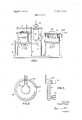
- FIG. 1is a side view of the coating apparatus of the invention.
- FIG. 2is a top view of the object holding means and of the coating vat of FIG. 1.
- FIG. 3is a side top view of an object holding device.
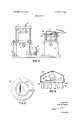
- FIG. 4is a side view partly in cross sectionof another form of the coating apparatus.
- FIG. 5is a view, similar to FIG. 2, of the holding device of FIG. 4.
- FIG. 6is a side view of the holding device of FIG. 5, with a heating attachment.
- the dipping vat 21is suitably supported above the level of base plate 1 and the supply tank 6 is supported on bearing plate 5 which in turn is guided for vertical movement on guide rods 4.
- the interior of vat 21is connected to the interior of tank 6 through flexible conduit 15 and suitable connectors 7 and 7', so that the level of coating liquid 16 tank 6 corresponds to the level in vat 21.
- Bearing plate 5 and tank 6is moved up or down by the pressure cylinder 31, suitable electromechanical valves 26 and 26 being provided to control the flow of fluid or air in and out of the cylinder to move piston rod 32 and bearing plate 5, up or down.
- FIG. 1shows tank 6 in an intermediate position.
- Accurate and steady lowering of the tank 6can be obtained by fluid or air pressure so that the level of liquid in vat 6 is lowered at a uniform and desirable rate. Raising the level of tank 6 to fill vat 21 to the desired level can be conducted at a faster rate. Suitable electrical switches 19 can be provided to stop the movement of plate 6 at its upper and lower limits.
- the cover 23 of vat 21also serves as the holder for the objects to be coated.
- the cover or holder 23comprises a metal plate, fitted in its lower side with one or more fixtures 23A for snugly holding the objects to be coated 33 and on the-upper side of said plate, a first means, such as heating coil 22A is provided, for heating the plate, and a second suitable means, such as refrigerated coil 25, is provided for cooling the plate 23.
- the articles to be coatedare indirectly heated by transmision of heat from heating coil 22A or 25 through the metal cover and fixtures 23A.
- the vat 21can be made of glass, ceramic or other heat-resistant materials so that heat from the cover 23 is not damaging to the walls of said vat 21, or said vat can be made of plastic whereupon an insulating gasket 33 is interposed between vat 21 and cover
- FIGS. 4, 5 and 6are similar to the devices of FIGS. 1, 2 and 3 respectively and like numbers are used to designate like parts in the respective FIGS.
- FIG. 4the vertical movement and position of tank 6 is controlled by a reversible motor 12, operating through pulleys l3, belt 14 and screw rod 9, the bearing plate 5 being secured to nut 11 which rides on the threads of screw 9.
- the metal plate 23 of vat 21is provided with a refrigerating coil 25, but is heated inductively by means of H.F. coil 22. It will be noted that coil 22 is positioned to heat the plate 23, rather than to directly heat the objects being coated.
- the objects 33 of FIG. 6are snugly held by fixtures 123A which are designed to fit snugly within a tubular portion of objects 33' to provide good thermal conductivity to said objects.
- fixtures 23A and 123Acan be designed to support and conduct heat to whatever type of object 33, it is desired to coat.
- the holder 23'may be provided with a reflecting covering means 34, within which is positioned an infrared lamp 35.
- the cover means 34is provided with an insulating gasket 36.
- An apparatus for uniformly coating metal objects with coating materials applied in the form of a liquid compositioncomprising:
- vatmeans for covering said vat and metal means depending from said cover and heat insulated therefrom for holding one or more objects to be coated within said vat;
- a vertically movable supply tankfor the coating material and means for covering said supply tank;
- conduit meansconnecting the interior of said supply tank to the interior of said vat to form a closed system whereby moving the supply tank upwardly automatically charges the vat with said coating material and moving the supply tank downward discharges 'the vat through gravitational force;
- the heating means including said metal meanscomprises an electrical heating element to raise the temperature in said object through conduction.
- heating meansincludes a H.F. induction coil whereby to heat said metal means through Eddy current.
- heating meansincludes infrared heating means whereby to heat said metal means.
Landscapes
- Application Of Or Painting With Fluid Materials (AREA)
- Coating Apparatus (AREA)
Abstract
Description
United States Patent [72] lnventor George Farago 206 East 37th St., Brooklyn, N.Y. 11203 [21] Appl. No. 806,401 [22] Filed Mar. 12, 1969 [45] Patented Jan. 26, 1971 [54]IMMERSION APPARATUS 7 Claims, 6 Drawing Figs.
[52] U.S.Cl 118/7, 118/59,118/69, 118/421 :134/57, 137/453 [51] Int.Cl 1305c ll/l0 [50] Field ofSearch.... 118/50, 50.1, 4, 7, 429, 423, 425, 421; 134/57, 141; 137/253,571,453,386;117/113,114,116,117
[56] References Cited UNITED STATES PATENTS 2,114,998 4/1938 Fickett et a1 118/50X 8/1938 8/1938 2/1951 4/1952 ll/l955 1/1959 7/1962 10/1965 Waldron Leguillon Newton et al.
Rau
Cooper Woods Kaulen Cooper et a1.
FOREIGN PATENTS France Primary Examiner-Morris Kaplan Att0meyGreene & Durr 1 18/429X 134/57X 137/253X l34/57X 1 l8/429X 1 18/429X 1 18/49 ABSTRACT: Immersion-coating apparatus having the work holder depending from the immersion vat cover. The holder is a part of the substrate heating and cooling means. A vertically traveling supply tank feeds and drains the immersion vat by variation in the hydrostatic head.
r1 r1 FJLI I 1 J FIG. I
INVENTOR. F George Forogo ATTORN EYS.
PATENTEDJAN 26 l9?! SHEET 2 [IF 2 ISILH FIG.6
INVENTOR George Forogo FIG.5
ATTORNEYS.
IMMERSION APPARATUS Although immersion or dip-coating is one of the most economical mass production methods of applying coatings to metal objects, the coatings obtained are usually of somewhat inferior quality and result in many rejects.
Among the objects of the invention is to provide an improved apparatus for the production of dip-coated metal objects.
The apparatus of the invention is especially adapted to coat metal objects with liquid compositions of low to medium viscosity, i.e., with emulsions, dispersions, suspensions, colloidal solutions, etc., which may be varnishes, lacquers, paints, vitreous or organic enamels, plastic dispersions, etc., so that the coating material is distributed uniformly to the required thickness on the surface of the objects, and to complete the coating by drying, sintering, polymerizing or otherwise setting or curing the coating layer.
When an object is immersed into a viscous liquid which wets" the object, it is well known that a certain amount of the viscous liquid remains as a coating on the surface of the object. The amount of coating and the uniformity of distribution depends on the density, surface, tension, and viscosity of the coating liquid, and on the speed of withdrawal of the object from the liquid. A uniform withdrawal rate is desired to avoid the production of horizontal streaks and the withdrawal rate should also be relatively slow to avoid vertical streaks.
The present invention is based on the concept of a device for holding the objects to be coated in a stationary position while providing a fully closed system for filling a coating vat or container with coating liquid to a predetermined level and then withdrawing the coating liquid at a uniform rate by gravitational force. In said closed system, excessive evaporation of the vehicle of the coating material is prevented and the coating material, as well as the object to be coated, is protected from contamination of the environment. Dust particles in the air, for example, are capable of contaminating the coating material and the layer of coating retained on the object.
To prevent any contamination of the coating material in use and of the surface of the objects after coating, means are provided to cure or set the coating layer on said objects without removing them from their position in the coating vat. Most setting, drying, or curing steps involve a heating treatment (or some treatment which generates heat exothermically). In a previous patent, US. Pat. No. 1,967,031, the article which has to be heat-treated is placed in a magneticfield of a I-I.F. coil and the induced Eddy current generates the heat in the articles metallic part. This method has serious limitations. The
holding fixture has to be made completely of nonmetallic andnonmagnetic material which is not sensitive to elevated temperature and considerable temperature changes, and must be mechanically stable under such conditions. Further, the distance between the HF induction coil and the metal article has to be the same in every direction for equal heating rate. To eliminate these limitations, the apparatus of the present invention provides indirect heating methods, which means that the objects are placed on a heat-conductive holding fixture and are heated to the necessary temperature indirectly, through heat transmission in the fixture, i.e., after the holding fixture is heated through l-I.F. induction, or alternately through heat conduction, or radiation, or convection. It is also desirable to provide means to cool the objects after the coating is cured because in many instances the rate of cooling determines the characteristics of the coating.
Further objects and features of the invention will be apparent from the reading of the subjoined specification and claims and from a consideration of the accompanying drawings illustrating principles of the invention.
In the drawings:
FIG. 1 is a side view of the coating apparatus of the invention.
FIG. 2 is a top view of the object holding means and of the coating vat of FIG. 1.
FIG. 3 is a side top view of an object holding device.
FIG. 4 is a side view partly in cross sectionof another form of the coating apparatus.
FIG. 5 is a view, similar to FIG. 2, of the holding device of FIG. 4.
FIG. 6 is a side view of the holding device of FIG. 5, with a heating attachment.
According to FIG. I, thedipping vat 21 is suitably supported above the level of base plate 1 and thesupply tank 6 is supported onbearing plate 5 which in turn is guided for vertical movement on guide rods 4. The interior ofvat 21 is connected to the interior oftank 6 throughflexible conduit 15 andsuitable connectors 7 and 7', so that the level of coating liquid 16tank 6 corresponds to the level invat 21.Bearing plate 5 andtank 6 is moved up or down by thepressure cylinder 31, suitableelectromechanical valves piston rod 32 and bearingplate 5, up or down. FIG. 1 showstank 6 in an intermediate position. Accurate and steady lowering of thetank 6 can be obtained by fluid or air pressure so that the level of liquid invat 6 is lowered at a uniform and desirable rate. Raising the level oftank 6 to fillvat 21 to the desired level can be conducted at a faster rate. Suitableelectrical switches 19 can be provided to stop the movement ofplate 6 at its upper and lower limits.
Thecover 23 ofvat 21 also serves as the holder for the objects to be coated. As shown in FIGS. 2 and 3, the cover orholder 23 comprises a metal plate, fitted in its lower side with one ormore fixtures 23A for snugly holding the objects to be coated 33 and on the-upper side of said plate, a first means, such asheating coil 22A is provided, for heating the plate, and a second suitable means, such as refrigeratedcoil 25, is provided for cooling theplate 23. The articles to be coated are indirectly heated by transmision of heat fromheating coil fixtures 23A. Thevat 21 can be made of glass, ceramic or other heat-resistant materials so that heat from thecover 23 is not damaging to the walls of saidvat 21, or said vat can be made of plastic whereupon aninsulating gasket 33 is interposed betweenvat 21 and cover The modified form of the devices shown in FIGS. 4, 5 and 6 are similar to the devices of FIGS. 1, 2 and 3 respectively and like numbers are used to designate like parts in the respective FIGS.
In FIG. 4, the vertical movement and position oftank 6 is controlled by areversible motor 12, operating through pulleys l3,belt 14 andscrew rod 9, thebearing plate 5 being secured to nut 11 which rides on the threads ofscrew 9.
Themetal plate 23 ofvat 21 is provided with a refrigeratingcoil 25, but is heated inductively by means ofH.F. coil 22. It will be noted thatcoil 22 is positioned to heat theplate 23, rather than to directly heat the objects being coated.
Theobjects 33 of FIG. 6 are snugly held by fixtures 123A which are designed to fit snugly within a tubular portion of objects 33' to provide good thermal conductivity to said objects.
It will be understood that the various kinds offixtures 23A and 123A can be designed to support and conduct heat to whatever type ofobject 33, it is desired to coat.
Another method of heating the holder 23' is shown in FIG. 6. Thus, the holder 23' may be provided with a reflecting covering means 34, within which is positioned aninfrared lamp 35. Preferably, the cover means 34 is provided with an insulatinggasket 36.
In operation it will be seen that from the time thebodies cover 23 or holder 23' and the holder is supported withinvat 21, said articles are protected from outside contamination until the coating process is completed. At the start of a cycle, thesupply tank 6 is at its lowermost position so that it contains substantially all of thecoating composition 16. After theholder 23 or 23' has been inserted in thevat 21 and the vat covered,supply tank 6 is raised until the level of coating material reaches the predetermined point inapplicator vat 21. Thesupply tank 6 is then lowered at a uniform rate so as to gradually and uniformly lower the level ofliquid 16 invat 21. Once thecoating composition 16 is removed fromvat 21, themetal bodies 33 or 33' are indirectly heated through theholder vat 21,
It will be seen therefore that the invention succeeds in:
1. Providing a processing apparatus for dip-coating where the coating takes place in a stationary and closed area, by immersing the fixed objects to a predetermined level into the coating material and wherein the level of the coating is then gradually lowered at a controlled rate,
2. providing for heat treatment of the uniformly distributed coating on the predetermined portion of the surface of an object without moving said object from fixed position,
4. protecting the coating materialfrom contamination by moving it in a closed system,
5. controlling and preventing the loss of coating material through evaporation,
6. providing a system that can be operated by a suitable programming circuit, so that 7. all operations take place automatically.
I claim:
1. An apparatus for uniformly coating metal objects with coating materials applied in the form of a liquid composition, comprising:
a stationary vat;
means for covering said vat and metal means depending from said cover and heat insulated therefrom for holding one or more objects to be coated within said vat;
a vertically movable supply tank for the coating material and means for covering said supply tank;
conduit means connecting the interior of said supply tank to the interior of said vat to form a closed system whereby moving the supply tank upwardly automatically charges the vat with said coating material and moving the supply tank downward discharges 'the vat through gravitational force;
means for moving said supply tank downward at a controlled uniform speed so that the liquid coating composition can be withdrawn at a uniform rate from the vat; switch means disposed at the extremes of supply tank travel whereby to limit said upward and downward movement; means to indirectly heat the coated object to cure the coating composition, remaining thereon after said excess composition has been discharged from vat;
means to cool the coated objects; and
means for heating and cooling including said metal means.
2. The apparatus as claimed in claim 1 comprising electrical means to lower the supply tank from its upper most position at a relatively slow uniform rate whereby to withdraw the coating material from the surface of the object and leave a uniform layer on the object. I
3. The apparatus as defined in claim 1 comprising pneumatic means for lowering the supply chamber from its uppermost position at a relatively slow, uniform rate.
4. The apparatus as defined in claim 1 comprising hydraulic means for lowering the supply chamber from its uppermost position at a relatively slow; uniform rate.
5. The apparatus as defined in claim I, wherein the heating means including said metal means comprises an electrical heating element to raise the temperature in said object through conduction.
6. The apparatus as defined in claim 1, wherein said heating means includes a H.F. induction coil whereby to heat said metal means through Eddy current.
7. The apparatus as defined in claim 1, wherein said heating means includes infrared heating means whereby to heat said metal means.
Claims (6)
- 2. The apparatus as claimed in claim 1 comprising electrical means to lower the supply tank from its upper most position at a relatively slow uniform rate whereby to withdraw the coating material from the surface of the object and leave a uniform layer on the object.
- 3. The apparatus as defined in claim 1 comprising pneumatic means for lowering the supply chamber from its uppermost position at a relatively slow, uniform rate.
- 4. The apparatus as defined in claim 1 comprising hydraulic means for lowering the supply chamber from its uppermost position at a relatively slow, uniform rate.
- 5. The apparatus as defined in claim 1, wherein the heating means including said metal means comprises an electrical heating element to raise the temperature in said object through conduction.
- 6. The apparatus as defined in claim 1, wherein said heating means includes a H.F. induction coil whereby to heat said metal means through Eddy current.
- 7. The apparatus as defined in claim 1, wherein said heating means includes infrared heating means whereby to heat said metal means.
Applications Claiming Priority (1)
| Application Number | Priority Date | Filing Date | Title |
|---|---|---|---|
| US80640169A | 1969-03-12 | 1969-03-12 |
Publications (1)
| Publication Number | Publication Date |
|---|---|
| US3557749Atrue US3557749A (en) | 1971-01-26 |
Family
ID=25193965
Family Applications (1)
| Application Number | Title | Priority Date | Filing Date |
|---|---|---|---|
| US3557749DExpired - LifetimeUS3557749A (en) | 1969-03-12 | 1969-03-12 | Immersion apparatus |
Country Status (2)
| Country | Link |
|---|---|
| US (1) | US3557749A (en) |
| GB (1) | GB1248887A (en) |
Cited By (9)
| Publication number | Priority date | Publication date | Assignee | Title |
|---|---|---|---|---|
| JPS4910224A (en)* | 1972-04-26 | 1974-01-29 | ||
| JPS5026A (en)* | 1973-04-28 | 1975-01-06 | ||
| JPS5294339A (en)* | 1976-02-04 | 1977-08-08 | Hitachi Ltd | Method of paint application |
| US4204498A (en)* | 1978-05-31 | 1980-05-27 | Emil Ivancic | Apparatus for applying coating liquid to articles |
| EP0238084A3 (en)* | 1986-03-19 | 1988-01-27 | Fujitsu Limited | Apparatus for depositing mono-molecular layer |
| EP0792697A1 (en)* | 1996-03-01 | 1997-09-03 | Xerox Corporation | Dip coating apparatus having a single coating vessel |
| US6280788B1 (en)* | 1995-11-22 | 2001-08-28 | Rijksuniversiteit Groningen | Method and a system for manufacturing a catheter and a catheter manufactured by that method |
| US6339012B1 (en)* | 1999-11-29 | 2002-01-15 | Thomas Jackson | Method of fabricating a semiconducting thin film of polymer with improved chain ordering by drying in solvent rich atmosphere |
| US20100068404A1 (en)* | 2008-09-18 | 2010-03-18 | Guardian Industries Corp. | Draw-off coating apparatus for making coating articles, and/or methods of making coated articles using the same |
Families Citing this family (2)
| Publication number | Priority date | Publication date | Assignee | Title |
|---|---|---|---|---|
| JPH0634956B2 (en)* | 1987-08-06 | 1994-05-11 | セントラル硝子株式会社 | Thin film coating method and apparatus |
| IT1231384B (en)* | 1988-08-26 | 1991-12-02 | Central Glass Co Ltd | PROCEDURE AND DEVICE FOR COATING THE SURFACE OF A PLATE WITH A THIN LIQUID FILM. |
Citations (10)
| Publication number | Priority date | Publication date | Assignee | Title |
|---|---|---|---|---|
| US2114998A (en)* | 1933-03-17 | 1938-04-26 | United Shoe Machinery Corp | Pressure treating device |
| US2125364A (en)* | 1930-02-18 | 1938-08-02 | Frederick A Waldron | Apparatus for drying and impregnating |
| US2127413A (en)* | 1934-11-05 | 1938-08-16 | Goodrich Co B F | Method and apparatus for coating strip material |
| FR906154A (en)* | 1942-12-29 | 1945-12-26 | Grinten Chem L V D | Apparatus for applying a thin layer of liquid to a sheet |
| US2542830A (en)* | 1948-02-20 | 1951-02-20 | Newton | Automatic photographic processing device |
| US2591197A (en)* | 1952-04-01 | Sheetsxsheet i | ||
| US2724392A (en)* | 1953-08-06 | 1955-11-22 | Daniel C Cooper | Dipping tank |
| US2869509A (en)* | 1955-09-14 | 1959-01-20 | Technicon Int Ltd | Automatic immersion apparatus |
| US3046156A (en)* | 1958-09-17 | 1962-07-24 | Bekk & Kaulen Chem Fab Gmbh | Process and apparatus for the seamless coating of printing elements, such as plates and cylinders |
| US3213825A (en)* | 1959-12-31 | 1965-10-26 | Trw Inc | Vacuum deposition apparatus |
- 1969
- 1969-03-12USUS3557749Dpatent/US3557749A/ennot_activeExpired - Lifetime
- 1970
- 1970-03-12GBGB1187970Apatent/GB1248887A/ennot_activeExpired
Patent Citations (10)
| Publication number | Priority date | Publication date | Assignee | Title |
|---|---|---|---|---|
| US2591197A (en)* | 1952-04-01 | Sheetsxsheet i | ||
| US2125364A (en)* | 1930-02-18 | 1938-08-02 | Frederick A Waldron | Apparatus for drying and impregnating |
| US2114998A (en)* | 1933-03-17 | 1938-04-26 | United Shoe Machinery Corp | Pressure treating device |
| US2127413A (en)* | 1934-11-05 | 1938-08-16 | Goodrich Co B F | Method and apparatus for coating strip material |
| FR906154A (en)* | 1942-12-29 | 1945-12-26 | Grinten Chem L V D | Apparatus for applying a thin layer of liquid to a sheet |
| US2542830A (en)* | 1948-02-20 | 1951-02-20 | Newton | Automatic photographic processing device |
| US2724392A (en)* | 1953-08-06 | 1955-11-22 | Daniel C Cooper | Dipping tank |
| US2869509A (en)* | 1955-09-14 | 1959-01-20 | Technicon Int Ltd | Automatic immersion apparatus |
| US3046156A (en)* | 1958-09-17 | 1962-07-24 | Bekk & Kaulen Chem Fab Gmbh | Process and apparatus for the seamless coating of printing elements, such as plates and cylinders |
| US3213825A (en)* | 1959-12-31 | 1965-10-26 | Trw Inc | Vacuum deposition apparatus |
Cited By (11)
| Publication number | Priority date | Publication date | Assignee | Title |
|---|---|---|---|---|
| JPS4910224A (en)* | 1972-04-26 | 1974-01-29 | ||
| JPS5026A (en)* | 1973-04-28 | 1975-01-06 | ||
| JPS5294339A (en)* | 1976-02-04 | 1977-08-08 | Hitachi Ltd | Method of paint application |
| US4204498A (en)* | 1978-05-31 | 1980-05-27 | Emil Ivancic | Apparatus for applying coating liquid to articles |
| EP0238084A3 (en)* | 1986-03-19 | 1988-01-27 | Fujitsu Limited | Apparatus for depositing mono-molecular layer |
| US4779562A (en)* | 1986-03-19 | 1988-10-25 | Fujitsu Limited | Apparatus for depositing mono-molecular layer |
| US6280788B1 (en)* | 1995-11-22 | 2001-08-28 | Rijksuniversiteit Groningen | Method and a system for manufacturing a catheter and a catheter manufactured by that method |
| EP0792697A1 (en)* | 1996-03-01 | 1997-09-03 | Xerox Corporation | Dip coating apparatus having a single coating vessel |
| US5725667A (en)* | 1996-03-01 | 1998-03-10 | Xerox Corporation | Dip coating apparatus having a single coating vessel |
| US6339012B1 (en)* | 1999-11-29 | 2002-01-15 | Thomas Jackson | Method of fabricating a semiconducting thin film of polymer with improved chain ordering by drying in solvent rich atmosphere |
| US20100068404A1 (en)* | 2008-09-18 | 2010-03-18 | Guardian Industries Corp. | Draw-off coating apparatus for making coating articles, and/or methods of making coated articles using the same |
Also Published As
| Publication number | Publication date |
|---|---|
| GB1248887A (en) | 1971-10-06 |
Similar Documents
| Publication | Publication Date | Title |
|---|---|---|
| US3557749A (en) | Immersion apparatus | |
| RU2135370C1 (en) | Method and device for manufacture of decorated extrusioned shaped members | |
| US10204809B2 (en) | Method for thermal treatment using heat reservoir chamber | |
| US20030077396A1 (en) | Dip coating system | |
| CA1042736A (en) | Method of and apparatus for coating articles | |
| US3262420A (en) | Coating and oven system including work handling means | |
| US2966469A (en) | Method of curing plasticized polyvinylchloride using radio frequency electrical energy | |
| US8257507B2 (en) | Method for drying a substrate | |
| KR102189266B1 (en) | Apparatus for forming a thin film and method of forming a thin film using the same | |
| US3060057A (en) | Method and apparatus for controlling distribution of plastic coatings on articles | |
| US2776640A (en) | Automatic dip soldering and dip tinning machine | |
| US4036168A (en) | Apparatus for coating articles | |
| CN108195661B (en) | Full-automatic pretreatment device for down feather fluffiness test | |
| CN212143752U (en) | Quartz product dewaxing device | |
| US3341355A (en) | Process for impregnating porous bodies with a solid fusible substance | |
| KR101539930B1 (en) | Dip coating apparatus comprising heat processing part | |
| CN109686553B (en) | Reactor surface impregnating varnish sagging treatment method | |
| US3028260A (en) | Method of coating containers | |
| CN104943045A (en) | Lifting device and method for preparing organic thin film applying same | |
| US3072960A (en) | Apparatus for curing vinyl resin foam | |
| JP2008212825A (en) | Coating film forming apparatus and molding method | |
| US2387273A (en) | Coating apparatus | |
| JPH04157076A (en) | Method for laminatedly forming metallic powder by using laser | |
| DE19951991C2 (en) | Method and device for loading a susceptor | |
| US2493754A (en) | Apparatus for coating sheet metal articles |