US3553673A - Theft alarms for television sets - Google Patents
Theft alarms for television setsDownload PDFInfo
- Publication number
- US3553673A US3553673AUS662455AUS3553673DAUS3553673AUS 3553673 AUS3553673 AUS 3553673AUS 662455 AUS662455 AUS 662455AUS 3553673D AUS3553673D AUS 3553673DAUS 3553673 AUS3553673 AUS 3553673A
- Authority
- US
- United States
- Prior art keywords
- oscillator
- contact
- solenoid
- switch
- battery
- Prior art date
- Legal status (The legal status is an assumption and is not a legal conclusion. Google has not performed a legal analysis and makes no representation as to the accuracy of the status listed.)
- Expired - Lifetime
Links
- 239000004020conductorSubstances0.000description14
- 230000010355oscillationEffects0.000description5
- 240000007594Oryza sativaSpecies0.000description1
- 235000007164Oryza sativaNutrition0.000description1
- 238000010276constructionMethods0.000description1
- 238000010586diagramMethods0.000description1
- 230000008439repair processEffects0.000description1
- 235000009566riceNutrition0.000description1
Images
Classifications
- G—PHYSICS
- G08—SIGNALLING
- G08B—SIGNALLING OR CALLING SYSTEMS; ORDER TELEGRAPHS; ALARM SYSTEMS
- G08B13/00—Burglar, theft or intruder alarms
- G08B13/02—Mechanical actuation
- G08B13/14—Mechanical actuation by lifting or attempted removal of hand-portable articles
- G08B13/1409—Mechanical actuation by lifting or attempted removal of hand-portable articles for removal detection of electrical appliances by detecting their physical disconnection from an electrical system, e.g. using a switch incorporated in the plug connector
Definitions
- the principal object of this inventionis to incorporate a self-contained alarm-signal circuit in the cabinet of a conventional television set, which will operate automatically to cause the set to emit a loud, easily audible, attentionattracting, assistance-calling sound should an unauthorized person attempt to disconnect, or gain admission to, the set.
- Another objectis to so arrange the alarm-signal circuit that it will continue to operate even after the set has been disconnected from, and removed from, its installed location.
- a further objectis to provide means whereby authorized personnel can disconnect or gain access to the set for removal, replacement and repairs without sounding the audible alarm.
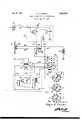
- T.V. set elementsare diagrammatically illustrated in the drawing and designated by numerals as follows: wall receptacle 10, cover plate screw on wall receptacle 11, removable back panel of T.V. set 12, primary of a speaker transformer 13, speaker leads of T.V. set 14, and the speaker voice coil 15.
- the voice coil 15comprises two, series connected, matching coils the conductors to which, indicated at 16 and 17, are shorted, as indicated by the dotted line 17, in the conventional T.V.
- the only change made in the conventional T.V. circuitis to remove the short 17 and connect the conductors 16 and 17 to relay contacts to be later described.
- the theft-alarm of this inventionemploys a conventional R-F oscillator, as outlined by the broken line rectangle, 19.
- the R-F oscillatoris of the capacitance type having a transistor 20, the collector and base of which are in series with an oscillating circuit 21, including a conventional turning coil 22, which is energized, from a positive grounded battery 23, through a negative lead 24 and a positive lead 25 so as to oscillate at a radio frequency (such as 400 kc./s.).
- a flexible additional-capacitance-lead 26When installed in a T.V. set for theft protection a flexible additional-capacitance-lead 26 is connected between the oscillating circuit 21 and the cover plate screw 11 of the receptacle 10. This places sufficient additional coupled capacitance in the tuned circuit 21 to detune the latter and prevent oscillation. However, should the additional-capacitance-lead 26 be cut, broken or disconnected, the R-F oscillator will immediately oscillate to produce a radio frequency to actuate the audio portion of the alarm device.
- the audio portion of the alarm devicecomprises a conventional A-F oscillator, as outlined by the broken line rectangle 27 in the drawing, which may be of any suitable type to energize the voice coil 15 of the T.V. set.
- the A-F oscillator 27is provided with a transistor 28, the collector and emitter of which are bridged by a diode 29 to prevent voltage surges from damaging the transistor 28, and which provide AC current to the primary of an oscillation transformer 30 the secondary of which furnishes operating current to the voice coil '15 through voice coil leads 31 and 32.
- the actuation of the audio portion of the deviceis controlled by a triple-bladed, double-throw, spring-loaded relay consisting of a solenoid 33 which, when energized, simultaneously actuates three switch blades 34, 35 and 36.
- the switch blade 34is connected to the voice coil conductor 17 and is normally closed against a contact 37 which is connected to the other voice coil conductor 16.
- the blade 34normally replaces the conventional short 18 so that the voice coil will function normally when the theft alarm is dead.
- the solenoid 33be energized the blade 34 will be swung into contact with an A-F contact 38 which is connected by means of the voice coil lead 31 to the oscillation transformer 30 so that the voice-coil will respond to the frequency of the A-F oscillator 26.
- the switch blade 35is connected to the emitter of the transistor 28 through a positive conductor 39 and, when the solenoid 33 is energized, contacts a ground contact 40 to complete the positive circuit between the battery 18 and the A-F oscillator 26.
- the negative DC. for the alarm circuitsis supplied from a main negative conductor 42 connected directly to the battery 23 and the negative current to the solenoid 33 is conducted through a solenoid conductor 43. Normally there is no current flow from the main conductor 42 to the solenoid conductor 43, for the circuit is broken by a normally closed micro-switch 44 and a normally open switch blade 45 the closure of either of which will complete the negative circuit to the solenoid 33.
- the micro-switchis held open by physical contact with the back panel 12 of the T.V. set.
- the switch blade 45is resiliently held open and will be attracted to the closed position by energizing a high impedance, actuating-solenoid 46 which is series connected in the oscillating circuit of the R-F oscillator 19. Therefore, if either the back panel 12 be removed, to cause the micro-switch to close, or the capacitance lead 25 be cut or removed, so as to energize the solenoid 46 and initiate oscillation of the R-F oscillator 19, the negative main 42 will be directly connected to the solenoid conductor 43 to conduct negative current to the solenoid 33'.
- the positive DC.is supplied from the positive ground of the battery through a positive conductor 47 and a solenoid conductor 48, between which, three rotary multiple contact switches '49, 50 and 51, of the shorting type, are individually series-connected.
- Each of the rotary switcheswhen rotated, makes successive contacts with an annular series of contacts 52. All of the contacts 52, except one in each series, are connected to the solenoid conductor 48. For instance, as illustrated, contact 1 in switch 49, contact 6 in switch 50 and contact 9 in switch 51 are not connected to solenoid conductor 48.
- the switch blade 36closes against a solenoid contact 41 to maintain the solenoid 33 energized even though attempts are made to open the micro-switch 44 and/or the micro-switch blade 45.
- the theft alarmcannot be shut off except by placing all of the rotary switches 49, 50 and 51 in the correct open circuit combination or by removing or disconnecting the battery 23. Since these elements are built into the cabinet of the set in relatively concealed positions, disconnection of the alarm by unauthorized personnel is a remote possibility.
- the speaker transformer 13is of the magnetic core variety, so the voice coil, when energized by A-F oscillator, operates in the residual magnetic field of the core when the "RV. set circuits are inoperative.
- a theft alarm for an electronic instrument setcomprising:
- (d)means actuatable by the R-F current from said R-F oscillator to connect said A-F oscillator to said battery;
- a magnetic speakerincluding a voice-coil connected to receive an A-F signal from said A-F oscillator;
- a capacitance lead from the oscillating circuit of said R-F oscillatoradapted to be connected to additional connected capacitance exteriorly of said set and acting to detune said R-F oscillator to prevent oscillation thereof until said capacitance lead is disconnected;
- each switchhaving a contact closing element adapted to successively contact a plurality of independent contacts, said contact closing element and said contact being connected in series between a pole of said battery and said theft alarm so that if any contact in any switch is closed, current can flow to said theft alarm and if a contact in every switch is open no current can flow to said theft alarm.
- a theft alarm for a television set as described in claim 1having a plurality of independent rotary multicontact switches of the shorting type for connecting and disconnecting both oscillators from said battery, each switch having a contact-closing element adapted to successively contact a plurality of independent con-tacts, said contact-closing element and certain of said contacts being connected in series between a pole of said battery and said theft alarm so that if a certain contact in any of the switches is closed, current can flow to said theft alarm and if a contact in every switch is open, no current can flow to said theft alarm.
Landscapes
- Physics & Mathematics (AREA)
- General Physics & Mathematics (AREA)
- Burglar Alarm Systems (AREA)
Abstract
Description
1971 D. N. FISTELL 3,
THEFT ALARMS FUR TELEVISION SETS Filed Aug. 22, 196? 2 w ED I n //--6 26 ll g ,1 i l l .9--l I l I I I. I
INVENTOR. fim /o A4 flan-21.
United States Patent 3,553,673 TEEFT ALARMS FOR TELEVISION SETS David N. Fistell, 1001 Bannock St, Denver, Colo. 80204 Filed Aug. 22, 1967, Ser. No. 662,455 Int. Cl.G08b 13/14 US. Cl. 340-280 2 Claims ABSTRACT OF THE DISCLOSURE An R-F oscillator supplies R-F current to an A-F oscillator which is coupled to the voice coil of a television receiver set to produce an audible signal. The R-F oscillator is maintained inoperative by connecting a ground lead to additional capacitance at the receiver location. The A-F oscillator is maintained inoperative by a microswitch which is normally held open lay physical contact with the back panel of the set. The current supply from a selfcontained battery can be shut off by authorized personnel by actuation of a combination of rotary switches.
It is the present custom to install television sets for the attraction of, and for the pleasure of, overnight tenants in hotels and motels. Unfortunately, all of the tenants are not strictly honest and the presence of an expensive television set in close proximity to convenient conveyance facilities, as are found especially in motels and motor hotels, presents quite a temptation to the unscrupulous tenant and results in exceedingly heavy monetary loss to the landlord.
The principal object of this invention is to incorporate a self-contained alarm-signal circuit in the cabinet of a conventional television set, which will operate automatically to cause the set to emit a loud, easily audible, attentionattracting, assistance-calling sound should an unauthorized person attempt to disconnect, or gain admission to, the set.
' Another object is to so arrange the alarm-signal circuit that it will continue to operate even after the set has been disconnected from, and removed from, its installed location.
A further object is to provide means whereby authorized personnel can disconnect or gain access to the set for removal, replacement and repairs without sounding the audible alarm.
Other objects and advantages reside in the detail construction of the invention, which is designed for simplicity, economy, and elliciency. These will become more apparent from the following description.
In the following detailed description of the invention reference is had to the circuit diagram of the theft alarm of this invention shown on the accompanying drawing.
Conventional T.V. set elements are diagrammatically illustrated in the drawing and designated by numerals as follows: wall receptacle 10, cover plate screw on wall receptacle 11, removable back panel of T.V. set 12, primary of aspeaker transformer 13, speaker leads of T.V. set 14, and thespeaker voice coil 15. In a conventional speaker thevoice coil 15 comprises two, series connected, matching coils the conductors to which, indicated at 16 and 17, are shorted, as indicated by the dotted line 17, in the conventional T.V. The only change made in the conventional T.V. circuit is to remove the short 17 and connect theconductors 16 and 17 to relay contacts to be later described.
The theft-alarm of this invention employs a conventional R-F oscillator, as outlined by the broken line rectangle, 19. The R-F oscillator is of the capacitance type having a transistor 20, the collector and base of which are in series with anoscillating circuit 21, including aconventional turning coil 22, which is energized, from a positive groundedbattery 23, through anegative lead 24 and apositive lead 25 so as to oscillate at a radio frequency (such as 400 kc./s.).
When installed in a T.V. set for theft protection a flexible additional-capacitance-lead 26 is connected between the oscillatingcircuit 21 and the cover plate screw 11 of the receptacle 10. This places sufficient additional coupled capacitance in the tunedcircuit 21 to detune the latter and prevent oscillation. However, should the additional-capacitance-lead 26 be cut, broken or disconnected, the R-F oscillator will immediately oscillate to produce a radio frequency to actuate the audio portion of the alarm device.
The audio portion of the alarm device comprises a conventional A-F oscillator, as outlined by thebroken line rectangle 27 in the drawing, which may be of any suitable type to energize thevoice coil 15 of the T.V. set. As illustrated, theA-F oscillator 27 is provided with atransistor 28, the collector and emitter of which are bridged by adiode 29 to prevent voltage surges from damaging thetransistor 28, and which provide AC current to the primary of an oscillation transformer 30 the secondary of which furnishes operating current to the voice coil '15 through voice coil leads 31 and 32.
The actuation of the audio portion of the device is controlled by a triple-bladed, double-throw, spring-loaded relay consisting of asolenoid 33 which, when energized, simultaneously actuates threeswitch blades
Theswitch blade 34 is connected to the voice coil conductor 17 and is normally closed against a contact 37 which is connected to the othervoice coil conductor 16. Thus, theblade 34 normally replaces the conventional short 18 so that the voice coil will function normally when the theft alarm is dead. However, should thesolenoid 33 be energized theblade 34 will be swung into contact with anA-F contact 38 which is connected by means of thevoice coil lead 31 to theoscillation transformer 30 so that the voice-coil will respond to the frequency of theA-F oscillator 26.
Theswitch blade 35 is connected to the emitter of thetransistor 28 through apositive conductor 39 and, when thesolenoid 33 is energized, contacts aground contact 40 to complete the positive circuit between thebattery 18 and theA-F oscillator 26.
The negative DC. for the alarm circuits is supplied from a main negative conductor 42 connected directly to thebattery 23 and the negative current to thesolenoid 33 is conducted through asolenoid conductor 43. Normally there is no current flow from the main conductor 42 to thesolenoid conductor 43, for the circuit is broken by a normally closedmicro-switch 44 and a normallyopen switch blade 45 the closure of either of which will complete the negative circuit to thesolenoid 33.
The micro-switch is held open by physical contact with the back panel 12 of the T.V. set. Theswitch blade 45 is resiliently held open and will be attracted to the closed position by energizing a high impedance, actuating-solenoid 46 which is series connected in the oscillating circuit of the R-F oscillator 19. Therefore, if either the back panel 12 be removed, to cause the micro-switch to close, or thecapacitance lead 25 be cut or removed, so as to energize thesolenoid 46 and initiate oscillation of the R-F oscillator 19, the negative main 42 will be directly connected to thesolenoid conductor 43 to conduct negative current to the solenoid 33'.
The positive DC. is supplied from the positive ground of the battery through apositive conductor 47 and a solenoid conductor 48, between which, three rotary multiple contact switches '49, 50 and 51, of the shorting type, are individually series-connected. Each of the rotary switches, when rotated, makes successive contacts with an annular series of contacts 52. All of the contacts 52, except one in each series, are connected to the solenoid conductor 48. For instance, as illustrated, contact 1 inswitch 49, contact 6 inswitch 50 and contact 9 inswitch 51 are not connected to solenoid conductor 48. Therefore, if all of the switches are positioned upon a nonconnected contact, such as the contact 1 inswitch 49, the contact 6 inswitch 50 and the contact 9 inswitch 51, no positive current will flow and the theft alarm will be inoperative. Any other arrangement of any or all of the switches will maintain the alarm in operative condition.
Theswitch blade 36 closes against asolenoid contact 41 to maintain thesolenoid 33 energized even though attempts are made to open themicro-switch 44 and/or themicro-switch blade 45. Once started, the theft alarm cannot be shut off except by placing all of therotary switches battery 23. Since these elements are built into the cabinet of the set in relatively concealed positions, disconnection of the alarm by unauthorized personnel is a remote possibility.
Thespeaker transformer 13 is of the magnetic core variety, so the voice coil, when energized by A-F oscillator, operates in the residual magnetic field of the core when the "RV. set circuits are inoperative.
While a specific form of the invention has been described and illustrated herein, it is to be understood that the same may be varied with the scope of the appended claims, without departing from the spirit of the invention.
What is claimed is:
1. A theft alarm for an electronic instrument set comprising:
(a) a battery;
(b) an R-F oscillator of the capacitance-tuned type energized by said battery;
() an A-F oscillator;
(d) means actuatable by the R-F current from said R-F oscillator to connect said A-F oscillator to said battery;
(e) a magnetic speaker including a voice-coil connected to receive an A-F signal from said A-F oscillator;
(f) a capacitance lead from the oscillating circuit of said R-F oscillator adapted to be connected to additional connected capacitance exteriorly of said set and acting to detune said R-F oscillator to prevent oscillation thereof until said capacitance lead is disconnected;
(g) a removable panel in said set;
(h) a normally-closed micro-switch in the battery circuit of said A-F oscillator held open by physical contact with said panel so that removal of said panel will close the battery circuit to said A-F oscillator to energize said voice coil;
(i) a first solenoid energized by the radio frequency current from said R-F oscillator;
(j) a first solenoid switch blade attractable by said solenoid to close the battery circuit to said A-F oscillator;
(k) a second solenoid energized by closure of the first solenoid switch blade;
(1) a second switch blade attractable by said second solenoid to close a circuit from said A-F oscillator to said voice coil;
(m) a third switch blade attractable by said second solenoid to close the battery circuit to said A-F oscillator',
(n) manually operable switching means for disconnecting both of said oscillators from the battery when desired; and
(o) a plurality of independent multi-contact switches, each switch having a contact closing element adapted to successively contact a plurality of independent contacts, said contact closing element and said contact being connected in series between a pole of said battery and said theft alarm so that if any contact in any switch is closed, current can flow to said theft alarm and if a contact in every switch is open no current can flow to said theft alarm.
2. A theft alarm for a television set as described in claim 1 having a plurality of independent rotary multicontact switches of the shorting type for connecting and disconnecting both oscillators from said battery, each switch having a contact-closing element adapted to successively contact a plurality of independent con-tacts, said contact-closing element and certain of said contacts being connected in series between a pole of said battery and said theft alarm so that if a certain contact in any of the switches is closed, current can flow to said theft alarm and if a contact in every switch is open, no current can flow to said theft alarm.
References Cited UNITED STATES PATENTS 3,193,819 7/1965 Magner 340280 2,782,308 2/1957 Rug 340258CX 3,041,592 6/1962 Schmidt 340258C 3,042,908 7/1962 Pearson 340244C 3,045,226 7/1962 Trayner 34028O 3,129,414 4/1964 Rice 340258C 3,423,747 1/1969 Hogencamp 340 -280 DONALD J. YUSKO, Primary Examiner P. PALAN, Assistant Examiner US. Cl. X.R. 331; 340-258
Applications Claiming Priority (1)
| Application Number | Priority Date | Filing Date | Title |
|---|---|---|---|
| US66245567A | 1967-08-22 | 1967-08-22 |
Publications (1)
| Publication Number | Publication Date |
|---|---|
| US3553673Atrue US3553673A (en) | 1971-01-05 |
Family
ID=24657779
Family Applications (1)
| Application Number | Title | Priority Date | Filing Date |
|---|---|---|---|
| US662455AExpired - LifetimeUS3553673A (en) | 1967-08-22 | 1967-08-22 | Theft alarms for television sets |
Country Status (1)
| Country | Link |
|---|---|
| US (1) | US3553673A (en) |
Cited By (4)
| Publication number | Priority date | Publication date | Assignee | Title |
|---|---|---|---|---|
| US3696378A (en)* | 1970-08-11 | 1972-10-03 | Video Eng Inc | Appliance theft alarm using voltage magnitude switch |
| US3787831A (en)* | 1972-06-19 | 1974-01-22 | C Gordon | Alarm system |
| US4011555A (en)* | 1974-08-20 | 1977-03-08 | Monte Markowitz | Radio and television alarm system |
| US4237450A (en)* | 1978-11-13 | 1980-12-02 | Canez Antonio R | Appliance theft alarm |
- 1967
- 1967-08-22USUS662455Apatent/US3553673A/ennot_activeExpired - Lifetime
Cited By (4)
| Publication number | Priority date | Publication date | Assignee | Title |
|---|---|---|---|---|
| US3696378A (en)* | 1970-08-11 | 1972-10-03 | Video Eng Inc | Appliance theft alarm using voltage magnitude switch |
| US3787831A (en)* | 1972-06-19 | 1974-01-22 | C Gordon | Alarm system |
| US4011555A (en)* | 1974-08-20 | 1977-03-08 | Monte Markowitz | Radio and television alarm system |
| US4237450A (en)* | 1978-11-13 | 1980-12-02 | Canez Antonio R | Appliance theft alarm |
Similar Documents
| Publication | Publication Date | Title |
|---|---|---|
| US4121201A (en) | Carrier current appliance theft alarm | |
| US3054994A (en) | Visual signal generation and electrical outlet control means therefor | |
| EP0041781A2 (en) | Intrusion detection and alarm system | |
| US4237450A (en) | Appliance theft alarm | |
| US3440636A (en) | Sensing resistance device | |
| US3553673A (en) | Theft alarms for television sets | |
| US3484775A (en) | Theft prevention system | |
| US3133276A (en) | Burglar alarm system | |
| US4002956A (en) | Automatic electronic lock off system for an appliance | |
| US4075617A (en) | Alarm circuit for monitoring removal of plug from electrical power receptacle | |
| US2353452A (en) | Burglar alarm control box | |
| US3556394A (en) | Audible house alarm for rural mail boxes | |
| US3609742A (en) | Property security system | |
| US3623088A (en) | Alarm system with manually selectable time delay | |
| US3924254A (en) | Anti-intrusion alarm system | |
| US4754263A (en) | Burglar alarm system | |
| US3284791A (en) | Near alarm receiver having-time delay of discharge type | |
| US3801971A (en) | Telephone alarm system | |
| US3439359A (en) | Alarm system for preventing the theet of valuable articles | |
| GB2032664A (en) | Electrical control apparatus | |
| US3423747A (en) | Theft prevention device | |
| US2643372A (en) | Burglar alarm system | |
| US4059739A (en) | Electrical power receptacle having built-in switching contacts | |
| US4011555A (en) | Radio and television alarm system | |
| US3848242A (en) | Burglar alarm system with selectable latching mode |