US3516324A - Expandable plugs - Google Patents
Expandable plugsDownload PDFInfo
- Publication number
- US3516324A US3516324AUS700482AUS3516324DAUS3516324AUS 3516324 AUS3516324 AUS 3516324AUS 700482 AUS700482 AUS 700482AUS 3516324D AUS3516324D AUS 3516324DAUS 3516324 AUS3516324 AUS 3516324A
- Authority
- US
- United States
- Prior art keywords
- plug
- teeth
- slots
- legs
- terminus
- Prior art date
- Legal status (The legal status is an assumption and is not a legal conclusion. Google has not performed a legal analysis and makes no representation as to the accuracy of the status listed.)
- Expired - Lifetime
Links
- 210000001364upper extremityAnatomy0.000description13
- 239000000463materialSubstances0.000description5
- 239000011796hollow space materialSubstances0.000description3
- 238000004873anchoringMethods0.000description2
- 230000003247decreasing effectEffects0.000description2
- 230000006835compressionEffects0.000description1
- 238000007906compressionMethods0.000description1
- 238000003780insertionMethods0.000description1
- 230000037431insertionEffects0.000description1
- 239000002184metalSubstances0.000description1
- 238000012986modificationMethods0.000description1
- 230000004048modificationEffects0.000description1
- 239000007787solidSubstances0.000description1
Images
Classifications
- F—MECHANICAL ENGINEERING; LIGHTING; HEATING; WEAPONS; BLASTING
- F16—ENGINEERING ELEMENTS AND UNITS; GENERAL MEASURES FOR PRODUCING AND MAINTAINING EFFECTIVE FUNCTIONING OF MACHINES OR INSTALLATIONS; THERMAL INSULATION IN GENERAL
- F16B—DEVICES FOR FASTENING OR SECURING CONSTRUCTIONAL ELEMENTS OR MACHINE PARTS TOGETHER, e.g. NAILS, BOLTS, CIRCLIPS, CLAMPS, CLIPS OR WEDGES; JOINTS OR JOINTING
- F16B13/00—Dowels or other devices fastened in walls or the like by inserting them in holes made therein for that purpose
- F16B13/12—Separate metal or non-separate or non-metal dowel sleeves fastened by inserting the screw, nail or the like
- F16B13/124—Separate metal or non-separate or non-metal dowel sleeves fastened by inserting the screw, nail or the like fastened by inserting a threaded element, e.g. screw or bolt
- F—MECHANICAL ENGINEERING; LIGHTING; HEATING; WEAPONS; BLASTING
- F16—ENGINEERING ELEMENTS AND UNITS; GENERAL MEASURES FOR PRODUCING AND MAINTAINING EFFECTIVE FUNCTIONING OF MACHINES OR INSTALLATIONS; THERMAL INSULATION IN GENERAL
- F16B—DEVICES FOR FASTENING OR SECURING CONSTRUCTIONAL ELEMENTS OR MACHINE PARTS TOGETHER, e.g. NAILS, BOLTS, CIRCLIPS, CLAMPS, CLIPS OR WEDGES; JOINTS OR JOINTING
- F16B13/00—Dowels or other devices fastened in walls or the like by inserting them in holes made therein for that purpose
- F16B13/02—Dowels or other devices fastened in walls or the like by inserting them in holes made therein for that purpose in one piece with protrusions or ridges on the shaft
Definitions
- the inventionrelates to an expandable plug having integral front, intermediate and rear portions and includes on the front and intermediate portions a rst set of 01T- standing teeth of substantially equal radial extent with spaced groups of teeth of decreasing length carried by the intermediate portion and interposed between the first set of teeth.
- the tbody of the plughas an axial perforation which communicates with orthogonally related slotted areas in both the front and intermediate portions.
- This inventionrelates to a longitudinally slotted expandable plug having a hollow space extending longitudinally through the plug for the insertion of a fastening element, for example a screw, and having raised portions of a crosssectional shape similar to inclined teeth provided on the outside of the part to be spread out, said plug being made of a material, preferably a plastic material, adapted to be deformed by the driving-in of the fastening element.
- a fastening elementfor example a screw
- Expandable plugs having longitudinal slots extending over their entire widthare known, for example, from the disclosures of British patent specification No. 589,648 and from German patent specifications Nos. 910,588, 1,097,117, and 1,102,375. These specifications disclose such plugs having 'slots which begin at the front end of the plug, While the British patent specification No. 589,- 648 also discloses a plug having slots ibeginning at the rear end of the plug. These specifications also already show raised portions of a cross-sectional shape similar to sawteeth or inclined teeth. From German patent specification No. 569,700, which relates to a square-type plug or sleeve of sheet metal, it is also known to have projections similar to sawteeth cut deeper at the front end of the sleeve than toward the rear thereof.
- the essential clamping actionis produced only at the front end of the plug.
- the problem underlying the inventionis to improve the clamping action and to provide a plug giving a clamping and anchoring action extending over the greater part of the length of the plug and obtained even when the opening, for example, in the brickwork or other material in which the plug is inserted is of ample size in relation to the diameter of an envelope cylinder circumscribing the essential regions of the plug body.
- this aimis to be achieved 'without use of sensitive elements, that is to say, elements which can easily break off, on the surface of the plug.
- the present inventioncomprises a longitudinally slotted expandable plug having a hollow space passing through it in a longitudinal direction and serving for the introduction of a fastening element, for example, a screw, having rai-sed portions similar in cross-section to inclined teeth provided on the outside of the parts to be expanded, and being made of a material, preferably a plastic material, adapted to be deformed by the driving-in of the fastening element, characterized in that apart from a longitudinal slot which starts from the front end of the plug, is situated substantially in the middle, and extends over approximately half the length of the plug, there are provided, starting from an annularly closed rear portion of the plug body, in the middle region of the plug two longitudinal slots, which run substantially parallel to one another in spaced relationship, extend in planes at right angles to the plane of the front longitudinal slot, and which extend to a point approximately halfway along the length of the plug body.
- a fastening elementfor example, a screw
- rai-sed portionssimilar in cross-section to inclined teeth provided on the outside of the parts to
- the plug constructed according to the inventionconsequently has a second, differently expansible portion which adjoins the first-mentioned portion at the rear and likewise produces a clamping action, and which because of the annular rear portion of the plug body ⁇ will be referred to as the middle portion, so that a double expanding and clamping action is achieved, and this is done differently in the two portions used to obtain an expanding and clamping action.
- the probability that the plug will comply with the requirements imposed on it in all conceivable applicationsis increased in an advantageous manner.
- the cross-section of the teethincreases toward the front end of the plug; the anchoring action is thereby further improved.
- Another optional feature of the inventionconsists in that in the four band regions formed by the double slotting in the middle portion of the plug, teeth projecting farther radially outward on the periphery alternate with teeth projecting to a lesser radial extent outwardly. This contributes toward preventing the plug from rotating.
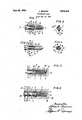
- FIG. 1is a side elevation of a plug constructed according to the invention
- FIG. 2is an end view of the plug illustrated in FIG. 1, viewed in the direction of the arrow II in FIG. 1;
- FIG. 3is a side elevation of the same plug in a position rotated through about the longitudinal axis in relation to FIG. 1;
- FIG. 4is a section on the line IVIV of FIG. 3;
- FIG. 5shows in longitudinal section the plug inserted into an opening in a wall
- FIG. 6shows the plug expanded in the opening in the wall.
- the plug according to the inventionhas three portions, that is an annular rear portion 1, a middle portion 2, and a front portion 3 of the plug body.
- annular rear portion 1 of the plug bodyOn the annular rear portion 1 of the plug body there are provided wedge-shaped ribs 4, which in the example illustrated are uniformly spaced around the circumference of portion 1 by 90 in relation to one another.
- the slot 5divides the front portion 3 into two front legs which are free at their front terminus and hingedly attached to about the mid portion of the plug at their rear terminus, where the slot 5 ends.
- An expandable plug having such front legsis known in the art.
- the middle portion 2there are provided four longitudinal slots 6 6 and 7 7 which run substantially parallel to one another in spaced relationship. It is particularly well seen in FIG.
- annular projections 8 to 12which in projection and in cross-section have sawtooth-like boundaries, the inclined tooth back facing the front end of the plug and the steep tooth front facing the rear end of the plug.
- These annular projectionswhich hereinbelow will be referred to for short as teeth, decrease in size from front to rear, viewed in the direction of the longitudinal axis of the plug. In the radial direction they have equal diameters, that is to say the same diameter as the rear annular portion 1 of the plug body, so that they can be inscribed in an enveloping circular cylinder to which the dimensions of the means defining the opening 14, which is provided in a wall and into which the plug is to be inserted, must correspond.
- the crowns -13 of the teeth 8 to 12are flattened.
- the frontmost largest tooth 8forms a forwardly tapering truncated cone, so that the plug body, viewed as a whole, thus has a truncated conical tip.
- the front portion 3 of the plug bodyis solid, whereas the rear annular portion 1 of the plug body contains a cylindrical hollow space 15 (see FIG. 5) which continues through the extent of the middle portion 2.
- the slots 6 and 7 on both sides of the plugare interconnected by a short transversal slot 30 as shown in FIG. 3.
- slots 6, 7 and 30 on one side of the plugdefine a band region 16, while corresponding slots 6, 7 and 30 on the other side of the plug define a band region 19.
- band regions 16 and 19are, at their rear terminus, attached to the rear annular portion 1 of the plug body, whereas, by virtue of transversal slots 30, they are free at their front end.
- Band regions 16 and 19are separated from one another by intermediate band regions 17 and 18 each merging with both the rear portion 1 and the front portion 3 of the plug.
- the regions 16-19may all be of equal width (see FIG. 4) or may alternatively have ditferent widths.
- the band regions 16 and 19are in fact rear legs which have a free front terminus by virtue of transversal slots 30, and a rear terminus hingedly attached to the rear annular portion of body 1 substantially rearwardly of the location of hinged attachment of the front legs. It is thus seen that the expandable plug according to the invention, in addition to front legs, has similarly constructed rear legs which-as it will be discussed in more detail later-substantially duplicate the clamping action of the front legs.
- the teeth 20 which face the front end of the plugproject farthest to the outside in a radial direction, in fact considerably beyond the envelope cylinder circumscribing the teeth 8 to 12 and the rear annular portion 1 of the plug body.
- the teeth 22 facing the rear portion of the plugare the lowest.
- the teeth 20 to 22have flattened portions similar to the flattened portions 13.
- teeth 23 to 25which, like the teeth 8 to 12, can be inscribed in the envelope cylinder.
- an expandable hollow plug of the typehaving at least two axially lextending front legs free at their front terminus and hingedly attached at their rear terminus to about the mid portion of said plug, said front legs adapted to spread radially outwardly when a fastening element is driven through the rear terminus of said plug axially thereof, said front legs having a plurality of teeth ⁇ at locations substantially along their entire length frictionally engaging the inner wall of a bore when said front legs are spread by said fastening element, the improvement comprising, at least two axially extending rear legs each having a free front terminus disposed approximately adjacent the rear terminus of said front legs, each said rear leg further having a rear terminus hingedly attached to said plug at a location substantially rearwardly of the rear terminus of said front legs, said rear legs adapted to spread radially outwardly when a fastening element is driven through the rear terminus of said plug axially thereof, said rear legs having a plurality of teeth substantially along their entire length, rearwardly successive teeth of
Landscapes
- Engineering & Computer Science (AREA)
- General Engineering & Computer Science (AREA)
- Mechanical Engineering (AREA)
- Dowels (AREA)
- Joining Of Building Structures In Genera (AREA)
- Package Frames And Binding Bands (AREA)
Description
A. BERNER Ex'PAnDABLE PLUGS FIG filed Jan. 25, 1968 .im4 23, 1910 v United States Patent O 3,516,324 EXPANDABLE PLUGS Albert Berner, Postfach 65, 7118 Kunzelsau, Germany Filed Jan. 25, 1968, Ser. No. 700,482 Int. Cl. F16b 13/12 U.S. Cl. 85--83 3 Claims ABSTRACT OF THE DISCLOSURE The invention relates to an expandable plug having integral front, intermediate and rear portions and includes on the front and intermediate portions a rst set of 01T- standing teeth of substantially equal radial extent with spaced groups of teeth of decreasing length carried by the intermediate portion and interposed between the first set of teeth. The tbody of the plug has an axial perforation which communicates with orthogonally related slotted areas in both the front and intermediate portions.
BACKGROUND OF THiE INVENTION This invention relates to a longitudinally slotted expandable plug having a hollow space extending longitudinally through the plug for the insertion of a fastening element, for example a screw, and having raised portions of a crosssectional shape similar to inclined teeth provided on the outside of the part to be spread out, said plug being made of a material, preferably a plastic material, adapted to be deformed by the driving-in of the fastening element.
Expandable plugs having longitudinal slots extending over their entire width are known, for example, from the disclosures of British patent specification No. 589,648 and from German patent specifications Nos. 910,588, 1,097,117, and 1,102,375. These specifications disclose such plugs having 'slots which begin at the front end of the plug, While the British patent specification No. 589,- 648 also discloses a plug having slots ibeginning at the rear end of the plug. These specifications also already show raised portions of a cross-sectional shape similar to sawteeth or inclined teeth. From German patent specification No. 569,700, which relates to a square-type plug or sleeve of sheet metal, it is also known to have projections similar to sawteeth cut deeper at the front end of the sleeve than toward the rear thereof.
In known plugs the essential clamping action is produced only at the front end of the plug. The problem underlying the invention is to improve the clamping action and to provide a plug giving a clamping and anchoring action extending over the greater part of the length of the plug and obtained even when the opening, for example, in the brickwork or other material in which the plug is inserted is of ample size in relation to the diameter of an envelope cylinder circumscribing the essential regions of the plug body. At the same time this aim is to be achieved 'without use of sensitive elements, that is to say, elements which can easily break off, on the surface of the plug.
SUMMARY OF THE INVENTION Accordingly, the present invention comprises a longitudinally slotted expandable plug having a hollow space passing through it in a longitudinal direction and serving for the introduction of a fastening element, for example, a screw, having rai-sed portions similar in cross-section to inclined teeth provided on the outside of the parts to be expanded, and being made of a material, preferably a plastic material, adapted to be deformed by the driving-in of the fastening element, characterized in that apart from a longitudinal slot which starts from the front end of the plug, is situated substantially in the middle, and extends over approximately half the length of the plug, there are provided, starting from an annularly closed rear portion of the plug body, in the middle region of the plug two longitudinal slots, which run substantially parallel to one another in spaced relationship, extend in planes at right angles to the plane of the front longitudinal slot, and which extend to a point approximately halfway along the length of the plug body.
In addition to the front expansible portion serving to produce a clamping action, the plug constructed according to the invention consequently has a second, differently expansible portion which adjoins the first-mentioned portion at the rear and likewise produces a clamping action, and which because of the annular rear portion of the plug body `will be referred to as the middle portion, so that a double expanding and clamping action is achieved, and this is done differently in the two portions used to obtain an expanding and clamping action. Thus, the probability that the plug will comply with the requirements imposed on it in all conceivable applications is increased in an advantageous manner.
If the central longitudinal slot starting from the front end of the plug and the abovementioned rear slots overlap, the connection of the two expanding regions is more resilient than `when there is no overlap, so that the expansibility of the clamping elements of the rear region is improved.
According to an optional feature of the invention, the cross-section of the teeth, particularly in the region of the middle portion of the plug body, increases toward the front end of the plug; the anchoring action is thereby further improved.
Another optional feature of the invention consists in that in the four band regions formed by the double slotting in the middle portion of the plug, teeth projecting farther radially outward on the periphery alternate with teeth projecting to a lesser radial extent outwardly. This contributes toward preventing the plug from rotating.
BRIEF DESCRIPTION OF THE DRAWINGS In order that the invention may be more readily understood, reference is made to the accompanying drawings which illustrate diagrammatically and by way of example, one embodiment thereof, and in which:
FIG. 1 is a side elevation of a plug constructed according to the invention;
FIG. 2 is an end view of the plug illustrated in FIG. 1, viewed in the direction of the arrow II in FIG. 1;
FIG. 3 is a side elevation of the same plug in a position rotated through about the longitudinal axis in relation to FIG. 1;
FIG. 4 is a section on the line IVIV of FIG. 3;
FIG. 5 shows in longitudinal section the plug inserted into an opening in a wall; and
FIG. 6 shows the plug expanded in the opening in the wall.
DESCRIPTION OF THE EMBODIMENT In the drawings, viewed from rear to front in the direction of the axis, the plug according to the invention has three portions, that is an annularrear portion 1, amiddle portion 2, and afront portion 3 of the plug body. On the annularrear portion 1 of the plug body there are provided wedge-shaped ribs 4, which in the example illustrated are uniformly spaced around the circumference ofportion 1 by 90 in relation to one another. Starting from theplane containing slots 6 6 and that containing slots extending over the entire cross-section of the plug runs to the rear, passing not only through theentire front portion 3 of the plug in the example illustrated, but also continuing into themiddle portion 2 of the plug, Theslot 5 divides thefront portion 3 into two front legs which are free at their front terminus and hingedly attached to about the mid portion of the plug at their rear terminus, where theslot 5 ends. An expandable plug having such front legs is known in the art. In themiddle portion 2 there are provided fourlongitudinal slots 6 6 and 7 7 which run substantially parallel to one another in spaced relationship. It is particularly well seen in FIG. 4 that theplane containing slots 6 6 and that containingslots 7--7 are, on the one hand, parallel with one another, and, on the other hand, extend normal to the diametrical plane containingslot S. Slots 6 6 and 7 7 begin at the rearannular portion 1 of the plug body and extend through the entire middle portion, so that they overlap thelongitudinal slot 5. A comparativelyweak connection 29 bridging over thelongitudinal slot 5 provisionally holds the plug halves or front legs together on each side of thelongitudinal slot 5, so that they will not open out or be accidentally pressed apart before the plug is inserted into means defining anopening 14. However, when ascrew 28 or other fastening element is threaded into the plug, theconnection 29 is automatically broken.
On thefront part 3 there are disposedannular projections 8 to 12, which in projection and in cross-section have sawtooth-like boundaries, the inclined tooth back facing the front end of the plug and the steep tooth front facing the rear end of the plug. These annular projections, which hereinbelow will be referred to for short as teeth, decrease in size from front to rear, viewed in the direction of the longitudinal axis of the plug. In the radial direction they have equal diameters, that is to say the same diameter as the rearannular portion 1 of the plug body, so that they can be inscribed in an enveloping circular cylinder to which the dimensions of the means defining theopening 14, which is provided in a wall and into which the plug is to be inserted, must correspond. The crowns -13 of theteeth 8 to 12 are flattened.
The frontmostlargest tooth 8 forms a forwardly tapering truncated cone, so that the plug body, viewed as a whole, thus has a truncated conical tip.
Except for thelongitudinal slot 5 extending through it, thefront portion 3 of the plug body is solid, whereas the rearannular portion 1 of the plug body contains a cylindrical hollow space 15 (see FIG. 5) which continues through the extent of themiddle portion 2. At their front terminus, theslots transversal slot 30 as shown in FIG. 3. Thus,slots band region 16, whilecorresponding slots band region 19. lIt is seen thatband regions annular portion 1 of the plug body, whereas, by virtue oftransversal slots 30, they are free at their front end.Band regions intermediate band regions rear portion 1 and thefront portion 3 of the plug. The regions 16-19 may all be of equal width (see FIG. 4) or may alternatively have ditferent widths. Stating the afore-described structure in different terms, theband regions transversal slots 30, and a rear terminus hingedly attached to the rear annular portion ofbody 1 substantially rearwardly of the location of hinged attachment of the front legs. It is thus seen that the expandable plug according to the invention, in addition to front legs, has similarly constructed rear legs which-as it will be discussed in more detail later-substantially duplicate the clamping action of the front legs. Although theslot 5 overlaps the fourslots 6 6, 7 7, the plug is still held together, because extensions of theband regions 16 to 19 still exist between the slots and connect thefront portion 3 to themiddle portion 2. This can best be seen in FIG. 1, where the projection lines produced in themiddle part 2 by theslot 7, the plane of which lies at rightangles to that of theslot 5, are shown.
On the band regions `16 to 19 of themiddle portion 2 there are likewise situated teeth, which in section are similar to the teeth provided on thefront portion 3 of the plug body, but which are not all of the same type. On the band regions orrear legs teeth 20 to 22 which project to different extents outwardly in a radial direction.
Theteeth 20 which face the front end of the plug project farthest to the outside in a radial direction, in fact considerably beyond the envelope cylinder circumscribing theteeth 8 to 12 and the rearannular portion 1 of the plug body. Theteeth 22 facing the rear portion of the plug are the lowest. Theteeth 20 to 22 have flattened portions similar to theflattened portions 13.
On theband regions teeth 23 to 25 which, like theteeth 8 to 12, can be inscribed in the envelope cylinder.
When the plug is inserted into thecylindrical opening 14, for example, inbriclework 26, themiddle portion 2 is compressed, this compression being greater in the plane of theteeth 20 to 22 provided on theregions screw 28, which may hold aplate 27, has been screwed into the plug, the clamping, holding, and gripping engagements indicated in FIG. 6 are obtained. Thus, it will be apparent that by this plug design some of the teeth particularly those in themiddle portion 2 of the plug project radially farther outward than those disposed at the front and rear portions thereof. This together with theslots
Although only one embodiment of the invention has been depicted and described, it will be apparent that this embodiment is illustrative in nature and that a number of modifications in the apparatus and variations in its end use may be effected without departing from the spirit or scope of the invention as defined in the appended claims.
What is claimed is:
l1. In an expandable hollow plug of the type having at least two axially lextending front legs free at their front terminus and hingedly attached at their rear terminus to about the mid portion of said plug, said front legs adapted to spread radially outwardly when a fastening element is driven through the rear terminus of said plug axially thereof, said front legs having a plurality of teeth `at locations substantially along their entire length frictionally engaging the inner wall of a bore when said front legs are spread by said fastening element, the improvement comprising, at least two axially extending rear legs each having a free front terminus disposed approximately adjacent the rear terminus of said front legs, each said rear leg further having a rear terminus hingedly attached to said plug at a location substantially rearwardly of the rear terminus of said front legs, said rear legs adapted to spread radially outwardly when a fastening element is driven through the rear terminus of said plug axially thereof, said rear legs having a plurality of teeth substantially along their entire length, rearwardly successive teeth of said rear legs projecting therefrom in a decreasing extent.
2. An expandable plug as defined inclaim 1, wherein the location of hinged attachment of said front legs is, when viewed axially, between the free front terminus of said rear legs and the location of hinged attachment of said rear legs.
3. An expandable plug as dened inclaim 1, wherein said free front terminus of each rear leg is located at approximately the middle of the length of said plug.
References Cited UNITED STATES PATENTS Fischer 85-66 Topf 85-72 Fischer 85-83 Dwyer 85-84 Croessant 85-83 Bass 85--66 6 FOREIGN PATENTS 6505993 10/ 1966 Netherlands. 1,332,253 6/1963 France.
652,838 9/1964 Belgium. 5 1,458,166 5/1965 France.
805,795 5/1951 Germany.
MARION PARSONS, JR., Primary Examiner 1U US. Cl. X.R.
POTW UNITED STATES PATENT OFFICE (Il/IVI) (IIII'I II"I(ATI3 OI*CORRECTION Patent No 3, 316, '524 Dated June 23 1970 Inventor(s) Albert Berner It is certified that error appears in the above-identified patent and that said Letters Patent are hereby corrected as shown below:
' In col., 3, line 4 "theplane containing slots 6--6 and that containing slots" should read the front end of the plug body a central longitudinal slot-- SIGNED AND t FCFAIED SEP 251970 qsEAL) f Attest:
Edward M. Fletcher, It. Attesting Officer WILLIAM E. SGHUYLER, JR.
C'onlnissione:I of Patents I.. I
Applications Claiming Priority (2)
| Application Number | Priority Date | Filing Date | Title |
|---|---|---|---|
| DEB0089745 | 1966-11-09 | ||
| US70048268A | 1968-01-25 | 1968-01-25 |
Publications (1)
| Publication Number | Publication Date |
|---|---|
| US3516324Atrue US3516324A (en) | 1970-06-23 |
Family
ID=25968177
Family Applications (1)
| Application Number | Title | Priority Date | Filing Date |
|---|---|---|---|
| US700482AExpired - LifetimeUS3516324A (en) | 1966-11-09 | 1968-01-25 | Expandable plugs |
Country Status (9)
| Country | Link |
|---|---|
| US (1) | US3516324A (en) |
| BE (1) | BE706226A (en) |
| CH (1) | CH485129A (en) |
| DK (1) | DK127985B (en) |
| ES (1) | ES133795Y (en) |
| FR (1) | FR1541627A (en) |
| GB (1) | GB1184469A (en) |
| NL (1) | NL6715184A (en) |
| SE (1) | SE326345B (en) |
Cited By (37)
| Publication number | Priority date | Publication date | Assignee | Title |
|---|---|---|---|---|
| US3937122A (en)* | 1972-11-08 | 1976-02-10 | Tox-Dubel-Werk, Richard W. Heckhausen Kg | Expanding masonry attachment plug |
| US4136599A (en)* | 1977-12-01 | 1979-01-30 | Illinois Tool Works Inc. | Plastic screw grommet |
| US4360301A (en)* | 1975-05-06 | 1982-11-23 | Bernal Ag | Expansion plug for securing fastening elements |
| EP0165674A1 (en)* | 1984-05-11 | 1985-12-27 | Illinois Tool Works Inc. | Insert for a drywall |
| US4566832A (en)* | 1982-11-10 | 1986-01-28 | Hilti Aktiengesellschaft | Sleeve-shaped expansion dowel |
| US4596503A (en)* | 1983-11-14 | 1986-06-24 | Hilti Aktiengesellschaft | Expansion dowel assembly with pivotally displaceable tongues |
| US5261914A (en)* | 1987-09-02 | 1993-11-16 | Russell Warren | Surgical fastener |
| US5288162A (en)* | 1991-06-25 | 1994-02-22 | Hilti Aktiengesellschaft | Expansion dowel |
| US5393179A (en)* | 1994-02-22 | 1995-02-28 | Bane; Robert F. | Anchor with drive pin and threadable bolt |
| EP0684395A3 (en)* | 1994-04-29 | 1996-10-23 | Black & Decker Inc | Wall-plugs having anti-rotation arms. |
| US5899938A (en)* | 1996-11-27 | 1999-05-04 | Joseph H. Sklar | Graft ligament anchor and method for attaching a graft ligament to a bone |
| US6116435A (en)* | 1998-07-27 | 2000-09-12 | Young; Richard E. | Mounting channel member and mounting channel member assembly and anchor fastener therefor |
| US6158934A (en)* | 1996-02-28 | 2000-12-12 | Adolf Wurth Gmbh & Co. Kg | Knock-in pin dowel |
| US6196780B1 (en)* | 1998-01-26 | 2001-03-06 | Wakai & Co., Ltd. | Threaded anchor |
| US6221107B1 (en) | 1998-08-03 | 2001-04-24 | Mark E. Steiner | Ligament fixation device and method |
| US6533816B2 (en) | 1999-02-09 | 2003-03-18 | Joseph H. Sklar | Graft ligament anchor and method for attaching a graft ligament to a bone |
| US6554862B2 (en) | 1996-11-27 | 2003-04-29 | Ethicon, Inc. | Graft ligament anchor and method for attaching a graft ligament to a bone |
| US20040202522A1 (en)* | 2003-04-11 | 2004-10-14 | Federico Cabrele | Screw anchor |
| US20050158139A1 (en)* | 2002-08-08 | 2005-07-21 | Hepworth Paul S. | Fixing plug |
| US20060054002A1 (en)* | 2004-09-14 | 2006-03-16 | Yoshihiko Tambara | Strap attachment member |
| US7083647B1 (en) | 1996-11-27 | 2006-08-01 | Sklar Joseph H | Fixation screw, graft ligament anchor assembly, and method for securing a graft ligament in a bone tunnel |
| US20070166122A1 (en)* | 2006-01-17 | 2007-07-19 | Cobra Fixations Cie Ltee - Cobra Anchors Co. Ltd. | Plastic anchor for drywall, plaster, brick and concrete |
| WO2007088065A1 (en)* | 2006-02-04 | 2007-08-09 | TOX-Dübel-Werk R.W. Heckhausen GmbH & Co. KG | Spreading plug |
| US20080085168A1 (en)* | 2006-08-11 | 2008-04-10 | Itw Construction Products Italy S.R.I. Con Unico Socio | Anchor device of wooden or metal structures to a wall |
| US20080161864A1 (en)* | 2006-09-29 | 2008-07-03 | Depuy Mitek, Inc. | Femoral fixation |
| AU2007203278B2 (en)* | 2001-09-28 | 2009-01-08 | Ethicon, Inc. | Graft ligament anchor and method for attaching a graft ligament to a bone |
| WO2009003461A3 (en)* | 2007-07-04 | 2009-05-28 | Guenther Zimmer | Dowel for automatically engaging behind cover panels, and method for placing it |
| US20100129172A1 (en)* | 2007-07-02 | 2010-05-27 | Goettlich Jutta | Expansion anchor and method for the preferably surface-near anchoring in an anchoring base |
| US20110022062A1 (en)* | 2009-07-22 | 2011-01-27 | Aesculap Ag | Application instrument for an aneurysm clip |
| US7901456B2 (en) | 2001-09-28 | 2011-03-08 | Ethicon, Inc. | Expanding ligament graft fixation system method |
| US20110144766A1 (en)* | 2008-06-19 | 2011-06-16 | Shreedhar Kale | Allograft Bone Plugs, Systems and Techniques |
| US20120259372A1 (en)* | 2007-01-19 | 2012-10-11 | Pbj, Llc | Orthopedic screw insert |
| USD759472S1 (en)* | 2014-08-20 | 2016-06-21 | Fischerwerke Gmbh & Co. Kg | Wall anchor |
| USD769703S1 (en)* | 2014-05-23 | 2016-10-25 | Fischerwerke Gmbh & Co. Kg | Wall anchor |
| US20180325260A1 (en)* | 2015-12-09 | 2018-11-15 | Leonardo S.R.L. | Visible and adjustable hanging-bracket group for anchoring a wall cupboard to a wall, with perfected fixing means to the shoulder of the wall cupboard |
| US10641306B2 (en)* | 2017-03-03 | 2020-05-05 | Chun Yen Huang | Fixing bolt |
| US20210008462A1 (en)* | 2018-01-04 | 2021-01-14 | KidKraft, Inc. | Play structure and play structure assembly methods |
Families Citing this family (3)
| Publication number | Priority date | Publication date | Assignee | Title |
|---|---|---|---|---|
| GR61624B (en)* | 1977-03-17 | 1978-12-04 | A H C Fischer | Dowel |
| DE3005544A1 (en)* | 1980-02-14 | 1981-08-20 | Frank 5758 Fröndenberg Knoche | PLASTIC CLAMP HEAD DOWEL |
| DE3818652A1 (en)* | 1988-06-01 | 1989-12-14 | Fischer Artur Werke Gmbh | SPREADING PLUG FROM PLASTIC |
Citations (11)
| Publication number | Priority date | Publication date | Assignee | Title |
|---|---|---|---|---|
| DE805795C (en)* | 1939-05-27 | 1951-05-31 | Elli Ahrens Geb Meier | Expanding sleeve dowel with expansion tongues |
| US3094892A (en)* | 1960-03-31 | 1963-06-25 | Jordan Ind Inc | Combination spacer anchor having a frangible head portion |
| FR1332253A (en)* | 1962-07-09 | 1963-07-12 | Friedrich Kratzer | Expandable pad made of a malleable material suitable for injection molding |
| BE652838A (en)* | 1963-09-09 | 1964-12-31 | ||
| US3171321A (en)* | 1960-05-14 | 1965-03-02 | Fischer Artur | Expansion bolt arrangement |
| US3213746A (en)* | 1963-10-24 | 1965-10-26 | James E Dwyer | Anchoring socket for screw type fasteners |
| US3232163A (en)* | 1963-05-16 | 1966-02-01 | United Shoe Machinery Corp | Plastic screw anchor |
| FR1458166A (en)* | 1965-05-07 | 1966-03-04 | Plastic plug for mounting screws, eyebolts and similar fasteners | |
| US3269251A (en)* | 1964-08-17 | 1966-08-30 | Bass Henry James | Threaded inserts with sliding segmental securing means |
| NL6505993A (en)* | 1965-04-03 | 1966-10-04 | ||
| US3279301A (en)* | 1963-12-19 | 1966-10-18 | Fischer Artur | Expansion anchor assembly |
- 1967
- 1967-10-18CHCH1458767Apatent/CH485129A/ennot_activeIP Right Cessation
- 1967-10-24FRFR125595Apatent/FR1541627A/ennot_activeExpired
- 1967-11-02GBGB49809/67Apatent/GB1184469A/ennot_activeExpired
- 1967-11-07DKDK554667AApatent/DK127985B/enunknown
- 1967-11-08BEBE706226Dpatent/BE706226A/xxunknown
- 1967-11-09SESE15364/67Apatent/SE326345B/xxunknown
- 1967-11-09NLNL6715184Apatent/NL6715184A/xxunknown
- 1967-11-09ESES1967133795Upatent/ES133795Y/ennot_activeExpired
- 1968
- 1968-01-25USUS700482Apatent/US3516324A/ennot_activeExpired - Lifetime
Patent Citations (11)
| Publication number | Priority date | Publication date | Assignee | Title |
|---|---|---|---|---|
| DE805795C (en)* | 1939-05-27 | 1951-05-31 | Elli Ahrens Geb Meier | Expanding sleeve dowel with expansion tongues |
| US3094892A (en)* | 1960-03-31 | 1963-06-25 | Jordan Ind Inc | Combination spacer anchor having a frangible head portion |
| US3171321A (en)* | 1960-05-14 | 1965-03-02 | Fischer Artur | Expansion bolt arrangement |
| FR1332253A (en)* | 1962-07-09 | 1963-07-12 | Friedrich Kratzer | Expandable pad made of a malleable material suitable for injection molding |
| US3232163A (en)* | 1963-05-16 | 1966-02-01 | United Shoe Machinery Corp | Plastic screw anchor |
| BE652838A (en)* | 1963-09-09 | 1964-12-31 | ||
| US3213746A (en)* | 1963-10-24 | 1965-10-26 | James E Dwyer | Anchoring socket for screw type fasteners |
| US3279301A (en)* | 1963-12-19 | 1966-10-18 | Fischer Artur | Expansion anchor assembly |
| US3269251A (en)* | 1964-08-17 | 1966-08-30 | Bass Henry James | Threaded inserts with sliding segmental securing means |
| NL6505993A (en)* | 1965-04-03 | 1966-10-04 | ||
| FR1458166A (en)* | 1965-05-07 | 1966-03-04 | Plastic plug for mounting screws, eyebolts and similar fasteners |
Cited By (79)
| Publication number | Priority date | Publication date | Assignee | Title |
|---|---|---|---|---|
| US3937122A (en)* | 1972-11-08 | 1976-02-10 | Tox-Dubel-Werk, Richard W. Heckhausen Kg | Expanding masonry attachment plug |
| US4360301A (en)* | 1975-05-06 | 1982-11-23 | Bernal Ag | Expansion plug for securing fastening elements |
| US4136599A (en)* | 1977-12-01 | 1979-01-30 | Illinois Tool Works Inc. | Plastic screw grommet |
| US4566832A (en)* | 1982-11-10 | 1986-01-28 | Hilti Aktiengesellschaft | Sleeve-shaped expansion dowel |
| US4596503A (en)* | 1983-11-14 | 1986-06-24 | Hilti Aktiengesellschaft | Expansion dowel assembly with pivotally displaceable tongues |
| EP0165674A1 (en)* | 1984-05-11 | 1985-12-27 | Illinois Tool Works Inc. | Insert for a drywall |
| US5261914A (en)* | 1987-09-02 | 1993-11-16 | Russell Warren | Surgical fastener |
| US5288162A (en)* | 1991-06-25 | 1994-02-22 | Hilti Aktiengesellschaft | Expansion dowel |
| AU651457B2 (en)* | 1991-06-25 | 1994-07-21 | Hilti Aktiengesellschaft | Expansion dowel |
| US5393179A (en)* | 1994-02-22 | 1995-02-28 | Bane; Robert F. | Anchor with drive pin and threadable bolt |
| EP0684395A3 (en)* | 1994-04-29 | 1996-10-23 | Black & Decker Inc | Wall-plugs having anti-rotation arms. |
| US6158934A (en)* | 1996-02-28 | 2000-12-12 | Adolf Wurth Gmbh & Co. Kg | Knock-in pin dowel |
| US8298285B2 (en) | 1996-11-27 | 2012-10-30 | Joseph H. Sklar | Graft ligament anchor and method for attaching a graft ligament to a bone |
| US6932841B2 (en) | 1996-11-27 | 2005-08-23 | Joseph H. Sklar | Graft ligament anchor and method for attaching a graft ligament to a bone |
| US7083647B1 (en) | 1996-11-27 | 2006-08-01 | Sklar Joseph H | Fixation screw, graft ligament anchor assembly, and method for securing a graft ligament in a bone tunnel |
| US7329281B2 (en) | 1996-11-27 | 2008-02-12 | Ethicon, Inc. | Graft ligament anchor and method for attaching a graft ligament to a bone |
| US20060030941A1 (en)* | 1996-11-27 | 2006-02-09 | Sklar Joseph H | Graft ligament anchor and method for attaching a graft ligament to a bone |
| US8636799B2 (en) | 1996-11-27 | 2014-01-28 | Joseph H. Sklar | Fixation screw, graft ligament anchor assembly, and method for securing a graft ligament in a bone tunnel |
| US6554862B2 (en) | 1996-11-27 | 2003-04-29 | Ethicon, Inc. | Graft ligament anchor and method for attaching a graft ligament to a bone |
| US5899938A (en)* | 1996-11-27 | 1999-05-04 | Joseph H. Sklar | Graft ligament anchor and method for attaching a graft ligament to a bone |
| US8562680B2 (en) | 1996-11-27 | 2013-10-22 | Jo Hays | Graft ligament anchor and method for attaching a graft ligament to a bone |
| US20070032870A1 (en)* | 1996-11-27 | 2007-02-08 | Sklar Joseph H | Fixation screw, graft ligament anchor assembly, and method for securing a graft ligament in a bone tunnel |
| US7578844B2 (en) | 1996-11-27 | 2009-08-25 | Joseph H. Sklar | Graft ligament anchor and method for attaching a graft ligament to a bone |
| US8048158B2 (en) | 1996-11-27 | 2011-11-01 | Depuy Mitek, Inc. | Graft ligament anchor and method for attaching a graft ligament to a bone |
| US6196780B1 (en)* | 1998-01-26 | 2001-03-06 | Wakai & Co., Ltd. | Threaded anchor |
| US6116435A (en)* | 1998-07-27 | 2000-09-12 | Young; Richard E. | Mounting channel member and mounting channel member assembly and anchor fastener therefor |
| US6276882B1 (en) | 1998-07-27 | 2001-08-21 | Richard E. Young | Mounting channel member and mounting channel member assembly and anchor fastener therefor |
| US6221107B1 (en) | 1998-08-03 | 2001-04-24 | Mark E. Steiner | Ligament fixation device and method |
| US20030191530A1 (en)* | 1999-02-09 | 2003-10-09 | Sklar Joseph H. | Graft ligament anchor and method for attaching a graft ligament to a bone |
| US7837731B2 (en) | 1999-02-09 | 2010-11-23 | Sklar Joseph H | Graft ligament anchor and method for attaching a graft ligament to a bone |
| US8778023B2 (en) | 1999-02-09 | 2014-07-15 | Joseph H. Sklar | Graft ligament anchor and method for attaching a graft ligament to a bone |
| US10143547B2 (en) | 1999-02-09 | 2018-12-04 | Joseph H. Sklar | Graft ligament anchor and method for attaching a graft ligament to a bone |
| US6939379B2 (en) | 1999-02-09 | 2005-09-06 | Joseph H. Sklar | Graft ligament anchor and method for attaching a graft ligament to a bone |
| US20060015107A1 (en)* | 1999-02-09 | 2006-01-19 | Sklar Joseph H | Graft ligament anchor and method for attaching a graft ligament to a bone |
| US6533816B2 (en) | 1999-02-09 | 2003-03-18 | Joseph H. Sklar | Graft ligament anchor and method for attaching a graft ligament to a bone |
| US20110112641A1 (en)* | 2001-09-28 | 2011-05-12 | Depuy Mitek, Inc. | Expanding ligament graft fixation system and method |
| AU2002301126B2 (en)* | 2001-09-28 | 2007-08-16 | Ethicon, Inc. | Graft ligament anchor and method for attaching a graft ligament to a bone |
| US8349010B2 (en) | 2001-09-28 | 2013-01-08 | Depuy Mitek, Inc. | Expanding ligament graft fixation system |
| AU2007203278B2 (en)* | 2001-09-28 | 2009-01-08 | Ethicon, Inc. | Graft ligament anchor and method for attaching a graft ligament to a bone |
| US7901456B2 (en) | 2001-09-28 | 2011-03-08 | Ethicon, Inc. | Expanding ligament graft fixation system method |
| US20050158139A1 (en)* | 2002-08-08 | 2005-07-21 | Hepworth Paul S. | Fixing plug |
| US20040202522A1 (en)* | 2003-04-11 | 2004-10-14 | Federico Cabrele | Screw anchor |
| US7517182B2 (en)* | 2003-04-11 | 2009-04-14 | Itw Construction Products Italy S.R.I | Screw anchor |
| AU2004201507B2 (en)* | 2003-04-11 | 2010-07-22 | Illinois Tool Works Inc. | Screw anchor |
| US7358430B2 (en)* | 2004-09-14 | 2008-04-15 | Yamaha Corporation | Strap attachment member |
| US20060054002A1 (en)* | 2004-09-14 | 2006-03-16 | Yoshihiko Tambara | Strap attachment member |
| US20220373012A1 (en)* | 2006-01-17 | 2022-11-24 | Cobra Fixations Cie Ltee - Cobra Anchors Co. Ltd. | Plastic anchor for drywall, plaster, brick and concrete |
| US7600956B2 (en)* | 2006-01-17 | 2009-10-13 | Cobra Anchors Co. Ltd. | Plastic anchor for drywall, plaster, brick and concrete |
| US10294975B2 (en) | 2006-01-17 | 2019-05-21 | Cobra Fixations Cie Ltee—Cobra Anchors Co. Ltd. | Plastic anchor for drywall, plaster, brick and concrete |
| US8142122B2 (en)* | 2006-01-17 | 2012-03-27 | Cobra Fixations Cie Ltee-Cobra Anchors Co. Ltd | Plastic anchor for drywall, plaster, brick and concrete |
| US20070166122A1 (en)* | 2006-01-17 | 2007-07-19 | Cobra Fixations Cie Ltee - Cobra Anchors Co. Ltd. | Plastic anchor for drywall, plaster, brick and concrete |
| US20120257944A1 (en)* | 2006-01-17 | 2012-10-11 | Cobra Fixations Cie Ltee-Cobra Anchors Co. Ltd | Plastic anchor for drywall, plaster, brick and concrete |
| US20090220316A1 (en)* | 2006-02-04 | 2009-09-03 | Klaus Burger | Spreading plug |
| WO2007088065A1 (en)* | 2006-02-04 | 2007-08-09 | TOX-Dübel-Werk R.W. Heckhausen GmbH & Co. KG | Spreading plug |
| US7682116B2 (en)* | 2006-08-11 | 2010-03-23 | Itw Construction Products Italy S.R.L. Con Unico Socio | Anchor device of wooden or metal structures to a wall |
| US20080085168A1 (en)* | 2006-08-11 | 2008-04-10 | Itw Construction Products Italy S.R.I. Con Unico Socio | Anchor device of wooden or metal structures to a wall |
| US8226714B2 (en) | 2006-09-29 | 2012-07-24 | Depuy Mitek, Inc. | Femoral fixation |
| US20080161864A1 (en)* | 2006-09-29 | 2008-07-03 | Depuy Mitek, Inc. | Femoral fixation |
| US8747470B2 (en) | 2006-09-29 | 2014-06-10 | Depuy Mitek, Llc | Femoral fixation |
| US10441409B2 (en) | 2006-09-29 | 2019-10-15 | Depuy Synthes Products, Inc | Femoral fixation |
| US9592115B2 (en) | 2006-09-29 | 2017-03-14 | Depuy Mitek, Llc | Femoral fixation |
| US9265602B2 (en) | 2006-09-29 | 2016-02-23 | Depuy Mitek, Llc | Femoral fixation |
| US9907646B2 (en) | 2006-09-29 | 2018-03-06 | Depuy Mitek, Llc | Femoral fixation |
| US20120259372A1 (en)* | 2007-01-19 | 2012-10-11 | Pbj, Llc | Orthopedic screw insert |
| US8951293B2 (en)* | 2007-01-19 | 2015-02-10 | Nuvasive, Inc. | Orthopedic screw insert |
| US20100129172A1 (en)* | 2007-07-02 | 2010-05-27 | Goettlich Jutta | Expansion anchor and method for the preferably surface-near anchoring in an anchoring base |
| US8672595B2 (en)* | 2007-07-02 | 2014-03-18 | Eugen Schnarr | Expansion anchor and method for the preferably surface-near anchoring in an anchoring base |
| US9458875B2 (en) | 2007-07-02 | 2016-10-04 | Eugen Schnarr | Expansion anchor and method for the near-surface anchoring in an anchoring base |
| US8857132B2 (en) | 2007-07-04 | 2014-10-14 | Günther Zimmer | Anchor installation in a lightweight construction panel |
| WO2009003461A3 (en)* | 2007-07-04 | 2009-05-28 | Guenther Zimmer | Dowel for automatically engaging behind cover panels, and method for placing it |
| US8840677B2 (en)* | 2008-06-19 | 2014-09-23 | DePuy Synthes Products, LLC | Allograft bone plugs, systems and techniques |
| US20110144766A1 (en)* | 2008-06-19 | 2011-06-16 | Shreedhar Kale | Allograft Bone Plugs, Systems and Techniques |
| US20110022062A1 (en)* | 2009-07-22 | 2011-01-27 | Aesculap Ag | Application instrument for an aneurysm clip |
| USD769703S1 (en)* | 2014-05-23 | 2016-10-25 | Fischerwerke Gmbh & Co. Kg | Wall anchor |
| USD771482S1 (en)* | 2014-08-20 | 2016-11-15 | Fischerwerke Gmbh & Co. Kg | Wall anchor |
| USD759472S1 (en)* | 2014-08-20 | 2016-06-21 | Fischerwerke Gmbh & Co. Kg | Wall anchor |
| US20180325260A1 (en)* | 2015-12-09 | 2018-11-15 | Leonardo S.R.L. | Visible and adjustable hanging-bracket group for anchoring a wall cupboard to a wall, with perfected fixing means to the shoulder of the wall cupboard |
| US10641306B2 (en)* | 2017-03-03 | 2020-05-05 | Chun Yen Huang | Fixing bolt |
| US20210008462A1 (en)* | 2018-01-04 | 2021-01-14 | KidKraft, Inc. | Play structure and play structure assembly methods |
Also Published As
| Publication number | Publication date |
|---|---|
| DE1500671B2 (en) | 1973-02-01 |
| ES133795U (en) | 1968-03-01 |
| BE706226A (en) | 1968-03-18 |
| ES133795Y (en) | 1974-01-01 |
| CH485129A (en) | 1970-01-31 |
| FR1541627A (en) | 1968-10-04 |
| DK127985B (en) | 1974-02-11 |
| DE1500671A1 (en) | 1972-04-13 |
| SE326345B (en) | 1970-07-20 |
| GB1184469A (en) | 1970-03-18 |
| NL6715184A (en) | 1968-05-10 |
Similar Documents
| Publication | Publication Date | Title |
|---|---|---|
| US3516324A (en) | Expandable plugs | |
| RU2083885C1 (en) | Plastic expansion bolt | |
| US3623396A (en) | Expansion plug | |
| US3213746A (en) | Anchoring socket for screw type fasteners | |
| US3883258A (en) | Plastic dowel pin and wood joint assembly | |
| GB1311805A (en) | Expansion anchor for screws and the like | |
| US3967525A (en) | Spring action expansion bolt | |
| US3381566A (en) | Hollow wall anchor bolt | |
| CA1046313A (en) | Expansion plug of plastics material | |
| US3522756A (en) | Axially split expanding plug of elastically flexible material for an anchor bolt or screw | |
| GB1124213A (en) | Expanding wall-plug of thermoplastic material | |
| JPH084733A (en) | Clip | |
| US3270793A (en) | Threaded insert | |
| JP2837227B2 (en) | Expandable anchor bolt made of synthetic material | |
| US4312612A (en) | Screw fixing device | |
| IE800057L (en) | Expanding fixing plug | |
| US3107569A (en) | Expansion bolt with nut actuated expansion wedges | |
| FI59469C (en) | EXPANDERBAR PROPP | |
| CN100378351C (en) | fixed plug | |
| US3398627A (en) | Anchor bolts | |
| US3785241A (en) | Expansion anchor | |
| JPH05164119A (en) | Expanding stopper composed of plastic | |
| US3472111A (en) | Anchor bolt | |
| US3313200A (en) | Expansible fastener means | |
| IE36869L (en) | Fastening device |