US3510747A - Two part separable battery charger - Google Patents
Two part separable battery chargerDownload PDFInfo
- Publication number
- US3510747A US3510747AUS356822AUS35682264AUS3510747AUS 3510747 AUS3510747 AUS 3510747AUS 356822 AUS356822 AUS 356822AUS 35682264 AUS35682264 AUS 35682264AUS 3510747 AUS3510747 AUS 3510747A
- Authority
- US
- United States
- Prior art keywords
- winding
- battery
- casing
- receptacle
- wall
- Prior art date
- Legal status (The legal status is an assumption and is not a legal conclusion. Google has not performed a legal analysis and makes no representation as to the accuracy of the status listed.)
- Expired - Lifetime
Links
- 238000004804windingMethods0.000description70
- 239000000463materialSubstances0.000description19
- 239000002184metalSubstances0.000description4
- 238000004382pottingMethods0.000description4
- 239000004020conductorSubstances0.000description2
- 238000010276constructionMethods0.000description2
- 239000011810insulating materialSubstances0.000description2
- 230000007797corrosionEffects0.000description1
- 238000005260corrosionMethods0.000description1
- 238000010586diagramMethods0.000description1
- 230000003628erosive effectEffects0.000description1
- 239000000835fiberSubstances0.000description1
- 238000003780insertionMethods0.000description1
- 230000037431insertionEffects0.000description1
- 239000000696magnetic materialSubstances0.000description1
- 230000000717retained effectEffects0.000description1
- 244000189420silver ragwortSpecies0.000description1
- 125000006850spacer groupChemical group0.000description1
Images

Classifications
- H—ELECTRICITY
- H01—ELECTRIC ELEMENTS
- H01F—MAGNETS; INDUCTANCES; TRANSFORMERS; SELECTION OF MATERIALS FOR THEIR MAGNETIC PROPERTIES
- H01F27/00—Details of transformers or inductances, in general
- H01F27/40—Structural association with built-in electric component, e.g. fuse
- H—ELECTRICITY
- H01—ELECTRIC ELEMENTS
- H01F—MAGNETS; INDUCTANCES; TRANSFORMERS; SELECTION OF MATERIALS FOR THEIR MAGNETIC PROPERTIES
- H01F38/00—Adaptations of transformers or inductances for specific applications or functions
- H01F38/14—Inductive couplings
- H—ELECTRICITY
- H02—GENERATION; CONVERSION OR DISTRIBUTION OF ELECTRIC POWER
- H02J—CIRCUIT ARRANGEMENTS OR SYSTEMS FOR SUPPLYING OR DISTRIBUTING ELECTRIC POWER; SYSTEMS FOR STORING ELECTRIC ENERGY
- H02J50/00—Circuit arrangements or systems for wireless supply or distribution of electric power
- H02J50/005—Mechanical details of housing or structure aiming to accommodate the power transfer means, e.g. mechanical integration of coils, antennas or transducers into emitting or receiving devices
- H—ELECTRICITY
- H02—GENERATION; CONVERSION OR DISTRIBUTION OF ELECTRIC POWER
- H02J—CIRCUIT ARRANGEMENTS OR SYSTEMS FOR SUPPLYING OR DISTRIBUTING ELECTRIC POWER; SYSTEMS FOR STORING ELECTRIC ENERGY
- H02J50/00—Circuit arrangements or systems for wireless supply or distribution of electric power
- H02J50/10—Circuit arrangements or systems for wireless supply or distribution of electric power using inductive coupling
- H—ELECTRICITY
- H02—GENERATION; CONVERSION OR DISTRIBUTION OF ELECTRIC POWER
- H02J—CIRCUIT ARRANGEMENTS OR SYSTEMS FOR SUPPLYING OR DISTRIBUTING ELECTRIC POWER; SYSTEMS FOR STORING ELECTRIC ENERGY
- H02J7/00—Circuit arrangements for charging or depolarising batteries or for supplying loads from batteries
- H02J7/0042—Circuit arrangements for charging or depolarising batteries or for supplying loads from batteries characterised by the mechanical construction
Definitions
- a battery charger for portable, hand held devicessuch as an electric toothbrush.
- a storage receptacle for connection to a convenience AC. outletcontains the primary winding and core of a transformer.
- the portable device containing the secondary winding and a rectifieris positioned within the storage receptacle to charge a battery within the portable device.
- This inventionrelates to battery chargers and, more particularly, to battery chargers adapted to charge the batteries used in portable, hand-held, battery-operated devices.
- Iprovide a two-part, separable battery charger including a receptacle of magnetically permeable material.
- An electrical windingis mounted in the receptacle and provided with leads for connection to a conventional source of AC power.
- One end of the casing for an associated batteryoperated devicehas mounted therein a second electrical winding.
- This end of the casingis adapted for insertion within the receptacle adjacent the first electrical winding so that the first and second windings are inductively connected and form the primary and secondary windings respectively of an electrical transformer.
- the second windingis connected to a rechargeable battery by means of a rectifier circuit so that, when the hand-held device is inserted in the receptacle, the battery will be recharged.
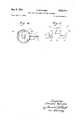
- FIG. 1is a perspective view of a hand-held, batteryoperated toothbrush including the secondary winding of my improved battery charger;
- FIG. 2is an elevational view of my battery charger, partially in cross section and with portions of the handheld device removed for purposes of clarity;
- FIG. 3is an exploded view of a portion of the battery charger of FIG. 2;
- FIG. 4is a plan view of the receptacle portion of the battery charger of FIG. 2;
- FIG. 5is a schematic diagram of the electrical circuit of my battery charger.
- FIG. 1there is shown a hand-held battery-operated device 10 including a casing 11.
- the casing 11has a central portion 12 which provides a handgrip for the user and separates a base portion 13 and head portion 14.
- the implement of the hand-held device 10, in the case illustrated a toothbrush 15,is inserted Within the casing through the head portion 14 to be operatively connected to a motor (not shown) which is enclosed within the casing 11.
- the base portion 13is formed from plastic or other non-magnetic material and includes an outer cylindrical wall 16 and a flat bottom wall 17.
- the center portion of the bottom wall 17is formed as an inner cylindrical wall 18 extending upwardly within and spaced from the outer wall 16 to form a central recess 19 (best seen in FIG. 2).
- an electrical winding 20is mounted on a metal coil form 21 including an inner cylindrical metal wall 22, an upper metal wall 23 and a lower fiber or plastic wall 24.
- the winding 20is mounted within the base portion 13 of casing 11 by inserting inner wall 22 about inner wall 18 until the coil form 21 comes into contact with bottom wall 17.
- a rechargeable battery 25is mounted within the casing 11 above the winding 20.
- the lower end of the batteryis secured to the top of coil form 21 by a cap member 26 having a base section 26a of heat insulating material which separates the battery 25 from the upper end of winding 20 and forms a heat shield therebetween.
- a number of resilient fingers 27extend upwardly from base section 26a and engage battery 25 with a firm friction fit.
- a number of lugs 28extend downwardly from base section 26a and fit around the edge of upper wall 23 to attach the battery to the coil form.
- a similar cap 29is provided to secure the battery 25 to the motor (not shown).
- the cap 29includes a base portion 30 of heat insulating material which extends between the battery 25 and the motor and serves as a heat shield.
- a number of resilient fingers 31extend downwardly from base portion 30 to engage the battery 25 with a firm friction fit.
- a screw-threaded lug 32extends upwardly from base portion 30 for attaching the motor (not shown) to cap 29.
- a spacer 33 of resilient plastic materialis positioned between the cap 29 and the top of battery 25 to insure proper positioning of the elements.
- One lead 34 of winding 20is connected to a diode 35.
- the diodeis also connected to the positive terminal 36 of battery 25 by a lead 37, thus forming a rectifier circuit between the winding and the battery.
- the lead 34is wound about a post 37a extending upwardly from base portion 30 of cap 29.
- the other lead 38 of winding- 20is connected to the negative terminal 39 of battery 25.
- an electrical circuitis formed from winding 20 through lead 34, diode 35, lead 37, battery 25 and lead 38 back to winding 20.
- the receptacle 40In order to mount the hand-held device for charging the battery, I provide a metal cup-like receptacle 40 formed magnetically permeable material.
- the receptacleincludes a flat base portion 41 and a generally cylindrical upstanding side wall 42 including a cutaway portion or opening 43. The top of the side wall 42 is open to receive base portion 13 of casing 11.
- a stud 44 of magnetically permeable materialis attached to the center of the base portion 41 in a conventional manner, such as the swaged connection 45. The stud 44 extends upwardly within the receptacle to a point a short distance below the top of wall 42.
- An electrical winding 46is mounted on a coil form 47 having an inner cylindrical wall 48, a top wall 49 and a bottom wall 50.
- the winding 46 and coil form 47are inserted in the receptacle 40 until a ring-shaped protrusion 51 depending from the bottom wall 50 of the coil form 47 contacts the base portion 41.
- the winding 46includes a pair of terminals 52 and 53 which extend through the opening 43 and are attached to the leads 54 and 55 of an electrical conductor 56 to connect the winding 46 to a conventional source of electrical energy, such as the 60-cycle, llO-volt electrical outlets usually provided in a house.
- a body of potting material 57is provided which encloses the winding 46 and coil form 47 and surrounds the lower end of stud 44 to hold them firmly in place within the receptacle 40.
- the body of potting material 57extends outwardly through the opening 43 so as to enclose and electrically insulate the connections between the terminals 52 and 53 and the leads 54 and 55.
- the lower surface 58 of the body of potting material 57is formed as an extension of base portion 41 of receptacle 40 to insure that the receptacle 40 is stable when placed on a suitable flat surface for charging battery 25.
- diode 35is connected in series between winding and battery by leads 34 and 37.
- the other end of winding 20is connected to battery 25 by lead 38.
- windings 46 and 20form the primary and secondary windings respectively of a current transformer.
- conductor 56is connected to a conventional source of electric energy, an electromotive force will be induced in winding 20 and a current will flow in the circuit including winding 20, lead 34, diode 35, lead 37, battery 25, and lead 38.
- diodewill only allow current to flow on every other half cycle; therefore, the alternating voltage induced in winding 20 will effectively charge battery 25.
- a battery chargerincluding:
- one end of said casingincluding a wall forming a recess for receiving said stud when said one end of said casing is inserted within said receptacle
- a battery chargerincluding:
- one end of said casingincluding an inner cylindrical wall forming a recess for receiving said stud when said one end of said casing is inserted within said generally cylindrical receptacle,
- a battery chargerincluding:
- one end of said casingincluding a generally cylindrical inner wall forming a recess for receiving said stud and a generally cylindrical outer wall for receipt within said receptacle so that when said one end of said casing is inserted within said receptacle said stud is positioned within said recess,
- a battery chargerincluding:
- said first windingincluding a pair of terminals
- one end of said casingincluding an inner cylindrical wall for receipt within said receptacle so that when said one end of said casing is inserted within said receptacle said stud is positioned within said recess,
- a battery chargerincluding:
- one end of said casingincluding a wall forming a recess for receiving said stud when said one end of said casing is inserted within said receptacle
- a battery chargerincluding:
- one end of said casingincluding a wall forming a recess for receiving said stud when said one end of said casing is positioned adjacent to said member
Landscapes
- Engineering & Computer Science (AREA)
- Power Engineering (AREA)
- Computer Networks & Wireless Communication (AREA)
- Charge And Discharge Circuits For Batteries Or The Like (AREA)
- Secondary Cells (AREA)
- Battery Mounting, Suspending (AREA)
- Rectifiers (AREA)
- Brushes (AREA)
Description
y 5, 1970 c. PETRID ES 3,510,747
7 TWO PART SEPARABLE BATTERY CHARGER Filed April 2, 1964 2 Sheets- Sheet 1 07 5? z, ZZNJ W May 5, 1970 Filed .April 2, 1964 c; PETRIDES TWO PART SEPARABLE. BATTERY CHARGER 2 Shets-Sheet 2 rm y United States Patent Us. or. 32o 59 6 Claims ABSTRACT OF THE DISCLOSURE A battery charger for portable, hand held devices such as an electric toothbrush. A storage receptacle for connection to a convenience AC. outlet contains the primary winding and core of a transformer. The portable device containing the secondary winding and a rectifier is positioned within the storage receptacle to charge a battery within the portable device.
This invention relates to battery chargers and, more particularly, to battery chargers adapted to charge the batteries used in portable, hand-held, battery-operated devices.
In recent years a number of battery-operated, handheld devices have been marketed in which the handle of the device encloses a motor for powering the operative elements of the device and the batteries for supplying energy to the motor. The batteries used with such devices are small, rechargeable batteries, quite often of the nickelcadmium type. A number of battery chargers have been produced for recharging the batteries of these hand-held devices after they have been discharged by use. Such recharging devices have electrical contacts with cooperate with contacts mounted in the casing of the hand-held device in order to transfer electrical energy to the batteries. Such constructions involve a number of problems. For instance, the mounting for the contacts in the casing presents a point of possible entry of moisture into the casing and for best performance the casing should be retained watertight. Furthermore, a low voltage is used to charge the batteries. Therefore, any increase in contact resistance, due to contact corrosion, erosion, misalignment, etc., could prevent adequate charging of the battery.
It is an object of my invention to provide a battery charger which insures adequate charging of the battery.
It is another object of my invention to provide handheld, battery-operated devices having watertight casings.
It is a further object of my invention to provide such a charger that is simple in construction, easy and convenient to operate from conventional sources of electrical energy, and efiicient in use.
In accordance with my invention, in One form thereof, I provide a two-part, separable battery charger including a receptacle of magnetically permeable material. An electrical winding is mounted in the receptacle and provided with leads for connection to a conventional source of AC power. One end of the casing for an associated batteryoperated device has mounted therein a second electrical winding. This end of the casing is adapted for insertion within the receptacle adjacent the first electrical winding so that the first and second windings are inductively connected and form the primary and secondary windings respectively of an electrical transformer. The second winding is connected to a rechargeable battery by means of a rectifier circuit so that, when the hand-held device is inserted in the receptacle, the battery will be recharged.
My invention will be better understood from the following description taken in conjunction with the accompanying drawings in which:
FIG. 1 is a perspective view of a hand-held, batteryoperated toothbrush including the secondary winding of my improved battery charger;
FIG. 2 is an elevational view of my battery charger, partially in cross section and with portions of the handheld device removed for purposes of clarity;
FIG. 3 is an exploded view of a portion of the battery charger of FIG. 2;
FIG. 4 is a plan view of the receptacle portion of the battery charger of FIG. 2; and
FIG. 5 is a schematic diagram of the electrical circuit of my battery charger.
Referring now to FIG. 1 there is shown a hand-held battery-operateddevice 10 including a casing 11. The casing 11 has acentral portion 12 which provides a handgrip for the user and separates abase portion 13 andhead portion 14. The implement of the hand-helddevice 10, in the case illustrated atoothbrush 15, is inserted Within the casing through thehead portion 14 to be operatively connected to a motor (not shown) which is enclosed within the casing 11. Thebase portion 13 is formed from plastic or other non-magnetic material and includes an outercylindrical wall 16 and aflat bottom wall 17. The center portion of thebottom wall 17 is formed as an innercylindrical wall 18 extending upwardly within and spaced from theouter wall 16 to form a central recess 19 (best seen in FIG. 2).
Referring now to FIG. 2, anelectrical winding 20 is mounted on ametal coil form 21 including an innercylindrical metal wall 22, anupper metal wall 23 and a lower fiber orplastic wall 24. Thewinding 20 is mounted within thebase portion 13 of casing 11 by insertinginner wall 22 aboutinner wall 18 until thecoil form 21 comes into contact withbottom wall 17.
Arechargeable battery 25 is mounted within the casing 11 above the winding 20. The lower end of the battery is secured to the top ofcoil form 21 by acap member 26 having abase section 26a of heat insulating material which separates thebattery 25 from the upper end of winding 20 and forms a heat shield therebetween. A number ofresilient fingers 27 extend upwardly frombase section 26a and engagebattery 25 with a firm friction fit. A number oflugs 28 extend downwardly frombase section 26a and fit around the edge ofupper wall 23 to attach the battery to the coil form. Asimilar cap 29 is provided to secure thebattery 25 to the motor (not shown). Thecap 29 includes abase portion 30 of heat insulating material which extends between thebattery 25 and the motor and serves as a heat shield. A number ofresilient fingers 31 extend downwardly frombase portion 30 to engage thebattery 25 with a firm friction fit. A screw-threadedlug 32 extends upwardly frombase portion 30 for attaching the motor (not shown) tocap 29. Aspacer 33 of resilient plastic material is positioned between thecap 29 and the top ofbattery 25 to insure proper positioning of the elements.
Onelead 34 of winding 20 is connected to adiode 35. The diode is also connected to the positive terminal 36 ofbattery 25 by alead 37, thus forming a rectifier circuit between the winding and the battery. For structural support and physical positioning of thediode 35 thelead 34 is wound about apost 37a extending upwardly frombase portion 30 ofcap 29. Theother lead 38 of winding- 20 is connected to thenegative terminal 39 ofbattery 25. Thus an electrical circuit is formed from winding 20 throughlead 34,diode 35,lead 37,battery 25 and lead 38 back to winding 20.
In order to mount the hand-held device for charging the battery, I provide a metal cup-like receptacle 40 formed magnetically permeable material. The receptacle includes a flat base portion 41 and a generally cylindricalupstanding side wall 42 including a cutaway portion or opening 43. The top of theside wall 42 is open to receivebase portion 13 of casing 11. Astud 44 of magnetically permeable material is attached to the center of the base portion 41 in a conventional manner, such as theswaged connection 45. Thestud 44 extends upwardly within the receptacle to a point a short distance below the top ofwall 42. Anelectrical winding 46 is mounted on acoil form 47 having an innercylindrical wall 48, atop wall 49 and abottom wall 50. The winding 46 andcoil form 47 are inserted in thereceptacle 40 until a ring-shaped protrusion 51 depending from thebottom wall 50 of thecoil form 47 contacts the base portion 41. Thewinding 46 includes a pair ofterminals opening 43 and are attached to theleads electrical conductor 56 to connect the winding 46 to a conventional source of electrical energy, such as the 60-cycle, llO-volt electrical outlets usually provided in a house.
A body ofpotting material 57 is provided which encloses the winding 46 andcoil form 47 and surrounds the lower end ofstud 44 to hold them firmly in place within thereceptacle 40. The body ofpotting material 57 extends outwardly through theopening 43 so as to enclose and electrically insulate the connections between theterminals leads potting material 57 is formed as an extension of base portion 41 ofreceptacle 40 to insure that thereceptacle 40 is stable when placed on a suitable flat surface forcharging battery 25.
Referring now to FIG. it will be seen thatdiode 35 is connected in series between winding and battery by leads 34 and 37. The other end of winding 20 is connected tobattery 25 bylead 38. Thus, whenbase portion 13 of casing 11 is inserted within thecylindrical side wall 42 ofreceptacle 40 with the upper end ofstud 44 received withinrecess 19,windings conductor 56 is connected to a conventional source of electric energy, an electromotive force will be induced in winding 20 and a current will flow in the circuit including winding 20, lead 34,diode 35, lead 37,battery 25, and lead 38. However, it will be noted that diode will only allow current to flow on every other half cycle; therefore, the alternating voltage induced in winding 20 will effectively chargebattery 25.
It will be understood that, if it is desired to use a handheld device requiring two rechargeable batteries, my improved battery charger will efiectively charge both batteries. In this case a second battery 59 and asecond diode 60 are connected in parallel withbattery 25 anddiode 35 byleads diode 60 are oppositely poled with respect tobattery 25 anddiode 35. Thus, when winding 46 is connected to a conventional source of electric energy, thebatteries 25 and 59 will be charged during alternate half cycles.
From the foregoing description, it will be apparent that I have provided an improved battery charger that is adapted to charge rechargeable batteries from sources of conventional electric energy found in the modern home. By inductively transferring the electrical energy between the main winding 46 and the secondary winding 20, I have eliminated electrical contacts which can cause improper charging of the battery. Furthermore, I have provided a battery-operated device having a watertight casing.
What I claim is:
1. A battery charger including:
(a) a receptacle of magnetically permeable material,
(b) a first electrical winding received in one end of said receptacle and forming the primary winding of a transformer,
(c) a stud of magnetically permeable material mounted in the center of said first winding and extending therefrom within said receptacle,
(d) a hollow casing for receiving a rechargeable battery,
(e) one end of said casing including a wall forming a recess for receiving said stud when said one end of said casing is inserted within said receptacle,
(f) a second electrical winding mounted in said one end of said casing around said wall forming a recess and forming the secondary winding of said transformer,
(g) means including a rectifier circuit for electrically connecting said second winding to the battery.
2. A battery charger including:
(a) generally cylindrical receptacle of magnetically permeable material, closed at one end,
(b) a first electrical winding received in the closed end of said receptacle and forming the primary winding of a transformer,
(c) a stud of magnetically permeable material mounted in said receptacle and extending through the center of said first winding,
(d) a hollow casing for receiving a rechargeable battery,
(e) one end of said casing including an inner cylindrical wall forming a recess for receiving said stud when said one end of said casing is inserted within said generally cylindrical receptacle,
(f) a second electrical winding mounted in said one end of said casing, around said inner cylindrical wall and forming the secondary winding of said transformer,
(g) means including a rectifier circuit for electrically connecting said second winding to the battery.
3. A battery charger including:
(a) generally cylindrical receptacle of magnetically permeable material, closed at one end,
(b) a first electrical winding received in the closed end of said receptacle and forming the primary winding of a transformer,
(c) a stud of magnetically permeable material mounted in said receptacle and extending through the center of said first winding,
((1) a hollow casing for receiving a rechargeable battery,
(e) one end of said casing including a generally cylindrical inner wall forming a recess for receiving said stud and a generally cylindrical outer wall for receipt within said receptacle so that when said one end of said casing is inserted within said receptacle said stud is positioned within said recess,
(f) a second electrical winding received within said one end of said casing between said outer wall and said central recess and forming the secondary winding of said transformer,
(g) means including a rectifier circuit for electrically connecting said second winding to the battery.
4. A battery charger including:
(a) a generally cup-shaped receptacle of magnetically permeable material having a flat base portion and an upstanding cylindrical wall portion,
(b) said wall portion having an opening in the lower section thereof,
(c) a stud of magnetically permeable material mounted on said base portion and extending upwardly within said wall portion,
(d) a first electrical winding received about said stud adjacent said base portion and forming the primary winding of a transformer,
(e) said first winding including a pair of terminals,
(f) a pair of electrical leads attached to said terminals through said opening in said wall portion to form a connection for supplying electrical energy to said first winding,
(g) a body of potting material securing said first winding in said receptacle and enclosing said connection,
(h) a hollow casing for receiving a rechargeable battery,
(i) one end of said casing including an inner cylindrical wall for receipt within said receptacle so that when said one end of said casing is inserted within said receptacle said stud is positioned within said recess,
(j) a second electrical winding received within said one end of said casing between said outer wall and said central recess and forming the secondary winding of said transformer,
(k) means including a rectifier circuit for electrically connecting said second winding to the battery.
5. A battery charger including:
(a) a receptacle,
(b) a first electrical winding received in one end of said receptacle and forming the primary winding of a transformer,
(c) a stud of magnetically permeable material mounted in the center of said first winding and extending therefrom within said receptacle,
(d) a hollow casing for receiving a rechargeable battery,
(e) one end of said casing including a wall forming a recess for receiving said stud when said one end of said casing is inserted within said receptacle,
(f) a second electrical winding mounted in said one end of said casing around said wall forming a recess and forming the secondary winding of said transformer,
(g) means including a rectifier circuit for electrically connecting said second winding to the battery.
6. A battery charger including:
(a) a member of magnetically permeable material,
(b) a first electrical winding positioned adjacent said 6 member and inwardly thereof and forming the primary winding of a transformer,
(c) a stud of magnetically permeable material positioned inwardly of said member and inwardly of said first winding,
(d) a hollow casing for receiving a rechargeable battery,
(e) one end of said casing including a wall forming a recess for receiving said stud when said one end of said casing is positioned adjacent to said member,
(f) a second electrical winding mounted in said one end of said casing around said wall forming a recess and forming the secondary winding of said transformer, and
(g) means including a rectifier circuit for electrically connecting said second winding to the battery.
References Cited UNITED STATES PATENTS 2,415,688 2/1947 Hall 219-246 2,967,267 1/1961 Steinrnan et a1 317101 3,043,994 7/1962 Anderson et al 33696 3,131,331 4/1964 Ray 336-96 X 3,143,697 8/1964 Springer 3202 J. D. MILLER, Primary Examiner A. D. PELLINEN, Assistant Examiner US. Cl. X.R.
Priority Applications (7)
| Application Number | Priority Date | Filing Date | Title |
|---|---|---|---|
| US356822AUS3510747A (en) | 1964-04-02 | 1964-04-02 | Two part separable battery charger |
| GB10990/65AGB1076354A (en) | 1964-04-02 | 1965-03-16 | Battery chargers for hand-held battery-operated devices |
| DE19651513149DE1513149B2 (en) | 1964-04-02 | 1965-04-01 | SMALL ELECTRIC DEVICE WITH RECHARGEABLE BATTERY AND CHARGER |
| FR11507AFR1436155A (en) | 1964-04-02 | 1965-04-01 | Improvements to battery chargers |
| CH454965ACH440403A (en) | 1964-04-02 | 1965-04-01 | Battery charger on a hand-held device |
| JP1969465AJPS4431368B1 (en) | 1964-04-02 | 1965-04-02 | |
| NL656504194ANL146632B (en) | 1964-04-02 | 1965-04-02 | BATTERY CHARGING DEVICE. |
Applications Claiming Priority (2)
| Application Number | Priority Date | Filing Date | Title |
|---|---|---|---|
| US356822AUS3510747A (en) | 1964-04-02 | 1964-04-02 | Two part separable battery charger |
| FR11507AFR1436155A (en) | 1964-04-02 | 1965-04-01 | Improvements to battery chargers |
Publications (1)
| Publication Number | Publication Date |
|---|---|
| US3510747Atrue US3510747A (en) | 1970-05-05 |
Family
ID=54207937
Family Applications (1)
| Application Number | Title | Priority Date | Filing Date |
|---|---|---|---|
| US356822AExpired - LifetimeUS3510747A (en) | 1964-04-02 | 1964-04-02 | Two part separable battery charger |
Country Status (7)
| Country | Link |
|---|---|
| US (1) | US3510747A (en) |
| JP (1) | JPS4431368B1 (en) |
| CH (1) | CH440403A (en) |
| DE (1) | DE1513149B2 (en) |
| FR (1) | FR1436155A (en) |
| GB (1) | GB1076354A (en) |
| NL (1) | NL146632B (en) |
Cited By (20)
| Publication number | Priority date | Publication date | Assignee | Title |
|---|---|---|---|---|
| US3633089A (en)* | 1970-04-09 | 1972-01-04 | Gillette Co | Holder for a safety razor |
| US4164670A (en)* | 1978-03-15 | 1979-08-14 | General Electric Company | Sealed motor mount for hand held device |
| US4845795A (en)* | 1985-06-10 | 1989-07-11 | Dental Research Corporation | Automatic cleaning device |
| US4991249A (en)* | 1989-02-09 | 1991-02-12 | Suroff Leonard W | Ultrasonic toothbrush |
| EP0886363A4 (en)* | 1995-05-29 | 1999-05-19 | Matsushita Electric Industrial Co Ltd | GENERATOR |
| EP0922288A4 (en)* | 1996-08-30 | 1999-11-17 | Optiva Corp | Charging coil core insert for electric toothbrushes |
| US6016046A (en)* | 1997-07-22 | 2000-01-18 | Sanyo Electric Co., Ltd. | Battery pack |
| US20090112156A1 (en)* | 2002-10-09 | 2009-04-30 | Abbott Diabetes Care, Inc. | Variable Volume, Shape Memory Actuated Insulin Dispensing Pump |
| US20100100077A1 (en)* | 2005-03-21 | 2010-04-22 | Abbott Diabetes Care Inc. | Method and System for Providing Integrated Medication Infusion and Analyte Monitoring System |
| US7884729B2 (en) | 2005-05-17 | 2011-02-08 | Abbott Diabetes Care Inc. | Method and system for providing data management in data monitoring system |
| US8047811B2 (en) | 2002-10-09 | 2011-11-01 | Abbott Diabetes Care Inc. | Variable volume, shape memory actuated insulin dispensing pump |
| WO2011077108A3 (en)* | 2009-12-21 | 2012-01-26 | Hiltech Developments Limited | Vehicle charging apparatus |
| US8112138B2 (en) | 2005-06-03 | 2012-02-07 | Abbott Diabetes Care Inc. | Method and apparatus for providing rechargeable power in data monitoring and management systems |
| US8343093B2 (en) | 2002-10-09 | 2013-01-01 | Abbott Diabetes Care Inc. | Fluid delivery device with autocalibration |
| US8467972B2 (en) | 2009-04-28 | 2013-06-18 | Abbott Diabetes Care Inc. | Closed loop blood glucose control algorithm analysis |
| US8512246B2 (en) | 2003-04-28 | 2013-08-20 | Abbott Diabetes Care Inc. | Method and apparatus for providing peak detection circuitry for data communication systems |
| US8560082B2 (en) | 2009-01-30 | 2013-10-15 | Abbott Diabetes Care Inc. | Computerized determination of insulin pump therapy parameters using real time and retrospective data processing |
| US8579853B2 (en) | 2006-10-31 | 2013-11-12 | Abbott Diabetes Care Inc. | Infusion devices and methods |
| US8638220B2 (en) | 2005-10-31 | 2014-01-28 | Abbott Diabetes Care Inc. | Method and apparatus for providing data communication in data monitoring and management systems |
| US8798934B2 (en) | 2009-07-23 | 2014-08-05 | Abbott Diabetes Care Inc. | Real time management of data relating to physiological control of glucose levels |
Families Citing this family (3)
| Publication number | Priority date | Publication date | Assignee | Title |
|---|---|---|---|---|
| GB8625429D0 (en)* | 1986-10-23 | 1986-11-26 | Philp R | Contactless electronic connectors |
| DE9007277U1 (en)* | 1990-04-04 | 1990-11-29 | Zimmermann, Silvia, 7981 Schlier | Stimulation current device with touch sensor electrode for current/potential control of electrodes for current/potential transmission |
| DE4142159C2 (en)* | 1991-12-20 | 1995-03-23 | Braun Ag | Holding device for battery-operated electrical devices with a connection coupling to a power source |
Citations (5)
| Publication number | Priority date | Publication date | Assignee | Title |
|---|---|---|---|---|
| US2415688A (en)* | 1943-05-05 | 1947-02-11 | Mrs Helen J Hall Jr | Induction device |
| US2967267A (en)* | 1958-03-26 | 1961-01-03 | Litton Systems Inc | Reactive intercoupling of modular units |
| US3043994A (en)* | 1957-10-11 | 1962-07-10 | Anderson Controls Inc | Encapsulated coil and method of making |
| US3131331A (en)* | 1960-03-28 | 1964-04-28 | Gen Controls Co | Coil-rectifier structures |
| US3143697A (en)* | 1962-05-31 | 1964-08-04 | Gen Electric | Toothbrush storage case and battery charger |
- 1964
- 1964-04-02USUS356822Apatent/US3510747A/ennot_activeExpired - Lifetime
- 1965
- 1965-03-16GBGB10990/65Apatent/GB1076354A/ennot_activeExpired
- 1965-04-01DEDE19651513149patent/DE1513149B2/enactivePending
- 1965-04-01FRFR11507Apatent/FR1436155A/ennot_activeExpired
- 1965-04-01CHCH454965Apatent/CH440403A/enunknown
- 1965-04-02JPJP1969465Apatent/JPS4431368B1/jaactivePending
- 1965-04-02NLNL656504194Apatent/NL146632B/ennot_activeIP Right Cessation
Patent Citations (5)
| Publication number | Priority date | Publication date | Assignee | Title |
|---|---|---|---|---|
| US2415688A (en)* | 1943-05-05 | 1947-02-11 | Mrs Helen J Hall Jr | Induction device |
| US3043994A (en)* | 1957-10-11 | 1962-07-10 | Anderson Controls Inc | Encapsulated coil and method of making |
| US2967267A (en)* | 1958-03-26 | 1961-01-03 | Litton Systems Inc | Reactive intercoupling of modular units |
| US3131331A (en)* | 1960-03-28 | 1964-04-28 | Gen Controls Co | Coil-rectifier structures |
| US3143697A (en)* | 1962-05-31 | 1964-08-04 | Gen Electric | Toothbrush storage case and battery charger |
Cited By (43)
| Publication number | Priority date | Publication date | Assignee | Title |
|---|---|---|---|---|
| US3633089A (en)* | 1970-04-09 | 1972-01-04 | Gillette Co | Holder for a safety razor |
| US4164670A (en)* | 1978-03-15 | 1979-08-14 | General Electric Company | Sealed motor mount for hand held device |
| US4845795A (en)* | 1985-06-10 | 1989-07-11 | Dental Research Corporation | Automatic cleaning device |
| US4991249A (en)* | 1989-02-09 | 1991-02-12 | Suroff Leonard W | Ultrasonic toothbrush |
| EP0886363A4 (en)* | 1995-05-29 | 1999-05-19 | Matsushita Electric Industrial Co Ltd | GENERATOR |
| US6075433A (en)* | 1995-05-29 | 2000-06-13 | Matsushita Electric Industrial Co., Ltd. | Power supply unit |
| EP0922288A4 (en)* | 1996-08-30 | 1999-11-17 | Optiva Corp | Charging coil core insert for electric toothbrushes |
| US6016046A (en)* | 1997-07-22 | 2000-01-18 | Sanyo Electric Co., Ltd. | Battery pack |
| US20090112156A1 (en)* | 2002-10-09 | 2009-04-30 | Abbott Diabetes Care, Inc. | Variable Volume, Shape Memory Actuated Insulin Dispensing Pump |
| US8029250B2 (en) | 2002-10-09 | 2011-10-04 | Abbott Diabetes Care Inc. | Variable volume, shape memory actuated insulin dispensing pump |
| US8343093B2 (en) | 2002-10-09 | 2013-01-01 | Abbott Diabetes Care Inc. | Fluid delivery device with autocalibration |
| US7922458B2 (en) | 2002-10-09 | 2011-04-12 | Abbott Diabetes Care Inc. | Variable volume, shape memory actuated insulin dispensing pump |
| US7993109B2 (en) | 2002-10-09 | 2011-08-09 | Abbott Diabetes Care Inc. | Variable volume, shape memory actuated insulin dispensing pump |
| US7993108B2 (en) | 2002-10-09 | 2011-08-09 | Abbott Diabetes Care Inc. | Variable volume, shape memory actuated insulin dispensing pump |
| US8047811B2 (en) | 2002-10-09 | 2011-11-01 | Abbott Diabetes Care Inc. | Variable volume, shape memory actuated insulin dispensing pump |
| US8047812B2 (en) | 2002-10-09 | 2011-11-01 | Abbott Diabetes Care Inc. | Variable volume, shape memory actuated insulin dispensing pump |
| US8029245B2 (en) | 2002-10-09 | 2011-10-04 | Abbott Diabetes Care Inc. | Variable volume, shape memory actuated insulin dispensing pump |
| US8512246B2 (en) | 2003-04-28 | 2013-08-20 | Abbott Diabetes Care Inc. | Method and apparatus for providing peak detection circuitry for data communication systems |
| US8029459B2 (en) | 2005-03-21 | 2011-10-04 | Abbott Diabetes Care Inc. | Method and system for providing integrated medication infusion and analyte monitoring system |
| US8029460B2 (en) | 2005-03-21 | 2011-10-04 | Abbott Diabetes Care Inc. | Method and system for providing integrated medication infusion and analyte monitoring system |
| US20100100077A1 (en)* | 2005-03-21 | 2010-04-22 | Abbott Diabetes Care Inc. | Method and System for Providing Integrated Medication Infusion and Analyte Monitoring System |
| US8343092B2 (en) | 2005-03-21 | 2013-01-01 | Abbott Diabetes Care Inc. | Method and system for providing integrated medication infusion and analyte monitoring system |
| US8089363B2 (en) | 2005-05-17 | 2012-01-03 | Abbott Diabetes Care Inc. | Method and system for providing data management in data monitoring system |
| US8653977B2 (en) | 2005-05-17 | 2014-02-18 | Abbott Diabetes Care Inc. | Method and system for providing data management in data monitoring system |
| US10206611B2 (en) | 2005-05-17 | 2019-02-19 | Abbott Diabetes Care Inc. | Method and system for providing data management in data monitoring system |
| US9750440B2 (en) | 2005-05-17 | 2017-09-05 | Abbott Diabetes Care Inc. | Method and system for providing data management in data monitoring system |
| US8471714B2 (en) | 2005-05-17 | 2013-06-25 | Abbott Diabetes Care Inc. | Method and system for providing data management in data monitoring system |
| US7884729B2 (en) | 2005-05-17 | 2011-02-08 | Abbott Diabetes Care Inc. | Method and system for providing data management in data monitoring system |
| US9332944B2 (en) | 2005-05-17 | 2016-05-10 | Abbott Diabetes Care Inc. | Method and system for providing data management in data monitoring system |
| US8112138B2 (en) | 2005-06-03 | 2012-02-07 | Abbott Diabetes Care Inc. | Method and apparatus for providing rechargeable power in data monitoring and management systems |
| US8638220B2 (en) | 2005-10-31 | 2014-01-28 | Abbott Diabetes Care Inc. | Method and apparatus for providing data communication in data monitoring and management systems |
| US8579853B2 (en) | 2006-10-31 | 2013-11-12 | Abbott Diabetes Care Inc. | Infusion devices and methods |
| US11508476B2 (en) | 2006-10-31 | 2022-11-22 | Abbott Diabetes Care, Inc. | Infusion devices and methods |
| US9064107B2 (en) | 2006-10-31 | 2015-06-23 | Abbott Diabetes Care Inc. | Infusion devices and methods |
| US11043300B2 (en) | 2006-10-31 | 2021-06-22 | Abbott Diabetes Care Inc. | Infusion devices and methods |
| US11837358B2 (en) | 2006-10-31 | 2023-12-05 | Abbott Diabetes Care Inc. | Infusion devices and methods |
| US10007759B2 (en) | 2006-10-31 | 2018-06-26 | Abbott Diabetes Care Inc. | Infusion devices and methods |
| US12073941B2 (en) | 2006-10-31 | 2024-08-27 | Abbott Diabetes Care Inc. | Infusion device and methods |
| US8560082B2 (en) | 2009-01-30 | 2013-10-15 | Abbott Diabetes Care Inc. | Computerized determination of insulin pump therapy parameters using real time and retrospective data processing |
| US8467972B2 (en) | 2009-04-28 | 2013-06-18 | Abbott Diabetes Care Inc. | Closed loop blood glucose control algorithm analysis |
| US10872102B2 (en) | 2009-07-23 | 2020-12-22 | Abbott Diabetes Care Inc. | Real time management of data relating to physiological control of glucose levels |
| US8798934B2 (en) | 2009-07-23 | 2014-08-05 | Abbott Diabetes Care Inc. | Real time management of data relating to physiological control of glucose levels |
| WO2011077108A3 (en)* | 2009-12-21 | 2012-01-26 | Hiltech Developments Limited | Vehicle charging apparatus |
Also Published As
| Publication number | Publication date |
|---|---|
| NL146632B (en) | 1975-07-15 |
| JPS4431368B1 (en) | 1969-12-16 |
| NL6504194A (en) | 1965-10-04 |
| GB1076354A (en) | 1967-07-19 |
| DE1513149B2 (en) | 1971-06-24 |
| FR1436155A (en) | 1966-04-22 |
| CH440403A (en) | 1967-07-31 |
| DE1513149A1 (en) | 1969-02-13 |
Similar Documents
| Publication | Publication Date | Title |
|---|---|---|
| US3510747A (en) | Two part separable battery charger | |
| US3418552A (en) | Separable transformer battery charger | |
| US6040680A (en) | Rechargeable battery pack and charging stand for charging the rechargeable battery pack by electromagnetic induction | |
| CA1131307A (en) | Battery charger | |
| US4086523A (en) | Rechargeable battery | |
| US4843298A (en) | Flashlight battery charger | |
| KR960006135B1 (en) | Battery powered energy use | |
| US5225760A (en) | Rechargeable power pack | |
| EP0079916B1 (en) | Rechargeable battery system | |
| JP2010028969A (en) | Charger | |
| JP2000243458A (en) | Power pack charging system and power tool charging system | |
| JP2008537471A (en) | Flashlight charger with improved terminals | |
| US3257599A (en) | Battery operated electric shaver and charger | |
| BG100046A (en) | BATTERY UNIT AND WIRELESS DEVICE POWERED BY SUCH UNIT | |
| US3711806A (en) | Power pack | |
| WO1997008804A1 (en) | Combination of an electrical appliance and an associated stand | |
| DE69208336D1 (en) | Rechargeable power supply unit | |
| US3379952A (en) | Electric toothbrush which is rechargeable with or without a recharging stand | |
| US3448365A (en) | Rechargeable battery operated cigarette lighter and recharging and storage device therefor | |
| JPH07211301A (en) | Battery assembly | |
| US4352052A (en) | Adaptor for charging small cells in large-cell charger | |
| US3320508A (en) | Battery and charging circuit cartridge | |
| CA2196379C (en) | Battery charger | |
| US3421142A (en) | Circuit to indicate presence of charging current | |
| JP2005124324A (en) | Non-contact type dry battery type charger |
Legal Events
| Date | Code | Title | Description |
|---|---|---|---|
| AS | Assignment | Owner name:BLACK & DECKER, INC., 1423 KIRKWOOD HIGHWAY NEWARK Free format text:ASSIGNS AS OF APRIL 27, 1984 THE ENTIRE INTEREST;ASSIGNOR:GENERAL ELECTRIC COMPANY A NY CORP.;REEL/FRAME:004349/0275 Effective date:19840824 | |
| STCF | Information on status: patent grant | Free format text:PATENTED FILE - (OLD CASE ADDED FOR FILE TRACKING PURPOSES) |