US3500373A - Method and apparatus for article theft detection - Google Patents
Method and apparatus for article theft detectionDownload PDFInfo
- Publication number
- US3500373A US3500373AUS548314AUS54831466AUS3500373AUS 3500373 AUS3500373 AUS 3500373AUS 548314 AUS548314 AUS 548314AUS 54831466 AUS54831466 AUS 54831466AUS 3500373 AUS3500373 AUS 3500373A
- Authority
- US
- United States
- Prior art keywords
- frequency
- coil
- energy
- circuit
- checkpoint
- Prior art date
- Legal status (The legal status is an assumption and is not a legal conclusion. Google has not performed a legal analysis and makes no representation as to the accuracy of the status listed.)
- Expired - Lifetime
Links
Images


Classifications
- G—PHYSICS
- G08—SIGNALLING
- G08B—SIGNALLING OR CALLING SYSTEMS; ORDER TELEGRAPHS; ALARM SYSTEMS
- G08B13/00—Burglar, theft or intruder alarms
- G08B13/22—Electrical actuation
- G08B13/24—Electrical actuation by interference with electromagnetic field distribution
- G08B13/2402—Electronic Article Surveillance [EAS], i.e. systems using tags for detecting removal of a tagged item from a secure area, e.g. tags for detecting shoplifting
- G08B13/2405—Electronic Article Surveillance [EAS], i.e. systems using tags for detecting removal of a tagged item from a secure area, e.g. tags for detecting shoplifting characterised by the tag technology used
- G08B13/2414—Electronic Article Surveillance [EAS], i.e. systems using tags for detecting removal of a tagged item from a secure area, e.g. tags for detecting shoplifting characterised by the tag technology used using inductive tags
- G—PHYSICS
- G08—SIGNALLING
- G08B—SIGNALLING OR CALLING SYSTEMS; ORDER TELEGRAPHS; ALARM SYSTEMS
- G08B13/00—Burglar, theft or intruder alarms
- G08B13/22—Electrical actuation
- G08B13/24—Electrical actuation by interference with electromagnetic field distribution
- G08B13/2402—Electronic Article Surveillance [EAS], i.e. systems using tags for detecting removal of a tagged item from a secure area, e.g. tags for detecting shoplifting
- G08B13/2428—Tag details
- G08B13/2431—Tag circuit details
- G—PHYSICS
- G08—SIGNALLING
- G08B—SIGNALLING OR CALLING SYSTEMS; ORDER TELEGRAPHS; ALARM SYSTEMS
- G08B13/00—Burglar, theft or intruder alarms
- G08B13/22—Electrical actuation
- G08B13/24—Electrical actuation by interference with electromagnetic field distribution
- G08B13/2402—Electronic Article Surveillance [EAS], i.e. systems using tags for detecting removal of a tagged item from a secure area, e.g. tags for detecting shoplifting
- G08B13/2465—Aspects related to the EAS system, e.g. system components other than tags
- G08B13/2468—Antenna in system and the related signal processing
- G08B13/2471—Antenna signal processing by receiver or emitter
- G—PHYSICS
- G08—SIGNALLING
- G08B—SIGNALLING OR CALLING SYSTEMS; ORDER TELEGRAPHS; ALARM SYSTEMS
- G08B13/00—Burglar, theft or intruder alarms
- G08B13/22—Electrical actuation
- G08B13/24—Electrical actuation by interference with electromagnetic field distribution
- G08B13/2402—Electronic Article Surveillance [EAS], i.e. systems using tags for detecting removal of a tagged item from a secure area, e.g. tags for detecting shoplifting
- G08B13/2465—Aspects related to the EAS system, e.g. system components other than tags
- G08B13/2468—Antenna in system and the related signal processing
- G08B13/2474—Antenna or antenna activator geometry, arrangement or layout
- G—PHYSICS
- G08—SIGNALLING
- G08B—SIGNALLING OR CALLING SYSTEMS; ORDER TELEGRAPHS; ALARM SYSTEMS
- G08B13/00—Burglar, theft or intruder alarms
- G08B13/22—Electrical actuation
- G08B13/24—Electrical actuation by interference with electromagnetic field distribution
- G08B13/2402—Electronic Article Surveillance [EAS], i.e. systems using tags for detecting removal of a tagged item from a secure area, e.g. tags for detecting shoplifting
- G08B13/2465—Aspects related to the EAS system, e.g. system components other than tags
- G08B13/2468—Antenna in system and the related signal processing
- G08B13/2477—Antenna or antenna activator circuit
Definitions
- This inventionrelates to detection systems and more particularly it concerns novel arrangement for reliably indicating the passage of articles past given checkpoints.
- the electronic circuits which are attached to the protected articles of merchandisebe as small as possible and that they be made up of only small and inexpensive components.
- Systemshave been developed wherein the circuits to be attached to protected articles comprise only a small piece of metal of a special size and shape to form a resonant circuit. These systems transmit continuously in the vicinity of the checkpoint at the resonant frequency of the circuits attached to the merchandise.
- the circuitWhen an article of merchandise bearing such circuit or piece of metal passes through the checkpoint, the circuit begins to resonate as a result of the transmitted energy. This in turn causes absorption of a portion of the energy in the vicinity of the checkpoint.
- Meanssuch as a grid dip meter are provided to monitor such changes in ambient energy level and to sound an alarm when the level drops as a result of its absorption by a resonant circuit passing through the checkpoint.
- the frequency insensitivity of energy level metersis in part caused by the fact that they are required to note changes in overall energy level while only sampling a small portion of the total energy. In order to do this, the basic energy level sensitivity of the meter must be raised to a very high degree; and this in turn renders the meter less capable of distinguishing between changes in energy level at one frequency and changes at another nearby frequency.
- the present inventionovercomes all of the above discussed ditficulties. With the present invention, it is possible to protect articles by means of very simple, inexpensive and compact electronic circuits. These circuits may comprise only a simple coil and capacitor packaged in a card-like element easily attached to or integrated with an article to be protected. The present invention moreover makes it possible, without resorting to the transmission of large amounts of power, to detect only those articles which are protected and to ignore the unprotected articles.
- the present inventioninvolves the transmission of energy at swept frequencies. That is, energy is transmitted continuously at a checkpoint, but its frequency is shifted cyclically. As a result, a tuned resonant circuit in the presence of this energy will resonate and absorb energy by different amounts during different portions of the frequency shift cycle. Thus irrespective of the total amount of energy absorbed by the circuit, it will produce variations in energy absorption from one portion of the cycle to another. Means are provided to monitor these changes in absorbed energy as opposed to the total amount of energy absorbed. Thus, the sensitivity of the system is made dependent, not upon the total amount of energy absorbed, but rather upon how frequency selective the absorbing object is.
- the embedded resonant circuitscan be made far more frequency selective than the articles they are protecting. Thus even if the articles themselves absorb more energy than do their protecting circuits, the fact that the articles are not as frequency selective as the circuits will prevent them from actuating the alarm. This is because no changes in energy absorption level will take place as the transmitted frequency is shifted.
- the present inventionmakes use of the fact that under certain conditions, the electro-magnetic energy fields developed about an antenna can be made to be principally inductive in nature as opposed to radiative.
- the transmitting antennais arranged and the frequencies are chosen such that the fields developed are primarily inductive or ca'pacitative. Thus the energy developed by the antenna always returns to the antenna.
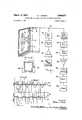
- FIG.'lis a diagrammatic and partially pictorial representation of a system which embodies the present invention.
- FIG. 2is an enlarged view of a frequency selective energy absorption device useful in connection with the present invention
- FIG. 3is a series of waveforms useful in understanding the operation of the present invention.
- FIG. 4is a detailed circuit diagram showing one version of the various components of the system of FIG. 1;
- FIG. 5is a view similar to FIG. 1 but showing an alternate coil arrangement
- FIG. 6is a view similar to FIG. 1 but showing a different means for generating electromagnetic fields
- FIG. 7is a perspective view showing an alternate arrangement for protecting an article according to the present invention.
- FIG. 8is a circuit diagram of a portion of the arrangement of FIG. 7.
- FIG. 9is a diagram of an alternate circuit forming a portion of the arrangement of FIG. 7.
- FIG. 1there is provided a coil 10 in the vicinity of a checkpoint 12.
- the checkpoint 12may be a doorway or other entrance or exit passage. Particularly good results have been achieved when the coil 10 is wound around the checkpoint 12 as shown so that everything and everybody passing the checkpoint must go through and be surrounded by the coil 10.
- Secondary coils 12a and 12bare also placed in the vicinity of the checkpoint 12 with their axes transverse to that of the coil 10. This ensures that the coil fields are such that at least one of them will intercept a planar element passing through the checkpoint no matter what its orientation might be.
- the coil 10receives energizing current from a main oscillator 14.
- the oscillator 14is continually shifted in frequency as will be discussed more fully hereinafter.
- its center frequency for the illustrative applicationis in the vicinity of one megacycle. This frequency is chosen in part because of the fact that it may be employed without requiring a special operating license.
- this frequencyis also advantageous due to the fact that for the size of the antenna used (i.e., about three turns around a doorway), the far greater percentage of magnetic fields produced by currents flowing through the coil, will collapse on the coil when the current is reversed through it. Conversely a relatively small percentage of the energy is lost through radiation. The significance of this is that the energy involved in operating the system is nearly completely controlled and can therefore be monitored more accurately. This contrasts with systems which radiate energy from a checkpoint and then attempt to monitor changes in the energy produced by an object passing through the checkpoint.
- FIG. 1illustrates a man 16 about to pass the checkpoint 10 through the coil 12.
- the man 16is wearing a protected jacket 18.
- This jackethas attached to it a wafer 20 (shown in dotted outline) which has an electric circuit printed thereon.
- the wafer 20may take the form of a card or label having identification, price and/or size information thereon.
- the wafer-labelis removed or deactivated by a sales clerk when a legitimate sale is made. However, when the wafer is not removed or deactivated, it affects the magnetic field in the vicinity of the coil 10 to produce an alarm signal as will be described.
- the oscillator 14is varied in frequenc between about 0.8 and 1.2 megacycles by means of a tuning circuit 22. This frequency shift takes place at about 500 cycles per second and follows a sinusoidal pattern.
- a frequency control oscillator 24 and an amplifier 26are provided to achieve this frequency shift in the main oscillator 14.
- the signals from the main oscillator 14are supplied to a junction 28 from which they proceed to the coil 10 and to a first signal detector 30.
- the first signal detector 30monitors the energy level of the signals at the junction 28. This energy level will vary as energy is withdrawn or dissipated out through the coil 10. During normal operation i.e., with no protected article in the vicinity of the passageway 12., the energy level at the junction 28 will remain substantially constant, and at a level near the output level of the main oscillator 14. This is because, as indicated above, nearly all of the energy which goes into the establishment of a magnetic field around the coil 10 is recovered as the field collapses back into the coil as the current is reversed. Very little of the energy is lost through radiation.
- the pulse detector 38is in effect a further filter which responds only to changes in signal level which occur at the rate at which the swept frequency crosses through the resonant frequency spectrum of the wafer 20. As will be seen, this rate is twice the oscillatory rate of the frequency control oscillator 24, or about 1000 times per second.
- the output of the pulse detectorenergizes a relay 40 which in turn closes a circuit to actuate an alarm 42.
- the wafer 20, which is attached to the jacket 18 or any other article of merchandise to be protected,is made up of a simple electrical circuit which, as shown in FIG. 2, comprises a coil 44 and a capacitor 46 connected to form a resonant loop.
- the resonant frequency of the loopis chosen to be within the range of frequencies through which the main oscillator 14 is swept.
- the frequency sensitivity or selectivity of the resonant loopshould be such that its range of resonance is substantially less than the sweep range of the main oscillator 14; and preferably, it should be close to the center frequency of the sweep, i.e., about 1 megacycle.
- Curve a of FIG. 3represents the output frequency of the main oscillator 14 as it varies in time. This variation, as shown follows a sinusoid pattern but is not so limited as long as it varies cyclically.
- the cross hatched band b of FIG. 3represents the resonance range of the coil 44 and capacitor 46 in the wafer 20.
- the wafer 20passes through the passageway 12 it encounters magnetic fields produced by the energization of the coil 10. These fields 'vary at a frequency which changes in accordance with curve a of FIG. 3.
- the coil and capacitorexhibit a high impedance and absorb very little energy from the field.
- the frequency of this variationis set by the frequency control oscillator 24.
- the varying frequency output of the main oscillator 14energizes the coil 10, causing it to produce magnetic fields which vary in the same manner. As stated above, these signals are also supplied to the first signal detector 30. In the. absence of metallic object in the vicinity of the coil 10, the impedance presented to the coil remains high'so that very little of the magnetic field energy surrounding the coil becomes dissipated. That is, nearly the entire magnetic field collapses back toward the coil 10 each time the current through it is reversed. Because very little energy is dissipated, the amount of energy seen by the first signal detector 30 remains high; and as a result, the output of the detector is as a result, the output of the detector is as shown in curve b of FIG. 3.
- the coil 44 and capacitor 46 of the wafer 20are connected to resonate only at certain frequencies well within the sweep range of the main oscillator 14, as indicated by band d in FIG. 3.
- These changes in resonance conditionsrepresent a change in the impedance value which the circuit exhibits to the cyclically varying magnetic fields from the coil 10. Consequently, when the magnetic fields from the coil 10 vary at a frequency outside the resonant frequency of the wafer circuit, its impedance is relatively high and the energy level sensed by the first signal detector 30 is high. However, as the frequency of the magnetic fields shifts into the resonance region (band d) of the wafer circuit, the circuit begins to resonate and to absorb large amounts of energy from the magnetic field.
- the resonant circuit of the wafer 20while not having an especially high power absorption characteristic, nevertheless does possess a sharply defined resonance characteristic; and this operates in conjunction with the shifting main oscillator frequency to absorb power in well defined surges which result in the development of pulses suitable for being detected and for operating the relay 40.
- FIG. 4shows a circuit diagram for the various components of the system of FIG. 1.
- a power supply circuit 50which includes a plug 52 for tapping into a conventional AC power supply, a fuse 54 and a main control switch 56.
- the primary side of a power supply transformer 58is connected in series with the plug 52, the fuse 54 and the switch 56.
- the secondary of the transformer 58is center tapped to ground 'by means of a lead 60; and its extremities are connected to diagonally opposed junctions of a full wave rectifier circuit 62.
- the remaining junctions of the rectifier circuit 62are connected respectively to positive and negative voltage conductors 64 and 66 which supply direct current voltages to the various components of the system.
- Filter capacitors 68are connnected between the positive and negative voltage conductors 66 and '64 and ground to smooth out the fluctuations in the DC voltages which occur upon rectification of the applied alternating current.
- the frequency control oscillator 24, as shown,takes the form of a conventional R-C tuned oscillator.
- This oscillatorincludes an NPN transistor 70 having emitter and collector terminals which are connected respectively to ground and through an output resistor 71 to the positive voltage supply line 64.
- the output of the frequency control oscillator 24is taken from the collector terminal of the transistor 70 and is communicated via an output capacitor 76 through a voltage divider network to the base terminal of an amplifying transistor 72, in the amplifier 26.
- the voltage divider networkcomprises a pair of resistors 82 and 84 which are connected between the positive voltage supply line 64 and ground. This voltage divider network serves to maintain a proper bias upon the amplifying transistor 80.
- the transistoris also of the NPN type, and has its collector and emitter terminals connected respectively between the positive voltage supply line 64 and a ground connected resistor 86.
- the main oscillator 14incorporates an NPN transistor connected to form a transistorized version of the well known Colpitts oscillator circuit.
- This circuithas a tuning or tank portion formed in part by a coil 92 and a pair of capacitors 94 and 96. These capacitors serve to make up the tuning circuit 22.
- the first capacitor 94is actually a variable capacitance semiconductor diode which, for high frequencies exhibits a capacitance which varies with the voltage applied across it. This applied voltage is taken from the emitter terminal of the amplifying transistor 80.
- the effective capacitance of the diode 94varies in accordance with the output of the transistor 80.
- the rate at which this variation in capacitance occursis thus equal to the output frequency of the control oscillator 24, which, in the illustrative system is set for five hundred cycles per second.
- the variation in the capacitance of the element 94produces a corresponding variation in the resonant frequency of the tank circuit of the main oscillator 14. This in turn causes the main oscillator to shift its output frequency in accordance with these variations.
- the basic frequency of the main oscillator 14 in the illustrative circuithas been chosen to be one megacycle and the frequency sweep has been chosen to cover 0.1 megacycle on either side thereof.
- the coil 92forms the primary of a transformer 98 whose output is amplified in a further transistor 100 and is then supplied to the junction point 28.
- the field coil 10is connected to the junction point 28 and is energized by the current supplied from the main oscillator 14.
- the fields of the electromagnetic waves generated in the vicinity of the field coil 10intercept the wafer when it passes through the checkpoint 12.
- the resonant circuitcomprising the coil 44 and the capacitor 46 in the wafer 20 resonates and absorbs some of the wave energy during certain selected portions of the frequency sweep undergone by the waves. Because this energy absorption takes place only during selected portions of the frequency sweep, the energy level at the field coil 10- changes abruptly and at particular intervals.
- the energy level at the junction point 28is detected by means of the first signal detector 30 which, as shown, may take the form of a conventional rectifier diode.
- the detected energycontains frequency components of both the frequency control oscillator 24 and the main oscillator 14.
- the RF filter 32serves to remove most of the components resulting from the main oscillator 14.
- This filteris known as a m derived pi section filter, and it comprises a series connected coil 102 with a pair of shunt connected capacitors 104 on either side thereof, and a shunt connected resistor 106.
- the output of the RF filter 32is applied to an amplifying transistor 110 of the PNP variety in the notch filter 34.
- the notch filteralso includes a resistor-capacitor network 112 located at the output of the transistor 110. This resistor-capacitor network serves to remove the five hundred cycle components from the rectified signals. The remaining portions of the signals are supplied to the pulse amplifier 36 where they are impressed upon the base terminal of a further amplifying transistor 114. The output of pulse amplifier is supplied to the pulse detector 38 where it passes through a pair of series connected capacitors 116 and 118, a transistor 120', and a pulse transformer 122.
- signals which pass through the various networks to the secondary of the pulse transformer 122are those signals which fluctuate abruptly at a frequency less than that of the main oscillator 14 and greater than that of the frequency control oscillator 24.
- signals having such frequency characteristicsare those which result from the variations in energy level when the main oscillator 14 output sweeps back and forth across the resonant frequency spectrum of the wafer circuit.
- the output of the pulse transformeris applied to a two stage transistor amplifier 124 in the relay circuit 40. The output of this amplifier energizes a relay coil 128, and this in turn closes a pair of normally opened contacts 130 which serves to turn on the alarm 42.
- FIG. 5A modified arrangement embodying the present invention is shown in FIG. 5. According to this modified arrangement there are provided separate transmitting and receiving coils 130 and 132 on opposite sides, respectively, of a checkpoint 134. A man 136 is shown passing through the checkpoint 134, and carrying with him a book 138 into the binding of which a wafer 140, similar to the wafer 20 of FIG. 2, is affixed. This arrangement is particularly useful for protecting libraries and similar depositories.
- the transmitting coil 130is energized from a transmitting unit 142 which contains the frequency control oscillator 24, the amplifier 26 the tuning circuit 22 and the main oscillator 14 of FIG. 1.
- the receiving coil 132on the other hand is connected to a receiving system 144 which contains the first signal detector 30, the RF filter 32, the notch filter 34, the amplifier 36 and the pulse detector 38 of FIG. 1.
- a relay and alarm unit 146is connected to the output of the receiving system 144 to be actuated whenever pulses occur from the receiving system at a proper repetition rate.
- the fields generated at the transmitting coilpass across the checkpoint 134 and are picked up by the receiving coil 132. These fields induce currents of corresponding frequency in the coil 132; and this in turn energizes or actuates the receiving system 144.
- the waferpasses between the two coils 130 and 132 it intercepts and absorbs or otherwise diverts the electromagnetic fields which vary at the resonant of tuned frequency of the Wafer circuit.
- FIG. 6shows an arrangement whereby use is made of such electric or electrostatic fields in this connection.
- a pair of capacitor plates 150 and 152are positioned facing each other on opposite sides, respectively, of a checkpoint 154. These plates may be made of wood, plastic plaster or similar backing material with a conductive paint or foil surface formed thereon.
- a coil 156is connected across the plates 150 and 152 to form a resonant circuit for impedance matching purposes.
- the circuit formed by the coil 156 and the capacitive plates 150 and 152, as shown,is connected between ground and the common junction 28.
- This common junctionas in the case of the embodiment of FIG. 1 is connected to both the main oscillator 14 and the first signal detector 30; and these latter components are connected to the remainder of the system as shown in FIG. 1.
- the capacitive plates 150 and 152become energized by the main oscillator 14 and generate a varying electrostatic field across the checkpoint 154.
- the energy contained in certain frequency components of the electrostatic fieldwill be absorbed by a resonant circuit tuned to such frequencies when the resonant circuit passes through the checkpoint 154. This selective absorption of energy results in the production of alarm signals as explained in connection with FIGS. 1 and 3.
- FIG. 7shows such an arrangement in connection with a package or carton.
- a carton 160within which an article of machinery 162 or other article to b protected is located.
- Sheets 164 of metal foil, foil tape, or other conductive mediaare provided along parallel sides of the carton and extend substantially over the entire area of these sides. There is thus formed an enlarged capacitor across the body of the carton 160.
- the sheets 164are connected to a miniature tuned circuit 166 located elsewhere in the carton 160.
- FIGS. 8 and 9show alternate configurations for the tuned circuit 166. As shown in FIG.
- the circuitcomprises a coil 168 with a ferrite core 170 and a capacitor 172 in parallel with the coil. Leads 174 from across the coil and capacitor extend out to the sheets 164, thus placing the capacitor formed by them in circuit with the coil 168 and capacitor 172.
- the sheets 164provide an expansive area for achieving significant amounts of energy absorption, while the coil 168 with its ferrite core 170 provides close control of the resonance frequency of the overall tuned circuit.
- FIG. 8bshows an alternate arrangement where there is pro vided a coil 176 formed in spiral fashion on a card 178 so that it itself has a relatively large surface area.
- a capacitor 180is connected across the coil 176 and leads 182 are provided across the coil 176 and capacitor 180 for connection to the sheets 164.
- a method of preventing the unauthorized taking of articles of merchandise from an enclosure having at least one limited egress facilityincluding the steps of attaching to individual ones of said articles, a resonant electrical circuit operable to absorb energy from electromagnetic waves of a given frequency present in the space surrounding said circuit, confining the exit of all articles leaving said enclosure to a path through said limited egress facility, continuously generating electromagnetic waves at said egress facility and causing the frequency of said waves to sweep through a frequency range, including said given frequency at a given repetition rate, receiving electromagnetic waves at said egress facility, filtering from the received waves their frequency components in the vicinity of said frequency range, filtering from the remaining components those components in the vicinity of said repetition rate, detecting the occurrence of pulses in the remaining components, and producing an alarm signal in response to such pulses, thereby indicating the unauthorized taking of articles from said enclosure.
- a sstem for detecting the unauthorized removal of articles from an enclosurecomprising means defining a limited egress facility from said enclosure, a wave generator arranged to generate electromagnetic waves in the vicinity of said limited egress facility, sweep means arranged in conjunction with said wave generator to shift the frequency of said electromagnetic waves over a given range at a given repetition rate, radio receiver means for receiving electromagnetic wave energy at said egress facility said radio receiver means including first filter means for removing from the received electromagnetic wave energy those components in the vicinity of said given range, further filter means for removing from the remaining components of the received electromagnetic wave energy, those components in the vicinity of said given repetition rate, pulse detector means arranged to detect the presence of pulses in the remaining components, alarm means coupled to the output of said pulse detector means to be actuated thereby, individual resonant electrical circuits positioned on articles within said enclosure, said resonant electrical circuits being operable to resonate and absorb electromagnetic wave energy in the presence of said circuits at a frequency within said given range, whereby said alarm means is actuated whenever. articles
- said absorption meanscomprises an enlarged reactive element extending over a large surface area and a smaller electrical circuit connected with said enlarged reactive element to form a resonant electrical circuit.
- said enlarged reactive elementcomprises a pair of conductive surfaces mounted in spaced apart facing relationship to form a capacitor.
- said enlarged reactive elementcomprises a coil spirally wound on a flat surface.
- said radio receiver meansincludes a further coil separate and disconnected from said first mentioned coil and positioned across said checkpoint from said first coil.
- said wave generatorcomprises a reactive circuit including a pair of enlarged conductive surfaces positioned facing each other across said checkpoint to generate electrostatic fields thereacross.
- said wave generatorcomprises a tunable oscillator and a coil connected to the output of said oscillator.
- said sweep meanscomprises a further oscillator arranged to produce an output which changes the'tuning of said tunable oscillator.
- said sweep meansincludes means for causing the frequency output of said tunable oscillator to sweepacross said given frequency spectrum cyclically at a given repetition rate.
- said tunable oscillatoris formed with a tank circuit including therein a voltage controllable variable capacitance element and wherein said further oscillator is constructed to produce a voltage output across saidivariable capacitance element.
- Fig. 1add the reference numerals 12a and 12b with lead lines extending, respectively, to the coils lying along one side and the bottom of checkpoint 12;
- Fig. 4remove the dot from the intersection between the leftmost vertical line connected via a resistor to the base of the transistor 110 and the horizontal ground line;
Landscapes
- Physics & Mathematics (AREA)
- Engineering & Computer Science (AREA)
- Automation & Control Theory (AREA)
- Computer Security & Cryptography (AREA)
- Electromagnetism (AREA)
- General Physics & Mathematics (AREA)
- Signal Processing (AREA)
- Burglar Alarm Systems (AREA)
- Geophysics And Detection Of Objects (AREA)
- Switches That Are Operated By Magnetic Or Electric Fields (AREA)
- Electronic Switches (AREA)
Description
March 10, 1970 'A. J. MlNASY 3,500,373
METHOD AND. APPARATUS FOR ARTICLE THEFT DETECTION Filed May 6. 1966 3 Sheets-Sheet 1 Hear 576mm.
8" A I 7 Q 7775 g I (10) a I I g I L d (e) INVENTOR. I 1 mm Mmsy- BY 77M T s 4 M-vswag Ar 11ers 3 Sheets-Sheet 2 A. J. MINASY s v mw i NV ow @W llllll MW M T w Q m. MA
n m u u M m n J M lll r r IL M March 10, 1970 METHOD ANDAPPARATUS FOR ARTICLETTHEFT DETECTION Filed May 6. 1966 K .iliwilp 0Q E ma 5 O6 March 10, 1970 A. J. MINASY 3,500,373
METHOD AND APPARATL IS FOR ARTICLE THEFT DETECTION Filed May 6. 1966 3 Sheets-Sheet 5 176 K INVENTOR. Akrwq J. MIN my A FTOIPIYEYS .U.S. Cl. 340258 United States Patent 3,500,373 METHOD AND APPARATUS FOR ARTICLE THEFT DETECTION Arthur J. Minasy, Woodbury, N.Y., assignor, by mesne assignments, to The National Bank of North America, as trustee, a national banking association Filed May 6, 1966, Ser. No. 548,314
Int. Cl. G08]: 13/00 20 Claims ABSTRACT OF THE DISCLOSURE A theft detection system wherein a resonant electrical circuit aflixed to articles to be protected, electromagnetic waves are generated at a checkpoint and are caused to sweep repetitively at a given rate through a frequency range including the resonant frequency of the circuit attached to the protected articles and wherein changes in energy level which occur at the repetition rate are detected.
This invention relates to detection systems and more particularly it concerns novel arrangement for reliably indicating the passage of articles past given checkpoints.
Various techniques have been developed in the past for monitoring checkpoints, such as the exits of stores, in order to prevent the unauthorized taking of articles of merchandise out of the store or other protected area. Some of these techniques utilize radiating electromagnetic energy which is reflected, absorbed, or otherwise transformed by miniature electronic circuits imbedded in or otherwise aflixed to the protected articles. The effect which the miniature electronic circuit produces on the transmitted energy is monitored continuously, and when a change occurs due to the movement past a checkpoint of an article bearing the electronic circuit, an alarm is sounded.
It is, of course, quite important that the electronic circuits which are attached to the protected articles of merchandise be as small as possible and that they be made up of only small and inexpensive components. Systems have been developed wherein the circuits to be attached to protected articles comprise only a small piece of metal of a special size and shape to form a resonant circuit. These systems transmit continuously in the vicinity of the checkpoint at the resonant frequency of the circuits attached to the merchandise. When an article of merchandise bearing such circuit or piece of metal passes through the checkpoint, the circuit begins to resonate as a result of the transmitted energy. This in turn causes absorption of a portion of the energy in the vicinity of the checkpoint. Means such as a grid dip meter are provided to monitor such changes in ambient energy level and to sound an alarm when the level drops as a result of its absorption by a resonant circuit passing through the checkpoint.
A major difliculty encountered in connection with prior systems of the above type, lies in the fact that the fre quency sensitivity of the energy level monitory equipment is quite low. A a result, many articles of unprotected or authorized merchandise, (i.e., articles of merchandise which may not be carrying the resonant electronic circuits), would cause the alarm to be triggered upon passing through the checkpoint. This occurs because many objects made of metal will absorb radiated energy to a certain degree irrespective of the size or configuration of the metallic portions of the object. Thus, prior systems are often incapable of distinguishing protected from unprotected articles. While it is undesirable when protected articles pass through a monitory checkpoint unice detected, it is often even more undesirable when false alarms are sounded when unprotected or authorized articles pass through.
The frequency insensitivity of energy level meters is in part caused by the fact that they are required to note changes in overall energy level while only sampling a small portion of the total energy. In order to do this, the basic energy level sensitivity of the meter must be raised to a very high degree; and this in turn renders the meter less capable of distinguishing between changes in energy level at one frequency and changes at another nearby frequency.
The present invention overcomes all of the above discussed ditficulties. With the present invention, it is possible to protect articles by means of very simple, inexpensive and compact electronic circuits. These circuits may comprise only a simple coil and capacitor packaged in a card-like element easily attached to or integrated with an article to be protected. The present invention moreover makes it possible, without resorting to the transmission of large amounts of power, to detect only those articles which are protected and to ignore the unprotected articles.
In one of its aspects, the present invention involves the transmission of energy at swept frequencies. That is, energy is transmitted continuously at a checkpoint, but its frequency is shifted cyclically. As a result, a tuned resonant circuit in the presence of this energy will resonate and absorb energy by different amounts during different portions of the frequency shift cycle. Thus irrespective of the total amount of energy absorbed by the circuit, it will produce variations in energy absorption from one portion of the cycle to another. Means are provided to monitor these changes in absorbed energy as opposed to the total amount of energy absorbed. Thus, the sensitivity of the system is made dependent, not upon the total amount of energy absorbed, but rather upon how frequency selective the absorbing object is. The embedded resonant circuits can be made far more frequency selective than the articles they are protecting. Thus even if the articles themselves absorb more energy than do their protecting circuits, the fact that the articles are not as frequency selective as the circuits will prevent them from actuating the alarm. This is because no changes in energy absorption level will take place as the transmitted frequency is shifted.
In another aspect the present invention makes use of the fact that under certain conditions, the electro-magnetic energy fields developed about an antenna can be made to be principally inductive in nature as opposed to radiative. In most prior systems where electro-magnetic energy is to be generated, efforts are expended to lower energy present in theinductive fields which always return to the antenna, and to increase the energy level of the radiative fields which dissociate from and leave the antenna. In the present invention however, the transmitting antenna is arranged and the frequencies are chosen such that the fields developed are primarily inductive or ca'pacitative. Thus the energy developed by the antenna always returns to the antenna. No energy is lost except that which may be absorbed by an article passing through the inductive and/or capacitive field, or which may be dissipated through the production of a secondary olf resonance condition by the article. As a result, by measuring the amount of energy which returns to the antenna, a very accurate indiction can be obtained of the amount of energy Which became absorbed in an article passing through the field.
There has thus been outlined rather broadly the more important features of the invention in order that the detailed description thereof that follows may be better un derstood, and in order that the present contribution to the art may be better appreciated. There are, of course, additional features of the invention that will be described hereinafter and which will form the subject of the claims appended hereto. Those skilled in the art will appreciate that the conception upon which this disclosure is based may readily be utilized as a basis for the designing of other structures for carrying out the several purposes of the invention. It is important, therefore, that the claims be regarded as including such equivalent constructions as do not depart from the spirit and scope of the invention.
A specific embodiment of the invention has been chosen for purposes of illustration and description, and is shown in the accompanying drawings forming a part of the specification, wherein:
FIG.'l is a diagrammatic and partially pictorial representation of a system which embodies the present invention;
FIG. 2 is an enlarged view of a frequency selective energy absorption device useful in connection with the present invention;
FIG. 3 is a series of waveforms useful in understanding the operation of the present invention;
FIG. 4 is a detailed circuit diagram showing one version of the various components of the system of FIG. 1;
FIG. 5 is a view similar to FIG. 1 but showing an alternate coil arrangement;
FIG. 6 is a view similar to FIG. 1 but showing a different means for generating electromagnetic fields;
FIG. 7 is a perspective view showing an alternate arrangement for protecting an article according to the present invention;
FIG. 8 is a circuit diagram of a portion of the arrangement of FIG. 7; and
FIG. 9 is a diagram of an alternate circuit forming a portion of the arrangement of FIG. 7.
As shown in FIG. 1 there is provided acoil 10 in the vicinity of acheckpoint 12. Thecheckpoint 12, as shown, may be a doorway or other entrance or exit passage. Particularly good results have been achieved when thecoil 10 is wound around thecheckpoint 12 as shown so that everything and everybody passing the checkpoint must go through and be surrounded by thecoil 10. Secondary coils 12a and 12b are also placed in the vicinity of thecheckpoint 12 with their axes transverse to that of thecoil 10. This ensures that the coil fields are such that at least one of them will intercept a planar element passing through the checkpoint no matter what its orientation might be.
Thecoil 10 receives energizing current from amain oscillator 14. Theoscillator 14 is continually shifted in frequency as will be discussed more fully hereinafter. However its center frequency for the illustrative application is in the vicinity of one megacycle. This frequency is chosen in part because of the fact that it may be employed without requiring a special operating license. However this frequency is also advantageous due to the fact that for the size of the antenna used (i.e., about three turns around a doorway), the far greater percentage of magnetic fields produced by currents flowing through the coil, will collapse on the coil when the current is reversed through it. Conversely a relatively small percentage of the energy is lost through radiation. The significance of this is that the energy involved in operating the system is nearly completely controlled and can therefore be monitored more accurately. This contrasts with systems which radiate energy from a checkpoint and then attempt to monitor changes in the energy produced by an object passing through the checkpoint.
FIG. 1 illustrates aman 16 about to pass thecheckpoint 10 through thecoil 12. Theman 16 is wearing a protectedjacket 18. This jacket has attached to it a wafer 20 (shown in dotted outline) which has an electric circuit printed thereon. Thewafer 20 may take the form of a card or label having identification, price and/or size information thereon. The wafer-label is removed or deactivated by a sales clerk when a legitimate sale is made. However, when the wafer is not removed or deactivated, it affects the magnetic field in the vicinity of thecoil 10 to produce an alarm signal as will be described.
Theoscillator 14 is varied in frequenc between about 0.8 and 1.2 megacycles by means of atuning circuit 22. This frequency shift takes place at about 500 cycles per second and follows a sinusoidal pattern. Afrequency control oscillator 24 and anamplifier 26 are provided to achieve this frequency shift in themain oscillator 14.
The signals from themain oscillator 14 are supplied to ajunction 28 from which they proceed to thecoil 10 and to afirst signal detector 30.
Thefirst signal detector 30 monitors the energy level of the signals at thejunction 28. This energy level will vary as energy is withdrawn or dissipated out through thecoil 10. During normal operation i.e., with no protected article in the vicinity of the passageway 12., the energy level at thejunction 28 will remain substantially constant, and at a level near the output level of themain oscillator 14. This is because, as indicated above, nearly all of the energy which goes into the establishment of a magnetic field around thecoil 10 is recovered as the field collapses back into the coil as the current is reversed. Very little of the energy is lost through radiation.
When a protected article bearing awafer 20 passes through thecheckpoint 12 however it absorbs some of the energy in the magnetic field so that not all of the field energy is recovered at thejunction 28 as it collapses back into thecoil 10. This depletion of energy is sensed by thefirst signal detector 30.
As will be described more fully, when a protected article (i.e., the jacket bearing the wafer 20), moves through thecheckpoint 12, the surrounding electromagnetic field is absorbed by the wafer in surges. These surges, as seen by thefirst signal detector 30, are in the form of negative going pulses. These pulses are passed through anR-F filter 32 which removes the frequency components of themain oscillator 14. The output of theR-F filter 32 is then passed through a 500 cycles per sec ond notch filter which removes the 500 cycles frequency components produced by thefrequency control oscillator 24. This output is then amplified in apulse amplifier 36 and passed through apulse detector 38. Thepulse detector 38 is in effect a further filter which responds only to changes in signal level which occur at the rate at which the swept frequency crosses through the resonant frequency spectrum of thewafer 20. As will be seen, this rate is twice the oscillatory rate of thefrequency control oscillator 24, or about 1000 times per second. The output of the pulse detector energizes arelay 40 which in turn closes a circuit to actuate analarm 42.
Thewafer 20, which is attached to thejacket 18 or any other article of merchandise to be protected, is made up of a simple electrical circuit which, as shown in FIG. 2, comprises acoil 44 and acapacitor 46 connected to form a resonant loop. The resonant frequency of the loop is chosen to be within the range of frequencies through which themain oscillator 14 is swept. The frequency sensitivity or selectivity of the resonant loop should be such that its range of resonance is substantially less than the sweep range of themain oscillator 14; and preferably, it should be close to the center frequency of the sweep, i.e., about 1 megacycle.
The operation of the above-descirbed system and the manner in which it achieves its improved results can be seen from the curves of FIG. 3. Curve a of FIG. 3 represents the output frequency of themain oscillator 14 as it varies in time. This variation, as shown follows a sinusoid pattern but is not so limited as long as it varies cyclically.
The cross hatched band b of FIG. 3 represents the resonance range of thecoil 44 andcapacitor 46 in thewafer 20. As thewafer 20 passes through thepassageway 12 it encounters magnetic fields produced by the energization of thecoil 10. These fields 'vary at a frequency which changes in accordance with curve a of FIG. 3. When these frequencies are in the region outside the band b of FIG. 3 (the resonance frequency of thecoil 44 andcapacitor 46 of the wafer), the coil and capacitor exhibit a high impedance and absorb very little energy from the field. However, as the frequency of the field variation moves into the resonance range at a regular rate, the frequency of this variation is set by thefrequency control oscillator 24.
The varying frequency output of themain oscillator 14 energizes thecoil 10, causing it to produce magnetic fields which vary in the same manner. As stated above, these signals are also supplied to thefirst signal detector 30. In the. absence of metallic object in the vicinity of thecoil 10, the impedance presented to the coil remains high'so that very little of the magnetic field energy surrounding the coil becomes dissipated. That is, nearly the entire magnetic field collapses back toward thecoil 10 each time the current through it is reversed. Because very little energy is dissipated, the amount of energy seen by thefirst signal detector 30 remains high; and as a result, the output of the detector is as a result, the output of the detector is as shown in curve b of FIG. 3.
On the other hand, when a metallic object passes through thecheckpoint 12, it tends to absorb energy from the fluctuating magnetic fields, so that the energy seen by thefirst signal detector 30 decreases substantially as incated in curve c of FIG. 3.
Now thecoil 44 andcapacitor 46 of thewafer 20 are connected to resonate only at certain frequencies well within the sweep range of themain oscillator 14, as indicated by band d in FIG. 3. These changes in resonance conditions represent a change in the impedance value which the circuit exhibits to the cyclically varying magnetic fields from thecoil 10. Consequently, when the magnetic fields from thecoil 10 vary at a frequency outside the resonant frequency of the wafer circuit, its impedance is relatively high and the energy level sensed by thefirst signal detector 30 is high. However, as the frequency of the magnetic fields shifts into the resonance region (band d) of the wafer circuit, the circuit begins to resonate and to absorb large amounts of energy from the magnetic field. This absorption occurs rather sudden- 1y depending, of course, upon the selectivity or Q of the resonant circuit made up by thecoil 44 andcapacitor 46. The resulting effect on thefirst signal detector 30 is illustrated by curve e in FIG. 3. It will be noted that the resonant circuit in thewafer 20 produces a series of sharply defined pulses which occur each time the output frequency passes through the resonant range of the wafer circuit. Thus, the pulses are produced at twice the output frequency of thefrequency control oscillator 24. These pulses also contain other frequency components, namely the 500 cycle per second component of thefrequency control oscillator 24 and the 1 megacycle component of themain oscillator 14. These known components are eliminated or attenuated in theR-F filter 32 and in the 500 cycles persecond notch filter 34. The resulting pulses then become detected in thepulse detector 38 which in turn activates therelay 40 to turn on thealarm 42.
It will be noted that system will not respond to the passage through thecheckpoint 12 of metallic artciles even though they may actually absorb more field energy than thewafer circuit 20. This is because most metallic articles do not possess the frequency selectivity of the wafer circuit and their energy absorption properties are such that substantially the same amount of energy is absorbed over the entire frequency sweep range of themain oscillator 14. Thus the signals seen by thefirst signal detector 30 are rather even as illustrated in the curve 0 of FIG. 3. Since this curve is not punctuated by pulses, thepulse detector 38 will not operate to energize therelay 40.
On the other hand, the resonant circuit of thewafer 20, while not having an especially high power absorption characteristic, nevertheless does possess a sharply defined resonance characteristic; and this operates in conjunction with the shifting main oscillator frequency to absorb power in well defined surges which result in the development of pulses suitable for being detected and for operating therelay 40.
FIG. 4 shows a circuit diagram for the various components of the system of FIG. 1. As shown in FIG. 4, there is provided a power supply circuit 50 which includes a plug 52 for tapping into a conventional AC power supply, afuse 54 and a main control switch 56. The primary side of apower supply transformer 58 is connected in series with the plug 52, thefuse 54 and the switch 56. The secondary of thetransformer 58 is center tapped to ground 'by means of a lead 60; and its extremities are connected to diagonally opposed junctions of a fullwave rectifier circuit 62. The remaining junctions of therectifier circuit 62 are connected respectively to positive andnegative voltage conductors Filter capacitors 68 are connnected between the positive andnegative voltage conductors 66 and '64 and ground to smooth out the fluctuations in the DC voltages which occur upon rectification of the applied alternating current.
Thefrequency control oscillator 24, as shown, takes the form of a conventional R-C tuned oscillator. This oscillator includes anNPN transistor 70 having emitter and collector terminals which are connected respectively to ground and through an output resistor 71 to the positivevoltage supply line 64. A frequency control network, made up of a series ofcapacitors 72 and a pair of shunt connected resistors 74, is arranged in the base circuit of thetransistor 70.
The output of thefrequency control oscillator 24 is taken from the collector terminal of thetransistor 70 and is communicated via an output capacitor 76 through a voltage divider network to the base terminal of an amplifyingtransistor 72, in theamplifier 26. The voltage divider network comprises a pair ofresistors 82 and 84 which are connected between the positivevoltage supply line 64 and ground. This voltage divider network serves to maintain a proper bias upon the amplifyingtransistor 80. The transistor is also of the NPN type, and has its collector and emitter terminals connected respectively between the positivevoltage supply line 64 and a ground connectedresistor 86.
Themain oscillator 14 incorporates an NPN transistor connected to form a transistorized version of the well known Colpitts oscillator circuit. This circuit has a tuning or tank portion formed in part by a coil 92 and a pair of capacitors 94 and 96. These capacitors serve to make up thetuning circuit 22. The first capacitor 94 is actually a variable capacitance semiconductor diode which, for high frequencies exhibits a capacitance which varies with the voltage applied across it. This applied voltage is taken from the emitter terminal of the amplifyingtransistor 80. Thus the effective capacitance of the diode 94 varies in accordance with the output of thetransistor 80. The rate at which this variation in capacitance occurs is thus equal to the output frequency of thecontrol oscillator 24, which, in the illustrative system is set for five hundred cycles per second.
The variation in the capacitance of the element 94 produces a corresponding variation in the resonant frequency of the tank circuit of themain oscillator 14. This in turn causes the main oscillator to shift its output frequency in accordance with these variations. As indicated previously the basic frequency of themain oscillator 14 in the illustrative circuit has been chosen to be one megacycle and the frequency sweep has been chosen to cover 0.1 megacycle on either side thereof.
The coil 92 forms the primary of a transformer 98 whose output is amplified in a further transistor 100 and is then supplied to thejunction point 28. As shown, thefield coil 10 is connected to thejunction point 28 and is energized by the current supplied from themain oscillator 14. The fields of the electromagnetic waves generated in the vicinity of thefield coil 10 intercept the wafer when it passes through thecheckpoint 12. When this occurs, as indicated previously, the resonant circuit comprising thecoil 44 and thecapacitor 46 in thewafer 20 resonates and absorbs some of the wave energy during certain selected portions of the frequency sweep undergone by the waves. Because this energy absorption takes place only during selected portions of the frequency sweep, the energy level at the field coil 10- changes abruptly and at particular intervals.
The energy level at thejunction point 28 is detected by means of thefirst signal detector 30 which, as shown, may take the form of a conventional rectifier diode. The detected energy, as' would be expected, contains frequency components of both thefrequency control oscillator 24 and themain oscillator 14. TheRF filter 32 serves to remove most of the components resulting from themain oscillator 14. This filter is known as a m derived pi section filter, and it comprises a series connectedcoil 102 with a pair of shunt connectedcapacitors 104 on either side thereof, and a shunt connectedresistor 106. The output of theRF filter 32 is applied to an amplifyingtransistor 110 of the PNP variety in thenotch filter 34. The notch filter also includes a resistor-capacitor network 112 located at the output of thetransistor 110. This resistor-capacitor network serves to remove the five hundred cycle components from the rectified signals. The remaining portions of the signals are supplied to thepulse amplifier 36 where they are impressed upon the base terminal of afurther amplifying transistor 114. The output of pulse amplifier is supplied to thepulse detector 38 where it passes through a pair of series connectedcapacitors
It will be appreciated that the only signals which pass through the various networks to the secondary of the pulse transformer 122 are those signals which fluctuate abruptly at a frequency less than that of themain oscillator 14 and greater than that of thefrequency control oscillator 24. As can be seen from the diagram of FIG. 3, signals having such frequency characteristics are those which result from the variations in energy level when themain oscillator 14 output sweeps back and forth across the resonant frequency spectrum of the wafer circuit. The output of the pulse transformer is applied to a twostage transistor amplifier 124 in therelay circuit 40. The output of this amplifier energizes arelay coil 128, and this in turn closes a pair of normally openedcontacts 130 which serves to turn on thealarm 42.
A modified arrangement embodying the present invention is shown in FIG. 5. According to this modified arrangement there are provided separate transmitting and receivingcoils checkpoint 134. Aman 136 is shown passing through thecheckpoint 134, and carrying with him abook 138 into the binding of which awafer 140, similar to thewafer 20 of FIG. 2, is affixed. This arrangement is particularly useful for protecting libraries and similar depositories.
The transmittingcoil 130 is energized from a transmittingunit 142 which contains thefrequency control oscillator 24, theamplifier 26 thetuning circuit 22 and themain oscillator 14 of FIG. 1. The receivingcoil 132 on the other hand is connected to areceiving system 144 which contains thefirst signal detector 30, theRF filter 32, thenotch filter 34, theamplifier 36 and thepulse detector 38 of FIG. 1. A relay andalarm unit 146 is connected to the output of the receivingsystem 144 to be actuated whenever pulses occur from the receiving system at a proper repetition rate.
In the arrangement of FIG. 5, the fields generated at the transmitting coil pass across thecheckpoint 134 and are picked up by the receivingcoil 132. These fields induce currents of corresponding frequency in thecoil 132; and this in turn energizes or actuates the receivingsystem 144. When the wafer passes between the twocoils
It will be appreciated that the present invention can be adapted for use in connection with electric as well as magnetic fields. FIG. 6 shows an arrangement whereby use is made of such electric or electrostatic fields in this connection. As shown in FIG. 6, a pair ofcapacitor plates checkpoint 154. These plates may be made of wood, plastic plaster or similar backing material with a conductive paint or foil surface formed thereon. Acoil 156 is connected across theplates coil 156 and thecapacitive plates common junction 28. This common junction, as in the case of the embodiment of FIG. 1 is connected to both themain oscillator 14 and thefirst signal detector 30; and these latter components are connected to the remainder of the system as shown in FIG. 1.
Thecapacitive plates main oscillator 14 and generate a varying electrostatic field across thecheckpoint 154. The energy contained in certain frequency components of the electrostatic field will be absorbed by a resonant circuit tuned to such frequencies when the resonant circuit passes through thecheckpoint 154. This selective absorption of energy results in the production of alarm signals as explained in connection with FIGS. 1 and 3.
The effectiveness of the tuned circuit which passes through a checkpoint can'be improved by increasing the physical size of its reactive components. FIG. 7 shows such an arrangement in connection with a package or carton. As shown, there is provided acarton 160 within which an article ofmachinery 162 or other article to b protected is located.Sheets 164 of metal foil, foil tape, or other conductive media are provided along parallel sides of the carton and extend substantially over the entire area of these sides. There is thus formed an enlarged capacitor across the body of thecarton 160. Thesheets 164 are connected to a miniature tunedcircuit 166 located elsewhere in thecarton 160. FIGS. 8 and 9 show alternate configurations for thetuned circuit 166. As shown in FIG. 8, the circuit comprises acoil 168 with aferrite core 170 and a capacitor 172 in parallel with the coil.Leads 174 from across the coil and capacitor extend out to thesheets 164, thus placing the capacitor formed by them in circuit with thecoil 168 and capacitor 172. Thesheets 164 provide an expansive area for achieving significant amounts of energy absorption, while thecoil 168 with itsferrite core 170 provides close control of the resonance frequency of the overall tuned circuit. FIG. 8b shows an alternate arrangement where there is pro vided acoil 176 formed in spiral fashion on acard 178 so that it itself has a relatively large surface area. Acapacitor 180 is connected across thecoil 176 and leads 182 are provided across thecoil 176 andcapacitor 180 for connection to thesheets 164.
What is claimed as new and desired to be secured by Letters Patent is:
1. A method of preventing the unauthorized taking of articles of merchandise from an enclosure having at least one limited egress facility, said method including the steps of attaching to individual ones of said articles, a resonant electrical circuit operable to absorb energy from electromagnetic waves of a given frequency present in the space surrounding said circuit, confining the exit of all articles leaving said enclosure to a path through said limited egress facility, continuously generating electromagnetic waves at said egress facility and causing the frequency of said waves to sweep through a frequency range, including said given frequency at a given repetition rate, receiving electromagnetic waves at said egress facility, filtering from the received waves their frequency components in the vicinity of said frequency range, filtering from the remaining components those components in the vicinity of said repetition rate, detecting the occurrence of pulses in the remaining components, and producing an alarm signal in response to such pulses, thereby indicating the unauthorized taking of articles from said enclosure.
2. A method as inclaim 1 wherein said waves are generated by supplying alternating currents to a coil.
3. A method as in claim 2 wherein said frequencies are within a range such that said electromagnetic waves are primarily inductive in nature and radiated energy is minimized.
4. A method as in claim 3 wherein said alternating currents are supplied to a junction and from said junction to said coil, and wherein the energy level changes at said junction are received.
5. A method as inclaim 1 wherein said waves are generated by supplying alternating currents to a coil and said monitoring is accomplished by measuring the variations in said currents.
6. A sstem for detecting the unauthorized removal of articles from an enclosure, said system comprising means defining a limited egress facility from said enclosure, a wave generator arranged to generate electromagnetic waves in the vicinity of said limited egress facility, sweep means arranged in conjunction with said wave generator to shift the frequency of said electromagnetic waves over a given range at a given repetition rate, radio receiver means for receiving electromagnetic wave energy at said egress facility said radio receiver means including first filter means for removing from the received electromagnetic wave energy those components in the vicinity of said given range, further filter means for removing from the remaining components of the received electromagnetic wave energy, those components in the vicinity of said given repetition rate, pulse detector means arranged to detect the presence of pulses in the remaining components, alarm means coupled to the output of said pulse detector means to be actuated thereby, individual resonant electrical circuits positioned on articles within said enclosure, said resonant electrical circuits being operable to resonate and absorb electromagnetic wave energy in the presence of said circuits at a frequency within said given range, whereby said alarm means is actuated whenever. articles previously arranged with said resonant electrical circuits are moved past said limited egress facility.
7. Apparatus as in claim 6 wherein said absorption means comprises an enlarged reactive element extending over a large surface area and a smaller electrical circuit connected with said enlarged reactive element to form a resonant electrical circuit.
8. Apparatus as in claim 7 wherein said enlarged reactive element comprises a pair of conductive surfaces mounted in spaced apart facing relationship to form a capacitor.
9. Apparatus as in claim 7 wherein said enlarged reactive element comprises a coil spirally wound on a flat surface.
10. Apparatus as in claim 7 wherein said enlarged reactive element is formed over the surface of a container for accommodating an article to be protected.
11. Apparatus as in claim 6 wherein said radio receiver means includes a further coil separate and disconnected from said first mentioned coil and positioned across said checkpoint from said first coil.
12. Apparatus as in claim 6 wherein said wave generator comprises a reactive circuit including a pair of enlarged conductive surfaces positioned facing each other across said checkpoint to generate electrostatic fields thereacross.
13. Apparatus as in claim 6 wherein said wave generator is constructed to produce electromagnetic waves which are primarily inductive in nature whereby loss of energy through radiation is minimized.
14. Apparatus as in claim 6 wherein said wave generator comprises a tunable oscillator and a coil connected to the output of said oscillator.
15. Apparatus as in claim- 14 wherein said sweep means comprises a further oscillator arranged to produce an output which changes the'tuning of said tunable oscillator.
16. Apparatus as in claim} 14 wherein said sweep means includes means for causing the frequency output of said tunable oscillator to sweepacross said given frequency spectrum cyclically at a given repetition rate.
17. Apparatus as in claim 6 wherein said sweep means is ,constructed to producela shift in frequency of said generating which is greate ijthan and includes the energy absorption spectrum of said electronic circuit.
18. Apparatus as in claim 15 wherein said tunable oscillator is formed with a tank circuit including therein a voltage controllable variable capacitance element and wherein said further oscillator is constructed to produce a voltage output across saidivariable capacitance element.
19. Apparatus as in claim 6 wherein said electronic circuit comprises a coil and a capacitor connected to form a resonant loop. I
20. Apparatus as in claim 19 wherein said coil and capacitor are embedded in a wafer-like holder.
References Cited UNITED STATES PATENTS FOREIGN PATENTS 5/1934 France.
JOHN W. CALDWELL, Primary Examiner D. L. TRAFTON, Assistant Examiner US. Cl. X.R. 340280 UNITED STATES PATENT AND TRADEMARK OFFICE CERTIFICATE OF CORRECTION PATENT NO. 2 3,500,373Page 1 of 2DA E 1 March 10, 1970 |NVENTOR( ARTHUR J. MINASY It is certified that error appears in the above-identified patent and that said Letters Patent are hereby corrected as shown below:
In the Drawings:
Fig. 1, add the reference numerals 12a and 12b with lead lines extending, respectively, to the coils lying along one side and the bottom ofcheckpoint 12;
Fig. 4, remove the dot from the intersection between the leftmost vertical line connected via a resistor to the base of thetransistor 110 and the horizontal ground line;
change the connection of the lower end of the primary of the transformer 122 from thepositive line 64 to thenegative line 66.
In the Specification:
Column 3, line 71, reverse the position of the reference numerals "l0" and "12";
Column 4,line 66, change "descirbed" to described UNITED STATES PATENT AND TRADEMARK OFFICE CERTIFICATE OF CORRECTION PATENT NO. 3,500,373 DATED March 10, 1970 ge 2 of Z INVENTOR(S) I ARTHUR J. MINASY It is certified that error appears in the above-identified patent and that said Letters Patent are hereby corrected as shown below:
Column Column Column [SEAL] 9, line 31, change "sstem" tosystem 10,line 10, change "checkpoint" to egress facility--line 14, change "checkpoint" to egress facility- 10, line 33, change "generating" to generator Signed and Sealed this Twenty-second Day 0f 4 I978 Arrest:
DONALD W. BANNER RUTH C. MASON Arresting Oflicer Commissioner ofPaelm and Trademarks
Priority Applications (6)
| Application Number | Priority Date | Filing Date | Title |
|---|---|---|---|
| US548314AUS3500373A (en) | 1966-05-06 | 1966-05-06 | Method and apparatus for article theft detection |
| GB08116/67AGB1181678A (en) | 1966-05-06 | 1967-04-20 | Security Alarm |
| SE6232/67ASE313005B (en) | 1966-05-06 | 1967-05-02 | |
| DE19671566716DE1566716B1 (en) | 1966-05-06 | 1967-05-03 | DEVICE FOR DETECTING UNAUTHORIZED GOODS |
| JP2816867AJPS4540869B1 (en) | 1966-05-06 | 1967-05-04 | Method and apparatus for article theft detection |
| BE698063DBE698063A (en) | 1966-05-06 | 1967-05-05 |
Applications Claiming Priority (1)
| Application Number | Priority Date | Filing Date | Title |
|---|---|---|---|
| US548314AUS3500373A (en) | 1966-05-06 | 1966-05-06 | Method and apparatus for article theft detection |
Publications (1)
| Publication Number | Publication Date |
|---|---|
| US3500373Atrue US3500373A (en) | 1970-03-10 |
Family
ID=24188296
Family Applications (1)
| Application Number | Title | Priority Date | Filing Date |
|---|---|---|---|
| US548314AExpired - LifetimeUS3500373A (en) | 1966-05-06 | 1966-05-06 | Method and apparatus for article theft detection |
Country Status (6)
| Country | Link |
|---|---|
| US (1) | US3500373A (en) |
| JP (1) | JPS4540869B1 (en) |
| BE (1) | BE698063A (en) |
| DE (1) | DE1566716B1 (en) |
| GB (1) | GB1181678A (en) |
| SE (1) | SE313005B (en) |
Cited By (94)
| Publication number | Priority date | Publication date | Assignee | Title |
|---|---|---|---|---|
| US3665448A (en)* | 1970-08-03 | 1972-05-23 | Hugh A Mcglinchey | Electronic shoplifting prevention system |
| US3686564A (en)* | 1970-10-08 | 1972-08-22 | Westinghouse Electric Corp | Multiple frequency magnetic field technique for differentiating between classes of metal objects |
| US3696379A (en)* | 1970-12-02 | 1972-10-03 | Knogo Corp | Apparatus for article theft detection |
| US3707711A (en)* | 1970-04-02 | 1972-12-26 | Peter Harold Cole | Electronic surveillance system |
| US3713102A (en)* | 1970-04-23 | 1973-01-23 | S Martin | Pulse interrogation article-sorting system |
| US3736369A (en)* | 1972-03-13 | 1973-05-29 | Theatre Vision Inc | Technique for encoding and decoding scrambled t.v. transmissions by the simultaneous transmission of the encoding and decoding signals |
| US3755803A (en)* | 1969-04-02 | 1973-08-28 | Unisearch Ltd | Electronic surveillance system |
| JPS4924640A (en)* | 1972-06-26 | 1974-03-05 | ||
| US3828341A (en)* | 1972-01-20 | 1974-08-06 | Ici America Inc | Alarm apparatus for facilitating the detection of an unauthorized removal of property |
| US3828337A (en)* | 1973-08-20 | 1974-08-06 | G Lichtblau | Noise rejection circuitry |
| US3836842A (en)* | 1973-01-22 | 1974-09-17 | Bell Canada Northern Electric | Encapsulated electrically resonant circuit and interrogating apparatus and method for finding same in various locations |
| US3838409A (en)* | 1973-04-13 | 1974-09-24 | Knogo Corp | Field strength uniformity control system for article theft detection system |
| US4016553A (en)* | 1975-06-27 | 1977-04-05 | Knogo Corporation | Article detection system with near field electromagnetic wave control |
| US4095214A (en)* | 1976-06-17 | 1978-06-13 | Knogo Corporation | Electronic monitoring system and responder device |
| JPS5390447U (en)* | 1976-12-23 | 1978-07-24 | ||
| US4118693A (en)* | 1977-05-09 | 1978-10-03 | Knogo Corporation | Method and apparatus for producing uniform electromagnetic fields in an article detection system |
| US4135184A (en)* | 1977-08-31 | 1979-01-16 | Knogo Corporation | Electronic theft detection system for monitoring wide passageways |
| FR2398355A1 (en)* | 1977-07-19 | 1979-02-16 | Precitec Gmbh | DEVICE AND METHOD FOR THE MONITORING OF A STARTING LINE |
| DE2826861A1 (en)* | 1977-06-20 | 1979-05-03 | Knogo Corp | MEASURING OBJECT PLATE FOR AN ELECTRONIC THEFT DETECTION SYSTEM |
| EP0003178A1 (en)* | 1978-01-11 | 1979-07-25 | Philips Electronics Uk Limited | Presence sensing system |
| US4215342A (en)* | 1978-03-31 | 1980-07-29 | Intex Inc. | Merchandise tagging technique |
| JPS5660141U (en)* | 1980-09-29 | 1981-05-22 | ||
| US4274090A (en)* | 1980-02-19 | 1981-06-16 | Knogo Corporation | Detection of articles in adjacent passageways |
| US4281321A (en)* | 1980-06-09 | 1981-07-28 | Sensormatic Electronics Corporation | Surveillance system employing a floor mat radiator |
| FR2489001A1 (en)* | 1980-08-21 | 1982-02-26 | Knogo Corp | METHOD AND DEVICE FOR ELECTRONIC DETECTION OF ARTICLE FLIGHTS |
| US4369557A (en)* | 1980-08-06 | 1983-01-25 | Jan Vandebult | Process for fabricating resonant tag circuit constructions |
| US4430645A (en) | 1981-04-07 | 1984-02-07 | Sensormatic Electronics Corporation | Surveillance system employing a dual function floor mat radiator |
| US4481428A (en)* | 1981-05-19 | 1984-11-06 | Security Tag Systems, Inc. | Batteryless, portable, frequency divider useful as a transponder of electromagnetic radiation |
| US4531264A (en)* | 1983-07-27 | 1985-07-30 | Knogo Corporation | Theft detection system target fastener |
| US4590461A (en)* | 1984-10-05 | 1986-05-20 | Knogo Corporation | Tamper resistant target wafer and fastener assembly |
| US4642613A (en)* | 1984-03-16 | 1987-02-10 | Knogo Corporation | Electronic theft detection apparatus with responder elements on protected articles |
| US4673923A (en)* | 1986-05-19 | 1987-06-16 | Checkpoint Systems, Inc. | Article surveillance using reactivatable resonant tags |
| WO1987004282A1 (en)* | 1986-01-03 | 1987-07-16 | Advanced Systems Research Pty. Ltd. | Inventory control system |
| US4720701A (en)* | 1986-01-02 | 1988-01-19 | Lichtblau G J | System with enhanced signal detection and discrimination with saturable magnetic marker |
| US4774504A (en)* | 1987-06-22 | 1988-09-27 | Monarch Marking Systems, Inc. | EAS tag with helical coil |
| US4774503A (en)* | 1987-06-22 | 1988-09-27 | Monarch Marking Systems, Inc. | Anti-theft tag |
| US4798175A (en)* | 1986-10-09 | 1989-01-17 | Alfa-Laval Agri, Inc. | Electronic identification system |
| US4816759A (en)* | 1987-10-28 | 1989-03-28 | Kaman Corporation | Inductive sensor for detecting displacement of adjacent surfaces |
| US4870391A (en)* | 1988-04-05 | 1989-09-26 | Knogo Corporation | Multiple frequency theft detection system |
| US4920335A (en)* | 1989-01-31 | 1990-04-24 | Interamerican Industrial Company | Electronic article surveillance device with remote deactivation |
| US5081445A (en)* | 1991-03-22 | 1992-01-14 | Checkpoint Systems, Inc. | Method for tagging articles used in conjunction with an electronic article surveillance system, and tags or labels useful in connection therewith |
| US5088165A (en)* | 1990-08-28 | 1992-02-18 | Knogo Corporation | Theft deterrent fastener and fastener assembly |
| US5106175A (en)* | 1989-12-28 | 1992-04-21 | At&T Bell Laboratories | Locatable object suitable for underground use and methods of locating same |
| US5144285A (en)* | 1990-11-29 | 1992-09-01 | Gore Milton W | Pulsed ultra sonic swimming pool alarm apparatus |
| US5241923A (en)* | 1992-07-23 | 1993-09-07 | Pole/Zero Corporation | Transponder control of animal whereabouts |
| US5258766A (en)* | 1987-12-10 | 1993-11-02 | Uniscan Ltd. | Antenna structure for providing a uniform field |
| EP0615217A1 (en)* | 1993-03-12 | 1994-09-14 | ESSELTE METO INTERNATIONAL GmbH | Electronic article surveillance system with enhanced geometric arrangement |
| US5447779A (en)* | 1990-08-06 | 1995-09-05 | Tokai Electronics Co., Ltd. | Resonant tag and method of manufacturing the same |
| US5560970A (en)* | 1993-07-16 | 1996-10-01 | Esselte Meto International Gmbh | Display marking tag, such as a display marking tag having an adhesive fastening strip |
| US5589251A (en)* | 1990-08-06 | 1996-12-31 | Tokai Electronics Co., Ltd. | Resonant tag and method of manufacturing the same |
| EP0774740A1 (en) | 1989-10-31 | 1997-05-21 | Checkpoint Systems, Inc. | Tags or labels useful in connection with an electronic article surveillance system |
| US5680106A (en)* | 1995-10-27 | 1997-10-21 | International Business Machines Corporation | Multibit tag with stepwise variable frequencies |
| US5695860A (en)* | 1990-08-06 | 1997-12-09 | Tokai Electronics Co., Ltd. | Resonant tag and method of manufacturing the same |
| US5786764A (en)* | 1995-06-07 | 1998-07-28 | Engellenner; Thomas J. | Voice activated electronic locating systems |
| US5812065A (en)* | 1995-08-14 | 1998-09-22 | International Business Machines Corporation | Modulation of the resonant frequency of a circuit using an energy field |
| US5825291A (en)* | 1996-04-10 | 1998-10-20 | Sentry Technology Corporation | Electronic article surveillance system |
| US6064308A (en)* | 1996-10-25 | 2000-05-16 | Pole/Zero Corporation | RF signaling system and system for controlling the whereabouts of animals using same |
| US6166643A (en)* | 1997-10-23 | 2000-12-26 | Janning; Joseph J. | Method and apparatus for controlling the whereabouts of an animal |
| WO2001003237A1 (en)* | 1999-07-02 | 2001-01-11 | Acos Limited | Coil antenna device and method for generating a varying magnetic field |
| WO2001073888A1 (en)* | 2000-03-29 | 2001-10-04 | Teratron Gmbh | Device for wireless communication with portable data supports |
| US6446049B1 (en) | 1996-10-25 | 2002-09-03 | Pole/Zero Corporation | Method and apparatus for transmitting a digital information signal and vending system incorporating same |
| EP1489572A1 (en)* | 2003-06-16 | 2004-12-22 | Sensormatic Electronics Corporation | Wide exit electromic article surveillance antenna system |
| US20040257294A1 (en)* | 2001-07-30 | 2004-12-23 | Tony Bernard | Loop-type antenna |
| GB2391710B (en)* | 2002-08-08 | 2005-11-30 | Shearwell Data Ltd | Antenna system |
| US20050270159A1 (en)* | 1995-08-14 | 2005-12-08 | Brady Michael J | Combination radio frequency identification transponder (RFID Tag) and magnetic electronic article surveillance (EAS) tag |
| US20070196456A1 (en)* | 2005-09-15 | 2007-08-23 | Visible Assets, Inc. | Smart patch |
| US20080074262A1 (en)* | 2006-09-20 | 2008-03-27 | Paulkovich Michael B | Asset protection system and method |
| US20090213023A1 (en)* | 2005-09-20 | 2009-08-27 | Patrick Bernard Gunston | Portal Antenna |
| US20100245075A1 (en)* | 2003-04-09 | 2010-09-30 | Visible Assets, Inc. | Tracking of Oil Drilling Pipes and Other Objects |
| US20100295682A1 (en)* | 2005-10-02 | 2010-11-25 | Visible Assets, Inc. | Radio tag and system |
| US20110163857A1 (en)* | 2003-04-09 | 2011-07-07 | Visible Assets, Inc. | Energy Harvesting for Low Frequency Inductive Tagging |
| US20110163882A1 (en)* | 2003-04-09 | 2011-07-07 | Visible Assets, Inc. | Passive Low Frequency Inductive Tagging |
| US20110169657A1 (en)* | 2003-04-09 | 2011-07-14 | Visible Assets, Inc. | Low Frequency Inductive Tagging for Lifecycle Managment |
| US20140261234A1 (en)* | 2013-03-15 | 2014-09-18 | Radio System Corporation | Electronic Pet Gate |
| US9516863B2 (en) | 2013-12-03 | 2016-12-13 | Radio Systems Corporation | Threshold barrier system |
| DE202016000501U1 (en) | 2016-01-28 | 2017-03-02 | Igus Gmbh | Energy guiding chain or cable routing device with electrical wear detection |
| DE202016102133U1 (en) | 2016-04-21 | 2017-05-23 | Igus Gmbh | Slide bearing, plastic sliding element, system and use for wear detection |
| WO2017129805A1 (en) | 2016-01-28 | 2017-08-03 | Igus Gmbh | Line guide device with electrical wear identification and radio circuit for it |
| US10154651B2 (en) | 2011-12-05 | 2018-12-18 | Radio Systems Corporation | Integrated dog tracking and stimulus delivery system |
| US10231440B2 (en) | 2015-06-16 | 2019-03-19 | Radio Systems Corporation | RF beacon proximity determination enhancement |
| US10514439B2 (en) | 2017-12-15 | 2019-12-24 | Radio Systems Corporation | Location based wireless pet containment system using single base unit |
| US10613559B2 (en) | 2016-07-14 | 2020-04-07 | Radio Systems Corporation | Apparatus, systems and methods for generating voltage excitation waveforms |
| US10645908B2 (en) | 2015-06-16 | 2020-05-12 | Radio Systems Corporation | Systems and methods for providing a sound masking environment |
| US10674709B2 (en) | 2011-12-05 | 2020-06-09 | Radio Systems Corporation | Piezoelectric detection coupling of a bark collar |
| US10842128B2 (en) | 2017-12-12 | 2020-11-24 | Radio Systems Corporation | Method and apparatus for applying, monitoring, and adjusting a stimulus to a pet |
| US10986813B2 (en) | 2017-12-12 | 2021-04-27 | Radio Systems Corporation | Method and apparatus for applying, monitoring, and adjusting a stimulus to a pet |
| US11109182B2 (en) | 2017-02-27 | 2021-08-31 | Radio Systems Corporation | Threshold barrier system |
| US11238889B2 (en) | 2019-07-25 | 2022-02-01 | Radio Systems Corporation | Systems and methods for remote multi-directional bark deterrence |
| US11372077B2 (en) | 2017-12-15 | 2022-06-28 | Radio Systems Corporation | Location based wireless pet containment system using single base unit |
| US11394196B2 (en) | 2017-11-10 | 2022-07-19 | Radio Systems Corporation | Interactive application to protect pet containment systems from external surge damage |
| US11470814B2 (en) | 2011-12-05 | 2022-10-18 | Radio Systems Corporation | Piezoelectric detection coupling of a bark collar |
| US11490597B2 (en) | 2020-07-04 | 2022-11-08 | Radio Systems Corporation | Systems, methods, and apparatus for establishing keep out zones within wireless containment regions |
| US11553692B2 (en) | 2011-12-05 | 2023-01-17 | Radio Systems Corporation | Piezoelectric detection coupling of a bark collar |
| US12292527B2 (en) | 2013-03-15 | 2025-05-06 | Radio Systems Corporation | Integrated apparatus and method to combine a wireless fence collar with GPS tracking capability |
Families Citing this family (6)
| Publication number | Priority date | Publication date | Assignee | Title |
|---|---|---|---|---|
| DE2065827C3 (en)* | 1969-07-11 | 1984-08-23 | Minnesota Mining And Manufacturing Co., Saint Paul, Minn. | Device for generating a number of electromagnetic fields in an interrogation zone |
| JPS511400B1 (en) | 1969-07-11 | 1976-01-16 | ||
| JPS4877695A (en)* | 1971-12-30 | 1973-10-18 | ||
| US4242661A (en) | 1975-03-27 | 1980-12-30 | Stifelsen Institutet for Mikrovagsteknik Vid Tekniska Hogskolan i Stockholm | Device for registration of objects |
| SE413359B (en) | 1978-08-25 | 1980-05-19 | Stiftelsen Inst Mikrovags | DEVICE FOR ASTAD COMMUNICATION OF A SIMPLE SIDBAND |
| DE3741780A1 (en)* | 1987-12-10 | 1989-06-29 | Karl Harms Handels Gmbh & Co K | MAGNETIC THEFT OR BURGLAR SECURITY SYSTEM AND SENSOR METAL ELEMENT SUITABLE FOR THIS |
Citations (6)
| Publication number | Priority date | Publication date | Assignee | Title |
|---|---|---|---|---|
| FR763681A (en)* | 1933-11-10 | 1934-05-04 | Method of locating objects by modifying a magnetic field | |
| US2147746A (en)* | 1934-07-27 | 1939-02-21 | Rca Corp | System for balancing an impedance network |
| US2646559A (en)* | 1949-06-09 | 1953-07-21 | Nutzler Paul Gustav Adolf | Approach detection by highfrequency radiation |
| US2693525A (en)* | 1951-01-17 | 1954-11-02 | Gen Railway Signal Co | Inductive control system |
| US2774060A (en)* | 1953-06-15 | 1956-12-11 | Richard B Thompson | Detecting means for stolen goods |
| US3115622A (en)* | 1958-10-15 | 1963-12-24 | Polard Electronics Corp | Panoramic scanning counter |
- 1966
- 1966-05-06USUS548314Apatent/US3500373A/ennot_activeExpired - Lifetime
- 1967
- 1967-04-20GBGB08116/67Apatent/GB1181678A/ennot_activeExpired
- 1967-05-02SESE6232/67Apatent/SE313005B/xxunknown
- 1967-05-03DEDE19671566716patent/DE1566716B1/enactiveGranted
- 1967-05-04JPJP2816867Apatent/JPS4540869B1/enactivePending
- 1967-05-05BEBE698063Dpatent/BE698063A/xxnot_activeIP Right Cessation
Patent Citations (6)
| Publication number | Priority date | Publication date | Assignee | Title |
|---|---|---|---|---|
| FR763681A (en)* | 1933-11-10 | 1934-05-04 | Method of locating objects by modifying a magnetic field | |
| US2147746A (en)* | 1934-07-27 | 1939-02-21 | Rca Corp | System for balancing an impedance network |
| US2646559A (en)* | 1949-06-09 | 1953-07-21 | Nutzler Paul Gustav Adolf | Approach detection by highfrequency radiation |
| US2693525A (en)* | 1951-01-17 | 1954-11-02 | Gen Railway Signal Co | Inductive control system |
| US2774060A (en)* | 1953-06-15 | 1956-12-11 | Richard B Thompson | Detecting means for stolen goods |
| US3115622A (en)* | 1958-10-15 | 1963-12-24 | Polard Electronics Corp | Panoramic scanning counter |
Cited By (125)
| Publication number | Priority date | Publication date | Assignee | Title |
|---|---|---|---|---|
| US3755803A (en)* | 1969-04-02 | 1973-08-28 | Unisearch Ltd | Electronic surveillance system |
| US3707711A (en)* | 1970-04-02 | 1972-12-26 | Peter Harold Cole | Electronic surveillance system |
| US3713102A (en)* | 1970-04-23 | 1973-01-23 | S Martin | Pulse interrogation article-sorting system |
| US3665448A (en)* | 1970-08-03 | 1972-05-23 | Hugh A Mcglinchey | Electronic shoplifting prevention system |
| US3686564A (en)* | 1970-10-08 | 1972-08-22 | Westinghouse Electric Corp | Multiple frequency magnetic field technique for differentiating between classes of metal objects |
| US3696379A (en)* | 1970-12-02 | 1972-10-03 | Knogo Corp | Apparatus for article theft detection |
| US3828341A (en)* | 1972-01-20 | 1974-08-06 | Ici America Inc | Alarm apparatus for facilitating the detection of an unauthorized removal of property |
| US3736369A (en)* | 1972-03-13 | 1973-05-29 | Theatre Vision Inc | Technique for encoding and decoding scrambled t.v. transmissions by the simultaneous transmission of the encoding and decoding signals |
| JPS4924640A (en)* | 1972-06-26 | 1974-03-05 | ||
| US3836842A (en)* | 1973-01-22 | 1974-09-17 | Bell Canada Northern Electric | Encapsulated electrically resonant circuit and interrogating apparatus and method for finding same in various locations |
| USRE29610E (en)* | 1973-04-13 | 1978-04-11 | Knogo Corporation | Field strength uniformity control system |
| US3838409A (en)* | 1973-04-13 | 1974-09-24 | Knogo Corp | Field strength uniformity control system for article theft detection system |
| US3828337A (en)* | 1973-08-20 | 1974-08-06 | G Lichtblau | Noise rejection circuitry |
| US4016553A (en)* | 1975-06-27 | 1977-04-05 | Knogo Corporation | Article detection system with near field electromagnetic wave control |
| US4095214A (en)* | 1976-06-17 | 1978-06-13 | Knogo Corporation | Electronic monitoring system and responder device |
| JPS5390447U (en)* | 1976-12-23 | 1978-07-24 | ||
| US4118693A (en)* | 1977-05-09 | 1978-10-03 | Knogo Corporation | Method and apparatus for producing uniform electromagnetic fields in an article detection system |
| DE2820166A1 (en)* | 1977-05-09 | 1978-11-23 | Knogo Corp | DEVICE FOR DETECTING GOODS PASSED BY UNAUTHORIZED AT A SURVEILLANCE POINT |
| DE2826861A1 (en)* | 1977-06-20 | 1979-05-03 | Knogo Corp | MEASURING OBJECT PLATE FOR AN ELECTRONIC THEFT DETECTION SYSTEM |
| FR2398355A1 (en)* | 1977-07-19 | 1979-02-16 | Precitec Gmbh | DEVICE AND METHOD FOR THE MONITORING OF A STARTING LINE |
| US4135184A (en)* | 1977-08-31 | 1979-01-16 | Knogo Corporation | Electronic theft detection system for monitoring wide passageways |
| DE2837637A1 (en)* | 1977-08-31 | 1979-03-08 | Knogo Corp | ELECTRONIC ANTI-THEFT SECURITY SYSTEM FOR MONITORING WIDE PASSAGE |
| FR2402255A1 (en)* | 1977-08-31 | 1979-03-30 | Knogo Corp | ELECTRONIC THEFT DETECTION DEVICE INTENDED TO MONITOR LARGE PASSAGES |
| EP0003178A1 (en)* | 1978-01-11 | 1979-07-25 | Philips Electronics Uk Limited | Presence sensing system |
| US4260983A (en)* | 1978-01-11 | 1981-04-07 | Tag Radionics Limited | Presence sensing detector and system for detecting a receiver/transmitter device affixed to an article |
| US4215342A (en)* | 1978-03-31 | 1980-07-29 | Intex Inc. | Merchandise tagging technique |
| US4274090A (en)* | 1980-02-19 | 1981-06-16 | Knogo Corporation | Detection of articles in adjacent passageways |
| US4281321A (en)* | 1980-06-09 | 1981-07-28 | Sensormatic Electronics Corporation | Surveillance system employing a floor mat radiator |
| FR2484095A1 (en)* | 1980-06-09 | 1981-12-11 | Sensormatic Electronics Corp | MONITORING DEVICE EMPLOYING A RADIANT ELEMENT IN THE FORM OF CARPETS |
| US4369557A (en)* | 1980-08-06 | 1983-01-25 | Jan Vandebult | Process for fabricating resonant tag circuit constructions |
| FR2489001A1 (en)* | 1980-08-21 | 1982-02-26 | Knogo Corp | METHOD AND DEVICE FOR ELECTRONIC DETECTION OF ARTICLE FLIGHTS |
| US4321586A (en)* | 1980-08-21 | 1982-03-23 | Knogo Corporation | Article theft detection |
| DE3128980A1 (en)* | 1980-08-21 | 1982-04-08 | Knogo Corp., 11801 Hicksville, N.Y. | METHOD AND DEVICE FOR PROTECTING OBJECTS AGAINST THEFT |
| JPS5660141U (en)* | 1980-09-29 | 1981-05-22 | ||
| US4430645A (en) | 1981-04-07 | 1984-02-07 | Sensormatic Electronics Corporation | Surveillance system employing a dual function floor mat radiator |
| US4481428A (en)* | 1981-05-19 | 1984-11-06 | Security Tag Systems, Inc. | Batteryless, portable, frequency divider useful as a transponder of electromagnetic radiation |
| US4531264A (en)* | 1983-07-27 | 1985-07-30 | Knogo Corporation | Theft detection system target fastener |
| AU587311B2 (en)* | 1984-03-16 | 1989-08-10 | Knogo Corporation | Electronic theft detection apparatus |
| US4642613A (en)* | 1984-03-16 | 1987-02-10 | Knogo Corporation | Electronic theft detection apparatus with responder elements on protected articles |
| US4590461A (en)* | 1984-10-05 | 1986-05-20 | Knogo Corporation | Tamper resistant target wafer and fastener assembly |
| US4720701A (en)* | 1986-01-02 | 1988-01-19 | Lichtblau G J | System with enhanced signal detection and discrimination with saturable magnetic marker |
| WO1987004282A1 (en)* | 1986-01-03 | 1987-07-16 | Advanced Systems Research Pty. Ltd. | Inventory control system |
| US4673923A (en)* | 1986-05-19 | 1987-06-16 | Checkpoint Systems, Inc. | Article surveillance using reactivatable resonant tags |
| US4798175A (en)* | 1986-10-09 | 1989-01-17 | Alfa-Laval Agri, Inc. | Electronic identification system |
| US4774503A (en)* | 1987-06-22 | 1988-09-27 | Monarch Marking Systems, Inc. | Anti-theft tag |
| US4774504A (en)* | 1987-06-22 | 1988-09-27 | Monarch Marking Systems, Inc. | EAS tag with helical coil |
| US4816759A (en)* | 1987-10-28 | 1989-03-28 | Kaman Corporation | Inductive sensor for detecting displacement of adjacent surfaces |
| US5258766A (en)* | 1987-12-10 | 1993-11-02 | Uniscan Ltd. | Antenna structure for providing a uniform field |
| US4870391A (en)* | 1988-04-05 | 1989-09-26 | Knogo Corporation | Multiple frequency theft detection system |
| US4920335A (en)* | 1989-01-31 | 1990-04-24 | Interamerican Industrial Company | Electronic article surveillance device with remote deactivation |
| WO1990009011A1 (en)* | 1989-01-31 | 1990-08-09 | Interamerican Industrial Company | Electronic article surveillance device with remote deactivation |
| EP0774740A1 (en) | 1989-10-31 | 1997-05-21 | Checkpoint Systems, Inc. | Tags or labels useful in connection with an electronic article surveillance system |
| US5106175A (en)* | 1989-12-28 | 1992-04-21 | At&T Bell Laboratories | Locatable object suitable for underground use and methods of locating same |
| US5695860A (en)* | 1990-08-06 | 1997-12-09 | Tokai Electronics Co., Ltd. | Resonant tag and method of manufacturing the same |
| US5447779A (en)* | 1990-08-06 | 1995-09-05 | Tokai Electronics Co., Ltd. | Resonant tag and method of manufacturing the same |
| US5682814A (en)* | 1990-08-06 | 1997-11-04 | Tokai Electronics Co., Ltd. | Apparatus for manufacturing resonant tag |
| US5589251A (en)* | 1990-08-06 | 1996-12-31 | Tokai Electronics Co., Ltd. | Resonant tag and method of manufacturing the same |
| US5088165A (en)* | 1990-08-28 | 1992-02-18 | Knogo Corporation | Theft deterrent fastener and fastener assembly |
| US5144285A (en)* | 1990-11-29 | 1992-09-01 | Gore Milton W | Pulsed ultra sonic swimming pool alarm apparatus |
| US5081445A (en)* | 1991-03-22 | 1992-01-14 | Checkpoint Systems, Inc. | Method for tagging articles used in conjunction with an electronic article surveillance system, and tags or labels useful in connection therewith |
| US5241923A (en)* | 1992-07-23 | 1993-09-07 | Pole/Zero Corporation | Transponder control of animal whereabouts |
| EP0615217A1 (en)* | 1993-03-12 | 1994-09-14 | ESSELTE METO INTERNATIONAL GmbH | Electronic article surveillance system with enhanced geometric arrangement |
| US5560970A (en)* | 1993-07-16 | 1996-10-01 | Esselte Meto International Gmbh | Display marking tag, such as a display marking tag having an adhesive fastening strip |
| US7902971B2 (en) | 1995-06-07 | 2011-03-08 | Xalotroff Fund V, Limtied Liability Company | Electronic locating systems |
| US5786764A (en)* | 1995-06-07 | 1998-07-28 | Engellenner; Thomas J. | Voice activated electronic locating systems |
| US5798693A (en)* | 1995-06-07 | 1998-08-25 | Engellenner; Thomas J. | Electronic locating systems |
| US6388569B1 (en)* | 1995-06-07 | 2002-05-14 | Thomas J. Engellenner | Electronic locating methods |
| US20080258902A1 (en)* | 1995-06-07 | 2008-10-23 | Thomas J. Engellenner | Electronic locating systems |
| US6057756A (en)* | 1995-06-07 | 2000-05-02 | Engellenner; Thomas J. | Electronic locating systems |
| US7321296B2 (en) | 1995-06-07 | 2008-01-22 | Thomas J. Engellenner | Electronic locating systems |
| US20050206523A1 (en)* | 1995-06-07 | 2005-09-22 | Engellenner Thomas J | Electronic locating systems |
| US6891469B2 (en)* | 1995-06-07 | 2005-05-10 | Thomas J. Engellenner | Electronic locating systems |
| US20050270159A1 (en)* | 1995-08-14 | 2005-12-08 | Brady Michael J | Combination radio frequency identification transponder (RFID Tag) and magnetic electronic article surveillance (EAS) tag |
| US6535108B1 (en) | 1995-08-14 | 2003-03-18 | Intermec Ip Corp. | Modulation of the resonant frequency of a circuit using an energy field |
| US5812065A (en)* | 1995-08-14 | 1998-09-22 | International Business Machines Corporation | Modulation of the resonant frequency of a circuit using an energy field |
| US5680106A (en)* | 1995-10-27 | 1997-10-21 | International Business Machines Corporation | Multibit tag with stepwise variable frequencies |
| US5825291A (en)* | 1996-04-10 | 1998-10-20 | Sentry Technology Corporation | Electronic article surveillance system |
| US6446049B1 (en) | 1996-10-25 | 2002-09-03 | Pole/Zero Corporation | Method and apparatus for transmitting a digital information signal and vending system incorporating same |
| US6064308A (en)* | 1996-10-25 | 2000-05-16 | Pole/Zero Corporation | RF signaling system and system for controlling the whereabouts of animals using same |
| US6166643A (en)* | 1997-10-23 | 2000-12-26 | Janning; Joseph J. | Method and apparatus for controlling the whereabouts of an animal |
| WO2001003237A1 (en)* | 1999-07-02 | 2001-01-11 | Acos Limited | Coil antenna device and method for generating a varying magnetic field |
| WO2001073888A1 (en)* | 2000-03-29 | 2001-10-04 | Teratron Gmbh | Device for wireless communication with portable data supports |
| US20040257294A1 (en)* | 2001-07-30 | 2004-12-23 | Tony Bernard | Loop-type antenna |
| US7123210B2 (en)* | 2001-07-30 | 2006-10-17 | Pygmalyon | Loop-type antenna |
| GB2391710B (en)* | 2002-08-08 | 2005-11-30 | Shearwell Data Ltd | Antenna system |
| US20100245075A1 (en)* | 2003-04-09 | 2010-09-30 | Visible Assets, Inc. | Tracking of Oil Drilling Pipes and Other Objects |
| US8681000B2 (en) | 2003-04-09 | 2014-03-25 | Visible Assets, Inc. | Low frequency inductive tagging for lifecycle management |
| US20110169657A1 (en)* | 2003-04-09 | 2011-07-14 | Visible Assets, Inc. | Low Frequency Inductive Tagging for Lifecycle Managment |
| US8378841B2 (en) | 2003-04-09 | 2013-02-19 | Visible Assets, Inc | Tracking of oil drilling pipes and other objects |
| US20110163857A1 (en)* | 2003-04-09 | 2011-07-07 | Visible Assets, Inc. | Energy Harvesting for Low Frequency Inductive Tagging |
| US20110163882A1 (en)* | 2003-04-09 | 2011-07-07 | Visible Assets, Inc. | Passive Low Frequency Inductive Tagging |
| EP1489572A1 (en)* | 2003-06-16 | 2004-12-22 | Sensormatic Electronics Corporation | Wide exit electromic article surveillance antenna system |
| US20070196456A1 (en)* | 2005-09-15 | 2007-08-23 | Visible Assets, Inc. | Smart patch |
| US20090213023A1 (en)* | 2005-09-20 | 2009-08-27 | Patrick Bernard Gunston | Portal Antenna |
| US8154465B2 (en) | 2005-09-20 | 2012-04-10 | Allflex Australia Pty. Limited | Portal antenna |
| US8026819B2 (en) | 2005-10-02 | 2011-09-27 | Visible Assets, Inc. | Radio tag and system |
| US20100295682A1 (en)* | 2005-10-02 | 2010-11-25 | Visible Assets, Inc. | Radio tag and system |
| US20080074262A1 (en)* | 2006-09-20 | 2008-03-27 | Paulkovich Michael B | Asset protection system and method |
| US11553692B2 (en) | 2011-12-05 | 2023-01-17 | Radio Systems Corporation | Piezoelectric detection coupling of a bark collar |
| US11470814B2 (en) | 2011-12-05 | 2022-10-18 | Radio Systems Corporation | Piezoelectric detection coupling of a bark collar |
| US10154651B2 (en) | 2011-12-05 | 2018-12-18 | Radio Systems Corporation | Integrated dog tracking and stimulus delivery system |
| US10674709B2 (en) | 2011-12-05 | 2020-06-09 | Radio Systems Corporation | Piezoelectric detection coupling of a bark collar |
| US8967085B2 (en)* | 2013-03-15 | 2015-03-03 | Radio Systems Corporation | Electronic pet gate |
| US12292527B2 (en) | 2013-03-15 | 2025-05-06 | Radio Systems Corporation | Integrated apparatus and method to combine a wireless fence collar with GPS tracking capability |
| US20140261234A1 (en)* | 2013-03-15 | 2014-09-18 | Radio System Corporation | Electronic Pet Gate |
| US9516863B2 (en) | 2013-12-03 | 2016-12-13 | Radio Systems Corporation | Threshold barrier system |
| US12089565B2 (en) | 2015-06-16 | 2024-09-17 | Radio Systems Corporation | Systems and methods for monitoring a subject in a premise |
| US10645908B2 (en) | 2015-06-16 | 2020-05-12 | Radio Systems Corporation | Systems and methods for providing a sound masking environment |
| US10231440B2 (en) | 2015-06-16 | 2019-03-19 | Radio Systems Corporation | RF beacon proximity determination enhancement |
| US11143270B2 (en) | 2016-01-28 | 2021-10-12 | Igus Gmbh | Line guide device with electrical detection of deterioration and radio circuit for same |
| DE202016000501U1 (en) | 2016-01-28 | 2017-03-02 | Igus Gmbh | Energy guiding chain or cable routing device with electrical wear detection |
| WO2017129805A1 (en) | 2016-01-28 | 2017-08-03 | Igus Gmbh | Line guide device with electrical wear identification and radio circuit for it |
| DE202016102133U1 (en) | 2016-04-21 | 2017-05-23 | Igus Gmbh | Slide bearing, plastic sliding element, system and use for wear detection |
| WO2017182662A1 (en) | 2016-04-21 | 2017-10-26 | Igus Gmbh | Slide bearing, plastics slide element, system and method for wear detection |
| US10613559B2 (en) | 2016-07-14 | 2020-04-07 | Radio Systems Corporation | Apparatus, systems and methods for generating voltage excitation waveforms |
| US11109182B2 (en) | 2017-02-27 | 2021-08-31 | Radio Systems Corporation | Threshold barrier system |
| US11394196B2 (en) | 2017-11-10 | 2022-07-19 | Radio Systems Corporation | Interactive application to protect pet containment systems from external surge damage |
| US10986813B2 (en) | 2017-12-12 | 2021-04-27 | Radio Systems Corporation | Method and apparatus for applying, monitoring, and adjusting a stimulus to a pet |
| US10842128B2 (en) | 2017-12-12 | 2020-11-24 | Radio Systems Corporation | Method and apparatus for applying, monitoring, and adjusting a stimulus to a pet |
| US11372077B2 (en) | 2017-12-15 | 2022-06-28 | Radio Systems Corporation | Location based wireless pet containment system using single base unit |
| US10514439B2 (en) | 2017-12-15 | 2019-12-24 | Radio Systems Corporation | Location based wireless pet containment system using single base unit |
| US12044791B2 (en) | 2017-12-15 | 2024-07-23 | Radio Systems Corporation | Location based wireless pet containment system using single base unit |
| US10955521B2 (en) | 2017-12-15 | 2021-03-23 | Radio Systems Corporation | Location based wireless pet containment system using single base unit |
| US11238889B2 (en) | 2019-07-25 | 2022-02-01 | Radio Systems Corporation | Systems and methods for remote multi-directional bark deterrence |
| US11490597B2 (en) | 2020-07-04 | 2022-11-08 | Radio Systems Corporation | Systems, methods, and apparatus for establishing keep out zones within wireless containment regions |
Also Published As
| Publication number | Publication date |
|---|---|
| SE313005B (en) | 1969-07-28 |
| JPS4540869B1 (en) | 1970-12-22 |
| BE698063A (en) | 1967-11-06 |
| DE1566716B1 (en) | 1971-11-04 |
| GB1181678A (en) | 1970-02-18 |
| DE1566716C2 (en) | 1973-12-20 |
Similar Documents
| Publication | Publication Date | Title |
|---|---|---|
| US3500373A (en) | Method and apparatus for article theft detection | |
| US3493955A (en) | Method and apparatus for detecting the unauthorized movement of articles | |
| EP0093281B1 (en) | Surveillance system having magnetomechanical marker | |
| US6359562B2 (en) | Resonant circuit detection measurement and deactivation system employing a numerically controlled oscillator | |
| KR100325280B1 (en) | Multi-frequency safety tag and its manufacturing method, safety tag detection method | |
| US3740742A (en) | Method and apparatus for actuating an electric circuit | |
| US3631442A (en) | Anti-shoplifting system | |
| US3624631A (en) | Pilferage control system | |
| JP3030082B2 (en) | Selectable active and inactive security tags for use with electronic security systems | |
| US3790945A (en) | Open-strip ferromagnetic marker and method and system for using same | |
| US3754226A (en) | Conductive-ring ferromagnetic marker and method and system for using same | |
| EP0341828B1 (en) | Antipilferage tags and their use | |
| US4710752A (en) | Apparatus and method for detecting a magnetic marker | |
| US8167204B2 (en) | Wireless damage location sensing system | |
| JP2008529188A (en) | Multi-frequency detection system | |
| JPS6214873B2 (en) | ||
| KR20030007587A (en) | Radio Frequency Detection and Identification System | |
| EP0892969A1 (en) | Electronic article surveillance system | |
| JPS59206998A (en) | Singal receiver-reradiator and monitoring tag | |
| WO1999033017A1 (en) | Tag and detection system | |
| EP0262994A1 (en) | A system for detecting a transfer of article | |
| EP1776678B1 (en) | Frequency divider with variable capacitance | |
| EP0157095B1 (en) | Electronic theft detection apparatus | |
| ES2297545T3 (en) | FREQUENCY DIVISION MARKER FOR ELECTRONIC SYSTEM FOR MONITORING ARTICLES. | |
| O’Handley | Magnetic materials for EAS sensors |