US3492037A - Magnetic touch latch - Google Patents
Magnetic touch latchDownload PDFInfo
- Publication number
- US3492037A US3492037AUS3492037DAUS3492037AUS 3492037 AUS3492037 AUS 3492037AUS 3492037D AUS3492037D AUS 3492037DAUS 3492037 AUS3492037 AUS 3492037A
- Authority
- US
- United States
- Prior art keywords
- door
- magnetic
- magnet
- plate
- cabinet
- Prior art date
- Legal status (The legal status is an assumption and is not a legal conclusion. Google has not performed a legal analysis and makes no representation as to the accuracy of the status listed.)
- Expired - Lifetime
Links
- 230000003247decreasing effectEffects0.000description20
- 230000035699permeabilityEffects0.000description7
- 239000000696magnetic materialSubstances0.000description6
- 230000007246mechanismEffects0.000description6
- 238000000926separation methodMethods0.000description6
- 230000004907fluxEffects0.000description5
- 230000007423decreaseEffects0.000description3
- 230000004044responseEffects0.000description3
- CWYNVVGOOAEACU-UHFFFAOYSA-NFe2+Chemical compound[Fe+2]CWYNVVGOOAEACU-UHFFFAOYSA-N0.000description2
- XEEYBQQBJWHFJM-UHFFFAOYSA-NIronChemical compound[Fe]XEEYBQQBJWHFJM-UHFFFAOYSA-N0.000description2
- 230000009471actionEffects0.000description2
- 230000008901benefitEffects0.000description2
- 230000006835compressionEffects0.000description2
- 238000007906compressionMethods0.000description2
- 239000000463materialSubstances0.000description2
- 239000002184metalSubstances0.000description2
- 229910052751metalInorganic materials0.000description2
- 229910001369BrassInorganic materials0.000description1
- 239000010951brassSubstances0.000description1
- 239000000919ceramicSubstances0.000description1
- 238000010276constructionMethods0.000description1
- 230000008878couplingEffects0.000description1
- 238000010168coupling processMethods0.000description1
- 238000005859coupling reactionMethods0.000description1
- 230000000694effectsEffects0.000description1
- 229910052742ironInorganic materials0.000description1
- 238000000465mouldingMethods0.000description1
- 230000008439repair processEffects0.000description1
- 230000000717retained effectEffects0.000description1
Images
Classifications
- E—FIXED CONSTRUCTIONS
- E05—LOCKS; KEYS; WINDOW OR DOOR FITTINGS; SAFES
- E05C—BOLTS OR FASTENING DEVICES FOR WINGS, SPECIALLY FOR DOORS OR WINDOWS
- E05C19/00—Other devices specially designed for securing wings, e.g. with suction cups
- E05C19/16—Devices holding the wing by magnetic or electromagnetic attraction
- E05C19/165—Devices holding the wing by magnetic or electromagnetic attraction released by pushing in the closing direction
- Y—GENERAL TAGGING OF NEW TECHNOLOGICAL DEVELOPMENTS; GENERAL TAGGING OF CROSS-SECTIONAL TECHNOLOGIES SPANNING OVER SEVERAL SECTIONS OF THE IPC; TECHNICAL SUBJECTS COVERED BY FORMER USPC CROSS-REFERENCE ART COLLECTIONS [XRACs] AND DIGESTS
- Y10—TECHNICAL SUBJECTS COVERED BY FORMER USPC
- Y10T—TECHNICAL SUBJECTS COVERED BY FORMER US CLASSIFICATION
- Y10T292/00—Closure fasteners
- Y10T292/11—Magnetic
Definitions
- a touch type latch for cabinet doorsis provided in the form of a magnetic catch device adapted to be secured to a cabinet frame for cooperation with a metallic plate adapted to be secured to the cabinet door in a position to be magnetically held by the catch device.
- the catch deviceitself includes means for decreasing the magnetic field strength of one portion of the magnet holding the plate, this means being responsive to a touching pressure on the door so that the door is thus released and opened.
- the means for decreasing the magnetic field strengthtakes the form of a member having a high permeability for magnetic flux which member may 'be either a so-ft ferrous metal or a second permanent magnet, is normally at a spacing from the permanent magnet holding the plate.
- Suitable coiled springsare included to assure positive separation once the magnetic field strength has been decreased and to further restore the movable members to their original positions preparatory to a subsequent operation of closing of the door.
- This inventionrelates to touch latches and more particularly to a novel magnetic touch latch for use with cabinet doors.
- Touch latches of the mechanical typeare well known in the art. These devices generally include a catch device adapted to be secured to an inside frame portion of a cabinet for cooperation with a hook element secured to an inside surface portion of the cabinet door. When the door is closed, the hook element is received in the catch device so that the door is held closed. Opening of the door is accomplished by exerting a touching pressure on the exterior surface of the door in such a manner as to urge the hook element further into the catch device. This action results in a releasing of the hook element so that the door is freed to swing open.
- Latches of the foregoing typeare very popular in modern construction wherein it is desired that the exterior surface of a cabinet door be wholly free of any knobs, handles, or undercut recesses normally necessary in order to open and close the cabinet door.
- the present inventionprovides a novel magnetically operated touch latch having all of the advantages of prior mechanical type latches discussed heretofore but wherein the two major difficulties of failure to latch or unlatch are wholly eliminated.
- the inventioncontemplates a magnetiolatch device including a permanent magnet arranged to be secured to the frame of a cabinet for cooperation wi h a plate member secured to an inside surface of the door in a position to be magnetically attracted to the magnet.
- the magnetic latch mechanismitself further incorporates means for decreasing the magnetic field strength of the permanent magnet at the portion thereof attracting the plate in response to a touching pressure on the door urging the plate against the permanent magnet. With this arrangement, the magnetic holding power is reduced sufficiently to release the door in response to touching pressure so that the door is free to open.
- the means for decreasing the magnetic field strengthconstitutes a member of high permeability normally positioned at a given distance from the permanent magnet.
- This membermay comprise a soft ferrous metal or alternatively a second permanent magnet.
- the distance between the member and permanent magnetis decreased in response to touching pressure on the door such that the member short circuits the fiux of the permanent magnet thereby decreasing its field strength at its holding portion to the door plate.
- the membertakes the form of a second permanent magnet, it would, of course, be oriented to have its north and south poles reversed relative to the first mentioned permanent magnet.
- the phrase member of the high permeabilityis meant to include either a soft iron member or second permanent magnet.
- the structureincorporates suitable spring means for assuring a positive separation of the door plate from the permanent magnet after the field has been weakened and for repositioning the movable parts to their normal spaced relationship preparatory to normal action when the door is again closed.
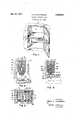
- FIGURE lis a fragmentary perspective view of a cabinet structure with the cabinet door in open position and wherein the novel magnetic touch latch of this invention has been incorporated;
- FIGURE 2is a fragmentary cross section taken in the direction of the arrows 2 2 of FIGURE 1 and further illustrating the door in a Aposition immediately prior to complete closing;
- FIGURE 3is a cross section of the magnetic latch structure taken in the direction of the arrows 3-3 of FIGURE 2 showing the door in its completely closed position;
- FIGURE 4is a cross section similar to FIGURE 2 illustrating the relative positions of the parts during the opening operation of the door.
- FIGURE 1there is illustrated generally by the numeral 10 a cabinet having a frame portion or jamb 11 against which a door 12 is arranged to be closed.
- the magnetic touch latch of the present inventionincludes a magnetic catch device 13 adapted to be secured to the frame 11 of the cabinet and a plate 14 adapted to be secured to an inside surface of the door 12 in a position to be magnetically attracted to the catch device 13 when the door is in its closed position.
- the magnetic catch device 13includes first and second side plates of non-magnetic material such as plastic designated 15 and 16 disposed on either side of a holder formed of plastic and designated by the numeral 17.
- a member of high permeable material 18is held in the holder 17 with a forward portion projecting into the space between the side plates 15 and 16.
- This space between the side platesdefines a channel having a forward open end facing outwardly from the cabinet or in the direction of the inside surface lof the door when the door is cl-osed.
- The' holder 17 and member 18constitute a fixed magnetic means and the side plates 15 and 16 define a guide channel.
- Receivable in the foregoing described guide channelis a movable magnet means including clips 19 and 20 of nonmagnetic material secured to side plates 21 and 22 of magnetic material defining forward and rearward pole pieces for a permanent magnet 23.
- the magnet 23is in the form of a block, the forward and rear ends of the si/"e plates 21 and 22 extending beyond the forward and rear surfaces of the block 23 as shown.
- the clips 19 andare dimensioned to lit within the channel between the side plates 15 and 16. In FIGURE 2, this channel is designated generally by the numeral 24.
- first spring meansin the form 0f coil springs 25 and 26 disposed in opposing bores formed in the clips and holder 17. These springs serve to hold the movable magnet 23 at a given distance relative to the fixed magnetic material in the form of the member 18.
- the Springs and 26will be compressed when the. permanent magnet 23 is urged into the channel to decrease the spacing between the magnet and the member 18.
- a second spring meansin the form of a compression spring 27 extending from a bore in the movable magnet means towards the plate 14 when the door 12 is in closed position. This latter spring will be placed under cornpression when the plate 14 is closed against the forward poles defined by the side plates 21 and 22 for the magnet 23.
- FIGURE 4illustrates the relative positions of the magnet poles 21 and 22 and magnetic material in the form of the member 18 when a touching pressure P is exerted on the door 12.
- the operation of the magnetic touch latch of this inventionwlil be evident from the foregoing description.
- the magneitc catch device 13 illustrated in FIG- URE 1is secured to the inside frame of the cabinet 11. This may be accomplished by providing suitable screw hole brackets on the member itself or alternatively simply embedding the member in the frame structure as illustrated.
- the plate 14is then held by a simple screw to the inside surface of the door 12 in a proper position to engage the forward poles of the side plates 21 and 22 when in closed position as illustrated by the dotted lines 12 in FIGURE 2.
- first springs 25 and 26 of FIGURE 3are compressed when the movable magnet means is received fully within the channel to the position illustrated in FIGURE 4.
- these first springswill tend to retract the permanent magnet 23 and associated clips 19 and 20 along with the side plates 21 and 22 from the channel.
- the components of the magnetic catch structure 13are as illustrated in FIGURE 2 and to close the door, it is only necessary to place the plate 14 in contact with the front edges of the side plates 21 and 22 where they are held by magnetic attraction. The door will then not reopen until an intentional touching pressure is applied in the direction of the arrow P to again compress tbe springs 25 and 26.
- a magnetic touch latchcomprising, in combination:
- a magnetic catch deviceadapted to be secured to a cabinet frame and including (1) a permanent magnet; (2) means for decreasing the magnetic field strength at one portion of said magnet; and (b) a plate member adapted to be secured to the inside surface of a door for said cabinet in a position to be magnetically attracted and held by said one portion of said magnet, said means for decreasing the magnet field strength of said one portion of said magnet comprising a member of high permeability normally spaced from another portion of said permanent magnet by a given distance, said given distance, being decreased by a touching pressure on said door urging said door against said magnet such that flux in said other portion of said magnet is shortcircuited through said member to thereby decrease the magnetic field strength at said one portion, permitting said door to be released to an open position.
- a latch according to claim 1including first spring means for holding said permanent magnet at said given distance from said member, said first spring means being compressed when said given distance is decreased; and Second spring means between said permanent magnet and plate member exerting a separating force therebetween less than the magnetic attractive force on said plate when said member is at said given distance and greater than the magnetic attracting force when said magnetic field strength is decreased by decreasing said given distance, whereby said second spring means releases said plate from said one portion of said permanent magnet after said given distance is decreased.
- a magnetic touch latchfor holding a cabinet door closed against a cabinet frame by magnetic attraction and responsive to a touching pressure on the door urging the door towards said frame to magnetically release the door so that the same opens, comprising, in combination:
- non-magnetic guide meansfixed to said magnetic means and defining a guide channel normal to and opening towards the inner surface of said door when said door is closed;
- said fixed magnetic meanscomprises a magnetic member having a high permeability; a holder secured to the rear surface of said member, said guide means comprising plastic plates fixed to opposite siles of said holder and extending forwardly beyond a front surface of said member towards said door when closed to define therebetween said channel, the front portion of said member extending into said channel, said movable magnet means comprising a permanent magnet in the form of a block with side plates of magnetic material extending forwardly and rearwardly beyond the forward and rearward surfaces of said block to define front and rear poles; and non-magnetic clip means on said poles dimensions to be received in said channel and guide movement of said block and poles from said spaced position to an inner position in which the forward portion of said member is received between the rear poles thereby reducing the magnetic attraction of the front poles to said plate.
- a latch according to claim 4in which said first spring means comprise compression springs received between opposing bores in said clip means and holder, said second spring means extending from a front bore in one of said clip means with a free end positioned to be engaged and compressed by said plate.
Landscapes
- Physics & Mathematics (AREA)
- Electromagnetism (AREA)
- Engineering & Computer Science (AREA)
- Mechanical Engineering (AREA)
- Refrigerator Housings (AREA)
- Specific Sealing Or Ventilating Devices For Doors And Windows (AREA)
Description
United States Patent O U.S. Cl. 292-2515 Claims ABSTRACT OF THE DISCLOSURE A touch type latch for cabinet doors is provided in the form of a magnetic catch device adapted to be secured to a cabinet frame for cooperation with a metallic plate adapted to be secured to the cabinet door in a position to be magnetically held by the catch device. The catch device itself includes means for decreasing the magnetic field strength of one portion of the magnet holding the plate, this means being responsive to a touching pressure on the door so that the door is thus released and opened. The means for decreasing the magnetic field strength takes the form of a member having a high permeability for magnetic flux which member may 'be either a so-ft ferrous metal or a second permanent magnet, is normally at a spacing from the permanent magnet holding the plate. Touching pressure on the door decreases this spacing in such a manner that the member short circuits the flux magnet thereby decreasing its attracting power to the plate and releasing the door. Suitable coiled springs are included to assure positive separation once the magnetic field strength has been decreased and to further restore the movable members to their original positions preparatory to a subsequent operation of closing of the door.
This invention relates to touch latches and more particularly to a novel magnetic touch latch for use with cabinet doors.
BACKGROUND OF THE INVENTION Touch latches of the mechanical type are well known in the art. These devices generally include a catch device adapted to be secured to an inside frame portion of a cabinet for cooperation with a hook element secured to an inside surface portion of the cabinet door. When the door is closed, the hook element is received in the catch device so that the door is held closed. Opening of the door is accomplished by exerting a touching pressure on the exterior surface of the door in such a manner as to urge the hook element further into the catch device. This action results in a releasing of the hook element so that the door is freed to swing open.
Latches of the foregoing type are very popular in modern construction wherein it is desired that the exterior surface of a cabinet door be wholly free of any knobs, handles, or undercut recesses normally necessary in order to open and close the cabinet door.
While the aesthetic appearance of cabinet doors is greatly enhanced by such touch latches as noted above, there are encountered certain difficulties. These difficulties arise from the mechanical nature of the hook and latching mechanism therefor and are of two major types: first, in many instances the hook will fail to be retained in the catch mechanism secured to the cabinet frame such that the door will not positively remain closed. Second, the hook becomes properly engaged but the release mechanism responsive to touching pressure on the cabinet door fails to function with the result that the cabinet door is locked shut. This latter type of failure is most annoying and can only be corrected by unhinging the door or, if the hinges happen to be buried in the molding as is often the case. actuallv damaging the door itself.
ice
BRIEF DESCRIPTION OF THE INVENTION The present invention provides a novel magnetically operated touch latch having all of the advantages of prior mechanical type latches discussed heretofore but wherein the two major difficulties of failure to latch or unlatch are wholly eliminated.
More particularly, the invention contemplates a magnetiolatch device including a permanent magnet arranged to be secured to the frame of a cabinet for cooperation wi h a plate member secured to an inside surface of the door in a position to be magnetically attracted to the magnet. The magnetic latch mechanism itself further incorporates means for decreasing the magnetic field strength of the permanent magnet at the portion thereof attracting the plate in response to a touching pressure on the door urging the plate against the permanent magnet. With this arrangement, the magnetic holding power is reduced sufficiently to release the door in response to touching pressure so that the door is free to open.
In the preferred embodiment of the invention, the means for decreasing the magnetic field strength constitutes a member of high permeability normally positioned at a given distance from the permanent magnet. This member may comprise a soft ferrous metal or alternatively a second permanent magnet. The distance between the member and permanent magnet is decreased in response to touching pressure on the door such that the member short circuits the fiux of the permanent magnet thereby decreasing its field strength at its holding portion to the door plate. If the member takes the form of a second permanent magnet, it would, of course, be oriented to have its north and south poles reversed relative to the first mentioned permanent magnet. Hereafter, the phrase member of the high permeability is meant to include either a soft iron member or second permanent magnet.
The structure incorporates suitable spring means for assuring a positive separation of the door plate from the permanent magnet after the field has been weakened and for repositioning the movable parts to their normal spaced relationship preparatory to normal action when the door is again closed.
Since holding of the door in its closed position and releasing of the door depends solely on magnetic field strength, the two major problems discussed heretofore with respect to mechanical type push catches are substantially avoided. Moreover, the entire device incorporates only one moving part with the attendant advantage of simplicity and reliability.
BRIEF DESCRIPTION OF THE DRAWINGS A better understanding of the invention will be had by now referring to a preferred embodiment as illustrated in the accompanying drawings, in which:
FIGURE l is a fragmentary perspective view of a cabinet structure with the cabinet door in open position and wherein the novel magnetic touch latch of this invention has been incorporated;
FIGURE 2 is a fragmentary cross section taken in the direction of thearrows 2 2 of FIGURE 1 and further illustrating the door in a Aposition immediately prior to complete closing;
FIGURE 3 is a cross section of the magnetic latch structure taken in the direction of the arrows 3-3 of FIGURE 2 showing the door in its completely closed position; and
FIGURE 4 is a cross section similar to FIGURE 2 illustrating the relative positions of the parts during the opening operation of the door.
DETAILED DESCRIPTION OF THE INVENTION Referring first to FIGURE 1, there is illustrated generally by the numeral 10 a cabinet having a frame portion or jamb 11 against which adoor 12 is arranged to be closed. The magnetic touch latch of the present invention includes amagnetic catch device 13 adapted to be secured to the frame 11 of the cabinet and aplate 14 adapted to be secured to an inside surface of thedoor 12 in a position to be magnetically attracted to thecatch device 13 when the door is in its closed position.
Referring now to the cross section of FIGURE 2, it will be noted that themagnetic catch device 13 includes first and second side plates of non-magnetic material such as plastic designated 15 and 16 disposed on either side of a holder formed of plastic and designated by the numeral 17. A member of highpermeable material 18 is held in theholder 17 with a forward portion projecting into the space between theside plates holder 17 andmember 18 constitute a fixed magnetic means and theside plates
Receivable in the foregoing described guide channel is a movable magnet means includingclips side plates permanent magnet 23. Themagnet 23 is in the form of a block, the forward and rear ends of the si/"e plates block 23 as shown. Theclips 19 and are dimensioned to lit within the channel between theside plates
With particular reference to FIGURE 3, there are provided first spring means in the form 0f coil springs 25 and 26 disposed in opposing bores formed in the clips andholder 17. These springs serve to hold themovable magnet 23 at a given distance relative to the fixed magnetic material in the form of themember 18. The Springs and 26 will be compressed when the.permanent magnet 23 is urged into the channel to decrease the spacing between the magnet and themember 18.
As also illustrated in FIGURE 3, there is provided a second spring means in the form of acompression spring 27 extending from a bore in the movable magnet means towards theplate 14 when thedoor 12 is in closed position. This latter spring will be placed under cornpression when theplate 14 is closed against the forward poles defined by theside plates magnet 23.
FIGURE 4 illustrates the relative positions of themagnet poles member 18 when a touching pressure P is exerted on thedoor 12. Thus, in the position of FIGURE 4 it will be evident that when thedoor 12 is urged further inwardly, themember 18 will be received between the rear poles of theside plates magnet 23. Because of the high permeability of themember 18, there will be provided a short circuit for the flux of the magnet through themember 18 thereby decreasing the magnetic field strength at the forward poles of theside plates plate 14 when the magnetic field is decreased as described in FIGURE 4 so that thedoor 12 is then separated from theplate 14 after application of the touching pressure.
OPERATION The operation of the magnetic touch latch of this invention wlil be evident from the foregoing description. Initially, themagneitc catch device 13 illustrated in FIG- URE 1 is secured to the inside frame of the cabinet 11. This may be accomplished by providing suitable screw hole brackets on the member itself or alternatively simply embedding the member in the frame structure as illustrated. Theplate 14 is then held by a simple screw to the inside surface of thedoor 12 in a proper position to engage the forward poles of theside plates lines 12 in FIGURE 2.
When the cabinet door is completely closed, it will assume the dottedline position 12 illustrated in FIG-URE 2 and will be held closed by the magnetic field of the 'magnet 23 appearing across the front portions of theside plates permanent magnet 23 and themember 18, maximum field strength will occur across the front poles so that proper holding of the door in its closed position will result. It should be noted that thesecond spring 27 of FIG- URE 3 will be compressed slightly when theplate 14 engages the front poles of theside plates magnet 23 and themember 18 remains as shown in FIGURES 2 and 3.
Whenever it is desired to open the door, it is only necessary for a person to apply a slight touching pressure on the exterior of the door in the direction of the arrow P of FIGURE 4. This pressure will then urge themagnet 23,side plates clips channel 24 in such a manner that themember 18 will be received between the rear poles defined by theside plates permanent magnet 23. Because of the high permeability of themember 18, the flux will be short circuited through this member thereby greatly decreasing the magnetic field strength at the forward poles defined by theside plates second spring 27 exerts a sufficient force against theplate 14 to readily separate it from the front poles of theside plates
In the foregoing operation, it will be understood that thefirst springs door 12, these first springs will tend to retract thepermanent magnet 23 and associatedclips side plates plate 14 by thesecond spring 27. 'Ihe position of themember 18 between the rear poles of theside plates member 18 to be completely withdrawn from between these plates and it is during this interval of time that thesecond spring 27 has an opportunity to effect the separation. Once the separation is made, -any residual magnetic attraction between the front poles of theside plates plate 14 is further decreased because of the distance between theplate 14 and the poles; that is, the resulting small space upon initial separation. The operation is such that there is assured a positive separation of the door and an actual outward pressure by thespring 27 on the door so that after releasing the touching pressure, the door will readily open automatically.
With the door open, the components of themagnetic catch structure 13 are as illustrated in FIGURE 2 and to close the door, it is only necessary to place theplate 14 in contact with the front edges of theside plates springs
From the foregoing description, it will thus be evident that the present invention has provided a greatly improved touch latch mechanism for cabinet doors. As in the case of the mechanical type touch latches presently available, there is not necessary any external knobs,
handles or the like to open or close the cabinet door so that a desired aesthetic appearance is realized. In addition, however, there is no possibility of a positive locking of the door in a closed position since there isv not involved mechanical moving parts subject to failure. It will be clear that there is essentially only one moving part, to wit thepermanent magnet structure 23 with associatedside plates channel 24 defined lbetween the plates and 16. Should this movable structure be locked in its innermost position by some fault, the field at the forward ends of theside plates door 12 will not be held closed and thus the catch mechanism is clearly exposed for ready repair. On the other hand, should the movable structure become stuck outwardly or bind outwardly for some reason, the door can still be held closed by the magnetic means and to open the same it is only necessary to apply sufficient outward force to overcome the magneticattraction coupling poles
While the invention has been described with respect to mounting the permanent magnet portion on the cabinet frame and the attracting plate to the door, it is of course understood that these parts could be reversed. Further, while the non-magnetic portions of the device have been described as plastic, any other non-magnetic material such as brass or ceramic could be used.
What is claimed is:
1. A magnetic touch latch comprising, in combination:
(a) a magnetic catch device adapted to be secured to a cabinet frame and including (1) a permanent magnet; (2) means for decreasing the magnetic field strength at one portion of said magnet; and (b) a plate member adapted to be secured to the inside surface of a door for said cabinet in a position to be magnetically attracted and held by said one portion of said magnet, said means for decreasing the magnet field strength of said one portion of said magnet comprising a member of high permeability normally spaced from another portion of said permanent magnet by a given distance, said given distance, being decreased by a touching pressure on said door urging said door against said magnet such that flux in said other portion of said magnet is shortcircuited through said member to thereby decrease the magnetic field strength at said one portion, permitting said door to be released to an open position.
2. A latch according to claim 1, including first spring means for holding said permanent magnet at said given distance from said member, said first spring means being compressed when said given distance is decreased; and Second spring means between said permanent magnet and plate member exerting a separating force therebetween less than the magnetic attractive force on said plate when said member is at said given distance and greater than the magnetic attracting force when said magnetic field strength is decreased by decreasing said given distance, whereby said second spring means releases said plate from said one portion of said permanent magnet after said given distance is decreased.
3. A magnetic touch latch for holding a cabinet door closed against a cabinet frame by magnetic attraction and responsive to a touching pressure on the door urging the door towards said frame to magnetically release the door so that the same opens, comprising, in combination:
(a) magnetic catch device adapted to be secured to said frame, said device including (1) a xed magnetic means;
(2) non-magnetic guide means fixed to said magnetic means and defining a guide channel normal to and opening towards the inner surface of said door when said door is closed;
(3) a movable magnet means received in the open end of said channel;
(4) rst spring means connected between said fix-ed magnetic means and said movable magnet means biasing said movable magnet means outward of said channel to a spaced position from said fixed magnetic means;
(5) second spring means extending from said movable magnet means towards said door; and
(b) a plate member adapted to be secured to the inside surface of said door in a position to compress said second spring means and be magnetically attracted to and held by said movable magnet means when in said spaced position, whereby application of a touching pressure to said door urges said movable magnet means into said channel to a position adjacent to said fixed magnetic means, said fixed magnetic means providing a new fiux path for said magnet means whereby the magnetic attraction of said plate to said movable magnet means is weakened sufficiently to be overcome by said second spring means so that said plate is separated from said movable magnet means and said door is free to open when said touching pressure is relieved, said first spring means then returning said movable magnet means to its said spaced position.
4. A latch according to claim 3, in which said fixed magnetic means comprises a magnetic member having a high permeability; a holder secured to the rear surface of said member, said guide means comprising plastic plates fixed to opposite siles of said holder and extending forwardly beyond a front surface of said member towards said door when closed to define therebetween said channel, the front portion of said member extending into said channel, said movable magnet means comprising a permanent magnet in the form of a block with side plates of magnetic material extending forwardly and rearwardly beyond the forward and rearward surfaces of said block to define front and rear poles; and non-magnetic clip means on said poles dimensions to be received in said channel and guide movement of said block and poles from said spaced position to an inner position in which the forward portion of said member is received between the rear poles thereby reducing the magnetic attraction of the front poles to said plate.
5. A latch according to claim 4, in which said first spring means comprise compression springs received between opposing bores in said clip means and holder, said second spring means extending from a front bore in one of said clip means with a free end positioned to be engaged and compressed by said plate.
References Cited UNITED STATES PATENTS 2,117,132 5/1938 Bagermann 292-2515 2,673,111 3/1954 Teetor 292-2515 2,854,273 9/1958 Cunningham 292-2515 2,888,290 5/ 1959 Pierce 292-2515 2,915,681 12/1959 Troy 317-123 RICHARD E. MOORE, Primary Examiner E. J. MCCARTHY, Assistant Examiner U.S. C1. X.R. 335-285
Applications Claiming Priority (1)
| Application Number | Priority Date | Filing Date | Title |
|---|---|---|---|
| US74033168A | 1968-06-26 | 1968-06-26 |
Publications (1)
| Publication Number | Publication Date |
|---|---|
| US3492037Atrue US3492037A (en) | 1970-01-27 |
Family
ID=24976043
Family Applications (1)
| Application Number | Title | Priority Date | Filing Date |
|---|---|---|---|
| US3492037DExpired - LifetimeUS3492037A (en) | 1968-06-26 | 1968-06-26 | Magnetic touch latch |
Country Status (1)
| Country | Link |
|---|---|
| US (1) | US3492037A (en) |
Cited By (32)
| Publication number | Priority date | Publication date | Assignee | Title |
|---|---|---|---|---|
| US3600025A (en)* | 1969-01-27 | 1971-08-17 | Maurice W Brainard | Releasable magnetic latch |
| US3934909A (en)* | 1973-07-23 | 1976-01-27 | Natter William J Van | Push releasable magnetic latch |
| DE2908833A1 (en)* | 1978-03-20 | 1979-10-04 | Kato Electric & Machinary Co | DOOR OPERATING DEVICE |
| US4270781A (en)* | 1979-02-28 | 1981-06-02 | Futaba Kinzoku Kogyo Kabushiki Kaisha | Opening and closing apparatus for doors and the like |
| US5033779A (en)* | 1990-04-30 | 1991-07-23 | Arthur Geringer | Electromagnetic door lock device |
| US5382167A (en)* | 1993-12-03 | 1995-01-17 | Eastman Kodak Company | Magnetically secured temporary electrical connector |
| US5485733A (en)* | 1993-05-13 | 1996-01-23 | Hoffman; Charles G. | Concealed magnetic lock for cabinet closure |
| WO2002004773A1 (en) | 2000-07-07 | 2002-01-17 | Eitan Ganzi | Closure mechanism for doors and the like |
| NL1018149C2 (en)* | 2001-05-25 | 2002-11-26 | Tamar Vanessa Grahmbeek | System of two mutually identical, flat elements which can be magnetically coupled, the system comprising provisions for disconnection of said elements by a user. |
| US6592156B2 (en)* | 2001-08-29 | 2003-07-15 | Steven Levine | Front adjustable catch |
| US20050268432A1 (en)* | 2004-05-21 | 2005-12-08 | Agostino Ferrari S.P.A. | Closing device for furniture |
| US20070079638A1 (en)* | 2005-10-10 | 2007-04-12 | Leung Chi P | Ground lock fitting |
| DE202006014002U1 (en)* | 2006-09-08 | 2007-10-25 | Grass Gmbh | Device for opening and / or closing a piece of furniture with a relative to a fixed furniture body movable furniture part and furniture fitting and furniture with such a device |
| US20080203738A1 (en)* | 2006-03-08 | 2008-08-28 | Alexander Peterlunger | Magnetic locking device |
| US20140001938A1 (en)* | 2011-03-22 | 2014-01-02 | Lama D.D. Dekani | Touch-latch device for opening and holding a furniture opening component in a closed position |
| US20140173811A1 (en)* | 2011-08-08 | 2014-06-26 | Uvex Sports Gmbh & Co. Kg | Unit composed of helmet and protective eye mask |
| US20170000297A1 (en)* | 2009-02-26 | 2017-01-05 | Safeway Safety Step, Llc | Bathtub door systems and methods |
| US20170122008A1 (en)* | 2014-05-19 | 2017-05-04 | Hao Min | Safety locking mechanism for lockset |
| USD797266S1 (en) | 2016-01-19 | 2017-09-12 | Safeway Safety Step, Llc | Bathtub closure |
| US20170321466A1 (en)* | 2014-11-24 | 2017-11-09 | Bortoluzzi Sistemi S.P.A. | A damping or return device for sliding door leaves or for drawers |
| US20180140144A1 (en)* | 2016-11-22 | 2018-05-24 | Brenda F. Music | Toilet brush cabinet |
| US9989998B1 (en) | 2017-07-18 | 2018-06-05 | Oculus Vr, Llc | Adjustable facial-interface systems for head-mounted displays |
| US10045449B1 (en) | 2017-06-29 | 2018-08-07 | Oculus Vr, Llc | Adjustable facial-interface systems for head-mounted displays |
| US10111560B2 (en) | 2016-01-19 | 2018-10-30 | Safeway Safety Step, Llc | Vertical bathtub closure systems and methods |
| WO2018231549A1 (en)* | 2017-06-16 | 2018-12-20 | Interlock Usa, Inc. | Side action flush lock for casement window and method of operating the same |
| JP2019190060A (en)* | 2018-04-20 | 2019-10-31 | タキゲン製造株式会社 | magnet catch |
| US10496130B1 (en) | 2017-07-18 | 2019-12-03 | Facebook Technologies, Llc | Adjustable facial-interface systems for head-mounted displays |
| US10648195B2 (en) | 2012-09-11 | 2020-05-12 | Interlock Usa, Inc. | Side action flush lock for casement window and method of operating the same |
| US10895751B1 (en) | 2017-06-29 | 2021-01-19 | Facebook Technologies, Llc | Adjustable facial-interface systems for head-mounted displays |
| US10938149B2 (en) | 2017-12-21 | 2021-03-02 | Ideal Industries, Inc. | Convertible force latching system |
| US11118374B2 (en) | 2012-09-11 | 2021-09-14 | Interlock Usa, Inc. | Straight action flush lock for casement window and method of operating the same |
| US11540672B2 (en) | 2014-04-28 | 2023-01-03 | Safeway Safety Step, Llc | Bathtub closure systems and methods |
Citations (5)
| Publication number | Priority date | Publication date | Assignee | Title |
|---|---|---|---|---|
| US2117132A (en)* | 1934-07-23 | 1938-05-10 | Jr Max Baermann | Releasable permanent magnet holding device |
| US2673111A (en)* | 1951-10-20 | 1954-03-23 | Macy O Teetor | Magnetic door catch |
| US2854273A (en)* | 1956-06-11 | 1958-09-30 | Westinghouse Electric Corp | Magnetic holding device |
| US2888290A (en)* | 1956-02-27 | 1959-05-26 | William C Pierce | Door with magnetic catch |
| US2915681A (en)* | 1957-11-20 | 1959-12-01 | Indiana Steel Products Co | Magnet assemblies |
- 1968
- 1968-06-26USUS3492037Dpatent/US3492037A/ennot_activeExpired - Lifetime
Patent Citations (5)
| Publication number | Priority date | Publication date | Assignee | Title |
|---|---|---|---|---|
| US2117132A (en)* | 1934-07-23 | 1938-05-10 | Jr Max Baermann | Releasable permanent magnet holding device |
| US2673111A (en)* | 1951-10-20 | 1954-03-23 | Macy O Teetor | Magnetic door catch |
| US2888290A (en)* | 1956-02-27 | 1959-05-26 | William C Pierce | Door with magnetic catch |
| US2854273A (en)* | 1956-06-11 | 1958-09-30 | Westinghouse Electric Corp | Magnetic holding device |
| US2915681A (en)* | 1957-11-20 | 1959-12-01 | Indiana Steel Products Co | Magnet assemblies |
Cited By (46)
| Publication number | Priority date | Publication date | Assignee | Title |
|---|---|---|---|---|
| US3600025A (en)* | 1969-01-27 | 1971-08-17 | Maurice W Brainard | Releasable magnetic latch |
| US3934909A (en)* | 1973-07-23 | 1976-01-27 | Natter William J Van | Push releasable magnetic latch |
| DE2908833A1 (en)* | 1978-03-20 | 1979-10-04 | Kato Electric & Machinary Co | DOOR OPERATING DEVICE |
| US4227726A (en)* | 1978-03-20 | 1980-10-14 | Katoh Electrical Machinery Co., Ltd. | Door operating equipment |
| US4270781A (en)* | 1979-02-28 | 1981-06-02 | Futaba Kinzoku Kogyo Kabushiki Kaisha | Opening and closing apparatus for doors and the like |
| US5033779A (en)* | 1990-04-30 | 1991-07-23 | Arthur Geringer | Electromagnetic door lock device |
| US5485733A (en)* | 1993-05-13 | 1996-01-23 | Hoffman; Charles G. | Concealed magnetic lock for cabinet closure |
| US5382167A (en)* | 1993-12-03 | 1995-01-17 | Eastman Kodak Company | Magnetically secured temporary electrical connector |
| WO2002004773A1 (en) | 2000-07-07 | 2002-01-17 | Eitan Ganzi | Closure mechanism for doors and the like |
| NL1018149C2 (en)* | 2001-05-25 | 2002-11-26 | Tamar Vanessa Grahmbeek | System of two mutually identical, flat elements which can be magnetically coupled, the system comprising provisions for disconnection of said elements by a user. |
| WO2002100235A1 (en)* | 2001-05-25 | 2002-12-19 | Tamar Vanessa Grahmbeek | Operating system for toilet seat and cover |
| US6592156B2 (en)* | 2001-08-29 | 2003-07-15 | Steven Levine | Front adjustable catch |
| US20050268432A1 (en)* | 2004-05-21 | 2005-12-08 | Agostino Ferrari S.P.A. | Closing device for furniture |
| US7273240B2 (en)* | 2004-05-21 | 2007-09-25 | Agostino Ferrari S.P.A. | Closing device for furniture |
| US20070079638A1 (en)* | 2005-10-10 | 2007-04-12 | Leung Chi P | Ground lock fitting |
| US7367596B2 (en)* | 2005-10-10 | 2008-05-06 | Chi Pang Leung | Ground lock fitting |
| US20080203738A1 (en)* | 2006-03-08 | 2008-08-28 | Alexander Peterlunger | Magnetic locking device |
| US8376420B2 (en) | 2006-03-08 | 2013-02-19 | Julius Blum Gmbh | Magnetic locking device |
| DE202006014002U1 (en)* | 2006-09-08 | 2007-10-25 | Grass Gmbh | Device for opening and / or closing a piece of furniture with a relative to a fixed furniture body movable furniture part and furniture fitting and furniture with such a device |
| US20170000297A1 (en)* | 2009-02-26 | 2017-01-05 | Safeway Safety Step, Llc | Bathtub door systems and methods |
| US11445863B2 (en) | 2009-02-26 | 2022-09-20 | Safeway Safety Step, Llc | Bathtub door systems and methods |
| US20180310776A1 (en)* | 2009-02-26 | 2018-11-01 | Safeway Safety Step, Llc | Bathtub door systems and methods |
| US12096891B2 (en) | 2009-02-26 | 2024-09-24 | Safeway Safety Step, Llc | Bathtub door systems and methods |
| US9516948B2 (en)* | 2011-03-22 | 2016-12-13 | Titus D.O.O. Dekani | Touch-latch device for opening and holding a furniture opening component in a closed position |
| US20140001938A1 (en)* | 2011-03-22 | 2014-01-02 | Lama D.D. Dekani | Touch-latch device for opening and holding a furniture opening component in a closed position |
| US20140173811A1 (en)* | 2011-08-08 | 2014-06-26 | Uvex Sports Gmbh & Co. Kg | Unit composed of helmet and protective eye mask |
| US10648195B2 (en) | 2012-09-11 | 2020-05-12 | Interlock Usa, Inc. | Side action flush lock for casement window and method of operating the same |
| US11118374B2 (en) | 2012-09-11 | 2021-09-14 | Interlock Usa, Inc. | Straight action flush lock for casement window and method of operating the same |
| US11540672B2 (en) | 2014-04-28 | 2023-01-03 | Safeway Safety Step, Llc | Bathtub closure systems and methods |
| US9822555B2 (en)* | 2014-05-19 | 2017-11-21 | Najing Easthouse Electrical Co., Ltd. | Safety locking mechanism for lockset |
| US20170122008A1 (en)* | 2014-05-19 | 2017-05-04 | Hao Min | Safety locking mechanism for lockset |
| US11447997B2 (en)* | 2014-11-24 | 2022-09-20 | Bortoluzzi Sistemi S.P.A. | Damping or return device for sliding door leaves or for drawers |
| US20170321466A1 (en)* | 2014-11-24 | 2017-11-09 | Bortoluzzi Sistemi S.P.A. | A damping or return device for sliding door leaves or for drawers |
| US10111560B2 (en) | 2016-01-19 | 2018-10-30 | Safeway Safety Step, Llc | Vertical bathtub closure systems and methods |
| US11382463B2 (en) | 2016-01-19 | 2022-07-12 | Safeway Safety Step, Llc | Vertical bathtub closure systems and methods |
| USD797266S1 (en) | 2016-01-19 | 2017-09-12 | Safeway Safety Step, Llc | Bathtub closure |
| US11089924B2 (en)* | 2016-11-22 | 2021-08-17 | Brenda F. Music | Toilet brush cabinet |
| US20180140144A1 (en)* | 2016-11-22 | 2018-05-24 | Brenda F. Music | Toilet brush cabinet |
| WO2018231549A1 (en)* | 2017-06-16 | 2018-12-20 | Interlock Usa, Inc. | Side action flush lock for casement window and method of operating the same |
| US10895751B1 (en) | 2017-06-29 | 2021-01-19 | Facebook Technologies, Llc | Adjustable facial-interface systems for head-mounted displays |
| US10045449B1 (en) | 2017-06-29 | 2018-08-07 | Oculus Vr, Llc | Adjustable facial-interface systems for head-mounted displays |
| US10496130B1 (en) | 2017-07-18 | 2019-12-03 | Facebook Technologies, Llc | Adjustable facial-interface systems for head-mounted displays |
| US9989998B1 (en) | 2017-07-18 | 2018-06-05 | Oculus Vr, Llc | Adjustable facial-interface systems for head-mounted displays |
| US10938149B2 (en) | 2017-12-21 | 2021-03-02 | Ideal Industries, Inc. | Convertible force latching system |
| US11539161B2 (en) | 2017-12-21 | 2022-12-27 | Ideal Industries, Inc. | Convertible force latching system |
| JP2019190060A (en)* | 2018-04-20 | 2019-10-31 | タキゲン製造株式会社 | magnet catch |
Similar Documents
| Publication | Publication Date | Title |
|---|---|---|
| US3492037A (en) | Magnetic touch latch | |
| US2809062A (en) | Latch mechanism | |
| US4254582A (en) | Electrically actuated overhead garage door opener assembly | |
| US2240035A (en) | Securing device | |
| US2288688A (en) | Magnetic lock | |
| US3790197A (en) | Magnetic latch | |
| US3009225A (en) | Separable two-part magnetic connector | |
| US2888290A (en) | Door with magnetic catch | |
| US2584480A (en) | Magnetic latch for doors | |
| US2521885A (en) | Magnetic retainer | |
| US3893723A (en) | Electromagnetic door lock | |
| GB2003586A (en) | Magnetically operated valve | |
| US7654590B2 (en) | Magnetic appliance latch | |
| US2901278A (en) | Magnetic latch assembly | |
| US3204154A (en) | Electromagnetic door holder and stop | |
| ATE446430T1 (en) | MAGNETO-MECHANICAL LOCKING DEVICE | |
| US3122388A (en) | Electric strike | |
| US3066964A (en) | Door locking device | |
| KR930024033A (en) | Bistable magnetic actuator | |
| GB2145461A (en) | Magnetically operated latch | |
| ES339572A1 (en) | Magnetically actuated tumbler lock | |
| WO2006111762A2 (en) | A lock assembly | |
| US3413026A (en) | Magnetic latch | |
| JP3099207B2 (en) | solenoid valve | |
| JPH05507449A (en) | Magnetic locking device for injection molding slider |