US3477317A - Method for producing an improved die for use with a multi-element punch - Google Patents
Method for producing an improved die for use with a multi-element punchDownload PDFInfo
- Publication number
- US3477317A US3477317AUS3477317DAUS3477317AUS 3477317 AUS3477317 AUS 3477317AUS 3477317D AUS3477317D AUS 3477317DAUS 3477317 AUS3477317 AUS 3477317A
- Authority
- US
- United States
- Prior art keywords
- punch
- holes
- die
- backup plate
- elements
- Prior art date
- Legal status (The legal status is an assumption and is not a legal conclusion. Google has not performed a legal analysis and makes no representation as to the accuracy of the status listed.)
- Expired - Lifetime
Links
- 238000004519manufacturing processMethods0.000titledescription6
- 239000000463materialSubstances0.000description44
- 229920003023plasticPolymers0.000description23
- 239000004033plasticSubstances0.000description23
- 238000000034methodMethods0.000description11
- 239000011159matrix materialSubstances0.000description5
- 238000004080punchingMethods0.000description5
- 239000007779soft materialSubstances0.000description5
- 238000010586diagramMethods0.000description2
- 238000003754machiningMethods0.000description2
- 229910052573porcelainInorganic materials0.000description2
- 229910052845zirconInorganic materials0.000description2
- GFQYVLUOOAAOGM-UHFFFAOYSA-Nzirconium(iv) silicateChemical compound[Zr+4].[O-][Si]([O-])([O-])[O-]GFQYVLUOOAAOGM-UHFFFAOYSA-N0.000description2
- 229910000831SteelInorganic materials0.000description1
- 239000003082abrasive agentSubstances0.000description1
- 239000000853adhesiveSubstances0.000description1
- 230000001070adhesive effectEffects0.000description1
- 239000002390adhesive tapeSubstances0.000description1
- 238000005516engineering processMethods0.000description1
- 239000002985plastic filmSubstances0.000description1
- 229920000915polyvinyl chloridePolymers0.000description1
- 239000004065semiconductorSubstances0.000description1
- 230000035939shockEffects0.000description1
- 239000010959steelSubstances0.000description1
Images
Classifications
- B—PERFORMING OPERATIONS; TRANSPORTING
- B26—HAND CUTTING TOOLS; CUTTING; SEVERING
- B26F—PERFORATING; PUNCHING; CUTTING-OUT; STAMPING-OUT; SEVERING BY MEANS OTHER THAN CUTTING
- B26F1/00—Perforating; Punching; Cutting-out; Stamping-out; Apparatus therefor
- B26F1/02—Perforating by punching, e.g. with relatively-reciprocating punch and bed
- B26F1/14—Punching tools; Punching dies
- B—PERFORMING OPERATIONS; TRANSPORTING
- B21—MECHANICAL METAL-WORKING WITHOUT ESSENTIALLY REMOVING MATERIAL; PUNCHING METAL
- B21D—WORKING OR PROCESSING OF SHEET METAL OR METAL TUBES, RODS OR PROFILES WITHOUT ESSENTIALLY REMOVING MATERIAL; PUNCHING METAL
- B21D31/00—Other methods for working sheet metal, metal tubes, metal profiles
- B21D31/02—Stabbing or piercing, e.g. for making sieves
- B—PERFORMING OPERATIONS; TRANSPORTING
- B26—HAND CUTTING TOOLS; CUTTING; SEVERING
- B26F—PERFORATING; PUNCHING; CUTTING-OUT; STAMPING-OUT; SEVERING BY MEANS OTHER THAN CUTTING
- B26F2210/00—Perforating, punching, cutting-out, stamping-out, severing by means other than cutting of specific products
- B26F2210/08—Perforating, punching, cutting-out, stamping-out, severing by means other than cutting of specific products of ceramic green sheets, printed circuit boards and the like
- Y—GENERAL TAGGING OF NEW TECHNOLOGICAL DEVELOPMENTS; GENERAL TAGGING OF CROSS-SECTIONAL TECHNOLOGIES SPANNING OVER SEVERAL SECTIONS OF THE IPC; TECHNICAL SUBJECTS COVERED BY FORMER USPC CROSS-REFERENCE ART COLLECTIONS [XRACs] AND DIGESTS
- Y10—TECHNICAL SUBJECTS COVERED BY FORMER USPC
- Y10T—TECHNICAL SUBJECTS COVERED BY FORMER US CLASSIFICATION
- Y10T83/00—Cutting
- Y10T83/869—Means to drive or to guide tool
- Y10T83/8821—With simple rectilinear reciprocating motion only
- Y10T83/8828—Plural tools with same drive means
- Y10T83/8831—Plural distinct cutting edges on same support
- Y—GENERAL TAGGING OF NEW TECHNOLOGICAL DEVELOPMENTS; GENERAL TAGGING OF CROSS-SECTIONAL TECHNOLOGIES SPANNING OVER SEVERAL SECTIONS OF THE IPC; TECHNICAL SUBJECTS COVERED BY FORMER USPC CROSS-REFERENCE ART COLLECTIONS [XRACs] AND DIGESTS
- Y10—TECHNICAL SUBJECTS COVERED BY FORMER USPC
- Y10T—TECHNICAL SUBJECTS COVERED BY FORMER US CLASSIFICATION
- Y10T83/00—Cutting
- Y10T83/929—Tool or tool with support
- Y10T83/9314—Pointed perforators
- Y—GENERAL TAGGING OF NEW TECHNOLOGICAL DEVELOPMENTS; GENERAL TAGGING OF CROSS-SECTIONAL TECHNOLOGIES SPANNING OVER SEVERAL SECTIONS OF THE IPC; TECHNICAL SUBJECTS COVERED BY FORMER USPC CROSS-REFERENCE ART COLLECTIONS [XRACs] AND DIGESTS
- Y10—TECHNICAL SUBJECTS COVERED BY FORMER USPC
- Y10T—TECHNICAL SUBJECTS COVERED BY FORMER US CLASSIFICATION
- Y10T83/00—Cutting
- Y10T83/929—Tool or tool with support
- Y10T83/9411—Cutting couple type
- Y10T83/9423—Punching tool
- Y10T83/9428—Shear-type male tool
- Y10T83/943—Multiple punchings
Definitions
- the methodcomprises boring holes of a diameter greater than the diameter of respective punch elements through a backup plate at locations which correspond to the locations of the respective punch elements; positioning said backup plate with respect to said punch elements so that said bored holes and respective punch elements are coaxial; attaching a soft, wear resistant material to the punch element facing surface of said backup plate and operating said punch elements to simultaneously punch holes through said soft material, each hole being within the area of a respective bore hole in said backup plate.
- any material which is to be punchedis placed on the die, the punch operated and the punch elements thereof punch through the material and into the correctly located openings in the die.
- This type of diehas served its purpose very well, especially since the die material is usually hard steel.
- the above mentioned conventional approach to die makinghas proved to be impractical.
- a matrix of holes having diameters in the ten-thousandths of an inch rangeare to be simultaneously punched at precise locations with respect to one another. It will be appreciated, that the least misalignment of die holes will require the making of a new die since it would produce v breakage of the fragile punches.
- the inventionis an improved method for making a die for use with a multi-element punch comprising the steps of: locating positions on a backup plate each of which corresponds to the position of a respective punch element; boring holes at said positions of a diameter 3,477,317 Patented Nov. 11, 1969 larger than the diameter of the punch elements; attaching a relatively soft material to one side of said backup plate and positioning the backup plate so that the soft material faces the punch elements and each of the holes is aligned with a respective punch element; and operating the punch so as to punch holes in the soft material die over the holes in the backup plate thereby producing a soft material die in which the holes are exactly aligned with the respective punch elements.
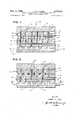
- FIG. 1is a vertical cross sectional diagram of the punch apparatus and soft, wear resistant material in place for punching.
- FIG. 2shows a vertical cross sectional diagram of the punch apparatus after being operated to punch holes in the soft wear-resistant material.
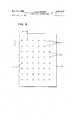
- FIG. 3is a sectional view along the line 3-3 of FIG. 2 which shows the matrix arrangement of the punch elements and the large clearance space for the punch elements in the holes in the backup plate.
- the punch apparatusconsists mainly of a matrix of punch elements 12, each of which is precisely located with respect to the others to produce, when operated, a precisely located plurality of holes in a matrix.
- the punch elements 12are held in position in holes in a punch holder 14.
- the punch elements 12each consist of an elongated shank 16 which ends in a tapered tip 18 of a very small diameter.
- the shanks 16 of the punch elements 12are each topped by a head 22 of a greater diameter than the shanks 16 which limits the lengthwise positioning of the punch elements 12.
- the punch apparatusalso has a backup plate 26 located parallel to the bottom of the stripper plate 24 a short distance therefrom.
- the material 28 to be made into a die in connection with this inventionis shown attached to the backup plate 26 in the space between the stripper plate 24 and the backup plate 26.
- a further backup plate 32abuts the bottom of the previously mentioned backup plate 26.
- the further backup plate 32has vacuum passages 34 therein.
- FIG. 2is a further view of the punch apparatus, shown in FIG. 1, showing the apparatus in the operated position.
- the operating forceis exerted downwardly on the punch element holder 14 via a backing plate 36.
- the stripper plate 24contacts the material 28 to be punched in the downward movement of the punch apparatus.
- the stripper plate 24 stopsthe punch elements 12 held by the punch holder 14 continue their downward travel and extend beyond the end of the stripper plate 24 and pass through the material 28.
- Springs 38 located between the punch holder 14 and stripper plate 24are compressed by the downward motion of the punch holder 14 toward the stopped stripper plate 24 thereby providing a somewhat controlled shock free movement between the punch holder 14 and stripper plate 24.
- the operationcontinues and the punch apparatus is raised to its initial position shown in FIG. 1.
- FIG. 3which is a view along the line 33 of FIG. 2, shows the matrix arrangement of the punch elements 12.
- the holes punched in the soft plastic materialsare spaced from one another by a distance d equal to .03185 inch.
- apparatus for punching holes of such close spacing and small dimensionsis used in connection with manufacturing small semi-conductor modules for electronic equipment.
- the punch element tip 18 diameteris .0051 inch. Punch elements as small as .003 inch in diameter have been used.
- holes 42are spotted and bored in a backup plate 26 of a diameter larger than the diameter of the tapered tip 18 of the punch elements 12.
- Each hole 42is precisely located to correspond with the location of a respective punch element 12.
- the tapered tip 18 of the punch element 12is .0051 inch in diameter
- the holes 42 bored in the backup plate 26are .008 inch in diameter.
- a thin sheet of a soft wear resistant material 28is located on the upper working surface of the backup plate 26.
- the material 28can be plastic such as a vinyl plastic.
- the material 28can be attached to the backup plate 26 in several ways.
- a double sided adhesivecould be used or preferably a vacuum system could be used to hold the thin sheet of material 28 in position on the backup plate 26.
- a vacuum systemis utilized in that embodiment.
- the vacuumis applied through the vacuum ports 34 which connect to the holes 42 bored in the backup plate 26 just mentioned, thereby, providing the necessary vacuum suction to hold the plastic material 28 in position thereon.
- the backup plate 26is positioned to line up the holes 42 therein with the punch elements.
- the punch apparatusis operated, as previously described, to punch the holes in the plastic material 28.
- the punch element tips 18extend through the plastic material into the holes 42 in the backup plate 26, as shown in FIG. 2.
- the vacuum system arrangement of holding the plastic material 28 onto the backup plate 26also provides suction and a passage for automatically removing any of the plastic material that may be punched out as a result of the punching operation and thus, the various punchout elements will not accumulate and cause any obstruction to the punch elements 12.
- the plastic sheet of material 28now has holes located therein which are precisely aligned with the punch elements 12 and which plastic material is backed up by a backing plate 26 having holes 42 of a larger diameter coaxial with the holes therein.
- the punched plastic material 28is a die and the material in which holes are to be punched is now located in the apparatus between the punch elements 12 and the plastic material die 28.
- the sheet material(not shown) inserted between the punch elements and the plastic material die will have the precisely located holes punched therein.
- Many of the materials which are to be punchedare abrasive and accordingly will produce wear on the plastic material die 28.
- one of the materials in which such holes are to be punchedis known as zircon alkaline earth porcelain green sheet.
- the thickness of materialis limited, due to the fragile nature and sizes of the punch element tips 18. Zircon alkaline earth porcelain green sheet .007 to 0.12 inch thick has been successfully punched.
- An improved method for making a die for use with a multi-element punch for simultaneously punching a plurality of small diameter holes in a sheet of materialcomprising the steps of:
Landscapes
- Engineering & Computer Science (AREA)
- Mechanical Engineering (AREA)
- Life Sciences & Earth Sciences (AREA)
- Forests & Forestry (AREA)
- Perforating, Stamping-Out Or Severing By Means Other Than Cutting (AREA)
Description
Nov. 11, 1969 L. E. LIANDER 3,477,317
METHOD FOR PRODUCING AN IMPROVED DIE FOR USE WITH A MULTI-ELEMENT PUNCH Filed April 12, 1967 2 Sheets-Sheet l FIG.1 I I l F /f /.5e 22 12 A I I a 7 ii +11..- i" :E V /////////////%W/V /F 34 7 s2 v 42 I I INVEQITOR LEONARD E. UANDER ATTORNEY 1969 L. E. LIANDER 77,317
METHOD FOR PRODUCING AN IMPROVED DIE FOR USE WITH A MULTI-ELEMENI PUNCH Filed. April 12. 1967 2 Sheets-Sheet 2 FIG. 3
G) G) (D (D G G) @i- Q G) G) (D G G (9 C) G) 6) 6 United States Patent 3,477,317 METHOD FOR PRODUCING AN IMPROVED DIE FOR USE WITH A MULTI-ELEMENT PUNCH Leonard E. Liander, Fishkill, N.Y., assignor to International Business Machines Corporation, Armonk, NY, a corporation of New York Filed Apr. 12, 1967, Ser. No. 630,340 Int. Cl. B21k 5/20; B26d 5/08; B26f 1/14 US. Cl. 76-107 6 (Ilanns ABSTRACT OF THE DISCLOSURE The method comprises boring holes of a diameter greater than the diameter of respective punch elements through a backup plate at locations which correspond to the locations of the respective punch elements; positioning said backup plate with respect to said punch elements so that said bored holes and respective punch elements are coaxial; attaching a soft, wear resistant material to the punch element facing surface of said backup plate and operating said punch elements to simultaneously punch holes through said soft material, each hole being within the area of a respective bore hole in said backup plate.
spective positions of the punch elements. Thus, any material which is to be punched is placed on the die, the punch operated and the punch elements thereof punch through the material and into the correctly located openings in the die. This type of die has served its purpose very well, especially since the die material is usually hard steel. However, in the present miniaturization direction of some technologies, the above mentioned conventional approach to die making has proved to be impractical. For example, in connection with the present invention, a matrix of holes having diameters in the ten-thousandths of an inch range are to be simultaneously punched at precise locations with respect to one another. It will be appreciated, that the least misalignment of die holes will require the making of a new die since it would produce v breakage of the fragile punches. Due to the precise machining problem involved in locating and boring the holes, the die becomes quite expensive. It has also been found, that the material to be punched if at all abrasive causes excessive wear of the die. It is also very difficult to make a die which is an exact duplicate of a die to be replaced because of boring runout problems.
Accordingly, it is the main object of the present invention to provide a method for making a die in which there is no hole misalignment with respect to the punch elements.
It is another object of the present invention to provide a die which is highly wear-resistant to abrasive materials. It is a further object of the present invention to provide a die which is an exact duplicate of a replaced die.
It is yet a further object of the invention to provide a die which practically eliminates punch element breakage.
Briefly, the invention is an improved method for making a die for use with a multi-element punch comprising the steps of: locating positions on a backup plate each of which corresponds to the position of a respective punch element; boring holes at said positions of a diameter 3,477,317 Patented Nov. 11, 1969 larger than the diameter of the punch elements; attaching a relatively soft material to one side of said backup plate and positioning the backup plate so that the soft material faces the punch elements and each of the holes is aligned with a respective punch element; and operating the punch so as to punch holes in the soft material die over the holes in the backup plate thereby producing a soft material die in which the holes are exactly aligned with the respective punch elements.
The foregoing and other objects, features and advantages of the invention will be apparent from the following and more particular description of a preferred embodiment of the invention as illustrated in the accompanying drawings.
FIG. 1 is a vertical cross sectional diagram of the punch apparatus and soft, wear resistant material in place for punching.
FIG. 2 shows a vertical cross sectional diagram of the punch apparatus after being operated to punch holes in the soft wear-resistant material.
FIG. 3 is a sectional view along the line 3-3 of FIG. 2 which shows the matrix arrangement of the punch elements and the large clearance space for the punch elements in the holes in the backup plate.
Referring to FIG. 1, there is shown a cross sectional view of a punch apparatus which could be utilized in making the improved die of the instant invention. The punch apparatus consists mainly of a matrix ofpunch elements 12, each of which is precisely located with respect to the others to produce, when operated, a precisely located plurality of holes in a matrix. Thepunch elements 12 are held in position in holes in apunch holder 14. Thepunch elements 12 each consist of anelongated shank 16 which ends in atapered tip 18 of a very small diameter. Theshanks 16 of thepunch elements 12 are each topped by ahead 22 of a greater diameter than theshanks 16 which limits the lengthwise positioning of thepunch elements 12. Spring loaded to thepunch element holder 14 is astripper plate 24 which has holes therein which correspond to the position of the holes in thepunch element holder 14. As can be seen in FIG. 1, thepunch elements 12 are inserted in the holes in the top of theholder element 14 and extend downwardly therethrough into the holes in thestripper plate 24. The punch elements .12 do not extend fully through thestripper plate 24 but end a short distance from the bottom thereof. The punch apparatus also has abackup plate 26 located parallel to the bottom of the stripper plate 24 a short distance therefrom. Thematerial 28 to be made into a die in connection with this invention is shown attached to thebackup plate 26 in the space between thestripper plate 24 and thebackup plate 26. In this particular embodiment, afurther backup plate 32 abuts the bottom of the previously mentionedbackup plate 26. Thefurther backup plate 32 hasvacuum passages 34 therein.
FIG. 2 is a further view of the punch apparatus, shown in FIG. 1, showing the apparatus in the operated position. As can be seen, the operating force is exerted downwardly on thepunch element holder 14 via abacking plate 36. In operation thestripper plate 24 contacts thematerial 28 to be punched in the downward movement of the punch apparatus. When thestripper plate 24 stops, thepunch elements 12 held by thepunch holder 14 continue their downward travel and extend beyond the end of thestripper plate 24 and pass through thematerial 28. Springs 38 located between thepunch holder 14 andstripper plate 24 are compressed by the downward motion of thepunch holder 14 toward the stoppedstripper plate 24 thereby providing a somewhat controlled shock free movement between thepunch holder 14 andstripper plate 24. Of course, the operation continues and the punch apparatus is raised to its initial position shown in FIG. 1.
FIG. 3, which is a view along the line 33 of FIG. 2, shows the matrix arrangement of thepunch elements 12. To provide an idea of the actual sizes and distances involved in the apparatus for carrying out the method of the instant invention, various examples of dimensions are given. The holes punched in the soft plastic materials are spaced from one another by a distance d equal to .03185 inch. Actually, apparatus for punching holes of such close spacing and small dimensions is used in connection with manufacturing small semi-conductor modules for electronic equipment. In the particular embodiment being described, thepunch element tip 18 diameter is .0051 inch. Punch elements as small as .003 inch in diameter have been used.
Considering now the method for producing the improveddie 28 for use with the multi-element punch apparatus just described,holes 42 are spotted and bored in abackup plate 26 of a diameter larger than the diameter of thetapered tip 18 of thepunch elements 12. Eachhole 42 is precisely located to correspond with the location of arespective punch element 12. In the example, where thetapered tip 18 of thepunch element 12 is .0051 inch in diameter, theholes 42 bored in thebackup plate 26 are .008 inch in diameter. Thus, this gives ahole 42 which is considerably larger than thepunch element tip 18 diameter. A thin sheet of a soft wearresistant material 28 is located on the upper working surface of thebackup plate 26. Thematerial 28 can be plastic such as a vinyl plastic. Thematerial 28 can be attached to thebackup plate 26 in several ways. For example, a double sided adhesive could be used or preferably a vacuum system could be used to hold the thin sheet ofmaterial 28 in position on thebackup plate 26. As can be seen from FIGS. 1 and 2 such a vacuum system is utilized in that embodiment. The vacuum is applied through thevacuum ports 34 which connect to theholes 42 bored in thebackup plate 26 just mentioned, thereby, providing the necessary vacuum suction to hold theplastic material 28 in position thereon. Thebackup plate 26 is positioned to line up theholes 42 therein with the punch elements. The punch apparatus is operated, as previously described, to punch the holes in theplastic material 28. Thepunch element tips 18 extend through the plastic material into theholes 42 in thebackup plate 26, as shown in FIG. 2. Since theholes 42 in thebackup plate 26 are of a considerably greater diameter than thepunch element tips 18, there is no problem with wear or breakage of thepunch element tips 18 because of small misalignments of theholes 42 with thepunch elements 12. It will also be appreciated, that the vacuum system arrangement of holding theplastic material 28 onto thebackup plate 26 also provides suction and a passage for automatically removing any of the plastic material that may be punched out as a result of the punching operation and thus, the various punchout elements will not accumulate and cause any obstruction to thepunch elements 12. It will be appreciated, that the plastic sheet ofmaterial 28 now has holes located therein which are precisely aligned with thepunch elements 12 and which plastic material is backed up by abacking plate 26 havingholes 42 of a larger diameter coaxial with the holes therein.
The punchedplastic material 28 is a die and the material in which holes are to be punched is now located in the apparatus between thepunch elements 12 and the plastic material die 28. When the punch apparatus is operated, as previously described, the sheet material (not shown) inserted between the punch elements and the plastic material die will have the precisely located holes punched therein. Many of the materials which are to be punched are abrasive and accordingly will produce wear on the plastic material die 28. For example, one of the materials in which such holes are to be punched is known as zircon alkaline earth porcelain green sheet. Of course, the thickness of material is limited, due to the fragile nature and sizes of thepunch element tips 18. Zircon alkaline earth porcelain green sheet .007 to 0.12 inch thick has been successfully punched. As the plastic material die 28 wears because of the abrasive nature of the materials being punched, a new sheet of plastic material can be substituted for the worn plastic material die 28, and the necessary holes punched therein by the punching apparatus as was done for the original plastic material die 28. Thus, it will be appreciated that this method provides an easily replaceable die which reduces punch element tip breakage, which needs no precise machining and which considerably reduces the cost and time involved in die making.
While the invention has been particularly shown and described with reference to a preferred embodiment thereof, it will be understood by those skilled in the art that the foregoing and other changes in form and detail may be made therein without departing from the spirit and scope of the invention.
What is claimed is:
1. An improved method for making a die for use with a multi-element punch for simultaneously punching a plurality of small diameter holes in a sheet of material, comprising the steps of:
locating positions on the working face of a backup plate each of which corresponds to the position of a respective punch element,
forming holes at said positions of a diameter larger than the diameter of the punch elements,
attaching a relatively soft plastic material to the working face of said backup plate,
positioning said backup plate so that said soft plastic material faces said punch elements and each of said plurality of holes is aligned with a respective punch element,
and operating said punch so as to punch holes in said soft plastic material over said holes in said backup plate, thereby producing a soft plastic material die in which the holes are exactly aligned with the respective punch elements.
2. The method according to claim 1, wherein said soft plastic material is attached to said backup plate by a twosided adhesive tape.
3. The method according to claim 1, wherein said relatively soft plastic material is attached to said backup plate by a vacuum applied through the openings in the backup plate, said vacuum also removing the portion of soft plastic material punched out by said punch elements.
4. The method according to claim 1, wherein said punch elements are .003 to .0051 inch in diameter.
5. The method according to claim 1 wherein the bored holes in said backing plate are approximately .008 inch in diameter.
6. The method according to claim 1, wherein said holes in said die are located from one another at a distance of approximately .03185 inch.
References Cited UNITED STATES PATENTS BERNARD STICKNEY, Primary Examiner US. Cl. X.R. 83-620, 660, 687
Applications Claiming Priority (1)
| Application Number | Priority Date | Filing Date | Title |
|---|---|---|---|
| US63034067A | 1967-04-12 | 1967-04-12 |
Publications (1)
| Publication Number | Publication Date |
|---|---|
| US3477317Atrue US3477317A (en) | 1969-11-11 |
Family
ID=24526778
Family Applications (1)
| Application Number | Title | Priority Date | Filing Date |
|---|---|---|---|
| US3477317DExpired - LifetimeUS3477317A (en) | 1967-04-12 | 1967-04-12 | Method for producing an improved die for use with a multi-element punch |
Country Status (1)
| Country | Link |
|---|---|
| US (1) | US3477317A (en) |
Cited By (23)
| Publication number | Priority date | Publication date | Assignee | Title |
|---|---|---|---|---|
| US4079647A (en)* | 1975-10-28 | 1978-03-21 | Velo-Bind, Inc. | Sheet punching apparatus |
| US4583438A (en)* | 1983-10-19 | 1986-04-22 | Kane Kenneth W | Piercing unit with rotating head |
| US4669345A (en)* | 1984-03-13 | 1987-06-02 | Suinat | Device for laterally perforating metallic pieces, particularly pressed pieces |
| US4728381A (en)* | 1986-05-12 | 1988-03-01 | Hooper, Inc. | Machine and method for manufacturing a disposable absorbent continence pad |
| US4742746A (en)* | 1986-04-17 | 1988-05-10 | Amp Incorporated | Reworking and sizing of flat conductor cable |
| US4763460A (en)* | 1986-05-21 | 1988-08-16 | Tosoh Corporation | Sealing foil breaker for analyzer test cups |
| US5303618A (en)* | 1992-09-08 | 1994-04-19 | Norell Ronald A | Via hole punch |
| US6047623A (en)* | 1996-03-05 | 2000-04-11 | Performance Design, Inc. | Hole punch quick-change die assembly with pin strap and positioning system |
| US6119555A (en)* | 1996-06-06 | 2000-09-19 | International Business Machines Corporation | Method of making a precision punch and die design and construction |
| US6276045B1 (en)* | 1998-10-28 | 2001-08-21 | Abb Lummus Global, Inc. | Method and apparatus for making structured packing element |
| US6305258B1 (en)* | 1998-02-18 | 2001-10-23 | International Business Machines Corporation | Punch actuator monitoring system and method |
| US6363826B1 (en)* | 1996-03-05 | 2002-04-02 | Performance Design, Inc. | Hole punch quick-change die assembly with pin strap and positioning system |
| US20020109257A1 (en)* | 1999-10-08 | 2002-08-15 | Joe Gaidjiergis | Methods and apparatus for manufacturing fiber-cement soffits with air vents |
| US6536321B2 (en) | 1996-03-05 | 2003-03-25 | Performance Design, Inc. | Hole punch quick-change die assembly with clamp system |
| US6634271B1 (en)* | 1999-05-05 | 2003-10-21 | Ger Elettronica Srl | Machine for marking skins or other articles in sheet form by perforation |
| US6679146B2 (en)* | 2002-01-11 | 2004-01-20 | International Business Machines Corporation | Die set with disposable molybdenum die plate and improved window plate for universal gang-punch tool |
| US6769339B2 (en) | 2001-06-25 | 2004-08-03 | General Binding Corporation | Die set pin retainer |
| EP1444925A1 (en)* | 2003-01-29 | 2004-08-11 | Artilat Naamloze Vennootschap | Perforation device and method for a mattress layer |
| US20040168560A1 (en)* | 2003-01-10 | 2004-09-02 | Groz-Beckert Kg | Device for punching green sheets |
| US20090090229A1 (en)* | 2007-10-03 | 2009-04-09 | International Business Machines Corporation | Method and apparatus for controlling size and alignment of precision ground plates |
| US20100024986A1 (en)* | 2007-02-14 | 2010-02-04 | Toyo Tire & Rubber Co., Ltd. | Perforating apparatus for tire constituent member |
| ITPN20090036A1 (en)* | 2009-06-01 | 2010-12-02 | Politop S R L | PROCEDURE FOR OBTAINING AN INSULATING PANEL FOR VARIOUS TYPES OF BUILDINGS PROVIDED WITH PASSING MICROPHORES, AND INSULATING PANEL PROVIDED WITH PASSING MICROPHORES OBTAINED |
| US20120180911A1 (en)* | 2008-10-03 | 2012-07-19 | Mark Bartolomucci | Method for producing a hole in plate member |
Citations (2)
| Publication number | Priority date | Publication date | Assignee | Title |
|---|---|---|---|---|
| US3228275A (en)* | 1963-04-22 | 1966-01-11 | Taber Philip | Punch and die assembly |
| US3273438A (en)* | 1964-09-22 | 1966-09-20 | Arthur F Brook | Punch head with punch-cut replaceable dies |
- 1967
- 1967-04-12USUS3477317Dpatent/US3477317A/ennot_activeExpired - Lifetime
Patent Citations (2)
| Publication number | Priority date | Publication date | Assignee | Title |
|---|---|---|---|---|
| US3228275A (en)* | 1963-04-22 | 1966-01-11 | Taber Philip | Punch and die assembly |
| US3273438A (en)* | 1964-09-22 | 1966-09-20 | Arthur F Brook | Punch head with punch-cut replaceable dies |
Cited By (34)
| Publication number | Priority date | Publication date | Assignee | Title |
|---|---|---|---|---|
| US4079647A (en)* | 1975-10-28 | 1978-03-21 | Velo-Bind, Inc. | Sheet punching apparatus |
| US4583438A (en)* | 1983-10-19 | 1986-04-22 | Kane Kenneth W | Piercing unit with rotating head |
| US4669345A (en)* | 1984-03-13 | 1987-06-02 | Suinat | Device for laterally perforating metallic pieces, particularly pressed pieces |
| US4742746A (en)* | 1986-04-17 | 1988-05-10 | Amp Incorporated | Reworking and sizing of flat conductor cable |
| US4728381A (en)* | 1986-05-12 | 1988-03-01 | Hooper, Inc. | Machine and method for manufacturing a disposable absorbent continence pad |
| US4763460A (en)* | 1986-05-21 | 1988-08-16 | Tosoh Corporation | Sealing foil breaker for analyzer test cups |
| US5303618A (en)* | 1992-09-08 | 1994-04-19 | Norell Ronald A | Via hole punch |
| US6047623A (en)* | 1996-03-05 | 2000-04-11 | Performance Design, Inc. | Hole punch quick-change die assembly with pin strap and positioning system |
| US6536321B2 (en) | 1996-03-05 | 2003-03-25 | Performance Design, Inc. | Hole punch quick-change die assembly with clamp system |
| US7036416B2 (en) | 1996-03-05 | 2006-05-02 | Performance Design, Inc. | Hole punch quick-change die assembly with pin strap and positioning system |
| US20040226428A1 (en)* | 1996-03-05 | 2004-11-18 | Marvin Whiteman | Hole punch quick-change die assembly with pin strap and positioning system |
| US6363826B1 (en)* | 1996-03-05 | 2002-04-02 | Performance Design, Inc. | Hole punch quick-change die assembly with pin strap and positioning system |
| US6748839B2 (en) | 1996-03-05 | 2004-06-15 | Performance Design, Inc. | Hole punch quick-change die assembly with positioning system |
| US6651540B2 (en) | 1996-03-05 | 2003-11-25 | Performance Design, Inc. | Hole punch quick-change die assembly with pin strap and positioning system |
| US6119555A (en)* | 1996-06-06 | 2000-09-19 | International Business Machines Corporation | Method of making a precision punch and die design and construction |
| US6463831B1 (en) | 1996-06-06 | 2002-10-15 | International Business Machines Corporation | Method of making a precision punch and die design and construction |
| US6880441B1 (en)* | 1996-06-06 | 2005-04-19 | International Business Machines Corporation | Precision punch and die design and construction |
| US6598505B2 (en) | 1998-02-18 | 2003-07-29 | International Business Machines Corporation | Punch actuator monitoring system and method |
| US6305258B1 (en)* | 1998-02-18 | 2001-10-23 | International Business Machines Corporation | Punch actuator monitoring system and method |
| US6276045B1 (en)* | 1998-10-28 | 2001-08-21 | Abb Lummus Global, Inc. | Method and apparatus for making structured packing element |
| US6634271B1 (en)* | 1999-05-05 | 2003-10-21 | Ger Elettronica Srl | Machine for marking skins or other articles in sheet form by perforation |
| US20020109257A1 (en)* | 1999-10-08 | 2002-08-15 | Joe Gaidjiergis | Methods and apparatus for manufacturing fiber-cement soffits with air vents |
| US8178018B2 (en)* | 1999-10-08 | 2012-05-15 | PacTool International Ltd. | Methods for manufacturing fiber-cement soffits with air vents |
| US6468453B1 (en)* | 1999-10-08 | 2002-10-22 | Shear Technologies, Llc | Methods and apparatus for manufacturing fiber-cement soffits with air vents |
| US6769339B2 (en) | 2001-06-25 | 2004-08-03 | General Binding Corporation | Die set pin retainer |
| US6679146B2 (en)* | 2002-01-11 | 2004-01-20 | International Business Machines Corporation | Die set with disposable molybdenum die plate and improved window plate for universal gang-punch tool |
| US20040168560A1 (en)* | 2003-01-10 | 2004-09-02 | Groz-Beckert Kg | Device for punching green sheets |
| US8191452B2 (en)* | 2003-01-10 | 2012-06-05 | Groz-Beckert Kg | Device for punching green sheets |
| EP1444925A1 (en)* | 2003-01-29 | 2004-08-11 | Artilat Naamloze Vennootschap | Perforation device and method for a mattress layer |
| US20100024986A1 (en)* | 2007-02-14 | 2010-02-04 | Toyo Tire & Rubber Co., Ltd. | Perforating apparatus for tire constituent member |
| US20090090229A1 (en)* | 2007-10-03 | 2009-04-09 | International Business Machines Corporation | Method and apparatus for controlling size and alignment of precision ground plates |
| US8106331B2 (en)* | 2007-10-03 | 2012-01-31 | International Business Machines Corporation | Apparatus for controlling alignment between precision ground plates and method of controlling a desired alignment between opposing precision ground plates |
| US20120180911A1 (en)* | 2008-10-03 | 2012-07-19 | Mark Bartolomucci | Method for producing a hole in plate member |
| ITPN20090036A1 (en)* | 2009-06-01 | 2010-12-02 | Politop S R L | PROCEDURE FOR OBTAINING AN INSULATING PANEL FOR VARIOUS TYPES OF BUILDINGS PROVIDED WITH PASSING MICROPHORES, AND INSULATING PANEL PROVIDED WITH PASSING MICROPHORES OBTAINED |
Similar Documents
| Publication | Publication Date | Title |
|---|---|---|
| US3477317A (en) | Method for producing an improved die for use with a multi-element punch | |
| US2230043A (en) | Punch stripper | |
| DE69615807T2 (en) | Device for punching sheet materials | |
| US3797342A (en) | Printed circuit board with plated through holes | |
| US2371565A (en) | Punch and die mechanism | |
| US5702556A (en) | Method and apparatus for producing a laminated viscoelastic product | |
| US4046303A (en) | Method of making needle guide devices for mosaic printers | |
| KR100607906B1 (en) | Flexible die and its manufacturing method | |
| US3554060A (en) | Die plates | |
| US2928450A (en) | Self-contained perforating and countersinking unit | |
| US3351003A (en) | Stamping tool die matrix with movable actuating head | |
| US2920509A (en) | Drill bushing and jig | |
| US2545560A (en) | Die set for punch presses | |
| JPS6336932A (en) | Countersunk screw hole processing method | |
| JPH01210299A (en) | Web punching device | |
| US2350436A (en) | Perforating device | |
| US2378603A (en) | Punching apparatus | |
| US2807323A (en) | Self-contained perforating unit | |
| US2776008A (en) | Punch and die | |
| US3354768A (en) | Rotary cutters for sheet material | |
| US2189086A (en) | Material working apparatus | |
| US3402623A (en) | Method of making a die set | |
| JP2541274B2 (en) | Drilling die unit | |
| US1070887A (en) | Multiple punch and die. | |
| JPH06262272A (en) | Die for punching thin sheet metal |