US3474452A - Omnidirectional circularly polarized antenna - Google Patents
Omnidirectional circularly polarized antennaDownload PDFInfo
- Publication number
- US3474452A US3474452AUS616541AUS3474452DAUS3474452AUS 3474452 AUS3474452 AUS 3474452AUS 616541 AUS616541 AUS 616541AUS 3474452D AUS3474452D AUS 3474452DAUS 3474452 AUS3474452 AUS 3474452A
- Authority
- US
- United States
- Prior art keywords
- loop
- dipole
- antenna
- vertical
- circularly polarized
- Prior art date
- Legal status (The legal status is an assumption and is not a legal conclusion. Google has not performed a legal analysis and makes no representation as to the accuracy of the status listed.)
- Expired - Lifetime
Links
- 239000003990capacitorSubstances0.000description8
- 230000005540biological transmissionEffects0.000description7
- 230000005855radiationEffects0.000description7
- 239000004020conductorSubstances0.000description6
- 230000010287polarizationEffects0.000description6
- 239000012212insulatorSubstances0.000description3
- QNRATNLHPGXHMA-XZHTYLCXSA-N(r)-(6-ethoxyquinolin-4-yl)-[(2s,4s,5r)-5-ethyl-1-azabicyclo[2.2.2]octan-2-yl]methanol;hydrochlorideChemical compoundCl.C([C@H]([C@H](C1)CC)C2)CN1[C@@H]2[C@H](O)C1=CC=NC2=CC=C(OCC)C=C21QNRATNLHPGXHMA-XZHTYLCXSA-N0.000description1
- 238000010276constructionMethods0.000description1
- 239000003365glass fiberSubstances0.000description1
- 230000001939inductive effectEffects0.000description1
- 239000000463materialSubstances0.000description1
- 238000000034methodMethods0.000description1
- 238000012986modificationMethods0.000description1
- 230000004048modificationEffects0.000description1
- 229920000728polyesterPolymers0.000description1
- 125000006850spacer groupChemical group0.000description1
Images

Classifications
- H—ELECTRICITY
- H01—ELECTRIC ELEMENTS
- H01Q—ANTENNAS, i.e. RADIO AERIALS
- H01Q21/00—Antenna arrays or systems
- H01Q21/29—Combinations of different interacting antenna units for giving a desired directional characteristic
Definitions
- Vertically polarized radiationmay be obtained from a vertical antenna such as a vertically oriented dipole; horizontally polarized radiation may be obtained from a horizontal antenna such as a horizontally oriented dipole or loop.
- the loopmay be bent into a complete circle, or be peripherally incomplete with the open ends of the semicircular conductors being connected together electrically by capacitance plates.
- Either loop formhas a toroidal radiation pattern polarized in the plane of the omnidirectional pattern and of the loop.
- a vertical dipolehas the same radiation pattern but polarized transverse to the plane of the omnidirectional pattern.
- the arrangement with the dipole at, or even near, the loop centerdoes not provide circular polarization in every direction in the loop plane.
- the polarizationdeparts radically from circular, and is in fact linear or near linear, in one or more directions in the omnidirectional pattern plane.
- a principal objectis to provide a modified loop antenna having a circularly polarized transmission pattern.
- Another objectis to provide a single structure having the characteristics of a horizontal loop antenna and a vertical dipole antenna oeprating in unison.
- Still a different objectis to provide a horizontal loop antenna and a vertical dipole antenna having a circularly polarized pattern and which is energized by a single feed.
- a capacitance plate type loop antennahaving dipole elements extending from the capacitance plates, can provide an omnidirectional radiation pattern in one plane circularly polarized in every direction in that plane.
- the dipole elementsmay be electrically connected to the capacitance plates for direct feed, or mechanically supported from the capacitance plates but electrically isolated from the plates with independent feed. Alternatively, the dipole may be independently supported and fed, provided the dipole is maintained proximate to the capacitance plates.
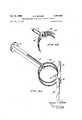
- FIG. 1is a plan view of a vertical dipole antenna and a horizontal loop antenna combined in accordance with this invention
- FIG. 2is a plan view of a vertical dipole antenna and a horizontal loop antenna combined in accordance with the prior art
- FIG. 3is a plan view of a vertical dipole and a folded loop antenna combined in accordance with this invention.
- FIG. 4Ais a pictorial showing of a preferred combined loop-dipole structure
- FIG. 4Bis a pictorial showing of the loop-dipole structure of FIG. 4A with a different feed;
- FIG. 5is a pictorial showing of an alternative combined loop-dipole structure
- FIG. 6is a side elevational view of an array of dipoleloop antennas
- FIG. 7is a side elevation of a vertical dipole antenna mounted on a horizontal loop antenna
- FIG. 8is a plan view of the structure of FIG. 7;
- FIG. 9is a side elevation of another combined vertical dipole antenna
- FIG. 10is a plan view of an alternative loop-dipole antenna.
- FIG. 11is an elevational view of a loop-dipole antenna.
- FIG. 1there is shown a capacitance plate loop antenna 12 with a dipole 14 located opposite the loop feed point 16.
- FIG. 2shows the prior art configuration with the dipole 14 placed at the center of the loop 12. The art has generally recognized the obviousness of the arrangement of FIG. 2 and it has been generally assumed that by locating the dipole at the center, the phase centers would coincide. This has not been found to be true for practical loops.
- the location of the dipoleshould be generally Within an area A of 7 ⁇ /41r diameter in front of the loop, centered at a point furthest from the supporting tower. In addition, it is advantageous to maximize the distance between the vertical dipole and the supporting tower.
- the arrangement of the loop and dipole in FIG. 1accomplishes this goal.
- the half wave form of the loop 18, shown in FIG. 3,is generally preferred by the industry because it is smaller.
- the ends of the conductors 19 and 20terminate in capacitance plates 22 and 23. Loops are generally M2 in circumference which corresponds to a diameter of )s/2fl'.
- the overall length of the vertical dipoleis therefore about ⁇ /2.
- a balun 36is employed for the purpose of connecting the antenna to a coaxial transmission line.
- the balunmay be mounted on a tower by means of flanges 37 and fed from a coaxial line.
- the dipole-loop antenna 30is fed from coaxial line C.
- the outer conductor of the coaxial linebeing directly connected to the loop and the inner conductor an inductive strap 38 is attached to a suitable point on member 39 for the purpose of impedance matching.
- the loop configurationis not critical. By way of example, there are shown other configurations.
- a cylindrical loop configuration 41is shown.
- a rhombic loop 43 with a dipole 45is shown in FIG. 10.
- a triplering loop antenna 47is shown in FIG. 11.
- the capacitor platesneeds not be one-piece and indeed as shown in FIG. 11, may be separate segments 49a, 49b and 49c.
- Dipoles 51a, 5112,are shown extending from opposite plates 49a and 49C. Plate 49b is supported by dielectric spacers 53.
- the dipole-loop of this inventionmay be conveniently arrayed, as shown in FIG. 6.
- Tower 40carries a transmission line 42 which is tapped by lines 44 to feed dipoleloops 46. It is to be noted that only a single feed line is required which represents a great cost advantage over an antenna system requiring a pair of feeds.
- FIGS. 7 and 8there is shown still another method of mounting the dipole 80 in front of the loop antenna.
- Capacitance plates 70 and 71 of loop antenna 72have afiixed to them insulator plates 73 and 74.
- a suitable material for'the insulator platesis, by way of example, polyester bonded glass fiber board.
- Arms 75 and 76 extending from the insulators 73 and 74support the dipole.
- a two-line feedis used to energize the dipole.
- One conductor 78ais attached to one arm 80a and the other con ductor 78b to the other arm 80b at the opposed faces.
- conductive strapscan be run from respective ones of the plates 70 and 71 to the dipoles for direct feed.
- the separate feedmay be used where phase adjustment means between the horizontal and vertical elements is desired.
- FIG. 9Still another construction is shown in FIG. 9 wherein the vertical dipole is fed by means of a balun 92 suspended directly below the loop antenna 94.
- the balun 92 and the loop antennaare fed through respective coaxial lines 97 and 99.
- the feed means employed for this purposemay be those conventionally employed in this art. It is is to be understood that while separate feed lines are shown, a common feed line may be employed.
- the loopwould be kept horizontal with respect to the earths surface and the dipole at right angles to the loop.
- the loopmay be positioned at an angle to the earths surface.
- An omnidirectional circularly polarized antennacomprising:
- a dipole antennahaving a principal axis orthogonal to the plane of the loop said dipole being supported within a circle having a diameter of A/41r, the circle being tangent to and outside the said loop, the point of tangency being diametrically opposite the feed point with the center of the said dipole proximate the plane of the loop, where A is the frequency of operation of said loop and dipole antenna;
- (c)means to energize said dipole antenna from a transmission line.
- the antenna of claim 1including a capacitor comprising a pair of opposed plates, said loop being in the form of two arms, each of said arms terminating in a respective one of said opposed capacitor plates.
- the antenna of claim 1including a capacitor inserted into said loop at a point diametrically opposite the feed point and in series with the loop.
- said vertical dipolecomprises a pair of arms each of which is mechanically supported from a respective one of said capacitor plates by an electrically conductive member for energization therefrom.
Landscapes
- Variable-Direction Aerials And Aerial Arrays (AREA)
Description
R. D. BOGNER Qct. 21,1969
OMNIDIREC'I'IQNAL CIRCULARLY POLARIZED ANTENNA Filed Feb. 16, 1967 3 Sheets-Sheet 1 FIG. 6
m T N E V m film/ll A. 117701212? OMNIDIREC'IIONAL OIRCULARLY POLARIZED ANTENNA Filed Feb. 16, 1967 R. D. BOGNER Oct. 21, 1969 3 Sheets-Sheet 2 FIG. 4A
INVENTOR IF/CHARD D. 306M61 Lana/J IJ. ATTORNE Oct. 21, 1969 Filed Feb. 16, 1967 R. o. BOGNER 3,474,452
4 v INVENTOR. RICA/4RD 12 fiOG'AER fl w. ,1 K ATTORNEY United States Patent 3,474,452 OMNIDIRECTIONAL CIRCULARLY POLARIZED ANTENNA Richard D. Bogner, Roslyn, N.Y., assignor to Electronics Research, Inc., Evansville, Ind Filed Feb. 16, 1967, Ser. No. 616,541
' Int. Cl. H01q 21/00 US. Cl. 343-726 17 Claims ABSTRACT OF THE DISCLOSURE A horizontally polarized loop and a vertically polarized dipole are combined to provide a single omnidirectional circularly polarized antenna.
BACKGROUND OF THE INVENTION It is well known that a combination of vertical and horizontal polarization (with respect to some reference plane, e.g., the earths surface) will result in circular or elliptical polarization of radiation, depending upon the relative phase and amplitude relationship. Vertically polarized radiation may be obtained from a vertical antenna such as a vertically oriented dipole; horizontally polarized radiation may be obtained from a horizontal antenna such as a horizontally oriented dipole or loop. The loop may be bent into a complete circle, or be peripherally incomplete with the open ends of the semicircular conductors being connected together electrically by capacitance plates. Either loop form has a toroidal radiation pattern polarized in the plane of the omnidirectional pattern and of the loop. A vertical dipole has the same radiation pattern but polarized transverse to the plane of the omnidirectional pattern.
It has been suggested in the literature that these two antenna types with identical radiation patterns when orthogonally polarized be combined to form a circularly polarized antenna, omnidirectional in one plane, usually the horizontal plane. To do this, it is necessary to so locate the loop and dipole that their phase centers are essentially coincident, and then to feed the two with equal signal, and 90 phase difference. It is usually assumed that the dipole in the center of the loop is the proper arrangement. This arrangement is taught for example, in the following US. Patents: 2,45,379 to Armig G. Kandoian; 2,460,260 to Paul J. Kibler; 2,953,782 to Denis Byatt; and is discussed in the Antenna Engineering Handbook, edited by Dr. Henry Jasik 1961), McGraw-Hill Book Company, sec. 17.2, p. 17-9, FIG. 17-8.
- I have found that in practice, contrary to theory and general opinion as being obvious, the arrangement with the dipole at, or even near, the loop center does not provide circular polarization in every direction in the loop plane. In fact, for this case, with any relative phase and amplitude between the dipole and the loop, the polarization departs radically from circular, and is in fact linear or near linear, in one or more directions in the omnidirectional pattern plane.
I have further found, however, that there does exist an arrangement of the loop and dipole wherein proper relative phase and amplitude Provides equal signal and circular polarization in every direction in the plane of the loop. This arrangement is quite an unexpected one, since it requires the dipole to be actually external to the loop, a small distance from the loop, and on the opposite Patented Oct. 21, 1969 side from the loop feed point. Often such a loop has a small gap opposite the feed point possibly with capacitance plates as described above, and if such a loop gap is used, the dipole should be placed just beyond it.
If a loop and dipole are so arranged and fed with proper, usually near equal amplitude, and proper relative phase as determined by expeniment, then a circularly polarized omnidirectional pattern is obtainable, within the 3 db variation limits generally accepted in the art.
Accordingly, it is a principal object of this invention to provide an improved circularly polarized omnidirectional antenna.
A principal object is to provide a modified loop antenna having a circularly polarized transmission pattern.
Another object is to provide a single structure having the characteristics of a horizontal loop antenna and a vertical dipole antenna oeprating in unison.
Still a different object is to provide a horizontal loop antenna and a vertical dipole antenna having a circularly polarized pattern and which is energized by a single feed.
These and other features, objects and advantages of the invention will, in part, become obvious from the following more detailed description of the invention taken in conjunction with the accompanying drawing which forms an integral part thereof.
SUMMARY OF THE INVENTION It has been found that a capacitance plate type loop antenna, having dipole elements extending from the capacitance plates, can provide an omnidirectional radiation pattern in one plane circularly polarized in every direction in that plane. The dipole elements may be electrically connected to the capacitance plates for direct feed, or mechanically supported from the capacitance plates but electrically isolated from the plates with independent feed. Alternatively, the dipole may be independently supported and fed, provided the dipole is maintained proximate to the capacitance plates.
BRIEF DESCRIPTION OF THE DRAWING In the various figures of the drawing, like reference characters designate like parts.
In the drawing:
FIG. 1 is a plan view of a vertical dipole antenna and a horizontal loop antenna combined in accordance with this invention;
FIG. 2 is a plan view of a vertical dipole antenna and a horizontal loop antenna combined in accordance with the prior art;
FIG. 3 is a plan view of a vertical dipole and a folded loop antenna combined in accordance with this invention;
FIG. 4A is a pictorial showing of a preferred combined loop-dipole structure;
FIG. 4B is a pictorial showing of the loop-dipole structure of FIG. 4A with a different feed;
FIG. 5 is a pictorial showing of an alternative combined loop-dipole structure;
FIG. 6 is a side elevational view of an array of dipoleloop antennas;
FIG. 7 is a side elevation of a vertical dipole antenna mounted on a horizontal loop antenna;
FIG. 8 is a plan view of the structure of FIG. 7;
FIG. 9 is a side elevation of another combined vertical dipole antenna;
FIG. 10 is a plan view of an alternative loop-dipole antenna; and
FIG. 11 is an elevational view of a loop-dipole antenna.
DESCRIPTION OF THE PREFERRED EMBODIMENT In FIG. 1, there is shown a capacitanceplate loop antenna 12 with adipole 14 located opposite theloop feed point 16. In contrast, FIG. 2 shows the prior art configuration with thedipole 14 placed at the center of theloop 12. The art has generally recognized the obviousness of the arrangement of FIG. 2 and it has been generally assumed that by locating the dipole at the center, the phase centers would coincide. This has not been found to be true for practical loops.
With the dipole located outside the loop and just forward of the loop opposite the loop feed point F, substantial coincidence of the phase centers is obtained and the polarization is close to circular in every direction. The location of the dipole should be generally Within an area A of 7\/41r diameter in front of the loop, centered at a point furthest from the supporting tower. In addition, it is advantageous to maximize the distance between the vertical dipole and the supporting tower. The arrangement of the loop and dipole in FIG. 1 accomplishes this goal. The half wave form of theloop 18, shown in FIG. 3, is generally preferred by the industry because it is smaller. The ends of theconductors capacitance plates
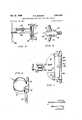
In FIG. 4 there is shown the presently preferred embodiment. Aloop antenna 30, shown by way of example as a double ring type and comprising aloop section 31 which terminates in a pair ofcapacitor plates conductive dipole arm 34 of approximately M4 in length is electrically and structurally secured to plate 32 and alike arm 35 is similarly secured toplate 33. The overall length of the vertical dipole is therefore about \/2. For the purpose of connecting the antenna to a coaxial transmission line, abalun 36 is employed. The balun may be mounted on a tower by means offlanges 37 and fed from a coaxial line.
In the embodiment of FIG. 4B, the dipole-loop antenna 30 is fed from coaxial line C. The outer conductor of the coaxial line being directly connected to the loop and the inner conductor aninductive strap 38 is attached to a suitable point onmember 39 for the purpose of impedance matching.
The loop configuration is not critical. By way of example, there are shown other configurations. In FIG. 5, a cylindrical loop configuration 41 is shown. Arhombic loop 43 with adipole 45 is shown in FIG. 10. Atriplering loop antenna 47 is shown in FIG. 11. The capacitor plates needs not be one-piece and indeed as shown in FIG. 11, may beseparate segments Dipoles 51a, 5112, are shown extending fromopposite plates 49a and 49C.Plate 49b is supported bydielectric spacers 53.
The dipole-loop of this invention may be conveniently arrayed, as shown in FIG. 6.Tower 40 carries atransmission line 42 which is tapped bylines 44 to feeddipoleloops 46. It is to be noted that only a single feed line is required which represents a great cost advantage over an antenna system requiring a pair of feeds.
In FIGS. 7 and 8, there is shown still another method of mounting thedipole 80 in front of the loop antenna.Capacitance plates loop antenna 72 have afiixed to theminsulator plates Arms insulators conductor 78a is attached to onearm 80a and theother con ductor 78b to the other arm 80b at the opposed faces.
If desired, conductive straps can be run from respective ones of theplates
Still another construction is shown in FIG. 9 wherein the vertical dipole is fed by means of a balun 92 suspended directly below theloop antenna 94. The balun 92 and the loop antenna are fed through respectivecoaxial lines 97 and 99. The feed means employed for this purpose may be those conventionally employed in this art. It is is to be understood that while separate feed lines are shown, a common feed line may be employed.
Generally, the loop would be kept horizontal with respect to the earths surface and the dipole at right angles to the loop. However, for many applications the loop may be positioned at an angle to the earths surface.
There has been disclosed heretofore the best embodiment of the invention presently contemplated and it is to be understood that various changes and modifications may be made by those skilled in the art without departing from the spirit of the invention.
What I claim as new and desire to secure by Letters Patent is:
1. An omnidirectional circularly polarized antenna comprising:
(a) a loop antenna lying in a principal plane and having a feed point for energizing said loop antenna from a transmission line;
(b) a dipole antenna having a principal axis orthogonal to the plane of the loop said dipole being supported within a circle having a diameter of A/41r, the circle being tangent to and outside the said loop, the point of tangency being diametrically opposite the feed point with the center of the said dipole proximate the plane of the loop, where A is the frequency of operation of said loop and dipole antenna; and
(c) means to energize said dipole antenna from a transmission line.
2. The antenna ofclaim 1 including a capacitor comprising a pair of opposed plates, said loop being in the form of two arms, each of said arms terminating in a respective one of said opposed capacitor plates.
3. The antenna ofclaim 1 including a capacitor inserted into said loop at a point diametrically opposite the feed point and in series with the loop.
4. The antenna ofclaim 1 wherein said loop and dipole antennas are energized from the same transmission line.
5. The antenna of claim 2 wherein said dipole is mechanically supported by said capacitor plates.
6. The antenna of claim 2 wherein said dipole has two arms each of which is electrically connected to a respective one of said capacitor plates.
7. The antenna of claim 5 wherein said dipole and said loop are energized from independent transmission lines.
8. The antenna of claim 3 wherein said vertical dipole comprises a pair of arms each of which is mechanically supported from a respective one of said capacitor plates by an electrically conductive member for energization therefrom.
9. In combination with a vertical tower, a plurality of the antennas ofclaim 1 arranged in a vertical column.
10. In combination with a vertical tower, a plurality of the antennas of claim 2 arranged in a vertical column.
11. In combination with a vertical tower, a plurality of the antennas of claim 3 arranged in a vertical column.
12. In combination with a vertical tower, a plurality of the antennas of claim 4 arranged in a vertical column.
13. In combination with a vertical tower, a plurality of the antennas of claim 5 arranged in a vertical column.
14. In combination with a vertical tower, a plurality of the antennas ofclaim 6 arranged in a vertical column.
15. In combination with a vertical tower, a plurality of the antennas of claim 7 arranged in a vertical column.
5 16. In combination with a vertical tower, a plurality of the antennas of claim 8 arranged in a vertical column.
17. In combination with a vertical tower, a plurality of the antennas of claim 9 arranged in a vertical column.
References CitedUNITED STATES PATENTS 6 FOREIGN PATENTS 577,789 6/1959 Canada.
HERMAN KARL SAALBACH, Primary Examiner 5 F. PRINCE BUTLER, Assistant Examiner US. Cl. X.R.
Applications Claiming Priority (1)
| Application Number | Priority Date | Filing Date | Title |
|---|---|---|---|
| US61654167A | 1967-02-16 | 1967-02-16 |
Publications (1)
| Publication Number | Publication Date |
|---|---|
| US3474452Atrue US3474452A (en) | 1969-10-21 |
Family
ID=24469919
Family Applications (1)
| Application Number | Title | Priority Date | Filing Date |
|---|---|---|---|
| US616541AExpired - LifetimeUS3474452A (en) | 1967-02-16 | 1967-02-16 | Omnidirectional circularly polarized antenna |
Country Status (1)
| Country | Link |
|---|---|
| US (1) | US3474452A (en) |
Cited By (22)
| Publication number | Priority date | Publication date | Assignee | Title |
|---|---|---|---|---|
| US3576567A (en)* | 1967-07-11 | 1971-04-27 | Edward H Shively | Circularly polarized broadcast antenna |
| US3665479A (en)* | 1970-07-28 | 1972-05-23 | Electronics Research Inc | Omnidirectional tower supported antenna |
| FR2315179A1 (en)* | 1975-06-20 | 1977-01-14 | Aerospatiale | Half wave aerial for circularly polarised signals - has two plane parallel loops of opposite sense connected by straight conductor |
| US4031536A (en)* | 1975-11-03 | 1977-06-21 | Andrew Alford | Stacked arrays for broadcasting elliptically polarized waves |
| US4119970A (en)* | 1977-10-19 | 1978-10-10 | Bogner Richard D | Dipole-slot type omnidirectional transmitting antenna |
| USD250112S (en) | 1977-03-21 | 1978-10-31 | Silliman Thomas B | Omnidirectional circularly polarized transmitting antenna |
| US4223315A (en)* | 1975-11-03 | 1980-09-16 | Andrew Alford | Stacked arrays for broadcasting elliptically polarized waves |
| US4600926A (en)* | 1983-07-28 | 1986-07-15 | Powell Stanley L | Television antenna |
| US5021797A (en)* | 1990-05-09 | 1991-06-04 | Andrew Corporation | Antenna for transmitting elliptically polarized television signals |
| US5751252A (en)* | 1995-06-21 | 1998-05-12 | Motorola, Inc. | Method and antenna for providing an omnidirectional pattern |
| EP0711000A3 (en)* | 1994-10-27 | 1998-11-25 | SICAN F&E GmbH ( SIBET) | Hybrid antenna and broadband hybrid antenna array |
| US6414647B1 (en) | 2001-06-20 | 2002-07-02 | Massachusetts Institute Of Technology | Slender omni-directional, broad-band, high efficiency, dual-polarized slot/dipole antenna element |
| WO2003044892A1 (en)* | 2001-11-22 | 2003-05-30 | Valtion Teknillinen Tutkimuskeskus | Modified loop antenna with omnidirectional radiation pattern and optimized properties for use in an rfid device |
| US20080136720A1 (en)* | 2006-12-11 | 2008-06-12 | Harris Corporation | Multiple polarization loop antenna and associated methods |
| US20080136721A1 (en)* | 2006-12-11 | 2008-06-12 | Harris Corporation | Polarization-diverse antenna array and associated methods |
| US20100090924A1 (en)* | 2008-10-10 | 2010-04-15 | Lhc2 Inc | Spiraling Surface Antenna |
| US20100188308A1 (en)* | 2009-01-23 | 2010-07-29 | Lhc2 Inc | Compact Circularly Polarized Omni-Directional Antenna |
| US20100207830A1 (en)* | 2009-02-18 | 2010-08-19 | Harris Corporation | Planar antenna having multi-polarization capability and associated methods |
| US20100207829A1 (en)* | 2009-02-18 | 2010-08-19 | Harris Corporation | Planar slot antenna having multi-polarization capability and associated methods |
| US7948440B1 (en) | 2006-09-30 | 2011-05-24 | LHC2 Inc. | Horizontally-polarized omni-directional antenna |
| US8803749B2 (en) | 2011-03-25 | 2014-08-12 | Kwok Wa Leung | Elliptically or circularly polarized dielectric block antenna |
| US20160043466A1 (en)* | 2014-08-08 | 2016-02-11 | Wistron Neweb Corporation | Miniature Antenna and Antenna Module Thereof |
Citations (3)
| Publication number | Priority date | Publication date | Assignee | Title |
|---|---|---|---|---|
| US2419539A (en)* | 1943-03-05 | 1947-04-29 | Standard Telephones Cables Ltd | Loop antenna construction |
| CA577789A (en)* | 1959-06-16 | Stewart-Warner Corporation | Sense antenna system | |
| US2953782A (en)* | 1955-05-04 | 1960-09-20 | Marconi Wireless Telegraph Co | Receiving aerial systems |
- 1967
- 1967-02-16USUS616541Apatent/US3474452A/ennot_activeExpired - Lifetime
Patent Citations (3)
| Publication number | Priority date | Publication date | Assignee | Title |
|---|---|---|---|---|
| CA577789A (en)* | 1959-06-16 | Stewart-Warner Corporation | Sense antenna system | |
| US2419539A (en)* | 1943-03-05 | 1947-04-29 | Standard Telephones Cables Ltd | Loop antenna construction |
| US2953782A (en)* | 1955-05-04 | 1960-09-20 | Marconi Wireless Telegraph Co | Receiving aerial systems |
Cited By (30)
| Publication number | Priority date | Publication date | Assignee | Title |
|---|---|---|---|---|
| US3576567A (en)* | 1967-07-11 | 1971-04-27 | Edward H Shively | Circularly polarized broadcast antenna |
| US3665479A (en)* | 1970-07-28 | 1972-05-23 | Electronics Research Inc | Omnidirectional tower supported antenna |
| FR2315179A1 (en)* | 1975-06-20 | 1977-01-14 | Aerospatiale | Half wave aerial for circularly polarised signals - has two plane parallel loops of opposite sense connected by straight conductor |
| US4223315A (en)* | 1975-11-03 | 1980-09-16 | Andrew Alford | Stacked arrays for broadcasting elliptically polarized waves |
| US4031536A (en)* | 1975-11-03 | 1977-06-21 | Andrew Alford | Stacked arrays for broadcasting elliptically polarized waves |
| USD250112S (en) | 1977-03-21 | 1978-10-31 | Silliman Thomas B | Omnidirectional circularly polarized transmitting antenna |
| US4119970A (en)* | 1977-10-19 | 1978-10-10 | Bogner Richard D | Dipole-slot type omnidirectional transmitting antenna |
| US4600926A (en)* | 1983-07-28 | 1986-07-15 | Powell Stanley L | Television antenna |
| US5021797A (en)* | 1990-05-09 | 1991-06-04 | Andrew Corporation | Antenna for transmitting elliptically polarized television signals |
| EP0711000A3 (en)* | 1994-10-27 | 1998-11-25 | SICAN F&E GmbH ( SIBET) | Hybrid antenna and broadband hybrid antenna array |
| US5751252A (en)* | 1995-06-21 | 1998-05-12 | Motorola, Inc. | Method and antenna for providing an omnidirectional pattern |
| US6414647B1 (en) | 2001-06-20 | 2002-07-02 | Massachusetts Institute Of Technology | Slender omni-directional, broad-band, high efficiency, dual-polarized slot/dipole antenna element |
| WO2003044892A1 (en)* | 2001-11-22 | 2003-05-30 | Valtion Teknillinen Tutkimuskeskus | Modified loop antenna with omnidirectional radiation pattern and optimized properties for use in an rfid device |
| US7948440B1 (en) | 2006-09-30 | 2011-05-24 | LHC2 Inc. | Horizontally-polarized omni-directional antenna |
| US20080136721A1 (en)* | 2006-12-11 | 2008-06-12 | Harris Corporation | Polarization-diverse antenna array and associated methods |
| US7505009B2 (en) | 2006-12-11 | 2009-03-17 | Harris Corporation | Polarization-diverse antenna array and associated methods |
| US9680224B2 (en) | 2006-12-11 | 2017-06-13 | Harris Corporation | Multiple polarization loop antenna and associated methods |
| US20080136720A1 (en)* | 2006-12-11 | 2008-06-12 | Harris Corporation | Multiple polarization loop antenna and associated methods |
| US8847832B2 (en) | 2006-12-11 | 2014-09-30 | Harris Corporation | Multiple polarization loop antenna and associated methods |
| US8570239B2 (en) | 2008-10-10 | 2013-10-29 | LHC2 Inc. | Spiraling surface antenna |
| US20100090924A1 (en)* | 2008-10-10 | 2010-04-15 | Lhc2 Inc | Spiraling Surface Antenna |
| US20100188308A1 (en)* | 2009-01-23 | 2010-07-29 | Lhc2 Inc | Compact Circularly Polarized Omni-Directional Antenna |
| US8203500B2 (en) | 2009-01-23 | 2012-06-19 | Lhc2 Inc | Compact circularly polarized omni-directional antenna |
| US20100207830A1 (en)* | 2009-02-18 | 2010-08-19 | Harris Corporation | Planar antenna having multi-polarization capability and associated methods |
| US8319688B2 (en) | 2009-02-18 | 2012-11-27 | Harris Corporation | Planar slot antenna having multi-polarization capability and associated methods |
| US8044874B2 (en) | 2009-02-18 | 2011-10-25 | Harris Corporation | Planar antenna having multi-polarization capability and associated methods |
| US20100207829A1 (en)* | 2009-02-18 | 2010-08-19 | Harris Corporation | Planar slot antenna having multi-polarization capability and associated methods |
| US8803749B2 (en) | 2011-03-25 | 2014-08-12 | Kwok Wa Leung | Elliptically or circularly polarized dielectric block antenna |
| US20160043466A1 (en)* | 2014-08-08 | 2016-02-11 | Wistron Neweb Corporation | Miniature Antenna and Antenna Module Thereof |
| US9570816B2 (en)* | 2014-08-08 | 2017-02-14 | Wistron Neweb Corporation | Miniature antenna and antenna module thereof |
Similar Documents
| Publication | Publication Date | Title |
|---|---|---|
| US3474452A (en) | Omnidirectional circularly polarized antenna | |
| US2267889A (en) | Antenna with wide wave range | |
| US3945013A (en) | Double omni-directional antenna | |
| US2283897A (en) | Antenna system | |
| US2640930A (en) | Antenna assembly | |
| US3348228A (en) | Circular dipole antenna array | |
| GB927051A (en) | Improvements in or relating to antennas for high frequencies | |
| US3019439A (en) | Elliptically polarized spiral antenna | |
| US4180820A (en) | Circularly polarized antenna system using a combination of horizontal and bent vertical dipole radiators | |
| US3044066A (en) | Three conductor planar antenna | |
| GB1338753A (en) | Multimode antenna | |
| US2539433A (en) | Circularly polarized antenna | |
| US2928087A (en) | Omnidirectional beacon antenna | |
| US2188649A (en) | Antenna | |
| US3039099A (en) | Linearly polarized spiral antenna system | |
| US3665479A (en) | Omnidirectional tower supported antenna | |
| US2210491A (en) | High frequency antenna | |
| US2290800A (en) | Antenna | |
| US4518969A (en) | Vertically polarized omnidirectional antenna | |
| US2556046A (en) | Directional antenna system | |
| US2512137A (en) | Antenna | |
| US2426632A (en) | Antenna structure | |
| US3055003A (en) | Spiral antenna array with polarization adjustment | |
| US2116734A (en) | Short-wave antenna | |
| US3123827A (en) | Log periodic structure feed system |