US3352489A - Thermostatic mixing valve - Google Patents
Thermostatic mixing valveDownload PDFInfo
- Publication number
- US3352489A US3352489AUS516431AUS51643165AUS3352489AUS 3352489 AUS3352489 AUS 3352489AUS 516431 AUS516431 AUS 516431AUS 51643165 AUS51643165 AUS 51643165AUS 3352489 AUS3352489 AUS 3352489A
- Authority
- US
- United States
- Prior art keywords
- valve
- casing
- block
- bleeding
- hot
- Prior art date
- Legal status (The legal status is an assumption and is not a legal conclusion. Google has not performed a legal analysis and makes no representation as to the accuracy of the status listed.)
- Expired - Lifetime
Links
- 230000000740bleeding effectEffects0.000claimsdescription34
- 239000012530fluidSubstances0.000claimsdescription20
- 239000007788liquidSubstances0.000claimsdescription16
- 238000004891communicationMethods0.000claimsdescription14
- XLYOFNOQVPJJNP-UHFFFAOYSA-NwaterSubstancesOXLYOFNOQVPJJNP-UHFFFAOYSA-N0.000description47
- 239000002184metalSubstances0.000description26
- 238000006073displacement reactionMethods0.000description4
- 238000010276constructionMethods0.000description3
- 239000003795chemical substances by applicationSubstances0.000description2
- 230000013011matingEffects0.000description1
- 239000000203mixtureSubstances0.000description1
- 238000012986modificationMethods0.000description1
- 230000004048modificationEffects0.000description1
- 230000002093peripheral effectEffects0.000description1
- 230000002035prolonged effectEffects0.000description1
- 230000000717retained effectEffects0.000description1
- 238000007789sealingMethods0.000description1
- 230000035945sensitivityEffects0.000description1
Images
Classifications
- G—PHYSICS
- G05—CONTROLLING; REGULATING
- G05D—SYSTEMS FOR CONTROLLING OR REGULATING NON-ELECTRIC VARIABLES
- G05D23/00—Control of temperature
- G05D23/01—Control of temperature without auxiliary power
- G05D23/13—Control of temperature without auxiliary power by varying the mixing ratio of two fluids having different temperatures
- G05D23/1306—Control of temperature without auxiliary power by varying the mixing ratio of two fluids having different temperatures for liquids
- G05D23/132—Control of temperature without auxiliary power by varying the mixing ratio of two fluids having different temperatures for liquids with temperature sensing element
- G05D23/134—Control of temperature without auxiliary power by varying the mixing ratio of two fluids having different temperatures for liquids with temperature sensing element measuring the temperature of mixed fluid
- G05D23/136—Control of temperature without auxiliary power by varying the mixing ratio of two fluids having different temperatures for liquids with temperature sensing element measuring the temperature of mixed fluid with pressure equalizing means
Definitions
- ABSTRACT OF THE DISCLOSUREThis invention concerns a thermostatic mixing valve which maintains the discharged fluid at set adjustable temperature irrespective of the temperatures and pressures of the two ingoing fluids to be mixed.
- the valvefurther has a means to vary the rate of flow of the outgoing fluid.
- the valvecomprises a block having a pair of separate passages for cold and hot fluids under pressure and each having an inlet and an outlet provided with a valve seat, a casing surrounding the block and in communication with the passage outlets for receiving and mixing the hot and cold fluids, an outlet for the casing disposed above the bottom of the casing, the valve seats being axially aligned, a valve stem slidable within the block and extending therethrough, main valve members secured to both ends of said valve stem and co-operable with the valve seats respectively, whereby axial movement of the valve stem will open one valve member and will close the other, a pressure chamber surrounding the middle portion of the valve stem and made in the block, a fluid-tight diaphragm separating the pressure chamber into two half-chambers, each inlet communicating with its associated half-chambers for feeding fluid from the respective inlets to said separate half-chambers, bleeding passageways made in said block and connecting each halfchamber with said casing, each bleeding passageway having a valve seat formed in the block, the two
- the present inventionrelates to improvements in thermostatic mixing valves, in which water of low and high temperature from separate conduits, is supplied to the valve, and a mixture of intermediate temperature may be delivered in accordance with the proportions of cold and hot water being mixed, the proportioning mechanism being controlled by a thermostatic element, usually in the form of a bi-metal.
- the result- .ing assemblyhas a large size and is therefore unyieldy and not very well adapted for use in association with conventional washbasins and the like,
- the general object of the present inventionresides in the provision of a thermostatic mixing valve or faucet, which obviates the above disadvantages, being fundamentally characterized by the fact that it uses the pressure of the water to directly control and actuate the proportioning valves, means being provided for establishing a water pressure difierential acting on the proportioning valves and being under the control of a thermostatic means, whereby said latter means can be made of small size and requiring to develop only a relatively small force.
- Another object of the present inventionresides in the provision of a mixing valve of the character described, which is very accurate in that the adjusted temperature of the output liquid will vary within a very narrow range, despite variations of temperature and pressure of the input cold and hot liquids.
- Another object of the present inventionresides in the provision of a valve of the character described, which can be made of relatively small size, which is simple and of relatively inexpensive construction and which will give a prolonged service, all the parts being of sturdy construction and with a minimum of linkages.
- Another object of the present inventionresides in the provision of a valve of the character described, provided with means for varying and adjusting the rate of flow of the output liquid.
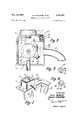
- FIGURE 1is a perspective view of a mixing faucet in accordance with a first embodiment of the invention associated with a washbasin, shown partially in cross-section;
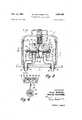
- FIGURE 2is a transverse section of the faucet of the first embodiment
- FIGURE 3is a section, taken along line 3-3 of FIG- URE 2;
- FIGURE 4is a partial section, taken along line 4-4 of FIGURE 3;
- FIGURES 5 and 6are end views of the cam means for adjusting the thermostatic element in the first embodiment
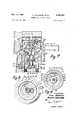
- FIGURE 7is a longitudinal section of a faucet in accordance with a second embodiment
- FIGURE 8is a cross-section, taken along line 8-8 of FIGURE 7;
- FIGURE 9is a cross-section, taken along line 99 of FIGURE 7. 7
- the mixing valve in accordance with the first embodimentcomprises a casing 1 having an output spout F 2, depending from one lateral wall thereof and in communication with the interior thereof.
- Casing 1has an integral bottom 3 and is closed at the top by a removable cover 4, held in sealing condition by means of through bolts 5.
- a single flow rate adjusting knob 6is disposed on top of cover 4, together with a temperature adjusting dial 7.
- Cold and hot liquid inlet tubes 8 and 9, respectively,extend through bottom 3 and are secured thereto and are adapted to extend through holes 10 made in the top 11 of the washbasin 12, or the like, to be connected with cold and hot liquid supply pipes (not shown).
- the casing 1is secured to the Washbasiu 12 by means of nuts 13, or the like, threaded on the outer portions of tubes 8 and 9.
- the discharge end portions 14, 15 of tubes 8 and 9are fully open and extend in a common plane perpendicular to the rotary axis of knob 6.
- a block 16is provided with two spaced blind bores 17 adapted to slidably receive the discharge portions 14 and of the inlet tubes 8 and 9.
- the bottom of the blind bores 17is lined with gaskets 18.
- the top of block 16is secured to and suspended from a bracket 19 having a threaded blind bore for receiving a threaded spindle 20, which is rotatably mounted within the cover 4 and extends therethrough to be secured to operating knob 6.
- block 16is caused to be raised or lowered with respect to the stationarily mounted tubes 8 and 9, so as to approach more or less the gasket 18 from the discharge ends 14 and 15 of the tubes 8 and 9.
- Thisprovides for the control of the flow rate of the liquid being discharged.
- Each blind bore 17is in communication with the inside of casing 1 by means of a passage 21 in lateral communication with the blind bore adjacent gasket 18 and with a frusto-conical cavity 22, made at the outer face of block 16. There might be several passages 21 opening laterally into one cavity 22 so as not to restrict the flow of liquid from tubes '8 and 9 into the casing 1.
- Each cavity 22acts a valve seat for a proportioning valve member 23, the two valve members 23 for the hot and cold water passages respectively being adjustably secured to a common stem 24 at the outer ends thereof, said stem being mounted for sliding axial movement within a through bore made in block 16 co-axial with the 'frusto-conical cavities 22 at both ends of the block, and having its axis substantially perpendicular to the discharge portions 14 and 15 of tubes 8 and 9.
- the block 16is preferably made in two symmetrical half-parts rigidly secured by means of tie bolts, not shown, in end-to-end relationship, so as to define in the center of the block a pressure chamber separated in two sections 29, 29 in liquid-tight manner by means of a flexible diaphragm 26 sandwiched between the two 'halfblocks and surrounding stem 24, and secured thereon by means of washers 27 and nuts 28.
- Each half chamber 29, 29'is in communication with the respective blind bores -17 by means of a small bore feeding passage 30 opening laterally within the blind bore 17 adjacent gasket 18.
- Each half-chamber 29, 29'is also in communication with the inside of casing 1 through a small bore bleeding passage 31, ,of a diameter substantially equal to that oi passage 30.
- the bleeding passages 31have axially aligned, spaced valve seats 32 adapted to be closed alternately by means of a common pilot needle valve member 33 in the form not a double-pointed stem, which bridges space 34 defined by two lateral extensions of-the half-parts of'block 16 on each side of the diaphragm 26.
- the needle valve 33is actuated by a bimetal thermostatic element 35, wound in a spiral, the outer end of which is connected to the needle valve 33 by means of an L-shaped rod 36 which is pivoted inside a transverse central bore of needle valve 33, and which at its outer end is welded, or otherwise secured, to the outer end of the bi-metal 35.
- the inner end of the bi-metal elementis secured to a'bushing 37, itself surrounding and tightly secured to the horizontal leg 38 of an L-shaped rod 39.
- Leg 38is pivotally mounted in a blind bore of block 16, while the upper end of its vertical leg slidably engages an annular cavity 40 made in a rotary cam element 41, disposed within the casing 1, and having an upstanding shaft 42 passing through cover 4 and secured to the control dial 7.
- Shaft 42is eccentrically disposed with respect to annular cavity 40.
- Bi-metal 35is located .within casing 1 below the level of the inlet of spout 2 to be immersed in the mixed cold and hot water.
- Block 16is raised by means of knob 6 to uncover more or less lateral passage 21 to adjust the rate of discharge of water.
- bleeding passage 31must have a sectional area at least equal to that of feeding passage 30 so as to lower the pressure in the half-chamber 29 or 29' to substantially the pressure existing in casing 1, in order to produce the pressure dilferential.
- the proportioning valve formed by stem 24 and by bi-metal 23 and valve seats 22,is actuated by the water pressure differential on each side of diaphragm 26 and that the bi-metal element 35 only serves to displace the small diameter pilot needle valve 33 against the reduced force produced on the latter under the pressure discharge of the small bore bleeding passage 31.
- the bi-metal 35need not be of such a type as to develop a large force and, moreover, because it only has to develop a small force to move needle valve 33, the sensitivity of the arrangement is very high, and for any preset temperature of the thermostat, the actual variations of the temperature of the water being discharged will vary within very narrow limits.
- the needle valve 33seldom closes entirely one or the other of the valve seats 32, and similarly, the proportioning valve members are normally neither entirely closed nor fully opened, and the bi-metal 35 will act on the needle valve 33 to displace the same, to the left or to the right, to partially open and close the respective bleeding valves 32, so as to move the stem 24 a limited extent, resulting in very accurate proportioning of the hot and cold water.
- the temperature settingis adjusted by turning dial 7, the latter being provided with suitable graduations.
- Thiscauses rotation of piece 41, which, due to the excentrically disposed annular cavity 40, causes oscillating movement of the vertical portion of L-shaped rod 39 and consequent rotation of the horizontal leg 38 of said rod and thereby rotation of the inner end of the spiral bi-metal 35, to thereby adjust the latter to a new setting.
- FIGURES 7 to 9illustrate obviouslysecond embodiment of the mixing valve in accordance with the invention, which is of simpler and less expensive construction, which is easier to install on a wash-basin and the like and which is easier to service.
- This valvecomprises a generally cylindrical casing 50 having intermediate its ends a radial outer flange 51, and below said flange a threaded portion 52, on which is normally screwed a nut 53 surrounding casing 50.
- the casingmay be inserted within a hole of a wash-basin with the flange 51 overlying the marginal portion of the hole and the nut 53 screwed against the underface of the wash-basin, with the interposition of a washer 54.
- casing 50is provided with holes 55 making communication between the inside of the casing 50, and a discharge spout 56 forming an annular collar 57 surrounding casing 50 and having a groove 58 registering with holes 57 and communicating with the discharge passage 59 of spout 56.
- the angular position of spout 56may be adjusted with respect to casing 50 and said spout has a fluid-tight fit with the casing by means of gaskets 64
- a cover plate 61closes the top of casing 50 and is maintained thereon by a flange nut 62 screwed on external thread 63 near the top end of casing 50.
- Cover plate 61forms a sleeve 64 extending co-axially of casing 59, inwardly and outwardly of the same, said sleeve receiving a spindle 65 which is rotatable therein, an O-ring 66 being provided between sleeve 64 and stem 65 to prevent leakage of water along the spindle.
- a manually-operated knob 67is secured to the upper protruding end of spindle 65.
- Knob 67serves to adjust the rate of flow of liquid discharge through spout 56.
- the inner end of spindle 65is splined and is slidably inserted within a splined hole at the upper end of a spool 68, which is axially aligned with spindle 65 centrally of casing 50.
- rotation of spindle 65 by knob 67will cause also rotation of spool 68, but the latter can move axially with respect to spindle 65.
- the spool 68is preferably made of two parts in endto-end relationship and secured together, each part having a flange 69 adjacent each other and between each is sandwiched a flexible diaphragm 70 protruding radially outwardly from the flanges 69. Spool 68 can rotate relative to diaphragm 7 G.
- diaphragm 70The radially outer marginal portion of diaphragm 70 is tightly fitted in a water-proof manner within a groove 71 formed at the mating surfaces of the two half-parts 72,715 of a cylindrical block 74.
- Block 74is fitted within casing 50 and abuts at its lower end against the bottom 75 of casing 50 and is held in position within the casing by means of a locking collar 76, screwed within casing 50 opposite flange 51 and tightly engaging block 74.
- Spool 68loosely extends within an axial bore 77 made in block 74, said bore having a clearance with the spool,
- the bore 77forms an enlargement defining half-chambers 78 and 79 on the top and underside of diaphragm 70 respectively and housing said diaphragm and the flanges 69 of the spool 68 and allowing limited axial displacement of the spool relative to block 74.
- each block half-parts 72 and 73is provided with a cavity 80, 81 respectively, of cylindrical shape and'co-axial with bore 77 such as to define flat valve seats 82, 83 respectively surrounding the bore 77.
- valve member 84is screwed on the upper end of spool 68, While a valve member 85 is screwed on the lower end of the spool 68.
- Valve members 84 and 85 at the opposite ends of the spoolhave opposite pitch, so that rotation of the spool with respect to the two valve 6 members will cause axial movement of the respective valve members in opposite direction.
- Valve members 84 and 85are located in the respective cavities 80, 81 and are axially movable therein, but prevented from rotating with respect to block 74, because they are non-circular and cavities 80, 81 are also noncircular. For instance, there might be provided a tongue and groove system 86 between the valve members and their cavities.
- valve member 84 and 85In their closed position, the valve members abut against seats 82 and 83; in their fully open position, valve member 85 abuts against the bottom 75 of casing 50, while valve member 84 abuts against a flange 88 on stem 65.
- Flange 88also serves as an abutment for spool 68 in the upper axial limit position thereof, while bottom 75 serves as an abutment for the spool in the lower limit position thereof.
- Cold and hot water supply pipingis screwed in the bottom wall 75 of casing 50; for instance, cold water piping is screwed in threaded bore 89 of bottom 75, while hot water piping is screwed in threaded bore 98.
- Bore 89registers with a passage 91 made in the bottom half-part 73 and in turn communicating with an annular notch, or cavity 92, made in valve seat 83 coaxial with bore 77 and surrounding the same, so that the opening of cavity 92 may be closed by valve member 85 which registers with said opening.
- hot water bore 99communicates by a passage 93 made in block 74 with an annular cavity 94, similar to annular cavity 92 and opening at valve seat 82, opposite top valve member 84, so as to be closed by the latter.
- top valve member 84When top valve member 84 is open, the water discharged in cavity '80, flows around valve member 84 into the mixing chamber 95 defined by the casing 59 above block 74.
- the lower valve member 85When the lower valve member 85 is open, cold water flows around said valve member 85 into cavity 81, and from this cavity into mixing chamber 95 through a longitudinal passage 96 which is formed cylindrical block 74.
- Passage 96is defined by a longitudinal groove made in the cylindrical surface of block 74 and the inside surface of casing 50, and passage 96 opens dirwtly at the top end of block 74 within mixing chamber 95.
- passage 96may be flared to by-pass,
- top and outside surfaces of the top half-part 72 of block 74are formed with two cavities 9-7, which are angularly oifset from passage 96 and which define therebetween a needle valve body 98, the opposite lateral faces thereof being provided with small diameter openings 99, having a valve seat surrounding the same.
- Opening 99is in communication with the top half chamber 78 by means of a passage 101, while opening 100 is in communication with the bottom half-chamber 79 by means of a passage 102 made in the two half-block parts 72, 73.
- a yoke-shaped valve member 103extends transversely across and over body 98 and downwardly within the two cavities 97 to be terminated by a pointed head 104 adapted to open or close the respective openings 99 and 100 in an alternating manner.
- An upstanding rod 105is secured to the yoke valve member 103 at its lower. end, freely extends in mixing chamber 95 and is secured at its upper end to the outer end of a spiral bi-metal heat-responsive element 106, the inner end of which is secured to a sleeve 107 rotatably surrounding sleeve 64 of cover plate 61 and abutting the underside of the latter at one end.
- Sleeve 107has a horizontal flange 108 slidable on the underside of cover 61 and provided with a notch 109 at its periphery.
- a pin 110engages notch 109, said pin being eccentricallysecured to a pinion sector 111, journalled in cover plate 61 and extending above the same.
- the teeth of pinion 111mesh with the teeth of a toothed sleeve 112 which is an integral part of a knob 113 rotatably mounted on sleeve 64 between knobs 67 and cover plate 61.
- knob 113serves to adjust the temperature at which the water will be discharged. Suitable marks may be inscribed on the cylindrical flange of knob 113 indicating temperatures tobe set opposite an arrow, or the like, inscribed on flanged nut 62'.
- pinion sector 111is rotated in opposite direction, thereby displacing pin 110, which in turn causes rotation of sleeve 7 and consequent displacement along an arc of a circle, of the inner end of the bi-metal 106.
- the yoke valve member 103is caused to be displaced relative to body 98, so as to close more or less one or the other of openings 99,100 and to open more or less the other opening.
- a disc 114having through holes 115, is fitted over sleeve 64 of cover plate 61 underneath the bi-metal 106 and above block 74, being located in the mixing chamber 95 at approximately the level of the spout 56. More particularly, disc 114 has bevelled peripheral edge 116 aligned with the bottom of the holes 55 in communication with spout 56, so that the hot and cold water flowing out of block 74 into mixing chamber 95 will have to pass through holes 115 and become thoroughly mixed before reaching bi-metal 106 and only then will be discharged through spout 56.
- Disc 114is retained in position by means of splitretaining ring 117 engaging a groove in sleeve 64.
- Disc 114in turn supports sleeve 107 with the interposition of O-ring 118.
- stem 65By rotating the top knob 67, stem 65 causes rotation of spool 68, except diaphragm 70 and except valve members '84 and 85, the latter due to their screwed connection of opposite pitch on the spool, will move away from their respective valve seat 82, 83 to an extent depending on the amount of rotation of knob 67. Thus, the latter serves to adjust the rate of discharge of the water.
- the hot and cold waterpasses into the mixing chamber 95 after having passed around valve members 84, 85 and, finally, the hot .and cold water are mixed by the deflector member or disc' 114 when they reach bimetal 106.
- the Water pressure on each side of the diaphragm 70is equal and the spool 68 remains in a centered position with respect to the two valve seats 82 and 83.
- the valve members 84 and 85are also equally spaced from said valve seats 82 and 83 and equal amounts of hot and cold water are discharged.
- the bi-metalwill immediately move the needle valve 103 in the opposite direction to finally allow only cold water to be discharged.
- the proportioning valveis actuated by the water pressure. differential on each side' of the diaphragm 70 and the bi-me'tal serves only to displace the small diameter pilot needle valve 103 against the reduced force produced on the latter, under the pressure discharge of the small bore bleeding passages 101, 102.
- the needle valve 103In practice, the needle valve 103 seldom closes entirely one or the other of the valve openings 99,100, and the bimetal will act on the needle valve to displace the same to the left or to the right, to partially open or close the respective bleeding openings 99, so as to move the spools 68 a limited extent, resulting in very accurate proportioning of the hot and cold water.
- the various elements of the second embodimentare easy to assemble and disassemble and the valve is of compact form.
- the mixing valve in accordance with the inventionfunctions under the new principle that a proportioning valve for controlling the discharge of a liquid from a source, moves under the pressure difierential between the source pressure and a lower discharge pressure, said differential being controlled by a pilot needle valve actuated by a temperature responsive element and controlling a bleeding passage.
- a thermostatic mixing valvecomprising a block having hot and cold liquid inlet ports, a casing surrounding said block, inlet tubes extending through said casing and communicating with said respective inlet ports, said block having oppositely disposed axially aligned valves in communication with said inlet ports and opening into said casing, a valve stem slidable within said block and extending therethrough and connected to the two valves at both ends thereof, whereby axial movement of said valve stem will open' one valve and will close the other, a pressure chamber surrounding the middle portion of said valve stem and made in said block, a fluid-tight diaphragm separating said pressure chamber into two half-chambers, each inlet port communicating with its associated half-chamber for feeding fluid from the respective inlet ports to said separate half-chambers, bleeding passageways connecting eaehhalfchamber with said casing, each bleeding passageway having a valve seat, the two valve seats being spacedly disposed and axially aligned, a common double needle valve member for said two valve seats of said bleeding
- inlet tubesare cold and hot liquid inlet tubeshaving a sliding fit with said block inlet ports, a knob on top of said-casing, a spindle secured to said knob and rotatably mounted in said casing and having a threaded end, a bracket secured to said block and threadedly engaging said threaded spindle, whereby rotation of said knob will cause movement of said block with respect to J said inlet tubes, said inlet ports forming blind bores having lateral passageways making the communication between said inlet ports and said axially aligned valves, said movement of said block by said knob causing said inlet tubes to overlap more or less said laterally opening passageways.
- a thermostatic mixing valvecomprising a block having a pair of separate passages for cold and hot fluid under pressure, said passages each having an inlet for connection to a fluid supply under pressure and an outlet forming a valve seat, a casing surrounding said block and in communication with said passage outlets for receiving and mixing said cold and hot fluids, an outlet for said casing arranged above the bottom of said casing, said valve seats being axially aligned, a valve stem slidable within said block and extending therethrough, main valve members secured to both ends of said valve stem and cooperable with said valve seats respectively, whereby axial movement of said valve stem will open one valve member and will close the other, a pressure chamber surrounding the middle portion of said valve stem and made in said lock, a fluid-tight diaphragm separating said pressure chamber into two half-chambers, each inlet communicating with its associated half-chamber for feeding fluid from the respective inlets to said separate half-chambers, bleeding passageways made in said block and connecting each half-chamber with said casing, each bleeding passage
- valve stemhas threaded connections of opposite pitch with said two valve members, said Valve further having a knob, a spindle secured to said knob and connected to said valve stem for rotating the same, but allowing axial movement of said valve stem with respect to said spindle, rotation of said valve stem causing axial movement of said valve members towards or away from each other, to thereby vary the total rate of flow of the mixed fluid.
- a thermostatic mixing valve as claimed in claim 6,further including a perforated disc arranged in said casing between said block and said temperature responsive and deformable element, so that fluid discharged from said block will pass through the perforations of said disc and -be thoroughly mixed before reaching said element.
- a thermostatic mixing valve as claimed in claim 6,further including a needle valve body having substantially parallel side faces, said bleeding passages opening at said side faces and forming bleeding valve seats, said needle valve being constituted by a common yoke-shaped member having inwardly directed pointed ends adapted to engage said needle valve seats in alternating fashion, said common yoke-shaped member being connected to the end of said temperature responsive and deformable element opposite the end thereof connected to said dial knob.
Landscapes
- Physics & Mathematics (AREA)
- General Physics & Mathematics (AREA)
- Engineering & Computer Science (AREA)
- Automation & Control Theory (AREA)
- Multiple-Way Valves (AREA)
Description
1967 M. COULOMBE ETAL 3,
THERMOSTATIC MIXING VALVE Filed Dec. 27, 1965 I: Sheets-Sheet 1 INVENTOAS Yvon BUREAU Maw/2e (00101785PATENT AGENT 5 M. COULOMBE ETAL 3,352,489
THERMOSTATIC MIXING VALVE Filed Dec. 27, 1965 5 Sheets-Sheet 2 2/a2 a3 36 323/; Z.
IN VE N 7' 0/?5 Yvon BUREAU Maurice COULD/18E BYQ WMW B4 TENT AGE/V7 Nov. 14, 1967 M. COULOMBE ETAL 3,35
-THERMOSTATIC MIXING VALVE 5 Shets-Sheet s- Filed Dec. 27, 1965 INVENTORS Yvon Bl/AEAU flaw-ice (0010MB! PA TEN 7' AGENT United States Patent 3,352,489 THERMOSTATIC MDIING VALVE Maurice Coulombe, 4296 Charles Bedard Place, Charlesbourg, Quebec, Canada, and Yvon Bureau, 518 th St., Limoilou, Quebec, Canada Filed Dec. 27, 1965, Ser. No. 516,431 8 Claims. (Cl. 236-12) ABSTRACT OF THE DISCLOSURE This invention concerns a thermostatic mixing valve which maintains the discharged fluid at set adjustable temperature irrespective of the temperatures and pressures of the two ingoing fluids to be mixed. The valve further has a means to vary the rate of flow of the outgoing fluid. The valve comprises a block having a pair of separate passages for cold and hot fluids under pressure and each having an inlet and an outlet provided with a valve seat, a casing surrounding the block and in communication with the passage outlets for receiving and mixing the hot and cold fluids, an outlet for the casing disposed above the bottom of the casing, the valve seats being axially aligned, a valve stem slidable within the block and extending therethrough, main valve members secured to both ends of said valve stem and co-operable with the valve seats respectively, whereby axial movement of the valve stem will open one valve member and will close the other, a pressure chamber surrounding the middle portion of the valve stem and made in the block, a fluid-tight diaphragm separating the pressure chamber into two half-chambers, each inlet communicating with its associated half-chambers for feeding fluid from the respective inlets to said separate half-chambers, bleeding passageways made in said block and connecting each halfchamber with said casing, each bleeding passageway having a valve seat formed in the block, the two last-named seats being spacedly disposed and axially aligned, a common double needle valve member for said valve seats of said bleeding passageways, said needle valve member being axially displaceable to close one bleeding passageway while opening the other bleeding passageway, and vice versa, and a temperature-responsive element immersed in the fluid of the casing and connected to said needle valve member to displace the same in accordance with temperature variations of said fluid in the casing, to thereby cause displacement of the main valve stem to readjust the ratio of cold and hot fluids.
The present invention relates to improvements in thermostatic mixing valves, in which water of low and high temperature from separate conduits, is supplied to the valve, and a mixture of intermediate temperature may be delivered in accordance with the proportions of cold and hot water being mixed, the proportioning mechanism being controlled by a thermostatic element, usually in the form of a bi-metal.
In known thermostatic mixing valves of this type, the bi-metal element must exert a considerable force, because it directly controls and actuates the proportioning cold and hot water valves without the assistance of any outside force, with the result that such known mixing valves are usually inaccurate in that the temperature of the outgoing liquid varies within relatively wide limits.
Moreover, due to the large size of the bi-metal element and of the presence of a lever mechanism connecting the bi-metal to the proportioning valves, the result- .ing assembly has a large size and is therefore unyieldy and not very well adapted for use in association with conventional washbasins and the like,
The general object of the present invention resides in the provision of a thermostatic mixing valve or faucet, which obviates the above disadvantages, being fundamentally characterized by the fact that it uses the pressure of the water to directly control and actuate the proportioning valves, means being provided for establishing a water pressure difierential acting on the proportioning valves and being under the control of a thermostatic means, whereby said latter means can be made of small size and requiring to develop only a relatively small force.
Another object of the present invention resides in the provision of a mixing valve of the character described, which is very accurate in that the adjusted temperature of the output liquid will vary within a very narrow range, despite variations of temperature and pressure of the input cold and hot liquids.
Another object of the present invention resides in the provision of a valve of the character described, which can be made of relatively small size, which is simple and of relatively inexpensive construction and which will give a prolonged service, all the parts being of sturdy construction and with a minimum of linkages.
Another object of the present invention resides in the provision of a valve of the character described, provided with means for varying and adjusting the rate of flow of the output liquid.
The foregoing and other important objects of the present invention will become more apparent during the fol lowing disclosure and by referring to the drawings, in which:
FIGURE 1 is a perspective view of a mixing faucet in accordance with a first embodiment of the invention associated with a washbasin, shown partially in cross-section;
FIGURE 2 is a transverse section of the faucet of the first embodiment;
FIGURE 3 is a section, taken along line 3-3 of FIG- URE 2;
FIGURE 4 is a partial section, taken along line 4-4 of FIGURE 3;
FIGURES 5 and 6 are end views of the cam means for adjusting the thermostatic element in the first embodiment;
FIGURE 7 is a longitudinal section of a faucet in accordance with a second embodiment;
FIGURE 8 is a cross-section, taken along line 8-8 of FIGURE 7; and
FIGURE 9 is a cross-section, taken alongline 99 of FIGURE 7. 7
Referring now more particularly to the drawings in which like reference characters indicate like elements throughout, the mixing valve in accordance with the first embodiment comprises a casing 1 having an output spout F 2, depending from one lateral wall thereof and in communication with the interior thereof.
Casing 1 has anintegral bottom 3 and is closed at the top by aremovable cover 4, held in sealing condition by means of throughbolts 5. A single flowrate adjusting knob 6 is disposed on top ofcover 4, together with atemperature adjusting dial 7.
Cold and hotliquid inlet tubes bottom 3 and are secured thereto and are adapted to extend through holes 10 made in thetop 11 of the washbasin 12, or the like, to be connected with cold and hot liquid supply pipes (not shown).
The casing 1 is secured to the Washbasiu 12 by means ofnuts 13, or the like, threaded on the outer portions oftubes discharge end portions 14, 15 oftubes knob 6.
Ablock 16 is provided with two spacedblind bores 17 adapted to slidably receive thedischarge portions 14 and of theinlet tubes
The bottom of theblind bores 17 is lined withgaskets 18. The top ofblock 16 is secured to and suspended from abracket 19 having a threaded blind bore for receiving a threadedspindle 20, which is rotatably mounted within thecover 4 and extends therethrough to be secured to operatingknob 6. Thus, upon rotation of said knob,block 16 is caused to be raised or lowered with respect to the stationarily mountedtubes gasket 18 from thedischarge ends 14 and 15 of thetubes
This provides for the control of the flow rate of the liquid being discharged.
Eachblind bore 17 is in communication with the inside of casing 1 by means of apassage 21 in lateral communication with the blind boreadjacent gasket 18 and with a frusto-conical cavity 22, made at the outer face ofblock 16. There might beseveral passages 21 opening laterally into onecavity 22 so as not to restrict the flow of liquid from tubes '8 and 9 into the casing 1.
Eachcavity 22 acts a valve seat for aproportioning valve member 23, the twovalve members 23 for the hot and cold water passages respectively being adjustably secured to acommon stem 24 at the outer ends thereof, said stem being mounted for sliding axial movement within a through bore made inblock 16 co-axial with the 'frusto-conical cavities 22 at both ends of the block, and having its axis substantially perpendicular to thedischarge portions 14 and 15 oftubes
Theblock 16 is preferably made in two symmetrical half-parts rigidly secured by means of tie bolts, not shown, in end-to-end relationship, so as to define in the center of the block a pressure chamber separated in twosections flexible diaphragm 26 sandwiched between the two 'halfblocks and surroundingstem 24, and secured thereon by means of washers 27 and nuts 28.
Eachhalf chamber 29, 29' is in communication with the respective blind bores -17 by means of a smallbore feeding passage 30 opening laterally within theblind bore 17adjacent gasket 18. Each half-chamber 29, 29' is also in communication with the inside of casing 1 through a smallbore bleeding passage 31, ,of a diameter substantially equal to thatoi passage 30.
Thebleeding passages 31 have axially aligned, spacedvalve seats 32 adapted to be closed alternately by means of a common pilotneedle valve member 33 in the form not a double-pointed stem, whichbridges space 34 defined by two lateral extensions of-the half-parts of'block 16 on each side of thediaphragm 26.
Theneedle valve 33 is actuated by a bimetalthermostatic element 35, wound in a spiral, the outer end of which is connected to theneedle valve 33 by means of an L-shaped rod 36 which is pivoted inside a transverse central bore ofneedle valve 33, and which at its outer end is welded, or otherwise secured, to the outer end of thebi-metal 35.
The inner end of the bi-metal element is secured to a'bushing 37, itself surrounding and tightly secured to thehorizontal leg 38 of an L-shaped rod 39.Leg 38 is pivotally mounted in a blind bore ofblock 16, while the upper end of its vertical leg slidably engages anannular cavity 40 made in arotary cam element 41, disposed within the casing 1, and having anupstanding shaft 42 passing throughcover 4 and secured to thecontrol dial 7. Shaft 42 is eccentrically disposed with respect toannular cavity 40. Bi-metal 35 is located .within casing 1 below the level of the inlet of spout 2 to be immersed in the mixed cold and hot water. The valve in accordance with the first embodiment operates as follows:
Supposing the water being discharged from spout 2 and which at least partially fills casing 1 and in which thebi-metal element 35 is immersed, is at the exact temperature for which the bi-metal element has been set by means ofdial 7, thedouble needle valve 33 is then in centre position, thereby opening equally the twobleeding passages 31. Thus, the hot and cold water entering the two pressure half-chambers 29, 29' on each side ofdiaphragm 26 throughfeeding passages 30, are discharged at an equal rate throughbleeding passages 31 and, therefore, the water pressure on each side of thediaphragm 26 is equal and thestem 24 remains in a centered position with the twovalve members 23 equally spaced from their frusto-conical valve seats 22.
Supposing the water within casing 1 drops below the setting of the bi-metal, the bi-metal will displace the doubleneedle valve member 33 to one side so as to close thevalve seat 32 on the cold side, while allowingthe other valve seat to remain fully open. Thus, pressure builds up within the half-chamber 29', thebleeding passage 31 of which is closed, while theother pressure halfchamber 29 remains open to casing 1. Therefore, there is 7 established a pressure differential which acts on thediaphragm 26 and causes axial movement ofstem 24, so as to fully close the coldwater valve member 23 and iull open the hotwater valve member 23. Thus, the cold water is cut off while the hot water is allowed to flow freely through theopen passage 21.
Supposing the water becomes too hot, thebi-metal 35 immediately moves theneedle valve 33 in the opposite direction to close theopposite bleeding passage 31 and thereby opens the other bleeding passage, whereby the pressure dilferential on opposite sides ofdiaphragm 26 is reversed and thevalve stem 24 is moved in the opposite direction, to open the cold water discharge and close the hot water discharge. It will be noted thatbleeding passage 31 must have a sectional area at least equal to that offeeding passage 30 so as to lower the pressure in the half-chamber 29 or 29' to substantially the pressure existing in casing 1, in order to produce the pressure dilferential.
It is seen that the proportioning valve formed bystem 24 and bybi-metal 23 andvalve seats 22, is actuated by the water pressure differential on each side ofdiaphragm 26 and that thebi-metal element 35 only serves to displace the small diameterpilot needle valve 33 against the reduced force produced on the latter under the pressure discharge of the smallbore bleeding passage 31. Thus, thebi-metal 35 need not be of such a type as to develop a large force and, moreover, because it only has to develop a small force to moveneedle valve 33, the sensitivity of the arrangement is very high, and for any preset temperature of the thermostat, the actual variations of the temperature of the water being discharged will vary within very narrow limits.
In practice, theneedle valve 33 seldom closes entirely one or the other of thevalve seats 32, and similarly, the proportioning valve members are normally neither entirely closed nor fully opened, and thebi-metal 35 will act on theneedle valve 33 to displace the same, to the left or to the right, to partially open and close therespective bleeding valves 32, so as to move the stem 24 a limited extent, resulting in very accurate proportioning of the hot and cold water.
The temperature setting is adjusted by turningdial 7, the latter being provided with suitable graduations. This causes rotation ofpiece 41, which, due to the excentrically disposedannular cavity 40, causes oscillating movement of the vertical portion of L-shaped rod 39 and consequent rotation of thehorizontal leg 38 of said rod and thereby rotation of the inner end of thespiral bi-metal 35, to thereby adjust the latter to a new setting.
Becauserod 39 slidably engagesannular cavity 40, the vertical position ofblock 16 and, consequently, ot the L-shapedrod 39 with respect toelement 41, will not affeet the adjustment of the bi-metal 35, being recalled thatblock 16 is vertically adjustable to adjust the rate of flow of the outgoing liquid.
FIGURES 7 to 9 illustrate iarsecond embodiment of the mixing valve in accordance with the invention, which is of simpler and less expensive construction, which is easier to install on a wash-basin and the like and which is easier to service. This valve comprises a generallycylindrical casing 50 having intermediate its ends a radialouter flange 51, and below said flange a threadedportion 52, on which is normally screwed anut 53 surroundingcasing 50. Thus, the casing may be inserted within a hole of a wash-basin with theflange 51 overlying the marginal portion of the hole and thenut 53 screwed against the underface of the wash-basin, with the interposition of a washer 54.
Aboveflange 51, casing 50 is provided withholes 55 making communication between the inside of thecasing 50, and adischarge spout 56 forming anannular collar 57 surroundingcasing 50 and having agroove 58 registering withholes 57 and communicating with the discharge passage 59 ofspout 56.
The angular position ofspout 56 may be adjusted with respect to casing 50 and said spout has a fluid-tight fit with the casing by means of gaskets 64 Acover plate 61 closes the top of casing 50 and is maintained thereon by aflange nut 62 screwed onexternal thread 63 near the top end ofcasing 50.Cover plate 61 forms asleeve 64 extending co-axially of casing 59, inwardly and outwardly of the same, said sleeve receiving aspindle 65 which is rotatable therein, an O-ring 66 being provided betweensleeve 64 and stem 65 to prevent leakage of water along the spindle.
A manually-operatedknob 67 is secured to the upper protruding end ofspindle 65.Knob 67 serves to adjust the rate of flow of liquid discharge throughspout 56. The inner end ofspindle 65 is splined and is slidably inserted within a splined hole at the upper end of aspool 68, which is axially aligned withspindle 65 centrally ofcasing 50. Thus, rotation ofspindle 65 byknob 67 will cause also rotation ofspool 68, but the latter can move axially with respect tospindle 65.
Thespool 68 is preferably made of two parts in endto-end relationship and secured together, each part having aflange 69 adjacent each other and between each is sandwiched aflexible diaphragm 70 protruding radially outwardly from theflanges 69.Spool 68 can rotate relative to diaphragm 7 G.
The radially outer marginal portion ofdiaphragm 70 is tightly fitted in a water-proof manner within a groove 71 formed at the mating surfaces of the two half-parts 72,715 of acylindrical block 74.
In the middle ofblock 74, thebore 77 forms an enlargement defining half-chambers diaphragm 70 respectively and housing said diaphragm and theflanges 69 of thespool 68 and allowing limited axial displacement of the spool relative to block 74.
The outer end of each block half-parts 72 and 73 is provided with acavity bore 77 such as to defineflat valve seats bore 77.
Avalve member 84 is screwed on the upper end ofspool 68, While avalve member 85 is screwed on the lower end of thespool 68.Valve members valve 6 members will cause axial movement of the respective valve members in opposite direction.
Thus, rotation ofstem 65 will cause either opening or closing movement of the twovalve members seats valve member 85 abuts against the bottom 75 ofcasing 50, whilevalve member 84 abuts against aflange 88 onstem 65.
Cold and hot water supply piping, not shown, is screwed in thebottom wall 75 ofcasing 50; for instance, cold water piping is screwed in threaded bore 89 of bottom 75, while hot water piping is screwed in threadedbore 98.
Similarly, hot water bore 99 communicates by apassage 93 made inblock 74 with anannular cavity 94, similar toannular cavity 92 and opening atvalve seat 82, oppositetop valve member 84, so as to be closed by the latter.
Whentop valve member 84 is open, the water discharged in cavity '80, flows aroundvalve member 84 into the mixing chamber 95 defined by the casing 59 aboveblock 74. When thelower valve member 85 is open, cold water flows around saidvalve member 85 intocavity 81, and from this cavity into mixing chamber 95 through alongitudinal passage 96 which is formedcylindrical block 74.
The upper end ofpassage 96 may be flared to by-pass,
locking collar 76.
1 shown in FIGURE 9.
Referring again to this figure, the top and outside surfaces of the top half-part 72 ofblock 74 are formed with two cavities 9-7, which are angularly oifset frompassage 96 and which define therebetween aneedle valve body 98, the opposite lateral faces thereof being provided withsmall diameter openings 99, having a valve seat surrounding the same.
Anupstanding rod 105 is secured to theyoke valve member 103 at its lower. end, freely extends in mixing chamber 95 and is secured at its upper end to the outer end of a spiral bi-metal heat-responsive element 106, the inner end of which is secured to asleeve 107rotatably surrounding sleeve 64 ofcover plate 61 and abutting the underside of the latter at one end.
Thus,knob 113 serves to adjust the temperature at which the water will be discharged. Suitable marks may be inscribed on the cylindrical flange ofknob 113 indicating temperatures tobe set opposite an arrow, or the like, inscribed on flanged nut 62'.
By rotatingknob 113, pinion sector 111 is rotated in opposite direction, thereby displacingpin 110, which in turn causes rotation ofsleeve 7 and consequent displacement along an arc of a circle, of the inner end of the bi-metal 106. Thus, theyoke valve member 103 is caused to be displaced relative tobody 98, so as to close more or less one or the other of openings 99,100 and to open more or less the other opening.
Adisc 114, having throughholes 115, is fitted oversleeve 64 ofcover plate 61 underneath the bi-metal 106 and aboveblock 74, being located in the mixing chamber 95 at approximately the level of thespout 56. More particularly,disc 114 has bevelled peripheral edge 116 aligned with the bottom of theholes 55 in communication withspout 56, so that the hot and cold water flowing out ofblock 74 into mixing chamber 95 will have to pass throughholes 115 and become thoroughly mixed before reaching bi-metal 106 and only then will be discharged throughspout 56.
The device in accordance with the second embodiment operates as follows:
By rotating thetop knob 67, stem 65 causes rotation ofspool 68, exceptdiaphragm 70 and except valve members '84 and 85, the latter due to their screwed connection of opposite pitch on the spool, will move away from theirrespective valve seat knob 67. Thus, the latter serves to adjust the rate of discharge of the water.
The hot and cold water passes into the mixing chamber 95 after having passed aroundvalve members
' Supposing the resultant temperature of the mixed water is exactly the temperature for which thebi-metal element 106 has been set by means ofdial knob 113, then, the double needle yoke-shapedvalve member 103 is in center position with respect toneedle valve body 98. Thus,openings 99, 100 are allowed to discharge at an equal rate of flow. Thus, the hot and cold water entering the two half-chambers diaphragm 70 through feeding passages which are constituted by the clearance betweenspool 68 and bores 77, are discharged at an equal rate through the bleedingpassages diaphragm 70 is equal and thespool 68 remains in a centered position with respect to the twovalve seats valve members
Supposing the water within the mixing chamber 95 drops below the setting of the bi-metal 106, the bi-metal will displace thedouble needle valve 103 to one side so as to close bleedingpassage 102 and fully open bleedingpassage 101. Thus, pressure builds up within the lower ha1f-chamber'79, while the pressure in the top half-cham:ber 78 is substantially that prevailing in mixing chamber 95. Therefore, there is established a pressure difierential which acts on thediaphragm 70 and causes axial displace ment of thespool 68 to thereby close the entrance of the cold water by valve member and to fully open the hotwater valve member 84. Thus, the cold water is cut off while the hot Water is allowed to flow freely into the mixing chamber and then through the spout.
If the water becomes too hot, the bi-metal will immediately move theneedle valve 103 in the opposite direction to finally allow only cold water to be discharged.
As in the first embodiment, the proportioning valve is actuated by the water pressure. differential on each side' of thediaphragm 70 and the bi-me'tal serves only to displace the small diameterpilot needle valve 103 against the reduced force produced on the latter, under the pressure discharge of the smallbore bleeding passages
In practice, theneedle valve 103 seldom closes entirely one or the other of the valve openings 99,100, and the bimetal will act on the needle valve to displace the same to the left or to the right, to partially open or close therespective bleeding openings 99, so as to move the spools 68 a limited extent, resulting in very accurate proportioning of the hot and cold water.
The various elements of the second embodiment are easy to assemble and disassemble and the valve is of compact form.
From the foregoing, it is seen that the mixing valve in accordance with the invention functions under the new principle that a proportioning valve for controlling the discharge of a liquid from a source, moves under the pressure difierential between the source pressure and a lower discharge pressure, said differential being controlled by a pilot needle valve actuated by a temperature responsive element and controlling a bleeding passage.
While a preferred embodiment in accordance with the present invention has been illustrated and described, it is understood that various modifications may be resorted to without departing from the spirit and scope of the appended claims.
What we claim is:
1. A thermostatic mixing valve comprising a block having hot and cold liquid inlet ports, a casing surrounding said block, inlet tubes extending through said casing and communicating with said respective inlet ports, said block having oppositely disposed axially aligned valves in communication with said inlet ports and opening into said casing, a valve stem slidable within said block and extending therethrough and connected to the two valves at both ends thereof, whereby axial movement of said valve stem will open' one valve and will close the other, a pressure chamber surrounding the middle portion of said valve stem and made in said block, a fluid-tight diaphragm separating said pressure chamber into two half-chambers, each inlet port communicating with its associated half-chamber for feeding fluid from the respective inlet ports to said separate half-chambers, bleeding passageways connecting eaehhalfchamber with said casing, each bleeding passageway having a valve seat, the two valve seats being spacedly disposed and axially aligned, a common double needle valve member for said two valve seats of said bleedingpassageways, said needle valve member being axially displaceable to close one bleeding passageway while opening the other bleeding passageway, and vice versa, and a temperature responsive element immersed in the liquid of said casing, and connected to said needle valve member to displace the same in accordance with temperature variations of said liquid in said casing.
2. A thermostatic mixing. valve as claimed-in claim I, wherein said inlet tubes are cold and hot liquid inlet tubeshaving a sliding fit with said block inlet ports, a knob on top of said-casing, a spindle secured to said knob and rotatably mounted in said casing and having a threaded end, a bracket secured to said block and threadedly engaging said threaded spindle, whereby rotation of said knob will cause movement of said block with respect to J said inlet tubes, said inlet ports forming blind bores having lateral passageways making the communication between said inlet ports and said axially aligned valves, said movement of said block by said knob causing said inlet tubes to overlap more or less said laterally opening passageways.
3. A thermostatic mixing valve comprising a block having a pair of separate passages for cold and hot fluid under pressure, said passages each having an inlet for connection to a fluid supply under pressure and an outlet forming a valve seat, a casing surrounding said block and in communication with said passage outlets for receiving and mixing said cold and hot fluids, an outlet for said casing arranged above the bottom of said casing, said valve seats being axially aligned, a valve stem slidable within said block and extending therethrough, main valve members secured to both ends of said valve stem and cooperable with said valve seats respectively, whereby axial movement of said valve stem will open one valve member and will close the other, a pressure chamber surrounding the middle portion of said valve stem and made in said lock, a fluid-tight diaphragm separating said pressure chamber into two half-chambers, each inlet communicating with its associated half-chamber for feeding fluid from the respective inlets to said separate half-chambers, bleeding passageways made in said block and connecting each half-chamber with said casing, each bleeding passageway having a valve seat formed in said block, the two last-named valve seats being spacedly disposed and axially aligned, a common double needle valve member for said two valve seats of said bleeding passageways, said needle valve member being axially displaceable to close one bleeding passageway while opening the other bleeding passageway and vice versa, and a temperature-responsive element immersed in the fluid of said casing and connected to said needle valve member to displace the same in accordance with temperature variations of said fluid in said casing.
4. A thermostatic mixing valve as claimed inclaim 3, wherein said passage inlets comprise bores made in said block, inlet tubes having a sliding fit with said bores, said bores and inlet tubes having parallel axes, said bores having gasket-lined bottoms opposite the open end of said inlet tubes, and manually-operable means on said casing connected to said block to displace the same, with respect to said inlet tubes, to vary the distance of said gasket-lined bottoms of said bores from the outlet ends of said tubes to vary the rate of fluid flow from said inlet tubes.
5. A thermostatic mixing valve as claimed inclaim 3, wherein said valve stem has threaded connections of opposite pitch with said two valve members, said Valve further having a knob, a spindle secured to said knob and connected to said valve stem for rotating the same, but allowing axial movement of said valve stem with respect to said spindle, rotation of said valve stem causing axial movement of said valve members towards or away from each other, to thereby vary the total rate of flow of the mixed fluid.
6. A thermostatic mixing valve as claimed inclaim 5, further including a second knob disposed underneath said flrst-named knob and rotatably mounted on said casing and connected to one end of said temperature responsive and deformable element to adjust the same.
7. A thermostatic mixing valve as claimed inclaim 6, further including a perforated disc arranged in said casing between said block and said temperature responsive and deformable element, so that fluid discharged from said block will pass through the perforations of said disc and -be thoroughly mixed before reaching said element.
8. A thermostatic mixing valve as claimed inclaim 6, further including a needle valve body having substantially parallel side faces, said bleeding passages opening at said side faces and forming bleeding valve seats, said needle valve being constituted by a common yoke-shaped member having inwardly directed pointed ends adapted to engage said needle valve seats in alternating fashion, said common yoke-shaped member being connected to the end of said temperature responsive and deformable element opposite the end thereof connected to said dial knob.
References Cited UNITED STATES PATENTS EDWARD 1. MICHAEL, Primary Examiner. 45 ROBERT A. OLEARY, W. E. WAYNER, Examiners.
Claims (1)
1. A THERMOSTATIC MIXING VALVE COMPRISING A BLOCK HAVING HOT AND COLD LIQUID INLET PORTS, A CASING SURROUNDING SAID BLOCK, INLET TUBES EXTENDING THROUGH SAID CASING AND COMMUNICATING WITH SAID RESPECTIVE INLET PORTS, SAID BLOCK HAVING OPPOSITELY DISPOSED AXIALLY ALIGNED VALVES IN COMMUNICATION WITH SAID INLET PORTS AND OPENING INTO SAID CASING, A VALVE STEM SLIDABLE WITHIN SAID BLOCK AND EXTENDING THERETHROUGH AND CONNECTED TO THE TWO VALVES AT BOTH ENDS THEREOF, WHEREBY AXIAL MOVEMENT OF SAID VALVE STEM WILL OPEN ONE VALVE AND WILL CLOSE THE OTHER, A PRESSURE CHAMBER SURROUNDING THE MIDDLE PORTION SAID VALVE STEM AND MADE IN SAID BLOCK, A FLUID-TIGHT DIAPHRAGM SEPARATING SAID PRESSURE CHAMBER INTO TWO HALF-CHAMBERS, EACH INLET PORT COMMUNICATING WITH ITS ASSOCIATED HALF-CHAMBER FOR FEEDING FLUID FROM THE RESPECTIVE INLET PORTS TO SAID SEPARATE HALF-CHAMBERS, BLEEDING PASSAGEWAYS CONNECTING EACH HALFCHAMBER WITH SAID CASING, EACH BLEEDING PASSAGEWAY HAVING A VALVE SEAT, THE TWO SEATS BEING SPACEDLY
Priority Applications (1)
| Application Number | Priority Date | Filing Date | Title |
|---|---|---|---|
| US516431AUS3352489A (en) | 1965-12-27 | 1965-12-27 | Thermostatic mixing valve |
Applications Claiming Priority (1)
| Application Number | Priority Date | Filing Date | Title |
|---|---|---|---|
| US516431AUS3352489A (en) | 1965-12-27 | 1965-12-27 | Thermostatic mixing valve |
Publications (1)
| Publication Number | Publication Date |
|---|---|
| US3352489Atrue US3352489A (en) | 1967-11-14 |
Family
ID=24055561
Family Applications (1)
| Application Number | Title | Priority Date | Filing Date |
|---|---|---|---|
| US516431AExpired - LifetimeUS3352489A (en) | 1965-12-27 | 1965-12-27 | Thermostatic mixing valve |
Country Status (1)
| Country | Link |
|---|---|
| US (1) | US3352489A (en) |
Cited By (7)
| Publication number | Priority date | Publication date | Assignee | Title |
|---|---|---|---|---|
| US3441212A (en)* | 1966-10-31 | 1969-04-29 | William C Renne | Thermostatic mixing valve |
| US3489347A (en)* | 1966-07-29 | 1970-01-13 | Patinvest Ag | Thermostatic flow mixer |
| US4699172A (en)* | 1982-03-03 | 1987-10-13 | Masco Corporation | Handle valve assembly |
| US4874033A (en)* | 1986-11-28 | 1989-10-17 | Nicholas Marchiani Chatelain M | Rapid warmer for blood and blood products |
| US5072781A (en)* | 1990-07-30 | 1991-12-17 | United Technologies Corporation | Temperature control system |
| US5273208A (en)* | 1992-12-11 | 1993-12-28 | Herrick Frank A | Constant temperature valve |
| US5427312A (en)* | 1994-01-14 | 1995-06-27 | Simonov; Alexander | Thermostatic mixing valve and method of use thereof |
Citations (5)
| Publication number | Priority date | Publication date | Assignee | Title |
|---|---|---|---|---|
| US1819045A (en)* | 1929-07-26 | 1931-08-18 | Powers Regulator Co | Thermostatic water mixer |
| US1869663A (en)* | 1930-03-08 | 1932-08-02 | Marcel E Cartier | Thermostatic mixing means |
| US2415994A (en)* | 1944-01-24 | 1947-02-18 | Curtis Automotive Devices Inc | Automatic temperature control device |
| US2449766A (en)* | 1944-03-01 | 1948-09-21 | Dole Valve Co | Means for producing uniform fluid mixtures |
| US3228603A (en)* | 1963-05-07 | 1966-01-11 | Powers Regulator Co | Thermostatic mixing valve with volume control |
- 1965
- 1965-12-27USUS516431Apatent/US3352489A/ennot_activeExpired - Lifetime
Patent Citations (5)
| Publication number | Priority date | Publication date | Assignee | Title |
|---|---|---|---|---|
| US1819045A (en)* | 1929-07-26 | 1931-08-18 | Powers Regulator Co | Thermostatic water mixer |
| US1869663A (en)* | 1930-03-08 | 1932-08-02 | Marcel E Cartier | Thermostatic mixing means |
| US2415994A (en)* | 1944-01-24 | 1947-02-18 | Curtis Automotive Devices Inc | Automatic temperature control device |
| US2449766A (en)* | 1944-03-01 | 1948-09-21 | Dole Valve Co | Means for producing uniform fluid mixtures |
| US3228603A (en)* | 1963-05-07 | 1966-01-11 | Powers Regulator Co | Thermostatic mixing valve with volume control |
Cited By (7)
| Publication number | Priority date | Publication date | Assignee | Title |
|---|---|---|---|---|
| US3489347A (en)* | 1966-07-29 | 1970-01-13 | Patinvest Ag | Thermostatic flow mixer |
| US3441212A (en)* | 1966-10-31 | 1969-04-29 | William C Renne | Thermostatic mixing valve |
| US4699172A (en)* | 1982-03-03 | 1987-10-13 | Masco Corporation | Handle valve assembly |
| US4874033A (en)* | 1986-11-28 | 1989-10-17 | Nicholas Marchiani Chatelain M | Rapid warmer for blood and blood products |
| US5072781A (en)* | 1990-07-30 | 1991-12-17 | United Technologies Corporation | Temperature control system |
| US5273208A (en)* | 1992-12-11 | 1993-12-28 | Herrick Frank A | Constant temperature valve |
| US5427312A (en)* | 1994-01-14 | 1995-06-27 | Simonov; Alexander | Thermostatic mixing valve and method of use thereof |
Similar Documents
| Publication | Publication Date | Title |
|---|---|---|
| US3929283A (en) | Thermostatic mixing apparatus and a related method for regulating temperature | |
| US2317717A (en) | Automatic fluid temperature regulator | |
| NO177874B (en) | Device for mixing the components in a fluid flow, and using the device in a mass flow meter | |
| US4863097A (en) | Thermostatic mixing valve | |
| US5123445A (en) | Water tap | |
| US3204656A (en) | Valve cartridge | |
| US3352489A (en) | Thermostatic mixing valve | |
| US2332995A (en) | Thermostatic fluid mixing device | |
| US2158342A (en) | Mixing and control device for fluids | |
| US3642021A (en) | Blending valve | |
| US3943961A (en) | Cock unit for hydraulic systems, with interchangeable delivery spouts | |
| US1996330A (en) | Fluid control unit | |
| US2494044A (en) | Mixing valve | |
| US1780589A (en) | Water-regulating device | |
| US3938556A (en) | Faucet | |
| US4164321A (en) | Thermostatic mixing valve for two fluids | |
| US3342214A (en) | Device for cutting off and admixing two fluids | |
| US2507954A (en) | Thermostatic mixing valve | |
| US2679861A (en) | Mixing valve | |
| US2335761A (en) | Thermostatic mixing valve | |
| US4164239A (en) | Hot and cold water ratio and volume manual device | |
| US2714488A (en) | Mixing valve | |
| US2647529A (en) | Mixing valve | |
| US2269259A (en) | Mixing device | |
| US2578796A (en) | Thermostatic controlled pressure operated mixing faucet |