US3294518A - Apparatus for tempering bent glass sheets - Google Patents
Apparatus for tempering bent glass sheetsDownload PDFInfo
- Publication number
- US3294518A US3294518AUS296279AUS29627963AUS3294518AUS 3294518 AUS3294518 AUS 3294518AUS 296279 AUS296279 AUS 296279AUS 29627963 AUS29627963 AUS 29627963AUS 3294518 AUS3294518 AUS 3294518A
- Authority
- US
- United States
- Prior art keywords
- nozzle
- nozzles
- boxes
- series
- carriage
- Prior art date
- Legal status (The legal status is an assumption and is not a legal conclusion. Google has not performed a legal analysis and makes no representation as to the accuracy of the status listed.)
- Expired - Lifetime
Links
- 238000005496temperingMethods0.000titleclaimsdescription40
- 239000011521glassSubstances0.000titledescription71
- 239000012530fluidSubstances0.000claimsdescription19
- 238000010791quenchingMethods0.000description5
- 230000000171quenching effectEffects0.000description5
- 230000006835compressionEffects0.000description4
- 238000007906compressionMethods0.000description4
- 238000005452bendingMethods0.000description3
- 238000004519manufacturing processMethods0.000description3
- 238000000034methodMethods0.000description3
- 239000002131composite materialSubstances0.000description2
- 238000001816coolingMethods0.000description2
- 230000008878couplingEffects0.000description2
- 238000010168coupling processMethods0.000description2
- 238000005859coupling reactionMethods0.000description2
- 230000006872improvementEffects0.000description2
- 230000008569processEffects0.000description2
- 230000009471actionEffects0.000description1
- 239000005347annealed glassSubstances0.000description1
- 238000000137annealingMethods0.000description1
- 238000010420art techniqueMethods0.000description1
- 230000009286beneficial effectEffects0.000description1
- 238000005422blastingMethods0.000description1
- 230000008859changeEffects0.000description1
- 230000001627detrimental effectEffects0.000description1
- 238000009826distributionMethods0.000description1
- 238000002474experimental methodMethods0.000description1
- 239000012634fragmentSubstances0.000description1
- 238000010438heat treatmentMethods0.000description1
- 238000012423maintenanceMethods0.000description1
- 230000007246mechanismEffects0.000description1
- 230000002787reinforcementEffects0.000description1
- 238000005096rolling processMethods0.000description1
- 239000005341toughened glassSubstances0.000description1
- XLYOFNOQVPJJNP-UHFFFAOYSA-NwaterSubstancesOXLYOFNOQVPJJNP-UHFFFAOYSA-N0.000description1
Images


Classifications
- C—CHEMISTRY; METALLURGY
- C03—GLASS; MINERAL OR SLAG WOOL
- C03B—MANUFACTURE, SHAPING, OR SUPPLEMENTARY PROCESSES
- C03B27/00—Tempering or quenching glass products
- C03B27/04—Tempering or quenching glass products using gas
- C03B27/044—Tempering or quenching glass products using gas for flat or bent glass sheets being in a horizontal position
- C03B27/0442—Tempering or quenching glass products using gas for flat or bent glass sheets being in a horizontal position for bent glass sheets
- C03B27/0447—Tempering or quenching glass products using gas for flat or bent glass sheets being in a horizontal position for bent glass sheets the quench unit being variably adaptable to the bend of the sheet
Definitions
- This applicationrelates to apparatus for tempering bent glass sheets, and particularly concerns apparatus for tempering elongated glass sheets bent into non-uniform curvatures along their longitudinal axis, particularly glass sheets having bends including a gently bent portion and a sharply bent end portion adjacent thereto.
- the apparatusalso is suitable for bending glass sheets having both end portions sharply bent relative to a central portion of comparatively gentle curvature.
- the present inventionis especially designed to provide apparatus for tempering curved glass sheets of various sizes and shapes and to be accommodated readily for changes in pattern of sheets to be tempered.
- tempering glassThe basic process of tempering glass is old and described in prior art patents. Such process comprises heating a glass sheet above its annealing range and then rapidly cooling the surfaces of the glass sheet to set the latter while the center is still hot. This action results in the glass sheet developing a stress pattern wherein its surfaces are stressed in compression and the intermediate portion is stressed in tension.
- the surface stressed in compressionmakes the sheet much stronger than undernpered glass because glass is much more able to withstand external forces when it is stressed in compression than when it is stressed in tension. Moreover, when the outer surface or compression skin of the glass sheet is penetrated, the tension stresses locked up within the glass cause it to shatter into a large number of relatively harmless, smoothly surfaced pieces. In contrast, annealed glass is fractured more easily, and when fractured, breaks into relatively dangerous, large,
- the fluidis dispensed through two memori of nozzles, one series facing one surface of the bent glass sheet and the other series facing the other surface of the bent glass sheet.
- the even distribution of the cooling air on the glass surfacesis a prerequisite to uniform tempering and is usually accomplished by blasting the air through a plurality of uniformly spaced, elongated nozzles.
- a bent glass sheetis moved out of a furnace immediately after bending and supported intermediate upper and lower narrow elongated, curvilinear nozzles extending lengthwise parallel to the curved length of the glass sheet.
- the nozzlesare reciprocated transversely of their length through an amplitude sufficient to insure that each increment of the width dimension of the glass sheet is swept by at least one of the reciprocating nozzles.
- the distance between the nozzle orifices and the adjacent glass sheet surfaceis preferably kept as uniform as possible in order to promote uniform quenching.
- Prior art tempering apparatusprovided with slot nozzles having curved orifices facing the glass had a shape conforming to that of a particular high production pattern.
- a patternwas changed in production, it became necessary either to accept non-uniform quenching resulting from non-uniform spacing between different portions of the nozzle orifices and diflerent portions of the adjacent glass sheet surfaces, or, a an alternative, it became necessary to lose considerable time otherwise spent in production to replace the nozzles with others conforming to the configuration of the new pattern of glass sheets to be tempered. Neither alternative was satisfactory.
- the non-uniform temperingcaused the portions of the glass sheet most remote from the nozzle orifices to be weaker than desired. If the weakest portion of the tempered article were suificiently tempered, it was necessary to employ far more tempering fluid than was necessary in the other regions of the glass sheet to produce an acceptable commercial article. Employment of air in excess of minimum overall requirements caused overloading of the blowers and required more frequent maintenance and replacement of the compressor or use of larger, more expensive equipment than was desired.
- Apparatus employing the present inventionpreferably comprises a source of tempering fluid and at least two conduits for supplying fluid to each side of a bent glass sheet.
- Each conduitflares outward to form a nozzle box comprising a set of relatively narrow, elongated, parallel nozzles having curvilinear orifices and a set of elongated recesses having a width greater than that of the nozzles intermediate said elongated nozzles.
- An adjacent nozzle box formed by flaring the other conduithas its nozzles aligned with the elongated recesses of the other nozzle box and vice versa.
- the nozzle boxesprovide one series of nozzles through which fluid is applied to one surface of the bent glass sheet.
- the conduits for supplying fluid to the other side of said bent glass sheetalso flare outward to form nozzle boxes comprising spaced, elongated, parallel nozzles having curvilinear orifices separated by relatively wide recesses.
- Adjacent nozzle boxes for quenching the other glass surfacehave nozzles of one nozzle box aligned with the recesses of an adjacent nozzle box, and vice versa.
- the latter nozzle boxesprovide a second series of nozzles through which fluid is applied to the other surface of the bent glass sheet.
- the orifices of the series of nozzles for quenching one surface of the bent glass sheetare spaced from the orifices of the series of nozzles for quenching its other surface to form a curvilinear space or chamber having open ends.
- Meansis provided to support a curved glass sheet in the curvilinear space between nozzle orifices.
- the apparatusalso includes means to provide relative movement between said curved glass sheet supported in the curved space and said orifices in a direction transverse to the length of the elongated nozzles while supplying tempering fluid under pressure to the nozzles.
- each nozzle boxis less than that of the curvilinear space or chamber.
- the dimension of each conduit communicating with one of the nozzle boxes parallel to the length of the nozzle boxis considerably less than that of the nozzle box.
- the total dimension of the conduits in the direction of the length of the nozzles of the nozzle boxesis considerably less than the straight line distance of the curvilinear space.
- Meansis provided for adjusting the position of each nozzle box.
- their nozzlesface the entire length and the entire width of the longitudinally curved space, and conform the curved longitudial dimension of the space to the shape of a bent glass sheet supported therein.
- a specific embodiment of the present inventioncomprises a series of upper nozzle boxes and a series of lower nozzle boxes. Jacks are included for adjusting the vertical position of the upper nozzle boxes.
- Four sets of lower nozzle boxesare provided with their nozzles and recesses arranged in alternate planes.
- the two intermediate lower nozzle boxesare arranged for pivotal movement as well as longitudinal positional adjustment, while the endmost lower nozzle boxes are arranged for longitudinal positional adjustment only.
- the nozzles of each lower nozzle boxare aligned with the recesses of each adjacent lower nozzle box.
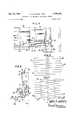
- FIG. 1is an end elevation of an illustrative tempering apparatus conforming to the present invention
- FIG. 2is a fragmentary plan section of an element of the apparatus taken along the lines II-II of FIG. 1;
- FIG. 3is an enlarged view of a portion of the apparatus shown in FIG. 1;
- FIG. 4is a plan fragmentary view of a portion of the enlarged apparatus seen in elevation in FIG. 3;
- FIG. 5is a fragmentary view showing how the apparatus is reciprocated during tempering
- FIG. 6is a schematic plan view of a typical operative arrangement of the upper series of nozzles and recesses facing the upper surface of a bent glass sheet during temper;
- FIG. 7is a schematic plan view of a typical operative arrangement of the lower series of nozzles and recesses facing the bottom surface of a bent glass sheet during tempering.
- a typical embodiment of tempering apparatuscomprises an upper plenum system 10 and a lower plenum system 12.
- Each of the plenum systems 10 and 12is supplied with air from the source of pressurized air such as a fan or compressor not shown.
- the upper plenum system 10comprises a pair of conduits 14, each connected through a flexible connection 16 to a narrow conduit extension 17. Each of the latter flares outwardly to form an elongated upper nozzle box 18 or 20.
- a control valve(not shown) is incorporated in the passage leading to each of the nozzle boxes in order to control the rate of flow of air under pressure.
- Each conduit 14, the flexible connection 16 and the narrow conduit extension 17 with which it communicatesforms a flexible fluid supply means for each upper nozzle box.
- the lower plenum system 12comprises a pair of conduits 22 which communicates with the main source of air through passages 24.
- the conduits 22extend downward on either side of the tempering apparatus and below a floor supporting the tempering apparatus to form a pair of horizontal passages 26.
- Each horizontal passage 26is bifurcated to form a pair of upwardly directed passages 28.
- the upper end of the upwardly directed passages 28each open into a flexible coupling 30 that interconnects with a narrow conduit extension 31.
- Each of the latterflares outward and upward to form one of a series of lower nozzle boxes 32, 34, 36, and 38 for each lower flexible fluid supply means comprising a passage 28, a flexible coupling 30, and conduit extension 31.
- Each of the upper nozzle boxes 18 and 20comprises a set of relatively narrow, parallel, elongated nozzles 40 separated by relatively wide, parallel recesses 41 (FIG. 5).
- Each nozzle 48has a curved bottom orifice 42. Nozzles 40 are disposed in planes equally spaced from one another. The ends of the curved bottom orifices 42 are depicted by reference characters 44 and 46 in FIG. 1.
- the upper nozzle box 20is provided with a set of narrow, parallel, elongated nozzles separated by relatively wide parallel recesses 47 (FIG. 6) and having curved bottom orifices 48 extending from one end 50 to another end 52 thereof.
- the curved bottom orifices 42 and 48are the mirror image of one another.
- the orifices 48 of the nozzles of upper nozzle box 20are located in parallel planes intermediate and equidistant from the planes occupied by nozzles 40 and in alignment with recesses 41. Nozzles 40 are in alignment with recesses 47.
- a frame support structure depicted generally by reference character 54('FIG. 1) comprises front and rear upper horizontal beams 56 (only the front beam of which is shown) and front and rear lower horizontal I-beams 58 (FIGS. 1 and 3).
- Vertical beams 59interconnect the corresponding ends of the upper beams 56 and the lower beams 58 to form the frame support structure 54.
- Vertical posts 60support conveyor stub rolls 62.
- the vertical posts 60are separated from one another a suffi-cient distance to provide clearance for the frame support structure 54 to reciprocate in a direction parallel to the axis of movement defined by the conveyor fomned by the conveyor stub rolls 62.
- the details of the drive mechanism for the conveyor structureare not shown in this application because they are conventional and well known in the art.
- a horizontal track rail 66is disposed at the upper surface of each upper horizontal beam 56 as is shown clearly in FIG. 2.
- a pair of carriages 68, each having wheels 70 supported for rolling along each of the horizontal tracks 66,are movable along the length of the parallel tracks 66 formed on the upper surfaces of the upper horizontal beams 56.
- Each carriage 68comprises a carriage frame 71 rigidly attached to the upper portion of one of the conduit extensions 17 by nut and bolt attachments 72 (FIG. 1).
- a rotating externally threaded rod 74(FIG. 2) is mounted on an internally threaded sleeve 76 carried by a bracket 78 which is secured to one of the sides of the carriage 68 by nut and bolt connections 79.
- Rod 74is connected by means of a universal joint 80 to a rod section 82 which is rigidly attached to a bevel gear 84 in a gear box 86.
- An actuating rod 88 having a square extension 90 at its accessible endextends through a bearing housing 92 mounted on the end of upper front horizontal beam 56.
- a bevel gear 94is attached to actuating rod 88 at its inner end. Bevel gear 94 meshes with the bevel gear 84 within gear box 86.
- a set of jacks 96is mounted on the carriage 68 with one jack at each of the four corners of each carriage 68.
- a crank 98is attached to one end of a jointed shaft 100 to rotate the latter.
- jointed shaft 100is provided with a sprocket wheel 102 which rotates therewith.
- a chain 104engages sprocket wheel 102 with another sprocket weel 106. The latter in turn is attached to one end of an additional jointed shaft 108 to cause the latter to rotate therewith.
- Each of the jointed shaftsis con nected to one of the jacks 96 adjacent each of its longitudinal extremities.
- each of the jacks 96Upon rotating the crank 98, each of the jacks 96 is caused to move vertically to displace the carriage frame 71 of the carriage 68 relative to the axles upon which wheels '70 are mounted.
- the upper nozzle box 18 or 20moves vertically with its associated carriage frame 71.
- each of the upper nozzle chambers 18 and 26is provided with means for positioning the latter where desired along the axis provided by the tracks 66.
- the jacks 96provide vertical movement to permit the arcuate bottom orifices 42 and 48 of the nozzles of the upper nozzles boxes 18 and 20 to define a curvature conforming substantially to the upper surface of a glass sheet to be quenched.
- the bottom orifices 42 and 48define a curved roof of a curved chamber or space within which a curved glass sheet is supported during tempering.
- FIG. 6shows how the curved bottom orifices 42 of the upper nozzle box 18 are arranged with respect to the orifices 48 of the upper nozzle box 20. It is seen from this view that the orifices of each nozzle box are disposed in vertical planes parallel to one another and that the nozzle orifices 42 of nozzle box 18 are oifset from the orifices 48 of the nozzles for the upper nozzle box 21).
- the set of nozzles from upper nozzle box 18interfit between the set of nozzles from upper nozzle box 211 to form the roof of a curved chamber or space receiving a bent glass sheet to be tempered.
- the curved chamberhas open ends and is completely within the frame support structure 54.
- Each of the lower nozzle boxes 32, 34, 36, and 38is provided with a set of parallel nozzles extending in a direction parallel to the direction of the series of nozzles for the upper nozzle boxes 18 and 20.
- the lower series of nozzlesare located in the upper ends of the respective lower nozzle boxes.
- FIG. 7shows a typical arrangement of the nozzles for lower nozzle boxes 32, 34, 36, and 38.
- a set of relatively narrow nozzles 112 separated by relatively wide grooves 113is provided for lower nozzle box 32
- a set of relatively narrow nozzles 114 separated by relatively wide grooves 115is provided for lower nozzle box 34
- a set of relatively narrow nozzles 116 separated by relatively wide grooves 117is provided for lower nozzle box 36
- a set of relatively narrow nozzles 118 separated by relatively wide grooves 119is provided for lower nozzle box 38.
- the nozzles in each lower nozzle boxare curved lengthwise and extend upward in parallel planes.
- the nozzles in each adjacent lower nozzle boxare offset with respect to one another and are aligned with the grooves of the adjacent lower nozzle box.
- Each of the lower nozzle boxes 32, 34, 36, and 38is adjustable in position in a direction parallel to that provided for adjusting the position for the upper nozzle boxes 18 and 20.
- the lower horizontal l-beams 58 of the frame support structure 54are provided with longitudinal slots 128, 122, 124, and 126. Since the structure for adjusting the position of lower nozzle boxes 32 and 34 is the mirror image of that provided for adjusting 6 the position of lower nozzle boxes 36 and 38, in FIG. 3 only, the latter two are disclosed in greater detail.
- an actuating rod 128similar in structure to actuating rod 88 is provided.
- Act-uating rod 128is geared to a driven rod by means of bevel gears located within a gear box 132.
- Driven rod 130is externally threaded within an internally threaded sleeve 134.
- the latterin turn is supported on a bearing housing 136 which is attached to the wall of nozzle box 38.
- a rod 138is received by slot 126 and forms an extension of an axle of a lower wheel 139 of a tilted carriage 127 rigidly attached to the lower nozzle box 38.
- the lower flange of Lbeam '58supports a horizontal track 129.
- the upper flange of I-beam 58supports an additional horizontal track 131 at each end thereof.
- Tracks 129 and 131are identified respectively as lower and upper track means.
- An upper wheel 133 of tilted carriage 127is rotatably supported on upper track 131 while lower wheel 139 is free to traverse lower track 129 a distance limited by the dimensions of slot 126.
- the actuating rod 128is rotated to adjust the position of the lower nozzle box 38.
- a similar actuating rod 140is geared in a gear box 142 to a driven rod 144 which is jointed.
- the latterhas its inner portion externally threaded for receipt within an internally threaded sleeve 146 carried by a bearing housing 148.
- a bracket 149 supporting an axle 150is rigidly attached to the lower nozzle box 36.
- the axle 150extends through the slot 124.
- a wheel 151rotates on axle 150 and is supported on the track 129.
- a rack 152is rigidly attached to the outer wall of lower nozzle box 36.
- a rotatable rod 154rotates with a gear 156 relative to the rack 152 to pivotally adjust the angular orientation of the lower nozzle box 36.
- Rod 154also serves as an axle for wheel 155, which also rides on track 129.
- a lock(not shown) may be included to lock the gear 156 in any desired position along the rack 152.
- Actuating rod 140controls the horizontal position of lower nozzle box 36 in a manner similar to the manner in which actuating rod 128 controls the position of lower nozzle box 38.
- the adjusting means for lower nozzle boxes 32 and 34are similar to those provided for lower nozzle boxes 36 and 38, respectively. Thus, each of the lower nozzle boxes can be adjusted to provide for a curved bottom wall for the curved space receiving a bent glass sheet between the upper and lower plenum systems.
- a sheet of glass Gis supported on a bending and tempering mold M.
- the latteris supported on a carriage C, whose carriage rails are supported along the stub rolls 62 of the conveyor which conveys the belt glass sheets into and out of the tempering apparatus after it has been heated.
- the frame support structure 54has a centrally disposed member 158 (FIG. 5) pivotally attached to the end of a crank arm 160.
- the crankis operated from a motor 162 by means of a drive 164 to reciprocate the frame 54 and the respective nozzle boxes 18, 20, 32, 34, 36, and 38 in a direction transverse to the direction of the tracks 66, 129, and 131.
- the tracksextend substantially parallel to the length of the nozzles at the discharge end of the nozzle boxes.
- Slides 166(FIG. 1) are rigidly attached to and interconnected reinforcements 167 for the bottom of the lower horizontal beams 58. These slides ride on greased rails 168, which extend in 7 a direction normal to that of the track means 66, 129, and 131.
- Adjustment of the length and curvature of the curvilinear chamber between the upper nozzle boxes and the lower nozzle boxesis made possible by the fact that the conduit or nozzle box portion engaged by the respective carriages have a total length less than that of the openended chamber which receives the glass for tempering.
- This specific structure and the carriage arrangementpermits adjustment of the position of each carriage along the track means.
- the nozzles of adjacent nozzle boxesare free to overlap when the length of the chamber is shortened.
- the shape of the chamberconforms to the composite shape of the partly overlapped nozzle sets.
- Apparatus for tempering curved glass sheetscomprising a frame, means for supporting a heated, bent glass sheet Within said frame, a first series of nozzle boxes located on one side of a position occupied by a glass sheet supported within said frame, a second series of nozzle boxes located on the opposite side of said position, each nozzle box comprising a set of parallel, elongated, relatively narrow nozzles separated by relatively wide elongated recesses, each nozzle having a curved, elongated orifice opening onto said position, the orifices of the nozzles of the first series of nozzle boxes being spaced from the orifices of the nozzles of the second series of nozzle boxes to form an open-ended curvilinear chamber therebetween, a relatively narrow flexible conduit communicating with each nozzle box, means to furnish tempering fluid to each nozzle box through its associated narrow flexible conduit, each nozzle box having a length less than the length of said curvilinear chamber, the total length of the nozzle boxes in each said series being greater than the length of
- said first series of nozzle boxescomprises an upper series of nozzle boxes and said second series of nozzle boxes comprises a lower series of nozzle boxes, the orifices of the nozzles of said upper nozzle boxes opening downward on said curvilinear space, the orifices of the nozzles of said lower nozzle boxes opening upward on said curvilinear space, and jack means is provided for adjusting the vertical position of each upper nozzle box relative to said frame.
- said first series of nozzle boxescomprises an upper series of nozzle boxes and said second series of nozzle boxes comprises a lower series of nozzle boxes, the orifices of the nozzles of said upper nozzle boxes openig downward on said curvilinear space, the orifices of the nozzles of said lower nozzle boxes opening upward on said curvilinear space, said lower series of nozzle boxes comprises a pair of end lower nozzle boxes and a pair of intermediate lower nozzle boxes, and means connects each said intermediate lower nozzle box to said frame for pivotable adjustment of said intermediate lower nozzle box about an axis substantially normal to the length of said nozzles.
- Appartus for tempering curved glass sheetscomprising a frame comprising upper and lower horizontal beams supporting parallel upper and lower horizontal track means, at least two carriages having wheels supported by each of said track means, each carriage comprising a carriage frame engaging the periphery of a relatively narrow, flexible fluid supply means, a nozzle box communicating with each said supply means and comprising a set of relatively narrow, elongated parallel nozzles separated by relatively wire grooves extending lengthwise in a direction substantially parallel to said track means, the nozzle boxes comprising a series of upper nozzle boxes, each of said upper nozzle boxes being independently associated with a different carriage supported along said upper track means and having its nozzles provided with orifices opening downward, and a series of lower nozzle boxes, each of said lower nozzle boxes being independently associated with a different carriage supported along said lower track means and having its nozzles provided with orifices facing upward, means connecting each carriage to said frame for adjusting the position thereof relative to another carriage along its associated track means, and means for reciprocating said frame in a direction trans
- Apparatus as in claim 4further including jack means for adjusting the vertical position of each carriage frame and its associated upper nozzle box relative to each carriage supported on said upper track means.
- Apparatus as in claim 4further including rack means carried by at least one of said lower nozzle boxes and gear means carried by one of said carriages supported along said lower track means and engaging said rack means to adjust the orientation of said one of said lower nozzle boxes about a horizontal axis.
- each said series of nozzlescomprises at least a pair of sets of parallel nozzles, the nozzles of one set of said pair extending only a portion of the curved length of said curved space, the nozzles of the other set of said pair extending only a portion of the curved length of said space and at least partially offset longitudinally from the portion of
- each conduitcommunicating with a source of tempering fluid at one end and a nozzle box having a set of spaced, relatively narrow, parallel elongated nozzles with curved orifices opening onto said chamber and relatively wide, elongated recesses between adjacent nozzles, means to support a bent glass sheet within said chamber, and means to reciprocate said nozzle boxes in unison in a direction transverse to the length of said elongated nozzles, the improvement wherein each conduit is flared in the direction of the length of said nozzles to form one of said nozzle boxes, the nozzles in one nozzle box being located in alignment with the recesses provided between the nozzles of the other nozzle box adjacent to said one nozzle box, and means attached to each nozzle box to adjust the position of said nozzle box relative to that of the other nozzle
- Apparatus for tempering curved glass sheetscomprising a frame, means for supporting a heated, bent glass sheet within said frame, a first series of nozzle boxes located on one side of a position occupied by a glass sheet supported within said frame, a second series of nozzle boxes located on the opposite side of said position, each nozzle box comprising a set of parallel, elongated, relatively narrow nozzles separated by relatively wide elongated recesses, each nozzle having a curved, elongated orifice opening onto said position, the orifices of the nozzles of the first series of nozzle boxes being spaced from the orifices of the nozzles of the second series of nozzle boxes to form an open-ended curvilinear chamber therebetween, means to furnish tempering fluid to each nozzle box, each nozzle box having a length less than the length of said curvilinear chamber, the total length of the nozzle boxes in each said series being greater than the length of said curvilinear space, the nozzles of each nozzle box in each series
- Appartus for tempering curved glass sheetscomprising a frame, means for supporting a heated, bent glass sheet within said frame, a first series of nozzle boxes located on one side of a position occupied by a glass sheet supported within said frame, a second series of nozzle boxes located on the opposite side of said position, each nozzle box comprising a set of parallel, elongated, relatively narrow nozzles separated by relatively wide elongated recesses, each nozzle having a curved, elongated orifice opening onto said position, the orifices of the nozzles of the first series of nozzle boxes being spaced from the orifices of the nozzles of the second series of nozzle boxes to form an open-ended curvilinear chamber therebetween, means to furnish tempering fluid to each nozzle box, each nozzle box having a length less than the length of said curvilinear chamber, the total length of the nozzle boxes in each said series being greater than the length of said curvilinear space, the nozzles of each nozzle box in each
Landscapes
- Chemical & Material Sciences (AREA)
- Physics & Mathematics (AREA)
- Thermal Sciences (AREA)
- Engineering & Computer Science (AREA)
- Materials Engineering (AREA)
- Organic Chemistry (AREA)
- Re-Forming, After-Treatment, Cutting And Transporting Of Glass Products (AREA)
Description
1966 F. B. LASECK ETAL. 33
APPARATUS FOR TEMPERING BENT GLASS SHEETS 5 Sheets-Sheet 1 Filed July 19 1963 INVENTORS 1 w m M 4 L R k m k F 3965 F. B. LASECK ETAL 3,294,51
APPARATUS FOR TEMPERING BENT GLASS SHEETS Filed July 19, 1963 5 Sheets-Sheet 2 INVENTORS name 3. [ASECK Q W4: me kisszaq .1?
66.27, 1965 LASECK ETAL 3,294,518
APPARATUS FOR TEMPERING BENT GLASS SHEETS Filed July 19, 1963 5 Sheets-Sheet 5 T l W INVENTORS f/PdA/K B. msscx 'r BY WATER J k'ssze'gJ A TI'OKNE'Y United States Patent Oiilice 3-,Zfld5l8 Patented Dec. 27, I966 3,294,518 APPARATUS FCtR TEMPERING BENT GLASS SHEETS Frank B. Laseclr, Natrona Heights, and Walter J. Reesler, Jr, Pittsburgh, Pa, assignors to Pittsburgh Plate Glass Company, Pittsburgh, Pa, a corporation of Pennsylvania Filed July 19, 1963, Ser. No. 295,279 Claims. (M. 655-348) This application relates to apparatus for tempering bent glass sheets, and particularly concerns apparatus for tempering elongated glass sheets bent into non-uniform curvatures along their longitudinal axis, particularly glass sheets having bends including a gently bent portion and a sharply bent end portion adjacent thereto. The apparatus also is suitable for bending glass sheets having both end portions sharply bent relative to a central portion of comparatively gentle curvature.
The present invention is especially designed to provide apparatus for tempering curved glass sheets of various sizes and shapes and to be accommodated readily for changes in pattern of sheets to be tempered.
In recent years, automotive designs have used curved glass sheets of increasing complexity. Particularly complex curvatures have been imparted to glass sheets utilized as backlights of automobiles and as rear quarter lights of station wagons. In automobile backlights, the glass is bent longitudinally into a central portion of comparatively shallow curvature merging near its extremities into sharply bent end portions. In rear quarter lights for station wagons, the glass sheet has a major portion that is substantially flat or at most only gently curved terminating in a very sharply bent end portion.
The basic process of tempering glass is old and described in prior art patents. Such process comprises heating a glass sheet above its annealing range and then rapidly cooling the surfaces of the glass sheet to set the latter while the center is still hot. This action results in the glass sheet developing a stress pattern wherein its surfaces are stressed in compression and the intermediate portion is stressed in tension.
The surface stressed in compression makes the sheet much stronger than unternpered glass because glass is much more able to withstand external forces when it is stressed in compression than when it is stressed in tension. Moreover, when the outer surface or compression skin of the glass sheet is penetrated, the tension stresses locked up within the glass cause it to shatter into a large number of relatively harmless, smoothly surfaced pieces. In contrast, annealed glass is fractured more easily, and when fractured, breaks into relatively dangerous, large,
jagged fragments. The uniformity of size of the shattered ously. The fluid is dispensed through two serie of nozzles, one series facing one surface of the bent glass sheet and the other series facing the other surface of the bent glass sheet. The even distribution of the cooling air on the glass surfaces is a prerequisite to uniform tempering and is usually accomplished by blasting the air through a plurality of uniformly spaced, elongated nozzles.
According to a preferred prior art technique, a bent glass sheet is moved out of a furnace immediately after bending and supported intermediate upper and lower narrow elongated, curvilinear nozzles extending lengthwise parallel to the curved length of the glass sheet. The nozzles are reciprocated transversely of their length through an amplitude sufficient to insure that each increment of the width dimension of the glass sheet is swept by at least one of the reciprocating nozzles. The distance between the nozzle orifices and the adjacent glass sheet surface is preferably kept as uniform as possible in order to promote uniform quenching.
Prior art tempering apparatus provided with slot nozzles having curved orifices facing the glass had a shape conforming to that of a particular high production pattern. Thus, every time a pattern was changed in production, it became necessary either to accept non-uniform quenching resulting from non-uniform spacing between different portions of the nozzle orifices and diflerent portions of the adjacent glass sheet surfaces, or, a an alternative, it became necessary to lose considerable time otherwise spent in production to replace the nozzles with others conforming to the configuration of the new pattern of glass sheets to be tempered. Neither alternative was satisfactory.
The non-uniform tempering caused the portions of the glass sheet most remote from the nozzle orifices to be weaker than desired. If the weakest portion of the tempered article were suificiently tempered, it was necessary to employ far more tempering fluid than was necessary in the other regions of the glass sheet to produce an acceptable commercial article. Employment of air in excess of minimum overall requirements caused overloading of the blowers and required more frequent maintenance and replacement of the compressor or use of larger, more expensive equipment than was desired.
Apparatus employing the present invention preferably comprises a source of tempering fluid and at least two conduits for supplying fluid to each side of a bent glass sheet. Each conduit flares outward to form a nozzle box comprising a set of relatively narrow, elongated, parallel nozzles having curvilinear orifices and a set of elongated recesses having a width greater than that of the nozzles intermediate said elongated nozzles. An adjacent nozzle box formed by flaring the other conduit has its nozzles aligned with the elongated recesses of the other nozzle box and vice versa. The nozzle boxes provide one series of nozzles through which fluid is applied to one surface of the bent glass sheet.
The conduits for supplying fluid to the other side of said bent glass sheet also flare outward to form nozzle boxes comprising spaced, elongated, parallel nozzles having curvilinear orifices separated by relatively wide recesses. Adjacent nozzle boxes for quenching the other glass surface have nozzles of one nozzle box aligned with the recesses of an adjacent nozzle box, and vice versa. The latter nozzle boxes provide a second series of nozzles through which fluid is applied to the other surface of the bent glass sheet.
The orifices of the series of nozzles for quenching one surface of the bent glass sheet are spaced from the orifices of the series of nozzles for quenching its other surface to form a curvilinear space or chamber having open ends. Means is provided to support a curved glass sheet in the curvilinear space between nozzle orifices. The apparatus also includes means to provide relative movement between said curved glass sheet supported in the curved space and said orifices in a direction transverse to the length of the elongated nozzles while supplying tempering fluid under pressure to the nozzles.
The length of each nozzle box is less than that of the curvilinear space or chamber. The dimension of each conduit communicating with one of the nozzle boxes parallel to the length of the nozzle box is considerably less than that of the nozzle box. The total dimension of the conduits in the direction of the length of the nozzles of the nozzle boxes is considerably less than the straight line distance of the curvilinear space.
Means is provided for adjusting the position of each nozzle box. When the nozzle boxes are moved to their proper position, their nozzles face the entire length and the entire width of the longitudinally curved space, and conform the curved longitudial dimension of the space to the shape of a bent glass sheet supported therein.
A specific embodiment of the present invention comprises a series of upper nozzle boxes and a series of lower nozzle boxes. Jacks are included for adjusting the vertical position of the upper nozzle boxes. Four sets of lower nozzle boxes are provided with their nozzles and recesses arranged in alternate planes. The two intermediate lower nozzle boxes are arranged for pivotal movement as well as longitudinal positional adjustment, while the endmost lower nozzle boxes are arranged for longitudinal positional adjustment only. The nozzles of each lower nozzle box are aligned with the recesses of each adjacent lower nozzle box.
The various freedoms of adjustment enumerated above furnish a quick and easy method for adjusting the longitudinal curvature of the space between the series of nozzles formed by the upper nozzle boxes and the series of nozzles formed by the lower nozzle boxes to conform to that of the bent glass sheets to be tempered.
In order to understand the present invention more clearly, an illustrative embodiment will be described. In the drawings which form part of the description and wherein like reference numbers refer to like structural elements,
FIG. 1 is an end elevation of an illustrative tempering apparatus conforming to the present invention;
FIG. 2 is a fragmentary plan section of an element of the apparatus taken along the lines II-II of FIG. 1;
FIG. 3 is an enlarged view of a portion of the apparatus shown in FIG. 1;
FIG. 4 is a plan fragmentary view of a portion of the enlarged apparatus seen in elevation in FIG. 3;
FIG. 5 is a fragmentary view showing how the apparatus is reciprocated during tempering;
FIG. 6 is a schematic plan view of a typical operative arrangement of the upper series of nozzles and recesses facing the upper surface of a bent glass sheet during temper; and
FIG. 7 is a schematic plan view of a typical operative arrangement of the lower series of nozzles and recesses facing the bottom surface of a bent glass sheet during tempering.
Referring to the drawings, a typical embodiment of tempering apparatus according to the present invention comprises anupper plenum system 10 and alower plenum system 12. Each of theplenum systems
Theupper plenum system 10 comprises a pair of conduits 14, each connected through aflexible connection 16 to anarrow conduit extension 17. Each of the latter flares outwardly to form an elongatedupper nozzle box flexible connection 16 and thenarrow conduit extension 17 with which it communicates forms a flexible fluid supply means for each upper nozzle box.
Thelower plenum system 12 comprises a pair ofconduits 22 which communicates with the main source of air throughpassages 24. Theconduits 22 extend downward on either side of the tempering apparatus and below a floor supporting the tempering apparatus to form a pair ofhorizontal passages 26. Eachhorizontal passage 26 is bifurcated to form a pair of upwardly directedpassages 28. The upper end of the upwardly directedpassages 28 each open into aflexible coupling 30 that interconnects with anarrow conduit extension 31. Each of the latter flares outward and upward to form one of a series oflower nozzle boxes passage 28, aflexible coupling 30, andconduit extension 31.
Each of theupper nozzle boxes nozzle 48 has acurved bottom orifice 42. Nozzles 40 are disposed in planes equally spaced from one another. The ends of the curvedbottom orifices 42 are depicted byreference characters 44 and 46 in FIG. 1.
Theupper nozzle box 20 is provided with a set of narrow, parallel, elongated nozzles separated by relatively wide parallel recesses 47 (FIG. 6) and having curvedbottom orifices 48 extending from oneend 50 to another end 52 thereof. The curvedbottom orifices
Theorifices 48 of the nozzles ofupper nozzle box 20 are located in parallel planes intermediate and equidistant from the planes occupied by nozzles 40 and in alignment withrecesses 41. Nozzles 40 are in alignment withrecesses 47.
A frame support structure depicted generally by reference character 54 ('FIG. 1) comprises front and rear upper horizontal beams 56 (only the front beam of which is shown) and front and rear lower horizontal I-beams 58 (FIGS. 1 and 3).Vertical beams 59 interconnect the corresponding ends of theupper beams 56 and thelower beams 58 to form theframe support structure 54.
Ahorizontal track rail 66 is disposed at the upper surface of each upperhorizontal beam 56 as is shown clearly in FIG. 2. A pair ofcarriages 68, each havingwheels 70 supported for rolling along each of thehorizontal tracks 66, are movable along the length of theparallel tracks 66 formed on the upper surfaces of the upper horizontal beams 56.
Eachcarriage 68 comprises acarriage frame 71 rigidly attached to the upper portion of one of theconduit extensions 17 by nut and bolt attachments 72 (FIG. 1).
A rotating externally threaded rod 74 (FIG. 2) is mounted on an internally threadedsleeve 76 carried by abracket 78 which is secured to one of the sides of thecarriage 68 by nut andbolt connections 79.Rod 74 is connected by means of a universal joint 80 to arod section 82 which is rigidly attached to abevel gear 84 in agear box 86.
Anactuating rod 88 having asquare extension 90 at its accessible end extends through a bearing housing 92 mounted on the end of upper fronthorizontal beam 56. Abevel gear 94 is attached to actuatingrod 88 at its inner end.Bevel gear 94 meshes with thebevel gear 84 withingear box 86.
Applying a Wrench to thesquare extension 90 of actuatingrod 88 rotates the latter. As the latter is rotated, thegears rod 74 to rotate relative to the internally threadedsleeve 76. This rotation causes thecarriage 68 to be displaced alongtracks 66, which are also identified as upper track means. It is noted again at this point that the upper portion of the apparatus depicted in FIG. 2, which was omitted, includes an additional horizontal beam similar to upperhorizontal beam 56 containing atrack 66. Thus, thecarriage 68 can .be adjusted in position longitudinally of theupper tracks 66 to displace theupper nozzle boxes carriages 68 throughconduit extensions 17. Theflexible connections 16 between the conduits 14 and theextensions 17 communicating with the correspondingnozzle chambers
The vertical position of theupper nozzle boxes jacks 96 is mounted on thecarriage 68 with one jack at each of the four corners of eachcarriage 68. Acrank 98 is attached to one end of ajointed shaft 100 to rotate the latter. At its opposite end,jointed shaft 100 is provided with asprocket wheel 102 which rotates therewith. Achain 104 engagessprocket wheel 102 with anothersprocket weel 106. The latter in turn is attached to one end of an additional jointedshaft 108 to cause the latter to rotate therewith. Each of the jointed shafts is con nected to one of thejacks 96 adjacent each of its longitudinal extremities.
Upon rotating thecrank 98, each of thejacks 96 is caused to move vertically to displace thecarriage frame 71 of thecarriage 68 relative to the axles upon which wheels '70 are mounted. Theupper nozzle box carriage frame 71.
It will be seen from the above that each of theupper nozzle chambers tracks 66. In addition, thejacks 96 provide vertical movement to permit the arcuatebottom orifices upper nozzles boxes bottom orifices
FIG. 6 shows how the curvedbottom orifices 42 of theupper nozzle box 18 are arranged with respect to theorifices 48 of theupper nozzle box 20. It is seen from this view that the orifices of each nozzle box are disposed in vertical planes parallel to one another and that thenozzle orifices 42 ofnozzle box 18 are oifset from theorifices 48 of the nozzles for the upper nozzle box 21). Thus, the set of nozzles fromupper nozzle box 18 interfit between the set of nozzles from upper nozzle box 211 to form the roof of a curved chamber or space receiving a bent glass sheet to be tempered. The curved chamber has open ends and is completely within theframe support structure 54.
Each of thelower nozzle boxes upper nozzle boxes lower nozzle boxes
In the drawing of FIG. 7 a set of relativelynarrow nozzles 112 separated by relativelywide grooves 113 is provided forlower nozzle box 32, a set of relativelynarrow nozzles 114 separated by relativelywide grooves 115 is provided for lower nozzle box 34, a set of relativelynarrow nozzles 116 separated by relativelywide grooves 117 is provided forlower nozzle box 36, and a set of relativelynarrow nozzles 118 separated by relativelywide grooves 119 is provided forlower nozzle box 38. The nozzles in each lower nozzle box are curved lengthwise and extend upward in parallel planes. The nozzles in each adjacent lower nozzle box are offset with respect to one another and are aligned with the grooves of the adjacent lower nozzle box.
Each of thelower nozzle boxes upper nozzle boxes beams 58 of theframe support structure 54 are provided withlongitudinal slots lower nozzle boxes 32 and 34 is the mirror image of that provided for adjusting 6 the position oflower nozzle boxes
For adjusting the position oflower nozzle box 38, anactuating rod 128 similar in structure to actuatingrod 88 is provided. Act-uating rod 128 is geared to a driven rod by means of bevel gears located within agear box 132.Driven rod 130 is externally threaded within an internally threadedsleeve 134. The latter in turn is supported on a bearinghousing 136 which is attached to the wall ofnozzle box 38. Arod 138 is received byslot 126 and forms an extension of an axle of alower wheel 139 of a tiltedcarriage 127 rigidly attached to thelower nozzle box 38.
The lower flange of Lbeam '58 supports ahorizontal track 129. The upper flange of I-beam 58 supports an additionalhorizontal track 131 at each end thereof.Tracks upper wheel 133 of tiltedcarriage 127 is rotatably supported onupper track 131 whilelower wheel 139 is free to traverse lower track 129 a distance limited by the dimensions ofslot 126. Theactuating rod 128 is rotated to adjust the position of thelower nozzle box 38.
Asimilar actuating rod 140 is geared in agear box 142 to a drivenrod 144 which is jointed. The latter has its inner portion externally threaded for receipt within an internally threadedsleeve 146 carried by a bearinghousing 148.
Abracket 149 supporting anaxle 150 is rigidly attached to thelower nozzle box 36. Theaxle 150 extends through theslot 124. Awheel 151 rotates onaxle 150 and is supported on thetrack 129.
Arack 152 is rigidly attached to the outer wall oflower nozzle box 36. Arotatable rod 154 rotates with agear 156 relative to therack 152 to pivotally adjust the angular orientation of thelower nozzle box 36.Rod 154 also serves as an axle forwheel 155, which also rides ontrack 129. A lock (not shown) may be included to lock thegear 156 in any desired position along therack 152.
When thegear 156 is rotated with respect to rack 152, thelower nozzle box 36 is rotated about a pivot provided byaxle 150. This freedom of rotation permits some provision for adjusting the orientation of the sheets of cold air dispensed through the intermediate sets of nozzles of the lower series of nozzles toward the lower surface of the bent glass sheet.
The adjusting means forlower nozzle boxes 32 and 34 are similar to those provided forlower nozzle boxes
A sheet of glass G is supported on a bending and tempering mold M. The latter is supported on a carriage C, whose carriage rails are supported along the stub rolls 62 of the conveyor which conveys the belt glass sheets into and out of the tempering apparatus after it has been heated.
Theframe support structure 54 has a centrally disposed member 158 (FIG. 5) pivotally attached to the end of acrank arm 160. The crank is operated from amotor 162 by means of adrive 164 to reciprocate theframe 54 and therespective nozzle boxes tracks interconnected reinforcements 167 for the bottom of the lowerhorizontal beams 58. These slides ride on greasedrails 168, which extend in 7 a direction normal to that of the track means 66, 129, and 131.
When a heated glass sheet is disposed between upper andlower plenum systems upper nozzle chambers lower nozzle chambers frame support structure 54 causes the entire system of tempering nozzles to reciprocate in unison in the direction of the greased rails 168. The adjustment of the positions of the variousupper nozzle boxes lower nozzle boxes
Adjustment of the length and curvature of the curvilinear chamber between the upper nozzle boxes and the lower nozzle boxes is made possible by the fact that the conduit or nozzle box portion engaged by the respective carriages have a total length less than that of the openended chamber which receives the glass for tempering. This specific structure and the carriage arrangement permits adjustment of the position of each carriage along the track means. The nozzles of adjacent nozzle boxes are free to overlap when the length of the chamber is shortened. The shape of the chamber conforms to the composite shape of the partly overlapped nozzle sets.
When this apparatus was first proposed, it was feared that transverse streaks would be imposed in the tempered glass in the areas exposed to overlapping end portions of adjacent nozzle sets. Provision was made to shield the overlapping portion of one of the adjacent nozzle sets. However, a few experiments showed that the overlapping ends produced a beneficial rather than a detrimental result. The additional air applied under pressure to the central region of the curved space helps produce a force to move the air in an outward direction from the area or areas of overlapping toward the open ends of tthe curvilinear chamber between nozzle series. This force helps remove the air from between the bent glass sheet surfaces and the nozzle orifice more rapidly than is the case when there is no overlapping of adjacent nozzle sets and the air is supplied uniformly over the entire glass sheet surfaces.
The form of the invention shown and disclosed herein represents a preferred illustrative embodiment thereof. It is understood that various changes can be made without departing from the spirit of the invention as defined in the claimed subject matter which follows.
What is claimed is:
1. Apparatus for tempering curved glass sheets comprising a frame, means for supporting a heated, bent glass sheet Within said frame, a first series of nozzle boxes located on one side of a position occupied by a glass sheet supported within said frame, a second series of nozzle boxes located on the opposite side of said position, each nozzle box comprising a set of parallel, elongated, relatively narrow nozzles separated by relatively wide elongated recesses, each nozzle having a curved, elongated orifice opening onto said position, the orifices of the nozzles of the first series of nozzle boxes being spaced from the orifices of the nozzles of the second series of nozzle boxes to form an open-ended curvilinear chamber therebetween, a relatively narrow flexible conduit communicating with each nozzle box, means to furnish tempering fluid to each nozzle box through its associated narrow flexible conduit, each nozzle box having a length less than the length of said curvilinear chamber, the total length of the nozzle boxes in each said series being greater than the length of said curvilinear space, the total dimension of the conduits communicating with each series of nozzle boxes in the direction of the length of the nozzles being less than the length of said curvilinear space, the nozzles of each nozzle box in each series of nozzle boxes being aligned with the recesses of each nozzle box of said series adjacent thereto, means intercon- 8 necting each said nozzle box to said frame and for adjusting the position of each said nozzle box in the direction of the length of said nozzles relative to said frame and means connected to said frame for reciprocating said frame in a direction transverse to the length of said nozzles.
2. Apparatus as in claim 1, wherein said first series of nozzle boxes comprises an upper series of nozzle boxes and said second series of nozzle boxes comprises a lower series of nozzle boxes, the orifices of the nozzles of said upper nozzle boxes opening downward on said curvilinear space, the orifices of the nozzles of said lower nozzle boxes opening upward on said curvilinear space, and jack means is provided for adjusting the vertical position of each upper nozzle box relative to said frame.
3. Apparatus as in claim 1, wherein said first series of nozzle boxes comprises an upper series of nozzle boxes and said second series of nozzle boxes comprises a lower series of nozzle boxes, the orifices of the nozzles of said upper nozzle boxes openig downward on said curvilinear space, the orifices of the nozzles of said lower nozzle boxes opening upward on said curvilinear space, said lower series of nozzle boxes comprises a pair of end lower nozzle boxes and a pair of intermediate lower nozzle boxes, and means connects each said intermediate lower nozzle box to said frame for pivotable adjustment of said intermediate lower nozzle box about an axis substantially normal to the length of said nozzles.
4. Appartus for tempering curved glass sheets comprising a frame comprising upper and lower horizontal beams supporting parallel upper and lower horizontal track means, at least two carriages having wheels supported by each of said track means, each carriage comprising a carriage frame engaging the periphery of a relatively narrow, flexible fluid supply means, a nozzle box communicating with each said supply means and comprising a set of relatively narrow, elongated parallel nozzles separated by relatively wire grooves extending lengthwise in a direction substantially parallel to said track means, the nozzle boxes comprising a series of upper nozzle boxes, each of said upper nozzle boxes being independently associated with a different carriage supported along said upper track means and having its nozzles provided with orifices opening downward, and a series of lower nozzle boxes, each of said lower nozzle boxes being independently associated with a different carriage supported along said lower track means and having its nozzles provided with orifices facing upward, means connecting each carriage to said frame for adjusting the position thereof relative to another carriage along its associated track means, and means for reciprocating said frame in a direction transverse to the direction of said track means, the nozzles of each of said nozzle boxes in each series of nozzle boxes being aligned with the relatively wide grooves of each nozzle box of said series adjacent thereto.
5. Apparatus as in claim 4, further including jack means for adjusting the vertical position of each carriage frame and its associated upper nozzle box relative to each carriage supported on said upper track means.
6. Apparatus as in claim 4, further including rack means carried by at least one of said lower nozzle boxes and gear means carried by one of said carriages supported along said lower track means and engaging said rack means to adjust the orientation of said one of said lower nozzle boxes about a horizontal axis.
7. In apparatus for tempering curved glass sheets comprising a source of tempering fluid, a series of upper elongated nozzles having curved bottom orifices, a series of lower elongated nozzles having curved upper orifices spaced below said curved bottom orifices to provide a curvilinear space between said orifices, means for supplying tempering fluid under pressure from said source to said nozzles, means to support a curved glass sheet in said curved space, and means to provide relative movement between said curved glass sheet and said orifices in a direction transverse to the length of said nozzles while supplying tempering fluid under pressure to said nozzles, the improvement wherein each said series of nozzles comprises at least a pair of sets of parallel nozzles, the nozzles of one set of said pair extending only a portion of the curved length of said curved space, the nozzles of the other set of said pair extending only a portion of the curved length of said space and at least partially offset longitudinally from the portion of said curved length occupied by said one set, the nozzles of said one set being located in spaced parallel planes, the nozzles of said other set being located in planes transversely spaced and intermediate the plane occupied by the nozzles of said one set, longitudinal grooves intermediate adjacent nozzles of each set of each series aligned with nozzles of an adjacent set of said series, and means for adjusting the position of each set of nozzles longitudinally thereof in unison to conform the curvilinear space between said upper and lower series of nozzles to the shape of a bent glass sheet supported in said curvilinear space.
8. In apparatus for tempering curved glass sheets, an open-ended chamber, at least two flexible conduits disposed on one side of said chamber, at least two other flexible conduits disposed on the other side of said chamber, each of said conduits communicating with a source of tempering fluid at one end and a nozzle box having a set of spaced, relatively narrow, parallel elongated nozzles with curved orifices opening onto said chamber and relatively wide, elongated recesses between adjacent nozzles, means to support a bent glass sheet within said chamber, and means to reciprocate said nozzle boxes in unison in a direction transverse to the length of said elongated nozzles, the improvement wherein each conduit is flared in the direction of the length of said nozzles to form one of said nozzle boxes, the nozzles in one nozzle box being located in alignment with the recesses provided between the nozzles of the other nozzle box adjacent to said one nozzle box, and means attached to each nozzle box to adjust the position of said nozzle box relative to that of the other nozzle box to modify the composite shape of the nozzles to conform the shape of said chamber of the shape of a bent glass sheet to be received within said chamber.
9. Apparatus for tempering curved glass sheets comprising a frame, means for supporting a heated, bent glass sheet within said frame, a first series of nozzle boxes located on one side of a position occupied by a glass sheet supported within said frame, a second series of nozzle boxes located on the opposite side of said position, each nozzle box comprising a set of parallel, elongated, relatively narrow nozzles separated by relatively wide elongated recesses, each nozzle having a curved, elongated orifice opening onto said position, the orifices of the nozzles of the first series of nozzle boxes being spaced from the orifices of the nozzles of the second series of nozzle boxes to form an open-ended curvilinear chamber therebetween, means to furnish tempering fluid to each nozzle box, each nozzle box having a length less than the length of said curvilinear chamber, the total length of the nozzle boxes in each said series being greater than the length of said curvilinear space, the nozzles of each nozzle box in each series of nozzle boxes being aligned with the recesses of each nozzle box of said series adjacent thereto, means interconnecting each said nozzle box to said frame and for adjusting the position of each said nozzle box in the direction of the length of said nozzles relative to said frame and means connected to said frame for reciprocating said frame in a direction transverse to the length of said nozzles.
16'. Appartus for tempering curved glass sheets comprising a frame, means for supporting a heated, bent glass sheet within said frame, a first series of nozzle boxes located on one side of a position occupied by a glass sheet supported within said frame, a second series of nozzle boxes located on the opposite side of said position, each nozzle box comprising a set of parallel, elongated, relatively narrow nozzles separated by relatively wide elongated recesses, each nozzle having a curved, elongated orifice opening onto said position, the orifices of the nozzles of the first series of nozzle boxes being spaced from the orifices of the nozzles of the second series of nozzle boxes to form an open-ended curvilinear chamber therebetween, means to furnish tempering fluid to each nozzle box, each nozzle box having a length less than the length of said curvilinear chamber, the total length of the nozzle boxes in each said series being greater than the length of said curvilinear space, the nozzles of each nozzle box in each series of nozzle boxes being aligned with the recesses of each nozzle box of said series adjacent thereto, and means interconnecting each said nozzle box to said frame and for adjusting the position of each said nozzle box in the direction of the length of said nozzles relative to said frame.
References Cited by the Examiner UNITED STATES PATENTS 2,263,679 11/1941 Ferre 348 2,646,647 7/1953 Bamford et a1 65-348 X DONALL H. SYLVESTER, Primary Examiner. A, D. KELLOGG, Assistant Examiner,
Claims (1)
- 4. APPARTUS FOR TEMPERING CURVED GLASS SHEETS COMPRISING A FRAME COMPRISING UPPER AND LOWER HORIZONTAL BEAMS SUPPORTING PARALLEL UPPER AND LOWER HORIZONTAL TRACK MEANS, AT LEAST TWO CARRIAGES HAVING WHEELS SUPPORTED BY EACH OF SAID TRACK MEANS EACH CARRIAGE COMPRISING A CARRIAGE FRAME ENGAGING THE PERIPHERY OF A RELATIVELY NARROW FLEXIBLE FLUID SUPPLY MEANS, A NOZZLE BOX COMMUNICATING WITH EACH SAID SUPPLY MEANS AND COMPRISING A SET OF RELATIVELY NARROW, ENLONGATED PARALLEL NOZZLES SEPARATED BY RELATIVELY WIRE GROOVES EXTENDING LENGTHWISE IN A DIRECTION SUBSTANTIALLY PARALLEL TO SAID TRACK MEANS THE NOZZLE BOXES COMPRISING A SERIES OF UPPER NOZZLES BOXES, EACH OF SAID UPPER NOZZLES BOXES BEING INDEPENDENTLY ASSOCIATED WITH A DIFFERENT CARRIAGE SUPPORTED ALONG SAID UPPER TRACK MEANS AND HAVING ITS NOZZLES PROVIDED WITH ORIFICES OPENING DOWNWARD, AND A SERIES OF LOWER NOZZLE BOXES, EACH OF SAID LOWER NOZZLE BOXES BEING INDEPENDENTLY ASSOCIATED WITH DIFFERENT CARRIAGE SUPPORTED ALONG SAID LOWER TRACK MEANS AND HAVING ITS NOZZLE PROVIDED WITH ORIFICES FACING UPWARD, MEANS CONNECTING EACH CARRIAGE TO SAID FRAME FOR ADJUSTING THE POSITION THEREOF RELATIVE TO ANOTHER CARRIAGE ALONG ITS ASSOCIATED TRACK MEANS, AND MEANS FOR RECIPROCATING SAID FRAME IN A DIRECTION TRANVERSE TO THE DIRECTION OF SAID TRACK MEANS, THE NOZZLE OF EACH OF SAID NOZZLE BOXES IN EACH SERIES OF NOZZLE BOXES BEING ALIGNED WITH THE RELATIVELY WIDE GROOVES OF EACH NOZZLE BOX OF SAID SERIES ADJACENT THERETO.
Priority Applications (1)
| Application Number | Priority Date | Filing Date | Title |
|---|---|---|---|
| US296279AUS3294518A (en) | 1963-07-19 | 1963-07-19 | Apparatus for tempering bent glass sheets |
Applications Claiming Priority (1)
| Application Number | Priority Date | Filing Date | Title |
|---|---|---|---|
| US296279AUS3294518A (en) | 1963-07-19 | 1963-07-19 | Apparatus for tempering bent glass sheets |
Publications (1)
| Publication Number | Publication Date |
|---|---|
| US3294518Atrue US3294518A (en) | 1966-12-27 |
Family
ID=23141345
Family Applications (1)
| Application Number | Title | Priority Date | Filing Date |
|---|---|---|---|
| US296279AExpired - LifetimeUS3294518A (en) | 1963-07-19 | 1963-07-19 | Apparatus for tempering bent glass sheets |
Country Status (1)
| Country | Link |
|---|---|
| US (1) | US3294518A (en) |
Cited By (27)
| Publication number | Priority date | Publication date | Assignee | Title |
|---|---|---|---|---|
| US4444579A (en)* | 1982-11-10 | 1984-04-24 | Ppg Industries, Inc. | Apparatus for tempering glass sheets of different sizes and shapes |
| US5209767A (en)* | 1991-03-19 | 1993-05-11 | Glasstech, Inc. | Glass sheet annealing lehr having gas support conveyor |
| WO2009122003A1 (en)* | 2008-03-31 | 2009-10-08 | Finntemp Oy | Arrangement for adujsting nozzle boxes |
| US20110154862A1 (en)* | 2008-09-09 | 2011-06-30 | Asahi Glass Company, Limited | Air-cooling/tempering apparatus for glass sheet, and air-cooling/tempering method |
| US20160091179A1 (en)* | 2014-09-28 | 2016-03-31 | Jiaxing Super Lighting Electric Appliance Co., Ltd | Led tube light |
| US9587817B2 (en) | 2014-09-28 | 2017-03-07 | Jiaxing Super Lighting Electric Appliance Co., Ltd | LED tube lamp |
| US9609711B2 (en) | 2014-09-28 | 2017-03-28 | Jiaxing Super Lighting Electric Appliance Co., Ltd. | LED tube lamp |
| US9611984B2 (en) | 2015-04-02 | 2017-04-04 | Jiaxing Super Lighting Electric Appliance Co., Ltd. | LED tube lamp |
| US9618166B2 (en) | 2014-09-28 | 2017-04-11 | Jiaxing Super Lighting Electric Applianc Co., Ltd. | LED tube lamp |
| US9618168B1 (en) | 2014-09-28 | 2017-04-11 | Jiaxing Super Lighting Electric Appliance Co., Ltd | LED tube lamp |
| US9625137B2 (en) | 2014-09-28 | 2017-04-18 | Jiaxing Super Lighting Electric Appliance Co., Ltd | LED tube light with bendable circuit board |
| US9629211B2 (en) | 2014-09-28 | 2017-04-18 | Jiaxing Super Lighting Electric Appliance Co., Ltd. | LED tube lamp with improved compatibility with an electrical ballast |
| US9794990B2 (en) | 2014-09-28 | 2017-10-17 | Jiaxing Super Lighting Electric Appliance Co., Ltd. | LED tube lamp with improved compatibility with an electrical ballast |
| US9851073B2 (en) | 2015-04-02 | 2017-12-26 | Jiaxing Super Lighting Electric Appliance Co., Ltd. | LED tube light with diffusion layer |
| US9879852B2 (en) | 2014-09-28 | 2018-01-30 | Jiaxing Super Lighting Electric Appliance Co., Ltd | LED tube lamp |
| US9885449B2 (en) | 2014-09-28 | 2018-02-06 | Jiaxing Super Lighting Electric Appliance Co., Ltd | LED tube lamp |
| US9890909B2 (en) | 2014-09-28 | 2018-02-13 | Jiaxing Super Lighting Electric Appliance Co., Ltd. | LED tube lamp |
| US9903537B2 (en) | 2014-12-05 | 2018-02-27 | Jiaxing Super Lighting Electric Appliance Co., Ltd | LED tube lamp |
| US9945520B2 (en) | 2014-09-28 | 2018-04-17 | Jiaxing Super Lighting Electric Appliance Co., Ltd | LED tube lamp |
| US9955587B2 (en) | 2015-04-02 | 2018-04-24 | Jiaxing Super Lighting Electric Appliance Co., Ltd. | LED tube lamp |
| US9982848B2 (en) | 2014-12-05 | 2018-05-29 | Jiaxing Super Lighting Electric Appliance Co., Ltd | LED tube lamp |
| US10021742B2 (en) | 2014-09-28 | 2018-07-10 | Jiaxing Super Lighting Electric Appliance Co., Ltd | LED tube lamp |
| US10161569B2 (en) | 2015-09-02 | 2018-12-25 | Jiaxing Super Lighting Electric Appliance Co., Ltd | LED tube lamp |
| US10190749B2 (en) | 2015-04-02 | 2019-01-29 | Jiaxing Super Lighting Electric Appliance Co., Ltd. | LED tube lamp |
| US10634337B2 (en) | 2014-12-05 | 2020-04-28 | Jiaxing Super Lighting Electric Appliance Co., Ltd | LED tube lamp with heat dissipation of power supply in end cap |
| US20220106219A1 (en)* | 2019-01-10 | 2022-04-07 | Glasstech, Inc. | Glass sheet quench arrangement |
| US20220315471A1 (en)* | 2019-07-03 | 2022-10-06 | Glaston Finland Oy | Tempering furnace for a glass sheet and a method for heating a glass sheet for tempering |
Citations (2)
| Publication number | Priority date | Publication date | Assignee | Title |
|---|---|---|---|---|
| US2263679A (en)* | 1937-11-02 | 1941-11-25 | Ferre Ferdinando | Means for toughening glass |
| US2646647A (en)* | 1948-09-10 | 1953-07-28 | Libbey Owens Ford Glass Co | Process and apparatus for bending and tempering glass |
- 1963
- 1963-07-19USUS296279Apatent/US3294518A/ennot_activeExpired - Lifetime
Patent Citations (2)
| Publication number | Priority date | Publication date | Assignee | Title |
|---|---|---|---|---|
| US2263679A (en)* | 1937-11-02 | 1941-11-25 | Ferre Ferdinando | Means for toughening glass |
| US2646647A (en)* | 1948-09-10 | 1953-07-28 | Libbey Owens Ford Glass Co | Process and apparatus for bending and tempering glass |
Cited By (42)
| Publication number | Priority date | Publication date | Assignee | Title |
|---|---|---|---|---|
| US4444579A (en)* | 1982-11-10 | 1984-04-24 | Ppg Industries, Inc. | Apparatus for tempering glass sheets of different sizes and shapes |
| US5209767A (en)* | 1991-03-19 | 1993-05-11 | Glasstech, Inc. | Glass sheet annealing lehr having gas support conveyor |
| US5700306A (en)* | 1991-03-19 | 1997-12-23 | Glasstech, Inc. | Glass sheet strip forming system including annealing lehr |
| US5948132A (en)* | 1991-03-19 | 1999-09-07 | Glasstech, Inc. | Glass sheet strip annealing method |
| WO2009122003A1 (en)* | 2008-03-31 | 2009-10-08 | Finntemp Oy | Arrangement for adujsting nozzle boxes |
| US20110154862A1 (en)* | 2008-09-09 | 2011-06-30 | Asahi Glass Company, Limited | Air-cooling/tempering apparatus for glass sheet, and air-cooling/tempering method |
| US8381547B2 (en)* | 2008-09-09 | 2013-02-26 | Asahi Glass Company, Limited | Air-cooling/tempering apparatus for glass sheet, and air-cooling/tempering method |
| US10024503B2 (en) | 2014-09-28 | 2018-07-17 | Jiaxing Super Lighting Electric Appliance Co., Ltd. | LED tube lamp |
| US9927071B2 (en) | 2014-09-28 | 2018-03-27 | Jiaxing Super Lighting Electric Appliance Co., Ltd | LED tube lamp |
| US9609711B2 (en) | 2014-09-28 | 2017-03-28 | Jiaxing Super Lighting Electric Appliance Co., Ltd. | LED tube lamp |
| US10426003B2 (en) | 2014-09-28 | 2019-09-24 | Jiazing Super Lighting Electric Appliance Co., Ltd. | LED tube lamp |
| US9618166B2 (en) | 2014-09-28 | 2017-04-11 | Jiaxing Super Lighting Electric Applianc Co., Ltd. | LED tube lamp |
| US9618168B1 (en) | 2014-09-28 | 2017-04-11 | Jiaxing Super Lighting Electric Appliance Co., Ltd | LED tube lamp |
| US9625137B2 (en) | 2014-09-28 | 2017-04-18 | Jiaxing Super Lighting Electric Appliance Co., Ltd | LED tube light with bendable circuit board |
| US9629211B2 (en) | 2014-09-28 | 2017-04-18 | Jiaxing Super Lighting Electric Appliance Co., Ltd. | LED tube lamp with improved compatibility with an electrical ballast |
| US9625129B2 (en)* | 2014-09-28 | 2017-04-18 | Jiaxing Super Lighting Electric Appliance Co., Ltd. | LED tube light |
| US9794990B2 (en) | 2014-09-28 | 2017-10-17 | Jiaxing Super Lighting Electric Appliance Co., Ltd. | LED tube lamp with improved compatibility with an electrical ballast |
| US9845923B2 (en) | 2014-09-28 | 2017-12-19 | Jiaxing Super Lighting Electric Appliance Co., Ltd | LED tube lamp |
| US10190732B2 (en) | 2014-09-28 | 2019-01-29 | Jiaxing Super Lighting Electric Appliance Co., Ltd | LED tube lamp |
| US9869431B2 (en) | 2014-09-28 | 2018-01-16 | Jiaxing Super Lighting Electric Appliance Co., Ltd | Thermo-compression head, soldering system, and LED tube lamp |
| US9879852B2 (en) | 2014-09-28 | 2018-01-30 | Jiaxing Super Lighting Electric Appliance Co., Ltd | LED tube lamp |
| US9885449B2 (en) | 2014-09-28 | 2018-02-06 | Jiaxing Super Lighting Electric Appliance Co., Ltd | LED tube lamp |
| US9890909B2 (en) | 2014-09-28 | 2018-02-13 | Jiaxing Super Lighting Electric Appliance Co., Ltd. | LED tube lamp |
| US20160091179A1 (en)* | 2014-09-28 | 2016-03-31 | Jiaxing Super Lighting Electric Appliance Co., Ltd | Led tube light |
| US9587817B2 (en) | 2014-09-28 | 2017-03-07 | Jiaxing Super Lighting Electric Appliance Co., Ltd | LED tube lamp |
| US9945520B2 (en) | 2014-09-28 | 2018-04-17 | Jiaxing Super Lighting Electric Appliance Co., Ltd | LED tube lamp |
| US10021742B2 (en) | 2014-09-28 | 2018-07-10 | Jiaxing Super Lighting Electric Appliance Co., Ltd | LED tube lamp |
| US9964263B2 (en) | 2014-09-28 | 2018-05-08 | Jiaxing Super Lighting Electric Appliance Co., Ltd. | LED tube lamp |
| US9982848B2 (en) | 2014-12-05 | 2018-05-29 | Jiaxing Super Lighting Electric Appliance Co., Ltd | LED tube lamp |
| US10634337B2 (en) | 2014-12-05 | 2020-04-28 | Jiaxing Super Lighting Electric Appliance Co., Ltd | LED tube lamp with heat dissipation of power supply in end cap |
| US9903537B2 (en) | 2014-12-05 | 2018-02-27 | Jiaxing Super Lighting Electric Appliance Co., Ltd | LED tube lamp |
| US10352540B2 (en) | 2014-12-05 | 2019-07-16 | Jiaxing Super Lighting Electric Appliance Co., Ltd | LED tube lamp |
| US10082250B2 (en) | 2014-12-05 | 2018-09-25 | Jiaxing Super Lighting Electric Appliance Co., Ltd | LED tube lamp |
| US10190749B2 (en) | 2015-04-02 | 2019-01-29 | Jiaxing Super Lighting Electric Appliance Co., Ltd. | LED tube lamp |
| US9851073B2 (en) | 2015-04-02 | 2017-12-26 | Jiaxing Super Lighting Electric Appliance Co., Ltd. | LED tube light with diffusion layer |
| US10047932B2 (en) | 2015-04-02 | 2018-08-14 | Jiaxing Super Lighting Electric Appliance Co., Ltd. | LED tube light with LED leadframes |
| US9611984B2 (en) | 2015-04-02 | 2017-04-04 | Jiaxing Super Lighting Electric Appliance Co., Ltd. | LED tube lamp |
| US9955587B2 (en) | 2015-04-02 | 2018-04-24 | Jiaxing Super Lighting Electric Appliance Co., Ltd. | LED tube lamp |
| US10161569B2 (en) | 2015-09-02 | 2018-12-25 | Jiaxing Super Lighting Electric Appliance Co., Ltd | LED tube lamp |
| US20220106219A1 (en)* | 2019-01-10 | 2022-04-07 | Glasstech, Inc. | Glass sheet quench arrangement |
| US11987517B2 (en)* | 2019-01-10 | 2024-05-21 | Glasstech, Inc. | Glass sheet quench arrangement |
| US20220315471A1 (en)* | 2019-07-03 | 2022-10-06 | Glaston Finland Oy | Tempering furnace for a glass sheet and a method for heating a glass sheet for tempering |
Similar Documents
| Publication | Publication Date | Title |
|---|---|---|
| US3294518A (en) | Apparatus for tempering bent glass sheets | |
| US5173102A (en) | Apparatus for curving glass sheets | |
| US4557745A (en) | Bending of glass sheets on a shaping bed consisting of rotating elements | |
| US4292065A (en) | Method and apparatus for shaping thermoplastic sheet material | |
| US5118334A (en) | Apparatus for bending glass | |
| DE3525451C1 (en) | Device for the production of strongly curved tempered glass panes | |
| CA1326136C (en) | Apparatus and method for tempering glass sheets | |
| AU625158B2 (en) | Centering and levelling of mobile press bending apparatus | |
| US4433993A (en) | Glass sheet shaping and tempering using multiple cooling stations | |
| EP0326609B2 (en) | Glass bending and tempering apparatus | |
| KR101592045B1 (en) | Air-cooled tempering device and air-cooled tempering method for glass plate | |
| EP0249161B1 (en) | Adjustable quenching apparatus for tempering hot glass sheets | |
| US3869269A (en) | Method and apparatus for press shaping heat-softened sheets | |
| US3008272A (en) | Tempering curved glass sheets | |
| US3801298A (en) | Supporting and tempering bent glass plates | |
| US3340037A (en) | Glass bending furnace with burner blast guide tubes | |
| EP0440776A1 (en) | DEVICE FOR BENDING AND TRANSPORTING GLASS DISCS. | |
| US3856499A (en) | Shaping heat-softened glass sheets by roll forming | |
| US5846281A (en) | Method and apparatus for adjusting the quench head of glass tempering | |
| FI82025B (en) | FOERFARANDE OCH ANORDNING FOER ATT BOEJA EN GLASSKIVA. | |
| US3891420A (en) | Shaping heat softened glass sheets by roll forming | |
| US4343645A (en) | Quenching apparatus for tempering curved glass plates | |
| US3294519A (en) | Glass sheet tempering apparatus | |
| US3929441A (en) | Roll forming heat-softened glass sheets | |
| US3600151A (en) | Apparatus for tempering glass sheets |